




Abstract
The way social workers discursively construct ‘service user’ identities in everyday interactions (interviews, conversations and text) can affect quality of relationships and practice outcomes. Even though research has focused on the construction of ‘service user’ identities by professionals and service users, little has been done to explore such discursive formulations by pre-qualifying social work students. This is especially relevant, given the strengthening of the ‘expert by experience’ identity in social work education. This paper seeks to make visible mechanisms of student identity constructions as to ‘who a service user is’, and implications for practice through the examination of student written work pre- and post- a module focussing on lived experience. A critical discursive psychology approach was followed, recognising the interplay between localised professional encounters and wider contexts of power relations. The findings show a shift in the ‘service user’ identities employed by the students mainly based on individualistic discourses and deserving/undeserving themes (substance misuse the result of vulnerability, rather than selfishness, domestic abuse narratives denoting resilience rather than victimhood). The effect to practice showed shifts between the reflective, expert, person-centred and critical/radical practitioner, mainly stressing the need for professional growth at an individual level, with less emphasis on addressing social inequality. The paper argues that predominantly individualistic discourses can perpetuate de-politicised or oppressive categorisations of ‘service users’ and calls for further critical engagement with the discursive micro-practises enacted and developed in the social work classroom, if we are to unveil and challenge narrow, or stigmatising categorisations early on.
Keywords
Introduction
The way social workers discursively construct ‘service user’ identities in everyday interactions (interviews, conversations and text) can affect the types of relationships and quality of service provision enacted in the professional realm. Such practitioner micro-transactions have been the focus of research, revealing practices potentially perpetuating stigmatising identities (Hall et al., 2003; Juhila and Abrams, 2011). Less attention has been placed on the way social work students construct ‘service user’ identities at the pre-qualifying stage. This forms the focus of this paper, as it examines how students formulate discursive ‘service user’ identities and whether classroom experience of expert by experience involvement impacts such identity constructions. A closer exploration of this area is important if we are to unveil and challenge narrow, constraining or stigmatising categorisations early on.
Identity in this article is understood through a social constructionist lens that recognises the centrality of discursive practises in producing variable identities for key actors (Benwell and Stokoe, 2006). Adopting such an approach, Juhila, et al., (2003) argue that ‘clienthood’ is not an abstract, fixed identity, but rather a product of everyday interactions in social work and stress the need for a constructionist research focus on micro social work practises (interviews, conversations or text) where ‘client’ identities are ‘produced, maintained, modified and broken’ (Juhila, et al., 2003:13).
The terms ‘service user’ and ‘client’ are used interchangeably in this article to reflect their use in research and policy in different national contexts. The author recognises their contested historical and socio-political nature (Beresford, 2005; McLaughlin, 2020; Shaping our Lives, 2021) and primarily places them in inverted commas to denote their socially constructed nature. The term ‘experts by experience’ is also used in reference to pedagogical roles in social work education.
Constructing identities-theoretical considerations
Discourse is an integral part in the social construction of professions. This takes the form of written texts, spoken language, and various forms of non-verbal communication, all combined to historically create and reproduce professional practices (Gunnarsson et al., 1997). Professional discourses not only construct professional identity but develop that in conjunction with identities of the ‘other’, that is, patient or service user (Mackay and Zufferey, 2015; Schrewe, et al., 2017). This relationship is characterised by power asymmetry and negotiation; professional discourse can turn individuals into subjects (Foucault, (1983) 2013), giving prominence to workers’ definitions and categorisations. Nevertheless, ‘service users’ can also actively negotiate, resist and construct identities in localised encounters with social workers (Juhila and Abrams, 2011; Rodger, 1991).
This research followed a critical discursive psychology approach (Edley, 2001; Potter and Wetherell, 1987; Wetherell, 1998, 2015; Wetherell and Edley, 2014); recognising that the production of identities and the discursive practises present in micro-interactions are not only based on individual positions but are underpinned by the historical and cultural context of linguistic choices, the ‘taken for granted’ ways to talk about an issue (Juhila and Abrams, 2011). As such, a key concept informing the theoretical and methodological approach to this study is that of interpretative repertoires (Potter and Wetherell, 1987): these are defined as culturally familiar and habitual lines of argument comprised of recognisable themes, terms, figures of speech, metaphors (Wetherell, 1998). In simple terms, they represent a relatively consistent way of speaking about something. The use of interpretative repertoires is governed by culturally available resources; in the case of social work, these include professional theories, social welfare policies, institutional settings and their agendas (Juhila, 2009; Juhila and Abrams, 2011).
Social work discourses and ‘service user’ identities
For social work students in the UK, existing and developing knowledge, theories and professional frameworks influence the interpretative repertoires they employ to construct ‘who a service user is’. Core frameworks and standards in England (the Professional Capabilities Framework and the professional regulator Social Work England standards) promote variable identities for those in contact with social work, as in need of such services (‘working alongside people to determine their needs and wishes’; (British Association of Social Workers, 2021), as unique individuals (‘recognising diversity’) and as experts by experience (Social Work England, 2021); (Social Work England, 2021). Furthermore, when exploring ‘what is social work’, UK-based social work students will invariably be exposed to the categorisations of social work functions by Payne (2005, 2014) and Dominelli (2009): the therapeutic, the individualist-reformist/maintenance and the socialist-collectivist/emancipatory. Gregory and Holloway (2005) further identify moralistic and managerialist discourses in the historical evolution of social work. ‘Service user’ identities under these approaches oscillate between individual explanations of one’s circumstances (i.e. due to personal flaws in the moralistic approach, to past traumas and unique life histories of the ‘client’ in the therapeutic) to structural factors (as in the emancipatory approach which understands service users as a product of wider social forces of inequality). In the more recent managerialist, neoliberal approach, service users are also constructed as risks to be managed (leading to more punitive policy and practice responses) or as ‘consumers’ and entrepreneurs (promoting choice and self-reliance, yet with potentially stigmatising effects for those unable to fulfil this role; Scourfield, 2007). Emancipatory approaches also promote conceptualisations of individuals, groups and communities as ‘experts by experience’ and active partners in co-producing services. Nevertheless, they can also construct a fixed, deterministic identity for individuals and groups, potentially promoting a ‘victimhood’ identity (Fook, 2016).
These positions cannot be treated as distinct, but rather, co-exist in social workers’ discursive practises, constructing variable favourable or indeed stigmatising identities of ‘service users’ (Levin, 2009; Juhila and Abrams, 2011; Cedersund, 2013). In the study by Mackay and Zufferey (2015), social work academics were simultaneously drawing on helping, emancipatory and social control discourses to describe the social work role, framing ‘clients’ as oppressed, disadvantaged and in need. In Masocha’s research (2015) social workers predominantly constructed asylum seekers as vulnerable and deserving, as ‘just like us’, as resources; yet a minority in his sample employed negative formulations of asylum seekers as cultural ‘other’, as burden and insincere. The ‘resistant’ or even ‘bad client’ is a persistent identity bestowed upon individuals who do not follow the ascribed identity/organisational expectations of ‘service user’ behaviour (i.e. accepting help, seeing social workers as competent and not questioning; Juhila, 2003). Such negative moral constructions can give rise to linguistic attempts by service users to produce acceptable, legitimate identities (i.e. ‘victim’, ‘not coping’; Hall, et al., 2003; Slembrouck and Hall, 2003), or indeed resist stigmatising identities put upon them (‘insincere’, ‘manipulative’; Van Nijnatten and Hofstede, 2003; Virokannas, 2011). This identity work becomes particularly challenging when individuals navigate dual identities of professional/‘service user’ (Fox, 2016; Beresford and Boxall, 2012).
Social work students and ‘service user’ identities
Whereas attention has been paid to the construction of ‘service user’ identities by social work and social welfare professionals (Juhila, 2009; Solberg, 2011) and by service users (Albertin et al., 2011; Miller, 2011), very little has been done to explore such discursive formulations by pre-qualifying social work students, usually remaining implicit in studies that explore the construction of professional identity (Wheeler, 2017; Wiles, 2017; Roscoe, 2014). Focus on this is especially crucial given indications of less favourable views held by social work students towards certain groups (e.g. older people; Duffy, 2017), tendency to adopt moralising neoliberal discourses (Fenton, 2014), as well as internalised stigma leading to non-disclosure for those students with service user status (Newcomb, et al., 2017; Kotera et al., 2019).
The focus on student discourses is also pertinent given important discursive shifts in ‘service user’ identities taking place in social work education in the UK (in what was termed the ‘quiet revolution’ by Beresford, 2014) and internationally (Cabiati and Raineri, 2016; Driessens, et al., 2016; Gutman and Ramon, 2016). Drawing from neoliberal and emancipatory discourses (Beresford, 2012), the involvement of those with personal experience of services in the education of social work students aims to challenge traditional conceptualisations of service users as passive, dependent, lacking in knowledge or experience (Sadd, 2011). Such activities have moved beyond the aspirational to embedded practises in classroom and practice education settings, as well as programme management, design and evaluation levels. A key driver is to affect student values and attitudes, challenging bias and ‘service user’ stereotypes (Baldwin and Sadd, 2006; Fox, 2020; Voronka and Grant, 2021) and improve practice (Tanner et al., 2017; Hughes, 2017). Cabiati and Ranieri (2016) affirmed a reduction in stigma and improved student attitudes following expert by experience educational input. In further studies, students report a challenge to preconceptions, moving beyond an ‘us and them’ mentality and recognising expertise by experience (Tanner et al., 2017; Hughes, 2017). Where educational activities are based on a co-production ethos (Askheim, et al., 2017), those with lived experience are seen as allies and equals. Involvement in social work education also seems to affect service users’ own sense of identity, boosting confidence and solidifying their presence as expert contributors (Fox, 2020; Sadd, 2011).
Even though there are indications of service user involvement challenging students’ narrow, or stigmatised ‘service users’ identities, more research is needed to explore the mechanisms by which such student discursive constructions are produced. This paper will enquire this through student written work pre- and post-a module based on extensive expert by experience input. It aims to examine students’ potential shifts in ‘service user’ discursive identity conceptualisations and outline implications for their developing value-base, attitudes and practice.
Methodological approach
The research followed one cohort of BA social work students at a UK University. Twenty-six (out of 40 students) consented to be part of the research. At the beginning of their second year the students attend a module whose learning aims focus on promoting understanding of the lived experience of service users and carers, critically examine power, anti-oppressive practice and students’ own values. The main form service user and carer involvement takes is the sharing of personal narratives, yet more educational roles are also present, both as part of this module (i.e. module planning, seminar facilitation, and assessment-see Skoura-Kirk et al., 2013) and in the wider social work programmes at the University (i.e. simulated interviews, programme management, and research ethics).
The module convener worked closely with members of the established Experts by Experience group at the University; the module sessions reflected existing expertise in the group, that is, sharing narratives around experience of mental health, domestic abuse, being a carer, disability and substance misuse. Added input came from other contacts with practice placements (child protection and homelessness). The module’s learning aims were discussed with the individuals and the timetable/content of the module was planned in partnership with the group. Individuals were briefed about sharing their narrative, potential questions they might be asked, the stage and dynamics of the student cohort (e.g. the possibility that students can also have lived experience of services). In recognition of the dynamic nature of identity construction and service user discourses (Juhila and Abrams, 2011), individuals took a lead in terms of the content and delivery of their own story, as their narrative was perceived to be a powerful means to challenge power asymmetries (Eriksson, 2015).
During the module sessions, the Experts by Experience group members weaved personal emotive experiences, chronology, critical approach to services they received into their classroom narrative. Some sessions were more personal, whereas others stressed the impact of societal stigma and poor professional practice. The narratives were shared either as a lecture-type delivery to the whole class, or in smaller groups in a seminar setting. Debrief meetings between the lecturer and experts by experience were offered after each teaching session, in recognition of the emotional impact of sharing one’s story.
To explore the students’ discursive practises in constructing ‘service user’ identities, the following data were examined: a) written statements completing the phrase ‘a service user is…’ collected on the first day of the module (exercise by Warren, 2007) and b) students’ reflective essays on the theme: ‘How has your understanding of the issues affecting a service user or carer group been developed during the course of the module’; these were part of the summative assessment and were collected at the end of the module.
Ethical approval was granted by the University’s Faculty Research Ethics Committee; there was clear recognition of the potential power inequalities affecting the lecturer–student relationship, especially when part of the data included assessed work. To address these, participation to the study was based on informed signed consent, and all data were anonymised. The researcher did not participate in the marking of the assignments, to maintain a degree of detachment and neutrality towards the research data.
The analysis of the statements and the essay material begun with several readings of the documents, leading to an initial coding process (Potter and Wetherell, 1987). The statements were written out and re-examined on the basis of identified repertoires, for example, whether need or empowerment were more prominent in the words of the students. When coding the reflective essays, there was recognition that the structure of the essays was in many ways similar across the student group, making it a useful analytical tool. Attention was paid to the specific use of language, borrowing elements of content analysis (Krippendorf, 1980), that is, use of emotional verbs to describe the impact of service user narratives (‘shocked’ and ‘feel guilty’).
As the essay title was focussing on the development of the students’ understanding of service user and carer issues, it introduced the idea (and potential bias) of a progress in their learning. They were also written as part of a formal University assessment; this can make the students feel that they have to write the ‘right’ things in order to pass. This is acknowledged; yet it does not devalue this written material as research data, as the focus was not on establishing understanding of the issues affecting service users (a more positivist focus), but with how students used language to construct identities. To put it simply, even if the students were writing purely to ‘please’ the lecturer and gain a pass mark, it is important to examine what they think this ‘correct’ discourse looks like and what interpretative repertoires are at their disposal whilst navigating their professional discourse.
Issues of validity were important, especially as the analysis was undertaken by an individual researcher with her own frames of reference, history, position of power and subjectivity. To address this, a focus group was held at a later date, both to elicit further data on the topic, but also to present some of the initial analysis for the participants’ comments (respondent validation-see Silverman, 2006).
Findings
Initial student written statements on ‘a service user is…’
At the first session of the module, and before any didactic and critical examination of terms and definitions, or expert by experience module input, the students were asked to complete the statement ‘a service user is…’ in writing. They could do this up to five times (as per the Warren exercise, 2007), allowing for multiple discursive definitions per student. All participants provided between 4–5 statements. The statements were examined for recurring words, and consistent discursive ploys; the collected statements showed a variability of ‘service user’ identities constructed by the students, weaving together different interpretative repertoires (Figure 1). Interpretative repertoires linked to initial student written statements on ‘a service user is…’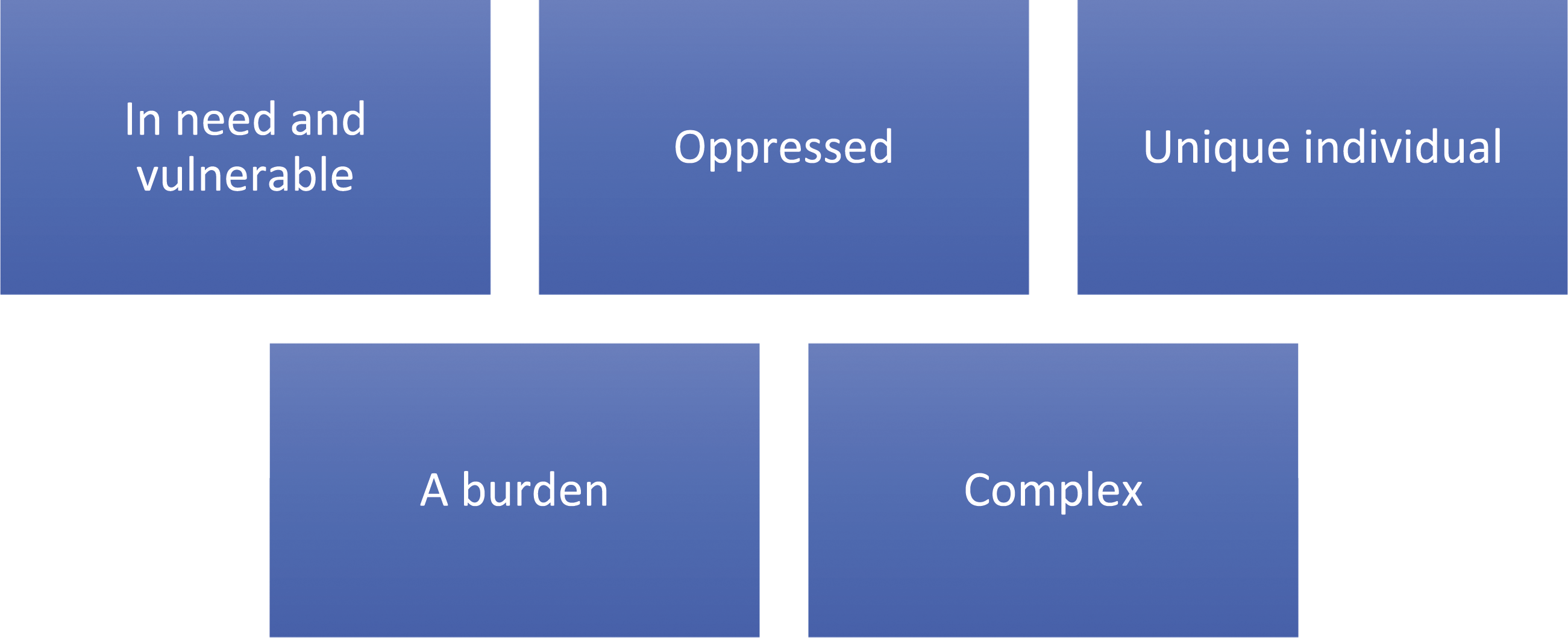
Through the analysis, words like ‘need’, ‘support’ and ‘vulnerable’ were found to be used by almost 84% of the students, constructing ‘service users’ as requiring help. The repertoire of the ‘service user’ as in need/vulnerable ranged from a temporary upset in people’s lives, to a more profound inability to manage: Someone vulnerable or incapable of looking after themselves entirely.
A strong emphasis on person-centred conceptualisations was present in just under 40% of student statements, capturing the individuality of service users as well as resisting an ‘us and them’ approach: A service user is my equal, a person just like me.
Words like ‘oppressed’, ‘excluded’, ‘rights’, ‘disadvantaged’, associated with political/emancipatory elements (the ‘oppressed’ repertoire) were in the minority of the statements (29% of the students): A service user is in danger of being oppressed by the very people who should be assisting them.
The final two categories stood out during the data analysis. Two ‘oppressive’ statements indicated more negative understandings of service users as ‘burden’: Someone who is dependent on government funding. A service user is part of a caseload that could be taking up time that could be used more positively elsewhere.
These statements capture negative stereotypes and moralistic discourses around ‘service users’ and even though in the minority, it is important that they are acknowledged as part of the rich tableaux of attitudes and values that social work students hold.
The two statements of the final category grapple with the complexity of people’s identities:
A service user can be challenging, difficult, negative but can also be inspiring, positive and a life changing experience for those that encounter them.
Someone with whom we work collaboratively with, in most situations, however occasionally we force ourselves on them.
These statements capture the co-existence of multiple and contrasting characteristics, both in terms of the individual ‘service user’ but also of the professional relationship (note the striking expression ‘force ourselves on them’ which in some ways could be interpreted as containing abusive elements).
Student reflective essays
The student essays were submitted after the completion of the module and addressed the question ‘How has your understanding of the issues affecting a service user or carer group been developed during the course of the module’. As such, the emphasis was placed on student personal reflection and impact of the learning experience on their conceptualisations and insights regarding lived experience of service user and carer groups. The discursive analysis of the essays located ‘service user’ identity shifts in three main areas of student-produced text: a) ‘An eye-opener’: discursive exploration of the impact of the expert by experience narratives, b) ‘Through no fault of their own’: service user identity constructions ‘before and after’ the module learning and c) ‘I am less likely to make this mistake in practice’: Student repertoires on future professional practice and relating to ‘service users’. These will be examined in more detail below:
‘An eye-opener’: discursive exploration of the impact of expert by experience narratives
Key findings in this area lie with the emotional tone of the writing, as well as the ‘getting it right’ approach by some students. Strong emotional language was often present when the students were discussing the expert by experience narratives. Words like ‘shocked,’ ‘an eye-opener’, ‘uncomfortable’, ‘ashamed’ often came up. One student captured the complex emotional impact well when writing about a young carer’s narrative (carer for her substance misusing father): I was not sure why I was feeling angry until the next day when reflecting on the session. I then realised that I was angry about the father of (carer) (…) This made me question my ability to maintain unconditional positive regard and to be non-judgmental.
Part of the emotional impact of the narratives related to personal insights gained by the students, sometimes linked to their own identities: It came as a surprise to me when I realised that I could relate to (carer) because at the time I looked after my brother. However, I did not realise that I was a carer until (the carer) told her story.
Another aspect of the language use was the tendency by some students to use words like ‘correct’: My perception was that an individual could not psychologically cope as an adult because they had not developed the correct skills needed to deal with life because of maltreatment as a child. I now realise that this is incorrect.
‘Through no fault of their own’: Service user identity constructions ‘before and after’ the module learning
As the essay title focused on the development of understanding of issues affecting service users, the key narrative ‘ploy’ that all students made use of related to a ‘before and after’ theme: namely identify previously held beliefs and how these were challenged through the module.
The students chose to focus on specific module sessions and service user or carer groups. Most essays focused on substance misuse (7), followed by domestic violence (6) and homelessness (4). These groups were the target of the most negative preconceptions held by the students; the language around drug use was particularly strong: When I have read the paper or hear on the news about people committing crimes or failing their children due to substance misuse, I immediately imagine an individual with bad skin, missing teeth, dark circled eyes and dirty clothes. Essentially, I view these people as (…) selfish in their views and cravings.
Similar views were also expressed around homelessness, especially when associated with substance misuse: My perception of this service user group was stereotyped. I classed homeless people as individuals that chose to be homeless and to beg on the street.
The main ‘before’ discourse around domestic violence can be encapsulated in the following quote: My thoughts on domestic violence have been, why put up with it? The person should just leave the abuse they are being subjected to.
For other groups (i.e. carers, mental health and child sexual abuse survivors), the students were highlighting limited initial knowledge around the issues, definitions or outcomes for people.
If these negative or uninformed views were the ‘before’, the students were describing an increased awareness of alternative discourses/conceptualisations of individuals in their ‘after’ discussions. In terms of the most maligned group, that of substance misusers, the discourse seems to shift from individual faults and moral failures (the moral approach as described by Gregory and Holloway, 2005) to a ‘damaged goods’ one (more closely aligned to the therapeutic approach; see Figure 2): When engaging with the narratives of the first service user I began to see how her past experiences had impacted the decisions she had made. I began to (see) addiction as more of a coping mechanism to escape the sadness people felt in their lives, rather than my narrow view of a simple ‘life choice’. (the module helped to reconstruct) my opinion of problem drug-users as vulnerable, as opposed to dangerous. Shifts in students’ discursive ‘service user’ identities.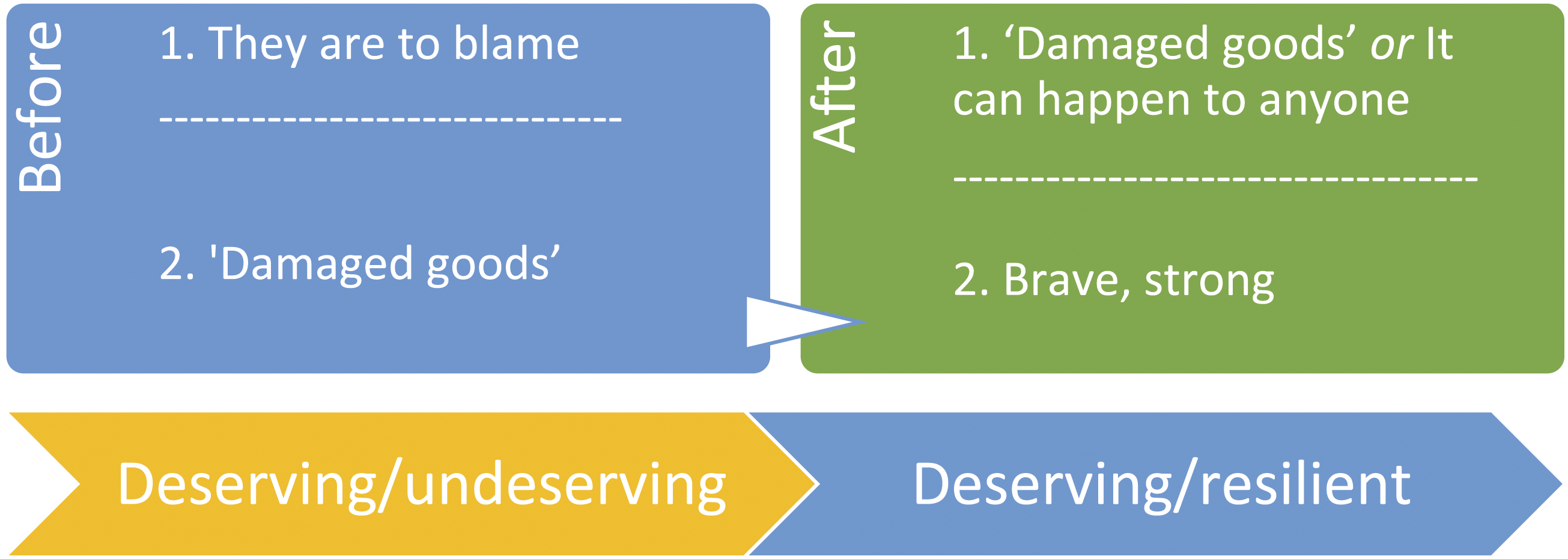
Similar shifts took place around homelessness: People go through many things and some lead to homelessness, through no fault of their own.
In terms of domestic violence, or issues such as child sexual abuse, the discourse seemed to shift from one around personal weakness (or what could be termed ‘damaged goods’) to strength, dignity and resilience: the person standing in front of me completely challenged the preconceived ideas I had uncomfortably formed. A strong woman, who didn’t come across at all like a victim.
Figure 2 captures these shifts in the discourses. In the ‘before’, there seems to be some preoccupation with the idea of choice, weakness or moral failings, especially linked to more stigmatised groups (substance misuse, homelessness, domestic abuse). These are perceived as personal failings with no reference to structural factors. Even the more sympathetic approaches (i.e. the ‘damaged goods’ approach) still operate at the individual level. This contrasts with the emancipatory repertoire present in the initial statements (Figure 1). The structural explanations are also very limited in the ‘after’ discourses-personal blame is replaced by a ‘damaged goods’ discourse, which still implies an individually located identity. Where more empowering discourses appear (‘brave’ and ‘strong’) they again point to resilience at an individual level.
Consequently, it could be argued that the underlying themes underpinning these discourses is one of the deserving/undeserving dichotomy in the ‘before’ stage, replaced by a ‘deserving/resilient’ in the ‘after’ (see Figure 2). This well-known binary appears to still be highly influential in the way in which social work students develop their views and relational approach to service users. One student was particularly troubled by this: I did start to question why my views had changed so quickly and I wondered if my views had changed because he was from a hardworking, educated and wealthy background and would of (sic) my views changed in such a way if he had been an alcoholic, drug user who had never worked before?
‘I am less likely to make this mistake in practice’: student repertoires on future professional practice and relating to ‘service users’.
In their essays, the students were keen to explore how their emerging insights on ‘who a service user is’ would affect their future practice. Closer examination of the essay writings identified emerging professional identities that ‘borrowed’ from prevailing social work discourses (professional frameworks and theoretical models of practice). Four overarching interpretative repertoires of future professional selves were identified: a) reflective practitioner, b) expert practitioner, c) person-centred practitioner and d) critical/radical practitioner. These approaches were not distinct, but co-existed in the students’ writings, quite often interwoven in one sentence. Most importantly, these professional selves captured shifts in the relational context of practice, whereby ‘service users’ were constructed in variable ways (see Figure 3). Some of these ‘service user’ identities echo the categorisations in Figure 1 and the shifts presented in Figure 2, with concepts such as ‘need’ and ‘vulnerability’ still present yet approached as increasingly multi-layered and complex. Students’ interpretative repertoires of future practice and ‘service user’ identities.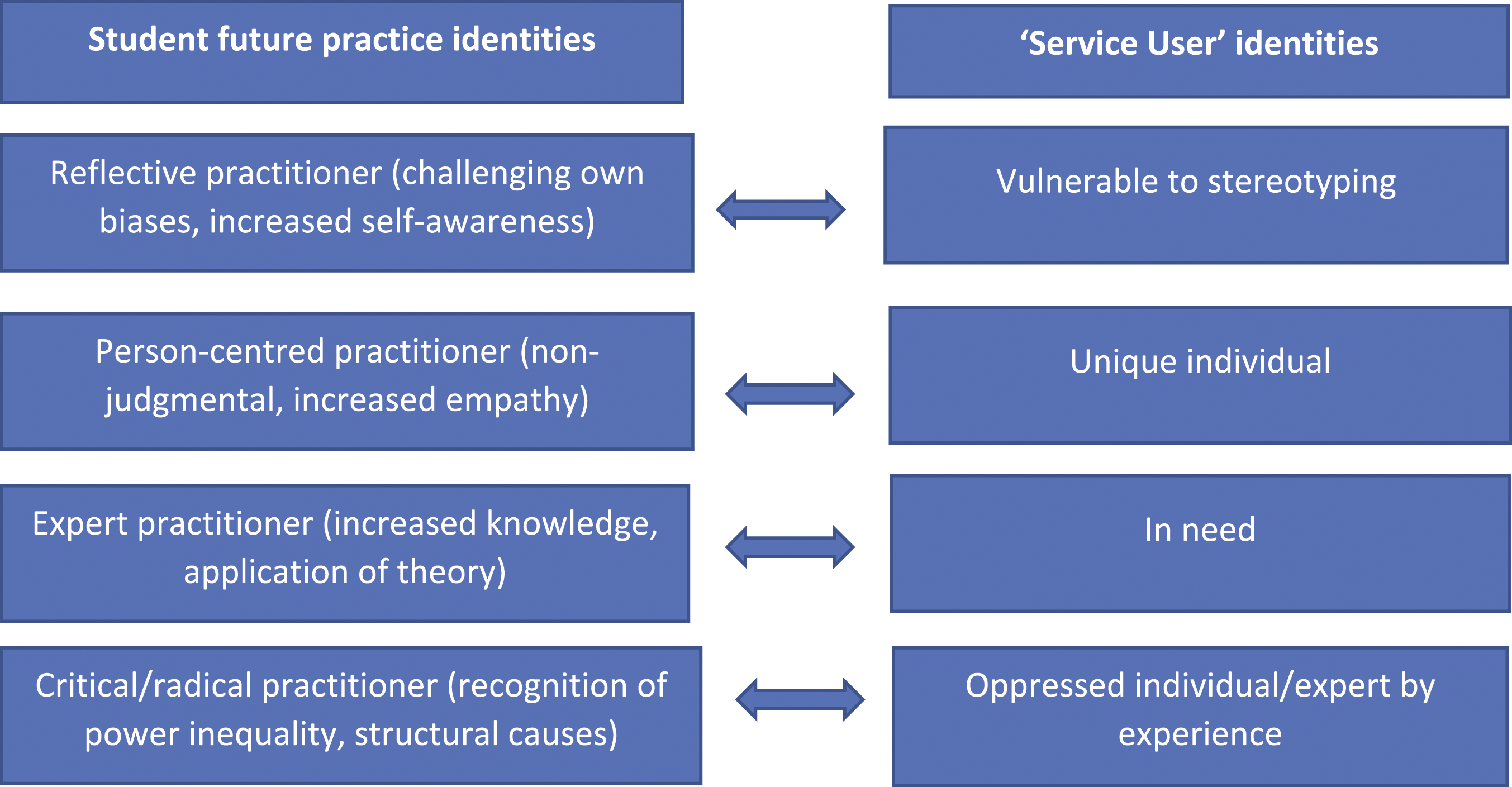
The most prominent one was the reflective practitioner (present in 21 out of the 26 essays), with students recognising how unchecked biases could lead to poor practice; as such, ‘service user’ vulnerability was increasingly linked to negative stereotyping and subsequent oppressive practice: I am aware of the challenges faced when working with the complexities of addiction; I have shown how I felt different towards two service users in the same situation. Understanding this means that I am less likely to make this mistake in practice
For some students, this led to employing a person-centred interpretative repertoire when discussing how they would practice in the future; in 16 out of 26 essays students made reference to Rogerian concepts, either by merely stating them or elaborating on how they would apply them in the professional relationship. The common thread in this repertoire was an increasing recognition of ‘service users’ as unique individuals, focussing on relationships characterised by increased empathy, unconditional positive regard and non-judgemental approaches: every service user is a “series of one” and should be understood in respect of the unique experiences of a person’s life.
The ‘expert practitioner’ was also prevalent (in 18 out of 26 essays), with students asserting that the module had increased their understanding (e.g. on how to identify signs of domestic abuse) and helped them identify relevant knowledge gaps (in terms of theory, policy, service provision and multi-agency work). ‘Service users’ were associated with unrecognised or unmet needs. For some students, this related to future practice that will promote ‘positive support the service user needs, to help regain control of their lives’ as one student put it (echoing the maintenance approach to social work), or more empowering/advocacy approaches, as expressed below: It has led me to carry out wider reading around substance misuse (…) Whenever I am on placement, I will be questioning the professionals about their own knowledge of substance misuse.
The critical/radical repertoire was linked to a structural, societal perspective as the origin of service users’ circumstances. Only one essay (out of 26) exclusively adopted this lens, whereas in three more essays there was recognition of professional power and societal stigma affecting particular groups (e.g. creating fear of disclosing domestic abuse): This notion of professional disempowerment created a powerful realisation, which does not sit well with me. The realisation that social work can and does disempower service users was a catalyst warranting development of a critical approach.
In this minority repertoire, ‘service users’ were constructed as individuals and groups that are disproportionately affected by structural inequalities, as well as holding expertise by experience: After hearing his story my views had changed and I felt empowered and wanted to fight the causes of homelessness. I really felt the inequalities and the oppression homeless people faced every day of their lives. having carers as guest speakers within the module lectures was informative, as they are ‘experts by experience’ and able to inform first-hand from the front line.
Whereas the shift in conceptualising ‘service user’ identities in more sympathetic ways is influencing the students’ views on their future practice, the dominance of individualistic approaches to practice was again noted, with social work predominantly constructed as ‘micro-practices’ at the interpersonal level. Even though benefits are undoubtedly inherent in relational approaches, the limited presence of emancipatory/political social work discourses remains concerning if we aim to challenge narrow or passive ‘service user’ identities.
Discussion
This article sought to explore discursive practises by pre-qualifying social work students when constructing ‘service user’ identities. The findings suggest that following a second-year undergraduate module with extensive educational input by experts by experience, shifts in identity descriptions did take place. Nevertheless, the understanding of ‘who the service user is’ was predominantly located at the individual level in the students’ writings, i.e. as deserving, as people who need help, as ‘damaged goods’, or as strong and resilient. This may be related to the fact, in part at least, that expert by experience input mainly took the form of narratives; these can ‘individualise’ social issues such discrimination. Students may also be more comfortable with the therapeutic approach and are reluctant towards or perhaps intimidated by structural/emancipatory approaches (Woodward and Mackay, 2012). An emphasis on individual approaches to social work can of course have benefits, i.e. be linked to person-centred ideas and relational practice, approaches that students in this study affirm will underpin their future practice as a result of their module learning; yet it could also run the risk of perpetuating top-down approaches, positioning the social worker as the ‘expert’ and further de-politicise social work under the neoliberal gaze (Morley, et al., 2014; Fenton, 2014). Rather than challenging power inequalities, lived experience narratives in some respects could end up reproducing positions of dependence or ‘otherness’ (Eriksson, 2015). These are concerns shared by Sapouna (2020: 511) who expressed her discomfort “with some students’ fascination with a ‘brave’ individual’s story at the expense of an interest in systemic change”.
Linked to the above is the underlying theme of deserving/undeserving ‘service users’: in this research, students seem to indicate increased empathy when adopting more therapeutic discourses (from dangerous/lazy/weak to vulnerable), motivating them to work in an empowering way with those previously stereotyped as undeserving. But is empathy only reliant on being able to identify an individual in more personable, socially acceptable terms? How do we relate to those we might deem to be ‘non-deserving’? Is empathy conditional on being able to identify with or ‘like’ the person we work with? This can have important practice implications, as the motivation of students to work in more empowering ways was underpinned by these shifting, ‘deserving’ service user identities.
Similar concerns run through the resilience discourse. Increased empathy for those seen as resilient (implying a potentially more ‘deserving’ identity) can create pressures for those in challenging situations, narrowing the range of behaviours or responses perceived as ‘desirable’ or ‘acceptable’. Even with the best intentions, discourses of strength and resilience can affect the relationship between social worker and ‘service user’. What about empathy for those who are struggling, who are seen as ‘not coping’, as ‘weak’? This becomes especially troubling in child protection work, given identified mental health knowledge gaps in social workers, often leading in overlooking or stigmatising parental mental health needs (Karpetis, 2017).
The above points relate to the inherent variability of people’s identities and the risks present when reducing them to simplistic, stereotypical categories. ‘Service users’ cannot be reduced to a simple binary of deserving or undeserving due to character traits and behaviours-they have complex identities, combining strength and vulnerability, ‘good’ and ‘bad’ decision-making. Grappling with contradictory elements when constructing identities is an important area of learning within social work education, especially given historical and current political dominant discourses around marginalised people and the prevalence of stereotypical negative representations.
The impact on future professional practice was also mainly located in the individual sphere in the students’ writings (i.e. expert knowledge, personal reflection and increased empathy). The political/emancipatory function of the profession was again under-represented and if anything, seemed to retreat after the module (compared to the initial statements). This raises similar concerns around constructing a passive ‘them’ needing expert (albeit sensitive and self-aware) professional intervention. Is the social work task constructed as confined to the relational, personal sphere of individual casework, rather than encompass emancipatory, collectivist approaches towards social change? Nevertheless, an interesting finding is the absence of managerial discourses, that is, language linked to risk, agency aims and professional jargon. This is perhaps unsurprising, given that the module took place before the students’ exposure to the workplace through their first placement.
The above considerations lead to a number of pedagogical recommendations relating to social work education and expert by experience involvement. The impact of such involvement is palpable in the student discourses, as they navigate emerging and shifting conceptualisations of ‘service user’ identities. Part of this process connects to an emotional response: students can be moved by the narratives, as well as feel challenged regarding their own values. This emotional impact and personal resonance is one to acknowledge as educators, not only in relation to the ‘final product’, that is, in promoting critical, deep learning, but also as part of the educational process: there is a need for pre- and post-session reflective spaces for the students to explore and process the emotional impact of such narratives. Nevertheless, this needs to be approached sensitively and with the agency of individuals at the core of such pedagogy, to avoid a voyeuristic gaze and exploitation of the personal story (Sapouna, 2020). Moreover, social work educators need to remain aware of the variety of students’ personal values, background experiences and multiple identities. Safe spaces to explore preconceptions, biases, even what could be labelled as oppressive attitudes need to be promoted. This is particularly important, as sometimes as educators we run the risk of promoting a strict, narrowly defined professional discourse, characterised by ‘correct’ and ‘incorrect’ beliefs and attitudes (as some of the essays seem to point to).
Furthermore, the dominance of individualistic discourses needs to be balanced against or indeed challenged by an exploration of emancipatory/collectivist dimensions of the social work task. Service user involvement is an inherently political activity, challenging power orthodoxies in higher education. The broadening of the educational role of those with lived experience to encompass more strategic, planning and decision-making roles can help to further move constructions of identities from individualistic/passive to emancipatory, empowered agents of change. To achieve this, it is important to make discursive formulations of ‘service user’ identities visible and promote a deeper understanding of the effects of educational input by those with lived experience.
Limitations
There are limitations as to the generalisability of the findings given the small sample; nevertheless, given the epistemological and ontological concerns of discursive psychology, the main focus is not with an ‘accurate’ representation of reality, but more an examination of discursive practises constructing identities and relations (Masocha, 2015). ‘Carer’ identities are not fully addressed, even though these come through via the data presented. It was beyond the scope of this research study to address both; however, there is recognition of the need for further research addressing ‘carer’ identity construction. Due to its discursive positioning, the research does not provide quantifiable evidence of student attitude change-however, a repeat-measures future study could complement current findings. What the research is also not addressing is the shift in student discursive practises during and after their practice placement experiences. This is fertile ground for further research.
Conclusion
An engagement with discursive practices producing ‘service user’ identities can provide direction to social work educators and experts by experience when co-producing classroom activities. A critical engagement with the functions and oppressive potential of professional discourses is needed, both in social work pedagogy as well as research in order to recentre emancipatory approaches and create social work students/future professionals who are critically aware of power and ready to challenge negative and oppressive identities.
Footnotes
Acknowledgements
The author would like to thank the students who agreed to take part in this study and share their reflections and insights and the Experts by Experience group members who so generously contributed to the module. Thanks also go to Professor Alisoun Milne, Dr Rasa Mikelyte, Dr Jo Warner, Dr Alexandra Polyzou for their constructive feedback on drafts of this paper. Finally, thank you to the anonymous reviewers whose feedback greatly improved the final paper.
Declaration of conflicting interests
The author(s) declared no potential conflicts of interest with respect to the research, authorship, and/or publication of this article.
Funding
The author(s) received no financial support for the research, authorship, and/or publication of this article.
