




Abstract
How do children (aged 6–12 years) understand and make use of a digital tool that is under development? This article builds on an ongoing interdisciplinary research project in which children, social workers (the inventers of this social innovation) and researchers together develop an interactive digital tool (application) to strengthen children’s participation during the planning and process of welfare assessments. Departing from social constructionism, and using a discursive narrative approach with visual ethnography, the aim of the article is to display how the children co-construct the application and contribute with “stories of life situations” by drawing themselves as characters and the places they frequent. The findings show that the children improved the application by suggesting more affordances so that they could better create themselves/others, by discovering bugs, and by showing how it could appeal to children of various ages. The application helped the children to start communicating and bonding when creating themselves in detail, drawing places/characters and describing events associated with them, and sharing small life stories. The application can help children and social workers to connect and facilitate children’s participation by allowing them to focus on their own perspectives when drawing and sharing stories.
Introduction
This article discusses how invited schoolchildren and a researcher co-construct an application designed to increase children’s participation in a child welfare context. Child investigations in child welfare services must continuously find ways of improving children’s influence in assessments that have a major impact on their lives and well-being (Vis et al., 2012). International research illustrates that implementing children’s participation in child welfare services is often difficult to accomplish (Bijleveld et al., 2015; Seim and Slettebø, 2017; Thomas, 2000). In Sweden, children’s participation in welfare investigations became even more prioritised when the Convention on the Rights of the Child came into force on 1 January 2020 (The Government of Sweden, 2018). Our research objective is to produce a digital application that enables children to take part in the planning of their child welfare service investigations, rather than forming a new tool for therapeutic conversations.
Adults need to acknowledge that information and communication technologies (ICT) constitute a major part of children’s worlds (Anderson and Cook, 2015). Technical devices and sites like Snapchat, Instagram and YouTube are part of their everyday lives (Abiala and Hernwall, 2013; May-Chahal et al., 2014), given that the children of today are so-called digital natives (Gallo et al., 2016; Prensky, 2001).
In the last two decades of human-computer interaction research children have received increased attention and have been involved in the development of interaction technologies, which is also referred to as Interaction Design and Children (IDC) (Bekker et al., 2019). However, children are not a homogeneous user group in that they differ in age, interests, capabilities and needs - aspects that should be kept in mind when including them in the design process (Druin, 2002; Markopoulos and Bekker, 2003). In our study, the fact that children differ in these aspects is important, especially as the application is intended to suit children of various ages in different child welfare settings. Involving children in the design process in this project is to regard them as testers and informants (Druin, 2002), which means that they are part of shaping the product before it goes live in welfare settings. As testers they can give immediate feedback on usability, e.g. by identifying non-trivial functions and subjective aspects, such as if the application is boring, or has features that are not relevant. In addition, as informants they can make suggestions about what kind of functionalities are lacking or how the current versions can be improved (Druin, 2002).
Studying the communication between a child and a tablet includes observing and asking how the information that passes between them is perceived and understood in the given situation (Dubé and McEwan, 2017). This relates to children’s knowledge about how to navigate the application via menus, i.e. knowing how to use the affordances at hand (Dubé and McEwan, 2017). According to Gibson (1977), the definition of an affordance is a behaviour that is possible between an individual and their interaction with a device based on the latter’s physical appearance. Or as Norman (1999: 41) put it: “a range of possible activities” that a user can choose in the digital interaction. Another way of illustrating affordances is to view them as features or digital suggestions for what can be done (functions to click on) and achieved in the application. In the generic case, there is no clear separation between physical objects and their virtual counterparts, especially when considering the importance of vision and visual perception in the subject’s reasoning of its surrounding. The aim in our study is thus to identify how children use and make sense of the affordances of an application and influence its design (Dubé and McEwan, 2017; Sharma-Brymer et al., 2018).
Background
This article builds on an ongoing interdisciplinary research project in which social workers have identified a need to develop a digital tool (application) in order to strengthen children’s perspectives and participation in child investigations. The social workers’ ideas about developing a digital tool have been realised through cooperation and co-production with researchers (in the areas of social work and computer science). Increasing children’s participation in child welfare investigations by introducing a digital tool that they can use in planning and in investigative conversations is essential for their sense of control of and influence in their lives. Social work has to some degree included digital tools in child welfare, for example in British foster care (Dodsworth et al., 2013; Ferguson, 2016). According to the Swedish Association of Local authorities and Regions (SALAR), some municipalities are testing digital tools to follow-up treatment results. However, as yet no digital tools focus on the investigative planning and process of the child welfare assessment.
The empirical context of child welfare services in Sweden should be understood as the Swedish state and government preserving the welfare rights of every child, even though the means and services for maintaining these standards are provided by the municipalities. In Sweden, when a child’s welfare investigations are triggered the assessment must be completed within the space of four months. When starting an investigation the social worker has to draw up a detailed, assessment plan and this is done together with the family. However, according to the Health and Social Care Inspectorate (IVO), the governmental agency that is responsible for supervising social services, health and social care in Sweden, the assessment plan is often overlooked in child investigations. The plan itself should include the child’s perspective, which can have a major influence on the entire social investigation process. That is why social workers who are responsible for developing social work practices want to create a digital tool that can improve the number and content of children’s contributions.
In present study, the invited schoolchildren are viewed as experts, the request involves how they perceive the application from their perspective. With that said, the research approach is with young children rather than on them (Clark, 2010).
The aim of the article is twofold: to display how the children co-construct the application and to determine how the application can facilitate children’s “stories of life situations” by drawing on themselves as characters and the places they frequent. The research questions are: How do the children perceive and make suggestions about the affordances at hand in the application? What is important when they create themselves in the application? Which narratives of themselves emerge in the given situations?
By answering these questions, the article will contribute to an understanding of how a technical application can help children to express their perspectives of daily life situations. Developing a digital tool that increases the children’s participation is relevant in a pedagogical setting in which children of various ages can take part. To our knowledge, research on digital tools has not been conducted in the context of child welfare assessments. However, in health care settings (Stålberg et al., 2016) and pedagogical learning settings IDC research is more common (Lai et al., 2007; Sharma-Brymer et al., 2018).
Theoretical and methodological starting points
We base our study of the interactions between children and tablets and their co-construction of the application in their roles as testers and informants on social constructionism (Burr, 2003; Potter, 2004). This involves considering how the children construct reality using the spoken and written language, drawings and self-narratives, both in the application and in interactions with each other and us as researchers (Bamberg, 2011; Potter, 2004; Pink, 2007). Accordingly, language use is all about social action, how children do things with words, e.g. how they complain, praise, suggest or question and how they indirectly display their identity (Potter, 1996; Wetherell et al., 2006). Our interest in this study is how children construct and convey how they view the world through their expressions and drawings and test and co-construct the affordances in the application.
Using a discursive narrative approach involves considering how children use places and categories as rhetorical resources when drawing and talking about the pictures and how they create themselves as characters and/or other figures and thereby position themselves in the given situation and in the told narrative (Bamberg, 2011, 2004; Georgakopoulou, 2002, 2007; Potter, 1996). The use of what Georgakopoulou calls small stories in children’s drawings is about doing identity, i.e. by positioning themselves to other characters in the narrative and to others in the classroom it says something about how they want to be perceived (Bamberg, 2004, 2011; Georgakopoulou, 2002, 2007).
In one of the affordances in the application we encouraged the children to create places that were familiar to them, that they liked to be in, or scary places that they wanted to avoid. Places as rhetorical resources can convey a story and/or children’s relations with others and, at the same time, create a sense of the actual place (Potter, 1996; Stokowski, 2002). Places are therefore crucial when it comes to emerging stories of life situations that can benefit children in welfare settings by enabling them to get the support they need.
The children’s use of categories and what is associated with them (category-bound activities) (Potter, 2004; Sacks, 1992), such as mother, father, sister, brother, cat, Harry Potter, monsters, horses and so on, plays an important part in the telling of their stories when they draw and test the application. The categories they use say something about themselves as well as what they are conveying about the function and usefulness of the application.
In visual ethnography, where pictures and drawings are important research data, it is also possible to include children’s talk about their artwork in the interpretation of the results (Pink, 2007). We use visual ethnography in combination with the discursive narrative approach to illustrate what the children told us about their lives and artwork. This combined approach also reflects how the application can be used by social workers.
Technical implementation
The software application was developed using incremental prototyping methodology (Graham, 1992). Functionalities were added to increase the capabilities of the application. In practice, the implementation process was as follows. During the technical development, the discussions with the social workers related to the Swedish framework for assessment known as Barns behov i centrum (BBIC) (in English, Children’s needs in focus). In BBIC, child development aspects are investigated by focusing on education, health, social relations, feelings and behaviour. The application is intended to include these areas, but does not separate them. This decision was by researchers and professional social workers and is based on how children prefer to talk about people, places and situations, rather than dividing life situations into areas. A first version of the application was then produced and implemented. After the initial tests, based on input from the children, social workers and researchers, the application was updated.
User tests play an important role in identifying the shortcomings of the implementation. Exposing the application to the stakeholders is also a way of testing the validity of the research questions. Although the application that is implemented here is not a large-scale software solution, it does involve multi-stakeholders. It also involves children, which belong to a stakeholder category that may in some contexts be challenging as subjects. In the former, it is important to understand the role and objective of each of the stakeholder categories. In the latter case, with children, there is a need to carefully analyse the feedback from the children’s group, and obviously other involved groups. The two issues concerning the different needs of multi-stakeholders and children as challenging subjects were addressed in internal project meetings during which the researchers discussed the user tests.
The DIG child application and the child welfare assessment plan
The application is designed to fit with the formation of the child welfare assessment plan and aims to indicate how the welfare investigation should be conducted. What are the main investigative questions, and who can contribute the relevant information? The answer to this question is that the child is given the opportunity to identify the important people that they want to involve in their investigation. For this purpose, a timeline of four months has been created in the application, which is the limit for child welfare assessments in Sweden. The idea is that the child can chronologically visualise who they want the social worker to contact. It is also important for families in crisis to have a time perspective, because according to the social workers who have initiated this social innovation it provides them with the security they need (Nicolls and Murdock, 2012). From the social workers’ perspective, it is important to be open and curious in the process of getting to know the child and how they perceive their everyday life. The intention with the affordances is for the children to “create themselves”, “create others” and “create places” and in this way enable the social worker to get closer to the children’s own perspectives. The emotional affordance in the DIG Child application enables a child to express their feelings without using words, and helps to visualise a parent’s reactions when the investigation starts. During the investigation, the social worker can also encourage the child to update their feelings. As children are also digital natives (Gallo et al., 2016), this can create an asymmetrical communication with the adults who are present during the meetings with the social workers.
Methods
In visual ethnography it is important to note the visual aspects of culture, such as photographs, paintings, drawings or videos. As Pink (2007) points out, the approach should be used in relation to other data sources, and not solely to the visual. This means including data from interviews, participant observations, written texts in documents/diaries etc. In our case, with visual ethnography and a discursive narrative approach, we use participant observations, conversations with children and the children’s verbal interpretations of their drawings. Using participant observation involves taking fieldnotes about what happens in the classroom when the children test the application (Burgess, 1984). Examples of these fieldnotes are provided later in the article.
The visual consists of children’s drawings, which are illustrations of how they perceive themselves in relation to others and that facilitate small stories and help them to share parts of their own narratives (Bamberg, 2004, 2011; Georgakopoulou, 2002, 2007). In this sense, the discursive narrative approach contributes to discerning how children express their perspectives of daily situations in their self-presentations.
Data collection
We visited an elementary school and a preschool on seven occasions for a period of three months in the autumn of 2019 and met up with each class twice. We spent two hours with each class, with a total observation time in the classrooms of 14 hours. At the beginning of each visit the classes were informed about the project’s aim (see also the section on ethical considerations) and invited to contribute their perspectives and expressions when co-constructing and co-using a digital tool designed for children in a child welfare investigation process.
Each child borrowed or used their own tablet computer. We prepared usernames for them and, if necessary, helped them to sign in for the first and second time. Figure 1, below, illustrates the application and some of the affordances to click on or work with, such as creating themselves [Det här är jag = This is me], creating other people [skapa personer], and places [platser] and showing their own or the created characters’ feelings [känslor]. The latter affordance allows emotions to be illustrated without using words (see Figure 11 later in the article). The improvements associated with this affordance were prepared during the data collection phase, and were ready to test at the second meeting with each class. We also wanted the children to draw what they were doing on the internet, so we created a place that would inspire them to show us who they were communicating with and what they were doing. Clicking on “create people” enabled the children to choose different types of hairstyles, outfits and colours etc (Figure 2). The timeline [tidslinje] gave children an opportunity to show which people they wanted the social worker to talk to during the four-month welfare investigation period. When a child created a person that person could then be put on the timeline. At the time of writing the affordance called Soc (which stands for social services) has not yet been fully developed but is intended as a function for the social worker to document a child’s perspective during the investigation by saving pictures and the relevant fieldnotes.
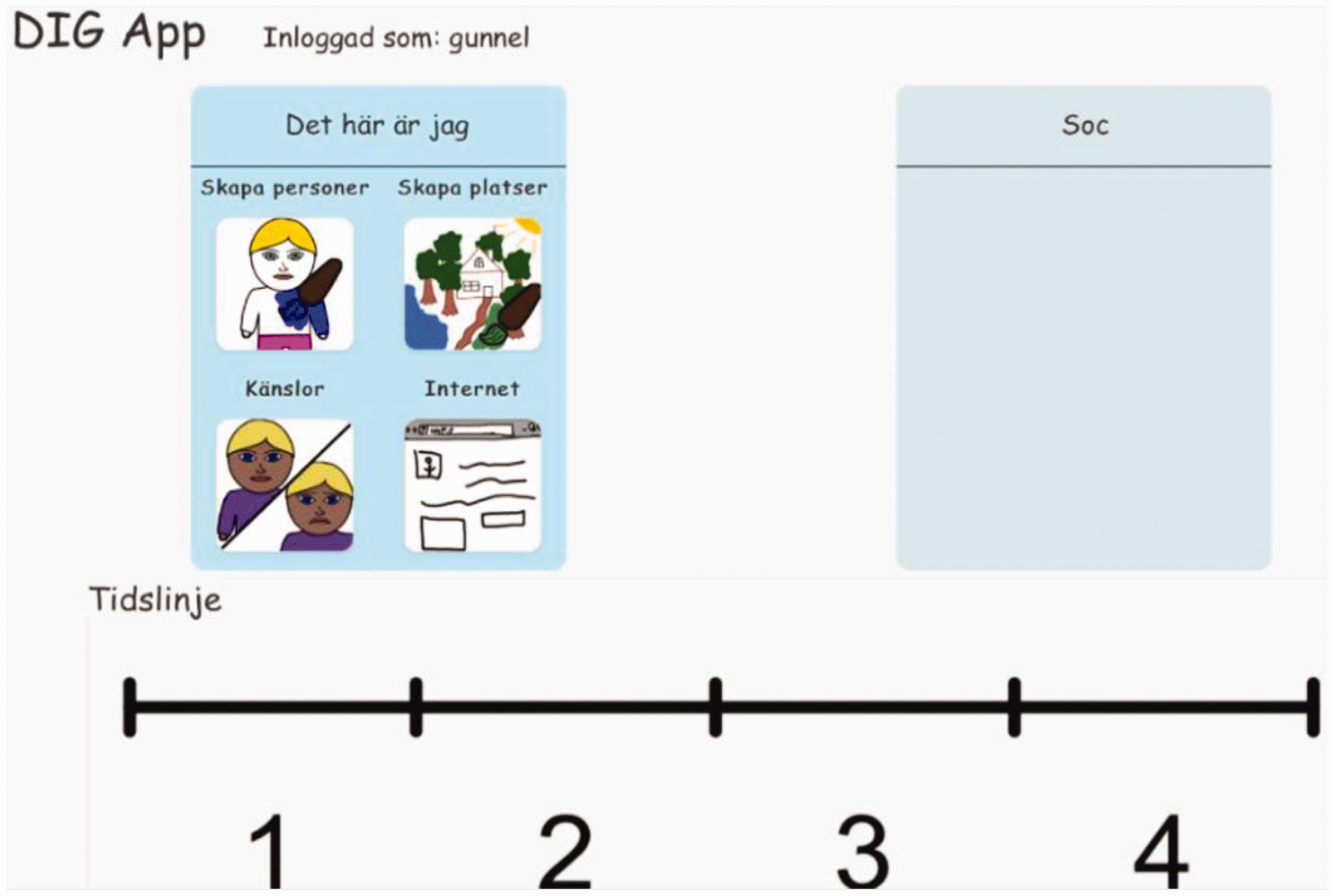
The digital application tool developed for the child assessment plan, Sweden, 2019.
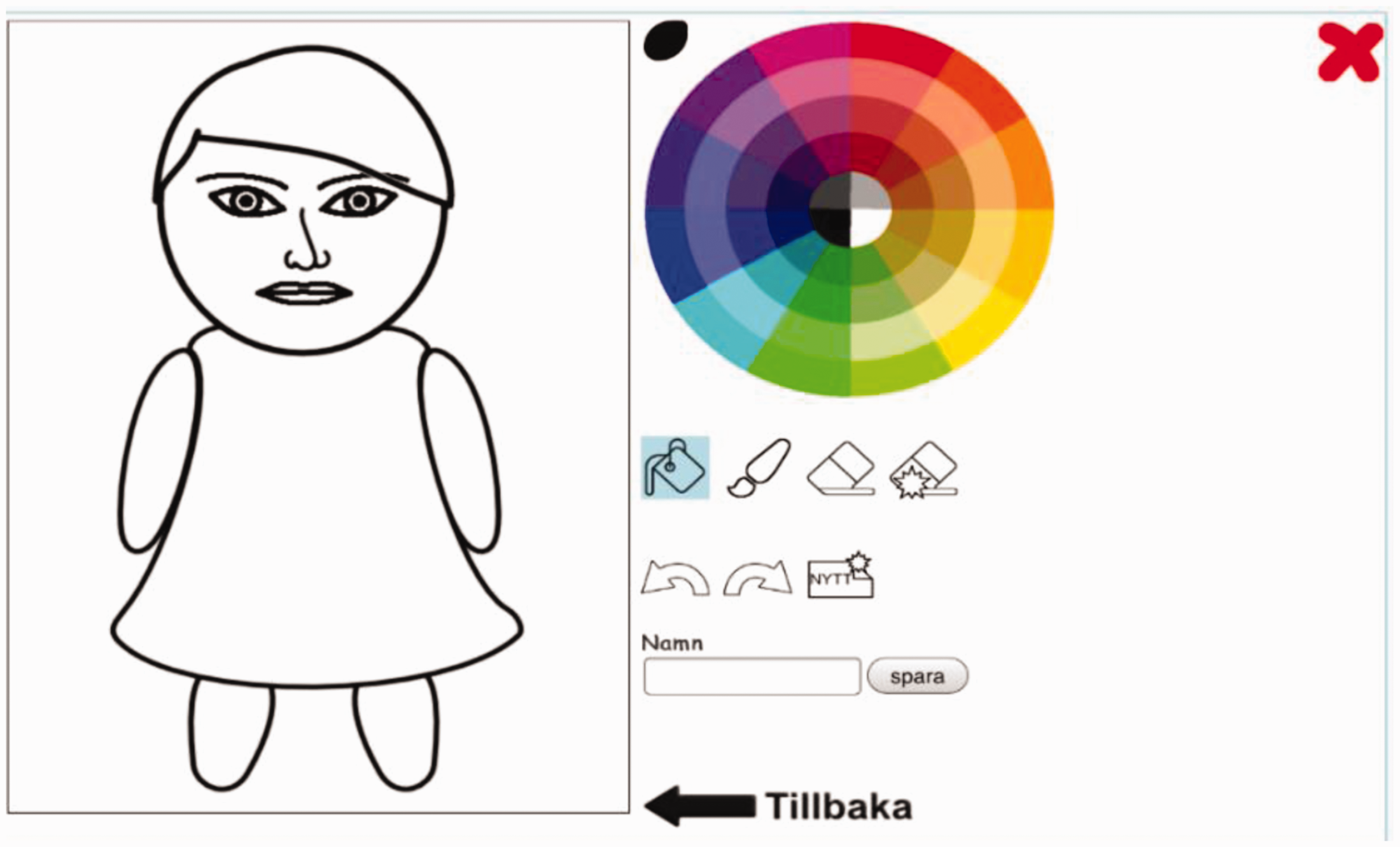
Colours that can be used when creating characters.
The participants
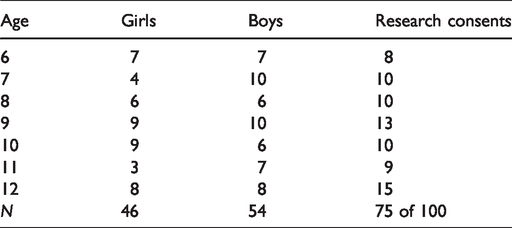
There were 100 pupils - 46 girls and 54 boys - between six and twelve years of age, all of whom attended the schools that we visited during the data collection process (see Table 1). Due to the children’s various ages, different kinds of input were received as to how they understood and perceived the application. For instance, after some instruction the six-year-olds understood how to navigate in the application and the children aged eight and upwards found it easy to create detailed pictures. The ten to twelve-year-olds perceived the application as amusing and not too “childish”, which indicates that the application can also attract older children.
Age and gender of the participants in the data workshops and consent to keep their pictures for research purposes only, Sweden 2019.
Field notes and analysis
During our visits to the classrooms, fieldnotes were made with a focus on the technical functions of the affordances, the child-tablet interactions and their interactions with each other and us as researchers. For instance, in the technical fieldnotes the focus was on how the children’s different ages and experiences affected their use of a touchscreen. Some children were careful, while others were more eager (often the younger children) to interact and pressed the screen very hard and quickly, or/and pressed several times under a short time span. Those who made several touches/pressed hard found it difficult to use the affordances in the application. Other technical fieldnotes focused on the bugs that appeared when the children used the affordances. Additionally, at the end of our visits, fieldnotes were made about the children’s role as informants as they brought up what they liked or did not like or what was lacking in the application.
In the child-tablet interactions we observed that they found it quite easy to understand the application menu and how the affordances they used inspired them to talk to each other. In our fieldnotes we wrote down a child’s username, e.g. the username 2a10, which represented the class (2a) and gave the child a number based on the class list (10), when we observed their interactions with each other and with the researchers. This procedure enabled us to find their pictures later in the applications database and to add how the children talked about their pictures in our analysis.
In our analysis we considered the fieldnotes, the pictures we traced by their usernames and how the children talked about the drawings. It was important to understand how they interpreted the drawings and to see which interactions and/or stories emerged in the given situation (Bamberg, 2011; Georgakopoulou, 2007; Pink, 2007). In the findings section we present the characteristics of how the children perceived and contributed to the application in a chronological way and give examples of the stories connected to the pictures that conveyed different life situations as part of their narratives about themselves (Bamberg, 2011; Georgakopoulou, 2007; Potter, 1996).
Ethical considerations
The project was approved by the Swedish Ethical Review Authority (2019-00466). All the pupils attended the classes testing the application, but their pictures were only used when the children and their legal guardians consented to the drawings only being used as part of the research project. It is also ethical to allow all the children to take part in what happens in the school with respect to the research project. Thus, both the children and their parents knew when the researchers were going to visit the class. Table 1 shows that most of the children and their parents agreed to being part of this research project.
Findings
Self-constructions in the app – who am I?
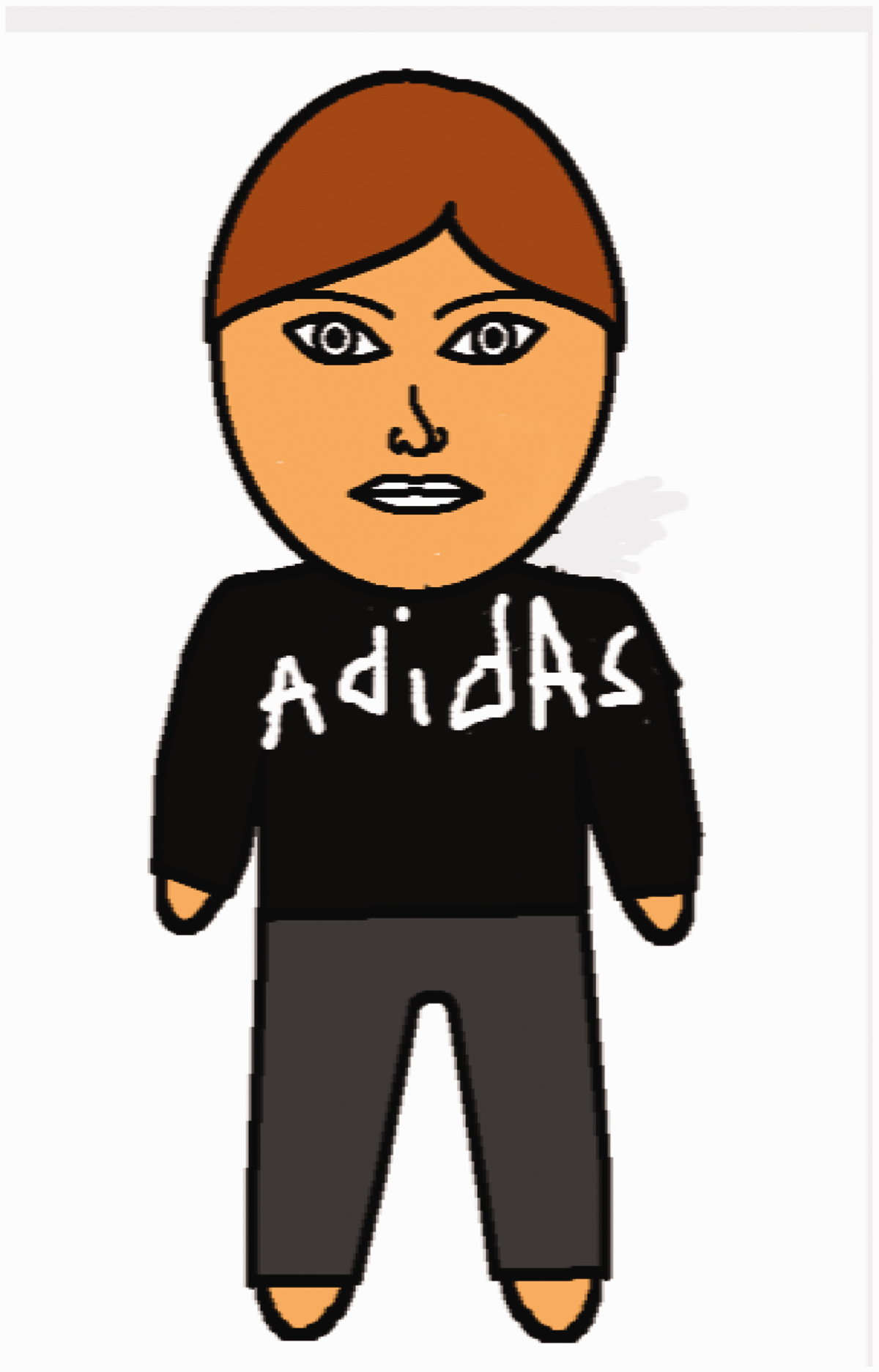
On our first visit, acknowledging the children’s abilities to develop the application enabled them take on the task in a motivated and enthusiastic way. In general, they all started by creating themselves in the application. It was important for the children to choose the attributions that they felt characterised them best. One girl (Year 2) drew herself with blond hair, blue eyes, a pink jumper and black flowered trousers, just as she was dressed that day (Figure 3). Likewise, a boy (Year 5) portrayed himself with the adidas sweater he was wearing (Figure 4). The affordance “creating yourself” in the application invoked interactions between the children, such as asking each other what colour their hair or/and eyes were in order to get things right.
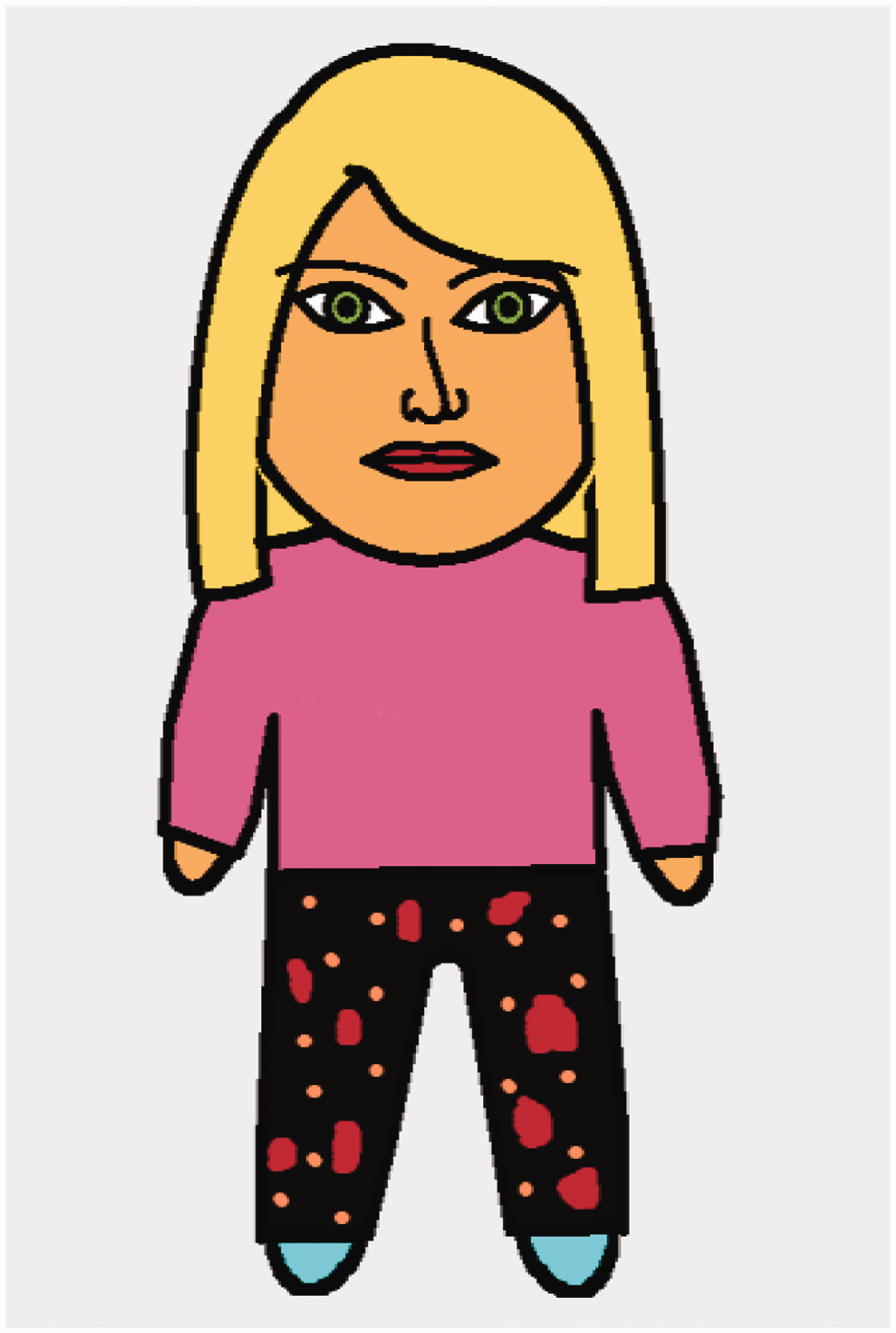
A girl.
A boy.
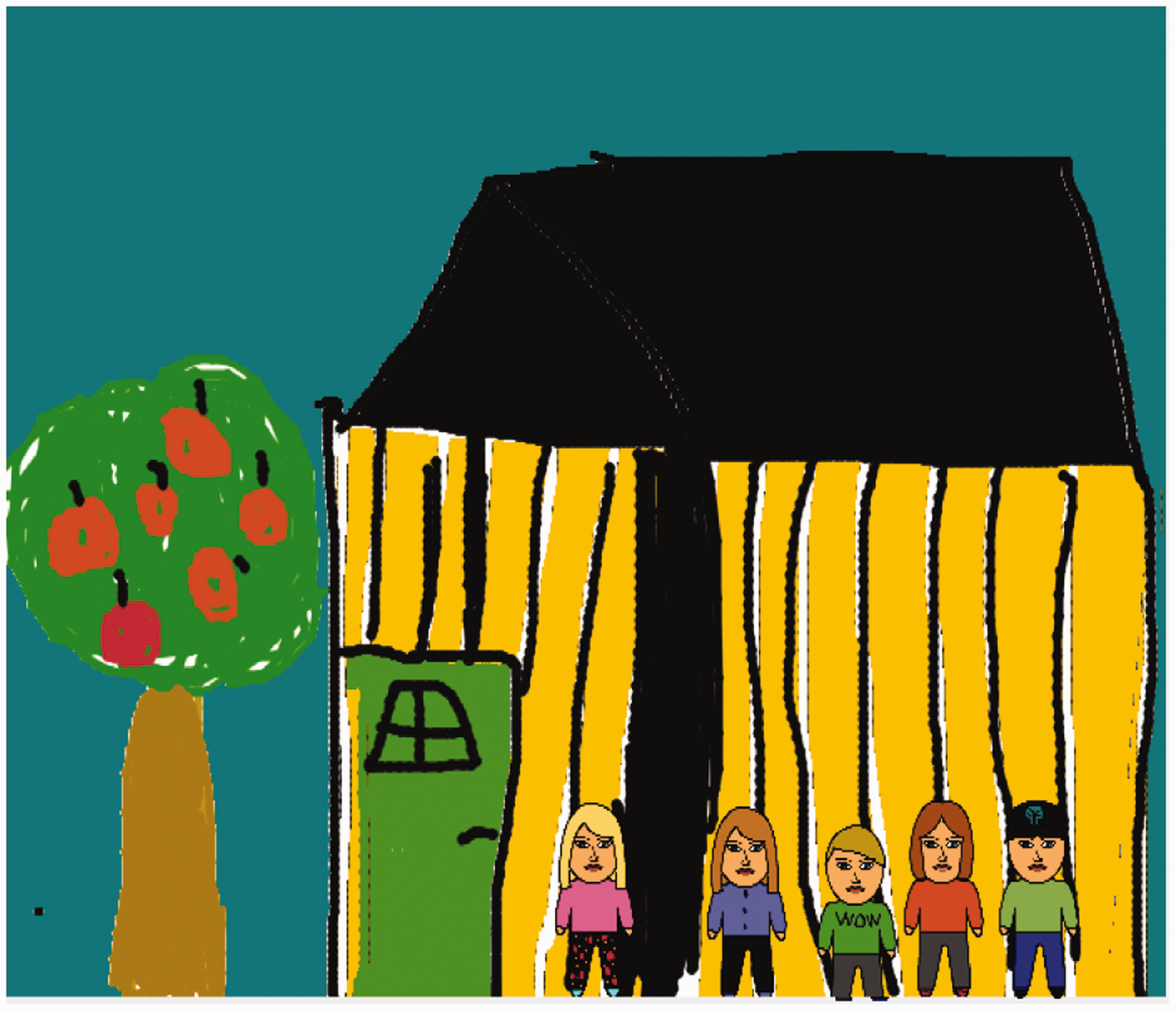
Another general pattern after creating themselves was to create their families, with siblings, mum and dad. Some also drew their grandparents and pets. This portraying was done with the same accuracy as described above for themselves. In several cases the family was placed outside their home (Figure 5), at grandpa’s house or in fantasy places like the moon. The family was significant in the creation of themselves, as it was part of who they were. By positioning themselves in relation to their family members they displayed how they perceived themselves and how they wanted others to perceive them (Bamberg, 2011, 2004).
A girl with her family outside their home.
Another aspect that the affordance “creating people” inspired was the possibility for the children to draw each other. After creating themselves and their families, some of the children started to draw their classmates sitting beside and/or in front of them. The following example illustrates such an interaction: Two girls sitting next to each other start negotiating about the colour of their eyes: “I have blue eyes” “No, you have green eyes” says the other girl. They continue drawing in the application with high concentration. Then they switch talking about the colour of their hair. “Do you have black hair?” “No, I have brown hair”. (Fieldnotes, 22 October 2019)
At the end of our first meeting, in their role as informants the children conveyed that they found certain details lacking, such as colours (to get the right colour of hair, eyes and skin), different kinds of hairstyles, glasses, earpads and hats, and wanted more pre-created places (examples that they could use without drawing places themselves) and so on. Other functions in the affordances that they pointed to were whether the pencil could be thinner and/or thicker, the created person could be bigger, if it was possible to zoom in while drawing pictures and if there were examples of pets to choose from. The things the children experienced as negative were that they sometimes could not save the created person or picture they had made due to a poor internet connection, or that sometimes the function of the “bucket” for filling in larger areas in the picture did not work. The positive things were the possibility to choose whatever they liked to do in the application and to draw several characters.
Playing with categories – part of your own narrative
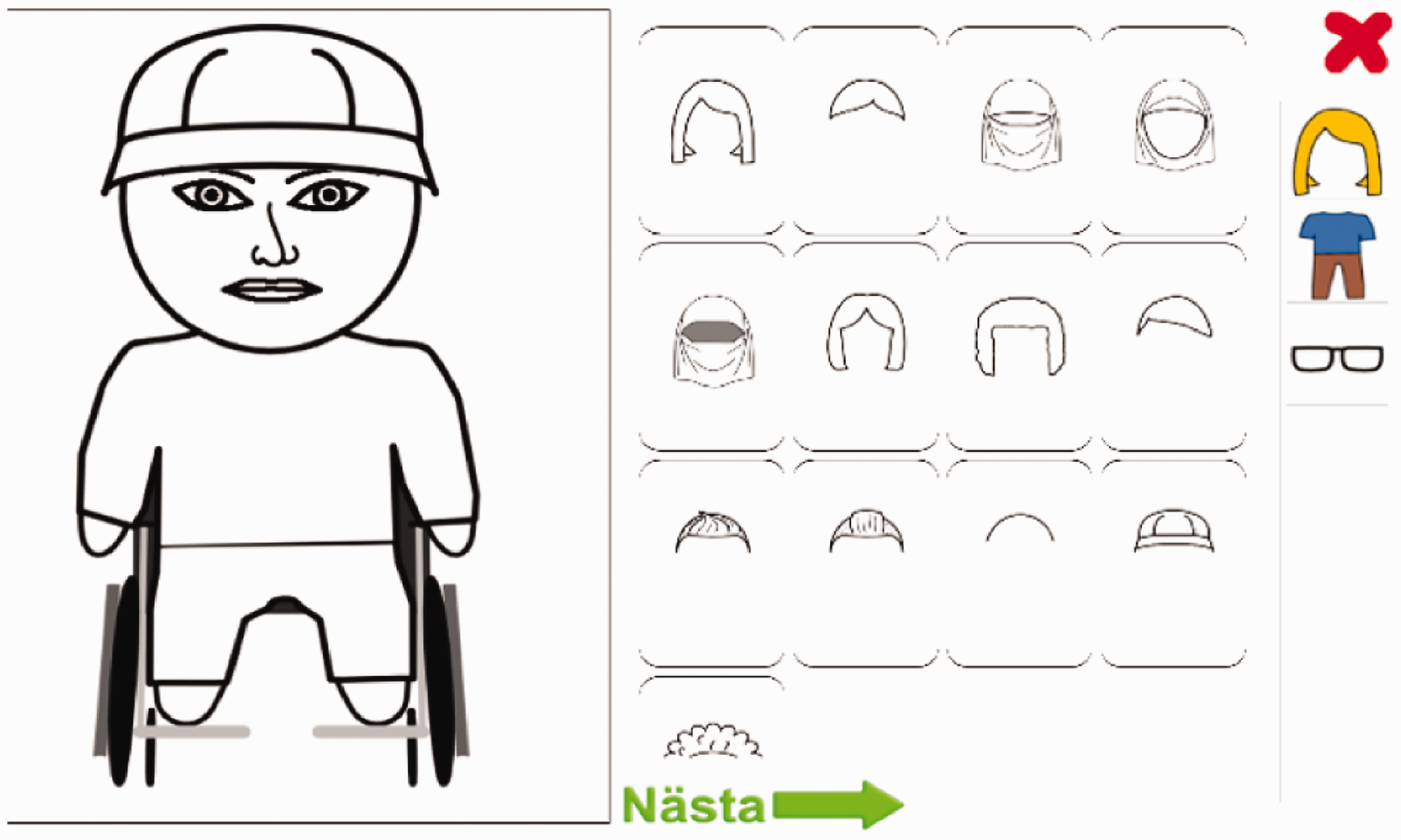
On our second visit to each class the children noticed that several of the changes they had suggested earlier had been included in the application. During the data workshops with the children, different outfits were developed based on the children’s suggestions, e.g. two dresses, different trousers with a long or short T-shirt, different spectacles, headdresses, burka and niqab. Also, assistive devices such as a wheelchair, walker and crutch were later added, again due to the children’s suggestions (Figure 6). In this second meeting with the class it became clear to the children that they had provided relevant knowledge about new aspects to the researcher responsible for developing the tool and that they were directly co-constructing the solution.
Different outfits and attributions.
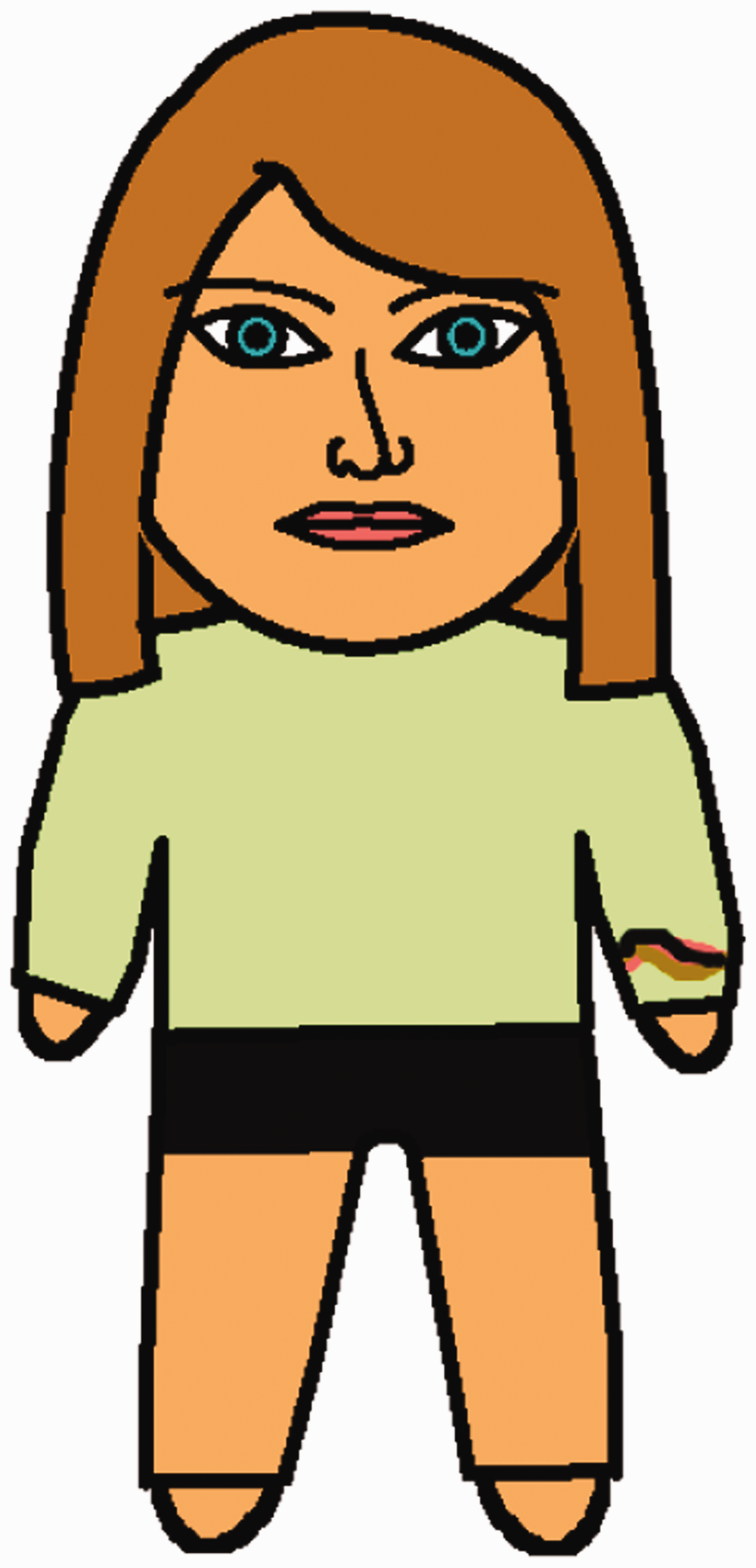
In both our visits the children found the creation of people - themselves, family members or classmates - amusing, especially when they discovered all the new functions in the affordance “create people”. One girl in Year 5 expressed her enthusiasm: Ah, you have made a lot of new stuff! Glasses, like mine! (Fieldnotes, 6 December 2019). However, fantasy figures or characters were even more enjoyable, in that working with them developed a sense of togetherness amongst the children and enabled them to display something of who they were, i.e. showing part of the narratives about themselves by playing with categories and what accompanied them (Bamberg, 2004, 2011; Potter, 1996; Sacks, 1992). Two 12-year-old girls created two different fantasy characters (see Figures 7 and 8) and wrote down the characters’ names:
VSCO girl.
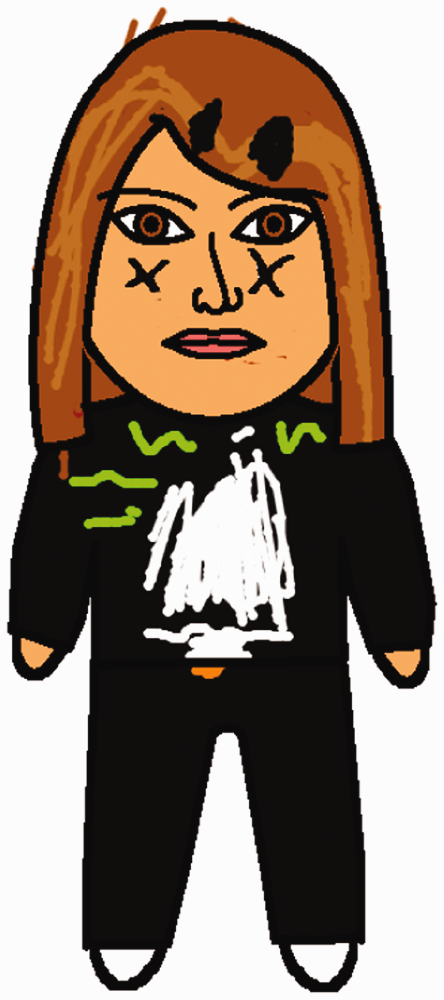
Electro girl.
The creator of VSCO girl associated with someone who edited her Instagram picture with a specific data filter, portraying herself with artefacts like a water bottle, Fjällräven backpack, Birkenstock (a shoe brand), ear pods etc. This enabled her to position herself as a girl who was active on Instagram - someone who knew about the new teenage trends on that platform. When positioning herself in interaction with the classmates sitting next to her, she indirectly conveyed part of her self-narrative. Likewise, the use of Electro girl enabled the other person to position herself as someone who liked superheroes, or more accurately, female superheroes.
At a table in the Year 6 classroom three children expressed their eagerness with the new functions in the affordance: When a boy (6e14), sitting with another boy and girl, sees the new function with glasses, he says: “ah, I am going to do Harry Potter!”. The three schoolchildren around the table are playing with different characters - everything from Harry Potter to the rapper Einar. The girl (6e4) tells me that she is drawing a celebrity and when I ask her who it is she says: “Einar, a rapper, he is really bad (laughter). (Fieldnotes, 6 December 2019)
Moreover, besides using fantasy categories like VSCO girl, Electro girl and Harry Potter, some of the children in Years 5 and 6 created and played with more scary categories. These illustrative examples in Figures 9 and 10 are from a boy and a girl and depict IT (from the film with the same name) and the Killer Clown.

IT.
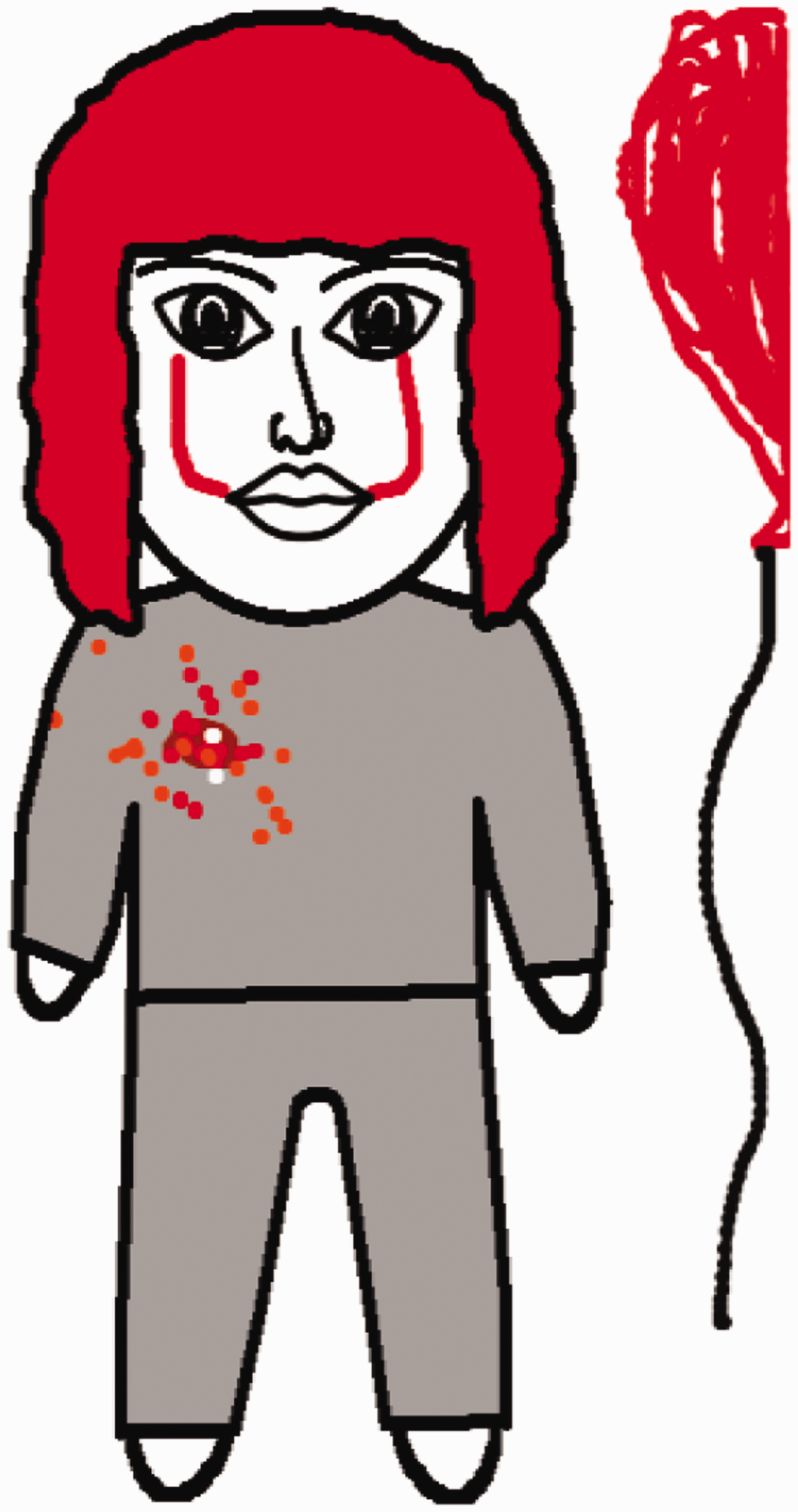
The killer clown.
The use of the categories IT and Killer Clown are associated with horror and, for children, forbidden films. The categories made it possible for them to position themselves as tough (as this means that they are able to watch that kind of film) in their interactions with classmates when showing the scary characters. Here, the children also positioned themselves as doing things without their parents’ permission, which could have indirectly conveyed that they were sometimes naughty.
The talk about clowns also appeared amongst the children in Year 6, who typically related to clowns as something frightening. One girl said: “I am going to draw a party and then a creepy clown joins in. I hate clowns! Then I can show that with the emotions too” (Fieldnotes, 6 December 2019). She thus drew on the affordance emotions [känslor], which she then tried out.
This affordance enabled the children to pick one or several of their own created and saved characters (visible underneath the large image in Figure 11) and to decide that character’s emotions or reactions in the given situation. In the affordance the children could move the blue dot between different expressions symbolising emotions such as surprised, happy, sad or angry. When they moved the blue dot, the face of the character changed in accordance with the chosen expressions. The children could then save the character’s emotion at any given moment. As testers, the children perceived ‘emotions without words’ as funny when switching between the different expressions but lost interest in the affordance rather quickly. This loss of interest could be understood as the children not seeing the function as useful or as something they could use in further interactions with their classmates. The affordance of visualising emotions is more useful for the social worker when talking with children at the first meeting to draw up the assessment plan and in follow-up conversations during the welfare investigation.
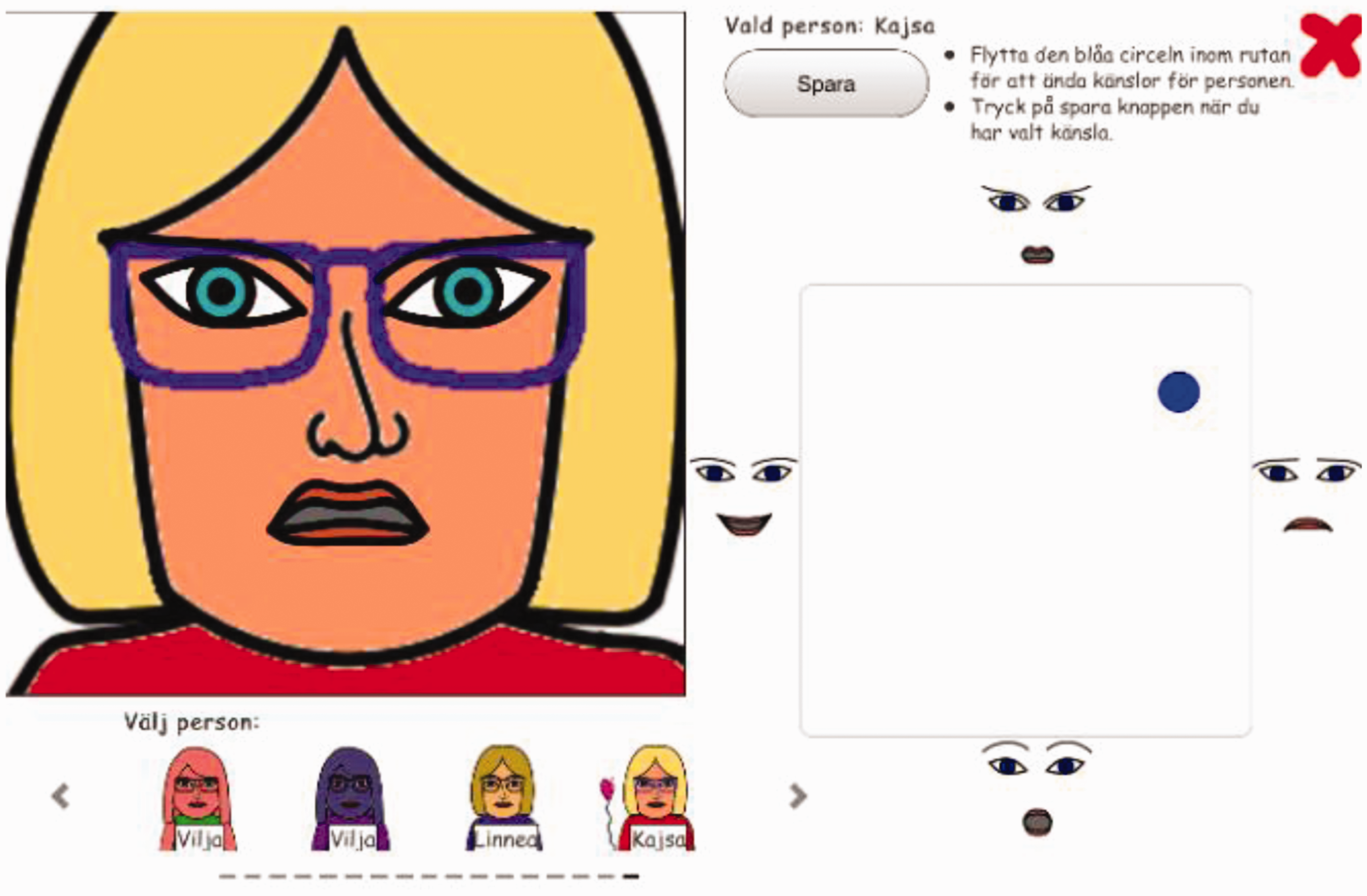
Emotions without using words.
The loss of interest in the emotion affordance revealed the importance of the context for what the application was designed to accomplish - in this case to be used as a digital tool by children and social workers in child welfare services. However, the invited schoolchildren contributed to large extent on the application’s usefulness. The children’s pictures of how they characterised themselves, others, fantasy or film characters and the places they drew were part of who they were. In other words, their use of categories was not only part of their self-narratives but also part of socially and culturally shared stories (Bamberg, 2004, 2011). In child welfare settings, it is essential for a social worker to get to know a child’s whereabouts and for the children to convey their own perspective of their life situation.
Drawing real and fantasy places to hang out in – emerging life situated stories
Another function in the affordance [places] that was developed in line with the children’s suggestion was the possibility of using already created pets in their pictures. This meant that the children could put people or other objects, such as cats, dogs and horses in their own drawings of specific places or chose already created places from the application menu (Figure 12).
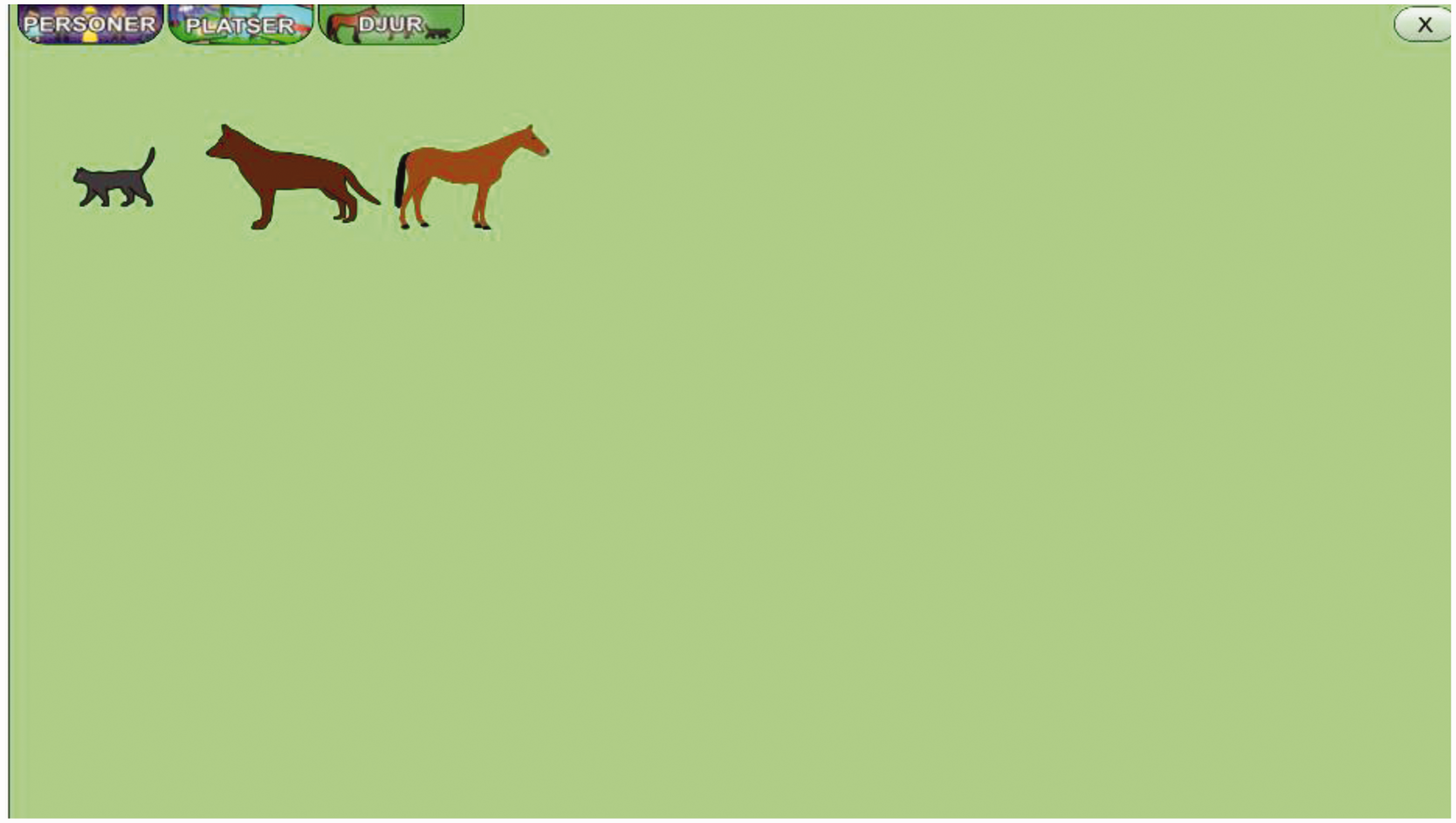
Application menu: Characters, places and pets.
A girl in Year 5 expressed her excitement when she found out about the pet function: “I am going to make an agility course for dogs. I love dogs! I have wished for a dog as an Easter, Christmas and birthday present” (Fieldnotes, 6 December 2019). Figure 13, below, illustrates her drawing.
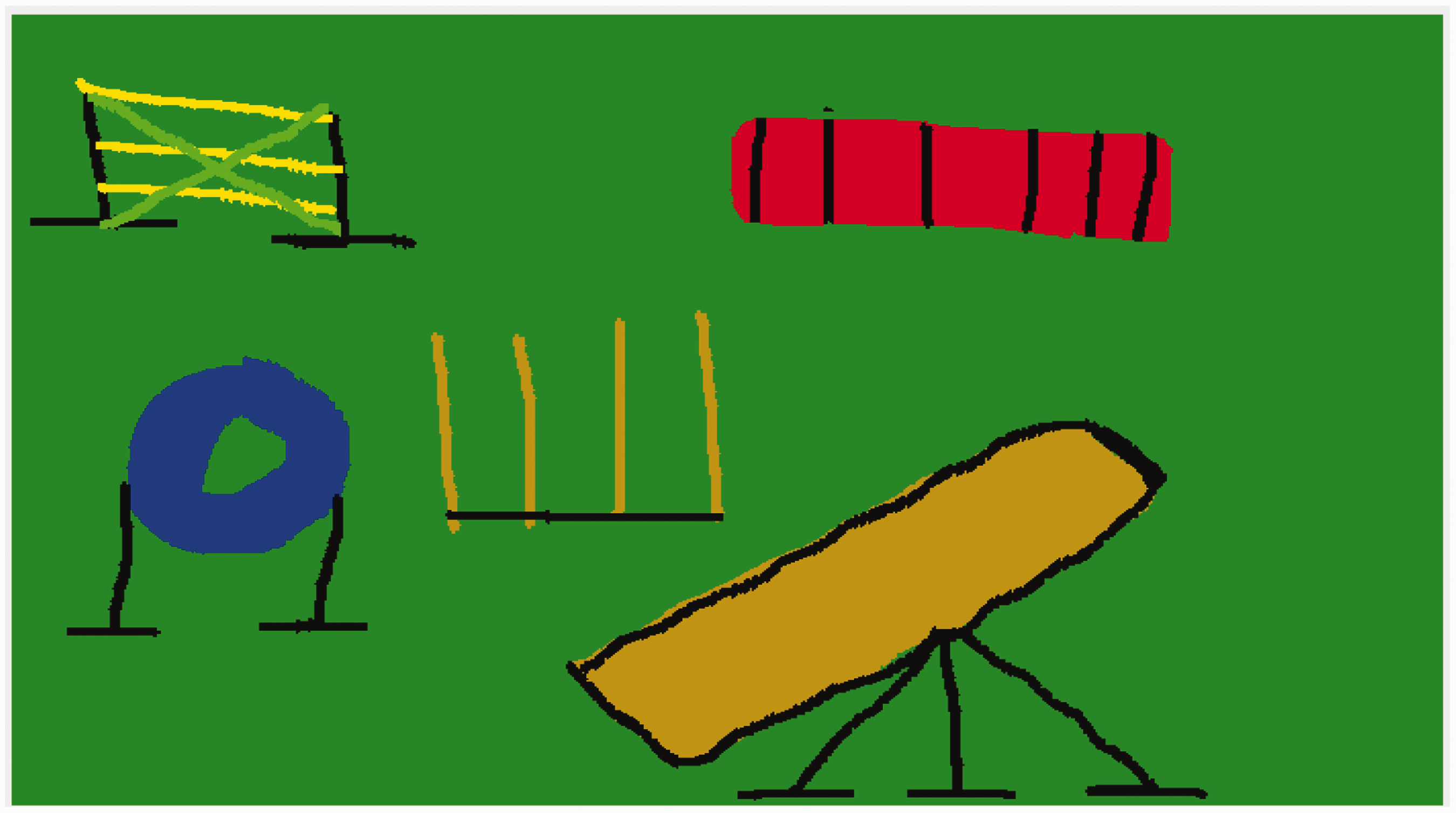
Agility for dogs.
The children found the use of pets as a function very appealing. As testers they enjoyed including pets in their pictures. Several of the children drew places, put pets in their pictures and described the social actions that occurred in the different places when trying out the application. In a group of four children in Year 2 a boy drew a soccer goal net containing several members of his family, two cats, one dog and one horse (which he selected from the menu) (Figure 14). The boy told us (classmates and researcher) that in the picture one of the cats was on the ground while as the other one was in “heaven”. Another boy sitting at the table asked: “Steven, which one of the cats died?” The first boy answered: “It was Vincent” and received sympathy from the boy asking the question. However, in real life the boy did not have a horse, and exactly why Grandpa had been painted over was not explained but could of course be a question to put to the child in a welfare investigation (Fieldnotes, 27 November 2019). When turning the children’s testing of the application into a child welfare context, this example shows how the application can help children to share what is on their minds at any particular moment and also provide an opportunity for the social worker to know more about the child’s situational context and experiences.
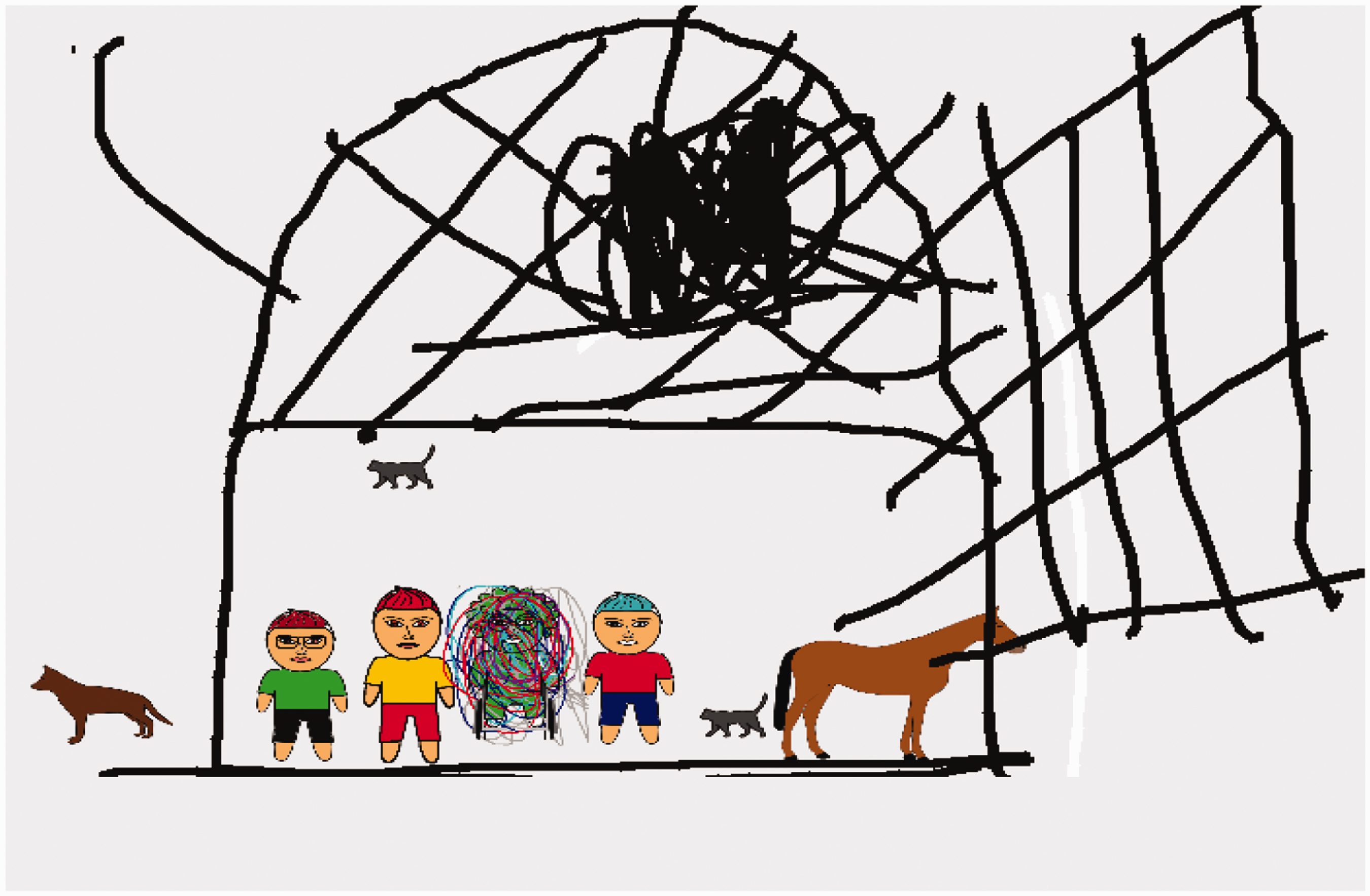
Soccer goal net with some of a boy’s family members and pets.
The boy’s loss of his cat was expressed both in words and graphically when drawing and interacting with the researcher and his classmates. Telling about the cat was part of the boy’s life situated story that emerged in the given situation (Bamberg, 2004, 2011; Georgakopoulou, 2007; Pink, 2007). Describing real life situations through drawings and talking is an example of the application’s aim, namely to give children the possibility to participate and share their perspectives. In addition, by using small stories that often occurred around the dinner table or, as in this case, when drawing and interacting with classmates, the boy not only conveyed his grief but also positioned himself as an empathic person who loved cats (Georgakopoulou, 2007).
Another small story occurred when a girl at preschool interacted with one of the researchers when drawing her house and placing characters that symbolised her family and pets in front of the house (Figure 15).
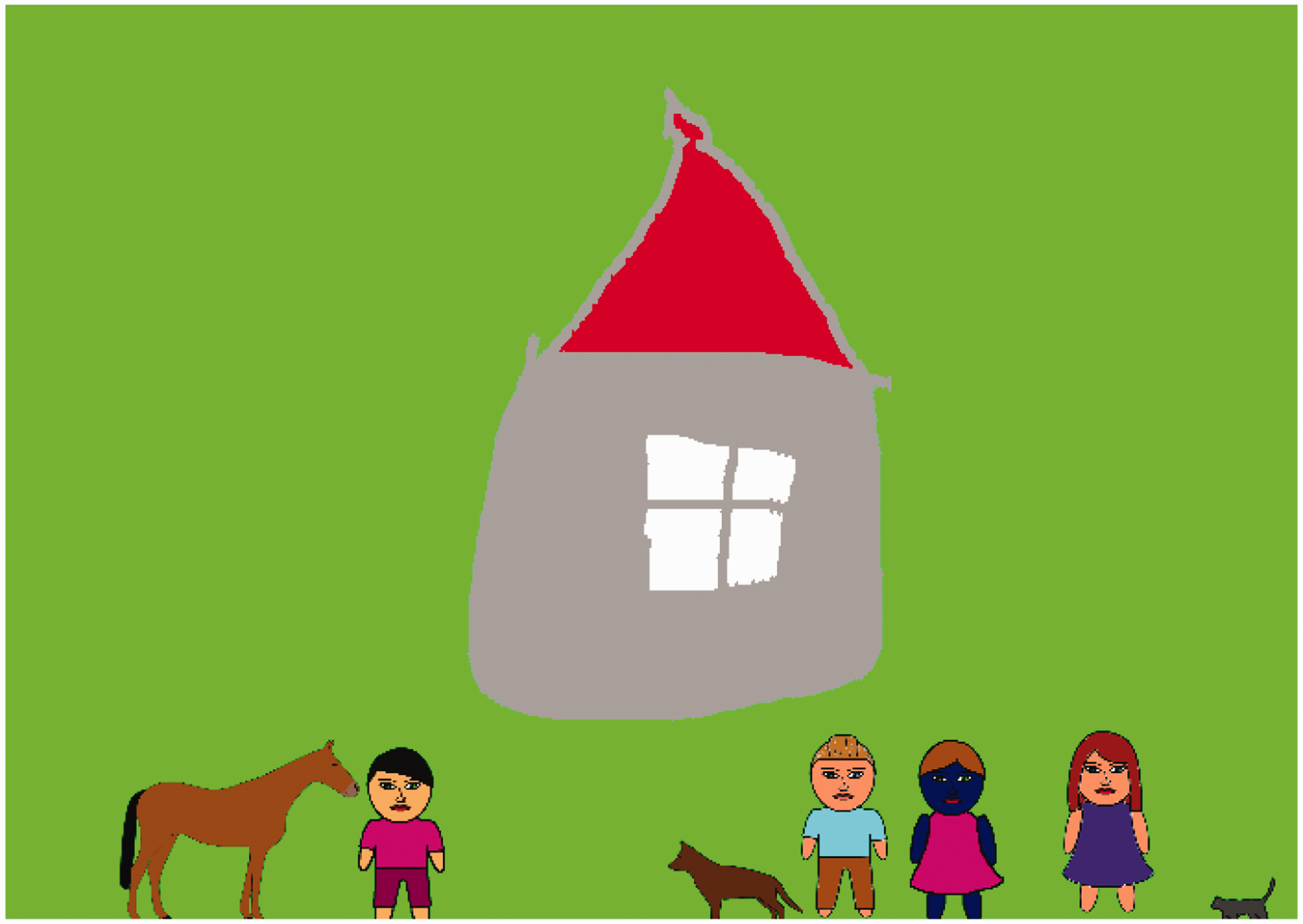
A 6-year-old girl and her family.
The following story was told during her drawing: “This is me and my brother and X. Sometimes X fights. Dad tells us not to fight. My mum is standing with the horse. Dad is going to move to the city (near the school, researcher’s note) and mum will stay in the countryside. X doesn’t have the same dad as me” (Fieldnotes, 24 October 2019). In this fragmental telling, the girl conveyed several things about her life situation: how her family consisted of relations other than biological ones, how someone fought or teased her, how dad was there to make them stop fighting and that her dad was going to move but her mum would stay put. By using her home in the picture she conveyed the sense of place when telling her life situated story – what things were like in her family. This example shows how the application can inspire children to interact and share small stories with others (Georgakopoulou, 2007). It is in the telling that we can discern who we are and who we would like to become, as well as how we want others to perceive us in the given situation (Bamberg, 2011; Giddens, 1991).
Discussion
This article displays how children co-construct the DIG Child application and investigates how and whether this digital tool can help them to express their own perspectives through people, places, emotions and small “stories of life situations”. The DIG Child application aims to help children to extend their contributions in child welfare conversations and influence the assessment plan. The study answers the following research questions: 1) How do the children perceive and make suggestions about the affordances at hand in the application? 2) What is important when they create themselves in the application? 3) Which narratives of themselves emerge in the given situations? It also suggests several key findings. One is that the children improved the application by suggesting the addition of more affordances so that they could better create themselves/others, by discovering bugs in the application, by giving positive feedback and by showing how the application could appeal to children of various ages (Druin, 2002; Dubè and McEwan, 2017). The affordances created in the application do not differ from those in other apps that the children use for fun. However, the design aims to avoid perceived complexity and instead focus on the value to the child welfare investigation.
The second key finding involves the significance of the actual context and what the application is designed for in the interaction between children and social workers. As testers in this study the children did not find the two affordances “emotions without words” and “timeline” useful or exciting. However, it is hoped that these affordances will be more relevant in the child welfare setting when the application is developed further and tested in the social work context.
The third key finding is how the application helps the children to start communicating and bonding when creating themselves in detail, share small life stories and create a togetherness (Bamberg, 2004, 2011; Georgakopoulou, 2007) that sometimes also involved the researchers. This suggests that the application can be a way for children and social workers to connect. Children are also often more digitally native than most adults, who are referred to ‘digital immigrants’ (Gallo et al., 2016; Prensky, 2001), and may therefore have the upper hand. We suggest that the DIG child application can give children and social workers opportunities to act as more equal partners, where the child is the creator, the social worker, audience and witness of these ‘small stories’ of life (Georgakopoulou, 2002, 2007). Accordingly, the application could also enable children to act, draw and talk on their own behalf, rather than adapt too many grown-up perspectives. However, studies of children’s participation (Bijleveld et al., 2015; Seim and Slettebø, 2017; Thomas, 2000) have shown the difficulties and challenges of implementation. How the DIG child application, which is still under development, will be received remains to be seen. In line with previous research (Anderson and Cook, 2015; Dodsworth et al., 2013; Ferguson, 2016), there are challenges with developing a digital tool that is suitable for welfare services with children. However, as this application is developed in conjunction with social workers, it is hoped that it will be easier to implement.
How the application led to the emergence of the children’s life situated stories by using characters while creating people and places is the fourth key finding. When playing with categories such as the killer clown, VSCO girl, Electro girl and Harry Potter in their drawings, not only do the children reveal how they want to be perceived in the given situation but also show something about themselves in their self-narratives (Bamberg, 2011). Likewise, they share life situated stories by drawing places and characters and describing events associated with them. In these stories the children convey their family situations and/or what previous and ongoing events that they have in mind. Stories or narratives are important and enable us to continuously reflect and evaluate ourselves in different life situations (Brockmeier, 2000; Giddens, 1991). In this sense, the digital tool can facilitate children’s participation by allowing them to focus on their own perspectives when drawing and sharing stories.
Conclusion
Including children's perspectives in child welfare assessments is not new, but developing welfare technologies that help children to express their own perspectives in the planning of the child welfare investigation is. This social innovation in social work was developed in cooperation with those professional social workers who initiated the DIG child application with the support of SALAR through its Innovation guide project in 2016. Moreover, the use of digital tools in welfare services is not a temporary occurrence. Welfare technology is here to stay. It is therefore important that social workers are given the opportunity to identify the need for technical complements in child welfare that improve children’s participation. The present project argues that viewing children as digital natives, experts in their own well-being and competent enough to take part in their investigation plans are important. Co-constructing new digital tools based on the practitioners’ own ideas about aspects that can be further developed by researchers in the field of social work and computer sciences is therefore a useful path to tread. The affordances in the DIG child application will be further developed for and by social workers in welfare assessment situations. The digital tool will also be further developed to include the children’s perspectives in child welfare conversations.
Limitations
One main limitation of the study is related to the findings about the ‘emotions without words’ affordance. The subjects in the presented work are schoolchildren, which means that certain aspects of the interaction between the application and the targeted users, i.e. children taking part in a welfare investigation, might not be captured in the school setting. Social workers play a decisive role in the sequence of activities that define the child welfare investigation. Assuming that many social workers are not digital natives, we also need to carefully consider the effect of perceived complexity in the context of using this app. Thus, any tool that is to be used in child welfare ought to generate added value for the social workers. If this requirement is not met, e.g. due to poor usability, it is likely that the app will not be used.
Footnotes
Acknowledgements
We are grateful to our colleagues in the department of Child and Youth Studies at Stockholm University and the department Social Work at Mälardalens University for their helpful comments and advice.
Declaration of conflicting interests
The author(s) declared no potential conflicts of interest with respect to the research, authorship, and/or publication of this article.
Funding
The author(s) disclosed receipt of the following financial support for the research, authorship, and/or publication of this article: The study received funding from FORTE, the Swedish Research Council for Health, Working life and Welfare.
