



Abstract
To prevent radicalisation and violent extremism, many European countries have adopted a multiagency approach, consisting of both police, teachers and social workers. Such strategies have caused concern for a securitization of social policy and stigmatization of vulnerable groups. This study aims at gaining insight into how Norwegian social workers involved in prevention work against violent extremism experience and manage role conflicts and emotions during interaction with their clients. This article presents findings from 17 individual and two focus group interviews which indicate that social workers experience emotional strain caused by role conflicts and emotional dissonance within a securitized field of social work. To handle these challenges, social workers apply a dynamic combination of surface and deep acting strategies, at both the reactive and proactive level, such as ‘Keeping a brave face’, ‘Character acting’ and ‘Adopting the client’s perspective’. Our findings contribute to expanding both the empirical and conceptual understanding of emotion management at work, and provides a novel insight into how prevention work against violent extremism is perceived by social workers. Also, in a field influenced by security rhetoric, our study gives encouraging new knowledge about how social workers can resist falling into oppressive and controlling practices by seeking to engage with and understand their clients’ human side, and relate this to their own lives.
Introduction
Social workers have become a part of the preventive work against radicalisation and violent extremism (PVE) in many European countries, such as the United Kingdom, Denmark, Sweden and Norway (Finch et al., 2019; Lid et al., 2016). Their preventive work in countering violent extremism is related to direct client work with youth and adults who may support or participate in both right wing extremist or Islamist extremist organisations (Lid et al., 2016). The concept of radicalization is debated, linked to the war on terror (McKendrick and Finch, 2016), and associated with unclarity (Neumann, 2013). While still debated in academic literature, the term is used to describe a cognitive and behavioural development towards an ideology leading to the use of violence to reach its goals (Koehler, 2017).
By preventive work, we refer to selective and indicative measures (Gordon, 1983) directed at single individuals or groups for whom concern for radicalisation has already been raised (Bjørgo, 2016). These interventions are often categorized as either disengagement or deradicalization strategies, the first addressing behaviour and the second cognition and ideology (Koehler, 2017). In Norway, individuals in both Islamist extremist groups, and right wing extremists groups are associated with many socioeconomic risk factors, such as trauma, substance abuse and being out of work or education (Police Security Service [PST], 2016, 2019). Hence, individual support to manage such problems are sought provided (Lid et al., 2016), often through traditional social work strategies revolving around the clients’ own understanding of their problems (Haugstvedt, 2019).
Preventing violent extremism is normally associated with hard measures, such as control and surveillance (Qurashi, 2018). Meanwhile, core values of social work are to support diversity and social justice, provide care and emancipation of clients (International Association of Schools of Social Work [IASSW], 2018). Also, social work has been described as a profession where one will execute both social care and social control (IASSW, 2018). This tension is possibly even more present in PVE work. The central practices of social work; building trusting relations and supporting empowerment, diversity and social justice, can be in conflict with attitudes of suspicion, distrust and hostility towards the clients (Finch et al., 2019). Further, client encounters in PVE can typically last for hours or even a whole day (Haugstvedt, 2019). Thus, the importance of this work weighs heavily on practitioners’ shoulders. However, social workers are competent to help individuals where concern for radicalisation has been raised, as the profession has insight into trauma, alienation and other possible roots of radicalization, and the system that handles such issues (Staller, 2019).
Involving social workers in national PVE strategies has raised concerns for a securitization of social policy (Ragazzi, 2017), soft policing of vulnerable groups (McKendrick and Finch, 2016), and stigmatization of Muslims as potential terrorists (Qurashi, 2018). Past research has found uncertainty among social workers when handling cases of violent extremism (Lid et al., 2016). Such experiences may reduce workers’ capacity to perspective-taking and empathy (Todd et al., 2015), which may lead to a practice of hiding or faking emotions in client encounters - strategies associated with cynical depersonalisation of work tasks (Brotheridge and Grandey, 2002).
While this topic is scarcely described in the scholarly literature, there is evidence that working with violent or traumatised clients has a negative emotional impact on social workers (Adams et al., 2006; Bride, 2007). One explanation of the uncertainties when working within PVE, is the unclarity of the concept of radicalisation itself (Neumann, 2013). Another may be the dilemma that when trying to prevent radicalisation; individuals may feel singled out and stigmatized (Gurski, 2018).
The apparent conflicts between core values of social work and attitudes in counter-terror work, in combination with potential issues of fear and mistrust in long-lasting client sessions, provides an empirical argument for problematizing and exploring how social workers manage these situations. Our approach to these empirical challenges is based on the concepts of person/role conflict (PRC): situations of person/environment mismatch. Research on persons involved in client work has established a link between person role conflicts, emotional dissonance, and sickness absence (Indregard et al., 2017). Further, PRC is linked with emotional dissonance and increased demands for emotion management (Abraham, 1998). As both clients’ and professionals’ emotions hold a key position within social work (Ingram, 2015), professionals’ ability to handle and work with emotions (Dwyer, 2007) is important to counteract the negative effects of emotional exhaustion, such as cynicism (Brotheridge and Grandey, 2002) and work alienation (Khan et al., 2019).
As shown, there are challenges and tension in other fields of social work. However, as radicalisation and violent extremism are linked to terror and the path towards such attacks, working in PVE introduces an extra dimension of security and responsibility that might weigh even heavier on social workers’ shoulders, and influence their emotions. Few studies have explored the emotional impact on social workers working with youth and adults at risk of (further) radicalisation, or how they manage emotions and expectations in this work. Our research aims to address this gap by answering the following research question: How do social workers experience and manage emotions and role expectations when working with PVE?
Social work and PVE
Ideologies that promote violence collide with core values in social work, such as human rights, diversity and respect (IASSW, 2018). Such value conflicts can cause confrontational discussions, making it harder to establish meaningful relationships between social workers and clients (Lindsay and Danner, 2008). Also, some scholars have argued that there is pressure on social work to fit into neoliberal and securitised rhetoric within social policy (Finch et al., 2019; McKendrick and Finch, 2016). This establishes a hierarchy of citizens which influences their social, civil and political rights (Ragazzi, 2017). Further, it may foster suspicion and distrust towards minority groups, and Muslims in particular (Finch et al., 2019; McKendrick and Finch, 2016; Qurashi, 2018). Thus, reshaping social work into a social policing profession (Finch et al., 2019) can create a stronger sense of ‘us and them. Also, social workers’ traditional role autonomy appears to be challenged by cooperation with police and security services, where decision-making processes are more centralized (Sivenbring and Malmros, 2020). Further, being afraid of or exposed to violence by clients increases the emotional challenges and levels of stress among social workers (Chudzik, 2016). This may explain the insecurity some experience in this work (Lid et al., 2016), combined with PVE training courses that have been found to lack up-to-date knowledge on (de)radicalisation (Koehler and Fiebig, 2019).
The challenges of social work within PVE appear to be threefold; 1) Conflicting role-related expectations from social work values and security tasks, that challenge what social workers should emphasize in their work with minorities and marginalized groups. 2) Fear and worries for personal exposure to threats and violence. 3) Lack of time, competency and resources in this novel part of social work. These three issues are not separate and affect each other, which shows the contextual complexity of this work. Nevertheless, research on how social workers experience and manage PRC and emotions when preventing radicalization and violent extremism is scarce. This study aims to fill this research gap. The concepts of emotion management are based on a critical approach to the exploitations of emotions as a part of the work role. Thus, our theoretical approach extends beyond the individual exposure and capacity of the single social worker and focuses on the work role within its’ context, expectations, and rules for emotion management. Thus, in the following, we will present and elaborate on the sociological perspectives of emotion management and PRC.
Emotion management and PRC
Our approach to investigating how social workers experience and manage the emotional impact of person/role conflict in their work within PVE leans on Hochschild's (2003) concepts of emotion management and Katz and Kahn’s (1978) concept of person/role conflict (PRC). According to Katz and Kahn (1978: 194), an individual’s “occupational self-identity” is based on personal values and needs that the individual brings to her/his professional role. PRC occurs when a focal person faces role-related demands to execute decisions or act in conflict with her/his personal values or needs (Katz and Kahn, 1978). However, as mentioned above social work is a normative profession, with established values and ethical codes of conduct (IASSW, 2018). Thus, one can assume that the social workers’ occupational self-identity is based on both personal and professional values and needs, where the professional values are internalized and experienced as personal. The concept of PRC has been linked to Hochschild’s (2003) concept of emotional dissonance (Abraham, 1998), or emotion-rule dissonance (Hülsheger and Schewe, 2011).
Hochschild (2003) suggested that emotions and emotional expressions are integral parts of the work role. Thus, work role–related expectations include expectations of appropriate emotional states and appearances. Hochschild coined these expectations ‘feeling rules’. Workers are at risk of experiencing emotional dissonance when work role–related expectations of emotional states and expressions conflict with genuine feelings (Abraham, 1998; Gunnarsdóttir, 2016). Our research review supports the idea that social workers are exposed to PRC and emotional dissonance to a degree that affects them in their work. They must balance the demands of public policy with expectations from professional codes of conduct (Bolton, 2005), and they often have personal expectations of their own enactment of their professional role (Gunnarsdóttir, 2016). Occasionally social workers are exposed to situations where the expectations of their role–related behaviour collides with their personal values or needs (Miller et al., 2006), similar to PRC. However, as mentioned above, role-related expectations of professional conduct also include feeling rules for accurate emotional displays in the role, or display rules (Ashforth and Humphrey, 1993; Rafaeli and Sutton, 1987). Feeling rules arise ‘when rules about how to feel and how to express feelings are set by management’ (Hochschild, 2003: 89). Social workers are particularly exposed to such presentation rules (Dwyer, 2007; Warming, 2019). The meeting between professional or organisational feeling rules and the professional person him/herself can lead to emotion-rule dissonance (Abraham, 1998; Bolton, 2005; Hülsheger and Schewe, 2011).
One example of this can be seen in relational preventive work, which depends on the social worker being able to engage in respectful and compassionate interactions with clients (Egan, 2014). Knowledge about consequences of PRC and emotional dissonance (Abraham, 1998; Hochschild, 2003), indicates that presenting oneself emotionally as a promoter of empowerment and emancipation in a client relationship, while mapping potentially extremist attitudes in the same encounter, can cause feelings of being phony (Hochschild, 2003: 134), fake in expression (Rafaeli and Sutton, 1987: 32) or conflicted. Thus, showing respect and understanding, while harbouring suspicion or alienation, can resemble a form of emotional dissonance. Another example is when social workers are interacting with clients who are angry, hateful or threatening. Such situations can cause emotional dissonance through emotions of fear and insecurity in the encounter (Chudzik, 2016). Emotional dissonance is linked to emotion management—the suppression of negative emotions and faking of positive emotions (Gross and Levenson, 1997; Zapf and Holz, 2006). Emotion management can also refer to the expression of genuine emotions (Ashforth and Humphrey, 1993). Next, we will present two strategies for managing emotions.
Surface and deep acting strategies
Hochschild (2003) suggested that emotional dissonance is handled, by workers, through the management of emotions and emotional displays. Emotion management consists of two strategies: surface and deep acting. Surface acting has traditionally been viewed as a response-focused strategy, such as pretending to be excited or happy (Ashforth and Humphrey, 1993). In contrast, deep acting has been suggested as ‘a natural result of working on feelings’ (Hochschild, 2003: 35). Thus, deep acting has been seen as a proactive strategy. The professional not only pretend to feel the ‘right thing’ but self-induces the appropriate feeling to express the expected emotions in the given situation. The worker does this by using personal experiences or memories (Gunnarsdóttir, 2014) or by viewing the situation through theoretical perspectives (Gunnarsdóttir and Studsrød, 2019). Earlier research has indicated that individuals who frequently engage in surface acting are at higher risk of experiencing emotional exhaustion, having low job satisfaction, distancing from their clients, and losing professional authenticity (Brotheridge and Grandey, 2002; Hülsheger and Schewe, 2011).
Grandey (2000) suggested that deep acting has a positive effect by being perceived as authentic and convincing, which in turn may lead to positive interaction and restoration of emotional resources. Furthermore, deep acting is a way of decreasing emotional dissonance, not merely suppressing emotion. This strategy has been found to create a sense of personal accomplishment and efficacy (Brotheridge and Grandey, 2002; Hochschild, 2003; Kammeyer-Mueller et al., 2013, Zapf and Holz, 2006). However, although there is sufficient support for labelling surface acting a reactive strategy and deep acting a proactive one, recent research has promoted new insight suggesting that emotion management is more complex and dynamic (Grandey and Melloy, 2017).
Our main assumption is that being involved in PVE causes PRC among the social workers and that this makes them particularly vulnerable to emotional dissonance. We base this argument on the already-stated potential conflict between the relational and trust-based approaches in social work practice and on the potentially severe consequences of not succeeding in this prevention work—stigmatization and/or possible acts of violence. Additionally, research findings have indicated that earlier views regarding surface acting as harmful and deep acting as positive are too simplistic (Grandey and Melloy, 2017; Judge et al., 2009). Knowledge about how social workers manage emotional dissonance, through surface or deep acting, can contribute to the understanding of how different emotions management strategies play a positive or negative role in social work and PVE. Thus, this study aims to explore how social workers manage emotions and roles, and provide new insights into the dynamics of surface and deep acting as strategies of emotion management.
Methodology
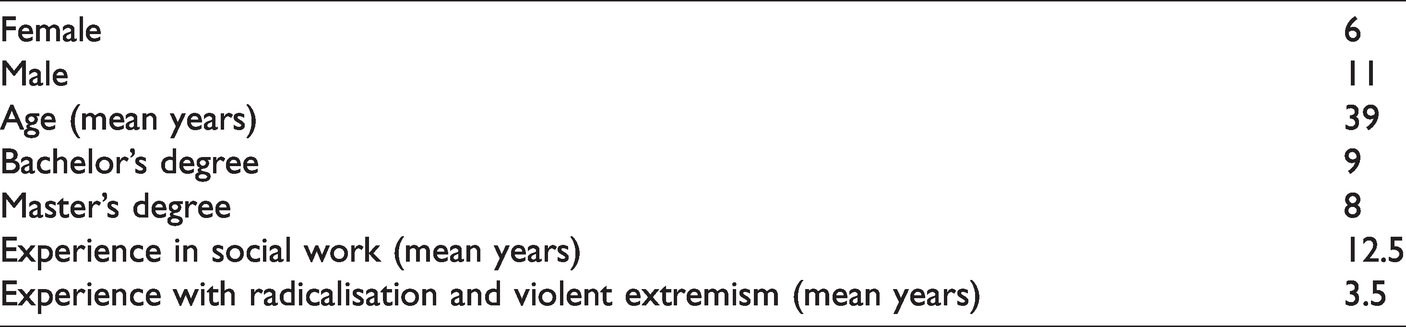
This is a qualitative in-depth study (Blaikie, 2010) of a particular branch and phenomenon in social work among several services. Frontline practitioners who carry out client-directed prevention work were found and recruited using purposeful sampling to obtain information-rich cases (Yin, 2016). There is no standard organisation of this prevention work in Norway. Hence, we included informants from child protection services, welfare services, outreach services and various projects. While the participants were employed at different places, they all had professional experiences and responsibilities within PVE. Data collection was carried out through 17 semi-structured in-depth interviews and two focus group interviews with five participants in each session. To address a sensitive issue such as social work and PVE, the main author developed an approach to facilitate trust from the informants which, to our understanding, led to honest and personal reflections from the participants (Haugstvedt, 2020). The interviews had a mean length of 101 minutes. Table 1 shows a breakdown of participant information.
Participant information.
The research was approved by the Norwegian Centre for Research Data on February 1, 2018 (project no. 58477). All potential participants were given information about the research project along with consent forms that were signed prior to the interviews. Interviews were audio-recorded and transcribed. All data were anonymised to ensure participants’ confidentiality.
Data collection, transcription and analysis were ongoing and overlapped throughout 2018, making it possible to further explore topics that emerged in the early stages of data collection. The two focus group interviews were the last stage of data collection. Topics from the in-depth interviews were further explored in group-discussions. The focus group context opens communication between participants, facilitating exchange of experiences and reflections that the interviewer cannot manage in a one-on-one interview setting (Lavrakas, 2008). Thematic analysis is widely used in social studies as a process of identifying, analysing and reporting patterns within data, through a six-phase process (Braun and Clarke, 2006). We utilized thematic analysis with an abductive approach. Abductive reasoning rests upon the researchers’ deep familiarity with theory, and starts with a broad reading of theory and related research to make the researcher curious and open for ‘surprises in the data (Timmermans and Tavory, 2012). Unlike inductive or deductive reasoning, abduction is a continuous dialectical examination of theory and data, which allows the research to draw plausible conclusions based on observations and theory. The analytical process resulted in two themes: emotional dissonance and emotion management. ‘Emotion management’ included three strategies of emotion work: keeping face, getting into character and adopting the clients’ perspectives.
Findings
Theme 1: Emotional dissonance
Our research shows that meetings with clients at risk of (further) radicalisation are emotionally demanding. The emotional dissonance appears to increase when social workers engage in deradicalization efforts, focusing on their clients’ ideology and values. The volume of these cases in Norway is relatively low, and thus, it takes time to develop professional experience in this work. One key subject was explicitly expressed in the second focus group interview: “You do not go emotionally untouched by this work”. An example of this, from one of the in-depth interviews: It’s not easy, because I think you’re constantly challenging yourself in terms of what you accept, what to endure, how to handle the information [from the clients]. So, I think that, yes, it may sound simple, but it’s not. It does require a lot from you. This is, for me, the most demanding conversations—the conversations I have where what he says really challenges my core values. He has some opinions that make me feel like my body is being torn apart. I have been sitting here screaming and arguing with the youth in an engaged discussion. When that happens, or they show that they are very hateful, you can feel a horror of some sort […] and not necessarily scared for myself there and then, but scared in a larger societal perspective. […]. You constantly have to make revisions on involving the police or not […]. It can be difficult to be professional sometimes. And by professional, I do not mean that one should just keep emotions hidden. […] You are in some way a bit naked because these are emotions that you are not used to working with. It’s like you’re exercising, and you’re not used to using those muscles., if you understand what I mean.
Theme 2: Emotion management
Strategy 1: ‘keeping face’
The social workers applied strategies for managing their emotions on two distinct levels: surface acting and deep acting. First, ‘keeping face’ refers to the social workers just trying to pull through a challenging client session by handling their body language and emotions at the superficial level, hiding their emotional states and keeping calm by breathing deeply. This indicates that social workers apply surface acting to mask their emotions while simultaneously managing them on a deeper level. Their ‘brave face’ allows them time to slow their emotional reactions, thus enabling them to adjust not only their emotional displays but also their actual emotional state. Reflecting on challenging attitudes, one participant said: So, I have to manage myself [When experiencing conflicting ideologies], try to control my body language, but it's not always easy when you suddenly sit there for four hours hearing about that, right? I’ve felt a bit like a guinea pig, actually.
Strategy 2: ‘Character Acting’
‘Character acting’ refers to proactive surface acting strategies. One social worker described this as necessary and challenging as follows: ‘Yes, you go into a role; you get into a character. You have to. […] It’s very draining.’ Similarly, the next transcript shows how the participant gazed inward, becoming conscious of his reactions while trying to harness his emotions by adjusting his body language. I try to be conscious of what it triggers in me—try to be conscious of my own body language. […] I challenge myself in the conversation because there are so many things that I should react upon which I don’t react upon. […]. Normally, you would react to it. But now, I sit back and say something like, ‘Interesting. Tell me a little more about that.’
Strategy 3: Adopting the client’s perspective
The third strategy involves handling the emotional dissonance through preparation by adopting the clients’ perspectives, and make some sense of their attitudes and ideologies. When I am completely unprepared […] and then get some extreme ideas thrown in my face, then I have to go through a phase [of surprise]. But if I am prepared and know that I’m going to talk to someone who has extreme attitudes … right? That’s different. […] So, being prepared for something, I think that plays a role.
Below, in two quotes, the participants explicitly state how upholding the core value of applying a client-perspective makes the work emotionally manageable. Further, his statement shows how this proactive strategy also entails a reactive component. The reactive component appears as a value and experience-based immediate professional response. Also, if you are prepared for it, you try to understand where it comes from and settle in with the person’s views and worldview and understanding. […] It helps me see it from their point of view so I can manage these conversations better so that I won’t be like… [gesturing that he will be shocked]
There is a lot I hear that seriously clashes with my own values, and it triggers something in me. I must be aware of that. But it sometimes helps to think, “Wheredoes he get those thoughts from?” “Why is that person thinking like that?” from his other point of view. It helps me deal with the situation and respond to it. Not just saying, “No, you have to pull together,” but rather coming up with an open question. Instead of confronting, try to see where it comes from.
By taking the clients’ perspectives, the social workers manage their emotional reactions, possibly also reducing the negative effect his display of emotions may have on the dialogue. This appears to be a reactive strategy because he manages immediate discomfort in situations where he is unprepared. Further, other informants applied a strategy of getting to know their clients: When I manage to establish a relationship, I meet a person who is a brother, father and a friend. I get a more personal image somehow. You realise that it is only a human being on the other side of the table. […] But I think you should meet those people as they are. Each one is different.
Discussion
Emotional dissonance and PRC
Social workers engaged in PVE is still an understudied research topic. The current study found that working with PVE has an emotional impact on social workers. It also found that social workers make efforts to reduce the risk of developing cynical strategies, that may alienate their clients. Further, perhaps ethical dilemmas in PVE may be of larger importance than the actual stories social workers are exposed to in this work. Thus, the antecedents for the emotional impact are complex.
We have identified that some personal and professional conflicts surface when social workers are involved in PVE. First, the inherent nature of this work, which implies a form of surveillance and suspicion towards the clients, can cause value-based conflicts between PVE tasks and social work values. Second, the social workers are exposed to statements and stories they instinctively react to, such as support for violent extremism. Third, they are expected to manage and mask emotions in accordance with professional rules of conduct (Bolton, 2005; Dwyer, 2007; Grootegoed and Smith, 2018), meanwhile dealing with internalised codes of conduct and their own personal values (Gunnarsdóttir, 2016). This includes situations of conflicting professional, organisational and personal expectations, and situations where social workers experience and assess threats or concerns for societal safety.
Social workers are expected to be non-judgmental and compassionate (Kanasz and Zielinska, 2017) also when experiencing difficulties with clients’ attitudes and personalities (Lloyd et al., 2002). In our study, PRC occurs as result of the discrepancy between personal and professional codes and expectations in social work (respect, diversity and emancipating clients), how they carry out their complex work tasks, along with dimensions of securitized tasks. Earlier, Norwegian social workers have been found to understand radicalisation as a social, not an ideological, issue (Haugstvedt, 2019). Nonetheless, concerns for clients’ capability of violent actions towards others affects them emotionally. The social workers seek to manage professionally inappropriate emotions in accordance with professional codes of conduct. They manage their emotions, by masking or adapting their genuine feelings in their interaction with their clients. The disparity between their genuine inner thoughts and feelings and what they display in client meetings resembles emotional dissonance (Hochschild, 2003). While emotional dissonance has been found among social workers earlier (Gunnarsdóttir, 2016), the securitisation and demand for revealing potential extremist threats appear to put additional strain on professionals working with PVE.
The participants in our study seem to push themselves to establish and maintain an open dialogue, in order to understand and influence clients’ values or ideology. While experiencing challenging feelings, brought forth by PRC, social workers see the need to manage emotions and emotional displays. We argue that this form of emotion management is particularly emotionally demanding because of PVE’s novelty in social work, with limited access to specialized training and support. Further, the nature of statements and threats, which the professionals are witnessing and assessing in this work, contributes to longer-lasting exposure to PRC and emotional dissonance than other forms of social work. The securitisation of, and uncertainty surrounding, cases of radicalisation can affect the social workers ability to focus on what traditionally is their role; to support, strengthen and emancipate their clients. Thus, their capacity and strategies in managing the emotional impact of this work should be interesting for this field in social work. Hence, the scope of this study is to contribute to an understanding of how social workers manage emotions to balance the emotional impact of working in the ambiguous and ethically challenging field of PVE. The different strategies of emotion management will be discussed in the following section.
Emotion management
Previous research on PVE has identified what appear to constitute a securitization of social work (McKendrick and Finch, 2016; Ragazzi, 2017), labelling Muslims in general as potential terrorists (Qurashi, 2018). This way of looking upon clients are in steep contrast to that of social work in general, of which aims at supporting and emancipating clients (IASSW, 2018). This conflict is additionally fuelled by the outspoken ideologies some clients present. As a response to emotional dissonance and PRC, the participants in this study employed strategies of emotion management; surface and deep acting (Hochschild, 2003). The latter by adapting to the clients’ perspectives, trying to see the world from their vantage point. The participants referred to unpleasantness when ‘keeping a brave face’ and ‘getting into character’, while deep acting was referred to as a positive coping strategy. In Table 2, the strategies are presented in accordance with level of acting and type of strategy.
Matrix of strategies.

Surface acting has traditionally been understood as a reactive strategy in the moment. (Ashforth and Humphrey, 1993; Bolton, 2005). However, recent research within emotion regulation and emotional labour suggests that surface and deep acting strategies can overlap (Grandey and Melloy, 2017). Our study supports this notion, as our participants applied proactive strategies while doing surface acting. ‘Going into character’ appears to put heavy strain on the workers, as the emotional dissonance may be of even greater intensity due to the length of the interaction when working with PVE. Character acting appears to be a surface-related strategy, yet with a proactive approach. The social workers ‘dress up’ in a tolerant and professional role while experiencing conflicting emotions underneath. The emotional dissonance appears to rise from an internal conflict fueled by professional role expectations, such as being tolerant, open minded and respectful, meanwhile taking part in surveillance, and/or listening to statement and ideology that promotes violence and discrimination.
The examples of deep acting strategies in our study are similar to earlier findings, with personal experiences (Gunnarsdóttir, 2016; Kruml and Geddes, 2000), preparation and theoretical perspectives used to induce genuine feelings (Gunnarsdóttir and Studsrød, 2019). The second strategy, adopting the client’s perspective, has previously been found to decrease negative effects on employees’ emotions (Bechtoldt et al., 2007). Our study indicates that perspective-taking serves to successfully manage emotions, which can help facilitate understanding of others’ perspectives, promoting forgiveness and empathy (Rizkalla et al., 2008). One way of doing this is by actively seeking to induce feelings based on own personal experiences and memories (Gunnarsdóttir, 2014). Additionally, utilizing own past experiences through self-reflection is recommended to understand others (Gerace et al., 2017), and perspective-taking is found to increase interpersonal liking (Noor and Halabi, 2018). This suggest that the strategies identified might function as dually supporting social workers in interactions with at-risk individuals by first functioning as emotion management and second, to resist oppressive practices of control and surveillance. Perspective-taking, what we labelled ‘Adopting the client’s perspective’, is found both as a proactive and reactive strategy. This might help social workers prepare for and prevent how security rhetoric (Finch et al., 2019; McKendrick and Finch, 2016) over time can influence social policy and social work with vulnerable individuals. This proactive self-reflexivity might be even more important in this field than elsewhere, as matters of PVE earlier have been found to stigmatise and label Muslims in particular as potential terrorists (Qurashi, 2018).
Finally, as shown above, our findings indicate that social workers are capable of applying deep acting strategies at the reactive level as well as proactive surface acting. This expands Hochschild’s (2003) dichotomous conceptualisation of surface acting versus deep acting and supports further research into how these strategies develop in different work roles and work contexts, especially in relation to PRC. To resist pushing clients further away into ‘alienation’, our findings underline the importance of having compassionate, capable and experienced case workers with experience in the field of PVE, as well as a critical eye on PVE’s underpinnings.
This study relies on data from 17 participants in total. Hence, there may be some limitations to our findings due to the low number of participants and possibly from the recruitment process. Also, this research was conducted with only Norwegian social workers, and the specific characteristics of the Norwegian welfare state may affect the findings. Given our abductive approach to the analytical process, we did engage with several possible theoretical frameworks prior to and during analysis. An earlier draft of this manuscript focused less on the contextual and role related aspects of the client engagement, with a narrower focus on the emotional tension from client statements themselves. However, we think the current framework adds a more interesting dimension to the analysis, and resonates much more with what surfaced from the interviews.
Conclusion
Our findings show that Norwegian social workers experience emotional dissonance and PRC when working with PVE in face-to-face client work. This experience seems triggered by the following: the rules and expectations towards them in a still-developing field with possibly more control responsibilities than elsewhere, influenced by the discourse on individuals’ risk to society, where they are exposed to ideologies that collide with their own. Social workers handle this through various strategies for managing their emotions: keeping a brave face, going into professional character and adopting the clients’ perspectives while connecting with their humanity. Theoretically, our findings expand Hochschild’s contribution to emotion management in the work role by adding connections and overlap between surface acting and deep acting strategies. We have brought forth some unique findings of emotions and emotion management in a still scarcely studied area of social work. In the field of PVE, which is of importance for social workers in many European countries and most likely elsewhere, our findings bring some optimism to a field where social workers may risk being ‘errand runners’ for security services, and lose touch with both clients and own professional values. Further development of constructive emotion work may counteract the initial troubles of engaging in dialogue with individuals who harbour extremist ideologies, or those who are merely susceptible to such influences due to their life situation. Such constructive emotion work might strengthen social workers’ ability to challenge, influence and support their clients without crossing over to surveillance and control.
Footnotes
Acknowledgements
We are grateful for the contribution of anonymous reviewers and fellow researchers at the Department of Social Studies, University of Stavanger, and especially those of Associate Professor Svein Erik Tuastad.
Ethical approval
The research was approved by the Norwegian Centre for Research Data on February 1, 2018 (project no. 58477).
Declaration of conflicting interests
The author(s) declared no potential conflicts of interest with respect to the research, authorship, and/or publication of this article.
Funding
The author(s) received no financial support for the research, authorship, and/or publication of this article.
