




Abstract
This article reports findings from an ethnographic study of pre-birth child protection, conducted in an urban Scottish setting. The study was designed to explore the interactions between practitioners and families in the context of child protection involvement during a pregnancy. This research aimed to understand the activities that constituted pre-birth child protection assessment, and the meaning attached to those activities by social workers and expectant parents. Very different perspectives on fathers and fatherhood emerged through the study. Fathers shared their feelings of familial tenderness in the context of research interviews. Yet social workers often focused on the risks that the fathers posed. This focus on risk led professionals to ignore or exclude fathers in significant ways. Fathers were denied opportunities to take an active role in their families and care planning for their infants, whilst mothers were over-responsibilised. Children meanwhile were potentially denied the relationship, care and identity benefits of involved fatherhood. This article shows how pre-birth child protection processes and practice can function so as to limit the contribution of expectant fathers. The way that fathers and fathering are understood continues to be a wider problem for social work, requiring development through research and practice. This study was not immune to the challenge of involving men in social work research in meaningful ways. Nevertheless, the findings highlight how participation in social work research can create a forum for fathers to share their concerns, and the importance of their perspective for practice.
Introduction
Marked increases in the incidence of infant removal have been reported within the broadly similar child protection systems of the U.K. nations of England (Broadhurst et al., 2018), Wales (Alrouh et al., 2019), and Scotland (Raab et al., 2020). Related patterns of increased levels of separation of infants from their birth families have been identified in Australia (O’Donnell et al., 2019), and in Aotearoa New Zealand, where concern about the impact on Maori families and communities has been reported (Keddell et al., 2021; Office of the Children’s Commissioner, 2020). This paper is based upon research into child protection work in the period leading up to the birth of a baby. A time when the decision is made as to whether professionals will seek legal measures to remove a baby soon after birth, or will support the family to care for their newborn baby at home.
Prenatal protocols vary in different national and regional contexts (Mc Elhinney et al., 2019). In the Scottish context for this research, the work undertaken with parents during a pregnancy to decide what child protection measures are necessary for the unborn baby is known as ‘pre-birth child protection assessment’. National Guidance describes when and how this work should be undertaken (Scottish Government, 2014). The pre-birth assessment is led by social workers, but is completed in close co-operation with colleagues in midwifery, community and child health, and adult services. The aim is to determine the risk of harm to the unborn baby and whether protective measures are necessary. Protective measures may lie along a continuum from voluntary supportive engagement with the family, to non-consensual removal of the newborn infant from the care of birth family; in order to ensure the baby’s safety and wellbeing.
Reasons for child protection referral during a pregnancy may include a prior history of child protection intervention, including measures designed to remove older children in the family. Difficulties experienced by the parents, including physical or mental health difficulties and current substance misuse may also introduce concerns about their capacity to care for an expected baby. The risks of domestic abuse are known to increase in pregnancy (Cottrell 2009) and present a risk to the health of the mother and baby (Potter and Feder, 2018). So that families with a history of intra-familial violence and abuse may be viewed by professionals as presenting risks during the pregnancy and for the baby once born. As Ward et al. (2006, 2012)’s research has shown, infants considered at risk of significant harm in the English context are born into families experiencing multiple deprivations and difficulties, often over a long period. Nevertheless, the decision of whether to remove a baby soon after birth is a highly charged and difficult one for practitioners (Critchley, 2020a). Broadhurst et al. (2017a, 2017b) have explored in detail the significant short and long term impacts on birth mothers of infant removal, and particularly of repeat care proceedings leading to the removal of consecutive newborn babies from the same birth mother. An experience characterised by immense loss and stigma, as highlighted by Morriss (2018), and of lasting consequence in women’s lives (Broadhurst and Mason, 2020). However, until recently there has been less attention paid to impact on the fathers whose children become subject to child protection assessment and measures before birth, or who have experienced the recurrent removal of their infants (Bedston et al. 2019).
This article focuses on the experiences of expectant fathers whose unborn babies were subject to pre-birth child protection assessment. The study reported upon here did not aim to explore expectant fatherhood per se. Rather, the research sought to understand the activities of pre-birth child protection and the meaning that was attributed to these activities by expectant mothers and fathers, and by social workers. Yet when the data was analysed, strong themes in relation to the experiences of fathers emerged. The first notable phenomenon within the data was that the men in the study who were present at the outset of the child protection involvement became less visible as time went on, with some disappearing altogether. Second, in analysing the data further, differences became apparent between the way that fathers presented and were talked about by practitioners in social work meetings, and the way the men interacted in the spaces created by the research. Whereas the fathers in the study were often conceptualised as a risk, within research encounters their potential as a resource for their children was far more apparent. Raising a question of whether social work practice can learn anything from social work research in respect of work with fathers. In this article I explore the tensions in relation to fathers, fatherhood and social work which arose through analysis of the data from this study. I then outline what these tensions might mean for social work research and practice with men as fathers, both within and far beyond the pre-birth period.
Ghost fathers and social work
It has long been established that there is an issue with under-representation of men in child care and protection processes, even when those same men remain involved with their children in some capacity (Brandon et al., 2009, 2019; Philip et al., 2019). Writing in 2009, Brown et al. described the problem of the ‘ghost fathers’ of child welfare. Within child welfare, fathers are not just discounted, they are often not seen at all even when they are present … Fathers exist in the lives of women and children in child welfare. Yet, fathers are rarely seen by child welfare, even when present. We chose the word ‘ghost’ to describe these fathers in child welfare because in order to see a ghost, one has to first believe in their existence and relevance (Brown et al. 2009: 25–26).
The study
Statement of ethics
The ethnographic study reported on here was funded by the Economic and Social Research Council (ESRC) and given permission to proceed by the ethics committee of the School of Social and Political Science at the University of Edinburgh. Fieldwork access was granted by an urban Scottish local authority, in accordance with their research ethics and access procedures. Firstly, access was granted for focus groups with social work practitioners and managers, which were conducted as a scoping exercise between 2012 and 2013. Later, access was granted for ethnographic fieldwork, which was completed over one year between 2014 and 2015.
Research methods
Over the course of a year, the author observed social work meetings occurring between the allocation of a social worker, up until the births of the babies in the study. Observed meetings included child protection case conferences (CPCCs), core group meetings, informal office meetings, and home visits. The study utilised mobile methods in order to follow participants across a range of settings and meetings (Critchley, 2019). Following Ferguson’s (2011, 2016) research methods in exploring the mobilities (Buscher et al., 2011) of child protection across multiple sites. The research reported upon here took place in social work offices and other public buildings, but also in family homes, in the author’s car en route to various meetings and appointments that research participants were required to attend, and in social workers’ cars. Observations were designed to capture the interactions between social work practitioners and families in the context of child protection involvement during a pregnancy. The interviews supported this work by exploring the meaning participants attached to these activities.
Families were invited to take part in the study through the social worker for the unborn baby. The consent of the social worker and of the expectant mother was necessary in each case. Whenever the expectant father was named and was involved in the social work process for the baby, his consent was also sought. None of the expectant parents approached to participate in the study refused consent. However, a number of social workers approached to participate refused consent, or would not approach the expectant parents. Thus, for those families approached by the researcher, the social worker already thought it possible that participation in the study would be of interest to the family. In total, thirteen mothers agreed to participate in the research. One mother later withdrew her consent, leaving 12 in the final sample. Eight expectant fathers provided consent to participation. For the remaining four unborn babies, either the paternity of the baby had not been shared with professionals or direct contact with the father was impossible within the parameters of the study.
Whenever practicable, both of the baby’s parents were invited to participate in a research interview. Not all the mothers chose to do so, and even fewer of the fathers. Six mothers gave research interviews, and only two of the fathers, compared to all 12 of the frontline social workers and five of the social workers who chaired the pre-birth Case Conferences. Some participants gave more than one research interview over the course of the study. In total, 20 observations and 31 research interviews were completed.
A haunted sample: Fathers’ participation in the study
The table below describes the extent to which the fathers of the unborn babies were present within the research observations and contributed to interviews in this study (Table 1). Although this is the first study that has directly sought to engage fathers in research during the pre-birth child protection processes, and to consider their perspective in a meaningful way, the role of the fathers was not the sole focus. Ultimately, the object of study was the interaction between expectant parents and social work practitioners in the pre-birth period. Attempts to include fathers were made by the author, but in line with the approach to the mothers, the optional nature of participation in the research was emphasised. Ethically, it was important that parents experienced control over the extent of their participation in this research, given the difficulties in their lives that had brought them into contact with child welfare services originally. Older participants seemed somewhat more likely to participate in research interviews, but there were exceptions to this. Women were more likely to participate than men, but this can be partly explained by the higher level of participation in child protection processes by mothers than by fathers in the sample. Mothers had no choice but to attend child protection meetings; the professional gaze was firmly in their direction. Fathers’ roles were more complex as outlined in the table that follows.
Involvement of fathers in the research study.
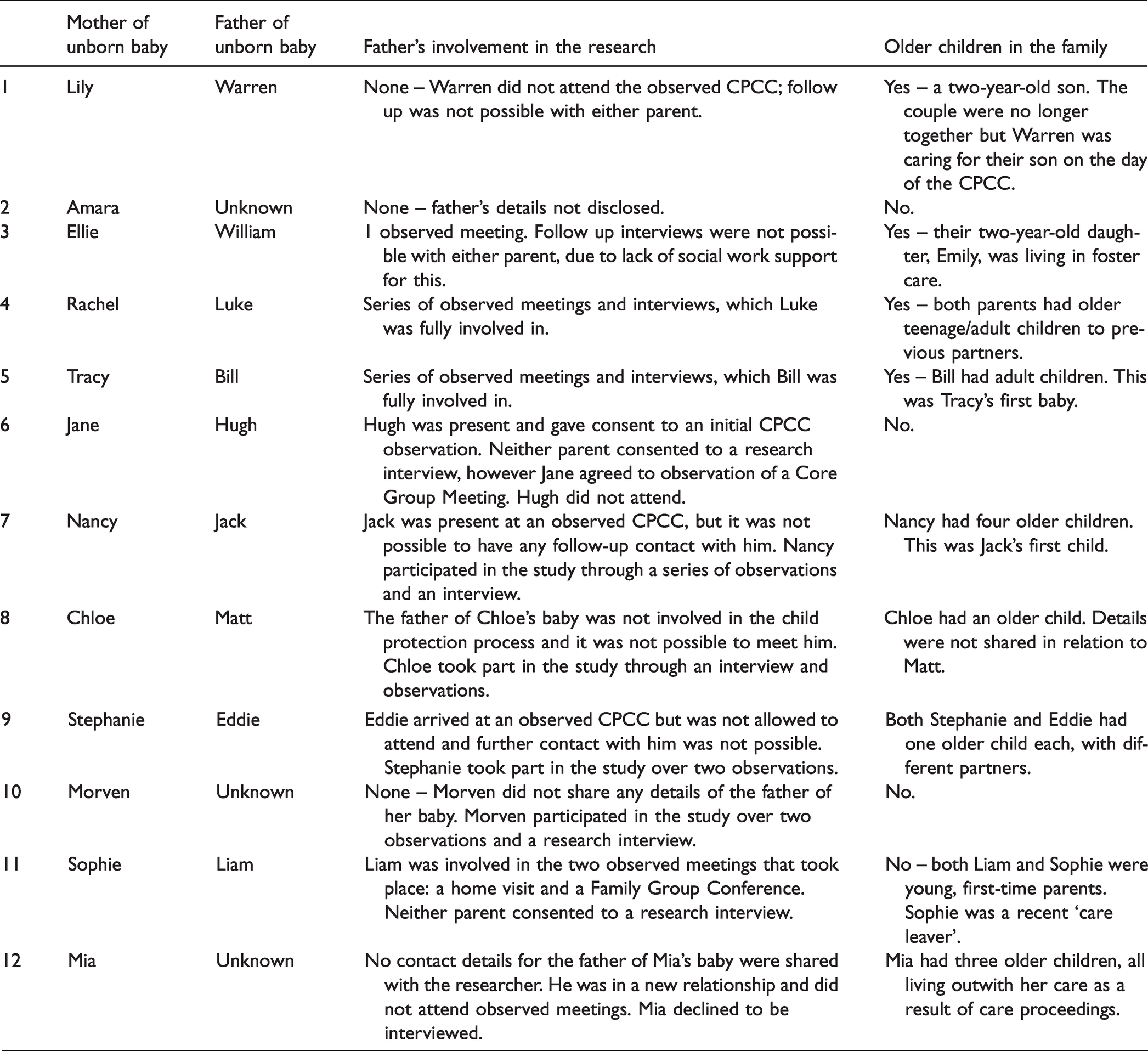
It is important to consider that some families in the sample were managing very complex paternal roles. Furthermore, some of the mothers had chosen not to name the father of their baby or were no longer in contact with him. To illustrate, Chloe, was expecting her second child. Her older son Bobby was cared for by his paternal grandmother in a kinship arrangement supported by the social work team. Bobby was at this stage six-years-old and Chloe visited him regularly.When I met her, Chloe was living alone in temporary council accommodation in a council estate on the edge of the city. The pregnancy had not been planned and Chloe had considered a termination at an early stage. She was no longer in a relationship with the father of the baby and had returned to a former boyfriend. Chloe explained in a research interview that this created difficulties in her current relationship, since her current partner was ‘really wanting a kid. Because he cries quite a lot because it’s not his. But at the end of the day, he met somebody else and I did, so. He always throws it in my face sometimes’ (extract from research interview with Chloe, expectant mother).
This delicate family situation made research access to the father of Chloe’s baby impossible. Another mother, Nancy, who took part in the study, was expecting her fifth child. Two of the fathers of her four older children had an active role in their lives and one of them was regularly involved in caring for the children. Nancy was expecting her current baby with Jack, who had not previously fathered a child and whose role in the family was yet to be established. All three of the men attended the pre-birth child protection case conference. However, none of the fathers were present in subsequent research encounters with Nancy, her children, and the social worker for the family.
There were ‘ghost fathers’ (Brown et al., 2009) haunting this research study. Although it was ethically and practically complex gaining access to the expectant mothers for the purposes of this research, gaining access to the fathers was even more difficult. There was a very intensive professional gaze on expectant mothers in the pre-birth child protection process. The women in the families were visible at the very centre of all child protection activities and professional expectations, while the men at times remained in the shadows. The mothers talked about the fathers of their babies, as did the social workers, yet the men’s corporeal presence and contribution in social work settings often dropped away. There were two fathers, Bill and Luke, who participated in a series of research observations and interviews and their views are considered in some depth in this paper. A further young father, Liam, was present at all observed meetings, but declined to be interviewed. For the remaining fathers, I met the men, and observed some of them participating in child protection meetings for their babies but was unable to sustain contact with them. They were never present again in observed meetings or research encounters with the mothers.
Data analysis
A large amount of multi-perspectival ethnographic data was created by the research. This data included audio recordings, detailed contemporaneous fieldnotes of observations and interviews, and the author’s field journal, containing elements of verbatim recording and reflection (Gioia, 2014). Transcription and analysis of the data was undertaken by the author, over a period of several years during and following the completion of fieldwork. Transcription was completed in original dialects, and where Scots dialect is strong, an English equivalent is provided in the quotations from the data shared below. Analysis was thematic in nature and proceeded through a process of codes and memos. Recognising dominant ‘symbols and cultural meanings’ (Vidich and Lyman, 1998: 44) present in the data was an important aspect of the analytic process.
Analysing data from fathers was poignant. Fathers who chose to participate in the research wanted to convey some of the feelings that they had for their children and for their partners. This was not always apparent in the context of social work meetings. This juxtaposition of the ‘risky’ fathers of child protection meetings, with the tenderness displayed by the men and described by the mothers in more domestic contexts provoked further analysis of the data. Although as stated above, the study did not set out to focus specifically on the men, the more detailed analysis established the research findings presented here. These are grouped under four headings and describe different phenomena in relation to the fathers in the study.
The first section deals with the way that the men’s tender feelings for their partners, expected babies and other family members emerged in the research data, in ways that were only rarely apparent in the social work meetings and assessments. The second section considers how the riskiness of men was established. The third section is concerned with the limited professional focus on the father’s contribution to the family, even when men were actively present in the child protection process. The fourth and final section considers the way that fathers were excluded or ‘disappeared’ from view in pre-birth child protection assessments, becoming ‘ghost fathers’. The implications of these findings are considered in the discussion section.
Findings
Paternal tenderness: A love that dare not speak its name?
In analysing the research data, it became clear that there was a gulf between the way that some fathers used the spaces opened up by the research, and the way the men appeared and were described in social work meetings and reports. In research encounters, the fathers’ feelings of tenderness and commitment towards their unborn babies, older children and partners were highly apparent. A particularly stark contrast emerged between one father Bill’s soft-spoken, thoughtful presentation in research interviews, and his more abrasive and argumentative style in social work meetings. Outside of the child protection meetings, Bill reflected on his experiences of being a father, and discussed how he felt about the expected baby and his relationship with his partner Tracy. Bill was aged 44 at time of participation in the research and had two adult children to a previous partner. I interviewed Bill once with Tracy, and once alone. In the second interview, I asked Bill if there were differences in becoming a father in the context of a pre-birth child protection assessment. Bill: Aye, it just, it’s, I mean it’s made Tracy think that she wished she got rid o’ it [terminated the pregnancy] at the start you know what I mean? it’s not a very nice thing having people basically telling you what to do with your ane [own] kid. You, you’re not even getting your ane kid, they’re gonna take it aff [off] you. [Pause] B: I suppose if the kid came, and then something happened to the kid then aye, right, youse [plural of ‘you’, here meaning child protection professionals] have got every right. But tae dae [to do] what youse have been shouting about, the kid’s going to get so much love it’s gonna be unbelievable! Know what I mean? Author: Mmm. B: It’s gonna be well looked efter [after], it’s no’ gonna need for nothing, know what I mean?’ Extract from research interview with Bill, father to Tracy’s unborn baby girl.
Interestingly, when men did display paternal tenderness in formal meetings, this was acknowledged by professionals, but did not necessarily reduce their assessment of the risk in the family. Ellie and William attended a case conference for their expected baby and for their two-year-old daughter Emily, who was living with foster carers. No definite decision about longer-term care arrangements was made at the observed Case Conference, however it was suggested that the baby was likely to be accommodated soon after the birth, and that it was unlikely that William and Ellie would be able to reclaim the care of either child. The main reason for this was previous neglect of Emily’s basic needs. As such this was a distressing meeting for the parents, and William made several emotional statements in relation to Emily and his expected son, who was due in approximately 3 months’ time. It’s the highlight of our week seeing Emily. I love seeing Emily but it’s hard knowing she doesn’t live with you because of what happened; what we did. It makes you feel bad I don’t know how it feels not to take my son home from hospital Extracts from contemporaneous fieldnotes of an observed case conference for Ellie and William’s expected baby and their older daughter Emily, aged two. They love this child. They love Emily. But they just can’t do it [parent the children safely]’ and that ‘you have to think of these children we’re advocating for and it would be worse if they did go home and something were to … [left unsaid] Extracts from contemporaneous fieldnotes of a research interview with Mary, social worker to Ellie and William’s unborn baby and daughter Emily.
I noted that I wanted to ask both parents about this. Unfortunately, it was not possible to interview William or Ellie. The social worker Mary was not supportive of the parents participating in a research interview, making this impossible to pursue. Relationships between expectant parents and social workers became observably strained when the plan was for the baby to be accommodated following the birth, and this may have been a contributing factor in Mary’s gatekeeping.
Paternal riskiness: ‘I felt unsafe’
The relationship between Bill, Tracy and the unborn baby’s social worker Courtney was described by the expectant parentsas difficult and antagonistic. The meetings between them that I observed were highly charged. At the point at which I interviewed Courtney, she had begun to describe Bill as a ‘risk’: a risk to the baby, to Tracy and possibly to professionals. The following quote encapsulates some of the perceived ‘riskiness’ around Bill. Courtney is talking about a visit she made to Tracy’s house with other professionals for a Core Group Meeting one weekday morning. Bill was present and was drinking alcohol with his adult nephew. Courtney is talking about what she took to be the implications of that situation for her assessment. But I felt unsafe the fact that it was his [Bill’s] it was just his cold presentation around it as well. He was quite aggressive, tut no! Passive, he wasn’t aggressive but he was a bit like, “I am [drinking] so what? What are you going to do about it?” Rather than “I’m really sorry”. If he’d come over and said,“Look I’ve made a mistake and I shouldn’t have done that, I should have been there for Tracy”. But he actually thought it was OK. It was a one-off so he was really minimising it, really dismissing it, and so was she [Tracy]. So what for me, if we’ve got in the future we’ve got professionals, that would be something that would make the baby, that would be a risk factor for the baby if his [sic.] parents are not able to prioritise his needs, his, her needs, over theirs. Because he [Bill] didn’t, wasn’t able to do that, that day Extract from research interview with Courtney, social worker to Bill and Tracy’s expected baby girl.
In research encounters, Bill shared information about his life that he was finding it difficult to communicate effectively to the people who really needed that information: the child protection professionals. For example, Bill talked in interview about a previous alcohol detox programme, the support he had valued from health professionals, and the techniques they had used that he found helpful. Although he was described by the social worker as ‘ambivalent’ about the baby, in research interviews Bill spoke about his joy at becoming a father again. He also described his fears for Tracy’s welfare if the baby was not in her care following the birth (Critchley, 2019). As uncomfortable as it was to see these fragmented perspectives emerge from the different participants in the research, it opened up important questions about how we talk to men as fathers in social work and gain a fuller picture of their lives and motivations in relation to their children. As Brandon et al. (2019) describe, most men in families who encounter child protection involvement are both a risk and a resource for their children. In this family, the resource part of this equation was apparent in the expectant parents’ descriptions, yet appeared absent from the social work assessment, which were pervaded by a gradually oozing risk that was attached to Bill.
The absent presence of fathers: ‘You were the one carrying the bairn’
The other father who it was possible to interview as part of this study was Luke. Luke was also in his 40s at the time of his participation and also had adult children, who had been raised by their mother. This was during a period when Luke had been heroin dependent and by his own admission not as involved as he could have been in his children’s care. Nevertheless, Luke retained a relationship with that family and particularly with his adult daughter. I interviewed Luke and his partner Rachel for the final time in the presence of their newborn daughter Tessa, who had arrived early and was at home with the couple. At the time of having Tessa, the couple were stable on methadone prescriptions and had good working relationships with the professionals involved, particularly their social worker Callum.
Gřundělová and Stanková (2019: 1915) have described how fatherhood is a multifaceted and contested construct. Yet even within this research interview Luke performed aspects of fatherhood dominant in the culture of the study, both the hegemonically masculine role of the father as ‘provider’ and the more ‘caring masculinities’ (Elliott, 2016) of fatherhood. Rachel made frequent reference to Luke being tired as he had been up the night before feeding baby Tessa. In the course of the interview, Luke talked about his determination to find work in order to support Tessa and Rachel, and also made coffee for Rachel, and made up Tessa’s next bottle. Luke’s displays of fatherhood appeared natural and consistent with Rachel and Callum’s descriptions of the family. In the context of this last research interview Luke began to talk about being in hospital with Rachel and Tessa, soon after her birth. He demonstrated a clear understanding of what might have happened in terms of Tessa’s care, and what the professionals had needed from both him and Rachel in order that they were given the opportunity to care for Tessa at home. Luke: We did it, we knew what was going to happen. [Here meaning that if they had not followed the child protection plan, Tessa would also have been removed, but she came home with them]. Rachel: There was a girl in the bed next to me, she got her baby taken off her. L: We knew if we never did it, that would happen to us but … R: It was heart breaking seeing it, thinking that could have been us do you know? L: Ken [I know]. R: But that’s gave us, we keep that, I’m going to keep that in my head for, like the days that I’m stressed. Not that I’ve ever been tempted to ever go and score again. It’s never, the thought’s never entered my head. Well it did at the beginning, but do you know since I’ve had Tessa, because they were worried that I could start drinking again, or start using again but it’s not, do you know what I mean, it’s no’ even entered my head. What was I going to say before that? There was something before that? Author: You were talking about the girl in the bed next to you in the … R: She, aye, she got her baby taken off her because it’s like she never had any intention of, I don’t know … L: Like you say, every case is different, everybody’s different … R: I was going to say something else but I can’t remember … L: Some people can get off [street drugs] for the kids, and other people get their kids taken off them basically … Extract from research interview with Luke and Rachel, parents of baby Tessa. Rachel was trying to talk about some quite difficult stuff with her Dad and Luke was holding her hand and kind of stroking it and I noticed it and I wasn’t sure that Shane did but it was the first thing Shane spoke to me about when we came out, he said, “They really, really support each other” and he said that, those kind of bits of emotional support were there in terms of you know, he’s very nurturing towards her and, and what I saw as being quite a sort of positive was that Shane said you know, maybe that could work for them. You know, maybe they have got something there that together as an item they would be able you know to give the baby everything it needed Extract from research interview with Callum, social worker to Rachel and Luke’s baby Tessa, prior to her birth. Luke: And they asked us right at the end, the Chair Person asked us what did I think? Rachel: I was sitting there thinking when are they even going to ask Luke’s opinion or do you know even speak to Luke … . I just felt like they didnae [didn’t] ask you anything really until the end eh? L: Until the end, aye. R: And I did feel like it was all focused on me. L: You were the one carrying the bairn [baby]. R: I know but the, like other issues like that come out of your drug use, and that, do you know what I mean? They left all that just a wee bit to the end … L: To the end aye. R: Whereas yours should have been just as in depth really.’ Extract from research interview with Luke and Rachel, parents of baby Tessa.
Disappearances and deflection: The creation of ‘ghost fathers’
Men can very easily become absent from view, even when they pose the most significant risks in families. Within the research sample, Eddie was the father of Stephanie’s expected baby. This was Stephanie’s second baby and her older child was cared for primarily by her own mother, in a kinship arrangement. Eddie also had a previous child to a former partner. He had assaulted both women to the stomach during the pregnancies with his children within a pattern of extremely violent domestic abuse. There were therefore high levels of concern for Stephanie and her unborn baby. In this extract from a research interview Benjamin, the social worker to the unborn baby, explains the risks. Yes. I have fear because of Eddie. I mean I’m looking over historically here, if we look back at his first child, at the previous relationship. He caused a lot of disturbances in the child’s early childhood. Yes, the child had witnessed a lot of domestic violence. I think a lot of alcohol abuse as well. So, that’s my worry. I wouldn’t want the child’s early childhood to be exposed to that kind of behaviour. Yes. That’s my worry … Eddie can come to me and present as if he’s a changed man but it’s very difficult to take it. Yes, we have services we want him to engage with, like domestic abuse services and anger management, mental health assessment that we would want him to, I mean, to see if he is going to stabilise. If he engages well … this is why I want to meet with him. I don’t want to rule him off completely. I still want to give him the chance, right? Put in place certain services that we think are relevant. And to support positive change. If he does engage, then we will see from there what we can do. Probably supervised contact [with the baby], something like that, at a contact centre’ Extract from research interview with Benjamin, social worker to Stephanie and Eddie’s expected baby.
What actually happened in terms of the observed pre-birth Child Protection Case Conference for Stephanie and Eddie’s unborn baby was that Eddie came to the social work office for the meeting. However, the meeting proceeded without Eddie. There was confusion over how he could be included given the threats he had made to Stephanie, he was deterred for some time and he eventually got up and left the building. The case conference was a very difficult meeting: the baby’s ‘name’ was placed on the child protection register, and Stephanie was advised that her baby may be accommodated shortly after birth. She was visibly shocked by this possibility. In a research interview sometime later, Benjamin told me that Eddie was no longer engaging with the child protection professionals. Yet they strongly suspected that Eddie was still in touch with Stephanie. Benjamin: Because I’m not quite convinced Eddie is completely away off the scene. He has not been responding to my calls, I have not met him since the case conference … I’ve tried so many times, I’ve written to him, I’ve phoned, I’ve sent him text messages. I’ve not had any positive response or him wanting to arrange a meeting with me. I was thinking also to make an unannounced visit his home as well, just to see what is happening. Author: And so do you get the impression that he knows what happened at the case conference? B: He knows! He knows, he knows, he knows, yeah. He knows. That’s one other thing that I tend to question their relationship because maybe Stephanie has communicated. Or Stephanie has communicated within her group or friends who have passed on the information to Eddie. I don’t know. But he knows. He knows. Extract from research interview with Benjamin, social worker to Eddie and Stephanie’s unborn baby.
Discussion
The treatment of fathers and fatherhood in the child welfare context appears to be an intractable problem across time and place (Coady et al., 2013; Maxwell et al., 2012; Mykkänen et al., 2017; Turesson, 2020; Zanoni et al., 2013). This issue has not been greatly improved by sustained calls for changes to practice (Clapton, 2013; Featherstone et al., 2007) or by ‘greenshoots’ initiatives (Scourfield, 2015). Brandon et al. assert that ‘in spite of the difficulties in engaging fathers, practitioners are able to create working relationships with men’ (2019: 449). Yet child welfare remains predominantly women’s ‘work’ (Brown, 2006). To the extent that as Ewart-Boyle et al. (2015: 472) have suggested, ‘an overreliance on working with mothers and exclusion of fathers is so deeply rooted in society and the culture of social work that it is often unquestioned’.
The exclusion of fathers from child protection processes increases the responsibilisation of mothers for the risks and difficulties in the family (Critchley, 2020b; Stewart, 2020). In only a small minority of cases did the working relationship that the social worker made with the father have anything like the strength and purpose of the working relationship that the expectant mother was expected to form with professionals. This ensured that the child protection spotlight was trained firmly on the women. The need for robust assessment of what exactly fathers may have to offer their children on a spectrum from life story information to parenting their unborn baby is highlighted by Ward et al.’s (2006, 2012) research into the care pathways of infants and very young children. This is clearly a very complex task in situations of domestic violence, where the primary task is to manage the risks to the child and mother (Devaney, 2014; Lloyd et al., 2017). What O’Hagan (1997) described as ‘avoidance’ of men by social workers has significant impact on all members of the family. As Pennell et al. (2014: 38) highlight, it ‘means that workers cannot directly address the abuse that men perpetuate against their children and the mothers of their children’.
The widespread social work exclusion of fathers from this work continues to have serious implications for fathers, for their children and for mothers in child-welfare involved families (Philip et al., 2019). Fathers are denied opportunities to enjoy their parental rights and responsibilities, whilst mothers are over responsibilised and often held to account for the harmful behaviour of men in the family setting. Children are potentially denied the benefits of a relationship with their fathers in terms of identity and day-to-day care. Progressive initiatives, such as gender neutral language, substitute terms like caretakers or parents for mothers or fathers … have done little to shift the focus from women to women and men. As evident in our file review, workers persistently read ‘parent’ as ‘mother’ in policy and legislation (Brown et al. 2009: 27).
This study found that social workers seeing fathers as ‘ends in themselves’ rather than obstacles in the way of the working relationship with the mother or of the monitoring of the baby’s safety was crucial. Such an approach underwrote all meaningful involvement of men in child protection meetings and assessment. As Zanoni et al. (2013) have argued, greater inclusion of fathers in practice and in research remains a pressing priority for social work, despite extensive literature calling for more effective engagement with men as fathers over recent decades (Daniel and Taylor, 1999; O’Hagan, 1997). Unfortunately, the findings of this study add weight to an over-flowing pool of evidence of social work’s failure to work respectfully with fathers for the welfare of their children. The inclusion of fathers in the research could have been more complete and a number of factors made this difficult, including gatekeeping both by social workers and mothers. Nevertheless, the contribution of the fathers to the research that was possible was important. Data involving fathers provided evidence that social work’s limited engagement with men extends to pre-birth work. Further, the research encounters with fathers that were possible, indicated that less agenda-driven, open conversations with fathers can lead to more reflective and informative outcomes.
Conclusion
Using data from and about fathers, I have argued that pre-birth child protection processes and practice can function so as to overlook or actively exclude the contribution of men. The findings of this study highlight the need for practitioners to see, talk with and understand fathers differently. Despite the problem of ‘ghost fathers’ in child welfare having been repeatedly identified through research, strategies to address this issue are yet to demonstrate significant changes in practice. Finding ways to effectively include men in the assessment of risk in their families and in care planning remains an ongoing challenge for child welfare.
Further research specifically focusing on the men in the families of children subject to child welfare intervention remains necessary. Methods for engaging fathers in this research also require further development. The research reported on in this paper indicates the potential of ethnographic methods in creating a meaningful forum for fathers to share their concerns and perspectives. Furthermore, the ways that men made use of research spaces created by this study suggested that less agenda- driven encounters with fathers allow men to provide information that is of potential significance for child protection assessment. In order to give up the ghost fathers of child protection, practitioners need to treat the men involved in children’s lives as real, multi-dimensional, and capable of both harmful and caring behaviour within their families.
Footnotes
Acknowledgements
Declaration of conflicting interests
The author(s) declared no potential conflicts of interest with respect to the research, authorship, and/or publication of this article.
Funding
The author(s) disclosed receipt of the following financial support for the research, authorship, and/or publication of this article:This research was funded by an Economic and Social Research Council (ESRC) 1 + 3 PhD studentship award number 1091282. The author’s doctoral research was undertaken at the University of Edinburgh, within the Graduate School of Social and Political Science.
