




Abstract
This article examines how seven social workers within the Swedish social services describe intimate partner violence between teenagers (IPV-BT). The article adds to the literature by examining IPV-BT outside a U.S. context, where most studies have been conducted. Based on semistructured qualitative interviews, the authors analyze descriptions of IPV-BT in relation to Charles Tilly’s notion of category making through transfer, encounter, negotiation, and imposition. They also analyze how the social workers’ descriptions of IPV-BT relate to the intersection between age and gender. The results show that the social workers mostly described IPV-BT by referring to encounters with teenagers and by transferring knowledge and theoretical definitions from their specialized working areas, primarily intimate partner violence between adults (IPV-BA) and troubled youth. More rarely, the social workers based their definitions of IPV-BT upon negotiating dialogues with teenagers. Also, those who worked in teams specialized on IPV had the mandate to impose their definitions of IPV-BT to other professionals and teenagers. When taking age and gender hierarchies in consideration, the results show IPV-BT risks being subordinate IPV-BA on a theoretical level, a practical level and in terms of treatment quality. The study suggests that social work with IPV-BT needs to be sensitive to the double subordinations of the teenage girl and of the teenagers who do not follow gender expectations.
Introduction
The teenage years are significant in maintaining and reconstructing our social identity. Many of us have romantic relationships as teenagers, years before we become adults. For some, these relationships are sublime. For others, they are pleasant but not remarkable, and for some, they include the risk of being exposed to or perpetrating violence.
Most studies about intimate partner violence between teenagers (IPV-BT) have been conducted in the United States. Makepeace (1981) published the first article on so-called courtship violence between college students in 1981. Since then, a range of studies have focused on intimate partner violence among young people (e.g., Draucker et al., 2016; Edwards et al., 2015; O’Keefe et al., 1986). Researchers have used terms such as adolescent dating violence (Ashley and Foshee, 2005), dating violence (Kelley et al., 2015), and teen dating violence (Zweig et al., 2014).
In Sweden, which is the focus of this study, the conceptual framework is still developing; state reports have used the terms intimate partner violence between young people and boys’ violence towards girls (The Swedish National Council for Crime Prevention, 2017; Ungdomsstyrelsen, 2013). Research on IPV-BT in a Swedish context has been scarce but grown in recent years. 1 Two Swedish studies have examined boys’ violence towards girls (Gottzén and Korkmaz, 2013; 2 Wiklund et al., 2010). Other studies have investigated the prevalence and health consequences of violence within young people's lives (Blom, 2015; Landstedt and Gillander Gådin, 2011) and IPV among youth (Blom, 2015). Similar to international research (Barter, 2009), Swedish studies highlight IPV-BT as a significant problem (Gottzén and Korkmaz, 2013) that is associated with great psychological distress (Landstedt and Gillander Gådin, 2011). Both international and Swedish scholars have linked IPV-BT to gender roles and gender expectations (Bowen et al., 2013; Sears et al., 2006; Wiklund et al., 2010), underlining the need for studies that address gender and age-related positions of teenagers (Barter, 2009; Gottzén and Korkmaz, 2013).
One frequently reported problem in both international and Swedish research is that few teenagers tell anyone about the violence or seek professional help (Ashley and Foshee 2005; Gottzén and Korkmaz, 2013; O’Keefe et al., 1986; Sears et al., 2006). Reasons for not sharing their experiences with violence include teenagers’ lack of trust for adults (Hellevik et al., 2015) and that teenagers do not want to be associated with the adult marital stereotypes of abused wife or abusing husband (Gottzén and Korkmaz, 2013). These studies reveal a need to explore how social service professionals understand and respond to IPV-BT; particularly when they could be a resource for teenagers. This article aims to examine the conception of IPV-BT in the context of Swedish professional social workers. More specifically, it investigates how social workers within the municipal social services describe IPV-BT as a category, particularly related to gender and age.
Conceptual and theoretical framework
This article refers to IPV-BT as all examples of physical and or psychological violence between teenagers who are, or have been, romantically and or sexually involved. We define Intimate Partner Violence Between Adults (IPV-BA) as all examples of physical and or psychological violence between adults who are, or have been, romantically and or sexually involved. Previous research has frequently linked IPV-BT to gender, but most studies have focused on heterosexual relationships only or have been designed with male and female as the only options for gender identity. The term IPV-BT enabled us to stay open to the social workers’ experiences of IPV regarding gender identities and same-sex relationships. Nevertheless, we are aware that the use of IPV is problematic. IPV, instead of men's violence against women, risks overlooking a structural power relationship where men’s violence against women is the ultimate tool to maintain a superior position (Holmberg et al., 2015). In the same fashion, IPV-BT, instead of boy’s violence against girls, risks overlooking a structural power relationship between boys and girls. IPV also hides the fact that men are overrepresented perpetrators in relation to systematic and controlling violence (Johnson, 2006). To mitigate these issues, we incorporate a discussion on gender inequality with the intersectional age and gender approach that represents the foundation of the analysis.
The making of social categories
To understand social workers’ descriptions of IPV-BT in relation to how categories are constructed, we draw upon U.S. sociologist Tilly’s (2003) discussion on durable inequality, where the making of social categories plays an initial part. Tilly describes how social categories emerge or change due to transfer, encounter, imposition, or negotiation (Table 1).
Category making processes (Tilly, 2003).
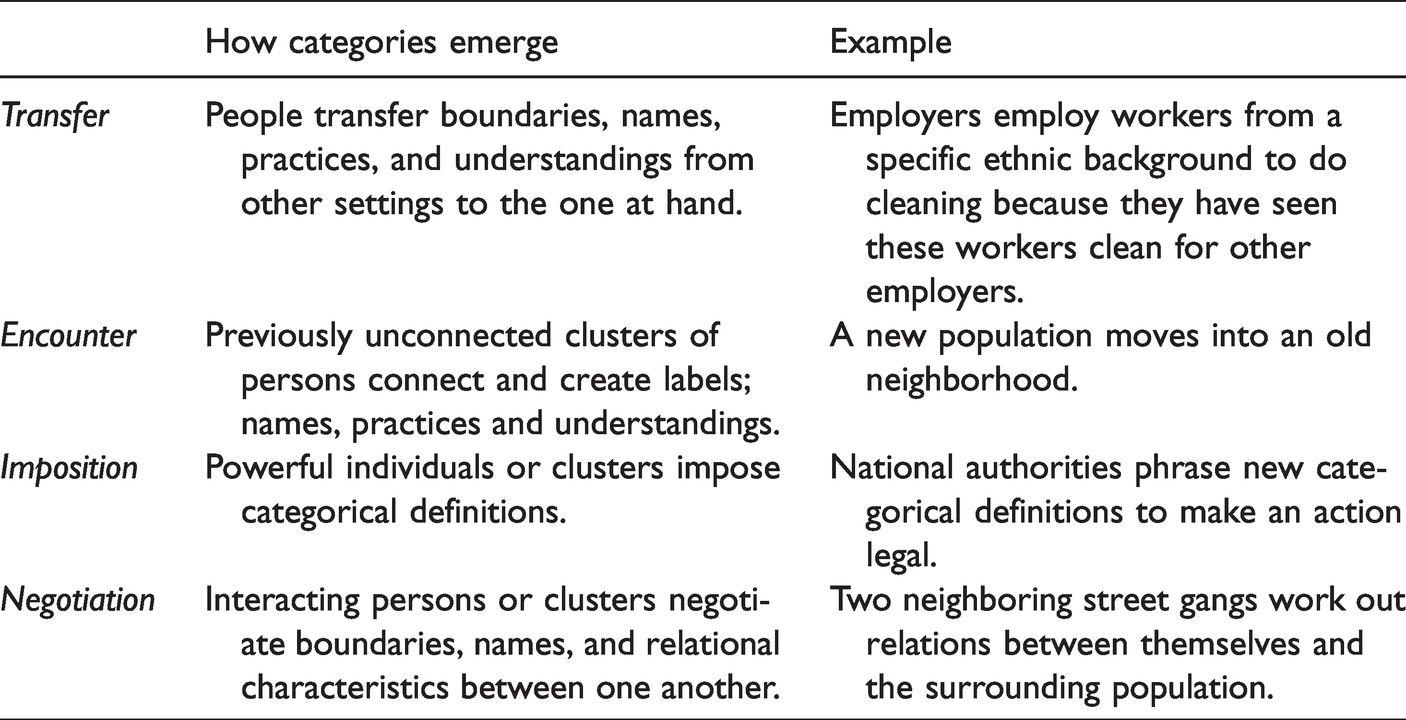
Tilly’s notion is useful to us since the social workers created their definitions of IPV-BT as an exclusive social category during the interviews. That is, though all had worked with IPV-BT, none were used to treat IPV-BT as a category separate from IPV in general. However, even though category-generating processes always produce differences between categories, they do not necessarily generate inequality (Tilly, 2003). We will discuss the construction of IPV-BT in relation to durable inequality in the conclusion section of this article.
Social categories coexist in relation to each other. In addition to IPV-BT, we focus on gender and age. More specifically, we will highlight the junctions between age and gender concerning the social workers’ descriptions of IPV-BT. Our approach is inspired by an intersectional framework, which enables the exploration of the junctures of multiple marginalization (Crenshaw, 1991; Taefi, 2009). We believe that age and gender are already biased by inequality. In regard to gender, women are often unequal to men. Men access more power than women in relationships and tend to be judged as individuals rather than men, while women are defined as women rather than individuals (Mattsson, 2010). Similarly, teenagers are often unequal to adults. In societies aiming for productivity, the adult population fit for labor is seen as superior to the young and elderly (Krekula et al., 2005). This article also relies on the assumption that gender has a meaning beyond biological conditions (West and Zimmerman, 1987) as well as age (Krekula, et al., 2005). What is considered appropriate behavior in terms of age and gender is temporally, spatially, and contextually bound, and is prone to change over time.
Methodology
This article is based on semi-structured qualitative interviews with seven social workers working in social services in five Swedish municipalities. Since the participants are few, the results shall not be interpreted in general manners; rather, they shall be read as a discussion regarding how social workers might be influenced by gender and age-related assumptions when constructing their understanding of IPV-BT.
In Sweden, social work is mainly part of the public sector, divided into three areas; the state, county, and municipality. Each municipality is mostly autonomous when it comes to organizing their social services. Many municipalities have specialized units where social workers work with specific tasks, groups, or specific problems (Lundgren et al., 2009). The municipal social services work is regulated by the Social Services Act (SFS 2001:453) (SoL) and other supplementary legislation. SoL states that social services are responsible for providing care and service, information, counseling, financial assistance, and other assistance for individuals in need. These responsibilities naturally include people affected by IPV (Ljungwald and Hollander, 2009).
We contacted 37 social workers in 14, randomly chosen, municipalities in southern Sweden. Our criteria for participation was the experience of working with IPV-BT. A considerable number declined to participate since they had only encountered IPV-BA or did not have enough experience working with IPV-BT.
As shown in Table 2, all seven participants worked in units specialized on either IPV, IPV-BT or troubled youth. They all had experience working with IPV-BT through individual or group therapy and support. Participants 2 and 3 had worked extensively with IPV-BT. The others had encountered IPV-BT occasionally. All except one worked in units specialized in either IPV or troubled youth. The IPV-units were supposed to support both victims, witnesses, and perpetrators. The troubled youth-units covered a wide range of areas, such as youth with substance abuse, youth who had been convicted, youth who suffered from mental health issues, and youth who did not receive proper care from their families.
Participants.
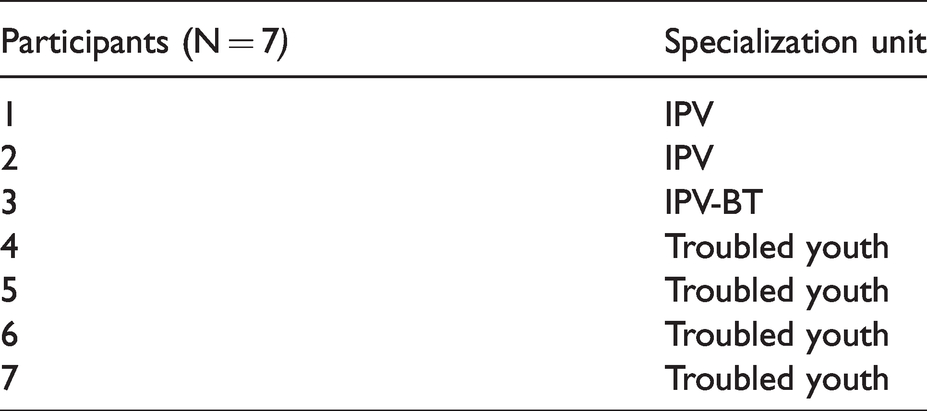
One of the authors conducted and transcribed all the interviews. Participants 1, 2, and 3 were interviewed separately, and participants 4, 5, 6, and 7 in pairs of two. Since social work is constructed both upon team cooperation and individual work, the inclusion of individual and pair interviews in the study shows a fair picture of the varied organizational nature that the teenagers meet when receiving help for IPV-BT.
We used thematic analysis to study the transcripts. A thematic analysis involves analyzing the research material for recurrent patterns, developing preliminary categories or themes, which are tested and changed as new themes and patterns emerge (Fook, 2002). Further, a thematic analysis can be used to develop the theme based on an available theory (Vaismoradi and Snelgrove, 2019). We started the analyzing process by reading the transcripts with our research question in mind, searching for patterns regarding descriptions of IPV-BT in relation to gender and age. Two themes stood out; IPV-BA and troubled youth, but also a general pattern where the social workers seemed to contradict their own descriptions or being unsure of them. We tried to interpret these contradictions through available theories, for example Johnson's (2006) theory that IPV consists of both controlling and noncontrolling violence, which makes IPV divisible into four different IPV typologies. We read the transcripts to see if the contradictions could be explained in that the social workers had encountered these different types of IPV-BT. But the transcripts did not contain enough descriptions regarding controlling behaviors, and the theory did not help us explain the recurring references to the themes IPV-BT and troubled youth. When rereading the transcripts with Tilly’s (2003) notion of category making processes in mind, we found that our initial themes IPV-BA and troubled youth made sense if interpreted through Tilly’s notion that categories can emerge through transfer of knowledge from already existing categories. We also found that the contradictions within the social workers descriptions could be explained in that the social workers simultaneously used different types of category making processes to create their definitions of IPV-BT. Based on Tilly’s four category making processes, we subsequently developed the themes: transfer, encounter, negotiation and imposition.
The making of IPV-BT
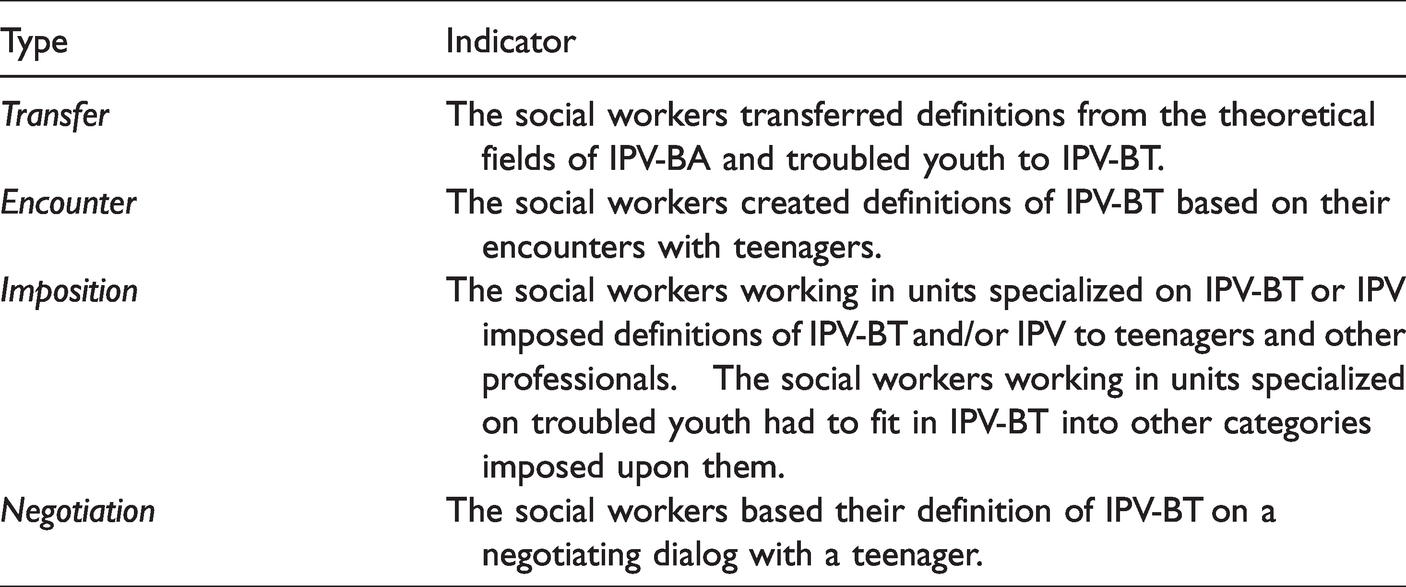
In this section, we will illustrate how social workers described IPV-BT. We will use Tilly’s (2003) notion of transfer, encounter, negotiation, and imposition, as shown in Table 3. Furthermore, we will discuss how these descriptions intersect with categories of gender and age.
The social workers’ use of category making processes during the interviews.
Transfer
According to the social workers, education and research regarding IPV-BT were inaccessible within their work. To understand IPV-BT, they transferred theories, research, or training from IPV-BA and troubled youth. For example, transfer occurred when one social worker used the information she had gained from a training day regarding troubled youth or, more specifically, youth who commit sexual abuse, to describe IPV-BT. By stating that IPV-BT is associated with youth who commit sexual abuse, and that “one who gets sexually abused within a relationship surely experiences ‘common’ beating in between as well,” she created a way to access information and to define IPV-BT through transfer. Another example of transfer, but this time from IPV-BA, is illustrated in the following quote: I don’t think it [teenagers’ intimate violence] is different from adults’. I think that it, initially among the girls, becomes normal and one thinks it was one’s own fault. And I think that the boy’s too, one gets provoked and “she’s got herself to blame.”
When transferring knowledge from both troubled youth or IPV-BA, the social workers described teenagers as either lacking adulthood skills or as different from the adult norm. This illustrates a hierarchy where adult skills are the norm towards which teenage skills are measured. For example, one social worker presumed that teenagers, unlike adults, lack self-control, which made IPV-BT more likely to occur in public spaces. As he explained: [Teenagers] are not so good at camouflaging it [IPV]. When we grow older, we feel more ashamed that we have this side to us … so we bite the bullet and let it out at home instead. Young people explode both here and there and everywhere. There are a lot of skills: structuring and planning, and organizing that are the last to develop … And these are the things that in a relationship, I think, if someone comments on that, might piss you off and trigger it [IPV-BT].
Sometimes the social workers' understanding of IPV-BA and troubled youth contradicted one another, which resulted in IPV-BT being conceived as different from IPV-BA. For example, one social worker described IPV-BT and IPV-BA as equally damaging but did not believe that youth had the same need for professional counseling as adults. She based this on the age-related assumption that teenagers’ relationships are easier to forget. As she explained: “With teenagers, I don’t know, it is [pause], the processes are often quite fast as well [pause]. And one forgets quite fast, one moves on, one gets a new guy and such.” The notion that teenagers’ relationships might be shorter caused the social worker to plan her work with IPV-BT differently from her work with IPV-BA in terms of treatment length.
In the same way as the social workers interpreted teenagers with experience of IPV-BT as soon to be adults, they also interpreted them as soon to be adult men or adult women. For example, one social worker described “masculinity” as an “exploration that’s in its early stages when one is young”. Since teenage boys have not yet fulfilled their gender exploration, he believed that they tended to “follow” each other more often, causing peer pressure to be “switched on to a higher extent”. The social worker’s understanding of age and gender helped him transfer the idea of peer pressure from troubled youth to IPV-BT. This transfer was made by several of the social workers, who expressed that teenagers might be affected differently by “peer-pressure”, “the role of peers” and “role models” than adults.
Moreover, the social workers agreed that peer-pressure affected boys and girls differently. According to the social workers, girls are pressured to be available and flexible to others’ needs (boys’ in particular), making them subordinate to boys and at risk for exposure to IPV-BT. Boys, the social workers’ explained, are pressured to involve their peers in perpetuating IPV-BT. As one social worker expressed: So, when one thinks about youth, then one hears about group rapes, and one hears about boys who “lend their girls” to their friends and that stand beside and watch. And that’s not very common to hear about among adults.
Encounter
Most of the social workers described IPV-BT as uncommon in their practices; yet, all of them referred to encounters with teenagers who had experienced IPV-BT. Similarly, the social workers in Ljungwald and Svensson’s (2007) claimed to come in contact with victims of crime rarely; however, when discussing victimization on an individual level, it was clear that they continuously met people that had been exposed to crime. Also, per Ljungwald and Svensson’s study, the social workers interpreted IPV-BT as more complex when defining it through encounters than when defining it through transfer. When departing from encounters, the social workers found IPV-BT hard to define. Some expressed that the definition of IPV reflects an adult point of view, which made it difficult to even talk with teenagers about it. As one social worker explained: When we talk about intimate partner violence, we talk in an adult way … we cannot talk to a sixteen-year-old in the same way as we do with a twenty-five-year-old. It is not possible. And if we haven’t got a definition for the violence, we cannot express what we mean. We often see adolescents that live in families where there’s a lot of violence within the family … and where it might be the brothers that beat the sisters and when it’s complicated … . We don’t know the nature of the violence, because it's a bit like we don't really know who's beating who.
The social workers’ statements also reflected how adult relationships and acquaintances are seen as superior to teenagers’ IPV-BT experience. As one social worker expressed: Sometimes I think that we diminish violence in youth relationships … the adults around them are like “Yeah, but what the heck … his dad is our bank clerk and her mother works at the school.” We don’t want to make a big deal out of it.
The social workers mainly encountered IPV-BT with boy perpetrators and girl victims. This might explain their general assumption, which manifested in their use of “he” or “the boy” in relation to the perpetrators, and “she” and “the girl” in relation to the victims. The social workers’ general assumption also fit IPV-BT definitions made by the teenagers, where teenage girls tend to define violence based on its damaging consequences whilst the boys define violence based on the perpetrator’s intentions (Sears et al., 2006). That is, girls' very definition of violence is from the victim’s point of view, while boys define violence from the perpetrator’s point of view.
Although the idea of the perpetrating boy and exposed girl bothered the social workers, it was normalized in the social workers’ perceptions of IPV-BT. However, when some of the social workers added that “girls can perpetrate violence as well”, they became uncomfortable, spoke more slowly, and chose their words more carefully. As one of them expressed: This is a bit [sighs and pauses] that one can’t talk that much about. I would like to be a bit careful with my words. But if I put it like this: there are also boys that are being very exposed by girls. Not the tough ones [boys] … . but those who are insecure and that are, like, subordinate the boys with power, but also become subordinate to the girls.
Based on the encounters with teenagers and other social workers, one social worker argued that the implied notion that girls are exposed to IPV-BT while boys are perpetrating IPV-BT leads to lesser support for perpetrating girls and exposed boys. He meant that perpetrating girls get support primarily related to depression and post-traumatic stress disorder, not related to their violent behavior, while boys exposed to violence get support related to their masculinity. The tendency to alter the support depending on gender expectations were present also in the social workers’ over all descriptions of their encounters with teenagers. One social worker advised teenage girls to find their inner child, while another social worker advised teenage boys to visualize themselves as grown-up men. As the two quotes, exemplifies: I often ask ‘can you bring a photo from when you were little’. So that they can take their own little girl by the hand and bring it along the way. When I talk to boys, I ask them to look ahead to what they would like the relationship with the woman they will marry to be like … do I want to have a woman, who is the mother of my children, who is scared of me?
Imposition
During the interviews, the social workers did not mention that specific definitions or perspectives of IPV-BT had been imposed on them. None of them talked about laws, regulations, directives, or management-initiated training related to IPV-BT. Instead, IPV-BT was not a prioritized category within their practices.
All social respondents worked in municipalities that divided the social work into specialized teams focusing on either IPV-BT, IPV or troubled youth. This organizational division between teams can be considered a making of categories based on imposition. Being part of this specialization-based organization, the social workers became the presumed specialists in different areas. This seemed to give some of the social workers a possibility to impose category definitions regarding IPV and IPV-BT to other professionals as advice-giving specialists. As the respondents working explicitly with IPV-BT illustrate below: It’s they who turn to us. I cannot say that we have anyone to turn to for discussions. [Because] this is our niche. So they can call here for advice, but we are the ones who are supposed to be the niche. Some school counselors might ask if they can come and get a bit of information. Which they naturally can. We also give education and lectures to our closest collaboration partners within the social services, the police, region-based counselors, schools and volunteer organizations, when we have the time. I have worked with someone who was sixteen, but that was only to explain how the process of normalization works so that this girl should understand what had happened to her. We consider adding a seventh violence type that we’d call “neglect.” And it [neglect] … might be that one gets wounded and [is] prevented from seeking hospital care. Mm, when it comes to treatment of juvenile offenders, for example, it might be decided that the person shall attend a specific treatment program. Which focuses specifically on the violence problem. It is like a referral and the way it has to be.
Negotiation
The social workers’ definitions of IPV-BT were not based on negotiations between them and other professionals. However, their encounters with teenagers seemed to contain certain negotiating elements. One social worker illustrated how her assumption that IPV-BT does not occur in the presence of parents in the family home changed when a teenager she met claimed otherwise. The negotiation between the social worker's assumption and the teenager's experience lead the social worker to construct a new definition as to where IPV-BT might occur. As shown below: It happens right there in their rooms, even though the parents are in the kitchen or in some other room … and I know, I ask: “Don’t they hear? Don’t they react?” “No, no” [the teenagers respond]. And then that sequence is over when they come out to eat, I suppose.
Conclusion
This article has examined how social workers within the Swedish social services describe IPV-BT. We found that the social workers mainly described IPV-BT by transferring knowledge and theoretical definitions from the specialized areas in which they worked, primarily from IPV-BA and troubled youth. Descriptions based on encounters with teenagers were also present in the interviews, which sometimes contradicted those based on transfer. For example, when transferring theoretical knowledge, the social workers described IPV-BT as equally damaging as IPV-BA. Nevertheless, based on encounters, the social workers argued that teenagers need less professional counseling even though they were presumed to be less skilled in handling relationships than adults. Also, the social workers mainly used IPV-BA as a departure for transfer. However, when talking about encounters with teenagers, they stated that IPV-BA is not sufficient to understand IPV-BT. Neither does teenagers want to be measured against adult gender stereotype, since this is a factor that prevent them from seeking help (Gottzén and Korkmaz, 2013).
Imposition was primarily used on an organizational level where IPV-BT was squeezed in as a subcategory beneath IPV-BA or troubled youth. We found only one example of when social workers used negotiation as a base for their definition of IPV-BA, primarily with teenagers themselves. In future studies, it would be interesting to see if a higher number of participants would generate more examples of the same kind, or if negotiation with teenagers is a rare process concerning IPV-BT.
Even though category-generating processes always produce differences between categories, they do not necessarily generate inequality (Tilly, 2003). According to Tilly, inequality occurs when understandings and social relations transfers from one category into a new, or when the rewarding of social routines depend on the maintenance of existing categories, or when efforts and resources are taken, or hidden, from one category to the benefit of the other (Tilly, 2003). In this article's results, we have seen indicators that IPV-BT, as a category, runs the risk of durable inequality in relation to IPV-BA.
Firstly, we have seen that the social workers’ understanding of the already unequal categories of age and gender are nestled into the category making processes. The most prominent indicator is the social workers normalization of adulthood which manifest in the conception that teenagers do not hold teenage skills, but merely lack adult skills. Also, we have seen that this lack was associated with feelings of shame and a trigger for IPV-BT. Combined with the social workers’ general experience of girls being the most common IPV-BT victims, this paints a picture of the teenage girl’s double unequal position. This might explain how even non-intimate relationships between adults were considered more important than girls being exposed to IPV-BT, causing IPV-BT to be less reported by adults.
Secondly, we found indicators of rewarding, depending on the maintenance of gender expectations. For example, the social workers’ advice to girls with IPV-BT experience was to relate to their inner child, whilst boys with IPV-BT experience were advised to relate to themselves as grown men. That is, the teenagers with experience of IPV-BT were advised to heal by maintaining an unequal power relationship between boys and girls. The fact that the beaten girl’s story was normalized within the social workers’ descriptions of IPV-BT (and that the stories of perpetrating girls caused discomfort) is another indicator of how maintenance of the gender expectations was rewarding. According to the social workers, the maintenance of gender expectations might be one explanation as to why girls who perpetrate IPV-BT did not receive as adequate support as boys who perpetrate IPV-BT.
Third, we have seen that some social workers shortened the treatment length of IPV-BT based on assumptions of age. Some also witnessed that the quality of the treatment varied depending on gender. This indicates that resources are taken or hidden from teenagers with IPV-BT experience, especially for those who exceeded the expected gendered norm.
I summary, we have found that IPV-BT runs the risk of being unequal to IPV-BA on both a theoretical and a practical level. Authorities must keep this in mind when organizing social work with IPV-BT. We have also shown how the teenage girl's double subordinate position in terms of gender and age, and teenagers who do not follow gendered expectations, might affect the quality of the help received. We suggest that social workers who work with IPV-BT stay sensitive regarding this when forming their interventions.
As it turned out, the respondents spoke almost exclusively of heterosexual, two-partner relationships. Only one of them had worked with IPV-BT in a same-sex relationship or where one or more of the involved in the relationship had a trans-, or other, gender identity. Some previous studies have not found significant connections between social class or ethnicity and IPV-BT (Ashley and Foshee, 2005; Landstedt and Gillander Gådin, 2011; O’Keefe et al., 1986). This does not imply that categories like such as, ethnicity, sexual orientation or ability are unimportant in the study of IPV-BT, they need to be further explored. Some racialized victims of both IPV and IPV-BT may, for example, be silent and not seek help because of issues related to racism or immigration status.
Footnotes
Acknowledgements
The authors thank the social workers who participated in the study.
Declaration of conflicting interests
The author(s) declared no potential conflicts of interest with respect to the research, authorship, and/or publication of this article.
Funding
The author(s) received no financial support for the research, authorship, and/or publication of this article.
