




Abstract
This essay aims to contribute to the understanding of the COVID-19 pandemic’s impact on a Norwegian- Russian social work research project. The reflexive act of writing about the project’s disrupted startup is an exercise of flexibility and dynamics in the research process. Well known grips for those of us working with qualitative inquiry. Still, the unpredictable landscape, uncertainty of what would come next, and the insecurity in the present moved us as researchers towards new local and contextual knowledge, forced by the pandemic’s extensive effects.
This essay aims to contribute to the understanding of the COVID-19 pandemic’s impact on a Norwegian- Russian social work research project. The reflexive act of writing about the project’s disrupted startup is an exercise of flexibility and dynamics in the research process. Well known grips for those of us working with qualitative inquiry. Still, the unpredictable landscape, uncertainty of what would come next, and the insecurity in the present moved us as researchers towards new local and contextual knowledge, forced by the pandemic’s extensive effects.
First, we give a short introduction of the project. We provide an outline of NGOs (Non-Governmental Organizations) and the development among voluntary organizations in Russia. We describe the context, before we present our steps in the research project, as Covid-19 became a reality both in Norway and Russia. We draw on experiences from the Murmansk oblast in North-West Russia and share our reflections on an interview with a representative of an old NGO organization in this region, and the information gathered by the Russian researchers about the new volunteer structures activated during the first month of lockdown. By giving reflections on the story of adapting our research project to a changing situation during the pandemic, we aspire to bring knowledge on international cooperation across borders in a time of isolation and quarantine.
Long term cross-border cooperation
The Norwegian-Russian border is only 198 km, and is situated in the northern, remote corners of both countries. Nevertheless, the importance of the border comes with the global security policy role of the area, and of sustaining permanent settlements and industries on both sides of the border in Kirkenes at the Norwegian side and Nikel on the Russian side for strategic reasons. The border relations are peaceful, and Norway is the only neighboring country which has not been at war with Russia. People living in the border region always connected and traded, particularly during the time of the Pomor trade from 1740 and up to the Russian revolution in 1917. The cold war, following World War 2, led to closed borders and shut down most of the contact. The Gorbachev perestroika period gradually changed the patterns of cross-border contact, and in 1993 the regional cooperation within the Barents region was formally inaugurated with new political and administrative structures. This regional political, administrative and people to people – cooperation survived several national and global setbacks following political sanctions in connection with Russia’s involvement in Ukraine. Our research project draws on experiences of cross-border Barents cooperation between NGOs and between researchers.
Short introduction of the project
The Norwegian-Russian three-year long research project ‘Adapting to a changing society. The social impact of NGOs in the Murmansk region’, funded by the Norwegian Research Council, was planned to start up in the beginning of 2020. The project’s primary objective is to understand how voluntary organizations operating in the border region of Murmansk adapt to changing legal, political and social circumstances. How do voluntary organizations address socio-economic and public health needs in local communities? How do they cooperate with the Norwegian voluntary organizations? We, Norwegian and Russian researchers collaborating in the project, wanted to study this in the context of a tightening grip on political expressions in Russia, and the growing diplomatic tension between Russia and Western nations.
Our project was expected to generate insights of direct relevance both to policy makers and the public in Russia and Norway. The initiative complemented ongoing scholarly inquiry at other Norwegian research institutions. It supported policy formulation at the municipal, regional and national levels in both countries concerning aspects of social affairs, foreign policy and security. For practitioners in civil society and the public sector, studying citizen involvement was expected to document knowledge gaps as well as best practices. Both types of lessons are useful to indicate future intervention. For the global research community, the interdisciplinary nature of our research would contribute to knowledge in social sciences. This included an aspiration to contribute to theory development relevant for studying NGOs, international collaboration, inequal resource access in times of intensifying political and economic changes.
NGOs
Globally, NGOs have, to an increasing degree, taken on responsibility for addressing socio-economic and public health needs among marginalized groups of people. NGOs are characterized by people working together for common causes, including building cross-community and cross-border relationships. A significant part of NGOs activities is carried out as a voluntary work, which has been defined as ‘unpaid work provided to parties to whom the worker owes no contractual, familial, or friendship obligations’ (Tilly and Tilly, 1994: 291). Voluntary work largely contributes to society, both at the community and individual levels (Blix, 2017). According to a study by Dam and Brathaug (2010), in Norway, with its extensive public sector, the value of voluntary work is estimated at 4 per cent of Gross Domestic Product (GDP). In Russia, the corresponding figure is 0,1 per cent of GDP (Kosygina, 2017).
The development among NGOs in Russia
The last fifteen years, NGOs in Russia have been restrained through a series of legislative measures. A law introduced in 2006 barred NGOs from pursuing certain political goals and placed restrictions on foreign funding and influence on NGOs activities (Bogdanova, 2017; Robertson, 2009). The Foreign Agents Law, enacted in 2012, compelled NGOs depending on foreign funding to register as foreign agents, leaving them subjects to strict government oversight (Flikke, 2016: 103). More than 150 NGOs were registered as foreign agents, while at least thirty NGOs opted to shut down instead (Human Rights Watch, 2016). At the same time, Russian authorities increasingly funded socially oriented NGOs that provided services seen as valuable by the state (Ivashinenko and Varyzgina, 2017; Stewart et al., 2017).
Our context
The project’s geographical scope include the Norwegian-Russian border region formed by Troms and Finnmark county with a population of about 240 thousand people and Murmansk oblast with more than 740 thousand people living there (Figure 1). Both regions are far away from central authorities in their countries. Cross-border cooperation and social work are important for local communities on both sides of the border. Due to the long history of interaction and close social ties between Norway and Russia in this area, societal challenges on the Russian side have ramifications on the Norwegian side, affecting cross-border trade, leisure travels, and family remittances from Russians living in Norway, and the overall climate of collaboration and social interaction between Norwegian and Russian border communities.
Even though some of the researchers in our team had worked together previously on Norwegian-Russian collaborative projects, we had not met as a group, and were looking forward to kicking off the project. The Norwegian researchers planned to go to Murmansk to meet the Russian researchers in March 2020, excited to cooperate in this international project, addressing social inequality. Would there be similarities between voluntary organizations on both sides of the border? The legal, political, and social circumstances in the two countries were so different, and as researchers we had so much to learn about each other’s countries and the societal challenges prevalent in the two countries.
That was before Covid–19. The global crisis hit Northern Norway in the beginning of March and the Murmansk oblast' few weeks later. Murmansk oblast appeared to have been hit harder by Covid-19, than Northern Norway. 1 The pandemic with its speed and scale of the spread, the severity of cases, and the societal and economic disruption has been dramatic (United Nations Report, March 2020). Physical distancing, quarantines, isolations and lockdowns suddenly became a part of our everyday life. Russian health services struggled with growing infection rates, and the situation was challenging the society and the government. People were recommended to stay at home, and people in need of help became more dependent on outside assistance
By the end of March 2020, the research team asked each other: Is there any chance that we can pursue with our project during a pandemic?
What now?
As the situation developed further, we realized that studying NGOs and the cooperation between the two countries, was not feasible here and now in the way we planned. The closed borders had stopped all voluntary organizations cross-border cooperation. We discussed the situation at Skype and Zoom meetings. Based on information available at the time, the Murmansk Oblast appeared to have been hit harder by the spread of Covid-19 than was the case in Northern Norway. Could we shift our attention to the Russian Covid-19 volunteers? The Norwegian researchers asked the Russian researchers to do some interviews in the city of Murmansk or Apatity in the Murmansk region among old NGOs or newly emerged volunteer groups helping elderly and people with limited mobility during their self-isolation. The research team was puzzled but realized that this new reality had only strengthened the rationale behind our project: cross-border solidarity and exchange of information on good practices felt like the extra important tasks to prioritize in a global crisis.
The pandemic, as horrible as it is, provided the project with another dynamics and opportunity to acknowledge and prove its relevance: a real time global crisis that we had not anticipated at the time of designing the project, with grueling ramifications for public and personal health, personal and national economies, local, national and international level politics; all aspects that motivate socially oriented NGOs to attend to marginalized groups to a much larger extent than only a few months ago. The pandemic provides the project with an – for us – unforeseen dynamics and opportunity and another angle to the projects very rationale: NGOs adaptation to a crisis.
Volunteer structures in the Murmansk oblast during the first months of the pandemic
Through Russian sources we learned that the workloads of the established NGO’s had increased during the pandemic. Local municipal authorities and the NGO worked together to organize how to bring medicine to residents with low mobility. An increasing number of children were attended to by the NGO. The growth in demand spurred the NGOs to train their volunteers on how to deal with new tasks. We anticipate that we will see the same pattern in other NGOs in the Murmansk region, and that it will be the same trend on a larger geographical scale. The NGOs will be under high pressure, as they depend on volunteers, who will be susceptible to Covid-19, and even expose themselves more to the virus as they work among vulnerable groups.
The Russian researchers gathered further information on new structures activated by the COVID-19 situation, based on media texts analyses. The pandemic led to the establishment of the United Volunteer Center of the Murmansk Region in April 2020, bringing together volunteers from different organizations such as businesses, administrations, sports clubs, volunteer movements as well as students, who want to contribute to alleviate the impact of the pandemic on vulnerable groups. Hotlines were people can solicit assistance were established, promoted in media channels and around the communities. Protective equipment is provided from Federal reserves. It is fair to say that there has been an extensive mobilization of different forces to alleviate the impact of the pandemic, reflecting the reactions in many countries in Asia and Europe in the first half of 2020. When the seriousness of the pandemic became evident, and that a spread was seemingly unavoidable, NGOs, local and federal authorities, and businesses were set up to attend to the weaker groups of society. The NGO Red Cross had an increased workload, but with the same number of volunteers. New centers with a growing number of volunteers appeared through the existing vertical structure of the All-Russia People's Front and the connections of regional and local authorities with this structure. Face-to-face interviews are not possible during the current pandemic stage; therefore, we plan to make phone interviews or use other ways of remote interviewing.
Our reflections on the story of adaption
International research cooperation across borders in a time of isolation and quarantine is difficult and demands ongoing adaption. The obstacles are many, and as in qualitative inquiry a high amount of flexibility is needed. We had to postpone all our plans and find new solutions during the pandemic. Could we mirror us in the challenges of the project? Old structures met new structures; somehow the original plan of the project were our old, safe structures that were faced with challenges, pushing forward new solutions and structures. By using the local and contextual knowledge of the Russian researchers, we could enter new arenas from which to acquire information. Social media as a source of knowledge and phone interviews became a substitute for face-to-face interviews, an alternative of not being able to work on the project at all. Last time we had a Skype- meeting one of the Russian researchers gave her reflections related to our work, and what we are doing: “It is so important what we are not giving up, looking for other solutions, struggling to find a way.” We still don’t know well what we can do in the close future with our work, but we are not giving up. Together, we find a cross-border collaborative process, which we insist on keep doing. Together we work with solidarity and stand together searching for new knowledge in times of unprecedented crisis. In our view, we lay foundation for good, collaborative research processes in the years to come.
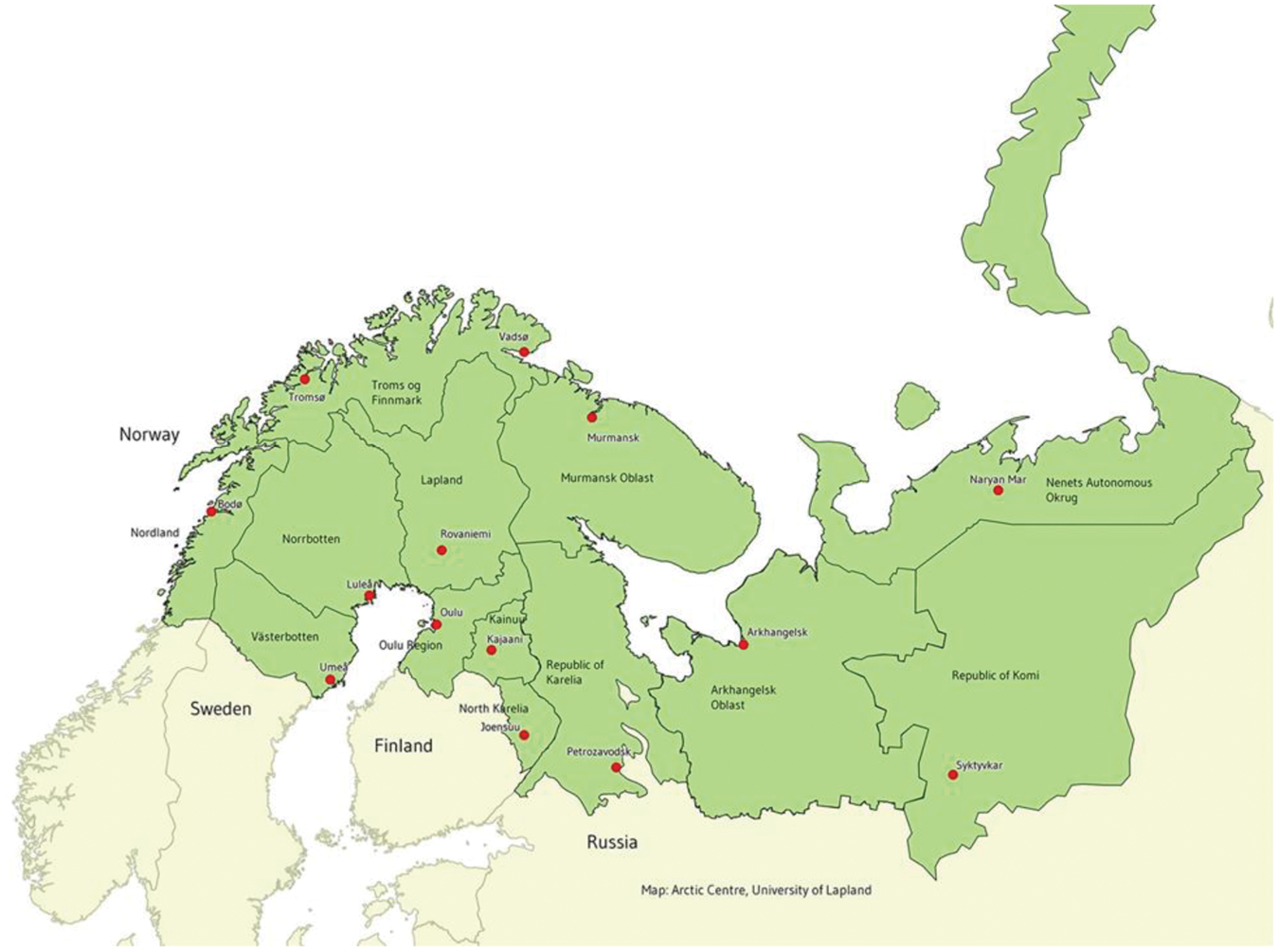
The Barents region, spanning four countries, and with Murmansk Oblast in the center.
Footnotes
Declaration of conflicting interests
The author(s) declared no potential conflicts of interest with respect to the research, authorship, and/or publication of this article.
Funding
The author(s) received no financial support for the research, authorship, and/or publication of this article.
