




Abstract
Social Work is all about Sensemaking, but Sensemaking, as we currently know it, is not fit for purpose in Social Work. Developed by Karl E. Weick, Sensemaking describes the process of coming to understand and act in circumstances that are confusing or otherwise problematic. In this article, the author provides a creative and inventive response to the limitations of Sensemaking in Social Work through the philosophy of Gilles Deleuze, and the use of artistic practices. In this article, he presents two stories; firstly, a story about overcoming ‘stuckness’ in a study of English Children’s Centre practitioners, and secondly, a bigger story about the limitations of Sensemaking in Social Work. These two stories are connected by Deleuze, and Art. The author responds to the opportunities presented by Deleuze by creating a series of visual Motifs, which act as idea-objects, used in his Sensemaking. He argues that whilst Social Workers do not need to be artists to make better sense of situations, they can use their own Motifs to better consider materiality, sense and affect in situations.
Introduction: Re-doing
This is a paper about becoming unstuck when trying to make sense when traditional ways of seeing and describing are limited. It is about reimagining Sensemaking – in other words, how we respond to uncertain or problematic circumstances so we can understand them and take action (Weick, 1995). I do this by presenting two stories that weave together and inter-relate. The first story is about how I became unstuck in my own research, and is a worked example of Sensemaking done differently. The second is a bigger story about the limits of Sensemaking in Social Work, and opportunities for change. Both stories involve the philosophy of Gilles Deleuze (2003) including his work with Fḗlix Guattari (1987, 1994), and their view of art; used here to disrupt habits and open up new opportunities. I start with my own story, and I use it to enact the ideas in this paper about seeing differently. Together, both stories present a space for reflection, an imaginative provocation to consider how Sensemaking in Social Work needs to, and can, develop.
My original study was a qualitative reflective narrative study with English Children’s Centre leaders, which worked with participants to ask (in effect), a) How does one get a story about oneself?, and b) Once one has a story about oneself, how does it shape practice?. In the UK, Children’s Centres, characterised by a multi-professional, multi-agency community orientation, were built on experimental philosophy of a preceding programme of Sure Start Local Programmes initiated by the New Labour government in the late 1990s. In such contexts, and in subsequent reorganisations and defunding of Children’s Centres, social workers and colleagues had to develop/navigate/enact new forms of professional identity and practice (Anning and Ball, 2008; LaPointe, 2010; Sharp et al., 2012). My study incorporated original visual methods within and in between five extended co-enquiry sessions that took place over the course of a year. The visual methods included drawing, alternative forms of mapping, and table-top work with visual artefacts which I principally intended to elicit participant narratives (Figure 1) of making sense. I had been drawn to work with participants leading Children’s Centre provision because of my own professional experience in them, and my subsequent teaching and coaching of social workers, and other professions working in similar contexts. My original study focused on identity transformations and social practices, and whilst visual methods were present (drawings, alternative maps, and table-top materials were used to elicit narratives) the work they did, and that which participants did with them, was invisible to me.
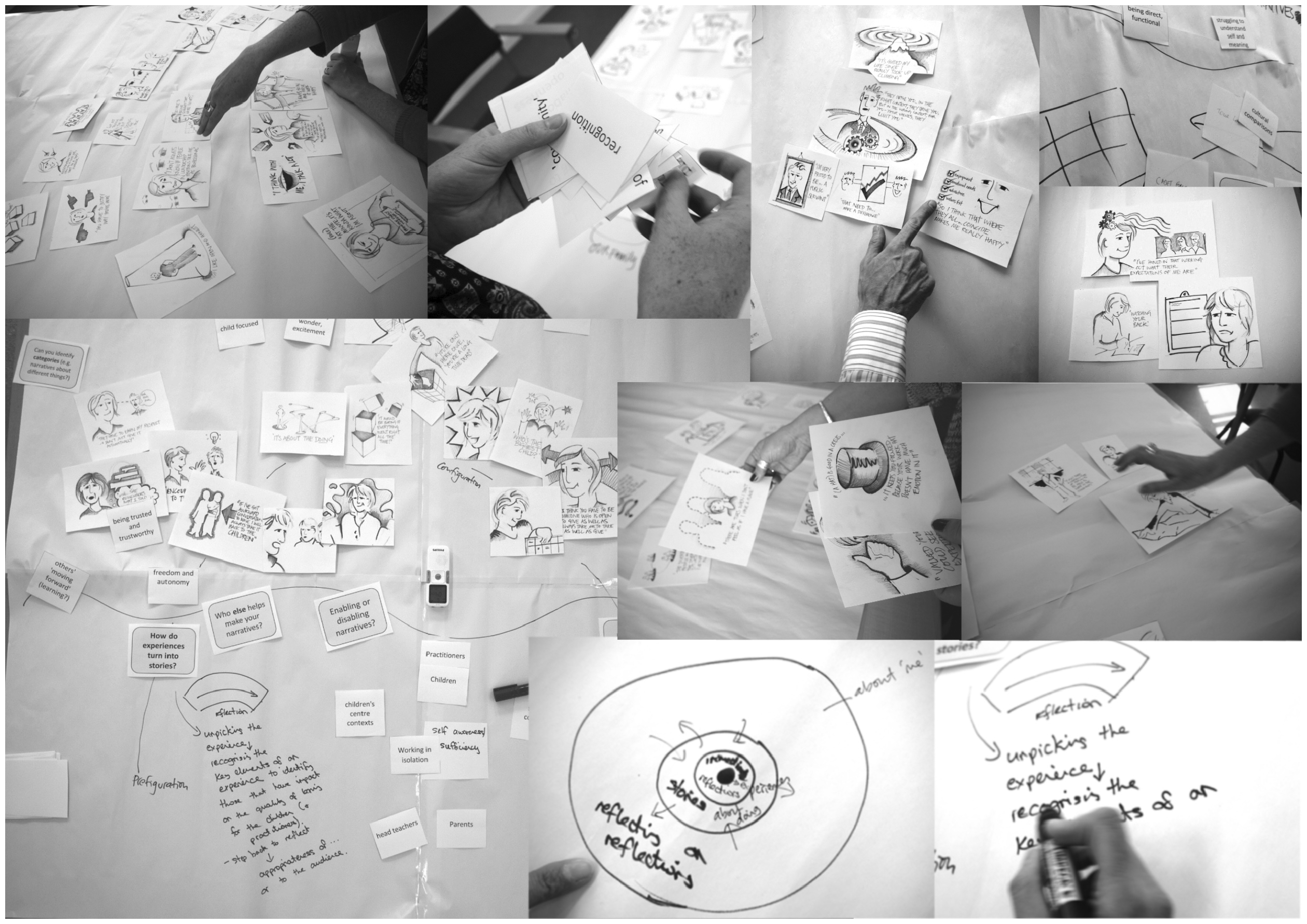
Example ‘original’ documentary images from the Sensemaking study.
Each time I tried to write about the Sensemaking work I documented with drawings, maps and table-top materials (Figure 1), I failed to understand what they were doing and how they worked. It was an exercise in proving added value, and this meant that I missed important activity in the situations I studied. Returning to my Sensemaking study only became productive once I found a way to address a fundamental dimension of Sensemaking which I came to call the material-affective. By this term, I referred generally to the “turn to matter” (Fox & Alldred, 2019) in the social sciences, describing the potential of all things (including people, objects, places, concepts, memory, imagination) to produce material affects; for human subjects, in the body and emotions (Barad, 1996; Braidotti, 2019). This immanent, material way of looking at reality is characterised in the philosophy of Deleuze and Guattari (1987, 1994), which I used as a way to disrupt traditional approaches to Sensemaking and find productive ways forward.
Sensemaking flattened?
I now switch to that bigger story about the limitations of Sensemaking in Social Work. Sensemaking is a perspective developed within and across the social sciences, and, as I will describe, appears most frequently as a label or everyday language term in social work literature. The term Sensemaking was formalised and fully articulated by Karl E. Weick (1969; 1995), as academic work in the late 1960’s increasingly focused on the social construction of reality and the significance of everyday practices (Berger and Luckmann, 1967; Garfinkel, 1967; Weick, 1969). In short, Sensemaking is the work that people do to understand and respond to experience. In their historical review, Maitlis and Christianson (2014) acknowledged the early cognitive focus in Sensemaking studies, focusing on how “meaning is constructed and transmitted” (p.60). This is typified in Starbuck and Milliken’s (1988) focus on the cognitive and linguistic processes of Sensemaking as “comprehending, understanding, explaining, attributing, extrapolating, and predicting” (p.51) circumstances, and more recently in Cornelissen et al.’s (2010) description of Sensemaking as a “cognitive process”.
Multiple definitions of Sensemaking exist, but most have addressed it as a process of responding to unexpected, surprising, ambiguous or equivocal circumstances (Maitlis and Christianson, 2014; Sandberg and Tsoukas, 2015) to bring order, clarity and understanding. Weick (1995:17) identified Sensemaking as a process and “perspective” (1995, ix), stating that it is “(1) grounded in identity construction, (2) retrospective, (3) enactive of sensible environments, (4) social, (5) ongoing, (6) focused on and by extracted cues, (7) driven by plausibility rather than accuracy”. Sensemaking, then, involves interpreting smaller ‘cues’ from a situation, in retrospect, and relating them to frameworks of understanding.
From the 1990s onward, a more diverse set of studies into Sensemaking was undertaken (Sandberg and Tsoukas, 2015: 61), fuelled in part by the popularity of Weick’s (1995) key text, Sensemaking in Organisations. As a result, contemporary understandings of Sensemaking have focused on it as a social process (Weick et al., 2005), set of actions (Maitlis, 2005), and a capacity we need to understand (Neill et al., 2007). However, most Sensemaking studies generally rely on “second order” (Sandberg and Tsoukas, 2015, S23) accounts, utilising interviews (e.g. Maclean et al., 2011) and case studies (e.g. Sylvian and Lamothe, 2012) to talk about Sensemaking processes, obscuring detail. Maitlis and Christianson (2014) called for developments in Sensemaking studies generally, including the need to clarify ontological positions (e.g. is it an internal cognitive process, or socially constructed?), and to better address emotions and topics of embodiment and sociomateriality (pp.94–107). Sandberg and Tsoukas (2015) echoed these concerns, and called for developments in Sensemaking to better conceptualise and research what is meant by “process”, to understand its pre-narrative stages, and in particular, to explore the significance of enactment and embodiment in Sensemaking (S25). This latter call was prompted in part by particular contributions focused on sensory aspects of Sensemaking (Orr, 2009; Xenakis and Arnellos, 2015), but especially the work of Cunliffe and Coupland (2012), which broke new ground in their “embodied narrative” work.
Social Work and Sensemaking
Within education, health and social care literature, closer to Social Work, Sensemaking featured in discussions of the development of professional practices on topics such as integration (e.g. Chantal and Lamothe, 2012) and role expansion (e.g. Hoff, 2019), often stimulated by the demands of multi-professional working (e.g. Rovno-Johansson and Liff, 2012). Such studies have often been based in ethnographic (Helm, 2013) and narrative (Chantal and Lamothe, 2012) traditions, but generally do not engage with details of Weick’s (1995) Sensemaking perspective. Here, Sensemaking has been used as a proxy, conveying a theme of “judgement” in professional situations.
In Social Work literatures, there are different types of engagement with Sensemaking as described by Weick (1995). I saw three broad types of uses or inferences of the term, used in relation to a) context, b) social work practice, and c) connections to the senses and materiality in social work. The first grouping I found was the use of the term in describing the contexts of social work. Textbooks for social work students occasionally include the term – for example, Brown et al.’s (2009) practice handbook for newly qualified social workers uses the term to talk in relation to “making sense of your changing identity”, when discussing the transitions student social workers face after qualifying. However, despite presenting Weick’s (1995) characteristics of Sensemaking, like most other social work textbooks, practices of Sensemaking in the profession were not discussed. Elsewhere, the term has connected to a potent sense of ambiguity in social work, particularly in child protection. Bode and Turba’s (2020) work is an example, describing Sensemaking in the German child protection system as as “schizophrenic” response to institutional ambiguity, producing “permanent indecisiveness and clueless collective improvisation” (p.10). However, both the description of the context and discussion of how Sensemaking (in Weick’s sense) is operationalised in this work is ambiguous. For over twenty years, social work literature has (implicitly) agreed with Weick’s (1995) argument that Sensemaking practices can become stuck. Talking about matters such as the use of language in social work, for instance, Witkin (2000) warned about how the “taken-for-granted or well established…keeps us from noticing “things before our eyes” (p.101).
In practice, the term has connected to an unsurprisingly strong sense of situatedness in child investigation work (Gunilla, 2015), case discussions (Riemann, 2005; Cook and Gregory, 2020) and supervision work (Petrauskienė and Raudeliūnaitė, 2014). In this work, there is a desire for “valid knowledge for practice”, with an understanding that learning is most often embedded in activity (Gunilla, 2015: 96). So, the Sensemaking label is applied to “…the everyday, situated ways in which social workers identify, select and attribute meaning to assessment information before arriving at a judgement” (Cook and Gregory, 2020: 183). In the example of Cook and Gregory’s (2020) ethnographic work, Sensemaking activities such as a conversation with a colleague, preparing to meet a client and making a ‘phone call are described. In so doing, there is an emphasis on the narrative aspects of Sensemaking through challenging practice boundaries, problem framing and debriefing. Typically, the narrative focus omits sensory-material (Cunliffe and Coupland, 2012) aspects of Sensemaking.
The third set of Social Work literature connects to materials and senses, through a concern with situations, how issues emerge and what moves people to action (Stepney and Popple, 2008). Some of this speaks to the material context and situations for social work, broadly relevant to Sensemaking, as discussed by Jeyasingham (2020), where practices such as agile working form “new configurations of people, things and spaces” (p.339), in which materials are more than a passive background for Social Work. More specifically, and also relevant for Sensemaking, is recognition that Social Work is an embodied practice (McCormick, 2011), in which emotions are not only important but are materialised (Rajan-Rankin, 2014). Navigating claims to knowledge, where evidence is not clear cut, is doubtless part of Sensemaking undertaken by social workers, and questions have been raised by authors such as Hardy (2013) about what else, other than so-called evidence, informs judgement. Elsewhere, Tangenberg and Kemp (2002) set out a convincing claim that social work is “embodied practice”.
Other social work literature has implicitly spoken to the issue of material-affective Sensemaking. Clark and Morris (2017) reviewed “visual research” in the discipline, as a way of “experiencing, expressing, sensing, and of course, seeing social work worlds” (pp.29–30), using Pauwels’ (2013) categories of pre-existing visual materials and researcher instigated materials. They suggested possibilities for deeper and alternative ways of seeing the world, ways of gaining insights into difficult, sensitive, emotional experiences, and means of engaging marginalised groups in authentic ways through visual research in social work. Morriss (2017) extended this consideration to “multisensorality” as a interdisciplinary critical methodology, implying the need to draw on new approaches to extend its study.
Objects and artefacts feature in the topic of sensory or material aspects of Social Work practice, again, only implicitly addressing, but still relevant to, the specific topic of Sensemaking. Building on commentary that “things” can influence interactions in practice (Ferguson, 2011: 62), there has been a growing recognition that objects and artefacts have attracted little attention in social work (Scholar, 2010: 631). Where they do appear, as in Watson et al.’s (2020) discussion of life story work, they have been a secondary feature. Making sense of/with space has also featured in Social Work literature; for example, Ferguson (2016) charted “a series of transitions from the office to the doorstep, and into the home, where complex interactions with service users and their domestic space and other objects appear” (p.65). Additionally, connections between (architectural) space and (implicit) Sensemaking are discussed by Grittner and Burns (2020) who consider the use of sketch walks, photography, spatial visualisation and creative mapping to gain “deeper understandings of engrained connections to the built environment” (p.8).
In summary, in looking in social work literature for the use of the Sensemaking perspective, I saw the use of the term, but not in ways which connected with the details of Weick’s (1995) perspective. Some of this literature recognised the sensory, material and affective dimensions of practice, but connections between Sensemaking and the material-affective were typically only implied. My getting unstuck therefore led me to disruptive thinking that placed the material-affective centre stage, and the application of the work of Gilles Deleuze to my study.
Making sense: The possibilities of Sensemaking, Deleuze and Art
To look at ways forward in Social Work Sensemaking, I switch back to the smaller story, that of my stuck research. In doing this, I respond to Bell’s (2012) call for Social Work to better attend to its ontological (i.e. nature of reality) assumptions, and Crociani-Windland’s (2017) view that Deleuze’s (1981, 1987, 1994) work offers an alternative to “dominant, neo-liberal, evidence based and medicalised discourses” (Crociani-Windland, 2017: 252) which have omitted the material-affective. In my study I found a way forward by connecting Sensemaking, Deleuze and artistic practices, creating new opportunities in a focused way that I could implement. Therefore, my discussion of Deleuze and art in this article is a pragmatic one, and I follow Cox’s (2011) attitude to “unpacking” concepts, not to get them right but to “see how they can move and flow, and what might make them explode” (p.201). Whilst I use Deleuze’s work directly, in this article I connect to social work literature throughout by drawing on texts which discuss topics of Deleuze, art and social work.
Although when I first began reading Deleuze’s (1987, 1994) work, it initially appeared intentionally confusing, unnecessarily provocative and resistant to my navigation, I remained curious. I found that as it jumped, folded and swerved around, it was fundamentally …creative. I saw this might be useful as I realised Deleuze offered a way of connecting things – in the same space, and in different ways. I noted Stivale’s (2005) claim that Deleuze’s philosophy unsettles particular bodies of knowledge, opening them up and linking them to other concepts within and outside those bodies of knowledge. Before I connect Deleuze, Art, and Sensemaking in this article, I provide four points of orientation to Deleuze’s work:
Deleuze presented an immanent, materialist philosophy – so, ideas and materials are not separate. All things, from people, to concepts were conceived of as located in the same plane of immanence, allowing for rhizomatic connections to be made between apparently disparate elements; apparent in his 1987 text with Guattari, A Thousand Plateaus. This is achieved in part because, as he argued, the single plane of existence incorporates the actual and the virtual. The virtual is just as real as the actual. Rather than being not real, the virtual is that which can effect but is not (yet) concrete. An example could be family details displaying on an electronic screen to a social worker, or an unstruck match - the virtual is a real set of pre-existing possibilities (Bogue, 2007: 275). Virtual-actual reality operates through machine-like connections of things, parts of which we see. These assemblages are dynamic, constantly becoming as they connect, form or dissolve over time (Delanda, 2016). Art provides a way of materialising and diagraming these assemblages (Saorsa, 2012). For Deleuze (Deleuze and Guattari, 1994) art is a space of possibility and “the exchange between the actual and virtual” (Angelucci, 2014:334). This materialising is possible because “philosophy and the arts share the common goal of creating possibilities of life, new modes of existence” (Bogue, 2007:280), or possible worlds (Clark, 2012:198), preserving sensations in material moments.
From this perspective, art creates a “territory” (Deleuze and Guattari, 1987[1969]: 348). Within this territory, we see things becoming as “an assemblage of movements and affective vibrations…a relation of forces” (Jagodzinski, 2015: 514). Deleuze and Guattari (1987[1969]) saw this as occurring through “nomad art”, characterised as art with “close-range vision”, utilising “haptic space”. Art gets one close up to things, and forces finding-around. The nature of “…the haptic smooth space of close vision is that its orientations, landmarks, and linkages are in continuous variation; it operates step by step” (Deleuze, 1987: 544). Nomad art (like animals on a cave wall, with legs that face both ways) does not require organising perspective, horizon or symmetry: these things are only for those interested in distancing and creating artificial distinctions. This kind of art breaks open structures and distinctions; so artmaking is a form of deterritorialisation (Smith, 2016:38).
Seen this way, art has something useful to offer to social work Sensemaking. It opens us up to daily realities of “complexity, contradictions and messiness” (Sandvik, 2010: 29), and provides material for a “…rhizomatic, creative action research that affords reflection, [and] sensemaking” (Smith, 2016: 41). Here, art is less about forensic reconstruction of a scene than exploring of the “in-between, interstitial spaces” (Jagodzinski, 2015: 510) through “embodied conversations with materials” (Clark, 2012: 200). These conversations are art-events, and making sense is the act of experimenting. Experiments require a site of production, a territory or body (Deleuze and Guattari, 1987[1969]; Smith, 2016: 36). These are areas or structures without organisation, but filled with potentiality, connections and affects. For Clark (2012), arts explorations work with these sites “through experimenting with different assemblages of bodies: ideas, chairs, sounds, my body, your body, and so on…each piece that connects…has different movements, potentials, and affects. Experimentation unlocks the potentials of the pieces” (Clark, 2012: 203). In social work, it provides opportunity for the “…reframing one’s experiences and working with problems” (Crociani-Windland, 2017: 251) in ways that present new relations, reconfiguring “…our affective connections, foregrounding some aspects of experience, whilst putting others in the background” (p.260).
These art-events present the actual and the virtual, providing encounters that undergird experimental learning (Deleuze, 2000[1964]; Smith, 2016: 38). These encounters are other than what we often see, and deterritorialise the status quo. For the social worker, this might be other possibilities for families; other configurations of their futures. Art therefore provides a way of mapping potentiality, and opens up a gap for seeing. The fixation achieved by art produces a “an interstitial, reflexive delay in the body” (Jagodzinski, 2015: 510), and a “block of sensation” that can become a site/surface for production (Deleuze and Guattari, 1994: 26; Bertetto, 2017). When produced, encountered or used, art provides something that can ‘work back onto the situation’. This is necessary, as “One never deterritorializes alone; there are always at least two terms, hand – use object, mouth – breast, face – landscape. And each of the two terms reterritorializes on the other” (Deleuze, 1987: 193). Art can work back on social work, and is an experimentation that “…tears the [researchers] notes apart, as it activates a multiplicity of potentials” (Sandvik, 2010: 32).
Material-affective attuned Sensemaking, using a motif
Having detoured into Deleuze, I re-read my smaller story, the story that was stuck, of Sensemaking in Sure Start Children’s Centres. I was able to reanimate and explore that study in new ways. I became unstuck not only when I considered Sensemaking as a material-affective practice, but also when I found a practical way to connect Sensemaking, Deleuze and artistic practice through what I called a Motif. A Motif is commonly defined as either a pattern, or a repeated theme or idea (Oxford English Dictionary, 2020). I wanted both senses of the word; Motif as idea and an object - a way of materialising Deleuze’s philosophy to create a site of exploration. So, following Deleuze, my motif was virtual (an idea) and actual (object) – an idea-object – which materialised into a series of Figures 2to 4 in this paper. The motif could have been realised as a concept-artefact, concept-poem…any heuristic tool that de-centred, unfolded and re-animated Sensemaking activity. In setting aside conventional Sensemaking tools (for me, the coding frame, and the accepted and familiar narratives about Sensemaking used in my stuck study), I selected documentation from my study that spoke to me of the Deleuzian themes I had engaged with. This documentation “glowed” (MacLure, 2010; 2013), with affective resonance, so; shifting speeds and intensities of engagement with the example do not just prompt thought, but also generate sensations resonating in the body as well as the brain – frissons of excitement, energy, laughter, silliness. (MacLure, 2010: 282)
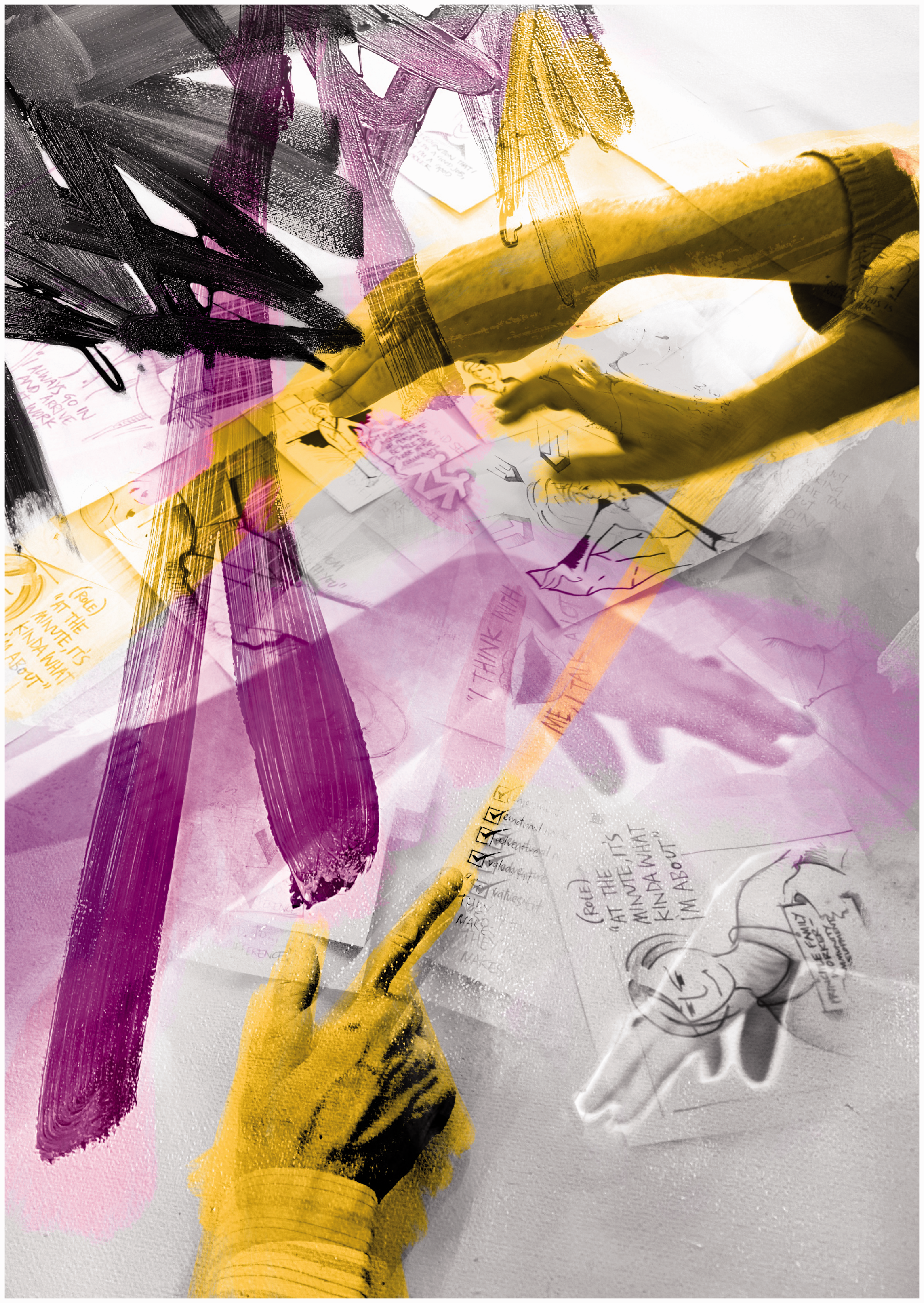
The gesture.
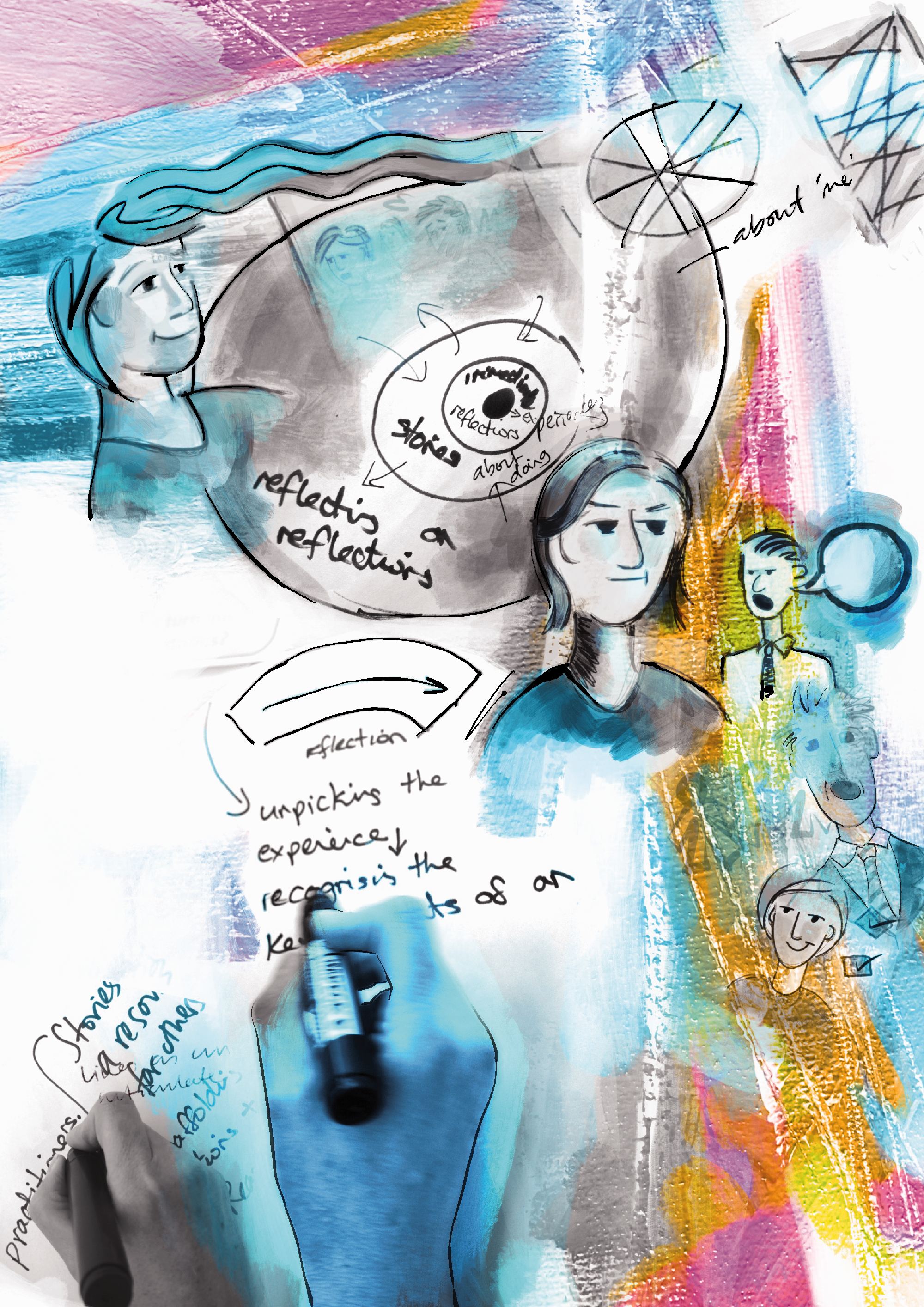
Mark-making.
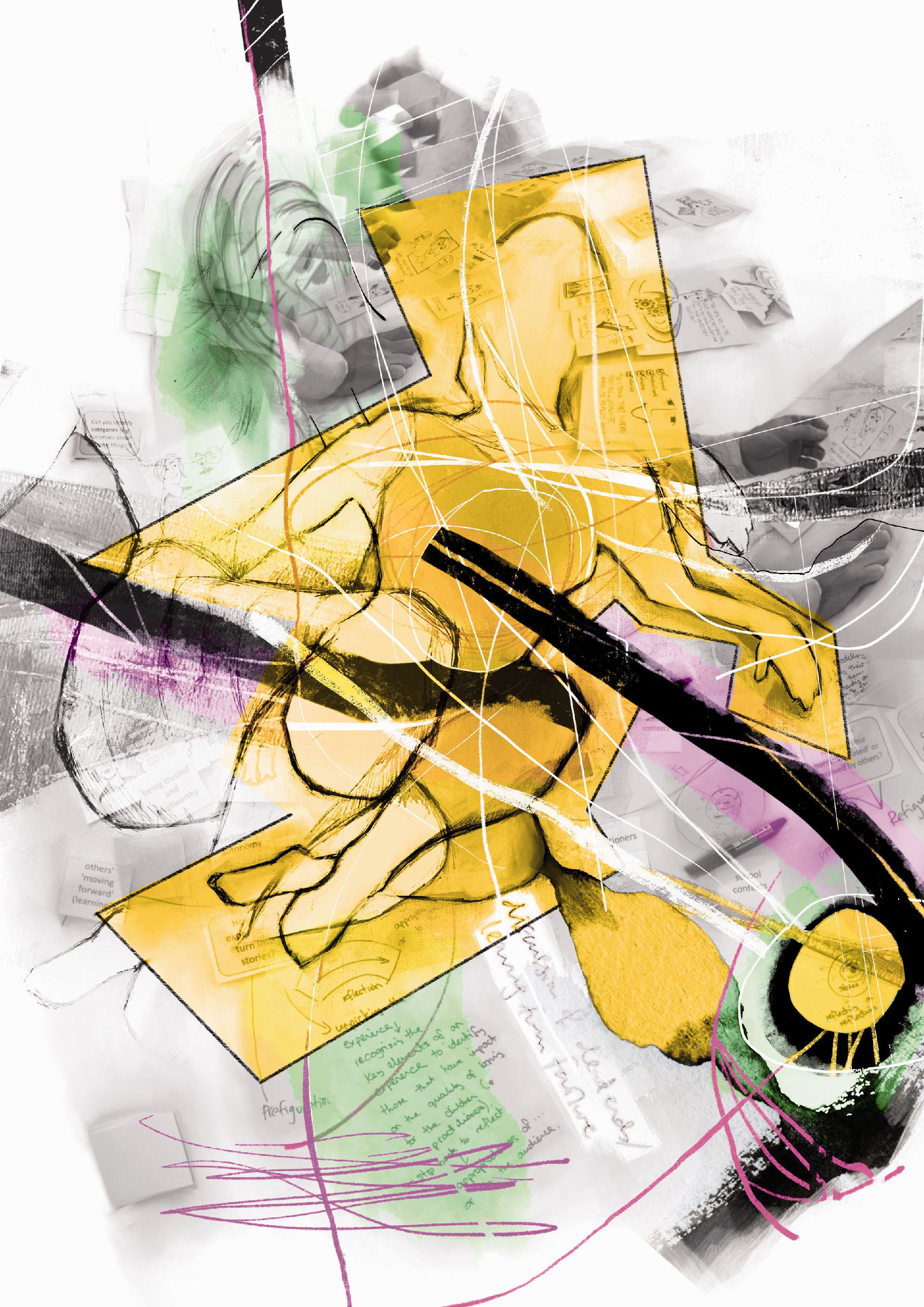
Assemblage.
I brought these together in Figures 2 to 4. They are my worked example of using a Motif in material-affective attuned Sensemaking, with the Motif and documentation from my original study put in conversation to re-territorialize one another (Deleuze, 1987: 193), as previously noted.
My example: Using the motif of the diagram
Following my engagement with Sensemaking as a material-affective practice, and the literature I have presented, I selected Deleuze’s concept of the Diagram as my Motif. For scholarly discussions of Deleuze’s work on the diagram, there are excellent texts such as that by Zdebik (2012). In this article, I simply provide description of my Motif’s key features, as it is enough to note that it was an idea I used, and was useful. You are welcome to use it, or to select your own.
The diagram is a map of connection and possibility. It is an idea consistent with Deleuze and Guattari, developed by Felix Guattari (1984), then in his work with Deleuze (Deleuze and Guattari, 1983). Guattari (2019[1977]) wanted to bypass representation and find direct ways of connecting things. His enquiry complemented the work of Deleuze, and together they developed an understanding of the Diagram as a means of mapping reality as the virtual-actual assemblages I summarised earlier (Deleuze and Guattari, 1983, 1987[1969]). Diagrams are not technical representations of literal objects (like a plan); they produce things, and provide a way to find our way around systems of virtual-actual relations. Examples help. Foucault’s (1980: 194) discussion of “power assemblages” share many of the features of the diagram, and his example of the penal system (featuring elements such as the law, and prisons) as power assemblage helped me to see what was meant. He presented the Penal system as a; Thoroughly heterogeneous ensemble consisting of discourses, institutions, architectural forms, regulatory decisions, laws, administrative measures, scientific statements, philosophical, moral and philanthropic propositions – in short, the said as much as the unsaid. Such are the elements of the apparatus. The apparatus itself is the system…of relations that can be established between these elements (Foucault, 1980:194).
Zdebik (2012) provides one of the most succinct descriptions of a Deleuzian diagram. As I read his work, I could imagine it as my Motif, standing for a sense of connecting I felt I had missed in my original study of Sensemaking in Children’s Centres: A diagram is commonly understood as a drawing conveying information about something incorporeal. From the Greek diagramma, it means to mark out by lines, to draw – where dia is through, across, apart and graphein is to write. The diagram is defined as a geometrical figure used to illustrate theorems. It can also be a sketch, a drawing or a plan that explains a thing by outlining its parts and their relationships… A diagram can be seen in the form of three different types of drawings: a plan, a map and a graph (or a schema). A plan represents a building that is not yet built. A map represents terrains on which we have not yet travelled. A graph displays relations between variable quantities. No matter what form it takes as a representation, a diagram is a configuration of lines, whether they are drawn or written. In a conceptual diagram, the lines marking out a space are abstract traits. The diagram thus does not represent, but rather maps out possibilities prior to their appearance, their representation. (Zdebik, 2012:1) the diagram brings things together; it is philosophical and artistic, visual and textual. Its productive aspect appears where it is embodied. (Zdebik, 2012: 193)
Using my motif to make sense
Inspired by this, I created three visual motifs (Figures 2 to 4). Each image drew attention to particular Sensemaking events or operations threaded through individual documentary images from the original study. These original photographs and drawings were my first point of connection to the data of my original Sensemaking study and were selected in the light of my reading about the diagram because they offered something vital and affective.
Methodologically, my motif – any motif – brings elements together in new, focused and partial ways. Creating these panels replaced my previous search for logical-rational causal links between actions and results, subjects and objects, and I was able, through digital collage, to visually stack, fold, juxtapose and map moments from my data. Rather than forensically representing the scenes of Sensemaking I recorded in my study, and freed from an unhelpful (on this occasion) set of objectivist questions (e.g. “how can I measure the added value of visual-material methods?”), I was able to animate the sort of Sensemaking energies and operations at play by collaging affective moments, and diagramming them.
My Motif acted as a gateway into a material-affective re-reading of my data. As I used a digital artwork package on my electronic tablet, re-animation of the data created new ways to see energies and operations at play. Data that had felt fossilised; boring, even – was now animated, reminding me of the sense of being there at that time with study participants. Materialising my Motif as three diagram frames provided me with a method akin to rewinding video footage in slow motion, or changing to another camera angle in filmmaking. Using my Motif, I literally and conceptually re framed my original study of Sensemaking with Children’s Centre leaders. So, instead of a definitive set of findings, I articulated and animated a set of material-affective Sensemaking operations. Each figure is accompanied by a short text, which conveys the sense I made at the time of working with the frames, sketching out (in words, this time) how each frame began to re-orientate my Sensemaking to its material-affective dimensions. This accompanying text is not a definitive answer, but simply represents an opening, in the in-between space (Jagodzinski, 2015), provided by art, for further material-affective Sensemaking. Hands begin to occupy table-top, creating a space. Claimed and inhabited. Arm moves through air, sweeping across material. Vectors of energy, carrying momentum. Before the statement - the rehearsal, the demonstration. Bodies join with paper to hold and place. I see the timing, the pause, the build-up. Shocked by their own hands, surprised by movement. What has been held now is holding. Lines drawn, electricity flowing from event to event. Inscribe this space, feeling, material as something. My name is on it, now. The paper, the grip. Confidence as they join. They write the claim together. Body drawn in as they resonate with the drawing. Intake of breath. I move and place within my diagram. It moves me and I animate it, we find words together. That event is held there, that mark is left unfinished on purpose. The materials say it with me. More than the sum of their parts; They approach a site of strange surgery. Proximity is pushing possibilities, Threads pull and open spaces. The table is a Body without Organs On its surface, operations gather what is useful and create the body moving over them.
Discussion: Re-turning (to) Social Work Sensemaking
Everything needed making sense of – my original study, how to turn Sensemaking to the material-affective, how to use my idea of a Motif in a worked example, and then the implications of my efforts for Social Work Sensemaking generally. I know that this process worked for me, because it began to open up material-affective spaces in my data. In Social Work generally, the work is equally required; Sensemaking must capture the nuance and complexity we face, and must draw on a wider range of methods (Maitlis and Christianson, 2014:106). Social Work must attend to more diverse and explicit ontological possibilities (Bell, 2012) and work through the implications. Calls to develop Sensemaking, such as those presented by Sandberg and Tsoukas (2015) make clear the need for practices that are better attuned to the senses, materials and emotions.
However this work is progressed, it would be a disservice to Weick (1995), to propose developments in Sensemaking that are either purely cognitive (i.e. big ideas about situations) or only practical (i.e. reductionist tools that act as templates). After all, his 1995 description of Sensemaking included both that it was “enactive of sensible environments” (the material-affective) and “focused on and extracted by cues” (which implicitly relate to frames of reference, including philosophy). As I see it, Social Work, as a profession, has an opportunity to develop a Sensemaking like its practice – practical, but grounded in reflection and ideas. Material-affective Sensemaking is not just for the artists, it is part of Social Work praxis: neither big ideas or templates by themselves are useful. Social Work needs portable, useful, inclusive Motifs that acknowledge the material-affective in puzzling situations.
The development of such motifs may not be straightforward. We must address how they may sit alongside realities of assessments, legal reports, and practice/research cultures that have to incorporate the techno-rational aspects of evidence-based practice (Cornish, 2017). Additionally, we must avoid creating yet more templates, which have the effect of confining and reproducing practice. My hope is that Social Work is pragmatic, and can develop a better, more diverse, toolkit in which Social Workers can find new ways to have conversations with clients using Motifs (idea-objects). Part of the work to be done is to develop the virtual (idea) together with the actual (object), to engage with both ideas and objects in social work praxis, in Motifs that bring them together.
Footnotes
Declaration of conflicting interests
The author(s) declared no potential conflicts of interest with respect to the research, authorship, and/or publication of this article.
Funding
The author(s) received no financial support for the research, authorship, and/or publication of this article.
