




Abstract
Participatory research methodologies have expanded the opportunities for critical, emancipatory and democratic health and social work research. However, their practical application in research with vulnerable participants has historically been challenging due to ethical, practical and theoretical concerns. Individuals who are homeless are typically seen as ‘hard-to-reach’, transient, ‘hidden’ and even chaotic participant populations. Unsurprisingly, examples of the use of innovative participatory research techniques with those groups have been relatively scarce. This paper aimed to address this gap by discussing the application of one such technique – the mobile phone diary in research with multiply disadvantaged homeless adults. Diary methods are situated within the qualitative research on health, illness and social marginality, and the enhanced capabilities of the mobile phone diary are highlighted. The author illustrates the application of the mobile phone diary in his participatory research on the everyday life narratives of adults with serious mental illness (SMI) who were homeless. The process of designing the mobile phone diary is detailed. Following this, participant testimonies of their use of the mobile phone diary are presented. They demonstrate the participatory and inclusive nature, as well as the cathartic and empowering potential, of this technique. The methodological contributions and challenges and the theoretical generativity of the mobile phone diary method are discussed. The mobile phone diary is a feasible approach for eliciting evocative, contextualised and nuanced accounts of the lived experience of homelessness, social isolation, coping and recovery.
Situating diary methods in qualitative participatory research
Participant diaries have been a part of the qualitative researcher’s repertoire for several decades, with applications in ethnography, anthropology, sociology, human geography, psychology, gerontology and other fields (Bartlett and Milligan, 2015; Bolger et al., 2003; Elliott, 1997; Jacelon and Imperio, 2005).The current paper will discuss the uses of solicited diaries (referred to as simply ‘diaries’ hereafter), in which research participants are asked to record their activities, experiences, thoughts, feelings and/or observations in a systematic manner for the duration of the study (Bartlett and Milligan, 2015). Diaries are compatible with a wide range of research designs and objectives. Examples include experience sampling designs to study between- and within-person variations in particular behaviours; journey or travel diaries; health-related diaries and others (Bartlett and Milligan, 2015). The flexibility of the diary method is also evidenced by its wide compatibility with other research methods such as questionnaires, interviews, focus groups, surveys and participant-generated photographs and drawings (Bartlett and Milligan, 2015; Elliott, 1997).
The broad appeal of diaries is primarily due to their suitability for exploring participants’ experiences as they naturally and dynamically occur within their daily lives (Elliott, 1997). As such, diaries can grant the researcher access to ‘invisible’, ‘taken-for-granted’ phenomena, which, however, may be significant for the topic under study (Elliott, 1997). ‘Buried’ in routine activity, such phenomena can become ‘knowable’ and articulated through diary entries and/or follow-up interviews (Elliott, 1997). In addition, because researchers can purposefully set few guidelines as to what the participants should record in the diary, diary designs are well-suited for participatory research, in which the focus may be on eliciting information about the respondents’ personal priorities, concerns, topics of interest and unique social contexts. A related asset of the diary approach is its suitability for generating intimate, authentic and personal accounts of sensitive and/or complex topics (Allen, 2008; Crozier and Cassell, 2016; Harvey, 2011). Diary recording can aid participants in retelling, reliving and reconstructing their stories of personal and collective experiences, even when those experiences may be ‘silenced’, stigmatised and/or misconstrued in society (Philaretou and Allen, 2005).
Beyond the traditional pen-and-paper format, diaries can be implemented using a range of modalities and formats, including audio diaries (Crozier and Cassell, 2016; Worth, 2009), video diaries (Gibson, 2005), photo diaries (Cunningham and Slade, 2019) and, more recently, mobile phone diaries (Plowman and Stevenson, 2012). In many cases, multi-modal diaries have been used combining different response formats (for example, text and images) within a single diary research design (Bartlett and Milligan, 2015). Those alternative diary formats have been shown to augment the methodological and theoretical capabilities of pen-and-paper diaries by allowing for a richer, more dynamic, sensorial and embodied insight into respondents’ lives (Cassell and Crozier, 2016).
Photo diaries (or photographic diaries), in particular, combine the communicative and emancipatory capabilities of the diary and of visual imagery (Allen, 2008). In a typical photo diary and photo-elicitation design, participants may be asked to document their experiences on a regular basis by taking photographs of their daily lives (recording phase), after which they may be invited to a one-to-one interview to discuss the images and/or other entries generated (elicitation phase; Allen, 2008; Padgett et al., 2013). From a participatory and a representational standpoint, participant-generated images can empower participants to vividly communicate topics and concerns that have the deepest personal significance to them and their lives, which has provided opportunities for challenging dominant discourses on a range of health and social issues (Allen, 2008; Foster-Fishman et al., 2005; Plunkett et al., 2013). As such, participant image-making may be agency-enhancing (Allen, 2008; Catalani et al., 2012; Dakin et al., 2014; Wang and Burris, 1994). Participatory image-making has been shown to be useful for stimulating participants to reflect upon aspects of their lives that they may not usually contemplate, positively reconceptualise difficult experiences, identify sources of strength and critique their social milieu (Gubrium and Harper, 2013; Han and Oliffe, 2016; Seitz and Strack, 2016).
The use of visual methodologies (such as photovoice and photo-elicitation) has expanded steadily in both mental health and social work research and has helped generate rich, multifaceted and authentic accounts of the lived experience of people with mental illness, substance use and that of other marginalised groups (Clark and Morriss, 2017; Han and Oliffe, 2016; Hodgetts et al., 2007; Padgett et al., 2013). The unique communicative functions of visual images have been especially valuable in helping research participants articulate their feelings about sensitive, painful, life-altering, stigmatising, ambivalent and/or difficult-to-comprehend experiences such as mental health recovery, chronic health conditions, social isolation, bereavement, homelessness and others (Clark and Morriss, 2017; Clements, 2012; Oliffe and Bottorff, 2007; Seitz and Strack, 2016).
Multi-modal diary-aided research on homelessness and co-occurring disadvantage
Despite this expansion of methodological options, multi-modal diary methods have remained relatively underused in qualitative research with people who are homeless. The current author failed to identify a single published qualitative study that utilised multi-modal diaries to explore the experiences of health and illness in participants who were homeless. This is surprising given the widely acknowledged importance of the spatial, material and relational dimensions of the homelessness experience (Hodgetts et al., 2007; Piat et al., 2017). As such, the use of diaries in participatory research with people who are homeless seems apposite for illuminating the psycho-affective, embodied and socio-material aspects of this experience (Hodgetts et al., 2010).
Although multi-modal diaries have been underutilised in homelessness research, the growing body of research using photo-elicitation or photographic diaries with this group has demonstrated the methodological and theoretical utility of the diary method (Cunningham and Slade, 2019; Hodgetts et al., 2007; Le Dantec and Edwards, 2008; Padgett et al., 2013; Seitz and Strack, 2016). Most of those studies have tended to focus on participants’ geographies, daily routines and movements, occupation, safety, hygiene, resilience and others (Cunningham and Slade, 2019; Johnsen et al., 2008; Radley et al., 2010; Seitz and Strack, 2016). Only a few of those photography-based studies, however, have specifically explored participants’ experiences of mental illness (Karadzhov et al., 2020).
The studies that have utilised photographic methods in homelessness research to explore participants’ mental well-being, mental illness and recovery have tended to be with formerly homeless participants. For instance, in their qualitative investigation of individuals with SMI living in supportive housing, Piat et al. (2017) foreground the role of places and spaces in mental health recovery. The authors were interested in the ‘physical, symbolic, and social’ (p. 71) functions that various settings and places, including ordinary ones, had on recovery. To elicit those meanings, the researchers asked the participants to obtain images of the places they visited in their everyday lives, especially those that carried personal significance to them. The analysis of the in-depth interview data revealed that some of the participants derived profound meaning from trivial places, objects and activities. Piat et al. (2017) conclude that ‘[u]nderstanding these areas [ . ] enables a reconceptualization of seemingly banal locales into dynamic sites of recovery, insofar as they foster autonomy and self-efficacy, increased self-care, and meaningful social connection’ (p. 76).
Similarly, in their qualitative research with formerly homeless individuals with a history of SMI, Padgett et al. (2013) employed the photo-elicitation technique, whereby participants were asked to document their daily lives with the use of disposable cameras and were then invited to discuss the images at one-to-one interviews. The authors conclude that the inclusion of the participant-generated photography component resulted in ‘deeper, more elaborated accounts’ (p. 1437). Specifically, the authors reported that the photo-elicitation interview helped yield greater detail, a higher degree of participant reflexivity, as well as new information altogether, including information concerning sensitive and traumatic experiences such as childhood hardship and relationship breakdown.
Hybridising methods: The mobile phone diary
Despite generating useful insights into the dynamic and situated experiences of homelessness, the studies referenced above have been limited methodologically and theoretically in several notable ways. First, many of those studies have been conducted with formerly homeless participants, some of whom self-identified as being ‘in recovery’ in relation to their mental health and/or substance use (Padgett et al., 2013; Piat et al., 2017). Second, only a minority of studies with currently homeless participants have explored their experiences of, and coping with, mental illness. This has obscured the insights into the ‘in situ’ experience of co-occurring homelessness and mental illness. Third, the overwhelming majority of photography-based studies with homeless participants have relied on disposable cameras (Padgett et al., 2013). Disposable cameras have become obsolete and therefore not only require considerable training but may also attract unwanted attention when participants are taking photographs in the field (Bartlett and Milligan, 2015).
Recent years have seen the expansion of technology-assisted qualitative research techniques (Markham and Stavrova, 2016). The proliferation of web-based and mobile technologies has transformed the capabilities of diary-aided data collection (Bartlett and Milligan, 2015). Mobile phone and web-based diary designs, in particular, have grown in popularity due to the availability, ease of use, affordability and built-in features of smartphones and web-based technologies (Bartlett, 2012; Bartlett and Milligan, 2015).
In particular, mobile phone diaries can augment the theoretical and practical capabilities of both the diary method and visual methods (Bartlett and Milligan, 2015). Mobile phone diaries require that respondents maintain personal logs using a mobile phone (including a smartphone) device. The mobile phone diary is a hybrid method lying at the intersection among diary studies, visual studies, mobilities studies and digital ethnography (Bolger et al., 2003; Büscher and Urry, 2009; Murray, 2009; Palen and Salzman, 2002). Mobile phone diaries are naturalistic, accessible, adaptive and low-cost tools for documenting ‘in-situ’ experiences (Bagnoli, 2004). Diary entries can be textual or digital (audio, visual and audio-visual), which augments the ‘bodily, sensory, synaesthetic, and memory capacities’ of the data (McLeod and Guillemin, 2015: 28). A distinct asset of mobile phone diaries is the option to record video material (video diaries; Büscher and Urry, 2009). Video-elicitation interviews have been shown to be particularly useful for prompting discussion, stimulating recall and providing basis for reflection in participant interviews (Murray, 2009).
The accessibility and ease of use of mobile phones, including among impoverished populations, make mobile phone diaries a viable and inclusive methodological option for research with people who are homeless (Eyrich-Garg, 2010; Rice et al., 2011; Woelfer and Hendry, 2010). The inherent flexibility of mobile phone use is well-suited for the highly transient and sometimes chaotic lifestyles that many people who are homeless seem to have (Eyrich-Garg, 2010; Le Dantec and Edwards, 2008). Moreover, unlike disposable cameras, mobile phone use is more naturalistic, thus avoiding the dangers of attracting unwanted attention and potentially putting participants at risk.
Exploring the everyday life narratives of persons with SMI who were homeless: A worked example
Informed by the methodological offerings of the mobile phone diary, the current author conducted a qualitative investigation into the lived experience of co-occurring homelessness and SMI between February and September 2018 in two small samples in New York City and Glasgow, Scotland. This study was underpinned by methodological pluralism in that it combined a mobile phone diary with semi-structured interviews and photo-elicitation (Bijoux and Myers, 2006; Padgett et al., 2013). To the author’s knowledge, this was the only study to date to utilise a mobile phone diary in research with people who are homeless and have SMI. The aims of the study were to explore participants’ experiences of mental health recovery, as well as their perceived facilitators of, and barriers to, positive well-being and social inclusion.
This qualitative, multi-site study took place in five different locations – two safe havens (temporary accommodation services for clients with complex needs) and one drop-in centre for clients who are homeless in New York City, and two temporary accommodation services in Glasgow. This study was granted ethics approval by the University Ethics Committee of the University of Strathclyde. All participants had to provide written informed consent.
In total, 18 participants (4 female and 14 male) volunteered to take part in this investigation. Participants were incentivised with a $20/£15 shopping voucher per interview. The incentive amount was determined after consulting with the local site staff and after reviewing the literature for examples of best practice (Seitz and Strack, 2016). Eligible participants were adults (older than 18 years of age) with a history of SMI (for example, depression, anxiety, schizophrenia or bipolar disorder), as well as a history of chronic homelessness, who were currently homeless.
The data collection proceeded in three phases. First, the participants’ life story narratives and perceptions of recovery were elicited over two in-depth interviews. Second, they could opt to complete a seven-day mobile phone diary documenting their day-to-day experiences and activities. If they did, they were given a short training session on using the mobile phone diary. Third, they were invited to a final, elicitation interview, in which they were queried about their diary entries. The purpose of the elicitation interview was to discuss the diary entries, gauge their wider context and understand the relevance of those data to the participants’ lives, well-being and recovery (Drew and Guillemin, 2014; Guillemin and Drew, 2010; Padgett et al., 2013).
Designing the mobile phone diary
The Ethnographic Observation System (EthOS Labs Limited; https://www.ethosapp.com/) web interface and mobile application, ethos, were selected to host the mobile phone diary. ethos was chosen due to its usability in both the UK and the US, affordability, user-friendly interface, capabilities to capture multi-modal data (via text, image, video and audio) and adequate storage, privacy and security provisions.
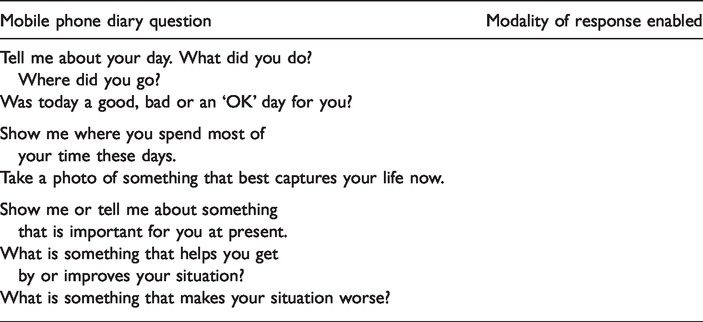
Participants were asked to make diary entries (via text, photographs, audio or video recording) in response to a pre-specified set of broad questions (see Table 1) during a seven-day period. The participants were not restricted as to the volume, regularity or type of entries they should generate. Participants were explained that the mobile phone diary intended to capture their present-day lives – habitual activities, interactions, settings, thoughts and emotions. The mobile phone diary questions also asked participants to consider aspects of their lives that helped and hindered their current circumstances. To manage the participants’ expectations about the requirements of participation, the researcher explained to them that there was no right or wrong answer and that their genuineness and spontaneity were important. The design of the mobile phone diary, including the specific questions or prompts, reflected the desire to preserve the participants’ flexibility of expression and autonomy and keep participants engaged but also provide a minimal framework in order to reduce non-responses (Crozier and Cassell, 2016). Table 1 shows the mobile phone diary questions and their corresponding modalities of responses (e.g., a photograph, audio recording, text entry or video recording). Figure 1 contains a snapshot of the mobile phone diary interface (ethos).
Mobile phone diary questions and their corresponding modalities of response.
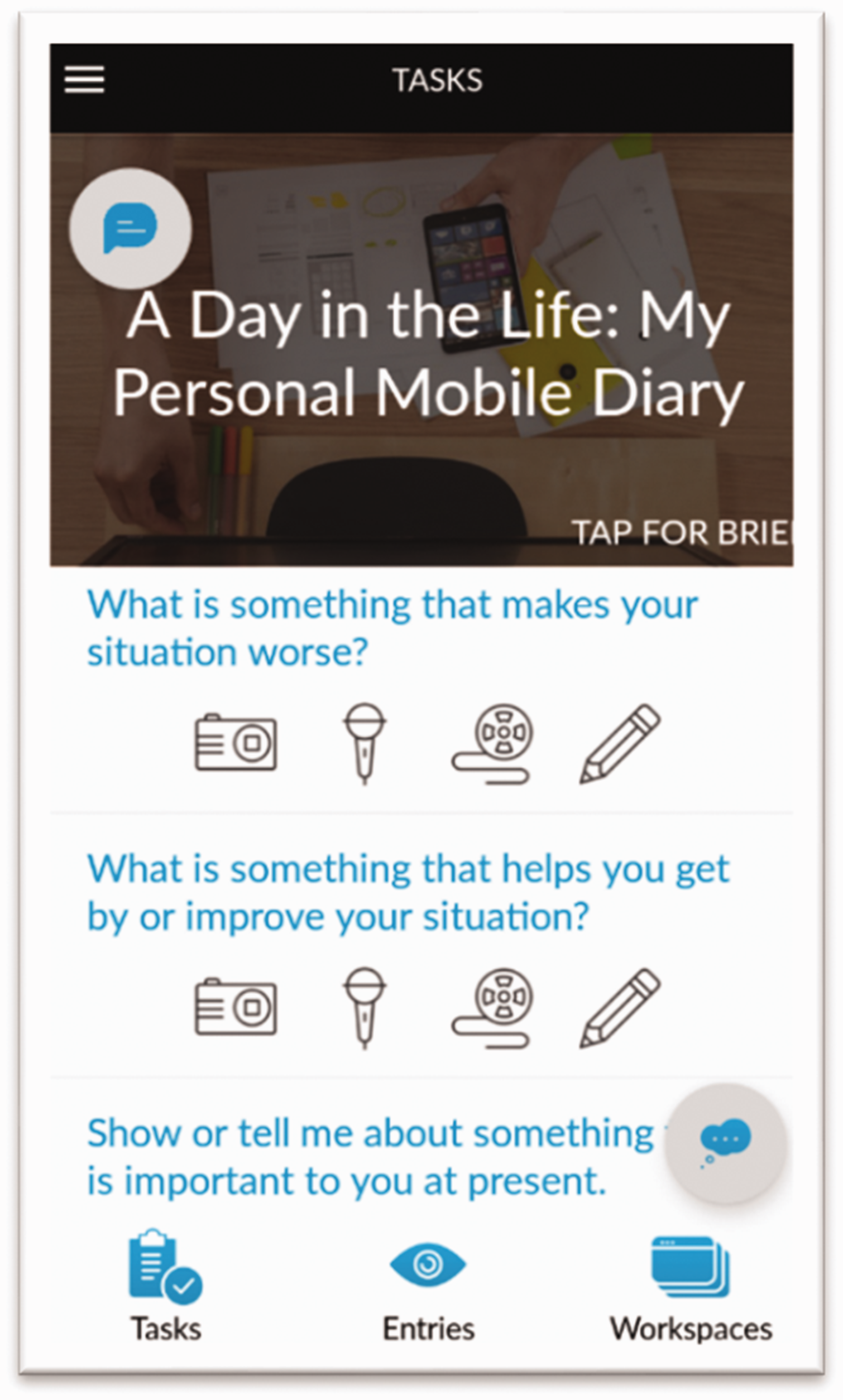
A snapshot of the mobile phone diary application interface (https://www.ethosapp.com).
The participants could use their own smartphone devices (by downloading the free ‘ethos’ mobile application) or could use a mobile device with the mobile application pre-installed provided by the researcher. Only two participants opted to use their own devices. The residential facilities that the participants were based at offered facilities for charging the mobile devices. To register and start using the mobile application, participants could use their own email address or an email address created for the study by the researcher.
Managing participant burden is one of the pertinent ethical challenges of diary studies (Brandt et al., 2007). To minimise the ‘in situ’ burden of diary recording, the participants in the current study were encouraged to record notes (keywords or snippets) at times when a full entry might be inconvenient. The researcher used reminders (via the mobile application) very scarcely. Reminders were only sent in instances when the participant had not made new diary entries for three consecutive days. This ensured that the participants were still willing to participate and were not experiencing any technical difficulties with the mobile device and/or the mobile application.
Secure storage and retention of all data generated via ethos were ensured by up-to-date and audited security measures such as secure Sockets Layer (SSL) encryption and database back-up solutions (technical details are available at https://ethosapp.com/site/security-policy). The researcher accessed the participant-generated data via a private, password-protected online account on the ethos web platform (https://www.ethosapp.com/). The researcher regularly exported and securely stored the data onto the university’s cloud-type storage system. Following this, at the end of the logging period for each participant, the researcher requested that all participant data held on the ethos web platform and mobile application be irrecoverably deleted. At the end of the logging period for each participant, any mobile devices provided by the researcher were wiped clean of any participant-generated data.
Elicitation interview
At the start of the elicitation interview, participants were requested to review and sign a ‘Release of Materials and Copyright License Consent Form’ if they agreed for the researcher to use any anonymised study materials for non-commercial purposes, including in research publications and reports, social media posts, teaching activities and knowledge exchange events. The form confirmed that the participants retained copyright of any materials created during the course of the study. Following this, the researcher presented the participants with printed copies of any photographs and with transcripts of any audio or video recordings generated via the diary. To protect the anonymity and confidentiality of any people featured in the diary entries, any images containing identifiable people were not printed off. Instead, participants were asked to discuss them from memory.
For each image, participants were asked to describe the picture; discuss what was happening in the picture; explain why they took the picture and share what they thought the picture revealed about the participants’ lives (Andonian and MacRae, 2011; Horwitz, 2012). Additionally, participants were asked about the context and circumstances surrounding each diary entry, as well as about the personal significance or meaning that each photograph (or other type of diary entry) had for them. The aim of this sequence of questions was to maximise participants’ recall, disclosure and reflexivity. Finally, the researcher asked questions about ‘non-data’ (‘Why did you decide not to use the mobile phone diary on that day?’; ‘Is there a photograph that you wish you had taken but did not or could not take?’ (Hodgetts et al., 2007; Palen and Salzman, 2002). This questioning technique was based on the premise that participants’ decisions not to engage with the diary on a particular day might reveal important insights about the dynamics of their daily lives (Palen and Salzman, 2002). At the end of the interview, participants were asked if they wished to retain copies of their anonymised diary data. Following the end of the elicitation interviews, all printed photographs were destroyed using an office document shredder.
Diary completion rate
The mobile phone diary engagement and output rates varied substantially between participants, which was unsurprising given their complex and unique personal circumstances. Altogether, nine (or 50%) of the current study’s participants opted to participate in the mobile phone diary phase. Reasons for attrition from the study included relocation to another facility, medical emergencies, personal crises, lack of interest in, or time for, completing the mobile phone diary, loss of contact with the researcher, and physical disabilities (For example, poor eyesight prevented one participant from using the mobile phone diary.). The total number of mobile phone diary entries was 202 (130 images, 40 text entries, 28 audio recordings and four video recordings). Across participants, the number of entries made varied dramatically – from three to 97, with a mean of 23 entries and a median of seven entries.
Evaluating the mobile phone diary approach
To enhance the methodological and ethical rigour in future mobile phone diary research with vulnerable and/or marginalised participants, a careful examination of its ethical, practical and theoretical implications is warranted.
Participant reflections on the mobile phone diary
At the beginning of the elicitation interview, the participants were asked to share their experiences with the mobile phone diary. All nine participants who completed it reported positive experiences with this data collection tool. They characterised the mobile phone diary as ‘fun’, ‘interesting’, ‘helpful’, ‘alright’, ‘modern’, ‘up-to-date’, enjoyable, ‘cool’, ‘great’ and even ‘exciting’ and ‘enriching’. Particularly enjoyable aspects of diary completion were the photography, the flexibility and choice of entry modality, as well as having the opportunity to share aspects of their lives (such as hobbies, aspirations and sources of joy) with outsiders who were genuinely interested in their day-to-day experiences. Three of the participants reported experiencing occasional technical difficulties, especially with attempts to record video entries. Those difficulties could be partially attributed to the relatively old mobile phone models that the researcher had provided to them.
Importantly, when asked about their experience with the mobile phone diary at the start of the third interview, most participants seemed cognizant of the aims and purposes of this data gathering tool. For example, one participant fed back: It was good. It was a good wee system. It’s quite exciting obviously knowing that somebody else is kinda . having a wee insight into your life because, I mean, as I said, I feel alone most of the time erm.The whole point of that was kinda . to give you a wee bit of insight into me [ . ]
Other participants also showed awareness of the research purposes of the mobile phone diary in terms of yielding insights into not only what they did on a daily basis but also into who they were as people, as well as into their ‘inner’ lives. For instance, one participant shared: ‘[ . ] I found it to be very informative about an individual’s life and how you can take a diary from paper and actually make pictures and voice recordings.’
Furthermore, one participant expressed regret at not utilising the video entry option more effectively: I could take a picture, I could talk about it, I could videotape it, whereas some I should have been talking and videotaping at the same time.I think.That was the thing.I could (have) videotaped and talked through it so that anybody can see (it) through my eyes. A daily inventory means to look at yourself daily-where you were at yesterday and where you are today, where you were maybe last year. You asked me what’s the difference between last year and now . ( . ) They take a daily inventory and look at it, you know . maybe like a year ago, the person may have been out on the streets, eating out of garbage cans.Now you got into a shelter, whereas they don’t have a lot of stipulations on you. [ . ] that helped me bring my awareness up somewhat. It really did, you know. It made me pay attention more to what I was doing and where I was at. [ . ] The thought process was like.There was one question, [ . ] ‘Who is important to you?’ I found that it's more than one thing that’s important to me in life. My sister is important to me. My health is important. Transportation-a lot of things are needed. What best captures my life? This is my door. This is the room I’m in. [ . ] I mean. I’m in the shelter, I’m in the room. I mean it’s better than where I was at anyway. Because once upon a time, I didn’t have no door to hang no bag on-you see what I’m saying? I didn’t have no door to close. I’m saying it’s the little things you gotta be grateful for. My situation (can) get worse if I start doing negative things, you know, like if I start hanging out with old friends or if I pick up drugs and start using drugs again. That would be like going backwards. All these steps I took to get to where I am at now, you know, was wasted, if I go back.
Methodological contributions and challenges
The flexibility of the diary method is often seen as integral to ensuring the ethical and equitable conditions of study participation for individuals who are vulnerable or otherwise disadvantaged (Bartlett and Milligan, 2015). As reflected in the participants’ testimonies cited above, the mobile phone diary offered an appreciable flexibility of self-expression. Furthermore, the multi-modal diary data helped triangulate the interview data, thus enhancing the credibility of the findings (Anney, 2014). The diary component also strengthened the participatory element of the study (Aldridge, 2014). In addition, by combining diary, interview and elicitation approaches, the present study demonstrated the feasibility of methodologically pluralistic designs in research with a participant group historically seen as hard-to-reach and difficult-to-engage in research (Crozier and Cassell, 2016; Eyrich-Garg, 2010). The present study also demonstrated the critical importance of follow-up, elicitation interviews for unpacking the meanings behind diary entries and for avoiding simplistic interpretations of the data.
The use of the mobile phone diary generated data that seemed to enhance both the internal and the external empathetic validity (Dadds, 2008) of the research. On the one hand, the participant-generated photographs, audio entries and other ‘in situ’ data deepened the researcher’s understanding of the weave and texture of the participants’ daily lives and ‘experiential worlds’ (internal empathetic validity; Dadds, 2008). The photographs, for instance, aided the researcher’s ‘imaginative engagement’ with the participants’ lived experience (McLeod and Guillemin, 2015: 39). On the other hand, the data generated via the mobile phone diary revealed the rich emotional and psychological lives of the participants, including their needs, wants and strivings for a better life. Thus, those data connect with our shared humanity and have the potential to resonate with audiences and promote empathy and reduce prejudice and stigma (external empathetic validity; Dadds, 2008; Gubrium et al., 2014).
The present study also helped advance the understanding of some of the challenges and effective strategies associated with the mobile phone diary method. Because the diary method, regardless of its duration, has been associated with considerable cognitive and physical costs of participation (Bartlett and Milligan, 2015; Crozier and Cassell, 2016), it was not surprising that only nine (50%) of the current sample opted to complete the diary. Indeed, the present study’s participants were experiencing a range of health-related issues such as substance use, SMI and physical disabilities, which might have prevented some of them from completing this data collection phase. To maximise the completion rates and sustain the motivation of those that did opt to complete the diary, the researcher carried out training with the participants, made himself available in case of any exigencies and was mindful of reminding participants that their voices mattered (Bartlett and Milligan, 2015). Nevertheless, the relatively high participant burden associated with diaries remains an inherent limitation of this technique.
Furthermore, despite recommendations for setting upper and lower limits on diary output (Bartlett and Milligan, 2015), the current study found that the purposeful lack of restrictions on entry frequency and volume met the needs for flexibility and low participant burden in this participant population. Indeed, as discussed above, the nine participants’ engagement with the diary differed dramatically, which reflected their diverse needs and circumstances. Following on from Hodgetts et al. (2007), some participants’ little engagement with the diary provided a central discussion point during the elicitation interviews. They were encouraged to narrate about how the daily demands of their predicament had precluded their ability to more thoroughly engage with the diary. It was important for the researcher to communicate to the participants that his primary interest was participants’ everyday life experiences rather than the diary entries themselves. This helped make them feel listened to, valued and respected despite the fact that they had not completed the diary as thoroughly as they had possibly hoped to.
While Packard (2008) cautions that the introduction of a novel piece of technology into the research with individuals experiencing severe economic deprivation is likely to entrench the power imbalance between the participants and the researcher, the current study found no such potentially adverse impacts of the mobile phone diary. In particular, in contrast to Packard’s (2008) study, none of the current participants reported feelings of incompetence, embarrassment or lowered self-confidence as a result of participation in the study. The testimonies offered above show the rather positive effects of participation in the research. At least two methodological decisions may have mitigated such potential power imbalances: the use of the rather familiar mobile technology (as opposed to disposable cameras used in Packard’s and in other photo-elicitation studies) and the introduction of the mobile phone diary at the end of the second interview, which likely increased the participants’ rapport with, and trust in, the researcher.
Theoretical insights
The mobile phone diary method seemed to be particularly generative of unexpected theoretical insights relating to the participants’ experiences of homelessness, shelter living and mental illness. Two somewhat contrasting insights will be briefly discussed here to exemplify this theoretical generativity: (a) the significance of ‘nothing’-ness and (b) the mental illness-inducing volatility of shelter living. Those insights emerged from two common themes in the participants’ diary entries: chronic boredom and the precariousness of shelter living and its effect on participants’ emotional well-being.
To begin with, several participants’ entries viscerally conveyed the overwhelmingly negative impact that boredom, repetitiveness and the lack of occupational activities had had on their mental well-being and recovery. Recurring entries such as ‘have nothing to do and nowhere to go’, ‘depression, boredom, alcohol’, ‘I’ve not got anything to do today . ’ and ‘no drink. no cigarettes and nowhere to go’, which were often accompanied by numerous images from inside the participants’ rooms at the shelters, provide an evocative testimony to those participants’ enduring sense of boredom, stagnancy and powerlessness, which some alleviated by excessive drinking of alcohol and which often caused a sense of ‘existential vacuum’ (Frankl, 1969). Those diary-aided data, supplemented by the pre- and post-diary interview data, offered revealing insights into the psychopathology of boredom and inactivity as manifestations of social exclusion, economic deprivation and restricted social participation. Those diary-aided data also helped advance the understanding of the relationship between homelessness, occupational alienation and recovery (Marshall et al., 2019).
Those findings highlight the need for the increased sociological attention to the significance of ‘nothing’ for the experience of mental health recovery amidst precarious living conditions (Scott, 2018). Seemingly ordinary, mundane experiences may, in fact, be indicators of the pervasive influence of overlapping forms of social marginality and exclusion, including symbolic exclusion, social exclusion, economic exclusion, informational exclusion and cultural exclusion. According to Susie Scott (2018: 3), ‘[ . ] nothing is always productive of something [ . ]’. In the present study, ‘nothing’-ness (manifested in silences, imposed passivity, empty bottles and unfulfilled hopes) appeared to engender immense psychological distress and hopelessness and contribute to the participants’ disidentification with the possibility for recovery in their lives.
Simultaneously, another thematic cluster of diary entries communicated the volatility of the daily conditions of homelessness and shelter living. One participant, who was street homeless and attended the drop-in centre in New York City, for instance, messaged: ‘It’s a good day because I have something to do and it makes me feel good. God bless.’ On the very next day, however, his internal state was captured by the message: ‘I am having a very bad day. Trying to get myself together.’ Indeed, for this participant, the uncertainty and precariousness of being without a home exerted a significant emotional toll, which he described in one of the one-to-one interviews as his ‘trials and tribulations’. His diary entries, albeit small in number, evocatively captured the impact of the chronic stress of street homelessness, as well as the crucial importance of doing things and feeling connected to others as conducive to coping with this predicament. This marked within-person variation in the emotional valence of the diary entries contributed to the understanding of the impact of the adverse physical and psychosocial conditions of shelters on the well-being of clients who have SMI (Nettleton et al., 2012).
Conclusion
Understanding the experiences of health and illness in marginalised, vulnerable and/or disadvantaged groups benefits from the creative and pluralistic, yet pragmatic, use of participatory research methods (Aldridge, 2014). The mobile phone diary method allows for the integration of contextual sensitivity and participatory focus in qualitative research with disadvantaged populations. The mobile phone diary method demonstrates the value of the hybridisation of qualitative modes of inquiry for obtaining rich, authentic and insightful data while preserving methodological and ethical rigour. Qualitative researchers should endeavour to apply creative and adaptive critical methodologies to access the ‘hidden knowledges’ that persons experiencing multiple social disadvantage possess (Elliott et al., 2015). The illustrative study conducted by the current author and discussed in this paper demonstrates the acceptability and feasibility of the mobile phone diary method in a traditionally hard-to-reach group-people who are homeless. Prospective researcher users of the mobile phone diary system should aim to maximise participant engagement without increasing the burden of participation and optimise the richness and usefulness of the data.
Footnotes
Acknowledgements
I am grateful to the anonymous reviewers for their thoughtful and constructive contributions. I wish to also thank my research supervisors, Dr Beth Weaver and Mr Neil Quinn, for the continuous support, as well as Prof. Deborah Padgett for the advice on my research. Lastly, I extend my thanks to the research participants in this study, who kindly and courageously gave away their time and shared their stories.
Declaration of conflicting interests
The author(s) declared no potential conflicts of interest with respect to the research, authorship, and/or publication of this article.
Funding
The author(s) disclosed receipt of the following financial support for the research, authorship, and/or publication of this article: This work was supported by the European Union’s Horizon 2020 research and innovation programme under the Marie Skłodowska‐Curie Grant 690954.
