




Abstract
Atmosphere is a neglected topic in social work, and so this article considers the production of atmospheres amongst the residents of an extant 1960s housing scheme in Edinburgh (UK). This is in order to address not only the complexity of feelings about living on such an estate but also to consider what consequences the paying of attention to atmosphere’s production and effects might have for a social work concern with welfare and wellbeing. The article is based upon semi-structured and walking interviews with 17 residents – council or private renters and home-owners – of Claremont Court, a mixed, low-rise estate and analyses their description and crafting of atmosphere as a way to understand questions of belonging, welfare and community in situ. After reviewing some existing research on atmosphere and outlining methodological issues relating to the Claremont Court project, the article goes on to consider how residents described their feelings about or sense of the estate and its design before discussing the emergence of contradictory narratives about home. The production of narratives about those needing welfare support is particularly pertinent to atmospheric accounts of the housing scheme, and so the article addresses this before finally making an argument for the relevance of immersive and emplaced accounts of space and place for both social work practice and research.
This article takes the call for social work to take both space and place more seriously as a starting point for the investigation of atmosphere, something that might, at first glance, appear to have little to do with welfare concerns. Yet, much of the research into child protection highlights atmosphere as a key – but overlooked – factor (Ferguson, 2010; Leigh, 2019). It has significant effects upon practice and, I would add, is also produced in and through those, often very dramatic, accounts. Atmosphere is an aspect of both space and place, in the sense that it is both formulated through people’s interactions within particular spatial configurations and it is also something frequently associated – albeit problematically – with certain places. Think of the notion of Paris as a “romantic city,” for example.
However, atmosphere – tricky as it might be to pin down – is no mere backdrop but, rather, a part of how people’s everyday activities are constituted. Many social workers will be familiar, for example, with the idea of going into a home that has a particularly good or bad feel. Social work, then, needs to be attentive to atmospheres, not only because these form part of the situation in which social workers may or may not intervene but also because they contribute to the ways in which welfare and wellbeing concerns arise in the first place. Thus, this article examines the production of atmospheres in a particular setting in order to show how welfare issues sometimes bubble to the surface. In this sense, atmospheres are part of a dynamic set of interactions that produce social work and welfare concerns, rather than being peripheral or contextual, a mere “… ‘bucket’ for social action” (Smith, 2017: 3).
This article uses data generated via interviews with residents of a 1960s modernist housing estate in Edinburgh in order to demonstrate the role that atmosphere plays in the creation of belonging, community and social welfare. This is important since such council/social housing estates are frequently regarded as either lacking in atmosphere or as having an oppressive feel (Boughton, 2018; Hanley, 2017). Concrete tower blocks are often used as gritty backdrops to conjure up atmospheres of decay, violence or dystopia, a discourse “reserved almost exclusively for works built by the state, and, most commonly, in reference to social housing schemes” (Roberts, 2017: 125). The idea of the estate as “concrete monstrosity” (Thoburn, 2018: 613) is often used to create an atmosphere of decay or to assign stigma, one that attaches to residents in similarly stigmatising ways and which, it is vital to note, is also used to lay the groundwork for profitable redevelopment. As Slater (2018) has noted, “the frequent depiction of public housing complexes as obsolete, poverty-creating failures [is used to justify] the expulsion of people from their homes and the subsequent gentrification of valuable central city land tracts” (891–892). Yet, such actions also rely upon the silencing of the residents of housing schemes, those whose voices, as some existing research notes (August, 2014; Roberts, 2017; Thoburn, 2018), are usually absent from debates about the nature of the very buildings they occupy. This means that we know very little about how atmospheres are interpreted by the people living in such housing developments and, crucially, how those residents’ day-to-day activities relate to the production of atmospheric effects.
This article examines atmospheres as lived at Claremont Court, an estate built by Sir Basil Spence and Partners in 1959–1962 and situated just north of the New Town in Edinburgh. The Court sits in an architecturally mixed area, alongside Georgian housing, tenements and more traditional local authority homes and so, for some, its modernist aesthetic makes it stand out from its surroundings. According to the Scottish Government’s Index of Multiple Deprivation (2016), Claremont Court is one of the fourth most deprived areas of the country by decile, with its housing stock ranking amongst the “most deprived.” Originally designed to foster better community and welfare, through features such as deck access, courtyard gardens, cottages for older people and maximisation of light and space, Claremont Court was intended to promote sociability, mixing of different classes and household types, care of ageing residents and personal welfare as part of local authority housing provision, something of an unusual project in the context of post-war Scottish housing (Costa Santos and Bertolino, 2018; Costa Santos et al., 2018; Glendinning, 2008). The open-plan layout of the homes and the connection between the kitchen, living/dining area and balcony were all features that suggested a modern way of life and one that “questioned the received social hierarchies of class and gender that were normatively inscribed into domestic architecture” (Attfield, 2002: 249), although, as Koch (2018) notes, it is important to remember here that post-war housing estates also subjected their tenants to “paternalistic forms of rent and housing management that required them to live up to state-sanctioned – that is, classed – standards of ‘respectability’ and ‘decency’” (15).
Comprising 63 dwellings in low-rise blocks plus two sets of cottages around courtyards, the Court today is socially mixed, with roughly one-third of dwellings still belonging to the local authority, one-third private rental and one-third owner occupied. Its residents are therefore a mixture of long-term tenants, more recent home-owners and a transient population of shorter term renters (including those who stay for a night or a weekend) and those placed in the Court by social welfare agencies. Due to its architectural significance, the building was listed by Historic Environment Scotland in 2011, but is in a relatively poor state of repair due to disinvestment and lack of maintenance.
This article examines, first, some of the existing literature and research on atmosphere, before outlining some background and methodological questions relating to the Claremont Court project. Next, data on the feel of the place and on aspects of its modernist design are examined, with attention given to residents’ contradictory and complex views about the estate. Finally, this article returns to the question of why atmospheres should matter to social work and makes some suggestions for immersive or emplaced research and practice.
Existing research on atmosphere
There have been various investigations into the concept of atmosphere, but most have suggested that atmospheres are not observable phenomena but, rather, “both experienced and created: they encompass extant features of emotional and material life as well as its staging or manipulation” (Gandy, 2017: 357). This is important, as it recognises that what passes for “atmosphere” is, in fact, sensed but also produced via interactions between persons and objects. Further, Gandy’s comment suggests that atmospheres may be changed – manipulated – which also infers that they are not necessarily agreed and that they may be fleeting. Just because some people say that a particular event or place has a “great atmosphere,” others may not feel this or may even experience it as threatening.
To these notions of atmosphere, Morgan (2019) has added the “original atmospheric experience will continue in memory and recounting after the actual event or encounter” (132). This is also a crucial point, since atmospheres are never just produced, they are invariably narrated. Further, Böhme’s (1993) work has suggested ontological complexity because atmospheres have a “peculiar intermediary status … between subject and object” (114). Bille et al. (2015) have similarly proposed that atmosphere “is characterized by a certain ontological and epistemological vagueness” (32), and Anderson (2009) describes atmosphere as “perpetually forming and deforming” (79), a useful concept that holds opposites, such as presence/absence, materiality/ideality, definite/indefinite or singularity/generality, in tension.
Bille’s research into the creation of cosy atmospheres – or hygge – in Danish homes has noted that residents use light to suggest a warm or comfy feel. However, this is part of “orchestrating a presence at a distance” since, although lights are used to create a communal feel, residents did not want intimate contact with neighbours, since this would highlight “differences that are often more pronounced than their lighting practices” (Bille, 2015: 62). This is an important reminder that atmosphere ought not to be treated merely as affect, since that would be in danger of eliding its social and material aspects. As Bille et al. (2015) note, it “must be understood as a spatial experience of being attuned in and by a material world” (35). Further, others such as Pink and Leder Mackley have suggested, based upon research into the creation of atmospheres within UK home interiors, that mundane aspects of atmospheric practice are important. Much of the creation of an atmosphere may involve “habitual, often unspoken about routines” (Pink and Leder Mackley, 2016: 180), rather than specifically intense practices.
It is here that Mason’s concept of “socio-atmospherics” (Mason, 2018: 123) is especially useful, since she argues that there is a danger of atmosphere being treated as a cipher, or as indicating “other things (by implication, the main things).” Mason (2018) uses “atmospherics,” instead, in order to convey a more dynamic, but also relational, set of “goings on” (179). To this is added “socio-” to indicate that atmospherics are not divorced from social, cultural or historical forces, a point also made by others (Edensor, 2017; Highmore, 2017a). Echoing the objection to surroundings as a mere “bucket” for social action, Mason (2018) comments that: “ … places, things and surroundings are not inert or static materialities, but neither do they simply house, corral or contain … elements [such as experience, feeling or memory] either; they are more like conduits for them … or focal points of the socio-atmospherics” (197).
To date, there is little in the social work literature on atmosphere, although there is some reference to it in ethnographic studies of child protection. Leigh’s (2019) work argues that researching affect in a comparative ethnography allows us to bring “atmospheric social interactions” into the picture of social work (213) and Jeyasingham’s study of the production of space in children’s social work notes the role that office acoustics and objects play in the creation of atmosphere. Here, objects such as paper, toys or clothes contribute to office atmospherics, yet are not obvious. Jeyasingham (2015) suggests “the component features of atmosphere are often apprehended as unexceptional in themselves and, in so doing, might have greater atmospheric effects” (140).
Perhaps the most attention to atmosphere has been given by Ferguson (2018), who has argued that, during social work home visits, overwhelming or unbearable atmospheres may generate anxiety or disgust or an “atmosphere of tension and sometimes menace, pervaded by uncertainty, anxiety, fear and adventure” (Ferguson, 2010: 1106). He adds an important methodological point, which is that most social work research lacks atmosphere, since it “fails to capture the texture, feel, the lived experiences of where the work goes on and how this impacts on perception and what does (and does not) get done” (Ferguson, 2010: 1102). Advocating a mobile, ethnographic approach, Ferguson (2010) suggests the aim of: … atmospheric inquiry into social work is to understand much more about the lived body of social workers and how they comprehend things as they are in motion and move through public spaces and then into the private lives and spaces of service users. (1108)
Background to the project
The Claremont Court project 1 employed ethnographic methods in order to understand how residents make sense of belonging, community and welfare in situ. Although the project’s broader concerns were to do with how a built environment and community of people act upon each other, the research also considered what influences the atmosphere of the estate (Lewis et al., 2018). The field research was conducted over a three-month period in the summer of 2016 and employed a combination of methods, including visual and contextual mapping of participants’ homes, participant observation and various types of interview. Prior to the interviews, there was a brief period of meeting with residents and observation of communal areas and, subsequently, there was also some follow-up, including a public event focused on housing policy and findings from the research, which was attended by some of the residents. To clarify, research participants were residents of Claremont Court and, although they gave their views about social welfare needs and help-seeking (Hicks and Lewis, 2019), professionals were not approached to take part in the project since the focus was upon what it is like to live in this setting. The project was approved by the Research Ethics Committee of the University of Northumbria and pseudonyms for participants have been used, as well as identities disguised to protect anonymity.
During the main fieldwork phase, semi-structured interviews were undertaken with 17 residents, 8 men and 9 women, from a mixture of middle- and working-class backgrounds and various ages (the youngest was 28 and the oldest 66, although most were in their 30s or 40s). Three couples were interviewed together, the remaining 11 people were seen individually and all were self-selecting; that is, those that agreed to take part in the project. All of these interviews were conducted in participants’ homes or, alternatively, in a place where they felt comfortable, such as the communal areas of the Court or a workplace. Participants were then invited to take part in follow-up activities: three filled out diaries, later used to elicit discussion of an ordinary week; and seven took part in walking tours or “go-alongs” (Kusenbach, 2003). For the respondent diaries, a proforma, which prompted residents to think about what they did, where and with whom over seven days, was used. This also asked participants to note down passing encounters in the street or shops in order to provide data on social interactions and community in daily life. In the follow-up interview, the diaries were used to elicit conversations with residents about their relationships with people and places, as well as their routines and the typicality of the events noted.
The walking interviews were used to highlight residents’ interactions with the building, other objects, sights, smells or sounds, which produced reflections upon place, space and other matters. The opening up of a vista, for example, elicited recollections about the past or about changes in the area, which allowed for the emergence of reflections on the environment to unfold “at street-level … offering novel perspectives and prompting different questions” (Bates and Rhys-Taylor, 2017: 4). Housley and Smith (2010) remind us that any route taken by a participant on a given occasion is tied to the research situation and thus reveals little about the way in which the informant uses and navigates the setting in the course of routine activity let alone what we might call the “navigational methods” used to achieve this. (3.5).
As with all methods, however, there were some limitations. Residents were less likely to volunteer to complete a diary, possibly because this involved quite a time commitment. Others did not take part in walking tours because, ironically, they felt they would be “watched” or that this would draw more attention from their neighbours. But it is also important to note, here, that the project drew upon Mason’s “facet methodology” (2011), which does not aim to capture social phenomena in their entirety – an impossibility – but rather to produce “flashes of insight” into different aspects of what is being investigated, not a “ … ‘fit’ between the different component parts of a study … or ‘corroboration’ of different findings or methods” (80–81). Thus, walking tours are not a “better” method than the sit-down interview (May and Lewis, 2019), but they provided different kinds of insight into residents’ perspectives.
All interviews were digitally recorded, transcribed and then entered into a software package to aid the analysis of qualitative data. After an initial read-through of the transcripts, a rough coding frame was developed, reflecting the aims of the project as well as the ideas introduced by research participants. One of these codes, for example, was to do with “atmosphere.” The transcripts were coded three times by members of the research team, which allowed for fine-tuning of the key themes and for comparison of codes and their significance. This allowed questions of atmosphere to be compared and read across the entire data set, but the transcripts were also examined again in order to consider how atmosphere was talked about within individual interviews. In part, this was to ensure that the analysis took the context within which questions of atmosphere were talked about into account.
With regard to questions of atmosphere, the project started from the position that residents interact with architecture via their bodies and senses, and that the sights, sounds and smells of Claremont Court contribute to whether a space feels inviting and, further, to how residents feel about where they live. However, a related aim was to investigate the ways in which residents produce atmospheres both within their individual homes and within the wider environs; that is, how they interpret atmospheres or impose these upon the building, including more intimate spaces, such as a kitchen or living room. In thinking about how to go about studying atmosphere, the influence of Pink et al.’s (2015) work, which argues to “go beyond interviews … to engage with participants in the environments in which the atmospheres … are actually generated” (366) was important. For the Claremont Court project, this entailed not just talking with residents but also observing their conjuring of atmospheres alongside them. Further, this also involved immersion in particular spaces in and around the Court, not only to access residents’ recollections and feelings about those spaces but, crucially, to provoke their feelings and, indeed, their production of atmospheres anew. Atmospheres are thus produced via the research encounter and are “something that we are in the flow of, rather than something that we are researching from the outside, or that it would even be possible to step out of and observe” (Sumartojo and Pink, 2019: 36).
The feel of the place
While immersed in or traversing particular spaces, Claremont Court residents were easily able to conjure atmospheres or tap into associated feelings. In this sense, none of the interviews lacked atmosphere. However, when asked face-to-face, residents found atmosphere difficult to put into words. In an interview, Emily said, “I don’t know quite how you’d describe it … But it’s definitely got its own little feel … it’s definitely unique … like a little kind of in-between-y place.” Tom also struggled:
Alastair, a resident in his 50s who, with his partner Catriona, owned one of the maisonettes, referred to the “aesthetic shock” he believed Claremont Court must have induced when it was first completed. But for Alastair this was positive, in that the flats represented “modernity.” He talked of the houses being “light and airy,” and said that the Court “has an atmosphere of its internal planning, it’s kind of very ‘60s in the sense of its setup … very angular and … very clean.” Alastair clarified here that he meant “clean … in an aesthetic sense … I don’t mean … antiseptic.” He gave an example: Even kind of curious things like the lighting in the corridors, you know, ours is out at the moment … trying to get the council to do that, but … there’s just something about it when you walk along these corridors at night with the lighting … It’s hard to explain it, it’s when you come in at night you kind of go, “Wow … this is … somebody’s thought about that,” you know, it’s a bit jaded now but the original thing … must have been quite startling. [Interview] Yeah, it was very kind of comforting, it … never became for me a dark space where I thought, “Well this is it,” it’s always the sunshine and daylight and brightness, it added to help me get out of it, help give me a shake … I never felt it was like a dark space where you wanted to give up … and that’s the other aesthetic for me … it was calming, at a point where you’re really feeling stressed … Even at night, you have the blinds down and you get the kind of crucifix patterns from the lights and passing cars and stuff and kind of watch, and there’s a whole process when the space takes on a different feel, you know.
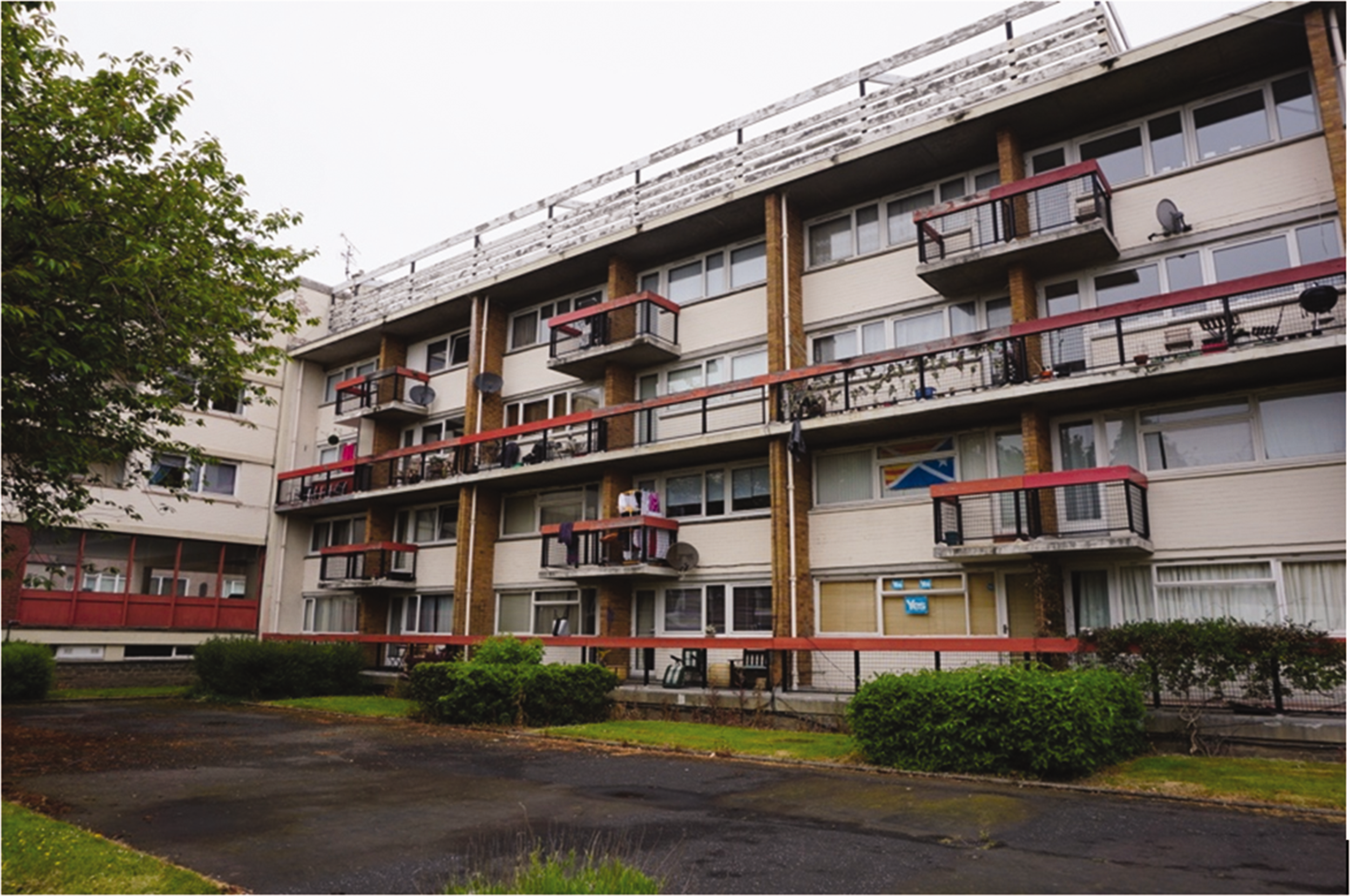
A view of Claremont Court (2016).
Alastair’s notion of “aesthetic shock” was echoed by others, such as Allan, a council tenant in his 30s, who recalled seeing the flats as a child: I’d never seen a house like it … And I remember looking through the letterbox and, when [Mum] opened the door the first time, I would run to the living room door and look at the staircase and go, “Oh, wow, this is cool.” I’d run up the stairs. I’ve lived in houses bigger than that but it just … that sort of small compact sort of cube, but with just a stair that goes right up. [Walking tour]
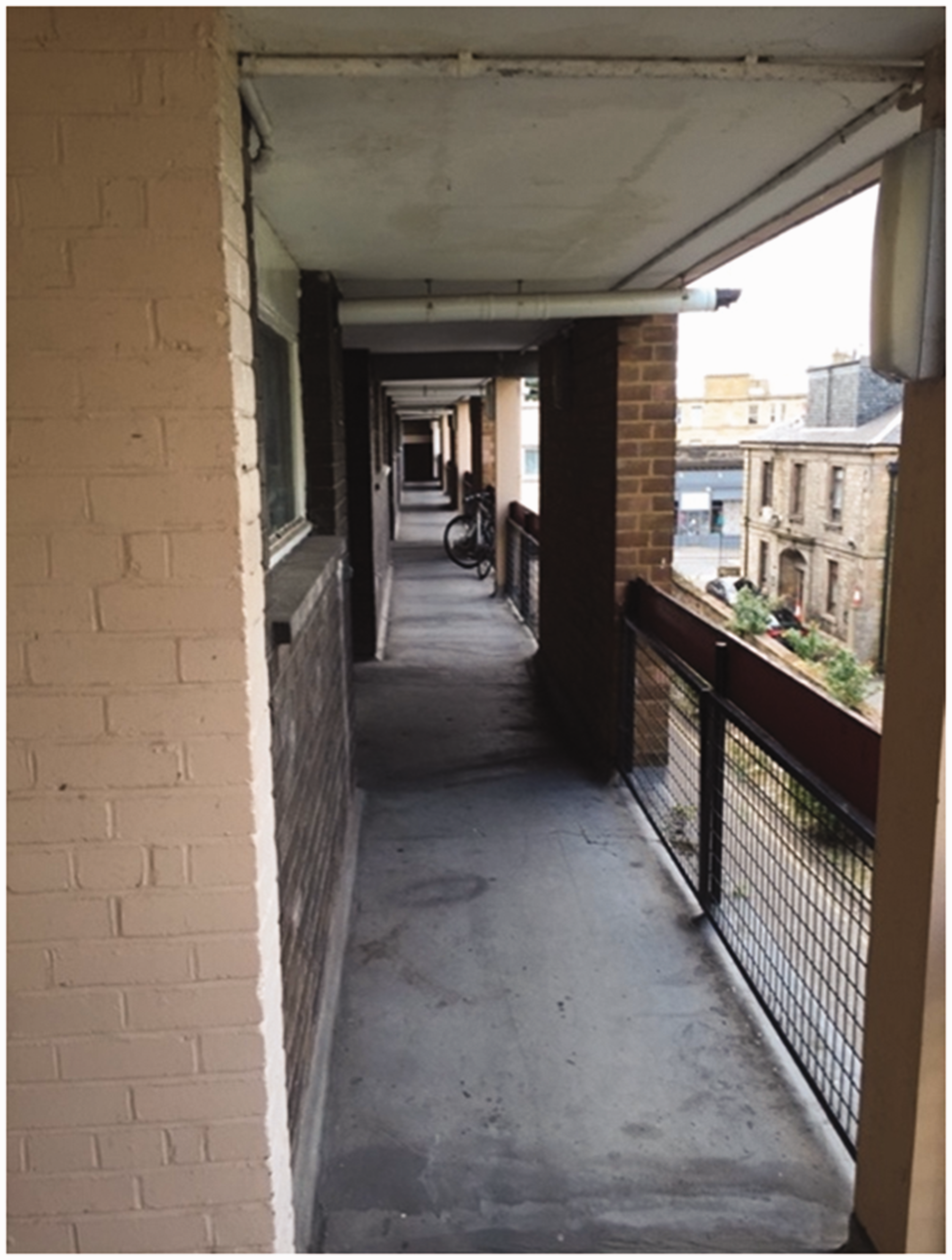
Deck access or a “street in the sky” at Claremont Court.
Jack’s point about use of deck access in the design of Claremont Court is especially interesting as “streets in the sky,” as they are also known, are often associated with the discourse of social housing as “social failure” (Highmore, 2010: 98). These decks were imagined originally to offer “new places of congregation, places for passing the time of day, for doing nothing, safe from the danger of increased traffic” (Highmore, 2017b: 86). Allan, for example, fondly recalled chasing around the decks and stairways as a child, but he also commented that these features sometimes attracted crime and other illicit behaviour, both of which are also reported by residents of the Aylesbury estate in Baxter’s (2017) study. Originally designed as “conducive to sociability” (Glendinning and Muthesius, 1994: 113) and intended to promote a better atmosphere – allowing residents to “meander” or to “be able to smell, feel and experience the new life that’s being offered through [their] full range of senses” (Peter Smithson, cited in Powers, 2010: 58) – it is now sometimes argued that these features “failed to function as real streets. They became a source of anxiety around anti-social behaviour and fear of being mugged” (Dodge, 2017: 33–34).
However, in the Claremont Court study, residents were largely positive about the benefits of decks, even though they were sometimes disturbed by people “lurking” in stairwells. Similarly, Thoburn’s study of Robin Hood Gardens found that residents’ views of the decks were largely positive. Although – like Claremont Court – the stairwells offered refuge for occasional drug use, residents suggested that decks promoted opportunities for sociability and an outdoor life (beautifully illustrated by Miah’s accompanying photographs): “ … nearly all the residents … talked enthusiastically of the streets in the sky, describing a complex of uses, sensory associations, emotions, and pleasures” (Thoburn, 2018: 623). Here, then, it may be important to remember that atmospheres are not caused by buildings or places – what Baxter refers to as “design determinism” (Baxter, 2017: 347) – rather they provoke interpretations from residents who, in turn, create the feel of a place via their various usages of it. As Rogaly and Taylor’s (2009) study of Norwich estates notes, it is “through the lives of the residents that … spaces and places gain … their layers of meaning” (59).
Alastair’s in-passing comments about “trying to get the council” to mend exterior lights or the estate being “a bit jaded,” however, also remind us that atmosphere references socio-political features too. Disinvestment in social housing produces decay or, as Jacobs et al. (2012) have noted, “mould, damp, dust, rust, and fading … play their part in the creation of architectural atmosphere” (136). At Claremont Court, significant water damage – in part caused by substandard repairs to flat roofs – as well as peeling paintwork and poor maintenance added to this feel (see Figure 3). The social ideals associated with 1960s council housing have shifted, with one consequence of this being disinvestment due to the creeping privatisation of housing provision or what Boughton (2018) refers to as a “system of commercially driven procurement and public-private partnership that has become near-ubiquitous in the social housing regeneration of recent years” (2). For example, at Claremont Court, the responsibility for upkeep – formerly that of the City of Edinburgh Council – is now unclear as home-ownership and the outsourcing of services have caused confusion over some aspects. In this sense, the original 60s design features promised a better life based upon state provision of decent housing but one that was “already on the brink of obsolescence” (Highmore, 2017b: 257), since subsequent changes to forms of government promoted attacks on the welfare state and the prioritisation of profit.
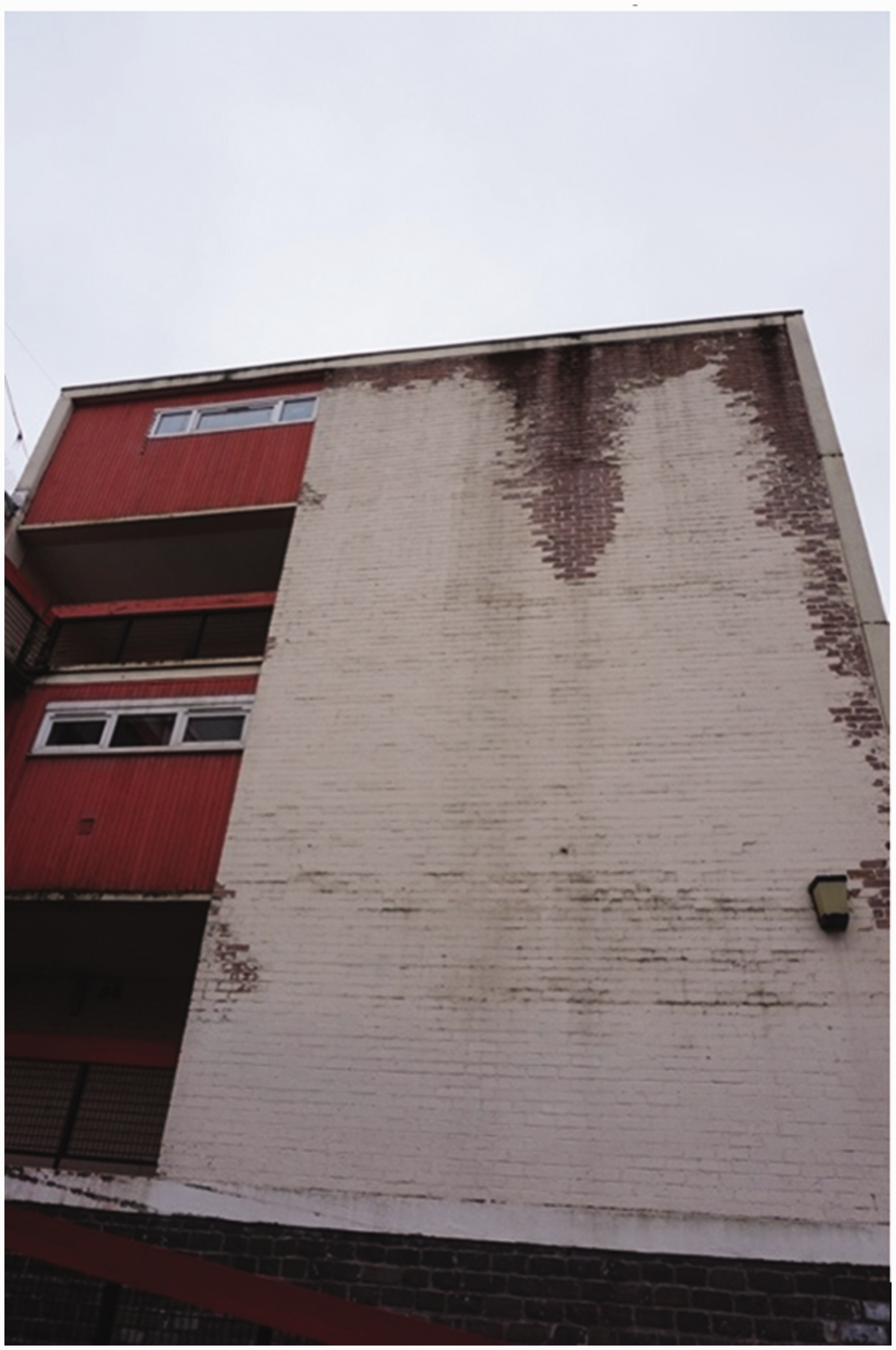
Another view of Claremont Court (2016). Photograph by Camilla Lewis.
Atmospheric contradictions?
Tom’s descriptions of Claremont Court were interesting because these conjured different senses of the place, dependent upon a number of factors. During his walking tour of the building, he highlighted architectural features that added to the aesthetic and a communal atmosphere: As an architect, my … view of block two is … when we came to view our property, I’d never walked into here and, as soon as I walked in, I loved that block … If you want to tick the box as an architect, that is like probably something you’re going to look at and think, “Oh yeah, that’s really cool, I like that.” And the little balconies, it’s one of those lovely little … as well as, kind of, looking good aesthetically in my opinion, there’s something quite nice about the balconies because they do get used quite a lot, it’s just quite nice, there’s always somebody out chatting, it’s quite a nice communal … it’s quite a nice social, you know, kind of little study in how to live next to each other, it’s really well done. The second time when I went back, erm, a wee bit later at night and I’d already seen the flat, so I was paying more attention … there were a couple of smashed windows at the time and I was starting to look and think, “Maybe there’s a reason it was so,” … ’cause it was really cheap … you know, relatively speaking … But then I looked, I was thinking, “Okay, maybe … maybe there’s more … maybe there’s more that I’m not seeing.” So, I kind of went off it a little bit thinking, “No, I don’t really want to … end up living somewhere with … where it seemed there might be kind of obvious social problems” … And there was a bit of graffiti on the wall … Oh, actually and I got “happily” accosted by … one of the few times I’ve ever been threatened in the street in Edinburgh, and it happened to be by somebody who then walked into the Court and I was like, “Oh, so that might be one of my neighbours?”
Tom’s apparently contradictory feelings about Claremont Court were a feature of many of the accounts given by other residents, who often held both positive and negative views of the development. Regarding atmosphere, this is a vital point since residents’ accounts often evoked contrasting feelings simultaneously – Anderson’s (2009) opposites held in tension. Emily, for example, a young owner occupier who sometimes rented out a spare room in her flat, was quite fearful of some of the drug dealing and drug use that took place in fairly close proximity to where she lived: It is quite stressful sometimes you’re … you don’t want to go out of your front door if you can hear that there’s people in the stair doing whatever, sometimes you get woken up late at night, or I find it difficult to go to sleep if there’s a lot of activity. Erm, yeah, that’s how it affects me. [Interview] But I think having been here for ten years now and really made it my own, I feel like it’s definitely … like, even these two girls [renters], when they arrived a few weeks ago, like, one was, “Oh your house has got such a nice energy.” And, like, people often say, like, “Oh, you can totally tell it’s your house.” And I feel like I have totally made it my own space. So, even when people come in, I feel like it’s a strong enough like … erm … I don’t know what you call it, “presence” I’ve got in the house now.
Referring back to Figure 1, for example, garden gnomes, washing, Scottish Independence posters (“Yes”), a flag supporting Scottish and Catalan independence, a barbeque, plants, chairs or satellite dishes all say something about residents. Although these may variously be outward-facing political statements (“Yes” or Scottish/Catalan independence), homely (plants or a barbeque) or even more incidental (residents who used balconies to air their washing were quite circumspect about this), even the space which occupies the private/public border (windows, balconies) is used to create a feel of home but also distinctions between residents. Even satellite television dishes, which might appear at first merely practical, were felt to “say” something. One middle class resident, for example, was quite embarrassed about having inherited a satellite dish from previous owners: “Oh yeah, that’s something we have to change … we were going to take the satellite dish down, but we’ve not done that yet.” In this sense, objects or modifications add to the feel of the place but also demonstrate the ways in which there may be many atmospheres circulating within a given space.
As well as concerns about drug use on the estate, some residents also mentioned the housing of people with “social problems” by welfare agencies as something that also caused concern. Catriona noted: Flat [X] I think it was, is known to be a flat the council use for people who have been homeless and trying to kind of get them back into the community. So sometimes there’d be all sorts of odd folk that would be placed in that flat. I’m not entirely sure if it really was hugely successful really, because being there that people are generally quite isolated. [Interview] We have probably called the police more than I ever have in my life living in the Court … partly to do with … as I understand there’s a, I don’t know if this is the right term, but a “crisis care” flat … And a couple of times they’ve put people into that flat unsupervised and people without the right kind of level of support and it’s not gone well. [Interview]
As has been noted elsewhere, this may sometimes be associated with particular features of modernist estates, such as lifts, stairwells or decks. But, as Catriona noted, a bad atmosphere was “more to do with some folk that you don’t know that loiter.” Yet, it is also worth remembering here that, while some of this was to do with people hanging about in communal areas, it is also about the creation of an imagined “other.” Wacquant (2008), in his work on stigmatised estates, for example, has suggested that micro-distinctions between residents involve the “diversion of public opprobrium onto scapegoats such as notorious ‘problem families’ and foreigners, or drug-dealers and single mothers” (183). The stigma that estate residents may feel from wider society is redirected towards particular or imagined co-dwellers. Loiterers and “others” were usually associated with certain areas of the estate in the minds of residents, areas that they treated with some caution, since they were “spooky,” “strange” or as Stuart, a council tenant in his 60s noted, had “a bit of a feeling.”
Why should atmospheres matter to social work?
For some social workers, it may seem odd or even indulgent to focus on Claremont Court’s “own little feel.” What can this tell us about social welfare concerns? Yet, my attention to questions of atmosphere, here, is part of an argument for the investigation of social work and welfare issues in situ, since it is my suggestion that the feel of a place is no mere backdrop, rather it is part of the production of spatial dynamics, distinctions between persons or places and residents’ sense of belonging. Thinking about the relevance of these points for social work practice, Ferguson (2018) has argued that “atmospheres, the feeling of a place and the internal world of families and the home have been largely ignored in the social work literature” (70), yet they are crucial because social workers must “navigate the atmospheres and inner space of domestic/family life” (71).
From another perspective, Firmin et al. (2016) have suggested that wider environment and context, not just the domestic or family situation, ought to be crucial components in the investigation and prevention of child sexual exploitation and abuse, since it is vital to ask “in what context/situations are a young person’s decisions constrained in ways that present risks to their sexual development” (2333). Frequently unobserved spaces such as stairwells, for example, were often referred to by young people as places of risk, and the interplay between “neighbourhood, peer group, school and individuals” was crucial to the ways in which abusive behaviours were normalised, rather than “any single context” (Firmin et al., 2016: 2326). Thus, the atmosphere of a stairwell but also its place in a narrative becomes part of a complicated, but often overlooked, scene.
I have also added that atmosphere is no mere contextual matter and that its production influences both the ways in which social welfare concerns arise and social work’s response to these. It is not just that atmospheres matter when practitioners respond to welfare needs but rather that a deeper understanding of the feel of a place may help us to see how “needs” are identified or emerge in particular spatial configurations. In the case of Claremont Court, such concerns are identified (or, indeed, are not) through residents’ interactions not only with others, but also with objects including the building and its environs. And here, I make a methodological point too – that is, social work research must also immerse itself in the ordinary methods that people use in their everyday lives, including spaces and places, to produce notions of community, safety, belonging, home, neighbours and the like.
This means that social work practitioners should not merely be attuned to atmospheres. That is important, as inquiries into child abuse deaths, for example, demonstrate. But social workers also need to pay attention to their own role in the negotiation and production of atmospheres at various sites and to how the feel of a place contributes to whether residents or community members are able to express their own concerns about safety, welfare, care or even the day-to-day aspects of their environment referred to in this study. Here, then, social work has a role to play in enabling communities to identify welfare concerns and to challenge the various forms of stigma that may be associated with the kind of estate described in this article. Further, however, I have also noted that micro-distinctions produced by residents also sometimes enact further stigma (“all sorts of odd folk”), which, although often about attempts to identify those who need support, may also result in further creation of social hierarchy. Social work has traditionally attempted to challenge such stigmatisation and so, along with the need to identify features of communities which promote a better way of life, it may draw upon the socio-atmospherics of a place to work alongside residents to argue for change.
The danger with some social work research, I would suggest, is that, in wanting to challenge “austerity” and poverty, homogenised pictures of estates and their residents may be reproduced, often in the very language of the “sink estate” and urban decay identified by some (August, 2014; Roberts, 2017; Slater, 2018; Thoburn, 2018). That is not to suggest for a moment that some modernist estates, especially neglected ones, do not present various problems for their residents. Indeed, the residents of Claremont Court have pressed this point in many ways. But the danger in “design determinism” (Baxter, 2017: 347) is that housing estates themselves are seen as causes of poverty or isolation, a ruse that conservative discourse employs to redefine poverty as a result of individual pathology and to earmark land for profit via the evacuation of council estates (Boughton, 2018; Elmer and Dening, 2016). This kind of homogeneous view of “the estate” may also be challenged via a socio-atmospherics (Mason, 2018), since a possible criticism of some of the literature on atmospheres is that this sometimes elides social and material aspects, including questions of inequality, and their role in the production of emplaced imaginaries.
Ethnographic or indeed practice immersion in a locale may allow us, instead, to see the complexity of how poverty and stigma are produced, welfare needs identified and resistance to the “blemish of place” (Wacquant, 2007: 67) mobilised. This involves more than counting numbers of people in poverty or those referred to social work services since, important as those figures are, my argument, taking atmosphere as an example, is for attention to sensory matters, movement, memory and the production of categories of persons. The residents of Claremont Court, as we have seen, have complex, contradictory and differing views of their estate but, relatedly, how questions of social welfare need emerge – if at all – is similarly complicated. Residents have helped us to see that some aspects of 60s social housing are valued as promoting sociability and better welfare; yet, they also point to the fact that changes in contemporary society’s responses to such housing have actually contributed to a poorer sense of wellbeing. The neoliberal “weaponising of stigma” (Scambler, 2020: 79) has also provided resources for the “othering” of those who require social welfare support.
How these residents feel about where they live matters, too, because this is part of how wellbeing and welfare work. Interpretations of some aspects of Claremont Court (e.g. gardens, decks, balconies) generally promote positive feelings of sociability, but others (stairwells, cellars, loitering) may prevent people from venturing out at times. Such negative feelings are also heightened by decay and disinvestment, since the look of the place may suggest neglect, something made worse by mismanagement and a lack of clarity about responsibility for issues such as upkeep. All of these have important consequences for residents’ lives, not just in terms of affective aspects of social housing but also for their ongoing well-being. For social work, this is a vital point, as it helps us to understand how and why aspects of place and space are implicated in the emergence of welfare needs and, crucially, in the possibilities for supporting those living in complex relational environments.
Footnotes
Acknowledgements
I would like to thank the reviewers and editors for their helpful comments on my work, as well as Camilla Lewis, Vanessa May and Dharman Jeyasingham for their thoughts and suggestions.
Declaration of conflicting interests
The author(s) declared no potential conflicts of interest with respect to the research, authorship, and/or publication of this article.
Funding
The author(s) disclosed receipt of the following financial support for the research, authorship, and/or publication of this article: This work was supported by the Arts & Humanities Research Council (UK) (ref. AH/N002938/1).
