




Abstract
The ‘insider’ status of peer researchers can increase access to study informants, enhance data quality and empower them, but comes with challenges related to their ability to collect and analyse quality data and ethical challenges. We piloted a peer research methodology in Senegal as part of a qualitative study on access to sexual and reproductive health services for young people with disabilities (YPWD) to assess how working with YPWD as peer researchers influences the quality of data and data analysis alongside understanding the experiences of being a peer researcher. Our study reveals that peer researchers facilitated building rapport with study informants, but they lacked experience in effectively probing. Some demonstrated potential to be involved in data analysis, but further research is needed to explore their contribution to the analysis and quality of data. We recommend considering peers throughout the whole research cycle, beyond data collection, and providing the necessary training and tools to allow them to effectively participate in the process, especially regarding exploration of sensitive research topics. Reflexivity tools can provide insights into the experiences of peer researchers, as well as monitor their well-being during the process, and contribute to data quality, but must be accompanied by clear guidance.
Introduction
Our study piloted the engagement of young people with disabilities (YPWD) as peer researchers for a qualitative study in Senegal. The study set out to explore access to sexual and reproductive health services (SRH) for YPWD, and pilot a peer research methodology to assess how working with YPWD as peer researchers influences the quality of data collection. We also sought to apply this participatory methodology to the analysis of the data as well as trial methods for more meaningfully understanding the experiences of the peer researchers.
There is growing interest in qualitative research carried out by members of a community being studied (Devotta et al., 2016; Mosavel et al., 2011; Porter, 2016). Numerous terms are used to describe these researchers, including ‘peer researchers’, ‘co-researchers’, ‘community researchers’ and ‘peer-interviewers’ (Elliott et al., 2002; Mosavel et al., 2011; Porter, 2016; Price and Hawkins, 2002). The origins of using peer methodology derive from a paradigm shift towards more participatory approaches to research, which emerged in the 1970s alongside global concerns with community development and giving rights and voice to marginalised people (Clark, 2004; Nind, 2011). The rationale for using peer researchers is they have ‘insider’ knowledge and shared ‘lived experience’ with informants (Devotta et al., 2016; Lushey and Munro, 2015; Smith et al., 2002). For the purposes of this paper, the term ‘peer researcher’ will be used.
This ‘insider’ status can enable improved access to informants and greater depth of the data collected due to the strong rapport peer researchers may establish with informants (Devotta et al., 2016; Smith et al., 2002). Consequently, this approach has the potential to facilitate greater access to hard-to-reach populations, improved data quality and research of sensitive subjects, such as sexual health (Brown et al., 2016; Devotta et al., 2016; Elliott et al., 2002; Porter, 2016; Price and Hawkins, 2002). Moreover, the approach can benefit peer researchers, providing them with new skills and empowering them by giving them a voice (Lushey and Munro, 2015, Smith et al., 2002). Balancing the insider–outsider status does not come without challenges; with a risk of some peer researchers’ ‘over-identifying’ with peer participants that can potentially compromise their ability to maintain their ‘outsider’ status as a researcher (Bradbury-Jones and Taylor, 2015).
To engage young people as researchers, rather than as the subject of research, has been relatively rare to date. However, more research is now being carried out in collaboration with young people as peer researchers (Jones, 2004; Lushey and Munro, 2015; Porter, 2016; Rutgers and International Planned Parenthood Federation (IPPF), 2013) and is being recognised as having multiple benefits; for young people (developing skills and support networks), the community (enabling community needs to be addressed) and the quality of the research (increased access to vulnerable populations, greater validity of the study findings and more uptake and buy-in of the research results) (Auerswald et al., 2017).
There is a growing interest in involving people with disabilities as peer researchers (Bailey et al., 2014; Joss et al., 2016). This interest, arguably, originates in a movement within disability studies calling for research about disability to be carried out by people living with a disability. Proponents of this view argue that only people with disabilities can understand what it is like to be disabled and, therefore, truly interpret data from their peers (Kitchin, 2001). There has been limited exploration of the role that people with disabilities can play in the analysis of data and what effect this has on the quality of the data (Nind, 2011). Perceived barriers such as communication difficulties, logistical challenges and time required to undertake research may be the reason that, to date, involving YPWD as peer researchers is uncommon (Bailey et al., 2014; French and Swain, 1997). However, as Bailey et al. (2014) demonstrate in their systematic review, the benefits of working with YPWD outweigh these challenges, including improved acceptability of research tools, greater credibility and interest in the study by the target audience, improved relevance and quality of data and a unique perspective during analysis, whilst benefits for the young people involved include greater confidence, new skills, greater independence and having their voice heard. It is, however, important to remember that there may be potential negative consequences for the YPWD involved, such as the research causing distress and difficulty in maintaining confidentiality (Bailey et al., 2014).
Despite the challenges recognised by the literature to date, we believed that the benefits of working with YPWD would supersede the challenges. To generate the best quality data, we piloted working with YPWD in order to create a more comfortable and relevant environment for the research informants, to minimise power imbalances between the researcher and the informant and to integrate meaningful youth participation in the research process. The vulnerability and exclusion of YPWD from current SRH interventions in Senegal and the sensitivity of the research subject in a conservative socio-cultural context made the use of peer researchers particularly important for data collection. Furthermore, we were committed to meaningfully involve YPWD throughout the research process, including review of topic guides, as well as in the preliminary analysis of the data they collected. We also felt this would increase their motivation and ownership of the research, as well as potentially offer fresh insights to the research outcomes. Engaging peers as peer researchers has demonstrated to be both beneficial and with its limitations in the collection and analysis of quality data. This paper thus explores how the peer approach in this study affected the quality of data collected and data analysis as well as looking at the experiences of the peer researchers throughout the process by using reflexivity tools.
Study description
Study context
Contraceptive prevalence and use of SRH services are low amongst young people in Senegal (10–24 years) (Agence Nationale de la Statistique et de la Demographie (ANSD) and ICF International, 2012). Limited use of and access to SRH services by young people is exacerbated by multiple factors including lack of knowledge, stigma attached to sex outside of marriage and negative provider attitudes. YPWD face further barriers in accessing SRH services – their age and barriers related to their disability, including lack of information, social exclusion, financial barriers, difficulties with communication and physical access to health facilities (African Child Policy Forum (ACPF), 2011), coupled with economic, social and cultural barriers (Frohmader and Ortoleva, 2012).
In 2015, a study was conducted in Senegal to explore YPWD’s key vulnerabilities and access to SRH services including service-use preferences and real-life barriers. 1 The study was conducted as part of the ASK Programme – a three-year programme (2013–2015) led by an international alliance of organisations 2 in seven countries in Africa and Asia to enhance uptake of SRH services amongst young people aged 10–24 years. This programme had meaningful youth participation in research and programming at its core, and applied a standardised methodology called EXPLORE in all seven countries to improve youth research skills. 3 The programme in Senegal placed a strong emphasis on reaching under-served and hard-to-reach groups, including YPWD, as well as meaningful participation of young people in research and intervention development.
Young people with physical, hearing and visual impairments aged 18–24 years were invited to participate in the study. YPWD were recruited and trained as peer researchers to lead the FGDs and in-depth interviews, and provide preliminary analysis of the research findings. A total of 144 YPWD participated in the study through 17 focus group discussions (FGDs) and 50 individual interviews.
Peer researcher recruitment and training process
A Senegalese Research Supervisor was recruited to lead on recruitment of peer researchers and supervision of data collection and analysis, supported by Principle Investigators. Young people with physical or visual impairments were identified through networks of disability associations and student disability associations. Due to the signing experience required to recruit young people with hearing impairments as peer researchers, the research team recruited two young sign language interpreters who had experience of working and socialising with young people with hearing impairments (as the research team needed to be able to verbally communicate with them and quality assure their learnings from the training). It was a requirement for peer researchers to speak Wolof and French, be computer-literate (for transcriptions) and if possible (but not required) to have data collection experience. In total, 14 people were trained: 3 were visually impaired, 9 had a physical impairment and 2 were sign language interpreters. One person dropped out prior to the start of data collection. Although we aimed to work with young people below 25 years only, it was difficult to find and recruit enough YPWD under 25 who met the criteria, so we included peer researchers between 25 and 30 years of age. We valued them being YPWD over them being under 24 years.
A four-day workshop was organised to build the capacity of the peer researchers in qualitative research skills using the EXPLORE toolkit (Rutgers and IPPF, 2013). The training included sessions on sexuality, SRH rights, an introduction to research, informed consent and qualitative research techniques (how to conduct FGDs and in-depth interviews, how to probe and use entry points). The training also included exercises to explore the ethics of research. Peer researchers had the opportunity to pilot FGD and interview skills, and feedback was provided on areas for improvement. The EXPLORE training and data collection tools were adapted for people with physical, visual and hearing impairments. The training materials and exercises were largely verbalised as opposed to being paper-based, and topic guides were translated into braille and pre-recorded onto dictaphones for those with visual impairments. Training sessions were as participatory as possible and delivered in a non-didactic style, aiming to ‘draw out’ existing knowledge within the group. Peer researchers were responsible for transcribing FGDs and interviews, and participated in a one-day workshop on manual thematic analysis where they learned how to code and group findings into themes, then organise findings around a pre-defined data analysis framework, to identify key and emerging themes. Peer researchers also had the opportunity to present conclusions of their preliminary research findings. The research team recognised that data analysis is a delicate and lengthy process and that only partial analysis could be achieved by peer researchers in the (short) time allocated, so they selected one FGD and one interview to analyse, and the core research team completed the data analysis process. A further half day workshop followed to reflect on the research process and the experiences of peer researchers.
Ethical considerations
The nature of the research topic and the engagement of YPWD as peer researchers raised several important ethical questions. During the initial training, a session on ethics was organised in which the peer researchers learned how to avoid causing any harm to the research informants, as well as protecting themselves in their role as a researcher. There was a small risk that peer researchers may know the informants through associations. These interactions were avoided by assigning an alternative peer researcher to conduct the interview. Confidentiality of data was ensured by requiring each peer researcher to sign data confidentiality clauses in their contract and to co-sign the consent forms that stated they would not disclose any data. The peer researchers were provided with a list of SHR referral points where informants could seek further information or services, in order to respond to informants’ needs that may arise during data collection but that peer researchers are not qualified to counsel on. Ethical approval for the study was obtained from the local ethics committee for health research in Senegal – the Comité National d’Éthique pour la Recherche en Santé (CNERS).
Reflexivity tools used to capture the experience of peer researchers
In our study, we tried to address the challenges of working with peer researchers through the use of reflexive tools. Reflexivity is commonly referred to as ‘the process of a continual internal dialogue and critical self-evaluation of researcher’s positionality, as well as active acknowledgement and explicit recognition that this position may affect the research process and outcome’ (Berger, 2015: 220). To be reflexive, researchers must acknowledge how their personal characteristics, such as age, gender, race, beliefs, biases and even emotional responses to informants, may influence the research process (Berger, 2015). Reflexivity is used for two purposes: to improve data quality and to ensure the research process is ethical (Berger, 2015). The former can be improved by accounting for the extent that researcher’s values, biases and knowledge impact on the data (Berger, 2015). The latter is obtained by addressing the researcher–researched power relationship through monitoring the researcher’s interpretation of findings and reducing the sense of ‘other’ (Berger, 2015).
We piloted a multi-method approach to encourage reflexivity during the study. Multiple tools allowed the research team to tease out thoughts, opinions and experiences of the peer researchers throughout different stages of the research process and triangulate across methods.
The Research Supervisor (FK) would organise a daily, verbal debriefing session with the peer researchers to reflect on what worked well or not well during the data collection . These sessions allowed the peer researchers to express themselves freely and discuss any difficulties they had encountered, addressing practical barriers such as translation of topic guides or terminology to local languages to improve the quality of future data collection.
We also distributed journals to the peer researchers for completion at the end of each data collection session. For peer researchers with visual impairments, journal entries could be verbally recorded on dictaphones and later transcribed. In these journals, guiding questions were provided such as what worked well or not during data collection, which approaches they would recommend or not, reflections on how they thought their profile impacted the data collected, key conclusions on research findings and any feedback on the quality of the data collection tools.
During the half-day reflections workshop, we gave the peer researchers a short questionnaire to complete about the research process, including their perspectives on positive and challenging aspects of their role, and whether they thought that their age, gender or disability had an impact on the data collected.
We also asked the peer researchers to use their journals to develop an ‘I-poem’ to depict their experiences during the data collection process. ‘I-poems’ trace how informants represent themselves in interviews through attention to first person statements, by focussing on the personal pronoun ‘I’ in written data (Edwards and Weller, 2012). It complements thematic analysis based on data collected, and has previously been used to look at how interview informants represent themselves. In our study, we used this approach with the peer researchers themselves. Based on extracts from their journals, peer researchers were asked to identify passages that included ‘I’, and compile these into a poem, as demonstrated in Figure 1.
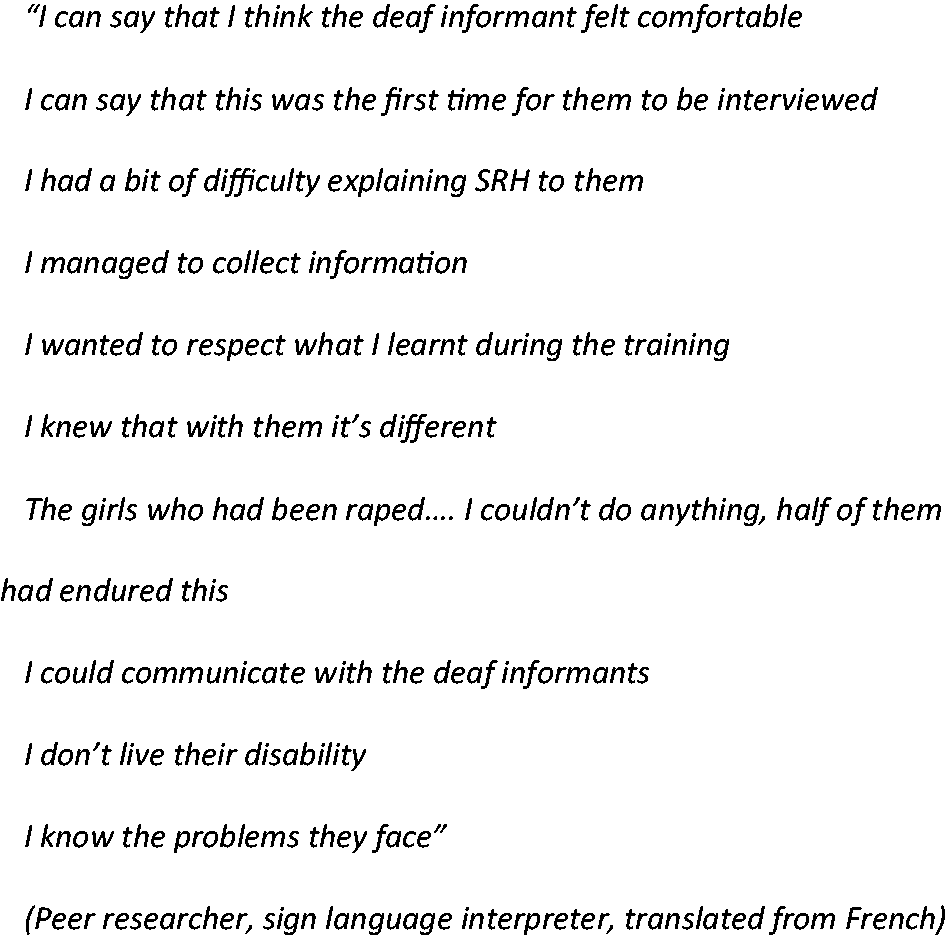
An example of an I-poem.
Findings were manually extracted by the research team from the journals and I-poems, and grouped into themes. Themes were organised around different stages of the research process, to assess what the impact of working with peer researchers was on: (1) data collection; (2) data analysis and (3) the peer researchers themselves. I-poems were translated by the research team from French into English.
Working with peer researchers: Impact on data collection
Working with peer researchers in this study was beneficial to data quality and presented opportunities for further exploration, but not without challenges. The benefits, and challenges, identified by the research team and by the peer researchers are presented below.
Strengthening data collection tools and approaches
The peer researchers provided insights into local terminology that was socially acceptable and in common use in Senegal to refer to YPWD, including in local languages. For example, YPWD did not appreciate terms such as ‘handicapés’ (handicapped), ‘non-valides’ (invalids), ‘aveugles’ (the blind) but preferred the use of terms such as ‘personne vivant avec un handicap’ (person living with a disability) or ‘personne a mobilité réduite’ (person with reduced mobility). During the initial training and induction to the research tools, the peer researchers led a discussion to identify the optimal language to use in topic guides, which was included in the final topic guides and data collection.
The peer researchers were instrumental in facilitating access to informants. The Research Supervisor was introduced by the peer researchers to key gatekeepers e.g. presidents of disability associations, to help with sampling for the study. Peer researchers were also able to foresee logistical constraints for YPWD and identify means of strengthening data collection to maximise respondents’ comfort and ability to participate in discussions. For example, for FGDs with young people with visual impairments, the peer researchers proposed allowing one person at a time to speak and to introduce themselves before speaking so the group knew who was speaking. The peer researchers also strengthened the participation of young people with physical impairments in FGD by selecting appropriate interview locations and maximising comfort by indicating the types of chairs that needed to be used by research informants.
Building rapport with research informants
The peer researchers felt that their age and disability created a more conducive environment for building rapport with informants thereby improving the quality of data collected. Information was disclosed about personal experiences during data collection, for example, many study informants confided in the peer researchers that they had had sex before marriage (which is heavily stigmatised in Senegalese society), and several revealed that they had been raped when they were younger. “ … they (informants) felt safe and did not fear prejudices” (female peer researcher with a physical impairment); “ … there are no hang-ups, nor any superiority.” (male peer researcher with a physical impairment) It occurred sometimes that I explained to the informants using « we the disabled » and I felt that this played an essential role in the responses…for example in Kaolack [study site] where I said, “what are the barriers that we, disabled people, encounter when accessing services” …and the answers flowed wonderfully.
Topic guides followed too rigidly
Whilst predetermined questions from the FGDs and interview guides were followed, these topic guides were intended to serve as a guide that was flexible to accommodate emerging questions. Several opportunities were missed for further exploration of potentially interesting findings during FGDs and/or interviews, as demonstrated below:
Peer researcher: Can you tell me about your first sexual experience?
Interviewee: I have already had sex. I didn’t use a condom…
Peer researcher: Many of us feel the need to seek support or advice about sex – such as falling pregnant or needing medical treatment. Have you had concerns linked to sexual relations? Can you tell me about them?
Transcriptions lacked specificity
Peer researchers were tasked with transcribing all their interviews. This generally involved translating dialogue from Wolof into French. None of the researchers had experience of transcribing and the task proved to be challenging for some, for example, the first drafts were written in the third person or errors were made in the transcriptions. Many transcriptions had to be reviewed and re-worked before being deemed suitable for use, making the process lengthy.
Working with peer researchers: Impact on data analysis
Outcomes of the workshops revealed that several of the peer researchers were capable of extracting key findings and grouping relevant information together under common themes. Due to limited time and inexperience of the peer researchers, the research team facilitated the grouping of information by supplying a list of predetermined themes to consider. This practical decision was to speed up the process of grouping information, but peer researchers were also encouraged to create new themes or identify any emerging themes, which some peer researchers managed to do. They also successfully extracted verbatim quotes of interest to reflect key findings. Several of the peer researchers were very motivated to participate in the analysis, demonstrating the empowering effect of involving them in this phase, but others struggled and lacked confidence in fulfilling the task. Not all peer researchers were equally capable to analyse data, but sufficient time and support was not allocated to this activity and remains to be further explored to identify its true added value to the research process.
Protecting the validity of analysis
Peer researchers provided their own reflections on the validity of statements by informants, which helped interpret transcripts. Whilst the peer researchers believed the informants were more open with them, they also thought that some of the informants were not telling the truth. To encourage the peer researchers to reflect on the validity of their data, at the end of each interview, they had to complete a form with a couple of questions. One question was: do you think the informant was telling the truth in the interview? If yes or no, why or why not? Overall, the peer researchers believed that the informants were telling the truth, but in some cases, like the extract below, they did not feel the informant was honest in their responses: Sometimes the informant refuses to tell you the truth and refuses to talk about their sex life. Or she gives you false information about sexuality. Like the case with the young women who I interviewed in Thies [study site], there I felt that she wasn’t telling me the truth, I don’t know why.
Project a priori opinions rather than logical conclusions from the evidence at hand
During the training sessions, peer researchers struggled to draw clear conclusions from their practice FGD and interview findings, jumping directly from synthesizing results to making recommendations. Whilst recommendations were important to reach, they were not always rooted in evidence but were based on their personal interpretation of events and their own ideas for how they would resolve the issues. As a result, and given the time available, during the analysis of field data more focus was placed on the presentation of results as opposed to recommendations. Recommendations from YPWD were crucial for the research team when policy recommendations were being formulated, so research informants (as opposed to the peer researchers) were asked during data collection what recommendations they would make to improve their access to SRH services.
Experiences: The impact on peer researchers
During data collection and analysis, the peer researchers talked about their experiences and documented these in the reflexivity tools. Through the journals and I-poems, we managed to capture what makes it difficult for YPWD to be engaged as peer researchers, both in terms of collecting quality data as well as negotiating ethical challenges that arose during the research. When peer researchers encountered difficult topics, these were discussed with the Research Supervisor during daily debriefing sessions, enabling the peer researchers to share their concerns and seek advice on managing the situation. For example, in one FGD, two cases of rape were reported. The peer researcher approached the informants individually to provide the informants with a listening ear and encourage them to seek support from a range of SRH referral points. The informants were wary of seeking support from these referral points out of fear of disclosure about the rapes to their parents. One peer researcher shared the impact participation in the study had on them: … it enabled me to better understand the problems faced by deaf people in society…this will allow me to inform others and raise awareness.
The I-poems provided insights into the emotional impact of being a peer researcher and how they felt in their role. They also demonstrated how the peer researchers became immersed in the research topic: I didn’t sleep because of the story about the rape I think this was the day I felt the most relaxed I was very moved when the girl spoke to me about sex I was proud about the way they answered me I think the fact that I was a young researcher was an advantage I know the problems that they face I noticed that the deaf informants do not know that facilities providing SRH services exist.
Discussion
Engaging YPWD as peer researchers was perceived by the peer researchers, and the research team, to have strengthened the research findings. FGDs and interviews generated sensitive data about the sexual experiences and barriers to services encountered by the study population – the first of its kind in Senegal – despite the taboo nature of the subject. Like in any study, there was a risk of bias and ethical issues, but this study confirms previous findings (Devotta et al., 2016; Lushey and Munro, 2015; Smith et al., 2002) that the lived experiences of peer researchers was considered an important factor to peer researchers to create rapport quickly and reduce the imbalance between the researcher and the researched.
The peer researchers believed that their age and disabilities enabled them to build stronger rapport with the research informants. It is difficult to fully evaluate the impact of their likeness to the study population on the quality of data, without asking the informants themselves. Further exploration of the impact of the personal characteristics and lived experiences of peer researchers on the informants’ willingness to share certain information and experiences, but also whether age and/or disability (or any other criteria) were both equally influential factors, whether one had more influence than the other, or whether multiple shared characteristics are important. The wealth of sensitive data collected by the peer researchers demonstrates that they did manage to create an open and safe environment for the research informants, which may not have occurred if there was a significant imbalance between the peer researcher and the informant. We can assume that disclosure of such personal experiences would have been unlikely if the research informants did not feel comfortable.
Whilst some peer researchers believed that informants were not always telling the truth, we can also deduce that response bias can be reduced by working with peer researchers but perhaps not eliminated. This may be a more realistic aim of working with peers.
YPWD demonstrated a potential ability to actively participate in data analysis, supporting the findings of Lushey and Munro (2015). Unfortunately, limited time and resources resulted in our study missing an opportunity to explore to what extent they can add to the analysis of their own peers’ data and whether this analysis would provide a different perspective to a non-peer. As identified by Nind (2011), this is an area of participatory research methodology that requires further exploration; and following our study, we would urge this to be more systematically included in future studies and the necessary time and resources invested to support it. We did not witness the peer researchers projecting their lived experiences onto the data analysis, only during the training sessions where they ‘imposed’ their recommendations to improve access to SRH services but did not root them in the facts, but this is likely due to inexperience of conducting analysis and formulating policy recommendations; or because of the difficulties associated with balancing the insider–outsider status (Bradbury-Jones and Taylor, 2015) where the peer researchers believed they ‘knew’ what informants were implying, compromising the rigor of the interpretation. Whilst not enough evidence was generated in our case about the contribution of peer researchers to the research outcomes, we would recommend considering their involvement throughout the research cycle and not solely for data collection. Their participation could prove especially beneficial in a different language setting and when the research is on a culturally sensitive topic, where their inputs may be invaluable in interpreting the data in a way that non-peers cannot. For the peer researchers, their involvement also had an empowering effect on their ability to talk about the research topic and to better understand the issues related to SRH faced by their peers, as well as gaining valuable research skills which could help them with future work opportunities.
Some missed opportunities to effectively probe informants during data collection were identified, highlighting some of the limitations to the capacity of peer researchers (see also Lushey and Munro, 2015; van Staa et al., 2010). Our reflections on the research suggest that the reasons for missing such opportunities could be explained by multiple factors such as lack of skills to ask probing questions, their inability to synthesise response quickly enough to probe in a timely manner, or their discomfort with the subject topic and responses. It must however be recognised that peer researchers are not academically or professionally trained and the research team can only mitigate the risk of this by ensuring sufficient and ongoing training and quality guides and tools in place to prompt peer researchers to ask follow-up questions. Increasing the level of training for peer researchers could better prepare them (Lushey and Munro, 2015; Porter, 2016; Smith et al., 2002) – especially by investing in increased practice sessions of mock FGDs and interviews, or peer reviewing transcripts as a means to identify missed opportunities for probing – and by providing ongoing supportive supervision throughout data collection to motivate peer researchers to reflect and improve their data collection techniques. In this case for example, together they could have identified missed opportunities for developing certain findings and probing could have been improved. In the case of the quality of some of the transcriptions, ways to overcome the quality issues could be to invest more on training and support for peer researchers, or to outsource this task, given the time it takes to transcribe to a high standard. It must be highlighted here that the investments in training peer researchers with a physical, visual or hearing impairment were not significantly more (to say young people without a disability) contradicting somewhat the findings by Bailey et al. (2014), we would argue is merely a question of good organisation and creating or adapting tools and training accordingly.
In our case, we must also recognise the risks associated with hiring ‘privileged’ peer researchers (see Nind, 2011) whereby peer researchers who were educated to a certain level, were computer literate and francophone was hired. In addition, sign language interpreters were recruited (as opposed to young people with hearing impairments) due to the inability of the research team to use sign language and therefore effectively train them and quality assures data collection. This leaves us with several questions about to what extent did these criteria contribute to increasing or decreasing the imbalances between the researchers and the researched?
Reflexivity can play an important role in improving data quality and validity, learning about experiences and addressing ethical challenges, but should be considered throughout all phases of the research process from conception to conclusions (Bradbury-Jones, 2007; Guillemin and Gillam, 2004). Reflexivity should have a clear purpose and accompanied by adequate tools a means to achieve this purpose. In our case, we wanted the peer researchers to reflect on their role and how it may influence the data, and to provide the research team with insights into their well-being. It is difficult for us to say that in this pilot that reflexivity directly influenced the data, but we did learn about the effect the process had on some researchers (e.g. the cases of rape), affecting their well-being. An important lesson for the research team was that the appropriate mechanisms must be in place to protect the peer researchers, and referral mechanisms must also be made available for them, as they may need emotional support to deal with difficult research findings, or potentially have lived those same experiences as the study informants. Whilst the involvement of peer researchers does come with a risk of affecting their wellbeing, if this is carefully managed and the right support systems are in place, then we believe the benefits of using peer researchers can be greater than the risks involved. Using multiple tools can provide important insights but the journals ranged in levels of detail documented, and the guiding questions were not always addressed and entries sometimes more factual; and whilst the I-poems offered an exciting new approach, they were only as insightful as the content of the journals on which they were based.
Journals and I-poems present an opportunity to assess certain ethical issues. They can show how peer researchers navigate between their role as an “insider” (with lived experience) and an ‘outsider’ (as a neutral researcher), but also provide peer researchers with a space to freely express themselves and reflect on their experiences, providing the research team with insights to influential factors on data quality, but importantly also on the well-being of the peer researchers during the process.
There could be many reasons why the reflexive tools did not breed the desired results; lack of clarity on the purpose of the tools, guiding questions in the journals were not sufficient to explore reflexivity, or lack of experience of reflexivity (perhaps a context issue where reflexivity in the education system is not routinely practised, or perhaps an age-related reason where peer researchers have not had much exposure to reflexivity). What the research team can conclude is that reflexivity tools can influence data quality as well as address some of the ethical issues faced by peer researchers, butpeer researchers need more support to effectively complete the tools; this could include a combination of supportive supervision, better guiding questions, and introducing other means for reflexivity such as peer-reviews, repeated interviews and transcript reviews, or poetry (Berger, 2015; Lapum, 2008).
Peer research and reflexivity go hand in hand. Each represents a field of study in themselves, but by including reflexivity as part of the peer research process, the validity of data can be verified and the well-being of the researchers monitored. Reflexivity provides an opportunity to enhance the story of the researched and understand the position of the researcher. It is a careful balance for a peer researcher to act as an ‘insider’ (to the lived experience) and an ‘outsider’ (to the research process) during the research process, positioning themselves as a peer but not influencing the data outcomes.
Conclusion
The peer research methodology continues to prove to be both beneficial but with limitations. It does undeniably present an opportunity to reduce, or even remove, the power imbalances between a researcher and a research informant, and generate sensitive data from research informants, but resources are required to adequately equip peer researchers to successfully fulfill their role and generate high-quality data. Realistic expectations of what can be achieved by using peer researchers are also important; peer researchers are not professional researchers and will therefore have some limitations to the rigour of their data collected and analysed, but their lived experience is an immeasurable asset to the research process, especially for hard-to-reach populations or when researching sensitive topics.
By using a range of reflexive tools, peer researchers have the opportunity to consider themselves and their experiences throughout the process, which in turn is addressed effectively, can have a positive impact on the subsequent data collected and their personal experiences.
This pilot approach provided insights into the benefits and challenges in using peer researchers, complemented by reflexivity on being peer researchers. Tools and approaches were tested and lessons learned which can feed into improving future methodologies and improving the quality of data as well as the experiences of those who generate it.
Footnotes
Acknowledgements
The authors would like to thank all the peer researchers for sharing their experiences of their participation in the research process. In addition, we would like to thank Victoria le May for her advice on the peer methodology and literature.
Declaration of conflicting interests
The authors(s) declared no potential conflicts of interest with respect to the research, authorship, and/or publication of this article.
Funding
The authors(s) disclosed receipt of the following financial support for the research, authorship, and/or publication of this article: This work was supported by a grant from the Dutch Ministry of Foreign Affairs as part of the ASK Programme