




Abstract
Despite the United Kingdom’s robust child protection policies and approaches to modern slavery, no specific UK-wide policy addresses the criminal exploitation of children. This paper presents multi-agency focus group and survey findings from a commissioned study which examined the adoption of policy and practice in Wales. Rather than a Wales-led, child-rights national framework, participants encountered inconsistency between a preponderance and absence of relevant guidance from the United Kingdom and Wales. Participants wanted the separation of criminal exploitation from the Modern Slavery Act 2015, a legal definition and amendment of the Children Acts 1989 and 2004 to include exploitation as a separate category of child abuse.
Introduction
This paper presents professional perspectives about policy and practice guidance relating to the criminal exploitation of children in Wales. It is timely given that the Crime and Policing Bill awaits its second reading at the House of Lords. The Bill looks set to introduce a new offence for adults who use children to commit criminal activities (Ministry of Justice, 2025). Reflecting a widespread call for a statutory definition for child criminal exploitation, this amendment was tabled by Sarah Campion, Member of Parliament for Rotherham (Champion, 2025). It is believed that a legal definition will address the lack of coherence between the UK nations and service responses where ‘safeguarding partners are working to different understandings of what constitutes criminal exploitation’ (The Children’s Society, 2021: 1). This lack of coherence is associated with variations regarding how safeguarding and criminal justice agencies identify, record and respond to criminally exploited children (Home Affairs Committee, 2023). Commissioned by Action for Children, a UK charity that protects and supports vulnerable children, the Jay Review (2024: 48) of Criminally Exploited Children found that ‘professionals responsible for child welfare and protection have given way to policing and criminal justice responses as the dominant legal framework’. To highlight their status as victims, Action for Children has rejected the term ‘child criminal exploitation’ and posited the alternative label ‘criminal exploitation of children’. This article uses both terms interchangeably and adopts the definition favoured by UK children’s charities where the criminal exploitation of children refers to another person or persons manipulating, deceiving, coercing or controlling a person under the age of 18 to undertake activity which constitutes a criminal offence (Barnardos, 2021).
While it’s unclear whether the Crime and Policing Bill will introduce a legal definition, it has been heralded as landmark legislation, with the former Home Secretary Yvette Cooper stating that it is aimed at ensuring ‘victims are properly protected and [to] prevent these often hidden crimes from occurring’ (UK Government, 2025). Such rhetoric is similar to that posited at the introduction of the Modern Slavery Act 2015 (MSA), yet review findings have questioned its impact on enhanced support for victims (Home Affairs Committee, 2023). This paper considers the current policy and practice landscape in Wales for criminally exploited children and whether existing service provision prioritises a child welfare approach in recognition of children as victims of exploitation.
UK policy and practice
Despite robust child protection policies and approaches to modern slavery in the United Kingdom, there is no specific UK-wide policy for the criminal exploitation of children. Rather, it is considered a form of modern slavery under the MSA with the United Kingdom adopting the terms defined in international law: slavery, servitude, forced or compulsory labour and human trafficking. Even though there have been multiple calls for its inclusion as a separate category of modern slavery (Every Child Protected Against Trafficking (EPCAT), 2024; Home Affairs Committee, 2023), the MSA is applied to criminally exploited children when they have been victims of forced criminal activity, bonded labour or if they have been trafficked with the intention of exploitation. A child can be trafficked across UK nations, regions or within the local area; the MSA does not require them to be moved across international borders. Where children face criminal charges, a defence under Section 45 of the MSA can be made based on the principle of non-prosecution for trafficked children and reflecting the United Kingdom’s duty under the Palermo Protocol (United Nations, 2000). It has been argued that children are less likely than adults to invoke the section 45 defence because it places the onus on them for proving exploitation occurred, fears of being labelled a ‘snitch’, and the potential for violent repercussions from the people exploiting them (Espeute and Lanskey, 2023). Moreover, evidence gathering requires coordination across multi-agency partnerships, yet challenges have been noted in the strategic prioritisation of modern slavery and processes for information sharing between agencies (House of Lords, 2025).
A decade after the MSA was introduced, the House of Lords (2025) review found that it has failed to keep pace with the evolving nature of exploitation. This is compounded by the nature of child criminal exploitation: it can be difficult to identify (Barlow et al., 2022), it challenges notions of victimhood (Maxwell, 2024) and child protection agencies in the United Kingdom were not designed to address extra-familial harm. In practice, frontline professionals seldom suspect criminally exploited British children of being victims of modern slavery (Modern Slavery Policy Unit, 2024). This is due to the common misconception that trafficking only occurs for non-British nationals (Celiksoy et al., 2024). Certain groups such as UK nationals, children and those with no recourse to public funds are particularly disadvantaged by the National Referral Mechanism (NRM), which is the United Kingdom’s framework for identifying and supporting victims of modern slavery. Under NRM guidance, local safeguarding partners have a duty to safeguard and promote the welfare of children who are criminally exploited. However, the Anti-Trafficking Monitoring Group (ATMG) (2018), a coalition of anti-trafficking organisations, has argued that frontline child protection workers often overlook or ignore children due to limited awareness of trafficking, especially as the United Kingdom emphasise movement unlike the broader international definition which views child trafficking as the recruitment, transportation, transfer, harbouring or receipt of a child for the purposes of exploitation (United Nations, 2000). The AMTG suggest that social workers are ill-equipped to respond due to a lack of mandatory training and a lack of additional resources. For some organisations, the introduction of a legal definition and national framework would address the current lack of awareness and coherence in service responses. The Jay Review (2024: 48) emphasised the need for exploitation to be included in legislation as a separate form of child abuse because the ‘professionals responsible for child welfare and protection have given way to policing and criminal justice responses as the dominant legal framework’. This is contrary to the enhanced support for victims posited under the MSA.
Under Section 49 of the MSA, local authorities are identified as the primary provider of support for criminally exploited children, yet the House of Lords review (2025) heard that despite their duty to support child victims, local authorities demonstrated limited understanding about their role. There were knowledge gaps across multi-agency partners, silo-working and limited understanding about the impact of criminal exploitation on child victims (McCoig and Durán, 2020). This supports findings from the Home Affairs Committee consultation on human trafficking (2023) which heard that local authority staff required further training in the identification of victims and their legal responsibilities as first responders to the NRM. The NRM stipulates that only authorised agencies can submit evidence about suspected victims of modern slavery. To do this, these ‘first responder’ agencies must have come into contact with the criminally exploited child, identify that exploitation is occurring, understand their referral duty and decide to make the referral (Setter, 2019). Therefore, NRM figures are not an accurate portrayal of all criminally exploited children in the United Kingdom. However, in the absence of more reliable data, they offer an indication of which children have been identified and referred to the NRM’s two-tier process. Undertaken by the Single Competent Authority, stage 1 determines whether exploitation is suspected but not proven (termed ‘Reasonable Grounds’) and must be completed within five working days of the referral. A stage 2 Conclusive Grounds decision determines whether on the ‘balance of probabilities’ exploitation has occurred; this must be made no sooner than 45 days after the first decision (Home Office, 2021: 3). Drawing on analysis by the Modern Slavery Policy Unit (2024), the NRM figures between 2019 and 2023 show there were 12,800 referrals for the suspected criminal exploitation of British children. Of these, 8879 were for boys. Despite the 45-day expectation, boys waited an average of 354 days for a decision in 2023 (IOM, 2023). Heys et al. (2022) have commented that no other victims of crime would be expected to wait around 1 year to be believed.
Welsh policy and practice
Since devolution, Wales has passed significant legislation in relation to social welfare. This includes the Social Services and Well-Being (Wales) Act 2014 which collates social services law and promotes collaborative approaches between agencies. At its inception, the Act placed new duties on local authorities, including the assessment of children who appear to need ‘care and support’ either instead of or in addition to the care and support provided by their family. This denoted a shift away from the ‘child in need’ assessments undertaken in England as outlined under the Children Act 1989. Wales has also placed impetus on the prevention of harm and the promotion of future welfare in the Well-Being Future Generations (Wales) Act 2015. Alongside these laws, Welsh Government published the Wales Safeguarding Procedures and Practice Guides aimed at improving child safeguarding and enhancing multi-agency responses with specific guidance for a range of issues, including child criminal exploitation. This non-statutory guidance states that when criminal exploitation is suspected, children’s services will arrange a multi-agency strategy meeting to consider what actions should be taken to safeguard the child (All Wales Practice Guide, 2021a). Wales has not introduced a legal definition for the criminal exploitation of children nor has it developed a national strategy to address this issue. This is particularly problematic given that unlike social care, health and education which have been devolved, policing and justice remain responsibilities of the UK Government. This has created a disjointed landscape with the criminal justice system likened to a ‘jagged edge’ that is caught between Wales and UK policies (Jones and Wyn Jones, 2022:8). Moreover, it has been suggested that there is misalignment between the UK Government mandated criminal justice system and the children’s rights approach to youth justice fostered in Wales (Hatherley, 2025). Similar to the application of the MSA, there have been concerns about inconsistent safeguarding approaches to criminally exploited children in Wales. The Children on the Margins consultation (Welsh Parliament, 2024) highlighted challenges in multi-agency working across children’s services, education, health and housing, with some participants questioning the effectiveness of partnership working. Nevertheless, Welsh Government (2025: 6) responded that, ‘We do not consider the development of a national strategy essential to achieve greater consistency in practice’, leaving professionals to navigate the difficult and sometimes conflicting landscape. Against this backdrop, the study discussed in this article was commissioned by Action for Children, a UK children’s charity, to gather evidence about the adoption and use of policy and practice guidance relating to the criminal exploitation of children in Wales and its impact on frontline practice. By capturing the voices of those directly involved in tackling the criminal exploitation of children, this study provides insight into how professionals understand and navigate policy incoherence and how this impacts multi-agency safeguarding. One of the strengths of the study is the high levels of engagement of children’s services as they play a crucial role in coordinating responses to criminally exploited children.
Research design
This paper reports focus group and survey findings from a sequential mixed methods design (Creswell, 2009). The study examined professional perspectives about policy and practice guidance relating to the criminal exploitation of children and participants’ views about the extent to which guidance facilitates or impedes multi-agency working in Wales. The study included three stages of data collection: focus groups, a survey and a co-design group with participants from two Welsh local authorities across eight sectors: children’s services, education, health, housing, police, third sector, youth work, youth justice. This paper presents findings from focus groups and surveys. Focus group themes informed survey development, and findings are presented together for coherence. To preserve the anonymity and confidentiality of participants, pseudonyms have been used to replace names and information that could be used to identify participants has been removed. Ethical approval was obtained from the Cardiff School of Social Science Research Ethics Committee.
Focus groups
Eleven focus groups (n = 49) were conducted in two Welsh local authorities using a combination of purposive and opportunity sampling. One local authority was rural with low deprivation in North Wales and one was urban with high deprivation in South Wales (Stats Wales, 2019, 2024). Recruitment was facilitated by third sector gatekeepers who disseminated study invitations through their networks of statutory and third sector multi-agency safeguarding partners. Two groups were multi-agency (MAFG); nine were sector-specific (children’s services (CFG), education (EFG), health (HEFG), housing (HOFG), police (PFG), youth work (YWFG), youth justice (YJFG)). Group size ranged from two to seven participants (mean = 4) and sessions were held online or in person, lasting on average 46 minutes.
A semi-structured guide explored policy and guidance adoption, what worked well and what was needed to enhance multi-agency working. Sessions were recorded using Microsoft Teams or Zoom and transcribed using the platform’s built-in functionality. An independent researcher cleaned the transcripts to ensure accuracy. Data were thematically coded beginning with data familiarisation followed by deductive coding based on pre-defined categories corresponding with the themes explored in the focus groups. Analysis also included inductive coding to include additional codes that arose from the data. The codes were re-examined by two members of the research team and grouped into themes. Analysis was facilitated by NVivo software.
Survey
Focus group themes were developed into a structured Wales-wide survey to measure their frequency and importance across a wider sample of multi-agency professionals. The survey included closed items on policy use, Likert-type scales (1 = strongly disagree and 5 = strongly agree) on knowledge and organisational approaches and open-ended items to capture richer perspectives about existing guidance, practice and recommendations.
The survey was disseminated to 149 stakeholders across Wales, including representatives from the 22 Welsh local authorities, Violence Prevention Unit, third sector gatekeepers and focus group participants. Representatives from children’s services, education, health, housing, police, third sector organisations, youth work and youth justice were asked to disseminate the survey through their networks. Three reminders were sent via email. The first reminder was sent to all representatives while reminders two and three were targeted to non-responders, including specific local authorities or sectors.
The survey remained open for 12 weeks, yielding 115 responses from 17 of the 22 local authorities. Although not fully representative, the dataset offers a range of views about policy and practice guidance adoption in this under-researched area. Quantitative data was analysed descriptively in Excel Spreadsheet while free text responses were thematically analysed .
Most responses were from children’s social care (40%), followed by education (12%), police (11%) and the youth justice service (11%). Health, housing, third sector organisations and youth work all gave fewer than ten responses (Table 1). The sample were predominantly female (70%), over 36 years of age (78%) and White British (90%), with 46% in their current role for more than five years (46:40%). Self-rated knowledge of child criminal exploitation was reported as good (46%) or average (40%). Focus group participants are referred to be pseudonyms. Reflecting the anonymised nature of the survey, respondents are referred to by code.
Survey participant demographic characteristics.
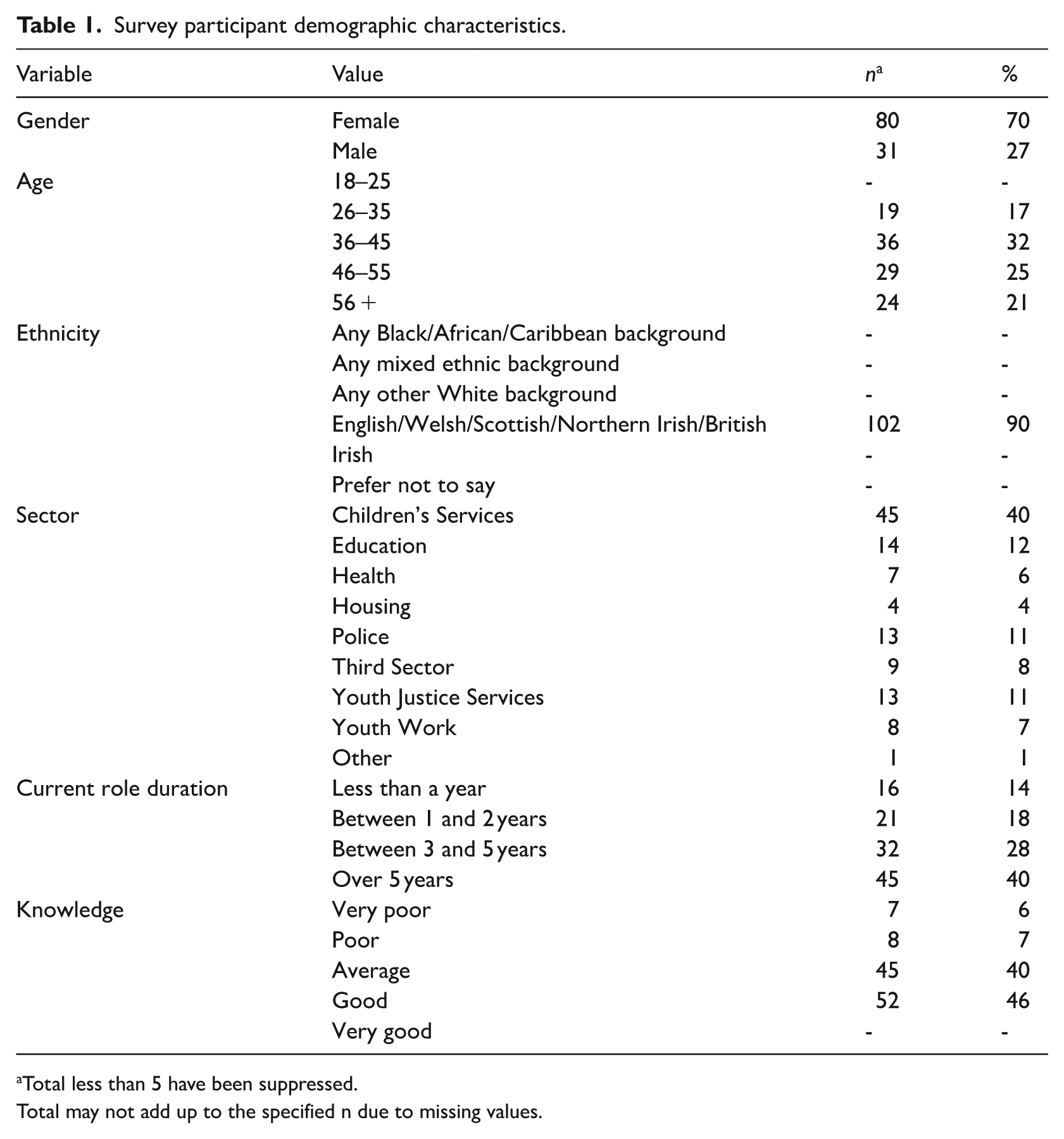
Total less than 5 have been suppressed.
Total may not add up to the specified n due to missing values.
Findings
‘Everybody comes with their own policies’
The lack of overarching UK policy and guidance created challenges for those working with criminally exploited children because ‘it can feel like we’re not doing the same, like we’re not after the same end-goal, but we are, cos it’s always the wellbeing of young people’ (Michael, YJFG). Frontline understanding about the complexities of exploitation varied, with some professionals who rarely encountered criminally exploited children having ‘no idea what child criminal exploitation was’ (Sarah, multi-agency focus group: MAFG). Variations in responses was evidence across sectors and individuals: The same situation reported to a different officer can get a massively different response and that’s the same for all of us in some ways, but particularly I think you notice it with the police. (Hannah, HOFG)
Service responses often depended on individual knowledge and understanding of the professional children first come into contact with. While most sectors in the United Kingdom have specialised exploitation roles or teams, mandatory training for all staff was rare. This meant that when a child was arrested for possession of drugs with intent to supply (PWITS), the investigation might not be based with the child exploitation team but rather: It could sit with any number of different policing departments . . . because there’s not a consistent approach in relation to how they’re dealt with. (Julie, PFG2)
Geographical differences compounded the problem. This was particularly problematic for sectors with regional or Wales-wide remits, such as the police because they had to navigate multiple local strategies: Our [area] local authorities don’t like doing things the same way, even if we put in a consistent process for ourselves and how we deal with each local authority it’ll be called something different in each local authority, which makes it difficult for us and it’s confusing. (Cameron, PFG2)
This confusion was not surprising given the range of policy and practice guidance. Focus group participants identified 11 different sources of policy and guidance (Table 2) which included UK and Welsh Government policy, practice guidance from regional safeguarding boards and local authorities, and sector-specific remits and responsibilities. Survey results (Table 2) confirmed the use of multiple sources, ranging from those who stated they drew on none (4%) of the 11 sources to those who cited them all (12%). Most participants (75%) reported using more than four sources, with a median of six. The top four sources highlighted a preference for child protection laws and policies and, perhaps reflecting the devolved nature of children’s services, education, health, housing and youth work, participants were more likely to refer to Welsh policy and guidance. Hence, the top four sources were the Wales Safeguarding Procedures and Practice Guides for child criminal exploitation (76%), child sexual exploitation (72%), the Social Services and Well-being (Wales) Act 2014 (69%) and the child protection provisions in the Children Act 1989 (62%).
Survey responses: Sources that influence practice.
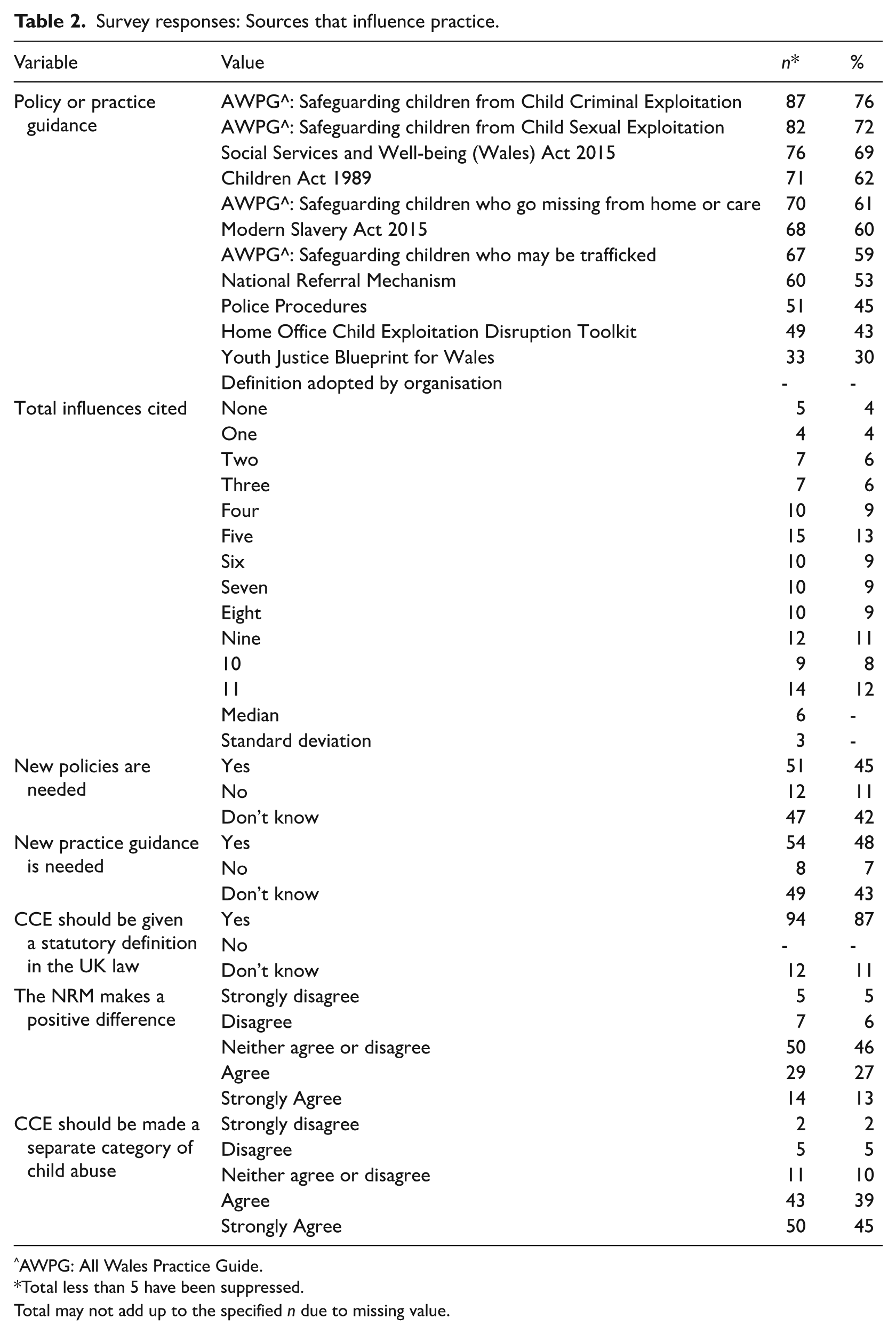
AWPG: All Wales Practice Guide.
Total less than 5 have been suppressed.
Total may not add up to the specified n due to missing value.
There was a sense that participants were more likely to cite sector-specific legislation and guidance as influential to their practice, but sample sizes for sector-specific analysis were small so this must be treated with caution: Everybody has different ways of working, everybody has different processes and practice and actually it doesn’t necessarily align and . . . the difficulty we have is that everybody comes with their own policies and that affects what they can and what they can’t do. (Helen, MAFG)
Perhaps reflecting the non-devolved nature of criminal justice in Wales, no police participants cited the Social Services and Well-being (Wales) Act 2014. Nevertheless, these results are suggestive of a disjointed landscape, with an absence of legislation contrasted with an abundance of practice guidance.
Open-ended responses suggested existing guidance was ‘extensive, wide-ranging, and exhausting to consume’ (SP036) but it was ‘hard to find a clear definition on what child criminal exploitation is defined as’ (SP016). With no mandatory training, the onus was on the individual to keep abreast of legislation and guidance and its application to their practice: We’ve incorporated things like national guidance around child criminal exploitation, child sexual exploitation and safeguarding policy. So our safeguarding policy is immense . . . but we’ve tried to incorporate guidance and toolkits within that, so it’s all in one place for people. (Hannah, HOFG)
Attempts at fostering joined-up approaches was also hindered by ‘fragmented and frustrating systems working in silo’ (SP0040). This reflected system incompatibility between agencies and reflected an ‘age-old problem’ (Charlie, PFG). Nevertheless, safeguarding efforts were impeded by the need to navigate multiple systems and ‘the amount of form filling and the amount of duplication, triplicates even, quadruple sometimes needs to be heavily reduced’ (Katie, EFG). Survey respondents identified 15 primary systems or forms to record child criminal exploitation. Most survey participants (61%) either agreed or strongly agreed their organisation had the necessary systems to support work around child criminal exploitation, although slightly more than a quarter of participants were unsure whether this was the case, possibly because few had bespoke exploitation tools.
It was suggested that a bespoke recording mechanism is needed to reduce administrative burden and to address problems with information sharing. Most participants attributed this to the General Data Protection Regulation (commonly known as GDPR) and the Data Protection Act 2018. According to focus group participants, the lack of national guidance about information sharing had led to inconsistent interpretation and application of GDPR. Consequently, sectors were adopting different stances about what was permissible. For example, while some sectors such as health had strict regulations prohibiting the sharing of information, other sectors were vague, leading to individual differences in how GDPR is applied: Each organisation takes on their own policy . . . at least with health, they’re clear and they’ve said to everybody, ‘don’t do it’ . . . education and youth services haven’t done that. So you’ve got individuals with different positions on it, some of whom are managers and some of whom aren’t. (Helen, MAFG)
Despite the vast majority of survey participants (84%) stating they had information sharing agreements in place, findings suggested there was a ‘lack of reporting and lack of data sharing between schools and police, children in care, children in hostels outside of care inspectorate powers’ (SP029). This failure impeded multi-agency approaches to safeguarding and strategic decision making. To counteract these differences, participants emphasised the importance of having good relationships with their partner agencies and using panel meetings to share information about at-risk children.
‘It’s not just about trafficking’
In the absence of clearly defined statutory duties, it was felt that criminally exploited children were often overlooked, ‘because there’s no legislation for CCE [child criminal exploitation], I think sometimes it just gets put a bit to one side’ (Kylie, MAFG). Some participants expressed frustration that exploitation is sometimes minimised by other agencies and reference was made to the language used when speaking about child victims: We have heard comments from other agencies when discussing exploited children such as ‘yes but there are other children who are actually being abused (as in, within the home)’ as if to imply that exploitation is a choice and fault of the child or young person. (SP009)
Doing so rendered children more likely to be seen as offenders first rather than a ‘child who might happen to be an offender’ (Steve, youth justice focus group). Steve’s assertion is aligned with the child first approach enshrined in the All Wales Youth Offending Strategy 2004 and Youth Justice Blueprint for Wales (2019). Yet, findings revealed difficulties with managing dual positionality of children as both victims of exploitation and perpetrators of criminal activities: The way some of those forms are being written, they’re not seeing young people as victims of exploitation, they’re seeing them as they want to do this, they choose to do this. That’s basically bravado and this fear that they get from young people; It’s not being translated into seeing them as victims. (Chris, CSFG)
This dual positionality was a ‘difficult dynamic to manage, and that can cause a few issues’ (Julie, PFG). This included the extent to which police officers obtained the evidence needed to substantiate human trafficking had occurred, ‘so when we have gone for those offences, because that is the right choice, we just don’t meet the threshold’. (Yvonne, PFG2). While Yvonne was referring to challenges with Crown Prosecution Service (CPS) thresholds, responses also highlighted ‘law enforcement heavy’ (SP095) practices which blamed children for their exploitation.
The dual perspective of children as offenders and victims also raised the issue of the appropriateness of service thresholds to address criminal exploitation. This was deemed a challenge for safeguarding any criminally exploited child but particularly with regard to children who were not in receipt of ongoing service provision such as those not on the child protection register, those who had successfully completed court orders with youth justice services and, as discussed later, children who aged out of children’s services.
Irrespective of ongoing concerns, if the levels of risk did not meet threshold criteria, these children stopped receiving support: There is an element of high risk that one of these young people could get killed . . . if these young people are not meeting referral criteria into children’s services or youth justice, there’s a definite gap in legislation, cos if we’re saying okay, there’s no services to intervene with this young person, we’re just going to let this young person carry on being exploited. (Daniel, YWFG)
Therefore, participants wanted policy and practice specific to criminal exploitation with statutory obligations that sit outside the MSA. Only two fifths of the survey sample either agreed or strongly agreed that the NRM made a positive difference to the lives of criminally exploited children. For those who neither agreed or disagreed (46%, Table 2), focus group findings cited lengthy decision-making times and the lack of statutory support to children before and following a Conclusive Grounds decisions, especially because with no criminal conviction, participants feared that children would continue to be exploited. Such provision was deemed crucial to disrupt and prevent the child from continued harm: Young people who perhaps we’ve known for a long time, we haven’t done enough potentially to support, child protection register’s not keeping him safe . . . he’s now becoming . . . almost like an Alpha Victim, because he’s moving himself up in the chain, becoming more powerful and prominent in the county line but recruiting more vulnerable young people behind him. (Chris, CSFG)
Alpha victims are criminally exploited children who exploit other children. Chris’ quote also demonstrates the tension between seeing the child as a victim, ‘we haven’t done enough potentially to support him’ and seeing them as perpetrators, ‘he’s moving himself up the chain’.
‘It’s useless if it’s not used’
Against the backdrop of inconsistencies in awareness and practice responses, there was an overwhelming demand for improvements to current approaches. The need for alignment between the UK and Welsh governments was stressed, reflecting tensions between devolved and reserved functions. This was based on fears that the introduction of a UK framework would not necessarily be adopted by Welsh Government or appropriate to how criminal exploitation manifests in Wales. Therefore, within an overarching national framework, most participants emphasised the need for flexibility to enable localised responses and calls were made for a Wales-wide, child-focused action plan to reflect Wales’ greater emphasis on child’s rights approaches. They also recommended including agencies not routinely part of safeguarding meetings such as ‘licensing, housing, youth services and probation’ (SP068).
Participants wanted unified acceptance across the United Kingdom that criminally exploited children are victims of a separate category of child abuse because it ‘would make it a lot clearer for agencies and services to know that it’s not just about trafficking, these young people are suffering child abuse’ (Robin, YWFG). This implies that trafficking narratives obscure the extent to which criminally exploited children are viewed through a child protection lens. It may also suggest that participants currently struggle to apply existing categories of abuse to criminally exploited children. Some suggested new guidance, others preferred to update existing documents, but all stressed the need for resources, mandatory training and practitioner buy-in (Table 2): You can have the most perfect document drawn up with diamonds on the paper but it’s useless if it’s not used, if it’s not understood, if it’s not adapted, if it’s not improved, so it’s more like how are people trained to think of it, apply it, use it in practice. (Michael, YJFG)
Irrespective of whether new or updated guidance was developed, participants wanted this development to include the voices of frontline practitioners, children with lived experience of exploitation and parents alongside UK and Welsh governments, regional safeguarding boards, local authorities, frontline professionals and third sector organisations. Some called for a research-informed approach and ‘an independent body who can draw on intelligence, best practice and horizon scan nationally and internationally’ (SP025). With reference to what new or improved policies were recommended, this included how the criminal exploitation of children is understood, amending the definitions of harm, enhanced police powers, an improved education offer and transitional safeguarding.
First, most participants (82%) either strongly agreed or agreed there should be a legal definition (Table 2). This was deemed necessary to provide safeguarding agencies with the legal basis for service provision and to embed a consistent approach across multi-agency agencies. Participants also either agreed to strongly agreed that it should be categorised as a form of child abuse (84%, Table 2) as it would create ‘a stigma that offenders are abusers of children’ (SP055). Several participants argued that plugging (where children are forced or coerced into concealing drugs or sim cards inside their bodies), should be explicitly acknowledged as sexual abuse.
Second, several participants wanted enhanced police powers ‘to see criminal exploitation criminalised’ (SP005). This included criminalising grooming for the purposes of criminal exploitation to align with child sexual exploitation legislation, because ‘the behaviours are often the same, but because there’s no clear criminal definition of grooming for CCE, it means things can fall through the cracks’ (Julie, PFG). Another way of enhancing police powers was the introduction of an ‘Child Exploitation Injunction Order’ as recommended in the Jay Review (2024). Participants wanted this order because it is akin to the Domestic Violence Prevention Orders which prevent perpetrators from being in or near the victim’s home for up to 28 days. This time could be used to give professionals the chance to develop trust and work with children and their families to support them safely away from exploitation. Finally, with respect to policing powers, participants also wanted amendment to the Child Abduction Act 1984 so that breaches of Child Abduction Warning Notices (CAWN) could be considered as a standalone offence. Currently used as a tool to disrupt exploitative relationships, these notices do not constitute a criminal offence but rather they are used as evidence in criminal proceedings. Yet, CAWN breaches occur when an adult continues to contact or associate with a child after being issued with a police warning stating they must cease contact. Participants believed that making CAWN breaches a criminal offence would serve as a deterrent for perpetrators and a ‘pre-cursor legislation for child criminal exploitation offences’ (SP006). This was perceived as a way of compelling and empowering the police to intervene more decisively and much earlier, enabling them to adopt a more proactive stance against exploitation.
Third, in relation to an improved education offer, participants wanted the lack of opportunities for children addressed with ‘specific policies on young people who are NEET [not in education, employment or training] or EHE [electively home educated] to have access to paid work’ (SP023). They also called for early intervention policies to tackle the vulnerabilities that render children susceptible to exploitation such as school exclusion and the impact of poverty: We’re being asked to improve school attendance when some of these children are not in a fit state to learn because they are hungry and that’s the bottom line, isn’t it? (James, EFG1)
This recommendation has implications for the development of legislation and guidance for criminally exploited children. It is not simply the introduction of a statutory definition and local authority duties to safeguard these children, it encompasses wider policies to tackle the root causes of exploitation and why so many children are falling victim. This emphasises both the interconnectedness of UK policies and the impact of previous austerity measures on children’s lives as ‘there’s more vulnerable families than ever there were before and that it’s not being met with more funding’ (Sarah, EFG1). Hence, education participants spoke about poverty and the extent to which it enhanced children’s vulnerability to exploitation both directly, in terms of being drawn into exploitative relationships to financially support their families but also indirectly through reduced service provision: You can’t keep cutting, cutting and cutting elements of support from the whole of society and then expecting to put a sticking plaster over it. What are they doing? They’re being picked up by the people who are going to show them some sort of attention and supposed care. (Emily, EFG2)
In addition to service cuts, service responses were impeded by the numbers of social workers, teachers and nurses leaving their professions due to large workloads and a lack of investment. This created a paradox where the complex nature of criminal exploitation necessitated experienced professionals with the skills to engage and work with children, yet these professionals were leaving their roles: When I’m complaining that this case hasn’t been picked up or whatever, it’s because there’s not enough staff, including our service. Do you know what I mean? Everybody’s overstretched. So things get missed and in children’s services, I mean, I think children’s services is the worst it’s ever been. (Megan, EFG1)
Finally, in relation to transitional safeguarding, when children become 18 in the United Kingdom they transition from child to adult statutory services. It was argued that arbitrary age-based criteria not only reduces safeguarding but increases the likelihood they will be criminalised for their exploitation, ‘when young people turn 18 they do not suddenly become the aggressors, this needs to be recognised and additional support needs to continue’ (SP003). The impact of service thresholds was reiterated with Daniel (YWFG) stating that: you find you’re fighting against the thresholds of adult services’ and the juxtaposition of young people who are not deemed vulnerable enough for some services but too vulnerable for others. This left participants fighting battles to garner support so they could ‘bolster resilience and [young people’s] ability to cope and build strategies for dealing with things. (Hannah, HOFG)
It also highlighted a service gap for those who age out of children’s services and whose circumstances do not reach the thresholds for adult services. Indeed, rather than safeguarding young people, it was suggested that current practice could heighten young people’s susceptibility to exploitation: So these children at the age of 18, have to present as homeless in housing and then you can see where they’re going . . . because ‘well, I might as well earn that extra money dealing drugs or whatever, because I’ll be able to get my own place rather than being homeless. (Rachel, HEFG)
Furthermore, it was suggested that young people should be assessed using developmental criteria in recognition of the negative impact that exploitation can have on a child, leaving them less equipped to manage adult responsibilities or navigate complex situations. This reflects a larger systemic issue, where individuals who do not meet strict statutory criteria are often left unsupported, making them more susceptible to exploitation and less able to escape criminal networks or harmful situations.
Discussion
This paper presents findings from a commissioned study which examined policy and practice adoption in Wales. The study benefitted from the high level of engagement from children’s services as they have a central role in coordinating responses to criminally exploited children. Findings demonstrated that the policy and practice landscape continues to prioritise criminalisation rather than child protection despite the Welsh Government’s commitment to child-rights, child-led policies in Wales. This is interesting given that, in the absence of UK guidance specific to the criminal exploitation of children and limited evidence about what works, the onus has been placed on the development of local responses (Child Safeguarding Practice Review Panel (CSPRP), 2020). Yet, rather than development of a Wales-led, child-rights national framework, there has been both a preponderance and absence of relevant guidance. This has resulted in disjointed responses with participants highlighting variations in policy and practice at the national, regional, local authority, organisational and individual levels. The devolution in Wales of child welfare but not criminal justice adds additional fragmentation in responses of criminal exploitation (Setter, 2019). Doing so exacerbates the existing ‘lack of a joined-up approach’ across criminal justice and child welfare systems identified in reviews of the impact of the MSA (Home Affairs Committee, 2023). By presenting the voices of multi-agency professionals, three main themes emerged in relation to how greater coherence could be introduced to current approaches to the criminal exploitation of children.
First, professionals differed in their levels of knowledge and understanding. This was compounded where agencies had elected to create specialist exploitation roles or teams rather than upskilling the entire workforce. In the absence of mandatory training, professionals had to navigate the myriad guidance that had relevance to the criminal exploitation of children. With no clear criteria or service pathways, this could lead to confusion and variability across professionals and sectors. These findings went further than a postcode lottery and suggested that some professionals have narrowly defined views about what constitutes criminal exploitation while others may struggle to see beyond children’s offending behaviours. This supports wider findings that have observed variations in knowledge and understanding, especially in education and social care (Beckett et al., 2017). This reflected the tension between safeguarding children from criminal exploitation and the prosecution of those committing criminal acts. This is especially problematic given that criminally exploited children may be both victims of exploitation and exploiters (Paul, 2024). It highlighted a disconnect between how modern slavery and trafficking are understood and lack of awareness about the impact of criminal exploitation on child victims. This led to questions around the appropriateness and application of the MSA for children who have been exploited and supports findings from interim reviews of the Act that have questioned the its effectiveness due to the ‘lack of a structured approach across operational agencies in identifying, investigating, prosecuting, and preventing slavery’ (Haughey, 2016: 3). Yet, divorcing criminal exploitation from the MSA may impede the police from holding perpetrators to account unless this is associated with new legislation. This includes amendments to existing legislation for child abduction offences and the introduction of a Child Exploitation Injunction Order to safeguard children from their exploiters. Findings suggested these offences would serve as a deterrent for individuals considering exploitation, facilitate robust enforceable responses and enhance the prioritisation of a child first safeguarding approach. Separation from the MSA also requires the introduction of a legal definition for the criminal exploitation of children and its inclusion in safeguarding procedures as a separate category of child abuse, as proposed by the Jay Review (2024). This would require amendment to the Children Acts 1989 and 2004 but it was deemed crucial to underscore its severity, to aid consistent responses and ensure potential victims of criminal exploitation were prioritised for a safeguarding response (Paul, 2024). However, considering criminal exploitation in isolation from the MSA also poses risks as the Centre for Social Justice has cautioned against: entrenching patterns that younger children are more readily identified as victims of exploitation and that once someone turns 18 they are not seen as a victim of exploitation and are held fully criminally responsible. (cited in the Jay Review, 2024: 41)
This includes the introduction of transitional safeguarding approaches and greater use of restorative approaches for children aging out of children’s services, those who continue to be exploited and alpha victims. This requires fundamental changes to the way in which social care is currently operationalised in the United Kingdom.
Second, data recording and sharing emerged as a barrier to multi-agency working. There was no universal case management system or searchable data-fields that could be used to identify patterns or trends (Setter, 2019). Information sharing was obstructed by system incompatibility between agencies and confusion surrounding GDPR. While caution is needed about whether sensitive, personal information about vulnerable children should be shared, the Senedd (2024: 98) has questioned ‘whether data protection is sometimes used as an excuse when information is not shared as effectively and efficiently as it should be’. This is surprising given the number of sector-specific systems and processes currently used to record information. Rather, current systems increase administrative burden and take professionals away from direct practice (Devlieghere and Roose, 2018; MacAlister, 2022). This was particularly pertinent given high workloads and the number of employment vacancies across universal services who play a crucial role in safeguarding children from harm.
Finally, these findings lend support to the Children on the Margins inquiry (Welsh Parliament, 2024: 38) which found that ‘there is no consistent understanding of criminal exploitation or the early indicators of grooming across safeguarding agencies’. This is in stark contrast to section 49 of the MSA which states that ‘a cohesive multi-agency approach’ is essential to the protection of child victims (Home Office, 2024: 74). While some participants were wary about introducing new policies, it was noted that successfully tackling the criminal exploitation of children requires law, policy and practice that provides a UK framework that addresses the unmet needs that make these children vulnerable to exploiters. This necessitates greater alignment between governmental policies on child protection, poverty and inequalities (ATMG, 2018). It also requires greater alignment between national and local policies that have been produced collaboratively by children and young people with lived experience, parents and carers, multi-agency professionals with lived expertise (Whittaker et al., 2018). Finally, for local authorities to fulfil their duties as the primary providers of support, participants emphasised the need for dedicated resources to recruit, train and retain professionals who are equipped with the skills to safeguard criminally exploited children from harm.
Footnotes
Acknowledgements
The authors would like to thank the participants for sharing their experiences and insight. They are also grateful to Abigail Palmer who contributed to focus group data cleaning and analysis and Julie Doughty for her helpful comments on a draft of the paper. The research was commissioned by Action for Children who facilitated dissemination of invitations to participants.

Funding
The authors disclosed receipt of the following financial support for the research, authorship, and/or publication of this article: The study was funded by Action for Children.
Declaration of conflicting interests
The authors declared no potential conflicts of interest with respect to the research, authorship, and/or publication of this article.