




Abstract
This article explores the dynamics between structure and agency in Welsh youth justice, focusing on the discretionary power of Youth Offending Team (YOT) managers. Drawing on qualitative research with practitioners, policy actors and young people, it explores how ‘soft devolution’ and local discretion facilitate the development of bespoke, rights-based practices that diverge from their English counterparts. Framed through Mills’ sociological imagination and Giddens’ structuration theory, the article demonstrates how YOT managers translate national policy into locally grounded practice, shaping outcomes in ways that both reflect and reconfigure wider structures. The voices of young people themselves underline the stakes of this process, revealing how professional discretion can either stifle or support their aspirations for the future. The findings highlight how frontline innovation, embedded in devolved governance and rights-based legislation, can transform space for a more welfare-oriented approach to youth justice in Wales. More broadly, the study offers lessons for devolved and quasi-devolved contexts, showing how local agency can sustain meaningful reform within structurally constrained systems.
Introduction: Structure vs agency in Welsh youth justice
Youth justice sits at the intersection of individual lives and wider social forces. Decisions made within youth justice systems, from assessment and diversion to intervention and enforcement, carry significant implications not only for children but for communities and society more broadly. Understanding how these decisions are shaped, therefore, matters.
Within this complex architecture, microstructures capture the lived experiences, everyday interactions and personal trajectories of young people, while macrostructures reflect the policies, institutional logics and power relations that frame and constrain these experiences (Case and Haines, 2015; Giddens, 1984; Goldson, 2005; Mills, 1959). The interplay between structure and agency, long debated in sociological and criminological scholarship, is central to how youth justice functions in practice (Bourdieu, 1990; Phoenix, 2009). Bourdieu’s notion of habitus further illuminates how young people navigate structural conditions that shape, but do not fully determine, their choices and futures.
Yet these dynamics are far from abstract. As one participant reflected: ‘Yeah, I think this time I’m in a better place to get on with college and change things’. Such accounts remind us that youth justice is not merely an administrative system but a site where futures, opportunities and identities are negotiated. This article explores these negotiations within the Welsh youth justice landscape, examining how structures, professional discretion and young people’s agency intersect in a devolved, pro-welfare policy environment. By doing so, it considers what is distinctive about Wales, why it matters and what it reveals about the broader governance of youth justice.
A sociological lens offers vital insight into this dynamic. The works of Anthony Giddens (1984) and C. Wright Mills (1959) are particularly instructive here, emphasising the dialectical relationship between structure and agency. Their theories illuminate how institutional practices and legal frameworks interface with individual decision-making, shaping not only young people’s journeys through the justice system but also the discretionary choices made by practitioners. This article draws upon these perspectives to explore the ways in which structure and agency co-construct youth justice in Wales, highlighting opportunities for intervention and reform that lie beyond traditional criminological frames.
In tracing these dynamics, the article contributes in three interrelated ways. First, it shows how the Welsh case illustrates the informal divergence of youth justice, locally driven adaptations of national frameworks within devolved policy contexts, where local discretion has produced approaches distinct from those in England. Second, it uses the insights of Mills and Giddens to frame YOT managers as agents who are simultaneously constrained and enabled by structures, thereby highlighting the recursive nature of their decisions. Third, it foregrounds the voices of young people themselves, demonstrating how their aspirations and experiences expose the link between private troubles and public issues and point towards the need for reform. Taken together, these contributions advance both sociological understanding and policy debate, offering lessons for other devolved and quasi-devolved contexts.
Building on this framing, the article offers valuable insights concerning three critical aspects of youth justice policy and practice: (1) How do YOT managers in Wales exercise discretion within a formally non-devolved but informally divergent youth justice system? (2) What does their autonomy reveal about the interplay between structure and agency in practice? (3) How might these dynamics inform wider debates about justice reform in devolved and quasi-devolved contexts?
In Wales, youth justice has been characterised by a pro-welfare-diversionary ethos (Brown, 2018). Analysing the theoretical underpinnings and practical applications of this approach is crucial to understanding how structure and agency interact in this devolved context. As a consequence of the conjoined England and Wales criminal justice system, the legislative framework is the same; however, Wales has carved out a distinctive identity in youth justice policy and practice, one shaped by a complex set of influences, including managerialism, performance metrics and risk-based models like AssetPlus (Baker, 2005; Haines and Case, 2012). These systems are intended to improve consistency and accountability but are often criticised for reinforcing structural constraints, reducing professional discretion and reproducing bias (Hagell and Newburn, 1994; National Association for Youth Justice [NAYJ], 2017).
At the heart of this inquiry lies a key sociological tension: the interplay between structure and agency, a dynamic that is especially pronounced in the governance of youth justice. Analysis of structure and agency arguably poses a need for challenge to orthodox responses regarding the very purpose of youth justice and its impacts.
Utilitarian frameworks have traditionally prioritised crime control, efficiency and punishment (Garside and Solomon, 2008), yet critiques from scholars like Stanley Cohen (1985) remind us that justice is also about social control, deeply political, historically contingent and entangled in moral discourse. Cohen (1985) and Polk’s (1987) reflections on the net-widening consequences of ostensibly progressive reforms highlight how even diversionary policies can lead to, sometimes unintended and arguably ironic, surveillance and intervention, drawing more young people into the system through the back door.
Indeed, the expansion of social control mechanisms, both in scope and intensity, has not always been accompanied by meaningful change. From Orwell’s 1984 to Kesey’s One Flew Over the Cuckoo’s Nest, literature has long warned of the dangers posed by a benevolent state gone awry (Austin and Krisberg, 1981). As Cohen (1985) noted, the net has become wider, denser and more varied, often incorporating new agencies and services without replacing older control mechanisms. The growth of penal systems – evidenced by a quadrupling of the prison population between 1900 and 2023 (Sturge, 2024) and the rise of community corrections – reflects both qualitative and quantitative expansions of penal power (McMahon, 1990).
In this context, questions about Welsh devolution and its potential to create a distinct youth justice system become critical. If current structures are unfit for purpose and defined by risk, surveillance and bureaucratic inertia, can devolution mitigate the failure of central government policy and offer a more progressive and enlightened approach, or would it simply repackage existing problems under a different administration (Case and Haines, 2016; Day, 2022).
This article argues that despite the systemic constraints that persist, Welsh Youth Offending Teams (YOTs) have managed to reimagine what youth justice can look like. Drawing on professional discretion, local innovation and a commitment to diversion, there is evidence that YOTs in Wales have taken advantage of the devolution settlement and ‘devolution space’ to pursue a more holistic and minimally intrusive form of justice. The agency of practitioners, particularly YOT managers, remains central to this story. While they operate within a structurally constrained system, they have carved out space to ‘do justice differently’.
To set in context and explain what YOTs have done in Wales, research undertaken across the nation will be used to chart the journey of YOT leaders. Their experiences, actions and innovative practice will be explored to enrich current understandings of YOTs, their roles and their potential for impact in Wales (potentially influencing others who provide youth justice services). This article draws on qualitative data collected through semi-structured interviews with Youth Offending Team (YOT) managers, policy experts and practitioners in Wales, conducted as part of a wider doctoral research project. Interviews were analysed thematically, with a focus on identifying patterns in how local actors negotiate national policy frameworks, exercise discretion and interpret their professional roles within a devolved policy context.
Methodology
This article draws directly on data collected as part of doctoral research undertaken in Wales to better understand post-devolution youth justice (Janes, 2023), supplemented by additional analysis for this study. It employed a qualitative, exploratory design to examine how Welsh devolution enables Youth Offending Teams (YOTs) to develop new and transformative approaches to youth justice, taking advantage of opportunities created by the devolution settlement. An interpretivist epistemology underpins the research, focusing on how stakeholders construct meaning from their lived experiences. A pragmatist philosophy guided methodological choices, combining approaches best suited to the research question while retaining flexibility to capture multiple perspectives. (Kelly and Cordeiro, 2020).
Data were collected across three phases. Phase 1 involved elite interviews with policymakers and senior Welsh Government officials to understand strategic decision-making and system-level priorities. Phase 2 focused on operational elites, including YOT managers and policy professionals, exploring how policy is interpreted and enacted in practice. Phase 3 engaged practitioners and young people through semi-structured interviews and focus groups, using innovative techniques such as circle time to facilitate participation. This final phase foregrounded the perspectives of young people and explored how frontline practitioners interpreted, adapted or at times resisted the discretion exercised by YOT managers, revealing constraints ‘from below’ as well as ‘from above’.
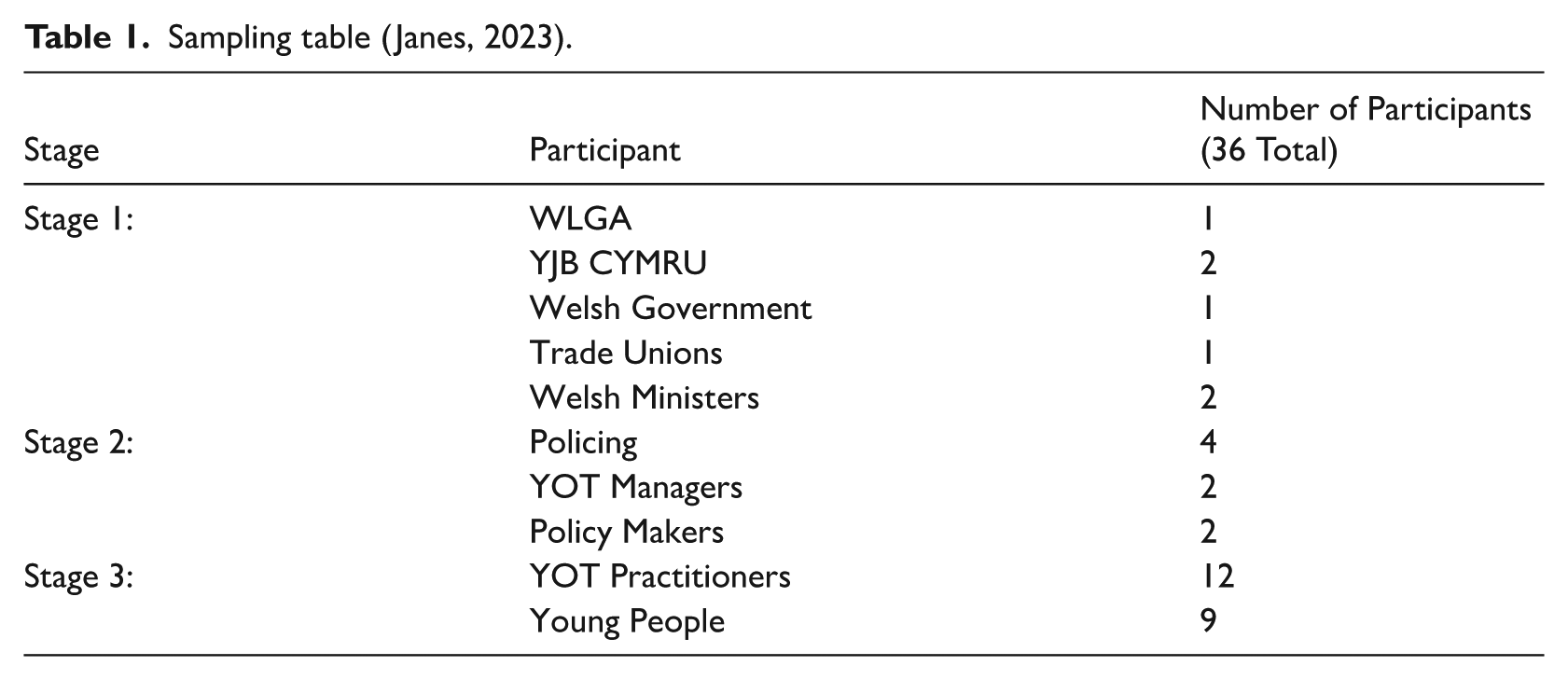
Interview schedules also included prompts on key Welsh innovations such as Child First practice, trauma-informed approaches (e.g. Enhanced Case Management) and prevention-focused services, ensuring participants could connect their experiences to wider developments in Welsh youth justice. Sampling was purposive and incremental, drawing participants with relevant expertise. Snowballing was used to reach otherwise hard-to-access stakeholders. In total, 36 participants took part, as noted in the sampling table above. All interviews were audio-recorded, transcribed, anonymised and thematically analysed following Braun and Clarke’s framework (Table 1).
Sampling table (Janes, 2023).
Ethical approval was obtained from the Swansea University School of Social Sciences Ethics Board, and informed consent was secured from all participants. There was careful consideration regarding respect for children’s voices and understanding of power dynamics within the research. The methodology prioritises transparency, reflexivity and participant voice, providing a robust foundation for understanding how Welsh devolution shapes youth justice practice.
Some challenges must be acknowledged. COVID-19 shaped the broader context of fieldwork and contributed to access challenges, particularly as gatekeepers had to prioritise safeguarding and service delivery pressures. Arranging interviews with young people was sometimes difficult, as their availability and circumstances could shift at short notice, requiring flexibility in timing and location. While these factors inevitably shaped the research process, they also underscored the importance of adaptability and sustained engagement, ensuring that participants’ voices were heard on their own terms.
All interviews were transcribed verbatim, anonymised and thematically analysed following Braun and Clarke’s (2006, 2021) reflexive thematic analysis. This approach aligned with the study’s interpretivist epistemology, enabling attention to both semantic and latent meanings and supporting an iterative, inductive reading of the data. Coding proceeded in stages: familiarisation with the transcripts; generation of initial codes; development and refinement of candidate themes; and a final phase of reviewing, defining and naming themes. Reflexive memo-writing and regular revisiting of earlier analytical decisions ensured transparency and consistency, while allowing themes to remain grounded in participants’ own accounts rather than being imposed a priori.
What follows builds on this methodological foundation to explore how participants themselves make sense of youth justice in Wales. The findings trace the movement from policy intent to lived experience, showing how YOT managers interpret and enact discretion, how practitioners negotiate and at times mediate that discretion in frontline practice and how young people experience its effects on their lives, opportunities and aspirations. In doing so, the analysis demonstrates how these perspectives collectively illuminate the interplay between structure and agency at the heart of Welsh youth justice.
A distinctive welsh context? Devolution, divergence and the architecture of youth justice
The dynamics of youth justice in Wales were frequently described by participants as a balancing act between central direction and local adaptation. As one Welsh policy expert observed, ‘Most of the direction comes from UK government policy and what it wants, but what you then have is local autonomy, to find a way of doing it [youth justice] that suits your local environment’. This insight is more than a descriptive comment; it captures a defining tension in the governance of Welsh youth justice.
The quotation foregrounds the central paradox of the system: statutory responsibility sits with Westminster, yet the day-to-day delivery of youth justice is embedded within a devolved policy landscape. This produces a dual dynamic in which Youth Offending Teams (YOTs) must operate within English legal parameters while simultaneously engaging with a distinctly Welsh policy ethos that emphasises wellbeing, prevention and children’s rights. As a result, local actors exercise meaningful discretion in how national policy is interpreted and enacted, creating what has variously been described as ‘soft devolution’ or ‘informal divergence’.
Criminal justice remains a reserved matter under the Government of Wales Act 2006, but many of the services essential to youth justice, including education, health, housing and social care, are fully devolved. This overlapping governance architecture has enabled the emergence of a more welfare-oriented and rights-focused model of youth justice in Wales, even in the absence of formal legislative devolution of the youth justice system itself.
While youth justice remains formally reserved, Welsh practice has increasingly diverged through relational working, informal governance arrangements and shared policy language across devolved domains. This divergence is not accidental but is shaped by the scale of the Welsh system itself. As one participant reflected: In Wales, we have something that looks different to England. We are a lot smaller . . . by the end of the week, I’ve usually seen everybody twice. (Welsh Government Official).
This compressed institutional landscape facilitates rapid information-sharing, repeated interaction and the accumulation of relational authority, conditions that amplify the discretionary power of YOT managers while also intensifying the risks of uneven practice. This structural intimacy helps explain how YOT managers are able to act as brokers between reserved and devolved systems, but it also sets the conditions for variation in leadership, priorities and service delivery across Wales.
These dynamics were not confined to managerial tiers. Frontline practitioners also exercised their own forms of agency, sometimes tempering or redirecting managerial decisions in practice. One youth justice worker described ‘working around’ directives to prioritise relationship-building with young people, even when this conflicted with prescribed targets. Such accounts highlight that discretion is navigated at multiple tiers: not only vertically between policymakers, YOT managers and practitioners, but also horizontally within teams. Welsh youth justice, therefore, emerges as a system shaped through ongoing negotiation across levels of practice, rather than by top-down policy alone. Yet this negotiated, multi-tiered reality is seldom reflected in how Welsh youth justice has been conceptualised within the academic literature.
This tension is rarely acknowledged in the wider youth justice literature, which often overlooks the complexity of post-devolution arrangements in Wales. The concept of ‘dragonisation’ (Jones, 2006), modelled after Scotland’s ‘tartanisation’, was originally coined to describe Wales’s efforts to chart a distinctive path in youth justice. Yet the term now appears insufficient to capture the applied realities that have emerged. Legally, the governance of youth justice remains straightforward: core powers sit with Westminster, and the Crime and Disorder Act 1998 continues to structure the system. Operationally, however, the picture is far blurrier. Successive Welsh Governments have embedded children’s rights and wellbeing within domestic policy, most notably through the Rights of Children and Young Persons (Wales) Measure 2011, the Social Services and Well-being (Wales) Act 2014 and the Well-being of Future Generations (Wales) Act 2015. Although these frameworks carry no authority to direct youth justice functions, they nonetheless influence local youth justice delivery by shaping the wider service environment in which YOTs operate.
The role of local government is also pivotal, for which the Welsh Government and Senedd have devolved competence. Despite the statutory structure of YOTs being rooted in UK legislation, local authorities have retained a directive role in the design and operation of youth justice services. As Charlie Taylor (2016), former Chair of the Youth Justice Board, observed, youth justice cannot function effectively without integration into local services, most of which are devolved in Wales. This creates a space that is inherently multi-strategic: unlike adult services, youth justice is intimately intersectional in-service terms, drawing together education, health, housing and social care. This makes the interface between central control and local discretion particularly important.
Understanding youth justice in Wales thus requires a departure from purely systems-level analysis. Instead, it demands engagement with the actors who mediate between overlapping policy spheres, particularly those with operational discretion, such as YOT managers. Their ability to interpret and rework national priorities in light of local conditions forms the backbone of the Welsh youth justice experience, an experience shaped not simply by law or structure but also by relationships, values and place-based innovation (Janes, 2023). This article examines how this interpretive work is accomplished in practice, and with what consequences.
Drawing on qualitative data from my doctoral research, this article foregrounds the everyday practices through which Welsh YOT managers navigate a fragmented governance terrain. Based on in-depth interviews with senior practitioners, policymakers and YOT managers across Wales, alongside participatory work with children subject to youth justice interventions, the research found that YOT managers accrued significant informal influence through longevity, professional networks and their ability to translate between devolved and reserved policy agendas. As one practitioner explained: Our YOT manager is very influential because of her experience and the power she has. When she believes in something, she will make it happen and make it work. . . some are just tick boxes, they don’t want to change things. (YOT Practitioner, Mid Wales)
This influence was unevenly distributed, however, shaped by local authority structures, funding arrangements and managerial positioning. As a result, Welsh youth justice emerged not as a uniform system, but as a series of locally mediated practices, creating the conditions for both innovation and disparity. It is precisely this combination of discretion, informality and local mediation that creates space for alternative justice philosophies to take hold.
This evolving landscape of devolved influence and local discretion not only facilitates divergence in practice but also provides fertile ground for the implementation of progressive justice philosophies, particularly those aligned with community-based, rights-focused models of intervention. These ideas find expression in the broader discourse of criminal justice reform, such as the ‘destructuring’ movement, which frames youth justice within a wider critique of institutionalised responses and the expansion of penal power.
Diversion, decarceration, decriminalisation and de-institutionalisation
The tension between progressive reform and systemic inertia is starkly evident in the rhetoric of the ‘destructuring’ movement, which advocates a shift from punitive frameworks towards more community-based models of criminal justice. As White and Perrone (1997: 177) describe, destructuring involves a deliberate move away from institutionalised, centralised responses towards less formal and more localised mechanisms. This can be seen in youth justice through the so-called four D’s: diversion, decarceration, decriminalisation and de-institutionalisation (Polk, 1987; Sarre, 1999). Yet, as Cohen (1985) warned, these intentions frequently clash with the expanding reach of the deviancy control system, where the net of penal power becomes more sophisticated and pervasive despite calls for reform.
The long-standing inefficiencies of youth justice remain a salient issue. As the Audit Commission (1988) observed nearly three decades ago, ‘The current system for dealing with youth crime is inefficient and expensive . . . The present arrangements are failing young people’ (p. 96). Despite incremental improvements, such as reductions in child arrests (Farrell et al., 2019) and advances in children’s rights (Children’s Legal Centre Wales, 2022), structural critiques persist. Case and Haines (2021) argue that youth justice remains fragmented, costly and often ineffective in realising meaningful change. These persistent shortcomings invite renewed consideration of how youth justice might be organised differently, particularly within a distinctive Welsh governance context.
This dissonance raises a broader question: what would a reimagined youth justice system in Wales look like, and to what extent could it resist the gravitational pull of dominant structural logics that continue to shape youth justice across England and Wales? Action to create change is already underway. Evidence from the doctoral study illustrates how such ambitions have often been realised through managerial discretion at the local level, particularly in relation to diversion and out-of-court disposal practices.
Rather than emerging through formal structural reform, evidence from the doctoral study illustrates how such ambitions have often been realised through managerial discretion at the local level, particularly in relation to diversion and out-of-court disposal practices. Several YOT managers described actively protecting diversionary pathways during periods of financial retrenchment, reframing prevention as a cost-avoidance strategy aligned with both Welsh Government priorities and local authority pressures. Participants emphasised that diversion was frequently among the first areas to be viewed as expendable during funding contractions despite its central role in preventing escalation and reducing downstream system costs.
However, this reliance on managerial discretion also exposes the fragility of such innovation. Even as Wales develops new language, priorities and institutional actors, there remains a risk that a distinctively ‘Welsh’ system might reproduce many of the assumptions and mechanisms of the existing framework, particularly where progressive practices depend on individual leadership rather than embedded structures.
The notion of ‘dragonisation’ first introduced by Edwards and Hughes (2009a) and later developed by Haines (2009a) sought to capture Wales’s early post-devolution efforts to chart its own path in community safety and youth justice, modelled loosely on Scotland’s ‘tartanisation’. Dragonisation described the emergence of a rhetoric of Welsh distinctiveness, grounded in partnership working, prevention and a public-service ethos. However, its analytical value has been debated. Critics argue that while the discourse of divergence became increasingly visible, the substantive powers necessary to transform youth justice remained reserved to Westminster, producing a form of symbolic differentiation rather than structural change (Briggs, 2017). A brief revival of interest in the concept can be found in more recent discussions of devolved governance and crime policy (Briggs, 2017; Jones and Jones, 2022).
Crucially, dragonisation also obscured the lived realities of young people and their families, whose experiences often reveal the limits of policy rhetoric. Research across the UK has documented how youth justice decisions, such as risk-based assessments, breach procedures and the escalating use of compliance-driven interventions, can have profound consequences for children’s wellbeing, educational engagement and family stability (Case and Hampson, 2019; Gray and Smith, 2019; Phoenix, 2019). Families frequently absorb the emotional and practical burden of supervision requirements, while communities can become sites of both support and surveillance. These dynamics underscore that divergence is not only a matter of institutional design but also of how structural decisions materially shape everyday lives.
Seen in this light, the Welsh case demands critical interrogation rather than uncritical celebration. Divergence may offer opportunities for more child-centred, prevention-oriented practice, but it also sits within a system whose foundational logics, risk governance, managerialism and responsibilisation remain largely intact. Understanding whether Wales can move beyond rhetorical distinctiveness, therefore, requires attention not only to governance structures but also to the consequences of youth justice intervention for children, families and communities.
Historically, penal practices have shifted from highly visible, public forms of punishment, such as executions and corporal spectacles, to more subtle, institutionalised forms of control, where surveillance and bureaucratic oversight replace spectacle (Cohen, 1985; Foucault, 1979; Simpson, 2002). These changes were not driven by compassion, but by practical concerns about public disorder and the limits of sovereign power and economics. What remains consistent across these changes is the intensification of control through professionalisation, proceduralisation and the proliferation of technical expertise (Hatherley, 2025). In effect, informalism and rehabilitation have not eliminated the logic of governance; they have merely evolved its mechanisms (Ridley-Duff, 2005; Tidmarsh, 2022).
In contemporary youth justice in Wales, with Youth Offending Teams (YOTs) as critical policy and service actors, these historical dynamics continue to resonate. Audit culture, performance targets and risk management frameworks frequently prescribe the discretion of practitioners and YOT managers despite policy rhetoric emphasising participation, development and welfare (Smith and Gray, 2019). This tension was repeatedly noted in my data, with one policy expert observing that ‘There can be tensions between what the UK Government wants and where it fits with Welsh Government policy direction’ (Policy Expert). Such divergence creates a complex practice environment in which discretion must be continually negotiated.
Young people, whose voices are already marginalised within decision-making structures, experience the consequences of these bureaucratic imperatives directly, while practitioners navigate competing expectations from both managerial and community perspectives. This tension is intensified by the organisational position of YOT leaders, who must mediate between the priorities of devolved services, education, social care, health and wellbeing and the reserved statutory requirements that continue to govern youth justice. Positioned at this junction, YOT managers are required to reconcile divergent policy logics, a dynamic that cascades through teams and shapes how children ultimately encounter the system.
Yet young people’s accounts reveal that, even within these structural constraints, the quality of support provided by YOTs can be transformative. One young person described how sustained encouragement enabled a profound shift in their sense of self and future possibilities: To be fair they really have (supported me) I am in a much better place! I would really like to be part of youth justice one day. . . helping young children and people like me who have offended. . . show them where I have gone wrong. (Young Person)
At the same time, young people also articulated the limits of the wider environment in which YOTs operate, particularly the erosion of community resources that once provided outlets, relationships and opportunities for growth. As another young person explained: More youth clubs and that to get people off the streets. . . more stuff with music. I would like to get involved with something like that. . . maybe learn some dancing. (Young Person)
Together, these accounts highlight that children’s experiences of youth justice are shaped not only by statutory obligations or managerial priorities but also by the availability (or absence) of broader community infrastructures. They underscore the dual reality in which YOTs operate: empowered to make meaningful relational differences, yet constrained by systemic pressures and the uneven distribution of preventive and developmental opportunities across Wales.
This article explores whether existing structures enable or constrain professional agency within Welsh youth justice. Focusing on YOT managers and frontline practitioners, it examines how structural pressures, policy priorities and managerial oversight shape the exercise of discretion and the capacity to innovate. YOT managers warrant particular attention because they occupy a pivotal leadership position at the intersection of devolved services, such as education, health and social care, and the reserved statutory framework that governs youth justice. Their role requires them to translate, reconcile and at times resist competing policy logics, making them central to understanding how agency is negotiated in practice. By situating contemporary practice within a broader historical and theoretical framework, this analysis highlights what is often described as a tension between systemic control and professional autonomy. Rather than viewing this solely as a point of constraint, the article treats it as a productive space in which new forms of practice, interpretation and local innovation can emerge. Recognising this dynamic is essential for identifying avenues for reform, supporting professional judgement and ensuring that policy intentions translate meaningfully into improved outcomes for young people.
The power of individual decision-makers
This article interrogates the often-overlooked influence of individual decision-makers within the youth justice system, particularly those operating at the frontline of service delivery. In doing so, it foregrounds the autonomy of key actors, specifically YOT managers, and asks how far individual discretion can shape local practices within a system ostensibly governed by national frameworks.
Autonomy, in this context, is not only a measure of administrative power but a criterion of political status, an attribute necessary for equal standing in the governance of services (Feinberg, 1986). Yet, the consequence of granting such autonomy, in the absence of standardisation or meaningful oversight, may result in postcode lotteries in service provision, thereby exacerbating systemic inequities. This fragility was a recurring theme within the doctoral data. Participants described how the departure of an experienced YOT manager could result in the rapid erosion of previously established practices, particularly where innovation had been sustained through personal relationships rather than formalised structures. One senior practitioner observed that ‘when a good manager leaves, a lot of that ethos leaves with them, it’s not written down anywhere, it just disappears’. Others highlighted how local authority restructuring and the absorption of YOT managers into wider service portfolios diluted youth justice priorities, reinforcing dependence on individual leadership rather than institutional resilience.
The concept of autonomy is crucial to understanding these dynamics. As Christman and Anderson (2005) argue: ‘To be autonomous is to govern oneself, to be directed by considerations, desires, conditions, and characteristics that are not simply imposed externally upon one, but are part of what can somehow be considered one’s authentic self’.
The role of the YOT manager is pivotal within the governance of youth justice in Wales. Although much of their authority is exercised informally, it is rooted in the statutory foundations laid out in the Crime and Disorder Act 1998, which requires each local authority to establish a Youth Offending Team and designate a YOT manager to coordinate its work. This statutory duty positions the YOT manager as a key local leader, responsible for convening and directing contributions from police, probation, education, health and social services. YJB guidance has long emphasised this coordinating function, describing effective YOT leadership as central to ‘driving multi-agency commitment’ and ensuring local coherence in the delivery of youth justice interventions (YJB, 2023).
In practice, the remit of YOT managers extends far beyond the formal text of the legislation. They operate across a wide multi-agency terrain that includes safeguarding partnerships, prevention and early-help services, school inclusion teams, children’s services, HMPPS case management structures, community safety partnerships and local authority governance frameworks. Their capacity to mobilise and negotiate within these networks gives them considerable influence over how national youth justice guidance is interpreted locally. This coordination, though not mandated explicitly, has emerged as one of the applied realities of youth justice under devolution: a form of operational leadership shaped by flexibility, interdependence and the need to mediate between reserved and devolved policy arenas.
Moreover, the ‘office’ of the YOT manager carries a distinctive institutional presence within each community and local authority area. It confers symbolic and practical authority, allowing managers to act as boundary-spanners who translate policy across organisational cultures, reconcile competing priorities and broker the resources required to meet children’s needs. While the Crime and Disorder Act 1998 provides only a skeletal outline of this role, more expansive guidance from the Youth Justice Board and local authorities implicitly endorses this discretionary, adaptive mode of leadership (Haines and Case, 2012; Souhami, 2012). In a devolved Welsh context, where youth justice is reserved but most child-facing services are not – this leadership becomes even more crucial, shaping not just organisational coordination but the texture of youth justice practice on the ground.
These accounts highlight how YOT practice can either stifle or enable ambition. In this sense, the Welsh case makes visible what Mills described as the link between ‘private troubles’ and ‘public issues’, where the aspirations of young people and the discretion of managers are entangled with the broader governance of justice. Likewise, in Giddens’s terms, YOT managers exemplify how agents are both constrained and enabled by structures, recursively shaping the very system they inhabit. While Giddens and Mills foreground agency within social structures, the logic of public choice theory reminds us that such agency is exercised within incentive-bound environments.
This discretion invites an analytical lens grounded in public choice theory, a framework that transposes economic logic onto political and bureaucratic behaviour (Niskanen, 1998; Shaw, 2002). As Buchanan (2003) describes it, public choice is ‘politics without romance’. It recognises that agents of the state may not always act in the public interest, particularly when their incentives are misaligned with broader societal needs (Sitter and Eliassen, 2008). Applying this lens reveals the tensions between individual agency and collective accountability within youth justice governance.
Such tensions are further exacerbated by the political volatility of youth justice policy, whether in Westminster, Cardiff or within Local Councils, which, despite recent superficial stability, remains tethered to cycles of reform, retreat and recalibration (Case and Hampson, 2019). Even as the field purports to evolve, it often remains anchored to entrenched paradigms through incrementalism and policy ‘bolt-ons’, frequently shaped by wider socio-economic anxieties and austerity agendas (Case et al., 2015). The lack of political will, coherence and resources to enact transformative change is particularly acute in the post-Brexit landscape (Case and Haines, 2021; Tetlow and Pope, 2020).
These dynamics were sharply reflected in participants’ accounts, particularly in relation to funding instability. One YOT manager described the dramatic expansion that followed the introduction of the Crime and Disorder Act 1998, noting the ‘massive’ growth in staffing and resources in the early years. Yet this was followed by a sustained period of retrenchment as austerity measures took hold from 2008/09 onwards. As they reflected: There was a lot of money coming in and massive growth (certainly in xxxxxxx) in terms of staffing, and then you know around 2008/9 there was a shrink back again and over the years since then the YOTs, when staff have left, they just haven’t been replaced etc. We are running on fumes. . . I wouldn’t want to see any further shrinkage. I think what has been happening sort of year-to-year concern over what money we are going to be getting. (YOT Manager).
This testimony illustrates how macro-level political shifts translate into chronic uncertainty on the ground, undermining the capacity of YOTs to plan strategically, sustain innovation or maintain the staffing levels required to deliver consistent, relational, child-centred practice. Ultimately, this article reflects the broader paradox of youth justice in the UK: a domain historically shaped by conflict, contradiction and compromise (Muncie and Hughes, 2002). Caught between welfare and punishment logics, and shaped as much by political expediency as by empirical evidence, the field remains vulnerable to oscillation between care and control. The degree to which individual decision-makers, such as YOT managers, can resist or reinforce these logics speaks directly to the core themes of structure, agency and power, threads that run throughout this article.
Progress through paradox: Moving forwards yet backwards in youth justice
The development of youth justice policy in England and Wales has been marked by significant reform alongside notable regression. As Case and Bateman (2020). highlight, the field is characterised by both progressive steps and policy reversals. For example, the Children Act 2004 represented a key advancement, extending safeguarding duties to criminal justice agencies and embedding multi-agency cooperation (Bateman, 2020). In contrast, the introduction of risk-based managerialism has been cited as a backward step, shifting discretion away from practitioners towards bureaucratic, predictive frameworks. Risk became synonymous with danger and deviance, prompting system responses rooted in control and prescription rather than care (Case, 2016).
One of the most profound legal changes shaping the contemporary youth justice landscape was the abolition of the presumption of doli incapax for children under 14, enacted through Section 34 of the Crime and Disorder Act 1998. This reform overturned a centuries-old common-law safeguard that presumed children lacked the capacity to form criminal intent unless the prosecution could demonstrate otherwise. Although doli incapax was a rebuttable presumption, political and media debates at the time frequently misrepresented it as a blanket defence (Arthur, 2010; Crofts, 1998), contributing to its removal.
The implications of this change have been widely criticised. The minimum age of criminal responsibility (MACR) in England and Wales is set at 10 and remains one of the lowest in Europe. Comparative data shows that many European jurisdictions set the MACR between 12 and 16, with 14 emerging as the most common threshold. The UN Committee on the Rights of the Child has repeatedly urged the UK Government to raise the age, emphasising that criminalisation at such a young age conflicts with developmental science and children’s rights standards. In its 2023 Concluding Observations, the Committee stated that ‘a MACR of 10 is “not internationally acceptable” and does not comply with the child’s best interests’ (United Nations [UN], 2023).
Such critiques underscore the enduring significance of doli incapax as a protective mechanism. Its abolition not only removed an important legal safeguard but also accelerated a shift towards earlier and more punitive forms of intervention. For children in Wales, where broader public policy embraces a children’s rights and wellbeing ethos, this structural legacy remains a fundamental constraint on the extent to which youth justice can truly align with devolved values.
While the landscape of youth justice has evolved considerably over the past 25 years, significant disparities persist. For instance, although there has been a welcome reduction in the number of children entering the system, this has not benefitted all groups equally. Ethnic minority children remain disproportionately represented, particularly at the more punitive ends of the system, with more than half of those in custody coming from minoritised backgrounds (Little, 2020). Similarly, children in care, with learning needs and from areas of poverty, remain more likely to be criminalised than their peers (Bateman, 2020).
The 1996 Audit Commission report Misspent Youth diagnosed a fragmented and inconsistent youth justice system, marked by significant delays and an underdeveloped focus on early intervention. This was prior to the establishment of the current 15 Youth Offending Teams (YOTs) in Wales. Notably, Misspent Youth advocated for increased diversion from the formal justice system, an ethos that would later become central to contemporary youth justice reform. It observed: ‘The youth justice system is characterised by delay and inconsistency. Too little is done to change behaviour when young people start to offend. . . Demanding and intensive community supervision programmes are spread unevenly across the country’. (Misspent Youth; Audit Commission, 1998).
While subsequent reforms have sought to address these structural inefficiencies – particularly through streamlining youth court processes and expanding diversion and prevention pathways (Lord McNally, 2015), many of the core problems identified in the mid-1990s persist. Hundreds of children continue to face delays that result in them being tried in adult courts, a practice widely viewed as inappropriate and harmful (Godfrey et al., 2022; Pidd, 2019). The Covid-19 pandemic further intensified these delays and exposed accumulated fragilities in the system (Raab, 2021).
Such pressures not only affect young people but also shape the operational realities of those delivering services. As one policymaker reflected, the combination of resource scarcity, risk aversion and legal accountability creates conditions in which innovation becomes increasingly difficult. Instead of fostering creativity or responsiveness, austerity and uncertainty encourage minimal compliance: I know from all of my experience of managing in public sector settings that when money is tight, you do what you know you will be in trouble if you don’t do, so you do the absolute bare minimum. You make sure that your back is legally covered, and that is not an environment that leads to innovation. (Policy Maker)
This insight underscores how systemic constraints, delays, resource shortfalls and heightened procedural anxieties not only shape young people’s experiences but also restrict the capacity of services to adapt, innovate or respond meaningfully to the complexities of children’s lives.
Devolution, disparities and the dynamics of local power
One key theme emerging from both Misspent Youth and the Crime and Disorder Act 1998 is the shift towards partnership working. Multi-agency collaboration became central to youth justice practice, with a focus on information-sharing, joint assessment and shared outcomes. Whether this model was adopted for financial efficiency or genuinely child-centred reasons remains contested. However, the foundations for partnership working had been laid much earlier, notably in the Morgan Report on crime prevention, which stated: ‘The key to successful crime prevention lies in partnership’ (Home Office, 1991).
This approach echoed wider developments in community safety and local governance (Berry, 2010). As Home Secretary Jack Straw later reiterated, the strategy required local actors, including local authorities, the police and the voluntary sector, to collaboratively analyse crime and devise targeted responses (Straw, 1996). These developments represented a shift towards managerial governance models, historically unexpected from a Labour government (Pike and Hindmoor, 2019).
Despite these reforms, youth justice continues to exhibit significant structural and constitutional complexities, particularly in Wales. Pre-devolution, the system was simpler, given central Home Office control. Devolution is defined here as the transfer or delegation of power to a lower level, especially by the central government to local or regional administration (Janes, 2023). Post-1998, Wales gained legislative and administrative powers through successive stages of devolution. However, youth justice remains a non-devolved area, legally under the control of the Ministry of Justice and the Youth Justice Board (YJB) (Drakeford, 2010). There are unresolved challenges in the devolution settlement, with key services (and assets) being responsible to the Welsh Government, rather than Westminster currently; this remains unresolved, creating a murky policy environment in which jurisdictional boundaries and competencies are often unclear (Davies, 2015).
Within this landscape, some YOT managers and other local stakeholders wield significant influence. Their decisions can shape service priorities, resource allocation and even the direction of local youth justice strategies. This focus on individual decision-making power is central to this article. It also connects with broader debates around structure and agency, notably in the work of C. Wright Mills. Mills (1959) challenged the tendency of social science to focus solely on large, impersonal structures, arguing instead for a dynamic understanding of how individual experiences intersect with broader social forces. This tension remains relevant in the youth justice context, where individual autonomy must be situated within wider bureaucratic and political structures (Frauley, 2015; Staubmann, 2021).
Wales: Innovation through informal power structures
Despite the legal constraints of a non-devolved youth justice system, Wales has leveraged devolved influence to develop a distinct approach. Local negotiation, partnership working and strategic leadership have enabled a more child-focused practice to emerge. The Youth Justice Blueprint for Wales (Welsh Government, 2019) illustrates this trend, committing to: ‘Support the youth justice sector with resources, training and qualifications to improve practitioner skills in recognising and responding to trauma’.
Before examining these innovations, it is important to acknowledge the limits of the evidence regarding their comparative effectiveness. While Welsh youth justice has introduced initiatives such as Child First practice (Case and Browning, 2021), Enhanced Case Management (Cordis Bright, 2017; Glendinning et al., 2021) and prevention-focused schemes (Haines et al., 2013; YJB, 2018), the available evidence is largely evaluative and predominantly qualitative in nature. This body of research provides rich insight into implementation processes, practitioner perspectives and young people’s experiences, but it offers limited capacity for robust cross-national or longitudinal comparison. Persistent difficulties in disaggregating data for England and Wales, combined with inconsistent recording practices, further complicate attempts to assess outcomes with statistical certainty (Jones and Jones, 2022). In addition, broader structural trends, including the significant decline in youth crime since the mid-1990s (Griffiths and Norris, 2020), make it difficult to attribute observed effects solely to policy or practice innovation.
For these reasons, this article positions Wales less as a model of proven effectiveness and more as a site of experimentation, where discretion, devolution and partnership working intersect to produce distinctive youth justice practices. Central to this exploration are YOT managers, whose leadership and local knowledge mediate between devolved services and reserved legal frameworks, shaping how policy intentions are translated into practice on the ground. Rather than assessing system-wide effectiveness, this study examines how these actors exercise professional judgement, navigate structural constraints and generate opportunities for innovation. Whether such practices can be sustained, scaled, or inform policy beyond the Welsh context remains an open question, highlighting the need for further longitudinal and comparative research.
Within this experimental space, local authorities, YOTs, the Welsh Government and other actors collaborate through a complex but adaptable governance framework. Individual agency, particularly that of YOT managers, is pivotal in steering these partnerships and shaping outcomes. Devolution has created a new relational and dialogue-based space, where actors navigate between reserved and devolved responsibilities, negotiate local priorities and exercise influence over the design and delivery of youth justice. Recent Welsh legislation, such as the Social Services and Well-being (Wales) Act 2014 and the Well-being of Future Generations (Wales) Act 2015, provides a supportive policy backdrop, reinforcing the importance of cross-sector collaboration and child-centred practice without directly altering the statutory structure of YOTs. Recent Welsh legislation, such as the Social Services and Well-being (Wales) Act 2014 and the Well-being of Future Generations (Wales) Act 2015, provides a supportive policy backdrop, reinforcing the importance of cross-sector collaboration and child-centred practice without directly altering the statutory structure of YOTs. It is within this enabling, but non-prescriptive, policy environment that local actors have been required to interpret and operationalise these principles in practice.
These dynamics were closely tied to distinctive Welsh developments in youth justice. Managers described how Child First and trauma-informed practices, such as Enhanced Case Management, offered both opportunities and new layers of accountability. Findings from the doctoral research further demonstrate how Welsh YOT managers have acted as key brokers in embedding these approaches locally. Participants described using their strategic positioning to align Child First and trauma-informed practices with devolved priorities in education, health and wellbeing, even where statutory youth justice requirements remained reserved. As one manager explained, this involved ‘constantly translating youth justice into a language that other services recognise, safeguarding, trauma, prevention, otherwise it just doesn’t get traction’.
This brokerage work illustrates how informal authority, rather than formal devolution, has enabled the development and sustainability of distinctive practices within Welsh youth justice. While youth justice remains legally reserved, the practical organisation of Youth Offending Teams allows for considerable discretion in how services are configured and prioritised at the local level. As one Welsh Government official explained:
A tremendous amount of autonomy . . . it’s small-d devolution really. . . when you look at the Act, it’s not a big collection of instructions for what a youth offending team needs to look like. Apart from a few core requirements, the stuff that you actually put in the basket is pretty much up to you. (Welsh Government Official)
This form of ‘small-d’ devolution reflects not a formal transfer of legislative power, but the combination of statutory minimalism and deep interdependence with devolved services. YOT managers are therefore afforded space to interpret, assemble and prioritise youth justice practice locally, while remaining accountable to national standards, inspection regimes and local authority governance.
Similarly, prevention and out-of-court initiatives were cited as spaces where discretion was most visible, but also most vulnerable to funding pressures and local authority restructuring. At the same time, practitioners emphasised that discretion did not flow only downwards: frontline staff sometimes challenged or adapted managerial decisions in practice, resisting what they saw as unworkable or overly rigid expectations. These micro-contestations illustrate how constraints operate not only from above but also from below, shaping what discretion looks like in everyday practice. As one practitioner explained:
Yes, I do push back, but it isn’t that straightforward. Practitioners have to be champions for change; we promote the work we do and advocate for the young people we serve. I’ll sometimes interpret, adapt, or even push back to our management team, especially when something that deserves funding or attention is being sidelined.
This account highlights how the exercise of agency within Welsh YOTs is multidirectional: practitioners negotiate, mediate and sometimes resist managerial directives, contributing actively to the shaping of local youth justice practice.
Over more than two decades of devolution, findings from my doctoral research indicate that Youth Offending Teams (YOTs) in Wales have gradually accrued a meaningful, though still uneven, capacity to shape local youth justice policy and practice (Janes, 2023). While the Crime and Disorder Act 1998 did not devolve youth justice to Wales, it did create organisational spaces in which local partnerships could innovate. Over time, Welsh policy commitments to children’s rights, prevention and multi-agency collaboration have strengthened these spaces, enabling YOTs to exercise influence through everyday decision-making, relationship-building and strategic negotiation with local authority and national actors.
However, the data also show that this influence remains constrained and contingent. Several managers and practitioners described systems that had evolved positively but remained vulnerable to structural limitations, particularly inconsistencies in local authority resources, political priorities and service configuration. These conditions produce what can be understood as a Welsh ‘postcode lottery’, in which the support a child receives is shaped not only by assessed need but by the specific practices, partnerships and funding environment of the area in which they live (Janes, 2023).
This unevenness was especially evident in relation to prevention and early-intervention work, where YOTs reported both the greatest freedom to innovate and the greatest exposure to retrenchment.
Bridging these disparities, therefore, requires more than policy alignment: it demands sustained attention to local capacity, relational governance and the lived realities of practice. For practitioners, this involves continually negotiating competing responsibilities and resource pressures; for policymakers, it means recognising and addressing the structural conditions that limit local discretion; and for researchers, it calls for ongoing interrogation of how devolution shapes practice ‘on the ground’, and where inequities persist despite progressive intent.
Autonomy in an age of structure: Reframing the agency debate
This research contributes to ongoing theoretical debates about the interplay between structure and agency (Giddens, 1984; Mills, 1959), offering a contemporary lens through which to understand these dynamics in the context of youth justice in Wales. C. Wright Mills observed that modern society is dominated by remote and impersonal forces that shape our experiences, behaviours and worldviews. In this light, structure, be it institutional, legal or political, appears to constrain agency. And yet, as this article demonstrates, agency is not merely residual within a structured system; it can be reimagined as a powerful, generative force.
Within the youth justice system, Youth Offending Teams (YOTs) represent a critical node in the operational landscape. While the Youth Justice Board (YJB) provides overarching expectations, it is YOT managers who exercise the day-to-day authority required to interpret, translate and operationalise policy. In Wales, this dynamic is particularly pronounced. YOT managers are not simply implementers; they are shapers of practice, operating within a discretionary space that reflects both local need and the broader cultural and political ethos of devolved Wales. This is not devolution in a formal legislative sense, but rather a form of soft devolution, an influence space, where local actors hold persuasive power beneath the surface of centralised structures.
As one policy expert observed: ‘You do not get things implemented with the same degree of fidelity, so I think the YOT manager kind of determining the direction and culture of the team is really significant’. (Policy Expert)
This insight aligns closely with statutory guidance that emphasises the strategic and outward-facing nature of the YOT manager role. Although the legislation does not specify a required grade for the post, the YJB has long stressed that it must carry sufficient seniority to operate effectively at a strategic level (YJB, 2018). The Home Office’s (1998) Inter-departmental Circular is even more explicit: [. . .] youth offending team managers should not be ‘buried’ within the management structure of any of the partner agencies; it is essential that they are able to engage, as appropriate, at a senior and strategic level with all the relevant local agencies, including by reporting directly to meetings of the chief officers’ steering group. (para. 44)
This deliberate positioning creates a distinctive form of professional space, one rarely afforded to managers in other public services. Far from being submerged within bureaucratic hierarchies, YOT managers are expected to maintain visibility, autonomy and cross-agency influence. Findings from my doctoral research indicate that this freedom to manoeuvre enables them to tailor youth justice delivery to local conditions, shaping bespoke interventions, team cultures and preventive frameworks (Janes, 2023). This ‘dual mastery’, answering simultaneously to a reserved legal structure and devolved policy logics, was repeatedly identified by participants as placing Welsh YOT managers in a uniquely empowered position.
Such structuring of the managerial role suggests that agency is not a departure from the system, but a feature deliberately built into it. In Wales, the structure–agency dynamic is therefore less a site of conflict and more a site of productive interpretation. The discretionary space YOT managers occupy allows them to mediate the disparate pulls of English legislation, Welsh rights-based policy and local community need. It is within this space that abstract notions of ‘justice’ are translated into everyday practice. Yet this autonomy also contributes to variation across the country.
In this context, agency is not a challenge to structure; it is its interpretation. It is in the hands of practitioners that abstract notions of ‘justice’ become tangible actions. The structure versus agency debate thus finds a unique expression in Welsh youth justice, where actors are not only navigating structural constraints but actively reimagining what youth justice can look like in practice.
Giddens’ (1984) theory of structuration offers a useful lens here, suggesting that social structures both constrain and enable human action, while those same actions recursively shape the structures themselves. This dialectic is vividly embodied in the role of YOT managers, whose discretion influences the very culture and efficacy of youth justice in Wales. Simultaneously, Mills’ (1959) ‘sociological imagination’ invites us to view these individual decisions not as isolated incidents, but as embedded within broader institutional and historical forces. Welsh youth justice, then, becomes a site of negotiated meaning between structure and agency, policy and practice, system and service.
Together, these theoretical insights underscore a central argument of the article: that the exercise of discretion within Welsh youth justice is not simply a matter of managerial preference or procedural variation, but a sociologically significant process in which frontline actors actively reproduce, and sometimes reshape, the broader system.
Conclusion: People, not just policy
This article has highlighted how Welsh youth justice operates at the intersection of structure and agency, showing that Youth Offending Team (YOT) managers exercise discretion within a system shaped by national frameworks, managerialist imperatives and devolved governance. These negotiations reveal how local knowledge, professional judgement and contextual pressures converge to shape practice in ways that are neither fully determined by structure nor wholly autonomous.
In doing so, the analysis demonstrates that Welsh youth justice has developed a distinctive form of divergence. Even in the absence of formal devolution, YOT managers have been able to cultivate welfare-oriented, rights-based approaches that depart from more punitive English traditions. Their discretion underscores the significance of frontline agency in sustaining meaningful reform, even within structurally constrained systems.
At the same time, drawing on the insights of Giddens and Mills shows that these dynamics are not simply managerial or procedural, but sociological. YOT managers exemplify how structures both constrain and enable action, while their decisions recursively reshape the system itself. The ambitions and perspectives of young people remind us that these dynamics are lived and consequential: their hopes to study, to work or to build futures beyond the justice system expose the link between private troubles and public issues in a particularly vivid way.
Finally, the Welsh case provides lessons that reach beyond Wales. It illustrates how devolved or quasi-devolved contexts can generate space for innovation but also how such space must be carefully supported if it is to avoid postcode lotteries or uneven provision. Policy implications are clear: decision-making must remain attentive to local context, grounded in dialogue with young people and supported by mechanisms that protect both professional discretion and accountability.
Taken together, these findings advance both theory and practice. They demonstrate that structure and agency are not opposing forces but interdependent elements within youth justice. When exercised reflexively, discretion can become a vehicle for progressive reform, but only if the voices of young people remain central, ensuring that policy moves beyond rhetoric to support genuine, lasting change.
Footnotes

Funding
The author received no financial support for the research, authorship, and/or publication of this article.
Declaration of conflicting interests
The author declared no potential conflicts of interest with respect to the research, authorship, and/or publication of this article.