




Abstract
Demands led by the Movement for Black Lives in the United States to defund the police in 2020 spurred a critical reassessment of anti-Blackness and police violence, particularly in schools. This study examines the perspectives of youth and community organizers who engaged in Police-Free Schools Campaigns across Los Angeles County, focusing on their redefinitions of safety and alternatives to policing. Through semi-structured interviews, this study highlights the interconnectedness of safety and care, revealing that participants advocate for community accountability, relationship building, and resource allocation as essential for a safe environment. Rejecting traditional punitive approaches, organizers emphasize safety rooted in abolitionist care, prioritizing emotional support and communal responsibility as key facets in creating safe schools. This redefinition challenges existing notions of safety, advocating for investment in supportive structures and divestment from policing within schools. By redefining safety in terms of abolitionist care, participants in this study seek to foster life-affirming schools and communities.
Introduction
In June 2020, high school student and youth organizer Kahlila Williams spoke at a rally to defund school police outside the Los Angeles Unified School District (LAUSD) headquarters. She shared a personal experience that encapsulated the ways policing prioritizes punishment over care. While organizing a school event before the pandemic, Kahlila became dehydrated and fainted. Instead of receiving medical assistance, she was awakened by school police, who shone a light in her eyes and immediately questioned her about drug use. As she regained consciousness and received water from peers and teachers, the officers continued their interrogation rather than ensuring her well-being, leaving her feeling frustrated and criminalized (Kohli, 2024). Later, Kahlila recounted this story in public testimony before the LAUSD school board, posing a critical question: What if she had taken drugs? Rather than providing life-saving care, police might have escalated the situation by arresting her, increasing her risk of harm, or even contributing to a fatal outcome. Her experience underscores a systemic reality: students in crisis are met with law enforcement, not care professionals. A 2019 ACLU report found that 1.7 million students attend schools with police but no counselors, and 3 million with police but no nurses (American Civil Liberties Union., 2019).
Kahlila’s story illuminates a central contradiction of schooling within the carceral state: punishment is prioritized over care. Her testimony reflects an abolitionist critique of policing as fundamentally incompatible with genuine safety (Kaba et al., 2022; McHarris, 2024). An abolitionist approach to safety centers care, addressing inequities that cause harm rather than addressing harm through punitive, carceral responses. The 2020 uprisings following the murders of George Floyd, Breonna Taylor, Tony McDade, and others propelled abolitionist frameworks into public consciousness, fueling demands to defund the police and reinvest in community care. The Movement for Black Lives and allied organizers pushed policymakers, school boards, and researchers to critically examine how safety is defined and enacted in institutions like schools (Kaba et al., 2022). This movement also amplified long-standing critiques of school policing’s disproportionate impact on Black and Latinx students (Schenwar and Law, 2020), creating momentum for campaigns to remove police from schools across Los Angeles, Long Beach, and the Antelope Valley.
There is ongoing debate among researchers, communities, and organizers regarding the effectiveness of police in school safety. While some argue that the presence of officers enhances school safety (Crichlow-Ball et al., 2022; Wood and Hampton, 2021), the literature widely indicates mixed and often harmful impacts of school resource officers (SROs; DePaoli and McCombs, 2023). Scholars have analyzed the racialized and carceral dimensions of school safety (Nocella et al., 2014; Oeur, 2018), documenting how Black students experience heightened punishment, surveillance, and exclusion at the nexus of anti-Blackness and carceral logics (Annamma et al., 2019; Schlesinger and Schmits-Earley, 2021). Separately, research on anti-violence movements has examined how communities conceptualize safety beyond policing (Battle and Powell, 2024). However, less attention has been given to how abolitionist community organizers themselves theorize safety and build alternatives to police in schools. This study bridges these conversations, centering the perspectives of youth and community organizers involved in police-free schools campaigns across Los Angeles County. Specifically, we ask (1) How do participants in Police-Free Schools Campaigns theorize the concept of safety? (2) What alternative approaches to school safety do they envision? By examining abolitionist organizing, this research challenges dominant frameworks that equate safety with policing. The findings highlight a fundamental redefinition of safety as rooted in what we refer to as abolitionist care, centering community investment and transformative justice, offering a vision of schools that do not rely on carceral approaches to manage harm.
Carcerality Embedded in School Safety
School safety presents a significant challenge for young people, as today’s students contend with a more punitive and heavily policed environment than previous generations. As of 2020, over 70% of public high schools and 68% of middle schools employed police officers, or SROs (Davis, 2023). Police presence in schools expanded in the late 20th century in response to school shootings (Edwards, 2021), rising punitive crime policies, and mass incarceration (Hirschfield, 2008). By the early 2000s, zero-tolerance policies further accelerated police involvement on campuses (Oeur, 2018). These approaches disproportionately target Black youth and students of color (Advancement Project, 2011; Nocella et al., 2014). Between 2011 and 2021, researchers documented 285 instances of police assaulting students, two-thirds resulting in injury, with 80% of those harmed being Black (Advancement Project, 2022). These patterns underscore the deep entanglement of school policing, anti-Blackness, anti-Brownness, and particular harm to Black youth. Anti-Blackness refers to the ongoing condition of social death that Black communities face and permanent exclusion from recognition as fully human (Hartman, 1997), while anti-Brownness refers to the disposability and permanent foreignness imposed on Latinx communities (Muñoz, 2020).
Increasing police presence as an approach to school safety is rooted in a logic that McDowell (2019) defines as carceral safety. Carcerality refers to the concept of punishment implemented through policies, institutions, and ideologies to address violations of societal norms and actions classified as crimes (Richie, 2021). Carceral safety centers punitive, often criminal legal, approaches as the only effective methods of addressing harm and violence (i.e. prisons, deportation, mass criminalization, and policing) (McDowell, 2019). Carceral safety demonstrates care through means of carceral punishment in schools (i.e. Criminal charges for truancy and fighting, contributing to the removal of children from families of origin into the foster-care system, etc.). This logic sets the foundation for having police embedded within schools, citing the need for protection against armed students or intruders and breaking up fights rather than focusing on addressing the causes and conditions that create violence.
Abolitionist scholars, practitioners, and activists have been innovating alternative models to school safety that more holistically address known factors that contribute to school violence, such as mental health concerns, unaddressed victimization, and exposure to violence (Lewis and Carlton, 2022) Specifically, there are a number of alternative approaches to school safety emerging in California that are focused on enhancing social services and supports for students. Pods are a transformative justice practice that includes intentional community arrangements that foster the development of values, skills, and strategies to prevent and intervene in interpersonal violence (Mingus, 2016). In the pods model, youth identify trusted and reliable adults in their lives to call on if harm happens to them; conversely, these adults are also called if youth need support in taking accountability for harm they have done. The FREE LA school run by the Youth Justice Coalition also uses pods along with extensive trauma-informed community building to promote a safe learning environment (FREE LA High School, n.d.). Furthermore, the Black Student Achievement Plan (BSAP) program, which provides mental health, well-being, and academic support to Black students (Los Angeles Unified School District (LAUSD), 2024; Murray et al., 2023), serves as another emergent model for alternatives to police, including the use of climate coaches to assist in the conflict de-escalation and mediation. The BSAP program’s inception was a direct result of the Police-Free LAUSD movement’s advocacy to redirect school police funds to support Black students. Here, organizers envision safe school environments free from overt policing and punitive practices. In its place, they implement culturally competent personnel in the school who work to address the social, emotional, and academic needs of Black students through targeted programming and intervention (Murray et al., 2023). This study contributes to the growing literature on alternative school safety models by rethinking concepts of safety and care from the viewpoints of youth activists and community organizers.
Critical Conceptualizations of Care
Public schools have long been sites of contestation, organized struggle, and community-led movements to turn schools into sites of care and possibility for young people, particularly Black, Latinx, Indigenous, and immigrant youth (Rogers and Morrell, 2011; Warren, 2021). For example, the Black Panther Party’s free breakfast program model drove public schools to provide free breakfast and lunch for all students across the country (Bloom and Martin, 2013). In the United States, schools are crucial hubs for accessing social services, which are frequently described as forms of “care” (Atkins et al., 2017). These services encompass a wide spectrum, including nutrition programs, healthcare access, counseling and mental health services, after-school programs, and support for students with disabilities (Atkins et al., 2010; Baldridge, 2018).
Abolitionist activists and scholars (Kaba et al., 2022), along with campaign coalitions like the Police-Free LAUSD, have advocated for police in schools to be replaced by care service programs like BSAP. Care has been defined in varying ways throughout scholarship, ranging from an ethic and fundamental social responsibility (Foucault, 1997, 2005) to a physical act of gendered and racialized labor (James, 2016). Cultural studies and social movement scholars have also explored the concept of care through the frame of social responsibility, arguing that collective accountability in caring for one another is especially crucial in the wake of the COVID-19 pandemic (The Care Collective, 2020; Gottlieb, 2022). Within this framework, care is an expression of love, and love binds individuals together, making them responsible and accountable to one another (The Care Collective, 2020). However, Black feminist scholars such as Joy James (2023) have advanced theorizing that care should not simply be understood as a material act of love but as a political philosophy. James positions care as an actualization of revolutionary love. Thereby, care is an actionable, political philosophy that enacts love in a communal sense. In this context, police accountability is not enough. Revolutionary love necessitates a world in which all human life is cared for and considered sacred (James, 2023). Braiding together these conceptualizations of care, we assert that abolitionist care is a practice grounded in our collective political obligation to care for and be accountable to one another.
The Movement for Black Lives and Police-Free LAUSD coalition demands that the state divest from policing and reinvest its resources into social services that are woven into the fabric of revolutionary love (Kaba et al., 2022; James, 2023) and abolitionist care. Although organizers in the Police-Free Schools movement have developed meaningful understandings of abolitionist care and safety, these perspectives remain largely undocumented in the existing literature. This study addresses that gap by exploring how they conceptualize safety and care, and how these ideas shape their strategies for building an abolitionist future.
LA County Police-Free Schools Campaigns
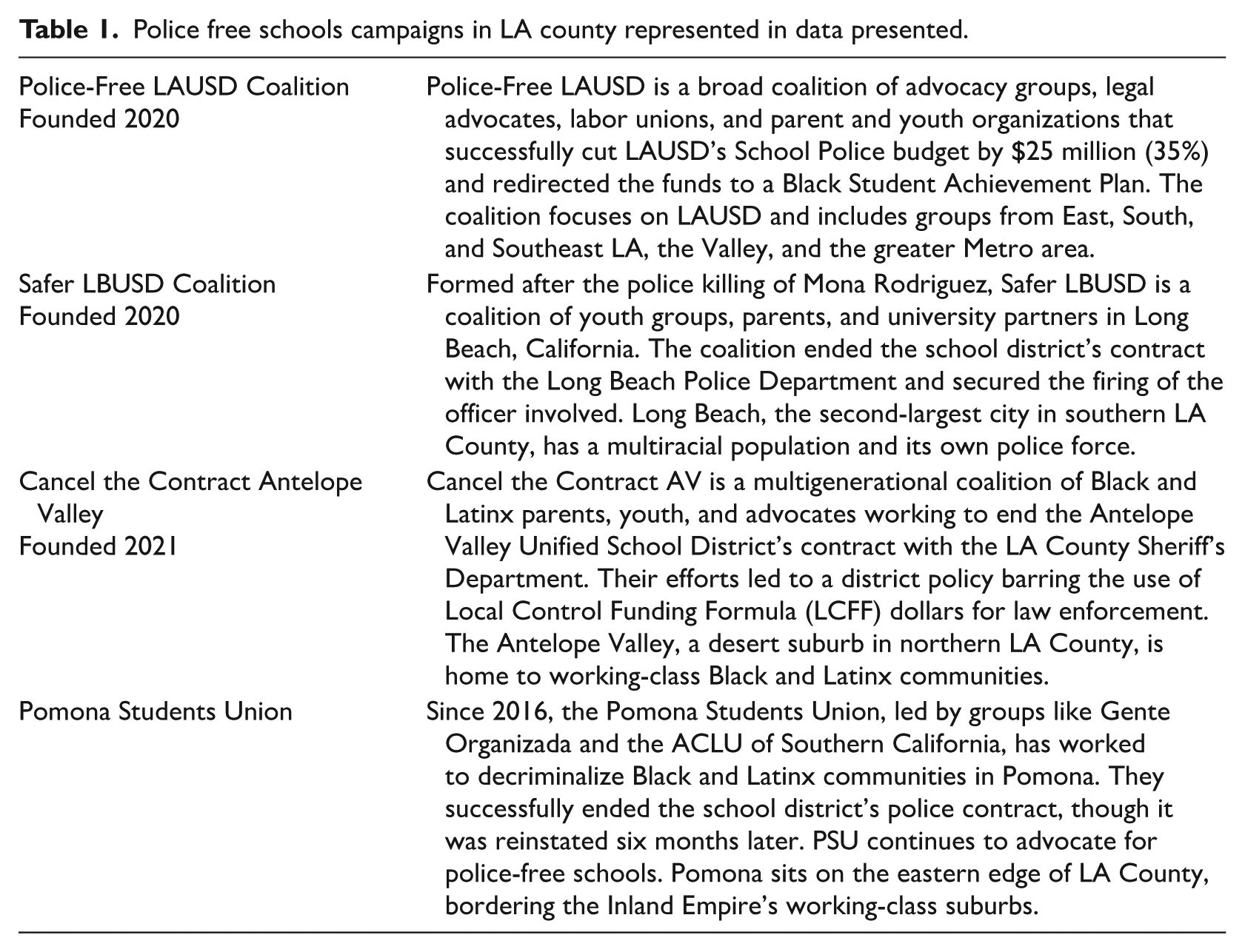
This moment of police critique and momentum around reimagining safety presented a unique opportunity for organizers to make headway in decreasing police power in LAUSD. The community-based nonprofit Students Deserve launched a survey to get students’ opinions about defunding school police. Over 5,000 students responded, and 86% of those respondents expressed a desire to defund Los Angeles School Police (LASP). The survey also revealed alarming statistics about the harm that school police were committing disproportionately to Black students. For example, 85% of current and former students who interacted with school police reported being followed, questioned, belittled, racially profiled, randomly searched, sexually harassed, and more (Murray et al., 2023). At the time of this study in 2021, Black students comprise 11.8% of the student population in LA County and 7.3% in LAUSD, while Latinx students make up 72% of students countywide and 73.8% of the LAUSD student body (California Department of Education, 2022). Yet, prior to BSAP, Black students had the highest suspension rates in both LAUSD and LA County, with rates approximately three times higher than those of White and Latinx students (California Department of Education, 2019). Concern over student safety led to a wide-array of community-based organizations forming what became the Police-Free LAUSD coalition. 1 As a result of the coalition’s Police-Free Schools campaign led by Black students, parents and community organizations, the LAUSD school board voted to cut $25 million from the $78 million LASP department budget in June 2020. This funding was redirected to invest in resources that support the mental health, well-being, and academic achievement of Black students, now known as the BSAP program (Murray et al., 2023). Other localized campaigns in the surrounding school districts of Los Angeles County were also launched to remove police from schools (see Table 1 for details).
Police free schools campaigns in LA county represented in data presented.
Methods
The data for this study were collected through in-depth semi-structured interviews with youth organizers and community organizers involved in Police-Free Schools campaigns throughout Los Angeles County and West Contra Costa County in California’s Bay Area. These interviews aimed to explore participants’ views on safety and alternatives to policing. There were 15 individuals who organized in LAUSD, five who organized in the Antelope Valley, three who organized in Long Beach and two in West Contra Costa, with two who organized in multiple coalition spaces, specifically Pomona, the Antelope Valley, and Los Angeles. Recruitment efforts occurred between February and June, 2023. Only adults above age 18 who were involved in organizations within the various Police Free Schools campaigns in some capacity during between 2018-2022 were recruited. The principal investigator reached out via email to recruit potential participants to respond affirmatively if they wished to participate in the study. A modified stratified purposeful sampling strategy was used, based on extant community organizer networks within school climate-based organizing. Through stratified purposeful sampling, we are able to assess how key phenomenon manifest differently across different political, geographical, political, and cultural contexts, and in our case—police free schools organizing (Suri, 2011). Those who responded were interviewed. With LAUSD being the 2nd largest school district in the nation, there were more organizers engaged in collective struggle around school discipline issues. Therefore, LAUSD-based participants are overrepresented in our sample, proportionate to their student population size and geographical reach. The data presented in this article are largely from three of the five school districts: LA Unified School District, Long Beach Unified School District, and the Antelope Valley Unified High School District.
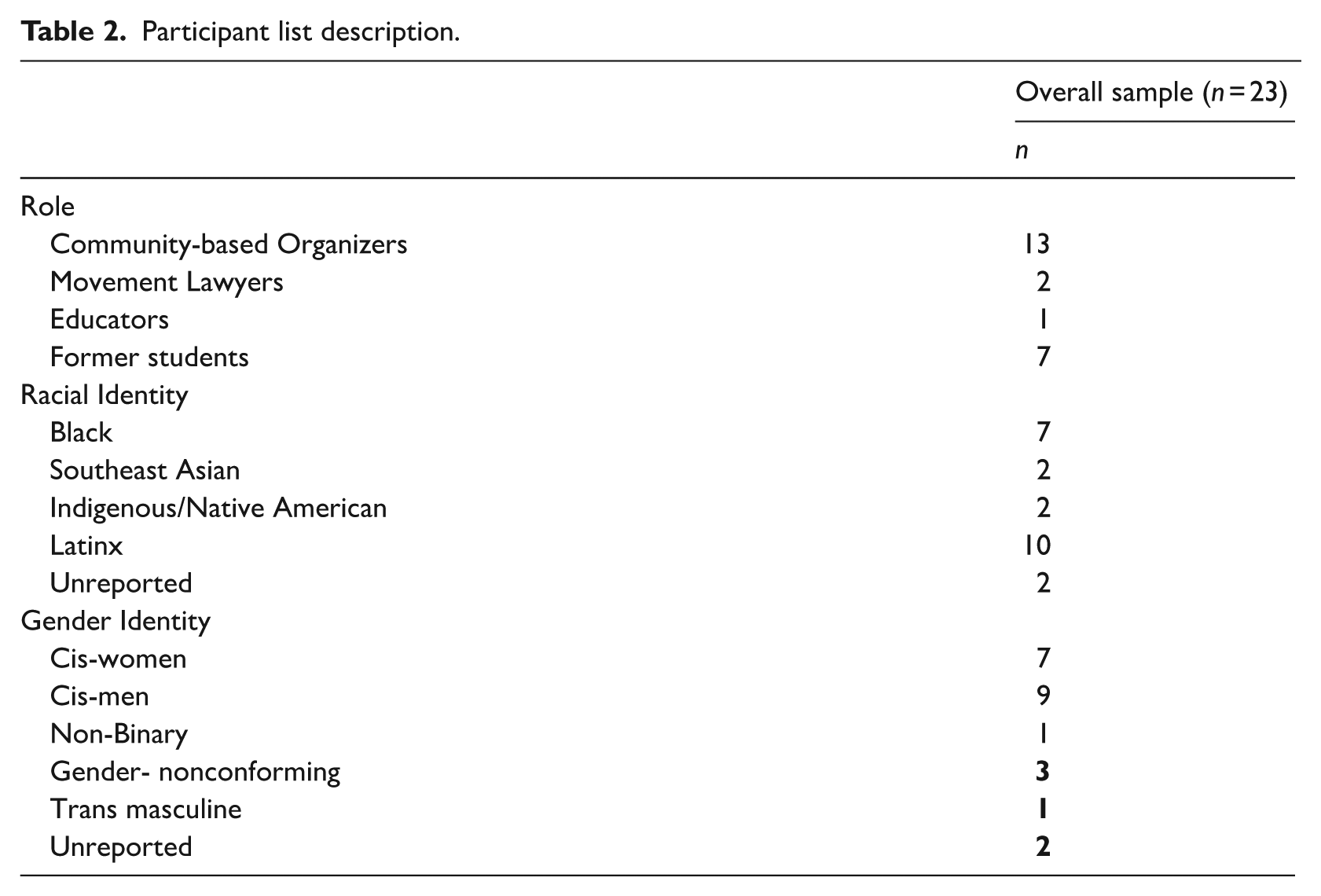
We interviewed 23 organizers for this project. For participant demographic details, please see Table 2 below. This study includes four types of movement participants: movement lawyers, educators, community organizers, and youth activists. Movement lawyers provided legal expertise and strategic support. Educators were school district employees—teachers, counselors, or administrators. Community organizers represented coalition member organizations, though the focus here is on coalition efforts rather than individual groups. Youth activists, aged 18–25, were high school students or recent graduates during key moments of the police-free schools campaigns before and after the pandemic.
Participant list description.
23 one-hour-long interviews were conducted using a private Zoom room with a required passcode to access. Participants chose a quiet and secure location for their Zoom interview to ensure their privacy. Oral consent was obtained from each participant prior to recording, in accordance with our Institutional Review Board (IRB) protocol, which did not require written consent due to the low-risk nature of the study and absence of sensitive personal identifiers. Semi-structured interviews (Charmaz, 2014) explored participants’ activism, Police-Free Schools organizing, and perspectives on issues such as defunding the police. Each participant received a $100 electronic Visa gift card, approved by the IRB, as ethical compensation for their time, labor, and expertise. This practice aligns with best principles of community-engaged research, particularly when working with historically over-researched and under-compensated communities.
The authors’ positionality played a crucial role in their access to participants and the data analysis process. Each one of the authors worked as a part of the research team and was involved in the interview process. The first three authors identify as cisgender women: Author 1 is a mixed-race (White and East Asian) doctoral student, Author 2 is a Black doctoral student, and Author 3 is a Black doctoral student. The fourth author, a Black cisgender man and principal investigator, participated in the Police-Free Schools campaign prior to this study. His connection to the Police-Free Schools campaign provided a point of entry for recruiting participants. However, the majority of the interviews were collected and analyzed by the doctoral students who had fewer ties to the campaign. Still, all the authors have been connected to abolitionist movements across the country throughout the years. We recognize that our social locations and experiences shape both our interpretations and our commitments to this work (Haraway, 1988). Our positionality shapes the way we approach the research by centering the views of the participants in our development of the argument. In this, we acknowledge our commitment to understanding abolitionist praxis and engaging its practitioners in good faith, without skepticism.
Analysis drew on Braun and Clarke’s (2006) reflexive thematic analysis and Blumer’s (1969) symbolic interactionism to center participants’ perceptions and meanings. The research team began by familiarizing themselves with the data, assigning each team member a set of interviews to immerse in by cleaning and transcribing using Otter.ai and conducting initial axial coding focusing on core concepts of the study (Saldana, 2013). The research team met weekly throughout coding to review interviewee quotes and resolve any coding issues. Once initial coding was complete, the team created concept maps to identify and construct thematic codes. During this process, care emerged as a prominent concept in describing how organizers understand and envision safety. Therefore, we conducted an additional step of organizing and analyzing the content specifically related to care across all 23 participants, yielding three core themes: safety, care, and community. These key themes are explored in terms of their interconnections, particularly how they build upon and relate to one another. We use pseudonyms throughout the findings to maintain anonymity.
Findings
Our findings address the research questions—how participants in Police-Free Schools Campaigns theorize the concept of safety and what alternative approaches they envision—by tracing the arc of organizers’ conceptualizations of the relationship between safety and care. Participants frequently spoke of safety and care as intertwined, often using the terms interchangeably. Upon closer scrutiny, what becomes evident is an interplay between the ideas of safety, care, and how this interplay maps onto community. The participants discuss how they have come to redefine these concepts in relation to one another and their process of redefining these terms for themselves.
Safety as Care
Since organizers identified police as a central source of harm and unsafety, our analysis turned to their definitions of what constitutes safety. In these visions, care consistently emerged as the foundation for creating safe and supportive school environments. Caleb, a Black longtime coalition organizer, explained, My view of school safety [. . .] is anchored in an understanding that safety is cultivated by providing people with the things that they need. It’s not reactionary. It’s rooted in preventative efforts, it’s rooted in building up young people’s ability and capacity to navigate conflict to work through challenging circumstances in ways that are restorative, in ways that actually deal with the root issues that young people are dealing with or are experiencing. And yeah, safety is the physical safety of young people, as well as the mental and psychological safety. Feeling like they’re seen, feeling like they’re heard, feeling or having a sense of trust in the people around them, as well as the literal physical safety of being able to stop harm, prevent harms that may come to them. (Caleb)
This viewpoint on safety emphasizes the importance of proactively addressing root issues and building young people’s skills to handle conflicts in a restorative manner. Therefore, safety must encompass not only physical protection but also mental and psychological well-being, including feeling acknowledged, listened to, and trusting of others; echoing components modeled in transformative justice approaches like pods (Mingus, 2016; FREE LA High School n.d.). This more holistic approach to safety aims to prevent harm and create an environment where young people feel secure and supported in navigating challenges. Put simply, as articulated directly by the following organizer, safety comes from caring for one another: I do believe that safety can look very different. For me, a lot of that looks like having wraparound support services for students. Like, for example, my nephew is on the spectrum for ADHD, and so sometimes him being hyperactive can sometimes lead to him being in trouble, when in reality I believe that students at all levels of learning need wraparound support that’s very specific to their needs. And I think that’s one way that you keep students safe when you’re meeting not only their academic needs, but also their personal and mental needs, and also physical needs in a school space. And I think at the same time you need prevention workers to de-escalate situations or to help young people navigate their emotions and their feelings and how they could process them. (Jules)
Jules, a Latinx nonbinary organizer, frames safety in terms of comprehensive support services for all students, including academic, personal, and mental health support. From their perspective, a safe environment is created by addressing the specific challenges students face and providing preventive measures to de-escalate situations and support emotional processing. This approach cultivates a more holistic sense of safety, encompassing both physical and emotional well-being, within schools and the broader community. This approach also demonstrates to students that adults care about their overall well-being and that they are safe to make mistakes. Ariel, a Black organizer and prior student, describes, School safety means a place where students are able to be themselves freely, and that includes trying things, getting in trouble, the whole high school experience when knowing that if I messed up right now this isn’t the end of the world [. . .]not feeling like this is the end and being able to be like, hey, the people on my campus actually care about me. I feel like it’s really important having people on campus who look like me. People who work in the neighborhood, people’s parents who do like the safe passage program. I think hiring those people that are already in our community to work and are on our campuses, to protect our students and to make sure they get to class. That’s what school safety looks like to me. It doesn’t look like police officers. It doesn’t look like fear mongering. It doesn’t look like people being pulled out of class. It looks like care, love, nurturing, relationship building, resources, funding. (Ariel)
Ariel shares her vision of school safety, centering the ability to explore and make mistakes without fear of severe punishment or threat. She envisions caring community adults who reflect the student body’s diversity as essential to student protection and well-being, aligning with Edwards’ (2021) definition of racial-cultural and academic safety for Black youth. Ariel centering youths’ need to feel cared for also invokes the love described by The Care Collective (2020) and Joy James (2023), positioning care as an actionable manifestation of love that can be utilized to create safer environments for youth to thrive.
Overall, organizers stressed the necessity of preventive approaches in regard to safety. Often, prevention included the need for enhanced care provision, including meeting a variety of social service needs. Fulfilling a duty to care for one another was a key facet in cultivating safer environments, as it aimed to address underlying issues and build supportive communities.
Safety is not Police
Youth and adult organizers explicitly expressed that they did not consider the police presence and involvement as an act of care within their communities. Contrarily, the Black and Latinx youth of this study described feeling targeted by the police: When I was in high school we had SROs in school [. . .] There was an incident where this girl got tackled by SRO [. . .] I just remember people feeling on edge. And it was just a lot of racial tension because majority Black and Brown students were being targeted in conflicts. If there was a fight, like it was always the black and Brown kids who are being pulled out and, you know, put in handcuffs or the ones getting the longer suspensions. So it was just a lot of racial tension in the school. Just feeling like we were always being watched in a way and honestly, I think I still feel that now [. . .] like knowing that you’re perceived as a threat. (River).
This quote highlights the experiences of River, a Black non-binary former student, who recalls the presence of SROs and the hostile impact they had on the school environment, particularly noting racial tensions where Black and Latinx students felt unfairly targeted during conflicts. The quote underscores a pervasive feeling of unease and surveillance among Black and Latinx students, who felt they were constantly viewed as threats by authorities (The Advancement Project, 2022). Conversely, Black and Latinx students felt they were at risk and under threat due to police presence in schools. Here, anti-Blackness and anti-Brownness are central to the police harassment, surveillance, and violence these students face and work to organize against. This is further accentuated by an example of fatal school-based police violence that occurred in Long Beach: School safety officers [. . .] have all of the powers of a police officer. So they carry weapons, they can refer students to the Long Beach Police Department, etc. On September 27, 2021, a school safety officer murdered an alumni. She was 18 years old. From Millikan High School. There was a fight, and she got in a car. And the car tried to drive away from the incident and the police officer felt the need to shoot at the car and murder Mona Rodriguez. (Charlie)
Charlie, a multiracial organizer from Long Beach, describes how the police escalated the situation fatally and suggests that there were alternative de-escalation methods available besides shooting Mona Rodriguez. This instance urgently catalyzed youth to organize for the removal of police from schools in Long Beach, emphasizing how police jeopardize student safety rather than promote an environment of protection and care. An organizer who was a high school student in LA during the time of Mona Rodriquez’s murder describes grappling with ideas of safety, protection, and the police’s role: I don’t think we even had an idea of what school safety was supposed to look like [. . .] but we knew police weren’t part of that, or at least them being in our classrooms roaming through our halls wasn’t part of it. We understood that school safety also meant protecting us. But we were like, why is it that [the police] are coming at us? Is it supposed to be for our protection? But instead it’s to target us? It’s to criminalize us? (Elian)
Elian, a Latinx former student organizer, addresses the initial confusion and conflict that he felt when going through the process of redefining school safety for himself. He indicates that he was told by school staff and broader society that the police’s function in schools was to protect students. Yet, he struggled to understand how the police were meant to protect students while he simultaneously felt targeted and criminalized by the police. Other organizers who were also students at the time described a similar process of decoupling the concept of care from punitive “protection,”: Every time there was a problem or something my mom in general but like my other family members they would just be like “Oh, just call the police.” It was like “the police are there to protect you and the police are gonna put away the bad people.” And so that’s kind of like the mentality that I kind of grew up in. But I started hearing the stories [. . .] what wasn’t covered on the news [. . .]And so I think just continuously being involved in this work changed my mind. (Zuri)
Zuri, a Latinx organizer and former student, summarizes her personal journey from viewing police as a source of protection to critically rethinking her conceptualization of safety. She describes how she initially was socialized to believe in carceral safety logics like calling the police as a solution to feeling unsafe, viewing the police as protectors who dealt with misconduct. However, through exposure to alternative viewpoints and stories of police violence, her perception of safety shifted. Zuri’s experiences with anti-Black police violence in schools as a former student, coupled with engaging in community organizing, broadened her worldview, leading to a change in her perspective on police as a source of safety. A crucial element the findings expose is the way race plays a role in who faces police violence in schools. Given this reality, it becomes clear that Black and Latinx youth do not benefit from the safety and protection that some claim police provide in schools (Edwards, 2021). Instead, their violent schooling experiences at the hands of police pushed organizers to rethink safety and care under an abolitionist lens.
Organizers’ perspectives on safety were shaped by numerous personal and community instances of police violence or threat of violence. These experiences shaped when and how organizers felt “safe.” Through their own experiences or those shared with them by other community members, organizers began to redefine what safety meant to them and what they believed was necessary to create a safe community. For these organizers, alternative forms of safety that do not include police action replace traditional carceral forms of safety as participants acknowledge the historical harm done to their communities.
Care as Community
Participants in this study not only linked safety to care, they clarified that a necessity of rendering care was community. Community was described as an intrinsic component to being able to enact care in the world as Latinx organizer Bryan stated: I think a lot of [care] is just like creating spaces, and prioritizing the relationship building . . .. not a sense of transactions or like a friendship of convenience . . . I think the idea is like actually building community. When people use that word it’s like a lifelong bond based on care. Like collective good. That I think is very intrinsic. (Bryan)
Bryan’s vision not only echoes but extends Heidelberg et al. (2022) definition of safety for Black youth to a universal safety, encapsulating the essence of care as creating meaningful spaces and genuine relationships. He differentiates between superficial relationships and a deeper, community-centered approach to establishing collective well-being. Bryan’s quote is an example of how organizers described care as moving beyond the transactional, building toward a shared sense of mutual support and commitment to a greater good. The importance of a mutual sense of support was echoed by other organizers: I think you really are able to keep everybody safe at the individual level, but also collectively, when you teach people that we have a responsibility to one another. (Jules)
Jules articulates a vision of safety rooted in relational care and collective accountability. His statement reflects the core tenet of revolutionary love (James, 2023): that care is not just an individual or emotional act, but a shared political obligation. By fostering a culture in which people recognize their interconnectedness and responsibility to one another, Jules indicates communities can create conditions of safety that do not rely on policing or punitive control. Through shared responsibility, care can be understood as individuals actively practicing being in relationship with one another to enhance collective well-being. Caleb described: I think the biggest thing is relationships, relationships rooted in care, understanding, and empathy. Across all the folks are so peer-to-peer relationships, faculty and staff relationships with the people [. . .] the demonstrated relationships of staff with each other. Yeah, that’s the biggest thing because I don’t believe that conflict never arises. But I think when folks have strong caring relationships, when that stuff comes about, you can easily deescalate, diffuse or even prevent because of the relationship . . . you can see the things brewing before it turns into an actual emergency or crisis, you can intervene. (Caleb)
Based on this perspective, nurturing a caring community can act as a preventive force against crises or unsafe conditions. Caleb highlights the critical importance of relationship building as a proactive approach to maintaining safety. He believed that strong relationships rooted in care, understanding, and empathy among young people and adults alike are key to preventing and managing conflicts. In order to build these vital relationships, multiple participants directly expressed how a crucial part of care was being able to practice listening to one another. Charlie goes as far as to say: Care, in practice, care is actually listening. Care is like being willing to have some trial and error in how you attempt to serve others because sometimes when they’re experiencing and going through challenging situations, they may not even know what it is they need but care and empathy is like trying something and that not working and trying a new thing, and trying a new thing. (Charlie)
This organizer conceptualizes care as an active practice that involves listening and a willingness to navigate through trial and error in order to find collective solutions. He emphasizes that the foundation of care is a commitment to accommodating based on the situation and persevering even when that requires innovative approaches to conflict resolution. From the perspective of organizers, this kind of problem-solving often requires co-creation, as seen when Alexis states: A safe school would look like that all families, all students have their dignity—they’re a part of meaningful participation of co-creating the policies of monitoring, right, being a part of those conversations. I think about school safety as more than just the kind of community care—it’s deep racial justice, solidarity. (Alexis)
Alexis, a Black movement lawyer, envisions a community where every family and student is treated with dignity and given access to meaningful participation in policy creation and community oversight. She expands the concept of school safety beyond broad terms like community care and asserts that a caring community includes a deep commitment to racial justice and solidarity. Yet, in order to support the creation of these policies and oversight that would support racial justice, communities require investment. Longtime organizer and Latinx movement elder, Teresa, describes, Our kids of color have not been invested at all in that way. And so that’s what we’ve had to [. . .] to fight for. I just don’t understand how over investing in law enforcement would help a child. [. . .] That’s the narrative that’s been normalized, right? [. . .] But you know, when you ask parents [..] what will make the greatest difference is that relationship with their educators, the whole team, and everyone working together. Our kids need a lot, you know, our kids need a lot of support, regardless of, you know, maybe their economic circumstances, every child needs a lot so that they can thrive and be themselves. Which is what we want for our kids. So you know [. . .] we have to redirect resources, like the defunding issue, to me is really like redirecting resources where our values are. And to me, the values are in our children. (Teresa)
The quote underscores the necessity of material resources to enact care to meet youth’s needs. In this selection, Teresa critiques that a persistent over-funding of law enforcement results in a lack of investment in community resources. She contrasts the prevailing belief that police are essential for ensuring children’s safety with the perspective of community members, who emphasize the significance of communal care for protecting children. Teresa advocates for redirecting resources from police and funneling them to “where our values are,” which in this context means redirecting funds from police to community resources.
Organizers described that not only was care crucial in creating a safer community, but community was also a crucial vessel in being able to deliver care. This interplay was crafted through relationships and trust built by providing intentional, mutual support. A caring community was rendered through active practices of listening, responsivity, and co-creation of problem-solving. Yet, these approaches all require resource investment.
Discussion
Returning to our central query concerning what creates a safe and caring school, our findings show organizers articulated that dismantling school policing is only one part of creating truly safe schools. What is needed is an abolitionist care praxis that fundamentally reimagines safety, emphasizing accountability, community, and support. These conceptualizations of safety and care emerge in direct contrast to policing, which participants described as undermining safety, particularly for Black and Brown students.
This study builds on existing literature by making explicit the racial and carceral contours of care within schools. Participants’ vision of abolitionist care challenges how carceral logics have historically shaped even so-called “caring” interventions in schools. Many students recounted experiences where surveillance, exclusionary discipline, and punitive responses to behaviors like truancy were framed as measures to “protect” them. These accounts of punitive protection reflect what McDowell (2019) terms carceral safety—a framework in which austere, often criminal legal, approaches are positioned as the only effective methods of addressing harm and violence. Concurrently, these measures were often justified as forms of carceral care, in which discipline, control, and surveillance were framed as necessary for students’ well-being. Within this dual logic, safety and care become entangled with punishment, transforming schools into sites of discipline rather than spaces of support. Organizers rejected these carceral notions of safety and care, asserting that true safety is inseparable from a model of care rooted in abolitionist values.
While their theorization of care was shaped by direct experiences of anti-Black police violence, their vision extended beyond Black students to a future where all students’ needs are met through an abolitionist framework. Participants positioned care as an abolitionist practice, expanding on James’s (2023) theorization of revolutionary love, understanding care not as an individual or emotional act, but as an actionable political commitment. This abolitionist understanding of care moves beyond reformist approaches to harm and instead offers a world in which safety is co-produced through relationships, solidarity, and sustained communal support. In this framework, care is not simply a service or institutional provision but an unwavering commitment to marginalized communities prospering.
By redefining safety through abolitionist care, organizers fundamentally disrupted dominant narratives that cast policing and punishment as essential to student protection.
Organizers identified five core elements of abolitionist care that must be present for schools to be safe: addressing conditions of unsafety, community accountability, relationship-building, infrastructure, and resources. Building toward abolitionist care, organizers emphasized the need to address the underlying conditions that create harm, conditions shaped by systemic inequalities, racialized discipline, and a lack of support structures. Participants described key remedies, including emotional support, academic support, cultivating a sense of belonging, and ensuring access to essential services. They indicated these structures of support and service-provision should not be provided by police, but trained care professionals that were also community members. Relationship-building emerged as a fundamental strategy for fostering safety, as participants emphasized that feeling genuinely cared for encouraged mutual accountability. As one participant stated, “We have a responsibility to one another.” However, this sense of responsibility must be reinforced by material resources, such as mental health support, academic assistance, and conflict resolution mechanisms grounded in transformative justice rather than punishment. Yet, a recurring theme was the inadequacy of funding for such alternatives, highlighting a key barrier to fully realizing abolitionist care in schools. Another barrier was reactionary conservative politicization of care. Just three years after LAUSD implemented BSAP, a conservative Virginia-based group sued the district, claiming the program unfairly favored Black students (Blume, 2024). Despite strong support from teachers, parents, and students, LAUSD ultimately removed race as a factor in BSAP allocating resources, a major setback driven by actors far removed from the communities impacted.
As schools face mounting attacks on diversity and equity programs, gains toward ending carceral violence in education remain precarious. Yet, organizers and youth leaders in this study continue to advance visions of abolitionist care, building on and expanding restorative and transformative justice frameworks. These trauma-informed approaches emphasize healing, accountability, and addressing harm at its roots (often tied to structural inequality), rather than relying on punitive discipline (Payne and Welch, 2013; Ginwright, 2016). Participants cautioned against reforms being co-opted by carceral logics and instead called for schools to be reimagined as spaces centered on collective well-being, mutual accountability, and structural transformation. Their work offers an abolitionist vision of care that moves beyond reform to fundamentally reshape what safety means in schools.
Limitations and Future Directions
While this study provides critical insights into the role of abolitionist care in school safety, it also has limitations. The majority of interviews were conducted with community organizers and former students, leaving the perspectives of teachers underrepresented. Future research should engage educators more deeply to explore how abolitionist care is implemented in day-to-day school interactions. In addition, this study focused on coalitions in Los Angeles County. Expanding the scope to include police-free school movements in other national and international regions would offer a comparative lens on how organizers conceptualize safety across sociopolitical landscapes. Finally, as abolitionist safety programs such as the BSAP continue to be implemented, further research is needed to assess which safety measures grounded in abolitionist care are most effective. Understanding the successes and challenges of these initiatives will be crucial to sustaining and expanding police-free schools movements.
Conclusion
This study contributes to education scholarship, social movement scholarship, and abolitionist scholarship by demonstrating the incompatibilities between police, safety, and care. While much of the existing literature focuses on the harms of school policing, this research highlights how abolitionist organizers actively construct alternative visions of safety. These visions center racial justice, community care, and transformative justice rather than punitive protection. In doing so, they contest the dominant assumption that safety must be ensured through force, surveillance, or punishment. The organizers in this study offer a blueprint for a future where schools do not merely remove police but invest in conditions that make policing obsolete. In a world where punitivity, police violence, and the school-to-prison pipeline disproportionately impact Black and Latinx students, young organizers are leading the way toward a radically different model of safety. The future they seek is one in which caring for one another is what truly makes schools and communities safe.
Footnotes

Funding
The authors disclosed receipt of the following financial support for the research, authorship, and/or publication of this article: This research project was supported by funds provided by the UCLA Center for the Transformation of Schools.
Declaration of conflicting interests
The authors declared no potential conflicts of interest with respect to the research, authorship, and/or publication of this article.