



Abstract
Youth justice policy making has been conceptualised as a reductionist, linear and decontextualised process dominated by governmental actors producing static policy ‘products’. However, semi-structured interviews with a range of expert policy actors illuminated youth justice policy-making (YJPM) as a complex, dynamic social construction shaped through relationships across professional contexts. Analyses discerned coherence from chaos in YJPM contexts characterised by simultaneous stability-change, conflict-ambivalence, short-termism and precarity. YJPM contexts were constructed and experienced by experts working in governmental and non-governmental contexts as the relational and dynamic features shaping the mechanisms through which policies are made and operate over time at multiple different levels of the social system.
Keywords
‘a wider view is required of what constitutes [youth justice] policy and where and by whom it is made’.
Despite the significant role of ‘policy’ in the socio-historical construction of ‘youth justice’, there has been little critical investigation of its complex, multi-layered and constructed nature and influence. What constitutes ‘policy’ is not a universally accepted fact, but rather a dynamic, contested and contingent social construction that is understood differently and subjectively by individuals and organisations working within and between local common national and international contexts. However, the mechanisms and processes of policy ‘making’ have been most commonly conceptualised in reductionist, decontextualised ways as sequential and linear, with policy development operationalised as moving through a series of stages, typically problem emergence/agenda-setting to policy formulation/decision-making to policy implementation/evaluation – commonly known as the ‘Policy Cycle Model’ (Klammer et al., 2021). Understandings of youth justice policy-making (YJPM) have been undermined by these assumptions of linearity, compounded by further reductionist assumptions that policy-making mechanisms/processes are dominated by governmental ‘actors’ (Vergari, 2015) pursuing policy outcomes in the form of static ‘products’ and ‘measures’ such as legislation and ministerial speeches (Souhami, 2015; see also Case, 2024). However, this static and decontextualised approach overlooks the dynamic and relational aspects of policy-making (see Greenhalgh and Manzano, 2021) and eschews understandings of youth justice policy-making as ‘a complex arena of social practice, incorporating a diverse range of actors, practices, relationships and networks (Souhami, 2015: 164). The central aim of the empirical research presented here, therefore, is to utilise expert interviews to interrogate youth justice policy-making as a complex and dynamic social construction shaped by a range of policy actors working and interacting within and across different professional contexts (Case, 2024). the jurisdictional context examined is the Youth Justice System (YJS) of England and Wales (within which the author is located), detailed examination of this national context has the potential to produce holistic, contextualised explanations that can address the ‘floundering and incoherent nature of policy formation’ and offer insights to ‘guide future youth justice reform’ (Goldson, 2020: 330; see also Lawrence, 2012), with the added benefit of producing insights that may also be relevant, applicable and transferable to other jurisdictional contexts internationally.
Who is Making Youth Justice Policy?
Youth justice policy-making has been understood as reflecting the power structures within and between formal, permanent institutions, typically located within and driven by the machinery of government and the wider political system, so ‘the primary agent of public policy making is the government’ (Croci et al., 2023: 5). In the socio-political and structural context of the YJS of England and Wales (within which the author is located), governmental actors include politicians, government ministers (e.g. Home Secretary, Minister of Justice) and their elected and appointed officials, including Senior Policy Advisers
1
(SPADs) and other civil servants, for example, those working in the Ministry of Justice (MoJ
2
) Youth Justice Policy Unit. These ‘visible’ governmental actors often fulfil prominent roles in placing social problems on policy agendas and are often privileged in analyses and explanations of how policy is made. As such, YJPM is typically viewed as the sole domain of ministers and SPADs who advise them, while the role of supporting bureaucracy is largely confined to policy implementation (Klammer et al., 2021). This reflects a ‘normative institutional understanding’ of a clear split between responsibility for policy formation and administration, seeing the primary purpose of government bureaucracy as supporting ministers, but without political authority to define its own objectives (Page and Jenkins, 2005). However: ‘Youth justice policy isn’t made just by senior civil servants and ministers, but by all kinds of people working in government and in partnership elsewhere’ (Souhami, in Case, 2021)
The non-governmental policy actors alluded to by Souhami, including strategists working in the Youth Justice Board (YJB
3
) for England and Wales, politicians in opposition parties, interest groups, mass media, academics and (crucially) practitioners, are typically represented in analyses as less visible and less influential ‘makers’ of policy. The neglect of these ‘hidden’ actors, however, can lead to a concurrent analytical neglect of specific policy-making processes for which they may bear some responsibility, such as developing policy solutions (see Kingdon, 2011) and effective policy implementation (Braithwaite et al., 2018; Hudson et al., 2019). Indeed, the ‘constructive influence’ (impact on the social construction of policy) of these non-governmental actors, who are typically responsibilised for youth justice policy implementation, continues to be marginalised (but, see Case and Browning, 2021), such that: ‘What becomes of the practice expertise which is so important in how youth justice services work? Does this play a part in how policies are made in central Government, and if so, how?’ (Souhami, in Case, 2021)
Long-term failure to acknowledge the full complexity of policy-making in analyses of justice contexts has severely restricted understandings of why policy is not always successfully translated into practice, otherwise known as ‘policy implementation failure’ or the ‘policy implementation gap’ (Gunn, 1978; see also Day, 2023). Instead of detailed contexualised explanations, there has been a political tendency to assign responsibility for [youth justice] justice policy ‘failure’ to ineffective implementation by practitioners, rather than to poor agenda setting and policy formulation/decision-making by government actors (see Davies et al., 2008). This has led critical youth justice scholars to assert that meaningful consultation with practice should be prioritised in order to better understand the degree to which youth justice policy may be ‘made’ and ‘remade’ in local contexts by professionals in non-governmental contexts through mediating and moderating national policy and strategy through their relations, discretion, decisions and adaptations (see Goldson and Briggs, 2021). Such consideration appears sensible, for example, because frontline practitioners are typically closer to, and have a better understanding of, the realities of implementation as policy-making in the real world, 4 compared to more centralised governmental actors (Hudson et al., 2019). Therefore, there is a pressing need to pursue broader explanations of YJPM that incorporate the ‘messy engagement of multiple players with diverse sources of knowledge’ (Davies et al., 2008: 188). Accordingly, improved, context-sensitive understandings of YJPM should encompass how and why policy is decided, understood, informed, experienced, enacted, developed, changed (i.e. reconstructed) and evaluated, focusing on the relationships between key stakeholders engaged in policy-making processes across a range of professional contexts. So, how should such a challenging project be undertaken?
Methodology: Exploring Contextualised YJPM
The overarching aim of this research is to identify, trace and critically examine the constructive and contextualised influences on YJPM in the jurisdictional context of England and Wales. The central temporal inclusion criterion guiding the stakeholder sampling was their being active in YJPM contexts since 1996. This political, policy and legislative period marked a significant stepping-off point for youth justice policy in the United Kingdom, formalising a YJS of England and Wales and introducing a central policy aim (prevention) to be pursued by ‘new youth justice’ strategies of managerialism, responsibilisation and risk-led early intervention (Goldson, 2000; see also Case, 2021).
The central aim was unpacked into three key research questions:
What is youth justice ‘policy’?
Who are the ‘makers’ of youth justice policy?
How is YJPM understood, re/constructed, experienced and made meaningful by policy-makers working in different contexts?
The methodology was necessarily qualitative and ethnomethodological (i.e. studying how social order is created through processes of social interaction) to enable context-specific examination of how YJPM may occur through dynamic, constructed processes and relationships. Relatedly, a lens of social constructionism was adopted to examine how YJPM realities may be created through these processes of social interaction and how they may be contingent on human perception and experience, thus viewing all knowledge as constructed (Taylor, 2018). This social constructionist perspective understood context as operating in dynamic, emergent ways over time across multiple contexts (Coldwell, 2019), rather than existing as merely static, observable features (space, place, people, things), general circumstances and background information that trigger/block access to policy-making processes at specific moments in time (Greenhalgh and Manzano, 2021). In relation to Analysis operationalised the constructive influence of context as the relational (interacting) and dynamic (changing) features or ‘forces’ that shape the mechanisms of YJPM (see Sutton et al., 2021).
Semi-structured interviews were conducted with key stakeholders from the youth justice sector (see Table 1), all of whom are ‘experts by experience’ through working in professional policy-making contexts. Interviews explored stakeholder experiences, perspectives and constructions of YJPM and were framed by a series of stimulus questions that aligned with the broader research questions:
What do you understand as youth justice ‘policy’ and policy ‘making’?
How do the key ‘makers’ of youth justice policy operate and relate to one another?
Are specific policy ‘makers’ more influential at certain stages of YJPM?
What enables/facilitates and obstructs/challenges effective policy-making in the YJS?
Expert stakeholders were identified through a staged sampling purposive into snowball sampling strategy, with access facilitated by long-standing researcher experiences, networks and relationships. Interviews were conducted over a six-month period (September 2022 to February 2023) and encompassed 41 stakeholders working in a range of national, local and organisational/occupational YJPM contexts (see Table 1).
Interviewees by occupational context a .
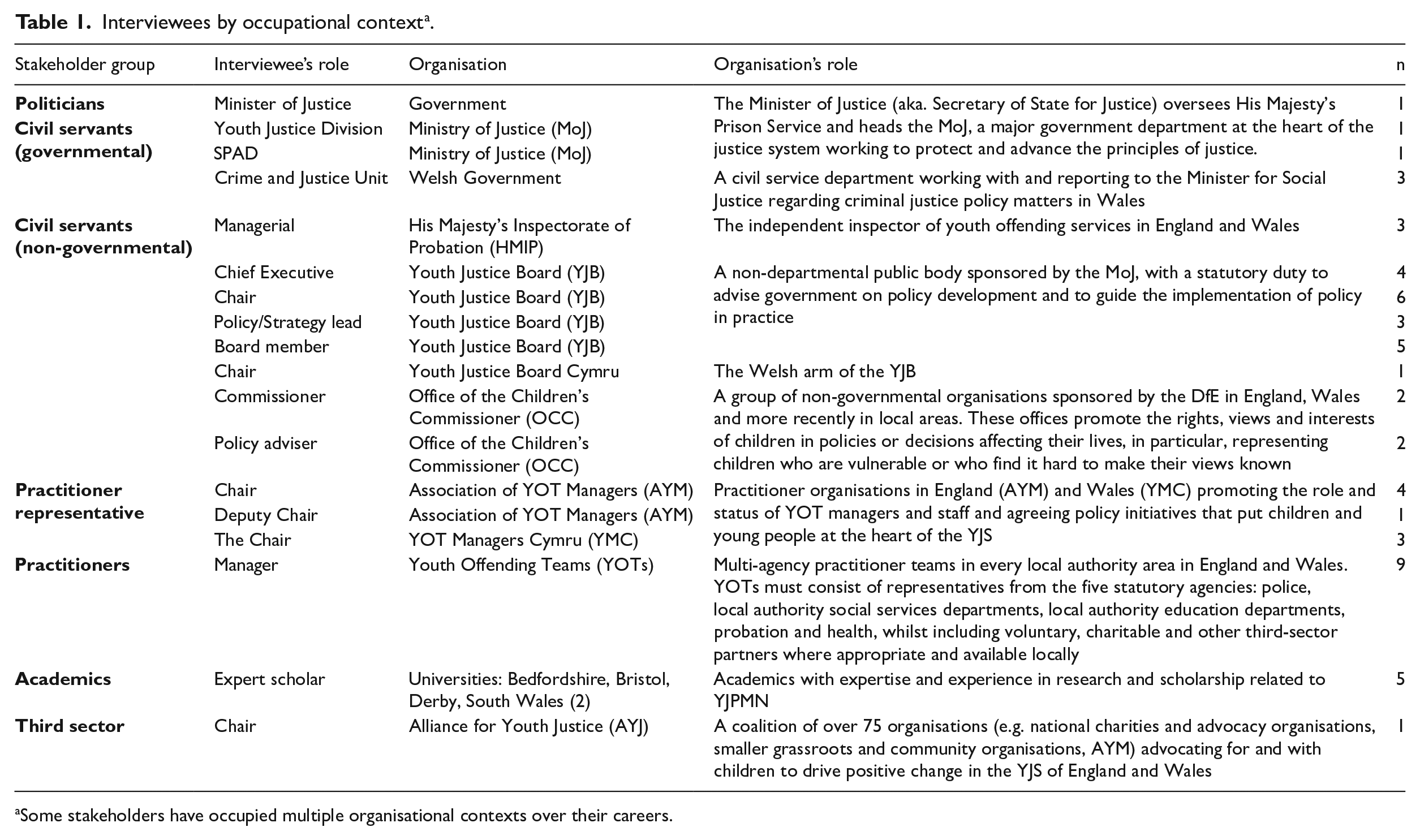
Some stakeholders have occupied multiple organisational contexts over their careers.
Like any research method, semi-structured interviews are subject to concerns regarding validity, reliability, authenticity, motivated authorship (e.g. political agenda, researcher ‘positionality’), lack of representativity and so on. These potential sources of bias were acknowledged, mitigated and moderated through standard techniques to enhance qualitative rigour, including triangulation (within documents and across study methods), ensuring adequate sample size, peer validation 5 and debriefing. Furthermore, access was inevitably limited by the availability and amenability of particular individuals, leading to over-representation of stakeholder/policy actor groups (e.g. YJB) and under-representation and even exclusion of others (e.g. police, courts, children).
Interview data was analysed using Reflexive Thematic Analysis, an advanced narrative analysis technique for data coding, identifying themes and developing, analysing and interpreting patterns across qualitative datasets (see Braun and Clarke, 2022). Reflexive Thematic Analysis was chosen to enable understandings of the situated meanings and interrogation of the meaning-making practices of research participants in order to generate contextualised and situated knowledge of YJPM. Analysis prioritised process and meaning over cause and effect, thus facilitating critical reflection on the dominant assumptions embedded in the cultural and occupational contexts of YJPM under investigation.
Findings: Examining the ‘What’, ‘Who’ and ‘How’ of Youth Justice Policy-Making
‘If we want to understand youth justice policy making, we need to look at what youth justice policy makers do’ (Souhami, in Case, 2021)
Analysis of interview data identified expert stakeholder perceptions of the complexity and (lack of) consensus around understandings of YJPM (the ‘what’), the key stakeholder policy actors working and interacting across the YJS (the ‘who’) and the contexts and mechanisms through which policy-making takes place (the ‘how’). Subsequent analysis of ‘how’ YJPM occurs illuminated a series of messy complexities (akin to chaos) and the perennial conflict and ambivalence in the social construction of youth justice, for example, socio-historical oscillation between competing welfare- and justice-based approaches and contemporary tensions between risk management and ‘Child First’ principles (see Case, 2021).
What is youth justice ‘policy? Complexity, conflict and ambivalence
Expert stakeholder experiences depicted YJPM as complex, contested, multi-layered and fragmented within and between organisational and systemic contexts. Commenting on the complexity surrounding what youth justice policy actually is and how it is understood across the sector, a chair of the Association of Youth Offending Team Managers (AYM)reflected: I’m doing a piece of work where I’ve asked colleagues for a number of different policies. Some people have sent me policy, some have sent strategies and some have sent what I would call practice guidance. They’re all using different language. What’s a policy meant to do? There isn’t necessarily that understanding across the system.
A professional view of complexity illustrated by lack of clarity of roles and responsibilities within YJPM, was provided by a senior official from His Majesty’s Inspectorate of Probation (HMIP): There isn’t one route to policy-making. There isn’t one clear process. It’s all very muddied. Sometimes there’s a real lack of understanding and lack of clarity about who fits where. The YJB works with YOTs and has more expertise than policy colleagues. Then there’s lobby groups like the Alliance for Youth Justice. It’s not clear to me what all those roles are and who has the say, so it's all very soft.
Several stakeholders commented on the multi-layered complexity of YJPM, with these layers understood variously as different levels of the social system (see Bronfenbrenner, 1995
6
) and different contexts of policy-making (e.g. occupational/organisational, systemic, geographical, national/local): Policy exists at lots of different levels and lots of different people have an important role to play. People’s importance as policy-makers exists at lots of different levels (YJB Chief Executive) I see layers of policy. In a political sense, I’ve always felt that regarding decision-making on direction of policy, the role for people like me [YOT managers] is to advise bureaucracy on how they shape policy, then to implement it as best I see fit. (YJB board member)
Stakeholders reflected that complex, multi-layered YJPM contexts produce fragmentation between/within systems and organisations/agencies, which in turn fosters role ambiguity and contested responsibilities for stakeholders involved in YJPM. According to a senior HMIP official: Strategy and policy straddle so many different government agencies, agendas and inspectorates. It’s really difficult to understand who’s prioritising what. This bit’s from Ofsted,
7
then this bit’s from HMIP. Then you’ve got the YJB saying something different than the Youth Custody Service and the MoJ. So it feels very disparate at a national level.
Reflecting on professional experience of the multi-systemic context of youth justice as contributing to fragmented policy-making, a former YJB board member observed: There is fragmentation of the policy picture. The YJS goes well beyond a single government department’s portfolio. Different policies may counteract one another. There’s no golden thread through the different portfolios of government. There isn’t a single point in government that owns the various different constituent parts that make an impact.
The issue of fragmentation and ambiguity of responsibilities for YJPM was reinforced by a senior leader from the Alliance for Youth Justice: In the MoJ, you’ve got the Youth Justice Policy Unit and they have a really big churn of staff and it’s incredibly frustrating, but at least you know that you’re going to be handed over to somebody’s successor when they leave. Whereas in the Home Office, half of our task is to try and understand who’s leading on a particular initiative . . . a specific place responsible and accountable for producing policy around children. That makes policy much more challenging to influence.
A senior YJB official referenced conflict between government departments as engendering role ambiguity and contested responsibilities in contexts of YJPM, whether macro-level structural/political contexts or meso-level government–YJB relationships: Government has different departments, with no-one necessarily taking responsibility for children. We [YJB] had Ed Balls in education and Jack Straw in the Home Office, with all of these policy ideas popping up from different places. We were trying to say where we think they should be taking their policy thinking, but there was quite a lot of competition between those two. (YJB Chair)
Notwithstanding the multi-layered complexity of YJPM, expert stakeholders identified mechanisms that promoted non-fragmented, joined-up, connected policy-making in otherwise disparate and complex youth justice contexts. For example, a policy adviser from the Office of the Children’s Commissioner (OCC) identified universal policy as a potential mechanism for cohering and reconciling competing agendas across systems and contexts, emphasising that: They’re still children we’re dealing with. So it’s not just youth justice. It’s mental health policy, housing policy, legislation, safeguarding. When people talk about what policies impact on the YJS, we must consider the impact of the same policies for every other child.
Other interviewees recalled their experiences of encouraging multi-agency collaboration through shared objectives, sense-making and seeking alignment as a mechanism for reconciling different occupational and disciplinary agendas, objectives and practices between and within policy-making contexts and organisations: Policy should be influenced by systems and people’s experience. We [in Wales] work with a range of policies, seeing where they contradict themselves or work well together, where they’re unclear relative to other agencies, policies and guidance documents. We have to make sense of all of that and work together, because it makes the policy more aligned in in the end, so it’s worth going back and forth. It’s certainly a process. (YOT Managers Cymru Chair)
The identification of complexity, fragmentation and ambiguity as characterising youth justice stakeholder understandings of what ‘policy’ actually is and what it means to them in their professional contexts aligns with the initial rationale for analysing YJPM as a dynamic, contested and contingent social construction. Intuitively, this headline lesson from the interview data would seem applicable/transferable internationally, or at least worthy of detailed consideration when analysing YJPM in other jurisdictional contexts.
Who are the makers of youth justice policy? Which stakeholders animate contexts of YJPM
Having gained a broad understanding from stakeholder experiences of what YJPM actually is (RQ1), there followed an interrogation of expert perspectives of who is involved in YJPM (RQ2), in which contexts this takes place and how it is understood by those policy actors (RQ3).
The centrality of governmental policy actors
Earlier contextualising discussion outlined that policy ‘actors’ working in governmental contexts nationally and locally are often more visible and privileged in explanations of policy-making processes (Croci et al., 2023), ‘a view consolidated in research from the Higher Education Policy Institute (HEPI) and Loughborough University (2023)’ While the term ‘policymakers’ can be nebulous, it is [typically] used to refer to the following three groups: political actors (such as Ministers and SPADs), those involved in parliamentary scrutiny and non-political actors such as civil servants (p. 7).
The policy-making role of governmental actors can be significant for numerous reasons: policy-making can never be extricated from politics, politics adds value to policy-making and evidence and analysis is never ‘pure’ or above politics (Institute for Government, 2011). Therefore, it is highly relevant to examine the constructive influence on YJPM of governmental actors working in political contexts, simultaneously acknowledging that their role and influence should be neither neglected, nor privileged over other groups.
Certain interviewees perceived a significant political influence on youth justice policy, often through the ‘rhetorical’ mode of policy where the power of professional politicians bring to the fore the punitive discourses founded in conservative-authoritarian values (Fergusson, 2007). For example, experts cited their experiences of a ‘dead hand’ political influence emanating directly from ‘number 10’, the Prime Minister’s office: The real deadhand was number 10 influence, because whatever the Secretary of State wanted to do was this overriding desire for number 10 to demonstrate that it was tough on crime. It made it difficult to take through or get support for policies that would bring the numbers of offenders down. The overarching power of number 10 to squash any kind of individual policy idea cannot be underestimated. (YJB Chair)
However, according to stakeholders, deadhand political influence on YJPM does not occur in a vacuum. Indeed, it can be significantly influenced by a less visible policy actor, media, more specifically, the deadhand influence of right-wing newspapers in the United Kingdom perpetuating a punitive, anti-child agenda that exacerbates public fear of crime (see Case, 2024). This finding immediately presents as applicable to other jurisdictional contexts internationally (e.g. Australia – Riddle et al., 2023). These relational and dynamic features of the right-wing media function as mechanisms shaping YJPM (e.g. influencing agenda setting) in political contexts: My experience of the deadhand of the Daily Mail or the right-wing Daily Telegraph is that they frighten the shit out of the Conservative Party. Very few politicians are willing to stand up to them. They have paranoia about negative opinions in the media about anything that looks flexible or lenient. (YJB Chair)
Civil servant role: Steering or being steered?
A pivotal debate within the policy-making literature concerns the nature and direction of the relationship between government/ministers and their civil servants, particularly the prescriptiveness and degree, nature and direction of political ‘steer’ (e.g. power) relative to the discretion of civil servants to ‘steering’, challenging and reconstructing centralised policies. It has been asserted that ministers have to recognise the value of challenges to their policy proposals, otherwise, civil servants have few resources to raise important issues and will privilege the maintenance of a ‘good relationship’ with their minister over constructive challenge (Souhami, in Case, 2021).
Reflecting on the traditional view of government steering civil servants in YJPM contexts, interviewees commented that: I had a very good relationship with my civil servants and the MoJ and never had any problem with any of them. I think they felt they had a very strong steer from me and were happy with that and followed it through. (Government minister) Ministers who have a clear idea of what they want to do can get their policies through, but they sometimes run into querulous civil servants who say ‘are you sure’? But if the minister has a clear idea, he can put it through. (YJB Chair)
Stakeholders discerned the role of SPADs as different in nature and influence to the ‘standard’ civil servant role of staff working in the Home Office or MoJ Youth Justice Policy Unit (YJPU). They described a much closer relationship with government ministers, with SPADs advising and steering both ministers and external, non-governmental organisations such as the YJB: The role is like the party whip of the manifesto. Any minister has got more than they can handle in terms of what they can pay attention to. They double check that this stuff’s in line with the manifesto and look for ideas or ways of looking at the world from the outside. (YJB Cymru Chair)
Some interviewees had experienced the (non-senior) civil servant role (with particular reference to the MoJ YJPU) as more steering and architectural – advising ministers and SPADs on how to re/construct pre-formed policy ideas and agendas at the formulation stage so that they would have the best chance of success at implementation: The manifesto of the party is the policy. Civil servants are asked to think of ways of implementing that policy. To call a civil servant a policy-maker is to mix up those two things. Civil servants are the architects of what Government want their house to be like. (YJB Cymru Chair) There is a civil servant way of selling a certain thing to fit the politics. Which also makes it messy and it makes it hard to be able to establish where these ideas come from and where these changes start. (YJB board member)
However, concerns were raised regarding the extent and nature of any civil service steer of/influence on government-led policy-making, on the basis that civil servants are generalist non-experts with limited youth justice specialism/expertise, particularly when compared to staff in other advisory bodies such as the YJB (Souhami, 2015): Civil servants advise on all matters youth justice and deliver ministerial priorities through policy-making. But how can they do that if they don’t know what the issues are . . . don’t know what they’re doing and are not working from evidence? Ministers are not experts, but they need a policy team that is. That’s why we have so many failed policies, because they’re flawed from the start. (Senior HMIP official)
Analysis of the civil servant role as capable of ‘steering’ ministers due to autonomy, discretion and generalised, technical expertise accords with policy analysis literature emphasising their role as a political counterbalance, managing risk for their ministers and developing robust policy in the face of socio-political and socio-economic uncertainty (Cairney and Oliver, 2020; see also Fergusson’s (2007) ‘codificational’ mode of policy making). However, stakeholders also reflected the view of civil servants as non-experts subject to ‘being steered’ by assertive ministers and/or being unable to provide effective steer due to a lack of specific subject/sector expertise.
The neglected role of non-governmental policy actors
The importance of acknowledging the influence on YJPM of a broader range of less ‘visible’ policy actors/makers (Vergari, 2015) located in non-governmental and third-sector contexts, including their potentially differing, contested constructions of what youth justice ‘policy’ actually is, was emphasised in the experiences of two senior managers: Policy is not in the first instance made by ministers or their senior civil servants. It’s made by strategic or operational leaders. That’s where the key makers of youth justice policy are and their insights and agreements then bubble up to policy work. (YJB Chief Executive) Who makes policies? It’s stakeholders, lobbyists, specialist groups. Policy comes from what is what is known, what is on the ground, your experiences, funding, as well as the amount of money available. (YOT Managers Cymru Chair)
With particular reference to the YJB, the organisation’s statutory functions 8 give the organisation a central role in shaping the YJS, although these functions are inherently ambiguous (e.g. ‘advising’, ‘monitoring’), elastic and open to multiple interpretations. Notably, the YJB’s non-departmental public body (NDPB) status allows for staff specialisation and continuity of knowledge and thus offers a unique structural opportunity for the expert administration of youth justice. The sustained nature of this context of expertise contrasts with the more transitory and generalist context within which civil servants operate as policy advisers. This NDPB ‘independence’ and its accompanying role ambiguity, gives rise to relationships between central government and the YJB that are not situated within a conventional hierarchy, but instead, with the flows of power dynamics between them in constant flux.
According to YJB stakeholders, the extent and nature of the organisation’s policy-making role and influence remains ambiguous and contested: MOJ would say that the YJB does not do policy; that policy is owned by MoJ and that we do oversight and advice and identifying and disseminating effective practice. But all of that lends itself to policy. What’s differed over time is MoJ’s capacity to fill that policy space. YJB is aware of this vacuum and we’ve stepped into it. But where does guidance end? Where does policy start? (YJB senior official)
The contested nature of the YJB role feeds into an ambiguity of identity, role and status, itself encouraged by the broad, generalised framing of ‘policy’ within the youth justice arena: We [YJB] have a lengthy list of statutory functions that can be interpreted in different ways. A classic example is oversight and monitoring of the YJS. Does it mean youth justice services and the Secure Estate? Every partnership organisation that make up a youth justice partnership? Are we even part of the YJS? (YJB senior official)
However, some senior YJB leaders were more confident regarding the organisation’s advisory and supportive role and influence, especially when compared to the role of MoJ civil servants: We’re less tied to political priorities [than civil servants], so we can focus on the evidence and our experience. There’s more freedom to manoeuvre. We have this relationship with the MoJ, an arms-length sponsorship arrangement. (YJB senior official) The YJB job is to advise on policy and strategy in youth justice. I envisaged our role as providing expertise and advising ministers. If we’re actually in the room where policies are being discussed, we’re able to have more influence. That’s the sweet spot. (YJB Chair)
Prima facie, therefore, the YJB’s structural ‘arms-length’ distance from government, its privileged ‘insider’ status and its slippery and ambiguous role and identity affords it significant space and opportunity to influence youth justice policy direction (Case, 2015; Souhami, 2015).
Experts identified a similarly unique and ambiguous, free-floating identity in relation to OCC policy-making influence: We’re not making policy, we’re not a delivery or implementation department. We’re not civil servants, although we draw on some of the same skills. We get to be the Gad fly, pushing the system into doing the things that it should be doing. We can identify problems or draw attention to problems that other people have identified.
Stakeholders offered their professional lived experience of OCC exercising soft power and collaboration, for example, in the partially devolved Welsh youth justice context: The intersection between being a policy-maker and making policy gives us that sense of soft power. When you build the right relationships with operational colleagues, that stuff starts to flow because these are often operational policy decisions regarding how to make things work, as opposed to lofty policy decisions. It takes cooperation, joint work and shared vision. (Welsh Government senior civil servant)
This notion of non-governmental actors utilising soft power and collaboration to influence policy-making was further reflected in the professional experiences of two YOT managers, one of whom had chaired the English YOT managers association: Politicians are not the only source of power. It’s about the ability of managers and practitioners to help shape and put policy into practice. We have residual power when minding the gap between national policy intention and localised practice. What goes on between is mediation and how things are interpreted, bastardised or improved by street-level bureaucrats and practitioners on the ground. (YOT manager) Colleagues will say to me, are you gonna be the practice or policy expert? I don’t necessarily see a difference. What I need is the right people in the right space. (AYM Chair)
As discussed, policy-making contexts are increasingly being understood as complex, multi-faceted and multi-layered, for example, when compared with reductionist hierarchical explanations privileging policy formation by governmental actors over implementation by non-governmental actors (Hill and Hupe, 2015). Consequently, findings suggest that it is essential to analyse YJPM in local common national and international contexts through a broader lens that considers the role and influence of practitioners and third-sector professionals. 9 This recommendation aligns with Fergusson’s (2007) ‘implementation’ mode of policy-making, wherein discretion is exercised collectively in localised contexts and animated through localised mediation and moderation of centralised policy prescriptions:
How is YJPM understood? Contextualised YJPM mechanisms of stability and change
Youth justice policy is this ‘thing’ that’s moving and fluid . . . its more challenging by the nature of the environment. (Senior HMIP official)
Initial analysis of interview data provided a general overview of the what and who of YJPM, with emerging contexts of policy-making largely framed as observable features: places, spaces, people and things (see Greenhalgh and Manzano, 2021). What is now required is a deeper dive into the how of YJPM, exploring the qualitative, explanatory, dynamic and relational features of the contexts that shape the mechanisms through which policy is made (Greenhalgh and Manzano, 2021). Stakeholder experiences of YJPM implicated an ongoing complex, dynamic, contingent and often contradictory mix of stability and change (including change as instability) within and between macro/meso/micro policy contexts. Interviewees experienced contextualised mechanisms promoting stability in the form of status quo, inertia, consensus and policy cycles (e.g. returning to previous policy constructions). They also experienced change, often concurrent to stability (e.g. policy cycles as cyclical development), gradual development, churn and sudden, unpredicted and opportunistic change, all operating with varying levels of coherence, predictability and explicability in different contexts at different times. A senior academic perceived macro-level political contexts as characterised by simultaneous stability and change, indicative of the messy complexities and perennial conflict and ambivalence of YJPM (see Case, 2024): New Labour’s agenda wasn’t particularly novel and was largely building on an emerging sense of punitiveness. The Government recognised that it was a stick to beat the opposition with, popular with the media and certain sections of the electorate. They put some gloss on it and operationalised it in a way which would make it seem like it was completely new.
Stakeholders observed that stability of youth justice policy trajectories was fostered by mechanisms of gradual development, indicative of a discernible coherence to YJPM, for example, due to its cyclical nature (see Bernard and Kurlychek, 2010): It’s a reaction to the problems that have emerged as a consequence of previous policy. Perceived problems of the current policy regime lead to a perceived need for change in the opposite direction, which gives policy-making some kind of randomness. (Senior academic)
In this sense, therefore, gradual development of policy reflecting practical reality is reflective of both (continued) stability and (gradual) change operating across different contexts: The pace of decision-making can feel quite painful. So Secure Schools took a couple years to find the right time and space and legislative vehicle for that to be possible. There is only so much bandwidth. We are trying to make a number of changes. We need to prioritise our efforts. We can’t do everything. (Senior civil servant)
The pursuit of consensus (moreover, common ground) between stakeholders within- and between-organisations presented as a mechanism facilitating gradual policy development by promoting collaboration, synergy and consistency in (typically meso-level) contexts of stability: There’s been a steady consensus to how youth justice policy has developed over the last 10-15 years. The result of a lot of hard work by the YJB and others. We had good ministers who understood the context of the issues. We didn’t have any serious clashes on youth justice. (Government minister)
Similarly, clarity and consistency of approach and messaging was viewed as a mechanism for identifying common ground and reconciling tensions between stakeholders and different agendas in policy-making contexts: The YJB decided collectively to go in the direction of Child First [the guiding principle for the YJS] because it set-out clearly what the aims of the overall system should be. Robert Buckland [Justice Minister] started to use that concept regularly. So it was a hook. We didn’t push too hard, but used it when there was a need to fall back on something. Then we just filtered it out from there. It’s a mindset piece,, rather than a sudden policy shift. (YJB Chief Executive)
A key mechanism identified by stakeholders as potentially influencing the pace, consistency and predictability of policy-making (stability and change) was turnover and ‘churn’ of staff in policy-making positions. Loss of key staff was identified as an occasional enabler of, but mainly as a barrier and challenge to, policy stability and change/development and to consistent, consensual YJPM. Churnover could be predictable with a long lead-in time (e.g. planned measures to address austerity, staff and governments reaching the end of their tenure, staff/organisational funding ending) or unpredictable and relatively sudden (e.g. staff resigning, being sacked, being moved into/out of policy-making positions, snap elections). Churnover influenced policy-making trajectories through mechanisms including shifts in ministerial agenda (precipitating sudden changes) or the need to re/educate new staff (necessitating the stalling or slowing of progress). Consequently, staff churnover contributed to YJPM contexts of discernibly ‘stable change’ (e.g. gradual development) and ‘predictable unpredictability’ (e.g. consistent and expected instability): Sometimes you take maybe three steps forward in conversations about development and policy growth. Then it’s back to the drawing board because you’re needing to reignite conversations with someone new and that’s from senior level within ministry departments. (Senior civil servant) I had an introductory meeting with the Youth Justice Minister a couple of weeks ago. It was in his first week of office and he’s no longer the minister. (YJB Chief Executive)
Other stakeholders expressed the contrasting view that ministerial churnover could actually benefit (or at least, not harm) YJB policy-making because it served to insulate from intense and unnecessary scrutiny. In turn, any negative impact could be moderated by consensus of policy agenda and approach within-government and through the stability and continuity of the YJB in relation to both agenda and staffing: Swift turnover meant less pressure on the YJB because ministers just didn’t have time; no sooner had they bedded in, than they were off again. We [Government and YJB] benefited from the fact that there was a consensus actually. We all had broadly similar views about youth justice, which meant a period of continuity. (Government minister).
Chaotic YJPM? Macro, meso, micro, messy
Interview data implicates YJPM as chaotic in the sense of sudden, non-linear, unpredictable, unstable, messy and even random and inexplicable (see also Case and Haines, 2014). Analyses identified contexts and mechanisms indicative of chaotic policy-making in the YJS, for example, sudden change in government/ministerial agenda, the impact of external events, political and financial short-termism, opaque policy drivers/incoherent policy-making and opportunism/instrumentalism. The challenge in this context of chaotic complexity remains to discern coherence and explicability to YJPM . . . to identify ‘patterns in the noise’.
Experts recounted their experiences of sudden policy change and instability in policy-making contexts following changes of government and as responsive to ministerial agenda: The change of policy can be just overnight with a change of government The slate can be wiped clean. (YJB Chair)
This assertion highlights a significant flaw in the reductionist, linear and deterministic Policy Cycle Model, that policy construction can be influenced by unpredictable/unpredicted external events, rendering YJPM inherently uncertain and unstable. Often, these events can be beyond a government’s control and outside of its agenda, leading to sharp discontinuities and illogical decisions (Institute for Government, 2011). A notable example of an unpredicted macro-level ‘event’ that undermined the UK Government’s coherent position on youth justice policy is the socio-economic austerity that engulfed the industrialised Western world circa 2010, necessitating sweeping and immediate youth justice policy change, such as service and resource retraction and rationalisation: Austerity had a massive impact on YOTs. We felt it five times worse because we had five statutory partners because we were a multi-agency partnership . . . losing great swathes of practitioners and certainly losing our more specialist roles. (Senior civil servant)
A more recent, unpredictable macro-level event was the global coronavirus (COVID-19) epidemic, which according to stakeholders, exerted an extremely significant influence on the nature of youth justice, most notably at the operational level: COVID threw a blanket over everything. The fact is that crime rates were suddenly totally different [dramatically reduced] . . . Government eyes were totally elsewhere. My role changed almost overnight from being largely strategic to being an operational Secretary of State. (Government minister)
The sudden, unpredictable and unstable nature of YJPM contexts was viewed as exacerbated by political and financial short-termism: When something happens, an individual event or general climate or bidding war between politicians, you suddenly find that although you were achieving short-term gains under the radar, you weren’t altering the fundamental climate within which policy is shaped, and your own achievements are like houses built in sand, they get washed away terribly quickly. (YJB Chief Executive)
Stakeholders reported that instability of YJPM can be further exacerbated in non-governmental contexts by financial short-termism and precarity, whereby organisational funding is often unpredictable in amount, frequency, duration and certainty. This situation has become so commonplace across the youth justice sector, particularly since austerity hit and support services retracted, that it can be characterised as a ‘stable instability’ or a ‘predictable precarity’ that constrains ambition, long-term planning and organisational resourcing/capacity: Finances drive a lot of policies, so if you’re wanting to push things that are going to cost money or which stop people making cuts, you’re gonna have a hard time. In times when there isn’t that pressure, people become more open to change. But they close down in times of crisis. (AYM Chair)
Political and financial short-termism can affect the quality of the policy-related output, according to professional experiences: The money is only guaranteed for a certain amount of time. For example, we [YJB] had to produce 15 Key Elements of Effective Practice guides and only got two years to deliver those and do a quality assurance process, because the money then dries up. If I was given more time, I would have done a proper consultation. (YJB board member)
The opacity and incoherence of policy-making processes and influences upon them, which can have the appearance of chaos and randomness, was outlined by stakeholders with direct professional lived experience of a range of policy-based, strategic and practice development: It’s not always clear what the policy driver is or what the principles are. Policies can be introduced, often without the rationale for that being clear and that then can lead to a real messy landscape (Senior HMIP official)
Experts perceived seemingly chaotic, random and opaque policy-making as driven by opportunism and instrumentalism in certain instances, thus having discernible and coherent strategic foundations and objectives (i.e. ‘patterns in the noise’), without necessarily being predictable: I’d love to say there was a beautifully worked-up strategy as to how we’re [YJB] gonna affect change, but that would be a lie. Where there’s a direction of travel, it’s a lot of grabbing an opportunity such as when there’s a new Prime Minister (YJB Chief Executive)
The chaotic and unpredictable nature of YJPM contexts was perceived as beneficial at times (like churnover), especially when it drove mechanisms of opportunism and instrumentalism that facilitated relationship-building, networking and associated policy-making. Several stakeholders discussed the instrumental importance of ‘picking your moments’ and identifying ‘windows of opportunity’ and ‘fertile periods’ in YJPM contexts, particularly in terms of relationships with government: There are fertile periods within our [YJB] relationship [with Government and MoJ]. Some things are harder to land now and might be easy to land in a month’s time or year’s time. The trick is being able to recognise and gauge when to have which conversation with whom and when not to. (Senior YJB official)
Analyses identify macro- and meso-level YJPM contexts as characterised by complexity (e.g. simultaneous stability/consistency and change/instability) and an almost predictable and consistent chaos containing elements of coherence (patterns in the noise). As with findings from the other analyses sections, it appears likely but these findings are either applicable/transferable to or certainly promising targets for further examination in, jurisdictional contexts beyond the YJS of England and Wales.
Conclusion: The Contexts–Mechanisms Relationships of YJPM
Analyses of key stakeholder interviews identified relationships between dynamic contexts and mechanisms (the ‘what’) as the central drivers of YJPM. ‘Experts’, understood here as professionals working in both governmental and non-governmental organisations, understood policy-making contexts as complex, contested, multi-layered, multi-systemic and fragmented. When offering their perceptions and experiences of ‘who’ makes youth justice policy in these contexts, experts perceived central roles for both influential policy-making contexts as inhabited by governmental actors (e.g. government, ministers, politicians, SPADS, civil servants) and non-governmental actors (e.g. YJB and OCC officials, YOT managers/practitioners, third-sector professionals). In governmental contexts, the deadhand influence of number 10 and right-wing newspaper media were mechanisms that served as barriers and challenges to effective YJPM, as was the retraction of civil service power (e.g. through governmental agenda, resource constraints and deprofessionalisation). The steering of civil servants by politicians and SPADs was seen as both barrier and enabler to YJPM, while governmental receptiveness/openness to being steered, advised and challenged was identified as a mechanism enabling and facilitating YJPM. Non-governmental actors experienced YJPM through relationships characterised by more equitable power dynamics wherein they felt able to exercise soft power, broker policy-making relationships and advise, support and challenge governmental policy (strategically and diplomatically), such as through the localised mediation and moderation of centralised policy. A consistently identified barrier/challenge to non-governmental policy influence, however, was the contested, ambiguous and often threatened identity and role of the YJB, although this ambiguity was also seen to offer opportunities for policy-making influence.
Analyses of ‘how’ youth justice policy is made by different actors in particular contexts discerned a degree of coherence from chaos (akin to ‘patterns in the noise’). Stakeholders reinforced the complexity of YJPM contexts as characterised by simultaneous stability and change, persistent conflict and ambivalence, and frequent instability, short-termism and precarity (i.e. stable instability and predictable precarity). In these contexts, mechanisms of YJPM were viewed as cyclical and gradual, often mediated and moderated by political and practical realities. Certain mechanisms were identified as enabling/facilitating more effective YJPM in these contexts, notably the pursuit of consensus and common-ground and adopting a clear, consistent policy-making approach. YJPM contexts were frequently viewed as chaotic, random, unstable and/or liable to sudden change, for example, due to a change in government, staff ‘churnover’ or unpredicted external events (i.e. predictable unpredictability). These contextual characteristics precipitated barriers/challenges to effective policy-making such as political and financial short-termism and opaque and incoherent policy-making processes. In contrast, however, they also produced more strategically designed responses that enabled YJPM through mechanisms such as (re)educating colleagues and those grounded in opportunism and instrumentalism during fertile policy-making periods, particularly for non-governmental actors.
A central lesson from this project is that the understanding, execution and experience of policy-making should reject blind acceptance of reductionist (e.g. linear, government-dominated) explanatory frameworks and embrace the complexity (e.g. construction, contextualisation, chaos) inherent to YJPM. Findings reinforce assertions that the Policy Cycle Model is unrealistic because YJPM is not linear, but rather a series of processes that are often inseparable, overlapping and inter-relating as real-world policy problems and solutions emerge contemporaneously at different levels of the social system. The qualitative methodology highlighted that the complexity of YJPM is made meaningful by governmental and non-governmental policy actors in relational contexts. In other words, YJPM contexts are constructed and experienced by experts as the relational and dynamic features shaping the mechanisms through which policies work, with context as operating in a dynamic, emergent way over time at multiple different levels of the social system (Greenhalgh and Manzano, 2021). Therefore, the relational and contextualised nature youth justice policy-making demands that we reject reductionism and embrace complexity. Relatedly, the ostensibly chaotic nature of policy-making in youth justice contexts is not definitive or inevitable. Developments, processes, constructions (e.g. identities) and relationships that present as chaotic, random and unpredictable, may actually hold a degree of meaning/sense, strategy/instrumentalism, consistency and coherence in the constructed realities of different policy-makers in specific contexts at specific times. Therefore, the coherence from chaos elucidated by this project becomes transparent and accessible by talking to policy actors and becomes accessible to policy-makers themselves as they seek to enhance YJPM locally and nationally in their own jurisdictional contexts.
Footnotes
Funding
The author(s) received no financial support for the research, authorship and/or publication of this article.
