




Abstract
Recent research demonstrates a rise in female-related violence. Associations between mental health and violence are well established, but the gender-specific impact remains under-evaluated. We explored how gender and well-being interact to affect likelihood of violence in a Northern Irish youth sample. A survey conducted as part of a wider evaluation asked respondents (N = 125) their gender, self-reported well-being, and likelihood of violence. Results showed a moderating effect of gender. Higher well-being was linked to higher likelihood for violence for females, with no effects for males. This supports previous research and implies a gender-neutral approach may not reduce the risk of violence.
Despite an observable decline in the number of young people involved in the formal youth justice system over the last two decades (Bateman, 2014, 2020; Farrell et al., 2014; McVie et al., 2019), studies have found that offending behaviour, particularly violent behaviour, is highly clustered in some communities and remains a global policy concern (Ignatans and Pease, 2016; McCarthy, 2021). In particular, female offending is an area of growing research (De Vogel and Nicholls, 2016). Furthermore, the declines that have been observed in general terms belie the significant heterogeneity found within the disaggregated data (Matthews and Minton, 2018), with reductions in recorded crime higher among younger, lower-level and adolescent limited offenders. The converse is observed among the smaller group of individuals that are responsible for more serious and chronic criminality (Farrell et al., 2014; Payne et al., 2018). Despite perceived declines in offending among some groups, Jones et al. (2014) highlight the closing of the gender gap in some types of crime, that is, male offending may be decreasing while in other types of crime, female arrests rates are increasing. As well as this, the social and economic costs associated with crimes such as violence remain significant (Bellis et al., 2014), thus necessitating action.
As mentioned previously, there has, historically, been little focus on female offending compared to male offending (Lutgen-Nieves and Petty 2024; Stephenson et al., 2014). However, this becomes even more apparent when examining female violence in particular (Hutton and Woodworth, 2014). Some research suggests this change in female offending may be a result of changing attitudes in society (Lynch, 2014) or that violent offending may be a male offender issue only (Wolff et al., 2017), but this is contradictory to other research that demonstrates female offenders are not only involved in increased number of offences but also involved in more violent crime (Chu et al., 2021; Hutton and Woodworth, 2014; Jones et al., 2014). Jones et al. (2014) highlight the closing of the gender gap in violent crimes, such as aggravated assault in particular, is partly due to an increase in the female arrest rate rather than a decrease in the male arrest rate. This is supported by Chu et al. (2021) who highlight this increase in female violent offending in both the United States and Europe. Some of these contrasting findings may be due to the fact that female offenders seem to be more heterogeneous than male offenders, that is, they have more distinct pathways into delinquency and offending (Jones et al., 2014; Vitopoulos et al., 2019). Vitopoulos et al. (2019) emphasise the importance of mental health needs particularly for female offending. Furthermore, Wong et al. (2024) highlight that these differing pathways can also impact upon the experiences of females involved in offending in subsequent reintegration and aftercare programmes. As such, it is imperative to understand the pathways connecting gender and crime, as well as examining what factors may be influencing this nuanced relationship.
The rising interest in female offending is evidenced via the increased existence of gender-specific intervention programmes. Foley (2008) highlights how this may be in part in response to the ‘1992 reauthorization of the 1974 Juvenile Justice and Delinquency Prevention Act’ (p. 262). Research has suggested that although there is some overlap in the needs of female and male offenders, they also differ, particularly around their pathways into crime, and thus require unique programmes (Duwe and Clark, 2015; Foley, 2008; Jones et al., 2014; Wong et al., 2024). Some research suggests that while gender-neutral programmes still have an effect on female offending, they are not as effective as gender-specific programmes (Gobeil et al., 2016). In addition, evidence has shown that females are more likely than males to drop out of interventions aimed at reducing offending, particularly if these are not gender-specific programmes (Stephenson et al., 2014). As such, it is important not only to take a general approach but also to view offending and intervention programmes through a gendered lens (De Vogel and Nicholls, 2016). The purpose of this article is to provide some further insight into the potential gendered effect of well-being on likelihood of violence, particularly in a Northern Irish context, which may inform future development of intervention programmes in this context.
A justice-focused model means a focus on responding appropriately to the deeds of the offender rather than their needs (Hazel, 2008). Alder and Wundersitz (1994) have succinctly summarised the justice model, noting that it ‘. . . assumes that all individuals are reasoning agents who are fully responsible for their actions and so should be held accountable before the law’ (p. 3). However, in several European contexts (Hazel, 2008), there has been a shift away from a criminal justice focus towards a public health approach (Shader, 2003). This places greater emphasis on sharing the burden of youth crime across sectors, risk identification, and the provision of supports (US Surgeon General, 2001). For instance, the Society for Adolescent Health recommends that . . . justice systems focus greater attention and resources on identifying and reducing the antecedents of high-risk and criminal behaviors, recognizing the rights and freedom of youth, and prioritizing the well-being of youth over punitive measures that may harm and disrupt healthy adolescent development. Youth engaged in disruptive, delinquent, or criminal behavior should receive supports for themselves and/or their family while remaining in their home, schools, and communities whenever possible. (SAMH, 2016: 483)
More recently, this has shifted towards a child first approach (Case and Haines, 2021). This model aims to treat children according to their age and circumstances, focusing on their needs in particular (Case and Haines, 2015, 2021). This approach removes offending as the central feature of the young person, even when involved in violent crime (Thompson and Spacey, 2023), and instead encourages a more multifaceted approach towards young people involved in offending (Case and Haines, 2015). Similar to the public health approach, child first approaches are interested in promoting the well-being of young people (Case and Browning, 2021). In addition, it aims to be more attuned to issues of gender, particularly as the strategies of engagement and needs of the young people can differ based on gender (Case and Browning, 2021; Thompson and Spacey, 2023). This focus on needs is in line with the aims of the current study as will be discussed in more detail.
Understanding the factors that place some young people more at risk of offending behaviours could help to interrupt trajectories, particularly for those most likely to remain criminally involved. Indeed, understanding these explanatory factors for adolescent offending is one of the most important objectives of developmental criminology (Le Blanc and Loeber, 1998). In Northern Ireland, as in other parts of the United Kingdom and Ireland, greater focus has been placed on understanding the needs of young people vulnerable to criminality and on interrupting offending trajectories. In terms of female offending and violence, it has been shown that the factors placing females at risk of crime involvement are not identical to that of males at risk of crime involvement (Jones et al., 2014). The current study seeks to examine one such factor, namely well-being, in a Northern Irish context which has thus far been limited.
Several longitudinal studies have sought to elucidate the individual and environmental factors that contribute towards serious offending (see, for example, Lipsey and Derzon, 1998; Zych et al., 2021). The data consistently connect a range of innate, situational, social and risk-related vulnerabilities to youth crime (Brown, 2017). What appears to be consistent is that children and young people engaged in serious offending are more likely to have had adverse backgrounds (Malvaso et al., 2016). This includes abuse, neglect, poor mental health (i.e. depression and anxiety; Staines et al., 2024), violent victimisation in the community, and economic deprivation compared with other children and young people who are not justice involved (Bui and Deakin, 2021; Ford et al., 2010). This is especially the case for female juveniles involved in crime (Blakemore et al., 2022). In their report Punishing Abuse, Chard and Debelle (2023) give an in-depth look at a sample of female justice involved young people. While a small sample, ¾ of them had grown up in poverty and over half had a diagnosed physical or mental health issue. All of the sample were suspected or confirmed victims of abuse. This is further supported by Blakemore et al. (2022) who highlight the significant overlap between female perpetrators of crime and female victims of crime. Furthermore, there appears to be a dose-response effect observed among the relatively small group of young people engaged in more serious and more persistent offending behaviours (Baglivio et al., 2014).
Given these observations, that those most at risk of offending often have difficult pasts (Walsh et al., 2021), it is often assumed that mental health issues, such as the presence of one or more major mental or personality disorders as defined by tDSM-V (American Psychiatric Association (APA), 2013), are implicated in the onset and duration of offending behaviour (Young et al., 2017). This is particularly the case for female offenders (Blakemore et al., 2022) and also with regard to violence (Ahonen et al., 2019). There is also at least some empirical support: it is estimated that between 70 and 90 per cent of young offenders have diagnosable mental health issues, with the lifetime prevalence of post-traumatic stress disorder ranging between 10 and 37 per cent (Moore et al., 2013). Cosma et al. (2022) state that adolescent mental health is a public health crisis on a global scale. These assumptions are also given credence by the mental health–related calls that police receive. For instance, in the United Kingdom, the volume of police calls related to acute mental health needs is currently defined as a ‘crisis’, prompting 22 national bodies from across health, policy, social care, housing and the third sector to agree to a joined-up response (Rodgers et al., 2019). The increased recognition of contextual risks has led to a proliferation of studies that describe justice-involved young people as ‘vulnerable’ (Bui and Deakin, 2021). McElvaney et al. (2013) highlight how addressing poor mental health goes beyond diagnoses to also encompass the psychological well-being of young people. Greater exposure to criminality, particularly violent crime, has also been implicated in poorer psycho-social well-being, thus poor well-being is hypothesised to be both crime inducing and psychopathology inducing (Fowler et al., 2009). Conversely, it has been hypothesised that positive well-being could buffer other individual and contextual risks (Zych et al., 2021).
Those most implicated in crime are also those from the most adverse backgrounds (Malvaso et al., 2016). This makes the relationship between mental health and offending hard to disentangle as many of the factors that are related to increased offending (i.e. maltreatment, Braga et al., 2017) are also linked to poor mental health (Hart and Brassard, 1987; Mills et al., 2013). While reasons for offending are numerous, for example, sensation seeking and testing boundaries (Ljubin-Golub et al., 2017), often there are two types of psychopathologies that tend to be examined in conjunction with offending: internalising disorders and externalising disorders. Externalising disorders are generally accepted to be connected to offending and can include attention-deficit hyperactivity disorder, oppositional defiance disorder and conduct disorder (Norozpour et al., 2023). They are considered more prevalent among offending populations in general and particularly prevalent in males. Hussey et al. (2007) showed that 52 per cent of their juvenile detention centre sample had an externalising disorder versus 10 per cent of the sample that had an internalising disorder. This is further supported by Assink et al. (2015) who found a higher odds ratio for externalising rather than internalising disorders.
Internalising disorders, while less common with juvenile offenders, present a more complicated story. Internalising disorders are often characterised as emotional problems, anxiety and depression (Assink et al., 2015). While it was previously believed that there was no link between internalising disorders and offending (Frisby-Osman and Wood, 2020), it is now being suggested that the effect may differ depending on gender (O’Shaughnessy and Andrade, 2008). Cauffman (2008) showed an effect of internalising disorders on offending but found that this effect was stronger for females than males. That is, internalising disorders were linked to higher rates of offending for females and therefore could be considered a risk factor particularly for this group. Wibbelink et al. (2017) also found an effect for internalising disorders on offending; however, they suggest internalising disorders are a protective factor for females rather than a risk factor. Thus, females with internalising disorders, or poorer well-being, are involved in less offending. The current study seeks to explore these contradictory findings further using well-being as an indicator of lower well-being and potential internalising disorders (Luijten et al., 2021). This has been done in previous work such as Makame et al. (2002) who used low scores on an internalising problems scale to indicate good psychological well-being.
Recent policies such as the Strategic Framework for Youth Justice in Northern Ireland (YJA, 2022) and the Cross Executive Programme on Paramilitarism, Criminality and Organised Crime (DOJ, 2020) outline the high-level priorities that focus on the principles of evidence-based prevention. Given that those involved in the justice system are disproportionally affected by adverse childhood outcomes and mental health disorders (Fazel et al., 2016; NIAO, 2019), understanding the mental health and well-being of children is highly relevant to attaining these strategic priorities. As well as highlighting the importance of well-being, the policy priorities highlight the importance of also focusing on female young people who are justice involved and/or victims of violence. This combined with the growing focus on female offending in research (De Vogel and Nicholls, 2016; Jones et al., 2014; Stephenson et al., 2014) demonstrates the importance of the potential gender-specific effects in this study. As previously discussed, violent crime such as aggravated assault comes with huge social and economic costs (Bellis et al., 2014). As such, this study seeks to explore the relationship between three variables: gender, well-being as a measure of mental health and associations with violence in a Northern Irish context with particular reference to young people involved in the Engage programme. Engage is a youth work programme delivered by the statutory youth service in partnership with community and voluntary organisations and aimed at youth 10–25 who are at risk of violence and exploitation. It is delivered across communities where criminality is clustered and where paramilitarism is most concentrated (Walsh, 2023).
The present study
Those most likely to be involved in offending behaviours are young people who come from adverse backgrounds (Malvaso et al., 2016) and who are considered vulnerable (Bui and Deakin, 2021). With this in mind, it is no surprise that research has demonstrated a complex relationship between violence and differing psychopathologies, particularly internalising disorders (Cauffman, 2008; Frisby-Osman and Wood, 2020; Wibbelink et al., 2017). Some evidence suggests internalising disorders are a risk factor linked to more offending (Cauffman, 2008). Conflicting research suggests the inverse, with internalising disorders being seen as a protective factor linked to reduced offending (Wibbelink et al., 2017).
Given the mixed evidence surrounding the effect of internalising disorders on offending, the current study sought to explore the relationship using well-being and offending, measured as likelihood of violence in the future. Specifically, we hypothesised that well-being would affect offending behaviour, however, due to the conflicting evidence that already exists; we did not hypothesis a specific direction. Prior research has demonstrated that how well-being affects offending may differ between males and females (O’Shaughnessy and Andrade, 2008). As such, we also hypothesised that gender would act as a moderator in the relationship between well-being and violence.
Method
Design
The current study utilised a self-report survey design and is part of a larger, longitudinal study examining the impact of a variety of factors on offending such as social support, paramilitary activity and adverse life experiences. The independent variable in the current study is well-being, with likelihood of violence being the dependent variable. Gender was included as a moderating variable.
Participants
This study was part of a wider evaluation of the Engage programme funded through the Northern Ireland Tackling Paramilitarism and Organised Crime Programme (DOJ, 2020). All young people involved in Engage are asked to complete a baseline and end-point survey when they begin and before leaving the programme. The mean age of the sample was 15.83 (SD = 1.89), ranging from 10 to 25. The majority of the sample were male (75.3%, N = 354), with females making up 24.7 per cent of the present sample (N = 116). This is in line with current statistics around the gender breakdown in juvenile antisocial behaviour, which shows that for roughly 1 in 4 juveniles involved in the justice system will be female (Research Matters, 2023). The data for the present study (N = 125) are taken from that sample. This represents the proportion of the sample that had responses to each of our variables of interest.
Measures
Well-being
Well-being was measured using the World Health Organization – Five Well-Being Index (WHO-5; WHO, 1998) 5-item scale. While there are many definitions of well-being (Cooke et al., 2016), the World Health Organization see it as another term for mental health (Topp et al., 2015). This is a widely used and well-validated measure of well-being (Dadfar et al., 2018; Nylén-Eriksen et al., 2022; Topp et al., 2015). This is widely used as a screening tool for psychiatric disorders in clinical samples but can also be used in the general population (Topp et al., 2015). It has been used in the past to measure internalising disorders such as anxiety and depression (Allgaier et al., 2012; Downs et al., 2017). Sample items include ‘I feel cheerful and in good spirits’ and ‘I have felt calm and relaxed’. Items are scored on a Likert-type scale from 0 = at no time to 5 = all the time. This score is then totalled and multiplied by 4, with higher scores indicating higher well-being. This scale has been used with juveniles in prior research (Haugstvedt, 2023), including those involved with the justice system in prior research (Islam et al., 2018).
Gender
Gender was assessed using a single-item measure with four options: male, female, neither, prefer not to say. Due to a lack of responses outside of either male/female (N = 1), this was condensed to a binary item for analysis.
Likelihood of violence
Likelihood of violence was measured using the Likelihood of Violence & Delinquency scale (Flewelling et al., 1993). Sample items include ‘Within the next month, how likely is it that you will get into a physical fight’. Items are scored on a Likert-type scale from 1 = Not likely at all, to 4 = Very likely. This score is then summed and divided by number of items to obtain the mean score. Higher scores indicate a greater likelihood for violence (Flewelling et al., 1993).
Results
Approach to analysis
IBM SPSS version 28 was used to analyse the data for the current study. Preliminary analyses tested distribution and determined the data were not normally distributed (p < .05). As such, non-parametric tests were used for correlations (Table 1). As we were interested in both the direct relation between well-being (predictor) and likelihood of violence (outcome), as well as the potential moderating effect of gender, Hayes’ PROCESS macro (version 4.2, model 1) with 5000 bootstrapping was used. A conceptual model of the analyses is included in Figure 1.
Means, standard deviations and bivariate correlations between well-being, likelihood of violence and gender.
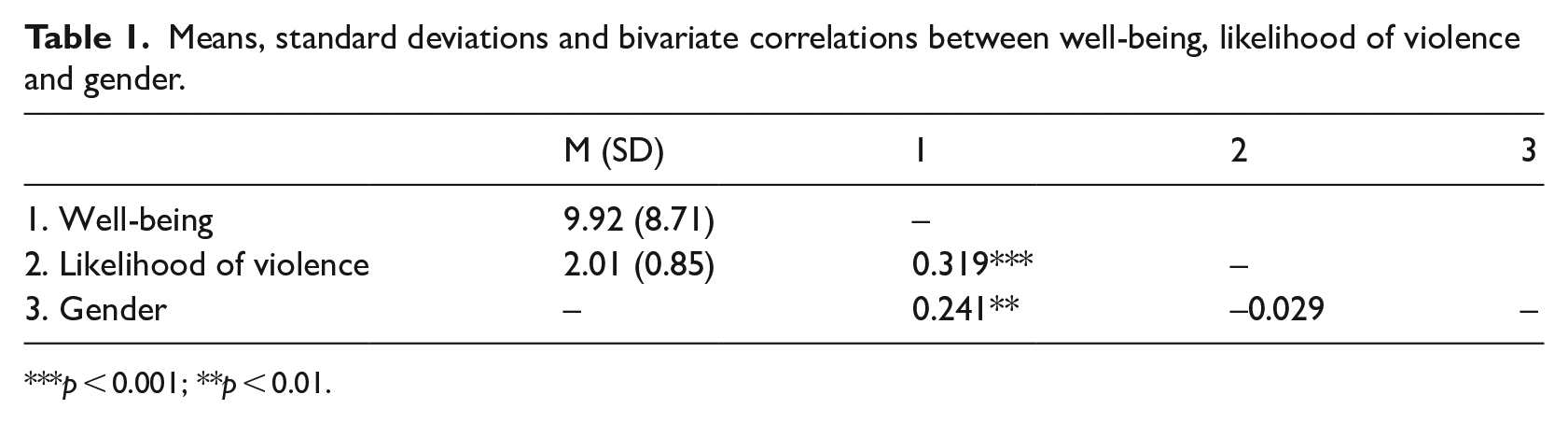
p < 0.001; **p < 0.01.
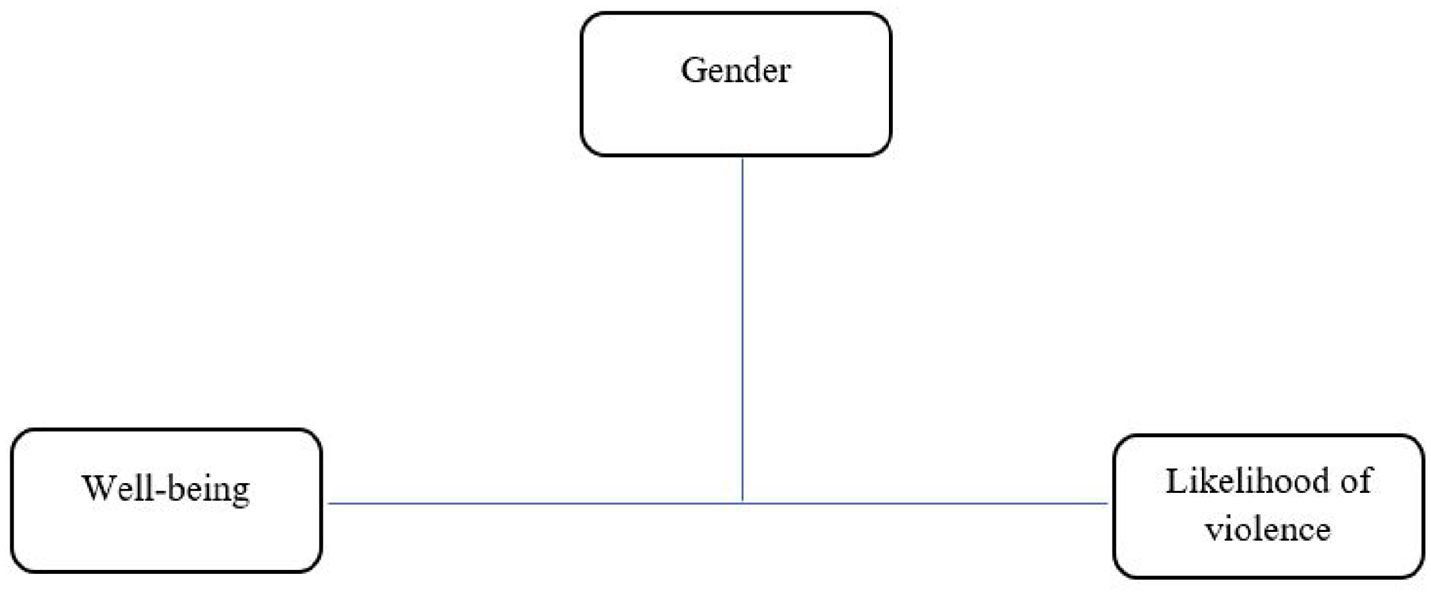
Conceptual model. Relationship between well-being and likelihood of violence.
Correlations
To investigate whether there was a relationship between well-being, operationalised by the WHO-5, and likelihood of violence for the whole sample, a bivariate correlation was conducted. As hypothesised, there is a strong, positive relationship between well-being and likelihood of violence (Table 1). This indicates that as well-being increases, so does likelihood for violence. As the literature has suggested, the relationship between well-being and violence may be impacted by gender; this was also included in the correlations. There is a moderate, positive relationship between gender and well-being, but no significant relationship between likelihood of violence and gender. To further investigate this relationship, a simple moderation was conducted.
Moderation analysis
The overall model predicting likelihood of violence was significant, R2 = .10, F (3, 121) = 4.58, p = .005. Well-being as operationalised by the WHO-5 did not directly affect likelihood of violence, b = −0.04, SE = 0.04, p = .28, 95 per cent confidence interval (CI) = [−0.11, 0.03]. The effect of gender on likelihood of violence was statistically significant, b = −1.46, SE = 0.55, p = .009, 95 per cent CI = [−2.55, −0.38]. This was qualified by a moderating effect with gender moderating the effect of well-being on likelihood of violence, b = 0.06, SE = 0.03, p = .049, 95 per cent CI = [0.0002, 0.12]. Looking at both the conditional effects and the model summary table (Table 2), this indicates that well-being increases likelihood of violence for females, b = 0.08, SE = 0.03, p = .005, 95 per cent CI = [0.03, 0.13] but not for males, b = 0.02, SE = 0.02, p = .105, 95 per cent CI = [−0.004, 0.04]. Overall, this indicates that higher well-being has a negative effect on lawfulness for young girls by increasing how likely they are to be involved in violence in the future.
Model exploring the moderating role of gender in the relationship between well-being and likelihood of violence.
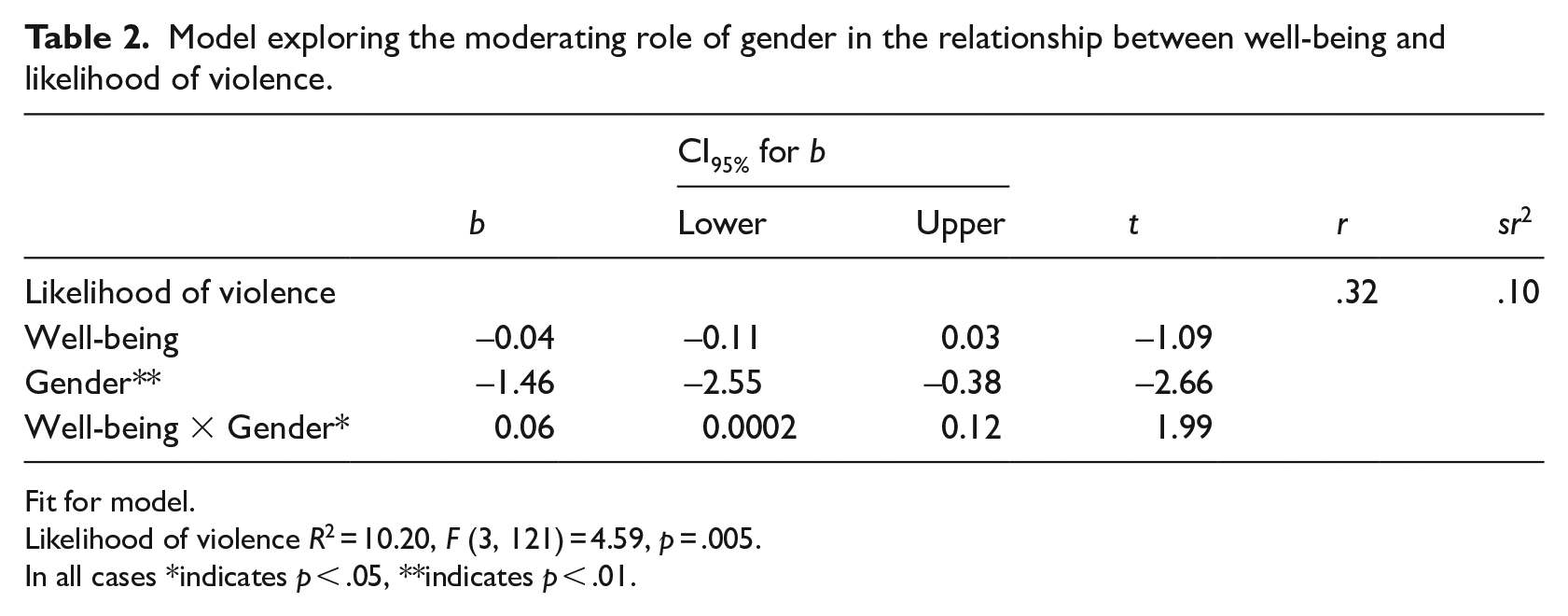
Fit for model.
Likelihood of violence R2 = 10.20, F (3, 121) = 4.59, p = .005.
In all cases *indicates p < .05, **indicates p < .01.
As research has suggested, anxiety and depression may also affect likelihood of violence, two additional models were also tested. The effect of anxiety on likelihood of violence via gender was not significant (b = −0.10, SE = 0.07, p = .177, 95% CI = [−0.24, 0.05]). This was also the case for the effect of depression on likelihood of violence via gender (b = −0.01, SE = 0.12, p = .959, 95% CI = [−0.24, 0.23]).
Discussion
Given the increasing interest in mental health and violent offending, the current study explored the effect of well-being on likelihood of violence, as well as how gender influences this relationship. We have demonstrated that well-being, as measured by the WHO-5 (WHO, 1998), is linked to an increased likelihood of violence, but that this effect is only present for the females in our sample. While we hypothesised there would be a direct effect of well-being on violence, our results did not support this. However, supporting our additional hypothesis, gender did moderate this relationship. This is in line with previous work which suggests that how well-being is linked to violence may differ for males and females (O’Shaughnessy and Andrade, 2008).
Our findings support Wibbelink et al. (2017) who found that internalising disorders were a protective factor against offending for females, that is, poorer well-being is linked to less offending or violence. In our sample, better well-being was linked to a higher likelihood of violence in the future, and while this may in and of itself not be causally related to violence, it does imply that violence prevention efforts that focus solely on improving well-being are unlikely to contribute towards violence reduction for females. However, this observation contrasts with others such as Cauffman (2008) who found that internalising disorders, which would be poorer well-being, were linked to more offending. As a potential limitation of our study, it may be that general well-being is too broad a measure to give in-depth insight into the relationship between mental health and likelihood of violence for young females. It may be that both sides of the research are correct and that the relationship between well-being and offending may depend on the level of well-being, potentially similar to an inverted u-curve relationship. Alternatively, it may be that high well-being as it is measured in the WHO-5 may be capturing a sense of overconfidence or bravado. Future work focusing on the more acute mental health needs of female justice-involved young people may provide a more detailed examination of what is occurring. Despite this, our findings add to the growing body of evidence demonstrating that the relationship between well-being, violence and gender is complex and that more work is necessary to understand the underlying mechanisms.
Historically, female offending was underexplored in research previously (Stephenson et al., 2014). While juvenile offending remains predominantly carried out by males, evidence suggests female offending is growing at a rapid rate (Cauffman, 2008; Hutton and Woodworth, 2014; Jones et al., 2014), with estimations that in the Republic of Ireland, for instance, that one in four participants in the national Youth Diversion Programmes (YDPs) are female (Research Matters, 2023). While the young female people in the Research Matters study were mainly characterised as low risk, Jones et al. (2014) highlight how the closing gender gap in offending is in part due to increased rates of arrests for aggravated assault carried out by females. As such, female violent offending is an important consideration. Mental health has been highlighted as a risk factor for offending in general (Ahonen et al., 2019; Young et al., 2017); however, it has been shown to be of particular importance for female offenders compared to male offenders (Cauffman, 2008; Wibbelink et al., 2017). As such, our findings give important insight into the gendered effects of well-being on anticipated violence among juveniles in a Northern Irish context.
While this study demonstrates that a relationship exists between well-being and violence, it appears that the mechanisms are different for male and female young people. From both our findings and the pre-existing research, it does not appear that general well-being is the core mechanism related to female initiated violence. Instead, it appears there may either be additional factors that need to be considered or that a more acute mental health approach would be more appropriate. The data from this study implies that youth justice programming may not achieve the greatest impact on crime prevention or on reducing recidivism if attending only to male young people or the general well-being of female young people. While the importance of gender-specific programmes may have been examined in other contexts (Gobeil et al., 2016), our study provides evidence for the need for this in a Northern Irish context, which to our knowledge has not been examined previously. Instead, a more nuanced and gender-specific approach may be beneficial. This is in line with moving away from a justice-focused model and more towards acknowledging and focusing on the needs of the young person (Case and Haines, 2015, 2021). Our findings give some insight into the complexity of mental health considerations when considering youth offending.
While the association differs between males and females, our moderation analyses demonstrate that the effects are either absent or contrary to the expected direction. Future research should explore the most salient risk factors and also disentangle the acute mental health needs of justice-involved young people (e.g. psychological trauma, substance abuse disorder) from mood-related difficulties and general well-being. It may be that these are currently being conflated and are likely having differential effects on violent offending and subsequently require different programming responses.
Although our findings support that of Wibbelink et al. (2017), they are quite surprising in light of the myriad of other research suggesting poorer well-being is linked to increased offending (Ahonen et al., 2019; Moore et al., 2013; Young et al., 2017). This may be in part due to the measure used in the study. The WHO-5, while widely used, has received criticism in the past (Cosma et al., 2022). To the best of our knowledge, we are the among the first studies to use the WHO-5 with this type of sample in Northern Ireland. In fact, other studies using the WHO-5 in a population such as this in other countries are also limited in number (Islam et al., 2018). It may be that some of the items are not suitable for this type of population, for example: ‘I have felt active and vigorous’ and ‘My daily life has been filled with things that interest me’. In a justice-involved population, these items may not just capture well-being but also some other factors such as, impulsivity, overconfidence or risk taking. As such, this measure is potentially unsuited to young people with more complex needs. We have suggested a number of potential explanations, and thus, our results would benefit from replication in a larger, similar sample for additional validity.
This article has shown that when looking at the link between well-being and likelihood of violence, it is not a simple story. Gender is a key factor to consider (O’Shaughnessy and Andrade, 2008). While offending is still predominantly carried out by males, proportionally, female offending is on the rise. As such, it is crucial to understand the mechanisms underlying this relationship to ensure that policy considerations remain in line with the most up-to-date evidence and in line with moving towards addressing the needs rather than the deeds of the young person. By no means are the authors suggesting poorer well-being is the solution to offending for females, instead we are demonstrating a need to better understand the gendered dimension of offending. Our findings and other research seem to suggest that improving well-being may not be a universal answer to violence reduction. Instead, we need to further examine the potential mechanisms that are at play. While the discussion of gender in the current Strategic Framework for Youth Justice in Northern Ireland (YJA, 2022) is brief, it indicates a change in a positive direction. We are increasingly aware of the importance of supporting justice-involved young people and their mental health. However, the resources to do so are limited, so it is important that these initiatives are evidence informed. Research has demonstrated that females often come into programmes with different needs than male offenders and are also more likely to drop out of interventions if they are not gender-specific programmes (Stephenson et al., 2014). As such, it is important for initiatives and programmes to look at offending through a gendered lens. An example of one such initiative, Moving On, is a Cognitive Behavioural Therapy-based programme specifically tailored to adult women which is conscious of the fact that female offenders are more likely to have been victims themselves as well as likely to have a history of poor mental health (Duwe and Clark, 2015). Another early initiative discussed by Anderson et al. (2019) looked at the difference in recidivism rates for justice-involved girls who received a group home treatment and those who did not. In this, sessions focused on myriad of factors related specifically to female offending such as mental health and self-esteem. This study also highlighted the importance of gender-responsive interventions. However, as highlighted by Wong et al. (2024), further work is needed particularly around aftercare and reintegration programmes for female populations outside of the United States. Our findings provide additional support for the importance of a nuanced response also within a Northern Irish context.
Our work demonstrates that initiatives seeking to target the offending/mental health nexus should recognise the gendered nuances of this association as a gender-neutral approach is unlikely to reduce the risk of violence. Instead, a gender-specific approach such as evidenced in Moving On may be more effective.
Footnotes
Funding
The author(s) disclosed receipt of the following financial support for the research, authorship and/or publication of this article: This research was supported by funding from the Higher Education Authority (Ireland) North-South Research Programme.
