




Abstract
This article presents findings from a scoping review of qualitative grey literature regarding children’s and families’ perspectives and understanding of Children’s Court criminal processes in which they are participants. Many children and families had difficulty understanding court proceedings, particularly formal and legal language, and fully appreciating the significant implications of decisions for their future lives. Professional support was often inconsistent and unreliable. One area where positive processes were experienced was in alternative courts, especially Indigenous courts. The findings support previous research and international law that recommends greater involvement of children and families in court processes to achieve fairer and better outcomes.
Keywords
Introduction
The purpose of this article is to present findings regarding children’s and families’ experiences during Children’s and Youth Court criminal proceedings in which they are participants. Building on a prior systematic review (Saunders et al., 2020) which explored peer-reviewed literature regarding court experiences, this second article extends our initial findings through a scoping review of grey literature during the period January 2006 to September 2022. This study sheds further light on concerns (Kilkelly, 2008; Rap et al., 2013; Sheehan and Borowski, 2013) raised about the minimal participation of children, youth, and parents in Children’s/Youth Court proceedings. The focus in this study, as it was in our previous study (Saunders et al., 2020), is on the voices of children and families to capture their insights about their court experiences. Our new findings also highlight the different structures, ethos and participation experiences of children and their families in alternative, primarily Indigenous, courts. Notably, in this second study, using the same search terms, findings on alternative courts which had not appeared in our previous review, were uncovered.
The role of children and their families in youth court proceedings
Children’s participation in criminal proceedings is integral to youth justice systems that are ‘child-friendly, rights-compliant’ and designed to ensure a fair trial – all of which are guaranteed under international instruments, especially the United Nations Convention on the Rights of the Child (Forde, 2018). To participate effectively and to ensure the trial is fair, children must have a general understanding of the trial process, know the consequences of court-imposed penalties, and have the capacity to respond to evidence presented (Bevan, 2016). Nevertheless, studies conducted in youth criminal courts suggest that children do not have the capacity to fully participate in proceedings in which they are involved (Snow and Powell, 2012). In an extensive observational study of four major Children’s Courts in Ireland, Kilkelly (2008) reported inadequate attention to young offenders’ rights to a fair hearing, including insufficient opportunities for them to be heard. A review of recent literature exploring children’s comprehension of practices in youth courts revealed that these concerns are current, ‘live’ issues (Sheehan and Baidawi, 2023; Turner and Hughes, 2022).
Moreover, parents rarely participate in their children’s criminal justice proceedings (Corrigan et al., 2006; Dyson, 2017; Pennington, 2013), particularly in countries with an adversarial legal system, despite recognition that their presence is important (Kilkelly et al., 2012; Rap, 2016). Even in inquisitorial legal systems, common in Western Europe, Rap et al. (2013) found vast differences in the involvement of children and their parents in European Youth Courts. There appears to be more parental participation in child protection matters (Horsfall, 2016), where parental involvement is expected in youth, child protection and family dependence courts (Saunders et al., 2020; Walker et al., 2015). Observational research on parental participation in court proceedings is sparse (Dyson, 2017). One of the few observational studies of parents of children on trial in youth courts (Fernandez-Molina et al., 2021) confirms diverging parental behaviours, as not all parents are either willing to embrace the system or to maintain a measured approach to participation. However, although some children may be distanced from their families, the lack of parental inclusion and participation in criminal-related proceedings is potentially unhelpful, given that some pre- and post-sentencing orders, such as bail, curfews, supervision orders and mandated counselling, may rely heavily on parental support to ensure that the child does not breach them.
Children’s mainstream and alternative criminal and youth courts
As previously outlined (Saunders et al., 2020), Australia, the United Kingdom, the United States, Canada, New Zealand, Ireland, and Western European jurisdictions have specialist child and youth courts, often with a dual functionality – a criminal division and a family division – the latter dealing with child protection/dependency/welfare matters (Liefaard and Kilkelly, 2018; Muncie, 2011; Sheehan and Borowski, 2013). Children (also referred to interchangeably as juveniles and young people) are generally stated to be below the age of 18 and above the age of criminal responsibility at the date of charges and will mainly appear in the criminal division of these specialist youth courts, though there are exceptions in some jurisdictions, notably Scotland and Ireland, where children above the age of 16 are tried in adult courts (Rap and Weijers, 2014). However, there are also increasing instances in many jurisdictions where children are being tried in adult courts, either because it is mandatory under specific legislation; the ‘waiver to adult courts’ exists (Kilkelly et al., 2023: 116-117); or where children have committed particular crimes and, due to the nature of that crime and/or its level of seriousness, will be transferred to adult courts (Lynch, 2018). Unsurprisingly, Lynch et al. (2022) report that children and young people transferred to these adult courts experience a range of difficulties, including appearing in courts that are fundamentally not adapted to children’s needs.
For Aboriginal, Indigenous and First Nations Peoples, an additional Children’s Court structure exists in many jurisdictions – in Australia known as the Koori, Nunga, Murri, Galambany Courts (e.g. in Victoria, South Australia, Queensland and ACT respectively), ‘circle sentencing’ (NSW) or community courts, over which a Magistrate, Elders or other respected persons preside (Commission for Children and Young People (CCYP), 2021). Similar courts exist in New Zealand (Rangatahi and Pasifika Courts (young offenders) held in open community spaces (maraes) not in actual court), Canada (Gladue Courts) and the United States (named variously depending on jurisdiction and including Navajo Tribal Courts; Toki, 2018). All these alternative courts have the same ‘mission’ statement – informal, community resolution of adversarial criminal matters. These courts also operate through the lens of rule 14 of the ‘Beijing Rules’ (UN Standard Minimum Rules on the Administration of Juvenile Justice, 1985) which states that court proceedings should be conducive to the child’s best interests, and conducted in an ‘atmosphere of understanding’, which allows the child to participate and to express themselves freely.
Recent research focusing on Indigenous courts reveals that they have the greatest potential to include both parents’ and children’s voices in court-based resolutions. In Australia, the Victorian Commission for Children and Young People (CCYP) (2021) reported, The Children’s Koori Court has the capacity to positively engage Aboriginal children and young people in the legal process, and to support them to address offending behaviour in a culturally and age-appropriate manner. (p. 477)
A recent New Zealand study found that family group conferences in the Youth Court, responding to children’s offending (under the Children, Young Persons and their Families Act 1989 (NZ)), reduced recidivism (Toki, 2018). Significantly, our current scoping review identified that, unlike most mainstream courts, Indigenous courts have taken composite steps to ensure that children’s and parents’ views and experiences are valued, heard and considered.
Methodology
To address our study’s aim of presenting findings from grey literature regarding children’s and families’ experiences during Children’s and Youth Court criminal proceedings in which they are participants, we chose a scoping review approach. In contrast to a full systematic review, scoping reviews summarise a range of evidence to provide a map of a field, and do not usually assess the quality of included studies (Levac et al., 2010). A scoping review was considered appropriate as this method allows a systematic approach to be taken to searches in grey literature to improve reproducibility, and to address some of the challenges that can be faced when conducting these searches, such as the absence of standard indexing and non-traditional document formats (Abdi et al., 2020).
To conduct the scoping review, Arksey’s and O’Malley’s (2005) five-stage framework and structured procedure were followed.
Stage 1: Identify the research question
Arksey and O’Malley (2005) recommend a broad approach to the research question to promote expansive coverage. Our broad research question was as follows: What is known from qualitative research reported in grey literature about children’s and families’ understanding of Children’s Court processes and decisions?
Stage 2: Identify relevant studies
We identified relevant studies through systematic searches in a wide range of electronic databases: ProQuest, Gale Academic OneFile, APO analysis and policy observatory, HeinOnline, BIOSIS Previews, Informit, PAIS International, Scopus, Web of Science with conference proceedings, Trove, Google Scholar and Google.
Search terms: (‘children’s court*’ OR ‘juvenile* court*’ OR ‘dependency court*’
OR ‘youth court’) AND (‘children’s participation’ OR ‘children’s understanding’
OR ‘children’s perspective*’ OR ‘children’s assessment’ OR ‘children’s experience*’
OR ‘children’s voices’ OR ‘children’s views’) AND (‘qualitative research’).
(‘parent* voices’ OR ‘parent* understanding’ OR ‘parent* assessment’ OR ‘parent*
experiences’) OR ‘(parent* participation’ OR ‘parent* views’ OR ‘parent* rights’)
AND (‘children’s court*’ OR ‘juvenile court*’ OR ‘youth court*’ OR ‘dependency court’) AND (‘qualitative research’).
Stage 3: Study selection
Inclusion criteria
Full study is available
Undertaken between January 2006 and September 2022
English language
Reports on children’s or parents’ insights
Reports on Children’s Court, Juvenile Court, Youth Court or Dependency Court (where children are involved in criminal justice court processes)
Includes qualitative data.
Exclusion criteria
Research design does not contain qualitative data
Reports on courts other than Children’s Court, Juvenile Court, Youth Court or Dependency Court (including child protection, family, or welfare matters)
Does not cover research but provide a commentary
Published outside the time frame January 2006 to September 2022
Only reports on the perspectives of other stakeholders in the court process.
The database searches produced 314 potentially eligible studies drawn from the following sources: ProQuest: 38, Gale Academic OneFile: 0, APO analysis and policy observatory: 1, HeinOnline: 0, BIOSIS Previews: 34, Informit: 0, PAIS International: 0, Scopus: 0, Web of Science with conference proceedings: 0, Trove: 41, Google Scholar: 100, Google: 100.
A second strategy in the search process (Arksey and O’Malley, 2005), involved hand searching reference lists in studies identified in the database searches to identify any other studies of relevance. Three additional studies were then included (Beck et al., 2009; Clark, 2016; Seymour and Butler, 2008). These met all inclusion criteria but were not found in the database searches.
A third search strategy involved perusing selected websites of relevant organisations and agencies, in a similar way to the hand searching method mentioned earlier (Godin et al., 2015). This resulted in the inclusion of two further studies (CCYP, 2021; Talbot, 2008).
Thus, a total of 319 studies were identified for screening. All three researchers read the potentially relevant studies to exclude or include those into the final set. This resulted in 14 articles fully fitting our criteria. The most common reasons for exclusion were that the studies focused on the voices of professionals, involved quantitative research, or were related to different courts, such as Family Courts. A flowchart illustrating the stages of the review is presented in Figure 1.
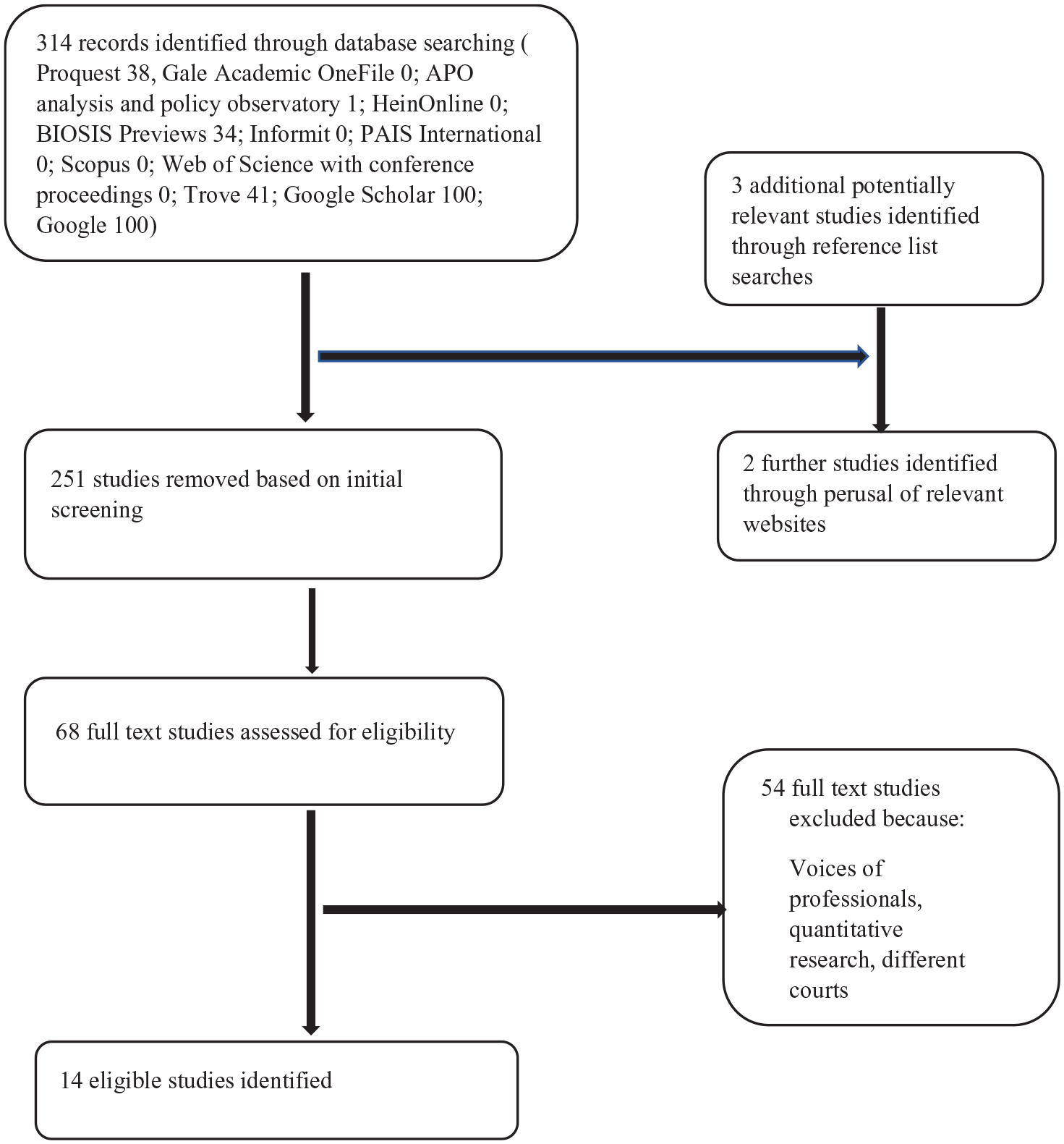
Flow chart of the screening and selection of studies.
Stage 4: Charting the data
This stage entailed ‘sifting, charting, and sorting material’ from the studies ‘according to key issues and themes’ (Arksey and O’Malley, 2005: 26).
We collected standard information from each study which was entered onto a ‘data charting form’ containing general information about the study as well as more specific information, where available, regarding the study population, aim, methodology and significant findings (Arksey and O’Malley, 2005: 26–27).
Stage 5: Collating, summarising and reporting the results
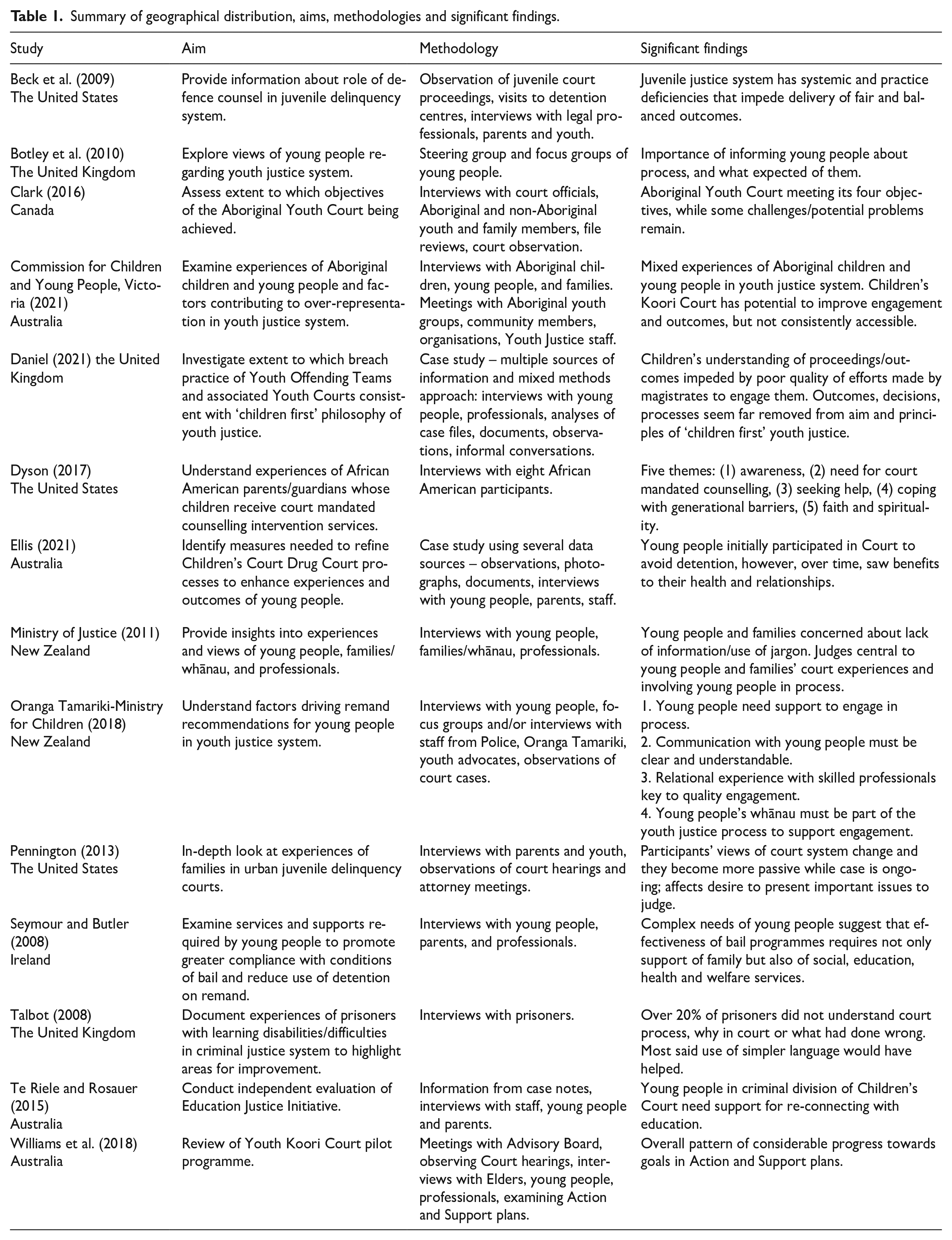
At this stage, the collation, summarising and reporting of the findings took place. The presentation of the findings is recommended to occur in two ways (Arksey and O’Malley, 2005). First, by presenting a summary of the geographical distribution and research methods used in the included studies. This is provided in Table 1. In the second process, qualitative findings in the literature are organised thematically, with Levac et al. (2010) recommending that qualitative data analytical techniques be considered. In relation to the qualitative data, we made use of Braun and Clarke’s (2006) widely employed form of thematic analysis. The first phase of this process required detailed reading of the studies to become familiar with their content. In the next step, codes were generated which identified important elements of the data in relation to answering the research question. Next, the codes and collated data were explored to ascertain potential themes. Following this, data were collated relative to the candidate themes, reviewed to see if each theme formed a consistent pattern, with the themes then being defined and named to reflect their essential elements. In the final phase, relevant extract examples were selected to present in the findings (Braun and Clarke, 2006).
Summary of geographical distribution, aims, methodologies and significant findings.
Findings
In total, 319 potentially eligible studies were identified in the initial search, of which 14 met the inclusion criteria. Four studies came from Australia, three each from the United Kingdom and the United States, two from New Zealand and one each from Canada and Ireland. Table 1 summarises the aims, methodologies and significant findings from these studies.
The following main themes were identified following the thematic analysis: (1) Inadequate communication and alienating language; (2) detrimental, unforeseen impacts; (3) inconsistent and unreliable support; and (4) alternative court structures.
Inadequate Communication and Alienating Language
Children’s experiences
Botley et al. (2010), in the United Kingdom, noted that children and young people can experience confusion and anxiety stemming from limited or no knowledge of what will happen in court but also a lack of preparation regarding getting to court and knowing where to go on arrival. Supporting this, a child in the Ministry of Justice (2011) research in New Zealand remarked, . . . [I] actually had no clue. Like ‘cause Youth Court, you don’t hear much about it and you don’t really see it on TV or anything, so I had no idea what to expect. (p. 28)
When in court, children reported feeling excluded, seemingly the focus of key professionals’ conversations and written documentation, but the child is a bystander rather than a participant. This aroused feelings of resentment, inadequate understanding and further confusion: I don’t even have to be in court. It’s like I shouldn’t even be there . . . like they can do it all without me . . . I don’t even get spoken to. (Ministry of Justice, 2011: 41)
One of Talbot’s participants, possibly with learning difficulties, which is not uncommon among criminalised youth (Snow and Powell, 2012), recalled, I couldn’t understand them. They talk so fast . . . jumping up and down saying things. I gave up listening. (Talbot, 2008: 21)
Other grey literature reported similar children’s commentary: The stuff that they used against me in court was so confusing . . . I didn’t even really know what they were saying . . . I just wanted to get out of there . . . so I just said, ‘Yes, no, yes’. (CCYP, 2021: 472)
Parents’/families’ experiences
Family members also commented that they had no understanding of what to do when they arrived at court: . . . you just figure it out as you go. For a lot of families, it is really quite scary. (Ministry of Justice, 2011: 32)
Parents too often received little guidance about how to effectively participate in the juvenile justice system, and few accommodations were made to include them: . . . the court thinks you understand what is going on and you really don’t. They should explain each step . . .. (Dyson, 2017: 34) You only hear bits and pieces. They don’t talk loud enough. I rely on the lawyer. (Pennington, 2013: 96–97)
Detrimental, Unforeseen Impacts
Children’s/parents’/families’ experiences
In this section, the findings have been combined as they involved a number of parents and children together in common experiences.
Unprepared and disengaged children might not realise the power of the court to curtail their freedom and to limit the opportunities available to them in life. Lack of awareness of potential consequences can have a dire long-term impact: . . . in a case in which a juvenile was charged as an adult for possession of a small amount of marijuana, waived counsel, pled guilty, and proceeded straight to sentencing for a drug offense, the judge asked the youth if he planned on going to college. The youth answered yes, and proudly named his top choice school. The judge then said, ‘You realize that you have now lost any ability to receive federal funding for financial aid because you just pled guilty to a drug offense’. (Beck et al., 2009: 78)
In this case, the judge has unnecessarily humiliated the uninformed young person in addition to the direct punishment for the offence.
In another case, neither a young person nor his parent understood the implications of breaking bail conditions: I thought that I was going to get probation . . . My ma hadn’t got a clue . . . Ah, if someone said that [I would be locked up], I would have stuck to them . . . Could have told me what would happen if I broke them . . . because I don’t want to be coming back to a place like this. (Seymour and Butler, 2008: 44)
Beck et al. (2009) reported several cases involving youth that alarmingly demonstrate the devastating impact of children’s inadequate understanding of legal language and of their rights. This included pleading guilty before understanding the sentencing process; not understanding sentencing options, and the long-term ramifications of sentences being proposed: The judge told me I had the right to do this, this and this, but I did not know what this, this and this was. (Beck et al., 2009: 30) I’ll just say I did it, I just want to go home. (Beck et al., 2009: 29)
Other grey literature also highlighted the seriousness of children and young people’s limited understanding, and consequent misguided responses, lack of responses and actions: The judge goes ‘blah blah blah blah blah, do you agree’ and then you go ‘yes’ and then I get on curfew. (Ministry of Justice, 2011: 45)
In a 2021 report, Our youth, our way, Indigenous Australian children described feeling like ‘another number in the system . . . They don’t understand our background and what we had to go through and what we experienced’ (CCYP, 2021: 473). Children, some with possible learning difficulties, in various grey literature studies described their feelings of nervousness, intimidation, being disrespected and estranged from the court proceedings: Court was . . . more nerve-racking than . . . the police station. I was never nervous about getting interviewed, but just in court . . . in front of everyone getting the charges laid out, it’s way more nerve-racking. (CCYP, 2021: 472) I didn’t like it, it shocked me. The judge asked me if I understood and I said yes even though I didn’t. I couldn’t hear anything, my legs turned to jelly and my mum collapsed. (Talbot, 2008: 21)
Parents wanted to be involved in decisions affecting their child, as these can affect their family lives, such as children returning home: I wanted to speak to the Magistrate about . . . not ordering him to do the rehab . . . The only reason I allowed him to come back home was if rehab happened . . . so I was really angry, very upset . . . they could have involved us more, a lot more. (Ellis, 2021: 225)
Inconsistent and Unreliable Support
Children’s experiences
Children frequently noted the need to rely on their parents, usually their mother, to provide support and guidance in the courtroom. This occurred regardless of how well-informed, or not, their parents might be. Previous research (Saunders et al., 2020) suggests that parents are often not well-informed: [Mother says] ‘You’ve got to kind of listen to what they say’. Or, ‘You can’t really disagree with them, ‘cause you really have no say’. . . . sometimes I’ll just be stubborn and get rude. So she like tells me what to do step by step. She helps me a lot. (Pennington, 2013: 191) I was nervous . . . Because he [my dad] weren’t there, I didn’t really have anyone to ask where to go, what happens now, what to do. (Botley et al., 2010: 9) They read me this list of my rights . . . I can’t understand Court. I have to have my mum to be beside me to explain. (Oranga Tamariki Evidence Centre, 2018: 21)
Children reflected on both positive and negative experiences in interactions with legal professionals – judges and lawyers, as well as with social workers and other professionals: [One solicitor] sat us down at his desk, got his notepad and pen and [was] comforting, it actually feels like he’s actually trying, like he understands. (Botley et al., 2010: 9) The judge . . . didn’t get angry or shout. He was nice and polite. (Talbot, 2008: 23) Mum was there with me. I had a support worker from [a local Aboriginal organisation] . . . My solicitor was awesome – he explained everything to me, spoke to me directly, gave me my options and helped. (CCYP, 2021: 473)
Some professionals were criticised for not representing them well, handling matters too quickly and/or without consultation or empathy, and providing repetitive, unhelpful advice: . . . my lawyer knows me and knows what I want. I get given this random lawyer that doesn’t know anything about me . . . I only meet them five minutes before I have to go to court. (Ministry of Justice, 2011: 45)
Beck et al. (2009) similarly observed that two children in their study ‘only got a chance to speak with their lawyers about five minutes before their hearings’ (p. 32) which meant that their attorneys did not know either the children or their perspectives.
Parents’/families’ experiences
Parents and families reported a range of experiences regarding support from professionals. Some received helpful information from youth advocates that enabled them to reasonably anticipate the courtroom’s setup: . . . that was pretty good actually, ’cause Daniel sort of walked straight up to the dock . . . The lawyer had already said, ‘Daniel will go to the dock there. There’ll be policemen over there. There’ll be a judge. There’ll be someone sitting down taking notes over there’. And she said, ‘And you, being mum, you’ll just slip up the side there and sit in those seats’. (Ministry of Justice, 2011: 33)
Youth advocates’ insights also helped some family members to predict what might occur in court in terms of procedures and possible outcomes: Our lawyer was really good. He told us everything that was going to happen before we got in there. (Ministry of Justice, 2011: 43–44) We always . . . went over what was going to be said and asked us if we had any more input on what has happened. (Ministry of Justice, 2011: 45)
One father reported that, although his daughter breached a court order, a magistrate referred her to a helpful programme: . . . we had to go back to Court . . . the Magistrate said ‘we’ve got this new program, it’s just started out . . . go and see them, this is what they may be able to offer. (Te Riele and Rosauer, 2015: 24)
Some families also commented positively on their experiences with social workers: Honestly [social worker] . . . has been brilliant. He comes over once a week and he rings up [child] . . . and sees how he is doing . . . (Ministry of Justice, 2011: 46)
Some, however, were not happy because of little contact, lack of trust or because of frequent changes of social workers: I have had to ring him up quite a few times and have left a message. He never rings back. When we see him at court and I bring it up with him [he says,] ‘Oh, yeah I have just been busy’. (Ministry of Justice, 2011: 46)
Alternative Court Structures
In alternative courts, the children/young people have usually pled guilty to an offence, so the courts essentially determine the most effective/rehabilitative consequences for the child’s/young person’s illegal actions. Unlike mainstream courts, alternative courts are generally not determining the child’s guilt.
Children’s experiences
Children described only positive experiences in alternative courts, especially in relation to respecting and engaging participants, providing detailed information and enabling constructive outcomes that children and young people felt motivated to achieve: [The Aboriginal Youth Court] was great . . . It’s easy going, the judge is really nice. The workers there are easy to talk to . . . I liked sitting in a circle. Isn’t the point of it to make you feel more comfortable? I liked that. (Clark, 2016: 34) Koori Court was different. I wasn’t in the stand, I was sitting with my family. The Elders go off at you . . . but they actually explain stuff to you . . .. You’re sitting down with a group of people that will look at you as more than just a criminal that fucked up. They look at you like a person. (CCYP, 2021: 474) . . . I felt uncomfortable in [regular court] . . . Yeah, like all the big words and stuff I don’t understand properly . . . whereas Koori Court . . . They explain it to me where I don’t understand. Try to – yeah . . . in other courts I really didn’t understand what they were saying. (Williams et al., 2018: 135)
Those involved in alternative courts appeared to better connect with children through being well-informed, familiar and engaged in the cultural aspects of participants’ lives: . . . you can go to normal court and sit in front of a different judge and say whatever, Koori court you’re sitting in front of your Elders, so when you say something, you’re actually going to do it. (CCYP, 2021: 474) [The AYC and community council] listen to your side of the story. They get to find out who you are and what type of person you are. They get to help you more, and they get to know what kind of programs you’re into . . . It gives you a better chance compared to someone not really caring and just giving you what they think you deserve. (Clark, 2016: 39)
Children and young people also especially appreciated people whom they respected reprimanding them. This appeared to be an impetus to positively change direction: I like how Elders sit down and tell you off – you need that sometimes. I don’t like getting told by white people because I don’t know them. (CCYP, 2021: 474) You sit at the table [in Koori Court] so like you got a voice . . . In the normal court you’re sitting in the dock. Koori Court, they are sitting right in front of your eyes. You feel sad for disappointing them . . . the Elders know that you feel bad. (CCYP, 2021: 474)
Parents’/families’ experiences
Notably, a magistrate in a Youth Koori Court demonstrated respect for a father and his contribution by taking time to listen to his story: Dad shares his story. It has been a long journey for him to being here with his children, trying to look after them. His story is heavy. Pain and disappointment are audible. He finished speaking, saying ‘That’s all I have to say about that’. The other participants have been silently listening and nodding throughout Al’s dad’s story. Now, the Magistrate softly says ‘okay’. She acknowledges that his words tell them all how much he has overcome to be here. (Williams et al., 2018: 13)
Discussion
This scoping review of children’s and families’ experiences within Children’s and Youth Court criminal proceedings sheds further light upon concerning practices occurring in these courtrooms (see Kilkelly, 2008; Rap et al., 2013; Saunders et al., Sheehan and Borowski, 2013; Turner and Hughes, 2022). Both the CRC (Articles 12.1, 12.2) and UN Committee on the Rights of the Child General Comment No 24 (para. 45) emphasise the importance of children’s informed and active participation at all stages of court processes. In addition, General Comment No 24 (para. 46) proposes that to be ‘effective’ the child must understand all aspects of the trial and it must be conducted in a participatory manner (court layouts and court personnel must promote children’s participation).
However, our scoping review reveals that too many children and their family members entered courtrooms not understanding the nature of proceedings or the key players and their roles. Professionals’ communication could too often be described as inadequate and/or confusing, adding weight to previous research suggesting that legal language frequently estranges children and their families (Ministry of Justice, 2011; Sheehan and Borowski, 2013). Children, commenting on professionals’ language choice, expressed confusion about what the words used actually meant. Fernandez-Molina et al. (2021) found that although professionals wanted to protect children’s rights and to modify court processes to align with children’s needs, the courtroom environment, atmosphere, technical language and formal tone did not facilitate children’s involvement. Indeed, children displayed minimal interaction and hesitated to verbally contribute. Such formalised settings lead to considerable difficulties with understanding and communication for children (Kilkelly et al., 2023).
Of particular concern, unfamiliar language and unclear communication in the court can result in children and their families’ underestimating the court’s power to stifle life opportunities (Kilkelly et al., 2023). For example, through pleading guilty to a drug offence, a child lost future opportunities to receive government financial aid for tertiary education, and another child was jailed after breaking bail conditions because he did not understand how serious this was. A recent scoping review (Turner and Hughes, 2022) revealed that limited or no understanding of procedures and processes and the failure to address this, is elevated when children appearing in court have low cognitive function or intellectual disabilities. Saunders et al., (2020) noted Liefaard’s (2016) concern that even the Council of Europe Child Friendly Guidelines, developed to address inadequate children’s participation, had not significantly affected either case law or standards in Member states. Recognising this, in 2020, the Council of Europe unveiled a new model which included reiterating the case for courts to accommodate the specific needs of children (and their families) to create a more ‘child-friendly’ system of criminal justice (Crowley et al., 2020). The outcomes of these initiatives have not been reported.
With respect to the families’ roles, the 2019 General Comment strongly advocates for parents’ participation: ‘parents . . . should be present through the proceedings’ (para. 56) and ‘enjoy their maximum involvement in . . . legal proceedings’ (para. 57). Similarly, Rule 15.2 of the ‘Beijing Rules’ states ‘The parents or the guardian shall be entitled to participate in the proceedings . . .’. To what extent, however, have these guiding principles been incorporated into domestic statutes? Our scoping review suggests that parents’ participation in courts involving their children may be less than adequate: ‘the court thinks you understand what is going on and you really don’t’ (Pennington, 2013). Moreover, Ellis (2021), in relation to Western Australian therapeutic justice focused youth drug courts (a forum which ostensibly promotes children’s and their parents’ involvement), reported that parents generally felt excluded from the process, despite the court’s intent to ‘recognise and engage the family as a valued partner in all components of the [drug program planning]’ (p. 46). These findings align with analogous studies in dependency courts involving foster parents who felt uninformed and confused about the court process and how to effectively participate (Cooley et al., 2017; Geiger et al., 2013).
Our scoping review also highlights the inadequacy of supports available to children and their families when they are engaged in court proceedings. Too many children relied on parents and other family members both for support and for information, whether or not families were well-informed. Children revealed that they could not understand what was happening in court. The reliability and extent of child and family support from lawyers, social workers and magistrates was inconsistent (Botley et al., 2010; CCYP, 2021; Ministry of Justice, 2011; Williams et al., 2018). When unsupported, feelings of disempowerment can lead to parents’ disengagement from youth justice processes, negatively affecting their children.
In contrast, a key finding, absent from our prior systematic review (Saunders et al., 2020), related to the pro-active involvement of children and their families in Indigenous courts. General Comment No. 24 endorses the establishment of customary, Indigenous or non-state forms of justice and recognises that these systems are ‘likely to contribute favourably to the change of cultural attitudes concerning children and justice’ (para. 101) and encourages justice sector reform that takes account of such systems (para. 102). In comparison to mainstream courts, our scoping review revealed that children and their families highly regarded alternative court structures, primarily Indigenous courts. Children commented that they felt very positive about having processes explained to them in understandable language and also felt more comfortable sitting in a circle. This is despite the fact that typically children appearing in an alternative court have pleaded guilty to an offence and are there for sentencing (Clark, 2016). Significantly, Clark’s (2016) report on the Canadian Gladue courts, observed that clients who had proceeded through the diversionary arm of the court (the Community Council) were ‘less likely to re-offend when compared to Indigenous offenders in other [mainstream court] jurisdictions’ (p. 51). Yeong and Moore (2020) also found that recidivism rates were lower when comparing First Nations people who had been sentenced through an Indigenous, rather than a mainstream, court system.
Limitations
This review does have some limitations. First, scoping reviews are intended to provide an overview and map of key concepts, studies and evidence, accordingly more extensive analysis such as appraisal of methodological limitations or risk of bias of the studies was not carried out. As well, more qualitative data were found regarding children’s rather than parent’s perspectives, so the experiences of families and parents may not be as well represented as those of children. In addition, only studies in English were included and relevant studies may have been conducted in other languages.
Future Research
In support of Jones (2015), this scoping review found that parents of child offenders represent a small but often hidden group caught up in children’s court proceedings. A multi-jurisdictional observational study of parents’ roles within both mainstream and alternative youth courts would be useful in determining the extent to which international covenants, such as the CRC and General Comment No. 24, are being given credence. Rose et al. (2004) developed a juvenile offender parent questionnaire (JOPQ) to assess and identify parental attitudes, thoughts and feelings towards their court involved child from a multi-dimensional perspective. Although their purpose was to ascertain how parents felt about a child’s involvement in the system, this questionnaire could be modified and extended to capture parents’ and children’s participation experiences and views about roles they are expected, and would like, to play in the court and sentencing processes.
Conclusion
This scoping review extends our previous research into how children and parents participate in and understand children’s criminal court processes in which they are involved, with a particular focus on their own voices and insights. We found that many children and family members lacked understanding of proceedings, especially the use of formal and technical legal language, and of the significant implications of these processes for their futures. Professional support during these legal proceedings, although helpful in certain instances, was often inconsistent and unreliable. One area where positive experiences were consistently described in terms of respect, engagement, provision of information, and constructive outcomes was in alternative courts, especially Indigenous courts. This review adds weight to previous research and to international law that recommends greater involvement of children and families in court processes with less formal, more inclusive courtrooms, use of understandable language, and the enabling of family support, so that fairer and better short- and long-term outcomes can be achieved.
Footnotes
Funding
The author(s) received no financial support for the research, authorship, and/or publication of this article.
