




Abstract
Although research has been conducted on the risks and effects of juvenile sexual assault, there is a gap in our knowledge surrounding juvenile sexual assault and how the law discusses victims. The goal of this endeavor is to provide a systematic summary of juvenile sexual assault statutes in the United States of America. In pursuit of this objective, a content analysis of the sexual assault and consent state laws of the United States of America was performed. Four themes emerged, including laws that sought to (1) conceptualize juvenile sexual assault victimization, (2) offer evidentiary standards in juvenile sexual assault cases, (3) assess the seriousness and punishment of juvenile sexual assault, and (4) provide services for juveniles who have been sexually victimized. Within these themes, legislation was inconsistent from one state to another. From these findings, however, we encourage legislative bodies to offer greater specificity in their laws, re-assess the seriousness of this phenomenon, and express greater support for victims of child sexual assault.
Introduction
According to a national telephone survey of 2293 15-, 16-, and 17-year-olds, nearly 1 in 9 girls and 1 in 53 boys have had direct experience with sexual abuse or had been sexually assaulted (Finkelhor et al., 2014). Sexual victimization of minors is, unfortunately, a common finding in the literature. Morgan and Kena (2019) and Snyder (2000) also reported that an overwhelming majority (61.6%) of rape and sexual assault survivors were under the age of 18 years at the time of their victimization, while Kilpatrick (2000) found that nearly a third (29.3%) of survivors were under the age of 11 years. While much has come to be known about the rates of juvenile sexual assault, little is systematically known about how states have criminalized this phenomenon. This is surprising given the persistent social science research observing the devastating effects of juvenile sexual assault. To that end, sexual assault survivors often experience short- and long-term trauma resulting from sexual victimization. Most rape victims, for example, experience symptoms of post-traumatic stress disorder, and greater than three-fourths of sexual assault survivors experience professional and/or emotional issues (Finkelhor et al., 2014; Langton and Truman, 2014; Zinzow et al., 2012). This phenomenological research suggests that our knowledge gap on juvenile sexual assault legislation comes at a real consequence.
To overcome this issue, this study explores how juvenile sexual assault victimization is defined and criminalized in American state laws. To accomplish this objective, every criminal justice statute, from all 50 states, was systematically collected. More than 130,000 state statutes were then Boolean searched to draw our attention onto laws reflecting this topic. Using an indicative coding scheme and a content analysis approach, four themes emerged from these data. Based on our analyses, we conclude by discussing the policy implications and areas of future research for juvenile sexual assault. Juvenile sexual assault in this context refers to sexual assault victimization of persons under the age of 18 years. Before getting into the data and their implications, however, we begin by situating this study in the extant literature on juvenile sexual assault laws and present widely acknowledged federal and state sexual assault legislation. This content broadly expresses tangential extant literature and policy but highlights the absence of juvenile sexual assault research and laws focused on victims at federal and state levels. Thereafter, extra-legal influences in juvenile sexual assault case processing are discussed to put people at the center of the discussion.
Juvenile sexual assault legal and social science research
Juvenile sexual assault legal research has primarily focused on juvenile sexual offenders and provides insight into various topics, such as assessment, offender registry, the juvenile justice system, delinquency, and treatments (see, for example, Craun and Kernsmith, 2006; Groth, 1977; Groth et al., 1981; Ryan, 1987; Sickmund et al., 1997). Through a review of former, for example, Vizard (2013) found that juvenile who have committed sexual offenses often require full clinical assessments to determine their risks and needs. Regarding offender registries, Caldwell and Dickinson (2009) observed, in a sample of 172 juveniles, that registered juveniles who commit sexual offenses had lower overall risk assessments but reoffended at a similar rate when compared with nonregistered juvenile who commit sexual offenses. On delinquency, Hendriks and Bijleveld (2004), in a sample of 116 male juveniles convicted of sexual offenses, reported they were more likely to be neurotic, experience social problems, bully others, and have negative self-views than their non-offending counterparts. Prisco (2015), in an analysis of family court records, revealed that juvenile who commit sexual offenses are more receptive to treatments than adults who commit sexual offenses when cases are managed by boards and multidisciplinary teams. Unfortunately, none of the extant literature – to our knowledge – explores how victimization or victims are represented in juvenile sexual assault laws.
Federal sexual assault legislation in the United States of America
Nevertheless, several federal laws since the 1970s have more broadly sought to address sexual assault, court processes in sexual assault cases, and provide resources to victims of sexual assault. Relating to the former, the Office on Violence Against Women (OVAW) was created in 1994 through the Violence Against Women Act (VAWA). The VAWA, through the OVAW, allotted funds to investigate and prosecute violent crimes against women, such as sexual assault. Boba and Lilley (2009), in their National assessment of panel data from 10,371 American jurisdictions, observed that a 1 per cent increase in funding from VAWA reduced incidents of rape (0/1%) and aggravated assault (0.116%). These official data, however, should be interpreted with caution, which is subsequently discussed.
Additionally, several pieces of federal legislation have aimed at reducing sexual assault on college and university campuses. The Clery Act of 1990, for example, required all colleges and universities in receipt of federal funding to disclose their crime statistics in an annual publication. In a 1992 amendment to the Clery Act, victim rights were included in the law, which guaranteed victims counseling, privacy, and an attorney. Fisher et al. (2002) declared that while the Clery Act was a noble step in addressing campus safety, in practice, it has proven to be more symbolic than substantive since it is dependent upon victims to report crimes, which is often an issue in sexual assault cases.
Accordingly, colleges and universities were given further guidance on addressing campus sexual assault in the 2011 Dear Colleague Letter. Research regarding the Dear Colleague Letter’s impact on campus sexual assault is limited, but Carroll et al. (2013) found in a case study that basic compliance was in place at colleges and universities. Institutions, however, often suffered from limited funding, legal complexities, and lack of communication/transparency in executing the Dear Colleague Letter mandate (Carroll et al., 2013). Also relating to sexual assault on campuses, the Campus Sexual Violence Elimination Act (Campus Save Act) was ratified in 2013 and clarified a fast and fair disciplinary process in sexual assault cases, while extending the definition of sexual assault to include incidents like dating violence and stalking. Like Fisher et al. (2002), Schroeder (2013) indicated that the Campus Save Act was a tremendous step in combating campus sexual assault but reported that more needs to be done on campuses. They encouraged colleges and universities to be more proactive, conduct thorough investigations, adequately discipline persons who commit crimes, and be less fearful of what addressing these issues would do to their public image. Overall, the Clery Act, the Dear Colleague Letter, and the Campus Save Act require colleges and universities to offer protections to students which is often considered a vulnerable population.
The venerability of youths is also frequently discussed in other spheres, including in religion, primary/secondary schools, and in sports. There has been, for example, some recognition that state laws may be protecting clergy engaged in sexual abuse within the Catholic church and a need for federal legislation to overcome these loopholes (Dearen and Rezendes, 2022). Federal legislation has also been sought (but not ratified) attacking trans youths (American Civil Liberties Union, 2022). Bathroom bills and laws excluding trans individuals from youth sports, for example, are frequently advocated in conservative settings, despite evidence of their efficacy or need and their outright bigotness. Protecting youths, nevertheless, is at the forefront of federal sexual assault legislation.
State sexual assault legislation
Though less comprehensive, several states have also sought to legislate sexual assault. Marital rape, rape shield, and age of consent legislation, for example, are among some of the most widely adopted types of state laws implemented to protect victims of sexual assault (see Oberman, 2000; Spohn and Horney, 1992). There is also a body of literature that focuses on some sexual assault statutes at the state level. These include limited work on statutory limitation statutes (Hagen, 1990), sexting statutes (McEllrath, 2014), hearsay statutes (Marks, 1995), and transfer statutes (Kokrda, 2005). Additionally, there is extant literature on extra-legal influences on case processing.
Extra-legal influences on case processing
Extra-legal case influences research most often focuses on case characteristics, investigation characteristics, and casework. In a sample of 392 juvenile sexual assault cases, Campbell et al. (2012) found that cases were more likely to be successfully prosecuted with younger victims, victims with disabilities, those who knew the perpetrator, and processed sexual assault kits. Similarly, through a law enforcement case review, Snyder (2000) discovered that victims were more likely to disclose being sexually assaulted when they were female, younger (12–17 years old), and assaulted in their home or the home of the perpetrator. Likewise and concerning investigation and casework, Riggs et al. (2000) concluded, from a sample of 1076 sexual assault victims, that (1) general body trauma is a common effect of sexual victimization, (2) the victim often knows the abuser, and (3) DNA evidence is often found during crime lab investigation. In addition to victim characteristics, victim offender relationship, and DNA evidence have also been found to impact case processing in the criminal justice system.
Comparably, from a sample of 1043 child victims of sexual abuse, Stroud et al. (2000) found that victim testimony and testifying in court were essential to advancing a case in the criminal justice system but were mediated by the victim’s age, gender, and ethnicity. Despite these contributions, there is still a gap in our knowledge of sexual assault victimization research of juveniles, which is significantly needed.
Methods
The current study
Juvenile sexual assault laws tend to focus on juveniles who commit sexual offenses, while federal and state laws tend to neglect victim of juvenile sexual assault and how their cases are part of a broader system. There is, however, a lack of empirical research that focuses on how state legislation treats juvenile victims of sexual assault, which comes at a substantial cost to juveniles who have been victimized, their families, and friends. To that end, the goal of this research is to systematically explore sexual assault state laws in the United States of America to understand how juvenile victims of sexual assault are represented in state legislation. In doing so, these analyses will highlight patterns and trends in juvenile sexual assault laws and focus on juvenile victims of sexual assault as they are characterized in the legislation.
Sampling
The data analyzed here were collected from government-sponsored websites and represent every criminal justice-related law in all 50 states (Branscum et al., 2019, 2021; Branscum and Fallik, 2021; Fallik et al., 2021). State Titles, Chapters, and Parts that appeared, even remotely, related to the criminal justice system were included in the data collection procedures (see Fallik et al., 2021 Appendix A for reference). 1 For consistency purposes, state statutes were collected following 2016, but before 2017, legislative sessions; however, states are the unit of analysis for interpretative purposes. Since legislative bodies were not in session during the sampling period, the observed statutes are temporally consistent. To ensure the reliability of these data, a line-by-line check was performed on the data against the government-sponsored website to assess data collection consistency (Auerbach and Silverstein, 2003). The line-by-line check allowed for the data to be thoroughly reviewed with no exclusions being made during the data collection stage of research. The error rate observed during this assessment was less than 0.01 per cent and was rectified for the final analysis.
The data are easily searchable like similar databases (e.g. Westlaw, FindLaw, and LexisNexis) but are not limited by algorithms that rank search results by relevance, which may omit content that is important but unavailable. Alternatively, these data provide a more holistic approach to understanding the American criminal justice laws and procedures by allowing researchers to set their inclusion and exclusion criteria. As shown in Table 1, states averaged about 760 pages of content, over half a million words, and more than 2600 individual statutes were captured in these data. There were over 130,000 statutes collected. Table 1 is a descriptive table of the original sample, which contained over 130,000 statutes (see Appendix A in Fallik et al., 2021 for a complete list of originally collected laws). While the structure of criminal justice statutes varies from state to state, the standard deviation of these measures is less than the mean, which speaks to the breadth and depth similarity among the states and that outlying states have little to no impact on these estimates.
Measures of central tendency for the observed criminal justice statutes.
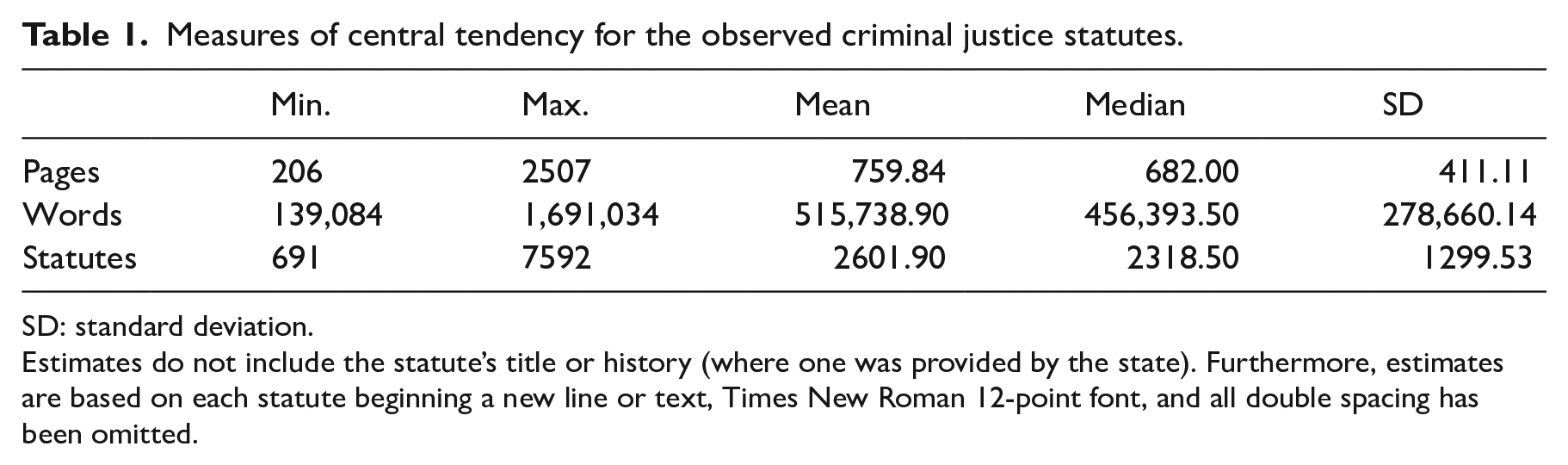
SD: standard deviation.
Estimates do not include the statute’s title or history (where one was provided by the state). Furthermore, estimates are based on each statute beginning a new line or text, Times New Roman 12-point font, and all double spacing has been omitted.
A multistep procedure was done to further distill these data down into relevant statutes for analysis. First, a preliminary search was done among all the statutes. Statutes containing the words ‘sex’ or ‘rape’ were selected for further evaluation. Statutes unrelated to sexual assaults were then excluded. Next, a secondary filter was added to this subsample that focuses on statutes with the following words and their derivatives: minor, juvenile, youth, and child. Table 2 shows descriptive measures of juvenile sexual assault-related statutes. The only interpretive difference between states is that the number of words observed in each state for this phenomenon was slightly skewed, which is somewhat expected given the hodgepodge of literature available on this topic. There were, however, a total of 2015 pages, 1,679,651 words, and 3663 statutes reviewed in these analyses. On average, there were 73.26 statutes per state analyzed in this subsample.
Measures of central tendency for the observed juvenile sexual assault state statutes.
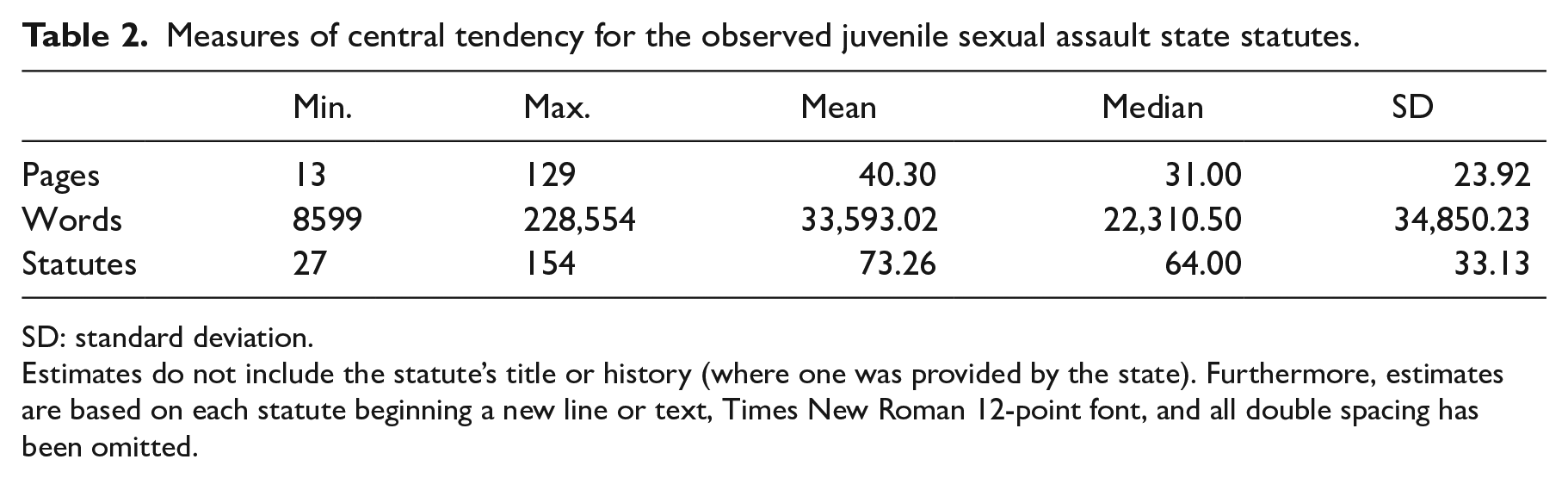
SD: standard deviation.
Estimates do not include the statute’s title or history (where one was provided by the state). Furthermore, estimates are based on each statute beginning a new line or text, Times New Roman 12-point font, and all double spacing has been omitted.
Analytical strategy 2
In the tradition of content analysis, similarities and differences among the identified laws were collectively described (Krippendorff, 2018; Lune and Berg, 2017). A coding scheme was developed to analyze the data. The initial coding scheme was inductive and based on grounded theory, which employed hierarchical open coding to identify themes associated with juvenile sexual assault victimization (Corbin and Strauss, 2014). This resulted in a series of binary questions of the presence (or absence) of a theme, followed by open-ended questions that captured the statute citation and legislative content. Recurring and unique data were cataloged into existing concepts and new themes were created as they became manifest (Saldaña, 2015; Schreier, 2012). Subcategories were developed during subsumption and, in doing so, the number of subcategories were expanded while the number of main categories were reduced (Auerbach and Silverstein, 2003; Saldaña, 2015). Patterns and trends were identified through a segmentation process, whereby recurring and unique data were then cataloged into existing concepts, and/or new themes were created (Auerbach and Silverstein, 2003; Saldaña, 2015). Each state’s statutes were then independently coded by two coders. Where differences were observed between coders, albeit a rare occurrence, they were rectified by a third independent coder in a ‘tie breaker’ approach. Previous research shows that 80 per cent intercoder reliability is acceptable (Lombard et al., 2002) and this rate was surpassed in the present analysis. Therefore, emergent themes were then organized in a narrative that was informed by our understandings of the extant literature. In doing so, this research seeks to understand if the law is written consistent with our existing knowledge of how juvenile sexual assault victimization occurs.
Results
Four themes emerged throughout these analyses and include statutes that sought to (1) conceptualize juvenile sexual assault victimization, (2) express the evidentiary standards in juvenile sexual assault cases, (3) assess the seriousness and punishment of juvenile sexual assault, and (4) provide services for those juveniles who have been sexually victimized. 3
Conceptualizing juvenile sexual assault victimization
Juvenile sexual assault and/or abuse was generally defined by four components: the use or threat of force; knowledge that a victim does not understand the act or give consent; the victim is under 18 years of age; and the perpetrator has a relationship to the victim. Some of these statutes include specific victim ages. In Illinois, for example, juvenile sexual assault is defined as an act of sexual penetration and: 1) uses force or threat of force, 2) knows that the victim is unable to understand the nature of the act or is unable to give knowing consent, 3) is a family member of the victim, and the victim is under 18 years of age, or 4) is 17 years of age or over and holds a position of trust, authority, or supervision with the victim, and the victim is at least 13 years of age but under 18 years of age. (§720-5/11-1.20 S-5)
Most states follow this definition. Many states, however, also listed the harms as most attributable to the repeated nature of sexual assault over a long period. California, for example, asserts that juvenile sexual abuse occurs when, Any person who either resides in the same home with the minor child or has recurring access to the child, who over a period of time, not less than three months in duration, engages in three or more acts of substantial sexual conduct with a child under the age of 14 years at the time. (§1.9.4)
In this context, the sexual abuse of a minor has varying definitions. In Maryland, for example, ‘sexual abuse’ is an act that involves sexual molestation or exploitation of a minor, whether physical injuries are sustained or not (see §315.3). The criminal acts that constitute sexual abuse of a minor also varied widely among the state statutes. ‘Sexual abuse’ was found to include specific criminal acts, such as (1) incest, (2) rape, (3) sexual offense to any degree, (4) sodomy, and (5) unnatural or perverted sexual practices (n = 38). The most common criminal acts of sexual abuse were sexual misconduct (n = 48), the display of obscene or indecent material (n = 47), sexual exploitation (n = 39), and rape/forcible sexual assault (n = 31). As it relates to the former, New York defines obscene material as any material that is harmful to minors, meaning the quality of any description or representation, in whatever form, of nudity, sexual conduct, sexual excitement, or sadomasochistic abuse, when it appeals to the prurient interest in sex of minors and is patently offensive to prevailing standards in the adult community as a whole with respect to what is suitable material for minors. (§235.20)
‘Rape’ of a juvenile or minor was often (n = 31) defined by states as sexual intercourse with a child under 18 years and compels the child to submit by force and against his or her or their will or compels such child to submit by threat of bodily injury. Some states did not follow the age 18 standard. Massachusetts law, for example, reports that the rape of a child occurs when the child is under 16 years of age (§235.22A). Age differences between states present unique children’s rights concerns.
Thirteen states, as part of their definition of sexual abuse, define molestation and were generally consistent. ‘Molestation’ usually involves engaging in sexual contact. Louisiana’s law provides detail on what constitutes molestation. It defines the acts as a commission by anyone over the age of seventeen of any lewd or lascivious act upon the person or in the presence of any child under the age of seventeen, with the intention of arousing or gratifying the sexual desires of either person, by the use of force, violence, duress, menace, psychological intimidation, threat of great bodily harm, or by the use of influence by virtue of a position of control or supervision over the juvenile. (§1.81.2)
In other words, molestation includes, but is not limited to, a person over the age of 17 years partaking in a vulgar or libidinous act with a child under 17 years to provoke or gratify the sexual wishes of either person.
Likewise, only five states defined ‘sexual harassment’. Among the states that do, most (n = 4) require perpetrator crimes to be continuous acts causing victims to feel fear, intimidated, abused, or cause property damage. Among states observing sexual harassment in their laws, Pennsylvania was the only state among these sexual assault-based data to include cyber-harassment and described it as ‘the intent to harass, annoy or alarm, the person engages in a continuing course of conduct’ of making lewd, lascivious, threatening, or obscene behavior by ‘electronic means directly to the child or by publication through an electronic social media service’ (§2709).
While 48 states refer to the use of electronic communication as facilitating and/or transmitting abuse of a juvenile, 37 states explicitly criminalize the use of the Internet to solicit and/or lure minors into sexually explicit situations. In many of the former statutes, the use of electronic communication includes the possession of any photograph, film, or visual depiction, of any depiction which is stored electronically, of sexual conduct by a child, or lewd exhibition of a child’s genitals or anus (n = 29). Relatedly, Florida was the only state among these sexual assault-based data to identify ‘sexting’ as a complimentary offense to using electronic communication to transmit or distribute an obscenity of a minor (§847.0141). Likewise, Washington is the only state that specifically defines the use of electronic communication as facilitating and/or transmitting abuse of a juvenile as sexually explicit visual material through a picture, photograph, drawing, sculpture, motion picture film, digital image, including such material stored in a computer’s temporary Internet cache when three or more images or streaming videos are present, or similar visual representation which depicts sexual bestiality. (§ 18.2-374.1)
In this example, the use of a computer and/or the Internet to distribute, produce, or transmit obscene material is not limited to the format of the material.
Additionally, child pornography can be distributed through the Internet and 29 states contain statutes that punish the use of computers and/or the Internet to send, receive, or create child pornography. States that do, generally describe child pornography as someone with knowledge of communication of sexually oriented material and who intentionally uses any computer communication system to transfer or send images or to initiate/engage in inappropriate communication with a person under the age of 18 years. Some states (n = 13) have statutes regarding the use of the Internet for live streaming child pornography. Florida specifically describes streaming pornography as the simulation of any act involving sexual activity live over a computer online service, Internet service, or local bulletin board service and who knows or should know or has reason to believe that the transmission is viewed on a computer or television monitor by a victim who is less than 16 years of age. (§847.0135)
Most states, however, broadly prohibit the dissemination or possession with intent to disseminate motion pictures, videotapes, or computer data files containing child pornography.
Evidentiary standards in juvenile sexual assault cases
The evidentiary standards for juvenile sexual assault cases rely heavily on the prevalence of physical evidence in many states. Most states rely on written or recorded testimony of victims of juvenile sexual assault, while others focus on evidence that exemplifies the severity of the harm caused by the assault (n = 47). Colorado, for example, explicitly states that a sexual assault occurs when, ‘the actor causes submission of the victim by threat of imminent death, serious bodily injury, extreme pain, or kidnapping, [. . .] and the victim believes that the actor has the present ability to execute these threats’ (§18-3-402). Iowa notes other harms in addition to physical harms, which states that sexual assault of a juvenile is ‘an intentional act or series of intentional acts, evidence unreasonable force, torture or cruelty which causes substantial mental or emotional harm to a child or minor’ (§802.2).
Seven states mandate medical or psychological assessment services for juveniles who have been sexually victimized. In Georgia, for example, juveniles who have been sexually victimized can receive a forensic medical evaluation, which ‘shall include a physical examination, documentation of biological and physical findings, and collection of physical evidence from the victim’ (§17-5-70). In Tennessee, the law specifies that a medical assessment may include ‘any photograph, report, or x-ray on examinations made shall be sent to the department’ and/or that a ‘video recording shall be taken to indicate the child’s physical or mental condition for future reference and utilization’ (§37-1-609). Nonetheless, the evidentiary standards of juvenile sexual assault cases rely heavily on the accessibility of evidence and are often based on physical and mental harm through assessments by medical professionals.
Seriousness and punishment of juvenile sexual assault
States varied in how they classified the seriousness of juvenile sexual assault in their laws. Juvenile sexual assault was most often classified as a serious offense, which is indicated by the number of states classifying it as a Class A Felony (n = 22), Class B Felony (n = 20), and Class C Felony (n = 18). New York classifies sexual assault as a first-degree and ‘predatory’ offense, whereas the perpetrator has engaged in ‘conduct constituting the crime of rape in the first degree, a criminal sexual act in the first degree, aggravated sexual abuse in the first degree, or course of sexual conduct against a child in the first degree’ (§130.96).
Some states use age to aggravate lower classifications into more serious classifications. Washington, for example, defines juvenile sexual assault as a Class A Felony when ‘a person knowingly causes another person under the age of eighteen to have, sexual contact with another who is less than twelve years old’ and a Class B Felony when a person causes sexual contact with a person ‘at least twelve years old but less than fourteen years old’ (§9A-44-083 and 9A-44-086, respectively). Similarly, New York aggravates the crime when the victim is less than 17 (§230.11), Massachusetts under 16 (§IV.1.265.22B), and Rhode Island under 14 (§11-37.1-2).
Many states categorized the sexual assault of a juvenile as a first- or second-degree felony (n = 21 and n = 21, respectively). The difference between the degree of an offense and the class of an offense varied greatly from state to state. 4 Most states, nevertheless, had mandatory minimum sentences that were also created for sexual crimes against juveniles (n = 39). Washington identifies 15 aggravating circumstances, including, but not limited to, psychological, physical, or sexual abuse of a victim or multiple victims, the offense resulting in the pregnancy of a child victim of rape, using a high degree of planning, or position of trust (§9-94A-535). Other states aggravated circumstances they deemed ‘against nature’ such as incest, assault of a person with a physical or mental disability, or sexual relations between relatives (§281-289.6). In North Dakota, juvenile sexual assault may be aggravated when the perpetrator ‘obtained the victim of the offense from a shelter that serves individuals subjected to human trafficking, domestic violence, or sexual assault, runaway youth, foster children, or the homeless’ (§12.1-41-08).
Services for juveniles who have been sexually victimized
Thirty-three states detailed who is a juvenile who has been sexually victimized and, therefore, eligible for services. Most definitions are vague, with very few statutes providing specificity. South Carolina, for example, operationalizes a ‘victim’ as ‘a person who has been subjected to the crime’ (§16-3-2010). Idaho’s statutes, more specifically, describe a victim as ‘an individual who suffers direct or threatened physical, financial, or emotional harm as the result of the commission of a crime or juvenile offense’ (§19-5306).
To address juvenile victimization, 23 states legislate Sexual Assault Response Teams or Sexual Assault Prevention Boards. In Arkansas, their juvenile sexual assault statute leveraged the Human Trafficking Act of 2013, which mandates agencies who are devoted to child services to collaborate with academic researchers to develop curriculum and train law enforcement and other criminal justice personnel concerning juvenile sexual assault. Regarding the latter, many states (n = 23) require police training and data collection to monitor and improve responses to cases of juvenile sexual assault. Sexual assault response teams were often tasked with providing recommendations and guidelines for educational materials to parents and guardians on the warning signs, referrals, and resources of child sexual abuse and information regarding perpetrators, geographic data, and location trends (Iowa §915.35; Maryland §11-725.7; Michigan §722.621-722.638; Oregon §147.401; Washington §7-68-801). These statutes typically promote a team’s approach to child protection and often include juvenile court officers, medical, and mental health professionals in a multidisciplinary human services network.
Seventeen states established safe zones to keep juvenile sexual victimization at a minimum. Safe zones were defined as areas dedicated to the safety of potential victims where the movement of persons registered for a sexual offense is limited. Texas, for example, requires that registered persons who have committed a sexual offense shall ‘not go in, on, or within the distance specified by the BPP Panel of premises where children commonly gather, including a school, daycare facility, playground, public or private youth center, public swimming pool, or video arcade facility’ (§508.187(b)). These statutes also often included living restrictions for those released on sexual assault charges, with the same or similar spaces also distinguished as safe zones.
Victim compensation funds were found among 25 state statutes to explicitly support victim restitution and/or the medical needs of juveniles who have been sexually victimized. The law in Florida, for example, states that a medical provider who performs an initial forensic physical examination may not bill a victim or the victim’s parent or guardian if the victim is a minor (§960.28). Rather, the medical provider is to seek restitution from the victim compensation fund. Restitution rights of victims of juvenile sexual assault often included property, lump sum, or periodic payment ordered to be made to any victim in many states. Florida’s statute, for example, states that ‘the court shall order the defendant to make restitution to the victim for damage or loss directly or indirectly by the defendant’s offense. Restitution may be monetary or nonmonetary restitution’ (§775.089). Seven states allow victim compensation funds to be used for rehabilitation services or psychiatric or psychological treatment incurred by the victim. In California, victim compensation funds are supported with the wages of perpetrators. Their state statute noted that ‘a portion of his or her earners specified by the court [may be applied] towards those costs’ (§2.8.1). Similarly, Kansas and New Jersey mandate that a perpetrator’s restitution payments must be equal to ‘the gross income to the defendant for, or the value to the defendant of, the victim’s labor or services or sexual activity’ (§22-3424 and §2C:13-8, respectively). In Tennessee, restitution may include ‘costs of necessary transportation, temporary housing, and childcare, at the court’s discretion and attorney’s fees and other court-related costs such as victim advocate fees’ (§39-13-314).
One final noteworthy finding was that 47 states had specific court procedures when a juvenile is the victim of sexual assault. Some states, for example, specify where testimonies from juveniles may be received. In Hawaii and Iowa, for example, ‘the court may order that the testimony of the child be taken in a room other than the courtroom’ and ‘be televised by two-way closed-circuit video equipment to be viewed by the court’ (§33.626.616 and §915.38, respectively). In Indiana and New Hampshire, the court may appoint guardian ad litem or a special advocate and issue child protective orders to juveniles who have been sexually victimized (§31.2.3 and §632-A:6, respectively). In Massachusetts, a child victim of sexual assault is expected to ‘testify as a witness to a sex crime and to minimize stress on such child, the court should take action to expedite the trial and give precedence to the case over any other case’ (§278.16F). Substantively, many states have shown some interest in the wellbeing of juveniles who have been sexually victimized in their laws.
Discussion
While social science research has made great efforts to understand juvenile sexual assault, prior legal research has not focused on sexual assault laws among juveniles who have been victimized. The lack of attention given to these juveniles is particularly tragic because most sexual assault victims tend to be under the age of 18 years at the time of their victimization (Morgan and Kena, 2019; Snyder, 2000). In fact, many rape victims are under the age of 13 years (Kilpatrick, 2000).
Unfortunately, most policy analysis on juvenile sexual assault have focused on juveniles who commit sexual offenses, while victims of juvenile sexual assault have been overlooked in state and federal laws and systematic explorations. Though these efforts have produced a proliferation of sexual assault laws – some even targeting juvenile sexual assault victimization – a gap in our knowledge on this topic has persisted.
To overcome this issue, we conducted a content analysis of the criminal justice state statutes of the United States of America to better understand how states have conceptualized victimization in their juvenile sexual assault laws. The initial coding scheme was inductive and based on grounded theory, which resulted in a series of binary questions assessing the presence (or absence) of themes, followed by open-ended questions that captured the statute citation and legislative content. Recurring and unique data were cataloged into existing themes and new concepts were created as they became manifest. Finally, each state’s statutes were then independently coded by two coders, which were assessed based on their consistency, or lack thereof, within our empirical knowledge of juvenile sexual assault.
Our content analysis observed four themes among state juvenile sexual assault statutes: laws that sought to (1) conceptualize juvenile sexual assault victimization, (2) offer evidentiary standards in juvenile sexual assault cases, (3) assess the seriousness of juvenile sexual assault, and (4) provide services to juveniles who have been sexually victimized. With a few exceptions, ‘juvenile sexual assault’ included the use or threat of force, the knowledge that a victim does not understand the act or give consent, the victim is between 16 and 18 years of age, and when the perpetrator has some sort of relationship to the victim. The most common criminal acts of sexual abuse were sexual misconduct, the display of obscene or indecent material, sexual exploitation, and rape/forcible sexual assault but varied widely among the states. Moreover, the evidentiary standard for juvenile sexual assault cases relied heavily on physical evidence collected by medical professionals, the harm victims sustain, and the psychological assessments of professionals. This has, unfortunately, shifted the evidentiary burden in juvenile sexual assault cases to victims. Additionally, there was little uniformity in how states evaluated the seriousness of juvenile sexual assault in their classifications or penalties, which indicates that states value juvenile sexual assault victimization differently. Nevertheless, most states (n = 33) showed an explicit interest in juvenile who have been victimized through their laws by statutorily providing them with services such as mandating Sexual Assault Response Teams and/or a Sexual Assault Prevention Board. Likewise, states often (n = 25) directed juveniles who have been sexually victimized toward victim compensation funds to pay restitution and/or medical services. Collectively, these efforts represent a mixture of legislation, whereby some innovative laws exist but have not been widely adopted throughout the United States of America.
Policy implications
These analyses lend themselves to several policy implications. First, many states have adopted a general conceptualization of juvenile sexual assault with phrases, such as ‘repetitive nature’, ‘threat of force’, ‘harm to the victim’, and ‘unable to give consent’. These expressions may be helpful to legislatures who are seeking to cover the scope of juvenile sexual assault, but these general conceptualizations of juvenile sexual assault have had the unintended consequence of shifting the interpretive burden of the law to the courts. ‘[H]arm to the victim’, for example, often includes financial harm, physical injury, emotional harm, mental harm, and many others, which can leave juveniles who have been sexually victimized vulnerable to implicit and explicit biases in the criminal justice system (Edwards et al., 2019; Fallik, 2019; Reiman and Leighton, 2015; Roberts, 2007; Smith and Levinson, 2011). Likewise, the vagueness around ‘harm’ in many of the statutes leaves room for victims to be neglected when it comes to their needs. State legislatures should evaluate detection, education, prevention, reporting, and assessment in their juvenile sexual assault laws to determine where specificity is needed because there are clear discrepancies across state borders that need to be addressed by lawmakers. We encourage states to first integrate assessment into their statutes since assessment can help contextualize the phenomenon locally. For example, California promotes ‘an interdisciplinary approach in the assessment and management of child abuse and neglect, sexual assault . . .’ (§4.6.3). The one exception to this suggestion has to do with sexual harassment and exploitation online, such as Florida’s §847.0135 model statute regarding prevention of child pornography and exploitation using computer technology.
The one exception to this suggestion has to do with sexual harassment and exploitation online. One place where vagueness is of value in sexual assault statutes is where technology is evolving because technological advancements have historically outpaced the speed of legislation. In fact, new legislation is often technologically outdated by the time it becomes law. Mississippi’s law provides a workaround for this issue by identifying broadly how juvenile sexual abuse can be transmitted through inappropriate communication between juveniles and those over 18 years by telephone, computer, and other available technology (§97-5-33). Other states should adopt similar catchall statements when it comes to technology.
There were many states where the law emphasized mental and/or physical harm to the victim in juvenile sexual assault cases. Sexual assault victims, especially juveniles, are less likely to report their emotional and mental harm when accompanied by physical injury (Langton et al., 2012). In this context, the evidentiary standards of juvenile sexual assault legislation should not be limited to explicitly stated victim harms or the medical opinions of some medical professionals. Doing so exposes victims of juvenile sexual assault to the implicit and explicit biases in the criminal justice system (Rivera and Veysey, 2014). Furthermore, many states need to reevaluate their seriousness assessment of juvenile sexual assault. While we agree that consistency across states is not necessary, state assessments on the lower end of seriousness do not give proper weight to the harms it causes and are, therefore, problematic.
In addition, and regarding task forces/prevention teams, an extraordinary example of well-intentioned prevention efforts is seen in Florida’s law, which provides an intervention network to assist with victim treatments (§985.48). To that end, we support legislating the continuous training of law enforcement and first responders on how to treat child victims of sexual assault (see Iowa §915.35; Maryland §11-725.7; Michigan §722.621–722.638; Oregon §147.401; Washington §7-68-801). Similarly, individuals working in childcare and school systems should be mandated to report and receive evidence-based training on the identification of common behaviors and signs of juvenile sexual assault victimization. In Michigan, for example, a task force works with school systems to ‘(i) Develop a child sexual abuse protocol to be utilized by all community partners to help to identify, prevent, and investigate child sexual abuse’ (§722.632b). In each instance, training could create clearer paths for the investigation, prosecution, and adjudication of juvenile sexual assault perpetrators.
Finally, identity protection, counseling, sheltering services, and other advocacies should be expressed among these laws. Model legislation relating to sheltering services, for example, is observable in California, which offers financial reimbursement to juveniles who have been sexually assaulted and requires individuals convicted of sexual assault to make payments to shelters (§1.9.1). Moreover, victim notification policies for when registered persons who have committed a sexual offense change residence, employment, and when financial restitution for juveniles who have been sexually victimized are available in various state statutes. To this point, Florida, Delaware, South Carolina, and Louisiana are leading the way in providing juveniles who have been sexually victimized with victim-centered, trauma-informed services, and processes (§960.28, §16-3-1410, §9009, and §15.1.243, respectively). Many states, however, lack complete and effective victim services in their statutes. More specifically, where victims of juvenile sexual assault are not clearly identified as eligible for victim compensation funds, they may be denied this victim service. The state laws of the United States of America collectively need greater emphasis on detection, education, preventive efforts, reporting, and assessment of child sexual assault.
Limitations and areas of future research
While systematic, this study is not without its limitations. Content analyses can be subjective and interpretive. To increase the reliability of the analyses, codes were data-driven, which allowed us to draw meaningful inferences in these analyses. These data were also independently coded and rectified by a third independent coder to lower interpretive differences, though this was rarely necessary because of the overt nature of these data. The narrative presented in the results section was also theoretically driven by prior scholarly work. To that end, while the coders had some knowledge of this topic, their expertise may differ from those with legal training.
Additionally, the data observed in this study were limited to state criminal justice statutes. Civil- and case-law were not included in the data or analyses because their inclusion would have made these analyses unmanageable. Nevertheless, future analyses of state juvenile sexual assault statutes should embrace a more complete approach by assessing civil- and case-law, as well as juvenile sexual assault criminal laws in other nations.
Finally, the expansion of anti-sexual abuse legislation is part of the discourse on reducing juvenile sexual abuse occurrences (Rape, Abuse, and Incest National Network, 2017); however, it would be inappropriate for us to generalize these data to the effectiveness of sexual assault reforms. We can, however, speculate based on our understandings of the extant literature that certain legislative reforms would benefit arrests, convictions, and victim services of juvenile sexual assault incidences, which we have done in the prior subsection. There is, however, a crucial need for more qualitative and quantitative research to identify better solutions for juvenile sexual assault case attrition and prevention. Researchers and both federal and state lawmakers should work to elevate the best practices and to provide a platform for victims to share their experiences. Researchers can provide expertise to these task forces, evaluate these task forces, and assess the criticism and feedback from practitioners directly involved in these task forces on what works.
Conclusion
The goal of these analyses was to provide a systematic review of how juvenile sexual assault statutes discuss victims. In doing so, this review highlights the current laws’ (in)consistencies of child sexual assault laws with social science research. We identified a mixture of legislation, with some innovation within juvenile sexual assault laws observed in a few states. In addition, legislative bodies were encouraged to give greater (1) specificity in the law when conceptualizing the many acts of sexual assault, (2) focus on preventive efforts, (3) re-evaluate the seriousness of this crime, and (4) provide victims comprehensive services. Such legislative endeavors will, we believe, reduce the occurrence of sexual assault among juveniles, its harms, and juvenile sexual assault case attrition in the criminal justice system.
Footnotes
Declaration of conflicting interests
The author(s) declared no potential conflicts of interest with respect to the research, authorship, and/or publication of this article.
Funding
The author(s) received no financial support for the research, authorship, and/or publication of this article.
