




Abstract
This article provides insights into a project involving youth justice undergraduates learning a range of social theory to inform reflexive explorations of ‘career’. Such exploration involved scrutinising personal operationalisation of ‘career’ and sociological factors that influence career motivation both retrospectively and anticipatorily. The analysis finds that students feel compelled by an emotional economy of care towards youth justice work; the overcoming of turbulent life events that now requires an emotional return. Such findings provide useful insights for future policy, pedagogy and practice to aid a ‘children first’ approach to critical reflective practice.
Keywords
Introduction
The practice of youth justice, like any social practice, is complex and cannot be researched, studied or enacted in the same predictable manner as a natural science (Stephenson et al., 2007). Given this complexity, a range of perspectives is required to inform reflective practice. With youth justice work focused upon the welfare of ‘young offenders’ and the communities in which they are embedded within, both in and outside of incarceration, it is important that multiple views are investigated, promoted and heard. Within the youth justice literature, there are a range of voices that have been researched, from the experiences of practitioners (Drake et al., 2014; Kelly and Armitage, 2015; Kilkelly, 2014), young people in the youth justice system (Harris and Allen, 2011), and in particular where there have been investigations to compare and contrast practice in different contexts (Hamilton et al., 2016; Kilkelly, 2008; Muncie, 2008, 2011). As indicated by Hamilton et al. (2016), it is important to gain voices from the ground to explore the intricacies and nuances of practice, where micro activity, influenced by macro policy and social structures, has significant impact upon the life chances of service users. However, there appears to be a void when exploring the views of those that are likely to become future practitioners, in the case of this article, students of a youth justice university course. This article wishes to explore this voice, to see if there are any revealing aspects of motivation to join the youth justice sector that may well provide an important impetus for practice in the future, influencing micro activity and potentially future policy.
This article starts by exploring important aspects of youth justice pedagogy and reflective practice. This article then moves to explore important contemporary parameters of the higher education (HE) sector, how the teaching of youth justice has been subsumed within this territory, with a sector focus on employability and graduate outcomes. It also explores the role reflective practice plays in the youth justice arena and how theory informs such practice, with a particular focus on Goffman’s (1961) notions of career being any social strand in a person’s life, Giddens (1991) notions of fateful moments and Derrida’s (1992) deconstruction of the ‘gift’. This article then provides insight into the interconnected pedagogical and research methodology of the project. This article asserts how the participants in this recursive pedagogical and research project articulate an emotional economy of care, a motivation to want to enter into the youth justice sector to ‘pay back’ those that aided them during turbulent episodes within the life career. It discusses the implications of the findings upon practice and policy, to inform a children first approach to reflective practice from an underrepresented voice in the literature (Haines and Case, 2018).
Research and Policy in the Field of Youth Justice Education and Reflective Practice
The early dawn of the Western cannon classified human action into two major activities: homo faber – man the worker; and homo luden – man the player. Homo luden is historically depicted as having an innovative and transcendent, a ‘what if’ quality, deviating from pre-ordained rules, whereas homo faber provides a servitude to an existing order, to consolidate this order without question (see Rojek, 2005: 47). Youth justice education provides the same old tears with a different background, with tensions between vocational and academic approaches drawn across similar lines (Case and Hester, 2010). The inception of the Youth Justice Board (YJB) in 2000 provided a polarisation of the teaching of youth justice in England and Wales, with two available routes to a youth justice education. The first being short term vocational training for a range of existing practitioners. Such training provides underpinning knowledge of a practical nature to promote skills and prescriptions to enable the practitioner to enact ‘what works’. The second route is via an academic education, of a more criminological nature, taught within university providing theoretical knowledge that can be utilised at the discretion of the practitioner in varying contexts, promoting critical reflective practice (Case and Hester, 2010; Eadie and Canton, 2002; Taylor, 2010).
The literature acknowledges the importance of the student having the skills and knowledge to function as a youth justice practitioner, so as to navigate the conflict between accommodating managerialist demands while also practising in a way that reflects their personal and professional values (Eadie and Canton, 2002). It is important to note that the values of the practitioner will not be of an innate quality, rather values will be influenced by the context in which they are immersed, a context of much complexity (Gee and Barnard, 2020). Within such a milieu the implementation of ‘effective’ practice becomes contested due to many people involved in such practice having competing values, demands and desires at varying yet entwined societal levels (Case and Hester, 2010). Due to the complexity of practice, the turn of the century saw the extension of HE provision in youth justice pedagogy. HE provision is to develop reflective and critical skills so that reflective practice becomes integral to youth justice work to enhance discretional judgement (Knight and Stout, 2009): Without self-reflection, it is difficult to improve upon what we think we know and how we may do things better. (Palmer, 2017: 230)
It is worth noting that there are criticisms within the literature of the use of reflective practice in the realm of youth justice education, as it may result in a ‘glib and reactive’ forms of ‘solutions’, especially if there is an absence of overarching theory (Nellis, 2001). To counter this reflexivity becomes an important constitute of reflection where the ability to consider how aspects of identity – that which can be fluid as well as concrete – may adapt and change while acknowledging aspects of continuity (see Gee and Barnard, 2020). Therefore, the professional worker is to consider the interplay of being and becoming and the way this duality traces upon a sense of self-narrativisation (see Gee, 2017). Doing so provides opportunity for the practitioner to consider their own social position as well as providing insight into personal values and bias that may well be (at times unwittingly) guiding practice (Case and Hampson, 2019). It is important to note that the strand of professional practice is only one of many interconnecting strands in the practitioner’s ‘life-career’ (Goffman, 1961). Goffman asserts that career is any social strand in a person’s life, a means of tracing personal development and action via a form of narrativisation (see Gee, 2017). The important point here is that reflecting upon professional practice should not be considered in isolation, as the theatre of practice is likely to be informed and connected with the theatres of the home, education, consumption and so on. For example, how might experiences of childhood and youth come to consciousness when the practitioner is working with a young person, a person whose predicament might resonate with personal memories? How might this interfere with a ‘children first’ approach to practice (Haines and Case, 2018)?
As highlighted in this section, education is to provide knowledge and skills to not only serve the student in anticipation of a work role but also in providing capabilities that can be used in multiple areas of life, to provide critical reflective skills informed by both underpinning and overarching theory. This becomes important in the current knowledge economy, where education continues to become a commodity, marketised and credentialised, especially in England and Wales, where the student is likely to be positioned to seek a return for substantial debt incurred. It is towards the dimensions of HE and its continual focus upon employability that this article now moves towards.
The Importance of Employability with the Current Higher Education Sector
The latter stages of the 20th century saw the massification of HE in post-industrial societies via a range of ‘widening participation’ policies (see Thomas, 2005). Such an increase and diversification of the undergraduate population saw a flux of non-traditional graduates looking to fill newly calibrated ‘professional’ roles including youth justice work (Clarke and Newman, 1997; Furlong, 2009; Oakley, 1986; Scalon, 2011). In such an arena employability has become a policy concern for HE institutions (Bathmaker et al., 2013; Berrington et al., 2014; Delva et al., 2021; Frayne, 2015; Purcell et al., 2012; Vigurs et al., 2016; Woodman, 2012). There are many critiques of employability highlighting how policy assumes students are rational consumers within a marketised education sector (e.g. Bathmaker et al., 2013; Berrington et al., 2014; Delva et al., 2021). Such critiques question linear rational approaches to employability, which overly focus on the skill acquisition of the student; what has been described as the dissatisfactory ‘folk theory’ of career practice (Bowman et al., 2005). Such approaches prove to be unpopular with students and tend to succumb to a conservative ideology reproducing inequality in a marketised educational system (Archer et al., 2003; Bathmaker et al., 2013; Browne and Misra, 2003; Delva et al., 2021; Hutchinson et al., 2011; Love, 2008; O’Regan, 2009; Roberts, 2009, 2018). Considering this context this article focuses on a critical employability approach embedded within a first-year module in a youth justice degree at a post-1992 university (an ex polytechnic) in the East Midlands of England. This BA Youth Justice degree provides a multidisciplinary approach to studying youth justice, informed by social policy, sociology, psychology, criminology and comparative international practices. The course is mapped against the ‘Skills for Justice National Occupational Standards for Youth Justice’ and is designed to open up a range of rewarding careers in secure estates, prisons, youth offending teams and the probation service with a built in 2-week observational placement in year 2.
The critical employability approach in question, influenced via McCash’s (2006) ‘career studies pedagogy’, enabled youth justice students the opportunity to academically scrutinise their own ‘career’ in a first-year module entitled ‘Managing Transitions’. This module provides both underpinning and overarching knowledge for the student, to be able to consider important parameters of ‘transition’ of both the self and young offenders. The first half of the module concentrates on how to ‘manage’ the transitions of service users within the youth justice system, while the second provides a theoretically informed critical reflection upon the student’s own career development by the broad lens of the ‘lifecareer’ (Goffman, 1961).
The purpose of this article is to provide an insight into important emergent themes from a ‘reflective worksheet’ completed by the students. This worksheet provided opportunity for the students to focus on their own career development and their own future transitions. It is argued here that the emergent themes provide useful insight into the motivations of the student and factors that may influence cultures of practice in the future, particularly as similar studies have revealed the endurance of such findings from a longitudinal perspective (see Gee, 2019; Mignot and Gee, 2020). Trinder and Reynolds (2000) assert that although the public might reasonably assume professional practice is informed by the most up-to-date and reliable research findings, in reality this is often not the case and that in most sectors many practitioners make limited use of research in everyday practice, suggesting that practice is likely to be influenced by knowledge gained during initial training, or via prejudice and opinion. Taking this into account this article argues that the findings here provide an insight into such ‘initial training’ as well as an insight into prejudice and opinion of future practitioners that may be detrimental to a ‘children first’ approach (Haines and Case, 2018). This article now highlights important conceptual parameters of the pedagogy undertaken by the students as well as important concepts utilised to analyse the pedagogical artefacts placed under scrutiny.
Important Conceptual Parameters of the Interconnected Pedagogical and Research Project
This article is to concentrate on the personal career development aspect of the module, where students were taught a range of social and career development theory to aid personal reflections and anticipations of their own career development. Reflections were captured via the completion of a reflective worksheet which constituted the second summative assignment for the module:
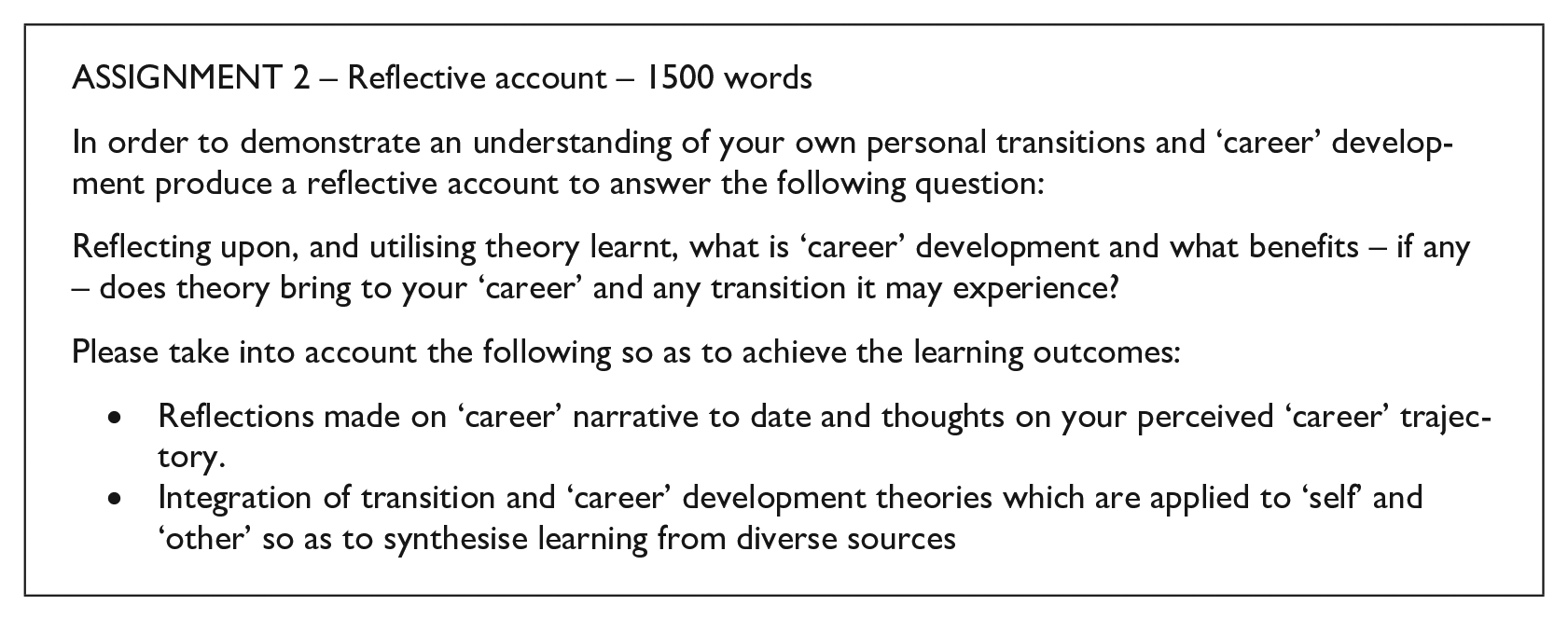
The pedagogy informing the completion of the assignment was influenced by McCash’s (2006) ‘career studies’ approach to ‘employability’. McCash is keen to challenge the ‘folk theory’ of employability influenced via the vista of Law and Watts’ (1977) Decision Making, Opportunity awareness, Transition and Self-awareness schema (commonly known as DOTS). DOTS provides a model of practice, sketching a schema for the student to follow, where the student is to match aspects of the self with opportunity knowledge so as to make well informed decisions to aid smooth transitions. McCash highlights how DOTS links to a particular moment in history, within the industrial age, where the matching of individual characteristics and opportunities was more robust and predictable compared to the fluidity of the labour market experienced in late modernity and a post-industrial society (Bauman, 2007). McCash asserts how rather than students being positioned to solely concentrate on skills to be promoted for employability, and the following of a dogma to ‘choose’ and gain a desired ‘opportunity’, which is the focus of DOTS, it is more useful for the student to be placed in the position of ‘career researcher’. In this position the student has more agency to focus on aspects of career development that interest them, informed by a range of career development theory (Gee, 2019; Collin, 1996; Holland, 1997; Law, 1981; Super, 1980, 1994) as well as social theory (Beck, 1992; Friedman and Laurison, 2019; Giddens, 1991; Goffman, 1961; Roberts, 2009, 2018) with a connection with their home study (Haines and Case, 2015, 2018; Muncie, 2008, 2011; Stephenson et al., 2007).
The pedagogy to aid this reflective task was framed via a duality framework of important concepts found within career development theory and a range of social theory literature exploring transition (see Gee, 2017). Duality here is presented as a ‘conceptualisation of reality that provides a paradoxical relationship between opposing yet entwining dual entities’ (Gee, 2017: 187). For this project the dualities framing exploration of career were self and other, agency and structure and being and becoming. This framework was to aid the student’s scrutiny of their own career development, where a range of theory was introduced as content within the duality framework to aid personal inquiry. As part of the student reflexive inquiry, they were provided opportunity to operationalise ‘career’, where a range of definitions and perspectives were provided (see Gee, 2016). Of note here is the inclusion of the Chicago School of Sociology. 1 This was included due to the school’s inquiry of ‘careers’ at the fringes of society as well those of a deviant nature, resonating with the home discipline of study, youth justice. The Chicago School thus moves the vista of career out of work centric and overly agentic forms found within everyday discourse (see Gee, 2022; Barley, 1989; Frayne, 2015; Mignot, 2001; O’Doherty and Roberts, 2000; Osipow, 1983; Roberts, 2009).
With career being viewed as any social strand in a person’s life, where an exploration of self and other, agency and structure and being and becoming are initiated, the likelihood is that significant moments become reflected upon. These moments are ones that become traced within memory, as they are likely to be moments where an individual’s ontological security is placed under threat (Giddens, 1991). These moments, what Giddens describes as fateful moments, are moments where a person’s sense of self becomes questioned, where the normal path of life becomes disrupted and where the business as usual can no longer follow predictable patterns. Therefore, transition becomes a marker upon life narrativisation, scaring the personal story and stories of the self-reflexive project (Giddens, 1991), where transition can be seen as episodes where an individual, or group of individuals, are to contemplate the paradoxical relationship between being and becoming (see Gee, 2017). Therefore, the duality framing of the pedagogy encouraged explorations of subjective experiences of society, to consider these from diachronic as well as synchronic perspectives. The framework thus provokes articulations of a paradoxical nature where an important unanticipated theme emerged, the paradoxical nature of gift and economy.
Gift and Economy and the Emotional Economy of Care
As already highlighted by Gee (2020) the duality of gift and economy can provide a useful lens upon youth work practices and the argument here is that this also translates into the field of youth justice. This section provides insight into this duality, which might be unfamiliar to the reader, leaning on the work of Derrida. Derrida suggests that the giving of a gift is impossible, as the gift is always annulled and tainted. When the ‘gift’ is given, there is always a sense left that the gift must be returned in some way, that the receiver is somehow in debt to the giver. A ‘thank you’ on receiving a gift, although ‘good manners’, provides a return, that it in some way pays semblance to the gift given. Derrida also points out that a gift may well have the intention of a return, this therefore provides an economy, not the veneer of a gift that may well be espoused. Gifts can also be seen as an act of self-righteousness, the giving to prove a point or show off, again, making the gift null and void as it quickly becomes subsumed into a circular economy, a sense of equal exchange (Derrida, 1992).
The ‘gift’, for it to ‘exist’, must tend towards the breaking of the cycle of economy, to provide a ‘moment of madness, to do something for once without or beyond reason, in a time without time, and to give without return’ (Derrida and Caputo, 1996: 144), making the ‘gift’ compelling and ‘desirable’. What becomes of interest here is how the ‘gift’ might relate to youth justice practice, or anticipation of practice, a desire for such practice in the future. The consideration here is how the giving of ‘care’ within practice may be viewed as a ‘gift’ yet, at the same time, is providing a form of economy, an emotional economy of care.
This section therefore invites a consideration of such a duality when reading career articulation, especially for the sample in this study where care is a focus of concern, acknowledging that youth justice has always recognised those they work with as young people in need of care as well as offenders (Eadie and Canton, 2002). Care is thus to be viewed as a complex phenomenon one which provokes contradiction, tension and paradox as outlined by Tronto: When people recognize that care is a complex process with many components, it becomes possible to avoid either despairing about care or romanticizing it. Care is more likely to be filled with inner contradictions, conflict, and frustration than it is to resemble the idealized interactions of mother and child or teacher and student or nurse and patient. Tronto (1993: 17)
Care therefore is difficult, when considered via Derridean thought, if not impossible to be in the form of a ‘gift’ – a purely altruistic act – as it will likely expect and call for a return, whether via an overt fiscal payment or via some form of emotional economy. This article will now provide insight into the research methodology of the project, to give detail of how the pedagogical artefacts were analysed, utilising the duality framework already announced to consider the artefacts from inductive as well deductive angles.
Methodology to Analyse Participant Case Studies – Pedagogical Artefacts Revealing Insightful Career Articulations
The assignments are analysed via Gee’s (2017, 2019) duality framework. The major dualities utilised to initially read the artefacts are self and other; agency and structure; and being and becoming (see Gee, 2017, 2019, for more detail). This provides an inductive form of analysis to see how the student articulates their own reading of such dualities. As indicated in previous research (Gee, 2017; Gee, 2019; Gee, 2020; Mignot and Gee, 2020) the use of such a duality framework provides useful insights into career articulation, exploring where there are tensions and paradoxes prominent in the text, where emergent ‘overarching paradoxes’ become deduced. It is to be acknowledged here that this deconstructive approach is not asserting that there is ‘One’ reading in which to be found ‘underneath’ the text, rather, that there are multiple readings, where the researcher provides a particular reading to inform the literature, based upon the literature review already announced (Caputo, 2000). What becomes apparent in this study is how the initial dualities espoused opened up a fourth duality that provides insightful readings of the sample, the duality of gift and economy linking to an ‘emotional economy of care’.
Completion of the ‘Reflective Worksheet’ provides accounts of the participant career, a theoretically informed form of autobiography and articulation. It is important to note that such accounts are pedagogically framed and therefore the documents analysed are viewed as artefacts of the pedagogy enacted, where the participant plays the role of student, providing an articulation of career as a lived experience layered with theory, their own interpretation and utilisation of theory (Gee, 2019). The artefacts analysed therefore provide a synchronic snapshot of career articulation, an articulation that is academically framed to demonstrate learning. Such accounts, although pedagogically framed, still provide insight into both the participant’s personal world, via multiple perspectives, that also acknowledges the role of student, and how this relates to the locale and wider socio-political context in which it is immersed and immerses (Roberts, 2002). While it is important to acknowledge how there is an element of academic performance here, previous studies have validated findings with participants from a longitudinal perspective (see Gee, 2019; Gee and Barnard, 2020; Mignot and Gee, 2020)
A purposeful sample of participants that resonate with cohorts found on the course is utilised (Yin, 2011). The course under scrutiny is one that heavily recruits female students, where the vast majority are the first generation to go to university, and also attracts a significant number of mature students, and provides cohorts that are consistently ethnically diverse. As the author is the marker of the assignments in the periods under scrutiny, they are extremely familiar with the major reoccurring themes that occur within the accounts. The purposeful sample here is to provide vignettes of what the author has consistently found and is considered significant to contribute to the literature. This small, yet detailed sample, consists of five students, four of which are female and one is male. Two students of the sample are from minority ethnic groups and one is a mature student, one of the students has an access statement of educational needs and four of the students are the first generation to go to university (characteristics that resonate with the cohorts found on the course). To illustrate the endurance of the findings, participants are taken from three cohorts, where the participants were first year students in the academic years of 2017/2018, 2018/2019 and 2019/2020.
Ethical research is a key component of any social research project where the wellbeing of the participants and sense of fair play is of upmost concern (Bryman, 2004; Henn et al., 2006, 2009; May, 2001). The research aspect of the project gained ethical approval from the Ethics Committee of the university where the study took place, the application of which provided details of the research undertaken, where consent was gained from the participants. The participants were contacted after the author had completed all teaching interactions with the students so that the participants would not feel under pressure to provide consent. The participants were informed that the extracts utilised in this article would be made anonymous to protect their identity. It is worth noting that all five participants provided willing consent and expressed gratitude in being asked to participate.
The project is to involve a form of double hermeneutics (Caputo, 2000), where the researcher’s interpretation of the participant own interpretation of their lived ‘career’ occurs. Given this scenario researcher reflexivity is of upmost importance. Therefore, this section has made apparent the process that has occurred to provide such interpretations. The article now moves towards providing voice to the participants and the researcher’s interpretations of these tracings to inform the literature.
Reflections upon Reflections
As mentioned previously the participants were provided an opportunity to engage with a range of social theory, youth justice and career development literature to inform a retrospective reading of career enactment to aid future career development. An important aspect of this form of pedagogy was to investigate their own operationalisation of ‘career’, an important phenomenon placed under academic scrutiny. The students were introduced to a range of perspectives, informed via the literature, which they clearly took on-board to embellish and challenge their own notions of career. This resulted in the vast majority of students broadening their perspectives on this phenomenon to introduce a life-wide as well as a lifelong diachronic analysis. Doing so the participants reflected upon how ‘career’ is both a sociological as well as a political concept, one that occurs in a social world, where the discourse of career may serve particular interests, in many articulations this relates to the serving of the capitalist class, illustrated by ‘Participant S’: The Oxford dictionary defines career as ‘the series of jobs that a person has in a particular area of work, usually involving more responsibility as time passes’. For the majority of my life, this was the definition that was the underlying foundation driving my execution towards my future. Before studying Youth Justice and dissecting the word, I refused to believe career was related to anything other than jobs and money . . . My comprehension of the word career has changed throughout my time at university and now my understanding is similar to that of Browne and Dylan (1981), in that career being defined as a job is a belief driven by capitalists, in order to drive the working class into believing they can achieve something beyond realistic means, and is a tool being used to manipulate them into maintaining status quo. (Participant S)
The above account provides a critical dimension to career to move it beyond the vista of paid work, to question its progress centric framing whist considering how the natural attitude serves particular interests. Participant G also demonstrates a broadening of career, via sociological dimensions, so that it can capture interconnecting strands important to the individual in this case family and education. Doing so the student provides a focused analysis, to scrutinise what is important to them: Erving Goffman (1961) suggests that career ‘encompasses an individual’s social strands’. (Gee, 2016: 7) This definition proved most applicable to my career as it allowed me to look at each area of my life as a ‘strand’ which influenced my choices. In looking at career from an agency perspective, education and family appeared to be the most prominent themes throughout my narrative. I will place the focus upon these two strands as they had the biggest impact on my career. Firstly, I will discuss my educational strand. (Participant G)
Broadening the analysis of ‘career’ allowed the students to consider how different facets of their lives interconnect and how ‘fateful moments’ (Giddens, 1991) in their lives left a significant memorial scar upon narrativisation, moments that provide a knock-on effect across the multitude of social strands of the life career. Such fateful moments influence future direction whether invited or forced upon them. It is important to acknowledge that there are a range of fateful moments that are reflected upon by the student body, moments that will be unique to the individual, however it is noted here that there are reoccurring fateful moments that the students, across the years, have reflected upon. Many of these are turbulent moments in life that are thrusted upon them, disturbing ontological security and sense of identity. The vignettes here have been chosen to highlight these reoccurring themes, to include divorce of parents, diagnosis of additional educational needs, experiences of racism, family bereavement and domestic abuse. The participants illustrate how they are able to theoretical inform their reflections of these significant moments to aid personal understanding, to not only consider their own private trouble but also how to utilise theory to acknowledge their connection to public issues (Mills, 1959): . . . my parent’s divorce was a fateful moment for me (Giddens, 1991: 13), which made me question my own worth and value. (Participant J) At the age of eight years, I was diagnosed with dyspraxia. This has affected my learning, causing difficulties with processing and memory. I struggled to keep up with the academic progress made by peers at primary school and at the age of nine the Local Authorities issued a Statement of Special Educational Need. This provided me with the funding enabling me to attend a specialist school. This was my first experience of transition, being moved from my peers and my local community school. (Participant G) For me, a fateful moment would be attending an all-white, predominantly Christian secondary school; this moment embarked a huge shift in my life as this was when I became aware of my Pakistani, Muslim identity and I suddenly realised I had a label. Labelling theory (Becker, 1963) notes how people make assumptions about others due to misinformation or generalising a ‘one fits all’ mindset . . . as much as I wanted to detach myself from the thought of being Asian, I knew that this strand was something I could never separate myself from, and my skin colour would never change, regardless of my behaviour. (Student S) As a child I frequently bore witness to my biological father violently attacking my mother, my earliest memory is indeed of one such event at the age of two. I believe that witnessing domestic violence and my mother accepting this aspect of her life led me to accept this in my own life. (Student L) . . . a significant transition that largely impacted my role as a daughter and also my own identity, was losing my dad when I was 17 years old. My dad made the decision to take his own life, following many years of not only battling addiction but also depression. (Student R)
The reflections recognise social position, how significant impactful moments in the past leave a trace upon identity and in turn career navigation, where aspects of identity interconnect with social structures and institutions. The student comes to acknowledge the influence of other upon career enactment, that being a situated actor means that the wider community can influence their own sense of self, agency and identity formation, providing a rich understanding of transitional processes and the paradoxical relationship between being and becoming and self and other (see Gee and Barnard, 2020; Gee, 2019). The reflections thus provide not only a memorialised synchronic snapshot of the life-career but also a consideration of how the past influences the ever slipping away present and crystalises anticipations of the future. What is apparent in the extracts below is how the students come to understand the fluid nature of the self and self-identity, how this is negotiated with other selves and predicaments, a self that has a temporal and spatial nature, with moments of significant change that connect with aspects of continuity: I can see that my life since the beginning has been affected by other people which has helped me fashion my own identity, when my identity experiences interruption that may force me to question and make uncomfortable choices, for example: how I felt about the relationship with my mother after her separation caused me to grow, my old identity dies and a new identity exists. (Participant J) I was encouraged by my parents to re-join a mainstream school at the age of 14. This was a difficult age to start at a busy local comprehensive; I knew nobody initially, feeling isolated. I would identify this as a particularly challenging transition as it meant rebuilding my educational and friendship strands. Here, ‘The Self and Other’ theory applies. This is a duality of my ‘past self’ and ‘new self’ entwined together. The transitional period of re-joining a mainstream school; enabled me to reconstruct my identity. This meant parting with the reflection of the old self in order to construct my new identity. (Participant G) To feel a sense of belonging, a young person must feel accepted by the people around them (Hitch et al., 2014); after a few years of battling with my own mind and my reality, I accepted who I was, in fact I reached a feeling of pride because I was different to the people around me. However, with this, came a sense of being without belonging therefore I still was not entirely satisfied with who I was as an individual. Higgins (1996) explored how there is an affiliation between negative experiences and motivation; because I knew I never wanted to feel the same way again, I felt the need to constantly push myself beyond the boundaries I had once restricted myself to. Instead of continuously feeling like I didn’t belong within my peer group, I detached myself and found a sense of belonging with God and my religion. (Participant S) I not only grew up in a working class family but went on to continue within the class structure, I did not access higher education as I never thought I was capable and worked in an office that needed only GCSE results to be employed. My class is something I hold dear to me, it is my morals, my beliefs and my very core being. My mother however did not, pushing, shoving, and fighting her way out, through looking at the hardships she faced I now wonder if this is due to her willingness to leave her previous life behind. (Participant L) During this time of my life [grieving the death of their father], many worries came into my mind surrounding not only my physical health but also my mental health. This had a large impact on my ontological security, as I now started to question who I am and who would I eventually be. (Participant R)
The student accounts therefore consider important dualities found within the career development literature, self and other, agency and structure and being and becoming (see Gee, 2019). Due to the broad and diachronic analysis invited the duality of gift and economy emerges. The surviving of turbulent live events experienced in early life yearn for a ‘giving back’, where such giving back is presented as a gift, though one that seeks an emotional return, an emotional economy of care. The venturing into the field of youth justice practice becomes an opportunity to provide such a return. The participant accounts highlight how turbulent experiences have enabled forms of ‘growth’, to provide skills and qualities dear to participant identity. These qualities can thus be utilised within a marketised higher educational sector to move towards a profession that will benefit from such qualities. The experiences, many of which could be described as victimhood, are converted to the vista of survival, linking to Nietzsche’s old adage of what doesn’t break you will only make you stronger: That period was difficult [separation of mother and father], and those interruptions were quite turbulent at the moment of happening, however, it remains to be one of the reasons for my choices in education; if those difficult moments had not occurred, I may not have decided to study at university [studying Youth Justice] and perhaps perused a job role that would have been a more suitable fit to the identity I may have had. (Participant J) This progression through higher education has led me to study a degree in youth justice. In looking to the future at my occupational prospects I am motivated to pursue a career in this field as I believe it would play to my strengths. The challenges I have faced have given me a strong level of empathy for young people experiencing adversity. This may challenge me as a practitioner, creating a ‘paradox’ as I will need to be aware and cautious that I don’t attempt to over-identify or ‘rescue’ people who are facing difficulties that are similar to my own experiences. This is a duality as my intentions although good, could be different to someone within the youth justice system. ‘The Department of Health conducted research with findings that over a quarter of children in the youth justice system have learning a disability’. (Newman et al., 2012: 6) They may have faced similar adversities such as learning difficulties, yet the fundamentals may be markedly different – if individuals did not receive the same level of family support. This challenge means I need to be self-aware and use my experiences while sustaining personal boundaries. (Participant G) I believe that a negative school experience has enabled me to have more compassion for other people which is why, at first subconsciously, I have had a clear ambition to work with young people. I believe strong family values and positive relationships between others can help a person to transition between different careers. Utilizing theory, such as labelling theory by Becker (1963), has provided me with the opportunity to reflect upon my experiences and understand how efficiently I have used my past experiences to transition throughout my identity and educational career. (Participant S) The process I had been through and being a survivor of domestic violence, the challenges I have faced due to my class and gender I believe allow me to help other individuals. My trajectory is still unclear, I am unsure as to where I will be best placed in a role in the community, but I am certain it lies with helping vulnerable young people. The experiences I have lived through with witnessing and being a survivor of domestic violence has provided me with an insight into a life that many others will not have experienced, giving me a strength and determination that I know I would not have if it was not for these transitions and part of my ‘career’. (Participant L) Therapy allowed me to talk about my thoughts and feelings I had been unknowingly storing . . . something I knew I could change was the path I wanted to take towards full time employment. Prior to losing my dad, I had hoped to eventually become an accountant. However, I had this change in my heart in which I felt like I needed to help people, in ways that my dad couldn’t be helped. From this sudden urge, I decided to stop my learning of accountancy, and instead decided a pathway of helping individuals who may have had similar upbringings to me, yet found themselves on the wrong paths in life. (Participant R)
These rich student accounts provide excellent illustration as to how a critical career studies approach can impact upon personal learning, where a broad pedagogy provides overarching learning that can aid reflections upon past events so as to inform future action and direction. The emotional economy of care becomes a striking motivation to pursue a youth justice course at university. Such a ‘choice’ links to future working aspirations, where the students can take their survival of turbulent life-events to both educational and labour markets to seek forms of capital to serve their community. Such a service provides an important contribution, to right some wrongs of previous personal experiences and ‘give back’ in some way, to not only the other but also the self.
Discussion and Conclusion
The reflections above provide insight into how those entering the youth justice field, in this case via a learning opportunity within a university setting, are situated actors, with different identity characteristics and experiences. While the participants provide unique stories in how they come to be on a youth justice course, what connects these stories is what is being described here as an ‘emotional economy of care’, where turbulent life experiences are endured and overcome to provide the status of ‘survivor’. Becoming a survivor provides a marker upon self-esteem, initially dented by such turbulent events, the survival process becomes seen as a strength that can be taken to the social mechanisms of education and the labour market to harness and utilise perceived attributes and expertise gained from life tribulations. Implicit within these accounts is that young offenders within the youth justice sector are ‘victims’ of circumstance, victims that require help and resources to overcome the turbulent positions they find themselves within. Youth is seen to be a lifecourse passage pregnant with opportunity, if only it can be guided towards overcoming turbulent terrain. The students therefore provide a giving back to the other to thus give back to the self, to address the turbulence of other to address the previously experienced personal turbulence that provides a sense of achievement, an emotional economy of care.
It is acknowledged that the study here provides a small yet detailed sample. With the sample being small it is acknowledged that the ‘findings’ cannot be generalised, however, they are detailed and rich enough to provoke questions for the readers of this journal to consider their own motivations for engaging with the youth justice milieu, whether it be practice, theory or research. It invites the question of whether other students that gravitate to youth justice courses, training and employment, have experienced similar circumstances, and whether practitioners may be motivated in similar ways to the students in this study. Given that current youth justice policy advocates for practice to be guided by the principle of ‘children first’ (YJB, 2019) and that the literature asserts the importance of being a critical reflective practitioner, it becomes important that practitioners, and those wishing to be so, consider their own motivations to enact such practice, how such personal desire is linked to the other. The emotional economy of care may link well to the guiding YJB principle of building children’s individual strengths and capabilities. The emotional economy of care appears to create a positive role model, someone that has survived turbulent experiences. If critically reflected upon such experiences can be utilised to provide meaningful collaboration with children and their carers (YJB, 2019). It is only through critical reflection, like that illustrated here, that practice can occur in a manner that serves the child rather than an unacknowledged yearning to serve one’s own emotional economy.
Therefore, this article advocates for future research in this area to not only include youth justice students but practitioners also. The argument here is that critical insights occur by viewing career broadly, via the Chicago school’s ‘life histories’, embraced by many sociological areas of criminology, connecting with the duality of gift and economy. Doing so allows for rich and revealing readings, to aid reflexivity, to provide insight into social position and motivation, a useful aspect to aid any practitioner’s reflective repertoire, including the youth justice professional.
Footnotes
Funding
The author(s) received no financial support for the research, authorship, and/or publication of this article.
