




Abstract
Equality is a fundamental principle, also in youth justice. Nevertheless, children from ethnic minorities, children with disabilities and children from low socioeconomic backgrounds are vastly overrepresented in youth detention populations across the globe. This article combines interdisciplinary theoretical perspectives and empirical findings from interviews with practitioners from two English youth courts to explore the meaning, perceptions and implications of the principle of equality in the specific context of the youth court. Ultimately, this article presents the first contours of a conceptual model of equality in the youth court, which aims to inform policy, practice and future research.
Introduction
It is estimated that on any given day, between 160,000 and 250,000 children 1 are deprived of their liberty in youth prisons and detention centres worldwide because they are accused or convicted of committing a criminal offence (Nowak, 2019). The populations of these youth prisons and detention centres typically consist of the poorest and most disadvantaged children in society (Goldson and Kilkelly, 2013; Webster, 2018). Overrepresentation of children from racial and ethnic minorities, children with disabilities and children from low socioeconomic backgrounds in detention is a reality in many youth justice systems across the globe (Bishop, 2005; Boon et al., 2018; Goldson and Kilkelly, 2013; Webster, 2018;Youth Justice Board, 2021).
Evidence suggests that the overrepresentation of these children in detention is partly due to disparities in youth court decision-making regarding pre-trial detention and sentencing (Armstrong and Rodriguez, 2005; Bishop, 2005; DeLone and DeLone, 2017; Guevara et al., 2006; Maroun, 2019; Rodriguez, 2010; Uhrig, 2016; Van den Brink et al., 2017). These findings are reason for concern: not only because detention has detrimental consequences for children’s well-being and future life chances (Goldson, 2009; Freeman and Seymour, 2010; Liefaard et al., 2014; Van den Brink and Lubow, 2019), but also because such disparities seem incompatible with the principle of equality.
Under the United Nations Convention on the Rights of the Child (‘UN CRC’; Art. 2), the principle of equality demands equal rights protection for all children, without discrimination of any kind. This fundamental principle is, in fact, an essential pillar of every youth justice system that adheres to the rule of law (cf. UN Committee on the Rights of the Child, 2003, 2019). Nevertheless, the normative question of what the principle of equality means and implies in the specific context of the youth court and how this principle is perceived by youth court practitioners on the ground is still surprisingly underexplored. This article aims to fill this gap by scrutinizing the meaning, perceptions and implications of equality in the youth court.
Using an interdisciplinary approach, this article starts with a general exploration of the underlying rationale and significance of the principle of equality as an overarching normative ideal, followed by an analysis of how the principle of equality relates to and interacts with other core principles in the specific context of the youth court. Subsequently, this article explores the perceptions of the principle of equality among youth court practitioners in two English youth courts. Informed by the theoretical analyses and the perspectives of the youth court professionals on the ground, this article ultimately aims to draw the first contours of a conceptual model of equality in the youth court and to explore its potential implications for policy, practice and future research.
Equality: An Overarching Normative Ideal
Equality is a fundamental human rights principle which is codified in many national constitutions and entrenched in several international and regional human rights treaties (cf. Arnardóttir, 2003; Besson, 2005; Farrior, 2015), including the almost universally ratified UN CRC. Article 2 (1) of the UN CRC obliges States to respect and ensure the rights set out in the Convention to each child within their jurisdiction, without discrimination of any kind, irrespective of the child’s or his or her parent’s or legal guardian’s race, colour, sex, language, religion, political or other opinion, national, ethnic or social origin, property, disability, birth or other status. This principle of non-discrimination is formally acknowledged by the UN Committee on the Rights of the Child (2003: para. 12) as one of the four ‘general principles’ of the UN CRC and aims to ensure children’s ‘equal access to [all] rights’ laid down in the Convention. In this regard, Arnardóttir (2003: 6–8) and Besson (2005: 434–435) note that under international human rights law, equality and non-discrimination are essentially two sides of the same coin: equality refers to the positive dimension of equality (i.e. promoting equal enjoyment of rights), while non-discrimination refers to the negative absence of discrimination, which forbids ‘treating differently similar situations without an objective justification’ to prevent unlawful impairments of rights-holders’ equal enjoyment of rights. The UN Committee on the Rights of the Child (2003) emphasizes that the application of the principle of non-discrimination (and/or equality) does not imply the identical treatment of all children. Instead, the UN Committee on the Rights of the Child (2003: para. 12) urges States to actively engage in identifying ‘individual children and groups of children the recognition and realization of whose rights may demand special measures’. Article 2 (1) UN CRC, thus, encompasses both the ideal of formal equality (i.e. ‘equal recognition of rights’, which underscores children’s equal entitlement to rights and safeguards) and the ideal of substantive equality (i.e. ‘equal realization of rights’, which may require children’s differential treatment to achieve equality of outcome) (see Abramson, 2008; Besson, 2005; cf. also Arnardóttir, 2003; Dowd, 2019; Farrior, 2015).
Equality, however, is not merely a (legal) human rights principle. A foundational concept that underpins various political, economic and sociological theories and related philosophical debates about morality, justice and fairness and equality is indeed an overarching normative ideal which has significance in many disciplines (cf. Arneson, 2013; Gosepath, 2011; Raz, 1978; Sen, 1992, 2009; Temkin, 1993, 2001, 2017). In the academic literature across disciplines, many divergent theoretical approaches to equality have been developed and proposed, leading to fierce debates about the conceptual justifications, meanings and implications of this notion. As Gosepath (2011) puts it, ‘In its prescriptive usage, equality is a loaded and highly contested concept’. In this regard, it should be noted that in some academic and popular discourses on social justice, a sharp distinction is made between the concepts of ‘equality’ and ‘equity’, as to which the first is narrowly defined as ‘treating everyone the same’, while the latter refers to equality of outcome requiring differential treatment of people dependent on their needs (see, for example, Maguire, 2016; cf. Dowd, 2019). This article, however, does not make this distinction, as it approaches ‘equality’ as a wider, overarching concept, which – as will become clear in the next sections – encompasses (dimensions of) both formal equality and substantive equality (cf. also Dowd (2019), who argues that equality includes equity).
Although it goes beyond the scope of this article to provide a comprehensive overview of the legal and philosophical debates about equality, it is worthwhile to raise three fundamental questions that emerge from these debates: (1) why equality? (2) equality among whom? and (3) equality of what? These questions and related viewpoints serve as starting points for exploring the meaning of the concept of equality in the specific context of the youth court.
Why equality?
A first question that sparked debates in the academic literature is, ‘Why does equality matter?’ Contesting the criticism that equality is ‘nothing more than an empty idea’ (cf. Westen, 1982), many theories of justice and fairness assert significance to the notion of equality (Arneson, 2013; Sen, 1992). Temkin (2001: 332) argues that it is important to distinguish between theories that value equality as dependent on the value of some other ideal it promotes (i.e. an instrumental approach to equality) and theories that recognize equality as ‘a distinct moral ideal with independent normative significance’ (i.e. a non-instrumental approach to equality). When taking a solely instrumental approach to equality, the question, ‘why equality?’ comes down to the question, ‘equality of what?’ (cf. Sen, 1992, 2009; see below). When deploying a non-instrumental conception of equality, however, the notion of equality also has value in and of itself.
According to Temkin (2001, 2017), the non-instrumental value of equality lies in what he calls the notion of ‘equality as comparability’. Moving beyond instrumental conceptions of equality, such as ‘equality as universality’ (i.e. the view that all principles must be universal in their application) and ‘equality as impartiality’ (i.e. the view that all people must be treated impartially), Temkin’s (2001: 334) notion of ‘equality as comparability’ is principally concerned with how people fare relative to others and is rooted in the idea that it is bad for some to be worse off than others through no fault or choice of their own. According to Temkin (2017: 45), this notion of equality as comparability ultimately boils down to a matter of ‘comparative fairness’, based on the rationale that ‘among equally deserving people, it is bad, because unfair, for some to be worse off than others through no fault or choice of their own’.
Overall, the argument that Temkin (2001, 2017) makes is that the notion of equality should be considered not only as a qualifying principle that serves to promote the realization of other ideals (cf. Besson, 2005: 435), but also as an independent substantive ideal that has value in and of itself. Importantly, these two valuations of equality are in my view not necessarily incompatible. Temkin’s (2001, 2017) notion of ‘comparative fairness’ incorporates the substantive value that the principle of equality has in and of itself, but also implicitly recognizes its instrumental value, since assessing whether, for instance, youth court decisions are ‘comparatively fair’ will also depend on how the components ‘equally deserving people’ (cf. ‘equality among whom?’) and ‘being worse off’ (cf. ‘equality of what?’) are measured and judged.
Equality among whom?
When looking at ‘interpersonal equality’ (Sen, 1992) or ‘equality as comparative fairness’ (Temkin, 2017), a second fundamental question that should be raised is, ‘equality among whom?’ This question relates to the diversity of people (and, in the context of youth justice, the diversity of cases) and essentially boils down to the question of comparability of people (or cases), as well as to the possible justifications of differentiation between people (or case dispositions). For example, assessing the comparative fairness of a sentencing disparity between a 17-year-old who is found guilty of murder and is sentenced to custody and a 12-year-old convicted of shoplifting who received a community sentence does not make much sense. Besides, even if such a comparison is made, there is a clear and objective justification for this sentencing differentiation to be found in the differences in both the offence severity and the defendant’s age. Equality analyses should, thus, focus on comparative fairness among children who appear before the youth court in (roughly) similar cases and circumstances (cf. Besson, 2005: 435).
However, assessing the comparability of children and cases is not necessarily straightforward, given – what Arnardóttir (2003: 30) refers to as – ‘the normative indeterminacy of the construction of sameness and difference’. Sen (1992) rightfully points out that there are diversities and similarities in many kinds and on multiple levels and that it is undoable to take into account all the diversities and similarities that exist among people. Therefore, Sen (1992: 117) suggests that in the analysis and judgement of equality, discretion is required to disregard some diversities and similarities and to concentrate on the most important ones, which ultimately comes down to the question, ‘What are the most significant diversities [and similarities] in this context?’ The next section will explore this question further in the particular context of the youth court, but not before raising a third – and related – question: equality of what?
Equality of what?
A third fundamental question regarding the concept of equality – particularly related to its instrumental value – is, ‘equality of what?’ According to Sen (1992, 2009), this is the most fundamental question when it comes to the evaluation of equality. In his ground-breaking book, Inequality Re-examined, Sen (1992: 1) starts his analysis of the concept of equality from the premise that the idea of equality is faced by two different types of diversities: (1) the basic heterogeneity of human beings, and (2) the variety of variables in terms of which equality can be measured and judged. Sen (1992: 1) points out that these two types of diversities are strongly related, as human diversity leads to divergences in the evaluation and judgement of equality in terms of different variables, which adds significance to the question, ‘equality of what?’
According to Sen (1992), the judgement of equality boils down to a comparison of some particular aspect of a person (such as liberties, rights or opportunities) with the same aspect of another person. This means that the evaluation of equality is highly dependent on the choice of the variable in terms of which comparisons are made. Sen (1992: 2) calls this the ‘focal variable’ – the variable on which the comparative analysis focuses. Establishing equality on the basis of one variable, however, may not coincide with equality in the scale of another variable, due to interpersonal differences among people.
Sen (1992) emphasizes that the wide variety of possible focal variables to assess interpersonal equality (that is, the relative advantages and disadvantages that people have) makes it necessary to face, at a very elementary level, a hard decision regarding the perspective to be adopted. Overall, Sen’s (1992: 20) conceptual reflections reveal that the choice of – what he calls – the ‘evaluative space’ (that is, the selection of relevant focal variables) is crucial to analysing equality. This choice of ‘evaluative space’ will largely depend on the context in which equality is measured and judged, which underscores that the meaning of the concept of equality is very much shaped by the particular context in which it operates, as we will explore further in the next section.
The Principle of Equality in the Youth Court
Youth justice systems are designed to regulate state responses to criminal offences committed by children who are above the minimum age of criminal responsibility (cf. Goldson, 2018; Zimring et al., 2015). In this context, youth courts are judicial institutions that play a key role in, inter alia, bail and pre-trial detention decision-making and in the adjudication and sentencing of children and young people (cf. Feld, 2018). Youth courts, however, operate within societies that are riddled with structural inequalities – often along the lines of race and ethnicity, gender, class and disability – across multiple interlocking systems, including education, employment, health care, housing and law enforcement (cf. Dowd, 2018; Piketty, 2020; Saito and Kinnison, 2020; Webster, 2018). These structural inequalities can and do deeply affect children’s daily lives and future life chances and significantly increase the likelihood of the most disadvantaged children ending up before the youth court disproportionately (Dowd, 2018; McAra and McVie, 2018). Consequently, children do not enter the youth court from a level playing field and will not return to a level playing field after their youth court involvement either (cf. Johnstone and Leacock, 2010). This reality profoundly complicates the exploration of the meaning and implications of the principle of equality in the operation and decision-making of the youth court.
Having said this, exploring the meaning of the principle of equality in the context of the youth court requires a thorough understanding of equality alongside and in connection to other fundamental principles and demands of the youth court. Therefore, this section will combine penological, developmental and children’s rights perspectives to explore equality’s (inter)relation to four other core principles (or paradigms) that are widely recognized as fundamental for the administration of the youth court, internationally (cf. Dünkel, 2015; Feld, 2018; Forde, 2018b; Van den Brink, 2019) as well as specifically in England and Wales (cf. Goldson, 2020; Smith and Gray, 2019), namely, (1) proportionality, (2) due process, (3) welfare and (4) risk. These four core youth justice principles will be used as guidance to select the most significant ‘focal variables’, as to which equality can be measured and judged in the youth court (cf. Sen, 2009). In doing so, this section aims to develop various parallel definitions of the principle of equality, which together form an ‘evaluative space’ for equality in the context of the youth court (Sen, 2009).
Proportionality
In most Western jurisdictions, the justification for imposing youth justice interventions is to be found in the suspicion or conviction that a child has committed a criminal offence for which she or he can be held responsible (Cipriani, 2009; Weijers, 2016). The imposed youth justice interventions, in turn, should be proportionate to the crime and the blameworthiness (or culpability) of the child (Steinberg, 2017; Von Hirsch, 2001; Weijers, 2017a). Although originally rooted in the retributivist ‘just deserts’ philosophy (Canton, 2017; Von Hirsch, 2017), the principle of proportionality has also found its way into international children’s rights law, which dictates that youth justice interventions should be proportionate to the offence and the circumstances of the child (Art. 40 (1) UN CRC).
The principles of proportionality and equality are strongly intertwined. First, because the notion of consistency is an integral part of both principles (Canton, 2017; Hayes, 2016; Wandall, 2006). Both proportionality and equality demand that, as a starting point, children who are convicted of an offence of equal seriousness should receive a sentence of similar severity or intrusiveness (Von Hirsch, 1990, 2017). This ideal of ‘ordinal proportionality’ is an important underlying principle of many sentencing guidelines, developed in various jurisdictions to enhance consistency in sentencing (Canton, 2017; Von Hirsch, 1990).
Second, both proportionality and equality call for a categorical differentiation between children and adults when it comes to criminal justice responses (Steinberg, 2017; Von Hirsch, 2001). Developmental and neuroscientific evidence suggests that children, compared with adults, are inherently more impulsive, more susceptible to peer pressure, more likely to engage in sensation-seeking, more likely to attend to the potential rewards of a risky decision than to the potential costs and less likely to consider the long-term consequences of their actions, which altogether diminishes their culpability in criminal justice (Steinberg, 2017; cf. also Grisso and Schwartz, 2000; Grisso et al., 2003; Scott and Steinberg, 2009; Steinberg and Scott, 2003). Besides, the experienced impact of a sentence or other criminal justice intervention, especially when it involves deprivation of liberty, will generally be more onerous when imposed on a child compared with an adult (Von Hirsch, 2001; see also Nowak, 2019). Thus, equally proportionate sentences and other justice interventions for children should, in terms of intrusiveness, be categorically scaled well below sentences and interventions for adults (Steinberg, 2017; Von Hirsch, 2001).
Third, both principles demand individualization among children and their specific cases and circumstances, which is in the context of sentencing often framed in terms of mitigating and aggravating factors (cf. Lovegrove, 2010). Such individualization at the interface of proportionality and equality requires (1) differentiation on the basis of the actual harm caused by the offence (which goes beyond the mere legal qualification of the offence), (2) differentiation on the basis of the individual child’s culpability and (3) differentiation based on the impact of the sentence or other intervention on the individual child (cf. Canton, 2017).
Taking this into account, integrating the principles of proportionality and the principle of (interpersonal) equality, one could come to a first contextual definition of ‘equality as comparative fairness’ (cf. Temkin, 2017) in the youth court:
I. If defendants A and B both appear before the youth court after committing a similar offence, causing similar harm to victims and society and are equally culpable, it is comparatively unfair if A is worse off than B (or vice versa) in terms of the intrusiveness of the sentence or other imposed intervention.
In this definition,‘[the proportionality of] the intrusiveness of the sentence or other imposed intervention’ is the focal variable, as to which equality is judged or measured (cf. Sen, 1992). When it comes to determining or measuring the intrusiveness – or ‘penal impact’ – of a sentence, Hayes (2016, 2020) suggests – with reference to Crewe (2011, 2015) – that one should take into account not only the length of a sentence, but should also its ‘depth’ (i.e. its intrusiveness in relations with family and the wider community), ‘weight’ (i.e. its psychological oppressiveness), ‘tightness’ (i.e. the level of control and surveillance) and ‘breadth’ (i.e. the extent to which it impacts and soaks everyday life).
Due process
Defendants who appear before the youth court are entitled to a due process: they have the right to a fair and effective procedure and trial, which encompasses various legal safeguards which are laid down in, inter alia, Article 40 (2) UN CRC and Art. 6 European Convention of Human Rights (ECHR). These due process safeguards include, among others, the right to be presumed innocent until proven guilty, the right to be informed promptly and directly of the charges, the right to be tried without delay before an independent and impartial court and the right to legal assistance (Art. 40 (2) UN CRC; Art. 6 (1) ECHR) and the right to effective participation in the procedure (ECtHR T. and V. v. the United Kingdom, 1999). From both a due process and an equality perspective, these fair trial rights should be universally applicable to all defendants. Moreover, all defendants should be equally enabled to effectively exercise their fair trial rights and to participate in the proceedings. This requires, first of all, that children in criminal procedures are treated in a different manner than adult defendants. Second, it requires individual differentiation among young defendants in the youth court.
While child and adult defendants are both equally entitled to a fair trial (Art. 6 ECHR), the European Court of Human Rights (T. and V. v. the United Kingdom, 1999; S.C. v. the United Kingdom, 2005; Panovits v. Cyprus, 2008) and the UN Committee on the Rights of the Child (2019) acknowledge that children require specific safeguards to ensure that they can effectively exercise their rights and participate in the procedure (Forde, 2018a; Rap, 2013, 2016). This premise is supported by an increasing body of knowledge about how children’s developing cognitive abilities (i.e. capacity to understand) and maturity of judgement (i.e. capacity to make grown-up decisions) impact their capacity to effectively participate in a criminal procedure (Feld, 2012; Grisso, 2000; Grisso et al., 2003; Liefaard and Van den Brink, 2014; Rap, 2013, 2016). Both developmental insights and children’s rights standards dictate that an equal enjoyment of due process rights for children in criminal proceedings requires, among others, the use of child-friendly language, assistance by a specialized lawyer, involvement of parents and more informal court hearings behind closed doors (cf. European Guidelines for Child-Friendly Justice, 2010; EU Directive on procedural safeguards for children in criminal proceedings, 2016; UN Committee on the Rights of the Child, 2019; see also Rap, 2013, 2016).
At the same time, it should be noted that there are large differences between individual children when it comes to their capacities to effectively participate and exercise their rights during youth court proceedings (Rap, 2016). This is especially true since many children who appear before the youth court suffer from learning difficulties, speech and language difficulties, mild intellectual disabilities, mental or emotional problems and/or trauma (Office of Juvenile Justice and Delinquency Prevention (OJJDP), 2017; Van den Brink et al., 2017; Simak, 2018). Moreover, children who appear before the youth court are from diverse social and cultural backgrounds (Webster, 2018). Equality in terms of effectively exercising due process rights in the youth court therefore also requires an individualized, tailored approach, informed by a thorough assessment of the individual capacities and vulnerabilities of the child and her or his social and cultural particularities.
This forms the basis of a second contextual definition of ‘equality as comparative fairness’ (cf. Temkin, 2017) in the youth court, with ‘effective enjoyment of due process rights’ as its focal variable (cf. Sen, 2009): II. If defendants A and B both appear before the youth court, it is comparatively unfair if A is worse off than B (or vice versa) in terms of the effective enjoyment of their due process rights during the court proceedings.
Welfare
Rooted in the rise of the welfare state in Western societies in the late 19th century, many contemporary youth justice systems still embrace the notion of ‘welfare’ as one if its overarching principles (Dünkel, 2015; Feld, 2018; Garland, 2001; Hazel, 2008; Trépanier and Rousseaux, 2018; Van den Brink, 2019). The welfare principle in youth justice centres around the ideal of rehabilitation and reintegration of young offenders through individualized, ‘needs-based’ and treatment-oriented youth justice interventions ((Dünkel, 2015; Feld, 2018; Garland, 2001; Hazel, 2008; Trépanier and Rousseaux, 2018; Van den Brink, 2019). Originally, the welfarist approach to youth justice was driven by a rather paternalistic attitude towards children and young people (Feld, 2018; Trépanier and Rousseaux, 2018) and was defined by the view that youth justice interventions primarily serve to ‘save’ troublesome children and young people from a life of depravity and crime through treatment and correction (Feld, 2017; Hazel, 2008). This paternalistic narrative portrayed children as objects of protection rather than subjects of rights (Weijers, 2017b), which could easily result in youth justice practices that disproportionately affected socially disadvantaged children who were subjected to lengthy and intrusive interventions ‘for their own good’, regardless of whether they had committed only minor crimes (cf. Platt, 1969).
Although paternalistic tendencies are still visible in youth justice practices today (Christiaens, 2015; Van den Brink, 2019, 2021a), the welfare principle has become more ‘rights-based’. Under the UN CRC, the child’s welfare (or ‘best interests’; cf. Art. 3) is considered to be best served by full compliance with the rights of the child laid down in the convention. According to the UN Committee on the Rights of the Child (2013), the ‘best interests of the child’ cannot be used as a justification for side-lining the child’s fundamental rights, which includes due process rights and the principle of proportionality in youth justice (see above).
Moreover, the welfare principle in youth justice has become increasingly informed by a growing body of knowledge about child development (cf. Feld, 2018). Neuroscientific and developmental psychological evidence have bolstered the premise that adolescence is a distinctive phase in the development of a child towards adulthood, during which children have specific needs, capacities and vulnerabilities that call for a specific and developmentally sensitive approach when dealing with children in the justice system (McGee and Moffit, 2019; Steinberg, 2017). Moreover, it has become clear that each individual child has its own developmental trajectory, which is shaped by the interaction between a child’s personal traits and the social environment in which she or he grows up (Dowd, 2018; Farrington et al., 2019; King and Maholmes, 2012). In light of this knowledge, the welfare principle demands youth justice interventions to be tailored to the individual child, on the basis of a thorough multidisciplinary assessment of her or his individual developmental needs, capacities and vulnerabilities (cf. also UN Committee on the Rights of the Child, 2019).
From this perspective, the welfare principle and the principle of equality in youth justice intersect in – what Dowd (2018) calls – the notion of ‘developmental equality’. This concept is grounded in the acknowledgement of the child’s needs, dependency and vulnerabilities, as well as their capacities and agency, and is principally concerned with their equality in terms of developmental opportunities (Dowd, 2018: 90). According to this notion, the youth justice system – as well as other interlocking systems, such as education, child protection and health care – should not sustain or generate inequalities and hierarchies among children, but should, instead, provide the necessary support to the ability of each individual child to reach her or his developmental potential (Dowd, 2018: 79). In the specific context of the youth court, this means that decisions and interventions should ideally provide equal opportunities for successful rehabilitation and reintegration to all children, to enable them to assume a constructive role in society in accordance with their individual developmental potential (cf. also Art. 40 (1) UN CRC).
Consequently, in line with the contemporary appreciation of the welfare principle in youth justice, Dowd’s (2018) concept of ‘developmental equality’ can provide a useful basis of a third contextual definition of ‘equality as comparative fairness’ (cf. Temkin, 2017) in the youth court, with ‘opportunities for successful rehabilitation and reintegration’ as its focal variable (cf. Sen, 2009): III. If defendants A and B both appear before the youth court and are subjected to youth justice interventions, it is comparatively unfair if A is worse off than B (or vice versa) in terms of support and treatment, tailored to her or his individual needs, dependency, vulnerabilities, capacities and agency, which is required to realize equal opportunities for successful rehabilitation and reintegration.
Risk
The prevention of reoffending is the overarching objective of the youth court in many jurisdictions (Hazel, 2008; cf. UN Committee on the Rights of the Child, 2019: para. 3). In most contemporary Western jurisdictions, this objective is inseparably connected to the notion of ‘risk’ (Case and Haines, 2016; Van den Brink, 2019). Parallel to the rise of the ‘risk society’ in the late 20th-century Western world (Beck, 1992), crime and criminals – including young offenders – have become more and more defined as ‘risks’ that should be managed to protect public safety (Feeley and Simon, 1992; Garland, 2001; Robinson, 2016). This development fuelled the widespread use of standardized risk assessment tools in many of today’s youth justice systems (Case and Haines, 2016; Cunneen, 2019).
A ‘risk-based’ approach, however, can be on strained terms with several fundamental principles of youth justice, such as due process, proportionality and – as this article’s primary concern – equality (Cole, 2007; Hudson, 2001; Van den Brink, 2019). When focusing on risk, socioeconomic and other disadvantages and vulnerabilities are easily framed as ‘risks’ and thereby become alleged justifications for more restrictive and intrusive youth justice interventions (Hudson, 2001; McIvor, 2016; Mauretto and Hannah-Moffat, 2007; Van Swaaningen, 1997). It has been pointed out by several scholars that risk-based approaches, including the use of risk assessment tools, often suffer from inherent biases, accumulate disadvantage and further the social exclusion of already marginalized children, thereby reproducing and deepening social inequality (Cunneen, 2019; Van Eijk, 2017, 2020). As Cunneen (2019) puts it, ‘the risk paradigm actively leads to greater criminalization of socio-economic disadvantage, and social and cultural disruption, further exacerbating the very conditions which gave rise to negative [risk] assessments in the first place’ (p. 14).
Against this background, Van Eijk (2020) argues for a more inclusionary usage of ‘risk’ in criminal justice, in contrast to exclusionary risk-based practices. Where risk-based decisions at the exclusionary end of the continuum deprive ‘high risk’ individuals from resources (e.g. by detaining them and focusing on incapacitation rather than treatment and support), risk-based practices at the inclusionary end of the continuum combine high-risk levels with access to resources, for example, by prioritizing ‘high risk’ individuals for treatment and support and by using risk assessments to inform treatment, education and support plans (Van Eijk, 2020: 1089). Moreover, McIvor (2016) points out that individuals’ high-risk levels should not be separated from the broader social context of their lives. She proposes that instead of focusing on the risks posed by individuals, attention [sh]ould shift to the risks experienced by them, and intervention [sh]ould aim to ameliorate the socio-structural factors that constitute individual riskiness rather than on the decisions made by the individuals themselves. (McIvor, 2016: 87)
In essence, these proposals attempt to integrate the risk-oriented approach and the welfare-oriented approach by addressing individuals’ needs and the risks experienced by them as a way of prevention of reoffending. This approach also seems to be in line with the children’s rights perspective, outlined by the UN Committee on the Rights of the Child (2019: para 3), which states that the preservation of public safety as a key objective of youth justice is best served by a children’s rights compliant system that promotes the child’s reintegration and assumption of a constructive role in society (cf. Art. 40(1) UN CRC). Moreover, these more inclusive, socially sensitive and welfare-oriented conceptualizations of risk seem to better align with the principle of equality and fit well with the abovementioned third (III) contextual definition of ‘equality as comparative fairness’ in the youth court, with ‘opportunities for successful rehabilitation and reintegration’ as its focal variable.
An ‘evaluative space’ for equality in the youth court
Overall, this section has distinguished three relevant ‘focal variables’ to measure and judge equality in the particular context of the youth court: (1) the (proportionality of the) intrusiveness of the sentence or other imposed intervention, (2) effective enjoyment of due process rights and (3) opportunities for successful rehabilitation and reintegration. Together, these focal variables form – what Sen (1992, 2009) calls – an ‘evaluative space’ for equality in the youth court. Yet, as Sen (1992, 2009) points out, pursuing equality on the basis of one variable may not coincide with equality in the scale of another variable, due to interpersonal differences among people. In the context of the youth court, for example, equal opportunities for children to successfully rehabilitate and reintegrate in society and to abstain from future reoffending might require very unequal levels of intervention, including unequal interferences with liberties and rights, because different children have different needs and risk factors that should be addressed to achieve equal opportunities for successful reintegration and prevention of reoffending. Consequently, following the principle of equality, youth court decision-makers have the complex task of striking a balance between the different focal variables and should strive to make decisions that are, overall, procedurally, substantively and comparatively the most fair.
Perceptions of Equality Among Youth Justice Practitioners: A Case Study of Two English Youth Courts
The previous sections have explored the principle of equality in the youth court from theoretical perspectives. In this section, we will have a closer look into how youth court practitioners on the ground perceive the principle of equality in their daily work, based on the findings of an explorative qualitative empirical case study research in two English youth courts. After briefly introducing the policy context of the study and its methodology, three dimensions of equality in the youth court will be distinguished on the basis of the perceived meaning of equality among youth court practitioners.
Equality in youth justice policy in England and Wales
In England and Wales, the principle of equality is formally acknowledged as a fundamental principle in criminal and youth justice laws and policies. Under the Equality Act (2010), the Ministry of Justice (MoJ) has a statutory duty to conduct an equality impact analysis for all its criminal and youth justice policy proposals, which assesses the potential equality impacts of these proposals on offenders’ protected characteristics, including ethnicity, gender and disability (cf. MoJ, 2020a). Furthermore, the Judicial College (2020) has drafted a 427-page ‘Equal Treatment Bench Book’ which aims to inform, assist and guide judges and magistrates in their duty to safeguard a fair and equal treatment for all defendants in court. Moreover, the Sentencing Guidelines for Children and Young People (Sentencing Council, 2017) dictate that judges and magistrates should take into account the particular vulnerabilities and needs that are related to children’s protected characteristics in their sentencing exercise.
In recent years, specific policies have been developed to address the disproportionality of Black, Asian and Minority Ethnic (BAME) individuals in the criminal and youth justice system. In 2016, the MoJ (2017b) launched the ‘Race Disparity Audit’ to systematically collect data needed to identify racial disparities, also in the criminal and youth justice system. Moreover, an independent review into the treatment of and outcomes for BAME individuals in the criminal justice system (Lammy, 2017) has led, among others, to the adoption of the ‘Explain or Reform’ principle (MoJ, 2017a). According to this principle, data showing inequalities in criminal justice decision-making have to be properly explained by the responsible authorities. When an adequate explanation and justification is lacking, reform is required.
When it comes to formally acknowledging and addressing inequalities in the criminal and youth justice system through official policy strategies, England and Wales are seemingly ahead of many continental European countries, where such policies do not exist and where particularly addressing issues of race and ethnicity is – for historical and legal reasons – still very much a taboo in the official discourse (Webster, 2018; cf. Boon et al., 2018; Van den Brink, 2018). At the same time, it should be noted that also in England and Wales, despite its official policy discourse, BAME children are still vastly overrepresented in the youth custodial population (MoJ, 2020b; cf. Gibbs and Ratcliffe, 2018; Youth Justice Board, 2021) and that, according to the Justice Committee (2019), the implementation of the Lammy Review’s recommendations still leaves to be desired.
Methodology
This section explores practitioners’ perceptions of equality in the youth court on the basis of semi-structured interviews with 25 youth court professionals from two Magistrates’ Courts in a big city in England. The interviews were conducted late 2019 and early 2020 in the context of a larger qualitative empirical study on remand decision-making in youth courts (see Van den Brink, 2021a, 2021b). With the permission of the MoJ, Her Majesty’s Courts and Tribunals Service (HMCTS) and the Crown Prosecution Service (CPS) and the informed consent of the respondents, the author interviewed court legal advisors 2 (n = 8), prosecutors (n = 4), defence lawyers (n = 6) and Youth Offending Team (YOT) officers 3 (n = 7). 4 These actors play pivotal roles in the administration of the youth court (cf. Staines, 2015).
The interviews were conducted individually, 5 face-to-face and in person 6 and lasted between 45 minutes and 2 hours, with an average length of 1 hour and 15 minutes. The interviews have been audio recorded, transcribed and thematically coded and analysed. During the interviews, the respondents were asked to reflect on the principle of equality in the youth court, partially in response to two vignettes (i.e. fictional youth court cases) that were presented to them at the beginning of the interview. More particularly, the respondents were asked about their views on whether and how diversities such as gender, disability, socioeconomic disadvantage and ethnicity (should) play a role in the administration and decision-making of the youth court.
The interview respondents themselves consisted of 80 per cent females and 20 per cent males. Moreover, 52 per cent of the respondents could be classified as White, while 48 per cent could be classified as having a Black Asian or Minority Ethnic (BAME) or Mixed background. All respondents work or regularly appear in the youth court of one of the two selected Magistrates’ Courts. The two courts are based in ethnically diverse urban areas, which is also reflected in the diversity of the young defendants who appear before the youth court.
Dimensions of equality in the youth court
The empirical case studies in the two English youth courts shed light on the perceived meaning of the principle of equality in the practice of the youth court. The interviews with legal advisors, prosecutors, defence solicitors and YOT officers reveal that despite interpersonal differences in perceptions, three interrelated dimensions of equality can be distinguished in the context of the youth court: (1) equality as fairness, (2) equality as access and (3) equality as belonging.
Fairness
First, many interview respondents – particularly those with a legal background (i.e. the legal advisors, prosecutors and defence lawyers) – associate equality in the youth court first and foremost with ‘fairness’. When asked to reflect on the meaning of the principle of equality in the youth court, many respondents explicitly or implicitly refer to ensuring equally fair procedures and decision-making outcomes for all children.
Some respondents associate equality primarily with – what Temkin’s (2001, 2017) calls – ‘universality’ and ‘impartiality’. In other words, they highlight that equality requires that the same principles and decision-making structures apply to all children and that there is no room for prejudice and bias in the youth court. As Legal advisor 7 explains: I would always say to the magistrates: we treat everybody the same. I hope that I treat everybody the same . . . I mean, everyone’s got prejudices. They have. But you leave them at the court room door and you follow the same [principled decision-making] structure for everybody. So everybody starts at the same place when they’re making that decision.
Other respondents highlight that equality requires first and foremost an individualized, tailored approach, especially in the youth court. Their conceptions of equality tie in with Temkin’s (2001, 2017) notion of ‘comparative fairness’ and Sen’s (1992, 2009) notion of ‘interpersonal equality’ as they start from the premise that equality cannot be realized without acknowledging and respecting human diversity. Illustrative is the response of Legal advisor 4 to the question what the principle of equality means in the youth court:
You mean the principle of equality and diversity. We treat everybody equally, we don’t treat everybody the same. That are two different things. If you treat everybody the same, chances are that the shirt that fits defendant A does not fit defendant B. We use the same principles, but we take each person’s circumstances into account. That’s why youth hearings take longer than adult cases, because the YOT usually has a lot of information to tell us.
Equality as comparative fairness thus implies that children receive tailored interventions, based on information about their individual circumstances. Other respondents highlight that a tailored approach is also required during the youth court procedure to safeguard the child’s effective participation during her or his trial:
It’s a bit of a silly word to call it ‘equal treatment’, because in a way it’s not equal, it’s more the differences that you have to highlight and pull out sometimes . . . I would tell my magistrates
[for example]: ‘this young person is 17, but has a learning age of 11. He may not be able to come across and engage with you in the way that you expect but that’s because . . . So you might want to adapt the way you speak to him’ . . . So, it’s not really about equality, it’s about the diversity of those who are in front of us, to tailor your whole approach to that person, because otherwise they are just not going to understand you. (Legal advisor 6)
Several respondents point out that differentiation in treatment and decisions in the youth court should be exercised only on the basis of individual circumstances related to the particular children and their cases. When asked whether wider group-level inequalities in society – for example, along the lines of ethnicity, gender and class – should be taken into account or even be perceived as a mitigating factor when dealing with an individual child from a disadvantaged social group in the youth court, few agree, but most respondents are reluctant or even strongly disagree. If ethnicity, gender or socioeconomic status of defendants is going to play a role in sentencing, ‘then you are’ – as Legal advisor 3 puts it – ‘entering dangerous territory’. Some YOT officers, however, sometimes include general contextual information and statistics about broader societal inequalities (e.g. in education) in their pre-sentence reports, ‘to highlight to the court that there is a wider issue beyond the particular child, which is affecting, for example, the child’s ethnic group’ (YOT officer 2). While some interviewed legal advisors, prosecutors, defence lawyers and YOT officers support the inclusion of such information in reports, others are not convinced of its added value or even express discontent. As one of the interviewed legal advisors argues, The report should be tailored to the actual person you are writing about and dealing with. The magistrates have to make a decision about this particular individual. I don’t see how general statistics could be helpful in this, because it has no bearing on what this boy has done and what his personal circumstances are. Again, people need to be treated fairly, so if somebody deserves a sentence because a certain offence he committed, he should get that sentence. We should not be thinking: because they are Black or whatever, I will not impose that sentence. I don’t agree with that at all. If the offence deserves a particular sentence, that sentence should be imposed, regardless of race, gender, etcetera. (Legal advisor 8)
Overall, ‘fairness’ seems to be generally perceived as an integral part of equality in the context of the youth court and is – explicitly or implicitly – associated with, inter alia, equally proportionate sentencing, equally effective participation of children in the procedure and equal opportunities to successfully reintegrate in society (cf. the focal variables distinguished in the previous section). According to the respondents, equality as fairness calls for a universal and consistent application of principles, rights and decision-making structures, the elimination of bias and prejudice inside the youth court as well as a tailored approach in which the child’s individual circumstances are taken into account. There is no consensus among the respondents as to whether and how wider societal inequalities should be taken into account in youth court decision-making.
Access
A second dimension of equality in the youth court that can be distinguished on the basis of the interviews with the youth court practitioners is ‘access’. When asked about the meaning of equality in the youth court, several respondents – particularly interviewed YOT officers – associate this principle primarily with access to, inter alia, services, information, procedures and opportunities. As YOT officer 6 puts it: I think it [equality] means giving all young people access to a fair and just system, access to information, access to opportunity, full well understanding that they’re not all from the same socioeconomic, ethnic, ability background. (YOT officer 6)
Several interviewed YOT officers highlight the importance of having a wide range of high-quality interventions and support services available – including mental health services, educational programmes, support networks and community-based alternatives to custody – that should be equally accessible for all children. As YOT officer 3 explains, In terms of equality, I mean everybody should have access to all the services. So, you wouldn’t discriminate somebody who needs a service and they should have equal access to it. But equality can also mean that you take an individual approach to it and take things on a case-by-case example. But you have got to have certain standards so that children get the same quality of service, in effect, but you take into account each individual child’s needs. So that wouldn’t mean that they are getting the same intervention as others, but they should have equal access to all the services they need. (YOT officer 3)
During the interviews, it is also pointed out that access to services, fair procedures and opportunities require access to information in understandable language. According to one of the interviewed YOT officers, this is an equality issue that requires particular attention in the youth court: Equality is what we are lacking quite in court, in terms of language. Many children in our youth justice system have communication difficulties. Yet, the way our system speaks to them is … we are using long words, using acronyms. That’s not equality. They are not having equal access to a service, because they probably don’t understand what you are saying. A lot of our job [as a YOT officer] is going outside the court room and explaining it in real English. I try to leave out the legal jargon and talk to them in a simplified way that they might understand.
Overall, equal access to high-quality services and understandable information is perceived as key for safeguarding an equally fair youth court procedure (cf. also access to legal assistance) and equal opportunities for all children to successfully rehabilitate and reintegrate in society. In the literature, Hawkins and Price (2002: 2) define access to services as ‘the social interface between services and the community’. This means, according to their definition, that equal access to services and information in the context of the youth court requires that services and information can ‘be obtained at a level of effort, and of monetary, opportunity and social cost, that is acceptable to and within the means of poor, marginalised and vulnerable people [i.e. children and parents]’ (Hawkins and Price, 2002: 2; cf. also MacDonald, 2012: 29).
Belonging
Third, the interviews with the youth court professionals reveal that perceptions of equality in the youth court go beyond notions of equally fair treatment and outcomes and equal access to services and information. Equality in the youth court is also perceived to have a deeper, personal layer related to (experienced) inclusiveness, understanding and connection. This layer of equality can be captured by the notion of ‘belonging’, which has been defined in the literature as the ‘commitment to not simply tolerating and respecting difference but to ensuring that all people are welcome and feel that they belong in the society’ (Powell and Menendian, 2016: 32). This involves ‘humanizing the other’ and rejecting and challenging negative representations and stereotypes (Powell and Menendian, 2016).
The importance of humanizing defendants in the youth court is stressed by several respondents during the interviews. Instead of looking at children as culpable offenders and dangers to society, one should see them first and foremost as human beings, more particularly as children, who are part of society (cf. ‘Children First, Offenders Second’; Haines and Case, 2015; Youth Justice Board, 2018). As one of the interviewed YOT officers explains, Most of our children [in the youth justice system] have faced real hardship. So instead of looking at them as just naughty, arguably they are just really disadvantaged, traumatized children. (YOT officer 7)
One of the interviewed defence solicitors highlights that humanizing young defendants requires that defendants can effectively present themselves as human beings (i.e. children) to the court. In this regard, this defence lawyer – as well as other respondents – is critical about the practice in which children in custody have to follow their hearings from a secure dock (i.e. a secure glass box) positioned on the side or in the back of the courtroom: [The dock] removes them from the proceedings. They [the magistrates] actually need to see the child in the well of the court, almost, to realise that they are small and vulnerable, and a person. I think it makes it easier to make persuasive arguments when a child is not in the dock. (Defence lawyer 5)
Also significant in terms of humanizing young defendants is, as an interviewed YOT officer points out, that all youth justice actors should avoid using stereotypical and stigmatizing language that puts a negative label on a child. This YOT officer observes that stigmatizing language disproportionately affects BAME children: What I notice in the system is the language used: the White boys are just White boys who commit offences all the time, but are never called a ‘gang’. The Black boys are always called a gang. Judges will always ask: are they in a gang? CPS and police say: they are in a gang. I don’t like language like that. I think we should stop saying ‘gang’. Because if you stop saying it, you have to say what you mean. And what you are then saying is: he has got a group of friends and they are all involved in similar activities. Because if you say: ‘he is in a gang’, he is labelled. The weight that that carries is so heavy in lots of decisions thereafter. So CPS is saying ‘he is gang-connected’, because the police is saying that, and then the judge takes it over. Tiny little things like that, language, can have a huge impact. I try to be very conscious with language in my own reports. (YOT officer 7)
Equality in the sense of belonging also demands, according to several respondents, that children’s diversity needs are taken into account in the youth court procedure, as well as in youth justice interventions and YOT supervision. As one of the YOT officers explains, there are diversity needs related to learning difficulties, mental health and family dynamics, but also in terms of cultural and ethnic needs that should be taken into consideration when working with a child: We consider diversity needs in supervision. We have to consider the basics, such as: ‘this is a BAME young person, what does this mean?; are we considering diversity needs?; are we considering cultural needs?’, and adapt intervention plans and approaches to that … BAME young people often have their own cultural values. So I have an Ethiopian client who only attends an Ethiopian church, so you might class him as Christian, but he actually only attends an Ethiopian church and the practices are a little bit different. So I have to take that into account. (YOT officer 2)
Furthermore, several respondents point out that equality in the youth court also requires a deeper level of inclusiveness, understanding and connection between the child and the youth court practitioners. According to these respondents, this calls for diversity of youth court practitioners, particularly within the bench. If such a deeper level of (experienced) understanding and connection is lacking in court, there is no equality in terms of ‘belonging’. This can negatively impact equality on multiple levels of the youth court procedure: from inequalities in terms of participation of the defendant to potential biases in youth court decision-making, as one of the interviewed legal advisors with a BAME background vividly illustrates: For a Black young person in court, and let’s say there is a bench of three middle class White people, he [the young person] thinks: ‘they are never going to understand where I am coming from’. So they are already defensive and approach the bench with a defence, closed up, before we have even started. So you find when the bench is trying to engage with them, they are not interested in engaging with the bench, because they think: ‘you are not going to understand me anyway’. I have actually seen examples of that, sitting as legal adviser in court. I vividly remember one case, it was a stabbing case. The defendant was Black and involved in a gang and in danger of his life. His mother told the court that they were trying to move out of the area because of his safety, but they couldn’t. And now he was attacked and used his knife to defend himself. I remember one of the magistrates saying: ‘if this was my child, I would have just moved out of the area’. And I said: ‘yes, but that’s because you are a White middle class man who probably owns your own property. If you are in social housing, how can you just move?’ So those kind of things. (Legal adviser 8)
Nearly all interviewed legal advisors, prosecutors, defence solicitors and YOT officers acknowledge the importance of diversity within the bench and within their own organization or occupation, not only ethnic and cultural diversity, but also diversity in terms of gender, class and age. A general line of thought among various respondents seems to be that the court room should reflect society, including its diversities. This, in turn, contributes to an environment in which defendants are not seen and do not feel as ‘the other’, but as equal members of the society that is served by the youth court (cf. Powell and Menendian, 2016). As Prosecutor 2 puts it, ‘Whether it’s ethnicity, gender, disability, whatever, people have more confidence in a system if we’re all represented’.
Towards a Model of Equality in the Youth Court
The previous sections have explored the meaning of the principle of equality in the youth court, based on theoretical perspectives and practitioners’ perceptions. Based on the theoretical exploration, three ‘focal variables’ have been distinguished that can be used to measure and judge equality in the youth court: (1) the (proportionality of the) intrusiveness of the sentence or other imposed intervention, (2) effective enjoyment of due process rights and (3) opportunities for successful rehabilitation and reintegration, which together form an ‘evaluative space’ for equality in the youth court (cf. Sen, 1992, 2009). Moreover, the exploration of the youth court practitioners’ perceptions revealed three dimensions of equality: (1) fairness, (2) access and (3) belonging. These dimensions are interrelated and partially overlapping, as an equally fair procedure requires equal access to services and an equal sense of belonging and vice versa. These dimensions can be seen as integral parts of the principle of equality itself, while the focal variables are based on equality’s connection to other core principles of the youth court. Nevertheless, the distinguished dimensions and focal variables are strongly interrelated as well, as fairness, access and belonging are key requirements for pursuing and achieving equality in terms of the distinguished focal variables. Thus, together, the dimensions and focal variables can form the basis of a conceptual model of equality in the youth court (see Figure 1).
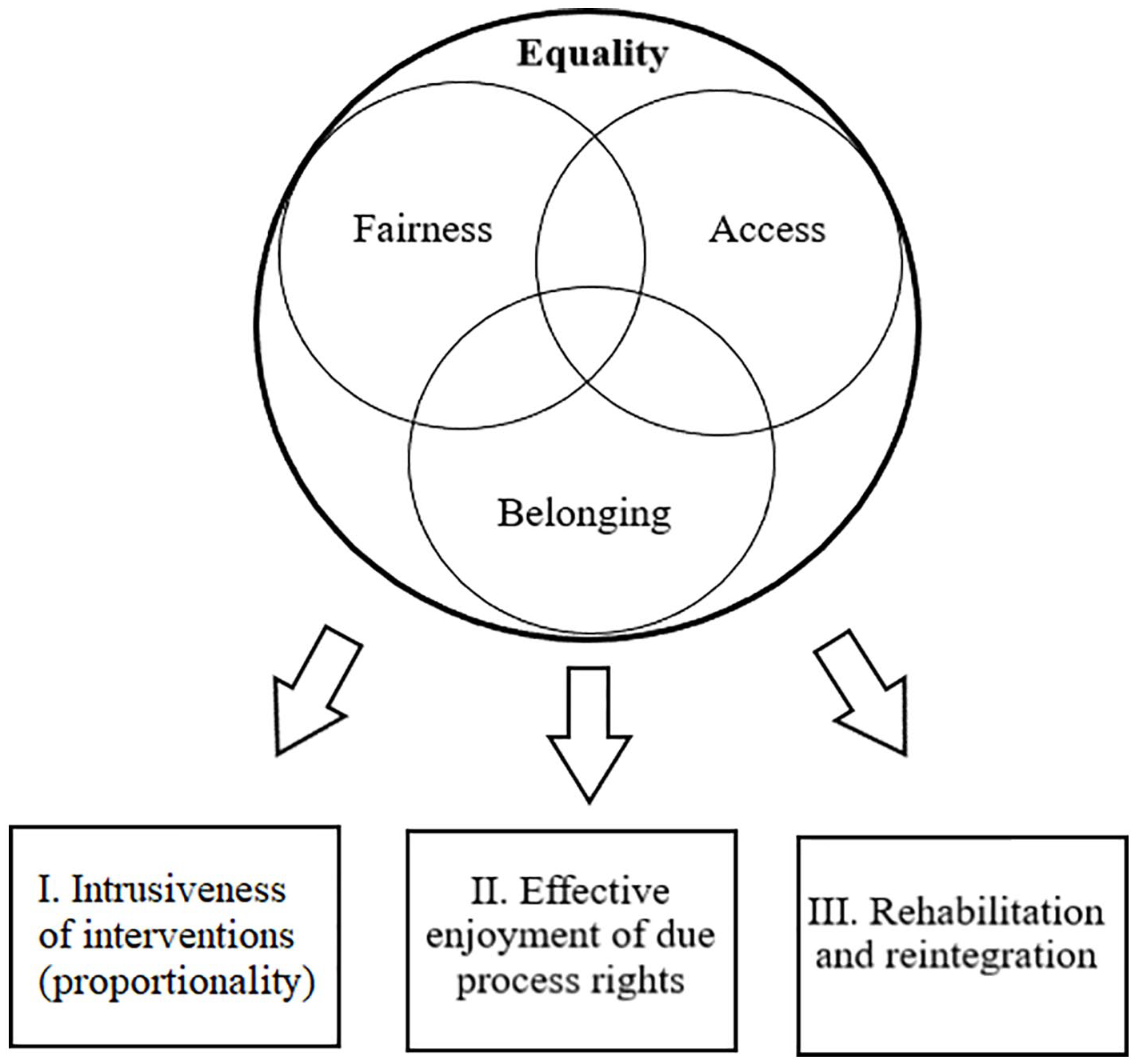
Dimensions of equality in the youth court and its focal variables.
The conceptual model, presented in Figure 1, is based on explorative research and requires further operationalization and examination. Yet, this model can potentially inform youth court practitioners, policymakers and researchers about the dimensions and focal variables that should be taken into account when measuring or judging equality in the youth court, not only in England and Wales, but also in other jurisdictions.
Youth court practitioners can use the model as a basis to reflect on their own role and responsibility in adhering to the principle of equality in their youth court work. As applying the principle of equality in the youth court can vary from adjusting the language used in the procedure to differentiating between two co-defendants in a sentencing exercise, the presented model could provide structure as to where to position such different practical applications within the larger framework of equality. Structured reflections of practitioners on how to safeguard equality should ideally be part of their routine in each individual case, but should also been done more broadly within organizations as well as collaboratively with other stakeholders.
Indeed, as the operation and decision-making of the youth court is essentially a ‘collective process’ (Van der Woude, 2016), strengthening and safeguarding equality requires the commitment of all stakeholders involved, also at policy level (cf. Van den Brink and Lubow, 2019). The model could provide structure and guidance to the diverse policy efforts that are required to strengthen and safeguard equality in the youth court, ranging from offering a wide range of accessible interventions and services for children to efforts that aim to diversify the bench and other actors in the youth court.
Finally, the model can be used for further research and monitoring purposes. When governments, advocacy organizations or scholars research or monitor equality in the youth court, data collection and analyses are often directed to quantitative data about detention rates and sentence lengths and how these relate to a particular protected characteristic of defendants, such as ethnicity. Although this is important, the presented model underscores the significance of also taking into consideration the other dimensions and focal variables of equality in the youth court. This calls for robust research or monitoring designs, which incorporate diverse – quantitative and qualitative – methods of data collection and analyses, in which a wide range of relevant case- and defendant-related diversities are taken into account.
Concluding Remarks
This article explored the meaning of the principle of equality in the youth court. Grounded in interdisciplinary theoretical research and perceptions and experiences of youth court practitioners, this article presented a rough conceptual model that aims to capture the multidimensional nature of the principle of equality and to structure and guide its diverse and multi-levelled implications for the administration of the youth court. In this final section, four closing remarks will be made.
First, this article intended to strengthen the normative understanding of the meaning of the principle of equality in the youth court. In this regard, it is important to distinguish the question of what the meaning of equality ought to be – which was central to this article – from the empirical question what the meaning of this principle factually is in the practices of the youth court. Given the abundance of evidence of disparities in youth court decision-making in practice, more empirical research is needed to locate the root causes of inequalities in the youth court (cf. Lynch, 2019; Van den Brink, 2021b). This should include, inter alia, psychological studies into the role of unconscious bias and stereotyping in youth court decision-making, as well as empirical socio-legal research into how broader societal inequalities play into the operation and decision-making of the youth court (Lynch, 2019). Moreover, the analysis presented in this article also touched upon normative considerations that require further inquiry, such as the fundamental question whether and how structural societal inequalities which disproportionately affect certain groups of children, such as children from ethnic minorities, should be taken into account in youth court decision-making at the individual case level.
Second, this article focused on equality in the specific context of the youth court. Although youth courts have to adhere to the principle of equality and can potentially play a role in strengthening equality system-wide (cf. Bell et al., 2020), it is important to highlight that equality in the youth court can only be achieved by safeguarding equality in the youth justice system as a whole, starting with the police (and the prosecutors) who control the ‘front gates’ of the system (cf. El Enany and Bruce-Jones, 2015; Gau and Paoline, 2020; Lammy, 2017). Moreover, from a holistic point of view, it can be argued that efforts to strengthen equality in the youth justice system should always go hand in hand with efforts to improve equality in interlocking systems, such as education, child protection and health care (cf. Dowd, 2018). In this regard, it should be noted that one should not overestimate the youth justice system’s ability and suitability as an instrument to counterbalance or ‘fix’ the wider societal inequalities that many children encounter in their lives. As Prosecutor 3 puts it, ‘If there’s that real starting point disadvantage, the criminal justice system is a blunt instrument’.
Third, this article explored the meaning of equality on the basis of perceptions of youth court practitioners. In doing so, this article captured perspectives of professionals who play a role in the daily operation of a youth court and, being in a position of authority, bear a responsibility for safeguarding equality in the youth court. Follow-up research, however, is required to capture the perspectives of the persons who ought to be protected by the principle of equality: the children who appear in the youth court (cf. Ansems et al., 2020; Shute et al., 2005). Insights into the children’s experiences and perceptions of equality are fundamental for furthering the model of equality in the youth court as presented in this article.
Fourth, as a final remark, it is noteworthy to raise the need for guidance at the international level when it comes to the meaning and implications of equality in youth justice and in children’s rights in general. It is striking that although the UN Committee on the Rights of the Child (2003) recognizes the principle of non-discrimination under Art 2 (1) UN CRC – which aims to safeguard ‘equal recognition and realization of rights’ – as one of the four ‘general principles’ of the Convention, there is no General Comment specifically devoted to this principle. 7 Given the significance of the principle of non-discrimination and equality for children and the effective enjoyment of their rights worldwide, a General Comment which clearly outlines the scope, meaning and implications of Article 2 (1) UN CRC and which provides recommendations for effective implementation of this provision in different areas of children’s rights, including youth justice, would be timely and most welcome. Hopefully the analysis presented in this article, together with other scholarly work on equality and children’s rights (e.g. Besson, 2005; Dowd, 2019), can inform the drafting of such a General Comment.
Footnotes
Acknowledgements
The author would like to thank the Ministry of Justice of England and Wales, Her Majesty’s Courts and Tribunals Service, the Crown Prosecution Service and the legal team managers of the two selected youth courts for their permission to conduct the empirical research and the interview respondents for their participation. The author is grateful to the University of Cambridge, Institute of Criminology, for hosting this research project, particularly to Dr Caroline Lanskey for her guidance throughout the project. The author is also grateful to the Netherlands Organisation for Scientific Research (NWO) for funding the project. Moreover, the author would like to thank James Bell for the inspirational conversations, which among others inspired the author to look into the concept of ‘belonging’. Finally, the author is grateful to the anonymous reviewers and the editor for their helpful comments on an earlier draft of this article.
Author’s note
As of 1 May 2021, the author is appointed Associate Professor of Criminal Law and Criminal Procedure at VU University Amsterdam, the Netherlands.
Funding
The author(s) disclosed receipt of the following financial support for the research, authorship, and/or publication of this article: This article presents findings from the research project ‘Different but Equal? Strengthening Equality for Children in the Juvenile Justice System’, which is funded by the Netherlands Organisation for Scientific Research (NWO Stimuleringsimpuls, Rubicon) (Grant No. 019.183SG.006).
