




Abstract
The delivery of interrogation rights to youth suspects and associated behaviours (e.g. seeking evidence of comprehension) were examined in a sample of real-world interrogations (N = 31). Interrogation rights were delivered fully in approximately one-third of interrogations. Verification of comprehension was attempted rarely, and interrogators asked the youth to explain each right in their own words in less than 10 per cent of interrogations. Without improvement in the administration of interrogation rights, youth suspects remain vulnerable and unprotected in the criminal justice system.
The Canadian Youth Criminal Justice Act (YCJA) was introduced in 2003, replacing the Young Offenders Act (YOA, 1984–2003). The overarching goal of the YCJA was to provide a legislative framework to ensure a fair and effective youth justice system (Department of Justice, 2017). One area targeted for enhanced protections was additional interrogation rights afforded to youth suspects – those aged between 12 and 18. Historically, police interrogators had to explain to youth that (a) they are not obligated to provide a statement and (b) any statement given may be used as evidence against them in court proceedings. With the enactment of the YCJA, police officers must now instruct youth that (c) they can consult with counsel and a parent/adult relative/appropriate adult and (d) any statement given must be in the presence of counsel or a parent/adult relative/appropriate adult, unless the youth desires otherwise. In addition, legal precedents exist whereby it must be demonstrated that youth understand their interrogation rights in order to satisfy the courts that the intended benefits of all interrogation rights were achieved. That is, the onus has been placed on interrogators to deliver rights in a way that the Crown can demonstrate to triers of fact that the rights were delivered to the youth in language appropriate to their age and level of understanding, and that the rights were understood. This study is the first systematic examination of how youth interrogation rights are delivered to youth in Canada, and more specifically, examines the extent to which officers engage in behaviours related to checking and verifying comprehension of these rights.
Canadian case law (R. v. L.T.H., 2008) reinforced the YCJA legislation that any waiver of interrogation rights will only be valid if it can be demonstrated that the youth understood the rights and the consequences of waiving them. L.T.H. (referred to by his initials to protect his privacy) was a young person brought to a police station for questioning in relation to a police chase. As part of a videotaped interrogation, the police officer delivered a legal waiver (which outlined the afforded interrogation rights) to L.T.H. verbally. L.T.H. acknowledged that he understood the waiver and subsequently waived his rights. L.T.H. provided inculpatory statements during the ensuing interrogation, and the Crown intended to introduce the videotaped statement as evidence. At trial, however, the Court heard evidence that L.T.H. had a learning disorder. The trial judge was unconvinced that L.T.H. understood his rights and the consequences of waiving them, and deemed that L.T.H.’s statement was inadmissible. The trial judge stated that ‘[o]ther than an affirmative reply to the questions “do you understand?” there is no other evidence that in fact [L.T.H.] fully and clearly understood his rights’ (R. v. L.T.H., 2008: para 35). The Crown called no further evidence, and the case was dismissed.
Upon appeal, the Supreme Court of Canada affirmed the trial judge’s decision. As outlined in R. v. L.T.H. (2008): The trial judge did not err in finding that police officers must form an opinion as to the level of understanding of the accused. A failure, as in this case, to make any inquiry in this regard will generally prove fatal to the admissibility of the statement, since the Crown must demonstrate that the explanation given was appropriately tailored to the particular young person. (Para. 51)
This legal decision aligns with empirical findings that show that self-reported confidence in understanding interrogation rights (i.e. yeah-saying in response to a closed yes/no question about comprehension) is an unreliable measure of comprehension. For example, in Cooke and Philip’s (1998) study, interrogation rights were delivered verbally to Scottish young offenders and they were asked, ‘Do you understand?’, as well as to explain the meaning of the right in their own words. While 89 per cent of the youth claimed to understand their rights fully, only 11 per cent were deemed to have complete understanding when explaining the rights in their own words. Similarly, Fenner et al. (2002) examined comprehension of the caution in England and Wales, which was modified by the Criminal Justice and Public Order Act (Home Office, 1994); they found similar results – 96 per cent claimed to understand the caution but none of them actually demonstrated understanding (also see Freedman et al., 2014; Shepherd et al., 1995 for similar findings in other jurisdictions).
To deliver interrogation rights to youth in a way that meets legislative and case law requirements, Canadian police organizations created what is known colloquially as youth waiver forms – written documents that outline the interrogation rights afforded to youth. A central underlying assumption is that youth waiver forms are an effective medium through which police interrogators should deliver rights to youth, prior to questioning them about their potential involvement in criminal events. However, an analysis of these forms being used by Canadian police organizations revealed that they lack standardization, are lengthy, and contain difficult-to-understand terminology and concepts (Eastwood et al., 2015; see Eastwood et al., 2014 for discussion). While the waiver forms lack standardization in their wording, they are required to inform the youth of the following: (a) they are not obligated to provide a statement (i.e. have the right to remain silent), (b) any statement given may be used as evidence against them in court proceedings, (c) they can consult with legal counsel (i.e. their own lawyer, lawyer provided by the government free of charge) and an appropriate adult, and (d) any statement that is given must be in the presence of legal counsel and/or an appropriate adult unless chooses not to have such individuals present during the interrogation (YCJA, 2002). Specifically, it was found that youth waiver forms are typically 4–6 pages in length, can range from 200 words to over 1000 words, and the majority of the forms contain at least one section which exceeds the recommended amount of information that a person can process in working memory (Baddeley, 1994; Rogers et al., 2007). The vast majority of the forms also contain at least one section that would require post-secondary education to understand. Eastwood and colleagues concluded that some sections of the waiver forms are more complex than the warnings delivered to adults, thus reducing confidence that the waiver forms actually help youth understand their rights (Eastwood et al., 2015).
There have been several studies published on the comprehension of interrogation rights among youth in Canada, the United States, and, to a lesser degree, in the United Kingdom. The first Canadian study to examine this issue found that youth recalled approximately 40 per cent of the information contained in the waiver form (Eastwood et al., 2015). Follow-up research (Freedman et al., 2014) using different waiver forms found that youth recalled less than 20 per cent of the information contained in the form. Furthermore, youth demonstrated disturbing misconceptions about their interrogation rights. For example, nearly half of the youth believed that they were required to answer all questions asked by the police – as opposed to having to answer only the questions that they wanted to answer. Despite the low levels of comprehension across the studies, the majority of youth reported that they understood their rights. In other words, their confidence in understanding did not correspond with actual understanding of their interrogation rights. Similarly, low levels of comprehension have been found with youth’s comprehension of juvenile Miranda warnings in the United States (e.g. Rogers et al., 2008, 2012; Sharf et al., 2017; see also Goldstein et al., 2003 for information on the Miranda Rights Comprehension Instruments-II – an instrument used to assess understanding of the Miranda rights), and youth’s comprehension of the Police Caution in the United Kingdom (see Clare et al., 1998). Such findings are especially troubling because they were observed using non-offender samples (see Rogers et al., 2014 for research on legally involved youth) who typically have greater cognitive capacities than offender samples (Owen-Kostelnik et al., 2006) and testing was performed under ideal conditions.
To date, there are no empirical data on how Canadian police officers deliver interrogation rights to youth (e.g. medium, rate of speech, comprehension checks). Research into the delivery of interrogation rights with Canadian adults has shown that there is much room for improvement. Specifically, Snook et al. (2010) found that police officers did not deliver the interrogation rights reliably (e.g. omitting sections), spoke quickly (above 200 words per minute), and attempted to verify that the suspect understood the rights in less than 20 per cent of the cases examined.
There are, however, a few published studies in other jurisdictions (i.e. the United Kingdom and the United States) which examined how police deliver interrogation rights to youth. With regard to the United Kingdom, Sim and Lamb (2018) provided the only description of how the police caution (similar to the Right to Silence in Canada) is delivered to young suspects. They examined 31 real-world interviews with youth suspects and found that the rights were delivered at an average speech rate of nearly 300 words per minute, which is well above the recommended rate of speech for aiding comprehension (Carver, 1982; Jester and Travers, 1966). Sim and Lamb also reported that interviewers checked for comprehension (asking the youth if they understood the caution) in just over half of the interviews examined. When asked to explain the rights in their own words, the youth suspects responded with a number of misconceptions about their rights. Also troubling was that interviewers stated misconceptions about the caution (e.g. the caution represented a loss of the right to silence) when providing additional explanations to youth.
In the United States, Cleary and Vidal (2016) examined the delivery of the Miranda warning (i.e. rights to remain silent, consult with own/appointed lawyer, have lawyer present during interrogation) in 28 interrogations with youth suspects. They found that the warning was presented with a combination of verbal and written explanation in half of the interrogations, just verbally in 10 interrogations, and the youth were instructed to read the warning on their own in the remaining interrogations. Comprehension was assessed mainly by asking the youth whether or not they understood the Miranda warning once the entire warning was presented; it should also be noted that no attempt to check comprehension was made in nearly a fifth of the interrogations examined. Furthermore, the majority (i.e. 90%) of the youth suspects waived their Miranda rights. Similar results have been reported in other US-based studies (Feld, 2006, 2013). Clearly, more data are needed, and from other jurisdictions, to help inform this under-researched area.
While the aforementioned studies from the United Kingdom and the United States are based on relatively small sample sizes and, therefore, lack generalizability, they still provide important insights showing that police tend not to deliver legal rights to an acceptable standard. If the rights are delivered in a manner that does not promote comprehension, and no checks are made to verify comprehension, youth may waive their procedural safeguards without appreciating the consequences of doing so. There are two potential negative outcomes when a youth waives their rights without appreciating the associated consequences. First, a lack of understanding means that a youth is unable to exercise their rights and make the informed decisions during an interrogation – which could potentially lead to a wrongful conviction. Second, public safety may be jeopardized as a guilty youth who is not delivered their rights properly may be released back into the community due to their statement being ruled inadmissible in court. Thus, the human rights of youth, the integrity of police investigations and public safety are contingent upon rights being delivered to youth in a manner that maximizes the chances of them understanding.
The aforementioned research from the United Kingdom and the United States, along with research examining Canadian adult suspects, shows that interviewers and interrogators are not administering interrogation rights in a manner that allows a suspect to make fully informed decisions when being questioned by the police. There is a lack of knowledge about how rights are delivered to Canadian youth in actual police interrogations, and importantly, the areas of this process that the police need to improve. The goal of this study was to start cumulating knowledge in this area by examining how Canadian police officers deliver interrogation rights to youth.
Method
Sample
A convenience sample of 31 audio-recorded police interrogations with youth suspects (Mage = 15.77, SD = 1.14) was obtained from a Canadian police organization. The sample was collected by a senior member of the participating organization who asked administrative personnel to search their files for recorded youth interrogations conducted by officers in the Criminal Investigation Division. The average length of the interrogation was 78.83 minutes (SD = 47.05, range: 11.22–185.57).
Coding guide
Youth waiver
The coding guide was developed prior to examining the interviews and was based on past research examining factors that support comprehension (e.g. rates of speech, how comprehension was checked). The main part of the coding guide was the four key rights, based on the YCJA (2002), which included the following: (1) Right to Silence, (2) Right to Legal Counsel, (3) Right to Consult an Appropriate Adult and (4) Right to Have a Person Present (the latter two are henceforth shortened as the Right to Consult, and Right to Person Present, respectively). We then isolated the sentences and key points within the participating police organization’s youth waiver form, as follows:
The Right to Silence was comprised of the following three sentences:
You do not have to say anything.
You do not have to give a statement.
Anything you say, and any statement you give, can be used as evidence in court. This sentence contained two discrete components; namely, the youth’s statement may be used (a) against them, and (b) in court.
The Right to Legal Counsel was comprised of the following three sentences:
You have the right to retain and instruct counsel, which is a lawyer, in private, without delay. The three components embedded in the sentence were the following: (a) the youth has the right to a lawyer, (b) the youth may speak to a lawyer in private and (c) the youth may speak to a lawyer without delay.
This means that immediately and before we proceed further with this statement, you may call any lawyer you wish, or get immediate free legal advice from legal aid duty counsel. The embedded components being: (d) the youth may speak to a lawyer immediately and before the statement begins, (e) the youth speak to any lawyer they wish and (f) the youth may speak to free legal aid duty counsel.
If you want to call duty counsel, or if you wish to contact any other lawyer, you can use the telephone free of charge and access to telephone numbers will be provided. The embedded components being: (g) the youth may use the telephone free of charge, and (h) telephone numbers will be provided.
The Right to Consult was comprised of the following two sentences:
You also have the right to consult with a parent, an adult relative, or another appropriate adult of your choice, in private, before we proceed. This sentence was comprised of five components: the youth could consult with (a) a parent, (b) an adult relative, (c) another appropriate adult of their choice, (d) in private and (e) before the interrogation began.
If you wish to call any of these persons I will provide you with a telephone and access to telephone numbers.
The Right to Person Present was comprised of the following two sentences:
You also have the right to have a lawyer and the adult with whom you consult here with you while I talk to you.
If you want either or both of these persons present you will be given a reasonable chance to have them with you.
Coding was binary; specifically, whether or not each sentence of the four rights were delivered in full, and whether or not any of the sentences were missed or read incorrectly was coded. Also coded was whether or not the interrogator asked the youth to explain the right (or part of it) in their own words, the youth attempted to explain any aspect of the right in their own words, the youth included all the necessary information when explaining the right in their own words, any of the right was reviewed by the interrogator a second time, the right was invoked at any point during the interrogation, the youth invoked the right on their own accord, or the youth invoked the right on advice of the appropriate adult or third party. Whether the invoking of the right was immediately granted by the interrogator and the number of times the youth asked for the right to be invoked before it was granted (if at all) were also coded.
The following variables were also coded at the end of the entire right, and with regard to each sentence:
The check for understanding variable was used to code whether or not the interrogator asked the youth if they understood the right, or sentence, presented to them. Interrogators were considered to have checked for understanding if they ask a closed yes/no question such as ‘Do you understand?’ or ‘Does that make sense to you?’. Interrogators could have checked for understanding after each sentence, or after each complete right.
The claimed to understand variable was used to code whether or not, after being asked ‘Do you understand?’, the youth claimed to understand the right presented to them. If the youth answered ‘yes’, they were considered to have claimed understanding. If the youth replied ‘no’, asked for clarification, or began offering an explanation in their own words, they were not considered to have claimed understanding.
The verifying understanding variable was used to code whether or not the interrogator made an attempt to verify that the youth’s claim to understanding was legitimate. Verifying understanding was considered asking questions such as ‘Are you sure you understand?’, or ‘Do you need me to go over that again?’. Verifying understanding is conceptually different from checking understanding, as verification represents a follow-up effort in addition to a previous check for understanding. Although asking these types of questions does not aid in gathering evidence of the youth’s understanding, or advancing the youth’s understanding, interrogators were given credit for these efforts.
The seeking evidence of understanding variable coded for whether or not the interrogator asked the youth to explain the right, or any part of it, in their own words. If the interrogator instructed ‘Explain that for me in your own words’, or ‘Tell me what that means in your own words’, they were considered to have sought evidence of the youth’s understanding. Also coded was whether the interrogator reviewed any of the rights or sentences a second time.
A quality of delivery score was calculated for each of the four rights in all interrogations. The quality of delivery score encompassed whether or not the officer spoke at an appropriate speed (i.e. at or less than 200 wpm), delivered each sentence of the right, checked for youth understanding at the end of each sentence and at the end of the entire right, attempted to verify claims of understanding after each sentence and at the end of the entire right, asked the youth to explain the right in their own words at any point during the right’s delivery, and attempted to review any of part of the right a second time. These criteria represented one point each, and the overall quality score could range from 0 to 57. The rate of speech was calculated for the delivery of interrogation rights as a whole, not for each individual right. Therefore, the quality score for each right was affected by the average rate of speech for the delivery of all interrogation rights in that transcript. A total quality score for each interrogation was calculated by summing the quality of delivery scores for each right delivered in that interrogation.
Data reliability
The first author coded all of the interrogations and the results are indicative of the first author’s coding. Agreement on the coding of the variables was assessed by having the second author code seven (22.58%) randomly selected interrogations. The second author was provided with a 1-hour training session regarding the content of the coding dictionary before coding. All coding was carried out at the partnering police organization due to the sensitivity of the materials examined. Interrater agreement yielded a mean Kappa of 0.79, suggesting substantial agreement between the raters (Landis and Koch, 1977). It should be noted that one transcript fell below substantial agreement (i.e. fair agreement, κ = 0.47), with the remaining Kappa values ranging from 0.71 to 0.98.
Results
A comprehensive description of the study sample can be found in Table 1.
A description of the sample transcripts.
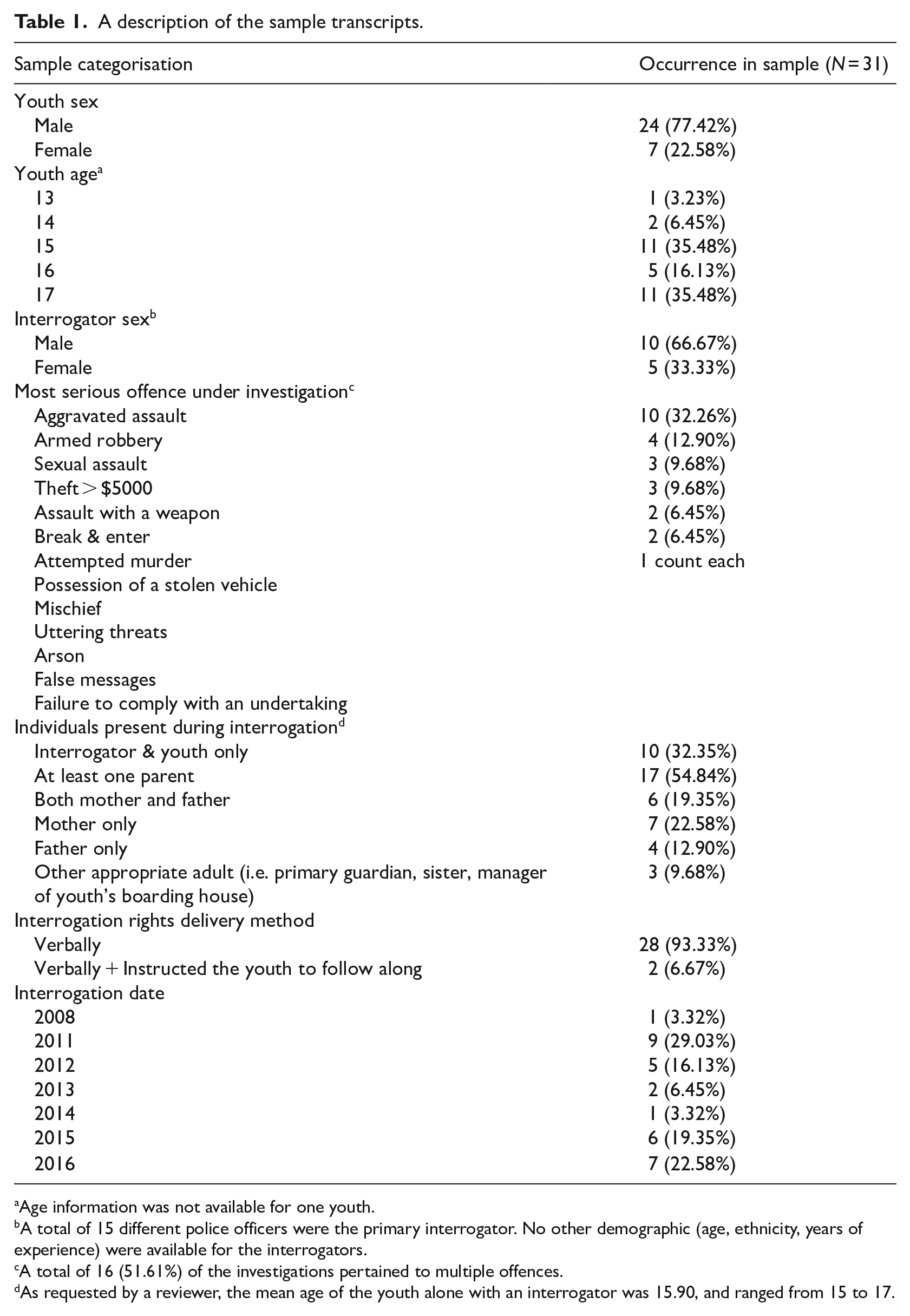
Age information was not available for one youth.
A total of 15 different police officers were the primary interrogator. No other demographic (age, ethnicity, years of experience) were available for the interrogators.
A total of 16 (51.61%) of the investigations pertained to multiple offences.
As requested by a reviewer, the mean age of the youth alone with an interrogator was 15.90, and ranged from 15 to 17.
Presence of appropriate adults
Of the 26 appropriate adults, 20 (76.92%) were present from the beginning of the interrogation, one (3.85%) arrived after jeopardy (i.e. the risks associated with an accused person being found guilty for the crime(s) under investigation, and the associated consequences) was explained to the youth but before the youth waiver was delivered, one (3.85%) arrived after the Right to Consult was delivered, two (7.69%) arrived after the Right to Person Present was delivered, and two (7.69%) arrived as a youth was providing a statement. Jeopardy was stated before the delivery of rights in all interrogations.
Delivery of interrogation rights
The average length of the introduction phase, before delivery of interrogation rights, was 4.69 (SD = 4.81, N = 31) minutes. The average length of the rights delivery phase was 23.70 (SD = 21.11, n = 30) minutes. The interrogation ended before the statement phase due to the invoking of a right in 5 (16.13%) interrogations, with the remaining 26 (83.87%) having a statement phase; the average length of the statement phase (i.e. post-delivery of interrogation rights) was 48.07 (SD = 44.40, n = 26) minutes. The average rate of speech of the interrogator during the rights delivery phase was 205.60 (SD = 30.08, n = 30) words per minute (wpm). The average rate of speech of the interrogator during the statement phase was 205.10 (SD = 40.76, n = 26) wpm.
An interrogator did not deliver any of the rights in one interrogation because the appropriate adult advised the youth to invoke their Right to Legal Counsel after jeopardy was provided, and the interrogator ended the interrogation. At least 1 aspect of the 4 interrogation rights was delivered in the remaining 30 interrogations. The rights were delivered in their entirety in 9 (29.03%) of the 30 interrogations. Thus, the following descriptive statistics pertaining to the delivery of interrogation rights are based on 30 interrogations. It should also be noted that an additional interrogation ended before the Right to Consult was delivered when the youth invoked the Right to Legal Counsel. The descriptive statistics for the Right to Consult and Right to Person Present are thus based on 29 interrogations.
Right to Silence
The frequency of delivery, whether or not the police officer checked for youth understanding, whether or not the youth claimed to understand, and officer attempts to verify the youth’s claim to understanding for each sentence of the Right to Silence can be seen in Figure 1. As shown in Figure 1(a), sentence 1 of the Right to Silence (do not have to say anything) was delivered in 28 (93%) interrogations, and was checked for understanding immediately after it was delivered in four (13%) instances. Three of the four youth claimed that they understood this sentence and verification was attempted for two (7%) of those youth.
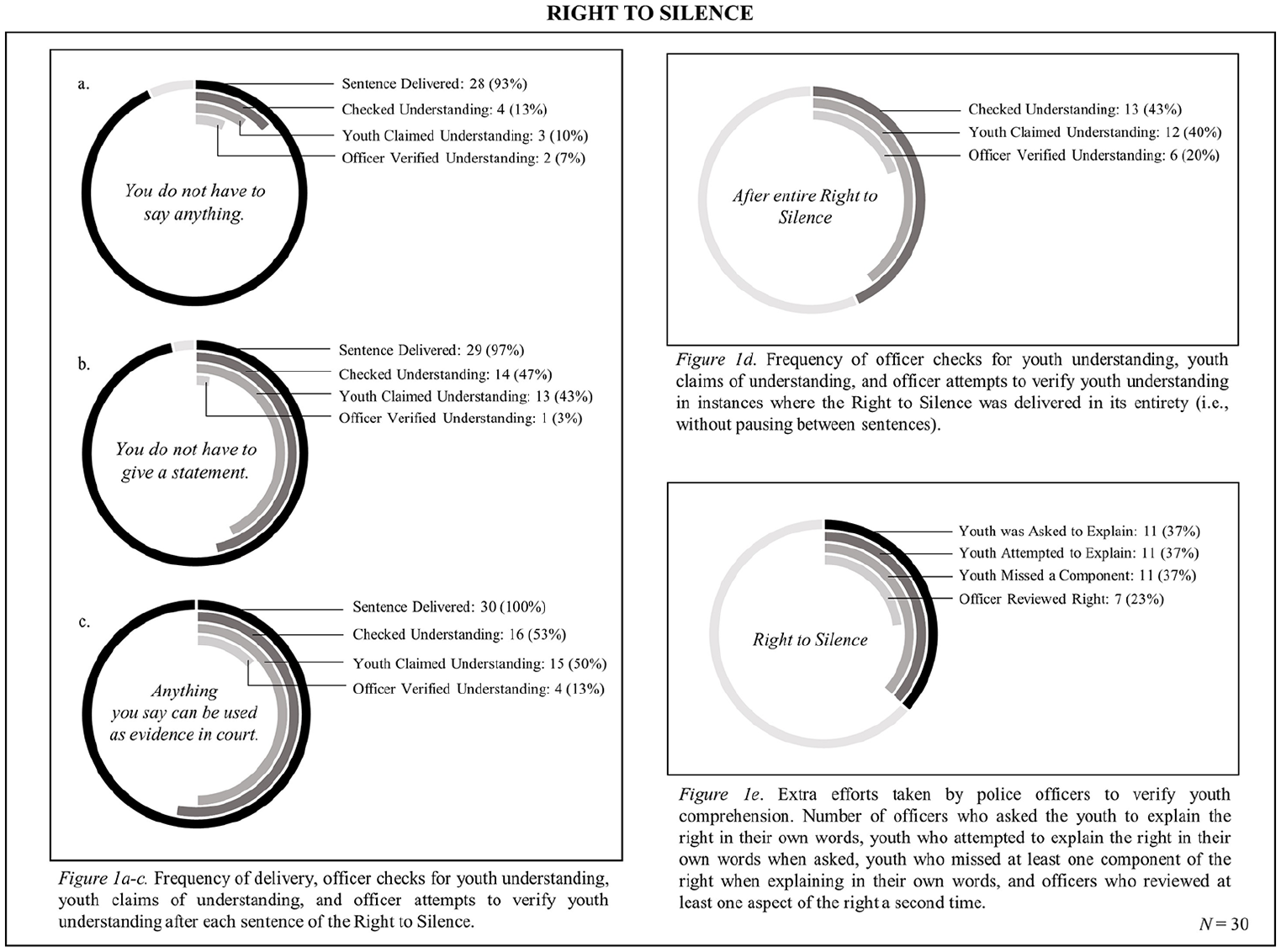
Right to Silence: (a) to (c) Frequency of delivery, officer checks for youth understanding, youth claims of understanding and officer attempts to verify youth understanding after each sentence of the Right to Silence, (d) Frequency of officer checks for youth understanding, youth claims of understanding and officer attempts to verify youth understanding in instances where the Right to Silence was delivered in its entirety (i.e. without pausing between sentences) and (e) Extra efforts taken by police officers to verify youth comprehension. The number of officers who asked the youth to explain the right in their own words; youth who attempted to explain the right in their own words when asked; youth who missed at least one component of the right when explaining in their own words; and officers who reviewed at least one aspect of the right a second time.
As shown in Figure 1(b), sentence 2 (do not have to provide statement) was delivered in 29 (97%) interrogations, and was checked for understanding immediately after it was delivered in 14 (47%) instances. Thirteen (43%; one response was inaudible) of the youth claimed that they understood this sentence and verification was attempted for one (3%) of those youth.
As shown in Figure 1(c), sentence 3 (statement may be used in court) was delivered in all interrogations and was checked for understanding immediately after it was delivered in 16 (53%) instances. Fifteen (50%; one response was inaudible) of the youth claimed that they understood this sentence, and verification was attempted for four (13%) of those youth. Although, sentence 3 was delivered in all interrogations, the interrogator failed to mention the first component of that sentence (i.e. the youth’s statement may be used against them) in one (3%) interrogation.
Frequency of checking for youth understanding after the entire Right to Silence was delivered, whether or not the youth claimed to understand, and officer attempts to verify the youth’s claim to understanding in these instances are shown in Figure 1(d). The Right to Silence was checked for comprehension after it was delivered in its entirety in 13 (43%) interrogations. Twelve (40%) of the youth claimed to understand the right in these instances, and interrogators attempted to verify six (20%) of these claims. The interrogator did not attempt to verify the two (7%) inaudible responses from youth.
Behaviours involving seeking evidence of youth understanding and reviewing the Right to Silence are displayed in Figure 1(e). As can be seen, interrogators asked the youth to use their own words to explain the right (or part of it) in 11 (37%) interrogations. All of the youth who were asked to explain this right attempted to do so; one (3%) response was inaudible, leaving 10 (33%) responses that could be coded. Two (7%) youth recalled that they did not have to say anything, but none specifically recalled that they did not have to give a statement. Four (13%) youth recalled that any statement they gave could be used against them in court, 3 (10%) youth recalled that their statement could be used against them, and all 10 youth specifically recalled that their words may be used in court. None of the youth included every aspect of the right when explaining in their own words. The interrogator reviewed at least one sentence in seven (23%) interrogations.
Right to Legal Counsel
The frequency of delivery, whether or not the police officer checked for youth understanding, whether or not the youth claimed to understand, and officer attempts to verify the youth’s claim to understanding for each sentence of the Right to Legal Counsel can be seen in Figure 2.
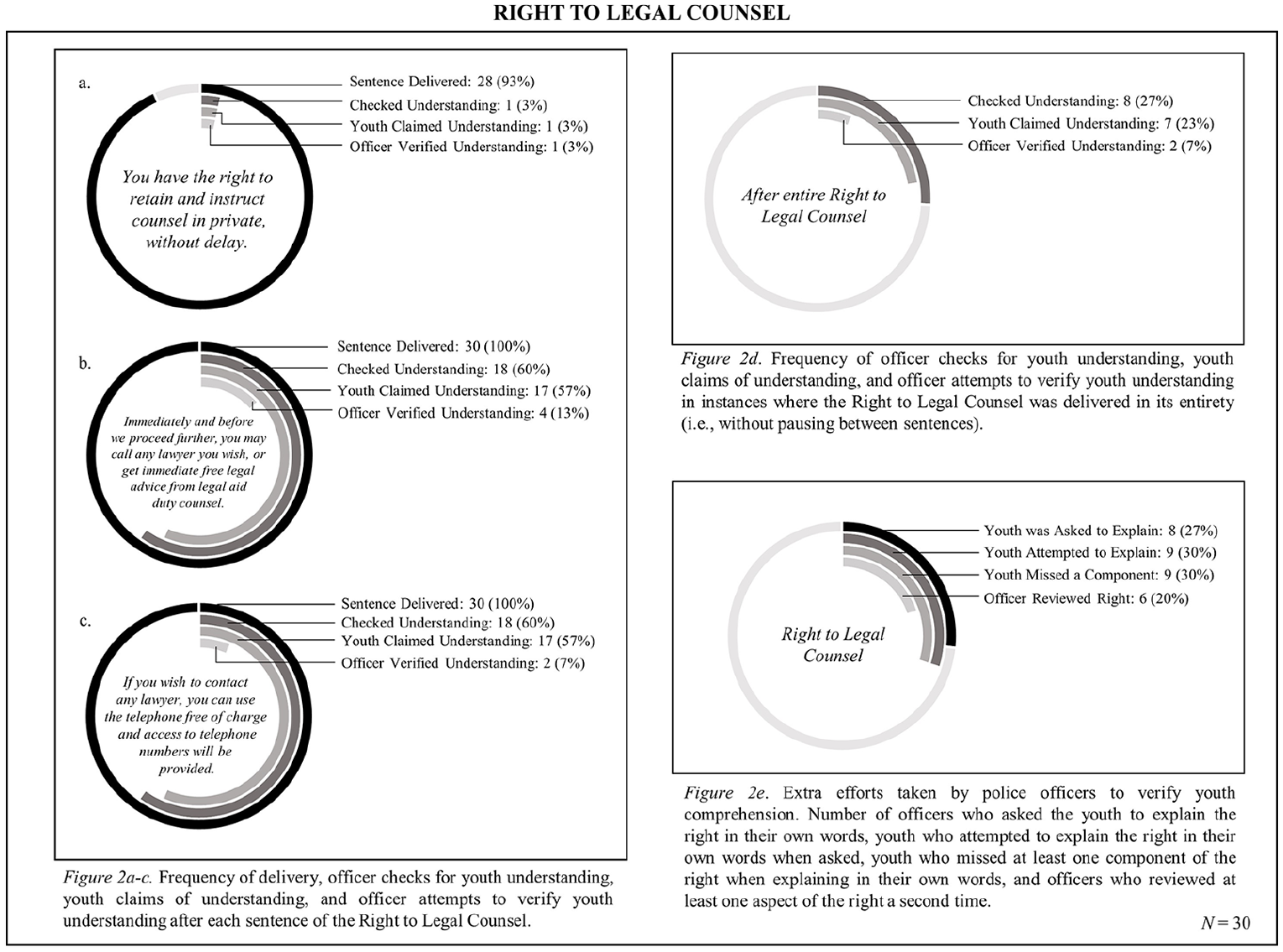
Right to Legal Counsel: (a) to (c) Frequency of delivery, officer checks for youth understanding, youth claims of understanding and officer attempts to verify youth understanding after each sentence of the Right to Legal Counsel, (d) Frequency of officer checks for youth understanding, youth claims of understanding and officer attempts to verify youth understanding in instances where the Right to Legal Counsel was delivered in its entirety (i.e. without pausing between sentences), and (e) Extra efforts taken by police officers to verify youth comprehension. The number of officers who asked the youth to explain the right in their own words; youth who attempted to explain the right in their own words when asked; youth who missed at least one component of the right when explaining in their own words; and officers who reviewed at least one aspect of the right a second time.
As shown in Figure 2(a), sentence 1 of the Right to Legal Counsel (hire and speak with a lawyer in private, without delay) was delivered fully in 28 (93%) interrogations, and was checked for understanding immediately after it was delivered in one (3%) instance. In this one instance, the youth claimed that they understood this sentence and verification was attempted by the interrogator.
Sentence 2 (immediate access to free legal aid) was delivered in full in all 30 interrogations, and was checked for understanding immediately after it was delivered in 18 (60%) instances (see Figure 2(b)). Seventeen (57%; one response was inaudible) of the youth claimed that they understood this sentence and verification was attempted for four (13%) of those youth; the interrogator did not attempt to verify the one inaudible response.
As shown in Figure 2(c), sentence 3 (provision of telephone and number for legal aid) was delivered in full in all 30 interrogations, and was checked for understanding immediately after it was delivered in 18 (60%) instances. Seventeen (57%; one response was inaudible) youth claimed that they understood this sentence and verification was attempted for two (7%) of those youth; the interrogator did not attempt to verify the one (3%) inaudible response.
Frequency of checking for youth understanding after the entire Right to Legal Counsel, whether the youth claimed to understand, and officer attempts to verify the youth’s claim to understanding in these instances are shown in Figure 2(d). The Right to Legal Counsel was checked for comprehension after it was delivered in its entirety in eight (27%) interrogations. Seven (23%) of the youth claimed that they understood in these instances and verification was attempted for two (7%) of those youth.
Behaviours involving seeking evidence of youth understanding and reviewing the Right to Legal Counsel are displayed in Figure 2(e). As can be seen, youth were asked to explain the right (or part of it) in their own words in eight (27%) interrogations (all youth complied), and one (3%) youth volunteered an explanation without a request from an interrogator. Eight (27%) of the youth recalled at least one aspect of sentence one; one (3%) youth recalled they could speak to a lawyer without delay; one (3%) youth recalled they could speak to a someone in private; and six (67%) youth recalled they could speak to someone without delay (i.e. acknowledged they could speak to someone but did not specify that the individual could be a lawyer or legal professional). Four (13%) youth recalled at least one aspect of sentence two; three (10%) mentioned only that they could speak to a lawyer before the statement began, and one (3%) mentioned only that they could speak with any lawyer they wish. Three (10%) youth recalled at least one aspect of sentence 3; two (7%) recalled only that they could use the telephone, and one (3%) recalled only that telephone numbers would be provided. None of the youth recalled every aspect of the right. At least one section of the right was reviewed by the interrogator in six (20%) of the 30 interrogations.
Right to Consult
The frequency of delivery, whether or not the police officer checked for youth understanding, whether or not the youth claimed to understand, and officer attempts to verify the youth’s claim to understanding for each sentence of the Right to Consult can be seen in Figure 3.
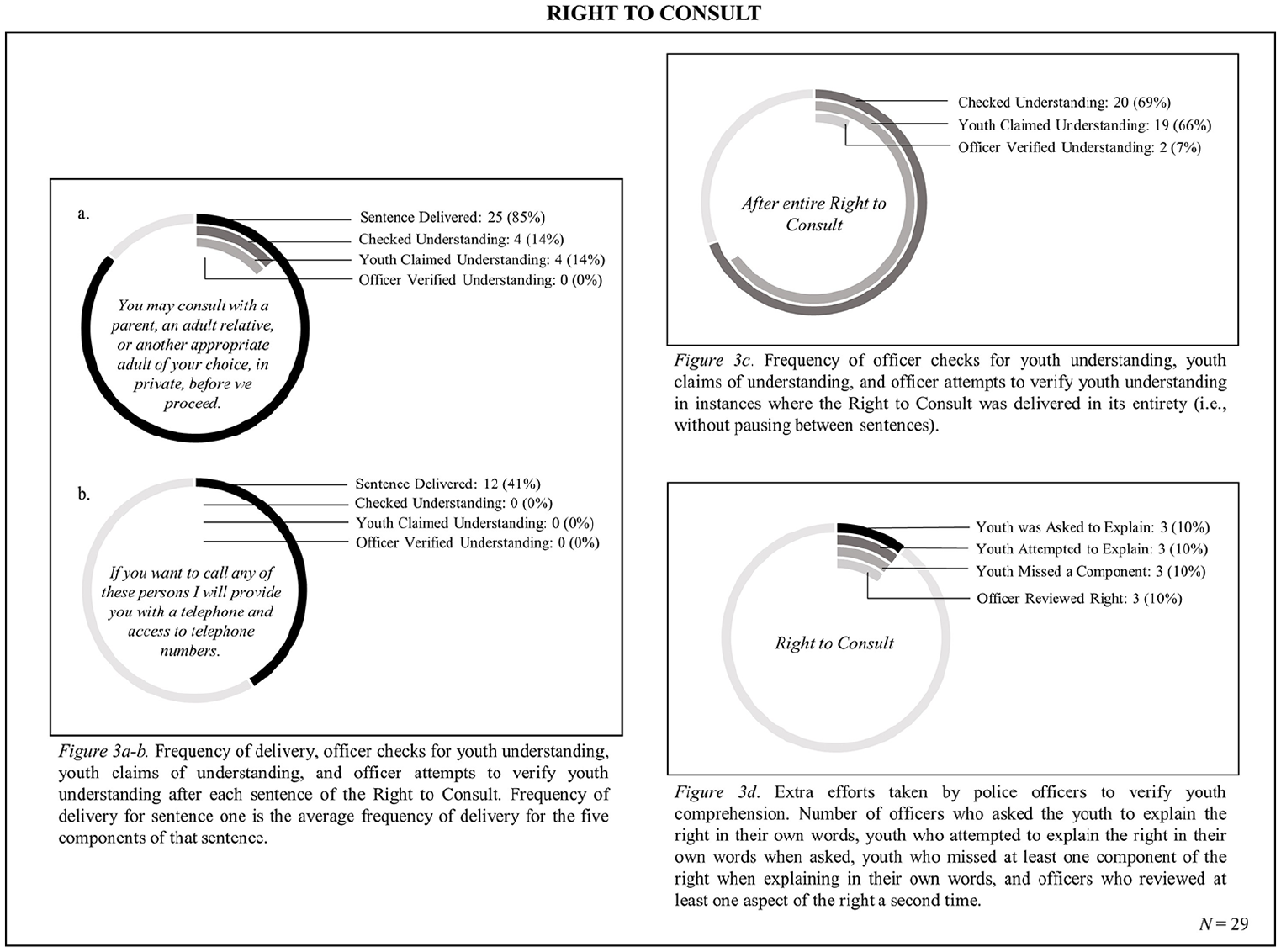
Right to Consult: (a) and (b) Frequency of delivery, officer checks for youth understanding, youth claims of understanding, and officer attempts to verify youth understanding after each sentence of the Right to Consult. Frequency of delivery for sentence 1 is the average frequency of delivery for the five components of that sentence. (c) Frequency of officer checks for youth understanding, youth claims of understanding and officer attempts to verify youth understanding in instances where the Right to Consult was delivered in its entirety (i.e. without pausing between sentences). (d) Extra efforts taken by police officers to verify youth comprehension. The number of officers who asked the youth to explain the right in their own words, youth who attempted to explain the right in their own words when asked, youth who missed at least one component of the right when explaining in their own words, and officers who reviewed at least one aspect of the right a second time.
Of the 29 interrogations that reached the Right to Consult, the first sentence (the right to consult with an adult in private, before proceeding) was never delivered in full. The youth was told they could consult a parent in every interrogation, and were told they could consult an adult relative and another appropriate adult in 28 (97%) interrogations each. The youth was told the consultation would be in private in 26 (90%) interrogations, and told they could consult with the adult before the interrogation began in 12 (41%) interrogations. The average delivery rate of these important components, 24.6 (85%), was used to represent the frequency of delivery of sentence 1 displayed in Figure 1(a). Four (14%) youth were asked if they understood immediately after sentence 1 was delivered, and all four claimed to understand the sentence. There were no attempts to verify understanding in any instance where a youth claimed to understand sentence 1.
As shown in Figure 3, sentence 2 (provision of telephone access and telephone numbers) was delivered fully in 12 (41%) interrogations, and no interrogator checked for understanding of this sentence.
Frequency of checking for youth understanding after the entire Right to Consult, whether or not the youth claimed to understand, and officer attempts to verify the youth’s claim to understanding in these instances are shown in Figure 3(c). The entire Right to Consult was read before comprehension was checked in 20 (69%) interrogations, and 19 (66%) youth claimed to understand the right (one response was inaudible). Interrogators attempted to verify claims of understanding in two (7%) instances; verification was not attempted for the inaudible response.
Behaviours involving seeking evidence of youth understanding and reviewing the Right to Consult are displayed in Figure 3(d). Youth were asked to explain the Right to Consult (or part of it) in their own words in three (10%) interrogations; all complied with the request. With regard to the first sentence, two (7%) youth recalled that they could consult a parent, no youth recalled that they could consult an adult relative or another appropriate adult of their choosing, one (3%) youth recalled they could consult with the adult in private, and no youth recalled that they could consult the adult before the interrogation began. One (3%) youth recalled sentence 2. A section of the right was reviewed in three (10%) interrogations; these were the same interrogations in which the youth attempted to explain the right in their own words.
Right to Person Present
The frequency of delivery, whether or not the police officer checked for youth understanding, whether or not the youth claimed to understand, and officer attempts to verify the youth’s claim to understanding for each sentence of the Right to Person Present are shown in Figure 4.
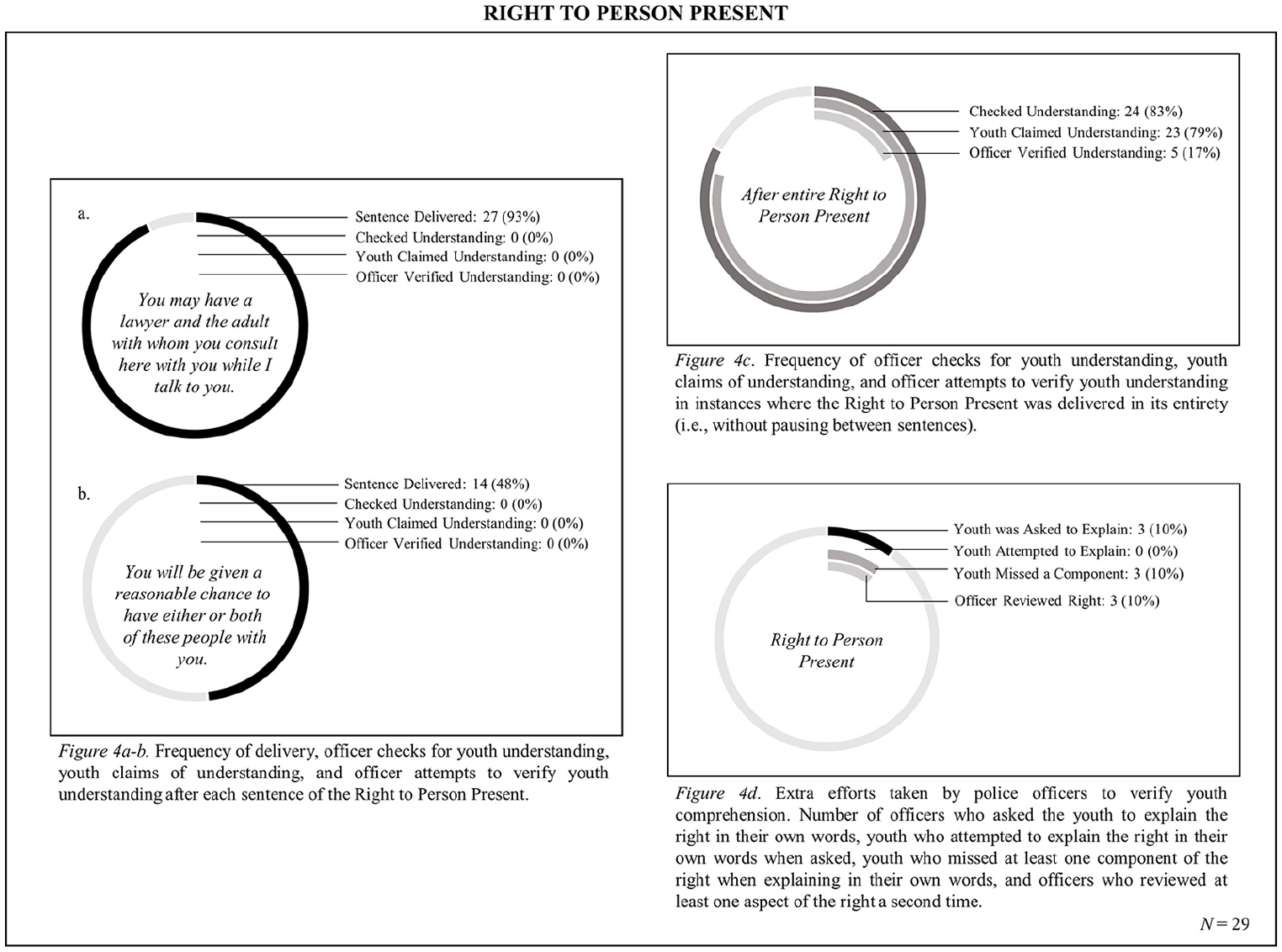
Right to Person Present: (a) and (b) Frequency of delivery, officer checks for youth understanding, youth claims of understanding and officer attempts to verify youth understanding after each sentence of the Right to Person Present. (c) Frequency of officer checks for youth understanding, youth claims of understanding and officer attempts to verify youth understanding in instances where the Right to Person Present was delivered in its entirety (i.e. without pausing between sentences). (d) Extra efforts taken by police officers to verify youth comprehension. The number of officers who asked the youth to explain the right in their own words, youth who attempted to explain the right in their own words when asked, youth who missed at least one component of the right when explaining in their own words and officers who reviewed at least one aspect of the right a second time.
Sentence 1 (right to have an adult and/or lawyer present) was delivered in 27 (93%) interrogations and sentence 2 (reasonable chance for adult/lawyer to be present) was delivered in 14 (48%) interrogations, as seen in Figure 4(a) and (b), respectively. As shown in Figure 4(c), in 24 (83%) interrogations the entire right was read before the youth was asked if they understood. Checks on comprehension of this right were only ever conducted after both sentences were delivered (i.e. at the end of the entire right). Twenty-three (79%) youth claimed to understand the right (one response was inaudible) and verification of those claims was attempted for five (17%) youth.
Behaviours involving seeking evidence of youth understanding and reviewing the Right to Person Present are displayed in Figure 4(d). Interrogators asked three youth (10%) to explain the right in their own words. None of the three youth were able to recall any sections of the right. Three (10%) interrogators reviewed the right, and in each case it was reiterated that the youth could have a parent or lawyer present but it was only reiterated in one interrogation (3%) that the adult and lawyer could be present simultaneously.
Invoking interrogation rights
The variables regarding invoking each interrogation right are based on the total sample of 31 interrogations as the rights do not need to be administered by a police officer to be invoked. For example, as was the case in one interrogation, if a youth has an appropriate adult present from the beginning of the interrogation, they have invoked their Right to Person Present without having been formally delivered that right.
Right to Silence
The Right to Silence was invoked in 10 (32%) of the 31 interrogations; on the youth’s own accord in 6 (19%) interrogations and on the advice of the appropriate adult in the remaining 4 (13%) interrogations. Of the interrogations where an appropriate adult was present (n = 20), 7 (35%) of the youth invoked their Right to Silence. Of the youth without an appropriate adult present (n = 11), 3 (27%) invoked their Right to Silence. The interrogator granted the invoking of the right immediately in five (50%) cases, after further questioning in three (30%) cases, and the invoking was not granted in the remaining two (20%) cases.
The quality of delivery for the Right to Silence was graded out of a possible 15 quality points. The average quality score for the delivery of the Right to Silence was 6.33 (range: 3–13). There was no significant difference in the quality of delivery of the Right to Silence between interrogations in which the youth did and did not invoke this right, t(28) = 0.28, p = .782, d = 0.11.
Right to Legal Counsel
The Right to Legal Counsel (i.e. communicate with lawyer through telephone) was invoked in eight (26%) of the 31 interrogations; on the youth’s own accord in four (13%) interrogations and on the advice of an appropriate adult in the remaining four (13%) interrogations. Of the youth with an appropriate adult present (n = 20), 6 (30%) invoked their Right to Legal Counsel. Of the youth without an appropriate adult present (n = 11), 2 (18%) invoked their Right to Legal Counsel. The interrogator granted the invoking of the right without further questioning in all eight instances.
The quality of delivery for the Right to Legal Counsel was graded out of a possible 15 quality points. The average quality score for the delivery of the Right to Legal Counsel was 5.93 (range: 3–12). There was no significant difference in the quality of delivery of the Right to Legal Counsel between interrogations in which the youth did and did not invoke this right, t(28) = 0.50, p = .621, d = .21.
Right to Consult
The Right to Consult was invoked in 9 (29%) of the 31 interrogations. The right was invoked by the youth on their own accord in 7 (23%) interrogations and was invoked on the advice of the appropriate adult in the remaining 2 (6%) interrogations. Of the youth with an appropriate adult present (n = 20), 6 (30%) invoked their Right to Consult. Of the youth without an appropriate adult present (n = 11), 3 (27%) invoked their Right to Consult. The interrogator granted the request without further questioning in all nine cases.
The quality of delivery for the Right to Consult was graded out of a possible 17 quality points. The average quality score for the delivery of the Right to Consult was 5.55 (Range: 1–12). There was no significant difference in the quality of delivery of the Right to Consult between interrogations in which the youth did and did not invoke this right, t(27) = 1.83, p = .078, d = .64.
Right to Person Present
The Right to Person Present was invoked in 21 (68%) of the 31 interrogations. In 16 (52%) interrogations, an adult was present at the outset of the interrogations. The right was invoked after jeopardy was stated in one (3%) interrogation, after the Right to Consult was delivered in one (3%) interrogation, after the Right to Person Present was delivered in two (6%) interrogations, and during the statement in one (3%) interrogation. The interrogator granted the invoking of the right immediately in all cases.
The quality of delivery for the Right to Person Present was graded out of a possible 10 quality points. The average quality score for the delivery of the Right to Person Present was 4.17 (Range: 0–10). There was no significant difference in the quality of delivery of the Right to Person Present between interrogations in which the youth did and did not invoke this right, t(27) = 0.14, p = .886, d = .06.
The average quality of delivery score for interrogations in which all four rights were delivered was 21.86 (SD = 6.95, range: 8–41) out of a possible 57 points, or 38 per cent. For the one interrogation in which only the Right to Silence and Right to Legal Counsel were delivered, the quality score was 16 out of a possible 30, or 53 per cent. The quality of delivery scores for the four rights were each significantly correlated with one another (r = .41–.78, ps < .05).
Discussion
It is essential that interrogation rights are delivered to youth in a manner that facilitates and demonstrates understanding. Youth must comprehend their interrogation rights so they are able to exercise them and make informed decisions during their interactions with police. In the case of R. v. L.T.H. (2008), it was ruled that simply reading rights to a youth and asking if they understand may not satisfy the requirements of section 146 of the YCJA. Furthermore, a wealth of aforementioned research from various jurisdictions showed that youth fail to understand their interrogation rights (e.g. Eastwood et al., 2015; Rogers et al., 2012, 2008). Thus, interrogators are required to make an extra effort to ensure youth understand their interrogation rights. The goal of this study was to measure the extent to which police interrogators checked, verified and sought evidence that youth comprehended their rights. Broadly, the results of this study revealed that interrogation rights were delivered inconsistently, and that there is room for improvement in meeting legislative and case law requirements.
The first key finding was that the rights were not delivered in full in nearly three-quarters of the interrogations examined. The average quality of delivery when all four rights were delivered was 38 per cent and ranged from 33 to 42 per cent. This means that, on average, interrogators rarely engaged in ideal behaviours appropriate for promoting and demonstrating understanding. If youth are not informed of their rights properly, there are a multitude of potential negative consequences (e.g. the youth being unable to make informed decisions, a guilty individual being released back into the community due to their statement being ruled inadmissible in court). Procedural misunderstandings on the part of interrogators may be to blame for the omission of some rights. For example, interrogators are required to inform the youth of their rights to consult with and have a person present, even if an adult is already present in the interrogation room. The importance of informing youth of all of their afforded rights is highlighted by one particular case in the sample. Although anecdotal, a father was present in the interrogation room with a youth when the rights were being delivered. Upon learning about the Right to Have Person Present, the youth decided he would be more comfortable speaking with the interrogators if his father was not in the interrogation room. Had the officer omitted this right, the youth’s ability to make an informed decision about the presence of his father would have been impaired. Training for interrogators must emphasize that each component of the youth waiver is important, and that all components should be delivered with careful attention.
The second key finding was that the vast majority of interrogators in our sample did not make use of multiple and varied methods to assess and aid understanding. Consistent with previous studies, the youth in this sample typically claimed to understand the rights with a ‘yes’ answer, even though research has shown that youth tend to demonstrate a lack of understanding when explaining interrogation rights in their own words, have serious misconceptions about their interrogation rights, and simply cannot understand the complex information presented to them (e.g. Cooke and Philip, 1998; Fenner et al., 2002; Freedman et al., 2014; Shepherd et al., 1995); very rarely did interrogators in our sample attempt to verify the youth’s understanding. With respect to seeking evidence of understanding, youth were asked to explain all four rights in their own words in less than 10 per cent of interrogations, and youth were asked to explain at least one of the rights in their own words in just over a third of interrogations. Asking youth to explain the rights in their own words provides police officers with a more nuanced perception of which aspects of the rights the youth had difficulty understanding, compared to simple yes/no assertions in response to closed-ended questions. The importance of asking youth to explain the rights in their own words is highlighted by the fact that none of the youth in the sample who attempted to explain the rights did so adequately enough to demonstrate full understanding, yet all had answered ‘yes’ when asked if they understood. Although interrogators should have reviewed and repeated the rights in every interrogation, they rarely did so. In instances where youth did not demonstrate full recall of the rights, police officers would better meet the expectations of the court and protect youth suspects by reviewing and filling gaps in their understanding.
There are four possible key explanations for the lack of interrogator follow-up on verifying comprehension. First, the affirmative answers by the youth may have been misconstrued as a valid indicator of comprehension. Such a finding is understandable because there is no formal training for interrogators on how to provide an in-depth delivery of rights. Second, interrogators may have been concerned about contributing to misconceptions that a youth has about their rights (see Sim and Lamb, 2018 for common misconceptions UK interviewers stated about legal rights). Third, there may be tension between ensuring that youth understand their rights while hoping that they do not exercise them. Fourth, the average time to deliver the interrogation rights was nearly 25 minutes, which represents approximately half the length of the average questioning phase. Therefore, interrogators may not want to further delay the already lengthy process of interrogation.
There are documented ways, however, to train officers in the delivery of interrogation rights. For instance, with the knowledge that youth rights are predominantly delivered orally, listenability characteristics of the waiver should be considered as a factor that may affect youth comprehension (see Eastwood and Snook, 2012 for further discussion). Previous research also suggests that speech rates should not exceed 200 wpm to improve comprehension (Carver, 1982; Jester and Travers, 1966). Interrogators in the current sample spoke to youth suspects at approximately 205 wpm when delivering the interrogation rights; a rate that exceeds what is acceptable for maximum comprehension. Research has shown that simplifying the youth waiver form (Eastwood et al., 2016) and providing simple explanations of the legal concepts leads to increased youth understanding (Eastwood and Snook, 2012; Freedman et al., 2014).
Two surprising observations emerged about the presence appropriate adults and lawyers developed potentially fruitful lines of future research. With regard to appropriate adults, it was noted on occasion, the appropriate adult present in the interrogation room was uncooperative, served as a distraction, or interjected inappropriately. 1 Also of note was instances where youth invoked their rights because the appropriate adult advised them to do so. There is no way to know if it was the youth’s intention to invoke their right, or if they were simply following the advice of the adult. Our observations open up the fundamental question about the validity of the assumption that having an appropriate adult present assists youth during the interrogation. Appropriate adults are often not trained legal professionals, and research has shown consistently that adults struggle to understand their interrogation rights and legal proceedings (Cleary and Warner, 2017; Eastwood and Snook, 2009 also see Fenner et al., 2002; Grisso, 1981; Rogers et al., 2007; Viljoen et al., 2007). Thus, if adults do not understand interrogation rights or legal proceedings, they arguably are unable to assist youth adequately. Youth may also feel less compelled to put effort into understanding their rights when an appropriate adult is present, and may not appreciate that how the interrogation proceeds is their own decision. Research from the United Kingdom has also shown that the role of the appropriate adult often remains unexplained (Clark and Milne, 2001) and that appropriate adults frequently contribute inappropriately to the interrogation (e.g. act as an advocate for the police rather than the youth; Medford et al., 2003). Further research on the nature of appropriate adult presence in interrogations is necessary to fully appreciate what role they play during youth interrogations.
Also of note in our sample was that lawyers were contacted rarely (in approximately one-quarter of interrogations), and no lawyer was ever present during an interrogation. Thus, appropriate adults were the primary individuals providing legal advice to youth. Given the aforementioned potential problems associated with relying on an appropriate adult for legal assistance, a possible solution would be to mandate the presence of a lawyer during youth interrogations. Requiring a lawyer’s presence for youth, as is done in England and Wales, would potentially enhance the procedural protections for youth. For example, research has shown that the presence of lawyers in an interrogation was associated with suspects invoking their right to remain silent and less coercive interrogations compared to when a lawyer was not present (Verhoeven and Stevens, 2012).
The major limitation of this study is the generalizability of the results. Specifically, the sample was relatively small, non-random and obtained from one police organization. While we do not intend to minimize this limitation, it is an unfortunately common issue when working with such real-world data that are very difficult to obtain – an issue that is highlighted by the similar samples from the United Kingdom (Sim and Lamb, 2018) and the United States (Cleary and Vidal, 2016). Our goal is to build towards a convergence of evidence on what occurs during youth interrogations; these data provide additional knowledge to the literature in terms of its diverse sample (e.g. suspect age, offences under investigation) and previously unexamined jurisdiction. Another limitation is that we are unaware of the representativeness of this sample to all youth suspect interviews conducted at the participating police organization from 2008 to 2016. Furthermore, interrogator (e.g. age, years of service, training) and youth (e.g. learning disabilities, first language, socioeconomic status) demographic variables were unavailable and we therefore do not know what impact these may have had on behaviours. Overall, replication of this study, with larger samples from various jurisdictions, is required so that knowledge can accumulate for this area.
Overall, this preliminary research suggests that there is room for improvement in the delivery of youth interrogation rights, as police interrogators in this sample rarely sought evidence of youth understanding. A standardized approach to the delivery of rights that stresses the importance, necessity and value of ensuring youth understanding may encourage interrogators to check and verify comprehension more thoroughly. In cases where understanding is not clearly demonstrated, youth statements are not admissible in court. In addition, and perhaps more importantly, youth suspects remain vulnerable and unprotected in the criminal justice system when they do not understand their rights. It is therefore crucial that understanding is demonstrated clearly by the youth, and that the youth’s full understanding is sought after by the interrogator. As concluded by The Honourable René Marin (2004): A warning obviously should not be merely a hasty recitation of some formula; it should be a careful compliance with the requirement of the law. Mere recitation of some words printed on a card will never satisfy the court that there was an adequate warning. (p. 60)
Footnotes
Funding
The author(s) disclosed receipt of the following financial support for the research, authorship, and/or publication of this article: The third author received funding from the Social Sciences and Humanities Research Council (SSHRC) of Canada (File #435-2015-0064).
