




Abstract
In contexts of high transaction costs and unclear property rights, urban planning may benefit from Coasian principles. This paper examines how such principles can clarify actors’ responsibilities and foster cooperation in market-oriented planning systems. Using Poland’s Housing Act (2018) as a test case, it analyses how negotiated agreements between public and private actors operate outside traditional land-use plans. The study contributes to debates on planning reform by adopting a Coasian institutional perspective, showing how flexible legal frameworks can reallocate development rights. It argues that Coasian approaches may improve planning outcomes where formal regulatory systems are fragmented or weak.
Highlights
• Coasian interventions promote the assignment of actors’ responsibilities within urban development, particularly within a market-oriented planning regime. • Coasian interventions create opportunities to shift toward a more cooperative planning framework, even when a market-driven regime serves as the baseline. • There is potential for interaction among three ideal planning regimes (regulatory, cooperative, and market) through targeted Coasian interventions. • The delineation of rights and responsibilities in Coasian interventions must be carefully aligned with specific policy goals to effectively achieve desired outcomes.
Introduction
The applicability of the Coase theorem and its alternative interpretations to urban planning has garnered increasing attention in recent decades, with scholars exploring how Coasian principles might inform both planning theory and practice (Buitelaar, 2007; Lai, 2005, 2014; Lai et al., 2015; Lai and Lorne, 2006; Needham, 2006; Needham and Louw, 2006; Shahab et al., 2018; Van der Krabben, 2009; Webster and Wu, 2001). The Coase Theorem, in its simplest form, states that if property rights are well defined and transaction costs are negligible, parties can negotiate privately to achieve an efficient allocation of resources regardless of the initial distribution of rights (Coase, 1960). The theorem has spurred a broad discussion on the role of property rights and transaction costs in land development, influencing significant contributions to planning theory. Proponents of Coasian approaches to planning argue that inefficiencies in land development often stem from challenges related to the assignment and delineation of property rights, as well as the existence of high transaction costs and information asymmetries. Webster and Lai (2003) note that, when transaction costs are high and information is imperfect, internalising externalities depends largely on how property rights are distributed.
Following this view, the aim of planning should be to structure markets by reducing transaction costs and clearly assigning rights and liabilities over land (Lai, 2007; Needham, 2006). This interpretation builds on earlier insights by Cheung, 1986, who argued that the Coase Theorem, if strictly applied, implies that there would be no difference in economic performance between centrally planned and market economies, a position that highlights the critical role of transaction costs in explaining institutional differences. This corollary has since shaped much of the institutionalist reinterpretation of the Coase Theorem, particularly in planning and property rights literature (Lai, 2007; Lai and Hung, 2008). This principle is not only relevant to negotiations between landowners over property development but also has broader implications for addressing significant planning challenges (Clinch et al., 2008).
The Coasian approach to planning has gained traction, particularly in contexts where traditional planning systems, dominated by regulatory zoning, are seen as insufficient or overly rigid (Lai, 1997; Pearce, 1981; Webster, 1998). This paper contributes to this ongoing discussion by examining the relevance of Coasian approaches to the establishment of actors’ responsibilities in urban development, with a specific focus on fostering cooperation between public authorities and private developers through negotiated agreements and shared responsibilities for infrastructure provision within the market governance regime. Our case study focuses on Poland, where a market-oriented planning system is prevalent despite the existence of a formal legal framework for land-use plans (Śleszyński, 2014). In practice, traditional land-use plans are often bypassed, leading to a more spontaneous pattern of urban development.
The central question posed in this paper is whether Coasian interventions could improve urban development outcomes and lead to shifts in the planning system that currently govern urban development in Poland. In this context, the term ‘Coasian intervention’ refers not to state-directed regulation but to institutional re-adjustments that lower transaction costs and redefine property rights to enable negotiated solutions among actors (Coase, 1960). The country’s spatial planning system has been subject to longstanding criticism from both scholars and practitioners (Chmielewski et al., 2018; Gorzym-Wilkowski, 2017; Kowalewski et al., 2014; Parysek, 2016). Despite the existence of spatial policy instruments at the local level, municipalities rarely take the lead in employing these instruments effectively (Havel, 2020; Zaborowski, 2021). The malfunctioning of the planning system is often cited as a major factor limiting the supply of housing units, excluding a significant portion of society from accessing the housing market due to financial constraints, while offering limited prospects for social housing. The market-oriented planning regime has also been associated with a widely acknowledged planning crisis, characterised by spatial fragmentation and its associated costs (Havel and Zaborowski, 2025).
In response to these challenges, the Polish parliament introduced the Act on Facilitating the Preparation and Implementation of Housing and Associated Facilities (commonly referred to as the Housing Act) in 2018. This legislation was designed to address inefficiencies in the residential market by empowering developers through a more flexible framework. The Housing Act (2018) seeks to stimulate housing development by relaxing the regulatory constraints traditionally imposed by land-use planning. Specifically, the Act allows housing developments to proceed irrespective of local land-use plans, reduces application timelines, and relaxes certain spatial parameters such as building height, density, and functional land-use restrictions. Significant concerns have been raised regarding the Housing Act, primarily because it promotes a development pathway that operates without traditional land-use plans and, in some cases, even contradicts existing ones. These concerns also include potential conflicts with community interests, particularly where increased density or changes in land use may affect local amenities or property values.
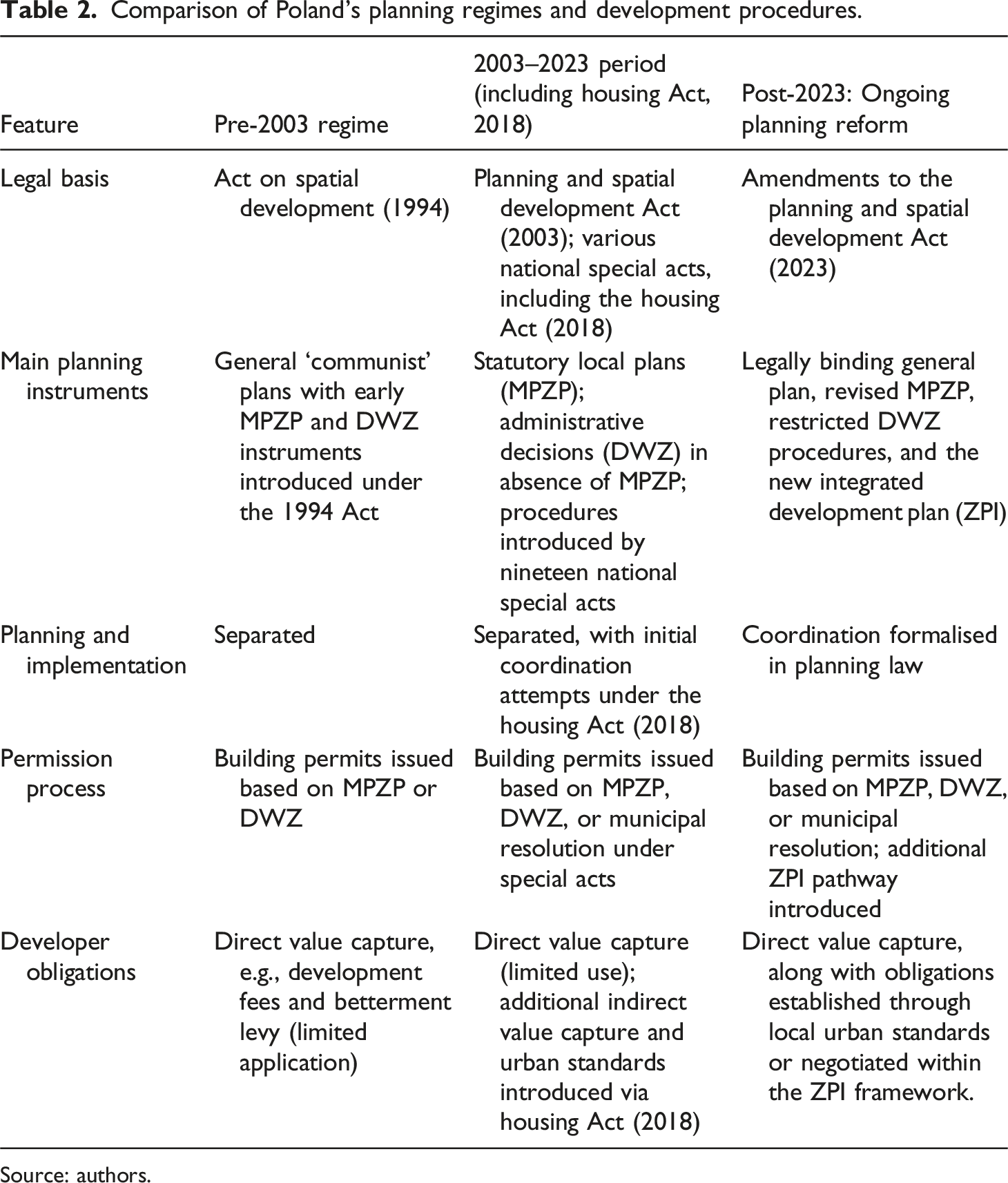
Poland’s planning system is formally plan-led, structured around hierarchically organised instruments. At the local level, the primary legal tool is the Local Spatial Development Plan (Miejscowy Plan Zagospodarowania Przestrzennego, MPZP), which is binding and prescriptive but often absent or outdated. In such cases, development decisions are issued through administrative procedures known as Decisions on Development Conditions (Decyzja o Warunkach Zabudowy, DWZ), which function without reference to a comprehensive local plan. This dual-track system was first introduced by the 1994 Act on Spatial Development and was retained in the 2003 Act on Planning and Spatial Development. Prior to 2003, the planning framework relied on general plans from the communist era, which held limited regulatory value under new market conditions, and new planning documents developed under the 1994 Act by the newly established local self-governments.
The Housing Act (2018) introduced a third mechanism, distinct from both MPZP and DWZ, allowing developers to propose housing investments irrespective of the planning status of the site. Municipalities may approve these projects through special resolutions, provided the developer complies with baseline statutory requirements. While framed as a means to accelerate housing provision, this bypass mechanism effectively reconfigures the assignment of development rights, enabling negotiated agreements between municipalities and developers that often override existing local plans. Relative to the more formalised statutory logic of the 2003 Act, the Housing Act (2018) reinstates a more discretionary and arguably more negotiable mode of development control, albeit now framed within national legislation. The Act thus challenges the current hierarchical model, where planning authority rests with municipalities, unlike the centralised state-led model under socialism. At the same time, it operationalises a market-oriented logic, opening the door for interpreting it as a Coasian intervention aimed at lowering transaction costs and fostering negotiated solutions in urban development.
This paper views the Housing Act (2018) as a test case for applying Coasian planning principles within Poland’s evolving planning system. It interprets the Act as an attempt to restructure market dynamics by reducing transaction costs and clarifying the allocation of development rights and responsibilities, roles that Coasian theory assigns to public authorities. Although implementation has remained limited in scale, the Act is analytically significant because it introduced new development rights and negotiation-based procedures that anticipated subsequent reforms. While the Act seeks to bypass the limitations of the regulatory planning system by enabling negotiated agreements between municipalities and developers, it also challenges established planning hierarchies and raises concerns about long-term governance outcomes. The emphasis on procedural acceleration, though effective in reducing investment preparation time, risks sidelining broader environmental, social, and economic considerations that are essential for sustainable urban development.
The paper contributes both theoretically and empirically. It develops a conceptual approach that adopts a Coasian institutional perspective on planning, offering a novel lens through which to analyse hybrid planning regimes. It also proposes a typology of planning systems grounded in institutional theory. Empirically, the paper examines the implementation of the Housing Act (2018) through case-based research, situating the analysis within the broader context of Poland’s housing market and planning challenges. In doing so, it evaluates the potential and limitations of Coasian interventions in addressing regulatory inefficiencies, highlighting the complexity of measuring their benefits within the dynamic conditions of urban development. The findings illuminate the tensions between rule-based and negotiation-based planning, the evolving role of public authorities, and the conditions under which market-oriented tools may support or undermine cooperative urban governance.
Coasian interventions and institutional perspectives on planning regimes
In institutional analyses of urban governance, planning practices are commonly grouped into hierarchical, network, and market governance (Buitelaar, 2003). This typology reflects core coordination models in new institutional economics, including Williamson’s (1985) governance structures and Thompson’s (2003) coordination logics, and aligns with regulatory, cooperative, and market regimes (Gerber et al., 2009; Halleux et al., 2012). While Coase (1937) distinguished markets from firms, later work reframed this as coordination through sale contracts versus employment contracts (Lai, 2005). Network governance, by contrast, relies on relational and procedural agreements among interdependent actors, para-contractual arrangements shaped by mutual expectations and continuous negotiation, marking it as a cooperative rather than price- or command-based form.
Various planning regimes can coexist within a given country, leading to a spectrum of planning practices across numerous subfields. In conceptualising these planning regimes, the responsibility for elaborating the land-use plan emerges as a crucial factor in establishing the ideal governance structure. Planning through zoning and land-use plans, typically developed by the public sector, aligns with a strong hierarchical governance system. This approach was the dominant planning thought and practice in Western Europe until the 1980s (Healey, 2007). In contrast, cooperation between public and private actors in planning, which integrates various economic and social dimensions and acknowledges the strategic role of planning, facilitates the formation of network governance and a cooperative regime. The category labelled ‘non-planning regime’ or ‘development without a plan’ is indicative of the market governance that arguably currently prevails in Poland.
A hierarchical governance system typically emerges as a response to market failures. It operates primarily through government interventions, such as land-use plans, which aim to coordinate spatial development. While ‘intervention’ is often understood as the ex-post imposition of regulatory constraints, planning rules can also take the form of ex-ante measures, whether imposed by order or established through mutual consent, which confer or regulate property rights (Lai and Davies, 2022). In contrast, a market regime adopts a more laissez-faire approach to spatial issues. Advocates of this model argue that greater market involvement can increase economic efficiency in land-use decision-making (Ellickson, 1991; Pennington, 1999; Vejchodská et al., 2022).
However, critics of market-based approaches contend that such regimes often fail to address collective needs. They warn that the emphasis on profit maximisation can come at the expense of broader public interests. Although market regimes are frequently criticised for producing socially inefficient outcomes, government interventions are not inherently superior. As Levačić (1991) points out, public policies can also result in inefficiencies, commonly referred to as government failures. This dual recognition of potential failure in both systems underpins a longstanding debate in planning theory, which oscillates between the poles of state control and market forces (Muñoz Gielen and van der Krabben, 2019; Slaev and Shahab, 2026). These issues continue to shape contemporary discussions on reforming Poland’s planning system.
Rather than framing the discussion as a dichotomy between market and government, new institutional economics emphasises the arrangement of coordination among various market actors, conceptualised as ‘governance’. This shift moves away from the binary choice of market versus government, introducing three coordination models: market, hierarchy, and networks. The emphasis is placed on understanding how institutions influence economic behaviour. It has become evident that transactions are not devoid of frictions, highlighting the significance of institutions, such as property rights (Slaev, 2017). The networks model of coordination specifically underscores the importance of contracting and the development of networks among stakeholders.
The emphasis on transaction costs and property rights was articulated in Coase’s seminal work, ‘The Problem of Social Costs’ (1960). The Coase theorem posits that when rights are well defined and the cost of transacting is zero, resource allocation is efficient and independent of the ownership pattern (Coase, 1960). This statement suggests that any initial allocation of property rights will yield the same efficient outcome in a low transaction cost environment, as interested parties will negotiate to rectify any externalities. However, in real-world scenarios, particularly when multiple actors are involved and information is inadequate or asymmetric, transaction costs cannot be overlooked (Clinch et al., 2008; Shahab and Viallon, 2020). Consequently, the initial allocation of property rights significantly influences how externalities are managed.
Researchers have often applied a corollary of the Coase theorem to explore institutional interventions in urban development. In settings with positive transaction costs, as Lai (2007) argues, the efficiency of resource use depends on how rights and liabilities are assigned through law, governance, and contractual arrangements. This expands Coase’s original insight beyond market exchanges to include the regulatory and institutional context in which property rights are defined and exercised. Efficiency outcomes are thus shaped not only by the ownership of property rights (Barzel, 1997) or the formal legal framework (Stigler, 1987), but also by how responsibilities are allocated within governance structures and informal institutions.
Coasian approaches argue that efficiency can be improved through negotiated solutions supported by institutions that reduce transaction costs and clarify rights. Local authorities often act as facilitators, structuring engagement between developers and communities (Clinch et al., 2008; Ennis, 1997; Shahab and Viallon, 2020). In contexts with high transaction costs or ambiguous rights, planning shifts from regulation to market structuring, clarifying entitlements and lowering coordination costs (Lai, 2007). Rather than relying on detailed regulation, Coasian thinking emphasises institutional frameworks that make negotiated development feasible and efficient.
Transaction costs refer to costs beyond production itself, arising from bounded rationality, incomplete information, and opportunism (Shahab, 2022). Institutions, as defined by North (1990), aim to reduce these costs, yet they also generate specific institutional transaction costs, such as administrative burdens, procedural delays, and coordination challenges among stakeholders (Klaes, 2008). In planning, these may include the time, uncertainty, and effort required to obtain planning consent, interpret legal provisions, and navigate multi-actor negotiations (Hou et al., 2020; Shahab et al., 2018). While minimising transaction costs is often associated with efficiency, this perspective is contested. Certain transaction costs, particularly those related to rule-based planning, may be justified by longer-term public benefits (Buitelaar, 2004, 2007; Falco et al., 2024).
The distribution of property rights is crucial, as it relates to their assignment and delineation, providing insights into the ownership structure during the development process and the manner in which rights are exercised and enforced (Libecap, 1989). The delineation of property rights determines who bears the economic rewards and costs associated with resource-use decisions and identifies the key parties involved in the development process. Following Lai’s (2007) corollary formulation of the Coase Theorem, this paper interprets the delineation of property rights as the distribution of rights and liabilities concerning land within urban development processes.
Webster and Lai (2003) argue that rights and liabilities should be allocated to those best positioned to shape a resource’s contribution to desired outcomes, making right-holders residual claimants and promoting efficiency. Their subsidiarity rule proposes aligning responsibility with influence, though such allocations may also create external costs. From a Coasian perspective, public authorities should reduce transaction costs and define rights and liabilities to support efficient urban development, yet the appropriate configuration is context-specific. As land-use systems pursue different policy goals (Lai, 1997; Needham, 2006), efficiency must be assessed in terms of how well they address particular problems and deliver intended outcomes (Buitelaar, 2007; Shahab et al., 2018).
Classification of governance models in the polish planning system
In Poland, the governance of land use is structured around two principal planning documents set forth by the Land Use Planning and Development Act of 2003 (LUPDA) 1 : the Study of the Conditions and Directions of Spatial Development (referred to as the Study) 2 and the Local Spatial Development Plan (referred to as local plans). These instruments serve distinct functions. The Study sets out general spatial policy for the entire municipality (art. 9.2–3, art. 12 LUPDA) but has no binding force on third parties, whereas local plans carry the force of law (art. 14.8 LUPDA) and specify detailed land uses consistent with the Study (art. 14.1 LUPDA). Municipalities are not obliged to prepare local plans unless required by other legislation, resulting in the common situation where a Study exists but no local plan has been adopted for significant areas. This has produced two parallel pathways for urban development: a hierarchical planning model and a market governance model.
Under the hierarchical model, municipalities prepare both the Study and the local plan (MPZP). Before the Housing Act (2018), Polish planning law offered little scope for negotiation between public and private actors, aside from rarely used provisions in the Revitalisation Act (2015) and public road construction under the building permit process. Public authorities maintain primary control over plan preparation and implementation, with limited input from developers. Although public participation has increased, it remains largely procedural, and final decisions rest with the municipality. This approach characterised Polish planning more as hierarchical governance than as network governance, where collaborative decision-making between public and private actors would otherwise be integral. Recent reforms have introduced the Integrated Investment Plan, allowing municipal councils to authorise developers to prepare planning documents, an instrument intended to replace the Housing Act (2018) and discussed later in the paper.
The second dominant pathway is market governance. As of 2020, local plans (MPZP) covered only 31.4% of the country’s land area (CSO, 2021). In areas lacking a local plan, property owners may proceed with development based on an administrative decision on land development conditions (DWZ), which confers legal rights to develop land in accordance with the ‘good surroundings principle’, i.e., if the plot has access to a public road, sufficient technical infrastructure exists, and neighbouring development sets a precedent for the proposed use, scale, and form (Art. 61.1 LUDPA). In practice, this principle allows for construction in areas that higher-level planning documents may have designated for public spaces, green corridors, parks, and other communal uses. DWZ decisions account for approximately half of all housing investments and about 80% of all new developments (Śleszyński, 2014). While ownership and use rights are formally registered and generally well-defined, the delineation of development-related liabilities, such as responsibilities for urban infrastructure provision and value capture instruments, is practically absent under DWZ procedures. This mode of development departs from traditional understandings of planning or spatial policy implementation, with market governance model emerging as the dominant framework and thus the baseline for potential future interventions.
Polish professional literature often critiques the current planning system for failing to address negative externalities resulting from urban markets, such as extensive urban sprawl, the absence of high-quality urban design, and persistent housing shortages (Jędraszko, 2005; Havel, 2014; Havel and Zaborowski, 2025). Inconsistencies in land-use planning and the over-designation of housing land, estimated to exceed actual need by as much as five-to six-fold, further undermine system effectiveness (CSO 2021; Kowalewski et al., 2014). While numerous reform attempts aimed to integrate a design and planning code akin to the German model, they were not implemented. Comprehensive reforms were introduced only recently, at the end of 2023. The planning system is currently in a transitional phase between the old and new regulations. As will be discussed, the Housing Act (2018) marked an important step in this process.
The planning system in Poland largely overlooked also the redistribution of land value gains to benefit the community, with public value capture instruments proving limited in both scope and application (Gdesz, 2011). The primary mechanisms for capturing public value included planning fees (renta planistyczna), betterment charges (opłaty adiacenckie), and obligations to (re)construct public roads as a condition for building permit approval. However, these instruments were largely inactive or underutilised in practice. In other words, despite a clear obligation to charge a planning fee, executive bodies often refrain from implementing it, especially when the cost of assessment exceeds the potential revenue (see Gdesz, 2011; Havel, 2017). According to LUPDA, local authorities lacked the ability to condition the approval of local plans on any formal agreement with private-sector investors, although the Act on Revitalization (2015) technically allows for development urban contracts, this instrument has not yet been applied in practice (Havel, 2017). Consequently, no negotiable cost recovery mechanisms or developer obligations were in place, leaving the planning framework without effective tools to capture the benefits of land value increases for public purposes. Moreover, existing instruments primarily address physical infrastructure rather than broader negative externalities, such as congestion, noise, or pollution, associated with intensified urban development. A more developed Coasian approach could allow municipalities and developers to negotiate compensatory measures for such externalities, provided that appropriate mechanisms exist to identify, quantify, and assign liability for these impacts.
Housing Act (2018) as an illustrative example of Coasian intervention: Interpretations in terms of property rights delineation and transaction cost reduction
Background of the Housing Act
The Act on Facilitating the Preparation and Implementation of Housing and Associated Facilities (Journal of Laws of 2018, item 1496) came into force on August 22, 2018, as a temporary, ten-year measure. As a lex specialis, the Act operates outside the typical legislative framework. The Act’s primary goal, as stated by the legislator, was to mitigate Poland’s housing deficit and improve housing standards relative to European Union averages through expedited administrative procedures.
Poland faces a critical shortage of affordable housing, particularly for middle- and low-income households (National Housing Program, 2016). High down-payment requirements create major entry barriers for younger adults aged 26–35 (Bryx and Rudzka, 2020), while larger families are often credit-excluded even for small units due to lower per capita income and higher living expenses that limit mortgage eligibility (Bryx et al., 2021). In 2019, the Ministry of Development estimated a housing deficit of 641,000 dwellings (4.5% of households), and 67.3% of adults aged 18–34 lived with their parents (Eurostat, 2022). Housing conditions remain below EU averages: in 2023, Poland had 419 dwellings per 1,000 people compared to the EU average of 517, and an overcrowding rate of 33.9% versus 16.8% EU-wide (Eurostat, 2022). Municipal housing provision is also strained. Local authorities in major cities struggle to meet statutory obligations, with ageing housing stock often concentrated in marginalised areas (Przymeński, 2021). Meanwhile, increasing commodification of housing, driven by high rental returns in urban areas, limits access for low-income groups as more dwellings are treated as investment assets by wealthy individuals and institutional investors.
Under the Housing Act (2018), housing projects eligible for this streamlined path must include either at least 25 multi-family residential units or 10 single-family homes. To initiate a project, developers must submit an urban and architectural concept of the proposed development to the municipal council and enter into negotiations. Developers may also be required to provide associated facilities for these projects, including public infrastructure, transport facilities, and spaces for cultural activities, education, childcare, healthcare, sports, and recreation. The Act respects the principle of local planning authority, allowing the municipal council to refuse housing project locations that conflict with municipal development needs or priorities.
New delineation of property rights: The right to develop on post-industrial land and the right to develop contrary to the local plan (MPZP)
The legislation introduced a reconfiguration of property rights by establishing new development rights for certain types of land. Specifically, it allowed for housing construction on various plots previously designated in the Study of Conditions and Directions of Spatial Development for functions such as railway, military, industrial, or postal services, provided these functions are no longer active. This act permitted housing development on such sites, irrespective of the Study’s or local plans’ provisions. However, this rule was amended in September 2023. Currently, housing projects must align with the Study but may proceed even if they conflict with the local plan (MPZP). This introduces a new layer of flexibility in the legal treatment of land-use rights, enabling developers to initiate projects on land that would otherwise be inaccessible under existing regulatory frameworks. The newly assigned right to develop is intended to increase the availability of land for housing by facilitating applications for housing project locations without requiring traditional land-use plans. Although ownership and use rights remain formally registered, this legislative shift reconfigures development rights in ways that challenge the established planning order. This legislative shift represents a strategic move to address land scarcity and expedite housing provision, challenging the conventional reliance on detailed local plans.
Distribution of rights and liabilities concerning urban infrastructure: Indirect value capture mechanism and new negotiation opportunities
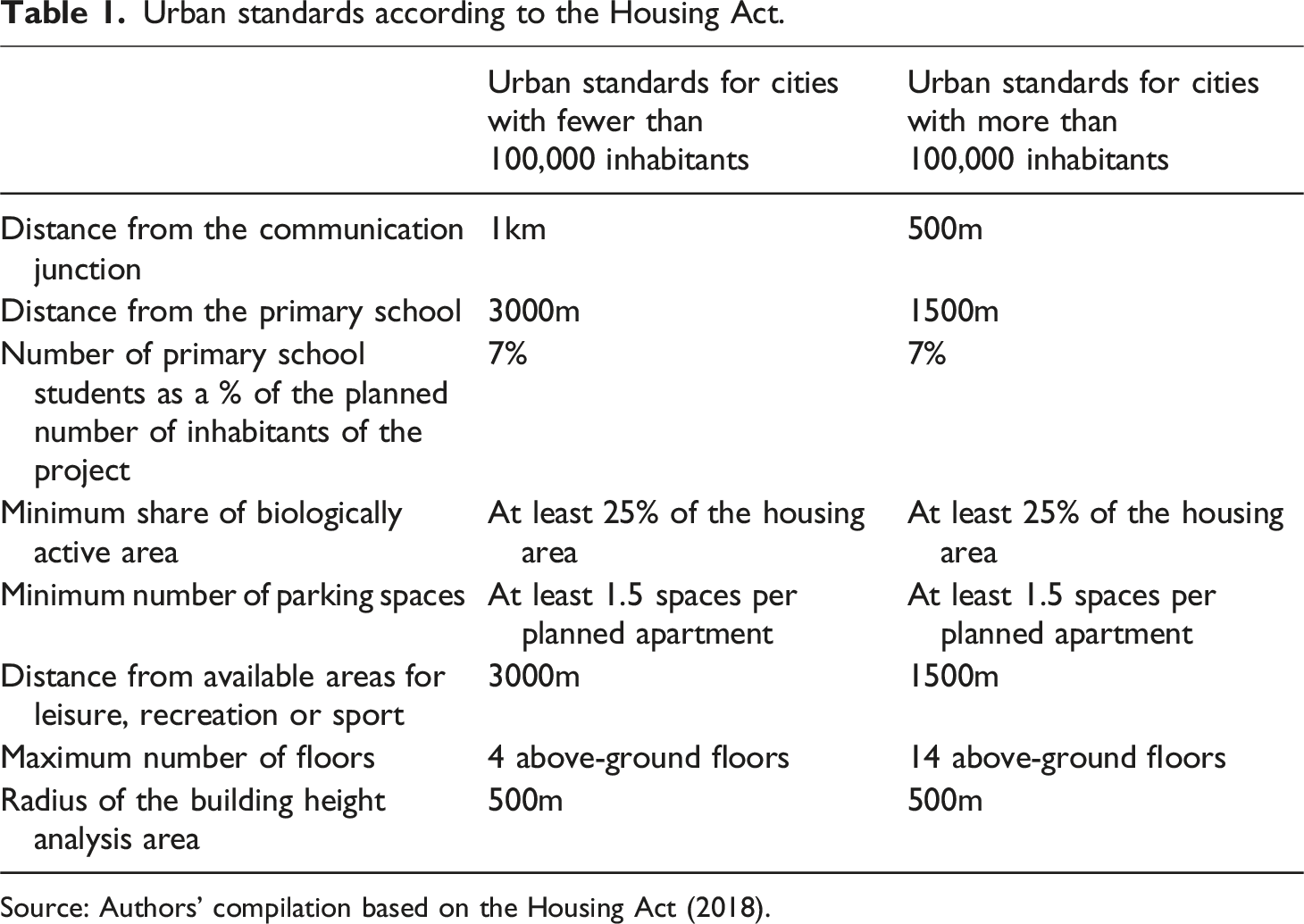
Urban standards according to the Housing Act.
Source: Authors’ compilation based on the Housing Act (2018).
Developers may enter into agreements with municipalities to determine locations for additional investments necessary for social infrastructure. These agreements form the basis for meeting social infrastructure requirements, balancing the responsibilities of developers with those of the municipality in providing necessary services. Furthermore, the Act assigns individual responsibilities to developers for urban infrastructure costs, encouraging negotiation with local authorities, who represent the interests of residents, regarding infrastructure costs. This setup, in line with Coasian principles, is intended to improve negotiation processes and expedite mutually beneficial outcomes. In addition to financial responsibilities, this Act also aims to address spatial quality concerns, using urban standards as a tool to mitigate urban sprawl, a common issue in Poland where many new housing developments on city outskirts are initiated without adequate infrastructure provisions.
Reduction of transaction costs
The application process for determining housing project locations requires developers to submit urban design and architectural plans along with documentation verifying compliance with urban standards 4 . This application, funded by the developer, includes an urban analysis, marking a shift toward reducing the financial and procedural burdens of traditional land-use planning in Poland. By streamlining procedures and clarifying requirements, the Act aims to reduce both monetary and procedural transaction costs. It also introduces greater regulatory flexibility by allowing projects to proceed outside existing local land-use plans. Furthermore, it promotes direct negotiations between municipalities and developers, lowering coordination costs and fostering a more cooperative governance regime. This negotiated approach to land development departs from Poland’s dominant regulatory traditions, offering opportunities for more coordinated and responsive outcomes.
One of the primary goals of the Housing Act (2018) is to accelerate the investment preparation process, reducing the average timeframe from five years to approximately one year. The Act introduces specific procedural obligations aimed at minimising both time and monetary costs. Following application submission, municipal councils are required to adopt a “resolution on determining the location of a housing investment” within 60 days, with a possible extension of up to 30 additional days 5 . This resolution then becomes binding for building permit issuance, thereby simplifying the approval pathway. Public hearings further promote transparency, offering residents the opportunity to submit comments and express opinions on new development projects, although the substantive negotiations between developers and municipal officials typically occur in-camera. As noted by Shahab and Viallon (2019), timely and equitable information dissemination reduces transaction costs by fostering an environment of informed participation across all stakeholder groups.
Analysing the implementation of the Housing Act (2018)
To better understand how the Housing Act (2018) fits into and departs from earlier planning frameworks and cultures in Poland, it is helpful to contextualise the country’s broader planning history. Poland presents a compelling case, having undergone several major reforms to property rights and urban planning institutions. After a period of centrally planned governance under communism, Poland transitioned to a market economy following the political transformations of 1989. Despite this shift, spatial plans developed during the communist era, designed under the assumption that the state would serve as the primary investor, remained formally in effect until 2003. These general plans were often vague and played a limited role in coordinating development. The introduction of the 1994 Act on Spatial Development marked an attempt to build a new statutory planning framework, later consolidated in the 2003 Planning and Spatial Development Act. These institutional changes occurred alongside broader administrative reforms, including the re-establishment of local self-government in 1990 and 1999 (Havel, 2014).
The Housing Act (2018), introduced without prior piloting and applied uniformly across all municipalities, generated significant controversy and came to be known as the ‘Lex Developer Act’. It marked a notable departure from the more rigid, plan-led logic of the 2003 framework. While the 2003 Act emphasised conformity to local plans (MPZPs) and administrative decisions (DWZs), the Housing Act (2018) introduced greater procedural flexibility by allowing time-bound municipal resolutions and negotiated obligations. To mitigate the potential adverse effects of this discretionary approach, many municipalities adopted local urban standards that imposed more stringent requirements on developers, especially concerning social and technical infrastructure. These local standards enabled municipalities to better manage development impacts and tailor responses to local conditions.
Comparison of Poland’s planning regimes and development procedures.
Source: authors.
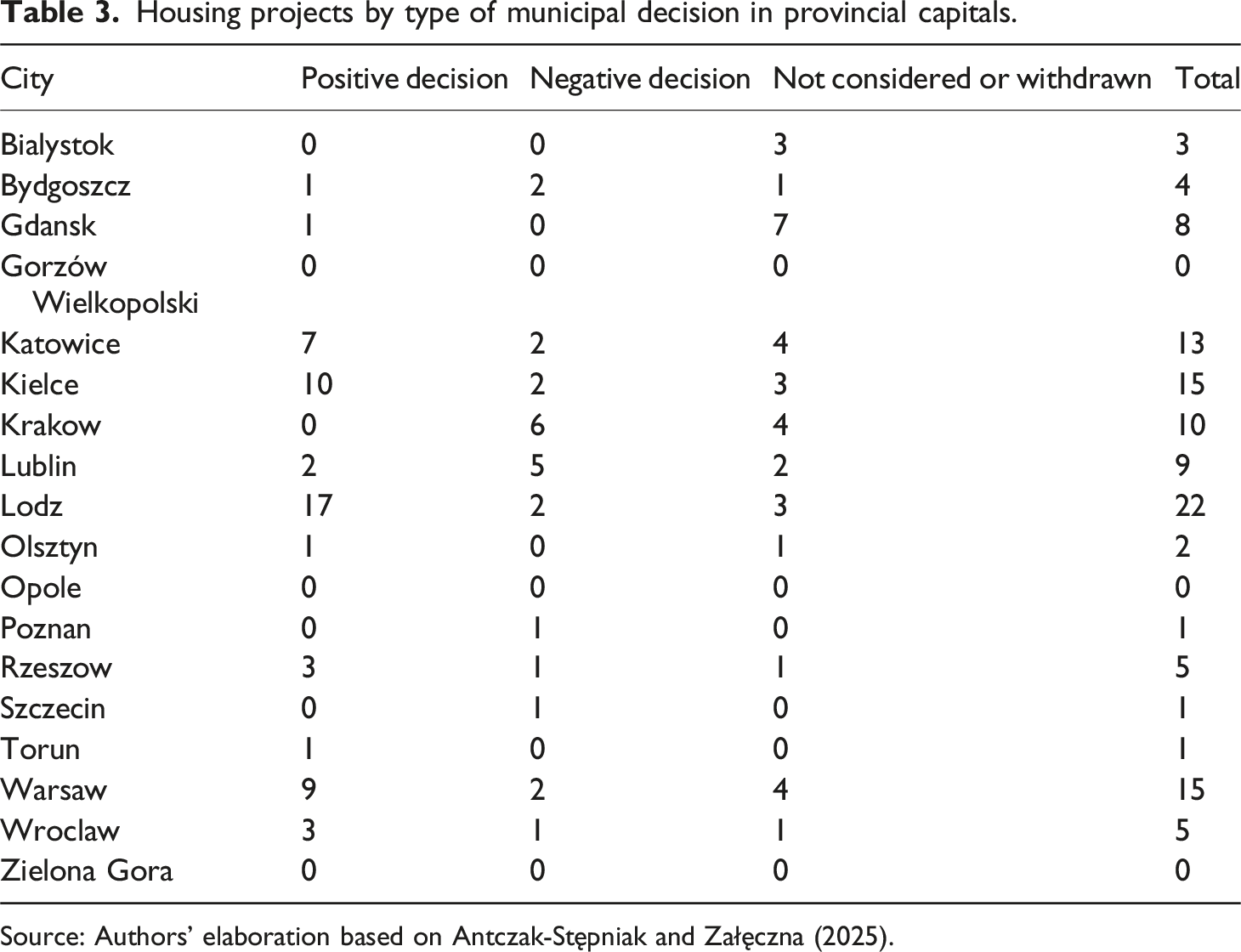
Housing projects by type of municipal decision in provincial capitals.
Source: Authors’ elaboration based on Antczak-Stępniak and Załęczna (2025).
According to Antczak-Stępniak and Załęczna (2025), despite applications being submitted in economically dynamic cities such as Krakow, Poznań, and Gdańsk, the authorities generally did not approve developers’ requests. However, some local authorities did accept applications, with the highest number of positive decisions recorded in Łódź (seventeen), Kielce (ten), and Warsaw (nine). Each of these cities has distinct socio-economic conditions and spatial development characteristics, which helps explain the differing levels of uptake, with authorities responding variously to local planning constraints, development pressures, and political priorities.
Łódź, a post-industrial city, has been significantly affected by the transformation recession, leading to a rapid decline in its population. However, revitalisation efforts in the city centre, primarily funded by the EU, along with low land prices and the proximity to Warsaw, have altered investors’ perceptions of the city. For many years, Łódź had a very low proportion of land covered by local planning documents. Among the reviewed cases, four projects conformed to local plans, seven were partially inconsistent, one was completely inconsistent, and the remainder were located in areas without plans. The discrepancies mainly related to the intended land use and function, as well as parameters such as building area, height, parking provision, and the share of biologically active land. Most proposed residential projects sought to increase development intensity. Kielce, a medium-sized city seeking development stimuli, also has a low share of land covered by local plans. Of the studied cases, one project conformed to the local plan, two were partially inconsistent, one was entirely inconsistent, and six were in areas without local plans. Warsaw, as the capital, is highly attractive to investors; however, the state of spatial development often limits the potential for new projects. As a result, local authorities view the expedited approval process as a potential solution to overcome these constraints. In the reviewed cases, one project aligned with the local plan, five were partially inconsistent, and three were fully inconsistent.
It is important to highlight that in Warsaw, the majority of positive decisions were inconsistent with the local plans (MPZP). The divergences involved the same elements as in Łódź, namely land use and function, as well as construction parameters, parking provision, and the proportion of biologically active land. Among the developers, three committed to providing social infrastructure for residents, although one later withdrew this pledge. The majority of the projects aimed to utilise existing social infrastructure and technical services provided by the city, offering only minor enhancements to road access for their respective plots. Notably, all proposals focused on commercial housing investments, with no inclusion of social housing. A significant proposal involved the transformation of Warsaw’s largest office centre into a multifunctional area, incorporating investments in public green spaces and a primary school, located in Mokotów on ul. Domaniewska.
Despite the initial promise of the Housing Act, its practical implementation has been slow across key cities, with limited progress on the ground. In Łódź, while there is growing investor interest due to revitalisation efforts and its proximity to Warsaw, the number of projects progressing under the Housing Act (2018) remains relatively small: three projects were under construction, with two more expected to begin soon, collectively offering just over 900 apartments. The situation in Kielce reflects a similar trend, with only a fraction of approved projects moving forward: only two out of ten approved projects were active, with a total of 255 apartments planned. As of November 2024, there were four ongoing projects in Warsaw, comprising nearly 1,100 apartments, three of which are commercial and one designated for social housing (Antczak-Stępniak and Załęczna, 2025). Despite Warsaw’s attractiveness for developers, the number of ongoing projects under the Housing Act (2018) has been constrained by complex spatial regulations and local plan inconsistencies, further compounded by a reluctance from authorities to approve developments that deviate from established urban priorities. These challenges suggest that while the Housing Act (2018) has created a new pathway for development, its broader impact is hindered by a combination of regulatory, political, and practical barriers, limiting its potential to fully address the housing needs.
Discussion
The potential of the Housing Act (2018) to structure the market through the delineation of property rights and the reduction of transaction costs warrants careful consideration. In many respects, the Act operates as a Coasian intervention: it avoids imposing rigid regulations on market participants and leaves developers and local authorities free to engage with the mechanism or not. By creating new development rights and associated liabilities, especially regarding public value capture for urban infrastructure, the legislation establishes a framework within which market dynamics can function. This reflects Webster and Lai’s (2003) view that rights should be allocated to those best placed to enhance a resource’s contribution to desired outcomes, such as increased housing supply. Within this framework, the state acts as an intermediary, addressing asymmetries in the distribution of rights and liabilities between developers and local authorities acting on behalf of communities. This negotiation setting echoes the Coase Theorem, insofar as the Polish legislator appears, perhaps unintentionally, to have adopted core Coasian planning principles by structuring the market to reduce transaction costs and clarify the allocation of rights and responsibilities in land use.
However, a critical evaluation reveals that the delineation of rights and liabilities may not align adequately with overarching policy goals. Although private sector investors hold significant sway over the housing stock, they are not necessarily positioned to fulfil specific policy objectives, such as enhancing housing accessibility for moderate-income households. The intention behind assigning rights and liabilities related to value capture and development rights was to stimulate efficiency in urban development by transforming developers from mere residual claimants into accountable actors responsible for mitigating externalities or contributing to public goods. Yet, the current framework lacks mechanisms to compel developers to deliver social or affordable housing. The absence of binding requirements for developers to allocate a certain proportion of units as such housing undermines the Act’s capacity to achieve its intended socio-economic outcomes. While such provisions could, in principle, function as Coasian interventions, negotiated contributions internalising social costs, they are not without trade-offs, as seen in other contexts where inclusionary policies have led to changes in house prices or unit sizes (Bento et al., 2009; Soltas, 2024).
Consequently, the market remains predominantly commercial, with developers free to set prices for housing without any assurance of affordability or alignment with public interest. This highlights the complexities inherent in using Coasian interventions within the planning regime. While the Housing Act (2018) attempts to provide a structure for market engagement, its effectiveness in delivering on policy goals is compromised by the lack of accountability mechanisms for developers. The success of such interventions depends not only on structuring rights and reducing transaction costs but also on ensuring that developers are incentivised, or mandated, to contribute meaningfully to the provision of affordable housing, thereby achieving broader social objectives.
In practice, commercial housing developers have capitalised on the new rights to develop land on former industrial sites in ways that do not conform to the Study or benefit from regulations allowing development that bypasses the local plan (MPZP), all while failing to deliver affordable housing. In several countries, notably the UK, there exist requirements for contributions to affordable housing in commercial developments (Crook et al., 2015; Dickinson and Shahab, 2021). However, such obligations are conspicuously absent from the Polish Housing Act. This oversight raises the question of why the Act, which could have been an ideal opportunity to mandate the provision of affordable housing, has not included such requirements. This lack of provisions has led to the opposition referring to the Act as the ‘Lex Developer Act’ from the outset.
Moreover, the vague language of the Act has facilitated broad interpretations and resulted in varied local applications of the law. This ambiguity has led to scenarios in which some municipalities find themselves unable to refuse projects; instead, decisions on project implementation are left to the courts, effectively eliminating opportunities for negotiation. The initial court rulings have also been ambiguous, complicating the situation further. During the analysed period, legal disputes between developers and local authorities, both at the first and second instance levels, resulted in 182 court cases. Of these, 44 reached the Supreme Administrative Court, indicating that the highest level of legal recourse in Poland was pursued. These disputes often caused significant project delays and increased uncertainty, undermining the predictability and credibility of the Housing Act (2018) as a planning instrument. In some cases, judicial rulings began to shape early legal interpretations of the Act’s provisions, setting precedents that influenced subsequent decisions by local authorities. This demonstrates both the parties’ commitment to legal action and the substantial financial, temporal, and administrative costs associated with such proceedings. It also highlights that in a predominantly market-based system like Poland’s, the market swiftly evaluates the potential benefits of new regulatory instruments and exploits any legal loopholes or shortcomings. Developers have used these provisions to intensify development parameters or to alter the designated functions of areas outlined in the local plan (MPZP). Nonetheless, it is important to note that the overall level of interest in this method of land development remains limited.
This imprecisely framed attempt at Coasian intervention has sparked a necessary dialogue concerning the delineation of rights and liabilities among all stakeholders in urban development, thereby fostering new avenues for collaboration in the planning process. Many cities were adopting ‘urban standards’ in a bid to safeguard themselves against the implications of the Act. This indicates that the interventions influenced by Coasian principles are indeed shifting planning regimes. Developers have begun to engage in open negotiations and to formalise agreements regarding contributions to urban infrastructure costs, acknowledging these expenses in their land development projects. The Housing Act (2018) aligns with a market governance model in planning, while also creating opportunities for initiating a collaborative learning process, a relatively innovative approach to urban development processes within the Polish context. Moreover, the Act addresses the pressing issue of financing urban infrastructure by introducing new value capture mechanisms, specifically through infrastructure provisions undertaken by developers. Although it does not directly confront the challenge of social housing, it has raised numerous urban standards that had previously been overlooked in development processes based on decisions regarding land development conditions (DWZ).
In late 2023, Poland amended its planning law, introducing ZPI as part of a broader reform. ZPIs allow municipalities and developers to negotiate infrastructure responsibilities through formal agreements, extending the collaborative approach of the Housing Act, which will remain in force until January 2026. Poland’s planning discourse remains divided between market-led administrative decisions (DWZ) and state-led land-use plans. Many existing plans lack regulatory precision, often functioning like DWZs by permitting wide-ranging land uses, undermining their authority and reflecting the risks of legal overcomplexity (Moroni et al., 2018). To address this, the reform introduces a mandatory general plan for each municipality, legally binding and intended to counteract sprawl by delineating regulated infill zones. However, the reform omits compensation for downzoning, raising concerns over potential legal disputes. Municipalities must adopt the new plans by mid-2026. As lower-tier instruments, ZPIs must conform to these general plans, ensuring vertical coherence in the planning system.
Poland’s planning system, shaped by the post-1990 transition, is widely seen as weak in both spatial and socioeconomic terms (Halleux et al., 2022; Havel, 2014). It has failed to deliver strategic land use patterns or effectively capture land value increases. The system oscillates between rigid regulation and market-driven approaches, a dynamic partly rooted in low social capital, which limits public-private cooperation. Broader European debates on state failure have challenged comprehensive planning models, prompting trends toward deregulation, decentralisation, and public-private partnerships (Webster, 2005). In weak planning regimes, where collaborative planning is constrained by low trust or corruption, Coasian interventions may act as transitional tools. In Poland, these have helped shift infrastructure burdens from the public sector and introduced mechanisms for negotiated development, fostering more collaborative outcomes.
Conclusions
This article contends that the assessment of transaction costs, as well as the allocation of rights and liabilities, must be approached on a case-by-case basis, calibrated to address specific efficiency concerns and evaluated against the efficacy of achieving designated policy objectives. Empirical evidence suggests that the delineation of rights and responsibilities under the Housing Act (2018) was inadequately aligned with the primary policy aim of affordable housing. The Polish legislator’s vague demarcation of these legal boundaries hindered the Act’s potential to fulfil its stated objectives.
Furthermore, this paper has explored the applicability of a Coasian framework in delineating actors’ responsibilities within urban development, as well as the prospects for fostering a cooperative planning regime within a primarily market-based framework. While the mechanisms introduced by the Housing Act (2018), such as accelerated procedures and the potential for negotiated infrastructure obligations, align with Coasian reasoning, the empirical evidence of improved planning outcomes remains limited. The study therefore argues that the Act’s significance lies less in demonstrable effects on development quality or externalities, and more in its role as an institutional adjustment that encouraged new forms of negotiation between municipalities and developers. Although the Act may be seen as a catalyst for fostering a more collaborative planning environment, the reallocation of development rights, particularly those granted to commercial developers over pre-existing local plans, raises significant challenges. Each case warrants thorough, context-specific assessment to determine whether deviations from established plans generate public benefits, especially where local plans preserve land for essential social functions.
The debate over the assignment of development rights remains active and unresolved. Moreover, there is limited empirical evidence indicating that developers and local authorities can arrive at mutually beneficial outcomes under the current legal framework. Nonetheless, the Act provides a basis for these stakeholders to negotiate to mitigate externalities, particularly in relation to the social infrastructure needs associated with housing developments. Continued research is essential to fully understand the practical implications of the Act’s implementation and to guide the development of a more cooperative regime in the country moving forward.
Based on the analysis presented in this paper, several targeted interventions could improve the effectiveness of the Housing Act (2018). First, introducing binding affordability requirements would help align private incentives with public goals. Second, clearer statutory guidance and standardised criteria for municipal discretion could reduce legal ambiguity, promote consistent implementation, and limit costly litigation. Third, strengthening mechanisms for public value capture, such as broader developer obligations for infrastructure, would ensure more equitable contributions to social infrastructure. Fourth, the practical limits of Coasian arrangements highlight the need to address asymmetric information and high coordination costs; without adequate transparency and safeguards, developers may use the Act to bypass local planning restrictions. From a Coasian perspective, inconsistencies between the Act and local plans could be mitigated by more explicit delineation of rights and baseline entitlements, enabling negotiated deviations to be assessed against clear local priorities. Protecting communities from excessive intensification also requires transparent valuation of externalities and proportionate compensatory obligations. Finally, embedding the Act’s negotiation-based approach within a broader strategic planning framework, such as the new general plans, could enhance coherence across planning tiers and strengthen the legitimacy of Coasian interventions.
Theoretically, this paper illustrates the feasibility of operating within multiple planning regimes within a single country and highlights the potential role of Coasian approaches in shaping these regimes. The empirical research presented herein indicates that, although this form of Coasian intervention has not advanced urban development outcomes in relation to the intended policy objectives, it has nevertheless influenced shifts within the planning regimes that govern urban development processes.
Footnotes
Declaration of conflicting interests
The authors declared no potential conflicts of interest with respect to the research, authorship, and/or publication of this article.
Funding
The authors received no financial support for the research, authorship, and/or publication of this article.
