




Abstract
For more than two decades, critical planning scholars have called for strategic spatial planning to cut its rational roots stemming from the 1960s–70s, and counter its tendency towards more incremental approaches of the 1980s–2000s. To truly address the core challenges of cities and regions in our times, spatial planning should plan for discontinuity. This paper explores how planning may embrace futuring practices to do so. Drawing on three materially oriented futuring approaches, ‘Critical Future Studies’, ‘Sociology of Expectations’, and ‘Sociology of the Future’, futuring practices may serve a threefold aim. First, exposing the power of ‘normalisation’, unlocking silenced futures. Second, providing a stage to exhibit and dramatise ‘future expectations’ (stories, images, artefacts) and their stakeholder connections. Third, letting urban materiality and corporeality truly speak for themselves to the present and the future, opening experiences of, and confrontations with, the technological, environmental and geographical unconscious. Consequently, we show how such futuring can take shape through the creation of an ‘Archive of the Future’, which we illustrate through Rotterdam as a case.
Keywords
Introduction
Today’s pressing environmental, social and economic challenges clearly warrant an orientation towards time and discontinuity. Ever since Friedmann’s (1987) seminal book calling for the transfer of knowledge to action, planning literature has stressed that an important aspect of spatial planning is to make a major contribution to a sustainable world. To be truly transformational, however, a major challenge is to organise planning processes in such a way that it causes a major break in how we think about, transform and use the spatial environment (Albrechts, 2010; Albrechts, 2015; Albrechts et al., 2019; Neuvonen & Ache, 2017). Such discontinuity should be achieved, moreover, in an inclusive way, involving policy-makers, politicians, communities and other ‘stakeholders’. An important part of the process is thinking about the future, shaping contours, images and targets of what spatial planning should aim for. Importantly, such thinking about the future (‘futuring’) is not about knowing the future. Rather, it is about informing the present about the future through a process occurring in the present (Adam & Groves, 2007; Borup et al., 2006; Inayatullah, 1990). Today’s articulations of the future are contingent upon the diverse and complex processes, practices, and contexts in which it is negotiated, represented, and imagined, “underway in the present” (Borup et al., 2006, p. 296), shaping futures-in-the-making (Groves, 2017). It is present futuring, then, that informs plan-making, be it via dialogue, story-telling (Throgmorton, 1992), or more elaborate forms of backcasting (Neuvonen & Ache, 2017).
Building on this strand of thought, this paper focuses on futuring as part of the ambition of a strategic spatial planning to achieve discontinuity. Several developments underscore this constructive focus on futuring. For one thing, planning studies have become increasingly centred on spatiality, leaving issues of time, temporality, and futures under-examined (Connell, 2009; Laurian & Inch, 2019; Myers, 2001; Nguyen, 2017). Also, the communicative turn in planning practice and theory has led much of contemporary planning research to focus on governance aspects and the deliberative dimension, with less attention for more substantive issues (Healey, 1996, 2007; Sager, 2012). To be sure, in more recent debates and experiments, both planning theorists and practitioners have explicitly acknowledged and addressed the indeterminacy of the future and the ways in which planners could or should deal with this (Balducci et al., 2017; Neuvonen & Ache, 2017; Wezemael, 2010). The major consideration of planners – whether theorist or practitioner – is thus how to act upon that conceived future, that is, how to narrate, debate, backcast, etc. What receives less attention is the strategic, collective and intelligent process of ‘future-in-the-making’. The aim of this paper, therefore, is to contribute to anticipatory thinking and practices within strategic spatial planning (Ache, 2017).
The discussion follows in three steps. First, we discuss the theme of discontinuity in strategic spatial planning. This focuses on the future’s past and present (understanding the path and story-so-far), future as drama (based on repertoire, narration and imagination), and the entanglement or heterogeneity of futuring (as anticipatory processes). Second, out of the huge range of future studies, we draw on three closely related strands with a more or less explicit material orientation, namely ‘Critical Future Studies’ (CFS), ‘Sociology of Expectations’ (SoE), and ‘Sociology of the Future’ (SoF). These approaches reflect how critical thinking on futuring has become more oriented towards the role of discourses and social production (Minkkinen, 2020; Tutton, 2017), chiming with important trends in planning (Albrechts, 2015; Albrechts et al., 2019). The discussion further deepens insights into how to shape anticipatory processes and practices of strategic planning, notably on the role of silent voices, the geographical-environmental unconscious and dramatisation. Consequently, the third part will outline a concrete proposal on how to equip anticipatory processes and practices, staging and illustrating the ‘Archives of the Future’. While the discussion does not elaborate a full case, it uses snapshots from Rotterdam. We have opted for Rotterdam because of the city's strong orientation towards the future, in vision as well as bricks and mortar, and our own involvement in the city.
Why/how the future? The rise and rupture of discontinuity
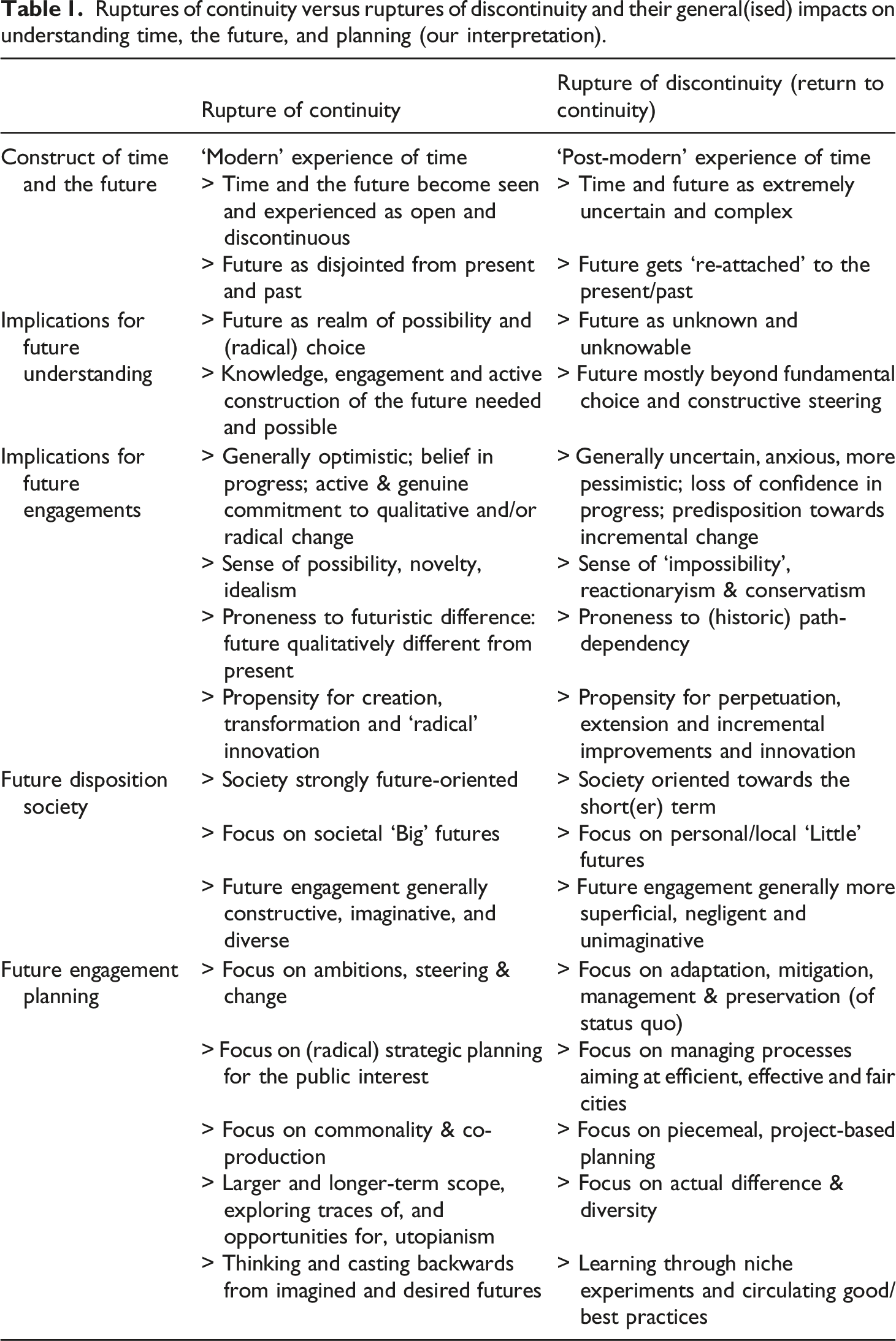
Ruptures of continuity versus ruptures of discontinuity and their general(ised) impacts on understanding time, the future, and planning (our interpretation).
So, it is particularly planning’s future orientation, as activity in the present, which enables its transformational function. Yet, the requirement to ‘bring the future adequately into the present’ requires discontinuity as a mental construct and aspiration to work with a certain continuity in practice. Contemporary renderings of planning confirm this double focus and tension. Whether described as an “exercise of deliberate forethought” (Alexander, 1992, p. 13), an “explicit exercise in imagining the future” (Healey, 1996, p. 242), as “envisioning the impossible” (Albrechts, 2015, p. 205), as “persuasive storytelling about the future” (Throgmorton, 1992, p. 1717), or as “a forward-looking activity that selects from the past those elements that are useful in analysing existing conditions from a vantage point of the future – the changes that are thought to be desirable and how they might be brought about” (Friedmann, 1987, p. 11), it is evident that, to do and think spatial planning, is to ‘do and think the future’. However, Friedmann (1993, p. 482), also warns that planners should be in the “thick of things”, focused and (inter)action-oriented rather than cast distant, abstract imaginative futures. He thus very much brings the future into the present. Albrechts and others (Albrechts, 2015; Albrechts et al., 2019), through a relentless advocacy of transformational, radical planning, stresses distance and concreteness. “Therefore, planning must involve a creative effort to imagine (structurally) different futures” (Albrechts, 2005, p. 253). “(W)e need a vision that embodies what is willed (this is the long-term strategy), we need concrete actions in response to everyday problems, and we need longer-term actions for the realization of possible futures” (Albrechts, 2005, p. 263). Hence, the ‘thick of things’ should go beyond the political and planning’s bureaucratic and political boundaries, and beyond current knowledge: “Alternative futures are created not just as technical means to predefined ends, but as social undertakings. As a learning process they have emancipatory potential” (Albrechts et al., 2019, p. 1498). The call for imaginative futuring and social learning echoes other criticisms in which planning’s future orientation was deemed superficial, too present- and short-term-focused, negligent, and unimaginative (Abbott, 2005; Connell, 2009; Myers, 2001). Futuring thus warrants opposition, conflict and dialogue. In Kühn’s (2021, p. 154) words: “the future tasks of planning lie primarily in the development of alternative solutions that are discussed early, controversially, and openly by different groups”. Without genuine alternatives, as Michael (2017, p. 514) argues, despite the frequent invocation of transformational ‘Big Futures’, in practice futuring is often confined to ‘Little Futures’, pertaining to “largely uncontroversial, mundane elements of everyday life”.
Such criticism ties up with a broader change in society, which can be termed ‘the rupture of discontinuity' (Connell, 2009, p. 93). As the opposite of the rupture of continuity, the rupture of discontinuity has made the construct of time and the future more continuous again (Table 1, right). This countertrend results from an uncanny combination of developments, including the rise of ‘practical’ policies chiming with neoliberalism and ‘capitalist realism’ of the present (Fisher, 2009), the popularity of postmodern “semantics of indeterminacy, incommensurability, variance, diversity, and complexity” (Connell, 2009, p. 93), and a long-term cultural move towards ‘temporal myopia’ (Bindé, 2000) plus ‘defuturising’, as anticipated by Polak (1961). Notably in view of current challenges, this has promoted a ‘crisis of the imagination’ (Ghosh, 2016) and growing incapacity to engage with the long-term and to think of futures which are qualitatively different from the present (Goode & Godhe, 2017). In response, the planning literature has repeatedly called to “put the future back in planning” (Myers, 2001, p. 365), notably by engaging with future studies and utopian thinking (Ache, 2017; Freestone, 2012; Friedmann, 2000; Hoch, 2016; Neuvonen, 2022; Pinder, 2002; Sandercock, 2003; Vermeulen, 2015). Moreover, as already mentioned in the introduction, actual spatial-environmental challenges demand that our thinking and doing is fully immersed in, and entangled with, the socio-material world we live in. Literature working from such a perspective stresses a present in need of future that is substantive (Groves, 2017), imaginative (Ghosh, 2016), engaging (Vanolo, 2016) and performative (Borup et al., 2006). Generally, this literature is far from naive about the possibilities to ‘see’ the future and to induce radical change. Yet, it seeks to translate a strong belief in how collective imagination can fuel transformation into perspectives and practices of futuring in the present, through narratives, anticipation, conceptualisation, co-production, etc.
So how should the nexus between planning and futuring evolve, if we want to embrace discontinuity? How do we stimulate creativity and learning and think the ‘impossible’, while also linking to the everyday and working in the “thick of things”? In other words, how do we engage in futuring while being fully in the social, political, administrative and spatial present? Drawing on our reading of the literature, the response may be threefold: (1) unlocking the past, (2) staging expectations and (3) drawing on affect, the material, and the unconscious.
First, unlocking starts with Friedmann’s (1987, p. 11) classic call for “a forward-looking activity that selects from the past those elements that are useful”. From a critical perspective, useful ‘elements’ are (routes towards) alternatives that are already ‘out there’, often ignored, hidden or even silenced. Their (re)discovery does not only include a future image, but also a study of their constrained role and significance so far. We will elaborate this below drawing on Critical Future Studies.
Second, staging expectations is about the way stories and images of the future become part of exchange experience and debate amongst the actors concerned (‘communities’ and ‘stakeholders’). Here the inspiration comes from Albrecht’s and others’ call, already mentioned, for a radical social-relational perspective towards imaginative futuring. This perspective, as the authors stress time and again, embraces “conflict, ambiguity and indeterminacy” (Albrechts et al., 2019, p. 1497), with a crucial role of local communities. “Communities become in this way both the text and context of new debates about fundamental socio-spatial relations, about thinking without frontiers” (Albrechts et al., 2019, p. 1499). Such debates should not start with (or be about) framing of the future, but entail genuine and open dialogue. This requires, in turn, open repertoires, and different forms of narration, contestation and imagination, for which we will turn to the ‘Sociology of Expectations’.
Third, affect, the material, and the unconscious present core aspects of corporeality and techniques of planning, and how planning is composed of very different elements and relations. As argued by Ploger’s (2008, p. 59), this invokes a notion of planning as ‘dispositif’ or ‘assemblage’, encompassing “concrete, situational ensembles of forces of becoming (…) in and of life”. Looking at the future, we are particularly interested in the way that futuring insights, methods, tools, and techniques give shape to ‘anticipatory assemblages’ (Groves, 2017) and equip planners with “anticipatory competence” (Borup et al., 2006, p. 296). To detail this further, we take inspiration from the Sociology of the Future.
Critical future studies: Unlocking the past
How do societies currently look into the future? Much of the answer lies in the past. Which ideas and practices of thinking about the future have become authoritative, possibly even hegemonic, and how? Which, and who, were sidelined, and may still be useful? For our first response, we draw on Inayatullah’s (1990) seminal elaboration of Critical Futures Studies (CFS). Employing a constructivist perspective, CFS sees time as a social construct, emerging within discursive spaces and practices. This includes the construction of the future. A core concept is ‘epistemes’, stemming from Foucauldian perspectives on discourse. Epistemes present naturalised ways of thinking and doing, that appear as self-evident ‘systems of truth’. Naturalisation obscures the way realities are contingently and actively created realities and rely on a variety of problematisations and practices that could have been different. In practical terms, epistemes exhaust “what is possible and impossible for anyone to think” (Inglis & Thorpe, 2012, p. 180), shaped by the powerful socio-material forces of an era. They do so basically at two levels. Fundamentally, epistemes implicate basic epistemological assumptions concerning time and the future (Table 1, top). More practically, they foreground certain directions (like in today’s ‘smart city' aspirations) while backgrounding and obscuring others (‘slow city’). Contingent victories stem from the burying of alternative conceptualizations, ideas and practices. Both the fundamental and practical aspects are significant for planning. All planning involves epistemological and philosophical assumptions, beliefs, and expectations concerning reality and how it is, can, or should be known, including the perception and role of time and the future, albeit rather implicitly. All planning draws, directly or indirectly, on certain problematisations and accompanying directions. As Inayatullah (1990, p. 116) states: “Every planning effort to plan the future is submerged in an overarching politics of the real”.
Clearly, such positions, and accompanying problematisations and ways of thinking, are pivotal for practising and understanding planning, since they influence how planning is done and organised. This is a crucial step for bringing the present into the future. Yet, in line with Foucault and Inayatullah, one should realise the complexity of the nexus between ways of thinking (epistemes) and doing (practice). This nexus comprises an ongoing articulation of ideational and material aspects, working at different levels. Basic problematizations and ways of thinking mutually interact with all kinds of expressions, discourses, and practices which continuously materialise, actualise, and also (re)shape and normalise particular epistemes. Drawing on established epistemes, there is a strong risk that vision-making is not more than a ‘normalising discourse’ (Ache, 2017; Huxley, 2002). From a critical point of view, such actualisation and normalisation should be properly reviewed and reflected on. While we may not fully agree with Inayatullah’s (1990, p. 116) strong view that until 1990: “Planning theories (…) often emerge as mentalities, frozen ahistorical categories of thought, ontological givens”, the 1990s ushered in a serious rethinking of the discipline’s foundations. Accordingly, since then, planning literature has explored its ontological and epistemological roots and limitations, notably through the notion of ‘becoming’ (Albrechts et al., 2019; Hillier, 2008). This has played an important role in the revival of a future-oriented, transformational perspective in strategic planning, as discussed above. At the more practical level, planning literature has always had a keen interest in the rise and circulation of new, inspirational concepts (Ache, 2017; Zonneveld, 2005; Kooij et al., 2014).
Thus, applying critical futures studies to the analysis of spatial planning and its futuring, it becomes vital to investigate the epistemological construction and actual thinking of the future in planning. Exploring the past and present thus helps to build ‘genealogies of the future’ (Groves, 2017; Inayatullah, 1990). Such genealogical work, historicising and spatially contextualising the present, yields insights into how prevailing articulations of the future (lay and expert) ‘perform’ the future through language and various institutionalised practices (Goode & Godhe, 2017; Kearins & Hooper, 2002). By doing this, one uncovers how critical epistemes embody power relations, how they “reinscribe the power politics of the present” (Inayatullah, 1990, p. 134). In a more practical sense, one explores which alternative problematisations, and potentially fruitful perspectives, have been disregarded or even silenced. Subsequently, moving from de- to re-construction, such an analysis helps to open up futuring discourses and epistemes, by showing that alternative discourses, and alternative constructions of ‘time’, ‘the future’, and ‘reality’, and other spatial conceptualisations, are not only possible, but can also be found ‘out there’ (Goode & Godhe, 2017; Mendieta, 2010).
The sociology of expectations: Staging of the future
How do we collectively, and productively, imagine the future? Our second response takes its inspiration from the Sociology of Expectations (SoE), in which expectations are defined as “statements about the future – uttered or inscribed in texts or materials – that circulate” (Van Lente, 2012, p. 772). In other words, they are articulated futures, which exist and travel in a variety of forms, types and ways. Originally developed within the field of Science and Technology Studies, SoE studies the creation and circulation of expectations in all kinds of foresight exercises. Common aspects under study are: expectations’ nature and structure, dynamics (how do they circulate, how do they come up and fade away, how do they interact with other expectations, statements, images, etc.), force (how do they legitimate, provide guidance, and coordinate actors and agency) and relations with strategy-making and steering capacity (Van Lente, 2012). SoE seeks to examine critically the actively constructed future within the present, yet it does so with a stronger focus on agency and roles in the ‘everyday setting’ of the present. It also does so“drawing on a detailed examination of the forms of action and agency through which the future is both performed (as a temporal representation) and colonised (as a spatial and temporal locus)” (Brown & Michael, 2003, p. 55).
An essential theoretical starting point is that expectations are performative and as such fundamentally generative: “…they guide activities, provide structure and legitimation, attract interest, and foster investment. They give definition to roles, clarify duties, offer some shared shape of what to expect and how to prepare for opportunities and risks (…)” (Borup et al., 2006, p. 286). Furthermore, expectations can bridge boundaries and coordinate and broker relationships between actors. By engendering all of these effects, expectations and the futures within them are enacted, performed, and made real in the present. They thus shape scientific and technological change, and contribute to social and political legitimacy and change.
It is useful here to distinguish between ‘formal’ assessments of the future on the one hand, and ‘informal’ assessments of the future on the other. Deliberate foresight exercises can be regarded as “formal articulations of possible futures” (Van Lente, 2012, p. 769), which take place within and relate to a broader, informal environment of visions, promises, expectations, and ideas. This informal “sea of expectations” (Van Lente, 2012, p. 777) influences foresight exercises and can even guide and structure them. In practices of visioning and planning, a great wealth and diversity of expectations, future images, and future imaginations are produced, negotiated, constructed, embedded, and circulated. The arena of planning, therefore, constitutes a crucial sphere for the empirical study of expectations, scrutinising the questions of what, how, why, who and with what effect? How, and why do planning efforts draw from existing repertoires of expectations, and what contestations and selections take place in the use of that repertoire? These dynamics have three defining features, namely repertoires, imaginaries and inscription, discussed in turn.
First, formal foresight exercises tend to happen within a wider informal environment, and the futures articulated within them are likely to be constructed from an existing set of futuring repertoires and assessments. So, whereas foresight exercises are usually meant to engage with the future openly, in view of alternative futures and ideas, they run the risk of contributing to path-dependency and lock-in (Van Lente, 2012). Planning efforts, just like foresight exercises, draw from “existing repertoires of expectations”, and, therefore, “will not generate many ‘new’ expectations, although ‘new combinations’ between elements of the repertoires are possible”, and thus, “they may reproduce images and arguments that are already circulating” (Van Lente, 2012, p. 778). This could also be expressed as a “predisciplining of the imagination” (Borup et al., 2006, p. 293), by which former expectations and futures constitute the basis for new planning endeavours. Even when planning and futuring exercises involve new stakeholders, as often promoted, the dynamics of expectations may ultimately limit how new stakeholders actually contribute to a proper re-imagination and hence discontinuity of the future (Ache, 2011, Ache, 2017; Vermeulen, 2015). Actual performativity of expectations, consequently, may have the effect that, on the whole, power relations and networks hardly change, not even on the longer term.
Second, a specific manifestation of expectations relevant in the context of planning is the socio-technical imaginary. Jasanoff and Kim (2015, p. 6) define socio-technical imaginaries as “collectively held, institutionally stabilised, and publicly performed visions of desirable futures, animated by shared understandings of social life and social order, attainable through, and supportive of, advances in science and technology”. Such collective socio-technical imaginaries often help to frame and partially structure expectations and expectation dynamics. In the words of Oomen (2021, p. 4) “the absence of meaningful images of the future can stifle transformative change”. Looking at contemporary urban futuring, an obvious but powerful example of this is the imaginary of the ‘smart city’. This socio-technical imaginary, trumpeting the intrinsic relationship between the city and (‘smart’) technology (Angelo & Vormann, 2018; Kitchin, 2015; Sadowski & Bendor, 2019; Vanolo, 2014), currently seems to have a strong hold on urban planning imaginations and practices. When researching futures and futuring in planning, one should thus be on the lookout for these imaginaries and their potential generative as well as lock-in effects. Despite the rhetoric, many ‘smart city’ strategies and practices tend to yield eye-catching innovations serving vested interests more than fueling genuine, progressive transformations in how we live, move, produce and consume (Mann et al., 2020). What imaginaries and discourses also tend to overlook are the many limitations and repercussions manifested by ‘smart technologies’ (Batty, 2013).
Third, SoE indicates that it is important to consider how expectations can become ‘inscribed’ in texts, processes, protocols, devices and actions; how they can become materially embedded within and by structures, systems, routines, practices, and more (Borup et al., 2006). A key idea here is that the dynamics and performative effects of expectations, however imaginative, play out more within the setting of practical devices than the imaginary-ideational level. Oomen et al. (2021) characterise these devices as ‘Techniques of Futuring’. These techniques may “create order in the unstable imagination of the future” and show “how these imaginings rely on shared background understandings” (Oomen et al., 2021, p. 8). The result is that path-dependencies and performativities are not only to be found in the domain of the imagination, but also in the realm of the socio-material. That is exactly the performative power of constructed futures: they reciprocally shape both the ideational and the material in an ongoing process. Expectations, both uttered and inscribed, can thus impact upon action and interaction in intended and unintended ways, and are themselves also affected by existing and circulating repertoires and collective imaginaries (Ache, 2023). The resulting problem then is, how these repertoires and collective imaginaries can be broken up and made transformative.
Accordingly, we may approach, and even support, the way protagonists stage, inscribe, and circulate future expressions, and how this meets contestation, resistance and counteraction, as a lively act of drama. From a dramaturgical perspective, key issues are how stories impinge upon everyday thinking and acting bearing upon the future, and how ‘Techniques of Futuring’ become tools of persuasion enabling transformative change. The elements “provide actions in the present with meaning, especially when combined with expectations about (…) the future” (Oomen et al., 2021, p. 4). In doing so, they connect (groups of) actors to (sets of) expectations. They shape actors’ positions, roles and coalitions, as well as divides between protagonists and antagonists and their respective supporters. The analysis and use of such drama explores the role of staging (how is the discursive arena organised?), narrating (which storylines and plots on problematisation, direction and solutions), roles and meanings (who is doing what, why and how, under what authority?) and identities (how do expectation-actor connections evolve?). Such futuring may also have another benefit. If sets of expectations help to reduce the gaps between opposing parties, this is likely to contribute to planning legitimacy and futuring capacities (Dixon & Tewdwr-Jones, 2021).
The sociology of the future: Embracing materiality, the unconscious and affect
SoE and CFS both draw on critical discourse theory to explore how, in actual processes of futuring, expectations interact, circulate, become performative and authoritative. In doing so, SoE highlights present coalitions of actors and expectations, while CFS highlights how the past has locked in the present, and how the future can benefit from unlocking the past. Drawing on Foucault, moreover, the use of critical discourse comes with a sensitivity for materiality and practice. Discourse does not only encompass semantics, but it also takes on board the wider semiotics and scripting that are part of the socio-material practices sustaining a discourse. However, these ‘more than language’ and ‘more than human’ aspects can be taken further, as elaborated by Groves and others in their perspective on the Sociology of the Future (SoF) (Adam & Groves, 2007; Davis & Groves, 2019; Groves, 2017; Metzger, 2016).
This approach, in one sentence, deals with ‘futures-in-the-making’ through the reciprocal interplay between materiality, practices and futures. Core concepts in Groves’ (2017) approach to assess this interplay are ‘anticipatory assemblages’ and ‘styles of anticipation’. Anticipatory assemblages comprise heterogeneous compositions characterised by continual conversations between the more expressive and material dimensions, in which material, technical (‘apparatus’), practical, representational, ideational, epistemological, and normative elements all work together to continuously constitute and enable each other and give rise to anticipatory forms of (inter)action. Echoing Foucault’s work on dispositifs, assemblages can be seen as evolving activity ‘systems’ of power relations and capacities, giving rise to particular creative and disciplinarian forcefields and tendencies. Consequently, as power-driven activity ‘systems’ of ‘future making’, anticipatory assemblages exhibit certain styles. These ‘styles of anticipation’ designate the sets of practices and ‘knowledges’ through which the future – in a specific place and time – is approached and anticipated. Such styles hold different types of social action, knowledge practices and normative frameworks. They implicitly align into working compositions and ‘epistemes’ that generate and predispose certain ways of dealing with time and the future. Examples are religious hermeneutics, or empirical methods and ways of theory-building within science (Groves, 2017, p. 32). Such overarching attitudes are made up of several intersecting and mutually constitutive elements – practical, material, epistemological, ideational, normative -, which, together, enable time and the relationships between past, present, and future to become meaningful. To a certain extent, the ways of knowing and acting that combine into ‘styles of anticipation’ can become rather routinised, and can thereby lead to the development of tropes and relatively entrenched temporal orderings. Such routinisation also depends on how practices of futuring tie in with the construction and distribution of expertise (Anderson & Harrison, 2010; Blok & Farías, 2016; Inayatullah, 1990; Seefried, 2014). Through shaping and inscribing sanctioned practices, knowledges, and technologies, ‘expert’ styles of futuring constitute, strengthen and reproduce futuring practices, and the images and ideas they bring forth.
The emphasis on styles and attitudes also draws the attention to the role of ‘affect’ and the ‘unconscious’. The interest in affect and the unconscious stems from assemblage theory’s focus on continuous creation and differentiation. While both concepts refer to the role of the subject, they should be understood at the level of social, that is, as an inter- or supra-subject, in relation to socio-material practices (Pohl & Swyngedouw, 2021). Following Groves (2017, p. 32), affect emerges from people as “invested subjects (…) whose engagement with socio-technical-natural environments is affective and emotional”. Affects emanate from the inter-subjective, even beyond-subjective sphere of values, intuitions and sentiments, and from other, intangible forms of (im)material encounter (Coleman, 2013). Within this broader sphere, humans experience and share feelings such as fear or hope, and their (dis)attachments to certain images of the future and practices of futuring. Hence, such affective aspects need to be taken into account as a ‘social-environmental’ (non-representational) sphere implicated within anticipation. A prominent example of the role of affect is the proliferation of ‘risk’ related interpretations of the future. These ‘risk futures’ and discourses explicitly and implicitly establish a link between the idea of dangerous or undesirable prospects on the one hand, and the ‘necessity’ to counteract or manage such risky futures through certain acts, beliefs, and systems of mitigation, adaptation, and governance on the other hand (Anderson & Harrison, 2010; Blok & Farías, 2016; Levitas, 2000). By implying and performing the ‘need’ for particular actions, decisions, discourses, and actor relationships and roles, and not others, such future dynamics can confer power onto some actor coalitions, while disempowering others. While SoE examines this future dynamics notably through staging and story-telling, SoF adds the more intangible and sensory aspects of affective socio-material life (Coleman, 2013).
Also the unconscious receives much attention in Groves (2017) work on anticipatory assemblages. The unconscious entails the various future (in)dispositions and (non)potentialities that are ‘scripted into’, but not signified by, environments, technologies, practices, and bodies. The extent to which this scripting entails semantic, affective and material aspects is subject to fundamental philosophical debate (Reckwitz, 2017). Here we follow an encompassing, pragmatic approach, in which the unconscious embraces the spectrum from the ‘superconscious’ to linguistic expression (Loukaki, 2016). This spectrum also defines our use of the unconscious, as explained below. Groves distinguishes between the technological and environmental unconscious. The technological interpretation sees anticipations as implicitly imprinted within infrastructures and technologies and their scripts. Anticipations stem from, as well as impact on, how futures are perceived and performed in articulations between the physical and the social, and with our ordering of space and time. This can both broaden and narrow future horizons. Comparable to technology, the environmental unconscious also entails (bio- and geo-)physical and social-affective aspects. Current environmental challenges have made this more dramatic. As a truly Janus-faced predicament, the environmental unconscious signals our collective (in)capacity to fully apprehend and respond to climate change and other environmental distortions (Blok & Farías, 2016; Bose, 2017; Ghosh, 2016). It dramatically probes the “residual capacity (of individual humans, authors, texts, readers, communities) to awake to fuller apprehension of physical environment and one’s interdependence with it” (Buell, 2009, p. 22) .
Broadening the scope to spatial visioning and planning practices, the realm of the unconscious intersects with the spatial dimension, captured by the notion of the ‘geographical unconscious’ (Gregory, 1995). The geographical unconscious constitutes the ‘shadow presence’ (Burnham, 2021) of all that haunts and energises a community in dealing with its own past, present and future. In words of Loukaki (2016, p. 88, adjusted), then, “(T)he collective potential of the [geographical] unconscious is amenable to both the openness of the individual psyche to socialisation as well as to linguistic translatability of unconscious energies into conscious discourse”. The unconscious thus wavers between myopia and potentiality, fuelling certain framings and translations of past, present and future. How this unfolds in anticipatory processes depends on local styles and politics of anticipation, in which anticipatory elements can feature, converge and connect but can also come into conflict and become contested and hidden (Davis & Groves, 2019; Groves, 2017). Such unfolding can fully enable, as well as block, visioning and transformation. Indeed, a critical question is how the technological and environmental unconscious, notably through their geographical manifestations, can stir a collective embracement of our posthuman condition to nurturing open, ‘discontinuous’ styles of anticipation.
In sum, the notion of anticipatory assemblages provides a lens to understand how, in a complex and dynamic world, stitched into the unconscious and affective, full of (in)capacities and (in)dispositions, more or less stable patterns evolve of actor-coalitions, discourses and course of (in)action (Groves, 2017). In doing so, anticipatory assemblages order anticipatory action in such a way that a specific take on time and the future is dispositioned and activated, sidelining other ways of knowing, performing, and organising. Anticipatory assemblages can thus “hang together in specific ways at different times and in different places” (Groves, 2017, p. 32). Achieving such patterning heavily relies on stable intermediaries, which act as relays and spokespersons of the whole gathering of ‘more than human’ elements. As Latour (2018) argues, the right translation allows the material itself to speak to the future in a particular way and style. Groves (2017, p. 33) illustrates this role in a case on energy infrastructure planning and energy security in the UK:
“In policy responses to this problem, the future is brought into the present chiefly through the socio-technical apparatus of demand forecasting, a combination of knowledge practices, techniques, and particular socio-technical apparatuses (such as modelling software, demand measurement technologies, and so on) (…) this assemblage produces a disembodied view, a ‘present’ future in which is represented a snapshot of the future as the necessary product of a set of known mechanisms. This then allows the future to be cast in a concrete, congealed form, such as a demand scenario”.
With these notions of translation and casting, our story has come full circle. Anticipatory assemblages yield ‘futures-in-the-making’ leaving traces which, in time, can be subject to critical scrutiny, and which, through new presences, can be staged and become part of new epistemes, new practices of knowing and novel actor coalitions. Let us now discuss a practical device for this, namely the creation of ‘Archives of the Future’.
Archives of the future: Practice and order of futuring
Radical (‘discontinuing’) strategic spatial planning, to quote again Albrechts (2005, p. 266) “combines the strategic force of reverse thinking with a critical analysis of the driving forces at work in the present.” This warrants a deep, collective understanding of, first, how we have arrived at our current present, and what there is to know from the past (including ‘hidden’), second, how the future is, and can be, staged, with what kind of repertoires, stories and images, and, third and last, how our thinking and doing are scripted, or can be re-scripted, into spatial, material practices. Our study of CFS, SoE and SoF has informed and detailed this threefold challenge. This section will elaborate a practical idea to meet this challenge, through the creation of ‘Archives of the Future’ as part of anticipatory assemblages, providing some snapshots from our case Rotterdam.
Planning for the future and considering discontinuity present important issues for the city of Rotterdam, for two main developments. First, over time, like other historical port cities, Rotterdam has become physically, economically and even politically, separated from the port (Kreukels & Wever, 1996; Zhang, 2022). Since the 1990s, the city has been engaged in intensive debates on whether to adopt a more ‘post-industrial’ and/or ‘neo-industrial’ orientation. This has resulted in both industrial (‘makers’) and non-industrial (residential, services, tourism) investment in old port areas. Besides, the city has continued its efforts to maintain and develop the nexus with the ever-more distant main port (extending into the Northsea), for instance through global trade services and investment in a ‘Greenport’ (Van der Weerdt et al., 2018). Second, the post-war need to fully rebuild its centre, plus the possibility to transform vacated port areas, helped the city to become a hotspot of urban design and architecture. (Re)building the city has become part of continual debate and practice regarding the city’s future in view of spatial, social, economic, and increasingly, environmental challenges and ambitions. Both developments have been accompanied by a sequence of promissory visions notably on Rotterdam as ‘Creative City’, ‘Resilient City’, ‘smart city’, and ‘Next Economy’, as well as by many concrete investments in (aspiring) innovative buildings, infrastructures and ‘urban districts’ (Municipality of Rotterdam, 2017; Zhang, 2022).
In terms of practice, the Archives of the Future draw on Foucault’s seminal idea to exhibit and order a discursive formation in view of a certain problematisation, revealing and elaborating its epistemes. The Archive thus presents “the institutionalization of a ‘series of rules’ which determine the appearance and disappearance of statements” and images concerning past, present and future (Pløger, 2008, p. 58). In the words of Sheringham and Wentworth (2016, p. 519), “It’s the archive as a dynamic process that combines heterogeneous timescales, scrambles origins and mashes up elements from different horizons (…) Seen this way, the archive is a space where the future is as much at stake as the past.” An Archive of the Future allows us to cruise through time as well as through space, navigating between broader situatedness and unique local experiences, between the concrete (tangible) and abstract (signifying narratives and images), and between the past, present and future (Sutherland, 2004). It helps to catalogue, frame and examine, in as much detail as possible, everyday efforts and experiences of future-in-the-making. Techniques of Futuring, as discussed before, may particularly help to create order and engagement. It also, in view of ‘smart’ innovations, may help us to ‘surf’ and catch novel ways and techniques to truly transform our cities (Batty, 2018, p. 193). As we will illustrate later, the Archive stands for a tangible collection here; it is not meant metaphorically. An Archive takes shape as a materially grounded gathering, which can be cruised, explored and experienced.
In the case of planning, architecture and the design of public spaces encompass such a source of open invitation: “Space ‘invites’ or ‘stimulates’ certain actions without determining” (Pløger, 2008; Roskamm, 2021). More specifically, with an eye to discontinuity, a key challenge is to see how place-based political drive and clout underpin unique actualisation of transformative futuring exercises, and their capacity to reach out. Such knowledge may also serve to use promissory visions (‘4th Industrial Revolution’, ‘CO2-neutral’ cities/regions, etc.) in a critical and energising way, yet avoiding any tokenism or ‘future washing’. A core challenge is to employ the multifaceted, dynamic archive to cast the future in different ways, ‘more than human’ but also beyond conventional, western gazes. In the words of Wells (2008, p. 11): “In the archive of the future, an understanding of the way in which affective spaces process and create information allows us to move away from the traditional centering of the western subject, of interpretive teleology and, perhaps, of textual inscription”. This further supports the proposed shift towards open, locally grounded, ‘discontinuous’ styles of anticipation drawing on ‘more than human’, other-inclusive knowledges and practices.
Rotterdam illustrates a rich, grounded setting for anticipating the future - and the elaboration of an Archive of the Future. Together with other, regional and port authorities, the city council is a key author of the promissory visions listed above. Noteworthy is Rotterdam’s membership of the 100 Resilient Cities (100RC) Programme (since 2013), resulting in the Rotterdam Climate Change Adaptation Strategy (RAS) (Municipality of Rotterdam, 2016; Spaans & Waterhout, 2017). Besides a strong orientation on planning processes, the council produced various maps highlighting the city’s threefold focus on the “Next Economy’ (developing new spatial-economic clusters), ‘City in the Delta’ (waterfront revitalization and overflow areas) and ‘urbanisation and mobility’ (transforming land use and connectivities) (Municipality of Rotterdam, 2016). While much of this echoes the ‘smart’, ‘green’, ‘inclusive’ boilerplate policy discourse found elsewhere, what is specific is the way visions and maps refer to the city’s record of transformation and (re)building. The city exhibits a large number of architectural icons, from ‘revolutionary’ tiny houses to skyscrapers, from renovated social housing to business compounds, from pavement to giant bridges. Each tangible item comes with a narrative, explaining what they signify architecturally, and how they meet ambitions and aspirations in the city, often with references to inclusive, sustainable, wealthy, and beautiful futures. The narratives are part of Rotterdam's habitus of creative-entrepreneurial ‘city-makers’ (stadsmakers, https://www.bouwenaanrotterdam.nl/stadsmakers), annual architectural award (https://www.rotterdamarchitectuurprijs.nl), architectural museum (https://hetnieuweinstituut.nl/), architectural month (https://rotterdamarchitectuurmaand.nl), tours and ongoing debates. Such debates, finally, are fuelled bottom-up through local media and encounters, for instance through the media sites Versbeton (‘fresh concrete’, https://www.versbeton.nl/) and Puntkomma (https://www.puntkomma.org). All sites with timelines and archives.
So, how does an Archive manifest a multiplicity of futures? In general terms, Archives of the Future constitute scripting devices for anticipatory assemblages, helping to understand and explore how diverse futures have been, and are being conceived, experienced and acted upon, or silenced. Through institutionalisation and dramatisation, the Archive provides a stage for exhibiting, encountering and engaging with these futures, in material and expressive ways. In particular, experiencing diverse futures serves to explore the geographical unconscious (and through that, the technological and environmental unconscious). The exhibition of statements and materialities (‘revolutionary’ buildings and spaces), guided by certain discursive formations, helps to stage and activate the ‘unknown knowns’. In doing so, Archives order multiple futures, highlighting what is thinkable and unthinkable, possible and impossible, desirable and undesirable, grounded in a place’s communicative and socio-material fabric.
Rotterdam shows how this staging of the future draws on practices and institutions around architecture and urban planning. One can witness ample experiencing and debating of ‘future-in-the-making’ in the many formal and informal sites listed above. Moreover, local media and encounters provide many examples of constructive critique and exposure. The city’s ambitions concerning resilience and economic transformation (‘Next Economy’) are exposed as hollow, lacking locally anchored intelligence and strategic sensitivity. Without the latter, it is difficult to see how current plans will achieve a genuine transition to a post-carbon, post- or neo-industrial city (Lenhart et al., 2015). There is also concern about creative city-making. Professional ‘stadsmaker’ Rijpers (2017, n.p., our translation) observes how genuine social and architectural creativity is often stifled by commercial interests: “It worries me if 'stadsmaken' is only a temporary process of value creation by creative companies. If project developers are subsequently allowed to develop the land, will the result be a windy and average urban area with high-rise buildings, as you would find in any 'modern' city? (…..) The creative caravan is kindly thanked and asked to move on .... Is it not possible to devise a form in which both the area is redeveloped and the creative users retain their role and place?”. Despite many good intentions, the staging of other actors and knowledges is often limited, and quickly overtaken by the drumbeats of city branding and competition. Likewise, the blogs of Puntkomma and Versbeton, amongst others, make many references to how Rotterdam’s characteristic built environment, its new centre, old neighbourhoods, waterfront, iconic bridges, metro, etc. should inspire further reaching imaginations of, and engagements with, urban change. This includes many visions of a somewhat different and better futures. Nevertheless, while Rotterdam thus exhibits many inspiring ‘little’ futures, through a variety of archival practices and scripts, there is a long way to go towards a ‘big’ rupture with continuity.
Conclusion
In a world in need of transformation, there is great potential for the work of futuring embracing discontinuity, in seeing the future ‘as disjointed from present and past’ (Table 1). The crucial question is then how do we make futuring operative and performative in the present? Unfortunately, that same futures-in-the-making is locking us in, willingly and unwillingly. Willingly, lock-in stems from practices that hide alternatives, powers that protect the status quo, and policies favouring piecemeal ‘transitions’ while keeping genuine transformative change at bay. Unwillingly, lock-in stems from a collective blindness for what is happening to our physical, ecological and spatial environment, a strong aversion against radical change and lacking capabilities and imaginations to truly experience and embrace discontinuity. Planning should play a fundamental role to counter such lock-ins. What is to become of society if even planning does not adequately engage with the future (cf. Ghosh, 2016)? However, planning also suffers from lock-in. An overly pragmatic approach demanded by neo-liberal policy has impaired planning’s ‘anticipatory competences’. Future imaginaries and expectations serve largely as the endpoints of more or less reckonable and continuous paths to the future, rather than as critiques of, and breaks with, the present (Bloch & Plaice, 1986). So how can we unlock planning and embrace discontinuity?
Drawing on three materially oriented futuring approaches, ‘Critical Future Studies’, ‘Sociology of Expectations’, and ‘Sociology of the Future’, we have elaborated three messages to counter lock-in. First, expose the power of ‘normalisation’ through discourse and social relations, unlocking the futures that have been silenced and sidetracked in the past. Second, provide a stage to exhibit and dramatise ‘future expectations’ (stories, images, artefacts), taking into account and developing connections with ‘stakeholders’. Third, let urban materiality and corporeality truly speak for themselves to the present and the future, opening experiences of, and confrontations with, the technological, environmental and geographical unconscious. This threefold message does not aim towards a synthesis of a futuring framework for planning. Rather, as discussed and illustrated in the second part of the paper, we propose to operationalise this unlocking, staging and opening of the future by creating tangible Archives of the Futures.
Archives of Future may thus help to build practical and lived anticipatory assemblages of discontinuity. Importantly, creating such Archives of the future will require a process in which (co)production of knowledge moves from a minimalist consensual solution of antagonistic positions towards a co-creative attitude of adversaries (Ache, 2017), in ways that are “constructive, imaginative, and diverse” (Table 1). For planning, this may help to overcome the dilemma of focusing on both consensus and conflict (Kühn, 2021). Epistemes of discontinuity, discomfort, contestation and conflict may act as sources of creativity, as opportunities to question underlying assumptions and unleash potential forces for creative irritation and disruption. In actionable terms, this may prompt suggestions and interventions to unlock silenced futures, to further ‘dramatise’ the future through the use of techniques of story-telling, performance or even ‘dreaming’ and to radically enhance ‘anticipatory competences’, ‘styles of anticipation’ and our engagement with the geographical-environment unconscious. As argued by Sheringham and Wentworth (2016), the ‘city as archive’ helps to cruise rather than use the urban. As part of planning, such cruising entails a collective and confrontational activity, rather than a leisurely drive. An issue to examine further, is whether such an activity, through working towards shared, materially grounded narratives and images, also adds to planning legitimacy. And as we learned from many cases, like the emblematic case of Pruitt-Igoe, this may even entail the breaking-up of past material futures unfit to provide the “house that meets our needs” (Mumford, 1922).
Footnotes
Acknowledgments
The authors would like our colleague and futurologist Sietske Veenman for her helpful comments on an earlier version of this paper. We are also grateful for the critical yet constructive feedback from reviewers, which have helped to substantially improve the contents and presentation of the argument.
Declaration of conflicting interests
The author(s) declared no potential conflicts of interest with respect to the research, authorship, and/or publication of this article.
Funding
The author(s) received no financial support for the research, authorship, and/or publication of this article.
