




Abstract
This paper provides a distinctive analysis of the value of international intermediation alliances for co-production, based on the way they operate in practice. While much attention is paid to ideal or normative models of co-production, there is less understanding of the complexities that pervade co-production practices in specific contexts or how this shapes outcomes. Despite longstanding critiques and reflection, international partnerships can reinforce unequal power dynamics embedded in already unequal global research and knowledge production circuits. However, such partnerships, despite their structural problems, can also give rise to more informal relations wherein the long-term value of international co-production inheres. We call for a re-examination of these complex sets of informal relations, beyond the structures of partnerships, that enable co-production across local and global divides. Drawing on comparative international evidence, we propose a framework for understanding and action based on the concepts of alliances, allyship and activism. These three characteristics of international co-production partnerships can constitute socio-material infrastructures that help maintain relationships of solidarity and care over time beyond the remit of individual projects. While this is relevant in any co-production context it becomes particularly important in international research projects so that they do not paradoxically reproduce colonising structures of knowledge production in the search for more just cities.
Introduction
Co-production is often positioned as a distinctly local activity, involving intermediation alliances between different knowledge communities, usually in combinations of the local state, civil society, academics, activists, enterprises and social entrepreneurs. The majority of empirically-informed analyses on co-production are grounded in the local, examining the neighbourhood or city as a site of action and focussing on local actors that mobilise capacity and resources (Perry et al., 2019; Rigon and Castán Broto, 2021). Co-production has been particularly implicated in the search for just cities, given that concepts of justice are complex, contested and require negotiation, that the realisation of urban justice is a process that is never completed, and that it requires the intermediation of competing knowledge claims (Castán Broto et al., 2022; Perry and Smit, 2022). However, co-production does not happen in a vacuum. Instead, implementing co-production initiatives and learning from them depends on a wide range of actors whose realms of action extend beyond delivery at the neighbourhood or local level, and includes those who support, convene, steer and fund work. In particular, co-production has become a common feature of international programmes, including multi-lateral projects, projects led by local, regional and international NGOs and civil society, or, more recently, research projects. Understanding the role and value of these international research partnerships for the delivery of co-production on the ground is the focus of this paper.
This is a fertile area of study for urban co-production and planning scholars. A focus on the value of the international dimension of co-production projects is distinctive, drawing attention to the range of encounters in knowledge production that contribute to efforts to realise just cities. This includes projects funded and anchored in Northern and Western contexts which develop lines of accountability to organisations in low or middle-income countries, as well as projects managed and delivered across cross-national borders (including, for instance, across nations on the African continent). This focus reflects the traditional global map of knowledge production in which funding is generally allocated from the so-called ‘global North’ to the ‘global South’ tied to particular outcomes, and which tends to structure practices of knowledge production. In this labour arrangement, southern scholars usually end up as data collectors, or conduits to research contexts, while northern scholars retain conceptual control (Mama, 2007). Co-production may claim to introduce a different rationality, yet is often centred on the local level and international intermediation alliances have been accorded insufficient attention to date.
In this paper we argue that the value of international intermediation alliances for co-production depends on the way they operate in practice. While much attention is paid to ideal or normative models of co-production, there is less understanding of the complexities that pervade co-production practices in specific contexts or how this shapes outcomes. Despite longstanding critiques and reflection, international partnerships can reinforce unequal power dynamics embedded in already unequal global research and knowledge production circuits. These are challenges that theories of co-production seek to address, yet risk reproducing (Goodwin, 2019). However, such partnerships, despite all their structural problems, can also give rise to more informal relations wherein the long-term value of international co-production inheres. We call for a re-examination of these complex sets of informal relations beyond partnerships that enable co-production across local and global divides. While this is relevant in any co-production context, it becomes particularly important in international research projects so that they do not reproduce colonising structures of knowledge production in the search for more just cities.
Drawing on our empirical experiences in four international co-production projects, we identify three specific concepts - alliances, allyship, and activism – which we offer as a means to understand and recognise informal relations and practices across national and international boundaries that sustain and add value to urban co-production projects. These concepts offer a vocabulary for researchers to speak back to traditional discourses of ‘impact’ or ‘outcomes’ and communicate what intimate sensibilities enable flexibility and long-term relations beyond individual projects. The paper reflects the acknowledgement by co-production researchers that international partnerships matter, but are not, on their own, sufficient to realise more equitable research arrangements for just urban futures.
In the first section of the paper, we present a framework for analysing aspects of co-productive practice in international research projects that are not captured by existing partnership theory. We argue that whilst co-production is one response to the need for more ‘equitable partnerships,’ there is a tension between the formalisation of partnership structures and the qualities and characteristics of co-produced research. We then elaborate alliances, allyship and activism to articulate the informal and often overlooked value of international co-production partnerships. In the second section of the paper, we provide illustrations of these concepts from within our own projects: Mistra Urban Futures, a 10—year programme funded by the MISTRA Foundation and Swedish International Development Agency (SIDA); Whose Heritage Matters, a follow-on project funded by the British Academy’s (BA) Sustainable Development Programme; Knowledge in Action for Urban Equality (KNOW), funded by the UK Global Challenges Research Fund (GCRF); and the Leading Integrated Research for Agenda 2030 in Africa (LIRA) programme, funded by SIDA. Finally, we reflect on the strengths and limitations of our framework of analysis. We conclude that the value of the international dimension to co-production partnerships resides in the extent to which these cross-border arrangements can generate alliances, allyship and activism in ways that challenge epistemic hierarchies and maintain solidarity over the long-term.
Theorising co-production beyond partnerships
The just city represents an objective in the making, but for most scholars of planning justice, it emerges at the confluence between processes of democratic decision-making and planning which seek to redress some of the ongoing inequities produced by capitalism (Campbell and Marshall, 2006; Fainstein, 2010). As the scale of the environmental crisis in cities has deepened, there has been an increasing need to incorporate understandings of justice that explicitly recognise environmental requirements, such as the idea of limits (Castán Broto and Westman, 2019), and socio-cultural dimensions as a fourth pillar of sustainability fundamental to urban justice (Sitas and Stewart, 2023). However, the just city is both a normative ideal for diverse groups seeking action to increase autonomy and emancipation, and a focus for planners and decision-makers whose concern is the mobilisation and framing of state action. The pursuit of urban justice involves multiple actors working on numerous fronts and with wide ranging skills. Systemic change in cities requires engaged modes of organising; appropriate evidence bases; champions in authorising environments; and locally responsive transformative action.
Yet some voices are louder than others. Whilst traditional conceptions of justice have focused on procedural or distributive justice, or questions of recognition and diversity (Fraser and Honneth, 2003; Young, 1990), there is an increasing focus on how social or environmental injustice is related to wider issues of epistemic injustice (Castán Broto et al., 2022; Perry, 2022). Co-production, then, is not only a practical task in the sense of extending and deepening collaborative arrangements, but is a necessity to both value different knowledges and forms of expertise that are usually marginalised and to redress historic epistemic exclusions (Perry and Atherton, 2017). This requires understanding whose knowledge matters, at both local and international levels, and focussing attention on the knowledge politics that underpin cross-border research collaborations and their formal organisation.
Indeed, as co-production has become increasingly more central to research funders and practices, debate has centred on the different modes of organization of the co-production process. ‘Partnership’ is a primary mechanism and paradigmatic approach through which international organisations seek to support co-production in planning for the just city (Castán Broto et al., 2015; Perry et al., 2018; Westman and Castán Broto, 2018).
In this next section we therefore analyse how partnerships are theorised in relation to co-production before arguing that co-production also relies on a series of encounters and relations (social, institutional and material) which are not easily codified in specific formal arrangements. We then turn to how alliances, allyship and activism collectively constitute infrastructures of solidarity and care which can confront the critiques of partnership theory and practical pitfalls in implementation. The relevance of these dimensions of co-production is informally recognised at the local level, because they are translated into aspects of social relationships, including friendships and institutional gestures, but they have not been theorised as constituting the specific value of international co-production projects.
Re-examining partnership theory
Partnerships are institutional arrangements that enable different organisations to work together towards a common goal (Brinkerhoff, 2002). In the context of international research, there has been debate into the forms of these partnerships and how they are developed. The ‘North-South research partnership’ itself was initially seen as a more equitable form of organisation away from technical assistance (Gaillard, 1994), but has remained unequal and unbalanced. By the 1990s scholars had already recognised the need for more equal partnerships based on strong mutual interest, joint decision-making, fair communications and long-term relations, for instance. Literature on North-South research partnerships continued to emphasise their role in supporting knowledge sharing and reducing research inequalities (Baud, 2002; Hassan, 2006). But critique was increasingly vocal of the ways in which such partnerships position northern partners as ‘givers’ and southern partners as ‘receivers’ (Binka, 2005; Mago, 2017) and the difficulty in centring southern partners in formal partnerships (Bradley, 2007).
Dodson’s report (2017) sought to address these challenges by identifying key actions funders could take to build equitable partnerships. However, the critique has persisted that research partnerships tend to benefit northern partners (Mabila and Singh, 2017) as southern partners are inherently in a weaker position due to the neo-colonial structure of partnerships themselves (Ishengoma, 2016). In their work on the participation of Latin American researchers in the EU Framework Programmes for instance, Feld and Kreimer describe their participation both as forms of cosmopolitanism and subordination (Feld and Kreimer, 2019a) and immersed in a centre–periphery dynamic (Feld and Kreimer, 2019b). A related concern is that international research partnerships may fuel ‘ethics dumping’ as the export of unethical research practices (Schroeder et al., 2019) with Mama (2007: 5) questioning the ethics of researching Africa through the ‘continued externalization of African scholarship’.
The rise of transdisciplinary, co-production partnerships can be seen as a response to this critique, implementing the good practice guidance for partnerships suggested by Dodson and others (see for instance, Wiesmann et al., 2011). The design of such partnerships, as we elaborate below, is often tangibly different from their predecessors, with joint development of research priorities and localised research teams embedded in place, rather than scholars from Europe or the US ‘parachuting in’. Funding tends to be more devolved, agendas commonly set, local priorities and projects locally determined.
However, the integration of co-production in partnership thinking is challenging (Klijn and Teisman, 2005) primarily because the construct of the ‘partnership’ approach itself is problematic. Framed in the tradition of collaborative governance, it risks perpetuating colonial forms of thought and practice (Galuzska, 2019). The experience of those writing critically on partnerships suggests that it is the institutional form itself that is part of the hegemonic order and may reproduce oppressive dimensions (Ndlovu-Gatsheni, 2020). Recent scholarship from Latin America has reinforced this point. Lehuedé (2021), for instance, reflecting on Chilean access to astronomy observatories that are under the control of organisations from the United States and Europe, warns against structures of partnerships which produce ‘epistemic obedience’ (Mignolo, 2009) which in turn risks eroding local ties and producing data conformism. Global South scholars have been vocal in many disciplines, and particularly in interdisciplinary African studies, identifying the implicit coloniality of research arrangements that reproduces planetary hierarchies in knowledge production. (Mama, 2007; Mignolo, 2009; Ndlovu-Gatsheni, 2020).
From this perspective, even with a co-production ‘slant,’ partnerships anchored in Europe, for instance, cannot avoid the structurisation of epistemic hierarchies and inequalities – particularly given that funders want specific outcomes which match their own agendas, judged according to specific metrics designed to measure (their) intended outcomes, which may nonetheless be at odds with what is relevant and valued in the ‘target’ contexts. At the same time, there is a potential mismatch between the idea of co-production and formalised partnerships as traditionally conceived. The characteristics of co-production as uncertain, messy and imperfect are counterintuitive to formalised partnership, instead reflecting diverse ways of knowing, seeing and acting across multiple contexts. This requires reading from different disciplines and perspectives beyond those dominating co-production scholarship, for instance, through drawing on feminist and post-colonial perspectives (Parashar, 2016) and informal practices within insurgent planning (Miraftab, 2009), to unpack the claims and practices of co-production. This mismatch between the formal partnership construct and the processual dynamics of co-production is exemplified through the emphasis by international and national research policy and funding organisations on co-production as a strategy for ‘empowerment’ and ‘capacity-building’ – terms which reinforce a deficit model of local expertise and a paternalistic narrative of ‘helping the South,’ rather than focussing on the amplification of existing capacities and mobilisation of existing agency and power.
Partnerships matter and are critical infrastructures in which collaborative relations can be forged, and resources redistributed. But they are not all that matters to co-production. Whilst the figure of the partnership finishes with the project, co-production for the just city requires long term, relational thinking if these challenges are to be overcome. The notion of partnership may define an instance of co-production but does not define the process of co-production as a whole. Indeed, in international co-production projects, there are complex dynamics that sustain the co-production process within but also beyond specific projects: alliances, allyship and activism. We elaborate these concepts below, which have arisen from our own experiences, before providing empirical examples in the following section.
Alliances, allyship and activism
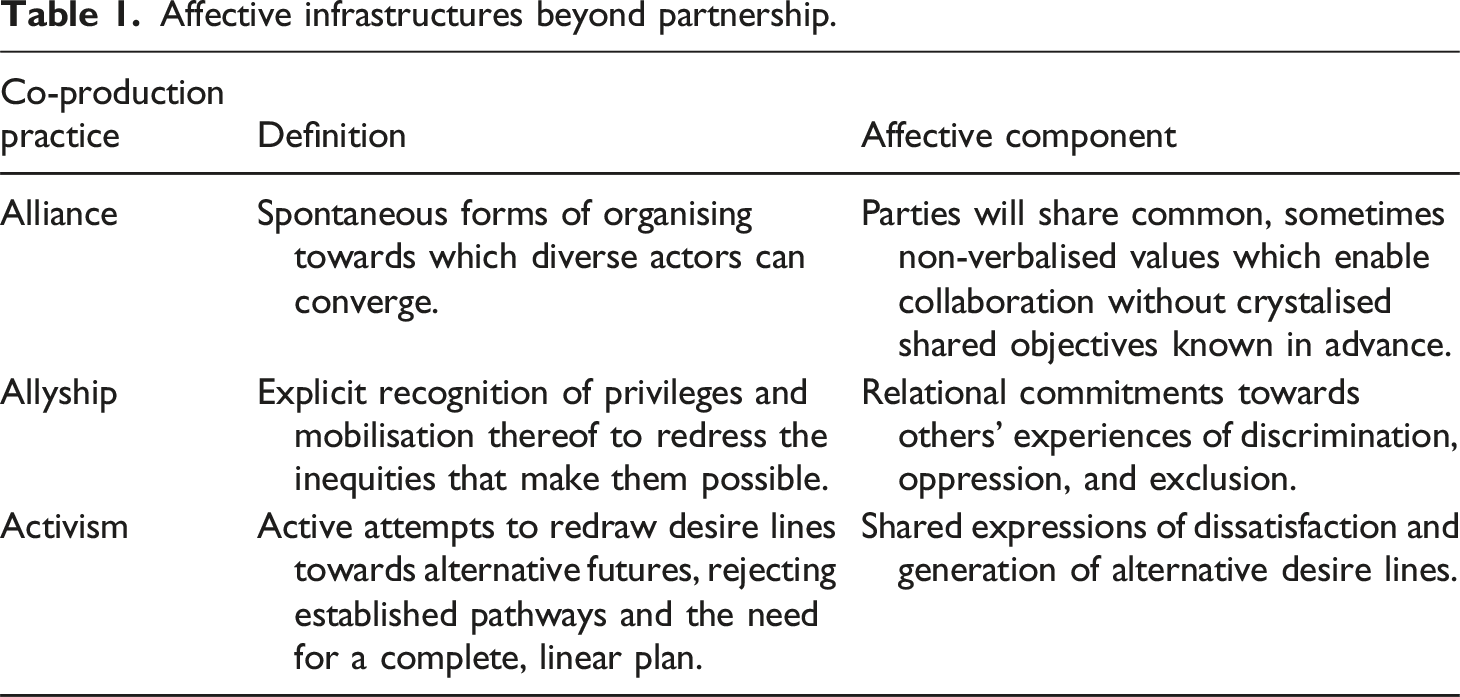
The idea of alliances draws attention to spontaneous forms of organising, for instance, via convening different actors within and outside formalised partnerships to address particular challenges and issues which may be unknown at the outset. If co-production is uncertain and messy and must be shaped and influenced by those involved in the process, then it is not possible to identify in advance all those that are appropriate for co-producing urban justice (Durose et al., 2021). Researchers ‘must provide evidence by organising co-production of knowledge while simultaneously empowering (sic) actors and institutions within and outside academia as agents of change’ (Ott and Kiteme, 2016: 422).
Alliances treat boundaries as porous and not fixed. Such a view of alliances as shifting and spontaneous reflects a worldism view (Aganthangelou and Ling, 2009) based on plurality and a form of politics which produces ‘syncretic engagements that enhance accountability and empathy’ (Parashar, 2016: 374). It speaks to a feminist politics of connection based on common interests and needs (Peake, 2016) and a relational approach in which all relationships are nested in other networks of relationships which impacts on the ability to care for others and ‘have a say in public debates’ (Koggel, 2014: 495). The building of alliances within or instead of more formalised partnerships for co-production is also potentially disruptive to the stated goals of the partnership, tactically unsettling existing knowledge claims (Perry and Smit, 2022).
What produces and emerges through such alliances is a practice not merely of collaboration, but of allyship. Allyship captures spontaneous acts of convening and gathering, but also speaks directly to the recognition of privilege, mobilisation of power and practices of care and friendship. Commonly deployed in relation to gender, sexuality, race or bodies, for instance, (Manokaran et al., 2021; Nash, 2019), allyship starts from the recognition of difference and structural inequality and involves continuous reckoning with how privilege can be mobilised to support social struggles. The idea of allyship is a practice. Rather than talk of being allies - which claims an identity that can never be achieved and is problematic (Carlson et al., 2020) - allyship is rather a work in progress, which recognises that failure is inevitable and actions never enough. It refers to processes and practices of working in solidarity with others to address injustices through co-production, which moves beyond calls for introspection or identity politics.
Allyship is based on a reparative logic: one that recognises the inherent inequalities embedded in the partnership and aims to redress them. While this may be related to specific institutional aspects of co-production, it also exceeds them, as allyship is manifest in personal commitments which are not necessarily shared across the partnership and can have concrete material impacts. For example, allyship may be directed towards recognising the structural wrong-doing of our own institutions, and redirecting resources, as ‘acts of hope in working towards better institutions’ (Barclay, 2021: 4). The increased interest in allyship is part of a moment in academia of ‘profound reckoning’ (Thieme, 2021) where the personal and professional are not bracketed from each other in ethical research practices.
Underpinning allyship is a commitment to a form of activism that supports locally defined goals, whether these are fixed or shifting, or relate to the specific requirements of funders. The affective aspect relates to the perception of a common, collective project without articulating it in a well-defined, utilitarian objective.
Formalised partnerships rely on funders who have specific outcomes and outputs in mind which need to be claimed as evidence to justify effective investment. For UK funders, for instance, such as the Department for International Development (DfID) or the British Academy, compliance with Overseas Development Agency (ODA) targets is a pre-requisite for funding. This not only frames both what impacts or outcomes are seen as legitimate and requires these to be sufficiently known in advance, but also implies a particular linearity and temporality.
The danger of co-production as a sanitised form of policy partnership is that this reflects the priorities of existing partners and outcomes that can only be imagined from the vantage point of the present. However, co-production is not time-limited or bound. For planning and development scholars committed to co-production as a strategy for challenging epistemic injustices in the urban environment, this means embracing non-linearity and long-term relations that go beyond any particular funding injunction or output-driven mentality. Co-produced research should instead evoke more ‘utopian’ thinking and be ‘future forming,’ replacing what Gergen describes as (2015: 6) the ‘captivating gaze on the world as it is with value based explorations into what it could be’ (italics added).
Alliances are central to activism, organising and building solidarities. Activism is often understood as a collection of reactive responses to an undesired society. Activism is a means to engage to create alternative pathways through a wide range of means, including institutional partnerships but also ad hoc demonstrations and imaginative representations that may shift existing discourses, not necessarily via a clearly marked pathway but simply, away from dominant ones that do not challenge epistemic inequalities.
Building socio-material infrastructures for collaborative work
Formalised, structural views of partnership, which tend to dominate theorisations of co-production, miss these informal elements of alliance, allyship and activism which are critical to realising the potential of co-production as a tool for planning more just cities. Feminist literature has referred to the social structures that reproduce solidarity arrangements and enable recognition of shared vulnerabilities as ‘affective infrastructures’ (Ortiz et al., 2022). This concept emphasises the emotions produced by collective work as it conditions forms of political organisation . When emotions are directed towards specific elements of reality that we associate with desires - desire for a better life, desire for improvement - they create the multiple affects that structure individual and collective action to engage with the world (Berlant, 2011). Those affects may be organised and channelled through alliances, stabilised through different forms of allyship, or reclaimed through activism. As socio-material arrangements that support the expression and pursuit of affects, alliances, allyship and activism are fundamental elements of the affective infrastructures that enable co-production.
In a positive way, the affective components of alliances, allyship and activism could be drawn as new desire lines. The idea of desire lines in planning emerges from an engagement with the work of Deleuze and Guattari (2003) that emphasise the spontaneous, non-marked lines through which desire develops. Desire lines are described as ‘spontaneous pathways that break away from the prescribed routes restricting mobility’ (Windsor, 2015: 157). Commonly used in relation to spatial navigations – for instance, the act of cutting across the grass deviating from the existing path - desire lines draw attention to lines not points or positions, a relationality and connectivity that stretches from the present into the future.
In this case, desire lines refer to the unknown nature, location, and temporality of outcomes from co-production for just cities. Alliances, allyship and activism provide the infrastructure to draw a wide range of conflicting but shared affects and desires alongside specific lines, that over time, enable the formulation of shared – however transitory – objectives. It is through that formulation of objectives that these affective infrastructures can help develop formalised partnerships, but these results are not a given and require a series of commitments that clearly stretch beyond the remits of specific research projects and programmes.
Affective infrastructures beyond partnership.
Experiences from the Field
Following Ahmed (2017) the purpose of this paper is to advance theorisation of co-production through reflecting on our own experiences and practices. This has involved an iterative and discursive approach, in which the writing process itself (Denzin, 2013) constituted the basis for reflexive analysis (May and Perry, 2017). The paper was catalysed through workshop discussions within a project funded by the Worldwide Universities Network (WUN) on the New African Urban University which coincided with the call for papers for this special issue. The four authors, who had in various forms worked with each other before, held a series of online conversations comparing their differing experiences, not as a means of generalisation but to identify lines of transversal connection (Robinson, 2016). After reviewing and discussing partnership experiences, the authors reached consensus about the need to foreground the informal and affective aspects of international partnerships that enabled collective sense-making and local value in co-production processes. The concepts of alliances, allyship and activism emerged as having explanatory power in the light of our own experience, as well as those of our collaborators which we had gathered through prior systematic processes of impact monitoring and evaluation required by funders. Although externally produced evaluation reports have evidenced the perspectives of our collaborators in co-production projects, we have focussed here on our own collective learning and a critical approach to self-evaluation which cannot be extended beyond the space of authorship. We recognise that the experiences of alliances, allyship and activism are highly normative and subjective, and must be engaged within the specific parameters of one’s individual reflexive experience. In other words, though we have taken account of, we cannot speak for participants in any of the projects. The paper reflects this iteration between reflexive analysis and conceptual development and relates as much to our relations to each other, as scholars in the global North and South, as to collaborators in our projects.
The empirical work underpinning the paper is grounded in each author’s considerable experience in leading co-production projects which have an explicit cross-national component and commitment to urban justice. Perry, Patel and Sitas were all involved in the Mistra Urban Futures centre, a 10-year programme funded by the MISTRA Foundation in Sweden and Swedish International Development Agency (2010-2020). The design of the project focussed on working with and through local interaction platforms (LIPs) in Gothenburg, Greater Manchester/Sheffield, Cape Town and Kisumu. Perry and Sitas forged an alliance through their work in the centre and developed a further project, Whose Heritage Matters, around cultural heritage, urban sustainability and justice in Cape Town and Kisumu, funded by the British Academy’s Sustainable Development Programme (2018-2022). Castán Broto co-led a work package enabling and comparing co-production projects within KNOW (Knowledge in Action for Urban Equality), a project funded by the Global Challenges Research Fund (GCRF) that sought to identify and promote transformative research which was already taking place in specific cities including Havana, Lima, Freetown, Kampala, Dar es Salaam and others (2017-2022). Patel was a member of the core team for the Leading Integrated Research for Agenda 2030 in Africa – LIRA - a research funding programme that sought to increase the production of high-quality, integrated solutions-oriented, and policy relevant knowledge on sustainable development in African cities (2016-2021). The programme, was funded by SIDA, and delivered through a partnership between the International Science Council (ISC), together with its Regional Office for Africa (ISC ROA), and the Network of African Science Academies (NASAC).
Whilst each project was structured to develop good practice in adaptive, distributed design, the constraints of formal partnership arrangements gave rise to alliance-formation, allyship and activism which strengthened the research processes more broadly in the pursuit of just cities. The analysis seeks to delineate each element and explore how different formal and informal elements co-constitute each other, sometimes through pooling affective relations and desire lines. For reasons of space, we will use illustrative examples selected from the projects, each of which was geared towards issues of urban justice.
The formation of alliances
The design of each of project variously sought to redress some of the critique of international research partnerships set out at the front of this paper, with aspects of distributed design, devolved decision-making and collectively determined resources. Nonetheless, in each case, alliances formed within and against formalised structures, and took the form of spontaneous convenings, gatherings and relations.
The example of Mistra Urban Futures illustrates these dynamics. The distinctiveness of the centre was based around the idea of local interaction platforms in Gothenburg, Sheffield-Manchester, Kisumu and Cape Town. These “LIPs” were discursively positioned as the primary organisational mechanism for transdisciplinary knowledge production in recognition that ‘all knowledge bearers’ are central in addressing sustainability challenges. However, formal decision-making for the Centre as a whole rested with an international Board, Swedish Secretariat and Consortium, including co-funding policy partners in the Gothenburg metropolitan area, which reported to the funders. Whilst the principle was that local partners would retain control over research agendas and determine priorities for research (cf. Bradley, 2008), in practice, there was at times a mismatch between decision-making, funding flows and the stated intention to co-design amongst local partners. This resulted in struggles over agenda-setting, the balance of power between different city platforms and degrees of relative autonomy, giving rise to the formation of unexpected informal alliances. One example was an alliance forged towards the end of the first phase of funding (2010-2015) between the LIP Directors to shift from the goal of ‘sustainable development’ to ‘the just city’, with themes that specifically reflected issues of local concern brought to the table by partners (for instance, socio-cultural justice in Cape Town, or socio-ecological justice in Kisumu). This move also resulted in the inclusion of the LIP Directors in the Board of Directors – from which they had previously been excluded - in an ex-officio capacity for the second phase of the project (2016-2020). Informal and shifting alliances were also formed throughout the lifespan of the project to push-back at a narrow output-focussed mentality from Swedish funders and the imposition of quality and management evaluation (QME) frameworks that did not reflect the outcomes valued on the ground.
The size and scale of Mistra Urban Futures, and complexity of the funding and partnership model, amplified these struggles and proliferated alliances. Mistra Urban Futures incorporated existing relations – for instance between scholars in Gothenburg and Kisumu – but was a new organisational construct. Like Mistra Urban Futures, LIRA was also a new partnership, as the ISC (then ICSU) and NASAC had not previously collaborated. The partnership emerged when ICSU was looking for an African partner for the programme, and NASAC was ‘interviewed’ amongst other organisations (Kado, pers comms, August 2022). These two projects were responses to external funding opportunities which required the formal structuration of partnership as a precondition for funding.
In contrast, KNOW and Whose Heritage Matters, whilst also responding to external funding calls, were themselves the results of alliances formed over time. KNOW emerged from a long history of collaboration, in which trust had been already articulated in multiple other projects, exchanges and events. Some of those collaborations had a strong affective component, as those driving them saw each other as constituting a collective international community fighting together for urban equality. This enabled tailoring the KNOW partnership to meet the shifting requirements of the underlying alliances informing the project. For example, a long-term alliance with the Asian Coalition for Housing Rights and the Development Planning Unit enabled flexible working, for example, changing the selection of target cities according to the changing priorities in the region.
Whose Heritage Matters was designed out of alliances forged during Mistra Urban Futures. Seeing the importance of asserting cultural justice more squarely on urban agendas (Sitas and Stewart, 2023), the project leveraged alliances from Cape Town and Kisumu, in collaboration with colleagues in Sheffield to funnel budgets towards locally relevant responses. As a result of a shared politics and ethics within these alliances, in these projects, local agenda-setting was a key priority. The potential for diversity and differentiation was designed into the conceptual framing, with the projects providing spaces for mediation to negotiate how each set of local partners could further their own interests, rather than imposing a homogenous view (Perry et al., 2021; Sitas and Perry, 2021). Whose Heritage Matters created space in the project to tap into, activate and amplify existing local alliances. The active constitution of alliances as informal arrangements that enable long-term change strategies was also important – for instance, in Whose Heritage Matters with heritage activists in Cape Town and in KNOW with community activist organisations in Kampala, Dar es Salaam and Freetown. At the same time, informality was used to strengthen formal partnerships: KNOW, for example, supported the formalization of academic centres such as the Urban Action Lab at Makerere University and the Sierra Leone Urban Research Centre that could forge more durable partnerships.
Practising allyship
There are two aspects of allyship that are particularly relevant in understanding the value of international co-production partnerships: the mobilisation of privilege and position, and the practice of solidarity. These were demonstrated in diverse ways across the four co-production projects, with a common focus on both questioning and acting on epistemic injustice, through prioritising local expertise, supporting south-south collaborations, structuring learning, and speaking back to institutions and funders.
KNOW and Whose Heritage Matters were characterised by ongoing dialogue about the role of different researchers in the project, motivated by the need to counteract the privileging first, of UK staff with enhanced access to funding due to tacit knowledge of the rules of the game, and second, of UK ideas grounded in colonial epistemic hegemonies. This reframing of roles also required reflecting on positionalities and adopting different practices.
Whilst academic practice is often shaped by and valued according to critique, allyship requires epistemic diplomacy, valuing ways of seeing and knowing beyond Western frames. This is not about abandoning critique (Perry, 2022), but instead finding diverse ways to mediate it and enable it to ‘land’, whilst retaining the potential for both friendship and enjoyment. In KNOW these aspects were important but rarely acknowledged, as the project struggled to meet funders’ objectives, deadlines and other administrative requirements. City teams had the freedom to define research agendas whilst international academic partners played intermediary roles to relate these local priorities to wider academic debates and agendas. At times, this also meant mediating and moderating forms of critique with a sensibility to the affective impacts of excessive negativity. A key example of allyship related to mobilising the project to try and change the practices of research within UK academia and within the Overseas Development Assistance (ODA) institutional configuration. This was a direct challenge to UK government policy, which increasingly positions international research as ‘aid’ only when it corresponds to tangible benefits to British society.
Similarly, in Whose Heritage Matters, COVID-19 provided an opportunity to challenge more directly the expectations of funders which had shaped the project, for instance, in terms of the funding allocation model and requirement for eligibility with ODA metrics. In recasting positions, positionalities and the performance of different roles in the project, we were able to challenge preconceived ideas of funders about how projects should work and who should be doing what parts of the empirical and conceptual work. The COVID-19 response centred practices of caring for each other, rather than any concern to meet project deadlines, and the development of a set of principles for the ethical conduct of the project during a global pandemic.
Ebersöhn et al’s (2022) concept of ‘academic flocking’ mirrors this spontaneous reorganising. Taking an Afrocentric approach, academic flocking is framed as a mobilisation in response to what the authors call ‘collective distress,’ for instance during COVID-19. Flocking is adaptive and relational and focussed on supporting wellbeing through the mobilisation and sharing of social, collective and cultural resources. The pandemic context enabled more radical repurposing of resources to Cape Town and Kisumu, and the adaptive design of the project according to local timelines, rather than the convenience of funded staff in UK universities. Extensions were paid for local partners, but not for the UK project lead, which effectively led to voluntary labour offered in a gesture of friendship and solidarity, even when time was not allocated in formal workloads. Beyond adapting designs, the pandemic led to a loosening of formal roles and adoption of more flexible practices of allyship and support at a distance. For the UK scholars this translated into degrees of discomfort, indecisiveness and at times, paralysis. For the South African scholars, flexibility tempered the usual discomfort felt in international projects where there are usually unrealistic expectations at a mismatch with the local context. For UK and South African scholars, practising allyship at a distance meant letting go, stepping up, stepping back and stepping aside from formal roles to refocus on wider affective and material dimensions of support.
In all our projects, operating from within the institutional context of universities necessitated the mobilisation of internal funds and capacities, efforts to redirect existing resources, and struggles to counteract bureaucratic structures which contradict the practice of equitable partnerships. Materially, this was important due to the exceptionally high overheads charged by Northern universities which significantly reduce budgets; but was also socially and institutionally significant as processes of contract negotiation often seek to re-establish traditional relations of power. Allyship is also then this internal negotiation and ‘massage’ of institutional constraints to try and ensure that partners are not left waiting for funds. It is the prioritisation of affective relations over effective ones, the latter often exemplified by administrators who prioritise efficiency and adherence to regulations even when flexibilty and adaptability is required..
These challenges led to some dramatic moves, for instance, the relocation of one LIP in Mistra Urban Futures to a new academic host institution where the conditions for co-production could be better established (Perry, 2022); and some practical ones, for instance, the earmarking of funds for professional administrators skilled at intermediating between the inside and outside of the university to advocate on behalf of community partners and adapt rules and regulations to enable co-production (Simpson and Isemo, 2021). For authors in the UK, the funding of these latter roles in international co-production projects is routinely planned as equal in importance to the funding of post-doctoral positions, recognising that there is a tension between the necessary affective work to maintain socio-material infrastructures of allyship and the bureaucratic system of the university itself.
“Activism without Announcement”
Across our projects, the scale of funding for international co-production, from funders couched in traditions of development ‘aid,’ produced systems of reporting and accounting that were counter-productive to the principles and practices of co-production. Traditional evaluation systems and metrics for research funding cannot be applied to international co-production projects as they reinforce patterns of extraction, whereby impacts are claimed by and attributed to researchers in the North, thereby denying pre-existing trajectories of change and commitments to local action. All our projects were, to differing extents, reliant on and complicit in these antecedent power relations, contract-bound to play the game by having accepted funding in the first place. This gave rise to forms of quiet activism, which did not immediately recognise or announce itself as such, but sought to challenge narrow, time-limited output mentalities.
This practice was named ‘activism without announcement’ by one community research partner, a crucial local ally in Whose Heritage Matters, who reflected on what it means to hold activism with a 'light touch' as opposed to thinking of activism always as a grand public gesture.
This sentiment echoed across all four projects in similar ways. First, activism refers to a commitment to align with existing strategies of change and add value to the efforts of local change agents rather than impose externally derived theories of change. Supporting what is already happening through international co-production partnerships, rather than seeking and claiming the ‘new,’ constitutes a fundamental challenge to the usual practices of both funders and academics. In KNOW efforts to mobilise the project to challenge the funding structures which perpetuate existing privilege (see above) were not ultimately successful, in the context of UK government actions to redefine ODA structures and reduce the power of the UK GCRF Fund. However, the project recognised activism as a key strategy to facilitate and legitimate co-production, for example, in the context of education and urban development, or in Lima, for instance, KNOW supported the co-production of solidarity kitchens during the COVID-19 pandemic (Desmaison et al., 2022). Co-production is a key means to first create and then maintain affective infrastructures through activist engagements.
Second, activism celebrates-without-capture an alternative set of outcomes that are less tangible or codified, tactically deploying projects as spaces to bolster and celebrate what is valued locally rather than by funding bodies. The initial impulse of funders of Mistra Urban Futures was to simply replicate and apply existing quality management and evaluation metrics to the Centre, despite their recognition that this was an experimental and different kind of investment. This disconnected formal appraisals of ‘success’ from the value of co-production on the ground. Internal Centre-wide alliances formed to push back at these processes, resulting in the creation of alternative narrative of change and platforms to tell different stories (Joubert and the Realising Just Cities team, 2021). The ‘actual impact’ was far more intangible than that claimed by funders, relating to the formation of networks, and opening of alternative imaginaries and pathways for urban planning, governance and development, based on alternative markers of progress towards realising just cities (Perry et al., 2019; Perry and Atherton, 2017).
Alongside tangible demonstration projects, a common outcome valued on the ground was the creation of creative or playful spaces to think and imagine different possibilities free from the constraints of everyday life or work, resulting in the asking of different questions or consideration of options previously off the table. In Whose Heritage Matters in Cape Town, creative researchers using arts-based methods of urban enquiry were put in conversation with cultural heritage policy development, traces of which can be found in the City of Cape Town’s spatial development, resilience and environmental management strategies. In KNOW, playful spaces for the imagination were combined with forms of activism that changed existing planning practices, for example, in Sierra Leone, Lima or Havana. In LIRA, hybrid visual methods were developed, including transdisciplinary visual ethnography (TVE) to reflect the different voices, and make visible (and audible) often marginalised contributions from the informal sector. These methods rely on co-producing visual depictions in different media, including photography, technical drawings, symbols and maps, with story lines from local community actors. Whilst these design features and innovative methodologies result in wider dissemination of findings, their real value lies in producing inclusive knowledge that shifts perceptions, attitudes and behaviour – of both policy makers and local communities, as in the capturing of shared interpretations between local authorities and communities of the goals and targets in Local Agenda 2030 for Kampala City.
Third, in contrast with allyship as a more spontaneous practice, activism can be a strategy for addressing epistemic injustices within global systems of knowledge production. This was the explicit goal of the LIRA programme, experimenting with transdisciplinary co-production in a range of African cities. In LIRA a learning study was launched in the second year of the programme. The team appointed to conduct the learning study included two African scholars, and one from the global North. Drafting the conceptual framework for the study included meetings between the three scholars. These discussions were formative for the study, as it became clear that the existing literature and practices used for evaluations in the global North could not be transferred into African contexts without adjustments. By highlighting the gap between the existing literature on learning from and evaluating transdisciplinarity, the learning study contributed to setting the tone for fostering a southern theory approach to scholarship emerging from the projects.
The process of rethinking and recalibrating assumptions and categories for learning in this LIRA study was in itself a key outcome for the programme, and subsequently became a structuring device in both the practice of the projects, and in their reporting (International Science Council, 2023). Rather than evaluation serving the need of funders to account for their funds and demonstrate success, the LIRA learning study structured reflection to create a context for ongoing change, enabling African scholars to reflect on challenges and opportunities as well as identifying strategies to improve future collaborative work. As a form of quiet activism, LIRA’s learning study was designed to support learning-by-doing and adjustments to local change strategies and actions through reflexive practice.
This quiet activism can be also redirected towards shifting the discourses of knowledge production. In KNOW, researchers examining the planning paradigms in Freetown, Sierra Leone, showed that over time multiple coalitions of actors can work to challenge existing epistemic injustices, but the process of change is slow (Macarthy et al., 2022). The mobilisation and recognition of community, place-based knowledge was central to all KNOW partners, whether their activist role was quiet or loud. However, such mobilisation and recognition may happen in multiple forums, with differential levels of access to participants in a co-production exercise.
Activism starts with adaptation to institutional conditions and, when possible, institutional change. In LIRA, the focus on transdisciplinary partnerships across and beyond African universities was in and of itself an act of activism. This way of working was contextually radical and unprecedented in many of the institutional contexts of partners involved. Many projects experienced delays with transfers of funding, especially between cities in the different countries. The finance systems of many of the African universities were simply not fit for purpose for cash flows beyond the institution. Early career scholars experienced challenges within their home universities, including having to justify the value of working in iterative ways, without clearly defined outputs, with partners who are not traditionally recognised as knowledge experts and brokers. Principal Investigators (PIs) of projects in the programme found that they had to play a dual role, as leaders of their projects, but also leaders in challenging and shaping processes at their own institutions which are steeped in disciplinary modes of knowledge production. In at least two cases, PIs found their institutional contexts constraining and even a hindrance, impacting on the ability for projects to reach their potential, and for researchers to thrive and grow. In at least two cases, LIRA PIs subsequently left academia to have more freedom to work on projects of social relevance. This experience finds echoes in northern institutions in which authors have built institutional changes for mundane aspects of research administration. Whose Heritage Matters principles for ethical redesign of the project under COVID-19 and adapting alternative approaches to measuring impact were recognised as good practice across the university; KNOW also triggered an important reflection on ethics, which led to a research and institutional agenda on Ethics in the Built Environment at the Bartlett School of Architecture (UCL, undated).
In these different ways, co-production involved multiple forms of activism – quiet, loud, and multi-tonal - and in multiple forums, including institutional change within a variety of institutions. A common feature is that activism is slow and relies on the long-term onset of open paradigms through recognising the multiple forms of knowledge, alliances and forms of allyship that contribute to just cities.
The value of international partnerships for co-producing just cities
In this paper we have sought to shed light on dynamics within the international aspect of co-production projects for just cities. Whilst recognising that the proliferation of international partnerships supporting local action on the ground matters, and that the way such partnerships are structured is often intended to challenge colonial practices of knowledge production, they may inadvertently reinforce them. Part of the mismatch between formalised partnerships and co-production is that it can be seen as the imposition of a particular way of seeing that does not fit in southern contexts (Galuszka, 2019). We therefore propose an alternative narrative that focuses on the value of international alliances, allyship and activism to those working deep within cities to realise urban justice. We argue that this better aligns with the ethos and ethics of co-production, which is processual, uncertain and holds within it the potential to fail - a fact that funders still struggle to recognise. If co-production is about operating within conditions of uncertainty, messiness and fluidity, fixed partnerships are always going to create points of tension with this practice. By drawing attention to alliances, allyship and activism as central to international co-production partnerships, values and practices of solidarity are revealed that seek to break down binaries of global North and South - at the level of practice if not structure.
International partnerships do matter, not only in the traditional sense of providing access to resources, but as they give rise to these forms of practice. Alliances, allyship and activism also characterise co-production at the local level, but are particularly relevant internationally in the context of historic epistemic hegemonic relations. In some of our projects, the theories of change underpinning the approach to co-production explicitly sought to build alliances, allyship and activism. In other projects, alliances, allyship and activism emerged to counteract the funding structures, reporting requirements and institutional constraints. Partnerships may give rise to alliances and provide for their formation; even as alliances may push back at those partnerships themselves. This points to the generative nature of international co-production partnerships, even if they are imperfect, in sustaining informal relations and networks of care and solidarity that add value to local co-production as planning for just cities.
The juxtaposition of alliances within and beyond formal partnerships is a means to capture the informal work and affective infrastructures that challenge the global production and circulation of knowledge even whilst participating in structures which may inadvertently reinforce this. Alliances are forms of more adaptive governance that is spontaneous and informal. Alliances and the practices of allyship that are fostered may disrupt or challenge formal partnerships, may be visible or under the radar, as means to cope with and speak back to inequalities. Allyship endures beyond the temporalities of formal partnerships and may enable things to happen at a much later date – this draws attention to the desire lines that extend from the project: what we sow through informal relationships and acts of solidarity has a different rooting and line that is not prescribed by what is originally planned. It is what is set in motion, what is in a process of becoming, what might be that matters, unconstrained by the realities of the current funding model. Allyship then is a situated praxis (Haraway, 2016) where situatedness is about sites and spaces that are not only limited to the local (Peake, 2016; Katz, 2001). Understanding how alliances and allyship are forms of and give rise to activism is a challenge for traditional North-South research funding models, and project leads who need to account for what funding has achieved. Activism may not happen without partnership but cannot be claimed by it.
Our own experiences demonstrate why these dimensions collectively constitute the socio-material infrastructures that enable slow change over extended periods of time. These infrastructures have social, material and institutional dimensions; solidarity, care and emotions matter, but so too do the concrete redirection of resource, the reshaping of academic practice, the speaking back to funders and institutions and the concrete legacies and impacts of projects. This is not, however, a heroic practice. We do not offer alliances, allyship and activism as solutions or answers, rather as a vocabulary for identifying what matters. A key contribution of our framework is to develop a vocabulary to communicate to funders the value-added of the international dimension of co-production projects beyond the delivery of funding or formal partnerships themselves. This vocabulary furthers understanding of different actors and practices of intermediation that seek to overcome structural limitations which work against co-productive principles. These practices are not about resolving them, but accommodating and managing the tensions and inevitable discomfort that comes from the inescapable power dynamics that shape international partnerships for co-production. In making this contribution, we have addressed a critical gap through focussing on intermediation alliances beyond the local, in the context of global circuits of knowledge production and funding. This framework furthers understanding of the value of the ‘international’ dimension of co-production partnerships beyond the local and sheds light on the implications for the ethical positioning and practice of academics in ‘Global North’ and ‘South’ universities.
Alliances, allyship, and activism are particularly important to explain how international relationships can support just co-production processes. The informal processes they support are complexly interwoven with debates about the way in which these kinds of international research projects reproduce colonising structures of knowledge production or extractive practices that delegitimise the co-production process. While debate has focused on the complexities of knowledge production, on the need to challenge knowledge-making hegemonies and on what post-colonial funding structures reproduce, the value of the cross-boundary component of knowledge co-production lies on the exploitation of the moment of encounter as a means to shift and change existing relations - not only at a personal level but also at a political one. There must be modest and humble limits to what claims one can make. There can be no resolution performed through individual projects or by individuals to the complex structural inequalities in global circuits of knowledge production. As Donna Haraway urges, we must however stay with the trouble: equity, justice and survival across contexts depend on ‘making oddkin,’ becoming ‘with each other or not at all.’ This means having a wide range of travelling companions in unexpected collaborations and combinations (Haraway, 2016).
Footnotes
Declaration of conflicting interests
The author(s) declared no potential conflicts of interest with respect to the research, authorship, and/or publication of this article.
Funding
The author(s) disclosed receipt of the following financial support for the research, authorship, and/or publication of this article: This work was supported by the Styrelsen för Internationellt Utvecklingssamarbete (LIRA), Global Challenges Research Fund (Urban KNOW), British Academy (Whose Heritage Matters), and Stiftelsen för Miljöstrategisk Forskning (Mistra Urban Futures).
This article is part of the Special Issue “Coproducing the Just City: Interrogating the Civil Society/Academy Interface” curated and edited by Barbara Lipietz and Agnès Deboulet.
