




Abstract
As urban self-organization grows into a key concept in spatial planning—explaining spontaneous spatial transformations—the understandings and applications of the concept divert. This article turns to the ontological dimension of urban self-organization and scrutinizes how a critical realist and a post-structuralist ontology inspire theoretical practices, analytical tendencies, empirical readings, and subsequent planning interventions in relation to urban self-organization. This is illustrated with an example of the self-organized regeneration of a deprived street in Rotterdam, the Netherlands. With this contribution, we aim to create ontological self-awareness among planning scholars in studying urban self-organization and invite them to reflect on how their positions complement, deviate, and potentially challenge or inspire those of others. We argue that by clarifying ontological diversity in urban self-organization, theoretical practices and complexity-informed planning interventions can be further deepened and enriched.
Keywords
Urban self-organization and its diverse interpretations
With the rise of complexity theories, self-organization becomes a key concept for analyzing complex urban dynamics (Boonstra and Boelens, 2011; Portugali, 2000; Rauws et al., 2016). Urban self-organization addresses urban transformations that emerge from not-centrally coordinated, local, and place-based interactions between a plurality of agents and/or elements. It is a spontaneous process, since agents—who act purposefully upon their environment—are largely ignorant about the remote effects of their actions and interactions (Heylighen et al., 2007). As a counterbalance against centrally planned developments, self-organization is considered pivotal in understanding, amongst others, urban transformations through civic actions (Boonstra, 2015; Cozzolino, 2017); the capacity of urban systems to adapt to economic, technological, political or natural events (Batty, 2018; Marshall, 2008); and unforeseen outcomes of policies and spatial interventions (Rauws, 2017; Teisman et al., 2009; Wilkinson, 2012). In addressing contemporary urban challenges, self-organization has thus become an essential building block.
However, the understanding of self-organization in urban studies and planning theory is far from uniform. It is rather diffused, divergent, and sometimes even contradictory (de Bruijn and Gerrits, 2018; Moroni et al., 2020; Rauws, 2016). One reason for this is the wide variety of urban phenomena to which the concept is applied 1 . Each of these phenomena comes with specific agent, system, and network characteristics, resulting in diverse interpretations of urban self-organization. A second reason for the diffusion of the concept is that planning scholars derive insights on self-organization from two cultures of science: the hard and the soft (Portugali, 2006; Snow, 1964). While some planning scholars for instance draw on the work of natural scientists such as Ashby (1947) and Haken (1987), others build upon interpretations of self-organization as developed by social scientists such as Luhmann (1984, 1997), Fuchs (2006), and Walby (2007). A third reason relates to divergences in research traditions in complexity and self-organization. For instance, Kwa (2002), Law (2004), and Hillier (2007) distinguish a romantic perspective on complexity, aiming to grasp emergent structures through simulations, and by identifying unifying principles, versus a baroque perspective, which emphasizes heterogeneity, situatedness, and performance. de Bruijn and Gerrits (2018) observe academic divergence between two epistemic communities within self-organization and spatial planning literature: One focused on modeling approaches to understand spatial patterns, the other on case-based studies on human agency in complex urban environments. Given these divergences in phenomena being studied, scientific cultures, and research traditions, it is no surprise that scholarly work on urban self-organization has taken varying directions as well.
This variety shows foremost the richness and potential of urban self-organization in urban studies and planning scholarship. However, each scholarly direction comes with its own unique but limited focus and fragmented understandings (Bechara and Van de Ven, 2011). While the limited focus of each of these directions is an inevitable part of the scientific endeavor, it turns problematic when it leads to limited exchange and hampers knowledge accumulation (de Bruijn and Gerrits, 2018). Moreover, committing to one single narrative reduces the ability to address the multidimensionality of today’s spatial challenges (Bechara and Van de Ven, 2011) and, as we think, impedes the development of complexity-informed planning approaches from being applied in planning practice (Chettiparamb, 2019; Rauws, 2016).
The aim of this paper is to advance the debate on urban self-organization in planning theory by exploring how different ontologies inspire diverse readings of urban self-organization. Doing so, we intend to contribute to a greater awareness on how different takes on urban self-organization arise and assist scholars in explicating how their positions complement, deviate, and potentially challenge those of others. Turning toward the ontological dimension might seem contradictory, as ontology concerns itself with being, existence, and reality (Crotty, 1998; Resca, 2009), and, as a basic form of thinking, should be by itself sufficient in providing a coherent and complete description of reality (Aspers, 2015; Katz, 2002). Indeed, ontology should not be equated to an analytical tool, perspective, or research method. However, ontology does influence: “what we think can be known about [something] (epistemology); how we think it can be investigated (methodology and research techniques); the kinds of theories we think can be constructed about it; and the political and policy stances we are prepared to take” (Fleetwood, 2002: 197). An ontological dimension therefore enables one to reflect on, question, and interfere in the foundation of a social science, as well as its premises, deficiencies, and often implicit assumptions (Aspers, 2015; Woolgar and Lezaun, 2012). We think that by bringing ontological assumptions to the foreground, exchange and knowledge accumulation can be fostered on the theoretical practices and complexity-informed planning interventions in the debate on urban self-organization.
The philosophical dimensions of complexity theories are severely plural (Cilliers, 2005; Hillier, 2012; Morçöl, 2001; Woermann et al., 2018) and include post-positivism, relativity, incrementalism, pragmatism, hermeneutics, post-modernism, and even positivism, as well as critical realism and post-structuralism. For two reasons, we concentrate on post-structuralist and a critical realist ontology in this paper. Firstly, because of the way in which post-structuralism and critical realism embrace complexity thinking. Both explicitly acknowledge a world of becoming (rather than being) and evolutionary shaped trajectories of development, which are crucial elements of complexity thinking. Moreover, both critical realism and post-structuralism not only problematize the object-subject distinction but also consider how normativity and subjectivity are inherent to generating understanding of a complex world (Woermann et al., 2018).
Secondly, both critical realism and post-structuralism have a particular presence in contemporary planning scholarship on complexity. Many post-structuralist planning scholars relate themselves to notions of complexity in order to expand their conceptual and empirical understanding on urban dynamics and multiplicity (e.g. Hillier, 2007; Van Assche et al., 2014; Van Wezemael, 2012), building on the resonances between post-structuralism and complexity as identified by (among others) Cilliers (1998), Woermann (2016), DeLanda (2002), and Kwa (2002). Critical realism has also significantly informed complexity-oriented planning scholarship (see e.g. Gerrits, 2008; Manson and O’Sullivan, 2006; Nilsson, 2010), building on the connections between critical realism and complexity as identified by (among others) Byrne (1998), Gerrits and Verweij (2013), and Cochran-Smith et al. (2014). Without denying that other ontologies within complexity scholarship are worth further exploration as well, it is for these reasons that we focus on critical realism and post-structuralism only.
The article is structured as follows. Respectively in section 2 and section 3, we will discuss the two ontologies and how each inspires specific readings of urban self-organization. With a case example of a self-organized regeneration of a shopping street in the city of Rotterdam, the Netherlands, we illustrate in section 4 how the different ontologies engender their own analytical tendencies in understanding the spatial transformations of this street and how these analyses in turn inspire different kinds of planning interventions. The paper concludes (section 5) by stressing the importance of ontological self-awareness of scholars as well as of nourishing ontological diversity in research that addresses the multidimensionality and complexity of today’s spatial challenges.
Critical-realist ontology and the study of urban self-organization
A critical-realist ontology
Critical realism is a school of thought developed by philosopher Roy Bhaskar and several British social theorists (Bhaskar, 1978; Gorksi, 2013). Critical realism clearly defines itself as an ontology (Resca, 2009; Yeung, 1997). It embraces the idea that reality has an objective existence outside human cognition (Danermark et al., 2002). Since knowledge about reality is produced by actors in a complex social world (Pratt, 1995), critical-realist scholars take the position that explanations and accounts of the world are partial and socially constructed, and thus fallible. However, critical realism holds that some explanations approximate reality better than others based on their theoretical and empirical thoroughness (Alvesson and Sköldberg, 2009; Bygstad and Munkvold, 2011).
Central in critical realism is the notion of generative mechanisms, which stands for the causal structures that explain phenomena (Bhaskar, 1998). However, in contrast to positivist research, critical realists do not look for universal laws and predictability. Instead, they consider these generative mechanisms responsible for certain tendencies, of which the outcome is situational, depending on time, and space specific conditions (Fleetwood, 2014). Critical realists thus assume a complex causality, that is, a reality that is non-deterministic, contingent, and emergent (Byrne and Callaghan, 2014; Gerrits, 2012): In an (unstable) space of possible outcomes, a particular outcome is actualized by the conjunction between generative mechanisms and conditions at a given point in space and time (Fleetwood, 2014). Generative mechanisms can to some extent be uncovered as they are mediated by structures with some degree of durability (e.g. formal planning rules or informal codes of conduct in an urban community). This position can be recognized in urban studies that, aside everyday behavior and experiences by citizens, ascribe explanatory power to durable economic, technical, and social structures for the emergence of socio-spatial configurations. Research that follows from a critical realist ontology is therefore directed toward understanding the generative mechanisms of events as well as the conditions that may actualize these generative mechanisms. Hence, the process of scientific explanation includes the observation of patterns of events (the empirical), the identification of key components (the actual), the inference in generative mechanisms (the real) and, finally, the empirical validation of these mechanisms (Bechara and Van de Ven, 2011; cf. Bhaskar, 1998; Sayer, 2000). Via continuous confrontations between what is observed and experienced on one hand, and scientific explanations or models of reality on the other hand, ideas on the complex interplay of processes can be specified, adjusted, or rejected (Danermark et al., 2002).
A critical-realist informed analysis of urban self-organization
How critical-realist ontology informs research can be explained by a stepwise framework developed by Bygstad and Munkvold (2011), which we use to explore how a critical realist ontology might inform the study of urban self-organization. The critical realist researcher would, according to Bygstad and Munkvold (2011), start with a description of patterns of events, and via the identification of key components of these patterns of events, move toward a theoretical re-description in which the concrete events are interpreted as something more general and abstract. This later step in critical realist informed research can be described as retroduction, an “arguing backwards” (Fleetwood, 2014) from the empirical manifestation of patterns of events toward candidate mechanisms and enabling and constraining conditions that have generated these patterns of events (Bygstad and Munkvold, 2011). In this step the analysis moves from “the manifest phenomena of social life, as conceptualized in the experience of the social agents concerned, to the essential relations that necessitate them” (Bhaskar, 1979/1998: 32, in Fletcher, 2017).
In the context of urban self-organization, patterns of events may, for instance, include pedestrian flows in public space, a clustering of specific economic activities, or a displacement process in a neighborhood. Key components of these events would include a plurality of urban agents, their actions, and interactions, as well as physical and social patterns produced by these agents and their interactions (Moroni et al., 2020). Mapping these components is important as their combinations are assumed to constitute the mechanisms that can trigger the observed events.
For the theoretical re-description of those events and key components, that is, spontaneous pattern formation as the empirical manifestation of generative mechanisms, we can for instance turn to the theory of Complex Adaptive Systems (CAS) (e.g. Allen, 1997; Holland, 1995; Portugali, 2000; Rauws, 2015). In line with critical-realist ontology, CAS theory enables the researcher to generalize spontaneous pattern formations as recurring events that are a distinctive property in the continuous adaptation of (urban) systems. According to CAS theory, these pattern formations feed the renewal and transformation of spatial and social configurations which, in turn, enable cities to remain vital under changing circumstances. CAS offers a rich set of concepts that help to explain such multilayered causalities, related to the layer of individual elements or agents all the way up to the interactions systems have with their environments (i.e. other systems). This multilayered perspective aligns with critical realist assumption of a stratified reality (Bhaskar, 1978), in which mechanisms at work at a lower level stratum can be an important precondition for a higher-level stratum, as well as form mutually reinforcing junctures or countervailing forces. Here we concentrate on CAS concepts that collectively can explain how and why spontaneous pattern formations—urban self-organization—might occur. We discuss four candidate mechanisms in more detail, which are prominent in the work of Francis Heylighen, Juval Portugali, and Gert de Roo: symmetry breaks, spontaneous alignment, feedback loops, and enslavement.
A symmetry break entails a local deviation within the urban configuration due to, for instance, an external pressure (De Roo, 2016; Heylighen, 2010). Such a break can push the system into a more dynamic stage when more agents spontaneously align their actions with the local deviation. Through this alignment, which is spontaneous because a predefined collective plan is absent, the local deviation grows into a bigger movement, exerting a stronger influence on the other agents in the system. In self-organization, this local alignment eventually expands into a global order due to feedback loops (Heylighen, 2001). Feedback loops may amplify the initial adjusting behavior by actors or elements, providing urban systems with the capacity to internalize new, deviating practices, and thus reconfigure the system as a whole. But feedback loops can also dampen changes, supporting the relative stability of a system (Heylighen, 2001: 8–9). This brings us to enslavement, as a final but crucial mechanism as it distinguishes self-organization from random fluctuations. Enslavement entails the stable ordering of local dynamics by a few ordering parameters that arise from firmly established patterns at the global level (Haken, 1987; Portugali, 2000). This is expected to happen when, over time, dampening feedback loops get dominant over amplifying feedback loops. A typical example is when through gentrification a new sub-culture is established in a neighborhood, which in turn enslaves the inflow and behavior of residents. Thus, enslavement enables emerging patterns to turn into structural transformations (Heylighen, 2001).
Whether a symmetry break leads to spontaneous alignment and whether feedback loops amplify or dampen urban self-organization is influenced by sets of conditions the system faces (note the plural, as various combinations of multilayered and causally intertwined conditions and mechanisms are possible). Such conditions may for instance concern the level of freedom agents for independent action and the intensity of their communication with others. Moreover, urban systems, such as cities, districts, and neighborhoods, are considered to be nested and embedded in other open and emergent systems, and sensitive to one anothers’ changes as these changes may (or may not) provide the necessary conditions under which certain mechanisms generate particular events (cf. Byrne, 2005). This is the complex causality that critical realism assumes.
The final research step in a critical realist informed study, according to Bygstad and Munkvold (2011), would be the validation of the explanatory power of the mechanisms identified, for example, an analysis of the extent in which these mechanisms are indeed most consistent with the empirical data in comparison to other candidate mechanisms.
Post-structuralist ontology and the study of urban self-organization
A post-structuralist ontology
Post-structuralism is a philosophical and sociological thinking that is not necessarily a coherent whole, but rather a web of interrelated thoughts and influences. The work of several predominantly French thinkers can be considered as its core, among others Gilles Deleuze, Jacques Derrida, Michel Foucault, and Bruno Latour (Belsey, 2010; Ieven et al., 2011). Post-structuralists subscribe to the idea that reality exists, but unlike critical realists, they are not concerned with reality as something out there in need of discovery. The word ontology is used extensively within post-structuralism, but with a different connotation than in the pure philosophical sense. With the terms practical or empirical ontology, post-structuralists do not describe the world or reality as such, but rather the practices of world-making (Van Heur et al., 2012; Woolgar and Lezaun, 2012) and the enactment of realities (Law, 2012). Instead of studying reality or cosmic order, post-structuralists are concerned with the scientific and human practices constructing those realities (Gough and Price, 2004; Law, 2012).
The focus of post-structuralism is therefore on processes of becoming: Irreversible and continuous processes of change, of becoming-different and producing difference—as opposed to being, for example, end states and fixed identities (DeLanda, 2002; Stagoll, 2010: 26). Consequently, general or fixed representations of reality are considered impossible (Parret, 2011). Representation is considered performative: Human attempts to transform elusive happenings into conceivable and durable presences (Romein et al., 2009: 60). As opposed to structuralism, which looks for causal effects and underlying explanatory structures, post-structuralists try to understand the changes and transformations that happen when entities and representations encounter (Parret, 2011). Reality is not the object of study; processes of becoming and the emergences of representation are (Belsey, 2010). Post-structuralism would subsequently aim at deconstructing these processes of becoming by continuously questioning who, what, when, why, what was done, how, and why things happened or changed, etc., in search for ever more details (Hillier, 2012; Kwa, 2002).
A post-structuralist informed analysis of urban self-organization
In order to move from a post-structuralist ontology to the empirical study of urban self-organization, there is no step-by-step framework. Assemblage Theory and Actor-network Theory, however, offer a repertoire of concepts through which to understand urban self-organization as processes of becoming (Anderson and McFarlane, 2011; Dewsbury, 2011; Dovey and Wood, 2015; McFarlane, 2011; Storper and Scott, 2016). Both theories have largely been derived from the work of Deleuze and Guattari (1972, 1987), and numerous authors have pointed out the resonances, complementarities, and even presuppositions between the two (e.g. Anderson and McFarlane, 2011; Dovey & Wood, 2015; Farías, 2011; Farías and Bender, 2010). Central is that both bring to the fore an ontological argument of a coming together of humans and non-humans within fluid, hybrid settings, into temporarily stabilized systems of interconnections (Storper and Scott, 2016).
In urban studies, assemblage theory emphasizes how socio-spatial wholes emerge out of the dynamic interactions between people, things, subjects, objects, places, ideas, etc.—a process of individuation (DeLanda, 2006; Deleuze and Guattari, 1987; Van Wezemael, 2008). The description of individuation follows a conceptual language of interiority (identity) and exteriority (transmissions), stabilization and destabilization, and the continuous nestedness of assemblages-within-assemblages (DeLanda, 2016). When understanding self-organization as the emergence of the self of an assemblage, that is, as individuation, self-organization is a progressive process in which the interplay of these interior and exterior, as well as stabilizing and destabilizing tendencies, provide resources for the assemblage’s maintenance and adaptation (Boonstra, 2015; Van Wezemael, 2010).
Actor-network theory is particularly applied in urban studies to describe how spatial interventions are accomplished (or not), and how human and non-human factors (such as sites, architecture, flora and fauna, planning documents, procedures, legal settings, etc.) play a constitutive role in such processes (Beauregard, 2015; Boelens, 2010; Rydin and Tate, 2016). These descriptions often follow the conceptual language of translation: Interactions that create a shift from fairly unstructured settings—through problematization (e.g. outlining a problem), interessement, and enrollment (e.g. coalition building, power plays, formalization, and hierarchization)—toward mobilization (e.g. organizational closure, coherence, collectiveness, and even shared identities) (Callon, 1986; Latour, 2005; Law, 1992). Through translation, a new type of order emerges in a self-organized fashion, one that is strong enough to remain together and to exercise an unquestioned persuasive power as a socio-spatial whole (Callon, 1986).
Both theories stress how, in a mix of intentional and contingent actions and interventions, synergy is reached among actors, and a small, relatively stable community of actors is formed within an unstable, uncertain, and dynamic environment. The larger this stable community becomes, the stronger its influence, so that eventually a collectivity will be assimilated as a new self (cf. Heylighen et al., 2007; Latour, 2005). In these post-structuralist informed theories, the self of self-organization implies both relational and emergent aspects. The self is not an isolated thing, but a (shared) identity and collectiveness which is defined progressively, constructed in a web of meaning and relationships (DeLanda, 2002). The conceptual languages of individuation and/or translation thus provide strong analytical tools for bringing these processes of becoming, for example, urban self-organization to the light.
When studying urban self-organization as a process of becoming, through the concepts of translation and/or individuation, multiple aspects would be rendered visible, of which we highlight agency and struggles of power, prominent within post-structuralist informed planning theory. Following on the Deleuzian-Guattarian concept agencement, agency stands for actively putting together and the capacity to act within the coming together of things (Dewsbury, 2011). Both assemblages and actor-network thinking offer a sensibility to the agency of non-humans, including arrangements of materials, technologies, organizations, techniques, procedures, norms and events, and ruptures, in having the capacity for agency (Latour, 2005; McFarlane, 2011). Even though agency suggests a certain purposefulness (Buchanan, 2015), it is acknowledged that this purposefulness is highly distributed over actors and time, and intermingled with contingency, non-linearity, and unintentionality (Baker and McGuirk, 2017; Law, 2004). Agency subsequently leads to ongoing and multiple struggles of power. Through a post-structuralist informed analyses, these struggles would be made visible, especially with the focus of actor-network thinking on who and what is taken into account and who and what is not (Farías, 2011). When actor-networks and their translations intersect, they also co-constitute, rework, and contest one another (Farías, 2011; Featherstone, 2011). Processes of translation are multiple and continuous (Hillier, 2012; Murdoch, 2006), and urban self-organization is thus full of power-plays, persuasions, associations, and controversies on whose reading of space gains priority (Massey, 2005).
These aspects of urban self-organization would be revealed through the inductive thick empirical and often ethnographic methods preferred by post-structuralists. In such an analysis the researcher follows the processes under study with no a priori theoretical frames or pre-assumptions, only provided with the abstract conceptual language as discussed above, and continuously asks who did what and why and how one action followed the other (Latour, 2005).
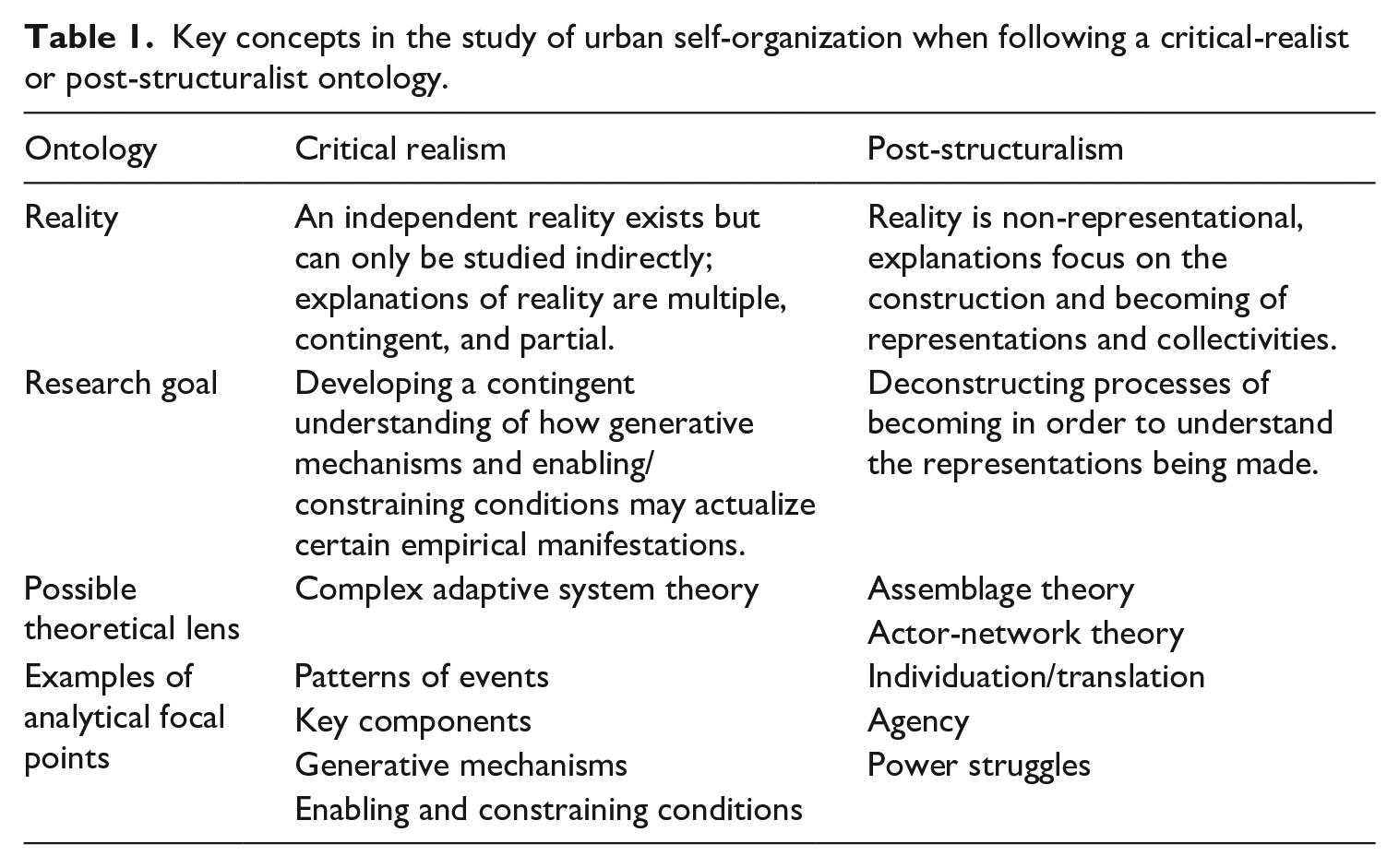
An overview of the key concepts in the study of urban self-organization when following a critical-realist or post-structuralist ontology is provided in Table 1. As stressed in the introduction, differently ontologies generate different research goals, theoretical practices, and analytical tendencies. For instance, with the focus on generative mechanisms, critical realist informed research would aim to identify causal structures that produce phenomena, while the focus of post-structuralist informed research would lie on deconstructing processes of becoming in order to reveal agency and ongoing power struggles. Such differences do not necessary imply that research activities are mutually exclusive, rather that they come with different focus.
Key concepts in the study of urban self-organization when following a critical-realist or post-structuralist ontology.
A self-organized urban transformation process: Nieuwe Binnenweg Rotterdam
Following the exploration of how the ontologies of critical realism and post-structuralism can inspire different theoretical practices in the study of urban self-organization, this section illustrates how these practices would resonate in empirical analysis as well as in preferences for planning interventions. For this purpose, we focus on the transformation of the Nieuwe Binnenweg, a shopping street in the city center of Rotterdam, as an example of urban self-organization. The transformation took place in the period of 2000–2015. We base our description on documents produced by the actors in the case, as well from interviews conducted in 2014–2015, and field observations in the period 2010–2019.
Stretching over 2 km from the city center into the western neighborhoods of Rotterdam, the Nieuwe Binnenweg flourished as an alternative shopping and nightlife district for the devastated city center after World War II (Figure 2). When the city center was rebuilt and suburbanization set in during the following decades, the street gradually lost its grandeur, and became strongly deprived. At the beginning of the 2000s, the main economic activities were sex and drug related, the street was a hot spot for criminal activities, many buildings were vacant, and public space was badly maintained (Luijt, 2011; Naafs, 2012). However, from halfway through the 2000s up until 2015 and later, the Nieuwe Binnenweg transformed into an attractive shopping and business street again. Today, the street has a hybrid contemporary character: Entrepreneurs mix shopping, business, hospitality, and community activities, and the street is filled with businesses in recycled, biological, local, design, lifestyle, and vintage products. The collective identity of the street radiates to the surrounding area and has upgraded the neighborhood as well. (See Figure 1 for a detailed overview of the events discussed below.)
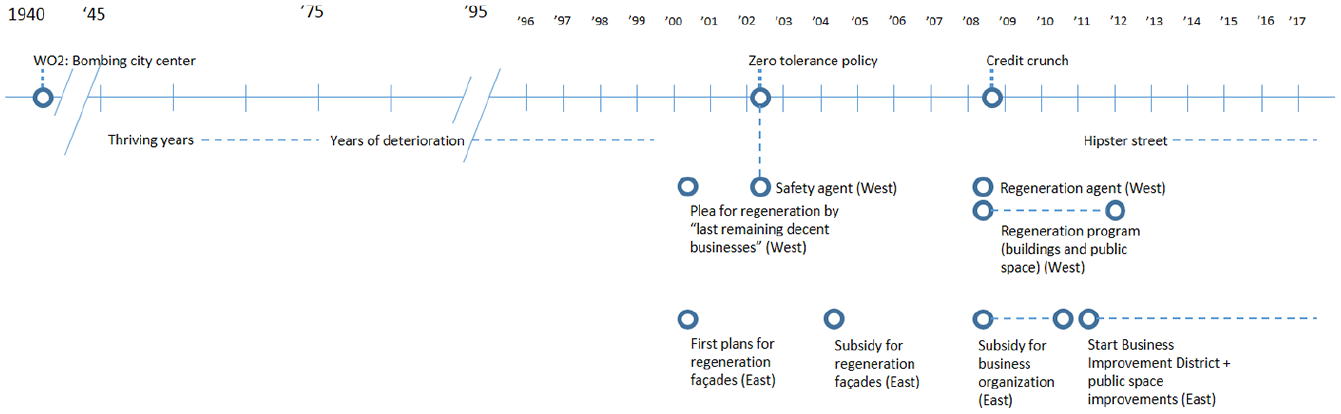
Timeline transformations Nieuwe Binnenweg (including interventions).
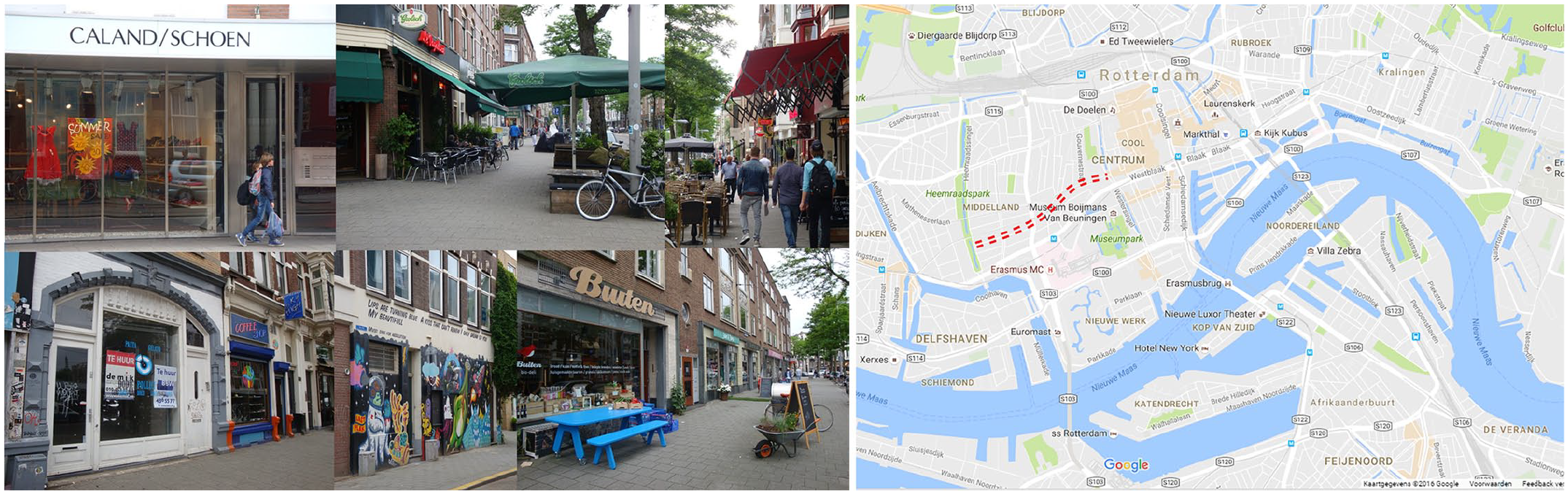
Impressions of the Nieuwe Binnenweg in 2013 (left) and position of the Nieuwe Binnenweg in Rotterdam city center (right).
A critical realist reading of the transformation of the Nieuwe Binnenweg
A researcher informed by a critical-realist ontology who aims to understand the regeneration of the street, would start with the identification of patterns of events and their key components. In the case of the Nieuwe Binnenweg these patterns would for instance include, among others, an accumulation of crime-related activities over time, and, at a later stage, the rise of creative class facilities. Key components would be the stakeholders of the street: drug dealers and their clients, individual shop-owners adjusting their business models, local community groups lobbying for public investments/organizing branding activities, and public authorities refurbishing public space and running renovation programs. As an equally important component, the direct and indirect local interactions between these stakeholders would be identified, assuming that the action of one stakeholder triggered follow-up actions of several others. At the Nieuwe Binnenweg, the researcher could argue, these interactions (small talks, organized meetings, copying behavior) enabled a dynamic process of (re)production and transformation of the socio-economic configuration of the street.
A theoretical re-description of the street as a complex adaptive system (CAS) would show the Nieuwe Binnenweg as a distinct and nested system. The street, with its public spaces and adjacent buildings, has its own identity, set of functions, and a plurality of relative independent but interacting agents who feel attached to the street. At the same time, this re-description would also show the nestedness of the street, for example, the Nieuwe Binnenweg as an open urban environment in the center of the city that evolves through interactions with other micro systems (e.g. a network of shop-owners) and macro systems (e.g. other commercial areas in the city center). From this perspective, the identified patterns of events are understood as expressions of the street’s inherent capacity to adapt. The clustering of coffeeshops, snack houses, call shops, and the sex industry at an early stage, and the arrival of experimental economic activities such as cooperative workspaces, pop-up shops, and vintage shops at a later stage, ensured the street’s complementary value to the wider urban context.
In exploring the self-organizing nature of these spontaneous pattern formations, a critical realist inspired researcher would then turn toward underlying generative mechanisms that might explain the empirical manifestations listed above. When taking symmetry breaks, spontaneous alignment, feedback loops, and enslavement as candidate mechanisms, the observed transformations of the Nieuwe Binnenweg could hint at, at least, two sets of symmetry breaks. One set of symmetry breaks included the change from a passive acceptance of deterioration toward a rejection of the dominance of crime-related industry. Through direct and indirect interactions, activities of local businesses and the municipality spontaneously aligned, which can be understood as a mechanism that increased the push for breaking away from the dominant pattern of crime-related activities. Another set of symmetry breaks would relate to the proliferating vacancies during the aftermath of the credit crunch of 2008. The arrival of new and experimental economic activities (sharing economy, cooperative workspaces, pop-up shops, etc.) on the street can be explained as a deviation from the pattern of abandoned shops.
Continuing the analysis, these local deviations of the dominant patterns could be explained as amplified and dampened by a series of multiple relatively independent, but mutually triggered, adaptations of a variety of local actors, for example, feedback. Individual shop-owners relocated their shops, changed their businesses, and decorated the areas in front of their shops. Local community groups organized events and lobbied for public investments, and public authorities upgraded the public space and installed regeneration subsidies for the physical upgrading of private property. Taking into account the wider conditions could subsequently provide insight in how these feedbacks gain in strength. Such an enabling condition at the local level could include the distributed control of fragmented real estate ownership at the Nieuwe Binnenweg, which in turn triggered a plurality of private initiatives and local activities. A wider societal trend that could have functioned as an enabling condition was, for instance, the emergence of the creative industry resulting in new business opportunities, also at the Nieuwe Binnenweg.
While the proposed generative mechanisms symmetry breaks, spontaneous alignments, and amplifying and dampening feedback loops help to explain the initial phase and acceleration phase of pattern transformation at the Nieuwe Binnenweg, the fourth candidate mechanism, enslavement, can be used to explain pattern stabilization. Enslavement as a generative mechanism would for instance shed light on the effects of the active nourishment of the new dominant socio-spatial configuration of the street as a creative hot-spot, and the growing level of conformity among associations of shop owners and public authorities since 2013 onwards.
Critical-realist informed interventions: Planning through conditions
The theoretical practice that follows from a critical-realist ontology informs planning interventions as well. Planners working from a critical-realist informed understanding of urban self-organization would for instance not predefine urban configurations, but rather take into account the continuous and situational interplay between key components in the street, and potentially underlying generative mechanisms as well as enabling and constraining conditions that were constitutive to the empirical manifestations observed. With the aim to avoid societally undesired developments and encourage desired ones, planners would subsequently intervene in the conditions that enable or constrain certain outcomes of urban self-organization. They can attempt to guide self-organized transformations with indirect interventions, aimed at triggering particular local symmetry breaks, and reinforcing more desired emerging patterns.
Intervening in conditions and mechanisms can for instance be made operational by the implementation of framework-rules (Moroni, 2010) or urban codes (Alfasi, 2018; Alfasi and Portugali, 2007). Such rules or codes function as filter devices (Moroni, 2015), which support the openness of cities for spontaneous developments, while narrowing the range of possible actions to safeguard important societal values (Rauws, 2017). An example in the context of the Nieuwe Binnenweg could be the financial incentives for individual landlords to renovate their buildings (Interview regeneration-agent, 2014). This intervention did not predefine particular functions but did limit the possibility space in accordance with emergent societal values.
A second approach focuses on feedback loops that amplify or dampen both individual and collective actions in response to symmetry breaks (Zhang and De Roo, 2016). One can think of incentives such as nourishing local initiatives or policies that generate preferable conditions for some developments over others (e.g. subsidies or spaces for activities), or providing requisite carrying structures (e.g. road and public transport networks, blue-green networks, and more data networks) (Rauws et al., 2014). For instance, on the Nieuwe Binnenweg, the refurbishing of public space, as well municipal support for community initiatives and promotional events can be seen as triggers for a feedback loop that raised confidence in the area for users and investors (Luijt, 2011; Naafs, 2012; interview safety-agent, 2013; interview regeneration-agent, 2014).
A third approach entails experimentation. Critical-realists argue that through experimentation, mechanisms can be actualized, and rendered visible (Elder-Vass, 2008). For planners, experimentations, in the form of living labs, provide tests beds for alternative practices that challenge existing routines (Evans et al., 2016). Moreover, as routine-breaking in themselves, experiments can trigger non-linear, self-organized adjustments (Rantanen and Faehnle, 2017). On the Nieuwe Binnenweg, many interventions by both public and private actors, such as the street events and pop-up stores, can be understood as such experiments.
A post-structuralist reading of the transformation of the Nieuwe Binnenweg
Following a post-structuralist ontology in reading the regeneration of the Nieuwe Binnenweg, the researcher would start with a close empirical and inductive observation of individual and dispersed interactions between (human or non-human) actors. Such a reading would reveal that halfway through the 2000s, a coherent or collective idea for regenerating the street did not exist. Rather were there several and dispersed interactions and relations between different interests and parts of the street: Businesses continuing their usual practices; businesses pushing for change; change agents sent by the municipality or municipal departments that were responsible for the maintenance of public space; various public spaces, post-war buildings in single ownership in the east; and businesses, public spaces, and privately owned pre-war buildings in the west.
From these interactions, the researcher would follow the emergence or the becoming a collective identity for the street over time. The researcher would emphasize, among others, how the municipality synchronized her investments in public space and the renovation of the tramline with the investments of shop owners. How structural deliberations between the municipality and businesses on urban development and cultural events promoting the Rotterdam city center were organized and how local businesses in the eastern part installed a Business Improvement District in 2011 (Naafs, 2012). Moreover, whereas the eastern and western parts of the street had different identities and different actors in the beginning of the 2000s, the researcher would describe how connectivity between these parts of the street strengthened over time, as two solid and active business associations started to work in close cooperation with the city authorities, and how they collectively maintained and promoted the emerged identity of the rough, messy, creative, and innovative street (Interview regeneration-agent, 2014; Ondernemersvereniging Binnenweg, 2010).
Crucial in this post-structuralist informed reading is the performance of agency which started and continued the regeneration of the street. In the west, this started with businesses presenting themselves as the last remaining decent businesses (e.g. in furniture and quality food), problematizing the deterioration of the street, and pushing the municipality to improve the connectivity to the city center, as well as the safety and outlook of the street. Following, the municipality performed agency by posting a safety-agent, a regeneration-agent, and a business-district manager in the street. Their jobs were to encourage individual businesses, residents, real estate owners, and diverse municipal departments to invest and regenerate, to attract new businesses, to strengthen collaboration, and to build a sense of collective identity. In the eastern part of the street, businesses performed agency as well, by starting a joint renovation of their buildings and pushing the municipality to invest in public space. All these actors operated intentionally, but within contingency and without being fully aware nor in control of the impact of their actions on the street.
From these close empirical observations of the interactions and performances of agency, the post-structuralist informed researcher would subsequently reveal struggles of power over whose reading of space gains priority: (i) the transformation of the image of the street from being seen as sex-industry, drugs, and criminality (majority of residing businesses) toward creativity, culture, style, and urban activity (a few residing and new coming businesses, as well as the municipality); (ii) the reading over the western part of the street, where some business owners tried to convince other shop owners of the need to regenerate their individual properties instead of just running their usual business; (iii) the eastern part, between the entrepreneurs and the municipality, when the initial positive relationship was hampered by a different vision on the refurbishment of the street, leading to tentative accusations of a lack of professionalism, responsibility, and hidden austerity measures (Naafs, 2012). The analysis would show how, over time, synchronizations of perspectives and actions took place, such as between various renovations and investments in the eastern part of the street, made possible by a local hairdresser who overheard various plans for renovation (Naafs, 2012), and stress how contingency and situational these struggles and synchronizations were.
Post-structuralist informed interventions: Planning through performance
Following a post-structuralist ontology, spatial planning would foremost be considered as performance (socially produced acts of bringing elements into relation (Parr, 2010)) of representation and agency (Hillier, 2007; Thrift, 2000), in which the performer and context are entangled in heterogeneous processes of spatial becoming (Murdoch, 2006). Everyone and everything that actively engages in performing spatial representations influences the competitive process between readings of space. Only few actors are professionally trained and employed as spatial planners; many more actors perform agency more or less accidentally, influencing the spatial, and collective reconfiguration of the street, nonetheless. Post-structuralist informed planning would consequently focus on creating more and new agency, as well as turning a multitude of individual performances into a collective one, for example, by creating a shared identity and common future.
A first step in creating this collectiveness would be to reveal the multiplicity of actors and deconstruct power struggles over the reading of space. Through this, a post-structuralist informed planner would make actors more sensitive to and self-conscious of potential openings and closures in the processes of which they are part (Hasanov and Beaumont, 2016; Loepfe, 2014). By increasing the awareness of individual intentionality as well as socio-psychological traits (Atkinson et al., 2017; Hasanov and Beaumont, 2016), planners would smoothen the ability to relate to the performance of agency of other actors. An example of the Nieuwe Binnenweg was the installation of the change agents, who carefully mapped the ongoing interactions and performances of agency and representation in the street.
After these awareness-raising deconstructions, post-structuralist informed planners might begin to intervene in emerging collectives through the further activation of agency (Rothfuss and Korff, 2015), by seeking connectivity between locally encountered individuals and various emerging actor-networks (Atkinson et al., 2017; Boonstra, 2015), and by building a narrative around the emerging collectivity of the Nieuwe Binnenweg as a creative/cultural/safe/livable environment, among others throught (street)art-projects, on-street poetry, books about the street, street events and marketing campaigns.
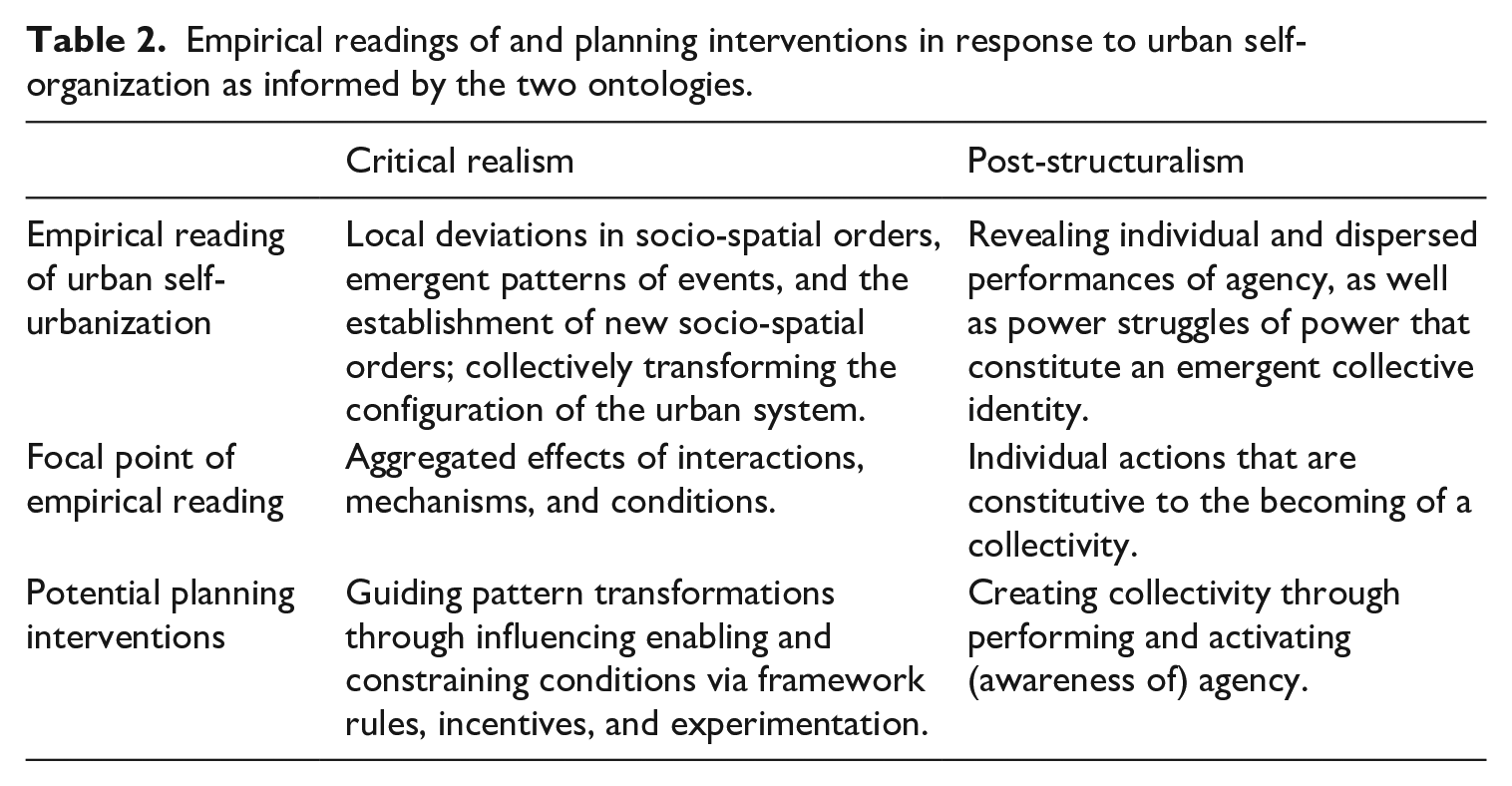
Table 2 summarizes the main insights gained by confronting a critical realist and post-structuralist informed reading of self-organization with the empirical reading of the Nieuwe Binnenweg.
Empirical readings of and planning interventions in response to urban self-organization as informed by the two ontologies.
Conclusions: Nourishing ontological diversity
This article elaborated how a critical realist and post-structural ontology inspire very different theoretical practices in the study of urban self-organization (see Table 1). It illustrated how these theoretical practices consequently lead to different empirical readings as well as different suggestions for planning interventions (see Table 2). In exploring ontological dimensions, this paper provides additional explanations for diverse conceptualizations of urban self-organization in urban studies and planning theory. By scrutinizing the premises, assumptions, and deficiencies within the theoretical practices that follow from either a critical realist or post-structuralist ontology, we have illustrated how each theoretical practice comes with certain analytical tendencies.
An empirical study of urban self-organization, informed by a critical-realist ontology, would look at spontaneous transformations of systems through pattern formation as empirical manifestations, and would aim to identify generative mechanisms and conditions as the complex and multilayered causality behind these manifestations. This analysis would thus concentrate on a “bigger picture”—identifying the aggregated effects of interactions, mechanisms, and conditions. Such an analysis would then lead to planning interventions that focus on adjusting the enabling and constraining conditions. An empirical study of urban self-organization informed by a post-structuralist ontology, would concentrate on individual actions and subsequently map how interactions, relations, and translations constitute (or not) a certain collectiveness. Such an analysis would then lead to planning interventions that generate (awareness of) agency for this emerging collectivity. To summarize, whereas both critical realist and post-structuralist informed theoretical practices look at the same dynamics of urban self-organization, they read these dynamics in analytically very distinct manors, and subsequently propose distinct planning interventions as well. A critical realist informed theoretical practice would seek for explanations and use these explanations to determine what conditions could or should be adjusted in order to influence the urban self-organization. A post-structuralist informed theoretical practice would work toward a description of the ongoing processes of becoming and use this description to further encourage agency in order to influence the urban self-organization.
We think that revealing the analytical tendencies, empirical manifestations, and spatial planning interventions that follow from the two ontologies discussed in this paper, can raise awareness among scholars and practitioners of potential analytical and intervention blind spots within their own practices. Moreover, ontological clarity might help planning scholars from different theoretical practices to explicate how their position complements, deviates, and potentially challenges or inspires those of others, and as such deepen the dialog on planning in the face of urban self-organization. Understandings of complex urban phenomenon are incredibly rich and diverse in their embracing of the multidimensionality and complexity of today’s spatial challenges. As such, while further developing complexity-informed planning approaches, ontological diversity should not be countered or ignored. Rather it should be nourished as we consider diversity—following Heylighen et al. (2007)—not as a problem, but as the most important resource of complexity.
Footnotes
Acknowledgements
We are much indebted to the four anonymous referees, as well as to Em. Prof. Dr. Jean Hillier and Prof. Dr. Lasse Gerrits for their valuable comments on earlier versions of this manuscript. Any errors that remain are, of course, our own.
Funding
The author(s) received no financial support for the research, authorship, and/or publication of this article.
