




Abstract
For Kristeva (1982) the abject not only caused visceral disgust but posed a threat to the established order of society. The abject is a product of particular times and places but limited attention has been given to understanding the process of transitioning away from abject status. We address this gap here through an examination of the planning profession in post-apartheid South Africa. The paper examines how the abject is fluid and resilient, evolving to fit a changing planning system and broader political economy where a discourse of abjection by race has been replaced by a focus on poverty.
Introduction
Racial zoning, comprehensive planning and town planning schemes were key tools in delivering the spatial segregation by race required under South Africa’s apartheid system (Harrison et al., 2008). Forced evictions and mass displacement were an inevitable consequence (Maylam, 1990). The planning profession was at the forefront of providing new township settlements, creating parallel systems of schools, hospitals, shops and other services designed to serve different racial groups (Christopher, 1987). Apartheid formally came to an end as part of negotiations undertaken 1990–1993, leading to the country’s first free and fair elections in 1994. More than a quarter of a century later, however, the legacy of apartheid continues to shape the nation both metaphorically and literally (Moodley, 2019).
Abjection, as Kristeva (1982) conceptualised it, is rooted in a visceral, bodily sense of revulsion, emerging where there are perceived threats to established social structures. Apartheid was predicated on the abjection of non-white bodies which were seen as dangerous, disgusting and a threat to the (white) moral order (Bick, 2010; Hook, 2004). In the years since 1994 there has been a clear policy discourse of creating a more equal society with various compensatory policies, attempting not only to remove racial abjection in law, but also in lived experience (Ndletyana and Maimela, 2015). Nonetheless, the cultural and spatial implications of the apartheid system did not suddenly come to an end with the introduction of new governance regimes (Berrisford, 2011). South Africa today remains a deeply divided country with extremes of wealth and poverty.
Abjection is understood to be culturally, temporally and spatially contingent; something seen as threatening in one place and time does not appear so in another (Douglas, 1966). What is less clear, however, is the process through which those once deemed abject can transition into acceptance. We seek to address this omission here through exploring the role of professional planners in post-apartheid South Africa. Because of how closely spatial planning was tied to the apartheid project, the profession has had to work hard to reposition itself from being seen by some as the handmaiden of segregation (Turok, 1994). There are, therefore, two interwoven stories within this paper. The first examines a profession seeking to regain and enhance its legitimacy in the post-apartheid state. The second explores the role of that profession since the mid-1990s in materialising a discourse of equality for all races in a nation plagued by abject poverty.
Thus, this paper moves beyond simply applying notions of the abject to a South African case study, towards examining what the planning of South Africa tells us about abjection as a process. As we discuss below, South African planning has come a very long way in terms of diversifying the profession and its practice. Fundamentally, however, this paper demonstrates that bringing a middle-class profession back from abject status is a great deal easier than doing the same for those suffering from racially informed structural poverty. Abjection can be seen as fluid, evolving to find ways to preserve the privilege of the powerful even as the prevailing political economy shifts. Neoliberal marginalisation by poverty therefore acts as a contemporary proxy for apartheid’s overt racial discrimination. The work of planners can mitigate some of the material manifestations of abjection but does so in a manner which cannot significantly challenge spaces of privilege and exclusion.
Our reflections on the process of transitioning away from abjection are based on a 30-month ESRC-NRF research project examining the training of planners in South Africa. This study represents one of the largest surveys of the profession in that country to date, including 89 in-depth qualitative interviews with practitioners at all levels as well as planning educators. We reflect on changing institutional and policy frameworks as well as the actions of individuals attempting to bring about a more socially just South Africa through planning.
Understanding abjection
Beyond visceral disgust, Kristeva (1982: 4) argues that abjection is anything which: …disturbs identity, system order. What does not respect borders, positions, rules. The in-between, the ambiguous, the composite.
Thus, the abject is a threat that must be purged or contained lest society be destroyed (Cresswell, 1997). Abjection has clear resonances with apartheid project, which positioned the racial Other as a dangerous force of contamination needing to be isolated and contained (Clark and Worger, 2004). It is, therefore, not hard to see why Kristeva’s work on abjection has influenced scholars working on questions of race in South Africa (Bick, 2010; Blackbeard and Lindegger, 2007; Hook, 2004; Popke, 2001) although the emphasis in this work has been more in applying the concept than developing it.
Kristeva was influenced by Douglas’ (1966) work on dirt, which highlighted the spatial qualities of contamination. Douglas emphasises that dirt is: …a relative idea. Shoes are not dirty in themselves, but it is dirty to place them on the dining table; food is not dirty in itself, but it is dirty to leave cooking utensils in the bedroom. . . (Douglas, 1966: 44, 45)
Apartheid was framed by this spatial regulation – it was acceptable for the black African 1 body to labour in fields or mines, but not to live in the house next door (Dubow, 2014). As with Kristeva writing later, the idea of boundary maintenance is a strong thread running through Douglas’ work. Contamination through ‘dirt’ occurs where these boundaries are insufficiently policed, going well beyond any notion of material pollution. Under the logic of apartheid, living in close proximity to a member of a different ethnic group could potentially lead to other forms of contamination (Coetzee, 1991) and the planning profession was employed to create environments where much more rigorous segregation could be enacted (Christopher, 1986).
As a theoretical frame, abjection is bound up with a critique of Lacanian psychoanalysis, in particular how Lacan conceived the role of the mother (Caputi, 1993; Butler, 1988). Lacan’s work is diverse, however, and different elements have already been extensively applied within planning scholarship particularly by Hillier and Gunder (2005, 2009); (Gunder, 2011, 2016). Lacan’s work on discourse, for example, examines the tension between the unconscious and the systems of language that construct our understanding of the world from a young age (Hillier and Gunder, 2003). Gunder (2004) explores this idea in the context of the ‘master signifiers’ within planning, i.e. big ideas such as sustainability, compact cities, environmental justice and so on. These master signifiers hold considerable sway over how planning is conceived, yet are ‘fuzzy’, ambiguously defined and shift in importance over time (Gunder, 2004: 303). Similarly, Gunder (2010) examines how ideas of ‘desire’ and ‘lack’ can be seen to support a neoliberal agenda within planning by conjuring a fantasy of new development that builds a better future for citizens in place of existing, less-than-perfect, reality.
Gunder and Hillier do not shy away from the complexity and psychoanalytic basis of Lacan’s work. Nonetheless, psychoanalytic theory is not universally appealing to scholars, with Lacan particularly criticised for not grounding his analysis in empirical evidence (Gunder, 2005: 90). There is a temptation, therefore, to ignore some of the more controversial psychoanalytic claims within such work and to focus instead on testing their application through real world case studies. This has certainly been the case with some of the work exploring Kristeva’s understanding of the abject which has, ironically perhaps, often shorn it from its psychoanalytical roots. Tyler (2013) has been very interesting here, particularly in exploring the ways that poor and vulnerable groups have been cast as the social abject within neoliberal Britain. The imagined figures of ‘chavs’ 2 and asylum seekers were thus given responsibility for society’s ills, usefully deflecting attention from those who actually benefit from neoliberalism’s structural inequality.
Tyler has, however, been keen to distance her use of abjection from some of the psychoanalytic baggage we see in Kristeva’s work. She argues that Kristeva’s account is founded on the need to reject the maternal body in order to produce an independent identity in the subject (Tyler, 2009). By this reading, Kristeva’s abject is fundamentally matricidal and ‘risks reproducing histories of violent disgust towards maternal bodies’ (Tyler, 2009: 77, 78). In her analysis of partner violence towards pregnant women, Tyler (2009) emphasizes the extent to which abjection is more than merely a ‘psychic process’ (p. 87) and instead grounds abjection in real world social effects.
Tyler (2020: 18) suggests that her more recent book on stigma was conceived as a ‘sister project’ to the 2013 volume examining the abject. This highlights the interesting commonalities between abjection and stigma which are useful for this paper. Ideas of stigma, coming out of Goffman’s (1963) work have taken on a more explicitly political edge in recent years (Tyler, 2018). From a planning perspective this is most acutely seen in Wacquant’s (2007) notion of ‘territorial stigmatisation’ where a language of ‘sink estates’, ‘ghettos’, ‘banlieues’ etc. becomes attached to neighbourhoods suffering from deprivation. The stigma of this kind of label becomes a justification for policy interventions that invite developers to demolish and rebuild such areas, with an associated purge of existing residents who are themselves stigmatised by association with the place. Stigma thus becomes a mechanism driving neoliberal gentrification (August, 2014). The globalised nature of neoliberal policies has meant that territorial stigmatisation has been convincingly applied across case studies in both global north and south (Sisson, 2020).
A key accusation made against neoliberal urban policy is that it blames the individual for poverty rather than questioning underlying structural inequality (McDonald, 2007). Thus the stigmatising of the urban poor is used to justify their ill treatment (Tyler, 2020). To synthesise these ideas, one can perhaps suggest that within planning processes that are increasingly underpinned by neoliberal discourse (Gunder, 2016), stigmatisation is becoming the acceptable face of abjection. For all that questions of stigma have become fashionable within urban studies, however, abjection retains its analytical power for exploring the rejection of the ‘other’. One reason for this is that the idea of abjection is surprisingly flexible. ‘The abject describes those forces, practices and things which are opposed to and unsettle the conscious ego’ (Tyler, 2009: 79) meaning that it can be used to examine not only the bodily, but institutions, objects, ideas and indeed anything that can be seen as threatening to the established order. More than this, the abject can be used to justify certain kinds of biopolitical control via mechanisms designed to ‘purify’ society (Duschinsky and Adey, 2014). As we discuss below, planning, which can be used to rationalise space, is potentially a very powerful tool for this kind of biopolitical control (Certomà, 2013).
Kristeva notes that purity discourses are variable across time and what may be abject in one period of history becomes normalised in another (Duschinsky and Adey, 2014). What is missing, however, is an understanding of how those mechanisms of abjection and normalisation function in practice, in particular, what needs to happen for the abject to become acceptable. As a result, in this paper, we are particularly interested in the path back from abjection, which we explore through our case study of planning in South Africa.
Planning and exclusion
Apartheid-era South Africa was not alone, of course, in using abjection based on ethnicity as the basis for decision-making about space. The German National Socialist discourse of the 1930s and 1940s that equated Jews and Roma with rats – sewer dwelling and linked to filth and disease – is the classic example of how the signification of disgust was used to justify violence towards particular ethnic groups (Sibley, 1995: 10). Roma and Jews were portrayed as particularly threatening by the Nazis because of a perceived rootlessness. Thus, we see attempts to spatially fix the racialized Other in place to prevent that contamination spreading. In the case of the Third Reich this was seen in the remaking of Jewish ghettos in towns across central and eastern Europe and subsequent deportations to concentration camps (Cole, 2003). A less extreme example can be seen in the rise of the exclusively white middle-class suburb in the post-war United States. ‘White flight’ was driven in part by fear, as wealthier families fled the increasingly ethnically diverse and poverty-stricken inner city of the 1950s and 1960s (Frey, 1979). High commuting costs and restrictive covenants helped to keep these suburban neighbourhoods segregated, with the non-white Other confined to the inner city.
The Group Areas Act, 1950 was one of the crucial pieces of legislation establishing formal apartheid structures in South Africa, strictly governing where different racial groups could live (Mabin, 1992). Apartheid went far beyond mere spatial separation; nonetheless, forced displacement and the creation of segregated settlements were highly visible manifestations of the attempt to regulate those bodies labelled abject by the white-controlled state (Turok, 1994). New segregated settlements had to be designed and laid out, putting the planning profession in the front line of making apartheid policy into a spatial reality (Christopher, 1987). It has been estimated that around 3.5 m people were forced to move 1960–1983 as a direct result of these policies (Surplus People’s Project, 1985).
By the 1980s, however, the apartheid system was becoming untenable, collapsing under public and international pressure as well as its own contradictions (Schwartzman and Taylor, 1999). The release of Nelson Mandela from prison in 1990 was an important step in dismantling the apartheid state. Four years later he was elected President in the first national elections where all ethnicities were permitted to participate, thus marking the end of non-white groups being legally labelled as abject. There is a difference, however, between abjection de jure and de facto; South Africa has spent the years since 1994 trying to overcome its deeply embedded racial inequalities (Ndletyana and Maimela, 2015). A reformed planning system has been a significant part of that process (Harrison et al., 2008). Because of the profession’s important role in materialising apartheid, it therefore becomes an interesting case study of the practical steps needed to transition away from abjection.
There is a particular colonial history to planning that continues to shape its operation in parts of the global south. Legacy infrastructures were usually designed to meet the needs of wealthier (white colonial) neighbourhoods and these areas often continue to be better served today (Terreni Brown, 2014). Rodgers (2012) has developed the idea of ‘abject urbanism’ to describe practices where infrastructure developments have been used as a means to help purge and control poorer populations. Indeed, particularly in a global south context, the denial of access to infrastructures such as water supply has been used to condemn certain groups to abject status, as seen in Anand’s (2012) work exploring poorer Muslim migrants in Mumbai. The power of infrastructure to create abjection thus places considerable responsibility on planners and planning legislation to regulate how these infrastructures are located and used.
Many countries in sub-Saharan Africa still use planning legislation dating to periods of British rule, drawing on what was seen as best practice in the UK during the inter- and post-war periods (Wekwete, 1995; Fuseini and Kemp, 2015). Indeed, prior to passing the Spatial Planning and Land Use Management Act 16 (SPLUMA) in 2013, a high proportion of South Africa’s planning law still dated from the apartheid and earlier colonial periods (Berrisford, 2011; Laubscher et al., 2016). SPLUMA was the culmination of many years’ work by the planning profession attempting to create an effective legal framework for the needs of contemporary South Africa, with a strong emphasis on socio-spatial justice. As we discuss below, important though these changes have been, there is still a disconnect between the capacity of planners to act and the challenges of attempting to heal divisions in a society where very large numbers of black African people continue to live in abject poverty.
Methods
The data for this project were collected as part of a 3-year, ESRC-NRF-funded study into planning education. The purpose of the project was to examine the changing face of the profession and in particular whether planning students are being adequately prepared for the challenges of working in South Africa today. The paper draws on a dataset of 89 semi-structured interviews undertaken with planning professionals and educators in South Africa, which represent one of the largest surveys of the profession to date. Although the sample is somewhat over-representative of white planners (n = 50, compared to ~37% of South African planners registered after 1994 being white), this does reflect a slightly older cohort who were able to take a long view of the development of the profession. The data were collected February–May 2018 through a mix of in-person and phone interviews and subsequently transcribed. The data were coded for analysis using NVivo, with a single person leading this activity to ensure consistency, with cross checking by the project team.
Rehabilitating the planning profession
A small number of our participants started their careers during the apartheid era. Looking back, one commented: I planned milk farms that are now Lotus Gardens in Pretoria, which was destined to be an Indian suburb. . . so I was then complicit to apartheid planning, so then you’ll have to sue me. [. . .] But yes, then it was probably morally wrong to put my hand to paper there. [If] I had to say to [my manager] at the time, “Sorry, it’s against my principles. It’s apartheid planning” then he said to me, “Well, bye”. Then I would have been without work. (Participant 75, white, male, interviewed 25/4/18, translated from Afrikaans)
If slightly defensive, this participant reflected a pragmatic response to the political conditions prevailing in the 1980s. Others reflected on the position of planning as a tool of the state, with planners adapting to the direction of policy at the time: So, I think, you know, I don’t think all planners were sort of part of the evil of apartheid, but I don’t think people questioned maybe enough. And I think still now, that people don’t question enough. (Participant 27, white, male, interviewed 4/4/18)
While many other professions benefited from or were complicit with apartheid policies, the simple materiality of townships and segregated settlements meant that planners are particularly associated with this period: …whether it’s unfairly so or fairly so, urban planning has been singled out as being one of those professions that have concretely contributed to reinforcing the legacies of the colonial apartheid eras. [. . .] I think that the profession itself is still recovering from the beating that they have taken. And I think that many urban planners are aware of that and I think that they still have to a large extent low self-esteem because of that. (Participant 63, coloured,
3
male, interviewed 12/2/18)
Many of our participants commented that one important achievement of planning today was regaining a sense of professional legitimacy in the aftermath of apartheid. The 1995 Club Mykonos workshop was a crucial moment for the profession to acknowledge its complicity in creating spatial division during apartheid and to rethink its role in the newly democratic nation (Nel and Lewis, 2019: 153). The profession has since worked incredibly hard to diversify itself. As Figure 1 shows, the numbers of black African planners registering for professional accreditation with the South African Council for Planners (SACPLAN) has risen sharply since the mid-2000s. The proportion of white registered planners fell from 90% in 1994 to 26% in 2018 (Nel and Lewis, 2019: 157).
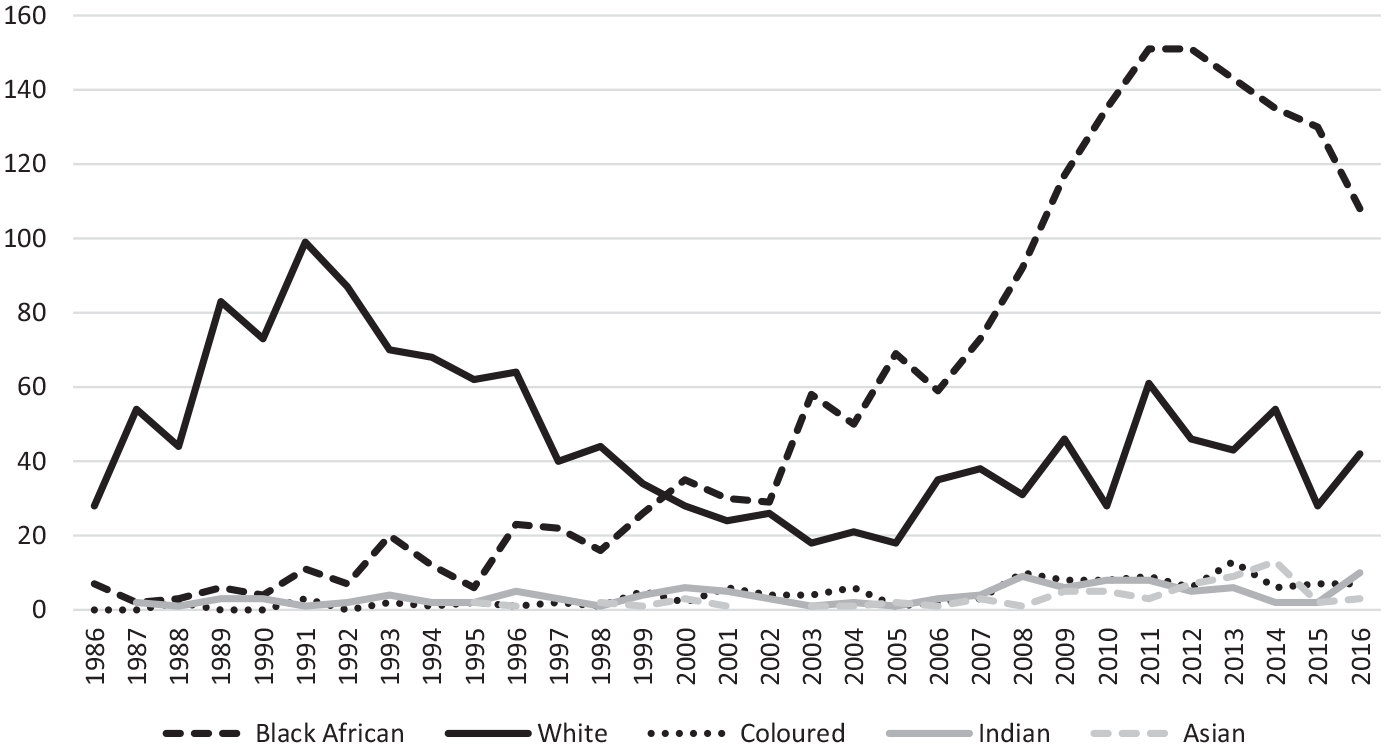
New practitioner registrations with the South African Council for Planners.
These changing numbers were reflected in the accounts of some of our interviewees who recalled training in the 1990s with almost entirely white student cohorts, sometimes taught exclusively in Afrikaans. The same participants contrasted their own training to the situation in South African universities today, with the student body being more representative of the population as a whole. This is not to say, however, that the planning classroom is now entirely post-racial as one recent graduate reflected: …obviously the issue of racism . . . but it honestly still exists. It’s something that I could experience from my varsity times, how, for example, the whites got isolated from the black students. In their group works, they can’t interact together. [. . .] it’s quite funny that if we behave like that, in future we still have to work together. [. . .] So, issues of diversity within those institutions, it’s something that must still be addressed. . . (Participant 15, black African, male, interviewed 17/4/18)
Group work is valued within education precisely because it mimics the need to collaborate with diverse groups in the workplace. It is clear that self-selected groups reproduce existing social hierarchies, which many educators recognise and attempt to mitigate (Chapman et al., 2006). The example Participant 15 gives is not necessarily white students consciously rejecting the perceived racial abject. Instead, this represents a more subtle Othering of those from different backgrounds, which is more insidious for being less blatant.
The profession has clearly come a long way in its thinking since the end of apartheid. Looking back, one participant recalled a situation in the late 1990s where he had been asked by central government to review the accreditation process for planning degrees: I got practitioners, planning practitioners from Cape Town, chaired by a Black woman, and in they went. And the first thing they said was, that nowhere, nowhere in the [university’s] planning curriculum, or the four-year planning degree, would they mention apartheid. The word, race and apartheid was not mentioned, they talked about pure planning. So, they said, “you can’t in 1998 in South Africa do that. . .” And the staff refused, they said it was irrelevant and they said that “planning is planning”. So, we closed them down. (Participant 62, white, male, interviewed 6/2/18)
This is, of course, only one person’s account of the reasons for the closure of that programme. Nonetheless, the fact that this very senior individual who was at the centre of the review process framed the closure in these terms is significant. The idea that ‘planning is planning’ reflects the thoroughly debunked modernist mindset that presented planning as a rational and objective science (Allmendinger, 2002). Participant 62 thus illustrates how the idea of planning as an objective, technical discipline can be used to obfuscate the crucial role of planning in broader questions of social (in)justice. Although there is an ongoing debate about the appropriate balance in curricula between more theoretical and applied content (Denoon-Stevens et al., 2020), there is no question that students today are learning much more about the planner’s role in mitigating major socio-economic problems relating to race and inequality. As a profession, therefore, attempting to move on from the abject status acquired through association with the apartheid project has meant: acknowledging its complicity; diversifying its membership; and, as we discuss in the next section, playing an active role in attempts to overcome grotesque inequalities in South Africa.
The role of the planning profession creating a more equal nation
Planning practice, as a highly diverse field, can contribute towards building social justice in a variety of ways from improving transportation systems and regional development, through enhancing urban design and environmental planning. For this section we have chosen to concentrate on three key areas which, in looking to manifest a discourse of equality, give useful insights into the mechanisms of abjection. These comprise: the legislative framework; the creation of new housing opportunities; and the management of informality.
New legislation
The Planning Profession Act, 2002, was an important assertion of the profession’s role in making the new South Africa. It established the South African Council for Planners as the body overseeing professional accreditation and identified those areas of work that were reserved for planners (Nel and Lewis, 2019). This central positioning of the profession was reinforced by the subsequent Spatial Planning and Land Use Management Act 16, 2013 (SPLUMA). Together, these Acts are an important symbol of how the profession has attempted to move on from its somewhat tarnished history, not least because SPLUMA replaced legislation which in some cases dated back to the apartheid and even the colonial eras.
One of the interesting aspects of SPLUMA is in shifting the balance of power in urban development back towards planners. An issue with this, however, is that SPLUMA devolved quite a lot of responsibility to local level for drawing up local ordinances, which can lead to specific problems: Okay so there’s a lot of hostile cutting and pasting from 1980-whatever so the people who are generating the land use management systems probably are still old school from 1985 legislation. And a lot of it [. . .] is show me what was in your land use planning ordinance and show you me what’s in your SPLUMA and show me how much of it is cut and pasted. Okay it’s a shocking eighty percent. (Participant 45, coloured, female, 9/3/18)
Re-using elements of existing local ordinances is not inherently problematic, particularly for more procedural elements of land-use planning, but it is a missed opportunity to reorient planning processes towards the needs of poorer citizens. A generous interpretation would be that this reflects a lack of capacity (in terms of people, skills and resources) at local level. Nonetheless, by reproducing the status quo at local level, the risk is of retaining a system which de jure favours the interests of wealthier (largely white) property owners while failing to challenge the de facto abjection of (largely black African) poorer communities.
A lack of capacity is crucial for how this well-intentioned legislation plays out on the ground: SPLUMA had a vision around integrated, well-capacitated municipality that can do strategic planning, that can make policies that can implement these and do schemes and implement it right across all their areas in all the municipalities that isn’t all focused on your old white areas and old township areas that are left to rot and become non-compliant, free for all. You know, I’ve always maintained, why should households in Soweto be subjected to the externalities of an informal abattoir next to them, blood running along their pavement or a panel beater dashing away at cars all day while their children are trying to study at home? There should be no discrimination around any of that stuff. (Participant 51, white, female, interviewed 19/4/18)
There are a couple of points here. Firstly, the participant reminds us that it is important not to romanticise the informal as a source of grassroots community action. The lack of planning regulation within informal settlements can have negative material effects that in turn reinforce inequality and the abjection of those living there (Richards et al., 2007). Secondly, while SPLUMA aspired to ensure that all communities could have access to high quality planned environments, the reality of financial and skills shortages means that this remains a challenge. Thus, a lack of planning capacity can be argued to be a major barrier to removing the abject status of those condemned to live in poorly planned areas (National Planning Commission, 2011: 18). As we emphasise below, however, even if there were to be sufficient capacity, good planning cannot alone address the abjection of endemic poverty.
Housing
A 1994 White Paper described housing as one of the greatest challenges facing the South African government (Department of Housing, 1994) and the right to adequate housing was enshrined in the new Constitution. Indeed, the first post-democracy piece of planning legislation, the Development Facilitation Act 1995, was explicitly focussed on creating new housing (Nel and Lewis, 2019: 153). From 1994/1995 to 2018/2019 4.774 million new subsidised housing opportunities 4 were created in South Africa (Africa Check, 2019). This is undoubtedly a major achievement. Nonetheless, the most recent official statistics reveal that only 81.1% of households were living in formal dwellings in 2018 (Statistics South Africa, 2019: 32). This leaves a housing gap of around 2.2 m households living in informal dwellings (Statistics South Africa, 2019: 80). Meanwhile, the population continues to grow.
Many participants talked about the pressure they felt from local politicians to deliver developments more quickly, not least because of the demands those politicians were facing from their constituents to provide promised new homes. Planners being blamed for the slow pace of housebuilding is far from a uniquely South African concern. Indeed, Gunder’s (2016) Lacanian analysis argues that the discourse of condemning planners for slow progress in improving housing conditions is part of a neoliberal attempt to distract from wider structural inequality. Nonetheless, South African planners have faced a particular mismatch of expectations and understandings of best practice. South Africa’s housing stock overwhelmingly takes the form of single-family units, with relatively few apartments. The aspiration to live in a house is very powerful, yet it does not always fit with current planning principles around producing more compact settlements. One participant summed up the problem of working in a smaller town: …the municipality tells you, “you must now plan housing there as quickly as you can”, and it’s a very sort of standard process. . . but the moment you go to double or three, walk up to three stories, you get resistance from these communities, they’re not used to it like the cities. And they still think it’s. . . “There’s a lot of land there, why must we now have high density here? Build some more houses over there”. And then it’s sprawl again. (Participant 72, white, male, interviewed 22/3/18)
While urban sprawl is often seen as the enemy of good planning, high density developments are a harder sell when attempting to demonstrate a national commitment to equality. Communities that see themselves as being given an inferior form of housing can argue with some justification that they are continuing to be treated as less-than wealthier, house-dwelling, white people.
The underlying ideas of compact city planning draw on European and North American examples. The UK’s Town and Country Planning Act, 1947 gave local authorities increased powers to use greenbelts to prevent urban sprawl. Later, Jacobs’ (1961) The death and life of great American cities argued for higher densities, greater use of apartments and mixing of residential and other uses to make for lively urban spaces. Together these ideas place an emphasis on reducing outward growth of cities. Combating sprawl also arguably reduces reliance on private cars and makes public transport more viable, meaning that ideas of the compact city have become seen as best practice for planning. As Schoonraad (2000) has argued, however, the compact city model is not necessarily compatible with the survival-strategy advantages for poorer communities of living in lower density suburban sprawl – not least because of the value of the backyard shack that we discuss below. This in turn raises the question of whether approaches to planning responding to conditions in the global north are easily transferrable to the global south
Informality
The appropriateness of northern approaches to planning has been a central concern within planning education in South Africa for many years (Watson, 2002). This concern has informed a lively debate about the management of informality (Porter, 2011; Roy, 2005). Planning theory from the global north has little to offer here since informal settlements were deemed abject and have largely disappeared from developed nations. Vast resources were dedicated to slum clearance and urban renewal in post-war Europe and North America to eradicate housing believed to be sub-standard (although with arguably mixed success, see Collins and Shester, 2013; Yelling, 2000). Attempts to replicate this total clearance model in South Africa ignores the issue that simply providing better housing does not in itself solve the problems of the acutely poor; Robins’ (2002) account of Cape Town’s Joe Slovo Park offers a salutary lesson here. The new settlement was intended to replace the shack settlement of Marconi Beam, to create a formal working-class suburb, but very quickly residents extended their neat brick houses with informal extensions and shacks to provide an additional source of rental income and space for extended family. For the very poorest, this is a logical response to the circumstances they find themselves in, particularly as backyard shacks are effectively integrated into existing local services (Turok and Borel-Saladin, 2016). The abject informal dwelling thus becomes a rational survival strategy for the poorest in a neoliberal economic system.
Moving past the headline of creating 4.7 m housing opportunities, the trend since the mid-1990s has in fact been for an absolute rise in the number of households living in informality, from 1.5 m in 1996 to 2.2 m in 2018 (Statistics South Africa, 2001, 2019). Informality in the global south is frequently presented as abject, a scourge to be removed, rather than a complex set of interlocking issues that cannot be resolved through housebuilding alone (Gilbert, 2014). Nonetheless, there are still pressures on planners to reproduce the northern model of wiping informal settlements off the map (Kamete, 2013). When asked about the current challenges facing the profession, on participant responded: Challenges that we have, I think they’re more of a political nature. And that same thing of an identity crisis, you know. . . not knowing whether are we following the European way of doing things? Is there an African way of planning? Or are we following the Indians? [. . .] when I represented our university, it was in Dar es Salaam so, whereby they wanted to change planning education to say, let us embrace informality and stuff like that. So, you’ve got all these planners wanting to do those things, but no South African government would ever allow that because people view that as being backwards. (Participant 23, black, male, interviewed 18/4/18)
Planners in South Africa face the challenge of working in a country that in parts resembles the global north, while elsewhere having the typical problems of the global south. The state’s aspirations to be seen as a modern player on the world stage pushes planning more towards the Northern approach of bringing an end to informality – ‘densifying cities’ and ‘upgrading informal settlements’ were identified as key aims within the National Development Plan 2030 (National Planning Commission, 2012). As was made clear in a speech by Deputy Minister of Human Settlements Zou Kota-Fredericks (2011), however, ‘The upgrading of informal settlements is high on our agenda because it is not possible to build houses for everyone at the same time’, with upgrading thereby depicted as a stop-gap on the way to eventual removal. One participant commented, however, that the political pressure to rehouse people and remove informal settlements was just ‘pissing against the wind to be quite frank. Because the capacity, the resources, the whole way of engaging with it was just never going to solve the problem if you saw it as a problem’ (Participant 1, white, female, interviewed 8/2/18). South Africa, though comparatively wealthy, has neither the financial resources nor sufficient skilled planners to rehouse its population quickly enough to keep up with demand (Oldfield and Greyling, 2015). Even if it was appropriate, therefore, simple practicalities mean that the informal cannot simply be treated as an abject needing to be purged as it is in Northern planning.
This is not an argument for keeping people in poor living conditions. As one participant reflected ‘my worry remains that informality can very easily become a cop-out of collective action, of doing the right things, of trying to break the back of poverty. . .’ (Participant 5, white, male, interviewed 23/4/18). There remains the problem, however, that the state simply does not have the capacity to formally plan its way out of inequality: It’s way too legislated because we’re trying to correct something that happened in the past but then it’s not allowing for productivity and also for communities to co-create their spaces. [. . .] people feel it’s controversial for a planner to say this in South Africa, but I feel that communities have also let go of their own control over where they live. They don’t take ownership as part of the process. It ends up being very much a dependency type of syndrome that we are dependent on the government but not really coming to the party. (Participant 6, black, female, interviewed 5/9/18)
The idea of communities taking more control in the co-construction of developments aligns with fairly mainstream ideas on participatory planning, although these can bring the risk of tokenism obscuring a lack of meaningful engagement (Monno and Khakee, 2012). Nonetheless, these more nuanced discussions of the place of informality in South African planning are an acknowledgment that any transition out of abject poverty will not be a rapid process, if possible at all given the structures of globalised neoliberalism (Peet, 2002). There are, however, potential strategies over the medium term to alleviate some of the ill effects of informality. Practices such as better managing informal microbusinesses (Charman et al., 2014) and backyard shacks (Turok and Borel-Saladin, 2016), dealing with environmental hazards (Harte et al., 2009) and putting key infrastructures in place (Victor, 2019) demonstrate some of the ways that planning action can be taken at the neighbourhood scale to improve the lives of those living with informality.
Many of our participants talked about the social mission of planning to improve life for society’s poorest and most vulnerable. Again, this is not an exclusively South African aspiration although it does align more closely with national policy around enhancing equality than in, say, the UK where the direction of policy since the 2000s has been reinforcing planning’s role in generating economic growth (Allmendinger and Haughton, 2012). Of course South Africa also puts a stress on growth-centred planning (Todes, 2012) though there are disagreements in the profession about where the emphasis of activity should lie: …generally I think there’s only a small fraction of planners that are actually in it for the difference they make on the ground. We have terms for planners, we call them armchair planners. They sit at their desks, they never see communities and the more digital we become and the better you become at GIS and maps and large datasets, the less you, there’s a distance between you and poverty and compassion. . . (Participant 22, white, female, interviewed 2/06/2018)
While some planners may be interested in helping to drive an agenda of equality, for others it can simply be an interesting office job with a good salary. In some ways, however, this can be seen as a symbol of a profession moving on from its past. Not everyone working in the sector feels the need to atone for the profession’s historic role in apartheid by immersing themselves in the messy and complex realities of helping communities living in poorly planned or informal settlements.
Discussion
The close of the apartheid era ended the legal abjection of the black African body. In the decades since then, South Africa has tried to turn law into material reality. Changing regulations around employment, finance, ownership and many other areas have helped move the nation forward (Bhorat and Kanbur, 2006). From a planning perspective, the removal of official segregation, the creation of new settlements and infrastructures alongside attempts to address informality have been key strategies in the aspiration to create a more equal South Africa (Harrison et al., 2008).
If this were the end of the story, then it would be a simple matter to present a narrative about pathways out of abjection, driven by a radical shift in law, materialised by the actions of dedicated people on the ground. Sadly, however, the story is not that simple. Despite major accomplishments since 1994, South Africa remains a deeply divided society. While a huge number of new, subsidised homes have been built, many cannot afford to live in them, let alone keep them in good repair. The stench of broken sewer lines, damp and decay have become all too common, while poorer communities reproduce the extensions and shacks of abject informal settlements in an attempt to keep their heads above water (Charlton, 2018). Turok (2014) even argues that much of the new housing being built has been located in such a way as to actually reinforce spatial segregation, trapping the poorest on the urban fringes.
While the law may have changed, therefore, the societal positioning of the racial other as problematic is not so simple to erase. While there has been a significant growth in the black middle class (Southall, 2016), many within South Africa’s non-white communities still disproportionately suffer from endemic poverty. This can be seen very much in line with the kind of social abjection of poorer citizens discussed by Tyler (2013).
Our aim with this paper was to address a gap in theories of the abject, by examining the mechanisms by which abject status is removed. Rather than the South African case shedding light on how groups transition out of abject status, however, instead it shows us how resilient abjection is, evolving its emphasis but still excluding those without power. This can be seen in the rise of a neoliberal discourse that stigmatises the poor, shifting the blame for inequality onto those with the least power to change the situation. As Tyler (2018) has highlighted, the stigmatisation of poverty is closely aligned with structural racism. South Africa’s black African middle class, then, have made the journey out of abject status through growing wealth (Donaldson et al., 2013). Meanwhile those without the financial means remain abject, even if the labels of stigmatisation are no longer explicitly about race. Indeed, the resilience of abjection can be seen more widely than the South African case, not least in how land use zoning can be used to continue the exclusion of ‘unwanted’ groups even following legal changes banning such discrimination (for the US case see Pendall, 2000).
Of course, it would be far too much to ask that planning alone could do the work of ending the abjection of South Africa’s poorest. Running in parallel to attempts to remove the abject status of black African citizens since the end of apartheid has been the rehabilitation of the planning profession itself. Because of its close association with the spatial mechanisms of segregation that underpinned Apartheid, as the political situation changed in the early 1990s, so the profession had to undergo a period of self-reflection. Planning has never been an objective, purely technical discipline (Davoudi, 2012), meaning that the profession needed to change in order to meaningfully serve the needs of the new post-democratic nation. Drawing on Gunder’s (2004) language, the master-signifiers of South African planning needed to shift to include much stronger discourses around inclusion and justice, lest the profession itself fall into abject status.
The generation of young planners coming out of university classrooms and gaining their professional accreditation today is majority black African. This transition can also be seen in broader debates around decolonising the planning curriculum in South African universities (Klein and Jenkins, 2018) and not relying on models of planning derived from the global north (Watson, 2009). The planning profession may have temporarily fallen out of favour in the 1990s because of its association with apartheid, but its path back into acceptability was smoothed by the fact that it serves a valuable purpose in a neoliberal economy, helping to drive growth (Abrahams, 2003; Boland, 2014). As such the profession’s journey from a somewhat abject status in the mid-1990s has been a comparatively straightforward matter of acknowledging past failings, diversifying its membership and actively engaging with a national policy discourse around equality (Nel and Lewis, 2019).
Conclusion
Abjection is socially, spatially and temporally contingent but Kristeva and other theorists in this area give us few insights into the process of removing abject status. Planning in South Africa is thus a valuable case study of this path back from abjection. The stigma derived from the close association of the planning profession with the segregation and oppression of the apartheid regime is starting to fade. The profession has worked hard to become more diverse both in who it recruits and how it trains. It has positioned itself as being the guardian of good practice in setting out new developments as well as spatially regulating existing settlements and infrastructures. There remain problems within the profession (Moodley, 2019), both in its practices and its future role, but there is a general acknowledgement that planners play an important role in creating a more modern and just South Africa, seen not least in the framing of legislation such as SPLUMA.
Fundamentally, however, the planning profession encompasses a group of people with relatively high social status working in a sector that plays an important role in providing the infrastructures needed for (politically desirable) economic growth. A change in the political climate of South Africa from overt racism towards pursuing inclusivity and greater equity required a realignment by the planning profession. This realignment, shifting its master signifiers and associated purpose helped bring it out of abject status. The inherent value of the profession to the nation meant, however, that this was a comparatively straightforward task, although this is not to underestimate the hard work undertaken by members of the profession to achieve this over the last quarter century.
Although the planning profession itself may be a good example of transitioning out of abject status, very large numbers of black South Africans continue to live in diabolical poverty despite no longer being abject in law. Planning can only go so far to bring this to an end, not least when the resources of money, skills and time cannot keep up with demand. The social abjection of racially led poverty continues and a broadly neoliberal political economy in South Africa means that this is likely to persist, even if the economic and political elite is now considerably more racially diverse than in the early 1990s. The mechanisms underpinning that abjection have shifted from an explicitly racist legislative system towards stigmatisation by poverty. Without more fundamental structural reforms, however, that abjection will continue so long as it serves the interests of those with power to exclude those without. As a result, one can see that abjection can be particularly resilient to change, especially when considering the exclusion of society’s poorest and most vulnerable groups.
