




Abstract
This paper proposes a new theoretical perspective for understanding urban social spaces and their interrelations. In an effort to understand these multifaceted, complex relations, an inquiry committed to a flat ontology was deployed. Accordingly, we draw our theorization on the Lacanian ontological lack, Harman’s object-oriented ontology, and Laclau and Mouffe’s discursivity of social reality. Thus, we propose that urban social spaces are discursive and real entities with real and sensual qualities and constituted through specific relations. They are located within discursive social relations, where each urban social space has a “differential position” in an urban system of relations. Each urban social space has an “identity,” defined by its specific mixture of social groups and its specific real and sensual qualities. These qualities construct a sensual object with a specific sensual identity within the web of different urban social spaces. Therefore, urban social spaces are being made through multiple interrelations and are constituted through their location in a nexus of positions. The proposed framework that captures the interrelations among urban social spaces is based on three interrelated logics: the logic of difference, the logic of equivalence, and the fantasmatic logic. Understanding the relations of urban social spaces through these logics offers multifaceted social, political, psychological, and spatial illumination, details, and a more nuanced and flexible investigation of the formation and change of these spaces. Hereby, the city is conceived as comprised of spatiotemporal configurations where social spaces have social and political relations ranging from harshly antagonistic to inclusive and equivalent. This proposed framework informs both sociological and political realms of planning theory. It provides planning theory with new perspectives for understanding the city as a web of interrelated social spaces. Furthermore, it allows a more critical understanding of urban reality by illuminating inequality, injustice, antagonism, and the formulation of “otherness.”
Keywords
Introduction
Cities are composed of various social spaces, which might be quarters, boroughs, neighborhoods, gated communities, enclaves, ghettos, favelas, barrios, ranchos and the like. This paper problematizes existing understandings of such urban spaces as separate entities linked by mere physical connections. By asking what the relations are between these social spaces, this paper brings to the fore the possible social and spatial relations and interactions between them and the ways in which these relations and interactions comprise the internal spatialities of cities. In this paper we propose a new theorization of the formation and interrelations of social spaces at the city level.
Our query regarding the relations of urban social spaces is broadly situated within “spatial turn” theories on spatial relations, with a specific focus on theories of space, time, and time-space (i.e. Cresswell, 2004; Foucault, 1980; Harvey, 1990, 2006; Jabareen, 2017; Jessop et al., 2008; Lefebvre, 1991, 2003; Massey, 1994; Thrift, 1977, 1995, 2006; Urry, 1985). Furthermore, globalization and neoliberalization processes have been key factors behind the sociospatial relations theories. These theories illuminate the way these processes transform global, national, regional, and local relations (Jessop et al., 2008). Specifically, these theories tend to focus on efforts to decipher large-scale transformations of sociospatial relations (i.e. Castells, 1996; Dicken et al., 2001; Harvey, 2001; Jameson, 1991; Jessop et al., 2008; Lefebvre, 1991; Paasi, 2004; Sassen, 1991; Sheppard, 2002; Soja, 1989). At the city scale, such theories pay attention to the spatial, economic, and social transformations resulting from globalization and neoliberalization (Ferguson and Gupta, 2005; Jessop et al., 2008). Urban restructuring, sociospatial divisions, and internal geographies are explained mainly as factors of these processes, representing the crystallization of the social divisions in society at large (Atkinson and Blandy, 2005; Burgers, 1996; Davis, 1991; Friedman and Wolff, 1982; Hamnett, 1998; Harvey, 2001; Lyons, 2003; Marcuse and van Kempen, 2000; Mollenkopf and Castells, 1991; Sassen, 1991).
However, focusing on a larger scale and understanding the state and city as essential entities, these studies leave their rich and complex internal spatial dynamics underdeveloped. The global state-city axis does not narrow down in scale to unravel the interrelations among the urban social spaces within the city itself. Thus, existing theories lack the deep application of the insights that evolved from the spatial turn to better understand the sociospatial relations of small-scale urban locals.
Moreover, epistemologically different approaches in social sciences explain the formation of urban social spaces through the lenses of the state and capital, cultural and ethnic domination, functional evolution, or the voluntary self-sorting of people to places. The relations between social spaces are explained through control and domination, or noncritically as relations of needs and interests, of give and take. However, we argue, these explanations remain too board and overlook the intricacies of the interrelations of social spaces at the city level.
This paper proposes that the interrelations of urban social spaces are multifaceted; therefore, our inquiry is committed to a “flat ontology,” which assembles various ontological theses under a single term (Bryant, 2018). Accordingly, the theorization structure is based on four pillars. The first is the literature on space and spatiality, from which we learn that urban social spaces are not fixed and self-contained but are rather relational, processual, dynamic, open, socially produced and nested in a web of social relations is derived (i.e. Allen, 2003; Amin, 2004; Cresswell, 2004; Foucault, 1980; Graham and Healey, 1999; Gregory and Urry, 1985; Healey, 1997, 2006; Jessop et al., 2008; Lefebvre, 1991; Massey, 1994). From such a relational perspective, Healey (2006: 526) suggests that “social relations are understood as webs or networks with diverse morphologies, connecting people and events in one node to others near and far” and that “places” “emerge as nodes in one or more networks.”
The second pillar is the political theory of Laclau and Mouffe (Laclau, 1990, 2005; Laclau and Mouffe, 2014; Mouffe, 2008), who suggest that every social reality is discursive and could be explained through the play of difference. The third pillar is the “ontological realism” that construes “the being of objects themselves, whether or not we exist to represent them” (Bryant, 2018). Criticizing discourse approaches as reductionist understanding of the social world, “Ontological realism” maintains that there are real objects “outside the text” and discursivity (Bhaskar, 1997; Bryant, 2018; Harman, 2018; Joseph and Roberts, 2004). Harman’s object-oriented ontology theory (Harman, 2018) is central to this pillar in distinguishing between real objects and real qualities and sensual objects and sensual qualities. Harman proposes that while real objects and qualities exist regardless of whether we perceive them, sensual objects and qualities exist only as related human acts of consciousness (Harman, 2018). The fourth pillar comprises Lacanian-driven concepts, mainly the concepts of fantasy and an “ontological lack” of subjects (Gunder, 2003; Glynos and Howarth, 2007; Stavrakakis, 1999, 2007; Žižek, 1991, 1993).
Accordingly, building on Laclau and Mouffe’s (2014) theory, we argue that urban social spaces are discursive entities located within a field of discursive social relations and that urban spaces are real and sensual objects with real and sensual qualities. Furthermore, drawing on Harman’s (2018) theory, we contend that the “war of position” among them is about social grouping and the sensual and real (empirical) qualities of spaces. To capture the formation and interrelations of social spaces, we utilize three interrelated logics: the logic of difference and the logic of equivalence, which are adopted from Laclau and Mouffe (2005), and the fantasmatic logic, which is adopted from Glynos and Howarth’s (2007) work.
In what follows, we present our conceptualization of the relations of urban social spaces. The next section reviews existing theories concerning urban social spaces and pinpoints their limitations. Then, we delineate the proposed conceptualization of urban social spaces and their interrelations in three subsections: first, we establish claims on the discursive and real foundations of urban social spaces; second, we present the logics that articulate how social spaces are formed and relate to each other; and third, we discuss the social and spatial interrelations of urban social spaces. The final section discusses the implications of the proposed framework in the understanding of cities in general and urban planning in particular.
The limits of existing theories on urban social spaces
It is possible to pinpoint socially oriented theoretical perspectives that offered an analysis of urban social spaces even before the spatial turn. The foundation of these perspectives is the prolific work of the Chicago School’s scholars (i.e. Burgess and Dogue, 1964; Hawley, 1971; Pahl, 1975; Park, 1952; Rex and Moore, 1967; Wirth, 1938). Their ecological and neo-ecological theories conceived of the city and its social spaces based on the Darwinian principles of “the struggle for existence,” “balance,” “competition,” “succession,” and “dominance” (Gans, 1994; Saunders, 1981; Savage and Warde, 1993; Savage et al., 2003). For them, the city becomes an “animal society”; all its parts are necessary and contribute to its functioning and survival, and their relations can be interpreted based on ecological concepts (Park, 1952). However, the works of the Chicago School have been rightly criticized for their limited and deterministic explanations (Gans, 1994).
Lefebvre claims that a social space is a historical product, political, “populated with ideologies,” and is produced through the process of capitalist development (Lefebvre, 2003: 171). As such, both the state and the market play central roles in determining urban social spaces. Relations between spaces, according to Lefebvre, are produced in a strict hierarchy that ensures the control of the state over places. This hierarchy corresponds to that of social classes, positioning the spaces of the working class as more isolated from other spaces (Lefebvre, 2003: 188). While the production of space is carried out by state intervention, the state naturally acts in congruence with the aims of capital to serve the dominant economic interests (Lefebvre, 1991). Therefore, the social spaces that are produced assume the form of a “collection of ghettos” for the elite, bourgeoisie, workers, foreign workers, etc., which “are not simply juxtaposed; they are hierarchized in a way that represents spatially the economic and social hierarchy, dominant sectors, and subordinate sectors” (Lefebvre, 2003: 95). In this way, the “social hierarchy” presents itself as a “spatial hierarchy” of spaces which are differentiated based on power and wealth (Lefebvre, 2003: 96).
Lefebvre’s Marxist approach offers an insightful perspective on the relations between spaces within the city. However, this approach is ultimately rooted in definite sets of social relations between the state and capitalism that, in turn, determine social spaces. As such, it overlooks other significant social relations of contention and antagonism that play along and sometime overpower the control of the state and the market.
According to Massey (1994, 2005), space is the result of and the basis for social interactions. It is “the product of interrelations” that is always in process, open, and never a closed system (Massey, 2005: 9). Soja (1985) also maintains the processual nature of social spaces, suggesting that “spatiality situates social life in an active arena” (p. 90). In addition, with the same dialectical insinuation as Lefebvre and Massey, he suggests that “spatiality is portrayed as a social product and an integral part of the material constitution and structuration of social life” (Soja, 1985: 92). As a social product, spatiality “is simultaneously the medium and outcome, presupposition and embodiment” of social relations (p. 98). Like Lefebvre’s (1991) call for reappropriation of space from capitalist spatiality, Soja argues that capitalist spatiality is not fixed but rather socially produced and reproduced and, as such, “presents a continuing source of struggle, conflict and contradiction” (Soja, 1985: 97). Thus, for Lefebvre (1991) and for Soja (2003: 275) the social production of urban spaces is “a continuous and contentious process” filled with politics, ideology, and power.
While time or temporality are implied by the idea of spatiality as a process, Harvey asserts that “concepts of space and time affect the way we understand the world to be” (1996: 208). Moreover, Urry (1985: 44) conceptualizes social relations as temporally and spatially structured, suggesting that “spatial-temporal changes have transformed the distribution of urban areas” and increasingly reduced each area “to the status of a labor pool” (p. 35). These theorists suggest that spaces are relational and socially constructed and saturated with power and contestation; however, they understand the interrelations between urban social spaces mainly as a hierarchy of spaces.
More recent studies offer a limited explanation of social spaces and their relations; they either focus on specific salient parts of the city or employ a one-dimensional explanation. One such track of studies explains differences in parts of the city with regard to people’s intentional/unintentional choices, suggesting that most of the divisions in cities are voluntary. According to this explanation, specific sociospatial formations such as ethnic enclaves or “little homelands,” as termed by Harvey (1985), are residential concentrations emerging from individual choice based on a shared collective identity, values, and interests, among other reasons (Hiebert et al., 2007; Logan et al., 2002; Marcuse, 2005; Peach, 2005; Qadeer, 2005; Walks and Bourne, 2006). Other studies suggest that the formation of urban enclaves is a result of discrimination, not the voluntary choice of people, and focus on various forms of ghettoization and poverty concentration (Balakrishnan and Kralt, 1987; Kazemipur and Halli, 2000; Thabit, 2005; Walks and Bourne, 2006). These studies are based on the premise that urban sociospatial segregated formations, such as ethnic enclaves, result from social, ethnic, or racial differentiation (Qadeer et al., 2010; Savage et al., 2003).
Reviewing the valuable studies and theories on social spaces and their relations, it seems that for the most part, they lack a comprehensive framework that sheds light on the nature, dynamics, and interrelations of social spaces in cities. Therefore, we wish to offer a conceptual framework for understanding urban social spaces and their relations.
Theorizing urban social spaces and their interrelations
This section discusses the discursive and real nature of urban social spaces, that is, their ontological foundations or what Heidegger (1982: 123) defines as “the mode of being of the subject,” the nature of reality, what sorts of things exist, and how they exist (Glynos and Howarth, 2007). It then demonstrates the three logics with which we capture the formation of urban social spaces and their interrelations. Finally, it describes the type of relations among urban spaces based on a three-logic conceptual framework.
The discursive nature of urban social spaces
Laclau and Mouffe’s (2014) political theory of discourse explicates political conflicts, identity, and the struggle for social power and “meaning” among different groups and discourses (Carpentier and Spinoy, 2008; Leurs, 2009). In their “post-Marxist” discourse-based political theory (Chouliaraki and Fairclough, 1999), Laclau and Mouffe envisage social reality in terms of discourses, where “every object is constituted as an object of discourse” (Laclau and Mouffe, 2014: 108). They argue that people’s perception of reality and the character of real objects is mediated entirely by discourse. However, this does not mean “that external reality has no independent existence,” but that discourse mediates these real objects.
A discourse is a result of the articulation of both linguistic and nonlinguistic elements (Laclau and Mouffe, 2014: 108). Thus, the practice of articulation consists not only of purely linguistic elements but also of materials from diverse institutions, rituals, and social and spatial practices, out of which a discourse is structured. Laclau and Mouffe propose that articulations establish relations among different identities or different groups. Each group occupies a different position in a system of meaning; as such, these identities are relational. They maintain that every social practice is articulatory and discursive because it constitutes and organizes social relations and constructs new differences. Accordingly, “any discourse is constituted as an attempt to dominate the field of discursivity, to arrest the flow of differences, to construct a center” (Laclau and Mouffe, 2014: 98). Thus, the process of articulation is an ongoing mode of making relations between social elements. This implies that power and hegemony should be seen in terms of the relative permanency of their articulation (Chouliaraki and Fairclough, 1999).
Based on the idea that every object is constituted as an object of discourse, we argue that urban social spaces are discursive social entities located within a field of discursive social relations. In this field, each urban social space has an identity and a “differential position” in an urban system of relations. Accordingly, individuals “constitute themselves as legitimate ‘differences’” (Laclau, 1990: 235), collectively forming a social space within the urban context. Similarities rather than sameness “can provide the basis for differing groups to understand each other and form alliances” (Harvey, 2004: 58). However, through this social process of constructing situatedness as a play of difference, “some are more other than others” and are excluded from “our” urban social spaces (Harvey, 2004: 62). From this perspective, the city is a collection of interrelated social spaces, each with a constructed identity and a position in relation to other social spaces in the urban system. That is, social spaces are interrelated articulations of identities relative to each other in their position. Thus, their formation and interrelations may be explained through the play of their differences.
The real-sensual nature of urban social spaces
The primacy of practice to discourse is asserted by some Marxist scholars, such as Lefebvre’s (1991: 143) claim that “space was produced before being read” (italics in the original) and Palmer’s (1990: xiv) claim that “language is not life.” As such, social inquiry was criticized by Harvey (1996: 95) for its “discursive determinism” that is amnestic with respect to the processes that form and reinforce discourses. Committed to a “flat ontology,” we propose understanding social spaces as discursive entities, an immaterial confluence of semiosis, images, and narratives but also as a real thing, with material substance and presence.
Harman (2018) suggests that any object is characterized as a real and sensual object and has real and sensual qualities. While real objects exist regardless of whether we perceive them or not, sensual objects exist only in association with our consciousness and perception. The sensual qualities of every object are related to the way people perceive it. Furthermore, “there are certain qualities so pivotal for this sensual object that, if they were removed, we would not be experiencing this object at all but something else instead” (Harman, 2018: 158). While sensual qualities are known through the senses, real qualities exist in their own right and can be grasped by “indirect allusion or innuendo” (p. 159). The Eiffel Tower, for instance, is a real object with multiple real features. Nevertheless, the Eiffel Tower is also a sensual object with multiple real features without which it would not be the tower that it is. That is, “the same object—whether real or sensual—has both real and sensual qualities at the same time and serves as the basis for both” (Harman, 2018: 164).
Following Harman (2018), we understand urban social spaces as real and sensual objects with real (empirical) and sensual qualities. The real qualities of social spaces are related to their empirical characteristics, such as their land-use profiles, housing types, and densities. These real qualities are correlated with the sensual qualities of the space and contribute to how we perceive the social space and conceive it as a sensual object. Thus, people designate urban social spaces as sensual objects and associate labels with them, such as “good,” “rich,” “clean,” “safe,” and “White,” or “bad,” “poor,” and “deteriorated.”
For Harman (2018: 161), “the sensual qualities of a real object remain both bound to it and separated from it.” An urban social space’s real and sensual qualities construct it as a sensual object with a specific sensual identity within the urban web of different urban social spaces. Furthermore, Harman (2018: 146) argues that “object-oriented politics also means that nonhuman objects are crucial political actors.” Urban social spaces have a vital role in constructing cities and their social and political interrelations. Hence, we argue that the “war of positions” among urban social spaces is as much a struggle over spaces’ real and sensual qualities as it is about their constitution as sensual objects. This struggle is as much about the real qualities and resources of the social space as it is about the differentiated sensualities of spaces. These qualities are the source for residents’ identification with the urban space and formulate relations between other urban social spaces at the same time. Thus, building on Latour (1993), we claim that urban social spaces are hybrids, “mixtures of nature and culture,” and compounds of human and nonhuman constructs.
The logics of the formation of urban social spaces and their interrelations
Our conceptual framework of the interrelations of urban social spaces is composed of three interrelated logics (see Figure 1). With them, we grasp how social spaces are formed and relate to each other. Thinking through these three logics enables us to investigate the “possibilities of phenomena” and to make statements about phenomena in various spatial and temporal contexts (Glynos and Howarth, 2007: 134).
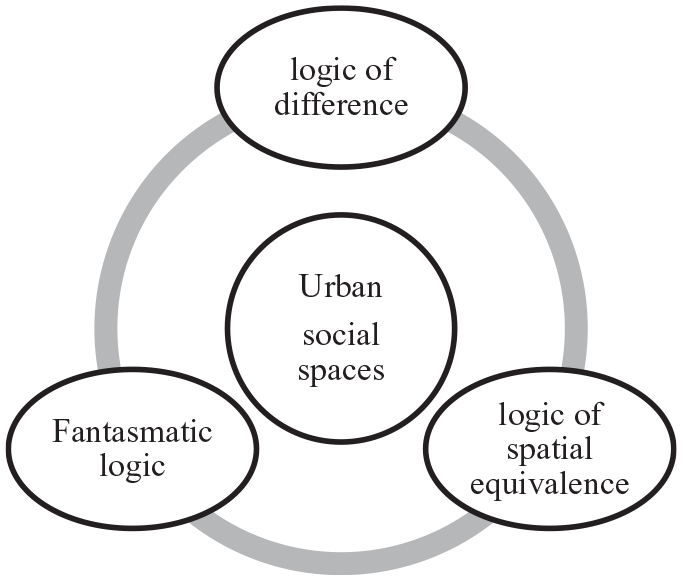
The conceptual framework of urban social spaces.
The first two logics—the logic of difference and the logic of equivalence—are offered by Laclau and Mouffe (2014) for articulating a discursive social reality. Laclau and Mouffe applied their conceptual framework in the political field without considering its spatial aspects. In contrast, we explain these logics by situating them in the spatial context. Furthermore, we find these two logics insufficient in explaining the fluctuating relations of social spaces and the continuous process of their formation. Therefore, another logic is incorporated—fantasmatic logic—based on Glynos and Howarth’s (2007) work. Fantasmatic logic helps explain the social, political, and psychological motivations that play a role in forming urban social spaces and their interrelations. Thus, the logics that compose the conceptual framework are as follows:
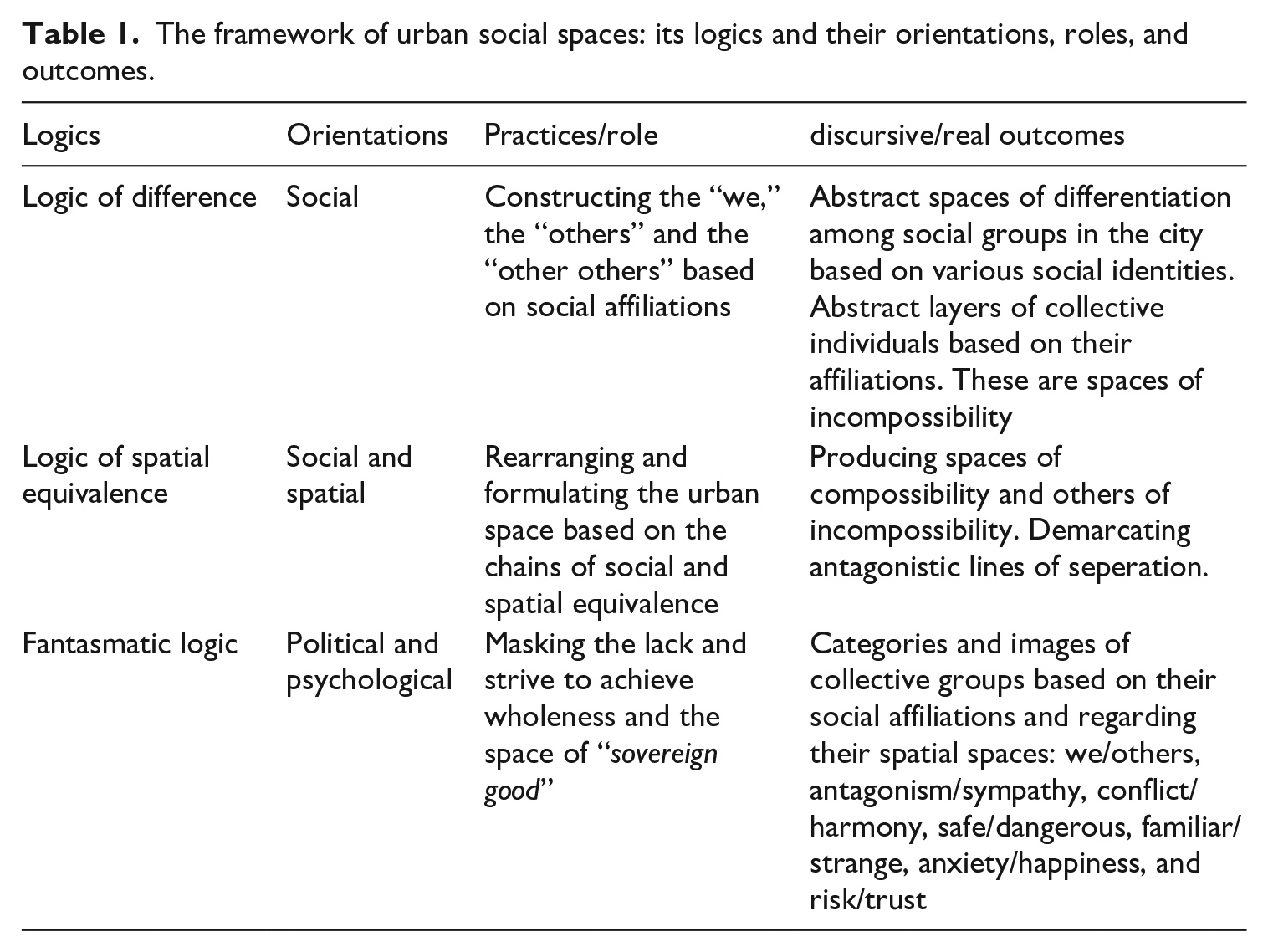
The logic of difference
The logic of difference captures differentiations and divisions among people based on various social categories. Thus, the logic of difference is socially oriented. It captures the city as a composite of different social groups based on different class, ethnic, religion, race, origin (local/immigrants), sect, color, education, culture, and other social differentiations. Using this logic, we can begin to grasp the divisions and limits of urban social spaces. This logic provides rules according to which people differentiate themselves from other people, which then determine where people decide or at least wish to live and not to live. In the political sphere, Laclau (1990: 33) advocates “the primacy of the political over the social.” However, in the context of sociospatial relations, we argue that “social” differences rule the political arena, excluding or devaluing persons and groups based on their group’s attributes. The logic of difference “assumes an essentialist meaning of difference; it defines groups as having different natures” (Young, 1990: 157) and determines spatiality and urban territoriality accordingly. Even in cases of a more egalitarian politics of difference, one “which defines difference more fluidly and relationally as the product of social processes” (Young, 1990: 157), the logic of difference is realized in almost the same spatial formation. In some cases, these formations are even more intensely segregated and socially politicized.
It is possible to discern the dominancy of the logic of difference, albeit in a somewhat narrow perspective, when considering the Chicago School’s writings. Burgess and Dogue (1964) argue that the process of differentiation conditions almost every aspect of urban social life, and that spatial segregation and aggregation are physical manifestations of the social and economic processes in the city. Thus, the differentiation of residential areas is “a spatial manifestation of social stratification,” and “social distances tend to be expressed in physical distances” (Hawley, 1971: 187). Moreover, Rex and Moore (1967) suggested that the city becomes differentiated into distinct subcommunities that are spatially segregated into various zones or sectors and are associated with specific types of residents who collectively exhibit specific types of culture. The structure of the housing market in the city “represents, analytically, a point at which the social organization and the spatial structure of the city intersect” (Haddon, 1970: 118).
The logic of difference distinguishes and constructs groups based on different social categories (e.g. class, ethnicity, and color), but these categories cut across the groups, and differentiations also exist within the same collective (e.g. rich whites and low-income whites). These multilayered groupings are abstract social spaces that interact, intersect, and are manifested across the city’s social spaces. In this way, the logic of difference constructs the categories of “we,” “others,” and “other others” and accordingly uncovers the antagonism and tensions that characterize the process of sociospatial configurations.
However, differences between groups are insufficient in explaining the complex relations between social spaces alone. As we will see in the next section, two additional interrelated logics—the logic of equivalence and fantasmatic logic—are needed to comprehensively explicate the formation of urban social spaces and their relations. By bringing these logics together, we can possibly provide a more nuanced understanding of what they are and how they are related to each other.
The logic of spatial equivalence
The logic of equivalence generates a relational equivalence in which differences of identity are accepted. It dissolves “positive differences” and creates spatial real boundaries that include all the desired identities in opposition to the discursively constructed identity of “the Others.” In the urban context, the logic of spatial equivalence dissolves some differential features among specific groups. In its first order, it defines the rules of those who should live together within a social space. In the second order, it defines the rules of connection and association between different spaces. In both orders, it defines the social and, literally, the spatial frontier of antagonism. In this way, the logic of equivalence expresses something new about the relations between spaces. It articulates the spatial lines and borders based on antagonistic relations with others, who are excluded and are not part of the chain of social and spatial equivalence.
Furthermore, outside the borders of equivalence, marked as antagonistic lines, is everything that is excluded. It “is not simply one more, neutral element but an excluded one,” which the chain of equivalence “expels from itself in order to constitute itself” (Laclau, 2005: 70). While the logic of equivalence subverts differences among groups, it also provides a real “existence to negativity” and antagonism toward the excluded others. Moreover, all the excluded differences are equivalent to each other in their common rejection. Thus, “all identity is constructed within this tension between the differential and the equivalential types of logic” (p. 70). It is “we” under the equivalence in opposition to the “other.” The social reality is, therefore, penetrated by negativity or, in other words, by antagonism.
Thus, the logic of equivalence is spatially oriented and involves the configuration of urban spaces through deterritorialization and reterritorialization. Sociospatial relations and the formation and configuration processes are “heterogeneous series of contradictory, dilemmatic, strategically selective, spatiotemporal, discursive-material ensembles” (Jones and Jessop, 2010: 1124). From the equivalent logic perspective, these sociospatial relations lead simultaneously to compossible and incompressible outcomes or actual spaces of “compossibility” and others of “incompossibility.” Spaces of “compossibility” ensemble individuals together, based on equivalence, while leaving the “others” to live in the spaces of “incompossibility” or the impossible. With these two logics, we can conceptually map the urban geography of “compossibility” and “incompossibility,” or of equivalence and difference (Jones and Jessop, 2010: 1124).
The fantasmatic logic
Building on the Lacanian concepts of ontological lack, fantasy, and desire, we propose the fantasmatic logic as playing a central role in the formation of urban social spaces. The logic of difference and the logic of equivalence determine the contours and content of social spaces. With fantasmatic logic, it is possible to explain how and why specific articulations and practices of spatial formation are constructed, maintained, and transformed.
Lacan considers lack as the foundation of human existence (Ruti, 2008). He suggests that at the “mirror stage,” a child in its early months “primordially identifies with the visual gestalt of his own body. In comparison with the still very profound lack of coordination in his own motor functioning, that gestalt is an ideal unity, a salutary imago” (Lacan and Fink, 2006: 113). In this way, “the infant acquires its first sense of unity and identity, a spatial imaginary identity” (Stavrakakis, 1999: 17). It appears that from the very beginning, we are able to conceive of our “own failure” and “irreducible gap.” This imaginary mode “turns out fantasies that proceed from a fragmented image of the body” to a “form of its totality” (Lacan and Fink, 2006: 97). The difference between the whole, total, and ideal image, and the fragmented experience of the infant, constitutes lack (Lacan and Fink, 2006), which must be understood not as “the lack of this or that” but as “the lack of being, properly speaking” (Lacan, 1997: 223). Furthermore, “lack” is always related to desire; it is lack that causes desire to arise (Lacan, 1997: 223). Desire is related to the existence of lack; it is a metonym for the
The fantasmatic logic, therefore, responds to the ontological lack and the desire of becoming “full” and “complete.” We argue that urban social spaces are constructed through social fantasies about achieving a sense of completeness, harmony, or wholeness. However, since the desired “completeness” can never be achieved, we also suggest understanding urban social spaces as constitutively incomplete and lacking, as never being “complete” and “harmonious” in terms of their identities (Jabareen and Eizenberg, 2019; Jabareen, 2018). In other words, urban social spaces are unfixed, unfinished entities, always in a process of becoming, and their identities are always lacking because every identity is lacking. Stavrakakis (1999) suggests that lack continuously re-emerges in the effort of consolidating identity. All attempts to overcome the lack and achieve a complete identity are doomed to fail. This failure repeatedly reinstates the “irreducible character of this lack which in turn reinforces our attempts to fill it” (p. 35). These ongoing efforts to fill the voids are in fact a “circular play between lack and identification which is marking the human condition; a play that makes possible the emergence of a whole politics of the subject” (Stavrakakis, 1999: 35). Thus, desires, which are repeatedly articulated as visions, goals, objectives, and practices, aim consciously and unconsciously to overcome the incompleteness and disharmony that are intrinsic to the identity of the subject.
This idea of circular play between lack and identification is profound to the emergence of the three logics that, as we argue, dominate the formation of social spaces and their interrelations. The logics of difference and equivalence underpin the differences of residents, differentiating between them and at the same time transcending and subverting various characteristics in order to constitute a “collective” and “complete” identity within a specific social space. Vis-à-vis the “harmony” within stands the “others,” who, as Žižek (1989) suggests, are perceived as those who wish to steal “our collective happiness,” “our neighborhood” or “our community.” They are a threat to the social character of the space and its appearance. The presence of different “others” disrupts the social identities of groups and provokes them. The paradox is that our social space as a “Thing” is understood as something inaccessible to the others and at the same time is threatened by them. Furthermore, fantasy plays a powerful role in the formation and maintenance of the social spaces of both the dominant groups and disadvantaged groups. Fantasy is related to the “harmony” and “wholeness” of a specific group of a social space. Fantasmatic logic provides the subject with “a promised future” which depends on the perceived unison of “us.”
These logics are also the basis for the exclusion of various groups—the “others.” This means not only perceiving them as alienated from the total fantasy but also as “others” who should be addressed through marginalization, oppression, and dispossession. However, the fantasmatic mode is also at the service of the marginalized and excluded people and groups, helping them at least imagine a “better life” and “better places” for themselves in the future, and transcend the miserable conditions of their current social spaces.
From our perspective, fantasmatic logic plays a role in socially and spatially structuring individuals’ social practices and social (ethnicity, class, color) groups. It allows for exploring the hidden or explicit ways people perceive the “other,” through the mediation of fear, loathing, apprehension, crisis, superiority, and antagonism. It also allows an understanding of how people see the collective “we” when sharing perceptions of fear and anxieties towards the “others.” Consequently, fantasmatic logic is spatially related to what we commonly refer to in our cities as neighborhoods, enclaves, gated and segregated communities, and large urban developments. Furthermore, it unsettles common notions such as “sense of community,” “attachment to place,” “good neighborhood,” “safe communities,” and “defensible spaces” (Jabareen and Zilberman, 2017; Jabareen, 2013), by recapturing them as fantasies based on an ontological lack.
In a fragmented, crisis-ridden urban society where “urban ontological security” is often disrupted (Jabareen et al., 2017; Jabareen et al., 2019), people in each urban space collectively develop a fantasy of the “People-as-One” (Lefort, 1988). Lefort (1988: 19–20) suggests that “when individuals are increasingly insecure” and when “society appears to be fragmented, then we see the development of the fantasy of the People-as-One, the beginnings of a quest for a substantial identity.” Fantasy formations allow the self to mask and ignore its lack (Silverman, 2000). “On the one hand, such fantasies appease our anxiety about the contingent foundations of existence. On the other—and precisely to the extent that they replace the anxiety of uncertainty with a misleading sense of certainty—they curtail what we find existentially possible” (Ruti, 2008: 486). Consequently, from a Lacanian viewpoint, some “sovereign good” is capable of shielding us from the terror of living. Thus, the urban social space appears metaphorically as a “sovereign good” in cases where the space has real and sensual qualities that provide a sense of security and protection from the excluded “others.”
Fantasmatic logic captures the political drives of the logic of difference and the logic of equivalence. It is manifested through the construction of different dichotomies, mainly antagonism/sympathy, conflict/harmony, safe/dangerous, familiar/strange, anxiety/happiness, and risk/trust. The fantasmatic logic reinforces and sustains the differences between groups and therefore also the spatial configurations that were generated by these differences.
In sum, the formation and interrelation of social spaces in a city are articulated through the three interrelated logics. Each logic captures some aspects of the social reality and describes part of the phenomenon. Each of the three logics has a specific role in this conceptual framework and captures specific aspects of urban spaces, and each has its specific orientation, role, and material/immaterial outcomes, as Table 1 shows.
The framework of urban social spaces: its logics and their orientations, roles, and outcomes.
The interrelations of urban social spaces
As a venture point for this paper, we argue that urban social spaces should be examined as discursive and real objects. In addition, rather than bounded, detached, separated, and closed territories linked by physical infrastructure, social urban spaces are relational. They are articulated in relation to each other, making the city a composite of different relational social spaces. Each social space has identity and specific relations with the others. As Massey (2005) and Mouffe (2008) suggest, identities are constituted through their interrelations; “space does not exist prior to identities/entities and their relations,” and these “identities/entities, the relations ‘between’ them, and the spatiality which is part of them, are all constitutive” (Massey, 2005: 10).
We understand urban social spaces as part of the “war of positions” in a discursive field where the positions are based on a space’s real and sensual qualities. The “war of positions” and the spectrum of relations among these spaces, ranging from antagonist to equivalent, are illuminated by the three logics: difference, equivalence, and fantasmatic.
(a) Antagonist relations—The “play of differences” constitutes and organizes the relations of social spaces in the city. Each imagined identity represents the internal authenticity and homogeneity of a social space and its unique difference from other social spaces which lie outside, beyond their borders. Antagonistic relations between one social space and another, based on social, spatial, ethnic, or racial differences, are clearly marked and relatively easily articulated. Mostly so are the antagonistic relations between the privileged and underprivileged social spaces. The antagonistic relations between these “hegemonic” and “counter-hegemonic” spaces are based on a conflict of interests. On the one hand, there are practices of exclusion, out of fear of the “others,” aiming at preserving the homogeneity of “our” spaces and protecting them from those who want to steal our collective happiness. On the other hand, in the disadvantaged spaces, there are practices aiming at improving the conditions and qualities of space through a continuous struggle to reconfigure urban spaces and enhance the plurality and heterogeneity of the hegemonic spaces. In this way, spaces are always in formation, always in a process of being made, never finished and “never closed” (Massey, 2005: 9). Because they are products of relations and at the same time their identity is always lacking, urban spaces are unfinished and in an “open ongoing production” (Massey, 2005: 55).
(b) Equivalence relations—With the logic of equivalence, some differences between specific social spaces are dismissed, thus enabling the construction of a chain of equivalences among these spaces while excluding other spaces that do not fit. The equivalent social spaces are not similar, but their differences are accepted. The equivalent relations imply the interconnectedness and dynamic nature of social spaces, and their transcendental character in the sense that the relations between them transcend their territorial boundaries. These are relations of “consensus” and acceptance of differences, and of shared rejection of other (unaccepted) differences.
The interrelations of urban social spaces are imbedded in social, political, and spatial practices that respond to the difference and equivalence, and fantasmatic logics. The three logics generate spatial practices that constitute social spaces. The manifestations of these practices are the different tensions that characterize urban space: segregation/integration, inclusion/exclusion, homogeneity/heterogeneity, enclaves/social mixing, gated/open, formal/informal, fashionable/nonfashionable, and developed/underdeveloped or disinvested. Class, ethnic, and racial differentiations, together with the aggregated practices of residents, visitors, capital (local and global), nongovernmental organizations, the municipal planning apparatus, and other municipal units, form the identity of the social space, an identity that, as showed above, is always threatened and lacking.
The fantasmatic logic operates in conjunction with the constitutively lacking and incomplete identity of the social space. The hegemonic groups perceive the presence of “others” as harming the fantasy of “wholeness” and “completeness” (i.e. the fantasy of “our nation,” “our class,” “our territory,” and “our neighborhood”). The fantasmatic logic guides the discourse and practices of what the hegemonic groups “would like to be” in terms of territoriality. Hegemonic groups are often able to fortify their spaces through the use of common professional planning, economic practices, and manipulative planning measures aimed at excluding and marginalizing other people.
Conclusion
This paper seeks to contribute to the understanding of urban social spaces and their dynamic interrelations. Theorists such as Amin, Healey, Harvey, Lefebvre, and Massey, among others, stress that spaces are relational, processual, dynamic, nested in a web of social relations, products of interrelations and constituted through interactions. This paper problematizes the formation of urban social spaces and the dynamic interrelations among them. This investigation of the nature of the relations between urban social spaces yielded a framework with which these relations can be grasped.
In an effort to understand these multifaceted, complex relations, an inquiry committed to a flat ontology was deployed. Accordingly, we draw our theorization on the Lacanian ontological lack, Harman’s object-oriented ontology, and Laclau and Mouffe’s discursivity of social reality. Thus, we propose that urban social spaces are discursive and real entities with real and sensual qualities and constituted through specific relations. They are relational and are located within discursive social relations, where each urban social space has a “differential position” in an urban system of relations. Each urban social space has an “identity,” defined by its specific mixture of social groups and its specific real (empirical) and sensual qualities. These qualities construct a sensual object with a specific sensual identity within the web of different urban social spaces. Therefore, urban social spaces are being made through multiple “interrelations” and are constituted through their location in a nexus of positions.
The proposed framework that captures the interrelations among urban social spaces is based on three interrelated logics: the logic of difference, the logic of equivalence, and the fantasmatic logic. Understanding the relations of urban social spaces through these logics offers multifaceted social, political, psychological, and spatial illuminations, details, and a more nuanced and flexible understanding of the formation and change of these spaces. Hereby, the city is conceived as comprising spatiotemporal configurations where social spaces have social and political relations ranging from harshly antagonistic to inclusive and equivalent. Furthermore, the relations of urban social spaces reflect the practices of the construction of differences through the logic of difference on the one hand, and of the practices of subverting differences through the logic of equivalence on the other hand. The fantasmatic logic nurtures the articulation of who and what “We” are and who and what “We” are not, and by doing so, also constructs the identity of the “others.” The fantasized completeness and harmony of the “We” is always disrupted by “gaps” or “voids”; these are physical and social threats to the “We” as a social, racial, or ethnic group. Based on these three logics and the practices they engender, it is suggested that urban social spaces are relative to each other and that they are historical and not fixed in time. The circular play between lack and identification defines their formation and galvanizes their constant evolvement. In this ongoing formation, both lack (in the form of gaps from the fantasy) and identity are defined in relation to the other social spaces.
Putting it differently, the city is understood as an assemblage of interrelated social spaces, formulated in a pendulum-like motion that swings between its real qualities and its sensual qualities (i.e. the way people perceive it). These differentiated qualities are the roots of both identification with and contestation over urban social spaces. More abstractly, each space is part of the “war of position” as a sensual object with real and sensual qualities. Thus, this war is about real empirical qualities of spaces and sensual qualities, a “war” over resources and images. The hegemonic groups—the elite, high-income individuals, relatively powerful ethnic groups, and so forth—are in better positions to attain and protect resources, the image of the space, and access to other spaces. Their urban social spaces, which are not necessarily physically adjacent to each other, are part of a chain of equivalence of spaces. Together, they establish the antagonistic line behind which are the “others” and all the other lesser spaces. The “others” have limited access (or no access at all) to the hegemonic social spaces. Their spaces have fewer resources and a poorer image. In many cases, their spaces are informal, such as the spaces of millions in the Global South who reside in favelas, slums, and similar conditions. However, the war of position is ongoing. Inasmuch as the hegemonic groups protect their position in the city, so do the groups of social spaces of lesser positions, as they struggle to gain better access to other spaces and improve their own spaces in terms of resources and image (Eizenberg, 2019). Therefore, it is proposed here to look at urban spaces as ranging from hegemonic spaces to subaltern spaces; antagonistic and competing spaces that define each other and define the sociospatial fabric of the city. The concepts of power and hegemony play significant roles in the social and spatial relations among urban social spaces and their formation. These power relations contribute to the production of urban hegemonic social spaces and the spaces of the disadvantaged groups.
Problematizing these spaces made possible mainly by focusing on their dynamic interrelations and how the articulation of their similarities and differences, guided by a fantasy of the “we,” determines not only the configuration of the city but also its operation and experience. Therefore, using the three proposed logics, it is possible to begin site-specific inquiries into how differences, similarities, dominant fantasies and counter dominant fantasies are articulated and, in turn, produce the boundaries, relations, and transformations of the social spaces in a certain city at a certain point in time.
This framework for understanding the interrelations among urban spaces informs both sociological and political realms of planning theory. Framing together the sociological, psychological, and political nature of and relations among urban social spaces provides planning theory with new perspectives for understanding the city as a web of interrelated social spaces. While there is a vast knowledge of urban spaces’ socio-demographic characteristics, the logics of difference, equivalence, and fantasy, as an analytical approach, provokes new insights regarding the sociological and psychological aspects that interlink or distance these spaces.
Indeed, the state and city are powerful spatial and planning agents. As political institutions, they have territorialized political power (Jones and Jessop, 2010) and use it to affect the formation of social spaces and their interrelations. They also play a role in creating antagonistic sociospatial relations among urban spaces. Nevertheless, unpacking these relations and specifically demarcating antagonism lines may help promote more inclusive urbanism of co-existence.
The dynamic nature of social spaces and their interrelations, specifically their real and sensual quality, provides urban planners with an alternative and perhaps sharper lens to understand and then envision the city as more than just a neighborhood or a census tract. Furthermore, although urban planning and policy have devoted attention to the image and identity of places, this is rarely done through a deep unpacking of the sensual qualities of space and their comparison with real qualities. Such examination may better direct planning actions towards the improvement of places. This approach for understanding the relations among urban social spaces allows a more critical understanding of urban reality by illuminating inequality, injustice, antagonism, and the formulation of “otherness.” Future research in planning theory and practice may ask what is the responsibility of the state and the city in constructing conflict among urban social spaces, and how could planning be utilized to mitigate conflict and antagonism between urban social spaces, foster better and more supporting relations among different urban social groups, and promote more just urbanism?
Footnotes
Funding
The author(s) disclosed receipt of the following financial support for the research, authorship and/or publication of this article: This research was funded by ISF-Israel Science Foundation, Grant No. 2204/19.
