




Abstract
This article proposes an idea of radical urban contextualisation that follows Rudolf Otto’s discussion on an encounter with the Absolute Other. The article critically reviews current applications of postsecularism to urban theory formulated in a general framework of Jurgen Habermas’ intervention in the early 21st century. The article argues that contemporary postsecular urban theory cannot fully answer fundamental challenges that contemporary cities are facing – both political and environmental – mostly because it focuses on linguistic and cultural aspects of a city. The article proposes the ‘radicalization’ of postsecularism, engaging directly with the ‘religious experience’ defined by Rudolf Otto as an encounter with The Absolute Other – the unknown and unpredictable. The Absolute Other notion allows to ultimately contextualize every urban situation in order to formulate conditions for future-oriented (post-capitalist) urbanism.
Introduction. Why do we need postsecularism in urban theory?
This paper will begin by examining post-secular thought as it might be applied to contemporary urban situations, in particular Otto’s concept of the Absolute Other (Otto, 1958). It will then examine several contemporary paradoxical examples of cities in religious contexts that largely reflect Western modernist planning principles, before proposing an alternative post-secular mode of operation for urban planning based on a speculative ‘shield of possibilities’. The main argument of the article is that while discussing religion in the context of urban theory, religion should not be reduced to its social and cultural manifestations but understood more broadly, as an ontological position defining limitations of the human ability to fully understand and engage with the world.
Postsecularism
1
in urban theory is predominantly defined in a quite literal form as the return of religion (mainly in practices and activities) into the urban space (AlSayyad and Massoumi, 2011; Beaumont and Baker, 2011; Beaumont and Cloke, 2012; Becker et al., 2014). This perspective is indebted to the interventions of Jurgen Habermas (2006, 2008) in the early 21st century and aims to establish a dialogue between secular (post-Enlightenment) and religious reasoning (and language), as Habermas (2006: 9) argues, The liberal state must not transform the requisite institutional separation of religion and politics into an undue mental and psychological burden for those of its citizens who follow a faith. It must of course expect of them that they recognize the principle that political authority is exercised with neutrality towards competing worldviews. Every citizen must know and accept that only secular reasons count beyond the institutional threshold that divides the informal public sphere from parliaments, courts, ministries and administrations. But all that is required here is the epistemic ability to consider one’s own faith reflexively from the outside and to relate it to secular views. Religious citizens can well recognize this ‘institutional translation proviso’ without having to split their identity into a public and a private part the moment they participate in public discourses. They should therefore be allowed to express and justify their convictions in a religious language if they cannot find secular ‘translations’ for them.
In the context of contemporary urban theory and practice, Habermas’ proposal finds its place, allowing excluded and ignored voices and practices of religious communities to be heard and recognized. However, these bottom-up, localized planning and governing practices are not able to produce a response to the loss of subjectivity and limitations of agency in the modern city; they are not able to give an effective response to the need for cooperation across social and religious boundaries required to address climate change and looming environmental disaster. On the contrary, they could lead to an increase in xenophobic narratives based on an exclusionary interpretation of the notion of a community. Katie McClymont (2015: 542) suggests a correction of this approach and proposes a concept of ‘municipal spirituality’: ‘A place of municipal spirituality gives access to the transcendent, a potentially counter- hegemonic way of being, an alternative set of values underpinned by shared humanity not economic growth’. This proposal seems anti-modernist, deeply influenced by a radical orthodoxy thinking (Milbank et al., 1999) while refusing to see the world divided between reason and faith, suggesting a possibility of inclusive city created by residents who ‘confront’ the transcendence which is ‘beyond and above’ all of them. This unification is granted by hierarchical relationship between ‘transcendence’ and ‘the community’. Contrary to the usually horizontal perspective of democratic projects, postsecular narratives (and ‘spiritual municipality’ is an illustration of how this mechanism works) employ hierarchy as a mechanism of inclusion. The radicalized postsecularism proposed in this article is based on a similar intuition, but in contrast to spiritual municipality, which ‘. . . describes (an aspect of) a place which allows access to the transcendental, and promotes the common good’, (McClymont, 2015: 542) radical postsecularism is rooted in Rudolf Otto’s claim that access to the transcendent is almost impossible. The void between the Absolute Other and the human creates ‘religious experience’ as a foundation of any religion. In his seminal work The Idea of the Holy: An Inquiry into the Non-rational Factor in the Idea of the Divine and its Relation to the Rational (1917) Rudolf Otto defines an essence of religious experience as a relationship with the numinous – the Absolute Other. This experience is possible only for sentient, self-conscious beings; it is an essence of ‘anthropological difference’.
2
From Otto’s perspective, religion is a human mechanism of stabilizing the effects of facing the terrifying unknown into (safe) defined structures: rituals (practice), narratives (theology) and regulations (law). Otto’s argument is that religious experience – the irrational element of any religion – is a foundation of any religion, but is irreducible into the religion itself, irreducible into religion understood as a social and cultural phenomenon. The engagement with the unknown is, of course, also the basis of science, but while science aims to translate the unknown into the known, religion accepts the inability to close the void between a human being and the Absolute Other. The existential and ontological reflection on a void between the known and the unknown is therefore a foundation of any religion and is a point of departure for an argument for radicalized postsecularism. Otto’s work could lead to a postsecularism very different to the one proposed by Jurgen Habermas, and closer to the work of Slavoj Zizek (2000; Zizek and Milbank, 2009), Alain Badiou (2003) and Giorgio Agamben (2010, 2011), who question liberal and (post)Enlightenment theoretical frameworks. Their perspectives focus on theology and religious reflection, moving beyond language and engaging with ontological questions that Ratajczak and Zawisza (2015: 13) summarizes as follows: Agamben’s philosophical meditations on speaking operate on the very edge of language, where we find the unspeakable. That approach connects him to theology. In a manner also elaborated by, among others, Sloterdijk and Virno we can say that, for Agamben, Christian theologians, through theopoetic reflection on the incarnated Word, struggled with the rudiments of human existence and how it is conditioned by language.
This perspective, by actively engaging and endorsing limitations of language, creates a link with reflections on non-linguistic gestures – design-related activities, such as architecture, urban planning or urban design, fit very well into this category.
Contemporary postsecular thought is even richer – one can find more conceptual investigations focused on ‘queerying’ the religion (Bauman, 2018; Gorman-Murray and Nash, 2014), connecting practices with religious imaginary and ethical systems or more policy-oriented, for example, investigating religious values in a context of sustainable practices (Narayanan, 2015).
This article proposes a notion of a radicalized postsecularism built on the Otto’s idea of ‘numinous’, which he describes as a confrontation with the Absolute Other – ‘mysterium tremendum et fascinans’ (mystery of terror and awe). In this context, religion is not only a set of rules and institutions organizing the society but first of all is a mechanism designed to stabilize the unstable existence of the world. The reason why this idea may be useful while discussing urban planning and urban design (also architecture) is the power of ‘forced contextualisation’. The Absolute Other is always beyond any particular situation the planner or architect is dealing with and is always able to influence the situation in unpredicted way. The Absolute Other exists always as an indirect context of any building, any place, any spatial and temporal situation. It is important to note that context may have multiple meanings. In architecture, context includes the tension between global socio-economic forces and local spatial and cultural conditions influencing any design gesture. The Absolute Other influences all possible contexts through the possibility of an event of unknown (coming from ‘out there’) origin, such as a natural disaster, human-made accident but also long-term unpredictable consequences of human actions. The Absolute Other ‘contextualizes the context’, forcing designers, planners and users to always ‘look beyond’ and expect more than here and now.
This article proposes a radicalized postsecularism as a mechanism stabilizing the ‘ontological kernel’ of human existence by creating a ‘shield of possibilities’ as a set of gestures able in the same moment to stabilize human ontological security and to engage with the unknown. Radicalized postsecularism is an intellectual position introducing the notion of religious experience based on the confrontation of a human being with The Absolute Other, as the fundamental point of reference in thinking about the city. The ‘shield of possibilities’ (Figure 1) is a direct consequence of the radicalized postsecularist position. The Absolute Other influences the urban realm in two ways. It ‘contextualises the context’ introducing never-ending contextualisation process of going beyond ‘here and now’, and it introduces a dominant transcendent force which negates and flattens of all other hierarchies. This is how the Absolute Other influences reality and makes every urban situation ultimately open to interpretation and infinite speculation. This speculation in an open context under the pressure of the dominant transcendent factor stimulates togetherness, and in turn this particular kind of togetherness allows emancipation.
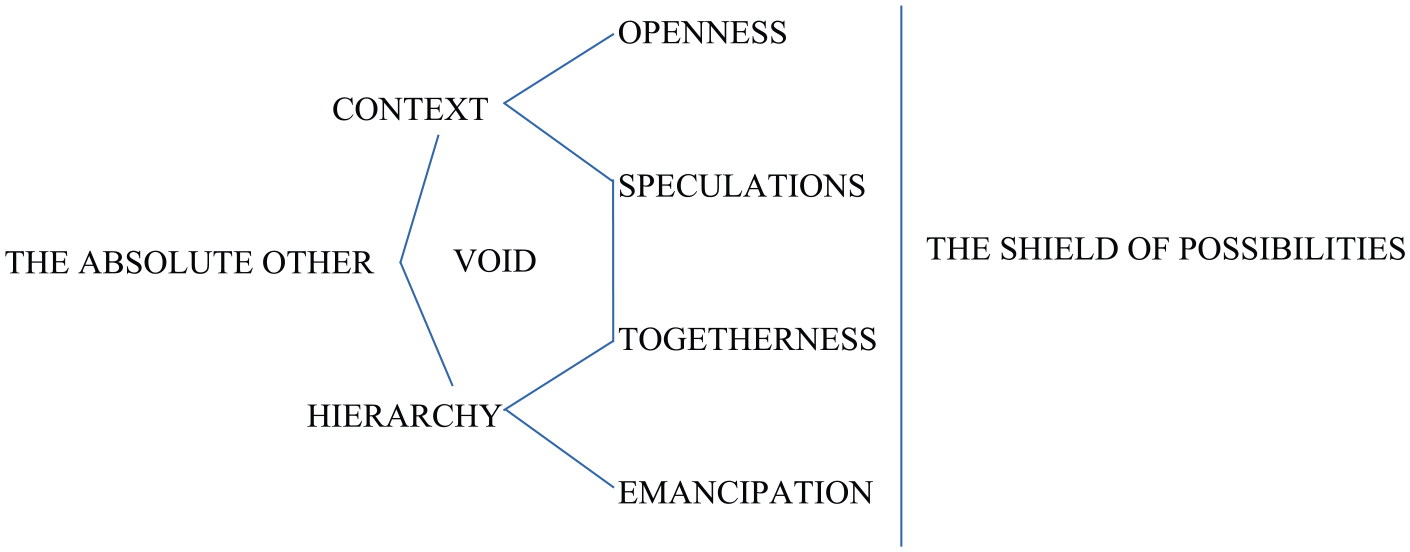
The shield of possibilities.
This ‘shield of possibilities’ refers also to Jean Hillier idea of ‘planning beyond the horizon’ (Gunder and Hillier, 2004; Hillier, 2008, 2017) and is conceptually related to the Speculative Design notion; there are ongoing debate what this term means (sometimes it is equal with Design Fiction) but as a broad umbrella of ideas Speculative Design could be defined as ‘. . .a practice of creating imaginative projections of alternate presents and possible futures using design representations and objects’. (DiSalvo, 2012: 109) What is essential for speculative design approach is a usage of an object as a ‘gateway’ to imagined universe. Material artefact is designed to help users not only imagine but also ‘touch’ and ‘feel’ how the other, alternative (future) world may look like. Speculative design is not about creating narratives, but rather is a world building activity. The narratives are then produced by users as individual scenarios. The process of producing these scenarios allows to test and build the (imagined) world further.
In the context of the multiplicity of strands of postsecular thought, the notion of ‘radicalised postsecularism’ aims to engage more directly with the existential and ontological consequences of a human being confronted with a secular, disenchanted universe. From this perspective, Habermas’ position may be the main (negative) point of reference for ‘radicalised postsecularism’. Habermas’ postsecularism is part of the post-Enlightenment, liberal conceptual framework, being an offspring of his work on post-modernism in the late 20th century. In liberal, multicultural and multi-religious Western cities such openness to diverse religious activities fits well in the post-modernist appreciation of the cultural (and economic) importance of minority groups. In Western post-industrial cities looking for their new economic engines in culture (Florida, 1995, 2005; Zukin, 1991, 1995), minority narratives and communities are seen as important elements increasing (by diversification) the value of the urban experience.
3
But what about cities where religion is not an element of cultural diversification, but an essential factor influencing (or even organizing) social life, culture and politics? Surprisingly, cities where religion plays a significant role in culture and politics are uncritically accepting a neoliberal model of development. Dubai, apart from executing some culturally conservative regulations (such as the segregation of male and female users on public transport), is seen as a perfect example of the modern capitalist, consumer-oriented city rather than a model of an ‘Islamic city’ (Kanna, 2011). Tehran
4
is also an interesting example – the contemporary masterplan used by the Islamic government can be viewed as a mutation of the scheme created back in 1968,
5
before the Islamic Revolution: Post-revolutionary governments claimed to revive many traditional forms and practices, as a reaction to radical modernization of the past. In relation to the built environment, however, they have shown strong modernist tendencies, with redevelopment remaining their favourite device, similar to previous generations. (Madanipour, 2006: 437)
Similarly, it is difficult to define essential Islamic thinking in the development of Kuala Lumpur, the capital of Malaysia. 6 Kuala Lumpur is shaped by its post-colonial past, by a political and economic tension between the Malay majority and ethnic minorities, by rapid modernization and global markets. Islam is present in the rhythm of urban life, in the way different ethnic and religious groups are using public spaces, and by the erection of religious buildings or by the location of spaces designated for praying in public and commercial building. However, there is nothing specifically religious in the way the city develops (King, 2009; Kozlowski et al., 2020). In Poland, where the Catholic Church has a very strong position (compared to other European countries) influencing state policies (mostly related to reproductive regulations and culture), the only effect that could be observed in an urban environment is an increasing number of statues of saints (including Saint Pope John Paul II). The Polish example is interesting because the Catholic church (thanks to the support of all governments after 1989) is the biggest landowner, actively involved in land and real estate speculation – the Polish Catholic Church in a literal sense capitalizes on its symbolic and political position to become a major player in a re-established capitalist (post-socialist) Polish economy.
Should we then say that religion is irrelevant to contemporary urban development? Certainly not. Religion is important as part of a cultural and social ecosystem in the form of religious charities and organizations. There are also new (and less often–existing) religious buildings (temples and religious centres) causing social and political conflicts, especially in a context of the growing climate of Islamophobia (Garbin and Strhan, 2017). Religious buildings and spaces are important elements of urban life and urban imaginary, but their role and their very existence is defined by the hegemonic logic of a secular worldview.
‘Liberal’ postsecularism, shaped strongly by Jurgen Habermas’ position, perceives religion as a particular kind of subculture: having its own set of values, languages and behaviours, but nevertheless – from this perspective, which is fundamentally secular – religion is mostly a cultural phenomenon. Obviously, this ‘cultural phenomenon’ has spatial and material consequences (in a similar way cultural-led regeneration projects are built structures not just a linguistic speculations), but does not question the ontological foundation of the contemporary capitalist city. In this context, ‘liberal’ postsecularism is incapable of reaching beyond the hegemonic narrative of the ‘soft’ neoliberal city, where the public sphere is privatized, allowing religions (seen as a part of private sphere) to engage in cultural and socio-economical activities (charities and businesses). From this perspective, religion is expected to stabilize the social ecosystem that has been destabilized by the neoliberal regime. Obviously the stabilizing function of religion may be questioned; there are many examples of religions causing violence and social disruption. However, these examples do not negate the stabilizing function of the religion – these eruptions of violence only strengthen the argument, because the violence appears as a tension between an already destabilized world (from the perspective of believers) and a religion anchored in transcendental order. Obviously, the stabilizing function of the religion is only seen from the perspective of religious actors aiming to establish an order based on particular religious values. From a secular point of view (or for members of minority religions), this stabilizing function of the religion means establishing new, authoritarian hegemonic order.
Facing the Absolute Other. Engaging with the void
Apart from the void defined by Otto between a human being and ‘The Absolute Other’, there is another void, which emerged as a product of the same process of becoming human (defining the anthropological difference) – the void between a human being and nature. In both cases, these voids are defining the loss of ontological security, a tragedy of a fragmented world, where enlightenment reason recognized a loss of safety when human beings left nature and started to build civilizations and culture. Humans are confronted with the unknown but are also losing nature as a given, freely available resource. The moment when nature was established as non-self (as described by Fichte) should also be seen as the moment when nature slowly started becoming a project (home), not just a resource (nest). When nature is a project, humans start actively changing and interacting with it – from being hunter-gatherers merely collecting what is needed, humans became members of agricultural society where (unevenly distributed) labour is required. The transfer of nature from being a resource (‘a given infrastructure’ – allowing humans to take from it as much as they like or can) – into nature as a project they need tirelessly to work on to maintain, is particularly significant in an urban context, where something new – a ‘second nature’ (infrastructure, public space and institutions) – starts to appear. In this article, the notion of the second nature is situated in broadly defined Marxist tradition. It also follows Murray Bookchin’s (1990: 164) perspective understanding second nature as a product of human activities intertwined with the ‘first nature’ (the world ‘untouched’ by humans) but ‘. . . using a mode of thought that distinguishes the phases of the evolutionary continuum from which second nature emerges and yet preserves first nature as part of the process’. Marxist tradition, as Alfred Schmidt (2013) investigates, focuses on mechanisms of production and exchange, and discuss how second and first nature are connected in an intertwined process of producing each other. This interest in exchange is actively developed by Kojin Karatani and in the current discourse on Capitalocene rather than Anthropocene.
It is important to mention that the second nature does not equal the commons (Dallenbaugh Kip Bieniok Muller and Schwegmann, 2015; Stavrides, 2016). Second nature is passive, constructed, but is then given to be used. Its maintenance is not directly related to the process of building a community. The commons are always under construction; they create social bonds and interactions and must be constructed by the community and are used by the community. Second nature continues the separation between ‘social’ and ‘natural’, even if second nature is constructed by the society it has a semi-autonomous character and does not need society to be able to construct it again. One can imagine second nature being constructed by one kind of society and then used by another. Because of this characteristic, as something existing (at least partly) beyond societal control and partly transcendent to the society, second nature fits the liberal model of social interactions. It allows humans to interact with it as independent individuals.
Second nature and religion are performing very similar actions – by accepting the existence of the void (known – unknown; human – nature) they are establishing a prosthesis, a mechanism allowing humans to cope and to survive. Second nature and religion are establishing conditions to recreate ontological security.
Radicalized postsecularism not only aims to explain the relationship between the unknown and the known, but also to create a postsecular urbanism as a project actively engaged with the unknown and unrepresented. The distinction between the meaning of these two words, ‘unrepresented’ and ‘unknown’, should be nuanced. Both can be seen as representing particular epistemological and ethical (political) challenges. For the ‘unrepresented’ however, ethical and political considerations seem to be fundamental, while the ‘unknown’ may stay as causing a mainly epistemological challenge.
Contemporary planning theory, has a fundamental problem with an unknown future (Gunder and Hillier, 2009; March, 2010): Planning theorists ask [. . .]: What sort of an activity is town planning? What should town planning be aiming to do? What are the effects of actual town planning practice? (Taylor, 1998: vi)
Modernist planning attempts to understand the present in order to project the future based on existing trends, and post-modern planning has been even more reluctant to engage with the future by rooting an urban development on a nostalgic image of the past. Contemporary planning, flirting with big data and smart city concepts, attempts to control the present in order to 1control the future: ‘[by] utilizing the numbers as they are given big data is stuck with what is rather than what should be’ (Barnes, 2013: 300). Radicalized postsecularism can inform very different planning practices – able to engage with the unknown future, creating ‘a shield of possibilities’, the mechanism for ontologically stabilizing human existence when constantly confronting The Absolute Other–urban prototyping combined with speculative design approach is able to help to imagine the future and to test its consequences. This approach, by acknowledging the void between the known and the unknown, between the present and the future, actively engages with the production of the future as a process of testing and experimenting. The whole process is done not only by scouting the unknown territory of the future but also by constant imagining and evaluating the future territory of the city.
Acting before naming. Un-knowing urban planning
Camilo Boano (2016, 2017) formulates the concept of whatever architecture as an urbanist’s interpretation of Agamben’s thought. Whatever architecture should be understood as an appreciation of radical pluralism existing immediately before ‘giving the name’ happens. This pluralism, existing on the edge of language, could lead us to Origen 7 and his investigation of the plurality of God’s names – this plurality of names equals plurality of ways of redemption. Exactly because there is not one proper name for God, apocatastasis is possible. The moment of the use of language 8 is a time of division, classification, the moment of destruction of the potentiality of existence (and obviously also a moment of knowledge production). More precisely, according to this formulation, whatever architecture (or whatever urbanism) would be an attempt to capture the moment of translating the living city into linguistic concepts and categories. Alain Badiou gives us a very useful concept of the Event: 9 ‘a pure unforeseeable happening that comes from “outside” the situation’ (Wright, 2008: online) when and where the unrepresented Real enters the social scene.
What if the force or factor influencing the city remains unknown? What if it could not be named? What if we can only recognize its influence, but not fully (or even partially) understand its cause?
There is a grey zone between the unknown and represented – this is where the shield of possibilities should be located as a machine producing spatial gestures and analysing their consequences. As presented in Figure 1 and discussed above, the shield of possibilities is not only creating scenarios of futures of the city but also actively creates social relationships between residents and in effect it creates an inclusive society.
We can call this process speculative prototyping (Tironi, 2018), which is described as a shift from a ‘problem solving’ to ‘problem making’ approach, a process open for counter-narratives and frictions. Speculative urban prototyping focuses on acting (or using the action of other actors) before knowing, or making assumptions and engaging with feedback. This method of engagement with urban problems is relatively cheap and produces results relatively quickly. It is also able to engage residents, stabilizing the final development before it is completed. This approach potentially creates a vision (speculative prototype) which could be backed by city residents and users, and hence stabilizes a (previously unknown/unexpected) future, which is of fundamental importance. Urban speculative prototyping is an attempt to engage with the unknown and unpredicted. It goes beyond linguistic games and manipulations – it is about ‘doing before knowing’. This method (and others, broadly located under the umbrella of ‘tactical urbanism’) may be seen as bottom up, engaging with democratic adjustments (or rejections) to top-down urban planning. Bottom-up interventions proposed by left-wing ‘radical democrats’ or right-wing libertarians are located on the plateau of the market oriented, capitalist socio-economical system. The question is, “How could these fragmented, radically local interventions change the city as a whole?” and “How would different logics 10 of bottom-up, community-led projects communicate?”
One (mainstream) answer would be – by the market. From this perspective, the capitalist economy 11 is and will be a mechanism evaluating the values of these local interventions, allowing them to fit into the broader (local and global) socio-spatial order. The market economy is based on commodification, on the reduction of the world into quantifiable and easily exchangeable fragments, when each fragment has a particular financial equivalent. It is an extremely efficient mechanism allowing the incorporation of local actions into a hegemonic narrative, but it contradicts the main idea and value of urban speculative prototyping – an engagement with the unrepresented (‘messy’) world.
The other answer would be – the commons. All these local interventions will (eventually) create a commons-based society 12 (or ‘Common City’), where all these different logics will be able (somehow) to communicate. Could the commons provide a language(s) allowing local practices to act between the unrepresented and represented reality?
According to Kojin Karatani (2014), the power of the commons may be questioned. Karatani defines four modes of exchange: ‘Mode A, which consists of the reciprocity of the gift; mode B, which consists of ruling and protection; mode C, which consists of commodity exchange; and mode D, which transcends the other three’. Each of these modes of exchange supports the development of a certain political and economic regime. Mode B is based on looting and redistribution, therefore it is fundamental for any paternalistic state (including the welfare state). Mode C is essential for (global) capitalism – especially its neoliberal version, attempting absolute commodification.
Mode A is interesting because it could be seen as related to contemporary discussion of the commons. In a convincing way, Karatani shows that reciprocity (of the gift but also of the ‘curse’, such as vengeance) is a deeply inefficient economic model, preventing any accumulation of power and agency. Mode A was the main obstacle preventing the transition from clan societies to the nation state (or Empire). Karatani’s thinking is also inspirational in the context of growing hope that the peer-to-peer, shared economy, based on collectively owned externalities, will provide a foundation for the post-capitalist economy. Putting this discussion into the context of Karatani’s thought allows us to question this hope. If contemporary mainstream post-capitalist discussion focuses on collectively owned or shared externalities, Karatani’s idea suggests discussed previously a concept of ‘second nature’, where an accumulation of agency is not blocked or dispersed by a reciprocity of the gift, but rather channelled in a new way (mode of exchange D). Second nature proposed in this article – understood as material and institutional framework produced by the society to enable human existence in the city (to name just a few elements of second nature one can discuss money, Internet or sewers) in the context of Karatani’s thought can accumulate dispersed agency and allow this agency to be used by city inhabitants. Each of them (if certain conditions are met) can use it individually to achieve their individual goals. This is the moment where two aforementioned voids (between humans and nature, and between humans and the Absolute Other) could be seen as one. This perspective allows us to focus on the ethical and practical aspects of mechanisms of ontological stabilization, presented as the shield of possibilities.
In Karatani’s theory, mode D is a pure gift. It is not a return to mode A, rather it is a return to nomadic society before mode A was established. Karatani makes a link between mode D and religion: ‘. . . socialist movements that aimed to bring about mode of exchange D were generally carried out under the guise of universal religions’. And further The most direct instances of mode of exchange D are found in the communistic groups that existed in the earliest stages of universal [not defined by particular place nor ethnicity] religions such as Christianity and Buddhism. In subsequent periods too, socialist movements have taken a religious form.
Mode of exchange D is seen by Karatani as a return of a better A or even as a return of pre-A. This pre-A stage is a primitive communism, located by Karatani not in a clan society but in a nomadic society. Nomads were groups of individuals, hunter-gatherers, who were liberated from the world that surrounded them (or rather they were immersed in), from which they could take as much as they wanted/needed. The world (nature) for nomads does
The blurred edge between ‘me’ and ‘probably-not-me’ is where the shield of possibilities may be located, especially its two aspects – togetherness and openness. Obviously, humans are not able to become a part of nature (again), the void remains, but they are able to define this ‘blurred edge’, a shield of negotiating mechanisms between ‘me’ and ‘probably-not-me’. In the same way, religion is a rationalization of the moment when The Absolute Other enters the human world.
Transcendence means hope
There is an increasing agreement among anthropologists (Cohen et al., 2013; Dávid-Barrett and Carney, 2016; Norenzayan, 2013) that awareness of the existence of something greater than ourselves permits the process of socialization and, as a consequence, the formation of larger social structures. Without transcendence, without something existing beyond ‘here and now’ there would be no public sphere. Therefore, if secularization means privatization (or rather – individualization and fragmentation) of the religious sphere (Asad, 2003); consequently, it should be understood as a process of destruction of the public sphere by preventing diverse fragments (actors) from connecting and creating a larger social structure. Facing The Absolute Other is a universal experience, uniting all human beings. In that context, radicalized postsecularism is not about returning religion to the public sphere – indeed it has never gone away – but it is an attempt to overcome the fragmentation of the world, both horizontally (by combining autonomous fragments existing ‘here and now’), and vertically (by assuming the existence of a realm beyond the ‘here and now’). Understood as such, radicalized postsecularism focuses on the edges between fragmented consciousnesses, singular entities, autonomous fragments, and on a projection of the world that does not (yet) exist. Radical postsecularism focuses on the ways these fragments mediate between themselves and their future.
The fundamentalist shift characteristic of the recent comeback that religions have made into the public sphere should be seen as an outcome of secularization. The aforementioned lack of religiously inspired urbanism is directly related to the issue of fundamentalist religions being just extreme versions of privatized religions. They are still operating in the private sphere, just extending this sphere drastically, so that they seem to be part of a public sphere. Langman (2005: 235) clearly localizes fundamentalist religions (in this article he focuses on Islamic fundamentalism, but the same logic could be used to define any fundamentalism) as an individualistic resentment: ‘The passionate embrace of fundamentalist identities, and the ferocity of hatred to the Other also require that we look at the depth psychological moments of identity, emotion and desire’. Contemporary fundamentalist religions attempt to stabilize the relationship between individuals and a changing world, looking for anchors in a constructed past. They do nothing to create any kind of new social structure. Radical postsecularism could be seen as a continuation and development of Harvey Cox’s (1965) ideas presented in his seminal book ‘The Secular City’, which views secularization not as an attempt to privatize religion but as a liberation from the bonds of what is here and now. For Cox, religion is an edge, mediating between our fragmented world and the Absolute. In this context, radical postsecularism, when applied to the urban context should be seen as an attempt to stabilize the future(s), to construct prototypes and speculate about the impact they will have. Religious practices (and not only those related to charity or to gift-giving) present in the urban sphere (material, spatial and social) should be considered as bridges to the unknown. One of the fundamental aspects of religion is practice. Religion must be lived-through. Facing the Absolute Other is what socially legitimizes religion.
Postsecular urban theory should seek to act just before the moment of reduction of the living city into its linguistic representation. Postsecularism represents a constant desire to liberate the world from norms and laws, testing pre-linguistic activity, and at the same time defining ‘the known’ as an ontologically stabilized (urban) second nature. Contrary to development based on plans and norms, a radicalized postsecularism attempts to create a ‘shield of possibilities’, a mechanism of continuous simulation, experimentation and testing.
Religions are a component of mechanisms stabilizing human ontological security. These mechanisms are tirelessly working to build a bridge over the void that separates humans from the world. Their work is essential for human survival, yet it will never be finished – the void remains. Cities are among the most significant products of this machine – they provide social and built infrastructure: second nature. Cities create a whole new environment and set of mechanisms allowing humans to live. There is a link between the city and the spaceship; both aim to create a shield protecting humans against the (hostile) environment and mediate between human beings and (first) nature. The stabilization provided by cities is not in itself stable, as contemporary neoliberal capitalism is deconstructing this infrastructure. The looming ecological catastrophe might cause first nature to overcome second nature. Radicalized postsecularism engages fully with the challenge of the existence of the void between humans and the unknowable world. It postulates a twofold – perspectival and active – disturbance of the existing status quo by experimentations and testing, intertwined with the production of second nature, freely accessible to all citizens with infrastructure to fulfil all of their existential needs. This perspective differs from the current narrative of the commons – in fact, referring to Korin Karatani’s notion of modes of exchange rather than modes of production, radicalized postsecular urban theory argues against commons as a dispersed agency. While capitalism leads to overproduction of goods and services, radicalized postsecularism postulates second nature to accumulate the agency. This accumulated agency is needed to face the Absolute Other, the Absolute Unknown. Liberal postsecularism focuses on religion as a socio-political and cultural phenomenon; radicalized postsecularism focuses on the irreducible elements of religion, on the experience of the void between a human being and the Unknown. This experience is universal, and makes radicalized postsecularism potentially a path leading to an inclusive foundation for the post-capitalist city.
Conclusion
Contemporary planning is seen as a proxy of real estate speculation: it has therefore lost democratic legitimization, becoming a part of the mainstream neoliberal agenda. The tradition of advocacy, or participatory planning, attempts to address this lack of legitimacy, but because of its localized, fragmented nature is not able to compete with the hegemonic power of the capitalist narrative. Postsecular urbanism seeks twofold legitimization – by engaging with localized urban prototyping and experimentation (beyond linguistic speculations, questioning existing rules and regulations), it positions itself as a practice open to the unknown. At the same moment, it engages (through the process of speculations in an open context) in the creation of a multitude of narratives (a surplus of narratives and stories escaping the process of commodification), defining the future city as an inclusive space. The oscillation between fragmented experimentation (testing), and the holistic, inclusive multiplicity of narratives of a better, ethical future emerging from these experimentations, may legitimize this postsecular urban praxis. This twofold legitimization is also a twofold stabilization, this stabilization comes from localized and contextualized speculative and prototyping practices, going beyond a linguistic (legal) framework: but also (the second layer of) stabilization comes from ‘the higher order’, from the ethically grounded inclusive narrative.
Following Rudolf Otto’s discussion of religious experience and the irrational component of any religion, this article discusses the power of the Absolute Other as a foundation for radicalized postsecular thought in the context of urban planning. On the one hand, the Absolute Other opens any (spatial, social, economic) situation and creates a mechanism producing a process of ultimate contextualisation (‘contextualisation of the context’). On the other hand, the Absolute Other establishes an ultimate hierarchical relationship which, paradoxically, diminishes any other hierarchies as insignificant, leading to the construction of a community facing the Absolute Other – ‘us against the Absolute Other’. The void between the Absolute Other and the represented world is an ultimate feature of reality, it cannot be overcome, it is not static, but it as a dynamic sphere between the ‘known’ and ‘unknown’. The void is constantly crossed from both directions, however, for designers and planners, the default position is to root the bridge into the unknown deeply into the known. This article argues this is a conservative and ineffective strategy, which is unable to prepare cities for the (unknown) dangerous future. This article suggests a more experimental and speculative mode of practicing planning and urban design, ‘doing-before-naming’, and suggests the adoption of speculative design and prototyping methods as a consequence of the intellectual application of postsecular thinking into planning.
Footnotes
Acknowledgements
The author would like to acknowledge and thank the anonymous reviewers and the editor of Planning Theory journal, whose insightful and extensive comments helped improve the article.
Funding
The author(s) received no financial support for the research, authorship, and/or publication of this article.
