




Abstract
One of the oldest questions of spatial planning is about the profession itself. Because of the direct fields of application on the urban or regional scale, or on sectorial fields like transport or environmental planning, scholars in planning sciences always quarreled with themselves whether their approaches can be seen as discipline itself. Regardless of the different answers and outcomes of this question, it becomes clear that the debate triggers more than just the acceptance as a discipline. One might think that the scientific nature of spatial planning and thus the raison d’être of planning sciences are under general suspicion. This requires a deeper discussion about the definition of sciences and the demarcation problem as discussed in classical (Popper, Kuhn) and more contemporary approaches (Hoyningen-Huene, Park) in the philosophy of science, and what this means for the discussion about spatial planning as a science as well as a discipline. Therefore, various conclusions to regard planning sciences not as one discipline but as multiple disciplines are possible. In this sense, let us dig deep toward the bottom line of the debate.
Introduction: spatial planning and its scientific status
The relationship between the scientific justification of spatial planning (spatial planning as a discipline) and its practical application fields (spatial planning as a profession) can be described as eternal tension of the field of spatial planning itself. In the following, the term planning refers to an understanding of spatial planning, including joint decision-making and action by public institutions on several levels (European, national, regional, local) as well as local-specific development with spatial impacts (physical, but also referring to a relational understanding of space like regulative, historical, or symbolic-cultural dimensions; Graham and Healey, 1999). While the professional field of planning in several areas of application like urban planning, environmental planning, or transport planning is unquestioned, there is still an ongoing debate whether spatial planning constitutes a discipline. In addition, there is an ongoing debate about what spatial planning exactly is and so, unsurprisingly, several definitions co-exist. In this article, we understand planning as guidance of future action, as this seems to be the common ground of the international literature debate (e.g. Alexander, 1986; Forester, 1989; Wildavsky, 1973). However, it is an undoubted fact that there is a close relationship between scientific and professional aspects. As Michel Foucault already assumed in his “Archaeology of Knowledge,” individual discourses should not be viewed in isolation, but in relation to non-discursive areas (e.g. institutions, political events, and practices; Foucault, 1969: 231). In conclusion, the academic aspects of planning and its professional practice are inseparable. This fact gives first insights, why we should care about the question whether spatial planning is seen as a science or not. Constituting a science means following certain rules, methods, and standards making the knowledge production transparent and comprehensible (gate keeping), not focusing on single cases but on generalizable reflections. For the non-discursive areas (professionals in practice as well as society), this implies professional recognition, the entire organization in institutions (like education, role in, for example, city administration and society)—in sum, the possible answers to this question have far-reaching consequences discussed in the end of this article.
The question of constituting a discipline and its conclusions have been addressed by several authors in the last 15 years (Alterman, 2017; Davoudi, 2015; Davoudi and Pendlebury, 2010; Hopkins, 2001; Pinson, 2004) and answering it has been a continuous process of additions and changes in the (not only) disciplinary understanding of planning. According to the different roots of urban planning (e.g. architecture, engineering sciences, social, and economic sciences; Rodwin, 2000: 14), there is no uniform concept of planning between the representatives of knowledge and practice, since it can be interpreted in very different ways (Birch, 2001; Wildavsky, 1973). These manifold origins and transitions make spatial planning appear diffuse as a discipline (Alexander, 2016) and tempt authors to call planning an “undisciplined discipline” (Buanes and Jentoft, 2009: 453; Pinson, 2004), ending up in general justifications of the planning approach itself.
But, somehow, the question whether spatial planning can be regarded as a discipline or not seems to be a revolutionary one—however, not because of the simple answers given or the dissent in the planning community. It is more about the motivation why scholars ask this question, their associated hopes and basic assumptions as well as the way they reflect on their own academic profession, about the everlasting question and justification of planning in academia. So, the more interesting and pivotal question is not if planning is a discipline but why scholars have doubts and difficulties to frame the practices in the profession as a discipline. Apparently, this has major concerns for the justification of the existence of spatial planning in academia. In a scientific point of view, it seems less important to constitute a discipline than a science, advantages of being a discipline lay in a stronger recognition of what planners do (in contrast to other neighboring disciplines like architecture, civil engineering, etc.), own disciplinary organizations and institutions (from faculties to professional roof organizations) representing planning’s demands, own funding pots (with planning experts familiar with the disciplinary logics), and others. In consequence, especially for the organization and the possibilities of planning research and teaching being a discipline is of crucial interest. By analyzing the purposes of constituting a discipline, grasping the underlying assumptions and making the possibilities hoped for explicit, we now start to dig a bit deeper toward the bottom line of the discussion.
First, in the “Starting point: the debate about planning as a discipline” section, an overview of the controversial debate about planning as a discipline is given, in both a historical and an epistemological way. Based on the suspicion that this question tangles the identity-giving core of what planning is and whether it can be called planning science at all, we dive in the “Digging deep in the philosophy of science: the demarcation problem and its implications for planning” section into the philosophical debate about sciences in general, and more specifically the demarcation problem of sciences. Following current reflections on what constitutes a science, we present different ways out of the planning’s justification dilemma. In the last “Reflections: planning and its joint knowledge base?” section, we return to the discussion in the field of spatial planning and draw conclusions for planning sciences, the debate about planning as a discipline and future tasks.
Starting point: the debate about planning as a discipline
Before starting with a brief historical overview on the debate, some key terms need further explications. The term discipline is often used in the planning literature and hardly well defined. It is not equivalent to the term academia or science in general. Disciplines differentiate scholarly units in relation to one another, in differentiation from hard to soft, and pure to applied disciplines (e.g. Abbott, 1988; Foucault, 1977). Disciplines, per definition, serve several critical functions; among others, they allow scholars to define the studied objects and phenomena and to establish the scientific methods, and techniques. The generated knowledge is primarily organized, exercised, and preserved in written form (Messer-Davidow et al., 1993; Serenko and Bontis, 2013). The scientific stake in a discipline is important to distinguish it from other disciplines (e.g. Olympics sporting disciplines) and to sharpen the understanding of the usage of the term discipline in academia. Therefore, it is crucial to point out that the term sciences used in this article does not refer exclusively to the English-language debate where sciences are mostly a synonym for natural sciences (as this narrows the debate enormously). Instead, we understand and define science in the sense of the German term “Wissenschaft,” including the natural sciences, social sciences, and all kinds of different approaches, knowledge production, methodologies, and methods.
The debate in a brief historical overview
One of the oldest questions of planning is about the profession itself. Many practitioners tried to push the profession toward a higher social acknowledgment, many researchers tried to argue about whether or not planning is a discipline; answers have been given in different ways and with different results. Some of the predominant motivations in this debate have been the aim to identify something like a core of what planning is, and the desire of planners to receive greater professional respect especially in academia. However, these discussions are not only relevant for theorists or scientists. Brooks (2002) analyzed and discussed the value of planning theories for practitioners in detail and pointed out the logic systematic of sciences in general which can be useful especially for planning in terms of future predictions, identifying causal relationships, and regular patterns, so to say key aspects of spatial planning (Brooks, 2002: 123).
The early history of spatial planning as a field of interest goes back to the early 20th century, when the Universities of Liverpool and Karlsruhe developed various courses of study in the field of urban planning and design (Stiftel et al., 2009). The focus was rather on an art and design approach in the training of planners (Davoudi and Pendlebury, 2010). To this day, planning is often perceived as one of the design professions (Alexander, 2010). In the following decades, the renowned planner Ladislas Segoe was asked to develop training materials for the field in the United States (Birch, 2001: 409). The result was the 1941 released “Local Planning Administration” (known as the “Green Book”) in which he gave instructions for planners. The planner himself or herself was described as “a technical expert who diagnosed his or her clients’ ills and prescribed their solutions” (Birch, 2001: 409). This view on planning was formative for the profession in the upcoming decades. Scientific methods and systematic procedures were increasingly applied not only in the professional field, but also in academia. Until the 1970s, the planning professionals focused on the development and implementation of their skill sets. Furthermore, the fast developing knowledge in the field led to continuous updates of the “Green Book” (Birch, 2001: 409f.). However, in the 1970s, the academies tended to refuse practical work as a legitimate scholarly activity (Birch, 2001: 413). Nathan Glazer formulated one of many critiques. In his article (1974), he described town planning as a “helping profession” (Glazer, 1974: 349) and accused planning strongly (and the “minor professions” in general): “[. . .] they aspire a status higher than they possess, and that the base of knowledge and competence with which students enter practice is not really serious, specialized knowledge.” As an example for many researchers, Glazer questioned the disciplinary and professional core of planning and the education of planning students. The criticism from Glazer and others expanded rapidly and had a great influence on the education of planning students (Brooks, 1988: 244).
The discussion about the planning discipline itself was at a peak at that time, but in the following decade, it partly subsided until, in the 1990s, there was a new change of direction toward a revival of the debate. Environmental concerns and underlying scientific approaches played a bigger role (Davoudi and Pendlebury, 2010) and at the same time, the focus was on communicative and collaborative planning approaches (Innes and Booher, 2010; Selle, 2013). With the dawn of the new millennium, the debates were newly raised once again and researchers started to focus more on the term “discipline” and the identity of planning as a discipline itself (e.g. Alterman, 2017; Birch, 2001; Buanes and Jentoft, 2009; Pinson, 2004). Since this point, previous authors have increasingly attempted to establish criteria defining a discipline and relate them to spatial planning (e.g. Alterman, 2017; Birch, 2001; Buanes and Jentoft, 2009; Davoudi and Pendlebury, 2010; Glazer, 2000; Pinson, 2004).
In the last 50 years, the debate underwent several changes in the way spatial planning was recognized. Emerged from a professional field, where the academic foundation was elaborated in the aftermath, spatial planning developed into a more technical and problem solving approach in the 1970s and 1980s. Followed by crucial critiques questioning the scientific nature of planning in general, the debate resurged again from the 2000s on. Today, in contrast to the discussion in the last century, scholars focus more on questions regarding what planning as a discipline constitutes, typical characteristics of the planning discipline, the specific knowledge making planning different from other approaches, and the core of what planning is. Therefore, the various phases of the discussion and their respective approaches, argumentations, and further developments are already visible in the brief historical presentation of the discourse. Davoudi (2010) recognizes from this process that planning as a discipline is constantly reinventing itself and thus creates public acceptance at the expense of a clearly defined intellectual basis, what might be seen as disadvantage for a scientific justification as a discipline.
The debate and what it reveals
Despite the ongoing discussion about planning as a discipline, reasons why this designation as a discipline is indispensable are not discussed in depth. Often authors point out that planning needs to be a discipline to underline the academic nature of the profession, where planning is being taught and where scholars highlight theoretical reflections on planning practices (Alterman, 2017; Davoudi and Pendlebury, 2010, etc.). Current publications seek the common ground of all planning approaches, that is, transport planning and environmental planning, urban planning, and regional planning, to crystallize something like the core of spatial planning and its theoretical foundation, whatever prefix specifies the action field. Therefore, like Stichweh (1994) claims, the definition and formation of a discipline seems to be necessary, since internal differentiation and the formation of special fields within a discipline are disadvantageous. These disadvantages of not being part of a discipline are not mentioned in detail, but consequences are sketched in a surprising way: Pinson (2004) states that planning “would be reduced to the surreptitious emergence of an intellectual and professional lobby that tried unsuccessfully, during the 20th century, to give itself a scientific foundation just as the exact sciences realised their domain” (504). There seems to be a silent agreement that being recognized as discipline somehow justifies the raison d’être of spatial planning itself. Apparently, the debate as to whether spatial planning constitutes a discipline or not, seems to have a much broader implication. There is more at stake than just the acceptance as discipline. What does being a discipline imply? Moreover, to what extent does this mirror the debate about planning sciences as academic field in general? To dig deep into these questions and their impact for planning sciences, we need to go a step back and to the side, meaning to change the perspective to gain an overview of the different wording and technical terms used in this discussion (step back) and reflect them from a point of view of philosophy of science (step to the side, see section “Digging deep in the philosophy of science: the demarcation problem and its implications for planning”).
Referring to the historical development of planning sciences, not only the term discipline arises in the debate, but also the term profession. Some authors do not differentiate between these two terms; they are used as synonyms for the institutionalization of what is called spatial planning. Those publications using profession as wording often refer to the debate about major and minor professions in general and its implications for planning. Glazer (1974: 374ff) and Forester (1993), for instance, regard planning as a minor profession. It is characteristic for minor professions that their knowledge does not only aim at a clearly distinguishable theoretical core, but also always arises in interaction with practitioners (in practice with laymen). This is not the case, for instance, in major professions, such as physics or medicine. In current publications, professions are discussed in relation to planning’s scientific foundations (academia) as well as its professional embeddedness (job market) and an organized professional body promoting professional norms and planning ethics (interrelation between these two spheres; Alterman, 2017: 3). In these debates, the need for planning to be considered as profession is relevant to fortify its professional core, to share areas of knowledge that are transferable, and to strengthen the boundaries of the profession and distinguish it from other professions and from the lay public (Alterman, 2017).
The discussion about constituting a discipline has in parts another focus. Those publications using discipline as wording contribute to the discussion by the claim for a specific domain of knowledge (e.g. Birch, 2001; Edward and Bates, 2011; Grange, 2017), for a methodology to create a set of unique capacities (e.g. Davoudi and Pendlebury, 2010; Pinson, 2004), or for the construction of an own identity (e.g. Alterman, 2017; Davoudi, 2015). Demarcating the discipline of planning from other disciplines is strongly connected with the hope, that the scientific community can identify its common ground and fortify its academic and societal acceptance. At the same time, disciplines are constantly changing, according to Abbott (1988), something like a firm core of the discipline can hardly be defined; instead, the discipline represents a cluster of inter-connected propositions, methods, and solutions that take their roots in different contexts and are subject to permanent change.
In the end, one cannot conclude that profession has a broader perspective on the field of planning, while discipline goes deeper into the scientific justification as the authors do not make the meaning of these wordings explicit, but a slight trend might be visible. Regardless of how the two concepts—discipline and profession—differ in terms of how planning is institutionalized, they are like two sides of the same coin. Keiner (2002: 83) described the relationship of discipline and profession as equivalent to modern reconceptualization of the traditional relationship between theory and practice, a helpful differentiation hardly applied in the planning field symbolizing the dilemma between the claims of science and academia as well as the claims of practice and the application field. For Buanes and Jentoft (2009), the differences of profession and discipline are obvious: academic disciplines vary according to whether they are also professions. [. . .] This suggests that disciplines do not only work as a regime for how the discipline should be practiced in society, but also that specific disciplines also install in their practitioners tools to define the matter of concern, and offer possible solutions to rectify the matter. (p. 449)
Following this argumentation, the close relationship between theories and practices and indirectly between disciplines and professions becomes apparent, as disciplines have direct impact on how realities are interpreted and practices are made.
The brief analysis why scholars want to frame practices in the profession as a discipline has led to questions concerning the core of planning, the constitution of planning, and the scientific justification of planning sciences. It became clear that even in the wording used, the dilemma occurs between planning as academic approach and its scientific justification on the one side and planning as a direct application field with the need of societal acceptance on the other hand. While the debate about planning as profession seems to be broader including the professional field, the debate about planning as discipline is highly interrelated with a scientific justification of existence. We conclude that the concept of discipline can rather be seen as external instrument of legitimacy for planning sciences as a fragile university discipline. Then, if the general assumption of spatial planning and its scientific status is challenged, the philosophical debate about sciences, their definitions and characteristics, as well as their differentiations is more than necessary.
Digging deep in the philosophy of science: the demarcation problem and its implications for planning
The question whether spatial planning constitutes a discipline leads to a general justification of its scientific status. So, how to differentiate between science and non-science, between professionalized knowledge and everyday knowledge, between an academic claim and the professional field? In the philosophy of science, these questions are framed as demarcation problem. The demarcation problem poses the question of the distinction between science and pseudoscience (non-science) and represents one of the fundamental questions of philosophy of science (Barker and Kitcher, 2014: 12ff). Philosophers since Parmenides have asked the question of a distinction between knowledge (episteme) and opinion (doxa; Laudan, 1983: 112). However, this is not only of theoretical significance, but also has important practical consequences; for example, the question of what is regarded as a reliable basis for political decisions or what is taught in public educational institutions (Newbold and Roberts, 2007: 324; Park, 2016: 77; Resnik, 2000: 249). The large number of approaches (to name some of them, for example, Dupré, 1993; Feyerabend, 1975; Hoyningen-Huene, 2013; Kitcher, 1982, 1993; Kuhn, 1962, 1970; Lakatos, 1978; Park, 2016; Resnik, 2000; Ruse, 1982; Thagard, 1988; Ziman, 1968) shows that no universal solution to the problem has been agreed upon (Barker and Kitcher, 2014: 21; Hoyningen-Huene, 2013: 202f.; Resnik, 2000: 249). In spite of this problematic starting position, the demarcation problem appears to be important for planning. As already mentioned, a solid foundation is necessary, especially for political decisions. Urban planning in the role of preparing such decisions has crucial influences on policies, which affect a large number of people and must therefore be examined with regard to its suitability for this task.
Classical approaches
The first approaches to solving the demarcation problem began at the linguistic level. Logical empiricists such as Ayer (1936) and Carnap (1928) count as founders, since they regarded the demarcation problem as one of the core problems of philosophy (Resnik, 2000: 253). They tried to distinguish between meaningful and meaningless sentences. Scientific statements are verifiable and accordingly meaningful (Kitcher, 1992). Popper (1963) presented one of the two most influential approaches to the classical debate on the demarcation problem. He offered a popular approach solving the demarcation problem, which is shaped by a fundamental distinction. However, he does not see the verifiability of sentences or hypotheses as a criterion for scientific status, but testability or falsifiability (Popper, 1963). According to Popper, examples of a pseudoscience are astrology or psychoanalysis. They cannot be falsified, since they articulate their theories only in ways that are going to be verified (Newbold and Roberts, 2007: 325; Popper, 1963). It is a constant stream of verification, since any event is recognized as confirmation. These scholars recognized a scientific theory by the fact that it can be falsified. In this narrow understanding of what sciences are, spatial planning is undoubtedly not fulfilling the criteria to count as a science.
Along with Popper, Thomas Kuhn can be regarded as the most influential philosopher of science in the second half of the 20th century (Hoyningen-Huene, 2013: 163). He is a representative of a historical perspective on science. In his work, “The Structure of Scientific Revolutions,” he states that the historical development of the sciences follows a certain pattern (Barker and Kitcher, 2014: 79; Kuhn, 1962). At first, there is a pre-paradigmatic chaos. In this phase, there is disagreement about fundamental determinations, different stakeholders define their standards differently (Barker and Kitcher, 2014: 79). This disagreement can lead to “normal science.” Under the conditions of “normal science,” the majority of scientists work most of the time (Kuhn, 1970: 4). Hereby, they work within a paradigm that uncritically defines fundamental principles, values, and techniques (Kuhn, 1970: 175; Park, 2016: 4) and thus forms a framework in which puzzle solving is practiced (Newbold and Roberts, 2007: 325). However, anomalies may occur that lead to the collapse of “normal science.” Sometimes, a piece of the puzzle, which cannot be inserted into the overall framework by the scientists, can cause this collapse (Barker and Kitcher, 2014: 79; Kuhn, 1962, 1970). The resulting crisis leads to a new phase in which alternatives to the paradigm are sought. If a new paradigm is found which turns out to be more attractive than the old one, a revolution occurs which leads to a new “normal science” under the new paradigm (Barker and Kitcher, 2014: 79; Hoyningen-Huene, 2013: 164). A classic example for this process and the duration it can take would be the theory of Nicolaus Copernicus. When in the 14th century, Copernicus put forward the thesis that the earth would revolve around the sun, the theory did not correspond to the paradigm of that time and was therefore rejected. Centuries later, Copernicus’ theses became accepted and created a new paradigm. Starting from this model, Kuhn criticizes Popper. He argues that scientists only try to falsify theories when they are in search of a new paradigm and not when they are in the phase of “normal science.” To be scientific means to practice “normal science” in Kuhn’s (1970) sense (p. 6).
With regard to the classical solutions of Popper and Kuhn, which operate within a strongly scientific framework, planning appears to be clearly outside the scope of the scientific framework. As both authors understand science primarily as natural sciences, this is not surprising.
Contemporary approaches
In spite of these and many other approaches, the demarcation problem is not solved yet (Barker and Kitcher, 2014: 21; Hoyningen-Huene, 2013; Laudan, 1983: 124, 202f.; Resnik, 2000: 249)—and perhaps will never be. A list of criteria seems to be the best we can offer (Dupré, 1993; Kitcher, 1993; Resnik, 2000). In addition to Laudan, Feyerabend in particular appears to be a strong critic with regard to a definite solution to the problem. He assumes that the history of science makes it clear that there is no uniform scientific method (Feyerabend, 1975). For him, the only rule that does not hinder progress is anything goes. According to Feyerabend (1975), science is to be understood primarily as a creative process and not in the sense of a law and order approach as Popper states. He thus attacks the basic principle of rationality that underlies every science; the modern paradigm of science, if one wants to follow Kuhn. In spite of these attempts to present the problem as unsolvable and even counterproductive, there were further attempts to find a solution. More recent approaches have a broader understanding of science and not only aim at natural sciences but also try to establish more generally valid criteria that should also include other scientific areas (Hoyningen-Huene, 2013; Park, 2016; Resnik, 2000). This also seems to be necessary, since there has been a significant increase in new scientific fields in recent decades. The close integration of planning with politics and its task of preparing decisions with a high impact on many people makes it necessary to solve the demarcation problem (Lakatos, 1978: 7; Resnik, 2000: 258). In the following, we will concentrate on two contemporary approaches (Hoyningen-Huene, 2013; Park, 2016) to take a closer look at the scientific status of spatial planning.
The main thesis of Paul Hoyningen-Huene (2013: 14) is as follows: “Scientific knowledge differs from other kinds of knowledge, in particular from everyday knowledge, primarily by being more systematic.” Hoyningen-Huene (2013: 9) treats science in terms of its epistemic substance: science in terms of scientific knowledge. This is a significant difference to the previous approaches. He poses the question “What is science?” not in the same sense as Popper, who wanted to find a strict demarcation criterion, but to ask what distinguishes scientific knowledge from everyday knowledge (Hoyningen-Huene, 2013: 10). Due to transitions between science and non-science, he also does not see it as necessarily obvious that by clarifying the question “What is science?” a definite boundary can be drawn between them in every case. At the same time, however, he sees the possibility of differentiating through his thesis between clearly scientific knowledge and approaches with unscientific goals (Hoyningen-Huene, 2013: 12f.). As Hoyningen-Huene himself shows, his approach to the demarcation problem is diametrically opposed to Poppers. He calls Popper’s criterion “global, static, and intrinsic,” while he calls his “local, dynamic, and comparative” (Hoyningen-Huene, 2013: 203). It is based on Paul Thagard’s (1978: 227f.) approach, which stated that “A theory or discipline which purports to be scientific is pseudoscientific if and only if:
it has been less progressive than alternative theories over a long period of time, and faces many unsolved problems; but
the community of practitioners makes little attempt to develop the theory toward solutions of the problems, shows no concerns for attempts to evaluate theory in relation to others, and its selective in considering confirmations and disconfirmations.”
It is local because it refers to a specific reference science at a certain time. It is dynamic because it evaluates the development of a scientific field over a period of time. It is relational and comparative because it does not consider only the intrinsic core of a scientific field. However, he sees only a vague demarcation as possible. This seems necessary if it should be possible not to divide scientific knowledge into two classes, between clearly scientific mathematics and more difficult to grasp like that of works of art (which also has an important meaning for human life; Hoyningen-Huene, 2013: 207). Other forms of knowledge are also worth investigating systematically. Accordingly, a flexible demarcation criterion is needed which is not too flexible at the same time.
Seungbae Park (2016: 5) argues that “to be scientific is largely to be interactive.” He sees this as a result of the fact that ideas from different scientific fields interact. Phenomena and hypotheses become easier to explain if different perspectives are involved. In support of his thesis, Park (2016) uses five aspects (p. 6ff) to show that ideas interact in the sciences:
Scientists use the knowledge of neighboring disciplines to form hypotheses.
Theories from different fields of science jointly explain newly emerging phenomena (e.g. biology and geology).
There is an ongoing attempt to unify science.
Scientists combine original ideas into packages (e.g. Newton’s law of inertia, discovered by Galileo and formulated by Descartes).
Scientists from different field’s research independently of each other but their results fit together.
Park shares Kuhn’s view that there is no clear distinction between science and non-science. However, he takes it for granted that there are these certain scientific activities. The more a venture shows of these activities, the more likely it is to be a science (Park, 2016: 8). He also shares the view that it is possible, if these five characteristics are recognized as core characteristics of science, that religions and astrology would be eligible for a scientific status as well (Park, 2016: 8). This may seem controversial, but is due to the very open and flexible nature of the status.
Implications for planning
What do these findings mean for spatial planning? We presented four different conceptions of science, two traditional approaches and two contemporary ones. The former conceptions (by Popper and Kuhn) clearly point out, that planning is not fitting the criteria for being a science. Here, it is obvious that planning cannot be seen as discipline either, as disciplines are part of sciences. In this case, planning academia and professionals are asked to rethink the planning profession and its organization within society in total. If planning knowledge cannot be falsified, how solid is the common ground of planning knowledge? And what can planning contribute to the society if it is as local-specific and based on single-case decision-making? Certainly, the perspective of these scientific concepts have far-reaching consequences for planning, regarding the organization of planning in academia (is there still a need for an academic background?), planning research (if planning is about single-case decisions, what might be the role of research then?), valid generalization of and reflections on planning knowledge (if this specific knowledge exists), the education of planners (outside academia), and spatial planning’s role and position in society (concerning gate keeping and representing public norms).
Following the more contemporary conceptions of science (Hoyningen-Huene, Park), spatial planning needs to fulfill the academic criteria of sciences (in the specification to which definition of science one is referring to). In Hoyningen-Huene’s (2013) definition of science, the systematicity approach, the entire knowledge of spatial planning needs to be re-organized more clearly in the sense of an inventory. Due to a softer distinction from pseudoscience, planning is most likely to fulfill the requirements for scientific knowledge. For a detailed proof in the sense of the systematicity approach, in a first step, there is a need for a reference science. This analogical approach calls for an undisputed science, in the field of planning engineering sciences are an obvious choice. Engineering sciences clearly fall within the spectrum of what Hoyningen-Huene defines as science: not only the classical sciences, but also other areas of great importance for human life (Hoyningen-Huene, 2013: 207). In a second step, the development of scientific knowledge in the field of engineering sciences and spatial planning should be considered retrospectively from today on. This in depth work goes beyond the scope of this article. However, as an example, there are new methods and developments in the engineering sciences, such as climate adaptation through net zero energy buildings (Sartori et al., 2012) and many others, mostly at the technical level. In spatial planning, new methods and developments were implemented as well, for example, approaches to solving infrastructure problems have evolved (Rode, 2018) as the introduction of new methods in dealing with society as an actor in the planning process (communicative turn, Healey, 1996; Rittel and Webber, 1973). In consequence, progress in the fields of engineering sciences and spatial planning can therefore also be regarded as approximately equivalent. In Hoyningen-Huene’s argumentation, spatial planning and its scientific corpus is analog to, for example, the systematic scientific findings within the engineering sciences, meaning the claim to be defined as science is also valid for spatial planning (analogy).
Park’s (2016) approach involves interactivity as a core criterion for being scientific. At a first glance, planning seems relatively unambiguously from this point of view. Park’s criteria 1 (using knowledge of neighboring disciplines), 4 (combining original ideas into packages), and 5 (results of independent research fit together) from the above-mentioned concept are clearly achieved. There is a close exchange between planning scientists and other disciplines (e.g. architecture, engineering, etc.). The results of scientific investigations are compared with those of other fields and enable problems to be viewed and tackled from different perspectives. Furthermore, we consider the results from different scientific fields fitting well in an integrated spatial view and are less contradictory. Criteria 2 (different theories explain newly emerging phenomena) and 3 (ongoing attempt to unify science), on the other hand, are more difficult to apply to planning because they are more applicable to classical natural sciences. It is more difficult to speak of the study and discovery of truly new phenomena, or of the unification of the sciences. It is relatively clear that architecture and planning try to distinguish themselves from each other as scientific fields and remain independent. However, the theories and the fields of investigation are very close and therefore in this respect quite unified.
Reflections: planning and its joint knowledge base?
So we come back to the very beginning of this article trying to find an answer whether planning can be seen as a discipline. The brief analysis why scholars want to frame practices in the profession as a discipline has led to questions concerning the core of planning, the constitution of planning, and the scientific justification of planning sciences. But then, if not only the question of being a discipline is at the core of the discussion, but a broader assumption about the scientific status of planning is challenged, a broader debate about sciences, their definitions and characteristics, as well as their differentiations is more than necessary. Therefore, we presented some classical as well as contemporary approaches and their implications for planning. In sum, what can be derived from the various approaches to demarcate science from non-science for planning? First, it seems obvious that there is no universal solution yet. Nor is it foreseeable. Summing up, one can state that after Popper’s approach, there was no systematic attempt to find a criterion that could convince a large number of philosophers. Many researchers consider finding a criterion is impossible because the sciences are too differentiated (Hoyningen-Huene, 2013: 202f.).
Traditional concepts of science deny the demand of planning being a science (see Table 1), with further impacts on the question, what planning then is and what this means for planning practice, planning in society and the knowledge produced in planning processes. This implies to rethink spatial planning and its knowledge production in the 21st century, but the question if planning constitutes a discipline is clearly answered: no.
Spatial planning as a science.
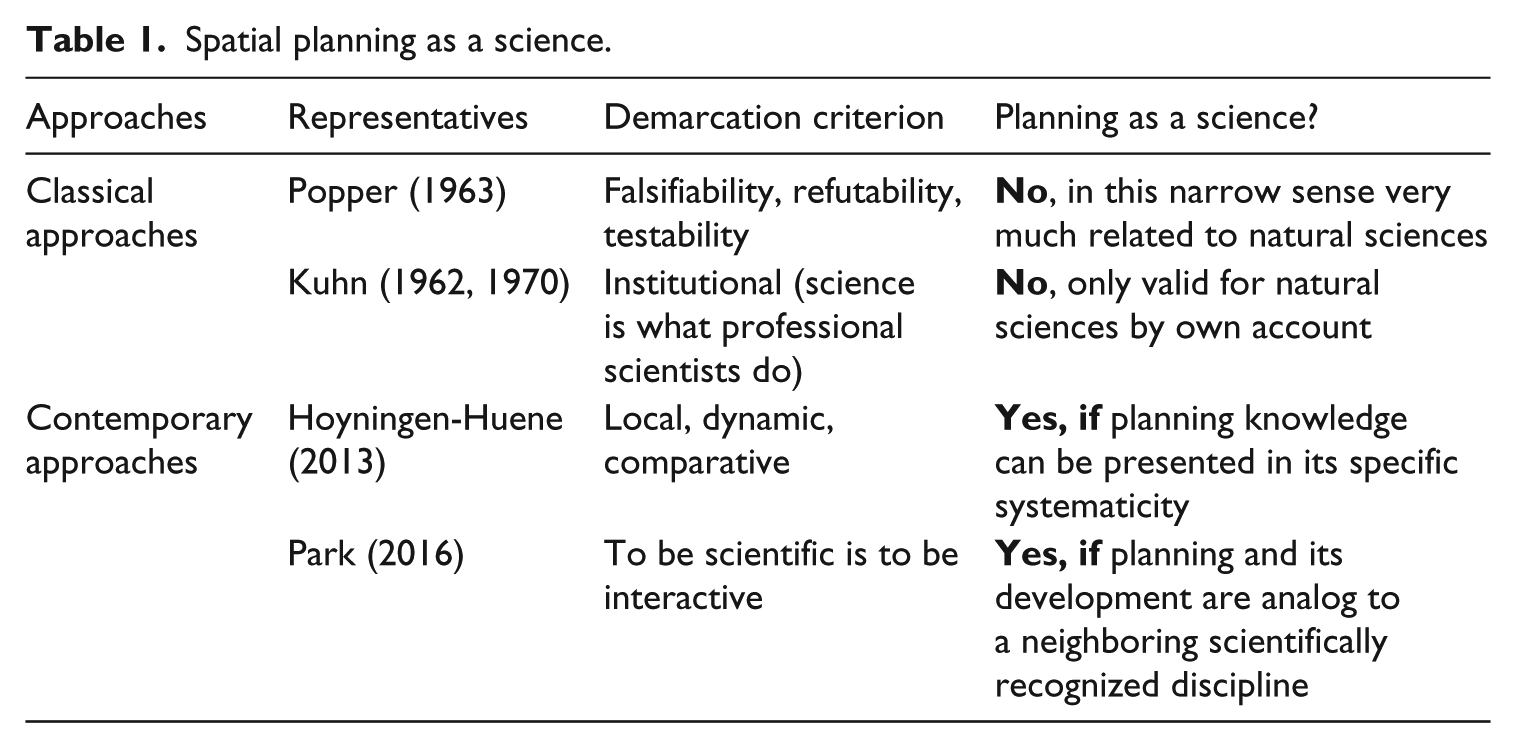
The more recent approaches do indeed allow the conclusion that planning is more a science than a pseudoscience, in a broader sense of science. However, to decide about the scientific status of spatial planning, further work has to be done, along the criteria of constituting a science within different philosophical approaches (Hoyningen-Huene or Park in this article). Then, the answer to the question whether planning constitutes a science is “yes, if.”
Only in the latter understanding of planning as a science in the contemporary understanding, we need to elaborate our thoughts on planning as a discipline. Both approaches are then specifying their criteria regarding the specific knowledge of, in our case, spatial planning. In sum, planning scientists then have to elaborate on the specific planning knowledge and start a discussion, what this might be. This represents a huge challenge for scientists as well as practitioners co-creating this knowledge—the joint knowledge base of what spatial planning constitutes, the core of planning, and the unique characteristics of this field of study. In the literature, some hints can be found, some ideas what this knowledge is all about, but far off from a structured debate, or a common ground to start from. Some authors state that a dominant part of planning is about interdisciplinarity (e.g. Davoudi, 2015). Buanes and Jentoft (2009), for example, have shown that planning is characterized above all by interdisciplinarity. Pinson (2004), on the other hand, had criticized that this interdisciplinarity arises from different disciplines and therefore cannot represent the specificity of one discipline alone. Apparently, the interdisciplinarity of planning does not fit very well with the disciplinary classification system of sciences in general, but, especially in regard to interdisciplinarity as core of spatial planning, in how far can a discipline be interdisciplinary? Or does this mean that planning constitutes a science without being a discipline, or, even consists of several disciplines? How can planning be a science but not a discipline? What does this mean for the organization and classification of planning as science? To explain and illustrate this, we use an analogy from the field of the natural sciences. The natural sciences can be divided into five main directions: physics, chemistry, astronomy, earth science (the exact natural sciences), and biology (the biological sciences; Brockhaus Encyclopedia Online, 2019). On one hand, these five subject areas differ greatly from each other, as they each deal with specific topics and themselves differentiate between different disciplines (e.g. physics into experimental physics and theoretical physics). On the other hand, they jointly contribute to the overall picture of the natural sciences and represent the joint interdisciplinary attempt to explain natural phenomena. The aim is to fathom phenomena and processes in nature as well as their laws by means of suitable experiments and to describe them by means of already known or to be developed theories (Brockhaus Encyclopedia Online, 2019). We are well aware that spatial planning cannot be considered in all aspects as an analogy to natural sciences, but in regard to its subdivisions we encourage to think of spatial planning in a similar structure: the generic term planning sciences can be regarded as equivalent to the term natural sciences, subdivided into different subject areas (e.g. housing, environment, transport, etc., see Figure 1). The individual subject areas of planning should not only strive for a stronger separation of content, but should also cooperate more closely in terms of their methodology and their contribution to the overall (spatial) planning context. Foucault traced such a process, among other things, for the knowledge of the diversity of living beings (Foucault, 1966). As Flyvbjerg (2001: 111) points out, Foucault (1966), in “The Order of Things,” addressed the question of whether human affairs can become scientific in an Aristotelian sense of episteme. Flyvbjerg (2001: 167) himself sees the goal for social sciences not to contribute to the episteme, that is, to represent a science like the natural sciences, but to focus on the phronesis in an Aristotelian sense. Rather, it should contribute to the practical rationality of society. We understand this approach as complementary to ours, since we do not want to claim that planning science should become like the natural sciences with regard to its practice, but that it should take up similarities in structure to gain a stronger status and become more effective within society. Friedmann’s (1987) perspective on planning as a rather social-scientific contribution to policy-making also presupposes the approach described here. This role can only be successfully performed from a sound scientific basis, which needs to be developed in the sense of planning sciences as shown in this article.
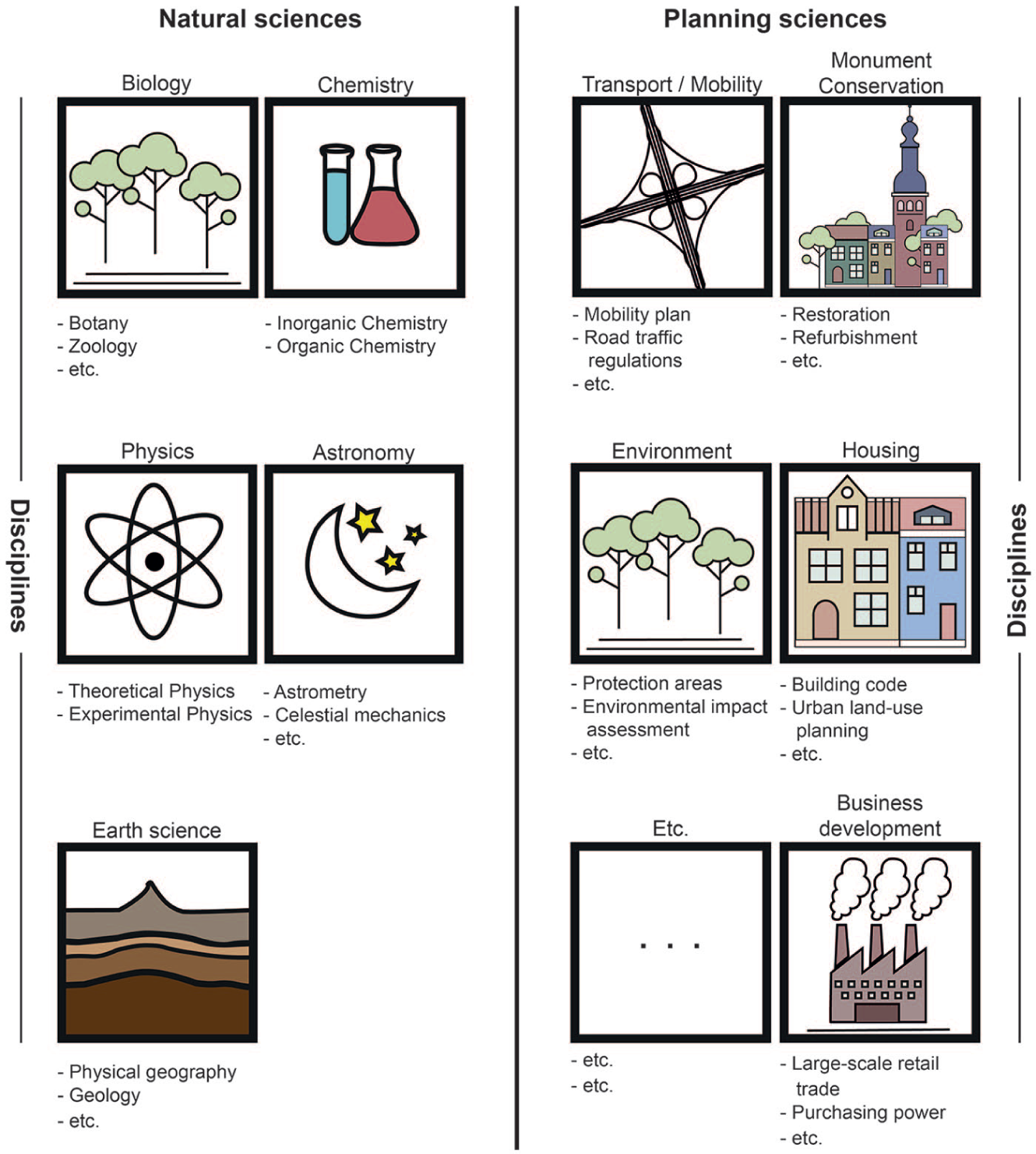
Analogy of natural sciences and planning sciences as multidisciplinary approaches.
What do we learn from our findings for the discourse in planning? First, the question of whether planning is a discipline does not lead to an answer about the identity of planning or what is at the very heart of planning. The question behind this is rather whether planning can be recognized as a science; therefore, second, the question can most probably be affirmed from a philosophical point of view in the sense of a contemporary understanding of science. In a traditional perspective of science where spatial planning is not seen as science, the implications for the planning’s field of action are far-reaching: from reconsidering the academic background to the education of planners and the question on which knowledge base planning is acting. Depending on which contemporary approach one wants to follow in the demarcation debate, however, it also becomes clear that more extensive analyses and reflections of the theoretical approaches of planning are necessary to better meet the scientific demands. Third, it is then necessary to further define the previous knowledge about planning, the knowledge base specific to planning, and which academia relies on. This could be its multidisciplinary approach and the individual disciplinary approaches, as interdisciplinarity is then a characteristic of planning as a science, not of the discipline of planning as discussed in planning literature today. To systematize and to differentiate a theoretical body of spatial planning seems to be a key issue to further develop the scientific status of planning. This implies a sound analysis of what is considered nowadays as knowledge base of planning, in academia as well as in practice, then a systematic approach allowing enough diversity to make different aspects of this knowledge transparent and a validation or broad discussion about it in academia—in other words, a restructuring of planning knowledge in the realm of sciences in transformation in the knowledge based age.
Digging deep toward the bottom line of the debate of planning as science means to question the underlying structure of basic assumptions which where elaborated, for example, in Friedmann’s or Flyvbjerg’s argumentation. However, what does this mean for future research pathways? How to deepen academic and professional planning knowledge, describe the huge variety of knowledge in planning, and validate these unique characteristics? We consider this re-thinking of spatial planning and its sound intelligence base (and specific knowledge) as one of the main projects the community needs a debate about in the 21st century, from many different perspectives, in a fruitful interdisciplinary dialogue. The pathways we identified are deeply connected with questions of philosophy of science, but there are surely others to develop: about the epistemology of planning science, about its historical development and the integrations of other disciplinary knowledge and the impacts on planning knowledge, comparative analysis of, for example, differences in national planning approaches in terms of impacts on knowledge, more empirical research on planners everyday life, and the knowledge they use for their decisions. Central to this discussion is, in our point of view, the focus on planner’s knowledge and their intelligence basis, their norms and values, and its reflection and preservation in academia.
Footnotes
Funding
The author(s) disclosed receipt of the following financial support for the research, authorship, and/or publication of this article: This study was supported by TU Dortmund University for the Open Access Publishing.
