




Abstract
To address the social, spatial and environmental problems of cities, planners often promote and engage with spatial practices that are intended to be experimental, innovative or transformative of existent processes. Yet, the actual nature of the novelty of these practices is often not explicit nor problematised by their proponents. This article develops an institutionalist framework to better appreciate the variegated nature of change in planning practices. It understands planning as embedded in, and simultaneously impacting on, three types of institutionalised norms: operational norms that define and allocate responsibilities among actors, collective norms that (re)produce planning polities and constitute the spatial-temporal context of their actions and constitutional norms that substantiate the idea of value defining the eligible stakeholders of a particular process. The article mobilises this framework and argues that contemporary planning practices convey a (a) shifting of responsibility towards individuals and households, (b) disaggregation of city regions through polycentric localism and (c) the reproduction of the process of accumulative valorisation of land. The article concludes reflecting on the complexity institutional change.
Introduction
This article offers a framework to problematise the institutional logics of planning practices. It does so in order to urge planning scholars to be critical of the nature of innovative approaches to urban intervention and to address the variegated nature of institutional change. It also talks to planning practitioners, with a plea to be explicit about the innovative aspects of practices presented as experimental and innovative.
The welfare restructuring, decentralisation and austerity policies enacted after the global financial crisis have set a fertile ground for a broad spectrum of practices in the field of service provision, land reuse, building retrofitting and experimentation with environmental resources (Moulaert et al., 2010). The aftermath of the post-crisis austerity reforms has been accompanied by a celebratory attitude towards a broad constellation of spatial practices based on a marked pragmatism to tackle urban problems, emphasising local and contextual solutions, and the more direct engagement of communities (Davies, 2012; Olsson and Haas, 2013). These practices include self-organised, activist-based and serendipitous spatial action, in building and neighbourhood regeneration, reuse and recycling, interactive urban design and economic revitalisation. They include policy-based practices of experimentation, carefully stimulated by governments to promote new economies, circular metabolisms in area development and more place-based service provision (Broto and Bulkeley, 2013). Today, it is common to define these emerging practices as ‘experiments’, ‘niches’, ‘living labs’ or ‘social innovations’ to stress their transformative potential for lifestyles and regulations (Evans et al, 2016). Nonetheless, the very nature of their novelty remains unproblematised – often by overly celebrating their capacity to develop solutions – or recursively redefined by their proponents depending on the audience and situation at hand.
In the past three decades, institutionalist planning scholarship has been concerned with the nature of change, innovation and transformations, questioning how emerging social practices relate to or impact on existent institutions (Bolan, 1991; Healey, 2004a; Savini et al, 2014). This consolidated field of planning theory builds on the dialectic ontology between actions and institutionalised norms in order to observe paths of change and continuity and to understand how (and why) planning institutions change or last in light of the particular goals of planning agents (Dembski and Salet, 2010; Moroni, 2007; Salet, 2002). According to this perspective, which includes a broad possible range of methodological, epistemological and ontological choices (see Jessop, 2001 and Hall and Taylor, 1996 for an overview), norms and actions are understood in a co-productive relationship and the actual mechanism of normative (re)production is the explanans of change. An institutionalist perspective looks at the dialectic relation between subjective aspirations or goals and the non-subjective norms that bias the definition of those same goals (Salet, 2018). Yet, in order to do so, planning scholars need to make an analytical choice about the norms that are considered the most crucial to this process, to uncover the generative mechanisms between actions and norms and those between different types of norms. As Healey and Barrett (1990) argued more than two decades ago, while planning research seems to show well how structures influence practices, the intensity and nature of the ‘kick back’ is still an open gap for research (p. 96).
This article addresses this analytical problem, building on the critical standpoint that, while planners, politicians and civic actors may celebrate the transformative potential of a particular planning practice in a given moment, the actual nature of this change is unproblematised. It is important for institutional planning theory and practice to make explicit what this change consists of and to uncover if practices presented as ‘new’ may instead reproduce existing orders. To do so, this article starts from the assumption that planning is a constellation of practices taking place within a broader socio-economic context, which includes norms that may not be directly linked to a planning process. While planning practices are built on purposeful relations between actors and stakeholders, the norms that impinge on those practices are produced at different levels of action, within different social spheres (Madanipour, 2010). A cautious appreciation of institutions in planning thus infers that norms carry social biases that may be constructed and extended beyond planning practices (Sager, 2012). This multi-level perspective, which I elaborate later, allows the cautious observation of institutional change by appreciating the complexity and heterogeneity of the conditions within which planning occurs.
This article initially argues that existing frameworks of institutionalist analysis tend to be overly based on either functionalist or geographical distinctions. Drawing on the works of Giddens, Ostrom, Habermas and other sociological institutionalists, this article instead defines institutions as a nested order of three types of norms: operational, collective and constitutional. The norms pertaining to each level are, respectively, reproduced and enacted in planning practices, and they: (a) govern the (re)allocation of responsibilities at the level of practice, (b) allow for a planning polity to crystallise across time and space and (c) underlie the definition of value and interests within contemporary capitalism. The argument of this article is that institutional analysis needs to address the interrelation between these norms carefully, and cautiously uncover whether changes at one level do, or do not, instead affect other levels’ norms.
In light of this challenge, the article also provides illustrations of how this framework can be used to critically reflect on the institutional nature of contemporary planning practices. In each of the following sections, I refer to existing research to elaborate a first critique of how the three levels of norms are today institutionalised: operational norms, I contend, are today driving the responsibilisation of households and individuals motivated by the problematic principles of shared responsibility; collective norms are those of polycentric localism, building a polity of interdependent localities within global processes; finally, constitutional norms of planning are the long-lasting structures of accumulative valorisation. I conclude that institutional change is a transformative process which inevitably generates tensions and conflicts. I do so to urge planning institutional research to better investigate the political drivers of institutional change.
Institutions and norms in planning: three levels of normativity
In its relational understanding, planning is a constellation of practices, embedded in context but simultaneously changing that same context (Alexander, 2015). Ontologically, institutions are both the context and the object of planning practices, which are the spatial and temporal manifestations of situated actions where norms are enacted, contested, routinised and changed. Planning practices are thus assemblages of open-ended sets of actions performed by agents, which mobilise skills and knowledge, ideas and materials in a more or less conscious way (Schatzki, 2005). Yet, planning practices are different from other practices because of their nature of intervention: planning impinges on the relation between land, built artefacts and social dynamics, and their future condition (Healey, 2004b). However, as with any other practice, planning’s actors and actions are embedded in and co-productive of institutions, which are structured norms. They simultaneously reproduce and change norms and values in time, as historical memory, codified rules, shared ideas or physical urban fabrics, and across space, across neighbourhoods, cities or countries. This particular understanding of planning allows scholars to look at institutional change as a historical path made of critical moments of evident change in practices (Sorensen, 2015), but also permits them to conceptualise institutional capacity as the ability to produce new norms and to make them widespread in space and durable in time (Healey, 1998). However, this process remains highly unpredictable and ‘all social change is conjunctural’ (Giddens, 1984: 245). The long-term unpredictability of collective action makes it very hard to observe institutional change, and makes it even harder for planners to target particular institutions over others to favour particular urban relations over others.
This difficulty springs out of the consideration that institutions are polymorphic, immaterial and dynamic, yet stable. Institutions have been defined in numerous ways and, in reality, they are everywhere. In the depths of the minds of individuals, they work as moral norms of action, but they also crystallise into tangible rules such as legal norms or public governments. Institutions can be best and generally understood as ‘systems of sanctions’ that orient actors in their daily choices by limiting the scope of ‘possible’ actions (Giddens, 1984), by defining what is ‘appropriate’ for actors to do (March and Olsen, 2010). Building on different sociological streams, planning scholars have provided numerous definitions of institutions, defining them as ‘patterns of norms’ (Salet, 2018), a ‘general cultural rule of conduct’ (Salet, 2002: 29), ‘basic rules of conduct’ (Moroni, 2010: 177) and urban codes (Alfasi and Portugali, 2007), or referred to strategic frameworks of action (Balducci et al., 2011), property rights (Buitelaar and Needham, 2007) and planning cultures (Taylor, 2013). All of these definitions emphasise that institutions constrain the set of possible actions and have a normative capacity to orient how agents will (possibly) interact with each other in a particular situation. Institutions entails norms and yet, because norms are everywhere and because institutional orders can be extremely complex, it is important to discern carefully which particular norms are the most critical for planning practice.
Institutionalist planning scholarship has approached this complexity by categorising norms into types, sets or groups, rethinking planning as something that takes place within a multi-scalar set of norms. Alexander’s multi-level perspective, for example, differentiates between macro, meso and micro norms (Alexander, 2005) and, recently, Moroni (2017) has argued for five levels of norms, from the pre-constitutional to civic society. Much more common is to discern between formal and informal institutions (Van Assche et al., 2012) or to assume that there is a ‘strategic’ level encompassing an operational one (Servillo and Van Den Broeck, 2012). Salet and Faludi (2000) distinguish between social, political and legal institutions of planning. Common definitions distinguish between ‘hard’ written-codified rules (including government bureaucracies) and ‘soft’ institutions include language, social ties, symbols and political values (Healey, 1997).
These views subdivide institutions according to hierarchy (macro/micro), substance (formal/informal), procedure (administrative/strategic), scale (national/regional/local) or function (social, political, economic). Despite the different uses of each of these categorisations, a methodological distinction should allow the analysis of planning practices independently from a particular geographical scale or particular social function, because context is ontologically internalised by a particular practice or event; it is not external from it. Institutions are simultaneously the condition and the object of change of actions, because they are reproduced or contested by those practices while they occur. A possible way to methodologically address institutions is to focus on the levels of normativity of sets of norms, building on what Giddens (1984) has called the ‘space-time extension of norms’ (p. 17). This is the potential capacity of norms to distinguish between different social practices and it does not refer to a particular sub-unit of society or geographical scale. The more operational the level of normativity, the more specific and unique the practices influenced by those norms are. The more constitutional and encompassing a norm is, the wider the totality of social practices that are influenced by that norm across space and time (Giddens, 1984). This distinction is purely methodological, and allows for an inferential, empirically informed type of research on institutional change. It recognises the capacity of institutions to encompass practices that may take place at different places and times but share very similar norms. It also assumes that norms exist in a dynamic and embedded relation between each other.
A distinction between levels of normativity presumes that some particular norms are more resistant in time and more extended in space than others, and that within a particular social order, some norms may change and others may not. Such a nested view is common in institutionalist theorisations that approach institutional continuity and change as a multi-scalar, complex and mostly unpredictable process, where the relation of agency and institutions can take multiple directions. It also allows to better appreciate the political geography of institutions. The strategic relational approach developed by Jessop (2001) builds on Giddens’ ontology to stress that institutional norms differ according to their level of strategic selectiveness, namely their capacity to enable (or exclude) practices across time and space. 1 By spatialising and temporalising norms, it is thus also possible to grasp the political nature of institutionalisation processes, stressing how actors’ practices can strategically operate to reproduce, mobilise or change institutionalised norms at particular moments and locations (see, for example, Chettiparamb, 2007; Valler and Wood, 2004). Regardless of the particular perspective at hand, an institutional order can be understood as a nested system of institutionalised norms with different spatial and temporal degrees of normativity.
What then are the specific norms that planners deal with while engaging in urban processes? The model provided by Kiser and Ostrom (2000) provides a suggestive definition of these norms, distinguishing between operational, collective and constitutional norms. Operational norms are more easily observable in planning research, because they provide the most space-time-specific context of normativity. They are the ‘rules that affect daily decisions’ on how to tackle and carry out interventions on urban spaces, land, urban living or ecological resources. They are recursively (re)produced in the establishment of agreements, relations and negotiations, and they provide the properties of any form of organised action on an urban matter. Kiser and Ostrom (2000) emphasise that these rules frame the distribution of responsibilities in a particular instance of practice, in order to organise particular resources in a stable manner. In his discursive approach, Habermas (1996) argues that operational norms (or procedures) are those that influence how agents deal with problems ‘and have less to do with becoming sensitive to new ways of looking at problems than with justifying the selection of a problem and the choice among competing proposals for solving it’ (p. 307). Giddens’ notion of structural properties similarly refers to those basic socio-spatial structures for action entailed in very specific times and places, and they often become visible within episodic events. In planning, these operational norms are closer to what can be defined as ‘organisation’ problems (Moroni et al., 2016): they have a lower degree of normativity because they define practices as existing in a particular space and time and between a particular set of interests and actors. These norms are most visible in the way actors agree with each other, and how they negotiate and frame their expectations because they are closer to the problem at hand. For the same reason, these norms have become easier targets of institutional design and process management.
Practices are simultaneously embedded within collective norms. Collective norms provide the meso-level normativity that allows individual agents to position themselves in relation to others before they establish a relation. They thus define the specificity of practices in terms of other practices occurring in other spaces and at other times. Ostrom (1990) shows, for example, that the capacity of communities to self-regulate the use of environmental resources requires a series of conditions that can be applied to a defined collective of actors with an interest in those resources (Ostrom, 1990). These norms include those that allow the perception and construction of ‘boundaries’ of action, built through dialogical processes of interaction, conflict resolution and cooperation. Giddens (1981: 55) has more abstractedly identified this level of normativity as that of ‘structures’ (or structural sets) that enable the ‘clustering’ of relations of transformation and mediation. Norms at this level allow to link practices with other practices occurring at different times and spaces. Habermas (1996) further argued that it is the argumentative process within a speech situation that sets the conditions for linking operational subjectivities to collective ‘claims’ on ‘right decisions’. In planning, these norms have been widely associated with those that allow for deliberation and argumentation in decision-making, setting a space for relationality (Mäntysalo et al., 2011). The collective level of normativity has been widely addressed in communicative institutional research and has inspired works on inclusive and communicative planning, arguing that it is important to facilitate durable, open and cooperative relations among stakeholders in order to set the bases for more operational, place-based interaction.
Collective norms are embedded within another level of normativity, here defined as constitutional. Kiser and Ostrom (2000) argue that ‘constitutional decisions are collective choices about rules governing future collective decisions to authorize actions’ (p. 208). This definition stresses the deepest level of normativity, which ultimately legitimises the choice to undertake collective action as such. Ostrom (1990) explains that, ‘in a constitutional choice situation, individuals decide whether or not to change a set of status quo rules that determine who is eligible [emphasis added] and how future collective-choice decisions are to be made’ (p. 141). Giddens (1984) has addressed this level of structuration more explicitly, arguing that it entails ‘constitutional problems’ of setting up the conditions that enable agency to reproduce agency itself. These are not the conditions that enable agents to act in particular situations, but instead enable ‘agency’ to be understood, in the first place, as the ‘possibility’ to act. Giddens (1981) specifically uses the notion of ‘structural principles’ to define these as ‘principles of organization implicated in those practices most ‘deeply’ (in time) and ‘pervasively’ (in space) sedimented in a society’ (pp. 54–55). Habermas (1996: 301) equally has problematised these principles in his perspective on legal adjudication, defining constitutional principles as those that allow ‘will formation’ and ‘the mobilization of publics’ before a speech situation. These norms have been often understood as moral values, the basis of any opinion-building (e.g. education or shared language), or the distinctive cultures that found inter-subjective communication.
This overview of three levels of normativity shows that institutionalisation is a nested process where different norms interact with each other. It shows that the three types of norms have different extensions in time and space, and that practices are distinct according to the type of norms they enact. These norms can be found coexisting in each planning practice, and together they allow the distribution of authoritative, allocative and communicative resources in a process. These norms are all reproduced and institutionalised through the mobilisation of ideas, discourses, and the legal and financial frameworks of planning. This categorisation aims at giving a dynamic and versatile framework of analysis in scrutinising the inner logics of a broad variety of emerging planning practices in different contexts. Practices that show very different operational norms (e.g. between different cities in the same country, or neighbourhoods within cities) may share similar collective and constitutional norms. But, as I argue below, they could also share totally different collective norms from each other. Operational norms are likely (but not necessarily) to change rapidly in light of socio-economic shifts or geographical context, while constitutional norms are more long-lasting across time and extended across space. Yet, this approach allows to imagine practices that attain to different constitutional norms. Finally, this framework allows the scrutiny of inner tensions within particular practices. Actors may, for example, attempt to shift operational norms, and in doing so may generate conflict with the institutionalised collective and constitutional norms. Below, I attempt to make this multi-level approach explicit, clarifying the specific norms (re)produced in planning practices.
Operational norms: allocation and sharing of responsibilities
Being the most specific in time and space, as Kiser and Ostrom argue, operational norms influence the behaviour of agents in their inter-subjective purposive relations, providing the basic points of reference of their mutual positions in achieving certain aims. Under conditions of trade-offs and dilemmas of action, the distribution responsibilities among actors within a specific locality are, in the view of this article, the first property of an institutional order, whereby individuals (and groups) establish an initial operational idea about their individual roles within a collective action. This understanding of responsibility is particularly important for planning and urban policy-making, because it allows to explain urban policy-making as a collective endeavour that emerges from a relation among individuals and stakeholders in particular contexts which may be previously institutionalised. In its relational sense, responsibility is thus an abstraction that originates from the purposive relation between actors but that ultimately transcends those same actors becoming institutionalised into rules, regulations and discourses (Sena, 2014). This occurs when (a) actors co-produce a frame that provides a certain degree of certainty on how other actors will act, (b) actors enter into a relation with each other and assume identities and positions in respect to other actors and (c) the process of attribution of positions involves some degree of agreement or disagreement (i.e. a judgement) over the possible organisation of tasks, capacities and roles (Donati, 2010). The building of responsibility is dependent on networks of relations as well as the sharing of information and reciprocal monitoring within particular action contexts (Ostrom, 1990), and it is productive of power relations which last over time.
Operational norms attributing responsibility allow the construction of a frame for sense-making in a particular situation, where actors have a perception about the possible ways in which other actors may operate. Interventions in cities ultimately refer to a particular, relationally constructed and, therefore, always normative, distribution of responsibilities among actors operating in a particular environment of uncertainty. Giddens (1999) better profiles the structuring value of responsibility, pointing out that ‘what brings into play the notion of responsibility is that someone takes a decision having discernible consequences’ (p. 8, emphasis added). The attribution of responsibilities therefore requires a process through which possible ‘consequences’ of collective action are abstracted and discerned, in a manner that can be more or less dialogical and participative but always relational (McNamee and Gergen, 1999). Responsibilities thus entail a framing and shared understanding of the consequences of particular actions and this process can take multiple forms. Nevertheless, it always entails a moment in which particular actors (more or less consciously) enter into a relationship that requires an understanding of the consequences of their action in a particular situation, and thus seek an acknowledgement of their positions. Habermas (1979) emphasises how responsibility is a generative norm of many other procedural and process operational rules, pointing out that responsibility emerges as an initial interpersonal obligation between actors (i.e. situation-specific), and which at one point assumes the possibility of discussion and change within the existing order of things.
The changing norms of allocation of responsibilities are vital to explain the shifting logics of policy-making in contemporary cities, yet existing research has rather focused on the notion of ‘accountability’ or ‘liability’, or has taken a static perspective. Some explicitly focus on responsibility but from a moral point of view as something that is already internalised by planning agents, hardly changing in intersubjective practices (Buitelaar et al., 2011; Sager, 2012). In other cases, responsibility has been simply intended as an object of efficient design (Mostert, 2015). Liability is more often used in the field of planning law and it is different from accountability because it refers always to the possibility of a legal ‘sanction’ (see Van Rijswijk and Salet, 2012). Accountability instead refers to particular subjects (individual or collective) with regard to a particular set of tasks, and it is enacted whether or not that task is performed. Instead, responsibility is enacted before the action is defined. Responsibility is an institutionalised relation of position between actors. It transcends those actors and is long-lasting, but can also be redefined and contested in practice. A critical view of institutions thus urges planners to problematise how operational norms of responsibility allocate change by generating new types of relational positions that last over time. As an example, for an institutional perspective on land use planning in a particular city, the focus on accountability would specifically problematise the particular enactors of a particular plan (e.g. a mayor or council, or the planning department of the city). A focus on the way responsibility is institutionalised would instead uncover the extent to which a land use plan recognises and gives certain rights to some actors to develop land rather than others. It is clear that the land use plan enacts and reconstructs a particular set of mutual positions which have meaning beyond the practice of land use planning itself. In the hypothetical case of a laissez-faire approach, these may reflect the acknowledgement of responsibility upon private investors vis-à-vis less responsibility by governments. This is independent of whether the land use plan is actually realised or approved.
The way responsibility is allocated has been changing in history, in reaction to changing socio-economic or environmental conditions (Strydom, 1999). This change always entails a redefinition of the relations between actors in a practice and it requires both the adoption of responsibility by new actors and its removal from others. Today, the specific strand of environmental studies labelled as the geography of responsibility (Massey, 2004) has particularly criticised how current policies tend to de-responsibilise some actors at the expenses of others under the principles of a shared responsibility. The notion of sharing advances the tenet that all individuals have the same position and capacities. This assumption is visible in many contemporary practices of experimentation within cities, where users are increasingly made responsible as active prosumers under idea of sharing economy or crowded processes (Evans et al., 2017; Howland, 2003). As a norm, the principle of sharing responsibility also substantiates practices based on private negotiation, contractualisation and individual arrangements for addressing socio-spatial problems. Examples are the organisation of localised and community-based energy grids in the United Kingdom and Italy (Moroni et al., 2016), the institutionalisation of community benefits agreements (Sagalyn, 1997), the promotion of self-built and micro-financed housing in the Netherlands and elsewhere (Savini, 2017b), and the diffusion of sharing and cohabitation practices to provide spatial amenities (Jarvis, 2011). The transfer of responsibility to individuals, from corporate or State actors, is a distinctive process of late entrepreneurialism during austerity (Peck, 2012; Savini, 2017a) and it has characterised major approaches to contemporary environmental policies (Maniates, 2001). The idea that citizens are themselves responsible for the quality of the urban environment is today institutionalised through all kinds of regulatory frames that allow resources to be given to individuals and their local associations within processes of ‘experimental’ innovation. In the context of urban development, the idea that responsibility can (and should) be equally distributed among all actors is at the base of contemporary neoliberal urbanism, perpetuated through the institution of the contract as the prime institution of planning (Tasan-Kok, 2010). Contracts between public, civic and private actors do represent a formalised materialisation of the contemporary principle of shared responsibility among apparently equal subjects, which engage in a permanent negotiation on their specific roles.
The first step for understanding institutional change requires a critical perspective of whether particular emerging planning practices propose and institutionalise new interpretations and allocation of responsibility among agents. Such a critical view would, for example, problematise the way particular households are required to bear responsibility for their actions through rules that sanction their energy consumption and energy infrastructure, while big polluters escape such obligations. However, while this step may explain the basic norms of organising purposeful relations in a practice (who is supposed to do what), they do not suffice to explain the particular ways in which the relations between different practices are constituted and the underlying normative assumptions that define the actors partaking in the process in the first place. This requires an examination of the way polities are reconstructed in planning and how stakeholders are defined.
Collective norms: polity-making and its disaggregation
The process of responsibilisation occurs, and is productive of, context. Collective norms are those that organise, define and imagine each planning practice in relation to other practices, producing context as a relational construct. These norms orient relations between actors, as all norms do, but collective norms make sense of the relation between one specific operational interaction and another taking place at different places and moments in time. Ostrom’s (1990) definition of collective action specifically refers to those ‘decisions about decisions rules’, pointing at the pre-set of norms that self-regulating actors need to set up in order to provide the conditions to organise operational relationships. Building on this idea, collective norms have been often understood as those dialogical processes that allow processes of representative democracy and define systems of membership within a particular political system (March and Olsen, 2010). In the context of urban planning and spatial policies, as I propose, these norms should be conceptualised as those that enable the institution of a planning polity, intended as a constellation of interdependent and interconnected practices within a spatial and temporal context. Each planning practice thus always entails (more or less explicitly) a particular normative understanding of a polity of relations, which refers to the way that a particular practice will influence others in the future or does affect other practices somewhere else.
Much less used than the term politics and policies, a polity is the socio-politically constructed set of spatial and temporal boundaries within which legitimate operational practices of planning take place. As Marsh and Stoker (2010) indicate, any study of politics refers to implicit assumptions on the spaces and times of reference of the political process; ‘When people say they ‘study politics’ they are making an ontological statement because there is an implicit understanding within the statement of what the polity is made of and its general nature’ (p. 8). The focus on a polity as the spatio-temporal boundaries of social relations is very common to understand globalisation and the rise of the modern nation state (Robertson, 1995). From this perspective, a polity is often understood as the crystallisation of a durable and stable set of spatial and temporal boundaries that define spaces of legitimate relations, while politics is the process of contestation and change of those boundaries. These boundaries are ultimately those that allow the limits of operational norms to take place, basically defining the specificity of a particular practice in relation to another. In planning, it is very common to look at a polity referring to the multi-scalar organisation of the State, divided into national, regional and local levels of government (Brenner, 2001; Tewdwr-Jones, 2005). From a classic, regulatory perspective on capitalism, a polity is a sort of meta-level ‘that allows for the recomposition of institutional forms’ (Boyer and Hollingsworth, 1997: 452).
Hajer (2003: 175) pointed out that the modern polities of national, regional and municipal boundaries have been dissolving in light of processes of globalisation and localisation. He understood this condition as an ‘institutional void’ for planning, which suffered the lack of those rules ‘through which politics is to be conducted and policy measures are to be agreed upon’. While the idea of a ‘void’ is suggestive, it does misinterpret the institutional nature of polities, since modern polities are not disappearing but simply changing and being constituted by different principles than those that apply to nation states. The building of a polity is an institutional process itself, and it is thus important to uncover the changing underlying norms of its production and the type of rules they produce. 2 In planning research, it has been demonstrated that the norms of polity-building are becoming more discursive than jurisdictional, reproducing unstable and fuzzy boundaries (Allmendinger and Haughton, 2009), which are de-territorialised (Metzger, 2013b) or ‘a-synchronic’ (Hajer, 2003). Shifting the focus from jurisdictional institutions to discursive ones, Healey (1997) has stressed that a polity crystallises as a ‘discursive community’, and it is founded on shared language and communication practices. These communities are reflectively produced through a discursive practice that allows actors to view themselves as part of a collectivity in space and time.
The different conceptualisations of polities under conditions of networked and multi-scalar governance share the same ambition: they point at the historically institutionalised norms that determine the way different practices enter in relation to each other across space and time. As Ostrom (2000) points out, today these norms underpin polycentric governance systems. They are repeatedly crystallised into institutions through social practices that promote a particular idea of collectivity or community, beyond jurisdictional or geographical boundaries. In Giddens’ view, the ‘social integration’ of practices occurs when relations of reciprocity are established in space and time. This process of constituting spatial and temporal boundaries defines the context of action in relational ways, and it drives the production of what he calls ‘locales’, the very setting of any interaction. In light of this article, the production of a polity is the process that constitutes the ‘context’ where apparently disconnected practices coexist. In other words, before establishing who is supposed to do what in a situation (operational norms), actors re-produce assumptions about the space and time boundaries that define those relations as situation-specific, among other possible relations. These boundaries are always ‘historically contingent’ assemblages of practices that acquire an (institutional) meaning, and thus crystallise the normative frames of collective action in space and time (Paasi, 1998).
Let me give a concrete example of the way polities are institutionalised in planning. In a particular neighbourhood, it is possible to distinguish different practices that take place simultaneously and that enact specific operational norms. Citizens and other groups may organise events of social cooperation, and divide responsibilities in the process of place-making through shared language, face-to-face meetings and direct participation. This community of practice may become the target of policies designed to promote social integration and become spaces for political engagement. Yet, within the same neighbourhood, we can find other planning practices, such as the reconfiguration of real estate investments on vacant land, with different operational norms. Both these practices are taking place within the same context but are not necessarily understood (nor dealt with) as related. The lack of relations between these practices leads to the paradoxical consequence that local governments, for example, may enact policies that promote social interaction in the community, while at the same time may overlook (or even instigate) processes of real estate development that are very likely to erode those same communities years later.
A polity is therefore understood as the context wherein particular urban processes and practices are interconnected with each other, and placed into a meaningful relation. The production of a context is never a neutral endeavour for planning, because it is within normative frameworks that give salience to those processes and give meaning to their relations. As Healey has shown, planning is productive of space (and time) because it is selective, and that selectiveness can follow different ‘criteria’, principles and logics (Healey, 2004b). As Madanipour et al. (2017) argue, today’s planning requires a new understanding of the interrelated ideas of space, place and territory 3 and, in my understanding, this means to problematise the polity of planning, namely the specific way in which the particular relation between space, place and territorial boundaries is institutionalised. This increases the urgency for ‘(a) multidimensional complex understanding of space and b) new ways of negotiating how society should [original emphasis] shape and influence the myriad of urban actors who mobilise and transform places’ (Madanipour et al., 2017: 4). The task of contemporary planning is thus to define, discover and redefine those norms that allow the re-connection of different practices and to link the actors that may instead operate in disconnection. This process is one of the core elements of the political process: to contest and redefine the normative boundaries of spatial relations. This normative selectivity enables processes of relational place-making, where individuals make sense of their position within complex socio-economic processes, and it can happen at very different spatial levels, from the neighbourhood to a city region (Pierce et al., 2011). This latter endeavour was largely taken up by strategic regional planners in the late 1990s and early 2000s, who understood (and carried out) planning as a process of exploration, problematisation and production of normative relations on a wider regional scale (Salet and Faludi, 2000). Spatial planning has the task to ‘accentuate’ the interdependencies between urban processes organised at different scales (Soja, 2015), and crystallise them into shared norms and principles of polity-making.
The norms that drive the institutionalisation of polities in contemporary planning practices are those of polycentric localism, substantiated by the principle that localised and communitarian interaction are the most effective means to address urban problems, yet within the broad context of global processes (Davoudi and Madanipour, 2013). Practices aiming to share responsibility through horizontal engagement and contractual private agreements often carry the seeds of a parcelled and fragmented polity into several independent units, opening up new spaces for capital accumulation (Swyngedouw et al., 2002). Processes of public/private negotiated development appear to be increasingly ‘decontextualised’ from the local social processes of urban living, with planning projects being often considered as ecosystems isolated from local contexts (Savini and Aalbers, 2015). On a higher scale, the production of regional polities today appears to follow norms of effective and specialised growth that, while allowing for localised processes of development, do fragment rather than integrate the regional space into different investment areas (Galland, 2012). Building on ideas of pragmatic communing and polycentrism, numerous contemporary practices of urban socio-environmental activism appear to organise themselves as hyper-local and communitarian initiatives, with processes of self-organisation being highly concerned with the here and now (often hidden behind a big ‘how’). As I have shown elsewhere, the claim for experimental and localised self-organisation has led to a spatial and temporal ‘disaggregation’ of city regions (Savini, 2017b).
The particular way in which polities are changing is a matter of empirical analysis and here I offer only an illustration of how norms can be problematised. Yet, it is important to argue that planners should not only look at operational norms but also target the deeper norms that provide the base for relations across spaces and times. This means to demonstrate and then instigate the change in those underlying normative assumptions that drive the selective construction of interdependencies, and the exclusion of others, and that therefore entail power relations that may reproduce unjust urban development. As explained by Palonen (2002), a ‘polity refers to those power shares that have already been politicised but also created a kind of vested interest that tacitly excludes other kinds of shares’ (p. 175). While polity-building and responsibility allocation can, respectively, reveal how practices are selectively interlinked across time and space and how they organise purposeful relations between agents, there is a further level of normativity in each practice that explains what an agent actually is and why agency occurs in the first place.
Constitutional norms: the constitution of ‘stakeholders’ and accumulative valorisation
In spatial planning, operational norms are those that underlie the way responsibility is allocated across specific actors and agents. Collective norms, instead, are those that frame processes that link these different practices and organise their spatio-temporal relations, constituting a context of planning, a place. Constitutional norms, the highest level of institutional abstraction, are instead those norms that provide the conditions through which planning agency is produced in the first place. To problematise constitutional norms means therefore to ask which normative assumptions about ‘action’ are enacted within a certain planning practice. Or, what ultimately defines a spatial planning practice as such for the actors involved in it. Giddens precisely defines these norms as ‘structural principles’ of a particular social order, namely those that are longer lasting, internalised by most actors and are shared by the largest number of practices across time and space. These principles allow for the ‘clustering’ of other norms, and enable the ‘societal integration’ that identifies the most basic and essential feature of a particular societal order (Giddens, 1984: 164). In contemporary planning theory, it is important to speak out the constitutional norms in light of the inner logics of development within a capitalist economy. In this article, I contend that this means to problematise the substantive idea of value that innovative planning practices convey. I argue that despite their transformative potential, planning practices often hide a reproduction of accumulative valorisation, specifically in relation to land, which is one of the main sources of value in spatial intervention.
The notion of value has been recognised by planning theorists as the very justification of planning agency in complex and uncertain urban dynamics. As Campbell (2002) puts it, ‘in a world where we understand that knowledge can only ever be partial and transitory, we must rely on judgement, and that fundamental to the process of judging between better and worse is the question of value’ (p. 274). Value is not per se an institution, but institutions allow collectivities to build and socially embed a particular meaning of value. An institutional explanation of value thus urges planners to move beyond both a classic utilitarian view and a pragmatist view on value. The first infers that value is always reconstructed depending on the set of goals and expectations of each actor. Value is in this sense what actors value the most to reach their goals. The second instead emphasises that value is contextually co-produced in situated practices of interaction. In this sense, pragmatist thought understands value more as an operational norm rather than constitutional. Building on a specific interpretation of Habermasian discursive theory, discursive pragmatism became a theory of value construction where value is the ‘socially produced conception of what is worth based on a particular understanding of ‘common good’ (Boltanski L and Thévenot, 2006; Fuller, 2016: 746).
In the view of this article, both utilitarian and (discursively) pragmatic views on value do not suffice to explain the historically long-lasting, agent-independent and spatio-temporally extended idea of value. Habermas himself ultimately referred to constitutional norms as those that activate the very process of discursive interaction in the first place, and he points at those that allow ‘will formation’, such as the education of a civic society. As Giddens contends, an approach that considers value as internally constructed within a particular relation risks both excessively prioritising the internal processes of interaction between specific agents in a given space or time, or overlapping value with a place-bounded ‘culture’ which is shared by actors in a particular area (most often a nation). Instead, ‘some of the most potent forms of ideological mobilization do not rest upon shared beliefs (any more than shared normative commitments); rather, they operate in and through the forms in which day-to-day life is organized’ (Giddens, 1981: 68).
In response to these risks, planning scholars have looked at constitutive planning institutions such as private property. As Moroni (2010) argues, ownership, property and freedom of contract are deeply rooted institutions that may have proven to be ‘enormously beneficial’ in the contemporary history of liberal democracy (p. 285). However, this view does not specify the norms that underlie the construction of a substantial and normative definition of value. To overemphasise the constitutional role of private property makes it hard to explain why, for example, countries or cities with very different land ownership show very similar planning institutions (Adams and Tiesdell, 2010). Private property is not a distinctive feature between capitalism and non-capitalist forms of societies (Giddens, 1981). It is instead one way (and not the only one, but the most effective) to extract a value from land. Private property is a long-lasting institution in planning, certainly in most countries but not all, but it becomes so in light of the historically more durable and geographically more diffuse norm of accumulative valorisation.
Accumulative valorisation is a constitutional norm because it substantiates the notion of an interest or stake, the prime condition for any purposive collective action. The notion of stakeholder (as holder of an interest) is one of the most used to define the actors involved in a policy process (Metzger, 2013a). Accordingly, the holders of no-stake are pushed out of the picture of a process, or identified as non-agents (Swyngedouw, 2005). The notion of stakeholder is, however, rarely problematised from a substantive and normative perspective. While it should be understood as something produced out of (institutional) ‘conditions’ (Metzger, 2013a), it is often given a ‘volitional’ character, as if the agents were self-defined (Kaza, 2014). Taking an institutional view on the idea of stakeholder means instead to problematise the underlying logic that defines the idea of an ‘interest’ (i.e. stake) and of a ‘subject’ (i.e. holder), as constituted, consequently identifying particular groups as eligible ‘agents’ or ‘actors’ in practice. Planners do enact, most often implicitly and unconsciously, a particular understanding of which subjects are holding a particular interest with regard to that policy and do ‘manipulate’ the conditions of inclusion (Metzger, 2013a). Yet, the way they do this is based on existent assumptions which are formed from their subjectivities, then renegotiated and internalised in their mid-sets, skill-sets and interactive processes. This view entails a normative definition of what is at ‘stake’ in a planning process. Institutions define the range of claims which are ‘worthy’ to be given the property of agency, based on a substantive idea of ‘value’. Institutions thus divide a broad spectrum of interests into some that can be understood as more worthy to be dealt with rather than others (Immergut, 1998). This discriminatory property of institutional orders allows practices to reproduce but also to radically contest the constitution of subjects (i.e. agents) in urban processes (Dikeç and Swyngedouw, 2017).
The norm of accumulative valorisation is a substantive principle that explains how holders of a stake are produced and contested in contemporary urban change and policy-making, while keeping open the fact that their specific goals may be different. This assumption is central to many types of analyses. Marxist views emphasise the coexistence of accumulation with class struggle and look at the accumulation of plus-value as a generative condition of society. Harvey (2014) defines capital accumulation as the logic that provides ‘structured coherence’ to society and which ‘extends well beyond economic exchanges to encompass attitudes, cultural values, beliefs and even religious and political affiliations’ (p. 149). Taking distance from a deterministic view, institutionalist sociologists have frequently confronted the evidence that accumulative valorisation is a constitutional principle of today’s society in order to argue that this was not so in the past and indeed could be otherwise in the future. Giddens has explained that the extraction and accumulation of value are the deepest and most distinctive principles of a capitalist society. He argues that ‘the key to analyzing the internal dynamics of the capitalist state […] is that the state’s revenue is dependent upon processes of valorisation and accumulation of capital which it itself does not directly control’ (Giddens: 1981: 14). The state’s revenue depends ‘upon the valorisation process’ (Giddens, 1981: 212). In explaining the legitimation crisis of the modern state, Habermas points to the same constitutional mechanisms in the shaping of civic society in contemporary capitalism. The sphere of moral values, he argues, has been colonised by the individual pursuit of growth, which substitutes pre-capitalist moral principles with the new foundational (amoral) principle of accumulative and individual economic success (Habermas, 1976).
In light of different perspectives on capitalism, accumulation can be problematised as a generative norm of other norms for planning practices. It does so by producing space and time, the fundamental categories of planning agency. Time is organised into expectations, programmes, cost–benefit projections, exploitation models, negotiation procedures, contractual agreements, zoning exemptions and rules of legal compliance, which are all internalised into pragmatic schemes of intervention. Space is ‘created’ by the norms of valorisation. Land becomes actually ‘something’ with a meaning, with a value for a theoretical future use. The turning of land into an asset is ‘the condition [emphasis added] that dictates the pure form of landed property under capitalism’ (Harvey, 1985: 96). When land is turned into an asset with a possible future value, a whole series of planning agencies are enacted. As an example, it is today hard to find a planning policy that does not address the increase or decrease of land value, and considers the effects of this value change on the amenities to be built. In addition, the active behaviour, contestation or organisation of owners’ associations is often based on internalised norms that properties are supposed, almost by definition, to increase their value in time. Finally, any development policy that may generate loss of value is today combined and compensated by other usages to off-set that prospect.
It is not the aim of this article either to explore extensively the mechanisms of accumulation under capitalism or to redevelop a Marxist critique of planning. The aim is instead to urge institutionalist planning research first to distinguish between the types of norms that are enacted in planning practices and, second, to substantiate them critically, looking at how they change or resist in time. As the regulation schools already addressed, the process of accumulative valorisation under capitalism is institutionalised into different context-specific polities and responsibilities across the State (Jessop, 1997; MacLeod, 2001).
This view explains why a broad variety of planning practices, which show different operational and collective norms, may instead reproduce similar constitutional principles. Examples include: the way legal norms are reformed in times of economic downturn to valorise vacant derelict land; how accumulative valorisation in times of corporate restructuring redefines stakeholders as ‘prosumers’; the promotion of regional polities to facilitate the agglomeration effects that may valorise peripheral land for residential and infrastructural development; the promotion of community benefits agreement through the institutionalisation of inhabitants’ committees as organised stakeholders in light of major investments and the constitution of public land development agencies with the task to valorise unused public ground. The spatio-temporal reach of this constitutional norm can also be observed in the way nature itself has been given the profile of a stakeholder in a certain process. This process takes place through a ‘ubiquitous monetarisation’ of the environment, which includes the use of so-called ‘option’ or ‘non-use value’ in the definition of expected value decreases and compensation mechanisms. These examples also show that, when accumulation becomes the norm to guide planning agency, there is a whole range of virtual stakeholders, those that are not simply considered as weak but those that are left out of the category of stakeholder altogether.
While accumulative valorisation appears to be a durable and encompassing norm today, an institutional view on different levels of normativity assumes that this norm is neither stable nor innate in planning and urban development. It instead occurs as a particular, historically specific, principle of societal ordering that is enacted through particular institutional context. It is thus possible to look for practices that may enact different constitutional norms, both in the present and in the future. If, after all, ‘accumulation of capital is nothing but the self-expansion of value – what economist calls economic growth’ (Kallis and Swyngedouw, 2017: 10), then it is possible to look for practices that may differ from this process, showing different constitutional principles. They may be based on non-growth strategies, non-accumulative valorisation of land, an idea of non-economic exchange or reciprocal sharing (Purcell, 2016). As I conclude below, constitutional norms are not fixed; they change from the interplay of collective and operational norms.
Concluding reflections on institutional change
Understanding institutions of planning as a system of nested norms with different levels of normativity gives a stronger case for planning research (and practice) to empirically observe and eventually promote institutional change and continuity, and to problematise the stability of collective norms of action. It builds on an institutional ontology that sees collective practices of planning as always embedded in institutions that provide the normative biases that guide, consciously or unconsciously, agents’ choices. Each practice enacts, reproduces and renegotiates norms, influencing long-term institutional change. Planning practices are embedded in a complex nexus of norms whose change may have multiple directions.
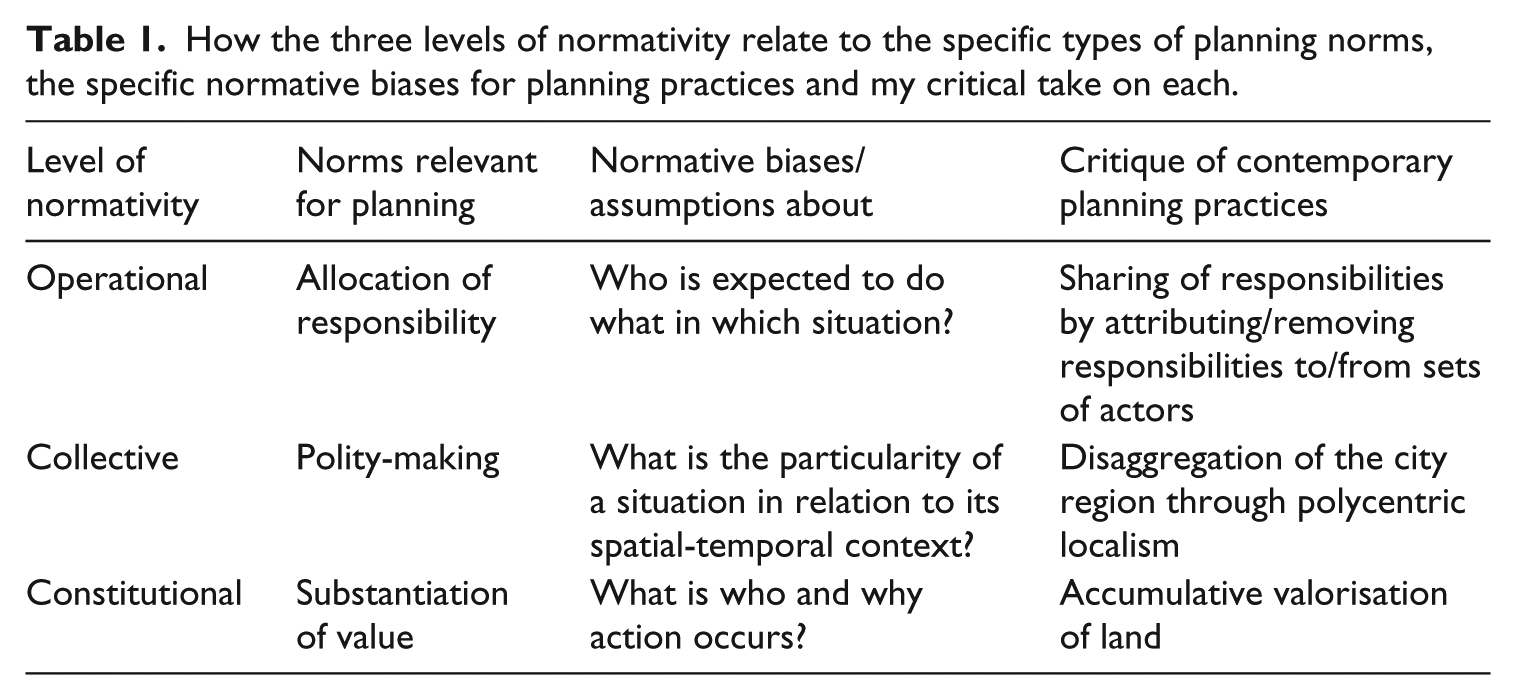
Institutionalist planning analysis is well equipped to critically reflect on the innovative and transformative nature of concrete planning practices. However, this article recognises that the underlying norms that are guiding these practices need to be carefully addressed to be explicit on the novelty of emergent planning practices and on the political biases of innovation. My first methodological point is that norms are of different types and simultaneously coexist within (and are enacted by) each specific practice, of different kinds and scales. Norms can be instead distinguished in terms of levels of normativity, which is the extent to which a particular norm is enacted in different practices across time and space. Second, norms need to be understood as ontologically nested because the change of some norms may instigate the change of others. Planning reproduces norms that define (a) how responsibility is allocated in a particular practice, (b) the way spatio-temporal relations between practices are understood and produced and (c) the assumptions that a practice carried about the substantive meaning of value and interest. Finally, I offered a possible way to use this analytical framework to critically reflect a multiplicity of contemporary practices. Table 1 provides an overview of the argument.
How the three levels of normativity relate to the specific types of planning norms, the specific normative biases for planning practices and my critical take on each.
Norms of responsibility allocation, polity formation and valorisation are nested into each other, and they can affect each other in multiple directions. Changes at the operational level of normativity impact on the way agents understand the relation between their collective action and that of others, across space and across time. These different meanings of polities may contribute to build a different idea of value, institutionalised in an alternative, more inclusive, definition of stakeholders. Institutional change can generate from each of these levels, it does not exclusively or necessarily start from the change of constitutional norms of value accumulation. By enacting new allocations of responsibilities, planning practices may enact the first steps in contesting the principles of value accumulation, instigating a reform of the key institutions of contemporary capitalism. Importantly, the dynamic change of norms inevitably generates conflicts and frictions, occurring whenever there is a mismatch between existent institutions and emerging practices. These conflicts are nonetheless productive of new institutional orders, making explicit the limitations that consolidated institutions poses for innovative practices. For example, we can expect that the way waste is re-categorised and revalued in light of a circular approach to urban development will impact on the regulations that determine the responsibility of individuals as producers of resources through their waste disposal practices. This process of responsibilisation may enlarge the range of stakeholders relevant for the planning of waste infrastructures. Similarly, the crystallisation of a global polity through international agreements is the fundamental condition to recognise those countries that are mostly affected by climate change as legitimate stakeholders in the global environmental policy process.
The norms discussed in this article are interdependent: each of them provides the normative conditions that re-produce, or contest, the others. These relations occur within each practice. When norms are institutionalised, they turn into normative frames of references for the way others norms are enacted and reproduced in each practice. This explains why it is, after all, so hard to radically rethink ideas of value, responsibility or regions in contemporary planning. Planners need to question their normative assumptions about valorisation, if they wish to be able to reconfigure the way responsibilities are redistributed or to mobilise different ideas of collectivity. The task of institutional planning research (and action) lies therefore in engaging with and nurturing practices that attempt to change operational, collective and constitutional norms. These are the practices that by changing the operational or collective norms of contemporary capitalism do indent the constitutional norms of accumulative valorisation. The first way to do so is to make explicit the underlying assumptions of these practices, the inherent understanding of who is legitimate to do what and how other actors may be excluded from planning processes.
The institutionalist approach to planning should be neither deterministic nor subjectivist. This framework does recognise that institutionalised norms are durable in time and provide normative biases (that are therefore purely political) for interventions in space. It also recognises the fact that spatio-temporally specific operational practices, which attempt to rethink urban relations, can be disruptive of the established constitutional norms of valorisation. Because constitutional norms are those that impinge on a large number of practices in space and time, change is more likely to happen when there is a critical mass of practices that propose a different idea of value. However, apparently innovative practices may in fact be just a different manifestation of the same institutional order, depending on the level of focus. In practice, it is possible to see many practices that follow different operational norms, organising responsibility in a new way, giving roles to new actors; collective norms also appear to change in some cases, with different polities being institutionalised, like local political communities. However, the constitutional norms of the accumulative valorisation of land often remain intact, with apparently innovative practices (re)producing accumulation, yet in different fashions and settings.
This view suggests a more optimistic story as well: operational practices that try to shift responsibilities may contain the first seeds of constitutional change, providing experimental test-beds for institutional (or social) innovation. The process of placing responsibility upon different actors may provide an input to redefine how practices impact on others, slowly eroding the principles of neo-communitarianism that fragment urban spaces. This process may finally encapsulate a different understanding of value, beyond an accumulative logic, and allow for new demands and claims to be included in processes of policy-making. There are many emerging examples of this transformative institutional thinking, linking to ideas of post-capitalism, de-growth or urban economies of reciprocity. These ideas suggest that it is possible to emancipate planning from the ubiquitous norm of accumulation of value, building on different constitutional norms such as solidarity or reciprocity. New constitutional norms entail different collective and operational norms. These could include attributing responsibility and resources to cooperative non-for-profit agencies, sharing responsibilities through land commoning, establishing policies that recognise and promote sufficiency-oriented lifestyles, integrating redistributive justice as the element of valorisation of land and imposing a different regionalisation of economic systems based on redistribution and sharing rather than accumulation and growth (Krueger et al., 2017).
This article advances that an embryo of social change can be contained within a broad variety of practices that may take place globally or locally, and are more or less insurgent and radical. Any emergent practice may entail alternative ideas of collectivity, responsibility or value, which sketch the first elements of a different social order. Planning research and practice need to keep an open-minded eye on the world, observing and discovering the inner logic of a large variety of urban practices occurring every day.
Footnotes
Acknowledgements
The author would like to thank Willem Salet, Miriam Meissner, Maria Kaika, Luca Bertolini, Beatriz Pineda Revilla, Mendel Giezen and the three anonymous reviewers for kindly giving comments to earlier versions of the paper.
Funding
The author(s) received no financial support for the research, authorship, and/or publication of this article.