




Abstract
There has been a recent growth in interest within planning theory in Actor–Network Theory. This article explores the potential for Actor–Network Theory to deliver a distinctive perspective on planning practice. Using a case study of commercial office development and the discussion of its carbon performance within the regulatory planning process, an Actor–Network Theory–based analysis is provided. The analysis points to the role of planning policy documents as intermediaries, the planning consent process as an obligatory passage point and energy-modelling exercises as potentially black-boxing low-carbon development. It also emphasises how materiality of the development embodies compliance with policy through the construction and warranting of evidence claims. In all these ways, the relationships between actants within networks are shaped. The practice-based conclusions draw attention to the importance of planners devising highly detailed and carefully worded plan policies, and understanding and being able to challenge the knowledge derived from energy-modelling tools as ways of developing agency to influence the outcomes of planning practice. Such agency is revealed by an Actor–Network Theory analysis to be small work in local sites of practice but set against the backdrop of regulatory regimes.
Introduction
The latter part of the twentieth century saw the planning community coming to terms with the failure of a modernist, linear model of planning in which the planner planned, based on expertise, which was limited to accredited individuals and collective professions and organisations. The key recognition has been that many different voices, across the public and private sectors but also in civil society, need to be included in the planning enterprise for effective action. This is particularly the case if the most deprived and powerless groups in society are to benefit from planning outcomes. This thread of planning theory has provided a rich vein of understanding on how to rethink planning in terms of relationships between people and organisations and how to manage those relationships collaboratively (Healey, 2007; Innes and Booher, 2010). Critiques have further deepened our understanding by emphasising the enduring nature of conflicts and power relations within these networks and the deep difficulty of achieving agreement and social redistribution (Bäcklund and Mäntysalo, 2010; Hillier, 2003; Pløger, 2004).
More recently, though, there seems to be a new movement within planning theory and practice. A number of papers have considered Actor–Network Theory (ANT) to be of relevance (Boelens, 2010; Doak and Karadimitriou, 2007; Rydin, 2010a; Webb, 2011). This is partly a response to ongoing debates within social theory over the last two decades (Murdoch, 2007), but it also reflects emerging challenges for planning practice within contemporary technological society (Barry, 2001; Rydin, 2010b). This is posing difficult questions for public policy, particularly in relation to environmental sustainability and climate change, as new forms of socio-technical studies are rapidly emerging. Planning organisations and planners within them are grappling with a new range of issues, new technologies and new sets of knowledge (Davoudi et al., 2009). The focus on new types of technical knowledge within planning domains has given ANT a purchase on planning problems. ANT seems ideally suited to understand a world in which technological systems and environmental change are major preoccupations. With its emphasis on the lack of any boundary between society and technology or between the social and the natural worlds, it has the potential to deliver a theory appropriate for contemporary planning practice for sustainability. It can offer an analytic edge over existing planning theories that only engage with the material and natural world through the values and communicative action of social actors.
This article explores the potential of ANT to understand planning for low-carbon urban development and it does so by taking a specific case study of a commercial office development in central London and its passage through the regulatory process, whereby permission to develop is granted. It begins by outlining the essential elements of an ANT approach and then uses the case study to provide an ANT analysis before drawing out some analytic conclusions and implications for planning practice.
The contribution of ANT to planning theory
ANT arose out of the sociology of scientific knowledge of the late twentieth century, which was taking onboard the insights of the discursive turn and a social constructivist perspective on knowledge claims but struggling with the question of whether this suggested that physical materiality had any reality or not. In response, ANT sought to understand how social and material elements – mutually termed actants – associate with each other to produce our scientific knowledge of the world through mutual processes of social construction and material resistance. This has been generalised into a sociological (or associological, as Latour (2005) would like to term it) method, in which the world is assembled from the association of actants. It is based on three central principles of radical relationality between elements, generalised symmetry (between social and material actants) and the importance of association between these actants as a way of achieving change (Farias, 2009: 3).
ANT is concerned with networks, specifically heterogeneous networks that encompass the technological, the social, the economic and the political (although much of the use of ANT in socio-technical studies concentrates on the interplay between social and technological dimensions; Guy and Moore, 2005). Latour (2005) has clarified that, in ANT terms, the network is a method not a thing ‘out there’ to be discovered. An ANT account is based on understanding the dynamic ways in which relationships between actants are forged, negotiated and maintained. Indeed, Latour rather regretted the use of the network metaphor because it tends to suggest stability rather than flux (Law and Mol, 2001: 612–613). He favoured a commitment to fluidity in relations and to ‘uncertainties, ambivalences, transgressions and resistances’ (Murdoch, 1998: 364). As Callon (1989) says, the actor network should not … be confused with a network linking in some predictable fashion elements that are perfectly well defined and stable, for the entities it is composed of, whether natural or social, could at any moment redefine their identity and mutual relationship. (p. 93)
This makes ANT particularly helpful in studying moments of controversy (Venturini, 2009, 2010) and societal shift.
However, controversies and shifts can only be seen as such against the backdrop of a degree of stability for some period of time. Thus, ANT theorists have also been interested in how ‘socio-material relations are arranged into orders and hierarchies’ (Murdoch, 1998: 359) and how (temporarily) stable relationships can deliver action. This is not to look only for the ‘perfectly well defined and stable’ (Callon, 1989) but rather to consider networks of relationships as either more or less stable, more or less fluid (Murdoch, 1998, 2007). Murdoch (1998) sees heuristic value in analysing ‘stable sets of relations or associations as the means by which the world is both built and stratified’ (p. 364, emphasis added) and thus proposes analysis of two different types of network or, indeed, two different aspects of the same network:
Stabilised, working in unison, with strong common norms and where the centre can speak for the whole network; and
Provisional, with divergent actors where standards are frequently compromised and components are continually renegotiating with each other.
Murdoch (1998) further argues that it is the mix of the social and the material that allows networks to endure and be stable over time and space, to become structural: ‘materials solidify social relations’ (p. 360). While recognising that ‘modes of ordering are never complete, closed totalities’ (p. 364), Murdoch nevertheless argues that it is through some stability of relations that action is transmitted (p. 361).
Since action, therefore, arises from the forming of (temporarily) stable links within networks, the work involved in creating such links is important. As Latour (2004) states, ‘Being connected, being interconnected, being heterogeneous, is not enough … really, we should say “worknet” instead of “network”. It’s the work … that should be stressed’ (p. 63). A variety of concepts are used to discuss this work within ANT. For example, translation refers to the ways in which agency is negotiated, wherein identities are fought over, roles ascribed and power relations fixed (Tait and Jenson, 2007). It can be unpacked into stages of problematisation, interessement, enrolment and mobilisation (Rodgers et al., 2009). Problematisation describes the process of framing the problem, a key aspect of which can be the definition of obligatory passage points. In obligatory passage points, actants are required to come together around the dominant framing and then engage in specific negotiations within the context of such framing. A specific actant may be implicated in the definition of this obligatory passage point and, as part of interessement, become accepted as a focal actant.
Enrolling is a particularly interesting process by which actants constitute other actants in their own agency, that is, involving them in network relationships on specific terms. Relationships between actants are further defined by intermediaries passing between them (Callon, 1991: 134); such intermediaries can take a variety of forms including literary inscriptions, technical artefacts and money. The term mediator is sometimes used instead of intermediary to distinguish between the more neutral transference implied by being an intermediary and the more unpredictable activities of a mediator (Latour, 2005). Certainly enrolling actants in networks is not neutral work. It results in the enrolling actant setting parameters for the agency of others; it may involve actants following given scripts set by others. The power flows involved in such network relations are clear (McGuirk, 2000). Potentially they enable governing from a distance (to borrow a term from Foucauldian analysis; Murdoch, 2007; Rose and Miller, 1992; Rydin, 2007).
Within the flux of such work in networks/worknets, a degree of stability is also often fostered by processes of calculation, classification and standardisation. However, these processes, and their complexities, assumptions and uncertainties, are often hidden within ‘black boxes’ (Callon et al., 2009). Such black-boxing resists the opening up of calculative processes to negotiation. Rather, they create areas within networks where relationships between actants are ‘taken for granted’ and unchallenged. As will be discussed below, this can be a step towards creating mobile exemplars of ‘good’ practice that can be applied in multiple locations.
There is a growing body of work using such ANT concepts to understand urban development, looking at architectural practice (Yaneva, 2009) but also broader urban change (Jacobs et al., 2007; Latour and Hermant, 2006; McGuirk, 2000; Zitouni, 2010). But what is the role of planners and planning processes from such an analytic perspective? ANT-inspired analyses vary in how they see human agency. Some effectively collapse the material into the social by arguing that it is only through human agency that material elements are able to engage in social processes such as planning (see the Actor Relational Approach of Boelens, 2010). Alternatively, a more postmodern sensibility could be argued to involve collapsing the social-material divide so far as to make the question of planners’ specific agency moot. The approach adopted here is to see planners’ agency as one small element within the assemblages of urban development (Doak and Karadimitriou, 2007; Farias, 2009; Marvin and Graham, 2001). Doak and Karadimitriou (2007) characterise urban (re)development as fluid assemblages, ‘as heterogenous collectivities of people and things, relationally tied to each other over time and space’ (p. 221). Planning actors can seek to exercise reflection, intentionality and negotiation in order to shift development outcomes but do so within the associative networks linking the social and the material and thus in the face of material agency also. This will be ‘small work’; Latour sees assemblage as building up from the very small (Latour, 2005: 15), what Farias terms ‘myriads of small, lateral and almost peripheral changes, petty movement and subtle displacements’ (2009: 1), ‘differently enacted at multiple sites’ (2009: 6). As Farias puts it, ‘ANT destabilizes the autonomy and explanatory priority attributed to space … substituting the key notion of sites in plural for it.’ (2009: 6). Again, Latour uses the metaphor of a dance to describe the process; when the movement stops, the dance ends but, of course, the actants have been changed (2005: 37). The dance of planning practice is thus about working with actants (social and material) in a variety of small ways, using intermediaries to bring actants into relationships with each other so that traceable associations and resultant action can be generated but in the knowledge that many other associations are also at work. This is a fundamentally distributed form of planning practice. The final section of the paper returns to this view of the role of the planner using reflections from the case study of urban development.
Methodology for case study
The article now turns to the case study of a commercial office development in central London and the associated networks as they emerged during the planning application stage. To render the case study manageable and to highlight the implications of a concern with the material aspects of planning for office development, the focus of the analysis is on how planning networks during regulation, understood from an ANT perspective, engaged with the energy consumption and associated carbon emissions from the development, that is, on only a part of the planning–development interactions, although an important part from the climate change perspective.
The methodology for the case study was based on document analysis, a site visit and discussions with British Land’s sustainability officer, two architects from Arup Associates and the developer’s planning consultant, all undertaken during 2010–2011. The documents analysed included the Mayor’s London Plan, the Greater London Authority’s (GLA) Supplementary Planning Guidance on Sustainable Design and Construction, the Unitary Development Plan for London Borough of Islington (LBI), the planning application files, and the Sustainability Statement (including the Energy Statement) submitted by the developer and supplementary documentation (Arup Associates, 2010; Ove Arup & Ptnrs Ltd, 2006). The method of document analysis was close reading, based on ANT concepts.
The evidence of the relationships between actants was drawn from the author’s interpretation of the full range of case study material. This has been used to support an analysis using ANT concepts but the relationships have also been illustrated using social network analysis software (UCINET). The intention is not to provide a social network analysis per se (which would clearly be at odds with the ANT framework) but to use it to map the relationships illustratively and provocatively. Latour and colleagues are using similar mapping techniques in their Mapping Controversies project (www.mappingcontroversies.net), and in a commentary on this project, Venturini argues (2010), ‘What would be the interest of such a method if it could just deliver a reproduction of the observed phenomena? To be of any use, social maps have to be less confused and convoluted than collective disputes. They cannot just mirror the complexity of controversies: they have to make such complexity legible’ (p. 2). This can be read as support for the pragmatic use of such network mapping on the understanding that it does not in any way substitute for a broader ANT analysis.
The next section briefly introduces the key features of this case study, including the illustration of networks using UCINET before going on to provide an ANT analysis of the dynamics of relationships within those networks.
Low-carbon commercial development: the case of 25 Ropemaker Place, London
The building ‘25 Ropemaker Place’ (Picture 1) is a 21-storey commercial development in the central financial area of London, adjacent to the postwar Barbican estate and just north of the Bank of England, the symbolic and physical heart of the City of London. It lies just outside the boundary of the Corporation of the City of London and inside the jurisdiction of the LBI; both authorities are within the GLA, led by the Mayor of London. The building was designed for the UK property company British Land by Arup Associates on a 0.5 ha site acquired by British Land in April 2006. The development team was quite small with a specialist landscape architect and colour glass consultant supplementing the project manager (with in-house quantity surveyor) and Arup Associates. The building was completed in May 2009 as a shell-and-core ready for fit-out by multiple tenants. It originally provided a total of 55,000 m2 of net office space with 1,270 m2 of retail at ground floor level; however, the retail component has been slightly reduced to accommodate a specific office tenant. The retail space has, at the time of writing, been let and is occupied. The property is held as a unit trust for British Land through Dominion Trust Ltd.
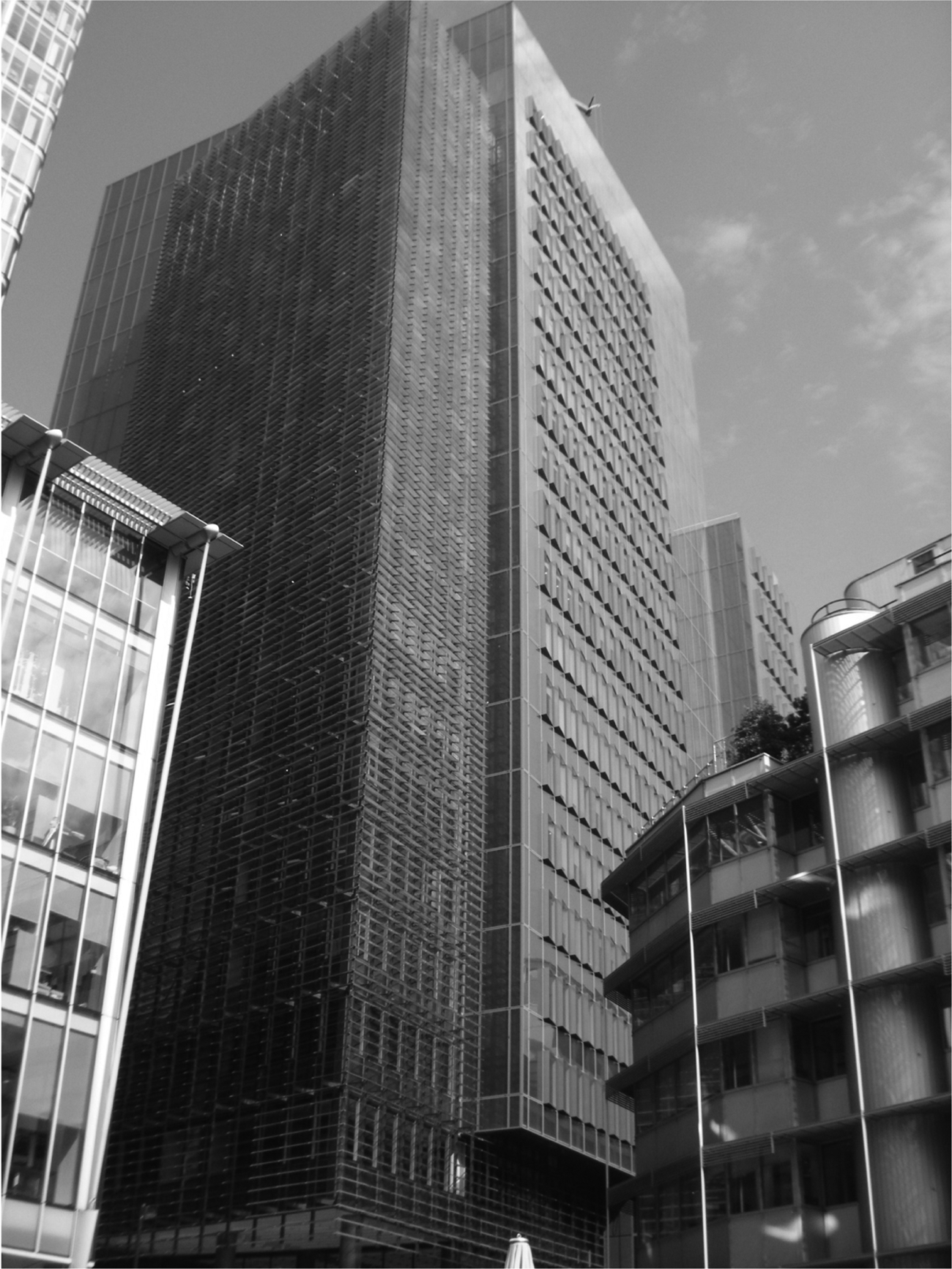
Ropemaker Place, London, EC2.
A standard actor-centred network analysis would focus on the relationships between the key social actors involved in delivering this building. This is illustrated in Figure 1. Apart from drawing connections between the key social actors, Figure 1 illustrates the impact of calculating the centrality score of betweenness to identify the actors who have a more central role within this network. It shows both the complexity of connections between different social actors and the importance of three actors: the architect, the developer and the LBI development control planner (or planners).
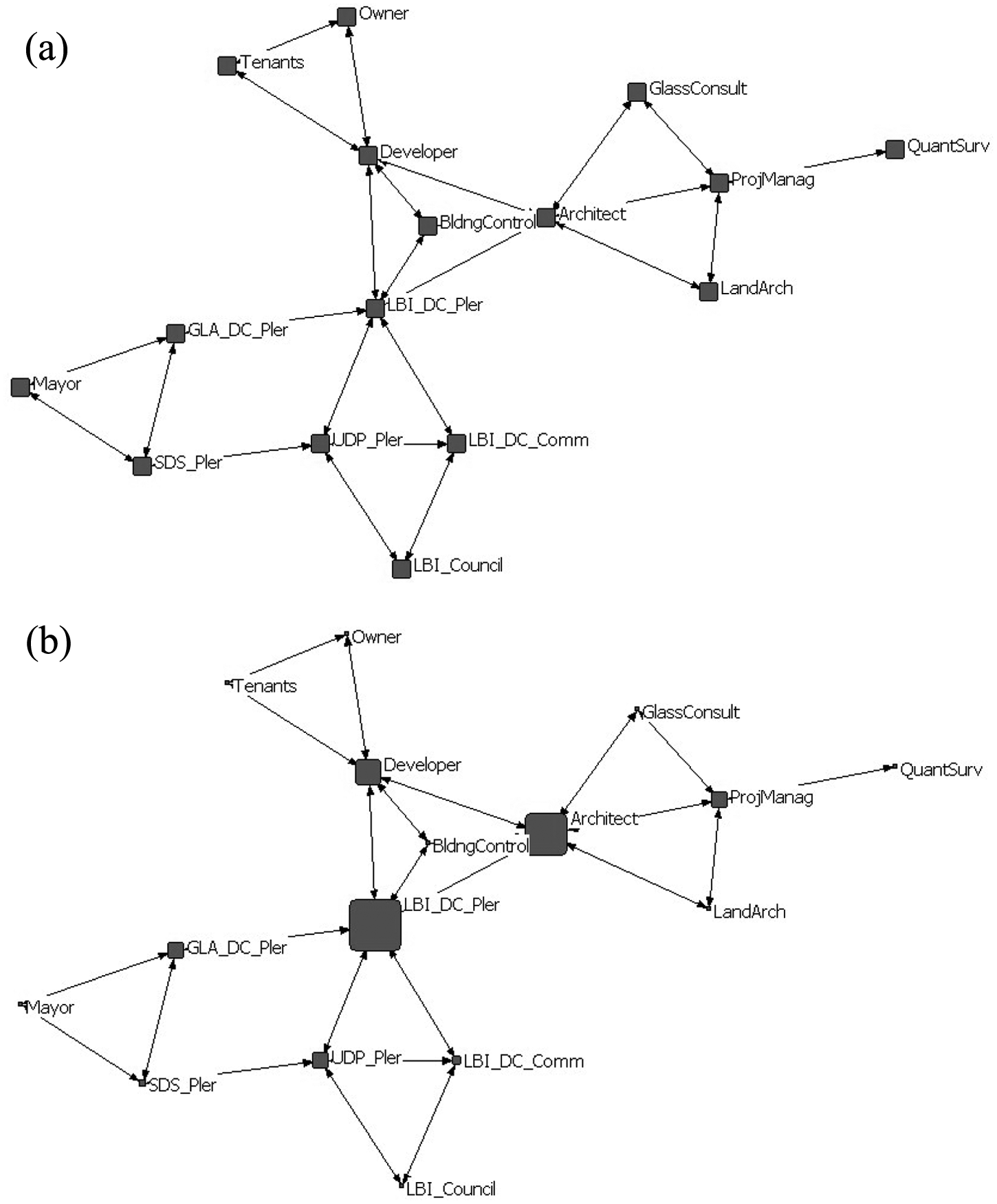
Network of human actors in commercial office development in Ropemaker Place. (a) Base network and (b) nodes weighted by betweenness score for actors.
But, of course, an ANT analysis draws attention to the role of the material world in addition to these social actors. A full ANT analysis of all aspects of the material world relevant to this case would be highly complex; focussing on the energy aspects provides one way into such an analysis. Energy was problematised the key element within planning debates about the sustainability of this development, as evidenced by the self- resentation of the development to the planning system through the planning application. The overall energy strategy for the development is based on three elements: a highly energy efficient building design, extensive heat recovery, and a combination of biomass boiler, solar thermal and photovoltaic systems (PVs) to provide energy from renewable sources.
The energy efficient design focussed on a specially designed facade comprising a series of storey-height insulated cassettes with projecting and tilting visions panels (Picture 2). The units project out and tilt in the vertical axis away from the sun towards the north and in the horizontal axis to the south. This reduces incident solar radiation and solar transmission through the glazing and provides some self-shading. As a result, average annual energy consumption for cooling was claimed to be 13%–27% lesser than with a flat facade depending on the orientation. The southeastern corner of the building has a more conventional treatment with external horizontal glass sunshade louvres to attenuate solar transmission. Areas of the facade without vision panels are covered by insulated glass spandrels with an optical glass colour effect. The entire facade was constructed to high levels of airtightness. A final element of the design contributing to thermal efficiency was the 1850 m2 of green roof terraces on three levels of the building, reducing heat conduction into the offices from the roofs.

The façade of Ropemaker Place.
The second aspect of the strategy is the use of heat recovery. Heat demand is minimised by recovering heat from ventilated air where it is not wanted (principally heat arising from the people in the building and the use of IT equipment) and rerouting it to where it is needed through ‘thermal wheels’. Similarly, free cooling is maximised where possible but standard absorption chillers were also put in place. These systems are themselves described as low-energy utilising technologies such as variable speed water pumps and centrifugal chillers, and low-velocity systems for air units.
Turning to the installation of renewable energy technology, the on-site renewable energy technologies comprise a biomass boiler (in the basement) and 75 m2 of solar hot water and 75 m2 of solar PVs in a roof plant enclosure above the top floor. These are collectively claimed to supply 15%–20% of the building’s energy demand and reduce CO2 emissions by 10%.
To capture the importance of energy-related material actants involved in this development, Figure 2 incorporates key elements of the material world into the social network of Figure 1. As before, the base network of relationships is illustrated but a version where nodes are weighted by the betweenness score of actants is also provided. This highlights the central nexus of the three key social actors – architect, development control planner and, to a lesser extent, developer – and two material actants – energy generating technology and, to an even lesser extent, the built form of the development. The weighted network could be seen as highlighting the actants gathered together within the obligatory passage point of the regulatory planning process.

Network of all actants in commercial office development in Ropemaker Place. (a) Base network and (b) nodes weighted by betweenness score for actants.
However, as emphasised earlier, these network illustrations are just that, illustrative. To understand how the networks are formed, negotiated and potentially stabilised, it is necessary to consider how these actants operate in relation to each other, how they enrol each other into the network and the role that intermediaries play in bringing actants together and defining their relationships. The next section looks at three key aspects: planning policy documents as intermediaries, the planning consent as an obligatory passage point, and the energy-modelling exercises as a form of black-boxing.
Planning policy documents as intermediaries
The material artefacts of the planning policy documents were important intermediaries within the networks surrounding this development. There were three planning documents of relevance to this case study: the LBI’s (2002) Unitary Development Plan, the Mayor’s the London Plan (2006b) and the Mayor’s Supplementary Planning Guidance (SPG) on Sustainable Construction and Design (2006a). While bringing key social actors into association with each other, these documents also contributed to the definition of the relationships between the material elements of the development and these social actors. For example, they were pivotal in connecting the spatial location of the development site with the construct of permitted land uses.
While the LBI, at the time of the research, was adding to its Local Development Framework (a portfolio of plans and statements required by the Planning and Compulsory Purchase Act 2004) at the time of the determination of the planning application on Ropemaker Place, the development plan in force was the 2002 Unitary Development Plan (UDP). This indicated that the use of the site for commercial development was broadly in accordance with the UDP (Policy E1). Similarly, the relevant version of the London Plan was the original 2004 version, as amended by alterations in 2006; a further set of alterations were under discussion but not yet incorporated (Rydin, 2010b). (Since then, with the election of a new Mayor, a replacement London Plan has been produced. Another important subsequent change came with the GLA Act 2007, which introduced a new statutory duty on the GLA to contribute towards the mitigation of, or adaptation to, climate change in the United Kingdom. However, these later elements did not shape the planning networks surrounding Ropemaker Place.) As with the UDP, the zoning of the site for the proposed commercial use was not in question. The site sits within the Central Activities Zone in the London Plan (Map 5B.2) and office development here is supported by Policies 3B.2 and 3B.3. The documents defined the relationship between the spatial materiality of the site and the planning decision-makers in terms of an acceptable land use.
It terms of consideration of energy issues concerning the development, the LBI and GLA planning documents differed greatly. The UDP contained relatively little guidance. There was a brief section (S 3.6) with three main policies: encouraging more energy efficient buildings (Env 30); encouraging the use of renewable energy, district heating and combined heat and power (CHP) (Env 31); and the statement that energy efficiency will be regarded as a material consideration in development control (Env 32). Overall, though this plan was light on content about energy and urban development, it relied explicitly on the London Plan as a reference point.
In contrast, the London Plan (or Mayor’s Spatial Development Strategy) contained considerably more policy guidance. The key sections of the 2006 version of the London Plan were first, the energy hierarchy, and second, Policy 4B.6 on sustainable construction and design; the latter was further amplified in the SPG (Mayor of London, 2006a). The developer explicitly measured the proposals for the development against these elements, with the structure of the submitted Sustainability Statement prepared by Arup following Policy 4B.6 and that of the Energy Statement section therein following the energy hierarchy. The Mayor’s energy hierarchy in 2006 was as follows:
Use Less Energy
Use Renewable Energy
Supply Energy Efficiently
(In the subsequent alternations, the order of the final two elements was reversed with a view to putting more emphasis on CHP and district heating systems.)
Policy 4B.6 set out a range of issues that should be considered from the perspective of sustainability, including the conservation of energy. The SPG then added considerable detail through a matrix of development types set against the Mayor’s essential and preferred standards for inter alia energy features of a development. The specified elements included the following:
Use of external passive solar design and planting to control or reduce summer heating
Use of internal passive solar design to reduce reliance on mechanical cooling systems and to make use of natural ventilation
Improvement of air flow and cooling through
• Heat/space ratio
• Water and groundwater use
• Cooling and mass basement construction
• Borehole cooling and wet underfloor cooling
Maximum use of energy efficiency techniques
• A hierarchy of possible techniques is provided
• A 10% reduction of carbon emissions through use of on-site renewable is required
• Installation of PVs or the ability to retrofit PVs is required
While providing considerable details on technological options, the SPG required the developers to submit an energy strategy. Importantly, it was stated that this strategy should investigate the technical and economic feasibility of the specified technologies listed in the London Plan. Furthermore, it should assess the likely heat and electricity demand and carbon emissions associated with the development, determine the percentage of reductions due to energy efficiency measures or renewable energy technologies, and select the scheme’s heating system in line with the Mayor’s hierarchy. Specific means of modelling these aspects were suggested.
The key aspect of these GLA planning documents as intermediaries was the considerable level of detail within policies. This defined the relationship between the GLA and LBI in terms of plan-making and allowed the latter to rely on the former or, to put it another way, allowed the GLA policy planners to shape the agency of LBI policy planners on this matter. The level of detail further provides support to the LBI planners involved in development control (i.e. the grant of consent to develop). The LBI development control planners could refer to and, again, rely on the London Plan and the SPG. Thus in both plan-making and planning regulation, the GLA were enrolling the LBI planners to act on their behalf, achieving governing at a distance from the City Hall through the reach of these very detailed GLA policies. The policy documents thus acted to define the relationships between these social actors; it is when the planning consent process is considered that the importance of material actants really comes to the fore.
The planning consent process as an obligatory passage point
The planning consent process ties together the social actors in the form of the developer, the architect and the LBI development control planners, but it further involves actants such as the site, the physical form of the development, the energy generation technology adopted within the development and potentially the district heating infrastructure (this last element notable by its absence in the case study locality). It thus acts as an obligatory passage point, marshalling actants into a sub-network for detailed negotiation work. The key question is which of these actants is enrolling the others within this network? Who is the focal actant?
Given the backdrop of regulatory power within the planning consent process, it might be tempting to see power as residing in the discretion of the GLA and LBI planners to shape the relationships. For example, a traditional account of decision-making around planning consent would focus on the GLA’s power to direct the refusal of planning consent for strategic developments of this kind. Because of this power, once the planning application was submitted in late 2006, it was passed to the GLA. In January 2007, the Mayor advised LBI that the proposal was broadly satisfactory in principle and, in March, when Islington stated they were minded to approve the scheme, the GLA said they did not intend to direct refusal. (Since then, the Mayor has also acquired the power to direct approval of planning consent for such developments.) Similarly, the discretion of the LBI development planners in negotiating with the developer over planning gain would be seen as a significant marker of the power of planners. Here, the LBI planners negotiated a S. 106 agreement for over £3.2 million of planning gain for streetscape and environment improvements, transport contribution to Transport for London, employment and training opportunities and affordable housing (to be provided off-site).
These are clearly important aspects of the planning networks, identifying how regulatory resources and money act as intermediaries between social actors. But the ANT analysis also emphasises the role of material actants connected into the network at this point. Here, the ability of such actants to embody compliance with planning policy is the key feature, an ability, which is dependent on their materiality and the co-construction of knowledge claims through discourses of evidence, and the resistance of this materiality to certain discursive claims.
For example, as discussed earlier, the site by virtue of its physical location conformed to the zoning in both the London Plan and the UDP. Furthermore, the site already ‘held’ a valid planning consent arising out of its established use and prior consents to develop the site. The building that previously occupied the site was permitted in 1985, and in addition, planning permission was granted in 2004 for a smaller office development although this was never implemented. The site, thus, through the intermediary of the pre-existing planning consent, was the spatial material expression of a valid land use.
The development form and proposed energy generation technology also embodied compliance with key policies and hence eased the process of granting planning consent. As indicated earlier, the developer submitted documentation with the planning application that described features of the development under the headings of the Mayor’s energy hierarchy and Policy 4B.A. The development control documentation acted as an intermediary between the LBI planners and the physical materiality of the development, describing the latter in discursive terms. Because of the claims made by this documentation for the compliance of that physical materiality with planning policy, the development – its form, design and technology – came to embody sustainability. The physical actant of the development and its constituent parts were the key enrolling elements in this network. It is not the regulatory power of the planners that shaped and stabilised this network – although that was a significant context – but the embodied power of the development as co-constructed by the claims for sustainability, the warranting of those claims within the regulatory process and the development’s physical materiality.
The importance of these documentary claims for material compliance with sustainability policies is further demonstrated by the argumentation put forward by the developer concerning why certain features had not been incorporated in the development design. In considering whether to exercise its regulatory power to direct refusal, the GLA requested further justification of the case against combined cooling, heating and power (CCHP) and CHP as these had been identified in the SPG as desirable technologies. The developer marshalled evidence about the modelling of heat load within the building: it was estimated that 39% of the final energy demand would be for heating and 61% for hot water. On this basis, it could be argued that because of the reduction in base load due to greater thermal efficiency and the subsequent balance between heating and cooling, CHP and CCHP were not technically feasible. The nature of the energy demand within the building and the high electrical demand from users of the building was also used to justify the decision not to aim for a zero-emissions development (ZED) even though the London Plan was seeking one ZED in each local authority in London. The materiality of the development was used to justify the level of compliance with planning policy; materiality and discursive claim, brought together within this obligatory passage point, both shaped action within the network in terms of permitting development to proceed.
Similarly, with regard to renewable energy options, it was argued that space heating would only be required for short periods in the day during the winter time due to the thermal efficiency of the design. Meanwhile, water heating requires high grade heat, and this limits the renewable options that can be used. Borehole and ground source heat pump technologies were rejected due to the use of a raft foundation in the development. Energy generation from PVs was constrained by the shadowing from surrounding buildings and the small surface-area-to-volume ratio of the building. Wind was considered unsuitable due to local turbulence. The materiality of the building and its surroundings determined the way in which the building could be claimed to comply with renewable energy policies.
Biomass and biofuel systems were identified in the development control documentation as the most desirable means of complying with the requirement, following the London Plan, that 10% of the energy needs of the building should be met by on-site renewables (the so-called Merton Rule). Here, the GLA requested further evidence concerning details of the supply chain and maintenance logistics. Information was proffered and accepted on the supply of wood pellets for the biomass boiler. The use of liquid biofuel was only proposed during periods of peak demand, but the GLA argued that the market for liquid biofuel was not well developed and supply could not be assured. The ability of biofuels to substitute for wood pellets was not resolved; it was left to the LBI planners to emphasise their wish to ensure that liquid biofuel be supplied sustainably. Here, where it was not possible to argue from the development’s materiality about the compliance with the policy, the emphasis instead moved to issues of economics, the supply chain and market processes and it was left to the intentionality of the LBI planners to ensure compliance. This, however, was the exception within the network defined by the planning consent, where the co-constructed materiality of the site generally embodied policy compliance.
The ways in which the social actors engaged physically with the materiality of the development are interesting. Site visits were a key element of the interaction between the developer’s representatives, the architects and the LBI planners and the material environment, mainly to consider the impact of the proposed building on the locality in terms of height and massing. The colour of the facade was also resolved by planners and developers physically engaging with glass samples, in this case, on the street outside the planning office, to test the effect of weather conditions. Many of the energy aspects of the development were resolved by visits by the architects to loci of best practice elsewhere and to a test site for the innovative facade units in Germany. But often the engagement was not direct in this way but mediated by plans, photos and images. These were used to assess the impact of the development on views from different vantage points, and they retain a physical presence in the planning file unlike the more ephemeral site visits (see also Latour and Yaneva, 2008, on the role of drawings in architectural practice).
The role of energy-modelling exercises in black-boxing
The above discussion has emphasised the importance of evidence about the material performance of the development in claiming compliance with plan policies, enabling the development form and energy technologies to perform key enrolling functions within the network. Central to this evidence is the role of energy modelling. Such modelling co-constructed the energy performance of the development through the engagement of quantitative and qualitative discourses with the material form of the development. The resulting knowledge claims defined the sustainability and hence the policy compliance of the development. Many of these energy-modelling exercises became black-boxed, losing any transparency as to how the modelling process worked in the emphasis on a singular outcome. Such black boxes fulfil important functions within networks of urban development. In their study of the erection and demolition of the Red Road high-rise flats in Glasgow, Jacobs et al. (2007) describe black boxes as consigning the turbulence of their invention to history in order to stabilise their mutability. This done, a black box can grow in status and become part of the collective ‘taken for granted’. It can become mobile so that ‘a diverse range of end-users readily accept and deploy it unquestioningly’ (p. 614). There were a range of energy-modelling calculative practices that potentially constituted such black boxes in the Ropemaker Place case.
One example is the Standard Assessment Procedure (SAP) used to support the consenting of more technical aspects of the design and construction through the Building Regulations; this supplements the granting of planning consent, which gives permission to develop the site. Development control and building regulations have traditionally been seen as quite distinct areas of regulation, each with their own professional remit. However, the growing emphasis on energy use (and other sustainability issues such as noise and water use) has brought planning and building consent regimes into overlap with each other. Within the planning consenting process, Building Regulations get referred to as a benchmark against which performance of the designed building’s fabric can be judged. Hence, in this case, it was repeatedly mentioned as a positive feature of the development that Building Regulation standards were being exceeded. For example, the use of a double pressure gasket line in the window units was stated as reducing air leakage to half that required under Building Regulations. Again, the building was described as being designed to achieve a 32.7% improvement over Part L of the Building Regulations 2006 concerned with energy efficiency.
However, other modelling tools were also used. This included Arup’s own copyrighted SPeAR© sustainability tool, but the more significant intermediaries were the energy-modelling calculations offered by the London Renewables Toolkit, recommended in the GLA’s SPG, and the independent dynamic thermal simulation, offered by the architects. Here, the two tools offered different figures for the development’s energy consumption. Under the London Renewables Toolkit, total energy consumption was calculated at just over 18 million kWh/year. The dynamic thermal simulation produced a figure of only 8 million kWh/year. The lower figure was claimed as the more accurate representation of the building’s performance and the acceptance of this as factual knowledge was important in supporting the developer’s arguments about the sustainability of the development. Bearing in mind that policy compliance would be measured by 10% reduction in carbon emissions from on-site renewables, this modelling ‘found’
energy reductions from ground-linked heat pump of 6.7%, bio-fuel boilers of 12.4%, solar water heating of 1.3% and PVs of 0.2%, giving a total of 20.6% energy; and
CO2 reductions of 1.4%, 8.2%, 0.8% and 0.3%, respectively, giving a total of 10.7%.
The recognition that the building form did not determine energy consumption in use and that such modelling was thus inevitably limited was mentioned only three times in the planning consent documentation. First, there was an acknowledgement that the use of low-energy cooling systems such as passive chilled beams or chilled ceilings was the responsibility of the tenant not the developer. In a core and shell development, it is up to the tenant to decide on the fit-out of the offices, including the specific facilities and management system to be adopted and which aspects of the energy system to hook up to. Second, it was briefly identified that there were arrangements for sub-metering for each tenant and each floor. Third, mention of the intention of the developer to engage tenants in a low-carbon facilities and the management approach was made within the Energy Strategy. Fundamentally, there is a lack of control on the part of the developer (and hence a planning system focussed on permitting the physical development) over the energy consumption by tenants of the building, but this issue was glossed over by reliance on the modelling of energy performance of the development as an isolated material entity. Since the building form and energy technology were key enrolling actants, the agency of these social actors – the tenants – was largely ignored.
Finally, there was repeated reference to modelling tools that wrap up building performance into a single label. These were the BRE Environmental Assessment Method (BREEAM) and its US counterpart, Leadership in Energy and Environmental Design (LEED). This was used repeatedly as a motif descriptor of the development. The developer claimed that, as well as being rated BREEAM ‘Excellent’, Ropemaker Place was the first office building in London to be pre-certified for the US Green Building Council’s LEED ‘Platinum’ Core and Shell rating.
All these calculative exercises suggest efforts at creating black boxes that define a ‘green’ building and prevent further discussion and negotiation over constituent elements of the development, whether it is regarding the adopted energy technology or the activities of occupiers and facility managers. However, this case suggests that black-boxing for low-carbon commercial developments is not yet stabilised and complete. The history of its invention is still happening. In part, this is because of the bespoke nature of such developments that makes black-boxing inherently difficult (Jacobs et al., 2007: 620); in part, it is because the work of stabilising the networks is still ongoing and mutability, negotiation and flux are dominating.
Conclusions for analysis and practice
This ANT-inspired analysis has shown how planning policy documents are important in mediating and defining the relationships between planners, within and across local authorities, here enabling the GLA to govern at a distance (see also Tait, 2010). It has also highlighted the way that, within the planning consent process, the material nature of the development shapes and solidifies network inter-relationships. It has suggested that the embodiment of compliance within the materiality of the development – through its spatial location, the designed form and adopted technology – results in the development acting as the focal point within the planning consent networks. This is shaping agency for sustainability. Key elements of the network dynamics are the detailed nature of planning policies combined with co-constructed evidence about the energy performance of the development. The calculative exercises of energy modelling and associated building classifications contribute to this evidence, but these potential black boxes are not yet closed, and there remains space for negotiation within the networks.
How can this conceptual perspective on a planning case study be related to recommendations for planning practice? The link from planning theory to planning practice has been a rather fraught one. Commentators have long argued that contemporary planning theory fails to offer practical guidance to planners. This is partly because much contemporary planning theory emphasises the ability of planning practitioners to reflect and ‘learn by doing’ (Wenger, 1998). It is therefore relying on the intellectual capacities of planners to do more than follow established pathways, hoping they will see around these pathways and disrupt them. The problem is that the concepts that planning theory offers as aids to such reflection and learning are abstract, generalised and high level; ANT certainly falls into this description. This is not about a gap between theory and practice (because all practice has some theory implicit within it and vice versa). Rather, the problem concerns the disjuncture between the theoretical concepts and the active ability of planners to incorporate these into everyday practice so as to change that practice.
Practicing planners have to operate within the constraints of given institutional contexts, and their practice is framed accordingly. These frames arise from a combination of interests, identity, social situation, institutional setting and the nature of organisational, professional and personal connections. It is important both to understand and accept the self-perceptions of the world within planning practice in order to influence it. Planning theorists often leap straight to triple-loop learning – in which the purpose of the organisational activity is itself reconsidered – rather than accepting that planners mainly have to operate at single and double-loop learning levels, given the nature of their work and the constraints they operate under (Argyris and Schön, 1978). With this in mind, a number of suggestions can be deduced from this ANT-inspired analysis for planning practice.
First, while the analysis has suggested that the materiality of the development results in this actant being the focal point within the network, this is occurring against the backdrop of a regulatory regime for granting planning consent to develop. This is the context within which all association of actants occurs and through which the definition of relationships has implications. A loosening of the regulatory regime would alter the necessity for negotiations between actants in order to deliver change. The importance of planning regulation is sometimes overlooked within contemporary planning theory, and there are strands with the ANT literature that would reinforce the emphasis on collaboration and deliberation, albeit within a world of actants rather than just actors (Callon et al., 2009; Metzger, 2011). This case study suggests that agency concerning more sustainable outcomes needs to be viewed through the lens of an effective regulatory regime.
Second, the ability to shape relationships within the networks of planning regulation has been shown to depend on the role of planning documents as intermediaries and the potential they offer to govern at a distance. But the case study emphasises that their impact depend on the detail of the wording within such documents and the precise words used. While policy makers often see more generalised planning policies as retaining discretion and power for planners, it is suggested here that more detailed policy documents can act to constrain the agency of others. But, of course, not any words will do if a particular outcome is desired by plan-makers. The Merton Rule (mentioned earlier) was a detailed policy that travelled across scales and localities but whose impact on carbon emissions has been called into question (Rydin, 2010c). The wording matters, otherwise compliant development may not deliver the intended results. This is a useful counter-balance to the idea that policies should be a mediated outcome of either the power play or communicative dialogue between stakeholders.
Third, the role of energy modelling in creating evidence claims for the compliance of a development with policies has been emphasised. At present, it seems as if the black box of such calculative exercises is not fully closed, and therefore, the contents are still open to scrutiny and negotiation. However, for their negotiation to be effective, planners have to be able to understand the energy modelling and, if need be, contest the modelling outcomes. This suggests that there is an urgent need to give planners the capacity (or access to the capacity) to challenge such modelling on equal terms with the developer’s consultants. A reluctance to engage in such negotiations among planners may actually hasten the rush towards black-boxing; it may be seen as easier within the planning profession to handle the aggregate categories of BREEAM classifications rather than feel out-of-depth in the realm of building physics. This is understandable but too hasty a reliance on such summary classifications, while simplifying planning practice may limit the ability to deliver on sustainability goals. Keeping the black boxes open and giving planning access to relevant expertise may enhance negotiations for carbon reductions.
Finally, the analysis has touched on one of the key limitations of planning practice where low-carbon developments are concerned. The network involved in the obligatory passing point of the planning consent is a contained one. The full network involved in producing carbon emissions is more extensive. In particular, the engagement of building occupiers and facilities managers with the technology of the building and its energy systems will ultimately determine energy consumption and carbon efficiency. While planning practice has extended its range into new technological areas, it remains limited by its focus on the physical development and the building’s energy performance, rather than the relationships forged by occupiers, users and managers with that materiality. This suggests that there are other networks of actants that need to be considered in producing action for low-carbon commercial development, networks that extend beyond the remit of the planning system.
McGuirk (2000) also found in her Latourian study of planning practice that the ultimate constraints on the power of planners arise from the established institutions of the planning system. She emphasised frameworks of assumptions, limited decision-making, sets of rules, ranges of ideas and access to resources and suggested the need to focus on shifting these. The analysis here agrees that the limitations within the regime of planning regulation constrain outcomes. However, there is perhaps less scope for realignment in the case of local regulation than McGuirk finds within local promotion of urban regeneration. Therefore, change may need to come through embracing a fully Latourian analysis that considers material as well as social actants. This would suggest that building planners’ ability to engage with the materiality of urban development may be the key to enhancing their network power and achieving planning-led change.
Footnotes
Acknowledgements
The author gratefully acknowledges the participants at the seminars at Manchester School of Architecture and the UCL Department of Geography, and the two Planning Theory reviewers for their constructive comments.
Author biography
Yvonne Rydin is Professor of Planning, Environment and Public Policy at University College London’s Bartlett School of Planning and Director of the UCL Environment Institute. She has extensive knowledge of environmental policy, governance and sustainability at the urban level with a particular interest in networks of governing, the role of social capital and the potential for learning to deliver sustainable urban development. Her current EPSRC-funded research is on urban energy initiatives and the built environment. Governing for Sustainable Urban Development (published by Earthscan) and The Purpose of Planning (published by Policy Press) are two of her most recent books.