




Abstract
Creative expression by people living with dementia and their families and carers can improve communication and relationships and strengthen relational personhood. The transition to residential aged care from living at home with dementia is a time of ‘relocation stress”, and a time when additional psychosocial supports like these might be particularly beneficial. This article reports on a qualitative study that explored how a co-operative filmmaking project functioned as a multifaceted psychosocial intervention, and explored its potential impacts on relocation stressors. Methods included interviews with people living with dementia who were involved in the filmmaking, and their families and close others. Staff from a local day centre and residential aged care home also took part in interviews, as did the filmmakers. The researchers also observed some of the filmmaking process. Reflexive thematic analysis techniques were used to generate three key themes in the data: Relationship building; Communicating agency, memento and heart; Being visible and inclusive. The findings reveal challenges regarding privacy and the ethics of public screenings, as well as the pragmatics of using short films as a communication tool in aged care settings. We conclude that filmmaking as a cooperative endeavour holds promise to mitigate relocation stressors by: improving family and other relationships during challenging times for family and for people living with dementia; providing opportunities for new self-narratives derived from relational subjectivities; supporting visibility and personhood; and improving communication once in residential aged care. This research has relevance for communities who are looking to support dynamic personhood and improve the care of people living with dementia.
Keywords
Introduction
Increasingly, the benefits of creative expression through participatory arts for people living with dementia, their family members and carers are being known and appreciated. The participatory arts refer to a broad range of artistic activities (dance, music, visual arts, storytelling) that incorporate active participation – rather than passive reception (Noice et al., 2014; Van de Vyver et al., 2019). Not only has research demonstrated that creative expression benefits cognitive function (Young et al., 2016; Zhao et al., 2021), a range of psychosocial benefits of participatory arts are also evident, and specifically for people living with dementia (Basting, 2018; Guzmán-García et al., 2013; Van de Vyver et al., 2019; Zeilig et al., 2014).
This paper reports on a qualitative evaluation of an Australian participatory, creative filmmaking project. The Moving Story Project took place during 2021–22, when people who were regular clients at a dementia day centre were invited along with their families and close supports to collaborate with a local filmmaker to make short films about their lives. The Moving Story Project aimed to use the filmmaking experience to improve relationships and communication for people living with dementia and families who were preparing for a likely move from home into a residential aged care home. The filmmaker, who also worked at the day centre, spent time getting to know the participants and discussing what they would like to include in the film. He encouraged people to tell him stories about their relationships, their pasts, their home-life and interests. Scripts were not pre-prepared, and the filming took place over a day, in and around people’s homes and at the day centre. were encouraged to express and convey their feelings, emotions and identities, and did not rely on accurate memory or recall or a cohesive narrative (Hydén, 2013; Witham & Haigh, 2018; Zeilig et al., 2014). The 12 finished films were available for participants to watch themselves, share with family and friends, and provide to staff in the residential aged care home should the move eventuate. With permission, some films were made available on the Moving Story website.
The project was designed on the core principles of a dementia inclusive cooperative endeavour (Clarke et al., 2020): co-operative communication, action and care. Following Clarke and colleagues (2020), the co-operative communication approach involved conveying stories and meanings without solely relying on verbal communication. The film production required co-operative actions that were abilities-focussed rather than loss-driven, and the project aimed to inform co-operative care practices that foregrounded relationality. For example, alongside reminiscing over photos, the films also showed the people who were living with dementia dancing or playing music, talking with family, telling jokes and sitting quietly. This co-operative design meant that even when participants living with dementia were experiencing “a disturbance of reflective and decentring functions” (Fuchs, 2020), manifesting as disrupted memory, logic and/or communication, they were afforded the means to convey their dynamic, relational personhood. Kitwood and colleagues (1992) fundamental work on personhood has established subjectivity as an ongoing relational reality, regardless of the cognitive impairments associated with dementia (Fuchs, 2020; Petherbridge, 2019). Providing supports to improve communication and strengthen relationships and relational personhood are particularly important for people living with dementia who are anticipating moving from home into residential aged care.
Transitioning from living at home to residential aged care can be one of the most difficult moves we make; not only for the person moving, but also their families (Smith & Phillipson, 2022). “Relocation stress” is a recognised risk factor for anxiety and depression (Polacsek & Woolford, 2022), and the risk is perhaps greatest for people living with dementia. Mental health conditions like anxiety and depression, and associated symptoms such as agitation and apathy, are commonly experienced by people living with dementia (Leung et al., 2021; Sury et al., 2013), and in Australia people living with dementia now represent an estimated half of the residential aged care population or greater (Australian Institute of Health and Welfare, 2011). Relocation stress can be mitigated by psychosocial support measures such as effective communication, personal control and autonomy, social connectivity, emotional support and maintaining a sense of purpose (Creighton et al., 2018; Polacsek & Woolford, 2022; Sury et al., 2013). However, the symptoms of dementia can sometimes make it difficult to implement effective strategies such as these. For example, people living with dementia are sometimes unable to communicate verbally by the time they move into residential aged care and have withdrawn from socialising. People living with dementia often lack agency at the time of relocation (Smith & Phillipson, 2022).
In this study we recognise these challenges, but also accept dementia as a phenomenon both relational and embodied and a period when “intersubjective or intercorporeal accomplishments” (Petherbridge, 2019) p308) remain possible. There are multiple potential benefits from participation in the arts, however some are more relevant to the common symptoms of dementia and relocation stressors. Evidence demonstrates that creative expression in participatory arts impacts positively on improving communication (Emblad & Mukaetova-Ladinska, 2021; Phillips et al., 2010) and on strengthening relationships and relational personhood (George et al., 2014; Guzmán-García et al., 2013; Zeilig et al., 2014).
This qualitative study explored how the Moving Story co-operative filmmaking storytelling project impacted on psychosocial supports like communication and relationships and relational personhood. By delving into the experiences of those involved with the Moving Story Project – the filmmakers, film stars and film users – our hope was to understand how film as a co-operative endeavour might be a feasible option to improve transition experiences and mitigate potential stressors of relocation to residential aged care. We also were interested in whether some of the project’s secondary aims such as providing a memento for families, improving the public visibility of dementia and creating a resource for care staff, were achieved and the associated impacts. As such, we designed our research around three research questions: • What was the experience of film participants and filmmakers in making the films? • How did care-givers and other staff experience and utilise the completed films? • What benefits/impacts were observed and/or felt from either the process (filmmaking) and/or outcomes (films)?
Methods
This qualitative study design is informed by principles of appreciative enquiry. We designed the research to enable the experiences of people to be integrated with theoretical and academic knowledge to achieve the research aims (Higginbottom & Liamputtong, 2015). We sought to give research participants room to express their existing strengths and positive experiences, as well as any problems or difficulties with the project, and potential solutions (Higginbottom & Liamputtong, 2015). In addition, as researchers working in the field of dementia studies, we accept and value the responsibility to enable participation of people living with dementia to participate (Dewing, 2007; McKeown, Clarke, Ingleton & Repper, 2010; Murphy et al., 2015; Portacolone, Berridge, Johnson, & Schicktanz, 2014). We chose two qualitative methods to achieve this, interviews (individual and group) and participant observation.
Interview participant details.
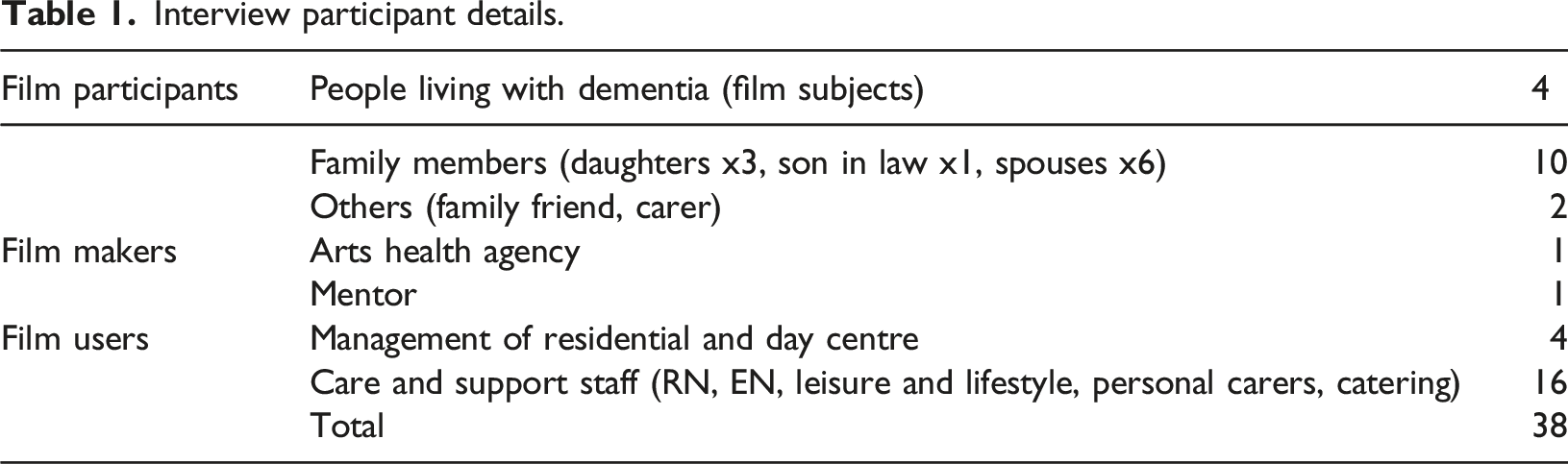
Some of the day centre staff had been part of the development of the Moving Story project idea, engaging clients, and supporting them and their families to participate in the filmmaking and watching the final films. There was some crossover of categories, as some day centre staff were also the subjects of the films, and some worked in a variety of roles across day centre and residential settings.
The majority of data was collected via semi-structured interviews, face to face in people’s homes, via phone or zoom, or onsite in an aged care home. These took place either one-to-one (filmmakers and some family members, senior care staff) or in small groups (day centre and care staff) and lasted between 20 to 90 minutes. Interviews with film participants took place after they had made and viewed the completed film. Film subjects who were living with dementia were given the option to undertake an interview with the support of others, and all four participants took this option (three were living at home and one in residential aged care). Four family members stated that the person living with dementia who was in the film would not be able to participate in an interview (one was living in residential aged care, three at home), and the spouse of one person had died since filming.
In order to enable working care staff to participate within working hours, two researchers [PM and HCP] were onsite for a day and staff came as able in groups of between 2-5 at a time. All interviews followed prompts that were designed to encourage informal conversation on the topic, sharing experiences of the films and ideas for improvements in the processes. In some interviews, the relevant film was rewatched to aid recollection and conversational flow. All interviews were audio recorded and transcribed in full.
The researchers were cognizant of embedding research techniques to mitigate the risk of creating apprehension or anxiety, recommended by leading dementia scholars (Hellström, et al., 2007; McKeown, et al., 2010; Murphy et al., 2015). These included the use of trusted persons in the interview, taking time to build rapport, being conversational and tuning in to bodily cues that might indicate discomfort or ill-at-ease and pausing or discontinuing if necessary. A key element of this approach is the process consent method (Dewing, 2007), which was also implemented. A recent literature review by West, Stuckelberger, Pautex, Staaks and Gysels (2017) found that process consent methods to be considered best practice in dementia research. We reassessed consent continually using these person-centred, relationship-based techniques. Ethics approval was granted by the Human Research Ethics Committee at the University of Tasmania (H26147).
In addition to interviews, data was collected via participant observation of the filmmaking process by one researcher [LW] on two separate occasions. The aim of the observation sessions was to better inform the research team about the process of filmmaking, and to help make sense of the impacts of the project that they heard about during interviews. General field notes were taken immediately after the sessions, noting things such as who was involved, what happened on the day, interactions, and moments thought to be of significance to the project aims. The field notes were not analysed as discrete texts, but were read and considered by the full team by way of informing the analysis of data generated through interviews.
Interview data was analysed using inductive and reflexive thematic analysis techniques (Braun & Clarke, 2019; Creswell, 2014). After each member of the team independently read and coded the units of meaning in each transcript, the team shared the codes, and discussed and reflected on the meanings of the data. During this iterative process, codes were synthesised into thematic categories of meaning and sub-themes.
Findings
Three overarching themes were generated by the data analysis: 1. Relationship building 2. Communicating agency, memento and heart 3. Being visible and inclusive
Participant coding key.
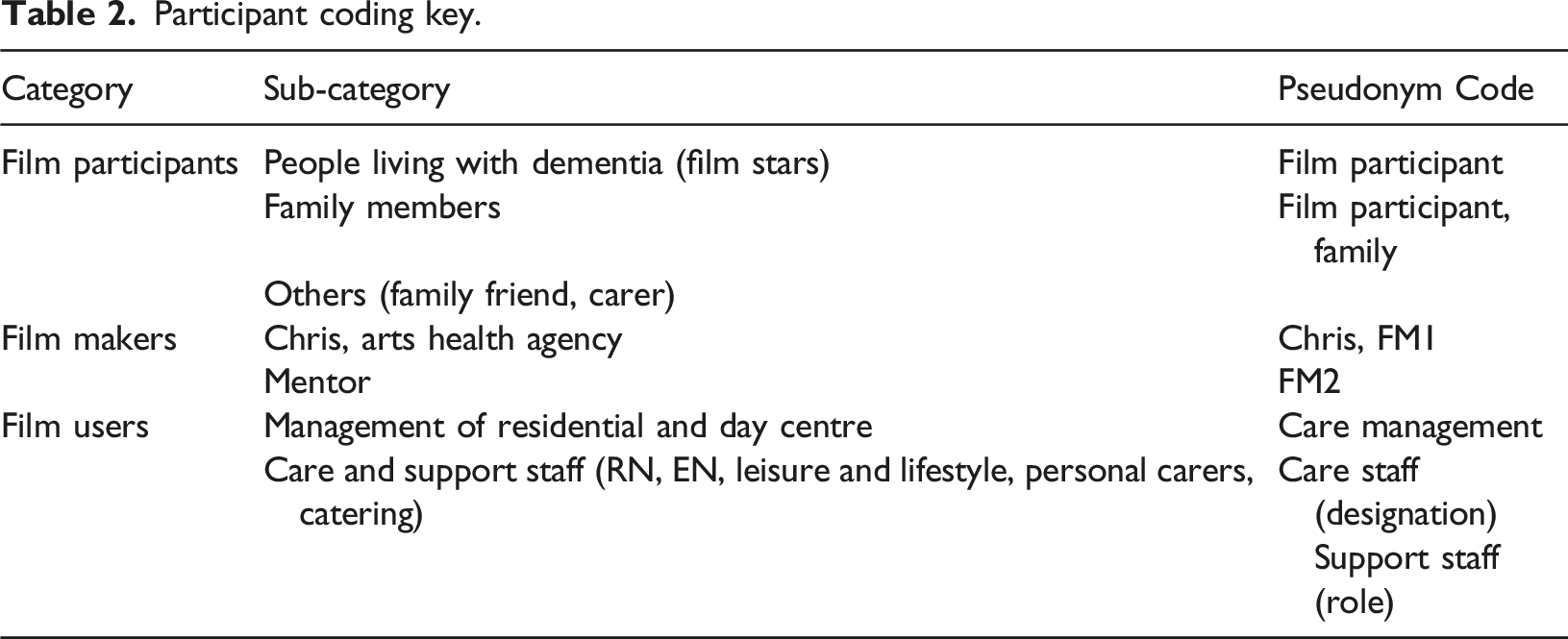
Theme 1. Relationship building
One of the key aims of the Moving Story project was to build relationships though the process of filmmaking and with the finished product. Using a co-production approach, with a very small filmmaking team and minimal equipment, it was hoped that the shared activity would bring people together. Interview participants described the varying ways that the films achieved this – for the person living with dementia, families and staff.
Chris, the filmmaker driving and implementing the project, considered relationship building to have been a successful and important achievement of the project: But very, I guess very early on one thing that really strengthened through the Co-production, I think is, is the idea of trying to seeing a way of how you could improve relationships. And so that was between the families, but also between the care providers as well, for those that transitioned into care. So, so that still feels like, the strongest point of the whole thing is just relationship building. Chris (FM1)
His observation was shared by others, including Daniel who said, “It brings the family together” Daniel (Film Participant).
Making the film often functioned as a shared project for families, that they would not have instigated themselves, and they valued the experience of storytelling and filming together. The process provided people an opportunity to relate in more meaningful and emotional ways. For some, it was a chance to reflect on a person’s life and achievements, which may not otherwise have happened due the stress and busyness of caring: You’re doing, doing, doing. You’re contacting people and organising and all that kind of stuff … I think it was more, sometimes you don’t really think about things until they come out of your mouth. And for me, it was talking about how brave, how brave Mum had been. Hannah (Film Participant, family)
For other family members, filmmaking showed the person living with dementia in ways new and surprising to them: A couple of times I did choke up a bit actually, to be honest, and I don't show emotions. Hearing Mum tell her story, not to me but to Chris and being filmed, it was like watching someone else in a way, because I'm so connected. It became more real. I can't describe it. Ingrid, (Film Participant, family)
The films also gave people to chance to present themselves in positive and life-affirming ways. You’ve got to have really, you know. You can’t take life…, well, you’ve got to take it serious and some aspects of it, but you’ve got to see that there’s a funny side to life. Janelle (Film Participant) And her youngest daughter in particular said to me ‘I wish I’d known that version of Mum’, cos Betty was free of all her hang-ups that had impacted on her life with her children. Aaron (Film Participant, family)
Family acknowledged that their relationships were permeated by strong emotions, including grief and guilt, and these surfaced during the project. Some family members had not watched the film, nor shared it with other family members, because of the sadness they felt with the progression of cognitive decline and the shift in their relationships that had occurred: “I know my son won’t look at it because he’s still grieving” Kelly (Film Participant, family). Others wanted to acknowledge the sadness, and celebrate the process: I get emotional whenever I have to focus on what’s been lost. But you know, for me, that’s no reason to think that there’s not a wonderful process, you know … I wanted to just have the process produce whatever it produced in me and allow that to happen. Aaron (Film Participant, family)
Some relationships between filmmaker and subject were pre-existing, and these served to improve the trust and rapport during the filmmaking. People described how they were happy to be involved because they knew Chris already, and thought that him knowing about their “situation, helped a bit” on the day (Ethel, Film Participant, family). These relationships between filmmaker and families were characterised by care and compassion, which continued through the life of the project, and underpinned the positive impacts of the filmmaking and the films: A lot of people find [dementia] very difficult to talk about, but having someone who is easy, like Chris, to talk to you and make friends with you, which is lovely. He would always go down to see [my husband] when he was in [the day centre]. And having that connection you think, well, he cares. You know, it's the caring part, doing all the films,Kelly (Film Participant, family)
For Care Staff, the film content gave them insight into the various relationships that people had had over their lives. They appreciated seeing the family members, such as “a beautiful wife” and “the grandchildren” Elizabeth (Care staff). One carer remarked, “It’s nice to see what they’re like around their families” Samantha (Care staff). The films helped to build relationships between the new resident and the care staff. The films complemented, extended and augmented the personal information they would otherwise obtain when getting to know a new resident. I like to know what’s the most important thing … we’re trying to find out five things about people that are really important … their family. Most people who’ve had longer standing relationships. [We ask] ‘Who’s their husband, have they got children, was it a dog that was important?’ Julie (Care management)
They provided insights that became conversation starters, aiding communication between staff and residents, and staff and families: Well originally I thought it was just a fantastic idea because a lot of the time, especially here in [the memory support unit], we have new residents come in and we don't have a lot of background and we don't, I guess have the history that the Moving Stories give us, extra history and a better idea about the person, I guess. Which is great for us because it gives us some tips and hints on communicating with that particular person. And what we can talk about? I mean, you don't always get a chance to talk to the families straight away for different reasons. Amanda (Care staff, EN)
Carers described instances when they directly changed the way they cared for the person and their families, as a result of watching the films. Their care became more relational: Yes. So hopefully we can build a big connection, great connection with the family member. Welcome them into what we do. It's hopefully, happier, everybody's happier all round … It gave me an insight to that person to relate immediately, I suppose, when they came in. So I thought ... “Okay. Now this lady's like to garden and this one’s done the shopping and the gentleman's had horses”. So, it was a great insight, to initially the person and to build some sort of small relationship to start with. Krystal (Care staff, lifestyle) One thing I learned from the video, is Laura is a very caring person. She doesn’t eat her meal alone … When she came here we were like: “Why she is not eating?” And then watching that video, I get to know that and now I always tell her Laura: “this one’s for you”. Hillary (Care staff)
Some watched the films multiple times - others, only once. However, it was not always possible to watch the films during working hours, sometimes due to workload pressures, other times due to access to technology, so staff watched them in their own time. Some preferred short films for convenience, others wanted longer films for more detailed information.
One Leisure and Lifestyle coordinator suggested that the films could help to keep people calm, to minimise aggression, because they help care staff to design their care as closely as they can to the life that person lived prior to moving in – daily living activities, likes and dislikes can be accommodated - not so much as a response to aggressive behaviour. One staff member who did use the film for this purpose was positive: I did watch with resident. … We watched together. Callum really enjoy it. He was like, “oh, that's my wife and me”. Hillary (Care staff)
Others could see the potential benefits for residents, but thought that care would need to be taken: If they're agitated, it's something that you could trial and sit down with him and say, look, do you remember this? That's Debbie, this is your backyard. It may have a reverse effect. And so, you'd have to gauge that at the time. Charlotte (Care management)
Staff also identified that there were limitations to the film’s capacity to build relations when it was difficult to view them with residents who had attention and/or comprehension challenges: And then it's still getting them to sit there and watch it for long enough so, they probably look and be like, and just go and do something else. Samantha (Care staff)
Theme 2. communicating agency, memento and heart
People described various aspects of communication that were part of their experiences in the project. These included the opportunity to express agency by people living with dementia, the creation of a memento for families and the conveying of a sense of warmth and caring (heart) that people associated with both the co-operative filmmaking endeavour and the final films that resulted.
The Project gave people the chance to talk about their lives, and share what they valued and found important. While family members in some cases did the bulk of the talking, in others it was the person living with dementia who drove the verbal narrative: Oh yes, I’m not frightened to speak my mind. So you can't please everyone, all of the time. You can only please some people out of the time. And I think you should make your views known. People might not perhaps think of that point that you're making. Yeah, you've got to sort of not be frightened to sort of speak your mind. Janelle (Film Participant)
The films afforded people living with dementia agency, which was noted by many participants, across the stakeholder groups. For care providers it was a welcome addition to the input from families: I think it’d be really good you know to get people perhaps when they first sort of are seeking help for living with dementia. It would be really good to get them at that point when they really are able to verbalise. … Because I mean, what they say is important to them, it mightn’t be what the family thinks is important. Julie (Care management)
One care resident, when asked by staff how he met his wife, replied: “oh haven’t you watched the story?” (Julie, Care Management). Others appreciated hearing the person living with dementia speak for themselves: And the idea that she would be able to introduce herself in that way and have her own voice and not be spoken for or spoken over. I thought it's just amazing and so few people are given that opportunity in our society that she's, you know, that what Chris is doing is actually enabling her to speak for herself. John (Film Participant, family)
So it was the idea of giving Mum her own agency and she felt, you know, she was special. That was a wonderfully exciting thing that someone made a film about her so that was a beautiful gift, in itself. Hannah (Film Participant, family)
One family member made a connection between the affordances of agency and dignity that she observed her mother gain from involvement in the filmmaking: But just giving her agency, I think is so amazing. It’s a gift to that person, as well as the carers, as well as the families. But to her [mostly], for her dignity. Hannah (Film Participant, family)
For family, the films gave them an increased confidence that their loved one would be better known and understood by staff, and also helped to ease some of their fears about relocation: Because that way, it's not so frightening for the families either, if they know that the staff would understand the person a little bit better rather than treating them as a disease I guess, coming in. They’re a real person. Debbie (Film Participant, family)
But Eric, living with dementia, was disappointed in the way he came across and felt that he was a poor communicator: I was just like a dummy on that day. It was, I just repeated myself over and over and over. It was so boring. When I saw it. And then yeah and I thought, God you’re a billy goat. You can think better than that. (Eric, Film Participant)
And Amber acknowledged the difficulty she had communicating, and the challenge this must create for the filmmaker: Must be hard for you though, trying to put people together when they’re all in bits (Amber, Film Participant)
Both Eric and Amber expressed frustration in their changing abilities, made apparent in the film. Eric stated “I can’t predict what I’m going to say sometimes” – and Amber felt a sense off disempowerment: It’s awful because I had really good hearing but now I’m calling people by the wrong name. Hasn’t bought me any good, now has it? Amber (Film Participant)
Most family members had watched their loved one’s film at least once and, in some cases, half a dozen times or more. Another of the aims of the Moving Story Project was to create a visual keepsake for families - which some people really appreciated. Some delighted in having a visual time-capsule for the future: Well, I love that we've got that now to keep forever. Yeah, like it's something nice that we can hang on to. Katie (Film Participant, family) It’s just a precious, precious thing to have… I mean, down the track. You know, umm.. In a hundred years’ time. Look what she did? Look at your great, great grandmother, look what she did, you know? Ingrid (Film Participant, family)
Most of the finished films were viewed by participants in the company of family members after their completion (and in some cases, as a prompt during our interviews). Watching their films back invited a range of responses and emotions. When Daniel watched the film his emotions changed as the film progressed – oscillating between sadness and joy. It sort of makes me a bit sad at times, you know, to think that it's come to this. [Daniel becomes upset]. [To Daniel] You’re alright… don’t get upset… You know, sort of, how emotional he is now, you know, that really upsets me at times. Ethel (Film Participant, family)
During one viewing, one participant began singing along with a performance captured during his time at the day centre. For another participant, the film provided a prompt for reminiscing about her working life, her love of clothes and childhood growing up on an apple orchard. The films provided opportunities for both sad and joyful reminiscences: She got a laugh out of it... She didn't feel insulted by it or embarrassed about it. Frank (Film Participant, family)
So I’ve watched it probably half a dozen times, but it’s still it’s still hard to look at, you know, it’s to go from where he was, the person he was to end up you know, with our songs… I know my son won’t look at it. Because He’s still grieving. And he was so close to George [my husband]. Kelly (Film Participant, family) I was delighted [when I watched the film] … It’ll be sadness for me one day, I’m sure because things will have changed. Hannah (Film Participant, family)
People acknowledged that there were limitations to what a short film could convey about a long life. As Janelle explained: A little snapshot, the best thing really. I mean, nobody's got the time to read read, read, read, read somebody’s life history, have they? They haven’t got the time. I wouldn't have the time to read some… so it doesn't upset me to the fact that other people wouldn't have the time to read my life history. If they knew me very well they might read on but not otherwise. Janelle (Film Participant) And the film just sort of explains a little bit about that person. And its only a little bit, it’s not the whole story. Debbie (Film Participant, family)
There were a couple of instances where family were surprised by the story the finished film portrayed, and in a couple of instances were disappointed: Well, the way I understood it was that the staff at a nursing home or whatever if he was going into care, would look at it and have a bit of understanding of Eric [my husband] as a person. And what his likes and dislikes and that are and yeah, just a little bit of what sort of a background, he’s had, which leads to better understanding. That's what I was hoping and not just for him, but for others in the same situation I was disappointed I thought this has not really captured anything. I think we missed a really good opportunity. That’s how I feel. Fay (Film Participant, family)
Staff in the care home reported they felt they knew the resident better after watching the film. Some used the films to prompts conversation, others changed the way they went about daily tasks of care. The films helped to communicate the new resident with more complexity than their diagnosis indicated: If the people in the different areas where your partner is going look at that, and they can see that it's not just another person with Alzheimer's. This is a person who had a life, who's got a life. Kelly (Film Participant, family)
The moving stories was a way of staff getting to know about the person and the family before they came into permanent care so that we get a feel for that person know what their interests are. I guess know their capability know about the history, I think that’s really important as part of care. Vera (Care management)
From this data, we see how the Moving Story Project films communicated everyday experiences of people in their homes doing things they enjoyed. The filmmaking process gave people living with dementia the chance to speak for themselves, and with agency that they were not always afforded in other parts of their lives. They expressed visually and verbally aspects of their personhood that might have been otherwise unseen or unknown, even to close family members. The films themselves communicated the confidence and dignity that people living with dementia held, and a ‘heart’-felt humanity.
Theme 3. Being visible and inclusive
Interviewees discussed various aspects of the increased visibility that the Moving Story Project afforded those involved in the final film, and the pros and cons they considered to be a result of this. For some, visibility was positively associated with increased opportunities for social inclusion, as the reach of the films extended beyond the immediate family.
By making people living with dementia more visible, on screens, participants hoped that viewers would see past the symptoms of dementia to more nuanced human: Films depict the ongoing contributions people living with dementia make to recording their own history and speaking for themselves. There was hope that through the films that others would look at them and see more about the person they are, rather than what might be their illness or what they can't do anymore. Charlotte (Care management) So, you want to sort of publicize what I do so you can prove that, just because you’re getting older, life doesn’t have to stop. Is that what you’re trying to say? Janelle (Film Participant)
Chris, the filmmaker, felt strongly that the films would not only make people living with dementia more ‘visible’, but also result in dementia itself being better understood. He envisaged a rethinking of ageing, and of the social exclusion that he associated with having dementia:
I wanted to say, this whole thing about films being visible - I still hope this is the impact in two years’ time. One of the hugest things that I want to do … [is] to disrupt people's thinking about dementia, and to actually make the subject visible and socially connected and not at risk of being excluded from anything, and to influence people to think differently about ageing, and dementia. Chris (FM1)
Family members also recognised the value of making the caring and support aspects of living with dementia more visible. The films showed some of their struggles, and they hoped that sharing experiences might help others: In the beginning, [I thought] oh God, I don’t want to do that. Everybody will see it. And then I thought, well, if everybody thought like that, they wouldn't have any information of how families cope with things like this. Like I kept saying, if it wasn't any help in the long run to us, it would be maybe to other people… I was just thinking that you know, people can watch it and realize they're not on their own in situations like that, you know. That it happens in any family, anywhere that, you know, dementia can strike and you know, the struggles of families. Ethel (Film Participant, family)
However, for some, being seen came with a fear that they were risking ridicule. For example, staff raised concerns that residents might make fun of the people in the film: “Can you imagine the ridicule?” (Olive [Care staff, RN]). Others were reluctant to show the finished film to the person living with dementia for fear of upsetting them: I'm not talking about everyone but in [my husband’s] case, he gets very depressed and down and anxious. And I mean, that's been a lifelong thing. But it would be very upsetting, and he’d just burst into tears and cry for hours I’m thinking, yes. … I can't say exactly how he would accept it, but that's how I think he would see it. Debbie (Film Participant, family)
In some instances film stars had become distressed when they saw themselves in the finished film:
So anyway, I was showing [a family friend] the little video because [he], Betty still has real trust in [him]. So, he's one of the few people who, if something happened and I needed to be away overnight or something like that, [he] would come and be with her, and she accepts him like part of the family. And so I was showing him when that came in, and then she walked over, because she could hear the voices. And she walked over and stood beside him. I can't remember which bit of it but at one point, she just sort of spat, and walked away. And she obviously didn't like seeing that particular bit. And I can't remember the exact bit. Aaron (Film Participant, family)
However, the films had also been viewed with excitement and pride:
E: You’re in the movies, dear
D: Yeah, what will people think seeing me in the movies? [Laughter] Yeah, but no, you know, and then a friend of mine that lives here, she saw me on the big screen down [in the town], you know, and she said, “oh you’re in the movies!” (Ethel, Film Participant, family; Daniel, Film Participant)
Being seen evoked self-deprecating humour too:
C: I said you're a film star. You’re on TV.
A: Ah, bull! [Laughter]. (Catherine, Film Participant, family; Amber, Film Participant)
Am I famous? [Laughter]. Am I famous? A bit late in the day but better to be at the end of your life than at the beginning…If I’m not careful, I’m gonna get a swollen head …The thing about fame is it doesn’t last very long… you’re today’s fame and tomorrow you’re forgotten almost. I won’t let it go to my head. (Janelle, Film Participant)
Visibility led to a sense of inclusion within in a community of ‘visible’ people and families – people who had taken the risk to be in the project. Many family members talked about watching other people’s films, often people who they knew. In the residential aged care settings, staff talked about wanting to use the films to help new residents feel included.
There were multiple suggestionss about when and where the films could be viewed: before the new resident arrived; as part of the admission process; during care plan creation; at handovers; on a tablet for easy viewing; or on the communal or staff screens in common areas: I've got quite excited because I thought, oh, this will be good because you have such a big turnover of staff. I thought, I thought this would be great to be able to pop on our TV here on a larger screen, rather than, not everybody watches, I guess, or, but they could sort of every now and then pop on or just when we have a new resident pop it on and then each shift can have a look. Just so it's a visual rather than going back and trying to find the information on a piece of paper, or I thought that's an excellent tool for, especially the staff, just to be able to look up and have a five-minute spin on this person quickly. A snapshot. Amanda (Care staff, EN)
Some staff wanted to watch the film just with the resident, as a reminiscence tool to make them feel at home. Others thought that this would not always be possible or beneficial, depending on whether the person can concentrate on the film, or how they might be feeling at the time. For some, there were issues about privacy that would prevent them from showing the films in a public space.
Some of the finished films had been shown in the public domain, with permission, in the local arts precinct and at conferences, and some are available on the project website for viewing. Some families had shared the link with families and via social media networks.
However, it was also evident that dementia was an uncomfortable topic for some people and, although central to the filmmaking project, sometimes people avoided the word ‘dementia’ altogether. Going through the process of making the film, because a lot of people find it very difficult to talk about, but having someone who is easy…to talk to you and makes friends with you [makes it easy]. Kelly (Film Participant, family)
While some were very comfortable with public screenings, several family members expressed a desire for the film to remain private, or with minimal sharing amongst select family and friends: So I think, kind of selfishly a little bit, that’s for me, that’s me and for my brothers. Hannah (Film Participant, family) There is a fine line between what mum shares…there are certain things she might say that I would say no, I don’t want that made public. Ingrid (Film Participant, family)
Discussion
Relationship building was clearly central to the Moving Story project, and evident across various domains of filmmaking as process, and film viewing, for subject, family and care staff. Pre-existing relationships between the filmmaker and the subjects and family contributed to the ease of filmmaking on the day, and taking the time to build genuine, trusting relationships with people living with dementia like this is frequently demonstrated to be important, in multiple contexts –the arts (Basting, 2018; Irons et al., 2020), care-giving (Clarke et al., 2020) and research (Dewing, 2007).
The films added to the suite of supports available to family and care staff. Many aspects of the relationship building findings resonate with the elements of a ‘co-operative endeavour’ described by Clarke and colleagues (2020) – the shared activity, listening, and the reciprocity of care. For the staff working in residential aged care – the films helped to transform the person from resident to relational being. People benefitted from sharing their lives, and from seeing and hearing the person living with dementia in their relationships and celebrating their lives. The most appropriate and effective preventative and protective measures against anxiety and depression for people living with dementia in residential aged care are psychosocial supports that optimise general wellbeing: social connection, respect of rights and choices (personhood) (Burley et al., 2022; Sury et al., 2013). Supporting healthy relationships is a key element of person-centred psycho-social supports required to mitigate risk and improve the quality of life for people living with dementia (Livingston et al., 2020). There is an even greater imperative to lessen the risk of mental ill health as aged care residents face site-based barriers to receiving pharmacological and other psychological treatments (Creighton et al., 2018).
There was some evidence of a self-reported reduction of stress for families as a result of their involvement in the project, despite that it was also a highly emotional experience at times. Stress reduction through emotional, shared storytelling might, therefore, help to mitigate relocation stress. Connecting with others through creative activities has been shown to improve resilience and optimism (Metzl & Morrell, 2008), valuable traits for mitigating relocation stressors and supporting a relational care approach.
The impacts of dementia can sometimes disrupt relationships, and in these situations (re)building them requires mindful, strategic effort. Fostering relationships in care settings has potential to deliver positive experiences for all involved. Relational care, or relation-centred care, focusses on connecting people with others in safe, respectful and meaningful ways (Clarke et al., 2020). Clarke and colleagues (2020) argue that sustaining old and building new relationships is “essential” to ensure wellbeing for people living with dementia. In their work with people living with dementia and care partners in the UK, DeWitt and Fortune (2019) found that a focus on relationship building blocks of friendships, trust, shared experiences and reciprocity resulted in positive relationships within a variety of care-giving and -receiving contexts.
Nevertheless, while it was evident that the films were building relationships and aiding relational care-giving, their impact was also hampered by workplace constraints. Despite evidence that short films are used successfully in aged care settings for reminiscence and conversation prompts (Bjørnskov et al., 2020), residential staff were not using the films to support residents’ emotional wellbeing - to create calmness at times of distress and use as a tool for reminiscence. This was in part due to the pragmatic barriers, such as time constraints, and human and equipment resource shortages; similar to barriers with staff use of written personal information documents (Baillie & Thomas, 2020). Staff also hesitated to view the films alongside people for fear they might upset them. This real fear needs to be considered in the context of over-protection and risk aversion in aged care settings, based on staff fears, which can be detrimental to wellbeing (Andrews et al., 2020).
The films were able to draw on additional communication devices – visual, embodied communication elements – to aid in conveying the emotions and non-verbal elements of people’s stories. As such, the films contributed to our discursive collective. They acted as a voice for the person who found verbal communication difficult, but also allowed for visual, embodied communication. The films had become an element of “everyday talk” (Schrauf & Müller, 2013) p14 amongst families and within the aged care setting. They were not biomedicalised portrayals of dementia – deliberately trying not to portray people as ‘neuropathically other’ (Low & Purwaningrum, 2020) p478). Low and Purwaningrum (Low & Purwaningrum, 2020) explain that both biomedical othering and/or positive ageing representations in dementia awareness campaigns have perpetuated notions of people living with dementia as having either no quality of life, or as living a charmed, if disconnected life. Nevertheless, the films did not construct an entirely positive image of dementia either. People found them often light and funny, but also emotional and sometimes sad. Storytelling has long been a means by which we cope with difficult life circumstances – making sense and finding meaning of life’s challenging times (Bosticco & Thompson, 2005; Rolbiecki et al., 2021). In this way, the Moving Stories invert some of the stereotypes seen on screen which have contributed to the development of unhelpful dementia discourses.
The findings suggest that the films might be an important enabler of changing selfhood narratives. Participants were not required to construct their own cohesive narrative using memory or relying on facts. Instead, people were able to talk about whatever they felt like saying. To construct the ‘story’ the filmmaker later edited footage together to create a cohesive narrative structure. This is a collaborative version of the way that stories are constructed by individuals. Stories are often a collection of events, exchanges, and emotions, but storytelling gives these context and provides a narrative structure that listeners are familiar with and recognise as coherent (Bosticco & Thompson, 2005). It also enabled the co-construction of new life narratives, reflecting changed selfhoods. In the Moving Story films people saw losses, but also the gains which were facilitated by the social contexts of people’s lives (the day centre, the family, the carers). Folkmarson Kall & Zeiler (2019) argue that communicating this is important for dementia care practices, as it encourages an enabling-care approach, prioritising social interactions and experiences for people living with dementia to help maintain personhood.
Not everyone was happy with the final narrative that the film told. Some people found them too distressing to watch. Sometimes this was due to grief over a sense of loss of the person that they had hitherto known. Sometimes it was embarrassment, or shame, when the person living with dementia saw themselves as others might. Film stories will inevitably be influenced by the technical intervention of the filmmaker, and also by the intersubjective relationship they build with the film subject. But viewer disappointment in the final film also speaks to the difficulties we might have in accepting changing personhoods in the process of dementia, and the personal narrative that accompanies them. Nevertheless, Sikes and Hall (2018) (Sikes & Hall, 2018) challenge the usefulness of the narrative that claims people living with dementia are “still the same”, despite being driven often by best intentions. However, the still-the-same narrative associated with personhood discourse responds to another problematic preceding dominant narrative – that of loss-of-self (Folkmarson Käll & Zeiler, 2019). Sikes and Hall found that people living alongside those experiencing changes to personality, mood, behaviour and family dynamics were unable to reconcile their own experiences with the idea that the person remains unchanged as symptoms progress (Sikes & Hall, 2020). Contemporary filmic representations of people living with dementia navigate these tensions, for example the 2014 fiction film, Still Alice (Glatzer, 2014) and more recently social media production turned feature documentary Everybody’s Oma (Van Genderen, 2022). Although sometimes painful, these disquieting stories can help to question narratives that do not marry with own experiences and potentially lead to more relatable and realistic representations.
The findings show that the Moving Story Project helped people living with dementia to be seen, and made visible their humanity rather than just their symptoms of dementia. The films also foregrounded some of the challenges and complexities of caring for and living with someone with dementia symptoms. Some people were excited to be visible, and positive about others seeing what it is like to live with dementia. Nevertheless, others were concerned about privacy. There were hesitancies about screening the films outside of the family, and even with the film star themselves, due to fears of negative repercussions of public viewing when the symptoms of dementia were evident, or if the film star’s wishes regarding the audience were unclear.
Increasing visibility is an important part of improving the quality of life for people living with dementia. Dementia awareness is a key strategy in the World Health Organization’s Global Action Plan on the public response to dementia (Global Action Plan on the Public Health Response to Dementia 2017–2025, 2017). The vision of the Plan is not only for prevention of dementia, but also for a world where people living with dementia and their carers “live well” and “fulfil their potential with dignity, respect, autonomy and equality”. Our findings show the important role that films can play in influencing more nuanced understandings of dementia, and potentially impacting broader social and cultural responses to dementia inclusivity. This is made more important because personalised, filmic storytelling interventions like the Moving Story types are unusual. Andrews and colleagues (Andrews et al., 2020, p597) state that in general, “older people are not … recognised as co-creators of knowledge, learning and development but as passive recipients of care, or objects of research”. While cinematic portrayals of people living with dementia have become increasingly more common over the last 10–20 years, they are still predominantly negative. Low and Purwaningrum (2020) in their review of 60 academic papers found that stories were often framed around the burdon of care, of not being fully human, and emphasising the inevitability of decline and death (Low & Purwaningrum, 2020). The ‘disaster’ narrative is persistent, even when the film itself might be suggesting a more nuanced reality. For example, the recent feature film Everybody’s Oma (Van Genderen, 2022) was one families attempt to provide a realistic insight into not only the challenges but also the positives of living with and caring for someone living with dementia. Nevertheless, film subject Oma was described by one reviewer as a “dementia-afflicted matriarch” (Ma, 2022), and another stated that the film would be of benefit when “dementia and Alzheimer’s overwhelm the sufferer’s existence” (MacDonald, 2022).
Everybody’s Oma generated widespread social media attention. Coinciding with lockdown measures to limit the spread of the COVID-19 pandemic, the short films (that preceded the feature) were viewed on social media platforms over 100 million times. This reflects the veracity and scope of contemporary short film distribution. In our study, the sharing of films about people living with dementia was not at the Oma scale, but nevertheless their distribution did raise important ethical questions about widespread public visibility of living with dementia. Creative expressions of living with dementia can help to overcome stigma and fear of ridicule - forceful drivers of social exclusion (Kontos et al., 2020). However, when a film travels widely to audiences unknown via public viewing platforms, there is limited means for the film star to control where and how they are viewed. Our findings suggest that concerns about distribution and spectatorship are heightened in situations when cognitive changes are disrupting the film star’s reflective capacity, or when people are more highly susceptible to mental disorders. Furthermore, when family members were experiencing grief and sadness they were not comfortable to share the films.
That some family members made decisions to share the films and others kept them private speaks to the complex tensions at the heart of visibility and inclusion discourses. Further work is needed to explore how measures like process consent, for example, might be applied into the film distribution phase to limit the chance of unintentional stressors.
Limitations
All people living with dementia were interviewed alongside a family member for whom verbal communication and memory recall was easier, and even though great attention was paid to ensuring that people were given ample chance to speak, the conversations favoured the more articulate and verbose interviewees.
Conclusion
This study concludes that the Moving Story Project functioned by way of a cooperative endeavour, that supported relational and communication factors in ways that suggest such projects have the potential to lesson relocation stressors. This study shows that the collaborative processes of the filmmaking had positive impacts on strengthening and deepening relationships between those involved at home and in aged care settings. It also improved communication both prior to the move into residential aged care, and for new residents and staff. The creative, shared project supported a type of relational care that enabled and respected dynamic, context-driven personhood, agency and emotional intersubjectivity. Initiatives like the Moving Story project, that directly involve and support people living with dementia to be more visible, and to communicate their personhood have the potential to inform the care they receive and raise awareness, share experiences and insights, and subsequently impact levels of stigma and misinformation in our communities.
We conclude that cooperative filmmaking holds promise to mitigate relocation stressors by improving family and other relationships during challenging times for family and for people living with dementia; providing opportunities for new self-narratives derived from relational subjectivities, and supporting personhood and improving communication once in residential care. Nevertheless, there are issues around viewing in private and public spaces and ongoing consent that require our attention, particularly in the context of wide social media distribution. This research has relevance for communities who are looking to support dynamic personhood and improve the care of people living with dementia.
Footnotes
Declaration of Conflicting Interests
The author(s) declared no potential conflicts of interest with respect to the research, authorship, and/or publication of this article.
Ethical Approval
This research was granted full ethics approval by the Human Research Ethics Committee of the University of Tasmania (H26174).
Informed Consent
All participants were provided with written information and consent forms, and the researchers applied a process consent method throughout the interview period.
Funding
The author(s) disclosed receipt of the following financial support for the research, authorship, and/or publication of this article: This research was supported by Arts Health Agency, through a grant from Arts Tasmania.
