




Abstract
Befriending is a service in which volunteers provide companionship and support usually to people who are lonely or isolated. Such services are promoted in Scotland’s national strategy to improve the lives of people with dementia, around a third of whom live alone. However, little is known about the perspectives of recipients. Taking a holistic qualitative case study approach, the aim of this research was to explore how people living alone with dementia experienced befriending and the contexts in which their befriending relationships were meaningful. Three people were visited on five separate occasions. Largely unstructured conversations allowed individuals to prioritise areas of importance to them within the broad topics of befriending, everyday life, social networks and biography. Participants also had the option of ‘showing’ how they spent their time with their befriender. Data were analysed using the voice-centred relational method. Three key messages emerged: befriending satisfied unmet needs and wishes for particular kinds of relationship; befriending was a facilitated friendship; and befriending was a human response to contingent and existential limitations.
Introduction
Grace 1 acknowledged, ‘I didn’t know very much about it when I started never really heard of it a befriender’. 2 This article is based on qualitative case studies which explore how, from their points of view, three individuals with dementia experienced befriending and the contexts in which their relationships with befrienders were meaningful. While this was a study about befriending, it was not a study about dementia. It concerned the life stories that dementia was part of, and the place of befriending within these life stories. Coincidentally, participants recruited to the project all resided on their own, and the work as a whole contributes to the small but steadily accumulating body of qualitative research on living alone with dementia. Although ‘living alone’ forms part of the interpretations – ‘findings’ – presented here, the main focus is befriending and the ways in which befriending relationships, both contrived and real, were a distinct type of tie, occupying a relational gap in the social world of participants, and responding to intractable as well rectifiable constraints in their lives.
Policy and demographic contexts
Over recent years there has been increasing interest in promoting befriending services for people affected by dementia. In UK, Scottish and Welsh government policy documents, in relation to dementia, befriending has variously been seen as an effective means to ameliorate loneliness, deliver practical and emotional support, and prevent crises (Department of Health, 2015); provide tailored carer respite (Older People’s Commissioner for Wales: Comisiynydd Pobl Hŷn Cymru, 2018); and foster ‘living well’ with dementia, enabling individuals and their significant others to remain visible, connected and active in their local communities (Scottish Government, 2013). In this last respect, dementia-related befriending is allied to the ‘dementia friendly movement’, a broad range of initiatives designed to make localities inclusive, supportive and empowering for people with dementia (Alzheimer Scotland, 2019), and seen by the Mental Health Foundation (2015) as ‘a manifestation of the social model of disability in practice’ (p. 25).
An estimated third of people with dementia in the UK live by themselves (Miranda-Castillo et al., 2010) in a wide range of circumstances (Evans et al., 2016) and have been found to be at higher risk of unmet social, environmental, psychological and medical needs in comparison with those with co-residents (Miranda-Castillo et al., 2010). Across the UK population as a whole, and among older people in particular, loneliness is now regarded as an endemic health and social issue (Campaign to End Loneliness, n.d.). People with dementia are more likely to feel lonely because factors linked with loneliness are common in people with dementia: living alone or in a care home, poor health, reduced mobility and cognitive impairment (Alzheimer’s Society, 2013). In addition, advancing age, a leading risk factor for dementia, often brings a reduction in social networks and confiding relationships (Victor & Bowling, 2012). Loneliness due to dementia is associated with loss of friendships and social withdrawal following diagnosis (Alzheimer Scotland, 2018), problems with motivation and initiating activity (Svanström & Sundler, 2015), the negative responses of others (Patterson et al., 2018), declining confidence (Frazer et al., 2011), worries about going out alone (Lloyd & Stirling, 2015) and difficulties with remembering visitors and bringing to mind people out of sight (Svanström & Sundler, 2015). In recent national strategies (HM Government, 2018; Scottish Government, 2018), befriending is among a range of interventions designed to augment social connectedness.
Befriending: Definitions
Befriending is typically a third sector voluntary service in which social, emotional and sometimes practical support is provided to a lonely or isolated person through their relationship with a volunteer befriender (Befriending Networks, 2014). Alternative terms for befriender exist both within and outside the UK such as ‘buddy’ (Christ et al., 2013), ‘side by side volunteers’ (Alzheimer’s Society, n.d.) and ‘friendly visitors’ (e.g., Alzheimer Society of Canada, 2021). Volunteers are recruited, trained, supported and supervised by a volunteer coordinator, usually a paid professional (Befriending Networks, 2014). It is considered good practice for befriending organisations to provide, as appropriate, specialist training, for example, on dementia (Befriending Network Scotland & Alzheimer Scotland, 2010).
Befriending encompasses diverse models and types of activity (Thompson et al., 2016) and is delivered in different formats: one-to-one, face-to-face visits (the most common), telephone befriending and group befriending (Befriending Networks, 2014). Befrienders and ‘clients’ have regular – normally weekly – contact. Services endeavour to match volunteers and individuals who wish to have a befriender according to shared interests (Cantley & Smith, 2007) or personality traits (Hill, 2016) or individual preferences with regard to gender, ethnicity, sexuality, age and language spoken (Moriarty & Manthorpe, 2017). Depending on the time volunteers are able to commit, the duration of befriending relationships varies with some relatively short-lived and others enduring for a year or more, and in some cases considerably longer (e.g., Tower Hamlets Friends & Neighbours, 2012).
A distinction is made between mentoring and befriending. Whereas the former is a time-limited, achievement-focused relationship, the latter is involved with meeting human needs for companionship over a longer period and is seen as meaningful in and of itself (Mulvihill, 2011), having ‘no particular agenda other than to be social’ (McCorkle et al., 2009, p. 294). However, there is evidence that some ‘befriending’ is shifting to a goal-centred model in which, over a fixed timeframe, the work of volunteers is to assist individuals to reconnect with previous, or establish new, social networks (Jopling, 2015; Moriarty & Manthorpe, 2017).
The distinctiveness of third sector befriending is often expressed in terms of its blend of professional and friend-like features (Befriending Networks, 2014). A recurring theme in befriending literature is the formal/informal boundary and the potential for it to be crossed or blurred in both advantageous and adverse ways, or, for volunteers, to create tension or discomfort (Greenwood et al., 2016). There is a chance that the development of a personal tie within a professional context may lead to mismatched expectations, confusion or upset (Andrews et al., 2003; Heslop, 2005; Jamieson, 2008), an eventuality that services address in volunteer training (Befriending Networks, 2019). In befriending relationships, questions of power and control arise in areas such as choice in the time, day and duration of visits and asymmetries in the disclosure of personal information (Andrews et al., 2003); the decision-making powers of befriending organisations (Thompson et al., 2016); and whether individuals choose or are cajoled into accepting a service (6, 2004).
Literature review
Formal literature on dementia-related befriending is relatively scarce and mainly comprises evaluations of pilot projects and accounts of established schemes in community, care home and hospital settings, though one qualitative research study (Phillips & Evans, 2016) explored befriending from an urban studies perspective. Across this work, wide-ranging rewards and advantages for people with dementia are reported.
Phillips and Evans (2016) provide a detailed description of a befriending session in which a man with young-onset dementia is accompanied by his befriender and another male befriender on a walk through the city. This study found that befriending enabled people with dementia to go out and keep in contact with their communities; to have a ‘free-flowing conversation’ (p. 2) with an interested listener; and to take part in a mutual relationship outside family and formal care. Walking in the city facilitated communication, helping to ‘reignite exchanges when memory fails’ (p. 20), and strengthened the tie between a person living with dementia and their befriender through a shared interest in place. In an evaluation of pilot early dementia advice and support services in which befriending was an integral component, Lingard and Milne (2004) noted that befriending relationships worked well when the individuality of service users was taken into account and individuals and their befrienders had similar interests. In a subsequent guide on developing early dementia support services (Cantley & Smith, 2007), befriending was seen as valuable in terms of providing opportunities for people with dementia to engage in stimulating conversation, and extending the range of services open to individuals wishing to participate in activities and have more social contact.
In the literature on befriending in care homes, only one service, the Harvard College Alzheimer’s Buddies programme (Christ et al., 2013), was specifically provided for people with dementia. However, many befrienders working in generic care home services formed relationships with residents living with dementia since a large proportion of people in residential care experiences memory loss and other cognitive impairment (Hill, 2016). Multiple benefits of befriending were identified including, for residents, having a regular visitor who dedicated time to them and who was not a health or social care worker; someone to talk to about a range of issues such as bereavement, loss, loneliness and their families; opportunities for reminiscence; someone to sit with or hold hands with; something to break-up the day and to look forward to; more purpose and pleasure in life and greater wellbeing (Christ et al., 2013; Downey, 2011; Hill, 2016; National Alzheimer Buddies, 2018; Weir et al., 2010). Hill (2016) points out that residents with dementia enjoyed the company and stimulation of befriender visits even when they were unable to recognise the volunteer from week to week, a point also made by McDonnell et al. (2014) in relation to hospital befriending.
In the UK, up to a quarter of hospital beds are occupied by people with dementia over the age of 65 for whom hospitals are often challenging environments (Dewing & Dijk, 2016; Digby et al., 2018). Two pilot befriending initiatives involved volunteers visiting in-patients with dementia. In one (McDonnell et al., 2014), volunteers were asked to provide a mix of befriending, companionship and diversional activities for orthopaedic patients with dementia as well as support for family caregivers. In the second (Preston & Burch, 2018), ‘buddying’ on two specialist dementia wards was understood as a form of befriending with the purpose of building strong and supportive friendships. In both initiatives, befrienders were found to provide, enhance and/or promote individualised care. Patients were reported to value the company of volunteers and to enjoy shared recreation (McDonnell et al., 2014). While talk with nurses was often care-related, with volunteers, patients could engage in relaxed, social conversation (McDonnell et al., 2014). Volunteers treated patients as individuals with rich past lives, engaged in pastimes meaningful to them, and recognised that patients unable to communicate verbally were nonetheless able to reciprocate in their buddying relationships through laughter, smiles and handholding (Preston & Burch, 2018).
In the literature as a whole, though, the voices of people with dementia are absent. Their views and experiences are largely, sometimes entirely, filtered through third parties – volunteers, paid professionals and family members – and may be indistinguishable from the experiences of older people in general. However, reports of consultations with people with dementia, themselves, identify befriending as a promising approach to enabling individuals to make new relationships, especially those who have significant personal care needs (Age UK, 2017); and as offering the opportunity to go out, take part in activities and in other ways continue to live their lives as before (Innovations in Dementia, 2011).
Rationale
The project aimed to address three main gaps in current literature. Firstly, although recent policies advocate for ‘dementia befriending’, there is a shortage of research on how such services are received, particularly those that are community-based. Secondly, there is a need to explore what befriending means to people with dementia in their own words, rather than assume that contact with befrienders matters to them purely in terms of policy objectives or in the ways described by third parties. Dementia-related befriending literature tends to focus on the befriending relationship, itself, with limited attention given to the situations in which particular relationships take place. Hence, thirdly, valuable learning can be gained from studying the experiences and meanings of befriending as an event in a person’s wider life.
Methods
Case study
In order to explore the meanings and experiences of befriending relationships in the specific circumstances in which they occurred, case study research was undertaken. This is a holistic and versatile approach to inquiry in which a phenomenon is comprehensively investigated in its real-world setting with a focus on depth, detail, singularity and complexity (Simons, 2009; Stake, 1995). A strength of case study is its capacity to hold, without trying to resolve, uncertainty, ambiguity and paradox in human affairs (Simons, 1996). Importantly, too, the versatility of a case study approach (Simons, 2009) makes it especially able to facilitate the inclusion of people with dementia in research – and thereby better comprehend their experiences – by providing flexibility of focus: the option to ‘follow’ where participants lead; flexibility of methods: the ability to include and be open to different ways of generating data; and flexibility of research role: the opportunity to adapt and improvise, as necessary, in order to support and empower individuals during the research process (Murphy et al., 2015; Nygård, 2006). The project used an emergent design whereby the initial research plan had in-built potential to shift attention or adjust methods in response to developing research relationships; to changes in emphasis by participants; and to unanticipated events and situations (Murphy et al., 2015; Nygård, 2006). An innovative and fruitful combination of methodologies was drawn on: narrative, ethnographic, longitudinal – or a concern with temporality (Thomson & McLeod, 2015) – and reflexivity (for a full account, see Andrew, 2020). This allowed the study to ‘get inside’ topics of interest from multiple angles (Thomas, 2011), helping to capture the richness of people’s lives (Brownlie, 2014). (The research was conducted by the first author to whom all first person statements relate.)
Eliciting narratives – storytelling – not only generated vivid data for analysis (Riessman, 2008), it was also significant in relation to the ways that it took on a role in relationships and relationship building (Frank, 2000), including the development of ties between myself and participants. Hence, the reflexive use of self as an instrument of knowledge (Ortner, 2006) came into play in several areas. Two overlapping modes of reflexivity produced insights in the study: ‘introspection’ and ‘intersubjective reflection’ (Finlay, 2002). In introspection, my subjective experiences of taking part were regarded both as primary data (Mauthner & Doucet, 1998) and as an analytic resource (Bondi, 2005). For example, my becoming imbued with doubt, like Grace, who worried she no longer had a befriender as there were no ‘appointment’ entries in her diary (see below), fed into an understanding of psychological presence and absence. In intersubjectivity, I brought a critical awareness to my encounters with participants, concentrating on how data and meanings emerged in our relationships in particular circumstances (Davies & Heaphy, 2011). Thus, relationships were at once a focus of the study and a methodological tool (Brownlie, 2011). Being with each person weekly over a five-week period (there was a two week gap before my final meeting with Tom), paralleling weekly befriending visits, amounted to more than consecutive data generation sessions. In effect, regular contact with individuals across that span of time constituted brief relationships with introductions, endings, processes of coming to know one another, the amassing of a short, shared history and the intertwining of lives. Unfolding research ties in the project came to enact elements of befriending, formal and informal, and the pleasures, intricacies and mutual processes of getting to know someone as described by participants. Lastly, ‘being there’ over time created an opportunity to adopt an ‘ethnographically inspired’ approach (Nygård, 2006, p. 103) to understanding individuals’ everyday lives.
Participants
Information on participants.
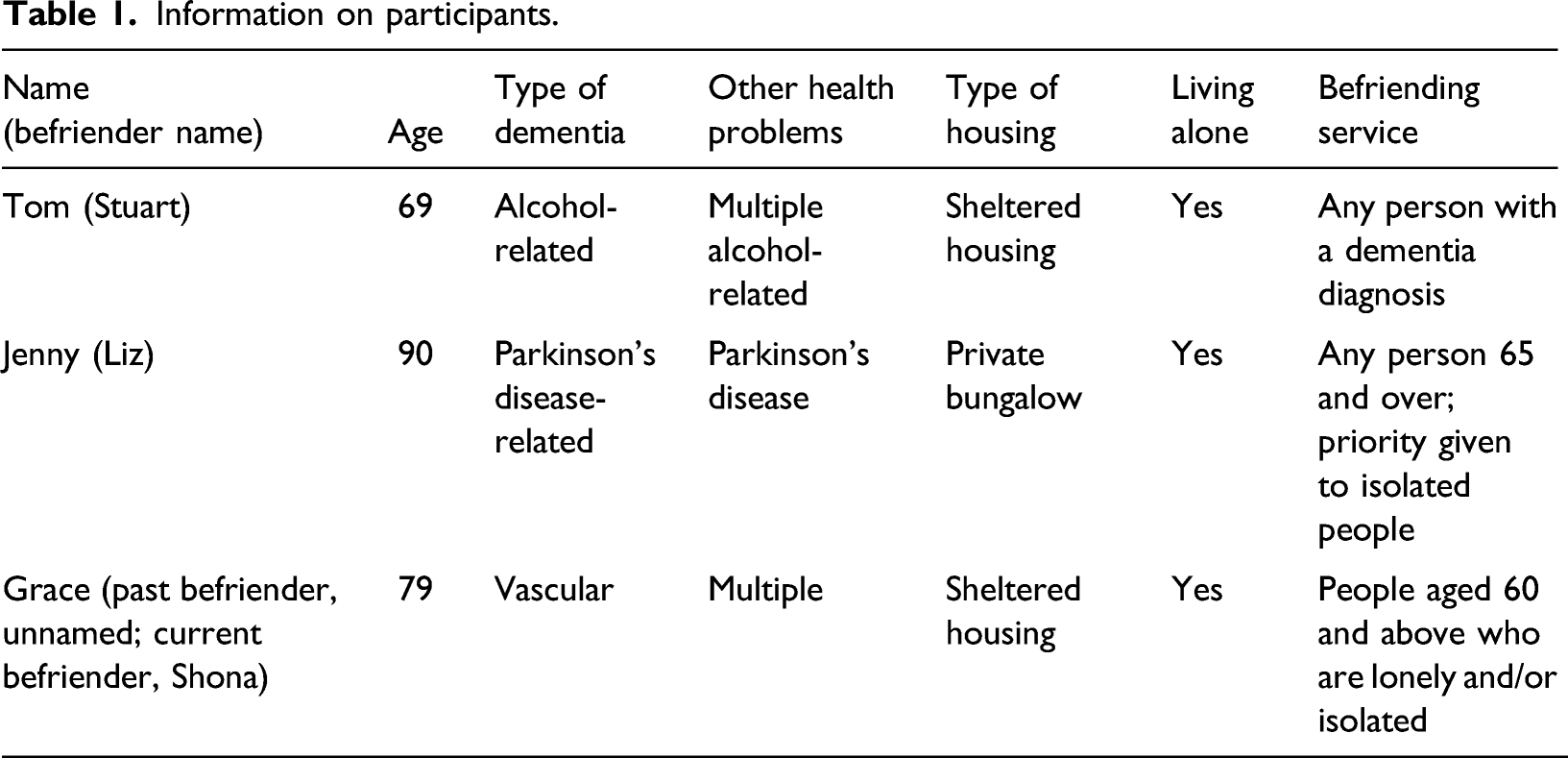
Tom had been a ‘travelling man’, ‘always up an doon the country’, but now found himself ‘stuck’ in sheltered housing: ‘this place’. (A glossary of Scots words spoken by Tom is provided below. 3 ) Having had ‘a bit o a drink problem’, five years ago, he ‘collapsed’ and ‘got transferred fae the hospital tae here’. He described memory problems, ‘black oots’ and ‘seizures’, not being able to walk far, taking pills for his stomach, being underweight, and feeling ‘doon in the dumps’ and ‘tired all day long’. What Tom missed intensely was ‘I’d jist get tae go where go anywhere I want like’ yet, irreconcilably, ‘I’ve just gone “Och I’m no wantin tae go oot” ken’ – his ‘up and go’ was gone, his home town gentrified and alien, and ‘aw ma friends are deid’. Tom had liked ‘meetin aw different people’ but, in ‘this place’, there was ‘naebody tae talk tae’.
Grace was ‘always a nurse’, but because ‘the memory’s rubbish’, ‘you wouldn’t think so now’. She missed driving ‘terribly’. Grace continued to go ‘to the hospital to have the check up on my breast because I had breast cancer’. She had a ‘sore back’, ‘wear and tear cos of all the lifting that I’ve had’, and ‘leukaemia’ meaning ‘I get tired easy’. Grace tried ‘not to worry but it is quite difficult when I’ve got no family here you know to confide in somebody’. In her own house, following a stroke, ‘I was getting very mixed up who was coming and who wasn’t coming’. She moved to sheltered housing and ‘what a difference it’s made!’ Even so, while ‘I knew my neighbours where I lived before’, she did not ‘know many folk in here and I’ve been in quite a while’. It seemed unjust to Grace that although she had been ‘a good person all my life’ – ‘being a nurse I helped everybody’ – God was ‘doing this to me’.
Jenny had danced since childhood; dancing to big band sounds at her local Palais was ‘like going into a palace all the lights it was magic’. Whenever she ‘heard the music [laughs] it does something to me’. Jenny used to be ‘very active’: volunteering in a charity shop; going to ‘tea dances’ and ‘the keep fit I went to a lot of things’; baking and cooking. Nowadays, she lived with Parkinson’s disease and its host of debilitating symptoms. While she kept herself ‘up and doing things’, ‘this dizziness restricts you’: ‘I haven’t been out by myself for a wee while now’. Dizziness was ‘like a spring inside you as if they’ve pulled it cuz I just feel this horrible feeling’. She had falls without warning. She was ‘fed up’, ‘frightened’, ‘wanting to get out’ and ‘make plans’; she felt ‘trapped’.
Conducting the research
I visited each participant five times, including introductory and final meetings. Visits lasted between one and three hours. Interviews mainly took the form of unstructured conversations allowing individuals to prioritise experiences and issues of importance to them (Surr, 2006) within the broad topics of befriending, everyday experiences, other relationships and life history. Participants also had the option of showing me (Nygård, 2006) how they spent their time with their befriender. In the study, this included reminiscing, storytelling, going out for afternoon tea, looking at photographs, confiding concerns, chatting, and me being asked for personal assistance and invited to share something about myself. I always met Tom and Jenny in their own homes while conversations and activities with Grace, as directed by her, took place variously in her flat and in communal areas within sheltered housing. On the occasion of our last meeting, at my suggestion, we visited a local café.
Ethics
Ethical considerations shaped the entirety of the project. Consent was treated as an ongoing process (Dewing, 2008) rather than a one-off determination at the outset, and confidentiality was assured within recognised limits. Prior to interviews, one participant signed a consent form, and two participants gave verbal consent which was audio recorded. With Jenny, consent was taken to be provisional until the final visit when, having taken part in the research, she had a much clearer understanding of what she was consenting to. Informed by capacity legislation and guidance from other bodies (e.g., Mental Welfare Commission for Scotland, 2010; Nuffield Council on Bioethics, 2009), I prepared an advice sheet for those involved in recruitment (myself included) on gaining consent, including assessing capacity to consent. I was also guided by core principles for involving people with dementia in research, developed by the Scottish Dementia Working Group (2014), with regard to communicating information about the research and its outcomes (e.g., I produced an interim findings newsletter); maintaining physical and emotional ‘safe zones’; reminding participants about visits and recapping on previous conversations. Careful thought was given to language use, the potential for role confusion and preparing for the ending of visits. Critical reflections on ethically important moments (Guillemin & Gillam, 2004) arising during the research were embedded in each case study.
Ethical approval for the research was granted from the University of Edinburgh School of Health and Social Sciences Ethics Committee on 7 January 2016.
Data analysis
Various kinds of data were generated: audio recordings; transcripts of research conversations; field notes made immediately after visits and subsequently; ethnographic observations; and reflective writing. Interview material was analysed using the voice-centred relational method (VCRM) (e.g., Gilligan et al., 2003; Mauthner & Doucet, 1998), a form of narrative analysis which integrates reflexivity. VCRM is predicated on an understanding of human society as characterised by dependency and interdependency (Butler, 2012), and the view that a person’s experiences, identity and sense of self are intimately bound up with their relationships with other people, and the society and culture in which they live.
According to the method, a series of ‘readings’ examines story elements and ‘tunes into’ and ‘amplifies’ multiple aspects of ‘voice’ in participant narratives. This makes it possible to trace an individual’s several, co-existing, varying relationships with self, others and socio-cultural milieux. In another reading, researchers record their own thoughts and feelings in response to a person’s stories. The idea is that, by placing their own background, history and experiences in relation to the people they interview, researchers may come to understand some of the assumptions and viewpoints which might be influencing their interpretations (e.g., Mauthner & Doucet, 1998). The high degree of reflexivity incorporated into the analytic process also allowed me to critically focus on, and include as findings, not only my responses to Grace, Tom and Jenny’s stories, but how I experienced our actual encounters. Doing so illumined ways that the research relationships performed features of befriending relationships and getting to know people, the latter emerging as especially salient in participant accounts.
Following long periods of immersion in the research data and separate sets of readings, I organised information unique to each person, based on particular facets of their self-experience and relationships, under headings drawn from the person’s own words. The ‘I-voice’ headings, for example, related to life changes (Tom: ‘things are turning a bit thingy’), health problems (Grace: ‘my memory’s so bad’) or important identities (Jenny: ‘I was very active’). Lengthy descriptions and early interpretations of this reconfigured data were synthesised and integrated with my earlier writing on narrative qualities of the material, ethnographic observations and reflexive insights into conducting the research, including ethical issues, and building research relationships over time. This culminated in three substantial case studies (Andrew, 2020).
All the cases contain descriptive, reflexive and interpreted material, and, while not identical in structure, overall, each first presents a picture of a participant’s everyday life, personal history, social ties and living circumstances using their and my words. They then look at what befriending relationships mean to individuals with reference to these contexts. The meanings and experiences of befriending are also explored through my critical reflections on the research relationships. These are woven into the fabric of each case study, sometimes episodically and sometimes chronologically. Finally, cross case topics and patterns were identified and divided into four thematic domains. The first three – liminality, personal community, and contingent and existential limitations – contextualised the fourth: befriending.
Interpretation and discussion
While the core themes of liminality and personal community were important dimensions of the experience and meanings of befriending for participants, this article focuses on the distinctive character of befriending, its relational significance and its capacity to respond to different sorts of constraint in someone’s life. The following discussion is organised around three key interpretations, or ‘re-tellings’ (Frank, 2010) which open up connections with other ideas and discourse: befriending satisfied unmet needs and wishes for particular kinds of relationship; befriending was a facilitated friendship 4 (this section includes the impact of memory loss on befriending experiences); and befriending was a human response to contingent and existential limitations.
Befriending satisfied unmet needs and wishes for certain kinds of relationship
For those who took part in this study, befrienders met a wish for a kind of social contact not often satisfied elsewhere in their lives. Every day Jenny saw or spoke to at least one person, and Tom and Grace several people, including family members, home carers, a home help, a hairdresser, cleaners, paid workers and attendees at day centres, and sheltered housing staff and residents. Yet all of them described feeling lonely some or much of the time, ‘on yer tod twenty-four hours a day’ (Tom).
Josselson (1992) writes that ‘Who is there in our life affects who else we need and how we need them’ (p. 27). ‘Who was there’ in the lives of participants had been subject to shrinkage due to loss of – or reduced – contact, for a range of reasons, with family, friends and neighbourhoods. ‘Having to rely’ (Jenny) on family members altered kinship dynamics. There was a general shift in sources of social contact with increasing professional and institutional involvement in each person’s network bringing a change in the underlying basis of many of their relationships. To maintain a social life, participants largely or wholly depended on people visiting them and being taken to visit other people – to day centres or occasionally (except Tom) to the homes of family members. Opportunities to make new rewarding ties were mostly limited to age- and client-segregated settings.
Grace, Jenny and Tom were discriminating in their relationships, aware of what different individuals and types of encounter did, or could, offer them. They spoke of ‘who else’ they needed and ‘how else’ they needed them. One sort of social tie that all participants identified as missing from their lives was a closer, compatible, mutual, supportive and sustained relationship which, for Grace and Jenny, lay outside family, and, for Tom and Grace, outside institutional settings, ‘without in here’ (Grace). In addition, both Jenny and Grace spoke of their wish for someone to confide in.
Josselson (1992) suggests that a person’s ability to find ‘necessary others’ (p. 28) lessens their reliance on relationships which are frustrating or disappointing in some way. With most former routes to making friends and acquaintances – pubs, paid and voluntary work, tea dances and so on – now unavailable to them, befriending, as a facilitated friendship, was one way in which Tom, Grace and Jenny could secure a necessary other. Necessary others, for all participants, included people they could get to know. Of both her befrienders, Grace told me, ‘I know them and they know me’. Getting to know people – to be known and to come to know others – mattered to participants but was something each was finding hard to achieve.
In sheltered housing and day centres, Jenny, Grace and Tom were among people with ‘something wrong with them’: ‘they’ve all got problems’ (Grace). ‘Something wrong’ – which might be mobility difficulties, sensory impairments, progressive and long-term illness, mental health problems, substance misuse and the need for protection from harm from others (Pannell & Blood, 2012) – applied to each of them as well as to other residents and day centre attendees and, for all, could present barriers to forming new ties. Grace told me that in sheltered housing, ‘I get to know all the people that lives in the flats’ but only ‘sort of get to know them’. Professional relationships were often role-bound and task-orientated. For instance, Tom’s home carers, ‘young lassies’, were ‘jist in an oot’ or unilaterally ‘just sit and talk’ or instruct him to ‘“Take yer tablets Tom”’, ‘“Take them!”’ By contrast, with Stuart, ‘we sit and talk’ (my emphasis). Stuart was socially and spatially on the ‘same plane’ as Tom, someone Tom could get to know on a more egalitarian social footing. As Baldwin (2009) observes, in relationships between those with and those without dementia, ‘all too often the narrative flow is one-way’ (p. 31).
In their same plane ties with befrienders, both participants and their befrienders became known to each other and part of one another’s lives. There was a strong sense of their befriending relationships as always unfolding rather than fixed in narrow client-worker positions. Jenny and Liz ‘chat about what we’ve been doing’, and Tom and Stuart ‘whit ye been getting up tae’. Knowing was perceived as two-way: ‘wanting-to-be-known’ (Frazer et al., 2011, p. 689) was coupled with the experience of someone reciprocally sharing their own stories. For Grace – an ex-nurse and one-time professional confidante – her befriender was someone in whom she could confide and who would also disclose personal information. She recalled, ‘I knew her’; ‘she told me all these things’. With their befrienders, Jenny, Grace and Tom were recognised as complex individuals with particular views, histories, values, interests, experiences and identities (Allan, 1989): ‘We could talk on any subject’ (Grace), ‘aboot aw different things’ (Tom), ‘about things that happened’ (Jenny). Being known in a fuller sense enabled them to resist primarily being defined as care recipients. Nevertheless, Grace and Jenny wanted their befrienders to understand their health problems – ‘what I’m like my memory’ (Grace), ‘what I can do and what I can’t do’ (Jenny) – and to act accordingly.
For participants, mutual exchange created familiarity and closeness, was indicative of their social worth (Allan, 1989) and betokened greater relational equality: ‘we-ness’. Jenny, Grace and Tom felt lonely not just because they were on their own a lot or because they had nobody: they missed a certain type of relationship, one with the closer bonds and mutuality of friendship, which befriending notably provided.
Befriending was a facilitated friendship
While befrienders were friend-like, they were also regarded as professional, as providing a service. Jenny, Grace and Tom were all in long-term befriending relationships (at the time of the study, Jenny and Liz: 2 years; Grace and her first befriender: two years; Grace and Shona: one year; and Tom and Stuart: four years). Despite the longevity and success of these relationships, they had not come to be viewed exclusively as friendships: implicitly or explicitly, participants at the same time understood befriending as an organised resource. Neither Tom nor Jenny nor Grace seemed to find the fluidity or the blurring of formal and informal problematic, deriving benefit from both.
For Tom, Stuart was both a sort of ‘awright’ care worker – he could not remember the name: ‘what dae ye caw em?’ – and ‘guid a friend an that’. His relationship with Stuart was different to his only remaining and much older friendship with Ron. Tom was aware that, while ‘a friend an that’, Stuart was there to provide a regular service: to give him – ‘once a week’ ‘fer aboot an oor’ – reliable company, a ‘break’ from everyday routines, and ‘someone tae talk tae’: in ‘this place’, ‘you need somebody like that’. These elements were fused. In Grace’s accounts, there was a similar melding of formal and informal features. Befriending was a service led by her preferences which gave her more scope to direct her life and expanded the choices available to her. But it also mattered to Grace that her befriender found pleasure in the time they spent together. The interweaving of professional-like and friend-like aspects was seamless. There were easy shifts between ‘I’, ‘we’ and ‘they’: well you’ve got something that you both like like if I wanted to go for a walk and it’s a nice day we’ll go for a walk and maybe have a coffee somewhere and they wouldn’t mind having a coffee with you (my emphasis)
For Grace, in befriending, the sphere of friendship – the cultivation of a unique, confiding, mutual relationship – overlapped with the sphere of a client-centred service – the assurance of confidentiality (‘you can tell them anything because the you know it’s confidential’); recognition of the rules differentiating befriending from friendship (‘well I couldn’t phone her up because they’re not allowed to give you their phone number’); and the expectation of regular contact, an understanding of her health conditions, and, if needed, the provision of practical support (‘if I wanted to shop I could maybe go in their car to the shops’).
It has been suggested that current generations of older people might prefer to receive emotional support via social contact in which the boundary between formal and informal is constructively ambiguous such as in kin-like or friend-like relationships with professionals (Brownlie, 2014). For Tom, Grace and Jenny, befrienders provided support in just this way, responding from both sides of a formal/informal divide.
Memory and psychological presence
All participants were known by their befriending service to have a diagnosis of some form of dementia, though each person differed in the extent to which they felt memory loss caused them difficulties. For all, cognitive impairment had some impact on their befriending experiences.
Tom could not remember whether he had seen Stuart that week in any of our conversations, often speculating that he was ‘on holiday’. He told me that ‘since he’s been away like ken I quite miss him’. While Tom knew when Ron was coming to see him by looking at his calendar, which also showed day club dates, there were no entries for Stuart’s visits, or at least not for that calendar month, which meant he could not check, himself, whether Stuart had been, or was due to come. But Tom was clear that ‘I look forward to him coming’. Although memory loss made it hard for him to remember specific befriending occasions, even so, Tom trusted that Stuart would be back, knew how often he came, and had a distinct sense of who he was, his presence in the room, how they related to one another, and the sorts of things they would do together: ‘he comes doon ken once a week like ken’; ‘we talk fer aboot an oor or something’; ‘he sits there and has a cup o tea’; ‘we talk aboot sport and things like that like ken’, ‘aboot aw different things’, ‘kind of everyday things usually, ‘jist life actually jist life’, ‘guid times’ and ‘men things’.
Grace’s befriender was ‘wonderful if I knew who it was’. She spoke of missing her befriender, who seemed to have vanished or ‘left me in the lurch’, and wondered whether she would ever return. The situation was complicated by Grace’s memory of her first befriender leaving. Appreciative comments about her befriender were almost always followed by expressions of confusion and abandonment: but I was quite friendly with Shona and we got on well together but she just suddenly disappeared and I don’t know where she is or why she’s not coming
The value Grace placed on befriending intensified her feeling of loss at the apparent departure or disappearance of her befriender, but also her resolve, if need be, to find ‘a new one’, though this caused concern that ‘it might be difficult to match me up’. Again and again, Grace explained how the key to the way she managed was writing things down and written information – ‘I live with my diary’ – yet there were no entries in Grace’s diary for befriending ‘appointments’. Not knowing about her befriender – who she was, if and when she was coming and had been – was bewildering and disempowering. However, while Grace did not exactly recall befriending events, nor was she sure she still had a befriender, she fully understood the role of befriender and the benefits to her of this kind of service.
Jenny was the only participant able to remember seeing her befriender each week and what had transpired. Normally she was certain that Liz came weekly – and visits were marked on her calendar – but at times also experienced forgetfulness. Once, following a mix up about the date, she was upset that Liz ‘comes when she can so I don’t know when I’ll see her again’.
Regular, face-to-face visits, of ample duration, from the same person helped Tom, Grace and Jenny hold onto, if not memories of particular befriending encounters, always vulnerable as memory loss progressed, then a sense of what their befriender – or a past befriender – was like, and the positive relational environment of their visits. At the time of the research, outside befriending contact, befrienders had, or could have, a beneficial psychological presence in the minds and memories of participants (Spencer & Pahl, 2006), though without suitable memory aides this might be lessened or lost altogether.
Befriending was a human response to contingent and existential limitations
As indicated, policy has envisaged a role for befriending as creating opportunities for people with dementia to live well, with an emphasis on enhancing choice, activity, independence, visibility and maintaining or extending lifestyles – in other words, the promotion of agency. This is in keeping with a social model of disability referred to earlier whereby the activities, desires and psycho-emotional wellbeing of those deemed impaired are avoidably restricted by socially imposed barriers (Thomas, 2010), or what Baars and Phillipson (2013) term ‘contingent’ limitations. Living well is often associated with the removal of such barriers. By availing themselves of a befriending service, this was borne out in practice for Jenny, Tom and Grace for whom health problems, ageing and social network change had led to multiple, entwined constraints in their lives. According to the wishes of each person, in providing access to transport, personal assistance, and, above all, companionship, befrienders played a part in helping individuals overcome obstacles to ordinary pleasures and pursuits, and to forging rewarding relationships.
Agency and patiency.
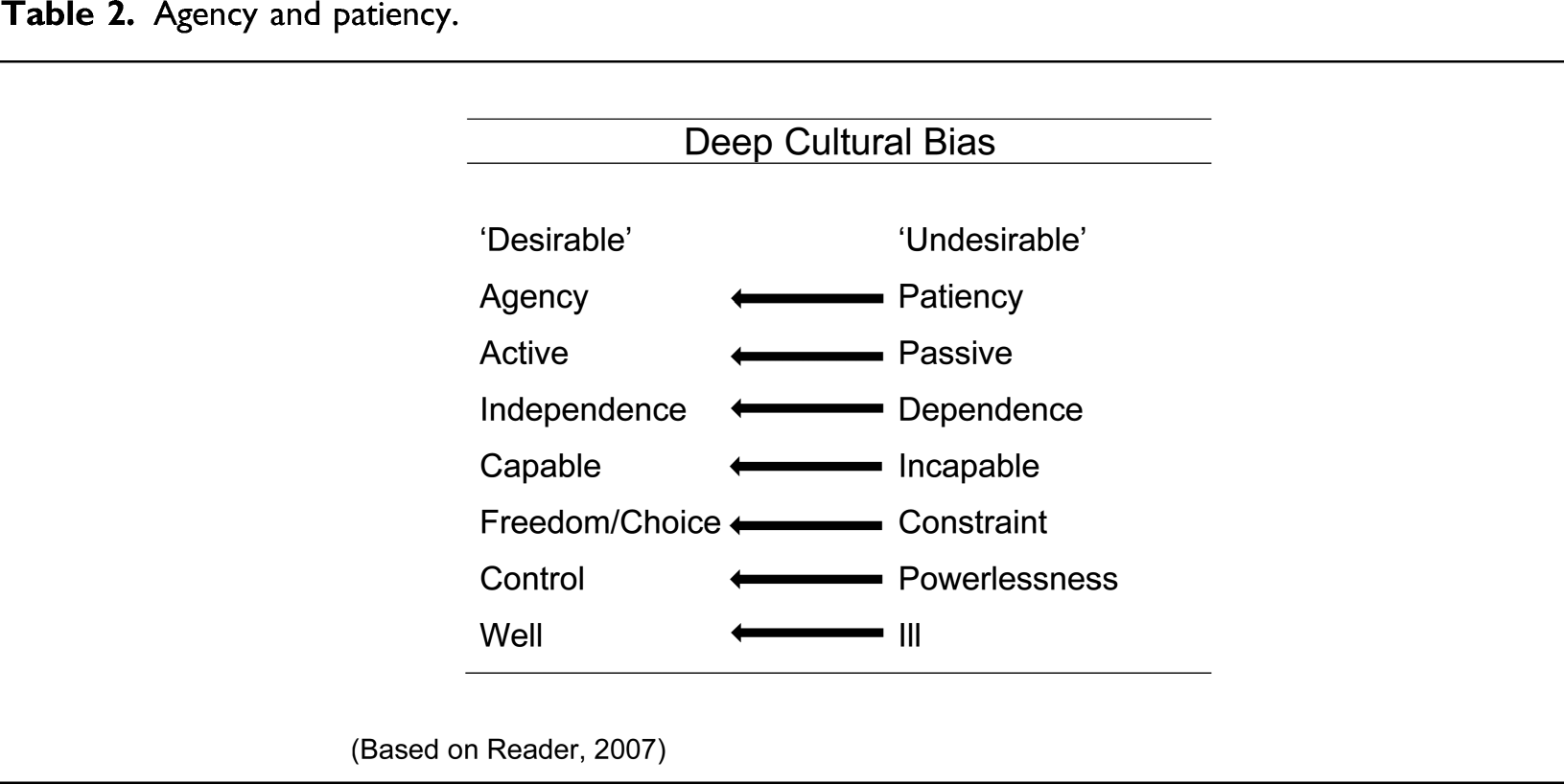
However, some of the problematic experiences that participants encountered were the result of unavoidable or ‘existential’ limitations (Baars & Phillipson, 2013), and had no restorative, agentic solutions. Here, befrienders offered a different kind of response. A selection of examples of the ways befriending created movement within both types of limitation – the resolvable and the inherent – will flesh out these points.
Hindered in their wish to form closer, mutual social connections, for Jenny, Grace and Tom, the development of befriending relationships was a significant means by which this difficulty was surmounted. Nevertheless, this could not take away the loss of important figures many of whom were irreplaceable or unreachable – for example, Jenny’s daughter and Tom’s ‘auld mates’ who had died, and Grace’s former neighbours. Yet during befriending visits, psychological contact with physically absent others could be made by looking at photographs, reminiscing or hearing about people in the lives of befrienders.
For both Jenny and Grace, befrienders offered a way to go out – both their befrienders had cars – helping to overcome movement restrictions, the result of transport issues and mobility problems. Going out with their befrienders expanded the spaces they had access to: shops, the woods, the park, places to eat, a garden centre, community venues and the wider local area. But befrienders also provided a meaningful response when barriers to travel were insuperable due in, Tom and Jenny’s case, to declining health. For all participants, outside spaces could be re-experienced through sharing memories of journeys, holidays, outdoor life, previous homes, places of work, towns, cities, villages and other countries.
While befrienders could not remedy continuing experiences of ill health and ill-being – for example, escalations of dizziness (Jenny); malaise (Tom); the stressful need to ‘check and check and check’ (Grace) – they could help to bring about feelings of wellbeing and relief, even if only temporarily. Often the presence of befrienders was linked with a lifting or easing of mood. For Jenny, Liz was ‘a comic’, ‘full of life’, ‘easy to get on with’, interested in her, thoughtful, indulgent, playful: she ‘helps you feel good’. Both Grace and Jenny gained relief by having, in Shona and Liz, someone to share their fears and worries with. For Tom, a visit from Stuart ‘breaks the day up’, alleviating his boredom, and injecting vitality into the oppressive sameness of his days: ‘the time just flies’. The opportunity to share ‘feel good’ life stories with their befrienders enabled Tom, Jenny and Grace to foreground what Bakhtin called the ‘valued other in me’ (as cited in Morson & Emerson, 1990, p. 217), cherished aspects of themselves such as Grace’s commitment to her patients; Tom’s spirit of adventure; Jenny’s capacity to be a good and loyal friend.
Grace, Jenny and Tom’s befriending relationships were long-lasting, providing relational continuity. Befrienders were – or, for Grace, were remembered as being – reliable companions, alongside them through the vicissitudes of their lives, and the real possibility of further change-events – the progression of dementia, the onset of new health problems, moving to alternative accommodation 5 . In situations of insoluble and intrinsic limitation, befrienders kept turning up, kept being there, kept listening, kept talking and kept sharing. For individuals with progressive cognitive impairment, that dementia is still widely equated with terminal loss of self has resulted in deprivation of choice, autonomy and self-expression (Gilleard & Higgs, 2010). Hence, agency-led ambitions for befriending are undeniably important. However, there is also a cost to neglecting patiency, the non-agential, as always part of a person’s experiences. Even when – as in this research – a befriending intervention has ‘worked’, the ‘suffering’ voice remains: ‘I’m goin doon an doon an doon an doon’ (Tom); ‘I’m suffering mentally and physically’ (Grace); ‘you still were frightened’ (Jenny). For Jenny, Tom and Grace, befriending helped foster wellbeing from within continuing illness and ill-being. Flexibly operating from both sides of formal/informal divide, and going beyond the reach of traditional health and social care services, befrienders engaged with their complex, entangled experiences of imposed and inescapable limitations.
Concluding comments
The present research adds to what is known about community-based befriending for people with dementia, and, to date, is the only such research to focus exclusively on their perspectives (though my own involvement as researcher-participant was also part of the study). The work provides considerable contextual detail, allowing the experiences and meanings of befriending to be understood in a wider matrix of biography, personal community, everyday living, disability and life events. The findings also contribute to the knowledge base in dementia studies on friendships, relationships outside the family and the kinds of social ties that constitute friendship (Ward et al., 2011).
In concentrating intensely on a small number of participants, it was never the intention to produce generalisable findings; rather it was hoped that the case studies would add to a diverse cache of information on befriending, and give rise to ‘new ways of seeing’ (Simons, 1996, p. 226). As Frank (2005) puts it, the meaning of a story – here, a research narrative – depends on the stories it generates. Future research in this field would benefit from attracting more socially varied participants. It would also be helpful to explore the impact on those with dementia of short-term befriending, where a service lasts for a number of months rather than years, and befriending relationships which are problematic, discontinued or declined.
In keeping with definitions of befriending as a person-centred service combined with elements of friendship, all participants gave account of their ties with befrienders as authentic, mutually enjoyable relationships within which, at the same time, their needs and wishes came first. This dual character made befriending distinctive – ‘different altogether’ (Jenny) – and especially valuable. The chance to get to know someone on a more equal social footing, and to have a confiding relationship, was particularly appreciated. A noteworthy finding was that befrienders had, or could have, a positive presence in the minds of participants, despite memory impairment, outside face-to-face visits. However, psychological ‘thereness’ (Brownlie, 2014; Josselson, 1992), and being able to look forward to seeing befrienders, was affected by memory loss and diminished when there were no reminders of past and forthcoming visits or a change of befriender. This could cause feelings of loss, uncertainty and worry. The research indicates the usefulness, for some at least, of finding tailored means to reinforce the psychological presence of befrienders. Examples from the study – including my own arrangements with participants – were calendar and diary entries, reminders from care staff, confirmatory telephone calls and the use of photographs.
With policy-makers and investors in services in mind, the research points to a need to move towards, conceptually and in practice, more fluid, non-binary approaches (see Dahlberg et al., 2009; McParland et al., 2017) to supporting people living with dementia (and often other health problems) – like befriending – which not only confront excess disability but which also acknowledge life’s limits. In the context of acute and long-term illness and accumulating losses, the case studies suggest that, paradoxically, those welcoming and benefitting from a befriending service might, in the overall context of their lives, feel better off and worse off at the same time (Molzahn et al., 2008). Against the grain of cost-utility thinking, this may be a reason for continuing befriending rather than evidence of its inefficacy. Befriending, through human acts and bonds, was a response to limitations both moveable and immutable.
Footnotes
Acknowledgements
We are extremely grateful to the individuals who took part in the study, to Befriending Networks, and to the co-ordinators of participating befriending services for their help at various stages of the project. We would also like to thank our anonymous peer reviewers and Janet Laverick (Specialist Occupational Therapist) for their helpful comments and suggestions.
Declaration of conflicting interests
The author(s) declare no potential conflicts of interest with respect to the research, authorship and/or publication of this article.
Funding
The author(s) disclosed receipt of the following financial support for the research, authorship and/or publication of this article: This work was supported by a University of Edinburgh studentship.
