




Abstract
Dementia research is critical to improve dementia care; however, participation in this research remains limited, and recruitment is challenging. During an international panel at the 2018 Alzheimer Disease International Conference in Chicago, presentations were given to raise the profile of dementia research and share the patient experience of research participation. We observed notable shifts in perspectives on research participation from 39 participants who completed a survey before and after the presentations. These findings set the stage for future studies exploring the strength of independent motivations for research participation as well as improving recruitment efforts through education and peer support.
Introduction
Novel and innovative approaches are needed to support people living with dementia, their families and caregivers, and society at large (World Health Organization and Alzheimer’s Disease International, 2012). Dementia research such as clinical trials and qualitative research studies involving social and ethical inquiries is vital to develop and advance new pharmacological and psychosocial interventions aimed at treating symptoms, modifying disease progression, and improving quality of life for persons with dementia as well as their loved ones. However, while the awareness of dementia continues to rise, participation in research remains limited, and recruitment is challenging (Bartlett et al., 2019; Chambers et al., 2017). Current barriers to the recruitment of dementia research participants include a limited pool to draw from, difficulties in recruiting a diverse sample in order to generalize results to the greater population, a lack of awareness of ongoing research from both potential participants and referring physicians (Bartlett et al., 2019; Robillard & Feng, 2017), and limited data sharing resulting in studies being duplicated, which can prove to be counterproductive. As such, alongside the research itself, the dementia research community must also explore how to promote, support, and evaluate both recruitment efforts and the experience of research participation.
Context
To raise the profile of dementia research and highlight the patient experience of research participation, the ethical, legal, and social impact program of the Canadian Consortium for Neurodegeneration in Aging sponsored an international panel at the 33rd International Conference of Alzheimer’s Disease International held in Chicago in 2018. This conference was attended by over 750 people including people with dementia, family care partners, researchers, professional carers, clinicians, and staff and volunteers of Alzheimer associations (Alzheimer’s Disease International, 2018). The panel entitled “Participation in observational and therapeutic research to prevent dementia: What’s in it for me and for society at large?” offered presentations about the importance of research for persons at risk (Dr Serge Gauthier), examples of use of shared data (Dr Kok Pin Ng), patient engagement in dementia research (Dr Julie Robillard), and notably a participant’s perspective on being part of a research study (Frank Everett).
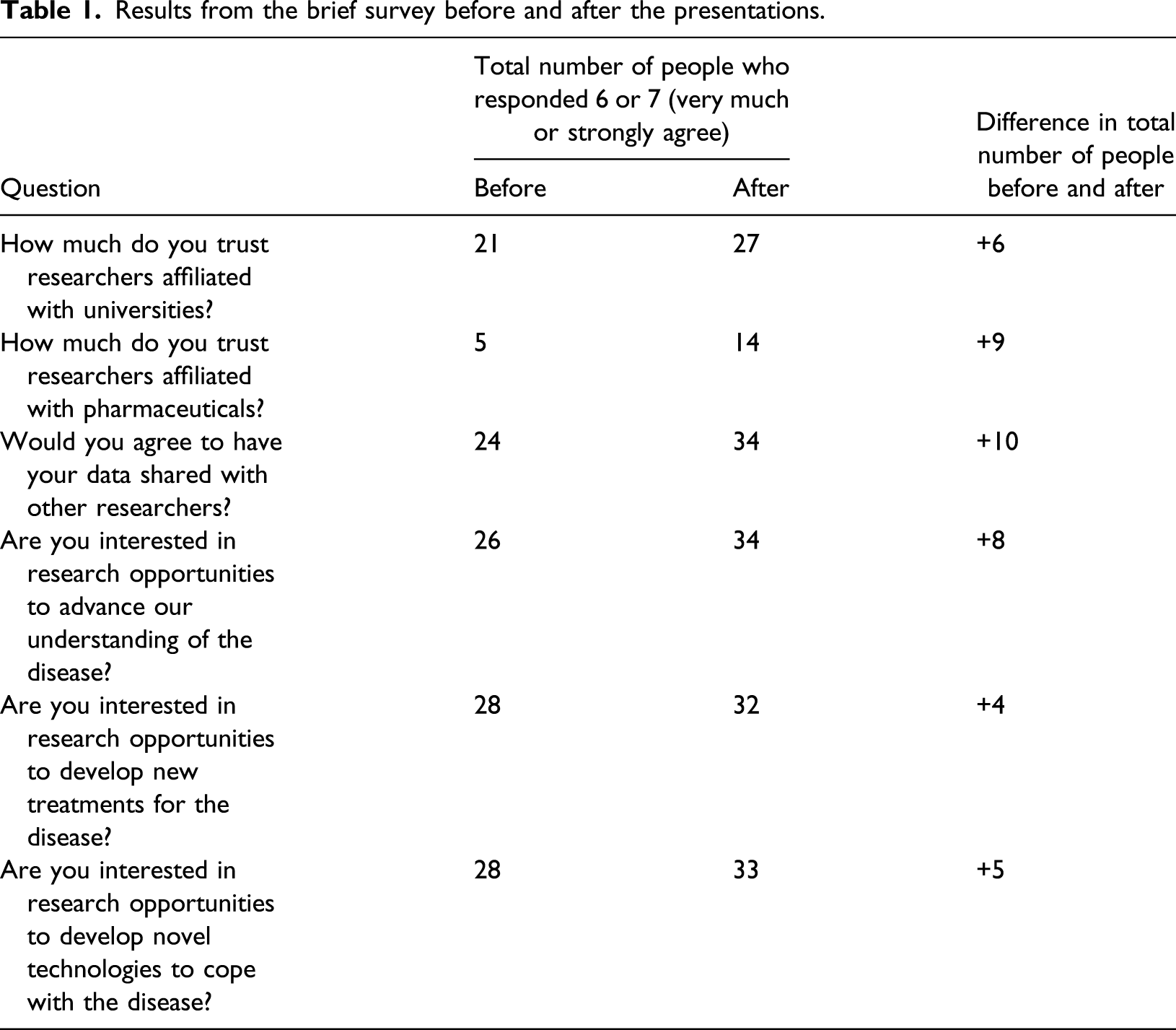
In order to explore the impact of educational initiatives on interest and intent to participate in research, attendees were asked to fill out a brief survey before and after the panel on the following themes: (1) experience in research participation; (2) trust in researchers; (3) willingness to share research data; and (4) interest in future research participation. Survey questions were given on a 7-point Likert scale.
Findings
Results from the brief survey before and after the presentations.
Discussion
Findings from the panel survey, although preliminary, suggest that a brief face-to-face education session about clinical research may increase trust in the research process and the desire to participate. Developing and delivering research education initiatives may serve a dual role: first to promote awareness of existing research opportunities, and second to address potential barriers such as concerns over industry partnerships.
As this was a multi-presentation panel, there are several potential areas of new knowledge that, alone or combined, may have contributed to the observed perspective shifts before and after the session. For example, the session on international data sharing may have led to a greater awareness of the potential reach of research data thus allowing the audience to appreciate the importance of contributing to research. The discussions of academic–industry partnerships may have alleviated concerns over conflicts of interest. Finally, hearing about the research participation experience from an actual participant may have modified perceptions of burden. Future research should examine which of these factors drive attitude changes in order to better target the development and delivery of education initiatives.
The findings described here set the stage for further exploration of motivators for participation in research. It is important to evaluate each of the potential motivators uncovered during the panel independently—discussions of academic and industry partnerships; learning about participant experiences in research firsthand; and information about the details and impact of data-sharing—and their level of impact on potential participants. Transparency is of utmost importance regarding the relationships between academia and the industry. Also, critical to recruitment research is the development and implementation of clear and common measurement strategies around the effectiveness of recruitment avenues. Appropriate measurement will enable the dementia research community to evaluate recruitment progress, and select outcome measures that capture attitudes, actual enrollment, and cultural differences.
While the findings are interesting and set the stage for ways to engage more research participants, this work constitutes innovative practice, and the approach will benefit from refinements. First, this activity took place in a very specific context related to dementia research, and it would be interesting to test the strengths and weaknesses of this novel approach in a community setting to improve the generalizability of the findings. Second, as the attendees were likely to have already been interested in research since they participated in the session, future studies should explore similar questions with individuals who are not familiar with research in dementia. From this, our findings serve as a learning opportunity in moving forward to inform future education and recruitment efforts. Other types of educational activities to encourage research participation such as webinars should be used, and the hosts of these activities may wish to consider including before and after assessments by the participants rather than the standard post-activity evaluation approach.
Conclusion
Education and peer support are integral components of global recruitment efforts in dementia research. Researchers will benefit from a deeper understanding of the needs of participants to facilitate their engagement and manage their expectations. Including the perspectives of research participants during the recruitment process may be beneficial in promoting a sense of community and in ensuring a meaningful research experience for all participants.
Footnotes
Declaration of Conflicting Interests
The author(s) declared no potential conflicts of interest with respect to the research, authorship, and/or publication of this article.
Funding
The author(s) received no financial support for the research, authorship, and/or publication of this article.
