




Abstract
Global migration has contributed to an increasingly multicultural workforce, yet studies suggest that immigrants are exploited and face discrimination in the United States labor market. While prior research has examined the workplace experiences of immigrant employees, little is known about the sense-making process of immigrant job applicants as they navigate the hiring process. This article addresses this gap by introducing a conceptual framework explaining why and how immigrant job applicants are vulnerable to exploitation, with a focus on their mode of acculturation. The framework also incorporates individual differences in recruiters’ cross-cultural attitudes, such as other-group orientation and human values, as conditional factors that could influence employers’ motivation to exploit immigrant applicants. The article concludes with practical implications, including guiding immigrants to adopt acculturation strategies that signal intercultural adaptation and dispel misconceptions about their resource capital and encouraging recruiters to engage in ethical training that fosters intercultural sensitivity in cross-cultural hiring processes. These insights advance understanding of immigrant exploitation and contribute to the broader literature on cross-cultural selection.
Introduction
A multicultural workforce has been found to give organizations competitive advantages through different resources, experiences, networks, ideas, attitudes, and skills that improve organizational creativity, innovation, problem-solving, and decision-making (Jackson and Joshi, 2004; Lu and Samaratunge, 2015; Van De Ven et al., 2008). Immigrants contribute to a multicultural workforce and currently comprise about 19.2% of the United States workforce (Bureau of Labor Statistics, 2025). In addition, immigration contributes to an ever-expanding multicultural society (Alcott and Watt, 2017). Yet, immigrants continue to encounter several challenges in the labor market in their quest for employment. One such challenge is exploitation. Theory from prior research suggests that employers may consider immigrants more vulnerable and easier to exploit than native-born Americans (Akinlade et al., 2020; Bloomekatz, 2007; Lambert and Akinlade, 2020; Moss and Tilly, 2001; Shih, 2002). Although the preference for vulnerable immigrants, particularly those from developing countries, may appear to provide these immigrants with job opportunities, some opportunities may be accompanied by unhealthy working conditions and low wages, making it difficult for immigrants to improve their situations (Bloomekatz, 2007: p. 4). In some cases, the vulnerability of immigrants may be perceived by employers during the recruitment stage even before they are employed (Akinlade et al., 2020; Lambert and Akinlade, 2020).
Despite evidence from prior research that the exploitation of immigrants is both prevalent and harmful (Foo, 1994; Livne-Ofer et al., 2019; Potter and Hamilton, 2014), little theoretical work addresses the underlying factors that influence recruiters to act on exploitative practices (see Akinlade et al., 2020, for an exception). Even less attention has been paid to the ways that immigrant workers may resist or facilitate such exploitation (Akinlade et al., 2020). For example, an immigrant’s acculturation, an intercultural behavior that reflects the extent of their cross-cultural adaptation, can significantly shape how hiring managers perceive them (e.g., Horverak et al., 2013b). While the limited research suggests that some immigrants are more vulnerable than others, with immigrant status contributing to that vulnerability (Akinlade et al., 2020; Livne-Ofer et al., 2019; Wilkinson, 2014), a comprehensive understanding of what drives the employer and applicant decision-making process as it relates to exploitation remains lacking in the management literature.
According to studies on immigrant fit perceptions, employers often focus on immigrant adjustment and orientation toward the majority culture -- that is, their acculturation, when evaluating fit (Horverak et al., 2013a, 2013b). Studies also show that immigrants who are more aligned with the majority culture have higher employment prospects (Constant and Zimmerman, 2008; Drydakis, 2013; Nekby and Rodin, 2010). We build on this by exploring how acculturation cues expressed by applicants may be used to shape hiring decision-makers’ impressions of the candidate, thereby impacting their perceived exploitability.
Because an increasing number of companies recruit and hire immigrants, it is important to explore how employers perceive immigrant applicants’ exploitability. Acculturation cues expressed by applicants may counter or reinforce any stereotypes formed about them based on factors such as immigration status, race, or language proficiency and influence employer perceptions in complex ways (Akinlade et al., 2020). This paper explores how such cues function in signaling resource capital and shaping perceived exploitability.
Prior research suggests that the decision to exploit an immigrant applicant is determined by the recruiter’s propensity to exploit applicants and the applicant’s perceived vulnerability. This phenomenon, referred to as exploitation opportunism (EO), describes “the decision-making process that can occur by and between employers and immigrant applicants and can lead to the discrimination of immigrant workers” (Akinlade et al., 2020: 396). While the EO framework highlights the interrelated sense-making processes of migrant job applicants and employer decision makers, it offers limited insights into the specific ways immigrants mitigate or facilitate exploitation. To address this gap, the proposed framework shown in Figure 1 explains how immigrant job seekers’ acculturation may serve as a moderator shaping employers’ perceptions of their exploitability. Additionally, the proposed framework introduces two employer characteristics - other-group orientation and human values - as potential moderators in the relationship between perceived exploitability and motivation to exploit. These factors are important for understanding how individual differences among employers can either weaken or strengthen the effect of perceived exploitability on the motivation to exploit. Conceptual framework of immigrant acculturation strategy on motivation to exploit.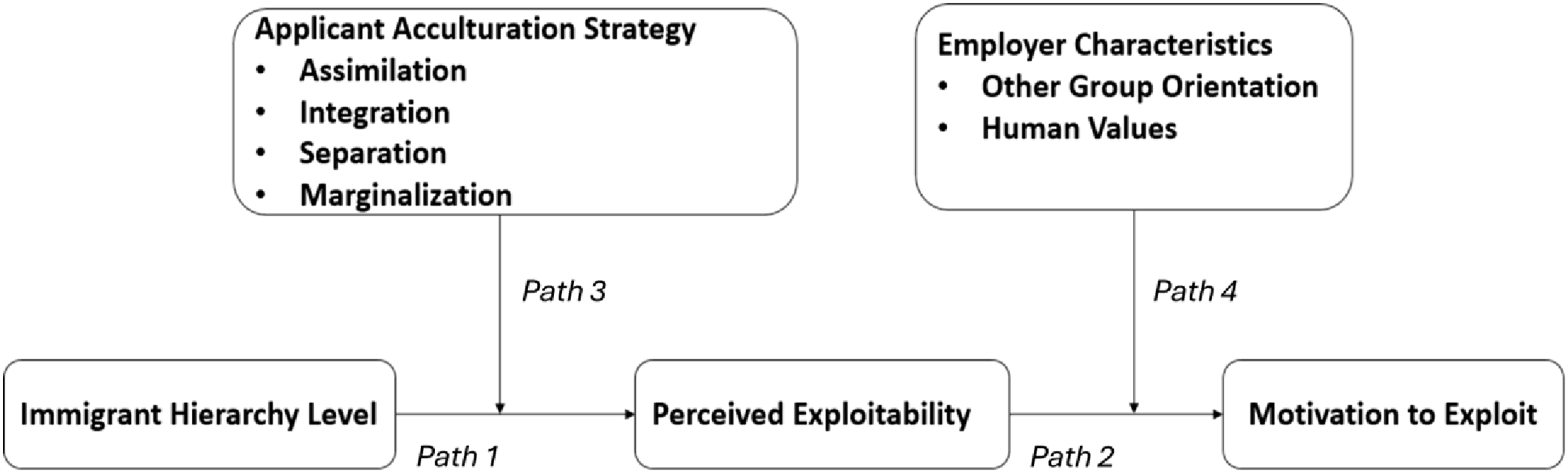
Our framework makes several important contributions. First, it advances the selection literature by integrating the EO framework with acculturation theory, offering additional insight to describe how immigrant job seekers’ acculturation strategies shape hiring managers’ perceptions in multicultural settings. Second, it identifies employer attributes such as other-group orientation and human values, which act as potential moderators that can influence whether perceived exploitability translates into exploitation opportunism. Third, it contributes to the immigrant literature by shedding light on how immigrant characteristics and behaviors influence employers' decisions. Finally, it addresses a notable gap in the cross-cultural management literature by theorizing about exploitation as an underexplored and important area in the field.
We begin by reviewing the literature on immigrant employees before describing the EO framework and how immigrant job seekers’ acculturation strategies influence the impact of immigrant hierarchy level on perceived exploitability. Subsequently, the moderating role of selection decision-makers’ individual differences on the relationship between perceived exploitability and motivation to exploit is described. The paper concludes with a discussion of the implications for the framework and ideas for future research on immigrants' experiences in the workplace. The terms “immigrant” and “foreign-born” are used interchangeably as done in prior research (e.g., Chiswick, 1978; Stevens, 1999) and refer to individuals born outside the country (the U.S.), including guest workers, as well as those with documented and undocumented status. Consistent with prior usage, the terms native-born, Domestic, U.S., and American applicants are used interchangeably to refer to individuals who are U.S. citizens. The terms employer(s), hiring manager(s), recruiter(s), and decision-maker(s) are used interchangeably throughout our framework and refer to any organizational decision-maker who plays an influential role in the selection process. Lastly, the terms “acculturation” and “acculturation strategies” are also used interchangeably to refer to post-migration changes in behavior, attitudes, values, and customs that immigrants undergo in the host country.
The prevalence of immigrant exploitation
From all over the world, skilled and unskilled immigrants with permanent, temporary, or undocumented status enter the U.S. in search of better opportunities and better lives. However, it is not uncommon to find immigrants working in jobs with adverse working conditions (Potter and Hamilton, 2014). Referred to as the new “invisible men and women” (Bell et al., 2010: p. 8), immigrants generally fare worse than natives as they tend to be overrepresented in low-paying jobs that do not require the completion of high school, with lower remuneration and poor interpersonal treatment (Mosisa, 2002; Rivera-Batiz, 1999). Workplace exploitation of immigrants is well documented (Foo, 1994; Herrmann, 2018; Potter and Hamilton, 2014). For example, in U.S. labor-intensive industries characterized by low-profit margins, many employers pay low wages to their employees, the majority of whom are immigrant workers, whose vulnerability often silences them in the face of abuse and unfair treatment (Foo, 1994).
While undocumented immigrants are especially vulnerable to exploitation due to employers' expressed or implied threats to report them to immigration law enforcers if they complain, and the fear of deportation, other documented immigrants (such as those with permanent or temporary status) are not exempt. For example, Herrmann (2018) recounts the experiences of two non-professional Guatemalan H-2B visa holders whose employer failed to provide written terms and conditions of employment, paid them below minimum wage, withheld pay for several months, and denied them access to wage records. The employer also deducted business expenses from their paychecks and refused to compensate them for long-distance travel (Hermann, 2018: p. 2). Similarly, Black immigrants in the U.S. report that they are often paid less than their native colleagues, endure worse shifts, have less control over their work hours, are not compensated for overtime work, and face harassment or threats at work (KFF, 2025).
Though admitted into the host country as professionals, skilled immigrants are not immune to exploitation. Costa and Hira (2023) report that H-1B visa holders, due to their temporary immigration status and fear of job loss, often accept substandard wages, longer hours, reduced benefits, and other poor working conditions. Generally, immigrants - regardless of skill level - are frequently left with no choice but to work in lower-status jobs with poor compensation due to non-recognition of their foreign credentials, employers’ preference for education obtained in the host country or academic institutions in developed countries, and a perceived lack of local experience, limited cultural know-how, and limited English proficiency (Siar, 2013: p. 3). Employers are also negatively impacted by exploitation through higher employee turnover (Livne-Ofer et al., 2019) and related increases in the costs of recruiting and training new employees. Thus, exploitation affects not only immigrant workers but also the organizations that employ them.
Significance of immigrant status and immigrant hierarchy
Immigrant status may be classified based on the distance of one’s immigration status from US citizenship: permanent status, temporary status, and undocumented status (Akinlade et al., 2020: p. 399). Immigrant applicants with permanent status generally share the same rights and freedoms as American-born citizens and do not need a company to sponsor them for work (Akinlade et al., 2020; U.S. Citizenship and Immigration Services, 2015). Consequently, their ability to stay and live freely in the U.S. is not compromised if they are unemployed. Immigrants with temporary status are restricted in terms of how long they can stay in the U.S., the types of jobs they can perform, and their legal rights (U.S. Citizenship and Immigration Services, 2013; U.S. Department of State, n.d). Usually, immigrant workers are sponsored by their company with a visa that grants foreign visitors the right to work in a host country for a limited period of time.
Undocumented immigrants, on the other hand, are those immigrants who cannot lawfully work in the United States without special authorization (Akinlade et al., 2020: p. 400). About 27% of immigrants in the U.S. are undocumented (Pew Research Center, 2025), and they make up about 6.7% of the labor force (The World Data, 2025). These immigrants have few or no legal liberties, opportunities, or rights, and are wholly dependent on their employers if and when they find work. Because of their dependency on employers, fear of retaliation, and the risk of deportation if discovered working illegally, these immigrants are more likely to accept low pay and work unhealthily long hours (Akinlade et al., 2020; Bell et al., 2010) without complaining.
Exploitation opportunism
While immigration status affects immigrants’ vulnerability to exploitation, it alone does not fully explain how immigrants are treated or perceived by their employers. The EO framework (Akinlade et al., 2020) builds on this by incorporating the intersectionality (Crenshaw, 1989) of immigrant status, race, and perceived resource capital to describe an immigrant hierarchy. Resource capital includes one’s financial resources, social capital, and cultural capital (Akinlade et al., 2020: p. 400). Financial resources refer to one’s financial stability. Social and cultural capital include one’s ability to speak the host country’s language, access to an established social network, and knowledge of the host country’s customs and norms. Immigrant workers who are documented or have lived in their host country for a long time usually possess more resource capital than those who are undocumented or have lived in the host country for a short while. However, the intersection of their race with their resource capital may cause hiring decision-makers to perceive their value through a hierarchichal lens. The EO framework describes how likely it is that applicants are perceived as exploitable by recruiters based on their perceived immigrant hierarchy level (see Akinlade et al., 2020 for details).
The hierarchy comprises three classifications of immigrants: dominant, quasi-dominant, and non-dominant. Dominant immigrants are those of European ancestry who are perceived as racially White. They may also be perceived as holding substantial resource capital, irrespective of whether or not they do, because of their skin color and/or country of origin. Also, because they are perceived to be White, their proficiency in the country’s host language is not as relevant to their hierarchy level. Dominant immigrants are perceived to have a high degree of financial capital, a high degree of social capital, and a medium degree of cultural capital, and their perceived exploitability ranges from low to medium as it relates to their immigration status. Quasi-dominant immigrants are individuals who are perceived as non-White or non-Black (i.e., Latinx, Asian/Pacific Islander, or South Asian), but with light skin color, and who can speak English. They are perceived to have a medium degree of financial capital, a medium degree of social capital, and a low degree of cultural capital, and their perceived exploitability ranges from low to high as it relates to their immigration status. Non-dominant immigrants include Black individuals from the African diaspora or West Indies and medium- or darker-skinned Hispanic and Latinx individuals who can or cannot speak English. Also, light-skinned individuals who are Hispanic, Latinx, or Asian and cannot speak English fall into this non-dominant category. Non-dominant immigrants are perceived to have low financial, social, and cultural capital, and their perceived exploitability ranges from medium to high as it relates to their immigration status.
Effect of immigrant hierarchy level on motivation to exploit
The motivation to exploit may be defined as the likelihood of the employer favoring applicants for hire because they are more likely to accept less pay, longer working hours, and/or lower-level job roles. Akinlade and colleagues argue that “rational” employers (those driven by utilitarian motives), because they lack information about the true productivity of potential employees, may rely on signals from applicants’ membership in specific identity groups that are statistically correlated with higher productivity and lower risks during selection (Akinlade et al., 2020; Thomas, 2003).
During the early stage of the selection process, there is limited information about immigrant applicants for employers to consider. However, cues embedded in their resumes and interviews, such as their work experience, educational background, activities and language fluency, may serve as signals to employers of an applicant’s position on the immigrant hierarchy level, influencing their perceived vulnerability to exploitation (Akinlade et al., 2020; Spence, 1973). Moreover, the EO framework argues that employers may form impressions about immigrants (i.e., person schemas) based on certain cues, such as their perceived level in the immigrant hierarchy (Akinlade et al., 2020; Fisk and Taylor, 1991). These cues may fuel perceptions of their social power and access to other resources (Akinlade et al., 2020). These formed impressions may then contribute to or weaken employers’ perceptions of immigrant exploitability, depicted as Path 1 in Figure 1.
Although prior research highlights the effect of applicants’ demographic backgrounds on selection outcomes, less is understood about the underlying mechanisms that inform employers’ decisions. Employers driven by utilitarian motives often prioritize productivity and profits over other values (Akinlade et al., 2020) and may achieve these goals by exploiting workers through low wages and long hours. At the same time, employers also wish to minimize any risk to the company (Arrow, 1998; Thomas, 2003). In other words, exploitation may occur when employers believe they can do so without consequence.
Employers may form schemas about immigrant applicants from their resumes and interviews, which offer cues about where applicants fall within the immigrant hierarchy. These schemas can signal to employers an immigrant’s vulnerability, specifically, how likely the applicant is to report or resist exploitation if hired. When employers perceive an applicant as unlikely to push back, they may feel emboldened to exploit them (Akinlade et al., 2020). Thus, an immigrant’s perceived exploitability plays a central role in activating decision-makers’ biases and their motivation to exploit.
In line with the EO framework, we contend that perceived exploitability is an antecedent to the motivation to exploit immigrant applicants post-hire and is the mechanism through which immigrant hierarchy influences selection decisions (Akinlade et al., 2020)—depicted as Path 2 in Figure 1. Contributing to the literature, our framework also suggests that recruiters may make inferences from other immigrant characteristics to form a more complete view of an applicant’s exploitability. In the next section, we propose that immigrant applicants’ acculturation strategies, further influence or reduce the extent to which employers perceive them as exploitable.
The role of acculturation strategy
Acculturation is the post-migration changes in behavior, attitudes, values, and customs that immigrants undergo as they adapt to a new cultural environment (Berry, 1997; Nekby and Rodin, 2010). This can influence their employment outcomes through how employers assess immigrant fit and potential (Krishnan and Berry, 1992). Acculturation can signal the extent of immigrants’ cross-cultural adaptation and behavioral assimilation, contributing to work outcomes such as job satisfaction (Lu et al., 2012), and workgroup commitment (Lu et al., 2013).
Berry’s (1997) acculturation model identifies four strategies—integration, assimilation, separation, and marginalization—based on two dimensions: cultural maintenance and adaptation to the host culture. These strategies may be employed as immigrants learn or unlearn “a new behavioral repertoire appropriate for the new cultural context” (Berry, 1997: p.13). We contend that each strategy sends different signals to employers about immigrants’ social capital, knowledge of labor rights, and employment prospects.
An integrated acculturation strategy is one in which people are interested in maintaining their original culture while simultaneously interacting with cultural groups from mainstream host country society. Immigrants who adopt the assimilation acculturation strategy are mainly interested in associating with members of the host country, while abandoning or rejecting their culture of origin (Berry, 1997; Samnani et al., 2012). A separation acculturation strategy entails the maintenance of strong ties with one’s ethnic group members alone, and avoiding mainstream cultural interaction (Li, 2004). Immigrants who adopt a marginalization acculturation strategy do not maintain relationships with members of their original culture or members of the host country (Horverak et al., 2013b).
Employers often evaluate immigrant applicants’ acculturation as part of assessing organizational fit (Horverak et al., 2013a; 2013b). Research shows that immigrants who demonstrate stronger attachment to the host culture tend to have higher employment prospects (Constant and Zimmerman, 2008; Drydakis, 2013; Nekby and Rodin, 2010). We contend that employers may interpret elements of immigrant applicants’ resumes, such as work history, volunteer roles, or other affiliations, as signals of acculturation (Bertrand and Mullainathan, 2004; Caldwell and Burger, 1998; Howard and Borgella, 2020), because these signals may override or reinforce assumptions (Spence, 1973) employers form, based on more visible characteristics like race or immigration status (Akinlade et al., 2020).
As selection processes progress, through interviews, site visits, and informal conversations, employers gain further insights into applicants’ values, behaviors, and familiarity with local customs (Horverk et al., 2013a; Kutcher et al., 2013). Studies suggest that cultural cues, such as clothing style or hobbies, may shape employers’ impressions of personality traits and perceptions of person-environment fit, ultimately affect hiring decisions (Gurlek, 2000; Mack and Rainey, 1990). Thus, acculturation strategy is a key factor in employer perceptions of immigrant applicants and their potential for exploitation. Indeed, studies have found that acculturation strategies that include elements of the host country’s culture (such as assimilation and integration) are usually favorably perceived by members of the host country, compared to acculturation strategies that involve only conservation of the immigrants’ origin culture (e.g., separation; Maisonneuve and Teste, 2007: p. 683). Similarly, Matera and colleagues (2011, p. 782) found that host members’ attitudes toward immigrants were more favorable when the immigrant’s desire for the host country’s contact was perceived to be high. In summary, acculturation strategies not only describe how individuals react to intercultural group contact; they may also shape how immigrant applicants are perceived during the selection process.
During selection, differences may exist in how immigrants are perceived as exploitable, depending on the acculturation they adopt. Immigrants exhibit acculturation strategies, intentionally or unintentionally, that may act as a buffer in the link between their hierarchy level and perceived exploitability. Sanderson et al. (2025) demonstrate that immigrants consciously adjust their self-presentation to gain workplace acceptance. We extend this to the pre-employment context and propose that some applicants deliberately project a particular acculturation type to shape hiring managers’ perceptions of their cross-cultural adaptation, social network access, and knowledge of rights, which may influence perceived exploitability. This pattern of deliberate signaling is not unique to immigrants. For example, individuals navigating age discrimination have been similarly shown to selectively signal attributes that counter negative stereotypes. Older workers may distance themselves from age-based assumptions during job interviews in order to mitigate potential bias (Gioaba and Krings, 2017), while evidence from experimental studies suggests that fictitious resumes including relevant computer skills may help reduce discrimination toward older applicants (Lahey, 2008).
Immigrants who adopt an integration acculturation strategy develop diverse social networks and access resources from both communities (Lu et al., 2013; Samnani et al., 2012). These networks provide access to valuable social connections and employment information, which enhances their job search outcomes and awareness of employment rights (Kealey, 1989; Krishnan and Berry, 1992). When integrated immigrant applicants disclose and leverage this dual embeddedness during the hiring process, whether deliberately or as a natural expression of their acculturation experience, they may signal to employers that they are well-resourced, knowledgeable about their rights, and connected to networks that make them appear less vulnerable and harder to exploit. Consistent with this, Horverak et al. (2013a), in an experimental study of Norwegian managers evaluating Turkish immigrant applicants, found that integrated candidates received significantly higher person-organization fit ratings and hiring assessments than assimilated or separated applicants. These favorable evaluations are consistent with our exploitability argument, suggesting that integrated applicants may signal to employers that they possess the dual social capital, financial resources, and awareness of rights that make them appear less vulnerable to exploitation.
Assimilated immigrants, though exhibiting the host country’s cultural values and knowledge, may lack access to information from their own communities about certain employment rights or niche job markets, which may make them appear more exploitable than their integrated counterparts. However, we propose that assimilation provides greater protection against perceived exploitability than either separation or marginalization. By demonstrating strong alignment with host country cultural norms, institutional knowledge and social networks, assimilated immigrants may signal to employers that they are somewhat informed, connected, and capable of resisting unfavorable treatment - signals that separated and marginalized applicants, with weaker ties to the host country - are less able to project. In line with this, Nekby and Rodin (2010) found that in Sweden separated and marginalized immigrant job seekers had considerably fewer chances of finding a job than did their assimilated counterparts, empirically providing support for the position of assimilation above separation and marginalization in the exploitability hierarchy.
Separated immigrants maintain strong ties to their original cultural community, but lack meaningful engagement with the host country culture., Although being connected to one’s ethnic group is helpful to its members, especially early in the migration process, these tight-knit communities often limit access to broader labor market opportunities and legal information (Bloomekatz, 2007). As a result, their exposure to and knowledge about their employment rights in the host country may be very limited, not because they lack social connections altogether, but because the connections they do maintain are predominantly co-ethnic and therefore less likely to provide information about host country labor market norms, legal protections, or institutional resources. Although the empirical literature finds no significant differences in employment outcomes between separated and marginalized immigrants (Constant and Zimmermann, 2008; Nekby and Rodin, 2010), we propose a theoretical distinction in their perceived exploitability. The separated immigrant, embedded within an ethnic cultural community, retains co-ethnic social capital that may signal to employers some degree of social connectedness that may partially constrain perceptions of exploitability. Marginalized immigrants, by contrast, will mainly rely on their own limited ability to search for jobs and gain employment due to their few social contacts with either cultural community (Samnani et al., 2012). Lacking meaningful ties to any cultural network, marginalized immigrants may project the greatest degree of social isolation and the least availability of resources, therefore positioning marginalization as the most vulnerable point in the exploitability continuum. Consequently, recruiters may perceive separated and marginalized immigrants as highly exploitable due to their perceived isolation, limited resources, and lack of bargaining power (Constant and Zimmermann, 2008; Drydakis, 2013), with marginalized immigrants facing the most acute vulnerability of all.
We contend that integration and marginalization acculturation strategies result in the greatest and worst outcomes for immigrant applicants, respectively, and that the perceived exploitability of all immigrants, irrespective of their hierarchy level, may increase when they exhibit marginalization acculturation and decrease when they express an integration acculturation. Integrated immigrants with broad support systems and cultural fluency may be perceived as less exploitable, while marginalized immigrants, those isolated from both cultures, may be viewed as most vulnerable.
Acculturation strategy and immigrant hierarchy
As explained earlier, dominant immigrants (high-hierarchy) are generally theorized to hold more social power and resource capital compared to non-dominant immigrants (low-hierarchy), and prior conceptual work suggests that perceptions of exploitability may increase as one descends the immigrant hierarchy (Akinlade et al., 2020). Acculturation strategies, however, may interact with immigrant hierarchy to moderate how employers perceive and respond to immigrant applicants, functioning as a boundary condition that shapes exploitability perceptions across hierarchy levels.
For non-dominant immigrants, expressing an integration acculturation strategy, may serve as a signal (Spence, 1973) to employers communicating a broader understanding of their employment rights, due to richer employment information from their social networks, including protection against exploitative working conditions, pay, and hours. To the extent that employers recognize and respond to the signal, non-dominant immigrants who adopt integration may be perceived as more capable of resisting exploitation in the workplace.
Dominant immigrants present a theoretically distinct case. Drawing from the EO framework, it is proposed that the perceived exploitability of dominant immigrants may be weaker than other hierarchy-level immigrants, irrespective of whether they exhibit a marginalization, separation, or assimilation acculturation strategy. This is because dominant immigrants may be viewed as possessing a great amount of resource capital (i.e., financial, social, and cultural) due to their appearance (Akinlade et al., 2020), which may still signal to employers that they are less vulnerable to exploitation despite the fact that they are known to be immigrants. Employers may still view dominant immigrants with a marginalization mode of acculturation as exploitable because their acculturation strategy signals a lack of awareness of their rights in the US workplace due to a lack of social relationships. Nevertheless, it is proposed that dominant immigrants are unlikely to be perceived as exploitable to the same extent as quasi- and non-dominant immigrants, as hierarchy-level appearance cues are posited to act as overriding signals in hiring managers’ perceptions of vulnerability to exploitation.
Quasi-dominant immigrants (medium hierarchy) occupy a more nuanced position in this framework. Drawing on the EO framework, it is theorized that expressing a separation or assimilation acculturation may serve to reduce perceived exploitability relative to marginalization, although through distinct mechanisms. When quasi-dominant immigrants (e.g., non-White or non-Black and English-speaking; Akinlade et al., 2020) express a separation acculturation, they may be perceived by employers as having less understanding of the host country’s culture (i.e., cultural capital; Akinlade et al., 2020). It is proposed, however, that their ability to fluently speak English may increase the richness of their communication with employers, their confidence to express their ideas (Harrison et al., 2019), and their ability to effectively assert themselves. Consequently, quasi-dominant immigrants may be perceived as less exploitable when they express a separation acculturation than their non-dominant immigrant counterparts. Whether this linguistic advantage is sufficient to reduce exploitability perceptions, and under what conditions, is a question that needs to be explored in future research.
When quasi-dominants express an acculturation of assimilation, the proposed mechanism operates differently. While they may still be perceived by employers as lacking resource capital due to their immigrant hierarchy level, expressing an assimilation acculturation with the ability to speak English may enable them to build their social and cultural capital in the host country, even though their ties to their ethnic enclaves and networks are weak. Highlighting their work experience or involvement in activities on their resume and during interviews may resonate with employers’ schema-based prototypes of a familiar candidate type. Drawing from schema theory, employers may form impressions of quasi-immigrant candidates, viewing them as an applicant archetype that mirrors them and domestic applicants.
Conditional influence of acculturation strategy on the effect of immigrant hierarchy on perceived exploitability.
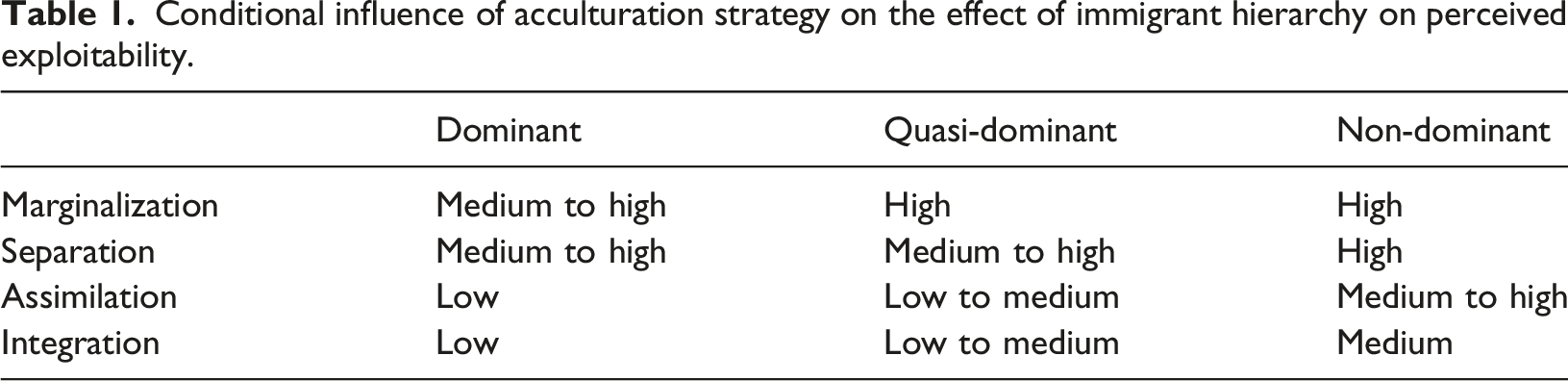
Thus far, we have discussed how the immigrant hierarchy level of applicants relates to employers’ motivation to exploit, through the perceived exploitability of immigrant applicants by employers (Path 1 and Path 2). Furthermore, we described how the relationship between the immigrant hierarchy level of applicants and the perceived exploitability of immigrant applicants by employers is influenced by the acculturation strategy perceived to be expressed by applicants (Path 3). Next, we will discuss how employers’ characteristics influence the effect of their perceived exploitability of immigrant applicants on their motivation to exploit.
The moderating role of employer characteristics
Studies on perceived exploitation tend to examine this issue from the perspective of the employee (see Livne-Ofer et al., 2019). Perhaps examining it from a new perspective (the employer’s perspective) will aid in understanding how their decision is influenced by the individual factors they possess that shape their sensemaking process. Although an applicant’s immigrant hierarchy level and acculturation strategy may signal to employers their perceived degree of exploitability, it is the decision of the employer (or hiring manager) to exploit the applicant or not. Other-group orientation and human values are employer characteristics that the current paper posits will change the effect that perceived exploitability has on their motivation to exploit.
Other-group orientation (OGO)
Other-group orientation is an attitude that describes the level to which individuals value interactions with others from different cultural backgrounds (Phinney, 1992). Individuals with a high OGO value seek interactions with individuals from other ethnic groups, while low-OGO individuals are more likely to experience discomfort interacting with individuals from different cultural and ethnic backgrounds (Phinney, 1992). Prior research suggests that employers with a high OGO exhibit positive attitudinal orientations toward and willingness to interact with immigrants (Long et al., 2020). It is proposed here that differences in recruiters’ other-group orientations will moderate the relationship between perceived exploitability and motivation to exploit based on their degree of preference to interact with outgroup individuals. Recruiters who are high in OGO may be more inclined to value and enjoy interactions with immigrants, even when these recruiters are not immigrants themselves. Such recruiters may be more likely to support diversity, considering immigrants as people who can add value to the organization through increased social and community connectedness (Lee, 2003) and favorable intergroup attitudes (Avery, 2003; Worrell and Gardner-Kitt, 2006). It is theorized that, even when these recruiters acknowledge the utility of exploitation (such as the ability to offer low wages to immigrants or compel them to work unhealthy hours), they are less motivated to engage in exploitative behaviors, because of the value and respect they have for other identity groups including immigrants. Prior research is consistent with this reasoning, suggesting that individuals high on OGO enjoy meeting and corresponding with multicultural individuals (Avery et al., 2013), including immigrants, and exhibit favorable, positive attitudes towards them (Worrell and Gardner-Kitt, 2006). Conversely, recruiters who are low in OGO may be less likely to support diversity and more likely to avoid interactions with immigrants. To these employers, immigrants may be perceived as perpetual outgroups that do not bring value. Consequently, among recruiters low on OGO, when the utility of exploitation is acknowledged, the motivation to exploit immigrants may be higher.
By actively pursuing opportunities to interact with immigrants, employers high on OGO may develop more favorable perceptions of immigrants, viewing their outgroup status as less salient. This favorable intergroup orientation is proposed to weaken perceptions of immigrant applicants’ exploitability, which in turn may reduce their motivation to exploit. Conversely, employers who are low on OGO would tend to avoid intergroup or cross-cultural contact and as such, may be less likely to perceive immigrants as a source of added value to the organization. Hence, the positive effect of perceived exploitability on motivation to exploit is sustained.
Human values
Human values are desired transsituational goals of varying importance that serve as guiding principles in a person’s life (Davidov et al., 2008; Schwartz, 1994). These values have been used to explain managers’ attitudes toward immigrants (Farashah and Blomquist, 2020). Schwartz (1992) developed a theory that describes 10 types of human values that are distinguished by their motivational goals. These values include stimulation, self-direction, universalism, benevolence, conformity, tradition, security, power, achievement, and hedonism. These values are further grouped into four dimensions: openness to change, self-enhancement, self-transcendence, and conservation (Davidov et al., 2008; Schwartz, 1992). Self-transcendence values comprise universalism and benevolence, both of which are concerned with the enhancement of others and the transcendence of selfish interests. On the other hand, conservation comprises conformity, tradition, and security, which emphasize the protection of order and harmony (Schwartz, 1992: p. 15). Self-transcendence and conservation values are more relevant to the context of our framework since they have been found to have unambiguous effects on attitudes towards immigration (Davidov et al., 2008: p. 5).
Self-transcendence values are those that reflect positive attitudes towards immigrants. Migration enables host country members (such as recruiters) to actualize their self-transcendence values (Davidov et al., 2008: p. 5). Recruiters with self-transcendence values may tend to be more tolerant, protective, understanding, and concerned for the welfare of immigrants (Davidov et al., 2008). These recruiters may consider immigrants as a source of added value and organizational innovation, and they may be more likely to make efforts to understand and appreciate the culture of immigrants as well as the diversity that culture offers (Farashah and Blomquist, 2020). Furthermore, recruiters who prioritize self-transcendence believe in social justice and see themselves as responsible for supporting others. Thus, recruiters with self-transcendence values may be more likely to recognize and understand the vulnerability of immigrants and seek ways to support them (Farashah and Blomquist, 2020: p. 20), rather than exploit them. Due to their positive attitudes towards immigrants, the current paper proposes that the effect of perceived exploitability on the motivation to exploit among recruiters with self-transcendence values will be weaker.
Conservation values, on the other hand, refer to recruiters’ exclusionist attitudes towards immigrants. Recruiters with conservation values prefer stability and view immigrants as a threat to the status quo (Farashah and Blomquist, 2020; Sagiv and Schwartz, 1995). Davidov et al. (2008, p. 9) found that conservation values have a negative effect on support for immigration. Similarly, Farashah and Blomquist (2020, p. 27) found that managers with lower conservation values have more positive attitudes towards immigrant workers. Therefore, it is proposed that conservation values among recruiters will be indicative of negative attitudes towards immigrants, such that recruiters with such values will undervalue immigrants’ potential and will seek ways to exploit rather than support them.
Taken together, recruiters’ OGO and human values are theorized to signal their role as cross-cultural facilitators, or inhibitors, in the recruitment process, complementing research in this area (Yu et al., 2022). It is proposed that the perceived exploitability of immigrant applicants based on their immigrant hierarchy level and acculturation strategy signals to employers the likelihood that they can avoid punishment for treating them unfairly. Select employers may be motivated to exploit immigrants based on this signal if they score low on OGO and/or hold a conservation values disposition. In conjunction with employers’ OGO and human values disposition, select employers may develop a motivation to exploit immigrants based on signals of perceived exploitability. See Path 4 in Figure 1 for depiction of this relationship in our conceptual model.
Discussion
The study of immigrants has been largely neglected in the cross-cultural management research (Bell et al., 2010). This is concerning because immigrants, as a group, constitute an important part of the global workforce today. The current research makes the following important contributions to the immigrant exploitation literature.
First, our framework theoretically discussed the antecedents of hiring personnel’s perceptions of immigrant exploitability. To increase workforce diversity, an increasing number of organizations hire immigrants under the guise that immigrants possess good work ethics, whereas they only do this because they believe that immigrants can be exploited without complaining (Bell et al., 2010; Moss and Tilly, 2001). The current framework theorizes that acculturation strategies, an indicator of the size and quality of immigrants’ social networks, will conditionally influence the effect of immigrant hierarchy levels on perceived exploitability. By shaping cross-cultural interactions and signaling behavioral assimilation, acculturation strategies contribute to the cross-cultural adjustment of immigrants, including their labor market success. Specifically, the current framework proposes that when immigrants express an integration acculturation, it mitigates the hiring personnel’s perception of their exploitability based on their immigrant hierarchy. Conversely, even though the perceived exploitability of high-hierarchy immigrants may be initially low, when they express a marginalization acculturation, their perceived exploitability may simulate levels similar to that of their low-hierarchy immigrant counterparts who express an integration or assimilation acculturation.
Second, by discussing other group orientation and human values, the proposed conceptual framework sheds light on how these hiring personnel’s cross-cultural characteristics may act as moderators of the relationship between perceived exploitability and motivation to exploit. Specifically, the framework suggests that motivation to exploit will be weaker among hiring personnel with a strong other-group orientation compared to those with a weak other-group orientation. Furthermore, our conceptual framework, Figure 1, proposed human values as a secondary influence of the effect of perceived exploitability on motivation to exploit, such that the impact of perceived exploitability on motivation to exploit is weakened among hiring personnel with self-transcendence values compared to those with conservation values. This perspective complements research on recruiters’ role as cross-cultural facilitators in the recruitment process (Yu et al., 2022).
In our conceptual framework, we focused specifically on hiring personnel’s dispositional characteristics (human values and other-group orientation) rather than factors such as racial, ethnic, and immigrant identity. We hone in on these characteristics to capture the general rather than demographic attributes of hiring personnel (Garcia et al., 2008) that will mitigate their motivation to exploit vulnerable immigrants. During job interviews, hiring personnel may or may not be immigrants and may or may not interview immigrants from the same race or ethnicity as them. For instance, consider a scenario where a White hiring manager, with a non-immigrant background, interviews a Black immigrant job applicant. Here, the interview dyad shares no commonality in race, ethnicity, or immigration background. Despite these dissimilarities, the White hiring personnel may not necessarily be motivated to exploit the Black immigrant job applicant if the White hiring manager possesses high human values and high other-group orientation. Consider another scenario where both the hiring manager and the immigrant job applicant are immigrants and/or share the same race and ethnicity. In this case, if the hiring manager is low on human values and other-group orientation, he/she may be motivated to exploit the job applicant despite the similarities between them. In a study on H1B holders in the US, for example, Varma (2020) observed how Indian H1B visa holders are taken advantage of by “body-shopping” companies (firms that maintain a pool of highly qualified individuals with in-demand technical abilities) owned by Indians or Indian-Americans. These companies give misleading information regarding jobs, wages, locations, work hours, and other details, thereby increasing the uncertainty and hardship that employees on this visa (H1B visa holders) typically have to endure. While we acknowledge that race, ethnicity, and immigrant identity of the hiring managers play a role in their motivation to exploit immigrants (similar-to- me effects: Sears and Rowe, 2003), our focus is on factors that may mitigate their tendency to exploit regardless of shared race, ethnicity, or immigration background with the applicant. To achieve this, we believe that human values and other group orientations play more prominent roles in explaining hiring managers’ value for both intra and even more so, intercultural contact (McKay and Avery, 2006), causing them to perceive immigrants favorably and as a source of benefits and added advantage (Farashah and Blomquist, 2020).
Further, while our conceptual framework mainly captures the experiences of immigrants from emerging economies permanently living, working or seeking employment in developed countries (e.g., from India to the United States: Varma, 2020), we also acknowledge that there may be other categories of individuals, such as those who moved from developed countries to developing countries. Often referred to as expatriates (Chen and Shaffer, 2018), these individuals are sent by a parent organization in their home country to a destination country to live and work on a temporary basis (Shah et al., 2022) and hence are not likely to experience exploitation as described in our framework.
Implications for practice and research
As a response to calls to raise awareness about the exploitation of vulnerable groups such as immigrants (Bell et al., 2010; Harrison et al., 2019) and to include other immigrant-related variables in the study of exploitation (Akinlade et al., 2020), this conceptual framework explores how immigrant hierarchy level and preferred modes of acculturation may influence hiring personnel’s perceptions of their exploitability (Akinlade et al., 2020). We recommend that low-hierarchy immigrants intentionally use an integrated acculturation approach to signal the extent of their cross-cultural adaptation and minimize hiring personnel’s misconceptions about their resource capital, thereby reducing their exploitability. Furthermore, recruiters need to be aware of the influence of their individual differences in mitigating the effect of perceived exploitability on their selection decisions. Employers can encourage this by offering training programs that emphasize cultural diversity and intercultural interactions to employees and ensuring that organizational mission and value statements reflect these values.
Future research can empirically test our conceptual framework by developing measures for perceived exploitability. Although Livne-Ofer et al. (2019) developed a scale for perceived exploitation relationships (PER), this scale taps into employees’ perception of being exploited by the organization. Therefore, it behooves researchers to develop a scale to measure hiring personnel’s or organizations’ perception of employees’ (in this case, immigrants’) exploitability. Also, future research should develop a measure of motivation to exploit while using the available measures for the other constructs. Further, we encourage future researchers to empirically apply this framework across different industries, to examine whether immigrants’ cultural intelligence - a characteristic that reflects one’s ability to function effectively in culturally diverse settings (Volpone et al., 2018) and job type are possible antecedents of perceived exploitability. Immigrant applicants seeking low-skill and routine jobs may be perceived as being more exploitable compared to those seeking more specialized and highly skilled opportunities. Also, one’s level of social capital or ability to develop it may influence their cultural intelligence as perceived by hiring personnel. Our proposed framework also theorized that individual differences in hiring personnel’s characteristics—other-group orientation and human values—will act as boundary conditions in the relationship between perceived exploitability and motivation to exploit. We encourage future research to examine the role of hiring personnel’s moral values, such as moral identity (Aquino and Reed, 2002), in the perceived exploitability-motivation to exploit link. Future efforts should also examine the role of organizational pro-diversity climates in these relationships.
Conclusion
The proposed conceptual framework extends the EO framework by contextualizing the immigrant exploitation process that occurs jointly between immigrants and hiring personnel (see exploitation opportunism: Akinlade et al., 2020). Extending this research, it describes how immigrants’ hierarchy levels and acculturation strategies are attributes of immigrants that make them susceptible to exploitation. These, in turn, affect hiring personnel’s motivation to exploit them. On the other hand, hiring personnel’s motivation to exploit or not to exploit immigrants also depends on their culturally relevant characteristics - other group orientations, and human values. Thus, the proposed framework provides a more comprehensive understanding of factors that drive immigrant exploitation during the selection process.
Footnotes

Funding
The authors received no financial support for the research, authorship, and/or publication of this article.
Declaration of conflicting interests
The authors declared no potential conflicts of interest with respect to the research, authorship, and/or publication of this article.