




Abstract
Informal networks are essential for professional and social integration in South Korea’s collectivist context, yet their exclusivity often creates significant barriers for self-initiated expatriates (SIEs). This study explores how SIEs navigate South Korea’s hierarchical and culturally embedded informal networks, such as Yongo (regional ties) and Yonjul (educational connections). Drawing on qualitative interviews with 30 self-initiated expatriates, it identifies strategies for accessing these networks and addresses gaps in understanding adaptation within the South Korean cultural context. The findings extend Social Capital Theory by highlighting the dual role of bonding and bridging capital—with bonding capital reinforcing exclusivity, and bridging capital enabling access through alternative pathways. The study also refines Berry’s Acculturation Framework by introducing a behavioral typology—Survivors, Politically Savvy Actors, Isolated Individuals, and Cultural Assimilators—which captures how relational and cultural dynamics shape adaptation. These insights demonstrate how SIEs combine strategic behaviors with cultural sensitivity to overcome exclusion and foster belonging in South Korea. The study offers actionable implications for expatriates, organizations, and policymakers seeking to support integration in Korea’s exclusive, high-context social environment. By bridging theoretical frameworks with practical strategies, this research advances our understanding of self-initiated expatriate adaptation within South Korea’s informal network systems.
Keywords
Introduction
Informal networks are critical in the professional and social integration of collectivist cultures (Horak and Paik, 2022), especially in South Korea, where they play a crucial role in collaboration, building trust, and enabling community inclusion. Although these networks, such as Yongo (regional ties) and Yonjul (educational or institutional connections), are deeply embedded in the socio-cultural fabric of Korean society, they are often inaccessible to foreigners, who struggle to navigate the exclusivity and culturally specific practices underpinning these networks (Horak, 2016; Horak and Klein, 2016). This lack of access can result in isolation or limited inclusion, particularly for self-initiated expatriates, who must learn to adapt without institutional support (Richardson and Ng, 2021
A key consideration in understanding these dynamics is the distinction between self-initiated expatriates (SIEs) and assigned expatriates (AEs), whose adaptation pathways differ significantly. SIEs—those who move abroad voluntarily for work or personal development—often lack the structured organizational support systems available to AEs, who are relocated by their employers (Froese and Peltokorpi, 2013; Suutari et al., 2018). In the South Korean context, SIEs face unique challenges in navigating informal networks, such as language barriers, cultural exclusivity, and status asymmetries (Arseneault, 2020; Froese, 2012). Recent studies suggest that SIEs’ cross-cultural adjustment, motivation, and personality traits strongly shape their integration strategies and performance (Hussain and Zhang, 2023; Jannesari et al., 2024). All participants in this study were self-initiated expatriates (SIEs), and the findings therefore reflect their experiences specifically. This distinction is important to frame how informal networks are navigated in the absence of corporate sponsorship and institutional access.
Furthermore, the study refines Berry’s (1997) Acculturation Framework by introducing a behavioral typology—Survivors, Politically Savvy Actors, Isolated Individuals, and Cultural Assimilators—that addresses the relational and network-specific barriers faced in hierarchical social systems like Korea’s Yongo and Yonjul. Horak (2017) describes Yongo-like ties as “determined by birth,” emphasizing the structural barriers those without such inherent connections face. Similarly, Horak and Taube (2016) point out these networks’ pre-defined, homogeneous, and exclusive nature while contrasting them with more flexible relational systems in other cultures. While such networks engender trust and cohesion within their circles, they reinforce exclusionary dynamics, leaving expatriates reliant on alternative strategies to establish bridging social capital. In response, expatriates often leverage social hobbies, weak ties, and culturally sensitive entry points to build connection, trust, and a sense of belonging (Jun and Ham 2015; Putnam, 2000).
While foundational, Berry’s framework has been critiqued for needing to address the relational and context-specific dynamics inherent in hierarchical and exclusive social systems like those in Korea. Adaptation in such contexts often requires the combination of cultural strategies with conscious efforts at building trust in informal networks (Kim, 2012). The dynamics are partly explained by Social Capital Theory (Bourdieu, 1986; Putnam, 2000), which illuminates the duality of the role of bonding and bridging capital in shaping the adaptation of expatriates. While bonding capital is necessary for group cohesion and thus acts like a gatekeeper, bridging capital allows expatriates to develop relationships with other groups and foster mutual trust (He et al., 2019). This study investigates strategies that self-initiated expatriates (SIEs) deploy to overcome exclusiveness in the informal networks of South Korea, a collectivist society characterized by strong, hierarchical, and culturally embedded relational structures.
The study intends to explore how SIEs overcome barriers to inclusion in the tightly knit networks defined by birth or shared history, such as Yongo and Yonjul. Furthermore, the study investigates strategies SIEs adopt in dealing with cultural and linguistic barriers within a very homogeneous context that adds even more complexity to adaptation due to its hierarchical and culturally specific practices. The study also highlights actionable insights for organizations that could help support expatriates in overcoming such challenges, building trust, and facilitating successful integration.
By addressing such dynamics, this study caters to calls made in the literature to explore more deeply the role of informal networks in East Asian contexts (Horak and Paik, 2022; Horak and Yang, 2016). This paper examines, from a Korea-specific perspective, how exclusionary dynamics of Yongo-like networks and other pathways serve as alternatives for SIEs to create integration, which provides cultural nuance into the relational mechanisms shaping adaptation. These findings, therefore, form the basis for further discussion and analysis of the strategies, barriers, and outcomes concerning expatriates in collectivist societies.
This paper is structured as follows: The literature review introduces the main theories—Social Capital Theory and Berry’s Acculturation Framework—and highlights gaps in understanding informal networks in collectivist cultures. The methodology section explains the qualitative approach based on interviews with SIEs in South Korea. The findings section explores how SIEs navigate barriers in exclusive networks like Yongo and Yonjul. The discussion connects these findings to the theoretical frameworks, showing how SIEs manage cultural and relational challenges. The paper concludes with practical recommendations for expatriates, organizations, and policymakers to support integration and global mobility.
Literature review
Social Capital Theory provides a robust framework for understanding relational dynamics in collectivist contexts (Bourdieu, 1986; Putnam, 2000). The theory highlights the resources available through social networks, categorized into bonding social capital (strong ties within tightly knit, homogeneous groups) and bridging social capital (weak ties connecting diverse groups) (Baughn et al., 2011; Kuki et al., 2021; Levy et al., 2019). While bonding capital fosters trust and cohesion within a network, as seen in Korea’s Yongo and Yonjul, it also creates barriers for outsiders, as Bourdieu (1986) and Putnam (2000) have noted. These networks, often “determined by birth,” as Horak (2017) describes, typically leave expatriates reliant on bridging capital to access resources and opportunities. As Putnam (2000) further explains, bridging capital allows individuals to form connections across group boundaries.
Self-initiated expatriates (SIEs) in South Korea often engage in activities such as hobbies and alternative social gatherings to build bridging social capital. While alcohol consumption is an integral and culturally significant part of South Korean social and workplace life (Atay et al., 2024; Bader et al., 2018; Horak and Klein, 2016), some expatriates—particularly for religious or personal reasons—intentionally seek non-alcohol-centered interactions such as hobby groups, community events, or cultural activities to foster meaningful relationships while aligning with personal or religious preferences. Such adaptive strategies reflect the broader behavioral flexibility and coping mechanisms observed among SIEs in Korea (Arseneault, 2020; Froese, 2012).
Horak and Taube (2016) further illuminate the distinct characteristics of informal networks in Korea. They note that Yongo networks, while society-spanning, are “predefined, partly by birth, and are hence homogeneous and highly exclusive” (p. 1). This exclusivity creates challenges for expatriates, contrasting with China’s more flexible guanxi networks. Jun and Ha (2015) also identify that bridging social capital indeed plays a critical role in enabling immigrant groups in Korea to integrate, especially when immigrants can establish long-term residence and attain fluency in the host country’s language. These findings have highlighted the importance of bridging capital in overcoming the structural constraints of bonding capital-dominated networks.
Importantly, expatriates’ ability to build such bridging ties is shaped by the nature of their expatriation. There is a well-established distinction between self-initiated expatriates (SIEs)—individuals who relocate abroad independently—and assigned expatriates (AEs), who are sent abroad by their employers. These groups differ significantly in their motivations, support systems, and adjustment experiences (Andresen et al., 2015; Froese and Peltokorpi, 2013; Suutari et al., 2018). SIEs often lack institutional resources and must rely more heavily on personal networks and informal strategies to adapt.
In the South Korean context, research has shown that SIEs face unique adjustment challenges, including language barriers, exclusion from institutional networks, and limited organizational support (Arseneault, 2020; Froese, 2012; Mäkelä et al., 2022). These barriers often require SIEs to be more proactive in seeking out or creating bridging social capital. Thus, understanding expatriate integration into Korean informal networks requires an appreciation of the expatriate type and its impact on relational strategies.
Trust is an intrinsic element of social capital, enabling and facilitating the exchange of resources and cooperation within networks. Expatriates surmount the barriers to inclusion via trust-building practices, which, to a certain degree, need to be culturally specific, such as gifting or attending social events (Wu et al., 2020). Informal multicultural social organizations may serve as a platform for building trust and provide interfaces across cultural and linguistic differences that enable integration (Lomnitz and Sheinbaum, 2004). Furthermore, Social Capital Theory (Bourdieu, 1986; Putnam, 2000) illuminates how the exclusivity of bonding capital creates a dual role for informal networks: they act as barriers to expatriates and offer opportunities for inclusion through bridging capital strategies (Horak and Paik, 2022). He et al. (2019) highlighted that the interplay between bonding and bridging capital fosters community capacity through trust and reciprocity, which can also enhance expatriate adaptation in local contexts.
Complementing Social Capital Theory, Berry’s (1997) Acculturation Framework provides an essential lens for understanding cultural adaptation. This framework categorizes strategies into four modes: integration, assimilation, separation, and marginalization. Integration involves keeping one’s cultural identity while actively participating in the host culture. Assimilation reflects a full adoption of the host culture, often at the expense of one’s original identity. Separation describes a preference to keep one’s cultural identity while minimizing interaction with the host culture, and marginalization occurs when individuals experience disconnection from both the host and original cultures.
Although Berry’s (1997) Acculturation Framework has been widely applied in cross-cultural research, scholars have also noted its limitations in capturing the relational and contextual dimensions of adaptation. For example, Weinreich (2009) highlights that identity negotiation and the influence of hierarchical structures are not fully addressed in the model.
Research on Korea’s informal networks similarly suggests that exclusive, birth-based ties such as Yongo and Yonjul introduce relational barriers that Berry’s framework does not fully explain (Horak and Klein, 2016). In addition, the concept of cultural distance is central to understanding how expatriates experience such barriers. Greater perceived cultural distance has been associated with slower social integration, higher adjustment strain, and limited access to informal networks (Kang and Shen, 2018; Mäkelä et al., 2022). In the Korean context, Confucian values, hierarchical workplace norms, and language-based relational expectations often amplify these effects, shaping how expatriates interpret and engage with informal structures like Yongo and Yonjul.
These complex issues, related to social capital combined with cultural adaptation strategies, draw attention to the need to integrate Berry’s framework with relational perspectives such as Social Capital Dynamics (SCD) (Parker et al., 2016) to capture the multifaceted process of expatriate adaptation. By introducing a behavioral typology that integrates relational strategies, this study refines Berry’s framework by showcasing the proactive creation of bridging capital through activities like hobbies and non-traditional social gatherings to better capture expatriates’ adaptation processes in exclusive cultural settings like Korea’s Yongo and Yonjul.
Moreover, the concept of acculturation overspill (Bader et al., 2018)—the interaction between adaptation in the workplace and private life—is particularly relevant in collectivist contexts like Korea, where informal social norms frequently cross into professional environments. This includes practices such as social drinking, language etiquette, and food-related expectations that influence both domains simultaneously. Choi (2001) observes that expatriates in Korea often find their personal lives shaped by workplace dynamics, underscoring how adaptation is not confined to the office. These findings reflect a blending of roles and expectations that amplify the emotional and psychological load of expatriates. As such, overspill can either contribute to stress or foster deeper integration, depending on the individual’s coping strategy and openness to engage with local norms. The present study provides qualitative evidence of this duality and proposes that understanding overspill is critical to fully grasping expatriate adaptation in tightly knit collectivist settings. In doing so, this research contributes to a growing body of work exploring how self-initiated expatriates (SIEs) uniquely navigate exclusionary environments without formal organizational support (Despotovic et al., 2022; Kubovcikova and Van Bakel, 2022; Park and Coleman, 2022).
This study extends Social Capital Theory by exploring SIEs’ efforts to navigate these exclusionary dynamics in Korea. It addresses gaps identified by Horak and Paik (2022), who argued that informal networks are often weakly understood regarding SIEs’ ability to connect to local ties. By linking these relational mechanisms to Berry’s Acculturation Framework, this research highlights how social capital complements cultural adaptation strategies, offering a comprehensive understanding of expatriate integration in collectivist societies.
Methodology
This study employed a qualitative research approach, using purposive and non-probabilistic sampling methods (Bryman, 2016) to gather rich, detailed insights into SIEs’ experiences navigating informal networks in Korea. The qualitative approach was chosen to explore nuanced, context-specific experiences, particularly in hierarchical and culturally specific settings like Korea. This aligns with calls in the literature for more interpretative methods to understand the complex relational dynamics inherent in collectivist societies (Boyatzis, 1998; Vaismoradi et al., 2013).
Data was collected through open-ended, semi-structured interviews, enabling participants to share detailed accounts of their professional and social experiences. These conversational interviews allowed unforeseen themes to emerge while linking the researcher’s objectives to the present study (Kallio et al., 2016). Sample interview questions are: “What efforts do you make to incorporate into the Korean society?”, “Can you describe your experiences with adapting to informal networks in Korea?” A pilot was executed with two participants using an iterative process to verify efficacy in the questioning protocol’s relevancy and edit refinements for the final guide, according to Clarke and Braun (2017).
Ethical considerations were critical in the present study. The ethics committee of the leading author’s previous university approved this research, and participants—who were clearly informed about their rights and the aims of the research—provided informed consent
“Snowball sampling was applied due to the rarity of SIEs who fit the criteria for this study (Vaismoradi et al., 2013). To ensure the suitability of participants, clear inclusion criteria were established in advance: individuals had to be self-initiated expatriates (SIEs) working in Korea with a minimum stay of 2 years. Each referral was screened against these criteria before being invited to participate. Consequently, all thirty participants included in the final sample met the definition of self-initiated expatriates, and no assigned expatriates were included in the study.
As with all snowball approaches, the potential for bias exists—for instance, overrepresentation of individuals from similar networks or backgrounds. To mitigate this, recruitment began with a heterogeneous set of initial contacts across industries, genders, and nationalities, and efforts were made to follow referrals into new social and professional circles. Data collection proceeded until saturation was reached, as indicated by the repetition of themes during preliminary analysis (Boyatzis, 1998).
Participant Demographics.
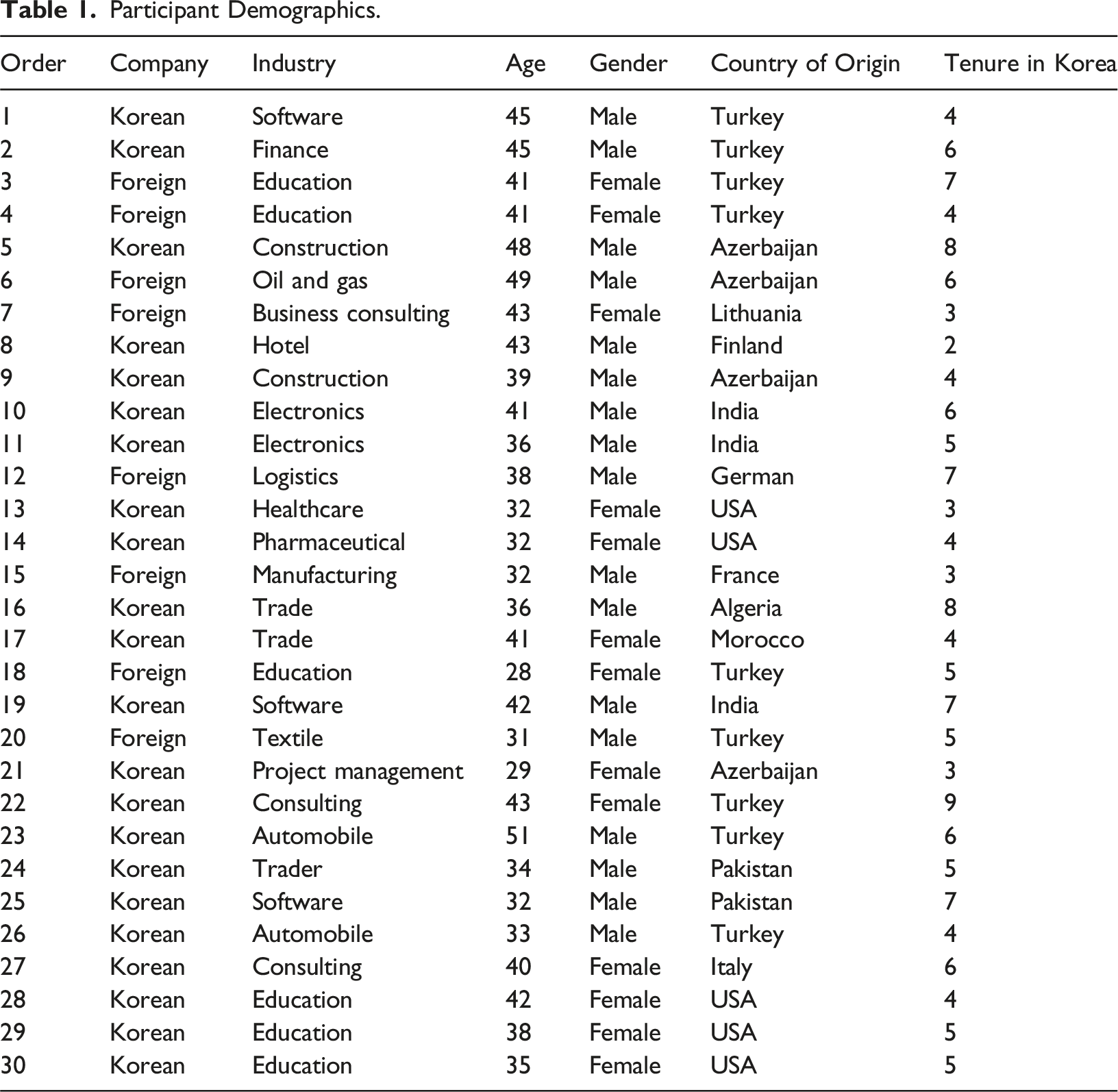
The sample included 9 Turkish participants, representing approximately 30% of the total sample (n = 30). This subgroup’s shared regional and religious background with the host context offered useful insights into how varying degrees of cultural proximity or distance shape adaptation patterns. This overrepresentation is partly a result of the snowball sampling method and reflects existing expatriate social circles in Korea. While this may limit the diversity of cultural perspectives, it also offers a rich case for examining adaptation from a Middle Eastern cultural background. Prior research (e.g., Arseneault, 2020; Waxin, 2004) has shown that cultural distance can affect expatriate adjustment, particularly in navigating informal and collectivist social systems. Therefore, while the findings provide valuable insights, interpretations must consider how specific cultural proximities or distances may have shaped participant strategies and challenges.
Although the study provides rich insights into SIEs’ experiences, its qualitative approach limits generalization to broader expatriate populations. Further, the focus on Korea may not capture dynamics in other collectivist societies, thus requiring future cross-cultural research. The study’s methodological rigor and contribution to understanding expatriate adaptation in hierarchical cultural contexts offset these limitations.
Analytical processes
Data collection and analysis were conducted using a systematic qualitative approach. Specifically, all 30 interviews lasting between 50 and 90 minutes were audiotaped and transcribed verbatim. The material was then analyzed for its thematic content. Thematic analysis was selected as the method to be used because of its flexibility in eliciting patterns within complex data sets, as proposed by Braun and Clarke (2006). To ensure maximum methodological rigor, two researchers independently coded the material and reviewed discrepancies jointly to increase interrater reliability and analytic consistency.
Theme tree.
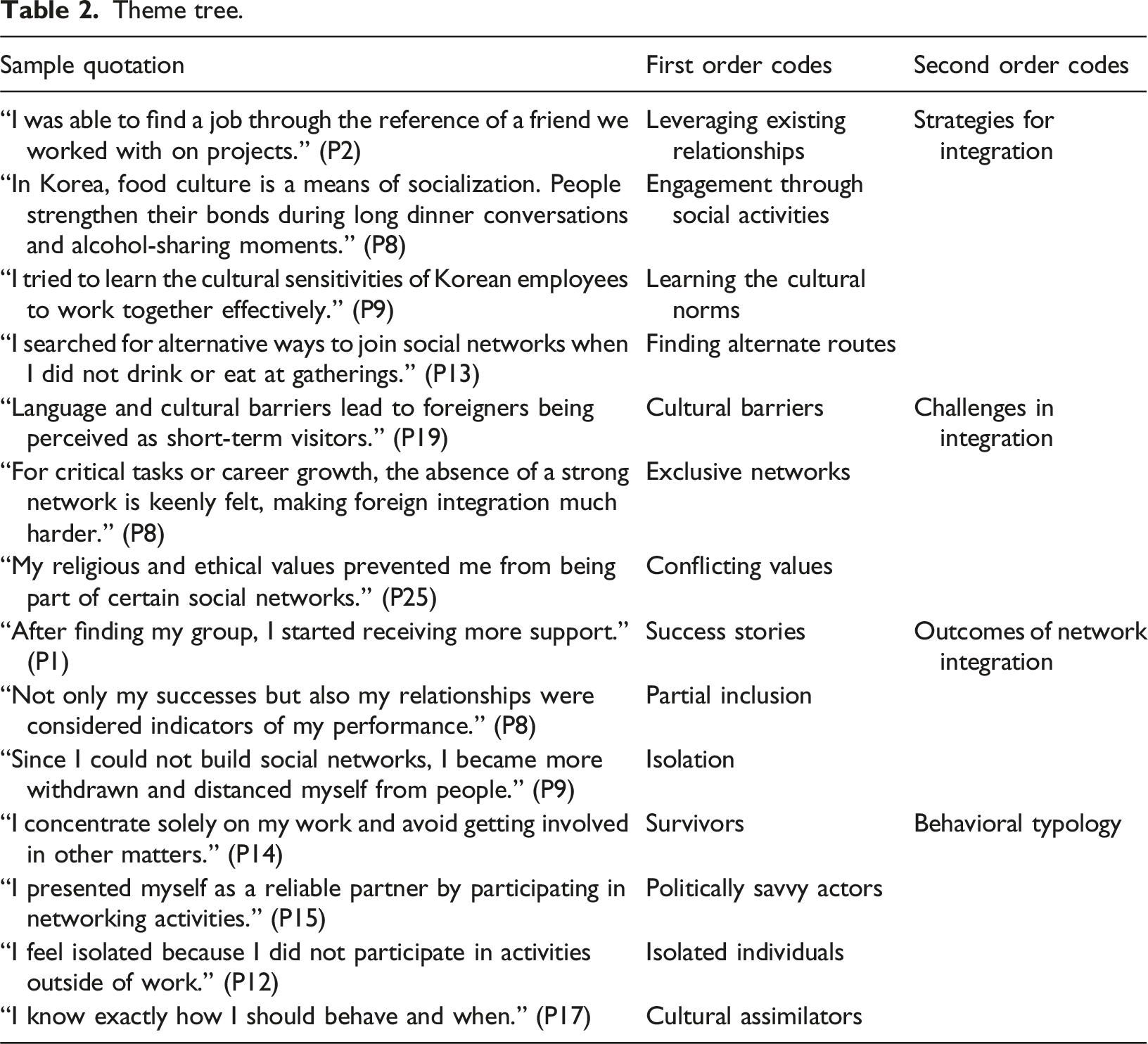
According to Vaismoradi et al. (2013), these themes were then iteratively refined through repeated readings and cross-validation to confirm coherence and relevance. This helps create findings that reflect the participants’ accurate experiences and interpretations. Participants reviewed their transcripts to validate the data, further enhancing the reliability of this study.
Emergent themes were then organized into how SIEs managed their challenges to integration along practical, relational, and cultural dimensions through mobilizing prior relationships, organizing social activities, learning about cultural norms, and identifying alternative routes to bridge ties with local communities. As reflected in participants’ narratives, adaptive strategies for overcoming obstacles—such as the exclusivity of Yongo and Yonjul networks—are particularly important for developing trust and fostering social connections, especially in situations such as workplace conflicts, team-building events, and informal gatherings (Table 2). This also highlights an element of acculturation overspill (Bader et al., 2018), where adaptation in private life and work settings intersect—for example, through after-work gatherings, language practices, and food-related expectations—underscoring how professional and social domains in Korea are closely intertwined. Triangulation across multiple researchers and participant feedback ensured reliability and validity. This holistic approach allowed this study to capture a nuanced understanding of SIEs’ adaptation strategies in a unique cultural context.
Results
Strategies for integration
Leveraging existing relationships
This section examines how SIEs draw on pre-existing social ties—such as friends, colleagues, and family members—to overcome barriers and facilitate adaptation in Korea. Participants consistently pointed out that using existing relationships is essential for surviving life and work in Korea. According to P1 (Male, 45, Turkey, Software, 4 years in Korea), the assistance of an acquaintance can enhance the ability to adapt faster to life in Korea: “I could adapt quickly since my friend helped a lot.” At the same time, P2 (Male, 45, Turkey, Finance, 6 years in Korea) explained job-hunting as being made more accessible by the reference given by a colleague: “I was able to get a job through the reference provided by a friend we had project gatherings with.” As for others, familial contacts serve well in situations. As P4 (Male, 48, Azerbaijan, Construction, 8 years in Korea) explains, “My spouse has friends since the past. They tend to assist in everything.” Taken together, these examples demonstrate how bonding social capital through pre-existing ties—whether friendships, colleagues, or spousal connections—reduces barriers to adaptation and provides SIEs with critical entry points into Korea’s professional and private spheres (Horak and Klein, 2016).
Engagement through social activities
This section highlights the importance of after-work gatherings and informal activities in building trust and reinforcing social connections among SIEs and locals. The after-dinner gatherings and informal activities after work were significant in cementing relationships and ensuring that one felt included. P5 (Male, 48, Azerbaijan, Construction, 8 years in Korea) reflected on the bonding opportunities presented through such gatherings: “People connect and strengthen their relationships during after-work dinner meetings.” These events can often strengthen relationships outside the workplace, as P6 (Male, 49, Azerbaijan, Oil and Gas, 6 years in Korea) described: “These social relationships are reinforced through informal meetings and meals outside of work.”
However, according to P7 (Female, 43, Lithuania, Business Consulting, 3 years in Korea), individual lifestyle preferences sometimes created initial hesitation: “At first, I avoided such meetings because I did not drink alcohol. However, I realized this isolated me and started attending the gatherings.” This reflects how personal choices—such as drinking habits—intersect with Korea’s alcohol-centered social culture to shape SIEs’ integration strategies.
Together, these accounts illustrate the critical role of social drinking and informal gatherings in Korea as gateways to trust and acceptance within professional and personal networks. Even when initial discomfort arises, participation in these activities functions as a bridging mechanism for expatriates, enabling them to reduce social distance and integrate more effectively into Korean relational systems (Bader et al., 2018; Horak and Klein, 2016).
Learning the cultural norms
This section explores how SIEs’ efforts to understand and adapt to Korean cultural expectations influence their integration into informal networks
Finding alternate routes
This section analyzes the alternative strategies SIEs employ—such as hobbies and non-alcoholic gatherings—to gain access to social networks when traditional routes prove inaccessible. Finding alternative ways to interact with others was necessary for SIEs who could not fit into the traditional social context. P12 (Male, 38, Germany, Logistics, 7 years in Korea) highlighted how hobbies helped him expand his social networks: “I found sport and joined several hobby groups.” For P14 (Male, 32, USA, Pharmaceutical, 4 years in Korea), sports activities also provided alternative access to networks: “I met new people through sports and hobbies. It gave me another kind of network.”
P13 (Female, 32, USA, Healthcare, 3 years in Korea) described feeling disconnected from broader Korean social circles but found ways to maintain limited support and social interaction: “I found alternative ways to enter these social networks if I did not participate in typical gatherings. I often looked for more casual settings where I could be myself and avoid the pressure to conform.” Her narrative indicates that while she experienced barriers to deeper integration, she did not withdraw completely. Instead, she selectively engaged in environments that aligned with her personal values and comfort zone. Her case does not fully reflect the profile of an “Isolated Individuals,” but rather someone practicing selective engagement—navigating around mainstream social practices while maintaining a basic level of social connection.
Together, these reflections reveal how SIEs create bridging capital by leveraging non-traditional social activities, such as sports or hobby groups, as substitutes for mainstream drinking-based networking practices. Such strategies demonstrate agency in circumventing barriers to inclusion, extending beyond individual preferences to reveal structural alternatives for building integration. This aligns with broader evidence that alternative interaction spaces can facilitate expatriate adaptation in hierarchical and collectivist contexts (Jun and Ha, 2015; Horak and Taube, 2016).
Challenges in Integration
Cultural barriers
This section identifies the challenges SIEs encounter due to Korea’s cultural homogeneity, language constraints, and food-related differences. Participants frequently described how cultural and linguistic barriers hindered their integration into Korean society. P16 (Male, 36, Algeria, Trade, 8 years in Korea) remarked on the challenges stemming from what he perceived as Korea’s cultural homogeneity, noting: “The fact that Koreans have lived as one nation creates a lack of understanding towards foreigners.” While such perceptions are common among SIEs, they should be situated within the broader political and social discourse in Korea, where government and media narratives often emphasize national unity and cultural sameness (Lie, 2014; Shin, 2006). This framing shapes how homogeneity is experienced by foreigners but does not fully capture the growing ethnic and cultural diversity within contemporary Korean society. Language barriers compounded these challenges, as P19 (Male, 42, India, Software, 7 years in Korea) highlighted: “Language and cultural barriers lead to foreigners being perceived as short-term visitors.”
Dietary restrictions added another layer of difficulty. As P17 (Female, 41, Morocco, Trade, 4 years in Korea) explained: “I had to explain my food sensitivities every time, and it was an exhausting process.” This account illustrates the personal burden of repeated explanation, which participants may experience as tiring or socially awkward. However, rather than being a fundamental barrier to integration, such experiences reflect everyday frictions that arise when individual lifestyle needs encounter limited cultural awareness in host settings. These frictions are common in cross-cultural contexts and highlight the micro-level challenges that accompany broader adaptation processes.
Taken together, these examples illustrate how narratives of homogeneity, language difficulties, and everyday lifestyle mismatches operate as barriers that restrict SIEs’ ability to fully participate in Korean informal networks. These obstacles reinforce outsider perceptions and limit relational integration, echoing findings in research on structural exclusivity and bounded trust in collectivist societies (Froese, 2010; Horak and Klein, 2016).
Exclusive networks
This section investigates the exclusivity of Yongo and Yonjul ties, which act as structural barriers to SIEs’ professional and social integration. Informal Korean networks are difficult to penetrate, especially for foreigners, who often lack cultural or social entrée. Admission to such networks frequently requires strong personal references, usually a typical school or regional background. As P21 (Female, 29, Azerbaijan, Project Management, 3 years in Korea) stated: “Your acceptance into a network relies on having a close referral to recommend you.”
As several participants observed, the exclusivity of these networks means that school ties, alumni relationships, and regional connections often become the filtering criteria for access. P23 (Male, 51, Turkey, Automobile, 6 years in Korea) emphasized: “School and regional connections are important references,” highlighting SIEs’ structural challenges. Once inside these networks, sustaining membership can be equally challenging. SIEs often perceive the group dynamics as unusual or alienating, leading them to withdraw. P21 (Female, 29, Azerbaijan, Project Management) added: “Gaining entry is not the problem; staying in is challenging. Foreigners often see the group’s atmosphere as something unusual and try to find their own space, leading to mental struggles.”
This difficulty is compounded by the hierarchical nature of Korean networks, which require significant investments of time and conformity to cultural practices, such as after-hours meetings and social drinking. Professional advancement within Korean organizations is also closely tied to these informal networks. Members of exclusive solidarity groups often receive preferential treatment for promotions or key assignments, sidelining outsiders, including SIEs. P24 (Male, 34, Pakistan, Trade, 5 years in Korea) articulated this exclusion bluntly: “Is it possible for a foreigner to be a member of such a group? Not.”
Maintaining high-level networks often involves culturally specific activities that further exclude expatriates. These include joining elite social circles, such as golf clubs or leadership programs requiring significant financial and cultural investment. P9 (Male, 43, Finland, Hotel, 2 years in Korea) noted this exclusivity in professional interactions, pointing out that expatriates are often excluded from such privileged avenues. These dynamics create a significant challenge for expatriates attempting to integrate into Korean professional environments. Access to these networks is necessary for expatriates to avoid barriers to professional growth and social belonging. P5 (Male, 48, Azerbaijan, Construction, 8 years in Korea) concluded: “For critical tasks or career growth, the absence of a strong network is keenly felt, making foreign integration much harder.”
Altogether, these testimonies underscore how the exclusivity and hierarchical nature of Yongo- and Yonjul-based networks act as structural barriers for expatriates, reinforcing reliance on bonding capital while denying opportunities for bridging ties. This reflects broader patterns in East Asian contexts, where informal networks function as both a gatekeeping mechanism and a determinant of professional advancement (Horak and Klein, 2016; Horak and Taube, 2016).
Competing values
This section presents the conflicts SIEs experience between personal values and cultural expectations in Korea, and how these tensions shape their strategies of adaptation. The respondents reported competing personal and cultural values as a significant dilemma. P25 (Male, 32, Pakistan, Software, 7 years in Korea) described how religious commitments restricted participation in certain activities: ‘My religious and ethical values prohibited me from being part of some social networks.’ Similarly, P26 (Male, 33, Turkey, Automobile, 4 years in Korea) reflected on the tension between maintaining individuality and conforming to group expectations: ‘Sometimes, fitting into societal norms involves giving up some of your values.’ These accounts illustrate how religious and ethical convictions—such as abstaining from alcohol or avoiding mixed-gender socializing—shaped the ways participants engaged in Korea’s informal networks. For several respondents, such avoidance resulted in fewer social invitations and a sense of being peripheral to the dominant group culture. This highlights the influence of both cultural and moral distance, where the misalignment between individual belief systems and collective social expectations restricts opportunities for informal integration and belonging.
These conflicts highlight the emotional and ethical challenges SIEs face when navigating Korean social life. They reveal the friction between personal identity preservation and the demands of cultural conformity. Such competing values create a space where SIEs must negotiate between separation and integration strategies, echoing insights from Berry’s Acculturation Framework while illustrating the specific pressures of Korea’s collectivist and hierarchical systems (Berry, 1997; Horak and Klein, 2016).
Outcomes of network integration
Success stories
Participants also provided examples of successfully penetrating the informal networks in Korea and often referred to perseverance and adaptability. P1 (Male, 45, Turkey, Software, 4 years in Korea) explained that finding one’s group significantly improved the situation: “Once I found my group, I started getting more support.” Similarly, P2 (Male, 45, Turkey, Finance, 6 years in Korea) highlighted trust and acceptance as outcomes of cultural adaptation: “Once you adapt, people start trusting you more.” These narratives highlight the benefits of active integration strategies, showing how persistence and cultural sensitivity can transform exclusion into trust and reciprocity. They also illustrate the transition from bridging to bonding social capital, aligning with findings that trust within informal networks develops gradually through repeated participation (Horak and Klein, 2016; Jun and Ha, 2015).
Partial inclusion
While some SIEs achieved limited success in integration, their experiences were characterized by incomplete inclusion. P5 (Male, 48, Azerbaijan, Construction, 8 years in Korea) reflected on his involvement in social activities: “I managed to join some social activities but could not build the same level of closeness with others.” P7 (Female, 43, Lithuania, Business Consulting, 3 years in Korea) observed that friendships with locals were often superficial, explaining: “You can be friends with Koreans, but deepening that relationship is quite difficult.” These accounts suggest that inclusion is often layered: SIEs may gain surface-level access but struggle to develop the deeper relational trust that defines Yongo- and Yonjul-based ties. This partial integration reflects the persistence of boundaries in collectivist contexts, where belonging is determined less by participation and more by shared history and cultural embeddedness (Horak and Taube, 2016).
Isolation
For some, efforts toward incorporation into informal networks led instead to isolation. P9 (Male, 43, Finland, Hotel, 2 years in Korea) detailed the psychological costs of limited connections: “Since I could not build social networks, I became more retracted and distanced from people.” P10 (Male, 41, India, Electronics, 6 years in Korea) explained how avoiding after-work gatherings shaped perceptions: “If you do not attend after-work meetings, you are perceived as antisocial.” Additionally, P12 (Male, 38, Germany, Logistics, 7 years in Korea) underscored the challenges of preserving individuality: “Keeping my lifestyle distinctive isolated me in Korea.” These accounts reveal how non-participation or value-driven withdrawal can reinforce outsider status, producing feelings of isolation despite professional presence. This underscores the psychological strain SIEs face when they cannot reconcile personal values with collective expectations, a tension also highlighted in acculturation research (Bader et al., 2018; Berry, 1997).
Behavioural typology
Behavioral typology matrix.
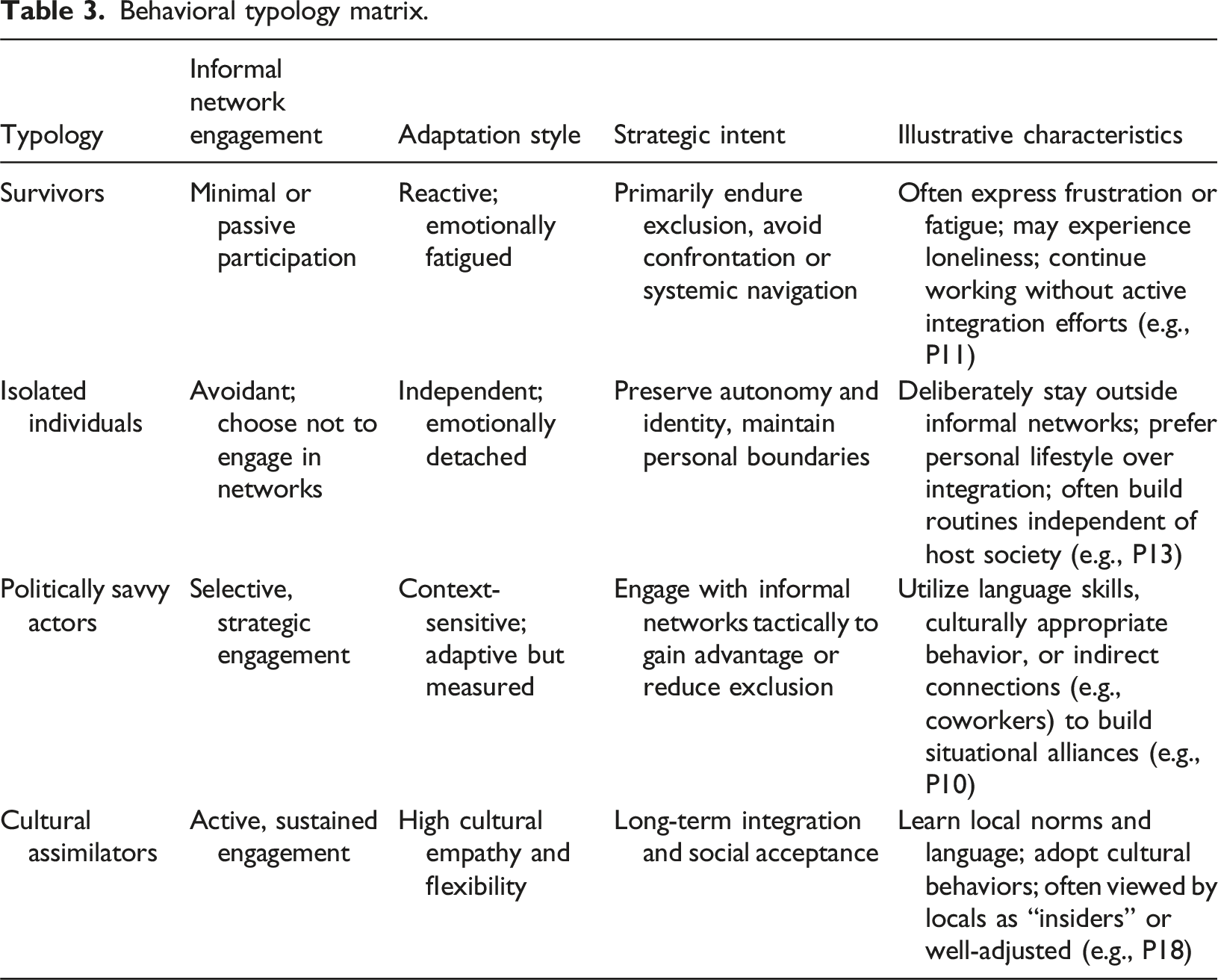
This framework aligns with research suggesting that expatriate adaptation is shaped by individual agency, cultural intelligence, and responses to structural barriers in the host environment (Choi, 2001; Siljanen and Lämsä, 2009). It also resonates with Earley and Mosakowski’s (2004) concept of cultural intelligence, particularly their argument that expatriates’ effectiveness depends on interpreting situational cues and flexibly adjusting behaviors to culturally specific contexts. However, while cultural intelligence is a multi-dimensional psychological capability, our behavioral typology is a context-sensitive classification of strategic responses to relational and structural exclusion—especially the exclusivity of informal networks. This approach captures emergent behavioral patterns within hierarchical, collectivist societies, where social integration is informal, trust-based, and often restricted.
By linking these insights to SIEs’ strategies in Korea, the typology highlights why some groups (e.g., Politically Savvy Actors and Cultural Assimilators) succeed in building trust and navigating exclusivity, whereas others (e.g., Survivors and Isolated Individuals) remain constrained by limited adaptation. Unlike Cultural Intelligence, which is rooted in psychological capability frameworks, our typology is sociologically grounded in Social Capital Theory, acculturation, and informal network exclusion, offering a more relational and situationally embedded view.
The typology also complements Berry’s (1997) Acculturation Framework by integrating relational strategies specific to informal network systems, such as Korea’s Yongo and Yonjul. In particular, Horak and Klein (2016) underscore the persistence, exclusivity, and birth-based nature of these ties, which pose unique challenges for foreign professionals. The matrix further aligns with findings from Bader et al. (2018), who show that SIEs in South Korea often adopt context-specific behavioral shifts to manage work-life boundaries.
This typology does not assume static categories but reflects adaptive tendencies that SIEs develop over time in response to relational and institutional challenges. It offers a dynamic yet structured lens to analyze how SIEs engage with, circumvent, or reshape the informal social fabric of collectivist and hierarchical societies like South Korea.
Survivors
They rely primarily on their professional success, and their involvement with informal networks is minimal. Most of them opt for work-related goals instead of social integration to cope with the complexities of expatriate life. P13 (Female, 32, USA, Healthcare, 3 years in Korea) explained that she paid attention to work and nothing else “just to avoid any kinds of conflicts,” adding: “Focusing solely on technical success is not enough, but it is what I focus on.” Similarly, P14 (Female, 32, USA, Pharmaceutical, 4 years in Korea) consciously avoided discussion outside of work: “I just focus on my job and do not get into other matters.”
For some, this emphasis on work came at a personal cost. P11 (Male, 36, India, Electronics, 5 years in Korea) admitted: “Working alone and achieving my goals makes me feel isolated.” Others, like P10 (Male, 41, India, Electronics, 6 years in Korea), stressed the need to continuously avoid social entanglements: “I always focused on my work and stayed away from relationships.” This approach reflects a mindset that puts professional performance above everything else. Additionally, P19 (Male, 42, India, Software, 7 years in Korea) indicated a consistent preoccupation with individualistic performance: “No matter what, I focused on my performance.” Along similar lines, P15 (Male, 32, France, Manufacturing, 3 years in Korea) recalled: “I finished the required jobs independently and ignored the social affairs.” These accounts demonstrate clear strategies for disengaging from informal social connections out of a preoccupation with job performance.
While survivors frequently exhibit professional success, they still acknowledge the limits of this approach. P13 (Female, 32, USA, Healthcare) admitted: “It is impossible to achieve technical success without the team’s support.” Similarly, P5 (Male, 48, Azerbaijan, Construction, 8 years in Korea) pointed out: “I am successful at my work, but I achieved this success alone.” Finally, P18 (Female, 28, Turkey, Education, 5 years in Korea) reflected on her approach: “I focused on individual success regarding the projects I worked on and ignored group relationships.” This epitomizes the conscious choice survivors make by prioritizing personal goals at the expense of the collective.
In sum, the Survivor type illustrates a defensive adaptation strategy where SIEs rely heavily on professional competence while deliberately minimizing social engagement. This echoes Berry’s (1997) separation strategy, but in Korea’s collectivist setting, it also reveals the costs of bypassing informal networks, leading to both achievements and isolation (Bader et al., 2018; Horak and Klein, 2016).
Politically savvy actors
The politically savvy actors negotiate exclusivity by strategically engaging with informal networks. Measured steps are taken to gain confidence and credibility within Korea’s socialization structures. P15 (Male, 32, France, Manufacturing, 3 years in Korea) emphasized how he used networking events to position himself as a reliable collaborator: “I presented myself as a reliable partner by participating in networking activities.”
On the other hand, P16 (Male, 36, Algeria, Trade, 8 years in Korea) described using culturally accepted gestures of appeasement, such as gifting on traditional holidays, to develop closer relationships: “I tried to please my Korean colleagues with meals and holiday gifts.” These conscious acts demonstrate an astute awareness of the cultural expectations required to navigate an exclusive network.
A central part of this strategy involves using social gatherings and casual interactions to reinforce relationships. P6 (Male, 49, Azerbaijan, Oil and Gas, 6 years in Korea) pointed out that social relationships were strengthened in activities outside of work: “These social relationships are strengthened in informal meetings and meals outside of work.” Similarly, P9 (Male, 43, Finland, Hotel, 2 years in Korea) reported putting effort into learning the rules of Korean culture: “I put effort into learning Korean culture and acting accordingly.” These are examples of proactive alignment with the host culture to achieve inclusion.
For politically savvy actors, relationships often serve as tickets to career advancement. P12 (Male, 38, Germany, Logistics, 7 years in Korea) explained that his ability to establish good social connections in academic environments led directly to job opportunities: “I found a job after my PhD by establishing strong social bonds with my professor and lab mates.” Similarly, P8 (Male, 43, Finland, Hotel, 2 years in Korea) noted: “I used relationships based on a shared past to find a job.” These examples show how strategic social engagement can pay off in exclusive settings.
Cultural intelligence also plays a significant role in their successful performance. P21 (Female, 29, Azerbaijan, Project Management, 3 years in Korea) reported deliberately working to build relationships with locals: “I improved my cultural intelligence and developed stronger relationships with Koreans.” The same can be seen in P20 (Male, 31, Turkey, Textile, 5 years in Korea), who said: “I have strengthened my relationships by giving small gifts during holidays.” Lastly, P3 (Female, 41, Turkey, Education, 7 years in Korea) explained her strategy to become more visible within groups: “I acted strategically to become more visible within the group.”
Altogether, these cases show how politically savvy actors deploy calculated methods—such as strategic gifting, cultural learning, and leveraging pre-existing ties—to gain entry and sustain inclusion in exclusive Korean networks. This aligns with research on cultural intelligence and relational agency, which highlights how SIEs actively manage host-country expectations to advance professionally and socially (Earley and Mosakowski, 2004; Horak and Klein, 2016).
Isolated individuals
Isolated individuals are those who, by conscious or unconscious decision, refrain from engaging in informal networks. Often, they devote themselves to personal or family concerns. Individuals maintain their values and a sense of personal well-being, which limits their ability to form broader social connections. P17 (Female, 41, Morocco, Trade, 4 years in Korea) expressed that avoidance of alcohol-related environments negatively impacted her social integration: “Avoiding alcohol-related environments disconnected me from social life.” This experience illustrates how certain self-initiated expatriates (SIEs) struggle to reconcile personal, ethical, or religious values with South Korea’s alcohol-centered social and workplace culture (Bader et al., 2018; Horak and Klein, 2016). Some participants, particularly those with religious or lifestyle constraints, sought non-alcohol-centered alternatives—such as hobby groups, community events, or intercultural meetups—to maintain social interaction and belonging while respecting their personal boundaries (Atay et al., 2024). These non-alcoholic gatherings represent individual adaptation strategies rather than reflections of broader Korean social norms.
Likewise, P18 (Female, 28, Turkey, Education, 5 years in Korea) expressed the emotional strain of managing multiple family-related expectations: “My concerns about my children’s future—making sure they succeed in school, learn the language, and feel at home here—prevented me from forming social connections. At the same time, I also feel responsible for my parents back in Turkey. It’s like I’m stuck between two families in two countries.” Her account reveals how SIEs often face dual pressures: forward-looking investment in their children’s integration into the host society and backward-looking obligations to relatives in the home country. These overlapping emotional and logistical demands consume time and energy, often limiting SIEs’ ability to engage socially or professionally beyond the family unit. Rather than signaling cultural resistance, this form of selective disengagement reflects a coping strategy shaped by collectivist family values, where the weight of transnational and intergenerational responsibilities can restrict broader social participation (Bader et al., 2018; Suutari et al., 2018).
Many isolated individuals emphasized personal identity rather than conforming to norms. P9 (Male, 43, Finland, Hotel, 2 years in Korea) reflected on how maintaining personal routines and boundaries that differed from local expectations affected his social experience: “Maintaining my unique lifestyle in Korea made me feel isolated. I prefer to keep a clear boundary between work and personal life, and I don’t always participate in social customs that are considered important here. That sometimes made others think I was not interested in connecting.” His experience highlights how a desire to preserve one’s individual lifestyle—such as limiting social engagement outside of work hours or approaching relationships with more formality—can unintentionally lead to social distancing in contexts that value collective interaction and informal bonding. In such settings, even subtle divergences from expected norms can be interpreted as disinterest or aloofness, resulting in unintended isolation. Similarly, P23 (Male, 51, Turkey, Automobile, 6 years in Korea) stated: “I stayed away from social circles to preserve my identity.” This often results from not wanting to relinquish valued parts of the self to fit in.
Differences in diet and culture also posed barriers for this group. P5 (Male, 48, Azerbaijan, Construction, 8 years in Korea) explained that dietary restrictions limited participation: “Halal food restrictions limited my social participation.”
While some participants, like P13 (Female, 32, USA, Healthcare, 3 years in Korea), initially appeared to fit this category due to limited host-network engagement, their narratives revealed more complex patterns. P13, for example, described intentionally seeking out alternative spaces that suited her values and boundaries. Her case reflects a strategy of selective engagement, which lies between cultural separation and partial integration.
Some individuals prioritized family over work or social commitments, further isolating themselves. P6 (Male, 49, Azerbaijan, Oil and Gas, 6 years in Korea) explained: “I avoided work to devote more time to my family.” For others, withdrawal was framed in terms of social expectations. P10 (Male, 41, India, Electronics, 6 years in Korea) remarked: “If you do not participate in after-work meetings, you are seen as being antisocial.” Finally, P12 (Male, 38, Germany, Logistics, 7 years in Korea) reflected on the emotional impact of this isolation: “I feel isolated because I did not participate in activities outside of work.”
Together, these narratives illustrate how isolated individuals consciously negotiate the tension between maintaining their individuality and facing exclusion from Korean networks. Their selective withdrawal highlights the costs of prioritizing personal or familial identity over group belonging, aligning with Berry’s (1997) separation strategy and research on structural exclusion in collectivist contexts (Horak and Klein, 2016).
Cultural assimilators
While cultural assimilators do not stop at necessary adaptation but go deeply into integrating with the local culture by aligning their behaviours, values, and even identities with those of the host society, in contrast to the politically savvy actors who instrumentally interact with informal networks, the driving force for cultural assimilators is a desire to immerse themselves in the culture, build meaningful contacts, and be part of the local way of life. They generally adopt the local language quickly, show respect for traditional ways, and demonstrate a long-term orientation to cultural fit—sometimes becoming almost indistinguishable from locals in everyday interactions. In a strongly collectivist society like Korea, where informal networks are imbued with cultural meaning, assimilation provides SIEs access to these networks and fosters deeper trust and relationships.
Cultural assimilators actively bridge the gap between their original culture and the host culture by adopting local norms and practices while retaining elements of their own identity. For example, P18 (Female, 28, Turkey, Education, 5 years in Korea) reported that after years of residency, she felt emotionally close to Korean society: “I have lived here for many years, so I feel myself closer to Korea and Koreans.”Besides such an emotional orientation, practical efforts at language learning reinforced this adaptation. P4 (Female, 41, Turkey, Education, 4 years in Korea) stressed: “When I started learning Korean, the fog around me began to disappear.” This indicates that language mastery not only improves communication but also deepens social connections.
Altogether, these cases illustrate how cultural assimilators pursue full participation in Korean society by internalizing cultural expectations and language norms. This goes beyond Berry’s (1997) integration strategy toward deeper assimilation, showing how alignment with host values enables access to exclusive informal networks and greater social trust (Froese and Peltokorpi, 2013; Horak and Klein, 2016).
Discussion
This study explores the strategies SIEs employ to navigate informal networks in collectivist cultures, focusing on Korea. By addressing gaps in the literature, the findings offer insights into the dynamics of informal networks and extend Berry’s (1997) acculturation framework. While Berry’s model offers a foundational understanding of broad acculturation orientations (e.g., integration, separation), our findings go further by illustrating how SIEs adopt informal, flexible strategies—such as selective participation, boundary-setting, and situational disengagement—that respond to specific social barriers and unspoken expectations. These context-sensitive behaviors do not fully align with Berry’s static categories, revealing the need for more dynamic, real-world typologies.
Moreover, the findings indicate that the degree of cultural distance plays an important moderating role in how these strategies unfold. Participants from culturally closer regions—such as Turkey—often reported smoother social adaptation and more immediate access to host networks, while those from culturally distant backgrounds described heightened uncertainty, slower trust-building, and more selective engagement. This supports earlier research suggesting that perceived cultural distance amplifies adjustment strain and limits informal network access (Kang and Shen, 2018; Mäkelä et al., 2022). Understanding these nuances provides a more differentiated view of expatriate adaptation, linking individual strategies to broader cultural proximity and distance dynamics.
Although these findings are grounded in the South Korean context, they may offer conceptual insights for understanding similar relational mechanisms in other collectivist environments, such as guanxi in China or wasta in the Middle East. However, each of these systems operates within distinct cultural, historical, and institutional contexts, and thus direct generalization should be approached with caution. Rather than suggesting universal applicability, the present findings contribute to a comparative understanding of how expatriates navigate exclusive informal networks across collectivist settings. This perspective invites future cross-cultural research to examine how cultural proximity, institutional structures, and social norms shape the transferability of these strategies beyond Korea.
This study refines Berry’s Acculturation Framework by proposing a behavioral typology: Survivors, Politically Savvy Actors, Isolated Individuals, and Cultural Assimilators, integrating relational and cultural strategies in the face of hierarchical and exclusive social systems. The findings also present some actionable insights for organizations and global managers operating in collectivist societies. MNCs can apply structured onboarding programs and culturally sensitive mentorship systems to enable SIEs to surmount barriers from exclusive informal networks. Managers can contribute to bridging capital by providing culturally relevant bonding opportunities, such as team-building activities or social events, in a culturally sensitive manner that welcomes all. This theoretical refinement links individual adaptation strategies and the culturally specific nature of collectivist networks.
Deepening awareness of informal networks
Several informal networks, such as Yongo and Yonjul, are deeply ingrained features of Korean society and essential for professional and social integration. Unfortunately, their exclusiveness also often acts as a barrier to SIEs. Previous studies have identified access to these networks as tricky because they are culturally specific (Horak, 2017). This study furthers those findings by documenting strategies adopted by SIEs, including leveraging prior relationships and engaging in some structured activity, such as hobbies or sports. Alternative pathways to expatriate integration reflect their agency to surmount systemic barriers.
Informal networks act as interfaces across cultural and linguistic differences, enabling trust and facilitating intercultural understanding (Horak and Paik, 2022). The SIEs’ ability to create and utilize alternative social routes—such as engaging in social gatherings or community-based activities—illustrates how individuals adapt informal networking practices to navigate Korea’s alcohol-oriented social culture (Bader et al., 2018). This adaptive behavior extends understanding of informal networks in collectivist cultures by showing how expatriates creatively bridge cultural distances while preserving personal or religious boundaries. It also highlights possibilities for practical interventions that can support SIEs in similar high-context environments.
Extending social capital theory
This study contributes to Social Capital Theory by demonstrating how expatriates in collectivist contexts navigate informal networks to generate both bonding and bridging capital. In such environments, access to opportunities and support often depends on tight-knit, exclusive ties (bonding capital), which can be difficult for outsiders to penetrate. Our findings show that expatriates proactively respond to this challenge by creating bridging capital—forming weak ties and informal connections across cultural boundaries through strategic activities like hobby groups, family-friendly gatherings, and culturally neutral events.
These behaviors reflect a shift from viewing adaptation as passive to seeing it as agency-driven and context-sensitive (Horak and Taube, 2016; Putnam, 2000). This pattern is consistent with prior research indicating that self-initiated expatriates actively construct social capital to compensate for the absence of institutionalized support mechanisms (Bozionelos, 2009; Cao et al., 2013; Lauring and Selmer, 2018). However, our findings extend this understanding by situating such agency within Korea’s culturally specific and hierarchical informal systems—Yongo and Yonjul—where relational access is governed by exclusivity and implicit norms. Through the behavioral typology introduced in this study, we demonstrate how SIEs strategically develop bridging capital under these constraints, thereby contextualizing and expanding prior applications of Social Capital Theory in collectivist environments.
Moreover, the findings illustrate the interplay between bonding and bridging capital: when bonding capital is inaccessible (e.g., exclusion from Yongo or Yonjul-based groups), bridging capital becomes a compensatory mechanism. This underscores the need to understand not just the existence of informal networks, but how individuals strategically maneuver within them, especially in collectivist settings where formal inclusion may be insufficient.
Behavioral typology and acculturation
The behavioral typology developed in this study—Survivors, Politically Savvy Actors, Isolated Individuals, and Cultural Assimilators—offers a fine-grained view of expatriate adaptation in informal, high-context environments. While Berry’s acculturation model outlines broad orientations (integration, assimilation, separation, marginalization), our typology shows how these strategies are shaped by contextual pressures and culturally specific social expectations.
Survivors reflect a pragmatic form of marginalization. Participants like P11 and P20, who focused on career goals while minimizing social contact, adopted low-investment strategies to reduce cultural stress—a pattern consistent with Jannesari and Sullivan (2021). Their approach was not avoidance but selective engagement for psychological sustainability.
Politically Savvy Actors enrich Berry’s integration strategy by showing how SIEs actively infiltrate exclusive informal networks through culturally appropriate tactics. For instance, P4 and P7 used gift-giving and local rituals to build trust within professional circles. Their cases support Wang et al. (2017), who argue that strategic adaptation to cultural norms fosters credibility in collectivist systems.
Isolated Individuals, such as P9 and P18, align with Berry’s separation strategy but offer further nuance. Their disengagement was driven not by cultural resistance but by personal ethics, family obligations, or value-based boundaries—such as avoiding after-work drinking or prioritizing transnational caregiving. These cases highlight that separation can be a deliberate, principled choice, not simply a lack of willingness to integrate. At the same time, these participants often displayed signs of bicultural identity conflict (Benet-Martínez et al., 2006; Cheng et al., 2006; Nguyen and Benet-Martínez, 2013), as they navigated the psychological tension between maintaining core elements of their home culture and meeting the implicit conformity expectations of the Korean context. This inner negotiation reflects how identity conflict, rather than cultural apathy, may drive selective withdrawal among some SIEs.
Cultural Assimilators, for example, expand Berry’s concept of assimilation by blending deep cultural adaptation with retained identity. As illustrated by P3, who mastered Korean and described herself as a ‘hybrid cultural being,’ these individuals reflect not just assimilation but identity transformation. This aligns with extensive prior research showing that host-language proficiency fosters cultural understanding, emotional connection, and social belonging (Selmer, 2006; Takeuchi et al., 2002). Language mastery thus operates not only as a communicative tool but as a relational bridge that enables expatriates to access and sustain meaningful participation in Korea’s informal networks.
Together, these four types show how SIEs’ strategies are not static categories, but dynamic, agency-driven responses to the specific demands of informal network navigation in collectivist contexts.
Overcoming difficulties with integration
The study identifies critical challenges SIEs face, such as cultural barriers, network exclusivity, and conflicting values. These challenges align with previous studies highlighting the challenges of adjustment to collectivist societies, where strong ties within groups often exclude outsiders (Peltokorpi and Clausen, 2011). The exclusiveness of networks, such as Yongo, based on regional or educational backgrounds, has been noted as a significant barrier for SIEs (Horak and Yang, 2016).
This research contributes a new understanding of how SIEs adapt to such challenges. For example, participants found alternative ways of connecting, such as engaging in hobbies or forming relationships through shared interests. This supports the work of Chen et al. (2016), who contended that activities based on informal community initiate inclusivity and provide routes for SIEs to transcend cultural and linguistic difficulties. The second significant challenge identified within this study is conflicting values, including alcohol-based socializing. Our findings also correspond to the opinion of Mao and Shen (2015) that cultural adaptation and flexibility facilitate cross-cultural understanding.
Practical and managerial implications
This study offers several important insights for practitioners—particularly managers and HR professionals working with SIEs in collectivist societies like South Korea. While prior research has often focused on formal acculturation strategies (Berry, 1997), our findings underscore the importance of informal, relational dynamics—and how they can act as both barriers and bridges.
First, companies should design structured onboarding programs that go beyond administrative orientation by including cultural mentorship. Pairing expatriates with culturally fluent locals or experienced peers can help them navigate informal systems like yongo (regional ties) and yonjul (educational connections). Second, managers should foster bridging social capital by organizing inclusive, culturally neutral social spaces—such as hobby groups, family-friendly outings, or non-alcoholic gatherings. These build trust while respecting diverse social comfort zones. Third, SIEs benefit from training in cultural intelligence (Earley and Mosakowski, 2004), including strategic behaviors like gift-giving, group participation, and managing hierarchy. However, organizations should also recognize that not all SIEs aim for full cultural assimilation. Supporting autonomy and avoiding rigid expectations can reduce disengagement and turnover, especially among those who prioritize professional contribution over social integration. Finally, organizations should consider institutionalizing informal network knowledge—through internal guides or onboarding briefings—clarifying how relational dynamics influence promotions, task delegation, and collaboration. These actions are especially critical in relationally driven work cultures like Korea’s and can enhance both inclusion and performance.
Limitations
It is important to acknowledge that the insights in this study are based exclusively on the experiences of self-initiated expatriates (SIEs). All thirty participants met the defined criteria for SIEs, and no assigned expatriates were included in the sample. Unlike assigned expatriates, SIEs operate without structured organizational support, which affects their modes of adaptation and access to informal networks. This distinction is not only methodological but also theoretical, as motivations, stress levels, and integration trajectories vary significantly between these two groups (Andresen et al., 2023; Mäkelä et al., 2022). Accordingly, the findings of this study specifically reflect the strategies, challenges, and adaptive behaviors of SIEs in the South Korean context. As such, the strategies identified here may not generalize to SIEs embedded in formal corporate ecosystems.
While this study offers deep insights into expatriate adaptation within South Korea’s informal social systems, caution is warranted in extending the findings to other collectivist societies. Each collectivist culture—such as Japan, China, or Saudi Arabia—maintains unique norms, relational practices, and historical underpinnings that shape informal networks differently. However, the challenges of exclusion, trust-building, and adaptation in hierarchically organized and high-context environments may resonate beyond Korea (House, 2004; Triandis, 2001). Thus, the behavioral typology and network-based strategies proposed here may serve as a conceptual starting point for comparative research in other collectivist settings, albeit with necessary cultural modifications.
Conclusion
The study contributes to the literature on expatriate integration into collectivist societies, especially in Korea, by examining the influence of informal networks on adaptation. Theoretically, the study furthers Social Capital Theory by illustrating the dynamic interplay of bonding and bridging capital, revealing how expatriates negotiate the exclusionary dynamics of tightly knit networks. It also elaborates on the relational dimension and typology in Berry’s Acculturation Framework by emphasizing the agency-driven strategies of expatriates operating within exclusive cultural contexts. The findings address fundamental gaps in the literature and respond to recent calls for deeper exploration of exclusionary dynamics and practical approaches to overcoming them.
By embedding Berry’s acculturation framework within the Korean context, this research demonstrates the strategic and deliberate nature of expatriate adaptation and portrays the subtle behavioral variations that accompany it. The study extends Social Capital Theory by showing that expatriates actively develop bridging capital to counterbalance the exclusivity of bonding capital–dominated networks, thereby portraying adaptation as a proactive, agency-driven process in collectivist cultures. For organizations, these insights highlight the importance of tailored support mechanisms, such as cross-cultural training and inclusive networking opportunities, to facilitate expatriates’ integration and foster more inclusive professional environments.
Longitudinal examinations of these behavioral patterns, or comparative studies across collectivist cultures, could further advance this line of research. While the findings are grounded in the Korean context, they hold conceptual relevance for other collectivist societies where hierarchy and informal networks play significant roles in professional and social integration. The paper therefore draws conceptual parallels—rather than direct comparisons—between Korea’s Yongo and Yonjul and other relational systems such as China’s guanxi and the Middle East’s wasta. These examples are referenced to situate Korea’s relational structures within a broader theoretical conversation, not to claim empirical equivalence.
These insights offer actionable implications for both organizations and policymakers. Organizations can design inclusive initiatives—such as culturally adaptive mentoring programs, community-based networking events, and multicultural engagement activities—that help expatriates overcome structural barriers to integration. Policymakers in collectivist societies may also consider policies that encourage cross-cultural interaction and promote social inclusion for expatriate communities. Overall, the findings contribute to fostering mutual understanding, trust, and collaboration between expatriates and host communities in an increasingly interconnected world.
Footnotes

Funding
The authors received no financial support for the research, authorship, and/or publication of this article.
Declaration of conflicting interests
The authors declared no potential conflicts of interest with respect to the research, authorship, and/or publication of this article.
Data Availability Statement
The data that support the findings of this study are available from the corresponding author upon reasonable request.