




Abstract
This study examines how national cultural practices influence perceived honesty across 62 countries. Using the GLOBE framework and data from the World Honesty Report, as well as controlling for socioeconomic factors such as GDP, HDI, happiness levels, immigration rates, and population size, this research investigates the role of nine cultural dimensions in shaping societal perceptions of honesty. Key findings reveal that dimensions such as uncertainty avoidance and institutional collectivism positively influence honesty, while in-group collectivism and assertiveness exhibit negative associations. Additionally, socioeconomic factors like GDP and HDI significantly mediate the relationship between cultural practices and honesty. These results provide insights for policymakers and organizations aiming to design ethical governance and management strategies tailored to specific cultural contexts. The study contributes to cross-cultural management literature by highlighting the critical role of cultural nuances in shaping ethical behavior.
Introduction
Honesty is a central matter in organizational settings, at both management and workers levels either domestically or internationally, as it fosters economic growth, trust, and societal well-being (Seleim and Bontis, 2009). Honesty is a catalyst to international trade and investment. It also strengthens confidence in institutions, both public and private, which ultimately leads to economic development (Husted, 2002).
While honesty and ethics are related, they are not synonymous. Ethics refers broadly to principles that govern right and wrong behavior, while honesty is a specific trait emphasizing truthfulness and transparency. Following Cullen and others (2004) and Parboteeah and others (2005) cultural values influence managers’ ethical decision-making, and honesty can be understood as a behavioral outcome reflecting ethical adherence. This distinction helps clarify the study’s focus on honesty as a measurable cultural outcome.
Empirical research has demonstrated that environments characterized by honesty are more attractive to foreign direct investment, which leads to long-term economic success (Zhao et al., 2003). On the other hand, when honesty is not present, trust in institutions deteriorates, and a negative impact on the development of human capital is the natural consequence (Ro, 1998). In other words, it is wise for organizations and governments to promote honesty, so they can build institutional integrity and create conditions that encourage fair competition and innovation.
Nevertheless, promoting honesty is not an easy task, as it requires tackling deeply ingrained societal norms and systemic issues. Honesty must be conceived on both horizontal and vertical levels across social and organizational structures. Indeed, governments, non-governmental organizations, and international bodies have been making significant strides in encouraging honesty through the establishment of ethical guidelines, anti-bribery initiatives, and institutional reforms (Getz and Volkema, 2001). Moreover, by strengthening honesty, these institutions have been building institutional capacity and fostering good governance (World Bank Group, 2016).
To that end, it is crucial to empirically investigate the antecedents of honesty, so that it can be implemented effectively. Understanding the cultural, economic, and institutional factors that influence honest behavior can provide actionable insights for creating policies, business strategies and management practices that foster transparency and integrity in both domestic and international contexts. In the case of the latter, cross-cultural frameworks such as those proposed by Hofstede (1980) and the GLOBE study (House et al., 2004) play an important role in advancing our understanding of the interplay between cultural practices and honest behaviors.
This paper explores honesty within the context of cultural dimensions, integrating theoretical insights from the GLOBE study. By examining honesty as influenced by institutional frameworks, societal expectations, and individual motivations, this study aims to uncover culturally influenced patterns that contribute to ethical or unethical practices. This exploration not only enhances theoretical understanding but also offers practical implications for policymaking, organizational culture, and cross cultural management.
Literature review
Numerous are the societal antecedents to honesty if one is to investigate the pertinent literature. Indeed, the increasing interconnectedness brought about by globalization has amplified the importance of honesty on a global scale. More than ever, managers are expected to be attentive of the potential for dishonest behavior and to ensure compliance with ethical standards across cultures and organizational settings (Davis and Ruhe, 2003; Park, 2003). Building trust through honesty has become more than an ethical pursuit, being rather an indispensable strategy in fostering robust international business relationships.
Scholars across various fields agree that societal cultures significantly shape a wide range of social phenomena, including ethical behaviors and honesty (Hofstede, 2001; House et al., 2004). Organizational behavior studies have demonstrated that culture strongly influences individual behaviors and decision-making processes (Javidan et al., 2006; Levie, 1970). To a certain degree, it seems like cultural dimensions shape individuals’ perceptions of ethical dilemmas, which in turn influences societal levels of honesty. Thus, it is crucial to understand the cultural dimensions that foster or hinder honesty with the goal to enhance competitiveness at a country’s level as well as improve the ethical conduct of businesses operating internationally (Dorfman et al., 2012; Gächter and Schulz, 2016).
National culture has been shown to play a pivotal role in shaping honesty, although cross-country empirical investigations remain relatively limited (Hofstede, 2001; Javidan and House, 2001). Previous studies, such as those by Gächter and Schulz (2016), have highlighted that societies with higher levels of cultural dimensions like uncertainty avoidance or gender egalitarianism tend to demonstrate greater transparency and ethical behavior. However, these studies often rely on older datasets, such as those from Hofstede (1983), which may not fully capture contemporary cultural dynamics.
This paper builds on the foundational classification system introduced by Hofstede while incorporating the more extensive and recent framework of the GLOBE project by House et al. (2004). The GLOBE project expands on Hofstede’s cultural dimensions by introducing additional constructs such as performance orientation, future orientation, and human orientation, which provide deeper insights into how national cultures shape honesty. These dimensions allow for a more nuanced analysis of honesty as influenced by both cultural values (societal aspirations) and cultural practices (observable behaviors).
Empirical studies using Hofstede’s measures often assume that cultural dimensions are stable and, therefore, evenly applicable across modern ethical situations (e.g., Harries and Davison, 1999; Myers and Tan, 2002). While Hofstede’s work remains invaluable for applying cultural analysis to management challenges (Mead and Andrews, 2009), the GLOBE framework offers more recent and contextually relevant data. This study, therefore, extends prior research by leveraging the GLOBE dataset to examine how cultural dimensions correlate with honesty across nations.
Cross-cultural research on honesty has significant implications across several strata, from workers, to managers to organizations worldwide. Therefore, understanding cultural influences is essential for navigating global cross-cultural managerial challenges. For instance, societies with high power distance or low gender egalitarianism may require tailored strategies to promote honesty compared to societies with more egalitarian norms (Dorfman et al., 2012). Likewise, Organizations operating in high in-group collectivism cultures may need to address loyalty biases that conflict with universal ethical standards, whereas those in high assertiveness cultures may need to mitigate the pressures of competition that undermine honesty.
The point of these examples, just a couple among many others, is that if we are able to identify the cultural dimensions that predict honesty, we can deploy suitable strategies to enhance managerial excellence. To this end, this paper provides not only theoretical, but also actionable insights for international organizations to design ethical governance and economic development programs. It does so by leveraging insights from the GLOBE framework to guide both managers, workers and organizations in promoting ethically and culturally sensitive behaviors that align with cultural norms while fostering global integrity.
In this sense, the theoretical link between cultural practices and honesty is grounded in behavioral ethics, which posits that societal norms and collective expectations shape individuals’ likelihood of acting with integrity (Cullen et al., 2004; Parboteeah et al., 2005; Treviño et al., 2006). The GLOBE framework provides a robust lens to explore this connection systematically across societies.
Theoretical background
Various theoretical frameworks have been developed to capture and classify cultural characteristics, with two widely recognized frameworks discussed below.
Hofstede and his collaborators categorized national cultures into five dimensions based on surveys conducted across 53 IBM branches worldwide during the 1970s (Hofstede, 1980; Hofstede and Bond, 1988). These dimensions include individualism, power distance, masculinity, uncertainty avoidance, and Confucian dynamism, capturing attitudes toward groups, authority, gender roles, uncertainty, and future orientation.
The GLOBE project, conducted in the 1990s, offers an updated framework by surveying cultural values across 62 countries (House et al., 2004). Expanding upon Hofstede’s dimensions, GLOBE introduces nine dimensions: assertiveness orientation, institutional collectivism, in-group collectivism, future orientation, gender differentiation, humane orientation, performance orientation, power distance, and uncertainty avoidance.
While both frameworks overlap in dimensions such as collectivism/individualism, power distance, future orientation, uncertainty avoidance, and gender egalitarianism, they differ in approach. For instance, Hofstede focuses on individualism, whereas GLOBE divides collectivism into institutional and in-group collectivism. Similarly, GLOBE’s gender differentiation contrasts with Hofstede’s masculinity dimension. Additionally, humane orientation, performance orientation, and assertiveness orientation are unique to the GLOBE framework.
The GLOBE framework
As explained earlier, the GLOBE framework identifies nine cultural dimensions that capture variations in societal values and practices (House et al., 2004). Among these, uncertainty avoidance, power distance, in-group collectivism, and assertiveness have been suggested in the literature to have significant correlations with honesty (Cullen et al., 2004; Davis and Ruhe, 2003; Gächter and Schulz, 2016; Getz and Volkema, 2001; Parboteeah et al., 2005; Swamy et al., 2001).
Societies with high uncertainty avoidance tend to establish structured rules and norms to minimize ambiguity, fostering environments where honesty is prioritized (Gächter and Schulz, 2016). Such societies are less likely to tolerate dishonest behavior because clear guidelines reduce opportunities for ethical violations.
High power distance cultures, characterized by hierarchical relationships, may struggle with transparency and accountability, potentially undermining honesty (House et al., 2004). Conversely, low power distance societies promote egalitarian values and mutual respect, creating conditions conducive to honest interactions (Eckhardt, 2002).
While in-group collectivism fosters loyalty and trust within close networks, it can challenge broader societal honesty. Favoring in-group members over universal ethical standards often leads to inconsistent applications of honesty (Getz and Volkema, 2001).
Highly assertive cultures prioritize competition and individual success, which can sometimes compromise ethical standards. In contrast, less assertive societies value collaboration and modesty, encouraging honest behaviors (Den Hartog, 2004).
Indeed, gender egalitarianism has also emerged as a significant predictor of honesty. Societies with greater gender equality often exhibit higher levels of honesty, as inclusive practices promote fairness and reduce discriminatory behaviors. Research by Swamy and others (2001) highlights how increased female participation in governance and decision-making correlates with lower instances of unethical behavior, reinforcing the link between gender equality and societal integrity.
In its measurements, the GLOBE project provides two data sets: practice scores, reflecting the current cultural status as perceived by respondents, and value scores, indicating aspirational directions for cultural development. Since this study focuses on the effects of culture on perceptions of existent honesty, I employ the GLOBE practice scores, as utilized in prior research by Chui and Kwok (2009) and Tang and Koveos (2008).
The GLOBE framework is particularly well-suited for this study for several reasons. First, it reflects a more contemporary understanding of cultural dimensions, as the data were collected in the 1990s, compared to Hofstede’s data from the 1970s. Cultural landscapes evolve over time due to economic, political, and social changes, making GLOBE’s more recent dataset better aligned with modern societal contexts.
Second, GLOBE’s division of cultural dimensions into practice and value scores offers a nuanced perspective. By focusing on practice scores—what societies actually do, rather than what they aspire to do—the GLOBE framework provides a pragmatic and empirical foundation for examining the real-world relationship between cultural practices and outcomes like honesty. This distinction is particularly relevant for this study, as the emphasis is on observed cultural influences rather than idealized values, allowing for a more accurate analysis of how culture shapes behaviors and perceptions.
Lastly, GLOBE’s methodology incorporates a more diverse and representative sample, surveying managers across multiple industries in 62 countries. This approach enhances the reliability and generalizability of its cultural dimensions compared to Hofstede’s dataset, which was derived solely from IBM employees. Given the global scope of this study, the GLOBE project’s comprehensive and inclusive data provide a stronger empirical foundation for analyzing cross-cultural variations in honesty and corruption.
Correlations between national cultural dimensions and honesty
Uncertainty avoidance and honesty
Uncertainty avoidance is a cultural dimension that reflects how individuals in a society respond to ambiguity and uncertain situations (Hofstede, 2001). It represents the extent to which a society relies on norms, rules, and structured procedures to navigate everyday events and situations. According to House and others (2004), in high uncertainty avoidance cultures, individuals tend to prefer organizations with well-established norms, rules, policies, and procedures. However, such structures can sometimes foster conditions that promote dishonesty. Bureaucratic systems, while designed to create order, may inadvertently encourage unethical behavior, as rigid social and cultural norms can lead individuals to perceive informal channels as necessary for achieving personal goals (Getz and Volkema, 2001). This behavior may include offering or paying bribes, as well as officials demanding or accepting bribes. Once such dishonest patterns are established, they can become self-perpetuating, as breaking away from them introduces uncertainty (House et al., 2004).
On the other hand, empirical studies have highlighted the potential for uncertainty avoidance to curb unethical behaviors. For example, Torsello and Venard (2016) observed that societies with high uncertainty avoidance tend to emphasize adherence to rules and procedures, which can reduce opportunities for corruption (i.e., the absence of honesty). This observation aligns with the findings that in societies with high uncertainty avoidance, individuals are less likely to engage in corrupt practices and are more concerned with maintaining order and following established guidelines (Davis and Ruhe, 2003).
The higher the level of uncertainty avoidance practices, the greater the adherence to rules and procedures, which positively impacts honesty by reducing corrupt practices in organizations.
Future orientation and honesty
Future orientation refers to the extent to which a culture emphasizes long-term planning and future-focused behaviors. It is defined as the degree to which a society encourages and rewards future-oriented behaviors, such as strategic planning and goal setting (House et al., 2004). Cultures with high future orientation tend to achieve greater economic success, have organizations with longer strategic orientations, and display flexibility and adaptability in their management (Dorfman et al., 2012). These societies prioritize long-term goals, possess strong capabilities to anticipate future contingencies, and actively develop strategies to meet their aspirations. Conversely, past-oriented cultures may evaluate decisions based on customs and traditions, while future-oriented cultures assess plans based on anticipated benefits (House et al., 2004).
Cultures with low future orientation, or high present orientation, often focus on immediate gratification, living in the moment without concern for past worries or future anxieties. This lack of planning may hinder their ability to anticipate and address potential negative outcomes of current behaviors (Ashkanasy et al., 2010). The GLOBE project findings reveal a strong positive relationship between future orientation cultural practices and various economic indicators. Interestingly, while future orientation practices correlate positively with success in basic science, future orientation values show a negative correlation with scientific success (House et al., 2004). This suggests that while societies may adopt future orientation practices to enhance their scientific and economic capabilities, these practices may not always align with societal values.
In light of this discussion, managers and workers in countries with short time horizons might prioritize immediate actions and decisions, often neglecting long-term consequences. As a result, corrupt practices are more likely to emerge in organizations in societies with lower emphasis on future orientation practices and values.
The higher the level of future orientation practices, the greater the emphasis on long-term planning and accountability, which positively impacts honesty by reducing corrupt practices in organizations.
Institutional collectivism and honesty
Institutional collectivism refers to the extent to which societal institutions encourage individuals to be integrated into groups within organizations and society (House et al., 2004). In cultures with high institutional collectivism, individuals are part of strong, cohesive groups where group goals take precedence over individual goals. Such cultures emphasize relatedness within the group, active participation in group activities, and clearer distinctions between in-groups and out-groups (Gelfand et al., 2007). Research suggests that institutional collectivism practices are positively correlated with economic prosperity, public sector support for economic development, and competitiveness (House et al., 2004). Moreover, it is also positively associated with success in basic science, while institutional collectivism values show a negative association (Gelfand et al., 2004). In highly collectivist societies, cooperation and collaboration often take precedence over individual desires, leading to a greater emphasis on synergistic efforts (Dorfman et al., 2012). This prioritization of group interests and collective goals reduces individualistic behaviors that may contribute to the absence of honesty. Consequently, organizations in institutional collectivist cultures are less likely to exhibit corrupt practices, as group accountability and shared responsibilities discourage self-serving behaviors.
The higher the level of institutional collectivism practices, the stronger the emphasis on group accountability and shared responsibilities, which positively impacts honesty by reducing corrupt practices in organizations.
Humane orientation and honesty
Human-oriented societies are characterized by tolerance, friendliness, and sensitivity, valuing harmony and compassion (House et al., 2004). In these societies, individuals are more likely to exhibit tolerance for mistakes and prioritize interpersonal relationships. Conversely, low human orientation is associated with a focus on self-interest and a lack of consideration for others. According to GLOBE findings, societies with lower levels of human orientation are often economically developed, modern, and urbanized. On the other hand, higher levels of human orientation are observed in societies where physical conditions and climate present significant challenges to well-being (Pagda et al., 2021). Furthermore, the GLOBE study also reveals that human orientation practices are negatively correlated with gross national product (GNP) per capita (Kabasakal and Bodur, 2004). High human orientation cultures emphasize caring, compassion, and personal relationships, which can have mixed implications for honesty. While these societies foster interpersonal trust, they may also create opportunities for leniency or tolerance of behaviors that could be perceived as exploiting personal relationships for individual gain, especially in work-related contexts.
The higher the level of humane orientation practices, the greater the emphasis on interpersonal trust, which positively impacts honesty by reducing corrupt practices in organizations.
Performance orientation and honesty
This cultural dimension relates to both external adaptation—how societies define success in responding to external challenges—and internal integration, focusing on how societies manage interrelationships among individuals (Dorfman et al., 2012). A key aspect of performance orientation is the way individuals and groups engage with the external environment, with high-performance-oriented societies placing strong emphasis on producing results and accomplishing goals (House et al., 2004).
The GLOBE project findings indicate that societies with high performance orientation tend to be more economically prosperous and demonstrate higher levels of national competitiveness (Javidan et al., 2006). These societies value education and training as essential for success, emphasize results over interpersonal relationships, promote competitiveness and initiative, and focus on achievements rather than inherent traits like family background (Dorfman et al., 2012). In organizations, these cultural traits support ethical and honest behaviors by prioritizing merit-based success.
In high-performance-oriented countries, the management style is often direct and explicit, with a strong focus on clarity and efficiency. Conversely, societies with low performance orientation tend to view feedback as discomforting, prioritizing familial and social connections over achievements, and emphasizing harmony over competition (House et al., 2004). While high performance orientation values may promote efficiency and innovation, they can also create pressure to achieve results at any cost, potentially leading to a decrease in honesty and ethical behavior.
The higher the level of performance orientation practices, the greater the pressure to achieve results, which negatively impacts honesty by increasing corrupt practices in organizations.
In-group collectivism and honesty
Individual collectivism refers to the strength of ties within small groups such close friends. In organizations with high levels of in-group collectivism, members of a team and close friends often have strong mutual expectations. To meet these expectations, individuals may prioritize personal relationships over rules or legal procedures, including favoring close acquaintances in recruitment, promotions, and allocation of rewards (House et al., 2004). Conversely, in organizations with high individualism, workers and management prioritize looking after themselves or their immediate peers. Individual goals take precedence over group goals, and rationality and independence are highly valued. Individuals in such cultures are more likely to engage in activities alone and make fewer distinctions between in-groups and out-groups (Gelfand et al., 2007).
The GLOBE project found that in-group collectivism values and practices are negatively correlated with success in basic science, suggesting that group-oriented cultures may prioritize loyalty and cohesion over innovation or efficiency (House et al., 2004). In collectivist societies, networks of family and friends often create strong relationships that can facilitate informal or illegal transactions, such as bribery or favoritism (Getz and Volkema, 2001). However, these connections may also foster honesty within the group by reinforcing trust and accountability (Gomez-Mejia et al., 2019). Collectivist cultures often apply different standards and regulations depending on the social group, reflecting a “double standard” that may support group cohesion but reduce overall efficiency (Hofstede, 2001).
Research has shown conflicting outcomes regarding honesty and collectivism. While strong family connections in collectivist societies can promote trust within the group, Davis and Ruhe (2003) found a significantly negative correlation between individualism (as measured by Hofstede) and honesty, suggesting that individualist societies may exhibit more consistent ethical behavior across broader social contexts.
The higher the level of in-group collectivism practices, the stronger the trust and accountability within groups, which negatively impacts honest overall societal practices in organizations.
Power distance and honesty
Power distance refers to the degree to which members of a group (an organization, e.g.) distribute, accept, and respond to power, authority, and status. It reflects the relationship between those who hold power (managers) and those who do not (workers) (House et al., 2004). In organizations in high power distance societies, obedience to superiors is expected, and clear distinctions are made between individuals with status and power and those without. These organizations often stratify into classes where power provides social order, relational harmony, and stability of roles. Access to information and resources is controlled, public honesty is high, and power is concentrated among a select few (Dorfman et al., 2012). Conversely, organizations in low power distance societies emphasize participative relationships, equal rights, and the use of legitimate rather than coercive power (Hofstede, 2001; House et al., 2004).
High power distance cultures often exhibit autocratic or paternalistic behavior, while low power distance cultures favor egalitarianism and open communication. Societies with lower power distance have been associated with greater innovation and creativity, as individuals feel freer to challenge authority and propose new ideas (Hofstede, 2001). However, the GLOBE study found that high power distance practices are linked to lower economic prosperity, less supportive public policies, reduced national competitiveness, and limited success in basic science (Carl et al., 2004).
In high power distance cultures, some scholars argue that public officials may view personal benefits as privileges of their class, leading to corrupt practices such as bribery and extortion (Getz and Volkema, 2001). Similarly, lower-ranking bureaucrats may use their positions to extract benefits, while individuals outside the bureaucracy may resort to informal or illegal means, such as bribing officials, to improve their living standards (Getz and Volkema, 2001). By contrast, in low power distance societies, the management style is one where superiors and subordinates are more likely to see themselves as equals, and titles and status are less significant, fostering cooperation and reducing hierarchical barriers (Dorfman et al., 2012).
Interestingly, research presents mixed findings regarding the relationship between power distance and honesty. While some argue that high power distance societies are more likely to accept inequality and corrupt practices (Park, 2003), Davis and Ruhe (2003) found a positive correlation between power distance and honesty, suggesting that hierarchical structures may enforce stricter ethical standards in some contexts. Overall, high power distance societies tend to tolerate inequality in power and authority, which can increase the likelihood of corrupt values and practices.
The higher the level of power distance practices, the greater the tolerance for inequality and hierarchical authority, which negatively impacts honesty by increasing corrupt practices in organizations.
Gender egalitarianism and honesty
Gender egalitarianism refers to the extent to which societies minimize differences in roles and opportunities for females and males in homes, organizations, and communities (House et al., 2004). Societies with high gender egalitarianism prioritize reducing gender role disparities, while others maintain or even emphasize these differences. High gender egalitarianism societies tend to have more women in positions of authority, grant women higher status in society, involve women more in community decision-making, and achieve higher female participation in the labor force, along with equitable educational opportunities for both genders (Emrich et al., 2004).
The GLOBE study found that gender egalitarianism practices were not significantly correlated with economic indicators such as prosperity, productivity, or GNP per capita (House et al., 2004), but at the same time other empirical studies have shown that women are generally less involved in bribery and corruption (i.e., behaviors intrinsically dishonest). For instance, women’s greater participation in parliamentary seats, senior government positions, and the labor force is associated with lower levels of corruption (Dollar et al., 2001; Swamy et al., 2001). This difference may stem from socialization, limited access to corrupt networks, or other contextual factors (Swamy et al., 2001).
Research also highlights behavioral distinctions between genders in economic decision-making. Women are often more socially oriented, exhibiting helping behaviors and generosity, whereas men tend to focus more on individualistic gains (Eckel and Grossman, 2008). As a result, societies with lower levels of gender egalitarianism, where women are less represented in key societal roles, are likely to experience lower honesty levels due to the perpetuation of male-dominated norms and networks that may facilitate dishonest practices.
The higher the level of gender egalitarianism practices, the higher the prevalen of honest practices in organizations.
Assertiveness and honesty
Assertiveness refers to the extent to which a society encourages individuals to be tough, confrontational, assertive, and competitive, as opposed to modest and tender (House et al., 2004). This is something that affects work environments and management styles in organizations. Highly assertive societies typically prefer strong, direct communication styles, while less assertive societies favor a more indirect and nuanced approach to interaction (Javidan et al., 2006). Assertive societies often emphasize competition, striving for achievement, and dominance in both interpersonal and organizational contexts (Den Hartog, 2004). These characteristics align with a desire to control the environment and a perception of others as opportunistic, which can lead to opportunistic behaviors themselves.
In this context, societies with high levels of assertiveness are expected to exhibit lower levels of honesty. The emphasis on competitiveness and individual achievement can foster stress and opportunism, which may undermine ethical values and practices. Although these societies encourage toughness and dominance, these same traits might detract from the development of trust and cooperative norms. Conversely, less assertive societies that prioritize modesty and tenderness may create environments more conducive to collaboration and ethical behavior.
The higher the level of assertiveness practices, the greater the emphasis on competitiveness and individual achievement, which may negatively impact honesty by fostering opportunistic behaviors and reducing trust in organizations.
Controlling for GDP, HDI, happiness, immigration and population size
Since there is a strong relationship between culture and socioeconomic development, investigating the relationship between culture and honesty requires controlling for macro-level indicators to account for potential mediating effects (e.g., Bagchi et al., 2004; Hofstede, 2001). Hofstede (2001) emphasizes the importance of including GNP per capita as a control variable to isolate the effect of cultural dimensions. Similarly, Davis and Ruhe (2003) incorporated various control variables, such as population size, population density, per capita GDP growth, per capita gross national income, government spending, and inflation rate, to explore the relationship between Hofstede’s cultural dimensions and a country’s level of honesty. Ye and others (2015) investigated the cultural influence on happiness, suggesting that happiness and cultural dimensions are interrelated. Moreover, Gächter and Schulz (2016) and Hugh-Jones (2016) included the Human Development Index (HDI) as a control variable in their studies of culture and honesty, highlighting the importance of societal development in shaping ethical behavior.
In this study, therefore, there has been a conscious effort to isolate the influence of cultural practices on honesty, offering a nuanced understanding of how cultural dimensions intersect with socioeconomic and demographic factors to shape ethical behavior across societies. In other words, GDP per capita, HDI, happiness levels, population size, and immigration rates have been expected to interact with national culture practices and impact honesty levels; therefore, they have been controlled for in the data analysis.
Research variables
Honesty is the dependent variable in this study and refers to the degree to which societies are perceived to demonstrate integrity, transparency, and adherence to ethical norms in public and private sectors. It is operationalized through the World Honesty Report (Helliwell et al., 2024), which synthesizes corruption perception metrics as a proxy for national honesty levels. In other words, the concept of honesty adopted in this paper is predicated on the reversed corruption metrics synthesized by the World Honesty Report. This study is conducted at the national level, using aggregated country data. The final sample includes 62 countries, consistent with the GLOBE dataset. The honesty variable is derived from country-level perceptions of corruption, reversed to represent perceived honesty.
The independent variables include the cultural practices dimensions in the GLOBE project include performance orientation, future orientation, assertiveness, uncertainty avoidance, power distance, institutional collectivism, individual collectivism, gender differentiation, and human orientation are the independent variables in the present study (House et al., 2004). Whereas the GLOBE study differentiates between cultural values and cultural practices, this study has only focused on the latter as it has been demonstrated to be a more reliable measurement to capture cultural realities (Heals et al., 2004).
The controlling variables in this study are as follows: Population size, GDP per capita and human development index (HDI), Happiness levels, and Immigration rates.
Measures and data sources
The annual happiness rankings are based on life evaluations from the Gallup World Poll. The Cantril Ladder asks respondents to think of a ladder, with the best possible life for them being a 10 and the worst possible life being a 0. They are then asked to rate their own current lives on that 0 to 10 scale. The rankings are from nationally representative samples over 3 years (Helliwell et al., 2024).
Data on Population size were based on the medium fertility variant of the United Nations Revision of World Population Prospects (2024) and Earth Database, (n.d).
GDP per capita is calculated by dividing a country’s Gross Domestic Product (GDP) by its total population. GDP represents the total value of all goods and services produced within a country over a specific time period, while “per capita” means “per person.” This metric provides an average measure of economic output or income for each individual in the population, making it a useful tool for comparing economic performance and living standards across countries or regions (World Bank, (n.d)).
The Human Development Index (HDI), is a metric compiled by the United Nations Development Programme and used to quantify a country’s average achievement in three basic dimensions of human development: a long and healthy life, knowledge, and a decent standard of living (World Population Review, n.d).
Honesty rates are based on reversed scores from the corruption perception index (Transparency International, 2020). The Corruption Perceptions Index ranks countries around the world, based on how corrupt their public sectors are perceived to be. The results are given on a scale of 0 to 100, where 0 is highly corrupt and 100 is very clean.
This study uses data on culture dimensions measured by the GLOBE project, which has been considered more appropriate and representative than other projects (Heals et al., 2004). Moreover, Hofstede’s dimensions, traditionally used in these types of study, were reported over 40 years ago and some aspects of societal cultures may since have changed. House and colleagues’ data set of the nine dimensions for measuring culture have not been used before in investigating the Honesty phenomenon. The GLOBE research project is comprised of a team of 150 researchers who have collected data from 18,000 managers in the telecommunications, food, and banking industries (House et al., 2004).
Results
To explore the relationship between GLOBE cultural dimensions and Honesty, both bivariate correlation and multiple regression analyses were conducted. Since all variables are measured at the country level, multilevel modeling (e.g., HLM) was not applicable. To that end, I have selected a significance level of α = 0.1 to align with the study’s goals and exploratory nature, since the main objective is to uncover potential trends and patterns. The bivariate correlation examined raw pairwise relationships, while the regression analysis assessed the unique contributions of each predictor after accounting for the effects of other variables.
Correlations for study variables.
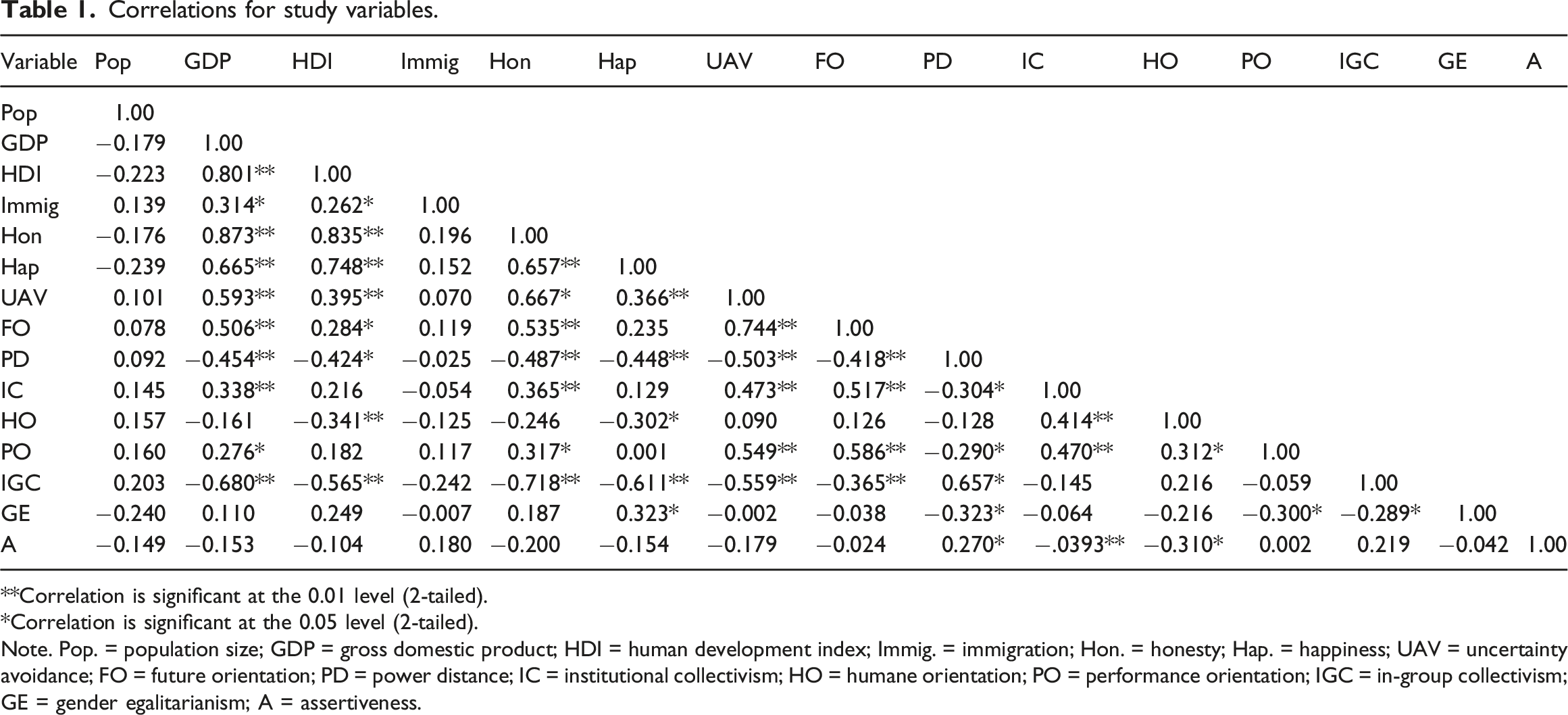
**Correlation is significant at the 0.01 level (2-tailed).
*Correlation is significant at the 0.05 level (2-tailed).
Note. Pop. = population size; GDP = gross domestic product; HDI = human development index; Immig. = immigration; Hon. = honesty; Hap. = happiness; UAV = uncertainty avoidance; FO = future orientation; PD = power distance; IC = institutional collectivism; HO = humane orientation; PO = performance orientation; IGC = in-group collectivism; GE = gender egalitarianism; A = assertiveness.
In addition, a hierarchical regression analysis was conducted to examine the effects of GLOBE cultural dimensions on the perceived level of honesty. Two models were tested: the first included only GLOBE cultural dimensions as predictors, whereas the second controlled for control variables GDP, HDI, Immigration, Happiness, and Population size.
The first model, which included only GLOBE cultural dimensions, explained 72% of the variance in Honesty (R2 = 0.72, F (9,49) = 13.97; p < 0.001). Here, it was Humane Orientation (β = −0.309, p = 0.002) and In-Group Collectivism (β = −0.490, p < 0.001) that significantly contributed to the model.
The second model, which also controlled for GDP, HDI, Immigration, Happiness, and Population size, explained 90% of the variance in Honesty—an additional 18%—(R2 = 0.90, F (5,44) = 16.08; p < 0.001). Here, it was Uncertainty Avoidance (β = 0.161, p = 0.087) and In-Group Collectivism (β = −0.242, p = 0.017) that significantly contributed to the model. Among the control variables, GDP (β = 0.276, p = 0.014) and HDI (β = 0.446, p < 0.001) also significantly contributed to the model.
Honesty as a function of cultural values (Model 1) controlled for GDP, HDI, immigration, happiness, and population size (Model 2). Standardized values.
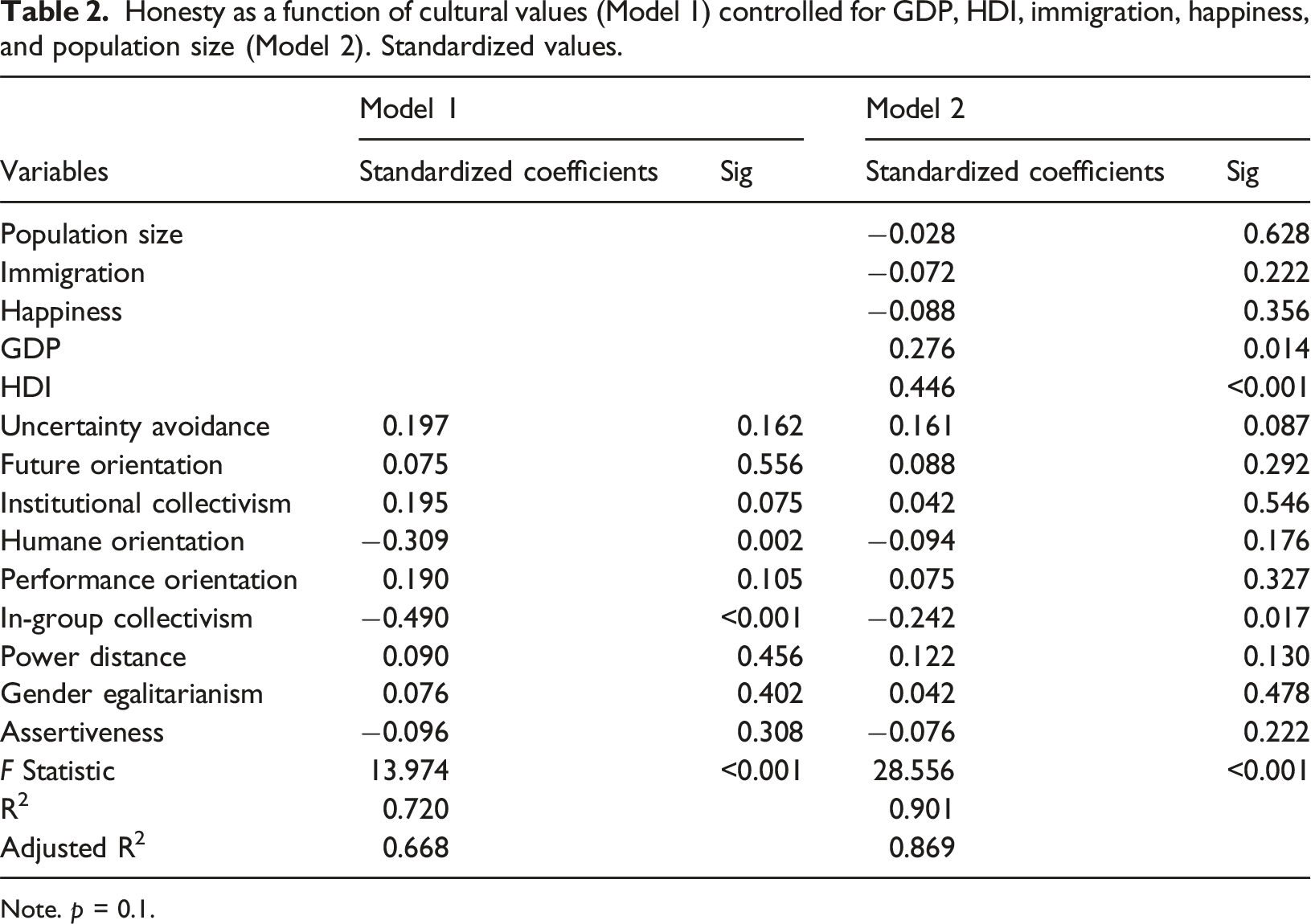
Note. p = 0.1.
It is possible to notice that while Model 1 included only cultural dimensions to examine their isolated effect, Model 2 added control variables to test robustness. This approach is justified given the theoretical interest in cultural variables as primary predictors.
Regarding H 1, ‘The higher the level of uncertainty avoidance practices, the greater the adherence to rules and procedures, which positively impacts honesty by reducing corrupt practices in organizations’, the results show a positive and statistically significant correlation between Uncertainty Avoidance practices and Honesty (β = 0.161, p = 0.087), indicating that a high score on Uncertainty Avoidance practices is associated with a high level of Honesty. This finding supports H1.
As to H 2, ‘The higher the level of future orientation practices, the greater the emphasis on long-term planning and accountability, which positively impacts honesty by reducing corrupt practices in organizations’, the results show a positive but non-significant correlation between Future Orientation practices and Honesty (β = 0.088, p = 0.292). This finding supports H2, suggesting that a high score on Future Orientation practices is associated with a high level of Honesty.
About H 3 , ‘The higher the level of institutional collectivism practices, the stronger the emphasis on group accountability and shared responsibilities, which positively impacts honesty by reducing corrupt practices in organizations’, the results show a positive but non-significant correlation between Institutional Collectivism practices and Honesty (β = 0.042, p = 0.546). This finding supports H3, suggesting that a high score on Institutional Collectivism practices is associated with a high level of Honesty.
Concerning H 4 , ‘The higher the level of humane orientation practices, the greater the emphasis on interpersonal trust, which positively impacts honesty by reducing corrupt practices in organizations’, the results show a negative and non-significant correlation between Humane Orientation practices and Honesty (β = −0.094, p = 0.176). This finding rejects H4 for the existence of a relationship between the level of Humane Orientation practices and Honesty.
When it comes to H 5, ‘The higher the level of performance orientation practices, the greater the pressure to achieve results, which negatively impacts honesty by increasing corrupt practices in organizations’, the results show a positive but non-significant correlation between Performance Orientation practices and Honesty (β = 0.075, p = 0.327). This finding rejects H5, suggesting that a high score on Performance Orientation practices is not negatively associated with Honesty.
The findings on H 6 , ‘The higher the level of in-group collectivism practices, the stronger the trust and accountability within groups, which negatively impacts honest overall societal practices in organizations’ confirm the hypothesis. A negative and statistically relevant correlation between In-Group Collectivism and Honesty has been found (β = −0.242, p = 0.017), indicating that higher levels of In-Group Collectivism are predictive of dishonest practices.
Regarding H 7 , ‘The higher the level of power distance practices, the greater the tolerance for inequality and hierarchical authority, which negatively impacts honesty by increasing corrupt practices in organizations’, the results show a positive but non-significant correlation between Power Distance practices and Honesty (β = 0.122, p = 0.130). This finding rejects H7, indicating that a high score on Power Distance practices is not negatively associated with Honesty.
As to H 8, ‘The higher the level of gender egalitarianism practices, the higher the prevalence of honest practices in organizations’, the results show a positive but non-significant correlation between Gender Egalitarianism practices and Honesty (β = 0.042, p = 0.478). This finding supports H8, suggesting that a high score on Gender Egalitarianism practices is associated with a high level of Honesty.
Concerning H 9 , ‘The higher the level of assertiveness practices, the greater the emphasis on competitiveness and individual achievement, which may negatively impact honesty by fostering opportunistic behaviors and reducing trust’, the results show a negative and non-significant correlation between Assertiveness practices and Honesty (β = −0.076, p = 0.222). This finding supports H9, suggesting that a high score on Assertiveness practices is associated with dishonest practices.
Finally, the analysis has partially confirmed that GDP per capita, HDI, happiness levels, population size, and immigration rates interact with national culture practices and impact honesty levels. While the results show a positive and statistically relevant correlation between HDI and Honesty (β = 0.446, p < 0.001) as well as GDP and Honesty (β = 0.276, p = 0.014), evidence also demonstrates a negative, non-relevant correlation with Happiness (β = −0.088, p = 0.356), Immigration (β = −0.072, p = 0.222), and Population size (β = −0.028, p = 0.628) with Honesty.
Discussion
Upon testing the proposed hypotheses, two were supported with statistical significance (H1: Uncertainty Avoidance; H6: In-Group Collectivism), three were directionally consistent but not significant (H2: Future Orientation; H3: Institutional Collectivism; H8: Gender Egalitarianism), and four were not supported (H4: Humane Orientation; H5: Performance Orientation; H7: Power Distance; H9: Assertiveness). These results are consistent with earlier studies that highlight the role of cultural dimensions in shaping societal ethics and behaviors. This might explain the high R2 value (0.90) in Model 2 that reflects the strong explanatory power of the combined cultural and socioeconomic variables, which aligns with previous findings (e.g., Gächter and Schulz, 2016) suggesting that both institutional and cultural factors jointly shape societal ethics.
For instance, Gächter and Schulz (2016) found that societies with high Uncertainty Avoidance practices tend to implement stricter rules and procedures, fostering environments where honesty is both expected and rewarded. This aligns with the notion that structured environments reduce opportunities for dishonest behavior by creating clear expectations and minimizing ambiguity. Hofstede (2001) also emphasized the role of Uncertainty Avoidance in establishing societal norms that discourage corruption and promote transparency. Along the same lines, future orientation practices were positively correlated with honesty, confirming the role of long-term planning, strategic vision, and goal-setting in fostering ethical behavior. Similarly, institutional collectivism practices were associated with honesty, as tightly integrated groups reinforce ethical standards and anti-corruption behaviors.
In cross-cultural management, work, and organizational contexts, these findings highlight the significance of understanding cultural dimensions when navigating ethical challenges and promoting honesty within global teams and multinational corporations. For instance, high Uncertainty Avoidance in organizational cultures can translate into the adoption of clear policies, structured workflows, and strict compliance mechanisms that deter dishonest practices and foster transparency. Leaders operating in such environments may find that their adherence to protocol and emphasis on accountability resonates positively with employees, enhancing overall trust and cooperation within the organization. Similarly, the association between future orientation and honesty suggests that organizations prioritizing long-term strategic goals and ethical foresight are better equipped to build sustainable practices that align with societal expectations of integrity.
Conversely, the negative association between In-Group Association and Honesty supports the findings of Getz and Volkema (2001), who argued that high levels of in-group favoritism often led to the exclusion of out-groups and the prioritization of personal networks over universal rules. This tendency can erode trust in public institutions and create environments where dishonest practices, such as nepotism and favoritism, are normalized. Performance orientation practices, on the other hand, were positively associated with honesty, highlighting how achievement-oriented cultural practices and an emphasis on excellence curb corrupt behavior.
The findings on in-group association offer a cautionary tale for managers operating in culturally diverse or collectivist settings. High in-group favoritism, if unmoderated, can lead to nepotism and hinder the implementation of meritocratic practices, thereby undermining trust and organizational cohesion. Cross-cultural management strategies must, therefore, include deliberate efforts to promote inclusivity, fairness, and universal ethical standards to counteract such tendencies. Moreover, the link between performance orientation and honesty reinforces the importance of cultivating achievement-driven organizational cultures that reward excellence and discourage corrupt behaviors. For multinational organizations, understanding these cultural nuances provides a valuable framework for aligning ethical standards across diverse teams, fostering global collaboration, and enhancing organizational effectiveness in a culturally heterogeneous world.
The evidence produced by this study contributes to the growing body of literature on the intersection of culture and ethics by providing empirical evidence of how specific cross-cultural practices also bear influence on honesty at the national level. Moreover, it is worth noticing that these results have been achieved after controlling for selected socioeconomic variables, which was a relevant strategy because these variables can significantly mediate or confound the relationship between cultural practices and honesty. For example, GDP per capita and Human Development Index (HDI) are known to influence institutional quality and societal transparency, which directly affect levels of honesty and corruption (Gächter and Schulz, 2016; Hofstede, 2001). By accounting for these factors, the analysis isolates the unique contributions of cultural practices, ensuring that the observed relationships are not simply artifacts of economic or developmental disparities.
Additionally, controlling for variables such as population size and immigration helps address the potential influence of demographic diversity on societal norms and behaviors. Larger or more diverse populations often face challenges in maintaining cohesive ethical standards, which can dilute the direct effects of cultural practices on honesty (Davis and Ruhe, 2003). Similarly, happiness, as a measure of societal well-being, is associated with higher levels of trust and lower levels of corruption, making it an important variable to account for in understanding honesty (Ye et al., 2015).
By incorporating these controls, the study provides a more robust and nuanced analysis, allowing for a clearer understanding of how cultural practices independently shape honesty. This approach also aligns with best practices in cross-cultural research, where the interplay of culture and socioeconomic factors must be carefully disentangled to draw meaningful conclusions (Javidan et al., 2006).
Conclusion
Using the GLOBE study’s dataset for cultural classification, this research validates the importance of adopting a cultural perspective in understanding and explaining honesty. By providing empirical evidence, it enriches the theoretical and practical understanding of how cultural dimensions interact with honesty and corruption. The findings presented in this paper contribute significantly to the growing body of empirical literature on honesty and corruption in cross-cultural settings, offering nuanced insights into the variability of ethical behavior across societies. The study underscores the utility of the cultural dimensions identified by House and others (2004), which serve as a comprehensive framework for analyzing how cultural practices influence ethical behaviors and societal norms.
One of the key contributions of this research lies in its application to multinational and international organizations. The insights derived from the study can be leveraged to design effective human resource strategies that align with culturally specific expectations and values. For instance, organizations operating in culturally diverse environments can utilize these findings to enhance recruitment processes by identifying candidates whose ethical standards align with organizational goals. Similarly, culturally informed strategies for selection, compensation, performance appraisal, and training and development can help build ethical organizational cultures that promote transparency and fairness. These insights are particularly critical for organizations seeking to maintain consistent ethical practices while respecting cultural diversity.
Additionally, this research highlights the significance of internal marketing of ethical behaviors within organizations. By understanding how practices like nepotism are perceived differently across cultures—positively in some and negatively in others—organizations can tailor their internal policies and communication strategies to resonate with local cultural norms while promoting universal ethical standards. For instance, in cultures where nepotism is traditionally accepted, organizations can frame merit-based practices as mechanisms that enhance fairness and collective well-being rather than as threats to traditional social structures.
From a policy perspective, this study provides valuable guidance for developing culturally sensitive anti-corruption strategies. Policymakers can use these insights to craft interventions that align with societal norms and values, thereby increasing the likelihood of successful implementation. For example, in societies characterized by high uncertainty avoidance, where clear rules and structures are highly valued, institutional mechanisms that emphasize accountability and transparency can be particularly effective in reducing corruption. These could include robust auditing systems, transparent procurement processes, and stringent enforcement of ethical standards.
Similarly, in societies with high in-group collectivism, policies that promote inclusivity and reduce favoritism can help mitigate the risks associated with nepotism and other forms of favoritism. For instance, implementing transparent hiring processes and emphasizing the value of diversity and meritocracy can help balance group loyalty with broader societal integrity. In such contexts, educational campaigns that highlight the long-term benefits of inclusivity and fairness may also play a critical role in shifting cultural attitudes and behaviors.
Moreover, the findings have implications for leadership development and organizational governance in cross-cultural contexts. Leaders equipped with an understanding of cultural dimensions such as uncertainty avoidance, in-group collectivism, and power distance can adopt culturally appropriate strategies to foster ethical behavior and organizational integrity. This could include creating inclusive work environments, promoting open communication, and implementing equitable reward systems that align with both organizational objectives and cultural expectations.
In conclusion, this research not only advances academic understanding of the relationship between culture and honesty but also provides actionable insights for organizations and policymakers. By leveraging the GLOBE framework, it bridges the gap between theory and practice, offering practical tools for addressing ethical challenges in culturally diverse settings. Ultimately, the study serves as a roadmap for fostering ethical behavior and reducing corruption, both within organizations and at the societal level, contributing to the broader goal of building trust and integrity in a globalized world.
Limitations and future research
This study, like all research utilizing secondary data, is subject to certain limitations. The data for the variables analyzed were collected in prior research projects, which constrains this study’s control over the scope of data collected and the methodological procedures employed during data collection and synthesis. As a result, the findings are shaped by these methodological constraints, potentially limiting the generalizability of the results.
A notable consequence of these limitations is that the findings are primarily situated within the context of the GLOBE project (House et al., 2004). Future research should address this by building on primary data and investigating additional factors influencing national levels of honesty and corruption, such as dominant religion, religious interpretations, national language, quality of governance, human development indicators, political stability, educational attainment, and access to information. Moreover, future studies could adopt a longitudinal approach and examine how these dynamics change over time as well as the degree to which cultural practices interact to influence honesty.
Further investigation is also needed at the organizational level of honesty, focusing on both private and public institutions. Replicating this study with alternative measures of honesty/corruption could provide more robust insights. Future research could also examine honesty in developed versus developing countries and assess its consequences on national intellectual capital, human capital, and social capital.
This comprehensive approach will contribute to a deeper understanding of the multifaceted relationship between culture and honesty, aiding policymakers and organizations in addressing corruption effectively.
Footnotes

Funding
The author received no financial support for the research, authorship, and/or publication of this article.
Declaration of conflicting interests
The author declared no potential conflicts of interest with respect to the research, authorship, and/or publication of this article.