



Abstract
Intercultural marriages have significantly increased in tandem with the global rise in migration and globalization, particularly in Western societies. While the advantages of diversity are widely celebrated in the workplace, the potential benefits that cultural diversity within a marriage might bring to professional environments remain underexplored. Despite numerous calls for in-depth analyses of close intercultural relationships, studies focusing on intercultural families are sparse. This conceptual paper investigates how intercultural marriages may foster family-to-work enrichment (FWE) through both instrumental and affective pathways. Utilizing critical contextual empiricism (CCE) and relational cultural theory (RCT), we propose a model that outlines how intercultural marriages can enhance enrichment from home to work. This model includes culturally diverse conflict management and communication skills, along with complementary characteristics that mutually enhance partners’ abilities. We suggest potential moderators of these effects and conclude by discussing theoretical and practical implications. In sum, our paper contributes to cross-cultural management research by identifying intercultural marriage as a context for cultural learning, which can enhance individuals’ capacity for empathy, adaptability, and relational competency in an ever-growing globalized world and work environment.
Keywords
Intercultural marriages defined as “a union of two people from diverse cultures as well as different countries, which may also, but not necessarily, indicate differences in race or religion” (Romano, 2008, 16) melds diverse sociocultural heritages and traditions into a relationship (Crippen and Brew, 2013). In the context of the present paper, intercultural marriage encompasses a wide range of combinations common in today’s world, including individuals from different countries who meet in a third country, or children of immigrants from different cultural backgrounds who marry each other. This definition encompasses unions amongst individuals whose upbringings and cultural experiences are different from one another and from the culture of the country in which the couple lives due to the fact that this type of union will lead to cultural adaptation and communication obstacles, as well as challenges pertaining to the integration of disparate cultural norms (Bustamante et al., 2011).
The dynamics of intercultural marriages extend beyond personal life, influencing workplace interactions as cultural effects permeate the work-life interface (Shockley et al., 2017). In contemporary workplaces, where effectively leveraging diversity is increasingly recognized as a competitive advantage (Christmas and Barker, 2014; Lu et al., 2017), the unique resources that intercultural marriages bring, such as cultural intelligence and competence (Adebayo and Sunderman, 2023), may impact workplace dynamics (Jaga and Bagraim, 2011).
Yet, research on intercultural families and their potential to enrich workplace performance remains relatively underexplored. Although the importance of understanding intercultural families has been mentioned by scholars, research remains limited (Barker and Cornwell, 2019; Cross and Gilly, 2013) and studies that examine the workplace implications of intercultural families are scarce (Lapierre et al., 2018; Lu et al., 2017). Further, existing research on the work-family interface views these interactions as a source of conflict (Nicklin and McNall, 2013), rather than highlighting the benefits that intercultural families may foster that may also enrich the workplace. This oversight leads to the failure to recognize how such families contribute to improved workplace diversity, communication, and collaboration (Kuo and Wu, 2022). By investigating the impacts of intercultural families, we can identify strategies and best practices to boost intercultural communication, teamwork, and workplace performance (Rozkwitalska, 2019).
Consequently, we develop a conceptual model to explore the relationship between intercultural marriage and family-to-work enrichment (FWE), which is defined as the extent to which family roles enhance workplace success. We examine how the dyadic experiences within intercultural marriages influence FWE. We apply principles from the critical contextual empiricism (CCE) framework (Longino, 1990, 2002) and the relational cultural theory (RCT) (Comstock et al., 2008; Miller, 1976). Longino (2002) notes that knowledge production is most fruitful in contexts that involve diverse communications and inclusivity. Similarly, we propose that diversity within intercultural marriages fosters learning and skill development that enhance FWE. Further, RCT’s focus on navigating the complexities of relationships, such as addressing differences and conflicts, and promoting empathy, mutual empowerment, and growth-fostering connections (Miller, 1976), helps us investigate how intercultural marriages influence FWE. Intercultural marriages can enhance conflict management and communication styles, as individuals learn about their partner’s cultural customs, becoming enriched and adaptable. Moreover, these marriages are thought to provide complementary traits that contribute to an enriched relationship. However, we propose that the extent to which the relationship is enriched or diminished depends on contextual factors. Notably, these include whether an individual works for someone from the same cultural background as their partner, family and community support, the stage of the marriage, and the relationship quality.
This paper makes several contributions to the literature. First, it adopts a dyadic perspective by applying CCE (Longino, 1990, 2002) and RCT (Comstock et al., 2008; Miller, 1976) to the intercultural marriage–FWE relationship. In doing so, it extends research on workplace diversity and the work–family interface. By highlighting aspects that lead to interpersonal growth within intercultural marriages, we show how relationships at home can enhance individuals’ success at work. This approach also addresses the dearth of previous research in investigating FWE, as past research has predominantly focused on work-to-family enrichment (Goswami and Sarkar, 2022). Second, we draw attention to cultural diversity that is cultivated within households. This aspect of diversity is largely overlooked in management research. Third, we identify contextual factors that either strengthen or weaken the effects of intercultural marriage on FWE. Finally, we contribute to cross-cultural management research by highlighting how intercultural marriage acts as a cultural exchange that produces interpersonal strengths that support the navigation of today’s increasingly globalized workforce (McKinsey and Company, 2025).
Conceptual Overview
The year 2020 marked a demographic milestone in the United States, as the generation under the age of 17 became a multicultural majority for the first time (PR Newswire, 2022). This shift has been caused in part by the increasing international migration that has enhanced the cultural diversity of Western countries (Kaya et al., 2019). The increase of cultural interactions has simultaneously increased the likelihood of forming intimate intercultural relationships (Bustamante et al., 2011).
We explore intercultural marriages and their impact on workplace functioning. This paper adopts the definition of marriage from the U.S. Respect for Marriage Act (2022), which describes it as a union between two individuals valid in the state or jurisdiction where it was entered. We expand this definition to include individuals in common-law partnerships, treating those who have been in a romantic relationship and cohabitated for at least 3 years as married, a status recognized by states such as New Hampshire. Regardless of legal marital status, long-term couples that live with one another will undoubtedly face the challenge of navigating cultural dynamics including values, gender roles, emotional management, and ethnocentrism (Romano, 2001).
We focus on marriages specifically between different national cultures, as opposed to other factors like race or religion for several reasons. By examining intercultural marriages, we look at how distinct cultural backgrounds promotes diverse values, customs, and traditions that each partner carries into the relationship (Bustamante et al., 2011). This focus allows for an in-depth exploration of the challenges and benefits that arise from navigating cultural differences, where both parties reconcile cultural differences (García, 2006). This specificity allows us to better understand how cultural norms surrounding marriage impact relationship dynamics and stability (Kaya et al., 2019). Further, we explore how partners from different cultural backgrounds negotiate their differences. This emphasis on intercultural marriages provides a platform for examining how couples manage cultural diversity and leverage it as a source of strength in their relationship that has implications in the workplace.
In terms of the relationship between intercultural marriage and FWE, Greenhaus and Powell (2006) introduced two pathways to FWE. Instrumental enrichment refers to tangible assistance in one role that provides increased performance in the other role. Affective enrichment encompasses resources received in one role that provides positive emotions, increasing performance in the other. We integrate both forms of enrichment into our argument.
We propose that intercultural marriage can enhance conflict management and communication styles of the partners, which can enrich the workplace. Conflict management encompasses the methods and processes used to manage and resolve disputes within relationships, vital for maintaining relationship well-being and marital satisfaction (Markman et al., 1993). Conflict arises when one party perceives their interests have been foiled by the other party, negatively impacting individual needs and goals (Thomas, 1976). There are two essential types of conflict management: destructive, involving coercion, avoidance, and inflexibility (Markman et al., 1993), and constructive, which promotes flexibility, empathy, and cooperative problem-solving (Hocker and Wilmot, 1995). Meanwhile, communication style refers to “the way one verbally or paraverbally interacts to signal how literal meaning should be interpreted, filtered or understood” (Norton, 1978: 99). These two factors are proposed to be improved with intercultural marriage.
Further, we propose that intercultural marriage enhances and highlights the complementary characteristics of both partners. Complementary characteristics are traits or values that, when combined, lead to synergistic effects. For example, creativity and attention to detail does not necessarily conflict, as traditionally thought. Instead, these characteristics can complement each other, allowing individuals to be innovative and precise (Miron et al., 2004). The two aforementioned propositions are proposed to be moderated by whether an individual works for someone from the same cultural background as their partner, as well as variables related to the stage of the marriage, family and community support, and relationship quality, defined as the evaluation of the connection, satisfaction, and dynamics within a relationship (Burlingame et al., 2018).
While examining the advantages of intercultural marriage, it is important to acknowledge previous research that highlights challenges, such as cultural differences in norms surrounding marriage that may introduce instability into relationships (Machette, 2019; Schug et al., 2010). However, most couples in intercultural marriages report high satisfaction and minimal negative impacts on their relationships (Machette and Cionea, 2022). This paper focuses on the positive contributions of intercultural marriages, particularly in terms of FWE. By shifting the narrative towards the satisfaction and minimal negative impacts experienced by most couples, we aim to reframe the discourse from challenges to positive outcomes. This approach is crucial for a deeper understanding of intercultural marriages. By emphasizing the benefits, this paper contributes to a comprehension of how diverse cultural backgrounds can enrich relationships and enhance workplace success.
Theoretical foundations
We examine intercultural marriage through the lens of RCT (Comstock et al., 2008; Miller, 1976), a framework that explains the importance of relationships in shaping development. Initially theorized Baker Miller’s work in 1976, RCT concentrates on the interconnectedness between individuals and the impact of these connections on personal growth and well-being (Comstock et al., 2008). This theory discusses relational empathy, intercultural alliances, and the development of cultural spaces in developing mutual understanding and positive interactions (Zhu, 2008). In the context of cultural theories, RCT advances the understanding of how cultural practices, beliefs, and values are communicated and transformed within social contexts (Neumann and Heikka, 2005). This theory is instrumental in explaining how intercultural marriage can advance and enrich the relationship in such a way that it spills over into the workplace.
We also utilize the CCE framework, a social epistemology of science highlighting the significance of diverse voices in knowledge-producing populations (Longino, 2002). While Longino primarily focused on advocating for assenting female voices in scientific production, her research became a staple in promoting the inclusion of social values. CCE is one of the most established diversity-promoting excellence theories (Fehr, 2011), lending itself to the argument that intercultural marriage promotes excellence that translates into the workplace. According to Longino, critical discourse is necessary, and when a community is too similar, information goes unchallenged. Longino (2002) proposed that cognitive processes are a social phenomenon, and interactions ensure the constructive advancement of knowledge. Similarly, research on diversity state that individuals from different cultures bring different perspectives (Martin, 2014).
Longino (2002) also argued that science focuses on objectivity and that researchers must reconsider such concepts. There are many representations of reality, and learning is constrained by the environment (Pinto, 2014). Thus, cognitive diversity is advantageous because it encourages critical exchanges. Criticism and acknowledgment of different truths are beneficial to scientific knowledge (Longino, 2002). This paper contends that intercultural marriage can promote exchanges that lead to FWE.
While critical realism, pragmatism, and critical management paradigms may be used to situate the theorizing in this paper, we believe that CCE offers advantages to our argument. One major reason is the framework’s attention to the social and cultural dimensions of knowledge production. By focusing on this factor, Longino’s framework is illustrative of the complexities inherent in intercultural marriages, which may be overlooked by other paradigms. Further, RCT focuses on the importance of relationships in growth and transformation. This theory complements CCE by emphasizing the psychological and relational aspects that are vital in intercultural marriages.
Model and Proposition Development
Our model (see Figure 1) assumes a dyadic lens to explore how intercultural marriage leads to FWE through affective and instrumental pathways. It is theorized that diverse communication and conflict management skills gleaned in intercultural marriage result in FWE. Further, intercultural marriage is proposed to enhance the synergistic relationship between complementary characteristics and lead to FWE. This relationship is said to be stronger when individuals work with others from their partner’s culture. Other moderators are the stage of marriage and relationship satisfaction. Finally, it is suggested that family and community support is a significant factor in determining whether an intercultural marriage will result in FWE. We explore each of these relationships below. Conceptual model linking intercultural marriage to FWE.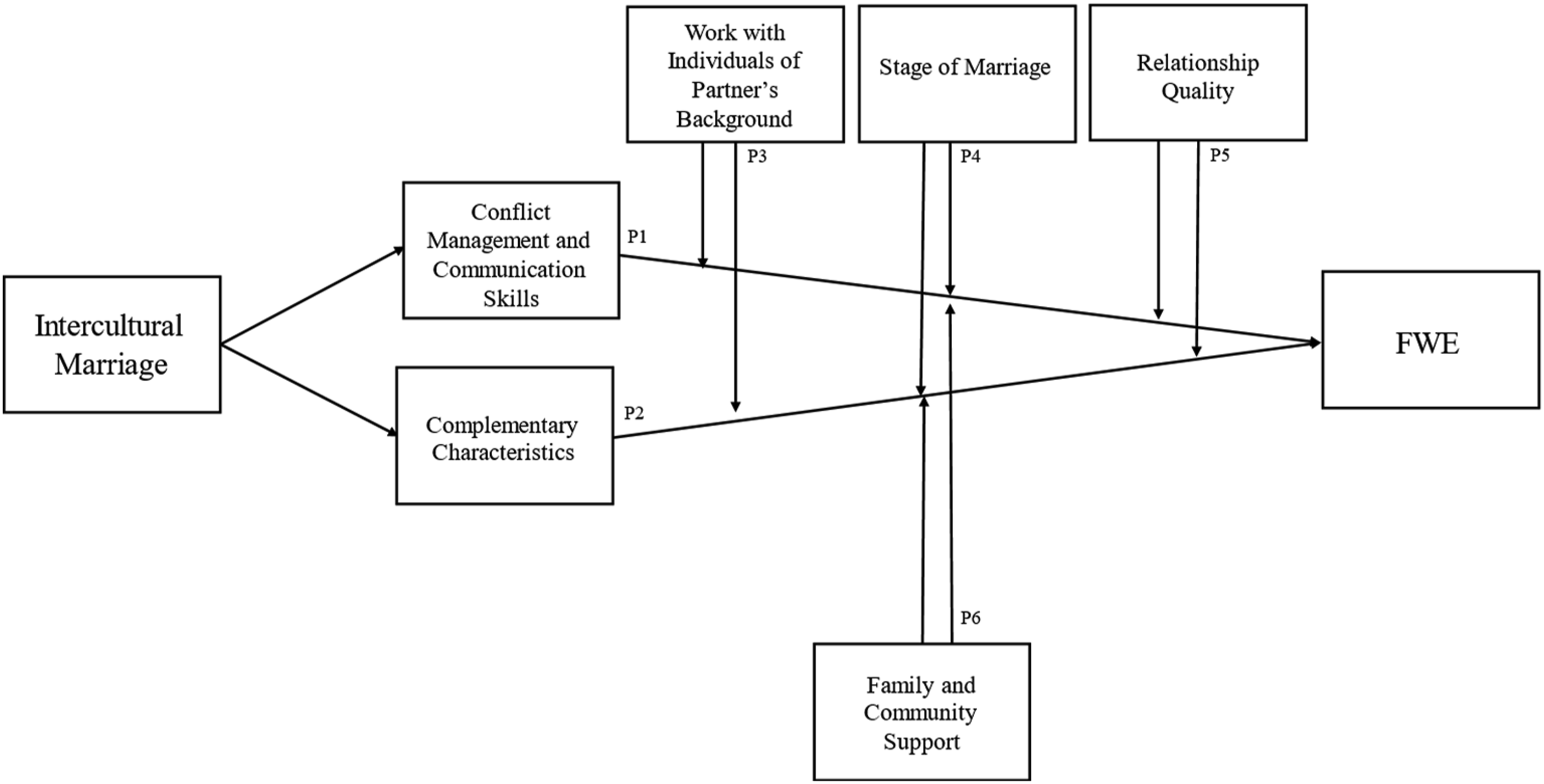
Communication and conflict management skills and FWE
Longino’s (2002) CCE emphasizes the importance of criticism and appropriate community responses to stimulate analytical discussions. Similarly, RCT views individual growth as fundamentally relational (Alvarez and Lazzari, 2015), emphasizing the role of human connections in development (Brown et al., 2020). This engagement integrates diverse cultural perspectives, promoting a more inclusive and supportive environment. The following section proposes that the intercultural interactions in a marriage enhance understanding and support for diverse cultural communication and conflict management styles, leading to FWE.
Communication style
In romantic partnerships, communication styles play a crucial role in shaping the dynamics between partners. Partners control their closeness by altering the frequency, mode, and style of communication to adjust levels of intimacy (Collins and Horn, 2019). Positive communication behaviors, including expression of feelings and open discussions about issues, are related to relationship development and satisfaction (Jiang, 2022). However, when romantic partners from different backgrounds interact, there may be misunderstandings on the motivation for sentiments or expressions (Holmes, 2017).
Couples often attribute communication challenges in their relationship to cultural differences (Machette and Cionea, 2022) and miscommunication in relationships can have severe implications, leading to power imbalances, relationship dissatisfaction, and conflicts (Leaper and Robnett, 2011). An example of how communication may vary across cultures depends on whether individuals are from a high context or low context culture (Romano, 2001). In the high context culture, they value ritual, politeness, and imagery and may find directness insensitive, whereas, in the latter, individuals express matters openly and directly and desire facts over intuition (Romano, 2001). Further, though research contrasting communication patterns cross-culturally is limited (Barker, 2016), studies highlight other examples of cultural differences in communication styles. One dyad included an Italian husband, Mario, and an Irish wife, Deidre. The study stated, “Mario’s style was loud, demonstrative, frank, direct, fast, probing and aggressive. Deidre’s was controlled, subtle, evasive, insistent, discreet, cutting and conciliatory” (Romano, 2001: 139).
Although it is integral to preserve one’s own cultural identity in an intercultural marriage, individuals must be competent in their partners’ cultural scripts (Killian, 2002). CCE contends that communication with participants from different backgrounds allows a community to advance (Büter, 2010). Communication and language can create bonds among cross-cultural communities, fostering understanding and connection (Abdulrahman, 2022). According to the RCT, growth occurs through connections with others and differences, when approached with curiosity and openness, can serve as opportunities for learning and growth (Comstock et al., 2008)
Conflict management style
Conflict management styles are essential in romantic relationships, affecting their continuation and quality (Kaya et al., 2022). When there is a lack of conflict management in a romantic relationship, it can lead to decreased relationship quality, cognitive, emotional, and behavioral issues within the relationship (Li and Chan, 2012). This issue might be relevant to couples in an intercultural marriage. Conflict management styles are culturally grounded (Ting-Toomey, 2006). For example, high context cultures utilize an avoidance-based conflict management style, whereas low context cultures have a competitive style (Morris et al., 1998). Further, whereas the British see compromise as integral (Fox, 2004), an individual from a Russian culture might see compromise as a ‘departure from their moral grounds’ (Leontovich, 2014: 288).
In intercultural marriages, conflict management involves working through the communication style that might contribute to conflict, assessing the behavior of communicators during the conflict, and developing face-saving or face-damaging and conflict resolution strategies (Leontovich, 2016). Conflict resolution involves a co-construction of reality. Individuals from different cultures meet at a mutual understanding by discussing and compromising cultural ideologies, values and behaviors (Friedman and Antal, 2005).
CCE lends well to this argument as conflict is a foundational aspect of this theory. Consensus formation occurs through criticism and permits the advancement of knowledge. Similarly, in an intercultural marriage, individuals undergo joint adaptation, leading to ‘personal transformations that could be compared to a process of mutual acculturation’ (Falicov, 1995: 234).
RCT emphasizes the importance of empathy in deepening relationships, allowing partners to understand and appreciate the reasons behind each other’s behaviors during conflicts. This empathetic understanding is crucial in intercultural marriages, where partners come from cultural backgrounds that influence their conflict management styles. By aligning these styles through mutual empathy, couples can foster a supportive and empathetic relationship environment. This contrasts with traditional theories that equate mature functioning with a progression from dependence to independence. Instead, RCT posits that maturity involves moving towards deeper connections and sustained relationships throughout one’s life (Jordan, 2001). Aligning on conflict management practices allows intercultural couples to navigate their differences, transforming conflicts into opportunities for growth and connection.
FWE
CCE highlights the significance of embracing criticism, where diverse viewpoints are actively integrated into understanding and action (Longino, 2002). Building on this framework, Borgerson (2011) contends that for criticism to be constructive, it must be accompanied by transparency and full disclosure. Similarly, we suggest that the intercultural interactions occurring within couples can foster understanding and deeper insights that lead to improved communication and conflict management skills, which are essential for FWE.
Healthy relationships enhance communication and conflict management skills. Partners in healthy relationships may adopt behaviors, such as increasing physical touch, which not only enhances communication but also strengthens emotional connections (Sorokowska et al., 2023). Additionally, maintaining a commitment in these relationships necessitates ongoing efforts to sustain open communication (Belleau et al., 2020). Furthermore, the way love is experienced and expressed is linked to constructive conflict resolution and building trust (Gonzaga et al., 2001).
These communication and conflict management skills are vital in intercultural marriages, where partners bring distinct cultural perspectives. Vivero and Jenkins (1999) have noted that intercultural families develop enhanced social and cognitive skills, including cultural adaptation, intercultural effectiveness, and greater flexibility. This dynamic can be understood through Relational Dialectics Theory, which explains that in any relationship, forces driving conflict and those creating common ground in communication and behavior coexist and interact (Baxter, 2004). Additionally, enculturation plays a significant role as it involves integrating cultural elements during socialization and encompasses the learning that occurs within relationships (Weinrich, 2009).
The divergent communication and conflict styles accumulated through intercultural marriage are proposed to foster enrichment through an instrumental path. As FWE research suggests, instrumental enrichment in one role can affect performance within the workplace (Greenhaus and Powell, 2006). FWE involves new knowledge, skills, and perspectives (Van Steenbergen et al., 2007) that are transferable resources taken from the home to utilize in the workplace (O’Driscoll et al., 2006). Similarly, as the RCT posits, relational competence highlights the importance of developing relational skills to a high degree of proficiency, which, once achieved, can be transferable across various relationships and settings (Fletcher, 1999).
Communication and conflict management skills accumulated in an intercultural marriage are proposed to lead to instrumental skills used in the workplace. Communication skills are one of the top skills that business executives believe are vital for success (Robles, 2012) and intercultural communication can lead to enhanced cohesion, trust, innovation, and personal development in the workplace (García and Cañado, 2011). Further, overcoming conflict can lead to superior decision making, as such conflict fosters a deeper cognitive grasp of the issues under discussion (Simons and Peterson, 2000). Employees with strong conflict management abilities are stronger in communication and more likely to be viewed as ideal for leadership positions (Trudel and Reio, 2011). Moreover, conflict management strategies decrease conflict-related job stress (Dodanwala et al., 2021).
A case in point is highlighted in a study in the Harvard Business Review. The study interviewed managers of multicultural teams and highlighted a scenario where a Brazilian manager negotiated with Korean counterparts within an American company. “On the first day, we agreed on three points, and on the second day, the U.S.-Spanish side wanted to start with point four. But the Korean side wanted to go back and rediscuss points one through three” (Brett et al., 2006). The manager’s experience highlights the importance of adapting to different approaches to communication and conflict processes. These skills can be developed within the home.
The communication and conflict management skills can also lead to FWE via affective enrichment. As RCT posits, growth occurs through connections with others and that relationships become deeper with mutual empathy (Jordan, 2001). In the context of intercultural marriages, RCT notes that navigating the complexities of different cultural backgrounds encourages partners to develop more empathy for one another. By creating a space where both partners feel valued, they may carry these emotions over to the workplace (Jordan, 2001). These emotions can influence employees’ relationships with colleagues (Elfenbein and Ambady, 2002). Therefore, this paper proposes:
Complementary characteristics
Intercultural marriage involves more than just the transformation of communication and conflict management skills. The initial years of marriage require significant personal and relational adjustments, as partners adapt and their personalities undergo changes (Lavner et al., 2018). RCT posits that meaningful connections are essential for individuals to transform (Jordan and Hartling, 2008). Additionally, CCE suggests that diverse viewpoints can create an enriched epistemic environment, enabling individuals to gain insights unavailable within a single cultural framework (Longino, 2002). Thus, we propose that intercultural marriages facilitate the development of complementary characteristics between partners that contribute to FWE.
The constraints of similarity are underscored by CCE, which posits that shared beliefs originating from comparable backgrounds, metaphysical, or theological perspectives restrict the frameworks accessible to researchers (Biddle, 2009). This contention can be applied to a relationship. The concept of interpersonal complementarity states that in a dyadic collaboration, an individual’s actions can provoke the interpersonal behavior of the other individual (Tracey, 1994). For example, controlling and dominant behavior attracts submissive behavior from another individual (Tiedens and Fragale, 2003). Consequently, relationships with complementary others can stimulate aspects of the self that enhance personal and professional domains.
Molina et al. (2004) suggested that intercultural relationships could be complementary, bringing a richness that is absent in less culturally diverse relationships. For instance, Ollier-Malaterre and Foucault (2018) explored the humane orientation of cultures by contrasting ‘as is’ scores—representing actual practices—with ‘should be’ scores—reflecting the ideals that respondents aspire to. They found a negative correlation between these scores, indicating that even if a culture does not exhibit certain characteristics, those characteristics may still be highly valued within that culture. Consequently, interactions involving these desirable but absent characteristics can lead to positive changes in individuals, enhancing personal growth and cultural understanding.
Different national cultures exhibit complementary characteristics that can be beneficial in various contexts. The complementarity between different national cultures can enable knowledge transfer, value creation, and innovation (Yue et al., 2021). For example, we see how the integration of complementary and integrative health therapies in healthcare systems highlights how practices like traditional Chinese medicine, Ayurvedic medicine, and others can work alongside conventional medicine to promote resilience and well-being (Austin et al., 2021; Pitcher et al., 2023). Similarly, we propose that the complementarities of different cultures within a marriage can promote effective communication, mutual understanding, and interpersonal growth, enhancing the dynamics and strength of the relationship.
The complementary behavior of individuals can produce enrichment via the affective pathway. Individuals that intermingle with complementary partners feel self-validation and security (Carson, 1969). It increases comfort with the other individual (Tiedens and Fragale, 2003), meeting the affective need that can stimulate FWE. FWE could provide positive emotions, alternative perspectives, and the acquisition of new knowledge or skills (Van Steenbergen et al., 2007).
However, complementary personalities also serve an instrumental purpose. Complementary dyadic personalities have increased performance via accuracy and task speed (Markey et al., 2010). This finding is consistent with CCE, which has posited that diverse interactions produce “critical communities of inquiry,” efficiently advancing research (Kelly, 2008). Furthermore, Baxter and West (2003) discovered that most couples reported learning new perspectives from their partners when they possessed differences. This enrichment leads to increased absorption in work (Rothbard, 2001) and heightened work engagement (Hakanen et al., 2011). Drawing upon these insights, this paper proposes:
The role of individuals of partner’s background
Factors exist that increase or decrease the ability to ensure collaboration among individuals with divergent communication or conflict management styles (Brown and Paz-Aparicio, 2021). A variable proposed to moderate this relationship is when employees within intercultural marriages work with individuals of their partner’s background.
Longino (2002) noted that social dimensions allow for biases and distortions in knowledge. However, individuals who marry outside their background possess an insider’s view of other groups’ lived experiences (Phan et al., 2023). The feeling of being understood is one of the most influential resources for feeling validated in group membership and personal identity (Ting-Toomey, 2006). When an individual feels as though they are understood, it ignites regions within the brain related to reward and social connection (Morelli et al., 2014). It strengthens their relationship quality (Reis et al., 2017) and results in positive intergroup orientations (Livingstone et al., 2020) and enhances perspective-taking and empathy (Vorauer and Quesnel, 2016).
Given that being understood acts as a rich relational enhancement, it can serve a functional purpose within the workplace. High-quality connections allow for professional advancement and development (Lewis, 2011). It is proposed that when an employee within an intercultural marriage interacts with coworkers that are of the same background of their partner, it enhances the other’s capacity to feel understood by someone outside their background, increasing their positive feelings and ability to form a relationship.
Furthermore, team resources serve as social support resources by inspiring positive experiences at work, resulting in positive affect, self-assurance, and personal energy (Tekleab et al., 2009). Thus, FWE can occur via positive affect and promote fulfillment and security (Carlson et al., 2006). This paper proposes:
The stage of marriage
Developing intercultural communication competence, conflict management skills, and functioning complementarities is an ongoing process. Deardorff (2006) conceptualized this evolution through a process model of intercultural competence, emphasizing that it requires continual learning. This framework suggests that the benefits of FWE, arising from the perspectives gained through intermarriage, may vary across stages of a marriage. Singla and Holm (2012) outlined phases of intercultural marriage, which we apply in developing the proposition, highlighting how each phase contributes to the growth of intercultural competence.
In the honeymoon phase cultural differences are exciting and lifestyle changes include practical adjustments (Singla and Holm, 2012). However, this is an idealized state and driven by passion (Kovacs, 2000). Longitudinal research on crossover effects of work and life suggests that marital satisfaction declines over time (Lavner and Clark, 2017). Thus, earlier stages of marriage may exhibit more pronounced enrichment. It is proposed that during the early stages of marriage, an individual will be enriched through the positive affect that an intercultural marriage produces. However, they will have less of the instrumental capabilities at this idyllic stage.
The next stage is the family establishment phase, composed of conflicting positions. Individuals work together to balance work, family, and parenting (Singla and Holm, 2012). Couples at this stage reconcile differences, and the rules of the relationship must be worked out (Kovacs, 2000). Further, at this stage, couples may start to see the impact of race or ethnicity on their family dynamics (Lengyell et al., 2023). Further, job satisfaction often decreases during middle age (Clark et al., 1996). Given these factors, FWE may be less prominent than at the honeymoon and later stages.
Finally, couples settle down at the reclining stage, have a stronger joint identity, share opinions, and perceive differences as non-threatening (Singla and Holm, 2012). Furthermore, marital satisfaction may influence organizational commitment for employees in advanced career stages (Onuoha and Idemudia, 2018). Therefore, this stage of marriage may entail the most significant relationship between intercultural marriage and the FWE. It is thus proposed:
Relationship quality
We propose that relationship quality moderates the impact of intercultural marriage on FWE. Cultural differences, communication barriers, and conflicting expectations often challenge relationship quality in intercultural marriages (Bustamante et al., 2011). These challenges are exacerbated by issues like family disapproval, language barriers, and conflicting cultural norms (Sappor and Affum, 2023). Such conflicts impede understanding between partners and fulfilling each other’s needs (Halford et al., 2018). RCT highlights the importance of cultural competence and effective communication in nurturing healthy relationships within intercultural contexts. When relationship quality is low, it reflects poor communication and a lack of cultural understanding, which complicate balancing work and family responsibilities (Bhugun, 2017).
Low relationship quality in intercultural marriages can lead to reduced FWE due to heightened conflicts and increased challenges within the family setting (Wisnuwardhani and Putri, 2020). This distress can further lead to depressive symptoms, poor health, and reduced work satisfaction (Sandberg et al., 2012). According to RCT, dissatisfaction in personal relationships can hinder an individual’s engagement in other life domains, exacerbating work-family conflicts and impeding the flow of resources between work and family (Steenbergen et al., 2014).
Navigating cultural differences is crucial for maintaining high relationship quality in intercultural marriages, which influences FWE. The challenges faced by intercultural couples can be mitigated by adaptability, flexibility, tolerance, appreciation, and open-mindedness towards each other’s cultural backgrounds (Bhugun, 2017). High-quality relationships in such marriages are essential as they enhance family resilience and contribute to overall satisfaction, positively affecting workplace dynamics (Williams et al., 2021). Thus, we propose:
Family and community support and FWE
In the formulation of CCE, Longino (2002) notes the importance of support. Humans are social beings, and even cognitive processes involve social elements (Longino, 2002). An antecedent to the enrichment experience includes a supportive environment or social context (ten Brummelhuis and Bakker, 2012). Social support can offer instrumental and affective resources (Greenhaus and Powell, 2006).
However, individuals in an intercultural marriage may experience social disapproval (Osanami et al., 2016) and distance themselves from their family, obstructing their success in different roles (Machette and Cionea, 2022). In this scenario, an individual will experience a loss of resources (McFadden and Moore, 2001). Burnout can result (Hobfoll and Shirom, 2001), leading to resource depletion (Chen et al., 2015).
Without instrumental support, individuals experience high role overload (Brown et al., 2005). Role overload weakens the relationship between resilience and FWE (Kacmar et al., 2020). Social support is a crucial indicator of resilience (Caza and Milton, 2012). For example, a story by CBC outlined how adult children may utilize their parent’s support with their children. One interviewee noted that her mother cared for her daughter when she returned to work, leading to less financial burden, more work concentration, and a greater career focus (Huck, 2019).
Mental health can also suffer without affective family and community support (Behzadifar et al., 2020). Emotion work, defined as managing feelings within the family and offering support and encouragement to others (Erickson, 1993), relate to family-to-work spillover (Stevens et al., 2007). Therefore, the current paper proposes that:
Discussion and Conclusion
Intercultural marriages are a focal point in intercultural studies, celebrated for their potential benefits such as enriching exchanges, resolution of differences, and enhanced intimacy (Bhugun, 2017). Despite recognition of these benefits, there remains a significant gap in understanding how these dynamics translate into workplace advantages. This connection is crucial, as intercultural marriages act as microcosms of broader intercultural interactions. Exploring this relationship highlight how individuals navigate cultural differences, an increasingly relevant skill in today’s diverse workplaces (Lahti and Valo, 2017).
We utilized CCE (Longino, 1990, 2002) and RCT (Comstock et al., 2008; Miller, 1976) to develop a dyadic model elucidating the pathways through which intercultural marriage fosters FWE. We propose that intercultural marriage can produce increased conflict management and communication skills, and enhance complementary characteristics, leading to FWE. Working with an individual of a partner’s background, the stage of marriage, relationship quality, and the family and community support are proposed as moderators. Based on these factors, intercultural marriage is proposed to impact a multitude of factors that lead to FWE, including new knowledge, skills, and perspectives (Van Steenbergen et al., 2007), positive affectivity (Wayne et al., 2007), human and psychological capital (Luthans et al., 2008) and increased resources (Wayne et al., 2007).
Theoretical implications
This paper aimed to address the dearth of research on FWE and elucidate the avenues by which the enrichment process can occur through intercultural marriage. Despite calls for a more comprehensive interpretation of intercultural interactions, intercultural families continue to be an under-researched family form (Cross and Gilly, 2013). There is theoretical space to broaden the understanding of the relationship between intercultural marriage and organizational outcomes.
Further, most work-family research has focused on negative spillover (Siu et al., 2010), and there is little research on FWE (Shockley et al., 2017). Additionally, the nature of the resources is ambiguous (McClean et al., 2021). Thus, we offer a novel advancement of diversity research by borrowing Longino’s theory of diversity promoting excellence to explain how diversity within the household can promote excellence within the workplace. By taking this stance, this paper offers a perspective on diversity that has not been considered.
In addition, we advance cross-cultural research by deepening the current understanding of how cross-cultural competence can be cultivated over time at the micro level through intimate and affectionate relationships. In doing so, we complement past macro-level studies that investigate factors including national cultural differences or expatriate adjustment (Brock et al., 2008). This paper therefore contributes to a micro-level perspective by highlighting how every day, frequent interactions and cross-cultural negotiations can shape workplace behaviors and relational effectiveness in multicultural teams.
Finally, by exploring intercultural marriages in the context of FWE we advance RCT by studying how individuals manage cultural differences and communication challenges within such relationships (Bustamante et al., 2011). Understanding how intercultural couples navigate stressors related to cultural differences can offer insights into how individuals negotiate role expectations and congruity within their relationships, contributing to a richer comprehension of how cultural norms interact in personal and professional spheres.
Practical implications
There are several implications for organizations. FWE improves psychological resources at work (Carlson et al., 2014), increases job satisfaction (Choi and Kim, 2012), family satisfaction, overall life satisfaction and health, organizational commitment, and in-role performance (Zhang et al., 2018). These benefits underscore FWE as a crucial element in understanding the work-life connection, with individual-level outcomes influencing overall organizational functioning. For instance, new knowledge and perspectives, integral for an organization’s survival, are advantages that stem from enriched home life experiences (Greer and Egan, 2019). Moreover, positive affect, recognized as vital for boosting job performance and, subsequently, organizational outcomes, is another benefit (Froman, 2010). Previous studies have demonstrated that FWE leads to significant organizational results (Wayne et al., 2007).
Our research on FWE dynamics focuses on intercultural marriages rather than intercultural relationships more broadly. This focus is intentional as intercultural marriages offer a distinctive framework to investigate the nuances of FWE. Intercultural couples deploy coping strategies to handle stressors derived from cultural differences, as noted by Bustamante et al. (2011). Additionally, the development of a bicultural ethnic identity within these marriages is common and correlates with increased relationship satisfaction (Kaya et al., 2019). Therefore, intercultural marriages provide a microcosm for examining broader intercultural interactions and allow us to explore the outcomes associated with these unions.
This study also highlights how a lack of social support can lead to burnout (Chen et al., 2015) and a decline in mental health (Behzadifar et al., 2020), obstructing the potential benefits of intercultural marriage. If the organization provides the means for adequate social support, it has been found that employee engagement can be enhanced (Jin and McDonald, 2017). Organizations might consider revisiting HRM policies to understand how to support individuals who lack familial support. Establishing affinity groups where employees can connect with others who share similar experiences may be useful.
Limitations and boundary conditions
There is room to build on the theorizing in this paper. One of the limitations is that applying intercultural marriage and FWE to RCT and CCE is nascent. Given the complex nature of the work-family dynamic, factors are not yet identified that impact the relationship between intercultural marriage and FWE. By utilizing a Heideggerian approach, future researchers are encouraged to see individuals as entities embedded in a historical and social context (Walters, 1995). This notion aligns with Heidegger’s emphasis on being-in-the-world, where identity is inseparable from individuals’ lived experiences. Further, conducting phenomenological research from a Heideggerian perspective involves recognizing the fluid nature of identity and the need to engage with multiple worldviews (Pham, 2022). This is especially valuable when studying intercultural relationships as in this dynamic, individuals’ experiences are shaped by this disruptive yet rich experience. Building on this, future research may also utilize intercultural marriage to explore other beneficial outcomes to the workplace beyond FWE.
Another limitation is that this paper only focuses on the positive side of intercultural marriage, negating the factors that lead to family-to-work conflict. Alternate research suggests that intercultural marriages are associated with greater relational challenges compared to those in intracultural marriages (Bustamante et al., 2011). Further investigation into these challenges is warranted (Machette and Cionea, 2022).
Finally, this paper did not consider different types of individuals who reside in an intercultural marriage. Men and women differentially experience intercultural marriage (Powell et al., 2009). Further, intersectionality between LGBTQ identities and various ethnic and community distinctions influences family dynamics. Moreover, issues such as expatriation and repatriation among international workers pose challenges to intercultural marriages. Future research should consider these factors.
The current study offered insights into advancing the work-family literature. The study focused on the avenues by which an intercultural marriage can create value through FWE. We contribute to advancing the current knowledge regarding the resources that lead to FWE by looking at a growing and understudied family form. This paper is a building block for future research on intercultural marriage and how this dynamic can benefit organizations.
Footnotes
Acknowledgements
An earlier version of the paper was submitted to the 2022 Midwest Academy of Management conference. We would like to thank the anonymous reviewers for their help in shaping this manuscript.

Funding
The authors received no financial support for the research, authorship, and/or publication of this article.
Declaration of conflicting interests
The authors declared no potential conflicts of interest with respect to the research, authorship, and/or publication of this article.