



Abstract
In this article, we propose a phenomenon-based approach as a suitable way of handling multiple paradigms in practice. We implement the phenomenon-based approach by means of active categorization to be differentiated into three steps – differentiation, integration, and patterning – and apply this approach to international knowledge transfer (IKT) in multinational enterprises (MNE). Via differentiation, we classify the IKT literature into six theoretical perspectives. Via integration, we identify power as the common element underlying knowledge transfer in MNEs. This leads us to conceptualize power as an influence on IKT through the paradigms and power assumptions of the Burrell-Morgan matrix and the characteristics of power proposed by Clegg. Via patterning, we draw implications for phenomenon-based multi-paradigm research, such as the dominance of regulative and functionalist power-assumptions over interpretive and critical ones and structural power lenses over rules of practice. We deduce recommendations and propose research questions for multi-paradigm research. With our conceptual frame, we enable researchers and practitioners to conceptualize power in more sophisticated ways. We contribute to multi-paradigm studies in Cross Cultural Management by exemplifying the benefits and implications of a phenomenon-based approach as a way to handle multiple paradigms in practice and propose further fields of application.
Keywords
Introduction
In recent years, there have been several calls for more pluralist, multidisciplinary, and multi-paradigmatic studies in International Business (IB) and Cross-Cultural Management (CCM) (Aguzzoli et al., 2023; Grosskopf and Barmeyer, 2021; Mahadevan, 2023; Welch et al., 2022). Still, most IB and CCM studies remain rooted in a single paradigm (Barmeyer et al., 2019a; Bonache and Festing, 2020; Romani et al., 2018) with a few notable exceptions (Mahadevan, 2013; Primecz et al., 2023; Romani et al., 2011; Sánchez et al., 2023).
Kuhn (1970) coined the term ‘paradigm’ to encompass the collective beliefs, values, and techniques shared within a community (p. 175). Burrell and Morgan (1979) further developed a metatheoretical conceptualization of paradigms, focusing on ontological and epistemological assumptions that guide research methodologies (Deetz, 1996; Romani et al., 2018). They identified four paradigms—functionalist, interpretive, radical structuralist, and radical humanist—along to their epistemological delineations (subjective vs objective) and assumptions about social change (stability vs change).
While the adoption of a singular paradigm serves to provide direction and cohesion for researchers within a specific field or discipline, scholars have voiced concerns regarding its constraining influence on the discovery of new knowledge (Aguzzoli et al., 2023). In instances where a paradigm becomes obsolete or undergoes a paradigm shift (Kuhn, 1970), scholars may resort to the utilization of diverse paradigms to devise alternative methodologies for knowledge production. Consequently, multi-paradigm research has the potential to transcend the constraints imposed by an established paradigm within a given discipline, thereby departing from entrenched adherence to a singular paradigm and embracing a more inclusive approach towards comprehending phenomena.
We follow Romani et al. (2011) and posit that the lack of multi-paradigm studies – that is, studies that apply more than one research paradigm through alternating or subsequent use (Grosskopf and Barmeyer, 2021) – is not so much due to paradigms being “mutually exclusive worldviews”, as Burrell and Morgan (1979: iii) suggest, but rather due to the obstacle of handling multiple paradigms in practice (Schultz and Hatch, 1996).
To enable CCM researchers and practitioners to handle multiple paradigms in practice, we show in this paper that a phenomenon-based approach (Doh, 2015; Marcus, 1995, 2008) is suitable. The phenomenon-based approach (Marcus 1995, 2008) is a research approach to culture that emphasizes focusing on specific social phenomena rather than aiming for a comprehensive account of a culture or society. It encourages researchers to delve deeply into specific phenomena in context, studying them intensively to reveal broader cultural and social dynamics.
We illustrate the implementation of the phenomenon-based approach by examining how existing studies conceptualize power influences on international knowledge transfer (IKT) in multinational enterprises (MNE). We chose this example based on the insight that CCM is increasingly knowledge-based and the underlying knowledge increasingly volatile, multi-directional, and emerging from a multiplicity of cultural influences (Cantwell and Brannen, 2016), making IKT a highly relevant contemporary IB and CCM phenomenon.
This article contributes to the scope and aims of this special issue in three ways. First, we specify the phenomenon-based approach as requiring ‘active categorization’ (Grodal et al., 2021). Active categorization involves the ongoing process of (re)structuring a researcher’s understanding of a phenomenon, aimed at gaining new theoretical insights and potentially informing management practices. Active categorization is therefore a means of arriving at multi-paradigmatic insights into an otherwise complex reality. According to Grodal et al. (2021), we differentiate active categorization into the three steps – differentiation, integration, and patterning – and suggest avenues for multi-paradigm research. Thus, we make a methodological contribution to multi-paradigm research in CCM studies. Second, we provide researchers and practitioners with a way of conceptualizing an increasingly relevant CCM topic – power – in more multi-paradigmatic and, thus, more sophisticated ways. Third, we exemplify the benefits of a multi-paradigm approach to contemporary CCM phenomena, namely enabling researchers and managers to ‘see’ more in a given reality, in this case: IKT in MNEs, and, consequently, to come to a position of devising better and more applicable theories and managerial solutions.
To contribute, we first outline the background and rationale of our study and provide an overview of the phenomenon-based approach, its link to paradigms, and the specific phenomenon of IKT. We then actively categorize IKT as phenomenon in three steps: (1) differentiation, (2) integration, and (3) patterning. Via differentiation, we classify the IKT literature into six theoretical perspectives (resource-based, network, institutional, political, cultural, language). Via integration, we identify power as the common element underlying IKT in MNEs and conceptualize power as impacting upon IKT in MNEs across the multiple paradigms and power assumptions of the Burrell-Morgan (1979) matrix and across the different properties of power proposed in Clegg’s (1989) Frameworks of Power. Via patterning, we show to what extent and how the existing IKT approaches are limited by a lack of sensitivity and/or explicitness concerning power and draw methodological, theoretical and practical implications from there. We also identify other phenomena, such as language or technology, as potentially viable avenues for phenomenon-based research. Finally, we summarize our findings with the benefits of a phenomenon-based approach as a way of handling multiple paradigms in practice.
Background and rationale
In this section, we outline our conceptual background and rationale for a phenomenon-based approach as a suitable way of handling multiple paradigms in research and practice. We illustrate this approach by analyzing power in the literature on international knowledge transfer.
What is a phenomenon-based approach?
The phenomenon-based approach, first suggested by cultural anthropologist George Marcus (1995) is a research approach to culture and cross-cultural differences that emphasizes the importance of focusing on one or few specific phenomena of social life rather than attempting to construct a comprehensive account of a culture or society. The phenomenon-based approach encourages researchers to delve deeply into a particular phenomenon, studying it intensively to gain insights into broader cultural and social processes which are relevant beyond the immediate research context. Instead of establishing generalizations on a given culture, Marcus’ focus is on understanding the complexities and nuances of specific social phenomena and their significance within and beyond the cultural context. According to Marcus (1995: 91-2), this means to “follow the people, follow the thing, follow the metaphor, follow the plot, story, or allegory, follow the life or biography, or follow the conflict”, depending on what manifests empirically. A prominent example is Garsten’s ethnography of Apple World (1994), which covers the company’s headquarters and subsidiaries and relates the company’s ‘Apple culture’ to its products and their use and perception by buyers. The phenomenon-based approach also extends beyond anthropology into CCM studies, particularly in examining the interplay between culture, management, and organization. A CCM application – whilst not referring to Marcus’ multi-sited ethnography – is Brannen’s (2004) analysis of how the symbolic meaning of Disney characters, products, and human resource practices change when travelling from Orlando and Anaheim to Paris and Tokyo.
Given the complex CCM realities, researchers and managers must address the extent of cross-cultural differences in organizational phenomena, reasons for perceived cultural distinctions, boundary conditions of these processes, their consequences, and effective management strategies. Rather than testing CCM concepts, such as cultural dimensions, upon a given situation, researchers and managers need to identify a key phenomenon that underlies multiple situations and induce from their insights whether cultural dimensions (or any other CCM theory) are relevant to this phenomenon. Birkinshaw et al. (2011) call this the need to study culture not from a distance and in generalizable ways, but close up and grounded.
Underscoring the value of a phenomenon-based approach for IB studies, Doh (2015) advocates, along with an in-depth focus on the phenomenon under study, for the combination of deductive, inductive and abductive research logics to fully and comprehensively understand contemporary IB phenomena. Such a combination at the ontological, epistemological and methodological levels can invite scholars to engage in greater multi-paradigmatic research. Based on our reflections on its relevance, we propose that IKT in MNEs is such a phenomenon in need of a multi-paradigmatic conceptualization since existing conceptual delineations do not capture this phenomenon to the fullest.
Why a phenomenon-based approach to handling multiple paradigms?
The most frequently used paradigmatic delineation in management and organization studies is the Burrell-Morgan (1979) matrix (Deetz, 1996; Gioia and Pitre, 1990). Burrell and Morgan (1979) classify managerial and organization studies by means of two delineations. The first delineation refers to the question whether reality is considered objective or subjective, and accordingly, there are positivist/functionalist approaches (objectivist reality) and interpretive approaches (subjectivist reality). CCM studies, for example, differentiate between Hofstede’s approach to culture (objectivist) and the anthropological idea of culture as a meaning system (subjectivist). Both objective and subjective aspects inform IKT, yet their assumptions of reality differ. Consequently, research methods (quantitative vs qualitative) and research outcomes differ, as the role of the researcher (detached, objective vs involved, subjective).
The second delineation holds assumptions about human nature: is human life a permanent struggle between interests and interest groups (social world as power-struggles and change) or is human life consensus-oriented (social world as balanced and stable)? Following the position, researchers need to employ critical (power-sensitive) approaches or non-critical (power-insensitive) approaches. The root cause of this difference is that a non-critical perspective assumes social, economic, or organizational systems, such as MNEs, lean towards equilibrium. Such an equilibrium-oriented position implies that power is nonproblematic, and that researchers and managers need to focus on how to regulate the system in better ways. Burrell and Morgan (1979) call this the ‘sociology of regulation’. Depending on whether researchers and managers proceed from an objectivist or interpretive perspective, they would need to regulate functions (objectivist reality) or meaning (interpretive reality).
Conversely, critical perspectives assume irreconcilable differences between interest groups, such as shareholders and workers, and this is why systems are assumed to be arenas of power struggles. A critical position implies that power is problematic because it always excludes, neglects, and dominates some individuals or groups. Researchers and managers therefore need to become change agents of the system. Burrell and Morgan (1979) call this the ‘sociology of radical change’. Depending on whether they proceed from an objectivist or subjectivist perspective, they would need to change dominant ways in which the system functions (radical structuralism) or the dominant meanings underlying it (radical humanism).
Due to the different underlying worldviews, the adoption of paradigmatic pluralism creates ontological, epistemological, and methodological challenges (Grosskopf and Barmeyer, 2021; Sánchez et al., 2023; Schultz and Hatch, 1996). For example, can one study stability and change at the same time (or at least in the same study)? Can one combine subjectivity and objectivity, as culture and institutions? Furthermore, how may researchers communicate their respective approaches across methodological divides? For example, many CCM scholars study cross-cultural dynamics in MNEs. However, they often examine ‘culture’ from distinct perspectives, lacking awareness of underlying assumptions influencing methodological choices (Mahadevan, 2020). This unawareness can impact research outcomes and relevance (ibid.) and underscores the need of explicitness in the conception of the phenomenon under study. This is important for creating and sustaining a pluralist CCM theory and practice, especially when it comes to shedding light on complex, multifaceted corporate dynamics in a globalized world.
A phenomenon-based approach might make a shift in CCM studies from ‘templates’ to ‘heuristics’ (Mees-Buss et al., 2022). While templates apply previous research methodologies or paradigmatic delineations, heuristics build novel theories and new research questions through active categorization (Grodal et al., 2021). Active categorization is the way in which a concept or theory is re-conceptualized, advancing disciplinary knowledge (ibid.). Suggesting a phenomenon-based approach to handling multiple paradigms, we follow the idea of active categorization for re-conceptualizing disciplinary knowledge. To reach this goal, we chose the practice of IKT in MNEs as the ‘phenomenon’ studied by scholars from different theoretical perspectives and paradigms for reasons we make explicit in the next section.
Why international knowledge transfer as a focal point?
The IB field has changed from product-based to knowledge-based, from stable to volatile, from mono- to multi-directional flows, and from single or dual cultural exchange to a multiplicity of cultural intersections (Cantwell and Brannen, 2016). International transfer literature exemplifies these contemporary IB conditions, calling for interdisciplinary and multi-methodological approaches (Fortwengel et al., 2023). IKT involves cross-cultural transfer and interaction and is thus highly relevant to CCM studies as multiple layers of culture (e.g., societal, organizational, interpersonal), increase complexity in cross-cultural dynamics (Bausch, 2022). Thus, we focus our phenomenon-based approach on IKT within MNEs.
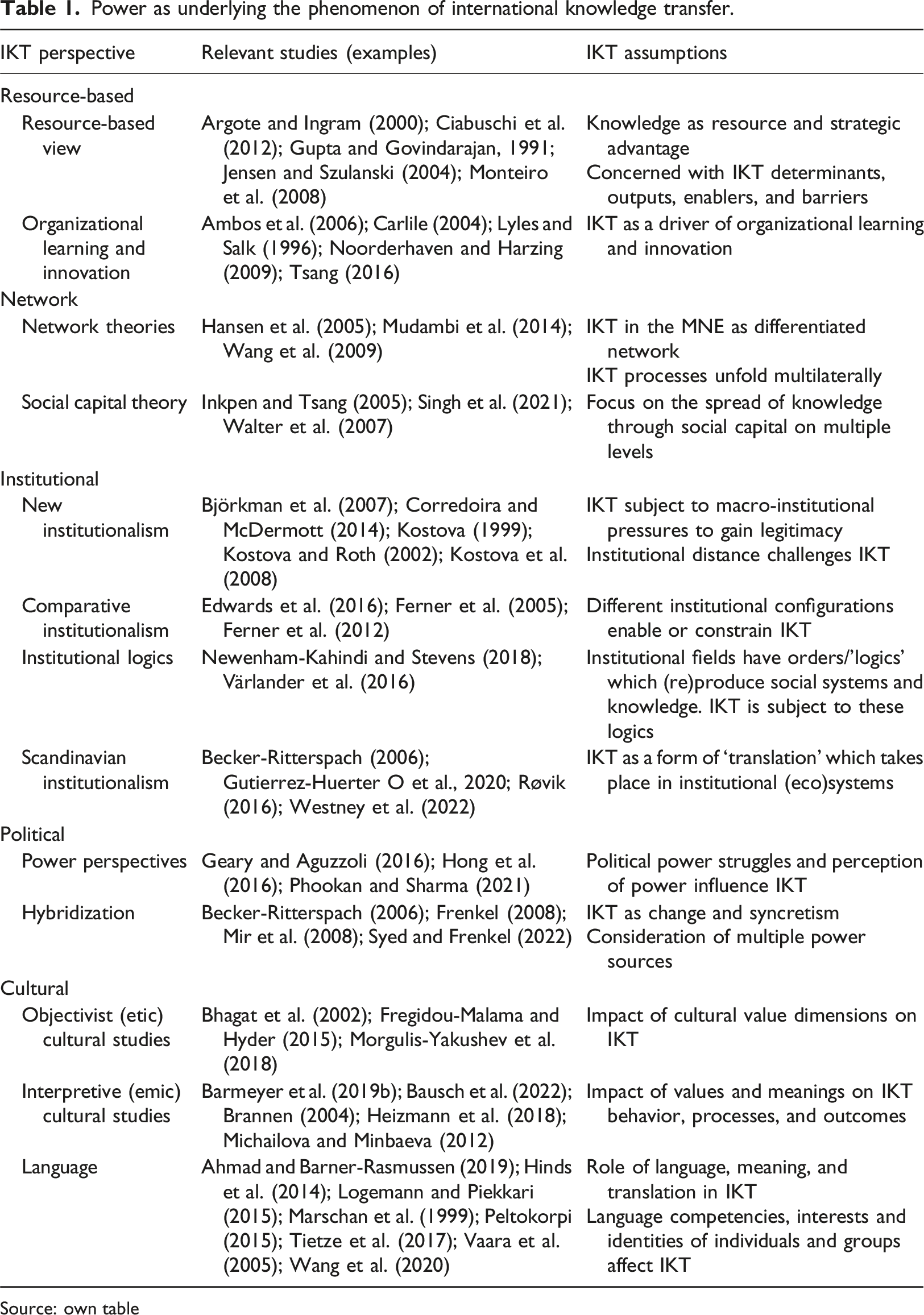
Power as underlying the phenomenon of international knowledge transfer.
Source: own table
Active categorization
In this section, we specify the phenomenological approach using Grodal’s (2021) methodology of ‘active categorization’. In line with Marcus (1995, 2008), our purpose is to find those elements in existing IKT studies that underlie it across single incidents to be able to generalize to a higher level of theoretical abstraction. Our approach involves three steps: (1) classifying the phenomenon (differentiation), (2) finding the common element underlying the phenomenon (integration), and (3) establishing the multi-paradigm contours of the phenomenon (patterning). Through the three steps, we establish how power implicates IKT across multiple paradigms.
Step 1: Classifying the literature (differentiation)
Starting from a phenomenon-based mindset, we reviewed the relevant literature on IKT in IB and CCM studies. Specifically, we scanned the following journals through EBSCOhost, Web of Science, and their websites on “international OR cross-cultural, “multinational companies OR multinational enterprise” (MNC OR MNE), “knowledge transfer”, “power”, and/or “politics”: Critical Perspectives on International Business, Cross Cultural & Strategic Management, International Business Review, International Journal of Cross-Cultural Management, Journal of International Business Studies, Journal of World Business, Management International Review. Additionally, we considered core publications in other outlets, such as monographs, edited volumes, and chapters that are acknowledged as important contributions to IKT literature. We considered publication dates until July 2023. Our review is thus interest-driven and heuristic (Mees-Buss et al., 2022) with the aim of reviewing and understanding key approaches to IKT in the literature. Our classification yielded six theoretical perspectives (strands): resource-based, network, institutional, political, cultural, and language perspectives. Table 1 provides an overview with example studies.
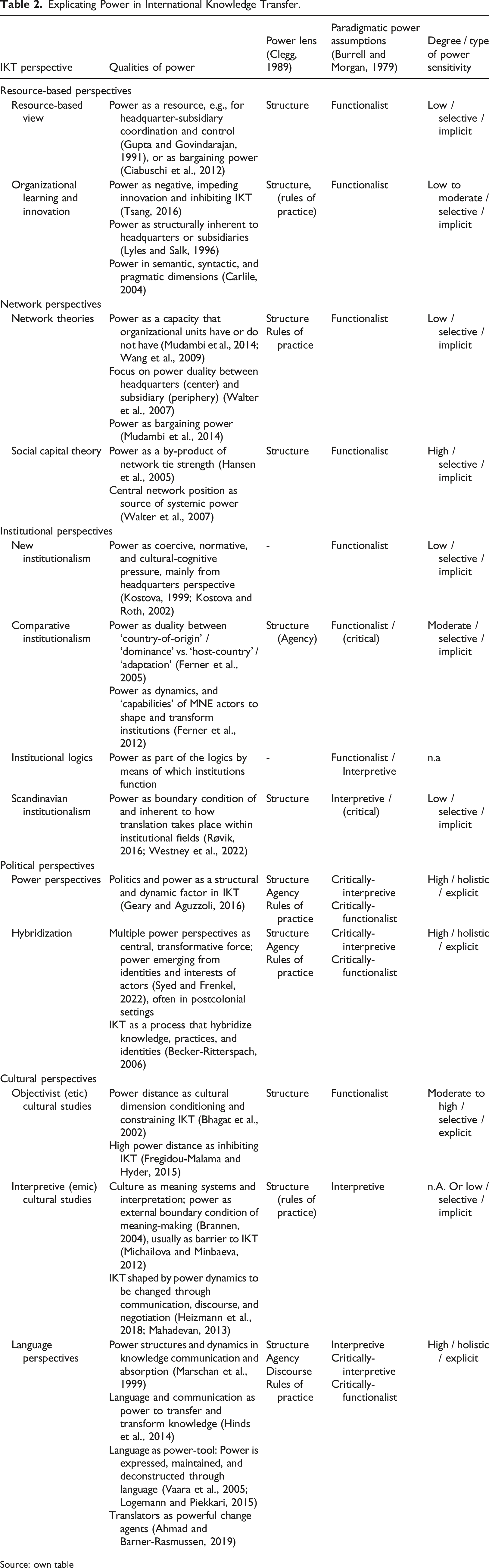
Explicating Power in International Knowledge Transfer.
Source: own table
Step 2: Stewart Clegg’s frameworks of power (integration)
After having established power as an omnipresent phenomenon across IKT studies, we sought for elements of the phenomenon helping to integrate the divergent perspectives, in other words, for aspects of the phenomenon to ‘follow’ (Marcus, 1995). For doing so, an integrative and, at the same time, differentiated approach to power is required. We find such a conceptualization in Stuart Clegg’s (1989) Frameworks of Power. Clegg’s analysis cuts across the properties of power as identified in the six perspectives, considering both structure (the ‘large’ and ‘stable’ power of institutions) and agency (the ‘small’ and ‘fluid’ power of culture of individuals to resist, change, and subvert any given structure, see Foucault, 1980). Clegg also acknowledges the relevance of ‘rules of practice’, that is, ‘how things are normally done’ in an organization, translating between structure and agency. For instance, processes of institutionalization in MNEs are the means by which individual action becomes structure. At the same time, institutionalized knowledge transfer guidelines are translated into culture by how people comply. Discourse, that is, how a phenomenon is normally spoken about and framed, is the boundary condition to all three qualities of power: structure, rules of practice, and agency. For example, language is the medium by which knowledge is transmitted. Language, then, creates the discourse through which a particular knowledge claim is accepted or rejected, but it is also simultaneously shaped by existing discourses that frame that process.
Rather than defining what power is, Clegg (1989) proposes focusing on what power does, studying the incidents in which the transformative potential of power manifests. For example, processes of institutionalization might become part of an MNE’s structures (power has made the transition from practice to structure). However, if a certain rule of practice is successfully resisted (other groups mobilize their agency), the same rules of practices are not institutionalized (rules of practice does not become structure).
To understand frameworks of power holistically, Clegg (1989) suggests paying attention to when and how power is (not) resisted, by whom, out of what goals and interests, and against whom. His approach to power thus fits the criteria of the phenomenon-based approach as suggested by Marcus (1995, 2008). Clegg’s model enables researchers and practitioners to identify when and how which ‘power switches’, that is, the transition from one type of power to another, are activated and how one power quality is transformed into another. Applying Clegg’s approach to IKT literature, we can see what lenses of power have been employed, even in those studies where power was not made explicit. For instance, although power is usually not explicitly mentioned in studies that take a resource-based approach, Clegg’s approach enables us to identify resource dependencies and power imbalances between headquarters and subsidiaries. This way, active categorization helps us to ‘see’ more in a certain phenomenon.
Step 3: Paradigmatic delineations of power in international knowledge transfer (patterning)
As a next step, we moved our analysis to the higher abstraction level of paradigms, asking for how Clegg’s (1989) qualities of power might be categorized in the Burrell-Morgan matrix. Figure 1 provides an overview of these assumptions. Power assumptions underlying CCM studies in relation to International Knowledge Transfer. Source: own figure.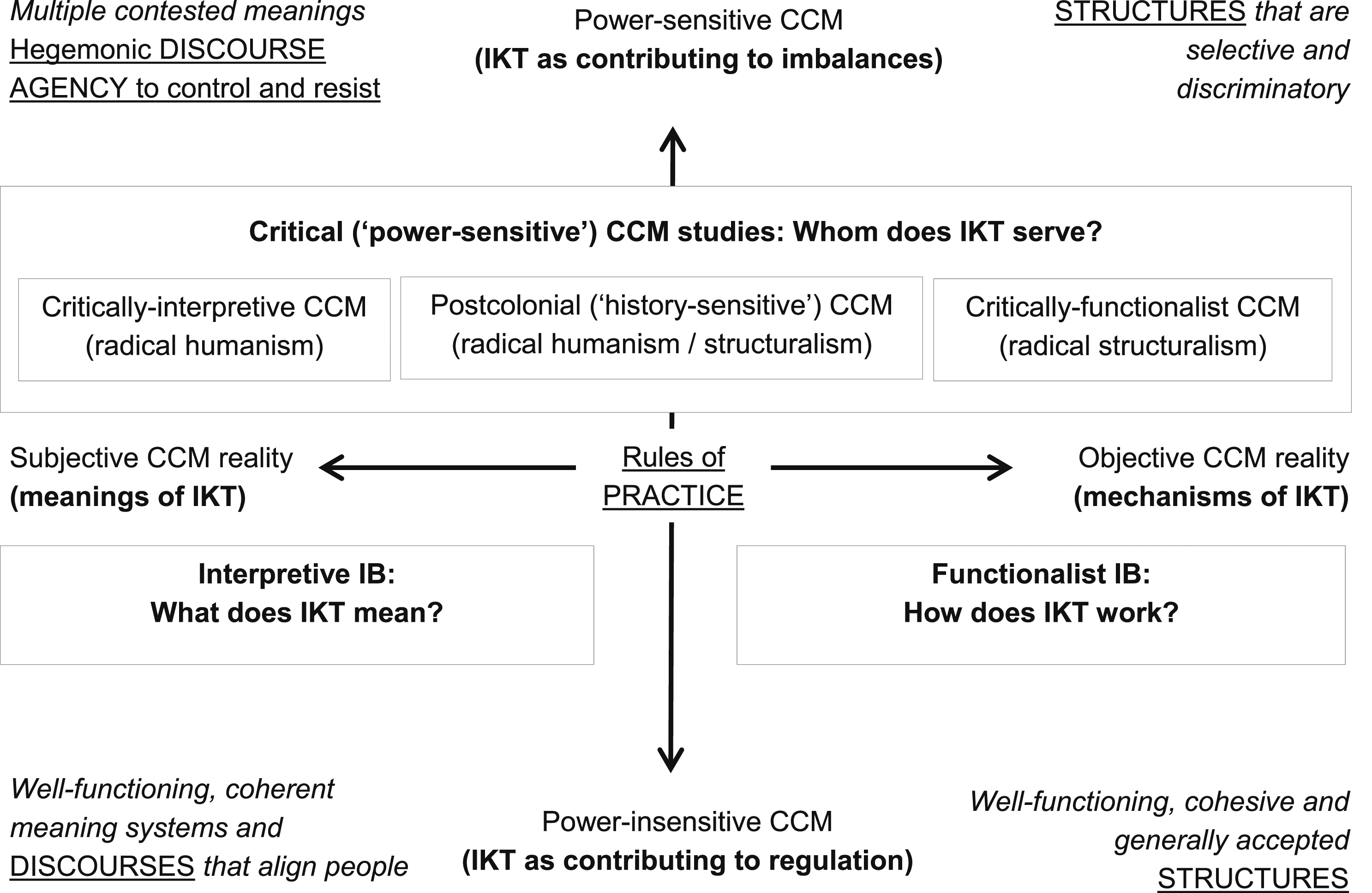
First, we adapted the terminology used in current CCM studies and kept the differentiation between interpretive and positivist/functionalist studies (Barmeyer et al., 2019a; Mahadevan, 2020). Second, ‘radical’ CCM studies are commonly called ‘critical CCM studies’ (Romani et al., 2018). We thus use the wording ‘critically-interpretive’ (for radical humanist) and ‘critically-functionalist’ (for radical structuralist). While a critically-interpretive perspective involves the power-sensitive study of the oppressive potential of subjective meanings, a critically-functionalist approaches focusses on systemic and objective power-inequalities rooted in structure and function. Third, we added another critical perspective – postcolonial studies – highly relevant to CCM and IB studies (Jack and Westwood, 2009). Postcolonial CCM studies adopt a specific, history-sensitive perspective on how contemporary CCM fields have developed. Postcolonial approaches to CCM involve both objective power-inequalities (critically-functionalist CCM) and subjective interpretations (critically-interpretive CCM). Fourth, we integrated key qualities of power immanent in Clegg’s (1989) frameworks of power (Capital, underlined). This way, we consider the subjective nature of discourse and agency and the objective impact of power-structures. Rules of practice are central to our figure, as they are the power mechanism by which agency, if successfully mobilized for resistance, change structure.
Consequently, researchers need to ask different questions when analyzing IKT, based on the assumptions underlying their approach. A critical researcher needs to investigate: Whom does international knowledge transfer serve? an interpretive researcher needs to ask: What does international knowledge transfer mean? and a functionalist researcher needs to focus on: How does international knowledge transfer work? Functionalist studies require an objective approach, and researchers need to remain detached from their object of study. Interpretive studies address subjective meanings; researchers are thus involved and need to reflect upon their own subjectivism. Critical studies need to acknowledge and reflect upon power, as objective structural and systemic inequalities in how IKT functions, as the contested subjective ways in which IKT is interpreted, or as involving both aspects.
Outcome of active categorization: Power in international knowledge transfer
When relating our combined conceptualization of power back to the existing literature, particularly the papers’ methodology, findings, and discussion section, we were able to consider whether the assumptions of what constitutes power in the papers were selective (e.g., power as the Hofstede cultural dimension ‘power distance’) or holistic (e.g., power as a constitutive element of IKT that involves power structures, organizational practices, or interpersonal interactions). Second, we were able to identify whether power-assumptions (paradigms) and power-lenses (qualities of power) were made explicit in these studies. This enabled us to classify the papers’ degree of power-sensitivity as low, moderate, or high. Table 2 includes these insights on the types and degrees of power-sensitivity of the respective IKT perspectives.
A multi-paradigm analysis of power in international knowldege transfer
When applying our approach of active categorization to IKT in MNEs, we arrive at the following findings structured into the six theoretical perspectives.
Resource-based perspectives
Studies from a resource-based perspective highlight the strategic role of knowledge for an organization (Gupta and Govindarajan, 1991; Jensen and Szulanski, 2004), conceptualize knowledge transfer as a basis for competitive advantage (Argote and Ingram, 2000), and investigate flows of knowledge across organizational boundaries (Monteiro et al., 2008). The studies’ focus is mainly from developed to emerging markets and to a lesser extent ‘reverse’ (Ambos et al., 2006). Being mainly rooted in a functionalist paradigm, resource-based studies are concerned with the relationships between determinants and outputs (Gupta and Govindarajan, 1991; Persson, 2006), such as performance (Ambos et al., 2006) and with enablers or barriers (Easterby-Smith et al., 2008; Jensen and Szulanski, 2004) of knowledge transfer, aiming to anticipate headquarter-subsidiary knowledge flows and results.
Power is thus addressed only selectively and implicitly, mainly via resource dependency theory (Persson, 2006), as HQ-subsidiary coordination and control (Gupta and Govindarajan, 1991) or as bargaining power (Ciabuschi et al., 2012; Inkpen and Beamish, 1997). The focus is on stable and structural qualities of power, that is, resources that organizational units possess or not possess (Ciabuschi et al., 2012). Adequate channeling is assumed to enable knowledge transfer ‘top-down’, whereas too tight control and restrictions are assumed to inhibit IKT (Easterby-Smith et al., 2008; Monteiro et al., 2008). The study of Monteiro et al. (2008) on IKT in six Swedish MNEs is a relevant application of this perspective.
We subsume organizational learning perspectives under resource-based perspectives because they understand knowledge as a resource that can be learned and transferred. Organizational learning perspectives examine the relationships between knowledge transfer, organizational knowledge acquisition, and innovation (Ambos et al., 2006; Carlile, 2004; Noorderhaven and Harzing, 2009). As such, they often understand knowledge transfer as innovation (Carlile, 2004) and examine organizational change through learning and unlearning (Tsang, 2016). Organizational learning perspectives are mostly functionalist, and due to their descriptive nature, mostly do not address power structures or dynamics explicitly. Exceptions (Lyles and Salk, 1996; Tsang, 2016) perceive power as structurally inherent to headquarters or subsidiaries and as inhibiting IKT and innovation. Moreover, Carlile (2004) considers power in semantic, syntactic, and pragmatic dimensions, offering room for further studies.
Network perspectives
From a network perspective, MNEs are viewed as differentiated networks in which subsidiaries and headquarters are interconnected actors and in which IKT unfolds multilaterally (Hansen et al., 2005; Mudambi et al., 2014; Wang et al., 2009). Some studies explore the role and use of social capital in such networks (Inkpen and Tsang, 2005; Singh et al., 2021; Walter et al., 2007). Despite assuming for complexity, most studies remain functionalist and aim at regulation. Power is usually conceptualized as a capacity that organizational units have or not have (Mudambi et al., 2014; Wang et al., 2009), and focus on structural power, such as the duality between headquarters (center) and subsidiary (periphery) (Walter et al., 2007). Thus, power is considered a by-product of network tie strength (Hansen et al., 2005). Some studies also extend to practice, for instance, by conceptualizing power as bargaining power on the level of organizational units. Mudambi et al. (2014), for example, investigate reverse knowledge transfer, arguing that subsidiaries can influence their powerbase by actively sharing or withholding knowledge in the MNE network.
Institutional perspectives
Institutional perspectives (Corredoira and McDermott, 2014; Edwards et al., 2016; Kostova, 1999) predominantly rely on old and new institutional theory for investigating how formal and informal institutions shape and impact the antecedents, processes, and outcomes of IKT. More recent approaches have also included institutional logics (Värlander et al., 2016) and Scandinavian ‘translation theory’ (Røvik, 2016) to explore IKT in MNEs.
New institutional studies are mainly functionalist, aiming at regulation on structural levels. These studies address power to an extremely limited extent and only implicitly as external coercive, normative, and cultural-cognitive ‘pressure’ shaping IKT (Björkman et al., 2007; Kostova, 1999). One of the main arguments is that the larger the institutional distance, the more challenging the transfer and the higher probability that knowledge is transformed and adapted to the host context (Kostova and Roth, 2002).
Comparative institutional studies assess how the institutional configuration (mainly on a national level) shape transfer processes and outcomes (Edwards et al., 2016; Ferner et al., 2005, 2012). Power is related to ‘country-of-origin’ and ‘dominance’ versus ‘host-country’ and ‘adaptation’ effects. While the ‘country-of-origin-effect’ assumes MNEs are likely to coerce pressure to standardize knowledge, the ‘host-country-effect’ considers that local employees resist an MNE’s global practices. Consequently, power is considered in terms of structure and less of agency. Studies are either functionalist or interpretive, aiming at regulation via structure or systems of meaning. Yet, a minor strand of comparative institutional research has integrated critical approaches, considering power as agency and rules of practice (Ferner et al., 2005, 2012). Key actors are seen as strategic and political agents of change and potentially subversion, driven by their interests, goals, and motives. Ferner et al. (2012) and Geary and Aguzzoli (2016) provide relevant IB applications of such a nuanced approach to power, involving dynamics across structure, agency, and practice.
Institutional logics (Newenham-Kahindi and Stevens, 2018; Värlander et al., 2016) is an emergent perspective on IKT, examining how “socially constructed, historical patterns of material practices, assumptions, values, beliefs, and rules” (Thornton and Ocasio, 2008: p. 101) impact IKT. It assumes institutional fields have their own orders (logics) that (re)produce social systems through meaning and adapt knowledge accordingly. Despite Thorton and Ocasio (2008) pointing out that institutional logics may compete in “a battlefield where power struggles motivated by competing institutional logics get played out” (p. 118), we found no evidence that power has received explicit attention from this IKT perspective.
Scandinavian institutional studies approach IKT predominantly interpretively, sometimes also critically, as a form of ‘translation’ (Gutierrez-Huerter O et al., 2020; Røvik, 2016). Originating from Actor-Network-Theory, studies challenge new institutionalist dichotomies of stability–change, imitation–innovation, and structure–agency and view these phenomena as interrelated and mutually constitutive. Translators are perceived as active, powerful, and creative soft actors, embedded in a unique social context that form and transform knowledge and practices (Becker-Ritterspach, 2006; Røvik, 2016). Scandinavian institutional studies are the most interpretive and partly critical (Becker-Ritterspach, 2006). Due to their proximity to language studies (Piekkari et al., 2020), they introduce discursive and agency-oriented perspectives on IKT. Despite a conceptual anchorage in Actor-Network-Theory, power dynamics are not yet fully considered (Westney et al., 2022). Røvik (2016), for example, understands power as an external boundary condition. Becker-Ritterspach (2006), as an exception, approaches power more dynamically and across structure, agency, and (rules of) practice. He integrates structuration theory with translation theory and considers knowledge transfer a “dialectic transformation, constituted by human actors and embedded in social systems” (p. 358) wherein actors actively engage in negotiation, employing their resources. IKT is thus subject to the social positioning, “affectedness”, and “conflicting interests” between actors who legitimize or delegitimize knowledge through their position (p. 372).
Political perspectives
Political perspectives are highly power-sensitive (Geary and Aguzzoli, 2016; Mir et al., 2008; Phookan and Sharma, 2021). These studies usually combine resource-based, institutional, or cultural theories with power-sensitive perspectives aiming at change (Hong et al., 2016). Individuals are seen as powerful, but embedded actors who, because of or despite of their structural power position, can choose to promote or subvert knowledge sharing and absorption. This makes the MNE a political arena or ‘contested terrain’ (Clegg et al., 2018) in which conflicts are played out by actors or interest groups and in which power-structures interrelate with people’s identities and interests (Geary and Aguzzoli, 2016) and with their practices (Bjerregaard and Klitmøller, 2016).
Power is considered holistically as the interrelated elements of structure, agency, rules of practice and discourse (Clegg, 1989). Political perspectives aim at change, not regulation (see the special issue on Politics and Power in MNC in Organization Studies, Geppert et al., 2016), via critically-functionalist, critically-interpretive, and postcolonial perspectives. Bjerregaard and Klitmøller (2016), for example, focus on conflicts in practice-sharing when knowledge is absorbed by an MNE subsidiary in Mexico. They focus on agency and rules of practice and show how ‘white-collar workers’ are better able to influence knowledge flows for personal benefit (agency) due to their socio-economic resources (social capital) than ‘blue collar workers’. Phookan and Sharma (2021) consider the agency of an Indian subsidiary and investigate whether and how MNE employees’ perception of their subsidiary’s relative power affects their knowledge sharing behavior. They find that perceived subsidiary power directly and positively affects knowledge sharing and indirectly affects organizational identification, with consequences for knowledge seeking.
We subsumed studies of hybridization as a specific variation of the political perspective as they are often set in power-sensitive contexts. Studies adopting hybridization approaches focus on how knowledge, as influenced by multiple cultures and institutions, is syncretized and undergoes change via being transferred (Becker-Ritterspach, 2006; Frenkel, 2008; Syed and Frenkel, 2022). These studies are highly power-sensitive, usually approach IKT from a postcolonial perspective, and advocate a sociology of radical change (Frenkel, 2008). They reflect critically on neo-colonial power-asymmetries between headquarters located in developed countries and subsidiaries located in emerging markets, often former colonial countries, aiming at a fairer and more inclusive systems (Syed and Frenkel, 2022). The agency and power-positions of individuals are assumed to be constitutive of how power is affirmed and resisted (Becker-Ritterspach, 2006; Syed and Frenkel, 2022).
Cultural perspectives
Cultural perspectives investigate the role of values, meanings, or cultural behavior in IKT antecedents, processes, and outcomes. While functionalist studies in the tradition of cultural dimensions approach culture objectively, searching for and comparing universal (etic) characteristics (Bhagat et al., 2002; Morgulis-Yakushev et al., 2018), interpretive studies approach culture from a culturally sensitive perspective, searching for unique and subjectively constructed (emic) cultural characteristics (Barmeyer et al., 2019b; Bausch et al., 2022).
Functionalist studies understand power mainly as the cultural value dimension of ‘power distance’ (Bhaghat et al., 2002; Fregidou-Malama and Hyder, 2015), which implies a selective, yet explicit but limited approach to power. Studies generally find high power distance hinders IKT (Fregidou-Malama and Hyder, 2015). Moreover, collectivist cultures are assumed to be better able to absorb tacit, people-bound knowledge while individual cultures are more suited to absorbing explicit, technical knowledge (Bhagat et al., 2002).
Interpretive studies are subjective and meaning-centered (Brannen, 2004; Heizmann et al., 2018), exploring the influence of culture-inherent concepts and the general influence of meaning systems on IKT (Barmeyer et al., 2019b; Brannen, 2004). Due to their focus on values and meanings, interpretive cultural studies usually leave power structures and dynamics untouched. However, if conceptualized, power is considered headquarters-subsidiaries hierarchies and a boundary condition of meaning-making (Brannen, 2004). Moreover, power in the sense of structural power asymmetries is considered a negative and inhibiting factor to IKT (Michailova and Minbaeva, 2012). Examples including power as rules of practice deliver Heizmann et al. (2018) and Mahadevan (2013). Heizmann et al. (2018) rely on practice theory for exploring the construction and negotiation of power in IKT between host-country nationals and expatriates in Vietnam. Knowledge sharing is understood as an intercultural communication practice imbued by power relations. Power becomes a “relational force” (p. 19) that conditions relationship building from the beginning. Power imbalances are reduced through expatriates’ honest interest in learning about the host culture and prioritizing relationships over tasks in the beginning of the knowledge sharing: A dynamic, multi-level conceptualization of power across structure and agency.
Language perspectives
Language perspectives focus on language as the medium of IKT (Wang et al., 2020; Welch and Welch, 2008) and on knowledge transfer as processes of translation (Piekkari et al., 2020). Several studies put their emphasis on individuals or groups to assess how language competencies, interests, and identities affect IKT (Ahmad and Barner-Rasmussen, 2019; Hinds et al., 2014; Tietze et al., 2017). These studies usually draw from or combine linguistic approaches and methodologies with IB concepts and are either interpretive, critically-functionalist, or critically-interpretive. Thus, they take into consideration power in terms of structure, agency, rules of practice, and discourse.
Interpretive studies from a language perspective show, for example, that a common language frame facilitates IKT in MNEs (Peltokorpi, 2015), benefitting network building, trust, and motivation in the short run and cost reductions in the long run (Welch and Welch, 2008). Conversely, an absence of a common language causes misunderstandings and misinterpretation and leads to misalignments in practices, affecting managerial decision-making. Yet, for most interpretive studies power plays a subordinate role as the focus is on assessing how language affects and is affected by the MNE and its members. In turn, critical studies investigate how language and discourse are used either as a means of dominance and oppression or as a power-tool for successful knowledge transfer (Logemann and Piekkari, 2015; Vaara et al., 2005). For example, language proficiency in the dominant language might be confused with knowledge on the subject. The degree of proficiency influences the ability of actors to build networks and trust, and their ability to express and convey knowledge, thus enlarging or diminishing individual power positions (Hinds et al., 2014; Marschan-Piekkari et al., 1999). Language differences, competencies, and policies are thus a serious distortion of IKT that can either empower or disempower social actors (Vaara et al., 2005).
Recommendations for multi-paradigm research
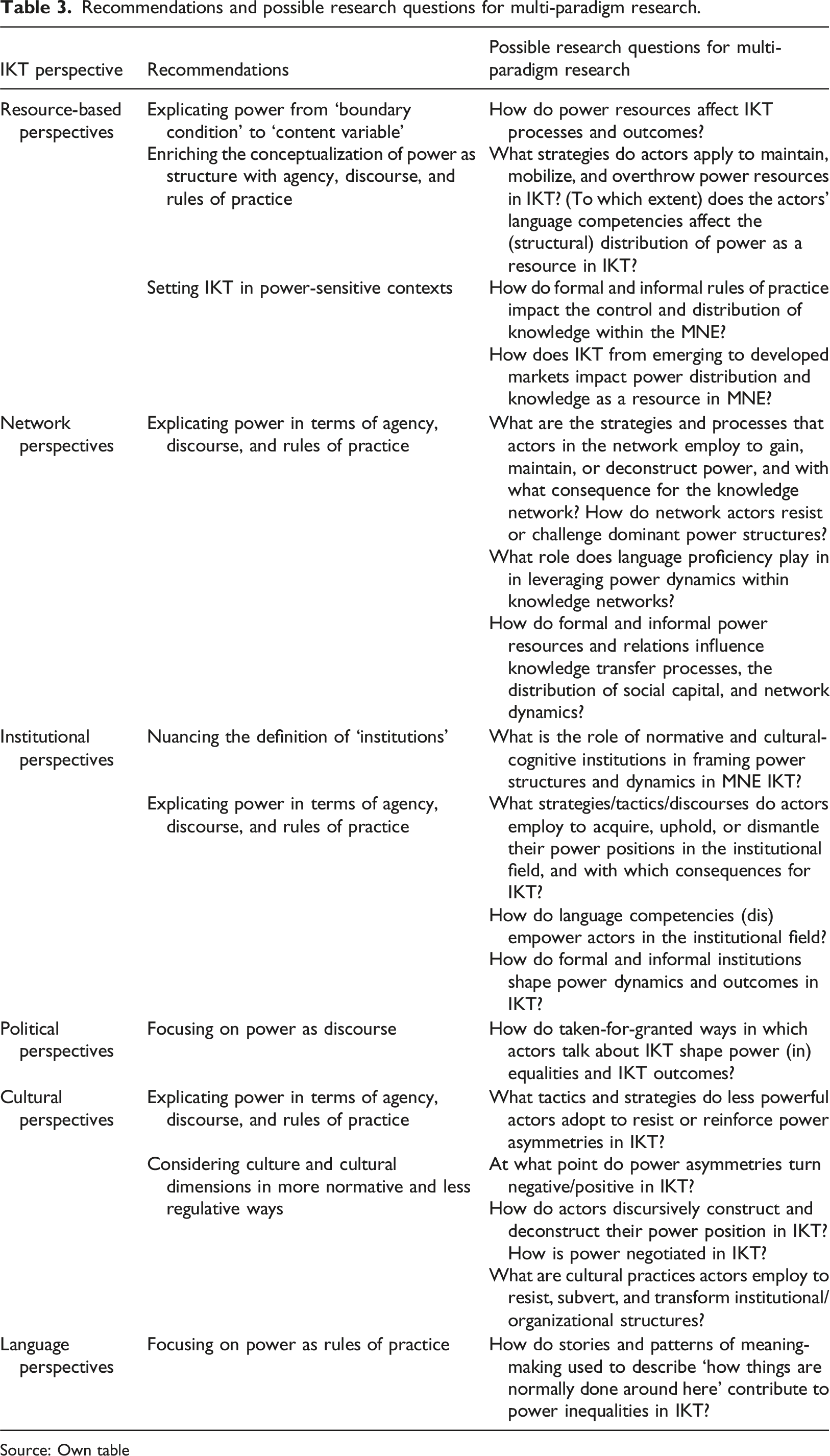
Recommendations and possible research questions for multi-paradigm research.
Source: Own table
Resource-based perspectives
Studies from a resource-based perspective generally adopt a functionalist paradigm that considers power implicitly and as a structural boundary condition. Resource-based perspectives therefore show a great potential to integrate interpretive and critical lenses on IKT through a more explicit acknowledgement of power, and through understanding power as involving agency, discourse, and rules of practice.
First, resource-based studies can shift their attention from considering power as a structural boundary condition to a content variable, understanding knowledge as power that can be leveraged as a resource transferred between headquarters and subsidiaries. Conceptualizing “local parent power [more] explicitly” (Lyles and Salk, 1996: p. 895) may reveal equal or unequal power distributions between organizational units, as ultimately affecting IKT processes and outcomes. Acknowledging power as an explicit content variable allows to shift the attention from a structural and stable conception of power towards an agentic and processual one, and to expose power as discourse and (rules of) practice (Carlile, 2004).
Second, considering further agency and discourse, functionalist resource-based studies can be expanded by interpretive (rooted in the sociology of stability) and critical (rooted in the sociology of change), addressing the diverse interests, interpretations, and strategies (processes) employed by actors to maintain, mobilize, and overthrow knowledge and power resources in the MNE. Resource-based studies can ask for the effects of headquarters and subsidiary actors’ interest in transferring knowledge as a resource or for the strategies actors choose to acquire, maintain, and mobilize power resources to obtain or spread knowledge in MNEs. Moreover, by addressing power in IKT through a discursive lens, resource-based studies can be enriched by interpretive and critical perspectives that examine how language, meaning, communication and discourse affect power and knowledge resources in IKT involving headquarters and subsidiaries. A great potential lies in conceptualizing power as rules of practice, thereby considering formal and informal (rules of) practice(s), norms, conventions, and unwritten guidelines that shape and transform power relations. The progressive three-level framework by Carlile (2004) may provide avenues for future multi-paradigm research as it considers syntactic (linguistic), semantic (culture), and pragmatic, thus, practice-oriented (power) perspectives on IKT. Exploring the rules of practice can then also explain the impact the control and distribution of knowledge within the MNE, or how mobilized actions of individuals striving to either maintain or overthrow power structures and resources that enable or constrain IKT in MNEs.
Third, resource-based studies may cross-fertilize functionalist with interpretive and critical perspectives through setting IKT in power-sensitive contexts. As power of MNE is gradually shifting from emerging to developed and other emerging markets (e.g. rise of emerging market MNE), a consideration of the local embeddedness of actors and their interrelationships may open a more nuanced perspective on power in IKT. Postcolonial contexts or contexts with political tensions may increase epistemic plurality in this regard.
Network perspectives
Network perspectives show the potential to integrate interpretative and critical paradigms by further explicating alternative qualities of power, such as agency, discourse, and rules of practice.
Rather than viewing power solely as a static attribute possessed or lacked by organizational units, or merely as a consequence of network tie strength, network perspectives can enrich their research designs by incorporating agentic and processual dimensions. In doing so, they expand the conceptualization of power beyond a fixed resource to embrace its dynamic nature (Inkpen and Tsang, 2005). The predominantly functionalist studies can thus extended by exploring not only how the distribution of power influences knowledge flows in the network, but also how the distribution of power came into being via agency and positioning. Studies may, for instance, explore the strategies and processes that actors in the network employ to gain, maintain, or deconstruct power and with what consequence for the knowledge network, or how actors leverage their social capital to consolidate their power in the network. We contend that the social capital perspective, in particular, provides a robust foundation for a multi-paradigmatic approach, given that its foundational theory (Bourdieu, 1972) elucidates how social capital is intricately linked to the perpetuation of class, status, and power dynamics within a social framework.
Furthermore, by transcending the binary perspective of power between headquarters (center of knowledge) and subsidiaries (periphery of knowledge), network studies can redirect their focus from ‘knowledgeable’ agents at the center towards the periphery. This shift can be achieved, for instance, by critically examining the current state of (reverse) knowledge flows and delving into the dynamics of resistance within knowledge networks. Such an approach not only fosters a critical, power-sensitive lens but also cultivates a reflexive perspective.
Further, network studies offer a pathway to incorporate discourse analysis by exploring the role of language and communication in IKT, thereby ushering in interpretive and critical perspectives. Network studies could then, for instance, investigate the role and impact of language proficiency in leveraging power dynamics within knowledge networks.
Lastly, even though rules of practice have been implicitly considered in some studies (Mudambi et al., 2014), this facet of power is not yet made explicit as a relevant and overarching power-lens. Through a further exploration of rules of practice, network studies possess the potential to elucidate the intricate interplay between structures and processes, thereby synthesizing both structural and agentic dimensions of power within IKT in networks. Moreover, exploring rules of practice can uncover hidden power structures in knowledge networks and shed light on how formal and informal power resources and relations shape knowledge transfer processes, the distribution of social capital, and thus network dynamics.
Institutional perspectives
Even though institutional studies have addressed power structures and relations in IKT occasionally, there is ample room for a more explicit and multi-faceted conceptualization of power and multi-paradigm research, particularly by integrating critical perspectives.
Institutional perspectives offer a fruitful ground for multi-paradigm research due to the broad and multi-faceted definition of ‘institutions.’ While the role of institutions can be perceived through regulative, normative, or cultural-cognitive elements (Kostova, 1999), most studies confine themselves to regulative and structural dimensions when examining power in IKT. Particularly via a normative and cultural-cognitive conceptualization of institutions, meaning (discourse) and behavior (agency) can be integrated into regulative and structural frames, complementing the predominantly functionalist studies with interpretive and critical lenses. Moreover, an examination of critical discourses such as on gender equality or minority rights offers an additional institutional perspective for multi-paradigm research.
Introducing a dynamic and agency-driven approach, institutional studies may further explore the interrelationship between MNE actors’ power position and the institutional setting they are operating in. To enrich structural and selective approaches to power, studies can question the strategies, tactics and discourses actors employ to acquire, uphold, or dismantle their power positions, and the consequences for IKT in the organizational setting. MNEs can be studied as ‘political arenas’ wherein powerful actions “make sense, manipulate, negotiate and partially construct their institutional environment” (Kostova et al., 2008: 1001). Viewing actors as strategic and political agents of change and potential subversion, propelled by their interests, goals, and motives (Ferner et al., 2012), further sharpens a critical perspective by unveiling acts of compliance or resistance within the institutional milieu, which may catalyze transformative shifts. We suggest that the institutional work perspective (Thornton et al., 2008) offers a particularly fertile theoretical framework, as it considers strategies of creating, maintaining, and disrupting institutions, grounded in agentic and dynamic considerations.
A discourse-based view could further advance paradigmatic plurality by examining the processes of communication, language, sense-making, and negotiation in the study of power in IKT. Scandinavian institutional studies are most interpretive and critical in this regard, yet, still neglecting a comprehensive consideration of power (Westney et al., 2022). The conceptual work by Piekkari et al. (2020) has highlighted the parallels of ‘transfer as translation’ and language studies, opening the path towards multi-paradigm research.
Lastly, institutional perspectives can be further enriched through exploring rules of practices, connecting structural with agentic views of institutions, thereby infusing functionalist and interpretive studies with a critical paradigm. Becker-Ritterspach (2006) exemplifies a dynamic view of power by integrating structuration and translation theories. IKT is seen as a dialectical process where actors negotiate, legitimize, or contest knowledge through social positioning and conflicting interests. Other avenues of research could question the interplay of formal and informal institutions such as hidden agendas, often prevalent in emerging markets, in the shaping of power relations in MNE IKT.
Political perspectives
Power is highly explicit and considered in differentiated ways in political perspectives. Studies on hybridization go the furthest in considering the dynamics of power across discourse, structure, practice, and agency and investigate how and when power is transformed from one quality to the other, thus promoting a processual and multi-level approach to power.
Although they tend to be multi-paradigmatic, political perspectives can be further enriched through interpretive lenses by considering power as discourse. This way, the power of politics is made ‘small’ and manageable, for instance, by paying attention to the stories which actors tell about the IKT reality, and whether they consider these realities successful or not. In this regard, power could be understood through language, meaning and discursive capabilities that shapes actors’ positions and agency in IKT (such as the powerful position of translators or intermediaries), the status of language(s) in a political setting, or as bargaining power between actors related to their language competencies.
Cultural perspectives
While cultural perspectives acknowledge power as a cultural variable or boundary condition, they have done little to explicitly address power as ‘content’, shaping the outcome of cross-cultural interaction. Often highlighted as a research limitation (Bausch et al., 2022), cross-cultural studies are seeking for a more explicit and nuanced integration of power. Promoting a multi-paradigmatic opening, cultural perspectives might go further in integrating power more explicitly and as agency, discourse, and especially as rules of practice.
To understand power through the lens of agency, cultural studies can investigate patterns, processes, tactics, or strategies of resistance or reinforcement of power within IKT in MNE. within knowledge transfers. Such an exploration can focus on the actions of both less powerful and more powerful actors, examining how power dynamics are negotiated and perpetuated in cross-cultural contexts. Ideal research settings pose politicized environments (e.g., labor unions, managerial boards) or postcolonial settings. Moreover, instead of conceptualizing power asymmetries as inherently negative (Michailova and Minbaeva, 2012), culturally relativist studies can analyze how these asymmetries can become beneficial, potentially enhancing IKT outcomes. This approach offers, moreover, a more normative and less regulative perspective, fostering multi-paradigm research.
Viewing power through a discursive lens, cultural studies can blend interpretive and critical perspectives by exploring the meaning, communication, and negotiation of power within cross-cultural interactions. This approach enables inquiries into the interpretation, acceptance, or resistance to power in IKT across cultures, as well as the negotiation patterns of involved actors. Drawing on language perspectives (Heizmann et al., 2018) offers promising avenues for further research in this domain.
Cultural perspectives can also deepen the understanding of power through the lens of rules of practice, identified as the ‘switch’ between structural inequalities and agency (Clegg, 1989). This entails exploring how cultural practices enable actors to resist, subvert, and transform institutional or organizational structures, merging interpretive and critical approaches. Another avenue is adopting an action research design, exemplified by Mahadevan (2013), who, while consulting for a German-Taiwanese joint venture, facilitated critical reflections with the bicultural team on their behavior and culturally contingent rules of practice, which eventually changed to more sophisticated IKT structures.
Language perspectives
Language perspectives exhibit significant potential for integrating diverse power lenses and assumptions, as already accomplished by several studies (Hinds et al., 2014; Vaara et al., 2005). Translations are not only impacted by factual interferences, ambiguities, or equivalence between languages, but also by competencies, interests, and identities of translators (Ahmad and Barner-Rasmussen 2019). In general, language perspectives have provided critical reflections on the structural power imbalances linked to phenomena such as English as a lingua franca as a source for individual agency to construct, consolidate, and deconstruct power in the MNE (Logemann and Piekkari, 2015). These perspectives extend beyond mere structural analyses of power within MNEs, incorporating agency, discourse, and to a lesser extent, discourse as a practice. As an avenue for multiparadigm research, language perspectives might further focus on the rules of practice as the ‘switch’ between agency and structural inequalities. For example, if subsidiaries are empowered vis-à-vis the headquarters, practices change, which can lead to new structural solutions in headquarter-subsidiary relationships. Language studies might then explore how stories and patterns of meaning-making used to describe how ‘things are normally done around here’ contribute to structural power inequalities in IKT in the MNE.
Implications and limitations
Methodological implications
The immediate methodological benefit of this paper lies in providing a differentiated understanding of paradigmatic delineations while delivering novel insights on a central topic of IB and CCM studies. Specifically, this paper sheds light on how to handle multiple paradigms by identifying overlooked aspects of power within the existing literature of IKT.
Via a phenomenon-based approach (Marcus, 1995, 2008) to IKT in MNE, this paper provided researchers and practitioners with a methodological way of handling multiple paradigms in practice. This is thus the wider, meta-level methodological contribution of this paper. Instead of starting with theoretical or conceptual assumptions, this approach enabled us to look at a relevant phenomenon – in this case, power in IKT– and determine how this phenomenon is structured in a certain way by actively categorizing it. As we showed in this paper, this requires considering both the internal heterogeneity of the phenomenon – in this case, reflected by the six perspectives on IKT and the integrative element which underlies the phenomenon (power) across its differentiations. Next, via actively seeking theories that represent both differentiation and integration aspects – in this case, through Clegg’s Frameworks of Power, 1989) – researchers and practitioners are enabled to capture the phenomenon in more sophisticated and nuanced ways, thus increasing relevance. We have conceptualized these three steps as active categorization (Grodal et al., 2021), involving: (1) differentiation, (2) integration and (3) patterning, providing researchers and practitioners with detailed methodological advice on how to implement a phenomenon-based approach. With this approach, we highlight the paradigmatic limitations of the individual streams of literature concerned with power in IKT and point to possibilities for further, more differentiated, multi-paradigmatic research.
Theoretical implications
Power is a central part of MNEs and their everyday activities (Clegg et al., 2018; Geppert and Dörrenbächer, 2014). Yet, literature has scantly reflected on the question how power manifests in MNE and how one might identify and explicate the ‘switches’ so that power dynamics are shaped in certain ways. To identify these switches and their impact upon IKT, it is important to consider and explicate power-lenses (structure, rules practice, agency, and discourse) and power assumptions (functionalist, interpretive, and critical in the variations critically-functionalist, postcolonial, and critically-interpretive). Our immediate theoretical contribution thus lies in showing that a combined and adapted application of Clegg’s (1989) Frameworks of Power and the Burrell-Morgan (1979) matrix serves the purpose of implementing a more dynamic and nuanced approach to power in CCM studies.
Differentiating the relevant literature into six categories (resource-based, network, institutional, political, cultural, and language perspectives), we identified how the current IKT literature stands in terms of power-assumptions (Burrell and Morgan, 1979) and power-lenses (Clegg, 1989). Concerning power-assumptions, we found that most studies are mainly functionalist and aim at regulation. This mirrors the general insight that there is a dominance of functionalist approaches and a lack of critical research within CCM studies (Barmeyer et al., 2019a; Romani et al., 2018).
Regarding power-lenses, structural power is more evident than agency, particularly in resource-based, network, and institutional perspectives. These studies implicitly assume power is an important factor in MNEs but fail to address what power does in terms of practice. With Geppert and Dörrenbächer’s (2014), we find power and micro-politics to be under-researched themes. Political and language perspectives acknowledge multiple power-lenses the most, as they also consider the interrelations of agency, discourse, and, to a lesser extent, rules of practice. Such approaches may inspire future research to integrate alternative and multiple power-lenses and approaches.
What remains generally underexplored is the transformative and integrative quality of rules of practice as the ‘power-switch’ linking structure, agency and discourse, subjective and objective power properties, and forces of regulation and change. Here, we find the greatest implication for CCM research and practice: to investigate how and when practice contributes to existing structures or how and when it succeeds in challenging individual agency to resist, subvert, and transform structures. Even though political perspectives focusing on hybridization have gone the furthest, IKT studies are still mostly “blind to power relations” (Primecz et al., 2016) in the multi-paradigmatic and phenomenon-based sense promoted in this article.
Practice implications
This being a conceptual and literature-based paper, our immediate implications for practice are limited. However, we make an indirect contribution to practice by enabling managers to ‘see’ more in the IKT reality they wish to improve upon and to devise more appropriate and applicable tools for solving specific knowledge transfer issues when they arise. This way, we enable practitioners to make more informed and grounded choices when dealing with the phenomena they encounter, this being a contribution to practice on meta-reflexive levels.
Limitations
Our study faces several limitations: We acknowledge the potential incommensurability of research paradigms (Burrell and Morgan, 1979; Kuhn, 1970). While reconciling different paradigms remains debatable, we agree with the call of this special issue that research phenomena can and should be explored from multiple paradigms to uncover counter-narratives (Jackson, 2021) and alternative truths. Yet, such endeavors require a pronounced consciousness of one’s own paradigm and a tolerance towards other paradigms (Grosskopf and Barmeyer, 2021). We advocate that the phenomenon-oriented approach, paired with active categorization, outlined in this paper is the appropriate way to promote such multi-paradigm research.
Moreover, we acknowledge that the identified gap in critical studies may not be entirely due to paradigmatic blind spots. As critical studies tend to be time-consuming and often critical to access, the lack of studies may also be due to a lack of empirical accessibility and methodological limitations in collecting data for such studies.
Further, we only exemplified the methodological benefits of this approach for one topic (power in IKT). However, other phenomena, such as language, and technology, might also lend themselves for a phenomenon-based investigation, due to their omnipresent nature and because they are differentiated and integrated.
Conclusion
In this article, we suggested a phenomenon-based approach as a suitable way of handling multiple paradigms in practice. We proposed to implement a phenomenon-based approach by means of active categorization, to be differentiated – and thus made ‘practical’ – into three steps: (1) differentiation, (2) integration, and (3) patterning. We applied this approach to our review of IKT studies in MNEs as a relevant contemporary IB phenomenon, also from a CCM perspective. Via the first step of differentiation, we classified the IKT literature into six perspectives (resource-based, network, institutional, political, cultural, language). Via the second step of integration, we identified power as the common element underlying IKT in MNEs. This led us to conceptualizing power, as impacting upon IKT in MNEs, across the multiple paradigms and power assumptions of the Burrell-Morgan matrix, and across the different properties of power proposed in Clegg’s Frameworks of Power. We then showed to what extent and how the existing approaches to IKT in MNEs are limited by a lack of sensitivity and/or explicitness concerning power. From there, we drew phenomenon-based implications across paradigms for the phenomenon in question, such as the insight that regulative and functionalist power-assumptions are dominant and that the structural power lens is employed most often, followed by interpretive, and even few critical studies that also consider agency and discourse. Rules for practice have emerged as the most neglected power lens, where the greatest scope for further IKT research lies. From there, we proposed research recommendations and possible research questions for multi-paradigm research, thus enabling researchers and practitioners to conceptualize power in more sophisticated ways. We also contribute to multi-paradigm CCM studies by exemplifying the benefits and implementation of a phenomenon-based approach as active categorization involving the three steps of integration, differentiation, and patterning as a way of dealing with multiple paradigms in practice.
By doing so, we contributed to the scope and aims of this special issue in three ways. First, we suggested a way to conduct multi-paradigm research, also in the sense of a reflexive CCM practice. Second, we provided researchers and managers with a way of conceptualizing an increasingly relevant CCM topic – power – in more multi-paradigmatic ways. Third, we showed how a multi-paradigm lens enables researchers and managers to ‘see’ more in a given reality, in this case: IKT in MNEs, and, consequently, to come to a position of devising better and more applicable theories and managerial solutions.
Footnotes
Declaration of conflicting interests
The author(s) declared no potential conflicts of interest with respect to the research, authorship, and/or publication of this article.
Funding
The author(s) received no financial support for the research, authorship, and/or publication of this article.
