




Abstract
Toxic leadership phenomenon persists in many institutions at the expense of organisational progress and performance. This article explores the centrality of sociocultural values in leadership formation in Ghanaian organisations. Through the lens of the constructivist paradigm and ethnomethodology research design, fifteen (15) in-depth interviews were analysed. The study revealed that society’s underlying sociocultural values systems fundamentally impact the construction of toxic organisational leaders through complicity and condoning malpractice, impertinence to time, and nonchalance towards leaders’ toxic behaviours. Context, in this regard, has an inbred role in making a leader either toxic or constructive. Society and its organisational setups must positively impact the co-creation of constructive leadership by nurturing values that demand leadership accountability and reward constructive leadership for its significant impact in engendering organisational progress.
Introduction
The issue of toxic leadership in Africa and the world has been a problem for ages. While this phenomenon has remained a topical issue in academia and the development sphere, the problem is exacerbated in certain jurisdictions (Padilla et al., 2007; Afegbua and Adejuwon, 2012; Abdulai, 2021; Arogbofa, 2022). There is no doubt that many regions are struggling to achieve sustainable development, an obvious consequence of toxic leadership (Afegbua and Adejuwon, 2012; Tushar, 2017). To proffer an understanding of this issue, toxic leadership is regarded as a leadership type where the leader abuses the power he/she wields, puts up unethical behaviours, and builds a hostile and negative environment that emits toxicity to his/her subordinates. Its defeatist ingredients include micromanagement, disregard for established procedures, favouritism, lack of transparency, bullying, and manipulation (Abdulai, 2021; Baloyi, 2020). Because toxic leaders prioritise their self-interest over organisational and followers’ well-being, they create detrimental effects on the physical and psychological morale and effective performance of employees in organisations. With the divisiveness, destruction, and demoralisation that toxic leadership occasioned in organisations, few studies have endeavoured to explicate this phenomenon of dysfunctional leadership (Schimdt, 2008; Baloyi, 2020) and its underlying root causes in the context of Africa (Abdulai, 2021). Conversely, constructive leadership is considered as the direct opposite and antithetical to toxic leadership. Constructive leaders behave in the best interest of their followers by stimulating followers and organisation’s well-being through motivating, supporting and taking care of followers to ensure job satisfaction and effective job performance (Pletzer et al., 2023). The conceptualisation of this leadership and its relationship with the sociocultural values in the middle-level organisational landscape of Ghana is equally interesting to this study.
Pocian and Mgaya (2015) lament the over-importation of the Western leadership models to tender explanations for the African context and argue that a proper reflection on the post-colonial African leadership trajectory will offer a better alternative and unearth the root causes of toxic leadership. According to Afegbua and Adejuwon (2012), the problem of toxic leaders emanates from the insufficient understanding of leadership obligations and proper exposure to the leadership contexts in developing countries, particularly moral discipline. While scholars are still in contention on the critical challenges of leadership and what accounts for toxic leadership in some organisations in Africa, they all agree on the poisoning and poor performance that toxic leaders wreak on the welfare of organisations and people (Rafferty et al., 2013). Recognizing the destructive effects of toxic leadership on people and organisations, attempts have been made to develop leadership skills and solve toxicity through leadership seminars, workshops, and training in many parts of Africa, but toxic leadership persists in organisations (Baloyi, 2020; Padilla et al., 2007).
Organisational leadership plays a critical role in organisational performance, and Dartey-Baar et al. (2011) observed that the culture of organisational leaders can either have transformational or adverse effects. Many organisational leaders in Ghana’s public sector have often created a toxic environment derailing organisational performance (Dartey-Baar et al., 2023; Salifu and Odome, 2022). Many of these leadership problems and practices are embedded in contextual constraints and demotivate leaders and employees to respond constructively (Aberese-Ako, 2018; Obuobisa-Darko and Domfeh, 2019). Respectively, leaders and followers are immersed in a sociocultural system that significantly influences whether the behaviours of leaders are constructively transformative or destructive. It is pertinent to understand the sociocultural practices that encourage the formation of constructive and destructive leadership in Ghana. Proper insights can be gained into toxic leadership’s detrimental effects on both individuals and organizations. The conceptualisation of these insights will inform the creation of relevant strategies that are capable of mitigating the negative impact.
Previous attempts to research this phenomenon have largely tilted towards the top-level political leadership approach to toxic leadership in Africa rather than emphasising both the middle-level organisational leadership and its relationship with the underlying values of the society (Abdulai, 2021; Arobgofa, 2022; Folarin, 2013; Jackson and Parry, 2008; Mbandlwa, 2020). This traditional approach of top-level leader-entered perspective alludes to an important element in leadership formation. Specifically, it downplays the significance of context and middle-level influence that drives the formation and practice of leadership. In this regard, studying the nexus between toxic organisational leadership, constructive organisational leadership and the impact of sociocultural values on them in Ghana and Africa at large will uniquely deviate from downplaying context and the influence of the middle-level leadership. By so doing, the new perspective will support and enrich the traditional top-level approach that has come to overwhelm leadership studies in Africa (Ibrahim, 2022; Nelson, 1993; Powers, 1979). To properly examine the sociocultural dynamics and how they affect leadership in organisations in Ghana, the study seeks to solicit answers to these questions: What socio-cultural practices in Ghana breed toxicity in organisational leadership? What opportunities are available to reconstruct organisational leadership practices in Ghana towards constructive leadership?
Theorising toxic leadership in Ghana from an organisational and socio-cultural perspective is significant for two reasons. Firstly, most African societies are multicultural, built on collectivist interests, and have varied forms of social organisations (Jackson, 2004; Muchiri, 2011). In this respect, such diversity propels varying views about leadership and the responsibility of leaders, especially their ability to promote in-group interest. Hence, it is salient to examine the role socio-cultural context plays in leadership formation in Africa. Secondly, unlike Europe, the dynamics of colonialism left many Sub-Saharan African (SSA) societies with precedence. This precedence and sociocultural climate underpinning resistance to colonial rule and the aftermath was not based on constructive leadership practices. Accordingly, it is established that the negative consequence of colonial rule in African leadership and governance in general is real. This is because the experience of colonialism impacted the socio-cultural values of Africans and caused many African societies to have two realms: private and public (Ocheni and Nkwankwo, 2012; Ekeh, 1975). This study explores one of the realms: the middle-level leadership of public realm (government institutions) in Ghana. Focusing research on this often neglected segment is crucial because it is essential for enhancing performance in organisations and improving decision-making. Also, nurturing and fostering future top-level leaders and bridging the gap and relationship between top-level leadership and frontline operational actors are harnessed (Shibru et al., 2018). Because of this unique context of African society, the socio-cultural approach to understanding toxicity of organisational leadership in Africa is important in order to reveal the dynamics of the social and cultural context in creating either constructive and or toxic leaders.
Conceptualising and characterising toxic leadership
In order to understand toxic leadership, it is proper to establish credence in what constitutes leadership and its formation. In this respect, Northouse (2018) postulates that leadership is a process and requires the capacity of the leader to influence and harmonise the random efforts of a group of individuals toward an outcome. In a similar light, the process of leadership involves the application of knowledge and extensive skills that exert influence on followers toward achieving a goal (Ibrahim, 2022; Jago, 1982).
In consonance with the views of the above scholars, studies such as (Baloyi, 2020; Mbandlwa, 2020; Arogbofa, 2022) reveal that leadership is not only about influencing an organisation’s activities, but a leader must possess that quality to motivate. A leader should be able to unite individuals’ ingenuity toward achieving a common organisational goal that has great returns. This manner of leadership characterisation is goal-oriented and focuses on constructing a symbolic relationship that ties the followers and organisational interests. In this regard, the definitive idea of leadership is result-oriented and embedded in the societal dynamics that leaders possess. According to Jago (1982), this is known as the trait of leadership rooted in leaders’ sociocultural underpinnings. Conversely, the values, beliefs, characters, ethics, and, in simple terms, culture form an integral part of leadership formation and dictate the extent to which one exudes constructive leadership or toxic leadership values and qualities.
The literature on toxic organisational leadership, and leadership in general, has lacked a consensus on the definition of toxic leadership. In effect, many scholars have phrased terminologies such as ‘narcissistic’ (Glad, 2002), ‘neo-patrimonialism’ (Mkandawire, 2015), ‘evil leadership,’ and ‘destructive’ leadership (Padilla et al., 2007) to describe the toxicity of leaders in different contexts and writings. However, the unique feature that remains central to this variegated conceptualisations of toxic leadership is the harm and poisoned outcome toxic leadership produces and reproduces on organisational performance (Glad, 2002; Mkandawire, 2015; Padilla et al., 2007). For instance, Killick (2019) describes toxic leaders as those who have poisonous effects on organisational culture and promotes toxic feelings among followers and the sociocultural environs they operate. Similarly, Whicker (1996), credited with first using the terminology ‘toxic leadership,’ argues that toxic leaders have specific behavioural attributes, especially their sense of self-value, that exude poisoning effects on their followers. So, he defined toxic leaders as people possessing personal characteristics and traits of behaviour that are toxic to the followers. Often, these leaders are maladjusted, destructive in behaviours, malevolent, and interested in their self-values, which are toxic to the followers. Subsequently, Lipman-Brumen (2005) proffers the explanation that toxic leaders are engaged in many destructive behaviours and exhibit specific dysfunctional personal characteristics which inflict serious harm that is enduring on followers. For Lipman-Bluman (2005), the peculiarity among toxic leaders is their ability and unrelenting efforts to unleash severe and long-lasting damage on the led because of their bad personal characteristics. Drawing from the foregoing, this study considers a leader as toxic when his or her self-seeking interest for power, economic interest, personally identifiable values, beliefs, and characteristics are overriding that of the organisation. Especially, when this self-interest violates the organisation’s interest and sprout out toxicity and detrimental effects on the followers and the organisation whose consequences cannot be annulled in the short-run (Killick, 2019; Lipman-Bluman, 2005; Whicker, 1996).
Leadership as construed by social constructivist perspective
The constructivist perspective construes leadership to be socially constructed over time. Leadership flows from the constant interactions of individuals among themselves and far from something that people possess in themselves. This viewpoint, about leadership, has a foundational basis in earlier studies undertaken by organisational scholars such as Pfeffer (1970), Smircich and Morgan (1982), and Foldy et al. (2008). They contended that leadership is constructed via individual actions in organisations. In this regard, leadership is co-constructed from socio-historical and collective meaning-making, which are negotiated continuously via complex interplay involving actors of leadership of different kinds (Fairhurst and Grant, 2010). It must be pointed out that constructionism is founded on symbolic interactionism (Mead, 1934) and phenomenology (Schutz, 1970) and popularized by Berger and Luckman (1966). There is reciprocity in people making their own social and cultural worlds and, at the same time, these worlds making people (Fairhurst and Grant, 2010). Thus, the approach reveals a ‘social and simultaneous playful basis, by which reality is both revealed and concealed, created, and destroyed by our activities’ (Pearce, 1995, p. 89). Social constructionist perspectives disapprove of leader-centric persuasions where the personality, style, and behaviours of leaders fundamentally influence followers’ thoughts and actions. Also, it places much premium on leadership as a co-constructed reality where the processes and outcomes of social actors are central (Fairhurst and Grant, 2010).
Instructively, social constructionists are most probably inclined to the eye of the beholder’s perspective of leadership (Barker, 2002; Fairhurst and Grant, 2010), By that, the situation and appropriateness of leadership are interpretative and contestable matters that cannot be measured by mere objective criteria. This is where the context of study matters. Ghana, a country within SSA as a context, is to be understood as a context that is capable of constraining the efficacy of a leader’s actions. Studies must be cautious and curious of this context in that it has identifiable and variegated structural, environmental, and sociocultural circumstances on specified styles and outcomes of leadership (Dickson et al., 2003; Muchiri, 2011). Research on value-based dimensions has succinctly put SSA as high on collectivism (Hofstede, 2001), at the same breadth, high on the humane orientation of culture (House et al., 2004). Collectivist societies are distinguished by intense social structures and togetherness that are seen in cohesive and strong in-groups as against out-groups. It espouses the values of family ties and religious or ethnic orientations as very salient. On the humane orientation dimension, such societies have compassion and generosity and demonstrate profound regard for the welfare of others and readiness to sacrifice self-interest for the collective interest. According to Muchiri (2011), it is plausible to think that collectivist values will impact leadership emergence and effectiveness. This is justifiable enough to explore how toxic leadership is constructed under such a social milieu. This aligns with previous thinking that leadership is “a collective social consciousness that emerges in the organisation” through people’s interactions (Pastor, 1998, p. 5). Through individuals comprehending the roles and the work assigned to them, leadership is socially constructed and assumes an independent course that is continuously enacted over time. Subsequently, leadership emerges as a property of the social system instead of merely an idea shared in people’s minds (Fairhurst and Grant, 2010). Since leadership can either be constructive or toxic, how is such leadership formed and socially constructed in such contexts? It is acknowledged that due to the pervasion of neo-paternalism in the spheres of the public sector in most SSA countries, people in authority accumulate and personify power. Also, egoistic, self-serving behaviours and prerogatives override the authority of laws and organisations, with leaders securing unjustifiable discretionary control over resources (Muchiri, 2011). This foregoing, to wit, is symptomatic of the fundamentals of toxic leadership, which damages the interest and welfare of the people and organisations who are themselves co-constructors and co-conspirators of such leadership (Allio, 2007).
Research design and method
As alluded to in the theoretical section, the study is paradigmatically, located within social constructionism, which presupposes that we live in a world constructed by us that is not readily susceptible to change once constructed (Bryman, 2004; Kuada, 2012). As such, the reality of leadership in the SSA context, be it constructive or toxic, is constructed by Ghanaians in their various organisations. The research design of this study is derived from ethnomethodology (EM). The godfather of EM, Garfinkel (1967) posited that EM researchers “must scientifically investigate the world that includes as problematic phenomena not only the other person’s knowledge of the world and how they see it” (Delanty and Strydom, 2003, p. 97). By this, we can examine the categorisations of social actions of people within departments by relying on the experiences of groups directly devoid of an imposition of researchers’ values on the research setting (Lynch, 1993). It must then be established that Ghanaians are co-conspirators to the incidences of toxic leadership plaguing the SSA as a social context.
Data sources
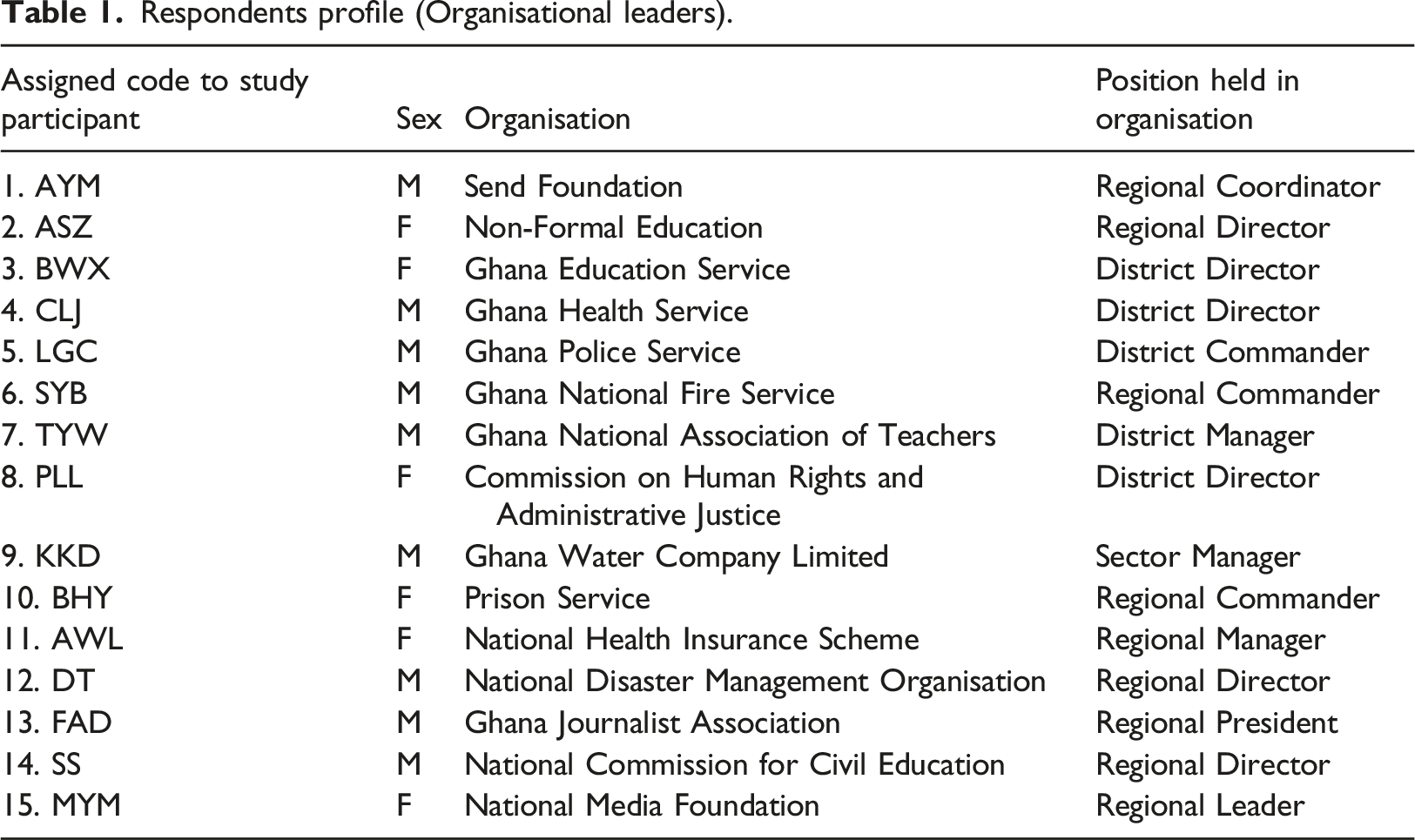
Respondents profile (Organisational leaders).
Data transformation and themes generation
The data transformation process was kick-started by importing the transcribed data into the Voyant tools software utilizing the links, TermsBurry, and trends. To arrive at the major themes for the analysis, the recurrent words or frequently used words by the participants were extracted using the Voyant data analytic tool (See the Figure 1 below). Some recurrent words and their inter linkages using the voyant tools. Source: Voyant Data Analytic Tool.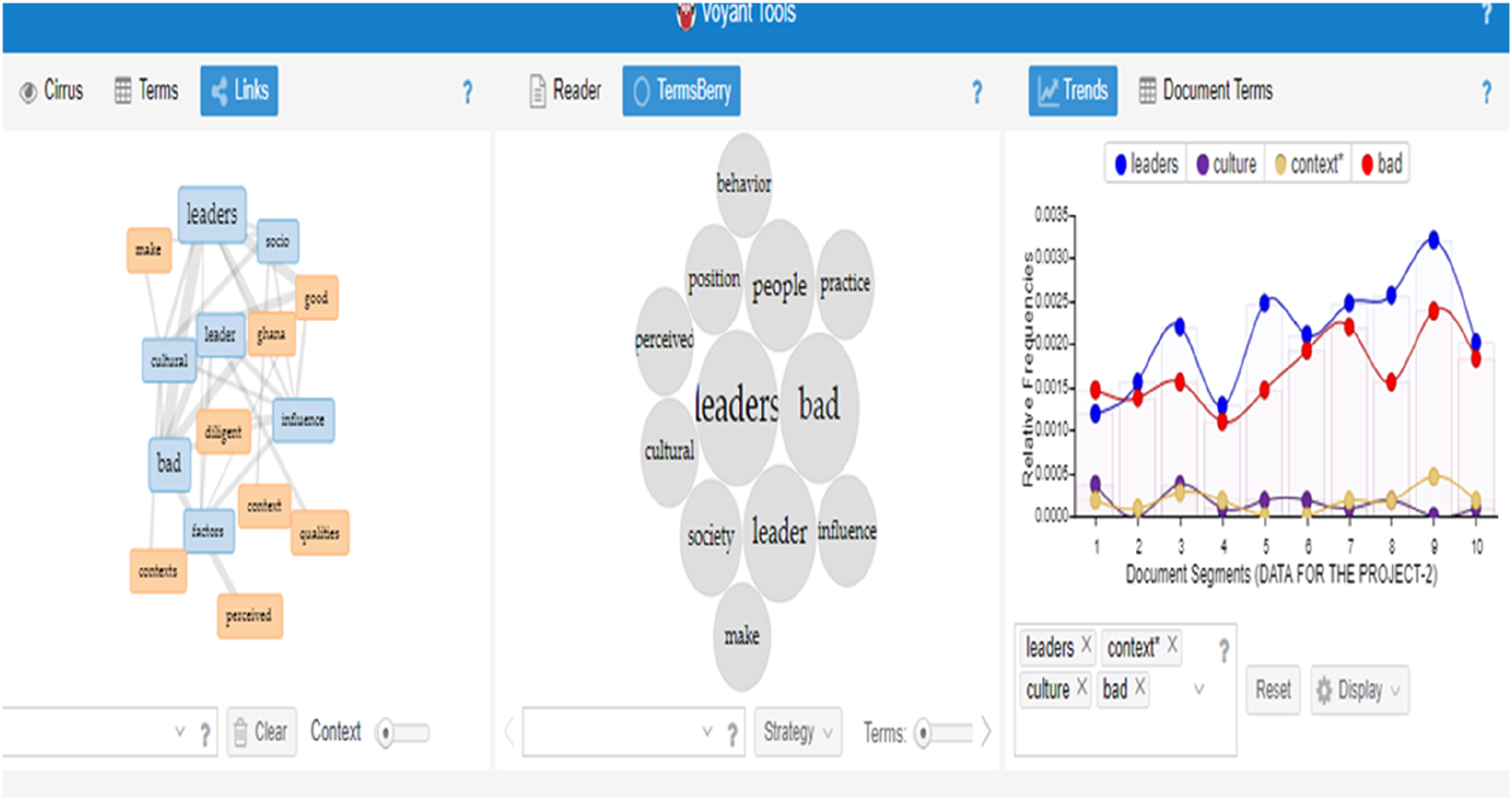
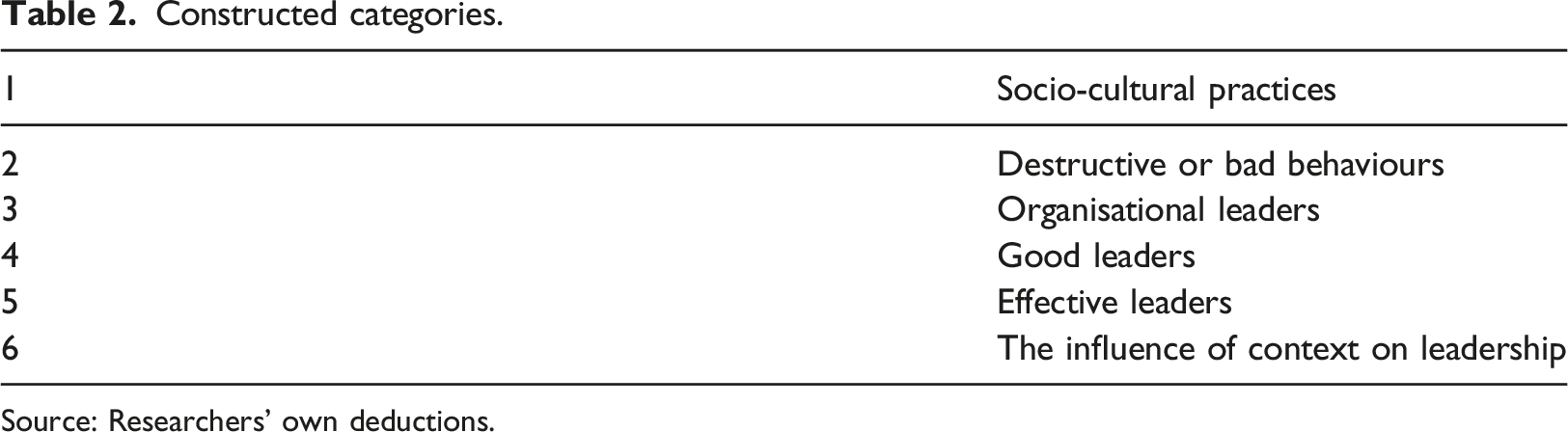
The above figure displays words that have had several mentioning by the participants and their interconnections with other key words in the data. The keywords captured on the links column of the Voyant tools software such as— leaders, sociocultural, behaviours, bad, influence have the same colour (Figure 2). Other interconnecting key words such as, diligent, perceived, good are labelled differently by the software, and the TermsBurry and Trends columns captured words such as leaders, culture, context, society, influence etc. (Refer to Figure 1 above). After carefully going through the recurrent words, we constructed the following categories in the table below (Table 2). Construction of themes. Source: Researchers’ Design. Constructed categories. Source: Researchers’ own deductions.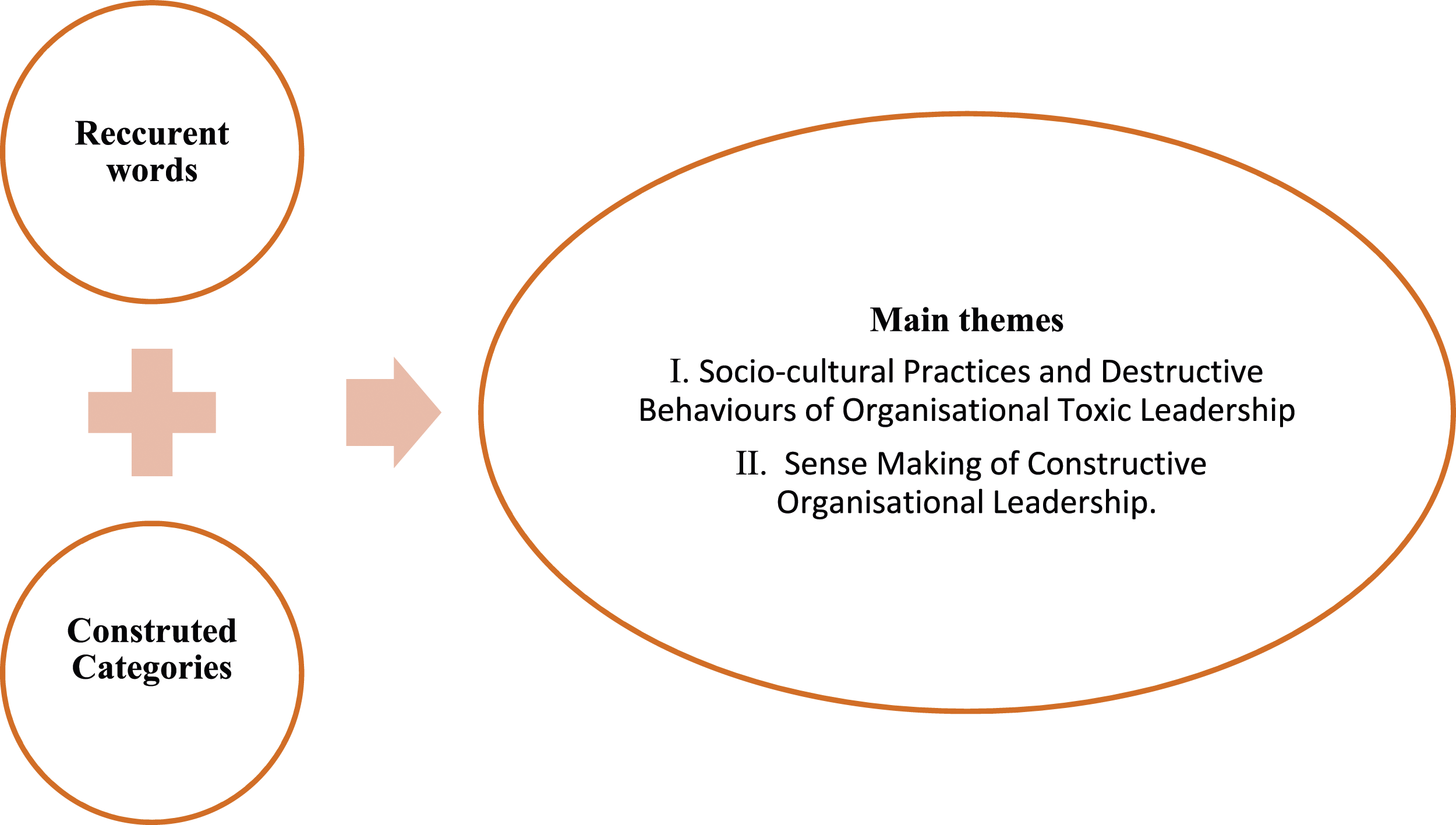
The above diagram displays how we arrived at the two main themes for the analysis. We carefully read the dataset, then added the recurrent words obtained from the Voyant tools plus the constructed categories we manually generated to get the two main themes. It is worth noting that these two major themes are very much intertwined. For instance, socio-cultural practices can have influence on either toxic leadership construction or modelling effective and good organisational leadership.
Findings and discussion
This part of the study illustrates the findings and discussion which is characterised under two main themes: sociocultural practices and destructive behaviours of organisational toxic leadership and sense making of constructive organisational leadership.
Sociocultural practices and destructive behaviours of organisational toxic leadership
Overwhelmingly, the data presents a portrayal of some toxic leadership prevailing in the organisational landscape in the context under study. This is how it is simply and explicitly articulated by one of the research participant when opinions were sought by the question “are there incidences of bad leaders in your organisations?” Yes, there are toxic leaders in Ghana. In my opinion, they abound everywhere in the country (MYM).
This laconic but lucid transcript above can be espoused to mean that there are some evidences of toxic leaders subsisting in every sphere and geography of the country. It may be least surprising because the phenomenon of toxic leadership has reached alarming proportion in many organisations globally. According to Lambert (2019), the Conference Board’s 2019 CEO Succession Report indicated that 23% of S&P 500 CEOs were relieved of their positions due to poor performance within 2009 to 2018 period. Naturally, how toxic leadership is conceptualised within this sociocultural context may differ but will be vital as a necessary underpinning to this study. In this regard, the recurring notion of toxic leadership in the data was one where leaders’ expected job outcomes were not met with. Incidences of beyond-the-reach and bossy predisposition, inattentive demeanours and hoarding of vital information were predominating. Below is a direct transcript elucidating that viewpoint: Bad leaders are those who do not deliver on their jobs, who are not approachable, they want to be worshiped, they do not listen, they are not opened, and they keep vital information to themselves. For example, there is a policy on how to spend capitation grant, but many headmasters keep to themselves and do everything on their own (SS).
The transcript above is a definitive statement emanating from the data and constituting the sociocultural notion of a toxic leader. Some of the descriptions are directly symptomatic of an autocratic leader in that autocrat’s limit inputs from the followers by solely making the decisions. Lipman-Bluman (2005) observed that toxic leaders are self-seeking in their interest with personal recognisable values, beliefs and characteristics which violate the interest of the organisation. The power to motivate and galvanise individual ingenuity directed at achieving common goals are watered down. Instead, the repugnant qualities of building empires around themselves (self-seeking leaders) where followers are kept away and their ideas not taken on board is predominating (Stogdill, 1974). With such qualities at play, the efficacy in collective goal accomplishment will dwindle significantly which sprout toxic outcomes in the organisation. The foregoing elaborative statement about toxic leadership is in consonance with what have been argued out in research. The argument emphasises on the ubiquity of leadership’s socio-psychological process of organising and directing the human social system (Kellerman, 2004). In every aspect of human endeavour, information is a necessary ingredient and input to achieving set goals and targets. Any leader who holds vital information out of the reach of the followers is suffocating them of the strategic soft infrastructure or facility to work with. Particularly, in this information era where individuals and societies depend on information for their transactions, growth and development. This puts some psychological damage to the psyche of followers and the end result is that the organisation bears the pernicious effect of the toxic leadership.
More crucially, it is sufficiently demonstrated in the data that leadership is supposed to inure to the development of the organisation. Failing to do that could be the creation of the organisation and society interplaying with the prevailing sociocultural environment as depicted in the transcript below: This leadership is supposed to benefit the people. In modern times, leadership should bring development; it is about prudent management of resources. So, when leadership brings retrogression in the abundance of resources in a country like Ghana, we can only say it is because of toxic leadership. Another reason is that leadership in every society reflects the people that are being led, so if a leader is selected and the person fails to live up to expectation, it is inherent in the people.
The deductions that can be made from the statement above is that, leadership supposedly, exist to provide benefits in the form of development through judicious utilisation of resources to achieve organisational goals. Conversely, when organisation and the larger society are experiencing retrogressions and other undesirable outcomes amid profuse resource endowment, then that can only be the architecture of toxic leadership. Since the resource may be satisfying a selfish interest of the person controlling it. It is also instructive from the statement that the type of leadership prevailing in an organisation or society is the mirror effect from the people. Thus, if selected leader is failing to deliver up to the people’s expectation that will be the people’s reflection. Suffice to say that the organisation, society and its people as social actors have co-constructed the leadership reality through processes and outcomes. In the perspective of constructivist perspective, this is in line with the reciprocity assertion that people create their own socio-cultural worlds which concurrently create the people (Fairhust and Grant, 2010). It is equally asserted that followers of toxic leaders should be treated as agents and co-creators of toxic phenomenon. Framing followers as innocent victim and bystanders is very risky for they are mirror effect of the toxic leader (Mergen and Ozbilgin, 2021).
In furtherance, the inseparability of leaders from the people as well as the interrelationships and sociocultural web of the people are serious realities. It was apparent that the organisation, society and its people sometimes connive and condone with prevailing bad leadership owing to the tide of relationships between the leaders and the followers. Consider this quote from data below: It is our attitude to due process and not exposing the rots in society because of our extended family system. Thus, the Ghanaian generally, likes shortcuts in getting things done and getting to higher heights. For example, if we know a particular organisational leader is misappropriating funds, but no one is willing to report or expose him or her because within the community, everyone is a relative of another. But we are the same people who will complain that, there is no development in the community (SS).
The submission above delineates the attitude of the people in exposing rot with a scenario. It is articulated that the bad leadership is persisting partly because the people’s attitude to due process is appalling in terms of exposing wrongdoing in the society. The lack of proclivity to expose the rot in society is traceable to the organisational relationship and extended family system where everyone is a relation to the other (web of interrelationships). Also, embedded in this bad attitude is the desire for shortcuts in their approach to issues towards reaching greater heights. However, much as they are not prone to exposing wrongdoing, but they turn to grumble and whine about under development in the organisations and communities. Goethals (2021) contends that dynamics of relationships interplaying between leaders and their followers can disable the effective resistance to bad leadership. By so doing, followers indirectly, by virtue of the dynamic interrelationships with leaders, empower such bad leaders which reinforces their corrupt leadership behaviours. It can also be deciphered that collectivist societies are marked by intense social structures and togetherness observed as in-groups as against out-groups.
Another fundamental way by which the organisation and society contribute to entrenching toxic leadership is through the underlying cultural values that pay little or no reverence to time; less value place on individual possession; and culture of silence in criticising the elderly even when they commit mistakes. First of all, we don’t respect time. Secondly, in our culture we don’t value someone else’s thing, but we learn to protect our things by protecting other people’s things. Another thing is that in the Ghanaian culture, the elderly cannot make mistake and we are not allowed to criticise a leader (MYM).
The response above tried to catalogue several values that explicate the aspects of sociocultural context providing fertile grounds for toxic leadership to flourish in organisations. It started off with laxity to time. Lax attitude to time could be explained to mean that the people do not plan their activities sequentially along timelines towards the realisation of their desired goals. In polychromic societies, time is not valued as a precious element in the production process. Alhassan et al. (2020) asserted that most of the SSA residents are socialised in a polychromic time philosophy. The implication of this on leadership is that timelines in relation to performance will be less significant and that will not be a sign of transformative leadership. A leader must be time-conscious in delivering his performance, but this context is breeding leaders and followers with lax attitudes to time. Also, the transcript expatiated on a cultural value that places less value on something belonging to another but protect someone’s belonging-selfish. Lastly, the notion of an elderly not making mistakes and critiquing a leader is something that is abhorred and not promoted in the society. It can be fathomed here that leaders are mostly the elderly in this context who have vast experience with the organisation for long. The society so much reveres the elderly in leadership positions that when they are failing to deliver the common goals in the organisation, people cannot criticise them nor proffer better alternatives. In this sense, the society have become co-conspirators to sustaining toxic leadership if the case be. These values are nourished in the sociocultural context of the people and imported to the organisational workplace to manifest.
Sense making of constructive organisational leadership
Effective and good organisational leadership is very crucial to driving organisational success under any context, but this is sometimes hard to come by in many developing countries context including Ghana. This hard-to-come-by effective leadership syndrome is leaving us to battle with the ravages of toxic leadership that is bedevilling many organisations. However, effective and constructive organisational leadership is well conceptualised within the organisational context in Ghana which is neither farfetched nor non-existing phenomenon. In this context, how a constructive leader is conceptualised in the context under study was profoundly expressed in the data as below: First, a constructive leader is a leader who delivers on his duties. He/she should be sociable, much opened, approachable, accountable, good listener and one who consults his/her followers and makes them feel that they are part of the decision making. This opens way for local participation which is good for development (SS).
From the transcript above, it is obvious that the notion of a constructive leader as conceived by participants is also embedded in the sense of efficacy in achieving collective goals. Constructive leaders are effective at realising goals that are explicit whether functional or moral along the dimensions of leadership (Wood et al., 2021). Also forming part of the conceptualisation is the elements of sociability of the leader, one who is easily accessible to the followers, one who listens, consults, and involves the followers in decision-making. Being sociable, accessible, and consultative as a leader will certainly promote good organisational culture with friendly feelings from the followers. Indirectly, it will not subject the followers to any poisonous effects and will not promote toxic feelings among followers which is symptomatic of toxic leadership (Killick, 2019). According to Ibrahim (2022), common goals are realised after leaders and the led both traverse through the decision-making process and meeting common grounds. The transcript emphasises that the result of such effective goal-achieving predisposition of the leader, good feelings and involvement of the followers will eventually promote enhanced local participation and legitimacy which is crucially positive for development. Leaders’ quality has everything to do with followers’ support and involvement in decision-making. Leaders’ real impact can be felt only when they get the support of a significant part of the committed followers (Blank, 2021). This submission resonates well with the postulation that African leadership concept is team-oriented, inclusive and participative and grounded on humanistic principles (Bolden and Kirk, 2009). Another important sense to make about the participant’s postulation is leadership values that provide a genuine sense of care for the led with awareness and commitment to ultimate accountability. This makes a leader a servant-leader. All in all, constructive leaders are goal-getters acting in the best interest of the followers and putting in the necessary support systems thereby ensuring job satisfaction (Pletzer et al., 2023).
In a similar vein, conceptualising constructive leadership in organizations in Ghana had some participants espousing knowledge of the job and flexibility in the efficient balancing of leadership styles based on circumstances as very essential among other things. These characterisations are vividly expressed below: Knowledge of the job, a manager of resources, a constructive leader should be a motivator, a good leader must be firm, thus apply the rules as they are, thus a good leader should act like the stove, it burns everyone in the same way when it is hot (FAD).
Good knowledge of the job requirement is, first and foremost, a critical key to leadership success. As observed by Afegbou and Adejuwon (2012), the problem about bad leaders is an insufficient understanding of their obligations and proper exposure to the leadership context. It is also asserted in the response that a good leader manages resources. Resource comes in different forms such as human, material, financial, talents to mention but some. All these forms of resources are under the control of the leader who is expected to mobilise and deploy them efficiently towards the realisation of organisational goals. Executing that role well where the common goals are achieved will make one a constructive leader. In the performance of his/her duties, the leader is expected to be fair in his dealings with the followers, all things being equal. A close link with this assertion is safeguarding the welfare and interest of the followers as expatiated below: A constructive leader blends leadership styles in his administration, he caters for the welfare of his workers, and he must not be nepotistic. Thus, what is good for senior staff must be good for junior staff, what is good for males must be good for females. When this is ensured, there will be peace and harmony in the working place (MYM).
The evidence from this transcript is pointing to the fact that a constructive leader does not stick to one leadership style. He/she must be one who motivates the led by sustaining and driving the motives of the followers aimed at realising the set goals of the organisation. In doing this, the good leader must stay firm on fairness in how he/she applies the rules without any fear or favour. This is where the issue of nepotism is expressed as an undesirable element in the demonstrable characteristics of a constructive leader. And for a leader to be able to motivate the led and treat all fairly, the leader must ensure that he/she adequately takes the welfare of the followers very high. It is also discernable in the articulation of the transcript that a constructive leader strategically applies different leadership styles to meet with the peculiar needs of different circumstances. This viewpoint found resonance in the contingency theory of leadership which posits that leadership should adapt a particular style and demeanour to suit the prevailing situation. The emphasis is on the consideration of the situational aspect that cast influence on leadership and cooperation (Heinz et al., 2006). A leader with such a predisposition will succeed in creating a peaceful and harmonious working environment with innovative and creative ways of solving complex problems. This centrally is about leadership creating an organisational culture where followers are influenced to be co-creators of the positive norms, and innovative ways of performing duties to achieve expected outcomes.
In responding to a question on why some leaders exhibit constructive leadership traits and others exhibit toxic leadership traits, a respondent posited that the context/environment of the organisation has a role to play. This is how the idea found expression in the data: Some leaders are constructive because of the environment/institution in which they find themselves. Some institutions have proper checks and balances and all that is needed is to do the work. Others are so porous that for example in the institutions, you cannot do without bribe. So much so that, even if you do not take it, others will take it and bring it to you (SS).
The above transcript can be interpreted to mean that context plays a very important role in making a constructive or toxic leader. Context, indeed, matters as Schmidt (2014) illuminates that context can influence “who is seen as a leader, how effective a leader is perceived to be, and how effective a leader actually is” (p. 183). Therefore, an organization that has well-established structures to define and guide what should be done and how it should be done will produce good leaders. Conversely, organisations with loose structures where what is to be done and how it should be done are not outlined but left to the discretion of the leader may turn out to be harbingers for toxic leadership construction. This is because such established structures support the efforts of the leader and offer him/her the blueprint to be implemented. According to Agbim (2013), an organisation’s structure is a framework consisting of roles, responsibilities, authority, and interactional relationships that is consciously designed to execute the tasks of the organisation and achieve the objectives. It is also considered as a means of leveraging knowledge to facilitate organisational knowledge diffusion (Gold et al., 2001). Additionally, it serves as a form of organisational control with the aim of guiding and encouraging members of organisations to exhibit a certain behavioural pattern towards achieving organisational goals (Cardinal, 2001). It must also be established that, despite the fact that well established structure can help prevent toxicity in leadership, leaders with destructive traits can still find a way of abusing the processes and laid down structures.
Aside the structural context, socio-cultural backgrounds also matters in making a leader either a constructive or toxic one. The study probes further to ascertain how the socio-cultural context influences a leader to be constructive. The respondents expressed the view that some societies have cultural practices, values, norms, beliefs etc. that is peculiar to it. It will most certainly imbibe into its members such essential values that will enable them to emerge as constructive leaders. This is how this point of view is articulated: Some of the socio-cultural practices and norms help to train people to be good leaders. For example, as a chief myself, I am trained to be humble, respectful, obedient and above all to listen more to people than I talk. Automatically, as a leader in the organization, these same qualities will be put into practices in dealing with teachers and my subordinates and so doing that makes you a good leader (AWI).
From the transcript above, it can be fathomed that the society that an individual comes from may prepare him/her towards constructive leadership roles by its values systems. The respondent is a royal which presupposes that he must be imbued with values that will make him/her emerge ultimately as constructive leader performing royal responsibilities. Some of the socio-cultural values of his orientation include a sense of humility, reverence, compliance and, more importantly, being a good listener and a constructive speaker. It is instructive to note that values impact on attitudes which in turn inform behaviours and mostly values are context-driven. Socio-cultural elements are fundamental in orienting the construction of organisational and leadership practices by way of how leaders make decisions and how they act and interact (Vilas-Boas et al., 2018). With such inbuilt values, the respondent as a leader in an organisation is bringing such values to bear. Personal values are noted to be impacting leaders by acting as perceptual filters in shaping leaders’ decisions or strategic choices as well as the behaviours of leaders. Ultimately, it leads to enhanced organisational performance (Lichtensein, 2012). This is in consonance with Vilas-Boas et al. (2018) view of leadership as a cultural practice which elucidates actions and interactions to be rebuilding the symbolic structures of knowledge. It will then allow leaders and the led to form interpretations of the world based on certain forms and exhibit behaviours based on active culture.
Furthermore, the study also delved into finding out strategically, what can be adopted to promote the spirit of good leadership calibrations in organisations in Ghana. In professing strategies to breed constructive leadership in the context under study, the more cross-cutting view is manifested below: Yes, we can promote good leadership practice in Ghana by restructuring the mode of appointment of leaders to make sure the right and qualified people are appointed for positions. We should consciously start training good leadership culture at home and in schools. Leaders should also consciously demonstrate good behaviour at work by delegating, doing what we mean and meaning what we do. By this, those understudying you will learn from you. Again, to promote good leadership practice in Ghana, remunerations and promotions to leadership should commensurate with their output and meeting of set targets. (MYM).
From the text, we can logically gather that the modus operandi of recruiting people into leadership positions is crucially the starting point of establishing constructive leadership in organisations in Ghana. The appointment process should be restructured to ensure that meritocracy is practiced where the right and most qualified candidates are offered the positions of leadership. The study also discovered that consciously commencing trainings on good leadership culture in organisations, home and in schools will enhance good leadership manifestations. No doubt, the exigency for effective leadership is high in Ghana and Africa but talented leaders are bereft of the necessary support systems including capacity development to reach their full potentials (Eckert and Rweyongoza, 2015). In the light of this, knowledge acquisition involving equipping leaders and would-be-leaders with the skills, values, and arts of leading at home and in formal training institutions is necessary and unavoidable. When leadership skills are strengthened, leaders will be able to exceed their present level of effectiveness, develop their capacities and unlock the untapped and hidden potentials embedded in them. Exemplary leadership and delegation of leadership roles to followers premeditatedly is also thought of as practices that can promote good leadership as it will afford followers the opportunity to develop their leadership skills. Leaders through delegation can train and coach the led so that organisations will sustain constructive leadership. This also empowers the followers by offering them some level of autonomy, thereby engendering improved organisational performance and efficiency. Another advocated strategy is rewarding and promoting leadership based on output in terms of organisations meeting their targets. It is very well grounded in behavioural research that organisations witness high level of performance when remunerations are contingent on efficiency, performance and achievements. Its far-reaching consequences include satisfaction for individual leaders, creativity, harmony and organisational effectiveness (Kahai et al., 2003). However, if it is not well implemented, it can derail as evidence demonstrates incidences of falsified outcomes in order to earn high rewards.
Summary, conclusion and limitation
In summary, the study discusses society and organisational leadership by investigating the sociocultural construction of toxic and conceptualisation of constructive leadership. The study points to some incidences of bad leadership, which the society and its underlying sociocultural values have been part and parcel of in co-constructing. This is done through conniving and condoning wrongdoing, failing to respect time as well as non-criticisms of the elderly in their shortcomings and committal of mistakes. Furthermore, the study sees a constructive leader as one who galvanises the people towards achieving collective goals using requisite knowledge of the job and flexibility in balancing different leadership styles. Therefore, it can be concluded that the sociocultural context has an inalienable role in making a leader either toxic or constructive. It retains its unique way of conceptualising toxic and constructive leadership and the predisposition to co-create, co-construct and sustain the kind of leadership architecture it most probably would have modelled out. The sociocultural construction of toxic leadership happens through the compounded interplay of socialisation from the culture of orientation, organisational culture, influence of diversity, the dynamics of power interplay between the leaders and followers. A proper conceptualisation of these dynamics can assist organisations in modelling healthy and constructive leadership and avoid acts that can breed toxicity in leadership in organisations. The focus of the study is narrow and limited in scope to only the northern part of Ghana. The study can undoubtedly provide valuable insights, but it should not be unduly generalised to the entirety of SSA. Future studies could vary and expand the context for the broader picture of SSA to be realised.
Footnotes
Declaration of conflicting interests
The author(s) declared no potential conflicts of interest with respect to the research, authorship, and/or publication of this article.
Funding
The author(s) received no financial support for the research, authorship, and/or publication of this article.
Ethics statement

Data availability statement
Transcribed data is available but the authors have no consent to release it to any third party.