



Abstract
Recent studies have shown that the validated dimensions in the best-known models of national culture converge into a two-dimensional default model, yielding a cultural map of the world reminiscent of the geographic one. The revised Minkov-Hofstede model is very similar to that default, whereas Inglehart-Welzel’s model is a rotated and flipped variant of it. However, another popular model - Schwartz’s - differs from the default: it does not have a dimension capturing the cultural contrast between East Asia and Latin America plus Africa. Consequently, it cannot explain national differences in educational achievement and a number of other important national indicators, relevant in international business. This omission in Schwartz’s model is puzzling as its author claims to have analyzed all values with invariant meanings across the world. On the other hand, Schwartz’s model has an idiosyncratic “mastery-harmony” dimension that is not consistent with any geo-economic pattern and has poor predictive properties, constituting another weakness. We show that these idiosyncrasies of Schwartz’s model stem from Schwartz’s controversial decision to ipsatize his items and use multidimensional scaling: a method which, even without ipsatization, can create spatial opposites of items that are not negatively correlated. A principal component analysis of raw (non-ipsatized) Schwartz value domains does yield a variant of the default model of culture. We argue that although ipsatizing Schwartz value measures is not wrong in an absolute sense, it yields an impoverished and somewhat puzzling image of cultural differences across the globe, whereas raw measures reproduce the Minkov-Hofstede variant of the default model relatively well, although a different selection of values might perform even better.
Keywords
Introduction
Recent studies have shown close similarities between major models of national culture, obscured by the fact that they are essentially rotated and flipped variants of each other (Fog, 2021; Kaasa and Minkov, 2022). After an analysis of all major models of national culture, Fog (2021) showed that their best-validated dimensions converge into a single two-dimensional model that can be considered an abstract universal default, 1 and is essentially a close variant of Minkov’s (2018) model obtained through his revision of Hofstede’s classic model, now called the “Minkov-Hofstede model” (Minkov and Kaasa, 2022). Using nationally representative studies, Minkov and Kaasa (2022) provided scores on the two Minkov-Hofstede dimensions for 102 countries and found that they are highly correlated with a vast array of national socioeconomic indicators relevant in international business and management, and perform better as predictors of them than dimensions from alternative models. The Minkov-Hofstede variant is also closely aligned with the Earth’s geographic axes, and associated with traditional types of agriculture in East Asia, North Europe, the tropics, North Africa and the Middle East, and other parts of the world. Thus, the Minkov-Hofstede model is not only very close to the abstract universal default, but is also underpinned by real geo-socioeconomic patterns. Also, a similar model was reported for the 50 US states, demonstrating that it can capture sub-national differences as well (Minkov and Kaasa, 2022).
This does not mean that any deviation from the abstract default is necessarily an indication that there is a problem with a particular model: for instance that some of its dimensions are somehow improperly measured or superfluous. A two-dimensional default cannot capture all the cultural diversity across the world, and in some cases alternative dimensions may provide better explanations. Yet, in addition to its superior predictive properties in a general sense, the default model has other strengths. First, compared to models with more dimensions, it provides a more parsimonious way to think of global cultural differences: a simple introduction for beginners, for instance international managers and business consultants, who can later enrich their knowledge of cross-cultural diversity if they so wish. Second, if several models converge into a common default despite the very different research programs from which they have emerged, that gives credibility to the abstract default and to whatever real model is close to it.
Fog’s (2021) study suggests that the closest real manifestation of the abstract default is the revised Minkov-Hofstede model (Minkov and Kaasa, 2021, 2022). Another variant is Inglehart-Welzel’s model, known from their popular two-dimensional map of the world on the World Values Survey website, and from the classic article by Inglehart and Baker (2000). Minkov-Hofstede’s and Inglehart-Welzel’s two-dimensional cultural maps of the world are very similar, and each could be more or less aligned with the other if it were rotated and flipped (Fog, 2021; Kaasa and Minkov, 2022).
However, Schwartz’s (2008a) well-known model of national culture differs from the Minkov-Hofstede and Inglehart-Welzel variants of the default in one important respect. It lacks one of the two default dimensions (flexibility-monumentalism). Instead, it has another dimension (mastery vs harmony) without an analogue in the default and without any resemblance to a geo-socioeconomic pattern or any close associations with important national socioeconomic indicators. This singularity of Schwartz’s model of national culture requires an explanation. Although there may be multiple reasons behind it, in this article we focus on one of them: the way that Schwartz treated his data. We explore the hypothesis that if one does not ipsatize the Schwartz values and does not analyze them with multidimensional scaling (MDS), but subjects raw scores to a principal components (PC) analysis, a complete variant of the default model of culture, with both of its dimensions, will emerge, whereas the mastery-harmony dimension will not. This would validate Minkov and Kaasa’s (2022) claim that a model similar to Minkov-Hofstede (and hence to the default) can be extracted from any large and rich database of culture-related items, as that model is like a compass that always shows North because of the objective existence of a magnetic pole.
The default model of culture in its Minkov-Hofstede and Inglehart-Welzel manifestations
The vertical dimension in Minkov-Hofstede’s model and the corresponding cultural map (Minkov, 2018; Minkov and Kaasa, 2021, 2022) paints a clear geographic contrast between cultures at high latitudes (Northwestern Europe) and those at low latitudes (Africa, Middle East, South Asia, tropical Latin America). High latitudes have cultures known as individualist (Beugelsdijk and Welzel, 2018; Hofstede, 2001; Minkov et al., 2018b; Van de Vliert, 2019), emancipated (Christian, 2013) or autonomous (Schwartz, 2008b). This means that they focus on various individual rights and freedoms for all, including gender egalitarianism, rule of law, economic freedom, democratic government, and concern for everybody’s welfare, including strong safety measures. Cultures at low latitudes tend to be collectivist (Beugelsdijk and Welzel, 2018; Hofstede, 2001; Minkov et al., 2018b), non-emancipated (Christian, 2013), and embedded (Schwartz, 2008a), which means that they are conservative-conformist. Individual rights and freedoms may be suppressed in the interest of social cohesion and maintenance of omnipotent and exploitative leaders in power. Also, these cultures are characterized by stronger divisions between in-groups and out-groups (Minkov et al., 2017), also known as an “us-them” contrast (Van de Vliert, 2019). Safety regulations are often weak and poorly enforced, resulting in high casualties in transportation and industrial accidents. Finally, collectivist societies tend to value social ascendancy (Minkov et al., 2018b) - achievement of power, wealth, and fame - more than individualist societies.
The same geographic and cultural contrast is clear on the famous Inglehart-Welzel cultural map on the World Values Survey website, except that it is captured by one of the map’s diagonals: from Northwestern Europe in the upper right corner to Africa and the Middle East in the lower left corner. In Inglehart’s terminology, this is a contrast between secularism plus self-expression versus traditional plus self-survival values. Christian (2013) devoted a whole book to the merger of these two dimensions, speaking of “emancipative values”, best of all characterizing the individualist Northwestern European societies. On Schwartz’s (2008a) cultural map, the corresponding individualism-collectivism axis is the horizontal one, from Western Europe to Africa and the Middle East. This is a contrast between egalitarianism plus autonomy versus embeddedness plus hierarchy. Thus, these three major models of culture are remarkably similar in terms of the individualism-collectivism dimension of culture, although they use different terms for it. The dimension is clearly visible in all three (Minkov et al., 2017) and although the three theories behind the three models might be somewhat different, they complement each other without major discrepancies.
The horizontal dimension in the Minkov-Hofstede model and the respective cultural map is aligned with the Northeast versus Southwest axis on the world’s geographic map. It runs from East Asia at one extreme to Latin America plus Africa at the other (Minkov, 2018; Minkov and Kaasa, 2021, 2022). This dimension was called “long-term orientation” by Hofstede, 2001, and was renamed “flexibility-monumentalism” (Minkov et al., 2018a). It is a multifaceted dimension, yet one of its key components captures a cultural focus on a flexible and calculative self, capable of duality, adaptability to shifting circumstances, and acceptance of change (East Asia), versus an emphasis on an immutable and admirable self (being always the same generous and helpful person), genuineness, and consistency with one’s true nature (Latin America, Africa, Middle East). One of the societal outcomes of these differences is that the flexibility pole is associated with strong educational achievement plus a desire for improvement and embracement of technological and social innovation (Minkov and Kaasa, 2022), whereas monumentalism stands for poor educational achievement plus a passive attitude toward the modern world and, in some cases, even some negative reactionism.
The East Asia versus Latin America plus Africa contrast is clearly visible also on the Inglehart-Welzel map. It is captured approximately by the top-to-bottom axis, corresponding to the secular-traditional dimension of culture. Although, at first glance, the theory behind the Inglehart-Welzel map is quite different from flexibility-monumentalism theory, a more profound conceptual analysis will reveal some similarities. The secular pole is about striving for modernity: an effort to change the world so as to make it a better place to live and adapt to that change. The traditional pole is about a focus on religiousness, which typically incorporates immutable values and beliefs, and encourages consistency between values and behaviors, as well as preservation of traditional societal norms rather than innovation and social change. Thus, the overarching theme that unites flexibility-monumentalism and secular-traditional is cultural plasticity versus rigidity.
Minkov and Kaasa (2021, 2022) showed that the Minkov-Hofstede model and a corresponding world cultural map emerge also from analyses of up to 20 national socioeconomic indicators, such as measures of rule of law, democracy, and political freedom, road death tolls and other measures of accident proneness, gender and other social equality, educational achievement, violent crime, family patterns, as well as diverse business and management indicators, including innovation rates, information technology adoption, savings rates, and some employment patterns. Even some semi-biological indicators, such as myopia rates (indicative of reading effort) and frequency of left-handedness (indicative of individual freedom) are strongly correlated with either of the two dimensions in the Minkov-Hofstede model, both across the world’s countries and across the 50 US states. This double concordance between the structures of subjective culture (respondents’ aggregate self-descriptions) and objective culture (aggregate measures of behaviors and achievement) demonstrates the validity of the Minkov-Hofstede model. As the Inglehart-Welzel model can be aligned with it by means of rotation (Kaasa and Minkov, 2022), it can also be validated in the same way.
Schwartz’s model of culture
Schwartz’s (2008a) model of national culture is a product of an MDS variant. MDS is a data reduction technique resembling PC analysis without rotation. One notable difference is that when one uses raw data, the MDS plot may be radically different from a PC plot. In MDS, items that are at opposite ends of a plot may not actually be strongly and negatively correlated. Therefore, an MDS plot of non-ipsatized items may be quite misleading with respect to the relationships between the items.
Schwartz ipsatized his items, which more or less guaranteed negative correlations between opposites in an MDS plot. The plot resembles a disc, sometimes called a circumplex, partitioned into seven domains, reminiscent of a pizza sliced into seven parts. The slicing is somewhat arbitrary (Schwartz, 2011), and is more concerned with theory than empirical reality, although it is not completely detached from the latter. Adjacent domains are statistically and conceptually associated, whereas opposites are correlated negatively and represent poles of a single dimension of culture. Below is a list of the seven domains, with brief descriptions, based on Schwartz (2008a): 1. Intellectual autonomy: Encouragement of pursuit of one’s own ideas and intellectual directions independently 2. Affective autonomy: Encouragement of pursuit of pleasure and excitement 3. Embeddedness: Firm attachment to one’s collectivity and maintenance of traditional order 4. Egalitarianism: Recognizing people as moral equals and a focus on everyone’s welfare 5. Hierarchy: Reliance on a system of ascribed roles 6. Harmony: Fitting into the social and natural world without trying to change it or exploit it 7. Mastery: Self-assertion in order to master the environment and achieve group or personal goals
Figure 1 is an MDS plot (Euclidian distances) of the seven value domains, based on data from Schwartz (2008b). An Alscal multidemensional plot of Schwartz’s (2008b) seven value domains at the national level. Note: INTAUTONOMY = intellectual autonomy, AFFAUTONOMY = affective autonomy.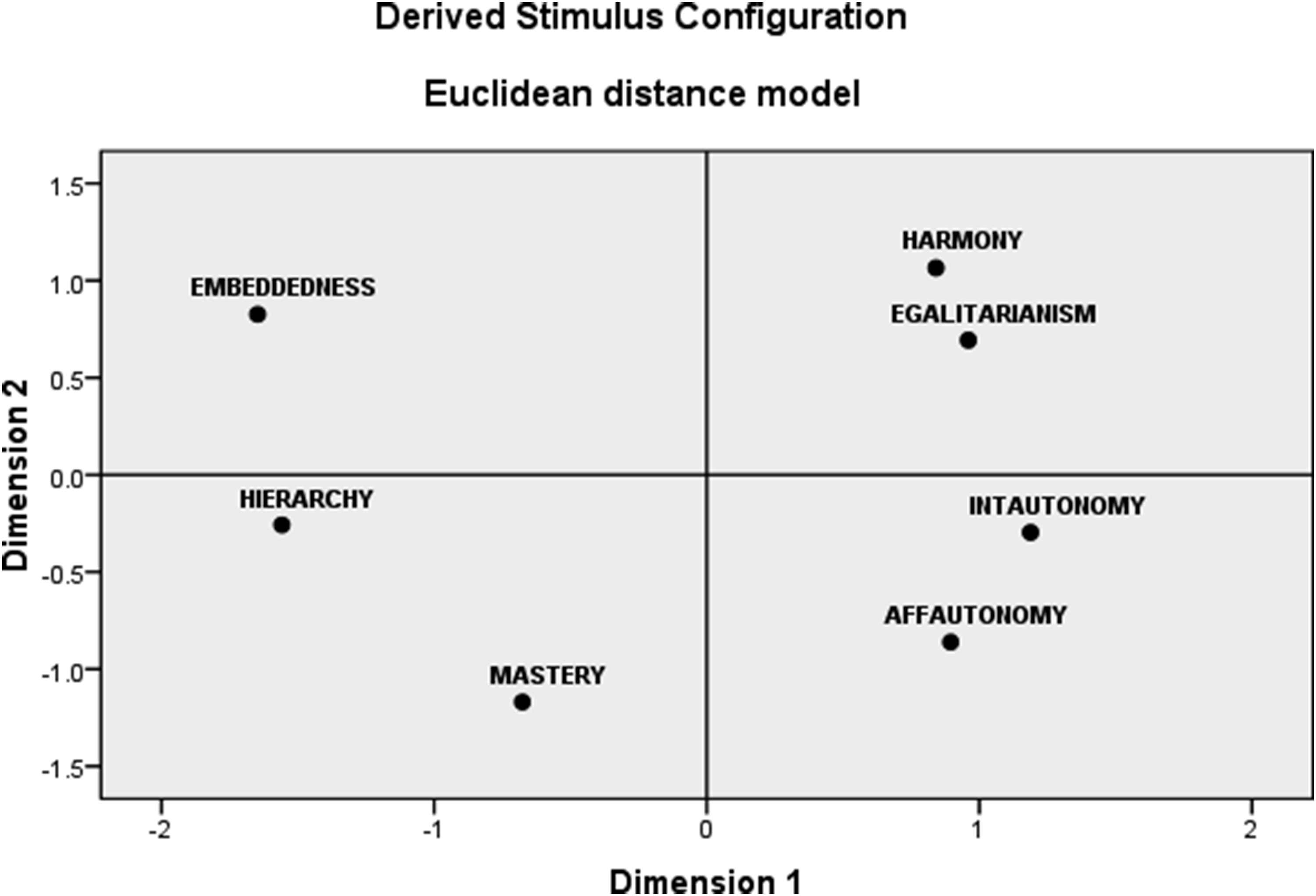
As MDS is hardly ever used in the cross-cultural domain outside studies devoted to Schwartz’s model, and many readers may not be familiar with it, we also present an unrotated PC plot in Figure 2. An unrotated principal component plot of Schwartz’s (2008b) seven value domains (ipsatized scores) at the national level. Note: INTAUTONOMY = intellectual autonomy, AFFAUTONOMY = affective autonomy.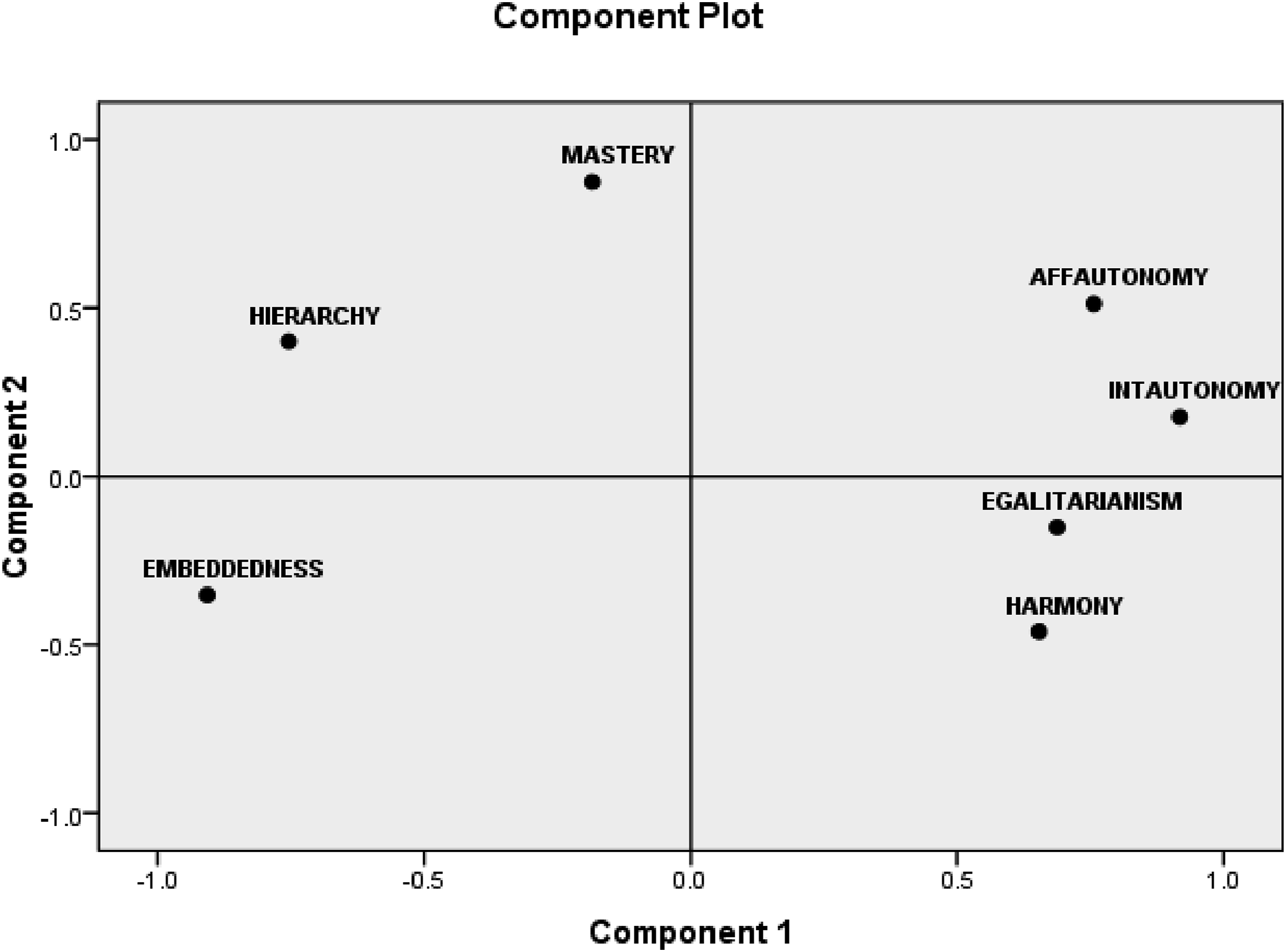
Figures 1 and 2 are remarkably similar, except that one is practically the other one turned upside down. However, we will later return to the point that MDS and PC do not always generate similar solutions, since this is a relevant issue in a discussion of Schwartz’s model.
Schwartz (2008a) advocates the identification of three bipolar dimensions of culture from his value plot: intellectual and affective autonomy versus embeddedness, egalitarianism versus hierarchy, and harmony versus mastery. Just like the slicing of the disc, this pairing up of domains is also partly arbitrary, and based primarily on theoretical considerations. Schwartz’s (2008b) measures of his seven domains, and the alternative measures by Ralston et al.’s (2011) yield just two principal components. 2
The three dimensions proposed by Schwartz do not seem to have been born equal. First, the mastery-harmony contrast is unusually weak. While embeddedness and intellectual autonomy (Schwartz, 2008b) are correlated at −.90 across 76 countries, mastery and harmony correlate at just −0.40. Second, the cultural contrast highlighted by mastery-harmony is between some East Asian countries (South Korea, Hong Kong), plus some African countries (Ghana, Zimbabwe), plus some Middle Eastern countries (Israel, Palestine), plus the US, at the high-mastery and low-harmony pole, versus diverse European countries at the low-mastery and high harmony pole. Figure 3 shows that a mastery-harmony plot of countries does not bear any resemblance to any geo-socioeconomic pattern. A mastery-harmony country plot based on ipsatized scores by Schwartz (2008b).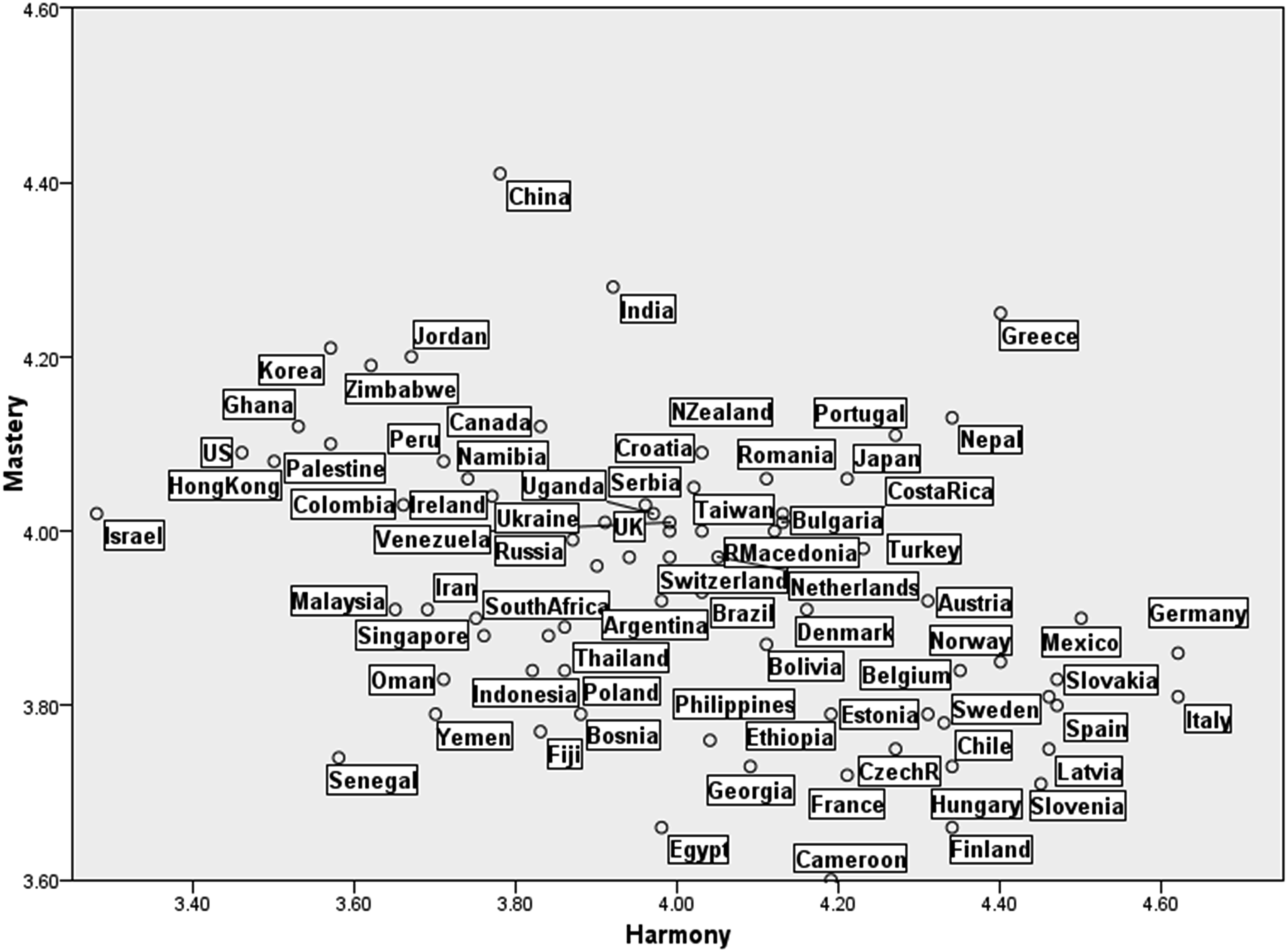
Switzerland is right next to Brazil, Ireland is next to Namibia, Bosnia is next to Fiji, and South Korea is next to Zimbabwe. France is much closer to Cameroon than to Italy, and Denmark is much closer to Bolivia than to Sweden, whereas Canada is much closer to Peru and Namibia than to the US. This is surprising because, with the exception of the English-speaking nations, geographic distance is normally strongly associated with cultural distance. This rule is valid for nations (Minkov, 2018; Ronen and Shenkar, 2013) as well as US states (Minkov and Kaasa, 2021). Even orangutan cultures exhibit that characteristic (Van Schaik et al., 2003): those that are geographically closer are more similar. Anomalies can be occasionally observed on the Minkov-Hofstede and Inglehart-Welzel maps, yet they are exceptions, whereas on Schwartz’s mastery-harmony plot, they are almost the rule. As nearly all important national socioeconomic indicators are related to geography or economic development (which is also related to geography) or both, it is only natural that a dimension such as mastery-harmony, which is far from this kind of alignment, cannot have broad and strong predictive properties across a large number of countries from all continents. 3
It is also surprising that a dimension that reflects the cultural contrasts between East Asia and Latin America plus Africa has not emerged from Schwartz’s database and that, instead, Schwartz’s model contains the mastery-harmony dimension. The surprise comes from Schwartz’s (2006a) view that values are the most central feature of culture (p. 139) and that his collection of values contains “all” the motivationally distinct values recognized across cultures (p. 144). Both of these claims may be challenged on various grounds, yet this issue is not central to the current article. There is no doubt that values are a very important element of culture and that Schwartz’s values collection is impressive. Why then does it not yield a dimension closely resembling flexibility-monumentalism in the Minkov-Hofstede model and secular-traditional in Inglehart-Welzel? Those two mutually supportive models were extracted from separate analyses of a huge variety of items and impressive databases of nationally representative responses. Minkov and Kaasa (2020, 2022) also showed that the Minkov-Hofstede model has a close analogue in a two-dimensional model from a wide range of important national socioeconomic indicators, and that the same model is recoverable across the 50 US states. Therefore, there can be no doubt either about the validity or the usefulness of the flexibility-monumentalism dimension. A variant of that dimension, called Confucian work dynamism, was obtained from an analysis of Chinese values (Chinese Culture Connection, 1987). Another variant, called consistency-variability, emerged from analyses of self-construals across numerous countries (Vignoles et al., 2016). Why is it then completely missing from the supposedly all-encompassing Schwartz model?
Hypotheses about the idiosyncrasy of Schwartz’s model of culture
A number of competing hypotheses come to mind concerning the discrepancy between Schwartz and Minkov-Hofstede plus Inglehart-Welzel. First, the discrepancy may be due to the nature of what was studied. Schwartz focused on values, operationalized as statements about what is important to the respondents in their own lives, whereas the Minkov-Hofstede and Inglehart-Welzel models are based on other constructs: self-construals, socialization goals for children, ideologies, and more. However, the prototype of the flexibility-monumentalism dimension was found in a study of values, operationalized like Schwartz’s, yet suggested by Chinese scholars (Chinese Culture Connection, 1987). Therefore the hypothesis that personal values cannot yield a flexibility-monumentalism dimension is not supported.
An alternative hypothesis is that, despite its large coverage, Schwartz’s value database lacks values from which flexibility-monumentalism can be extracted. Indeed, one of the main facets of that dimension - personal stability or consistency - does not seem to be addressed by any of Schwartz’s (2008a) items. None of them asks the respondents if it is important to them to have strong values that always guide their behavior, or if it is important always to be the same person in all situations, or if it is important to be genuine and avoid pretense (see Minkov et al., 2018a, for a complete list of flexibility-monumentalism items). Nevertheless, Schwartz’s “honest” item is reminiscent of the consistency facet.
The second main facet of flexibility-monumentalism - self-esteem plus self-confidence - may be even less well represented in Schwartz’s value collection. This facet is a personality domain that may not have a good equivalent in values. Having high self-esteem and considering it important to have high self-esteem may not be quite the same, especially at the cultural level. One can easily imagine a culture that does not promote current self-esteem but does encourage its members to value its pursuit through self-improvement, resulting in a never-ending quest. However, the third facet of flexibility-monumentalism, helpfulness (or generosity), is clearly represented in Schwartz’s instrument. “Forgiving” is another Schwartz item that may be associated with flexibility (Minkov et al., 2018b). Therefore, although Schwartz’s values collection is not a very appropriate tool for the extraction of a flexibility-monumentalism dimension, it is not completely inadequate for that purpose.
A third hypothesis emerges from the difference between Schwartz’s handling of his data and the approaches by Minkov and associates, as well as those by Inglehart and Welzel. Schwartz is the only one to have used ipsatized data. That may explain why his results are different. This is precisely our main hypothesis and we will subject it to a test. Before that, we have to explain ipsatization and its purpose.
Ipsatization as an instrument that reveals priorities
Schwartz (2006b) stated that the value scale should measure people’s “value priorities, the relative importance of the different values”, because it is the trade-off among relevant values, not the absolute importance of any one value, that influences behavior and attitudes (p. 171). This is precisely how he justifies ipsatization. That mathematical operation consists of two steps. First, one adds up all of a subject’s (be it a person or a country) scores on all items (provided that they are scored on the same scale) and divides them by the number of items. This operation provides each subject’s mean score across all items. In the second step, that all-item mean is subtracted from each of the subject’s scores on each item.
As a result, ipsatization places all values of a particular subject above and below 0, and reveals which values are more important to that subject (those above 0) and which are less so (those below 0). Also, ipsatization artificially creates negative correlations between values that are not negatively correlated in their raw form, as provided by the respondents. This result of the ipsatization process allows Schwartz (2006b) to claim that “actions in pursuit of any value have consequences that conflict with some values” (p. 166). In other words, different values may drive people in opposite behavioral directions, implying that these values are also opposite, even “antagonistic” (p. 167). Therefore, ipsatization reveals not only which values are more or less important to an individual or a society, but may also indicate the existence of conflicting values, at least from Schwartz’s perspective. It is important to note that without ipsatization there is no evidence of conflicting values as they are all positively correlated. Thus, an alternative view to Schwartz’s is that ipsatization does not reveal conflicting values but creates them artificially.
As an example of conflicting values, Schwartz and Bardi (2001) discuss achievement and benevolence, since “seeking personal success for oneself is likely to obstruct actions aimed at enhancing the welfare of others who need one’s help” (p. 94). Schwartz seems to be especially fond of this example as it recurs in practically the same wording in several of his publications (for instance Schwartz, 2006a, 2006b, etc.). From this perspective, one cannot seek to discover a new drug that saves lives and at the same time hope to be personally successful in this endeavor, as the two goals cannot be reconciled? Likewise, Schwartz’s views of values as being in conflict suggests that a political activist who is struggling to topple an oppressive regime is not pursuing personal success and the welfare of others at the same time. Many other values may seem opposites, yet people easily reconcile them. Football players obviously value competition and cooperation at the same time and strive to achieve both. If either of the two were missing, a football team would have no chance of winning.
Of course, one can think of counterexamples. We do not claim that values can never clash, resulting in a morally difficult choice. We just warn against sweeping generalizations concerning the nature of values, one of which is the view that values that Schwartz defines as opposites are always, or at least in principle, in conflict.
From a broader perspective, not necessarily limited to values research, Fischer (2004) discusses diverging opinions about the justifiability of ipsatization (also known as “standardization by subject” or “standardization within subject” in the methodology literature). According to some authorities, that procedure removes a method factor created by uniform responding to diverse questions, a topic that will be addressed in the next section. Yet others have demonstrated that ipsatization also filters out substantial and relevant cultural information. It is important to note that ipsatization is not used in personality psychology. Ipsatized scores have been criticized (Ten Berghe, 1999), one of the reasons for which is their unreliability (Bartram, 1996). Some authorities (Cheung, 2006; Hanges, 2004; Venaik et al., 2021) even state that ipsatized scores are uninterpretable or incomparable between individuals. This is so because those scores indicate only how individuals, or societies, prioritize items. Comparing subjects on ipsatized scores is somewhat like attempting to figure out how much alcohol subjects X, Y, and Z drink by knowing only that Y drinks 1.5 times more than X, whereas Z drinks 2.0 times more than Y. This is enough to rank X, Y, and Z, but is not sufficient to draw any conclusions about their disease risk. If X drinks 1 mg of alcohol a month, there is clearly no risk for any of the three individuals. Yet ipsatization conceals any absolute measures and makes it impossible to draw any inferences about the subjects without additional information about them.
Ipsatization as treatment of response style
There is a rich cross-cultural literature on response style (Fischer, 2004; Harzing, 2006; Hui & Triandis, 1989; Smith, 2011, etc.): the tendency of some subjects, or whole populations, to choose a particular position on a Likert scale, even if the items are seemingly diverse in content. Fischer (2004) stated that there is no consensus on how to treat response style. Some methodologists view it as noise that should be partialed out, for instance by ipsatization. Suppose that respondent A provides the following raw scores on a 10-point Likert scale: 8, 10, 8, 10, 8, 10. As all scores are close to the upper extreme of the scale, one might suspect that they are all inflated and do not reveal what psychologists call “true scores”. Therefore, the inflation factor needs to be removed. One can assume that it is equal to the respondent’s all item mean (9). After subtracting that mean from all scores, respondent A’s scores become −1, 1, −1, 1, −1, 1. The same would happen to the raw scores of respondent B if they were 1, 2, 1, 2, 1, 2. Thus, after ipsatization, the differences between the scores of A and B would disappear.
There are several problems with this approach. First, the assumption that all of a respondent’s scores are affected by response style, and consequently inflated or deflated to exactly the same extent, is impossible to prove. Second, the assumption that if a person has high or low scores on most values that means that the scores are not “true” is not always plausible. Buss (2008) found that, when assessing the eligibility of a potential attractive partner, more attractive women are more likely than less attractive ones to “want it all”: good genes (expressed as good looks), economic investment (high socioeconomic status), parenting proclivities, and emotional commitment. There is nothing unnatural for a woman who can afford to pick and choose men to value and expect high scores on all of these characteristics to a greater extent than a woman who is less fortunate in terms of physical appearance. Likewise, it is quite possible for highly qualified young individuals to have higher expectations concerning most job characteristics, such as salary, work climate, opportunity for advancement, work-life balance, etc., than less competitive individuals who cannot afford to attach equally high importance to all of these characteristics. In summary, it is hardly logical to assume that all individuals have more or less the same sum total of what they expect from their partners, jobs, or lives in general. Some may want a lot of everything, whereas others may be content with a little of everything or of a few things. This rule may apply to whole cultures, as well. Minkov et al. (2018b) report cultural differences in the degree to which parents socialize children to suppress their desires (in a general sense) or to try to satisfy them.
Treating the high raw scores of Latin Americans and Africans on most values as inflation of their true scores, and the low scores of East Asians on most values as deflation of their true scores, ignores the cultural differences between those two parts of the world. East Asia has the largest percentages of any population who state categorically (without a Likert scale) that their behavior is rarely guided by strong values. Instead, it depends on the situation (Minkov et al., 2018a). Latin Americans and Africans profess strong values in general, also in categorical responses without a Likert scale. Minkov et al. (2018b) find a similar parallel in a study of socialization goals: East Asians are less likely than Latin Americans to teach their children to satisfy all their desires. Instead, they are more likely to advise suppression of desire. If East Asians have relatively weak values in general, and weak desires, it is only logical that they will avoid the positive extreme on a Likert scale, whereas Latin Americans and Africans will gravitate toward the positive extreme. Artificially forcing the responses of such dissimilar cultures into the same mold through ipsatization could result in distortion of reality rather than revelation of truth. This is consistent with the findings of Venaik et al. (2021) who analyzed Gelfand’s tightness looseness dimension and showed that “besides distorting the descriptive reality of national Tightness culture around the world, within-subject standardization potentially amplifies the relationships with other national-level variables, resulting in spurious theories of culture and its consequences” (p. 7).
Smith (2011) views response style as integral part of culture. From this perspective, attempting to remove response style through ipsatization can cripple a particular culture-related database as it could remove culturally-relevant information. Fischer (2004) cites other methodologist who accept this view.
Hofstede (2001) ipsatized the work-goals from which he extracted his individualism-collectivism and masculinity-femininity dimensions. That proved to be an unfortunate decision as the second of these dimensions is obviously an artifact that could never be replicated and is not related to any external variables (Minkov, 2018a). Although Schwartz’s mastery-harmony replicates better than masculinity-femininity, its other shortcomings may be due to the fact that it is a product of ipsatization. Summarizing their analysis of ipsatized versus non-ipsatized tightness-looseness scores, Venaik et al. (2021) state the following concerning ipsatization as a method to correct response bias: “Such ‘corrections’ could inadvertently add ‘researcher’s bias’ into the analysis, misrepresent the true position of individuals and nations on a given characteristic, and potentially distort the reality and relationships captured in the original data” (p. 9).
A Schwartz model without ipsatization?
Minkov et al. (2017) provided a revised version of Hofstede’s individualism-collectivism dimension from self-construals. Rather than choosing positions on a Likert scale, the respondents provided categorical answers, selecting from two opposites, such as “bold” or “shy”. The revised individualism-collectivism measure, free of extreme responding and acquiescence, needed no ipsatization. It resulted in a measure consisting of two main components: conformism and social ascendancy. The first was somewhat similar to Schwartz’s embeddedness as it consisted of items measuring adherence to religious rules, a desire to curb other people’s freedom, and conflict avoidance. The second facet was similar to Schwartz’s hierarchy plus mastery: a desire to achieve social success through acquisition of power and fame. Therefore, we hypothesize that raw (non-ipsatized) versions of Schwartz’s embeddedness, hierarchy, and mastery will converge into a measure that is conceptually and statistically similar to Minkov et al (2017) individualism-collectivism.
Some of the remaining domains on Schwartz’s circumplex are reminiscent of monumentalism (Minkov et al., 2018a). The central one is egalitarianism, which is essentially about maintenance of a noble social image: honest, helpful, responsible, dependable, reliable, and just (Tables 1 and 9 in Ralston et al., 2011), conforming to the monumentalist ideal of always being the same admirable, helpful and reliable person with a strong moral anchor. Although these values cannot be unimportant in any society, they are more likely to be rated higher in monumentalist cultures, where this type of social image is emphasized to a greater extent. Also, one of the egalitarianism items is “Equality (equal opportunity for all)” (Ralston et al., 2011, Table 1). Minkov et al. (2018b) found that parents in monumentalist societies tend to teach their children not to discriminate against people from other nations, whereas those in flexible societies evidenced the opposite tendency. This is in line with the concept that monumentalism stands for consistency, whereas flexibility involves adaptable and inconsistent attitudes and behaviors depending on shifting circumstances. Therefore, respondents in monumentalist societies are more likely than those in flexible ones to score higher on egalitarianism items before ipsatization.
According to Schwartz (2006a), “intellectual autonomy encourages individuals to pursue their own ideas and intellectual directions independently” (p. 140), suggesting that cultures that emphasize intellectual autonomy deemphasize adaptation to the worldviews of others. Therefore, this particular type of independence (as opposed to other types of independence, such as economic self-reliance) is unlikely to appeal to flexible cultures, where possession of a malleable self that morphs as a function of its relationships with others is considered essential (Minkov et al., 2018a).
“Harmony emphasizes fitting into the world as it is, trying to understand and appreciate rather than to change, direct, or to exploit” (Schwartz, 2006a: p. 141). This suggests passivity, which is at odds with the dynamism of flexible societies. Accepting the world as it is reveals a past-and-present-oriented monumentalist mentality, more concerned with preservation than with improvement. “Accept my portion in life” (a harmony item) suggests acceptance of who one is by default, without a focus on positive transformation: a philosophy of passivity consistent with monumentalism. We must note that, based on Schwartz’s definition and item content, harmony does not relate to getting along well with other people: a cultural feature that may be prominent in East Asia.
In sum, there are reasons to hypothesize that the raw-score versions of egalitarianism, as well as intellectual autonomy, and perhaps even harmony, may converge into a single dimension of national culture that is associated with flexibility-monumentalism.
We cannot enunciate a hypothesis concerning affective autonomy as it does not have conceptual communalities with either of the dimensions in the Minkov-Hofstede model.
Method
Data
The only publicly available database that provides both raw and ipsatized versions of Schwartz’s measures of national culture is Ralston, Egri et al.’s (2011). Their data were obtained from convenience samples, consisting of 11,160 employees of diverse companies in 50 societies, all of them raised in the respective society. The authors of the study started from the 57 items in the Schwartz Values Survey and identified 45 of them that were comparable cross-culturally. They calculated raw and ipsatized scores for each of the seven Schwartz domains of national culture.
Unlike the samples of Schwartz (2008a; 2008b), Minkov (2018b), Minkov and Kaasa (2022), Inglehart and Baker (2000), and Christian (2013), those of Ralston et al. (2011) are considerably smaller, sometimes consisting of less than 100 respondents. To enhance reliability, we dropped samples smaller than 100. We also dropped Egypt as it was a strong outlier on a two-dimensional raw-score MDS map. This reduced the country sample to 38 countries. Still, all continents are well represented by this country sample, with the exception of Africa, which is not well represented in Ralston et al. (2011) sample either. There is only one sub-Saharan African country - South Africa - in the original sample and in ours.
Analysis
Ralston et al. (2011) focused on the internal reliabilities of Schwartz’s measures but did not assess their replicability. As a first step, we checked the replicability of Schwartz’s (2008a) nation-level circumplex and obtained correlations between Ralston et al.’s (2011) ipsatized measures of Schwartz’s seven nation-level domains and the respective measures by Schwartz (2008b). That was a check of the reliability of Ralston et al.’s (2011) data.
As a second step, we performed a PC analysis of Ralston et al.’s (2011) raw (non-ipsatized) seven nation-level domains. Then, we correlated the obtained components with individualism-collectivism and flexibility-monumentalism in Minkov and Kaasa (2022).
Results
Figure 4 is an MDS plot of the seven Schwartz nation-level domains, with ipsatized scores as provided by Ralston et al. (2011). It is clear that Schwartz’s circumplex is reproduced very well with Ralston et al. (2011) data. An Alscal multidemensional plot of Schwartz’s seven value domains at the national level with ipsatized data from Ralston et al. (2011). Note: “i” after the name of each item stands for “ipsatized”.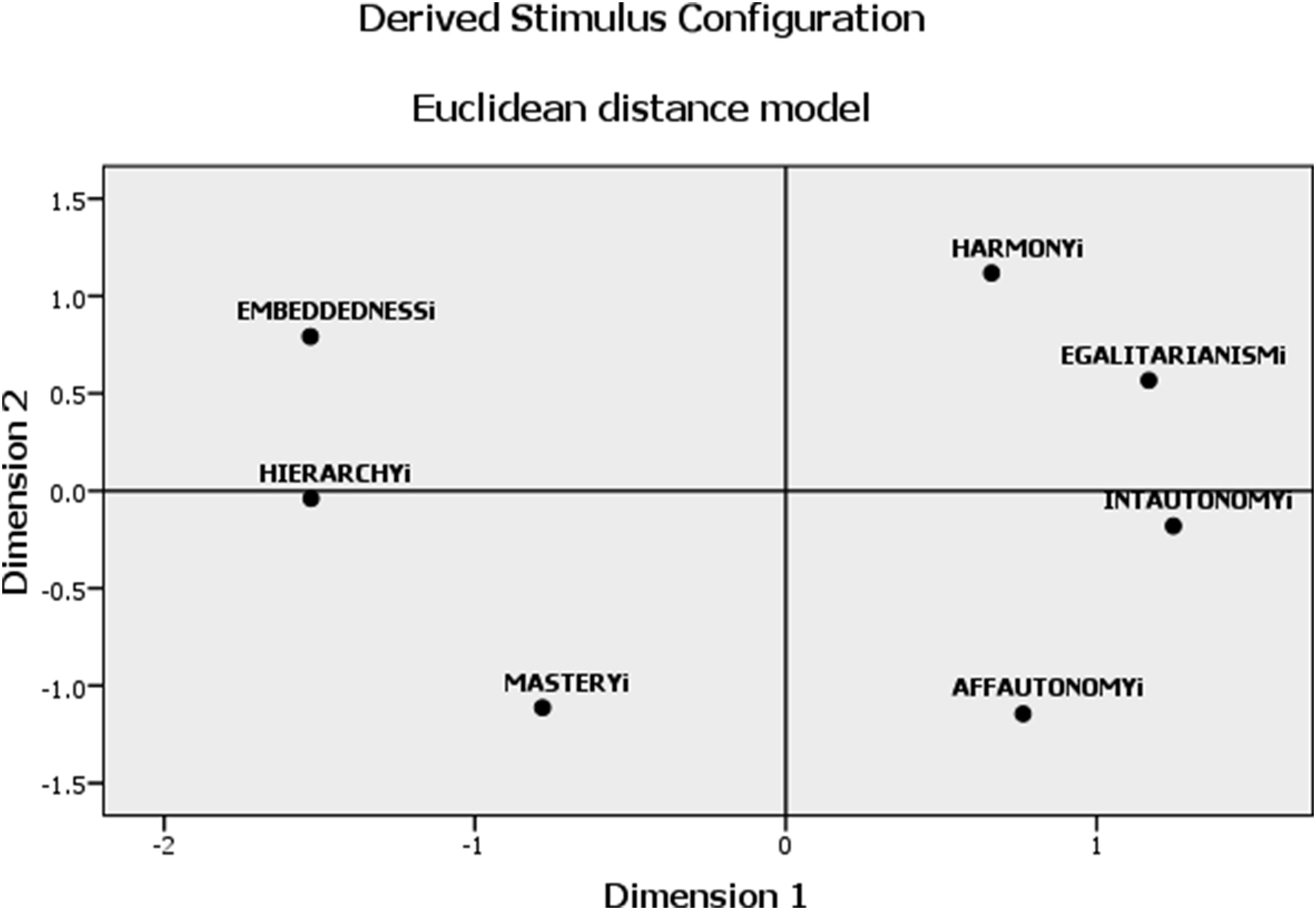
Correlations between the Schwartz national scores in Schwartz (2008b) and the ipsatized scores in Ralston et al. (2011).
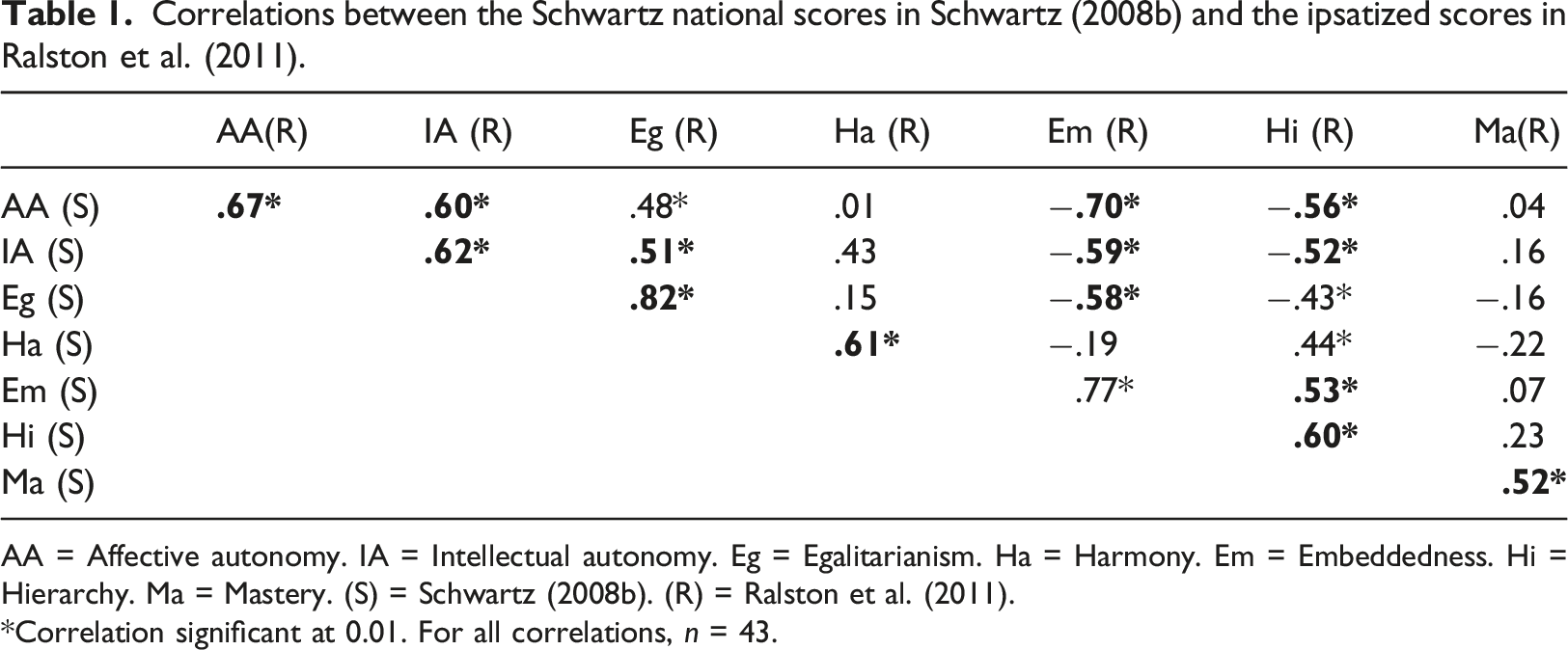
AA = Affective autonomy. IA = Intellectual autonomy. Eg = Egalitarianism. Ha = Harmony. Em = Embeddedness. Hi = Hierarchy. Ma = Mastery. (S) = Schwartz (2008b). (R) = Ralston et al. (2011). *Correlation significant at 0.01. For all correlations, n = 43.
Correlations between the ipsatized scores in Ralston et al. (2011).
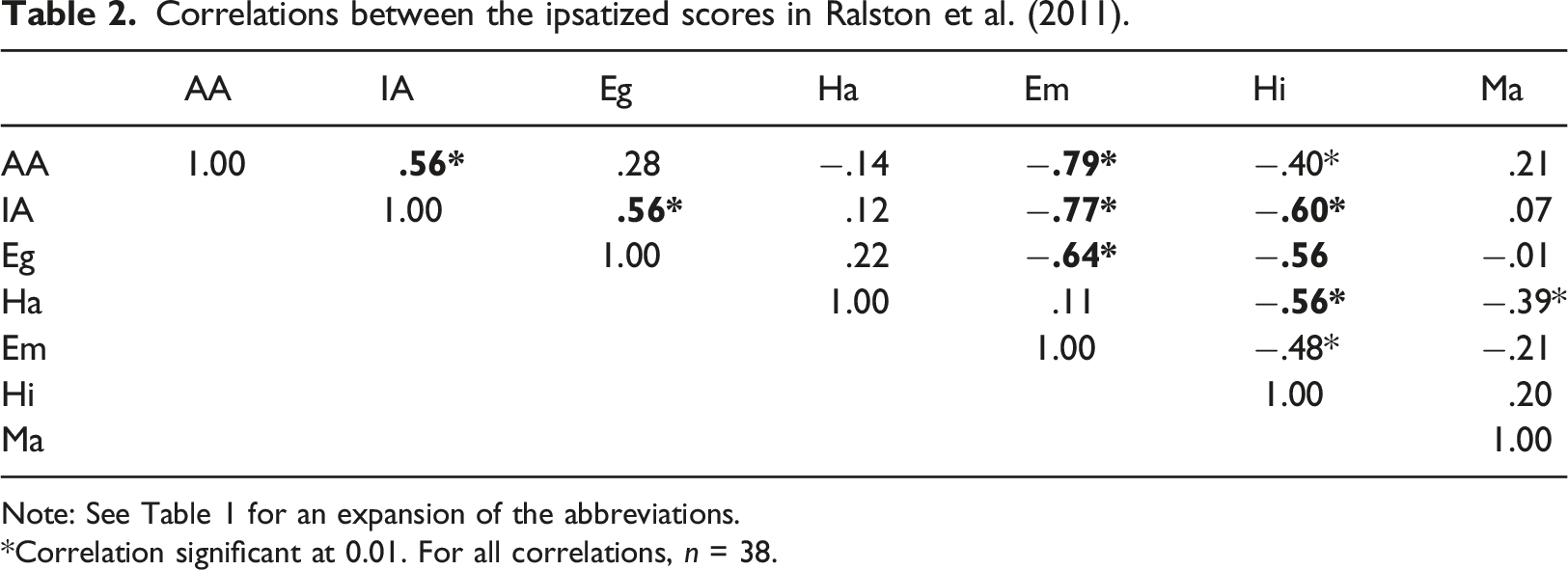
Note: See Table 1 for an expansion of the abbreviations. *Correlation significant at 0.01. For all correlations, n = 38.
The correlation pattern in Table 2 is consistent with Schwartz’s theory and the results from his data. We note that Ralston et al.’s (2011) mastery and harmony yield practically the same low negative correlation as the respective measures in Schwartz (2008b). This means that the low correlation is not a peculiarity of Ralston et al.’s (2011) database and, rather than indicating a weakness of that database, it actually suggests a strength. Overall, Ralston et al.’s (2011) data seem to be quite reliable and appropriate for an analysis of Schwartz’s model.
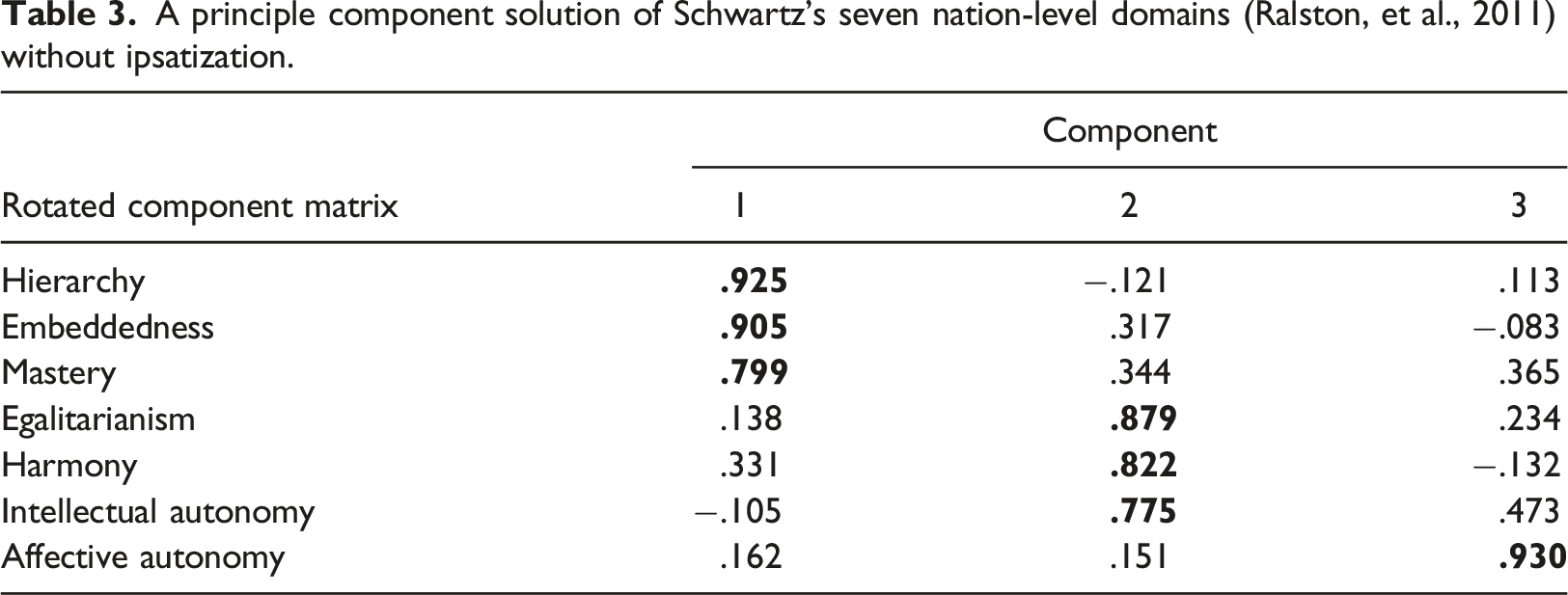
An MDS analysis of raw scores from Ralston et al. (2011) reproduced Schwartz’s circumplex acceptably, though not perfectly. However a varimax-rotated PC solution told a very different story. All items had only positive loadings on all components. Therefore, it is impossible for the items to yield a circumplex with statistical opposites. This means that the MDS solution of raw items does not reproduce the Pearson correlations between those items.
A principle component solution of Schwartz’s seven nation-level domains (Ralston, et al., 2011) without ipsatization.
Correlations between the three Schwartz components from raw data and the Minkov-Hofstede dimensions of culture.
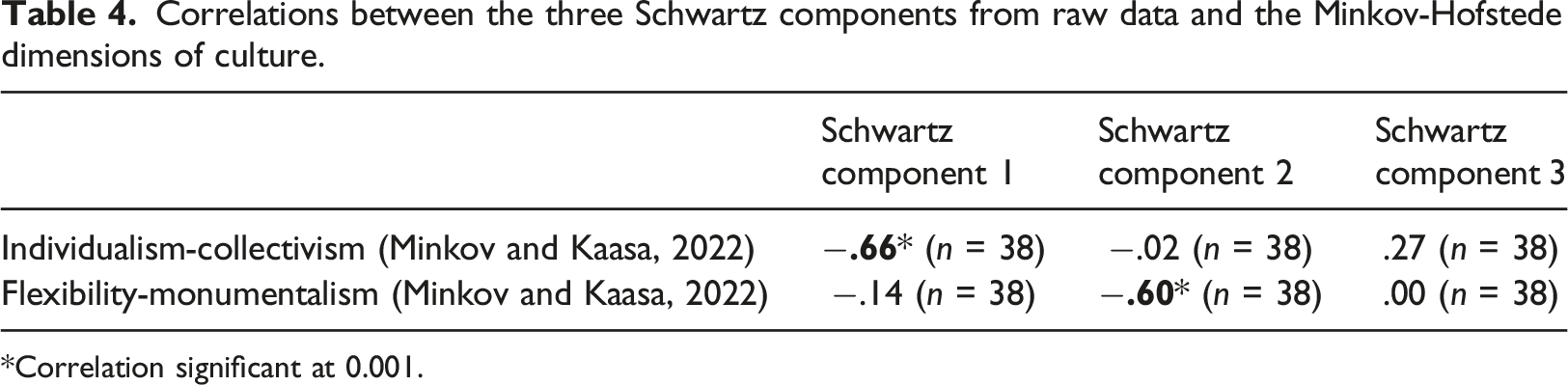
*Correlation significant at 0.001.
The first two components confirm our hypotheses. They do capture Schwartz domains that are consistent with individualism-collectivism and flexibility-monumentalism, albeit to different degrees. Figure 5 is a plot that visualizes the positions of the 38 countries on the two components from this study. All country scores have been multiplied by −1 to align the cultural map with the geographic one. The resulting cultural map outlines fairly homogeneous geographic clusters, with the exception of the positions of Russia, Israel, Slovenia, and perhaps Turkey. It is quite similar to the cultural maps in Minkov (2018) and Minkov and Kaasa (2022), based on the revised Minkov-Hofstede model. A country plot based on the two components obtained from non-ipsatized Schwartz data from Ralston et al. (2011). Note: Component 2 scores have been multiplied by -1.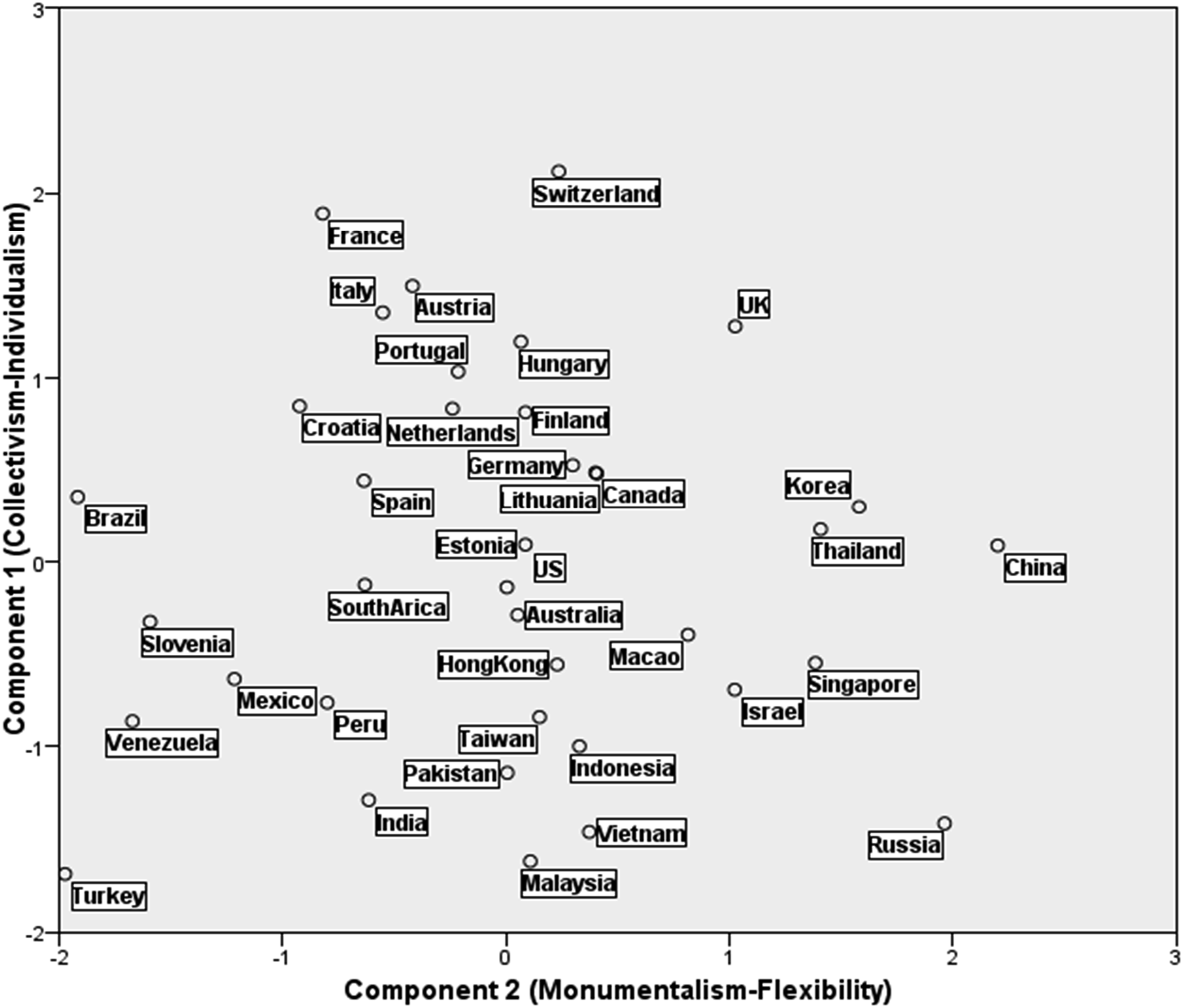
Discussion
Our study shows that a two-dimensional model of culture resembling that of Minkov-Hofstede can be extracted not only from Minkov’s (2018) database, the World Values Survey (Kaasa and Minkov, 2022), the International Social Survey Program (Minkov and Kaasa, 2020), national socioeconomic indicators (Minkov and Kaasa, 2021a, 2022), and US socioeconomic indicators for the 50 states (Minkov and Kaasa, 2021a), but also from a database of Schwartz items (this study).
The greatest controversy that this study might trigger is about the appropriateness of our data treatment. Is it appropriate to use raw Likert scale scores when analyzing Schwartz values? Aren’t they contaminated with too much meaningless response style?
We agree with Heine et al. (2002) that the use of Likert scales in cross-cultural research is fraught with pitfalls and we are of the opinion that the problem must be solved radically, by avoiding the use of such scales. The idea of a Likert scale is to measure intensity at the individual level of analysis. At the national level, one can measure intensity through the percentages of respondents that have endorsed a particular response. Likert scales are an unnecessary complication at that level. Nevertheless, Likert scales are a fact of Schwartz’s research tradition, including Ralston et al.’s (2011) study. Therefore, we had to use Likert-scale data.
As variants of the individualism-collectivism dimension emerge from Schwartz data regardless of how the data are analyzed - with or without ipsatization - the controversy affects only the remaining dimensions: the one obtained after ipsatization (mastery-harmony) versus the one extracted without ipsatization (flexibility-monumentalism).
Mastery-harmony cannot be easily related to any antecedents that might explain its existence since it is not closely associated with level of economic development, type of economy, or any geo-climatic factors. It does not have a significant effect on any important dependent variables in regression models using many countries from all continents (Minkov and Kaasa, 2022).
On the other hand, flexibility-monumentalism is strongly associated with latitude plus longitude, type of traditional economy (rice cultivation vs shifting agriculture or nomadic pastoralism) and many important socioeconomic indicators, and has equivalents from such indicators measured across nations and the 50 US states (Minkov and Kaasa, 2021, 2022). Therefore, it cannot be a response-style artifact with nothing real behind it.
We realize that our study has various limitations.
First, Schwartz’s choice of values was not done with flexibility-monumentalism in mind. Therefore, one cannot expect a very close variant of that dimension to emerge from a database of Schwartz values. This limitation actually makes our results all the more remarkable: a variant of flexibility-monumentalism does emerge from something that does not target it purposefully.
Second, our interpretation of the conceptual association between monumentalism and the corresponding Schwartz domains (egalitarianism, intellectual autonomy, and harmony) may be challenged. However, we are equally puzzled by Schwartz’s interpretation of the mastery-harmony contrast. Why should ambition for success and social recognition (mastery) be at odds with a desire to preserve the world (harmony)? We admit, however, that to have a fully convincing variant of flexibility-monumentalism from measures of values, one must write and field a number of new items, absent from the Schwartz Values Survey instrument.
Third, Ralston et al.’s (2011) database, used in this study, has only one sub-Saharan African country: South Africa.
In sum, we conclude that although Schwartz’s classic model of culture deviates from that of Minkov-Hofstede it can be aligned with it and, probably with the one of Inglehart-Welzel. In that way, the convergence between these three models, carriers of the oldest tradition and latest refinements in the study of culture through cultural dimensions, cross-validates all three and suggests that further research in this field should be based on the common ground of the three models.
Footnotes
Declaration of conflicting interests
The author(s) declared no potential conflicts of interest with respect to the research, authorship, and/or publication of this article.
Funding
The author(s) disclosed receipt of the following financial support for the research, authorship, and/or publication of this article: The first author was supported by the Basic Research Program of the Higher School of Economics, Russian Federation.
