



Abstract
It is empirically found that cultural diversity can influence group dynamics and social resources and demands. This study aims to explore if and how the effects of social demands and resources vary across teams of different levels of cultural diversity in the form of team compositions. This study proposes a research model to examine the associations between social demands (i.e., a lack of trust and accountability, misunderstanding and disagreement), social resources (i.e., managerial support and a positive team environment) and wellbeing impairments and empirically tests the model across three different team compositions. The sample is composed of 1049 participants who completed an online survey, working in either monocultural teams (i.e., one nationality only), bicultural teams (i.e., two nationalities), or multicultural teams (i.e., three or more nationalities). Multigroup structural equation modelling (SEM) was adopted to analyze the data and to perform cross-group comparison. The results show that the cultural composition of the team does influence the relationship between social demands and individual team members’ wellbeing. A lack of trust and accountability was found to be a significant predictor of wellbeing impairments in only mono- and bicultural teams, not in multicultural teams. Misunderstanding and disagreement was found to be positively associated with wellbeing impairments only in multicultural work teams, not in bi- or monocultural teams. No differences were found when comparing the effects of social resources on individual team members’ wellbeing between the three different types of teams.
Introduction
Teamwork has become the norm in contemporary management and plays an important role in a variety of settings in different organizations (Liu and Liu, 2018). Studies have highlighted the positive effects associated with teamwork, such as the availability of a broader range of knowledge (Jehn and Mannix, 2001). Against this, however, teamwork is also associated with demands (e.g., psychological costs) which may have negative psychological outcomes, such as stress. For instance, Cruz (2007) suggests that individuals working in teams are likely to differ in their assumptions, interpretations, and perspectives in responding to various stimuli, which can lead to operational difficulties within the teams and subsequent conflicts between team members.
According to the job demand-resource model (JD-R), employee workplace wellbeing is a function of demands and resources experienced in the work environment (Demerouti et al., 2001). Providing employees with appropriate and sufficient resources can alleviate the negative effect of workplace demands on individuals’ wellbeing (Lesener et al., 2019). Teamwork can increase resources such as social support and team cohesion (Hüffmeier and Hertel, 2011; Urien et al., 2017), which can act as protective factors of employee wellbeing
The literature suggests that team composition (e.g., skill sets, level of diversity) has a variety of positive and negative effects on teamwork (Stahl et al., 2010; Staples and Zhao, 2006; van Knippenberg et al., 2004). Under the theoretical lens of stress research, cultural diversity may influence the relationships between demands-resources and employee wellbeing.
Research into workplace stress often focuses on the effects of job-related demands, such as work hours, time pressure, and workload (e.g., Liu and Liu, 2018). Less investigation has been undertaken to understand the effects of social demands caused by teamwork and their impact on individual team member’s wellbeing. Moreover, there is a lack of attention drawn to the role of team composition in stress research (see Liu and Liu 2018). A study conducted by Leifels and Bowen (2021) reported that the number of nationalities within teams is positively associated with social stressors while being negatively associated with social resources experienced by team members and that social stressors negatively affect employee wellbeing. However, it remains unclear whether and how the relationships between social resources and demands, and employee wellbeing outcomes can be altered by different team compositions. These research gaps have led to the current study which aims to: 1. Propose and test a research model examining the effects of social resources and teamwork induced social demands on employee wellbeing; 2. Test the research model across different team compositions consisting of monocultural teams, bicultural teams and multicultural teams.
It is expected that this study will contribute to the body of knowledge by providing a nuanced understanding of how the effects of social resources and demands on employee wellbeing vary across different team compositions. The research results will inform the development of targeted strategies to support employees’ health and wellbeing within teams of different levels of cultural diversity.
Theoretical background and framework
In the present study, the authors use the JD-R model (Bakker and Demerouti, 2017; Demerouti et al., 2001) to analyze how social demands and social resources contribute to wellbeing impairments across three different team compositions. The JD-R model proposes that high job demands and low job control increase the risk of burnout and lead to negative outcomes such as health impairments, while resources can help to prevent and alleviate burnout and lead to positive outcomes such as increased work engagement (Lesener et al., 2019). The relationship between job demands and job resources and wellbeing are well documented in the literature (see, e.g., Lesener et al., 2019). There is considerable empirical evidence regarding the negative relationship between job demands and wellbeing (Woodhead et al., 2016), as well as the positive relationships between resources, and wellbeing, such as social support and health (e.g., Roczniewska et al., 2022; Woodhead et al., 2016).
Cultural diversity in teams may compound the stress levels of individual team members as tensions between individuals may arise due to cultural differences (Pines and Zaidman, 2014). In culturally heterogenous work teams, the efforts required to avoid misinterpretation of behaviors and messages underpinned by varying beliefs and values can be considered as additional job demands, compared to working in culturally homogenous teams. There is also some evidence that culturally heterogenous work teams, compared to culturally homogenous teams, have a lower level of cohesion (Staples and Zhao, 2006). Cohesion is more likely to develop in an environment where individuals share similar cultural values, language and national background (Staples and Zhao, 2006). Hence, the different cultural backgrounds in culturally heterogenous work teams may reduce the level of cohesion, which is considered an important resource to reduce psychological distress (Williams et al., 2016).
Pertinent theories to explain the effects of cultural diversity on team processes are the social categorization, similarity attraction theory, and information processing theory (see Stahl et al., 2010). First, according to the social categorization theory, people tend to categorize themselves and others into groups based on specific characteristics. Team members within their own group are more likely to be treated with favouritism as compared to members outside of their group (Stahl et al., 2010). Second, based on the similarity attraction theory, people are more likely to be attracted to and identify with people they perceive as being similar to themselves (Staples and Zhao, 2006). Third, the information processing theory postulates that diversity increases the range of available information, leading to enhanced problem solving, due to a broader range of knowledge and backgrounds (Stahl et al., 2010). Based on these theories and findings, cultural diversity may affect social demands and resources. Depending on the level of cultural diversity within teams, social demand and resources may influence individual team members’ wellbeing in different ways.
Social demands in work teams
Poor team relations
Poor team relations refer to the relationships amongst team members that are characterized by mistrust a lack of information sharing and social loafing. The term mistrust refers to a state of active uncertainty if trust should be offered towards someone or not, which may be temporary or prolonged (Breakwell, 2020). Whilst trust is crucial for an exchange of information (Hajro, 2009), mistrust in teams is likely to hinder information exchange amongst team members. Moreover, a low level of trust is also associated with individuals’ low sense of accountability (Thoms et al., 2002), which can lead individuals to reduce their contributory efforts in a team. These reduced efforts can express themselves in different forms, such as the tendency to engage in social loafing (Karau and Williams, 1993), which is defined by “the tendency for individuals to expend less effort when working collectively than when working individually” (Karau and Williams, 1993: 681). Based on the well documented negative relationship between demands and wellbeing, our research hypothesizes that poor team relations in a work team environment are positively associated with wellbeing impairments.
Poor team relations are positively associated with wellbeing impairments.
Lack of shared understanding
Working in teams can be associated with misunderstandings, differences in opinion and conflicts between team members (Behfar et al., 2011; Han and Harms, 2010; Jehn and Mannix, 2001). Jehn and Mannix (2001, p. 238) state that teamwork can become “hotbeds of conflicts”. The negative effects of workplace social demands, such as conflicts, on individual wellbeing are well documented in the literature (see, e.g. Gerhardt et al., 2021). We therefore anticipate that a lack of shared understanding in form of misunderstandings, differences in opinion and associated conflicts are positively associated with wellbeing impairments in work teams.
A lack of shared understanding among team members is positively associated with individual wellbeing impairments.
Social resources in work teams
Positive team environment
A positive team environment may provide unique resources that have a positive effect on team members’ wellbeing. A positive team environment is characterized by a high level of team cohesion and social support provided by team members, the ability to participate in team decision-making processes, and team reflexivity, which can be defined as a “process in which team members collectively reflect on the team’s objectives, strategies, and processes and adapt accordingly” (Chen et al., 2018: 443). A team environment that is characterized by a high level of cohesion can have positive effects on mental wellbeing as cohesion creates emotional connections between team members and provides team members with a sense of belonging within a team (Vanhove and Herian, 2015; Wright and Drewery, 2006). Moreover, cohesion affects the level of social support provided by team members, which is an important social resource (Steinhardt et al., 2003). Evidence shows that being able to participate in the decision-making process positively influences employee mental health through increasing team members’ sense of job control (Cruz and Pil, 2011). Other studies indicate that participation in the decision-making process is positively associated with team reflexivity, which further enhances team members’ perceptions of increased social support and job control (Chen et al., 2018). Furthermore, Chen et al. (2018) showed that participants assigned to an experimental team reflexivity condition showed a significant decrease in emotional exhaustion and cynicism which are two primary predictors of burnout. Hence, we propose:
The positive team environment is negatively associated with wellbeing impairments.
Managerial support
Studies highlight the importance of social support provided by the supervisor (e.g., Cruz and Pil, 2011; Hämmig, 2017), and emphasize its protective effects on an employee’s psychological wellbeing (e.g., Hämmig, 2017). From thereafter, social support provided by the supervisor will be referred to as managerial support. Literature indicates that managerial support has a stronger effect on an employee’s wellbeing than support provided by co-workers. Wolff et al. (2021) found that, compared to co-worker support, managerial support exhibits a stronger negative association with employee wellbeing as well as having stronger negative associations with employee experiences of job stress and burnout. This aligns with De Raeve et al. (2007) who demonstrated that workers have significantly less need for recovery from workplace demands only when they receive social support from their supervisor. We therefore propose:
Managerial support is negatively associated with wellbeing impairments.
Given the four hypotheses, the proposed research model, which examines the effects of social demands and resources on employee wellbeing impairments, is depicted in Figure 1. Hypothesized research model.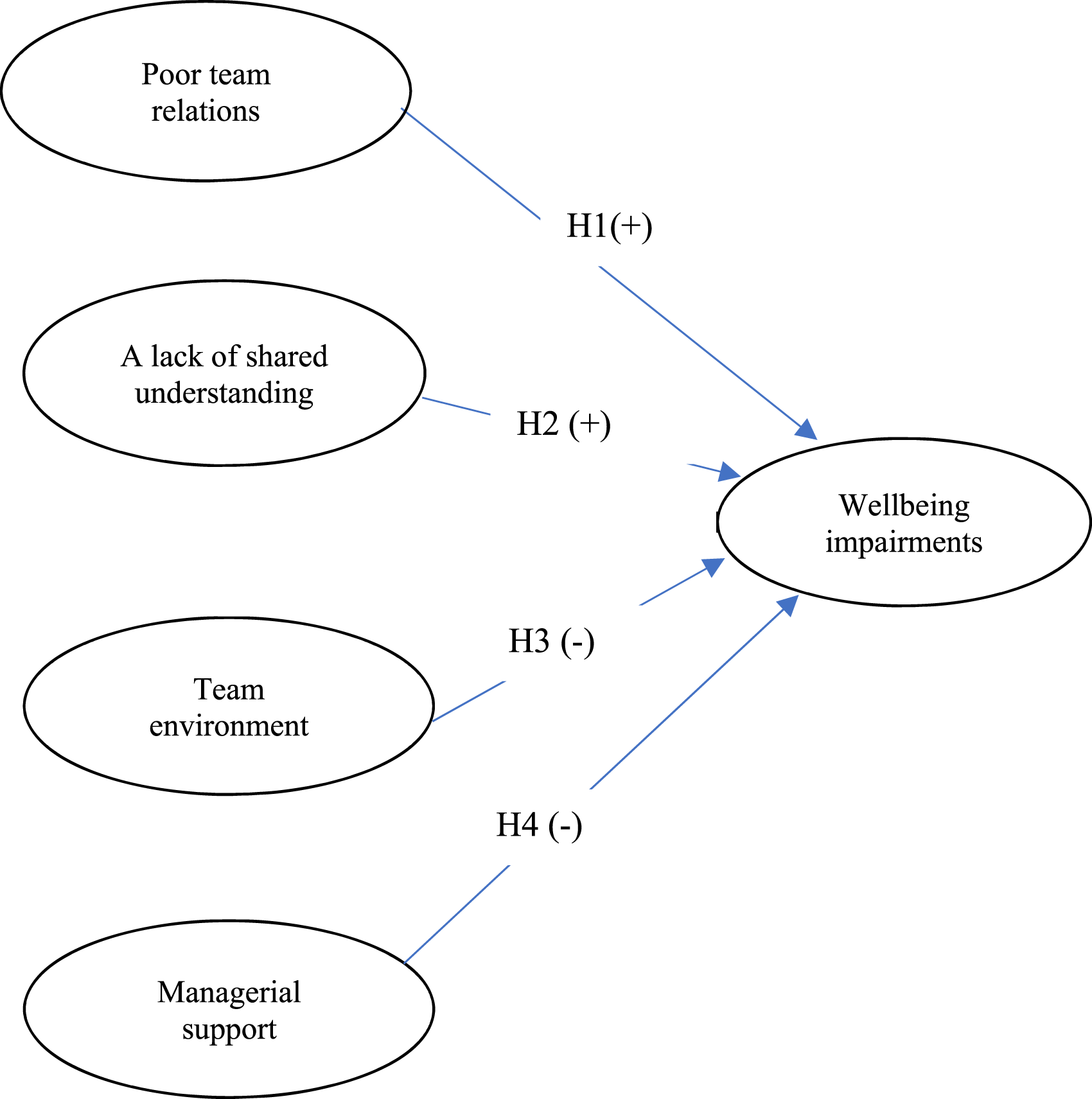
The effects of social demand and resources on wellbeing impairments in different team compositions
Cultural diversity in teams can have negative effects on a variety of team processes and team relations. For example, individuals working in culturally heterogenous teams are likely to have lower team cohesion due to intercultural issues such as mistrust (Leung and Wang, 2015), and low team cohesion was found to be associated with team members’ behavior of social loafing (Høigaard et al., 2006). Staples and Zhao (2006) also highlight that culturally heterogenous work teams have lower levels of trust among team members as compared to culturally homogenous teams. Moreover, Leung and Wang (2015) suggest that cultural diversity within teams may trigger negative social processes, resulting in cultural identity obstacles (e.g., identity fragmentation) and intercultural obstacles (e.g., difficulty in intercultural integration and incompatible behaviors), and these obstacles subsequently reduce team members’ willingness to share and integrate task-related information, ideas and skills. Therefore, cultural diversity in teams is likely to increase the level of poor team relations characterized by mistrust, lack of information sharing and a tendency for social loafing in teams. While it is proposed that poor team relations is positively associated with wellbeing impairment, we expect that the magnitude of this association changes across teams of different levels of cultural diversity, i.e. monocultural, bicultural, and multicultural work teams. Thus, we propose:
Poor team relations affect wellbeing impairments differently across monocultural, bicultural, and multicultural teams.
Members of culturally heterogenous work teams may have different values, behaviors, expectations and perceptions due to their different cultural backgrounds (Stahl et al., 2010), leading to incompatible assumptions and differences in opinion, misunderstandings and increased conflicts amongst team members (Leung and Wang, 2015; Staples and Zhao, 2006). Research shows a complex relationship between work team diversity and work team functioning and performance (e.g., Hajro, 2009; Pelled et al., 1999). Specifically, task-related conflicts likely increase incrementally with the level of cultural diversity in a team, due to individual divergent preferences and interpretations (Pelled et al., 1999). Moreover, Hajro (2009) argues that knowledge exchange can be reduced in bicultural work teams due to the emergence of subgroups between (or within) two cultures, and that the subgroups can cause uncertainty in interactions and results in misunderstanding and conflicts between subgroups and individual team members. All the research evidence suggests that the lack of shared understanding within teams can be exacerbated by cultural diversity. The effect of lack of shared understanding on employee wellbeing is likely to be stronger in teams with the presence of more than one culture than within monocultural teams. Therefore, we hypothesize that:
A lack of shared understanding affects team members’ wellbeing impairments differently across monocultural, bicultural, and multicultural teams.
Employees’ perceptions of team environment and associated impact on their wellbeing are likely to be affected by the level of culture diversity within teams. Based on the similarity attraction theory, individuals are more likely to cooperate and be attracted to work if their team members share similar values, beliefs or attitudes (Stahl et al., 2010). Therefore, members of culturally homogenous teams may perceive their work environment differently compared to those of culturally heterogenous teams, due to the possibility of a lower level of perceived social cohesion and support (Amason et al., 1999; Staples and Zhao, 2006). Amason et al. (1999) found that workers perceive a higher level of social support received from co-workers of the same cultural background than co-workers of different backgrounds.
A positive team environment affects wellbeing impairments differently across monocultural, bicultural, and multicultural teams.
Research shows that social support (including managerial social support) can be perceived differently by individuals from different cultural backgrounds (Beehr and Glazer, 2001; Kim et al., 2008). For social support to be considered as meaningful, Beehr and Glazer (2001, p. 122) state that: “it is expected that social support will only be as effective as the prevailing culture’s endorsement of ‘that’ type of exchange; therefore no type, source, frequency, or amount of support will be equally effective across all cultures”. The perception and appreciation of types and sources of social support differ between cultures. For example, certain types of managerial social support, such as emotional support, may be perceived as inappropriate in cultures that emphasize Hierarchy and Mastery, such as in China or India, as requiring this type of support would be viewed as weakness by the manager. On the other hand, managerial emotional support may be acceptable in high autonomy cultures such as in the USA (Beehr and Glazer, 2001). Consequently, managerial support may have different effects on employee wellbeing between monocultural teams and teams with the presence of more than one culture. We therefore hypothesize that:
Managerial support affects wellbeing impairments differently across monocultural, bicultural, and multicultural teams.
Methods
Explorative study
An explorative qualitative study was conducted first using semi-structured interviews to extract social demands and resources that play an important role in work teams. The interview participants (N = 15) were recruited using a snowball approach and included eight nationalities from 12 companies in four different countries, namely Germany, Switzerland, Canada and Ireland. The participants were between 26 and 54 years of age, 63.6% of whom were males. They worked in different industries, including Aerospace, Automotive, Electronics, Pharmaceutical and Information Technology. The average interview duration was 25 minutes.
As part of the interviews, participants were first asked to provide details about their work teams, including the size of their work teams, the number of nationalities within their teams and the amount of time that they had worked in their current teams. Interviewees were then asked to describe three specific situations in which they experienced stress when interacting face-to-face with their team members. To explore potential resources, interviewees were asked to explain “what helped them in this stressful situation”. The interviewees were also asked about the perceived impact of the situations on their individual wellbeing.
Following Braun and Clarke (2006), an inductive interview analysis was performed to identify stressors and resources in teams.
The stressful situations described by interview participants were closely examined to identify factors contributing to stress (stressors), which were categorized into emerging categories and associated subcategories. The authors ensured that there are no overlaps between categories or subcategories. The same analytical process was performed to identify resources.
Stress factors associated with social interaction with team members were categorized as social stressors. Our analysis revealed that the majority of stressors were perceived as differences in social behavior, communication differences and differences in work-related attitudes/behavior. The authors conducted a frequency analysis to extract the most frequent subcategory stressors, namely, misunderstandings, differences in opinion, conflicts, mistrust, a lack of information sharing, discrimination, and social loafing.
The resources were categorized into social support and (team) cohesion. Based on these findings, the authors also reviewed the existing literature to identify more relevant stressors and resources to develop items to measure social stressors and resources in work teams. A confirmatory factor analysis was conducted to validate the factor structure of the relevant constructs, which will be described later.
Measures
The identified stressors and resources items were compiled into a survey. The surveys were distributed in German and English. To ensure all items have the same meaning, the items were translated into English and German. The authors used the committee approach as proposed by Rippl and Seipel (2015). Poor team relations (PTR) and a lack of shared understanding (LSU) was each measured with six items, i.e., PTR1-PTR6 and LSU1-LSU6. Positive team environment (TE) was measured by seven items (TE1-TE7). Managerial support (MS) was measured with four items (MS1-MS4) while wellbeing and impairments was measured with five items (WB1-WB5). All constructs achieved excellent internal consistency with Cronbach alpha values ranging from 0.831 to 0.905. The individual items underlying each construct, their sources, Cronbach alpha values and measurement scales have been provided in Appendix 1.
Data collection
An online survey was administered between December 2015 and April 2016, using the platform of Qualtrics. Participants were originally recruited through their HR departments, company or industry newsletters, and subsequently through different social media channels in different countries. A snowball approach was also adopted to increase participation. All participants needed to be working in a team to be eligible for participation in the survey, so this was used as a primary filter. Informed consent was obtained from each participant.
Data analysis methods
Model fit indices and associated thresholds.
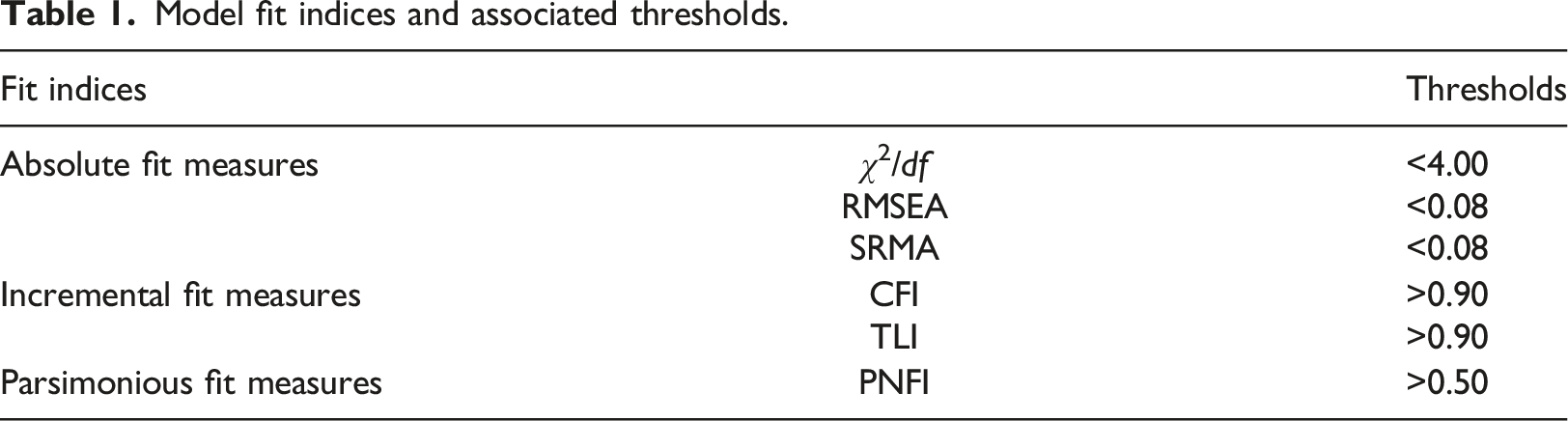
To test whether and how the effects of social resources and demands on employee wellbeing vary across monocultural, bicultural and multicultural teams (i.e. hypotheses 5-8), multigroup SEM was performed to examine whether the measurement model and the structural model are equivalent (or invariant) across different sample groups. The measurement invariance was assessed by testing configural invariance and metric invariance (Kline, 2005). The purpose of examining measurement invariance is to ensure that any future differences in the structural model between groups are not the result of different performances of the measurement model in different groups. Configural invariance is evaluated by specifying the same measurement model across sample groups and assessing whether the model fits the data for each group (Kline, 2005). All parameters in the model are freely estimated within each sample group during the testing process. Metric invariance is assessed by imposing cross-group equality constraints on factor loadings (i.e., the factor loadings of each measurement item are set to be equal across the groups), and then comparing the Chi-Square difference between the two models, i.e., one with equality constraints and one without equality constraints (Kline, 2005). If the Chi-Square difference is not statistically significant, measurement invariance can be assumed, i.e., each item loads onto the corresponding construct in a similar manner and with similar magnitude across the groups.
Structural model invariance was analyzed following steps similar to those for analyzing measurement model invariance. If the Chi-Square difference from metric invariance testing is statistically significant, which indicates the factor loadings of certain structural paths are not equivalent across groups, then steps need to be taken to identify which specific structural paths have contributed to the invariance. Specifically, a series of model testing will be conducted by imposing a cross-group equality constraint on one structural path at a time. The software of SPSS AMOS 25 was used to perform the multigroup SEM analysis.
Results
Missing value analysis
A total of 1102 valid responses were received from the survey. Missing data analysis indicated that 53 cases had greater than 10% missing values, and thus these cases were removed. The remaining dataset of 1049 cases was used for subsequent analysis. Little’s MCAR test on the remaining dataset of 1049 cases indicated that item missing values were missing completely at random (χ2 = 389.525, df = 412, p = .781) and were imputed using the expectation-maximization (EM) algorithm.
Sample description
Among the final dataset (n=1049), more than half of the respondents (n = 657, 62.6%) aged between 31 and 55. There were 439 (41.8%) males and 607 (57.9%) females. Most of the respondents (n = 869, 82.8%) considered themselves as white-collar workers. A total of 583 (55.6%) participants worked 36 months or less in their current teams, while 463 (44.1%) worked more than 36 months. The prevailing team size was 5-10 members (n = 499, 47.6%). Most of the respondents (n = 568, 54.1%) reported one nationality represented in their work teams, 239 (22.8%) reported two nationalities, and another 242 (23.1%) reported more than two nationalities.
Confirmatory factor analysis
The proposed measurement model was subject to a confirmatory factor analysis (CFA). The CFA results indicated that not all model fit indices met the threshold requirements (χ2/df = 5.279; RMSEA = 0.064; SRMA = 0.046; CFI = 0.910; TLI = 0.900; PNFI = 0.802). Specifically, the results showed that item TE2 underlying the construct “positive team environment” had a loading lower than 0.5. TE2 was therefore removed from the measurement model. The modification indices indicated that for the construct of “poor team relations”, there was a high covariance between the error terms for items PTR3 and PTR4, and for items PTR5 and PTR6. In addition, error terms for items LSU1 and LSU2 underlying the construct “a lack of shared understanding” also showed a high covariance. The high covariance indicates a high correlation or redundancy between each pair of items, suggesting the removal of relevant items. Items PTR4, PTR5 and LSU1 were removed from the measurement model as they had lower loadings onto the corresponding construct than the other three items. Additionally, the error terms for items TE4 and LSU6 highly covaried with several other error terms. These two items were therefore also removed from the measurement model. With the six items removed, the revised measurement model was re-tested and proved a very good fit to the data (χ2/df = 3.380; RMSEA = 0.048; SRMA = 0.038; CFI = 0.962; TLI = 0.956; PNFI = 0.816). The item loadings ranged from 0.61 to 0.92, and all were statistically significant (p < .001) (please refer to Appendix 2).
Testing research model with SEM
Based on the hypothesized research model and the CFA analysis above, a structural model was then specified to test hypothese1-4. The structural model demonstrated a good fit to the data (χ2/df = 3.380; RMSEA = 0.048; SRMA = 0.038; CFI = 0.962; TLI = 0.956; PNFI = 0.816). The modification indices indicated the need to covary the error terms between items MS1 and MS3, between items LSU2 and LSU5, and between items TE3 and PTR6. Those pathways were added to the structural model, and the model was re-tested. The resultant model achieved a good satisfactory model fit to the data (χ2/df = 2.278; RMSEA = 0.041; SRMA = 0.040; CFI = 0.972; TLI = 0.967; PNFI = 0.812). The final model with path coefficients is illustrated in Figure 2. Final structural path model.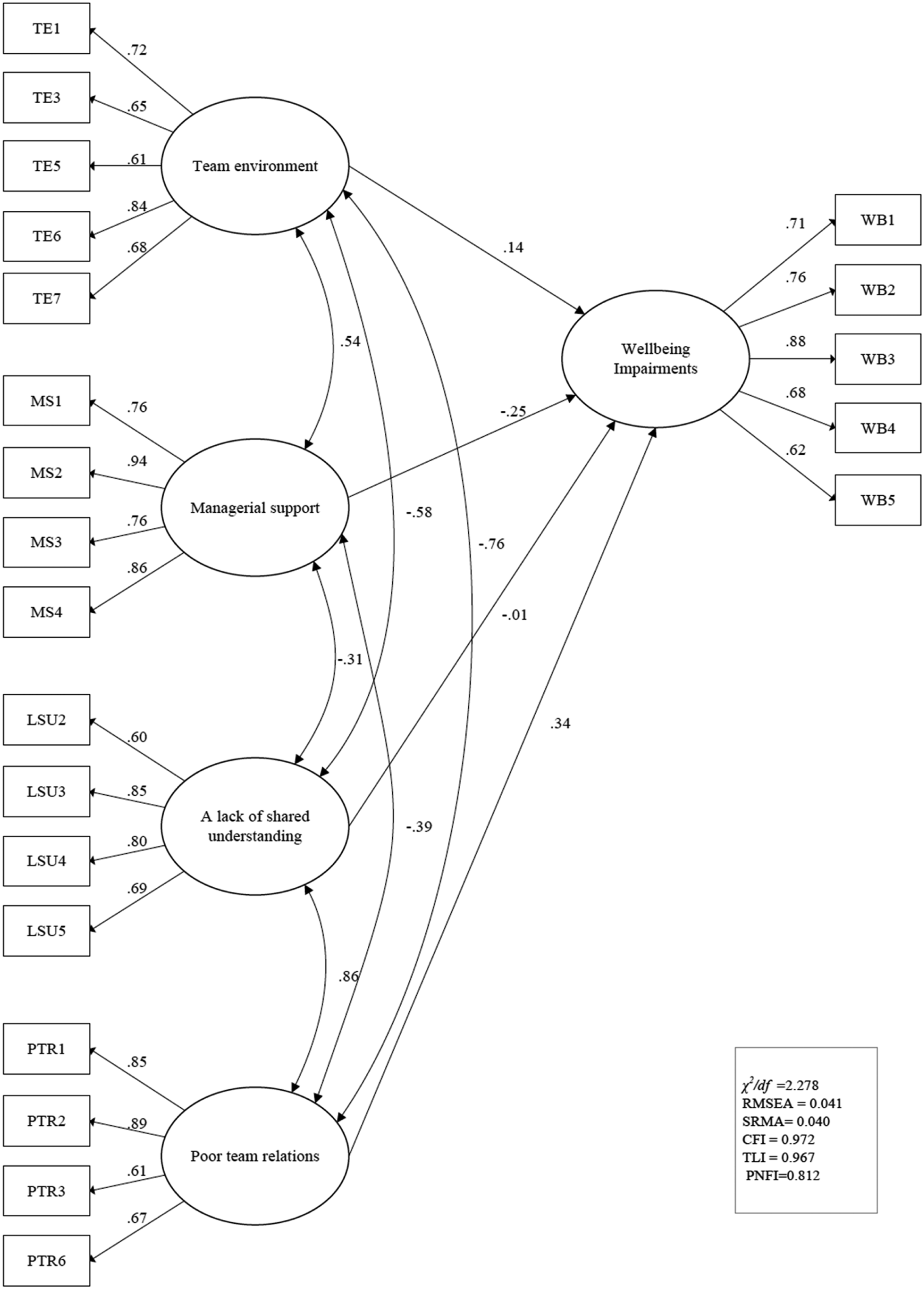
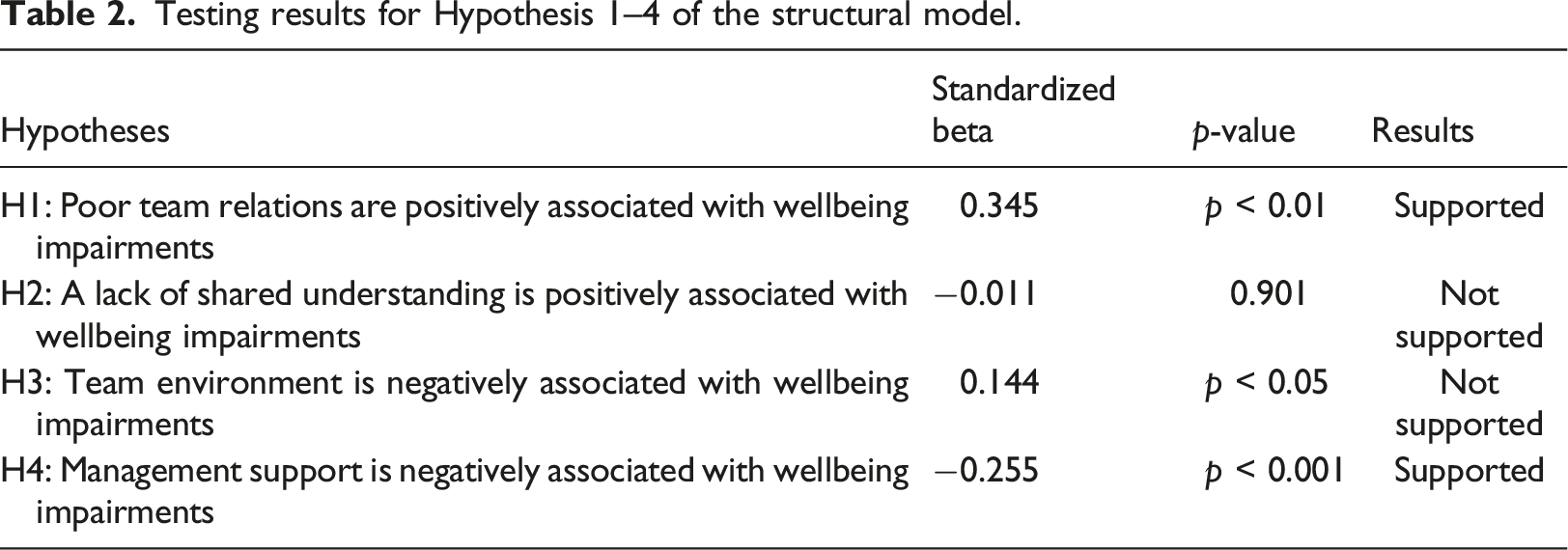
Testing results for Hypothesis 1–4 of the structural model.
Cross-team comparison with multigroup SEM
Measurement invariance analysis
Measurement model invariance was assessed as the first step to test Hypothesis 5–8, i.e., social demands and resources affect employee’s wellbeing differently across monocultural, bicultural and multiculture teams. Multigroup confirmatory factory analysis (CFA) was conducted to test configural invariance, i.e., whether the specified measurement model performs similarly across groups. All factor loading paths in the model were freely estimated at this stage. The results indicated that the model achieved a good multigroup model fit to the data, suggesting that the measurement model performs similarly across all three groups (χ2/df = 1.977; RMSEA = 0.031; SRMA = 0.038; CFI = 0.953; TLI = 0.946; PNFI = 0.784).
Metric invariance was then tested to examine whether the factor loadings of items are equivalent across the groups. Equality constraints were imposed to item loadings across groups. The Chi-Square difference between the constrained model and the unconstrained model was not significant (Δχ2 = 39.036; df = 34; p = 0.254), suggesting that the items loaded to their corresponding factors in a similar manner across the three groups. Therefore, measurement invariance was assured.
Multigroup structural equation modelling
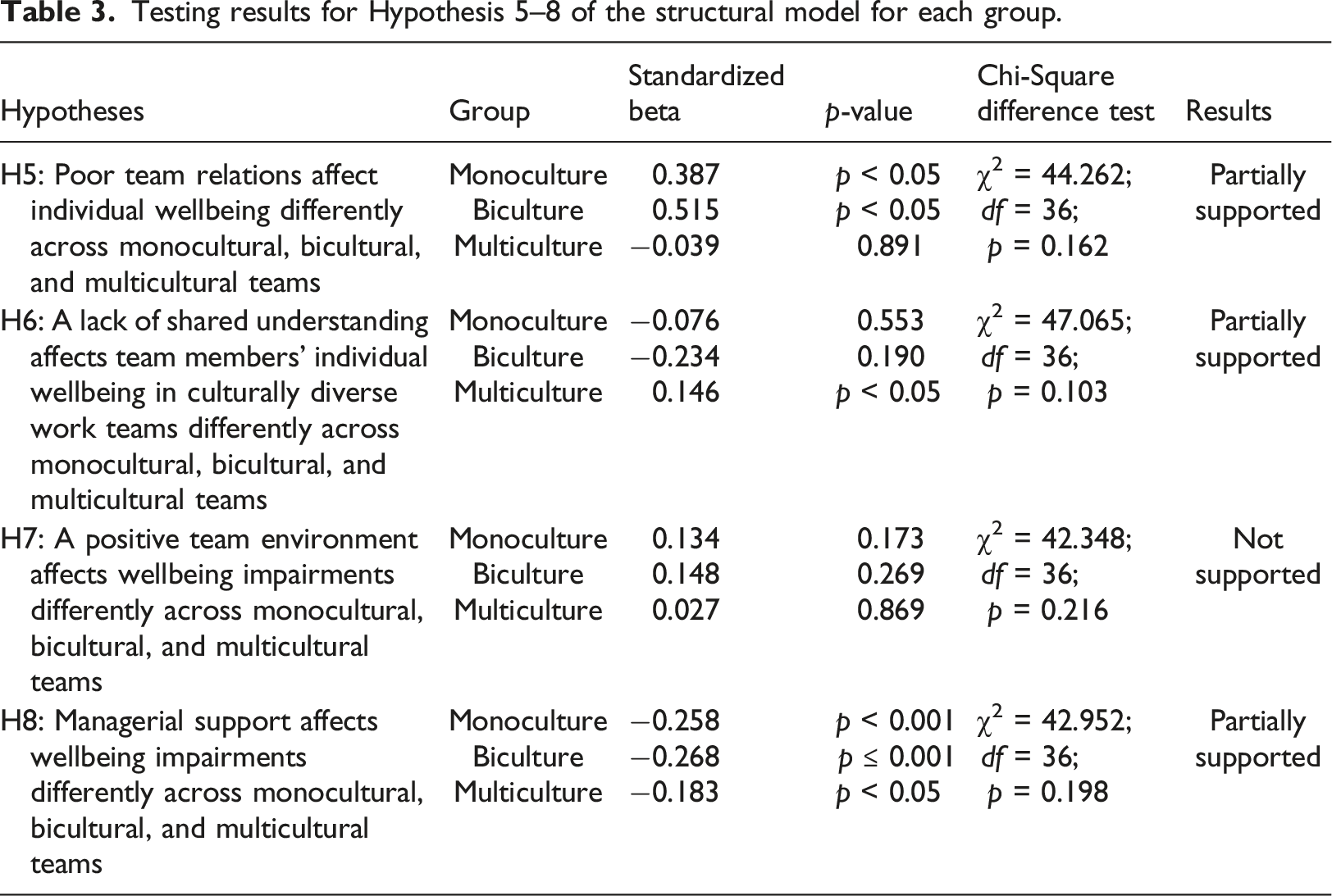
Testing results for Hypothesis 5–8 of the structural model for each group.
Discussion
Our study contributes to understanding the positive and negative aspects of teamwork. Based on the existing body of knowledge, we have integrated the positive and negative aspects of teamwork into the JD-R theory framework and examined the effects of social demands and resources on individual wellbeing impairments.
Our study shows that perceived poor team relations are positively associated with individual wellbeing impairment in teams, aligning with our hypothesis 1. However, there seems to be a difference regarding the effects on the wellbeing between members of teams with different levels of cultural diversity. The multigroup SEM analysis revealed that poor team relations only lead to wellbeing impairments in monocultural and bicultural teams, but not in multicultural teams partially supporting hypothesis 5. Although the between-group differences are not statistically significant, they point to the potential different impacts of poor team relations in different team settings. The differences could be explained by team members’ different psychological expectations associated with different levels of perceived cultural differences. An individual’s cultural background provides a source of identity, which is often accompanied with values and beliefs which define expected behaviors (Stahl et al., 2010). Individuals in the monocultural teams, and to a certain extent in bicultural teams, share a higher similarity in values, beliefs and norms compared to those in multicultural teams (Stahl et al., 2010). Thus, they would have a higher psychological expectation of team members from the same cultural background with regards to relationships, as compared to individuals working in multicultural teams. Accordingly, when the expectation is unmet, the adverse psychological effect on individuals’ who work in monocultural and bicultural teams can be stronger than that on individuals’ who work in multicultural teams.
The group comparison also revealed that a lack of shared understanding led to wellbeing-impairments only in multicultural teams, and not in mono- or bicultural teams, nor in the whole sample. One potential explanation for this finding could be due to the items used. First, the items used to measure a lack of shared understanding include items focusing on misunderstandings, disagreements, and conflicts. While the items measuring misunderstandings focus on communication differences due to the different cultural backgrounds and mother tongues, the items used to measure disagreements focused on differences in opinion about the team task, which can also be classified as task conflicts (Behfar et al., 2011). Litsou et al. (2020) highlight that conflicts can have potential benefits, and state that it is important not to focus solely on the negative effects associated with conflicts. For instance, conflict within teams can improve decision quality and strategic planning (Jehn and Bendersky, 2003). Hence, a potential explanation for our finding could be that the perceived misunderstandings, disagreements and conflicts were not considered to be negative by the participants of this study.
Wolff et al. (2021) and Swanzy (2020) highlight the role of managerial support in countering wellbeing-impairments. This assertation is supported by the findings of our study. Specifically, managerial support was found to be negatively associated with wellbeing impairments across all three types of teams.
Contrary to our expectation, our study suggests a positive relationship between a positive team environment and wellbeing impairments. A possible explanation for this finding could be the diverse effects of social interactions on strain effects and wellbeing. For instance, Beehr et al. (2010) suggest that the potential that supportive interactions with colleagues can be harmful to, rather than improving, an individual’s wellbeing. This is because social interactions can draw the individual’s attention to the demands and associated stress, which can be associated with an increase in strain effects (Beehr et al., 2010). The positive and supportive team environment could exacerbate the contagion of negative feelings amongst team members (Westman et al., 2011). As a result, teams with a positive atmosphere enable close relationships, which can result in the spread of wellbeing impairments (Westman et al., 2011). Another explanation could be that social support and related social interactions can also have negative effects on the psychological wellbeing (Lincoln, 2000). Examples include interactions in which individuals are discouraged to express their feelings or failings in order to receive help that was promised. In her review, Lincoln (2000) highlights several studies which found a negative relationship between social support from a variety of sources and the psychological wellbeing. Although most of the previous research has highlighted the positive aspects of social support, our findings support Lincoln’s (2000) remarks and highlight the need for further research.
Theoretical and practical implications
By taking into account the increasing trend for culturally heterogenous work teams and different levels of cultural diversity, we argue that our study contributes in several ways to theory and practice.
Firstly, few studies have examined the strain effects of demands and social resources in team settings (e.g., Torrente et al., 2012; Westman et al., 2011). By integrating social demands and resources which are related to teamwork, we extend the common application of the JD-R model. More specifically, we added psychosocial variables which are likely to have diverse effects in different team compositions. By doing so, our study offers theoretical insights into the effects of team-related constructs on individual wellbeing. Secondly, while some studies tested one model with different variables that represent cultural diversity or individual cultural background within teams (e.g., de Jong et al., 2020; Pelled et al., 1999), we further extend previous studies by testing the same model to different team categorizations. This approach has allowed us to ascertain the effects on wellbeing-impairments across three levels of diversity in teams. Finally, our study adds to the body of knowledge on social resources. Building on the findings of Westman et al. (2011), we suggest that team resources do not universally prevent wellbeing impairments. Instead, a positive team environment could be potentially harmful for the individual team member. Our study also offers relevant implications for practice. Firstly, we underscore the importance of managerial support. This has important implications for organizations, as it suggests that team managers should be targeted for training. Managers should be trained with regard to the behaviors demonstrating social support and the benefits of positive leadership which promotes health (Rigotti et al., 2014). Based on our findings, we suggest the provision of information and training sessions for managers who are leading teams in various cultural settings. After an analysis of their individual leadership styles, mangers should then be invited to training sessions with the aim of adapting or changing their management behavior into one which is more rewarding and supportive (Rigotti et al., 2014). Managers who are leading a bicultural or multicultural team should also be informed about the differences in perceived social support based on an employee’s cultural background (see, for instance, Glazer, 2006; Kim et al., 2008). Findings by Glazer (2006) suggest that individuals from autonomous cultures, such as those found in Western Europe, accept and thus perceive more managerial emotional support, as compared to individuals from cultures in which Conservatism is endorsed, such as in Asia and Eastern Europe. Managers of teams consisting of individuals from different cultural backgrounds need to be aware of how providing social support might be perceived in various ways (Glazer, 2006), and learn how to accommodate this.
Secondly, our study emphasizes the importance of the potentially negative effects of social resources. While resources are generally considered as being associated with wellbeing enhancements, managers as well as team members should be made aware that the converse may also be true. To reduce the risk of a crossover of demands and wellbeing impairments, opportunities to receive support should also be made available outside of the team environment. This could include counselling services for those individuals at higher risk of being exposed to high levels of demands, and therefore also at higher risk of enduring wellbeing impairments. Such services, including stress management courses, should be proactively accessible, rather than reactively, i.e. waiting until severe strain effects manifest among team members. Lastly, our findings suggest that the strain effects of certain demands can vary depending on the level of diversity within a team. Although the differences between the groups in our sample were not statistically significant, they point to the importance of considering the potential ramifications associated with different levels of diversity.
Limitations and recommendations for future research
This study has several limitations. Firstly, a cross-sectional design was utilized. This approach does not allow conclusions to be drawn with regards to cause and effects. Hence, a longitudinal approach would be better suited to rule out issues related to reverse causality, particularly with regards to the effects of a positive team environment on wellbeing impairments. Action research may be required to investigate this.
Secondly, this study investigated the perception of social demands and resources from individuals with different cultural backgrounds using self-reporting. Caution should be exercised when interpreting the findings, as perception and the response styles, from individuals with different cultural background, can differ (Harzing, 2006). Finally, this study used a narrowed number of demands and resources which are likely to occur in team settings. However, we cannot exclude the possibility that other demands and resources outside of the teams or workplace may have affected individuals’ wellbeing (see Sonnentag and Frese, 2003). Despite these limitations, we consider that our research design has yielded findings of value.
Future research could build on our findings and validate the results, in particular studying the effects of a positive team environment on wellbeing impairments. A longitudinal approach, using action research, is recommended to draw conclusions with regards to cause and effects of a positive team environment on wellbeing impairments. Future research should also include other variables to analyze potential moderator and/or mediator effects. While some extant research underpins the influence of “cultural distance”, which is the difference between national cultures, it is likely that cultural distance between team members may also affect their perceptions of social demands and resources. We believe our study offers several implications, for both theory and practice, to reduce the inherent wellbeing risks associated with teamwork, particularly in culturally heterogenous work teams.
Author’s note
The data employed in this study were originally collected for doctoral studies and utilised for a PhD thesis submitted by Ms. K. Leifels to the University of Bayreuth, Germany. However, all data and findings for this present study were conceptualised and analysed differently.
Footnotes
Acknowledgements
The authors would like to thank Professor Paul Bowen of the University of Cape Town, South Africa and Adjunct Professor Peter J Edwards for their suggestions to improve the manuscript.
Declaration of conflicting interests
The author(s) declared no potential conflicts of interest with respect to the research, authorship, and/or publication of this article.
Funding
The author(s) received no financial support for the research, authorship, and/or publication of this article.
