




Abstract
Paradigms are basic assumptions about how social reality is perceived, understood and explained. Whereas most research is based on a single paradigm, few empirical papers show the advantages of using multiple paradigms within a study. This article pleads for multi-paradigm studies in cross-cultural management research in order to reach a more multifaceted representation of cultural phenomena. This is particularly consistent with the field of cross-cultural management, because it would be ethnocentric to consider intercultural situations only from one perspective, usually that of one’s own culture. The argument corresponds to the ambition of cross-cultural management to respect and adopt multiple (cultural) perspectives and, analogously, to achieve a ‘paradigmatic ethnorelativism’. Based on an intercultural situation, and therefore going beyond meta-theoretical reasoning, this article demonstrates multi-paradigmatic sensitivity in terms of the functionalist, interpretive and critical paradigms. The use of these theoretical concepts leads to multiple angles and a less ‘ethnocentric’ position, and hence to more nuanced knowledge creation with regard to the intercultural situation. The ‘blind spots’ of each paradigm, but also their complementarities, are discussed. Consequently, this article raises theoretical and practical implications for cross-cultural management by offering a way to a richer understanding of intercultural situations through openness to different paradigms.
Keywords
Introduction
The relevance of various basic assumptions about reality is often underestimated. The continuing coexistence of these assumptions leads to parallel world views, so-called paradigms. Paradigms are systematic basic assumptions about how the world is perceived, understood and explained (Kuhn, 1970). Paradigms thus provide research fields with a framework, orientation points and structuring features that are used consciously or unconsciously to generate insights and explanations in the complex and contradictory (scientific) world (Burrell and Morgan, 1979; Kuhn, 1970).
In order to stimulate discussion on a reflexive meta-level, scientific paradigms should be given increased attention in research. Researchers from different disciplines often criticise each other on the basis of varying, supposedly ‘wrong’ or ‘inappropriate’ theoretical frames of reference, methodological approaches and viewpoints on research questions or the interpretation of research results. Most researchers argue that paradigms are ‘mutually exclusive views of the social world’ (Burrell and Morgan, 1979: iii) and in no way compatible. In this paper, we aim to show that the conscious handling of one’s own preferred paradigm and especially the openness to other paradigms, called multi-paradigm research, make it possible to adopt multifaceted perspectives on research phenomena. This promises not only an enrichment of knowledge but also innovative outcomes.
The relatively young discipline of cross-cultural management research is affected by various ‘separated’ paradigms. As an analogy, these various paradigms can be compared to different cultures in intercultural situations, for example in international working contexts. We argue that in cross-cultural management it would be very one-sided to analyse these situations only from one (often one’s own) cultural perspective, since a deeper understanding of a situation is not reached this way. Such ethnocentrism could correspond to a mono-paradigmatic view, which limits the respective analysis. Therefore, it would be more coherent to use multiple perspectives in an ethnorelativistic sense, and consequently multiple paradigms for knowledge creation which we call paradigmatic ethnorelativism. This analogy offers an argument consistent with the field and purpose of cross-cultural management – sensitivity to, respect for, and acceptance of multiple perspectives.
There are two paths that result in attention to different paradigms. First, the call for separate research works with similar phenomena in focus but different paradigmatic positions. In cross-cultural management research and practice, the dominance of a mostly quantitative – so-called functionalist – paradigm (concepts of Hofstede, 2001, or House et al., 2004), as well as a hermetically rigid concept of culture, is clearly given priority (Barmeyer et al., 2019b; Fang, 2012). Other researchers confirm this dominance (Barmeyer et al., 2019a; Primecz, 2020) and plead for an opening of the research field towards more comprehensive paradigmatic studies (Bjerregaard et al., 2009; Boyacigiller et al., 2004; Primecz et al., 2009; Pudelko et al., 2015; Sackmann and Phillips, 2004). A few examples extend this picture: in 2009 the International Journal of Cross Cultural Management published a special issue, ‘Cross-cultural management research: Contributions from various paradigms’ (Volume 9, Number 3), with six articles consciously selected from different paradigms. This kind of initiative creates awareness for other paradigms that can often fade into the background. Nevertheless, each of these articles was by itself mono-paradigmatic.
Second, we therefore argue for a sensitive consideration of different paradigms within a study of cross-cultural issues. Such multi-paradigm research in cross-cultural management is of great benefit because it allows a more diverse – ethnorelativist – view on intercultural phenomena of management and organisational practices. At the same time, this positioning of paradigm handling has a link to the solution-oriented, constructive design of cross-cultural management (Barmeyer and Franklin, 2016; Stahl et al., 2017): consciously and carefully used, the various insights that arise from paradigms contribute to research despite, but also precisely because of, their fundamentally different assumptions and thus separateness (Patel, 2016; Prasad, 2015; Primecz et al., 2015). Only a small number of existing empirical studies of cross-cultural management pursue a multi-paradigm analysis within the same (case) study (Mahadevan, 2013; Primecz et al., 2015; Romani and Primecz, 2019; Romani et al., 2011a).
This article benefits the scientific community by, first, pointing out the relevant theoretical concepts of three social science paradigms with regard to a concrete intercultural situation, thus highlighting the advantage of sensitivity to multiple perspectives in cross-cultural management research. Second, it comments on how multi-paradigm studies can contribute to the widest possible exploration of social/cultural phenomena. This combination of empirical demonstration and meta-theoretical discussion calls for more in-depth multi-paradigm studies and encourages the adoption of a reflexive meta-level. The overarching aim of our article is to direct more attention to paradigms and to raise awareness of multi-paradigmatic openness in order to derive advantages for cross-cultural management research.
The remainder of the paper is structured as follows. First, we introduce the reader to the state of the art and associated tensions in multi-paradigm studies and show briefly how we position ourselves in supporting multi-paradigm studies. We then present common social science paradigms in organisation studies which are being transferred to cross-cultural management research. Subsequently, we use an intercultural situation in order to show how the sensitivity to three paradigms creates a differentiated view of the situation. Consequently, the discussion will emphasise how a diversity of ways of thinking can be used complementarily to better understand the complexity of cross-cultural management – in terms of the content of the intercultural situation and at meta-theoretical level for proponents and opponents of this type of study. Finally, we underline the implications of this article and provide an outlook for future research.
Multi-paradigm studies: Proponents and opponents
The debate in cross-cultural management about opening up the field of research to multi-paradigm studies has its origin in various perspectives on the incommensurability of paradigms, meaning paradigmsʼ incompatibility due to their profound differences. These are the perspectives of isolation, integration and multiple use. The first point of view shapes the idea of isolated paradigms and was introduced as early as the 1970s by Kuhn (1970) and in particular by Burrell and Morgan (1979). Each paradigm is seen separately and there is and should be no possibility of combining them, since paradigms are based on incompatible ontologies, epistemologies and methodologies, and separate assumptions about human nature (Burrell and Morgan, 1979) – they are competing rather than complementary (Hassard and Kelemen, 2002: 344). Second, advocates of an integrative approach to paradigms are in favour of curbing ontological and epistemological pluralism and returning to a common basis in order to be able to promote (common comprehensible) knowledge (Donaldson, 1998; Pfeffer, 1993). Third, and this reflects our point of view, the multi-paradigm position also sees paradigms as ‘separate academic worldviews’ (Romani et al., 2011a: 434), but emphasises the possibility of exchange and connections between the paradigms.
Voices criticising the possibility of multi-paradigm studies have always existed. ‘Isolationists’ would say it’s not possible to rely on different paradigms and thus it is not acceptable to relate them. Proponents of the multi-paradigm position, and we are in line with this, would argue that isolation leads to paradigm segregation and deepens analysis of only selected aspects. Moreover, Kuhn (1970) distinguishes between three phases of science. He describes the ‘paradigm shift’ as a transition from pre-paradigmatic to ‘normal science’, saying that competing and incompatible views are largely lost over time. The scientific community can therefore accept a new paradigm. This example shows the learnability of paradigms as well as the possibility of sensitivity towards them. Additionally, ‘integrationists’ would want to come back to only one paradigm in order to enable research on a common basis (Donaldson, 1998; Pfeffer, 1993). Thus they deny the impossibility of finding a neutral common ground. In our opinion it is neither desirable to create one dominant paradigm nor is the negotiation about the ‘right’ ontology and epistemology possible any more due to the sophistication of different paradigms. Schultz and Hatch (1996: 551) referred to multi-paradigm studies as an alternative that bypasses the ‘paradigm war’ and the hegemonic position of a single paradigm, generating diversity and complementarity, and ultimately leading to novel solutions in the complex and contradictory world of knowledge as well as further reflexivity for researchers (Lewis and Kelemen, 2002; Romani and Primecz, 2019).
In our opinion, promoting the multi-paradigm position becomes particularly relevant in an intercultural context. The diverse influences of the different research disciplines of cross-cultural management could instigate multi-paradigm studies, which would underline the paradigmatic richness of cross-cultural management, discuss new paradigms, and take into account several existing paradigms in order to make the phenomenon under investigation more accessible (Primecz et al., 2009). In particular, the well-known challenges of cross-cultural management research – the strong simplification of the cultural concept, the equation of nation with culture, and the factors influencing individual behaviour that are neglected alongside the dominant cultural dimensions – can be enriched by the multi-paradigm position (Patel, 2016; Primecz et al., 2009).
Deepening cross-cultural research on the basis of one paradigmatic direction fosters specialised knowledge – certain aspects are perceived more sharply than others – which definitely has its raison d’être. Nevertheless, a progressive wider vision would achieve a conscious and constructive handling of paradigms beyond this narrow view of cultural realities and intercultural interactions; this we aim to demonstrate. Through this endeavour, similarities and differences between the paradigms come to the fore. Through differences in particular, we gain novel, complementary insights, i.e. other resulting paradigm foci and topics, which then can be examined from one’s own paradigm to gain advanced knowledge about research phenomena.
So far, there are only a few studies of cross-cultural management that pursue multi-paradigm strategies. They open up a more diverse view of interculturality and at the same time show the positive effects that a multi-paradigm study can have. For example, Romani et al. (2011a), in ‘Paradigm interplay for theory development: A methodological example with the Kulturstandard method’, illustrate the possibility of interaction between the functionalist and interpretive paradigms. The interplay shifts the focus of each individual analysis and thus helps to further develop theories and the research orientation of cultural standards. Mahadevan (2013), in ‘Performing interplay through intercultural simulations: Insights on tacit culture in a Taiwanese–German management team’, also illustrates the interaction of the functionalist and interpretive paradigms, during an intercultural simulation in a bicultural management team. The interaction of these paradigms is made possible by a reinterpretation of the functionalist GLOBE-study categories (House et al., 2004), ‘as is’ (what people actually do) and ‘should be’ (what people want, values), and helps to uncover implicit culture that is lived but not verbalised. Primecz and colleagues (2015) apply a parallel strategy in ‘A multi-paradigm analysis of cross-cultural encounters’. They examine the lack of service orientation in Hungary, according to Turkish migrants, on the basis of four paradigms using the same interview material. The different foci create added value and a broader, multifaceted understanding of the complex role of culture in intercultural encounters (Primecz et al., 2015: 438). A further milestone that clarifies the interplay strategy is the article by Romani and Primecz (2019), ‘Promoting and demystifying paradigm interplay: Reflexive practices on a study of Turkish mobile professionals’. While conducting the analysis, interplay was put into practice, and the authors reached different findings concerning Turkish mobile professionals’ experiences of integration in Hungary and Sweden. This ‘simultaneously reveal[s] how the interplay strategy, as a knowledge production process, is inscribed in the person, the practices, and the community of researchers doing interplay’ (Romani and Primecz, 2019: 31).
In this paper, we deal with the three main groups that classify multi-paradigm studies (see Lewis and Grimes, 1999; Lewis and Kelemen, 2002; Schultz and Hatch, 1996): first, on the basis of the multi-paradigm review, we present three important paradigms in organisation studies that enable researchers to orient themselves and define their own point of view – this is what we do in the section that follows. Thereafter, second, based on a critical intercultural situation, we raise sensitivity for multi-paradigm research, indicating which theoretical concepts would be the focus of analysis for different paradigms in order to create a more comprehensive understanding. Most important, third, in the discussion we want to contribute to meta-paradigm theory building. We highlight the advantages but also the blind spots of each paradigm as well as the benefits of approaching an intercultural situation from multiple paradigms. We also show those who doubt the meaningfulness of multi-paradigm studies that these studies do not generally assume that paradigms can be combined, either. Instead, a sensitive handling of the researchers’ own dominant paradigm and of other paradigms’ differences and similarities can overcome stagnation and drive progress.
Social science paradigms in cross-cultural management research
Even though the debate on paradigms is ongoing, we are convinced that the joint consideration of several social science paradigms is valuable, especially when investigating cultural phenomena. Therefore, in this paper, we encourage sensitivity towards multi-paradigm approaches. The classification of paradigms in organisation studies on which we rely has evolved since the 1970s. Various researchers have developed taxonomies of the available paradigms in cross-cultural management studies (e.g. Mahadevan, 2017; Patel, 2016; Primecz et al., 2009; Romani et al., 2018a). We adopt the terminology established in cross-cultural management research and focus on three paradigms: ‘functionalist’, ‘interpretive’ and ‘critical’. This is in line with Primecz (2020: 6), because ‘they [these three paradigms] have clearly distinctive basic assumptions, numerous publications based on the given paradigms, and there is a critical mass in the research community’. In the following we will broadly present their main features (see also Table 1).
Characteristics of paradigms (based on Deetz, 1996: 199 and Romani et al., 2018a: 255).
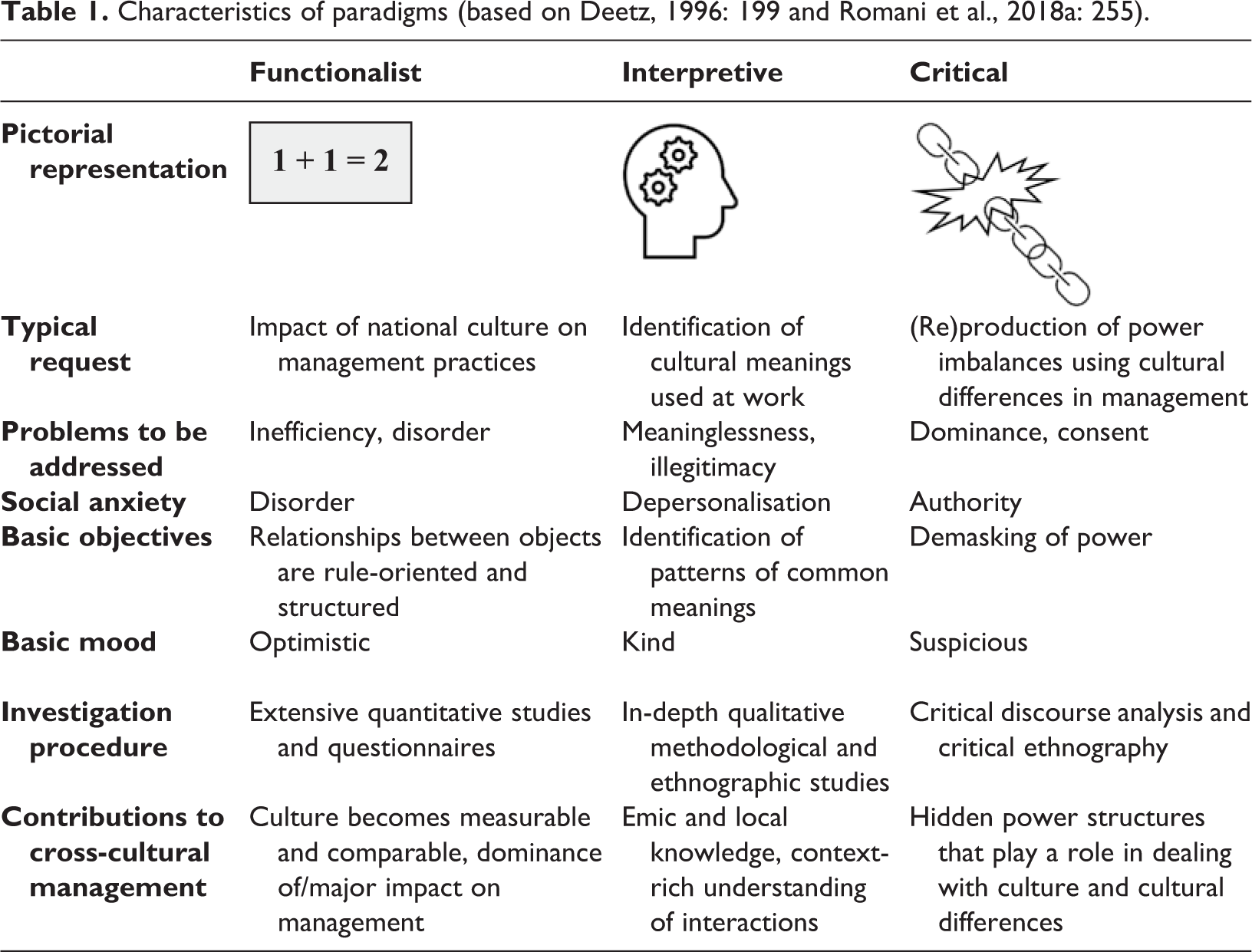
The functionalist paradigm, also known as positivist or objectivist, is based on the assumption that the world exists objectively and phenomena are real so they can be measured or proven. Thus, this paradigm builds on the view that social sciences are similar to natural sciences and that models are best suited to describe social reality and to find causal relationships between social phenomena (Donaldson, 2003). Comparative management and the most influential stream of cross-cultural management belong to this paradigm (Romani, 2008: 35), based on the assumption that (national) culture is stable, has clear boundaries and is internally homogeneous. Therefore large-scale quantitative surveys search for cultural differences or similarities and thus create cultural dimensions which rely on values, or patterns of behaviour (Hofstede, 2001; House et al., 2004). One goal of functionalist management research is to support decision-makers, leading to the increased effectiveness and efficiency of their organisations. Consequently, the current social order is not questioned.
The interpretive paradigm focuses on the understanding of culture through the explanation of social order ‘from within a culture’ (Romani, 2008: 6). Cultures are seen as interpretive frameworks (Geertz, 1973). Actors are sense-makers, because they perceive the socio-cultural reality within their interpretive frameworks in different ways and therefore give particular meanings to their social reality (Romani et al., 2011b). This paradigm thus pursues a subjective basic attitude. Corresponding studies therefore search for possible interpretations and social constructions of realities from the actors’ viewpoints (D’Iribarne, 2009). To study culture and intercultural interactions, context plays a decisive role: ‘The context is our content’ (Jackson, 2019: 1). The use of language as a core element of a meaning system also plays a crucial function (Holden, 2008). Research questions attempt to clarify differences and similarities between views of interest groups and thus describe and explain the respective attributed meanings from the actors’ perspectives (e.g. Gertsen and Zølner, 2014; Zølner, 2019). Observed phenomena, rather than laws, are represented. It is assumed that social and organisational phenomena are constantly changing, and that reality is always constructed and reconstructed by the actors. Concepts such as leadership, feedback and performance are culturally subjective (Chevrier, 2009). Consequently, concerning the socially constructed phenomena of research interests, ‘only’ the subjective interpretations made by the researcher (active role) are possible in this paradigm.
The critical paradigm (Alvesson, 2002; Mahadevan, 2017), which also includes the postcolonial paradigm (Jack and Westwood, 2006), considers knowledge and cognition as the result of a reflexive process of investigation. Dating back to Max Horkheimer, Theodor Adorno, and Herbert Marcuse, the ideological critique of capitalist societies is the subject of traditional critical theory. Alvesson and Willmott (1992) transferred these ideas to management studies. Critical research attempts to explore social phenomena through social inequality, injustice, dominance and exploitation. It takes into account those actors who have ‘less power’ and are less considered in social science. Disagreements concerning the existing (hidden or visible) social order and its power structures are uncovered, which leads to discussions. Cross-cultural management often focuses on power imbalance issues such as gender or religion in the workplace (Romani et al., 2018b) and intersectionality (Mahadevan et al., 2020). The aim of this iterative, reflexive approach is to improve society morally (Deetz, 1996: 202) or, in cross-cultural management, intercultural interactions and thus interpersonal relationships.
Multi-paradigmatic sensitivity: A critical incident illustration
To demonstrate the advantages of multi-paradigm research and in line with Jackson’s (2011: 535) request ‘to develop scholarship that can handle context-dependent, pragmatic action-oriented diversity’, we have chosen a critical incident (Flanagan, 1954), an intercultural situation characterised by typical misunderstandings and conflicts (Batchelder, 1993). These are triggered by cultural differences (e.g. diverging norms and value systems) and misinterpretations (e.g. diverging attributions of meaning) of the behaviour of the interaction partners.
The case was not collected within the framework of classical empirical social research but as part of a consulting assignment by the co-author of this article. It serves to illustrate how the same intercultural situation could be addressed by different paradigms, the functionalist, interpretive and critical paradigms. Diversity is highlighted, and paradigmatic differences are featured. We are able to show that multi-paradigmatic sensitivity leads to various angles on a specific situation and its context and thus a more differentiated understanding of the situation.
Self-reflexively, we, the authors of this article, are aware that due to our scientific socialisation we also express a preference for certain paradigms in our analysis. We situate ourselves at the interface of the functionalist and interpretive paradigms. Critics often ask for a clearer positioning of the researcher’s own paradigm while conducting multi-paradigm studies. This is due to the fact that one’s own dominant paradigm influences the way one sees and writes about the different paradigms. Moreover, being neutral or writing a paper solely from a meta-perspective is impossible. Multi-paradigm researchers have noticed that addressing only one audience at a time is advantageous in order to avoid confusing the readers (Romani et al., 2011a). We have chosen functionalist language at this point because it is most common in cross-cultural management and thus reaches a larger audience, not because we give priority to the paradigm in general.
The critical incident in Box 1 occurred in a German multinational company, a chemical group with subsidiaries in 30 countries worldwide including France. The financial department of the German headquarters is responsible for preparing the consolidated balance sheet. For this purpose, it requires the corresponding balance sheet figures from the foreign subsidiaries. Now, as when the incident occurred (in 2010), corresponding data is requested internally via email. The communication is mainly done in English, but sometimes also in German, depending on the language competences of the foreign colleagues. As is often the case in large corporate structures and across national borders, the actors do not know each other personally. Similarly, the parent company generally expects the subsidiaries to respond quickly. However, the French subsidiary did not reply.
A French–German critical incident.
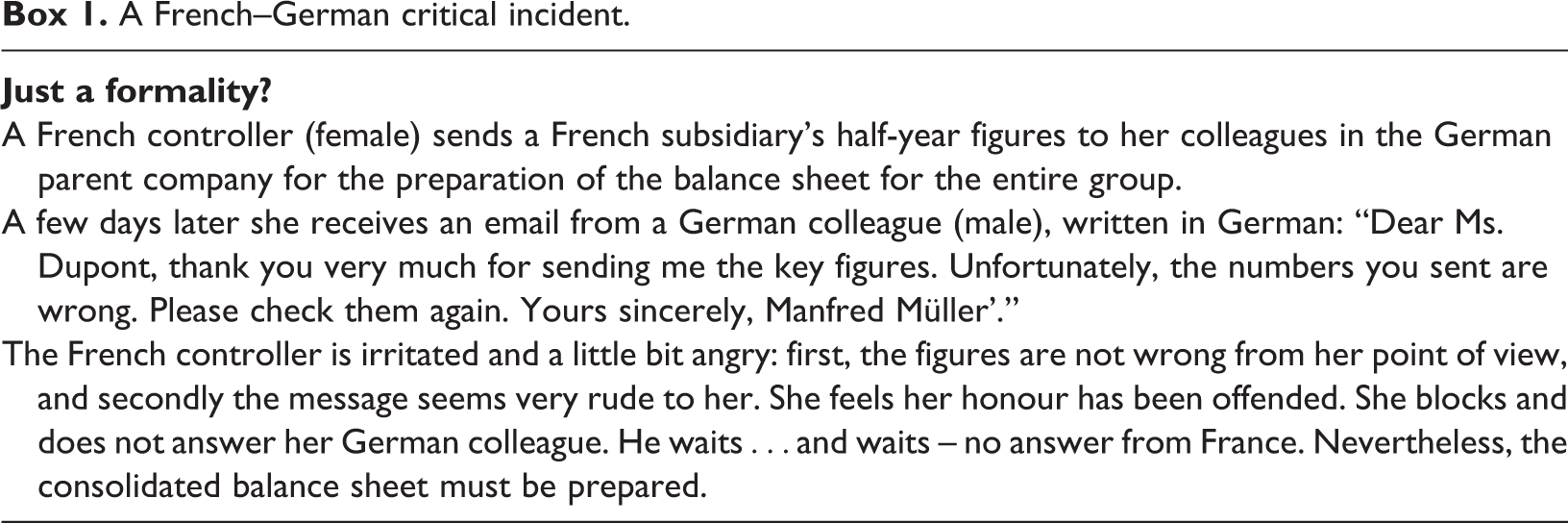
In order to demonstrate multi-paradigmatic sensitivity and the benefit of using multiple angles and perspectives, the following question arises: What concepts and theories exemplify possible analytical foci of the functionalist, interpretive and critical paradigms?
Functionalistic analysis
Concepts of intercultural research, such as cultural dimensions (Hall, 1981; Hofstede, 2001) or cultural standards (Thomas, 2018), are typical in the functionalist paradigm and are used to contrast cultural differences. Being sensitive to this paradigm, in this part we focus intentionally on national culture, which is typical for the functionalist mindset and its favouring of the tangibility of universal concepts, facts and figures.
Misunderstandings or problems arising in intercultural situations are often explained by cultural dimensions. In the present case, the masculinity/femininity cultural dimension defined by Hofstede (2001) could be used as a possible explanation for this critical incident. Masculinity characterises a society in which the roles of the different genders are clearly delineated: men have to be tough and materially oriented; women must be more modest and sensitive and value quality of life. Femininity characterises a society in which the gender roles overlap: both women and men should be modest and sensitive and attach importance to quality of life (Hofstede, 2001: 297). Masculine value orientations thus relate to characteristics such as independence, determination, initiative, achievement and competition, whereas feminine value orientations relate to harmony, equality and solidarity (Table 2).
Key differences between femininity and masculinity cultural dimensions (Hofstede, 2001: 299 and 317, extract).
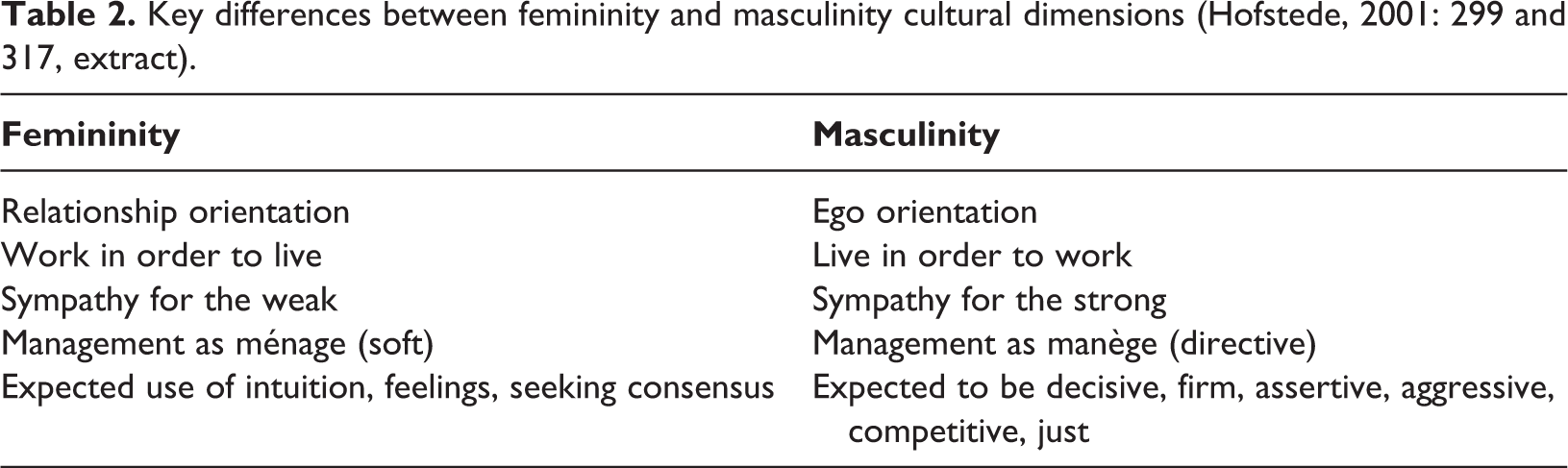
From a functionalist point of view and in terms of Table 2, the short and firm German email lacks personal address (‘Management as manège’) and thus can be seen as a ‘masculine’ orientation, which may have aggrieved the French colleague who is used to more empathy (‘Management as ménage’). The French colleague is more relationship-oriented, expecting an email to start more softly and indirectly with a few personal questions or remarks. According to Hofstede (2001), the difference of the femininity orientation of French people and the high masculinity of Germans explains the misunderstanding of such employees.
Another cultural dimension that could be used to explain the conflict is that of the cultural anthropologist Edward T Hall (1981). He describes whether people in communication situations tend to express their concerns more explicitly, i.e. clearly and distinctly, or more implicitly, i.e. indirectly and with paraphrasing. In the context of intercultural communication situations, Hall raises the question of information transfer and understanding: how much information (quantity) has to be passed on in which form (written/oral) and in which way (explicit/implicit), by whom (sender), to whom (receiver), in which language? Hall argues that people from France tend to communicate implicitly, whereas people from Germany tend to be more explicit. The German versus the French communication style is a national difference frequently discussed in cross-cultural management (Barmeyer et al., 2019b) and other studies (Heidenreich et al., 2012). In our case, the directly criticising email of the German employee is an explicit communication that may have offended the French counterpart.
Concerning written and oral communication it is important to underline that in Germany oral communication is perceived in the professional context as fleeting, imprecise and intangible, whereas written communication is considered to be precise and important; it can be relied upon and be enforced in the long term. This is also expressed in German everyday sayings such as ‘Wer schreibt, der bleibt’ (‘Those who write, stay’). In contrast, in France, written communication is perceived as impersonal and anonymous. It is therefore classified as less important than oral communication. An important message tends to be conveyed personally (Hall, 1981). The French employee in our case would have preferred personal dialogue, e.g. a telephone call, over an impersonal written email.
Cultural standards, nearly unknown in English-speaking literature with a few exceptions (Brueck and Kainzbauer, 2000; Romani et al., 2011a), are defined by Thomas (2018) as ways of perceiving, thinking and evaluating, and the typical actions of members of the same social system. Thomas (2010) identifies central cultural standards for Germany such as factual orientation (dealing with facts is more important than dealing with people), directness (expressing opinions clearly and unambiguously using necessary facts) and separation of personality and life areas (separation of professional and private life). While, according to Thomas (2018), German culture attaches great importance to objectivity in communication and cooperation, French culture is more person-oriented. In Germany, the relatively pronounced masking of feelings and moods enables efficient communication and cooperation. On the other hand, the quality of relationships in France increases by building personal trust and thus contributes significantly to efficient communication and cooperation. In our case, the fact-oriented email of the German colleague could be explained from a functionalist point of view, with German cultural standards offending the person-oriented French colleague.
In a nutshell, we summarise what kind of knowledge is reached: the functionalist paradigm focuses on ‘objective’ knowledge. The aim is to contrast and explain German–French cultural differences that lead to intercultural misunderstandings. Existing concepts, such as cultural dimensions, are used for this purpose. It is therefore about external and generalising knowledge that can be applied in an etic way to different intercultural situations.
Interpretive analysis
Researchers who assign themselves to the interpretive paradigm will immediately ask for more context regarding the critical incident because they search for perspectival perception. They would want to know about the sense-making process of involved actors – how notions and patterns of behaviour are perceived and interpreted differently. This is based on the assumption that within cultures actors develop and use specific systems of meaning which enable them to communicate and cooperate meaningfully with each other (Brannen, 2004; D’Iribarne, 2009; D’Iribarne et al., 2020). In our critical incident, different systems of meaning come together and lead to irritation because one actor (mis)interprets the behaviour of the other. In order to raise awareness and sensitivity to the interpretive paradigm, we use the following common interpretive theoretical conceptualisations in the field of cross-cultural management to show corresponding characteristics of an interpretive analysis: recontextualisation, negotiated culture, discourses and narratives (Gertsen and Zølner, 2020).
Recontextualisation describes the process of transferring practices as well as values from one country context to another, for example from parent company to subsidiary. To enable meaningful reception, meanings need to be adapted to the target context (Brannen, 2004; Gertsen and Zølner, 2012). In our case, an interpretive researcher could identify the failed transfer and try to capture the lack of understanding based on associated meaning in the German and French contexts respectively.
Another concept used in the interpretive paradigm is that of negotiated culture, which refers to a ‘new’ emerging working culture through situational and context-specific interaction (Brannen and Salk, 2000). Existing cross-cultural management research already examines Franco-German interpersonal interactions and negotiation (Barmeyer and Davoine, 2019). In our critical incident, negotiation fails due to denial of dialogue, no more emails are replied to and the process is stopped. An intervening researcher (action research) could promote a future constructive joint working culture on the basis of interviews by reflecting on the respective diverging views of the colleagues concerned.
Discourses and narratives would be suitable, for example, to learn how the two actors of the critical incident talk about the situational sequences ‘to show how managers and employees make sense of their cross-cultural experiences and how they use culture in this process’ (Gertsen and Zølner, 2020: 39). The different systems of meaning and interpretation of the German colleague and the French would thus become particularly clear, including their interests, points of conflict, and aspirations. So how do the actors see and interpret the behaviour of their counterpart? For example the direct and short email from the German colleague, using no paraphrasing or courtesies, may be interpreted by the French colleague as rude or even aggressive. Which interpretation do I give to the word ‘wrong’ in the phrase ‘unfortunately, the numbers you sent are wrong’? Are the numbers I delivered really incorrect? Or is it about something else, which is not linked to the numbers but perhaps to the quality of the relationship I have with my German colleague? Why is the message not formulated in a more polite and personal way? And why is the email written in the German language? On the other side, how may the non-reaction of the French colleague be interpreted by the German colleague? Perhaps my French colleague is ill or on holiday (personal reason)? Maybe she has not received my email (technical reason)? Perhaps she does not want to answer me (strategic/tactical reason)? It is possible that both colleagues will probably not even consider an intercultural interpretation.
Another approach in the interpretive paradigm is the consideration of national cultures. This is because culture is described as ‘shared meaning’ (D’Iribarne, 2009), conceptualised as ‘frames of intersubjective meaning structures’ (Gertsen and Zølner, 2020: 34). This presupposes close connections between actors. However, since a national culture comprises many people and thus interest (sub)groups, the ‘lowest common denominator’, i.e. the connection and the shared meaning system, is difficult to grasp (D’Iribarne, 2009: 311). D’Iribarne (2009) nevertheless finds underlying national unifying meaning systems, which he transfers to management systems. In empirical-emic studies, he points to historically rooted assumptions underlying national management practices. Other researchers (e.g. Chevrier, 2009; Segal, 2009), inspired by D’Iribarne, use other countries to show that culturally specific and emic understandings of supposedly universal concepts, such as leadership, empowerment or quality, are subject to different attributions of meaning and interpretation. This in turn reflects the existence of a national–cultural shared meaning. In our critical incident, these nation-specific peculiarities may also lead to misunderstanding. It is precisely this shared meaning that seems not to exist between the two actors. According to D’Iribarne (2009: 314), shared meaning also represents a ‘basic concern’ that people worry about or want to protect themselves from in everyday situations. As the French colleague does not respond to the email, she thus ‘plays dead’ – in French ‘Faire le Mort’. This term is frequently used in French working life to express displeasure or even resistance. Displeasure is not verbally expressed in a conversation or in a written email, but implicitly through non-verbal behaviour. This also goes along with the national core concern of the French in relation to their job, ‘métier’ (D’Iribarne, 2009), which stands for the rights that come with a social position. If these rights and duties of the job are externally questioned, ‘Faire le Mort’ may be a possible universal response.
In a nutshell, we summarise what kind of knowledge is reached: the interpretive paradigm is about understanding the respective views on a situation of the interacting people – the subjective knowledge that the actors construct socially. It is therefore not about whether the actors’ respective sense-making is right or wrong. It is about emic, culture-specific knowledge, for example forms of communication and cooperation. This knowledge is contextualised and cannot simply be transferred to other contexts.
Critical analysis
Being sensitive to the critical paradigm in cross-cultural management means demasking power imbalances and the unilateral assertion of interests, as intercultural studies from Moore (2016) and Ybema and Byun (2009) demonstrate. Mahadevan and colleagues (2020) assume that culture, power and diversity categories are interwoven and hence inseparable. Power is an integral part of any intercultural situation. In order to increase sensitivity to the critical paradigm, we detect different power asymmetries in our critical incident which we associate with three established aspects of general critical management studies that are important for the critical cross-cultural management research agenda (Romani et al., 2018b): denaturalisation, emancipation and reflexivity.
In contrast to the previous two paradigms, the critical paradigm wants to question and actively change the existing social order (Burrell and Morgan, 1979). Corresponding researchers are not considered as ‘bystanders’ but as ‘activists’ (Romani et al., 2018a: 253). The naturalised, taken-for-granted order is thus denaturalised. Not empathy and understanding but problematisations of knowledge come to the fore, enabling alternative research questions to generate new knowledge (Romani et al., 2018b). In terms of cross-cultural management, national–cultural differences and the well-known concept of cultural dimensions are questioned. Critical cross-cultural management considers other aspects – ‘implicit power elements’ (Romani et al., 2018b: 410) – influencing the perception of cultural differences independent of national culture. The paradigm thus aims to draw attention to alternatives and silenced voices (Jack and Westwood, 2009).
In our critical incident, for example, the power asymmetry between parent and subsidiary could be addressed by this paradigm from two perspectives. On the one hand, the email of the German colleague from the parent company may be seen as an expression of power and superiority by the French colleague. The person from the ‘powerful’ parent company can place demands and the person from the ‘powerless’ subsidiary should meet the demands as fast as possible. Also, the pre-established sensation of ‘correctness’ and ‘competence’ may be associated with the ‘big’ German parent company, whereas the ‘mistake’ and the ‘error’ is associated with the ‘small’ French subsidiary. According to Perlmutter’s (1969) publications on multinational enterprises (MNEs) and their strategies for managing foreign subsidiaries, this would be in line with an ethnocentric, powerful and regulatory parent company strategy.
However, on the other hand, a completely different perspective could also be taken which reverses the frequently stressed dominance of ‘powerful’ parent companies. In our critical incident, it is revealing to draw attention to the employee in the French subsidiary who, by not reacting, demonstrates power. The employee in the German parent company is dependent on the French colleague because he needs the key figures of the French subsidiary to prepare the consolidated balance sheet. However, since the French employee ‘plays dead’, the German colleague cannot exercise power over her. Sociological case studies in multinational companies address this hidden exercise of power (Geppert and Dörrenbächer, 2014). They show how employees in subsidiaries develop tactics and strategies to avoid complying with the guidelines of the parent company, for example because they consider them meaningless or simply because they do not want to carry out certain tasks and responsibilities. Particularly in the context of multinational companies, whose different country units are characterised by spatial, institutional, linguistic and cultural distance (polycentrism), subsidiaries can assert their interests unwaveringly against the parent company.
The inclusion or emancipation of less-established subjects is also reflected in further research interests of the critical paradigm. Romani et al. (2018b: 410) call these research foci ‘critical diversity markers’, and they include race, ethnicity, religion, language and gender. The two latter ones can be demonstrated in our critical incident: the German colleague writes his email to the French colleague in German, i.e. in the language of the country of the parent company, which can be understood as an expression of power (the email could instead have been written in English or French). Moreover, the employee in the parent company is a man, the employee in the subsidiary a woman. The socially attributed gender discrimination may be an annoyance to the French woman, even though the male German colleague may not have intended this. The direct and harsh tone of his email may emphasise her hurt feelings. As some women might expect, the careful handling of this woman’s sensitivity is ignored by the male colleague. Seen from another angle, in contrast this could be an indicator of his perception of equal position independent of gender.
Often, critical researchers refer to colonialist structures and the imposition of ideas and concepts from the Western world in power asymmetries (Alvesson and Willmott, 2012; Mahadevan, 2017; Primecz et al., 2015). So the paradigm ascribes a major role to contexts, for example historical, institutional, political or economic forces. According to critical cross-cultural management, these are aspects that are hidden behind the label ‘cultural differences’ (Romani et al., 2018a: 254) and influence intercultural communication, as our critical incident shows. Historical (war) experiences can play a role by unconsciously negatively influencing Franco-German intercultural cooperation via negative stereotypes. These past events are anchored in both collective memories by feelings of inferiority and superiority.
Sensitivity to this paradigm necessarily involves reflexivity regarding basic assumptions and routines as well as the researcher’s own role in the research process. It is important for knowledge generation that researchers are mindful of which of their own interests influence them (Jack and Westwood, 2009; Mahadevan, 2017). In this case, researchers would have to ask themselves whether they are more inclined towards one or the other ‘superiority’, depending on, for example, which nation they come from, which organisational side (parent–subsidiary) they work for, whether they are women or men themselves, but also how they approach the research process, and what the corresponding goal is.
In a nutshell, we summarise what kind of knowledge is reached: the critical paradigm is concerned with inequalities in society, and researchers of this paradigm actively seek to point out these injustices. Consequently, the critical paradigm and the created knowledge focus on the outcome of power imbalances and oppression. Ultimately, this knowledge about problems in society aims to draw attention to the imbalances, to foster change as well as identify alienation or forms of emancipation.
Discussion
Setting the paradigms in relation to each other
In this article, we demonstrate multi-paradigmatic sensitivity on the basis of a critical incident. In the following, we summarise insights gained during the juxtaposing of the three paradigms. Martin (1992: 5) postulates on the separate, parallel view of paradigms: What is to be learned from culture research is, in part, the usefulness of preserving the differences between these social scientific perspectives and deepening, rather than eradicating, the conflicts among them.
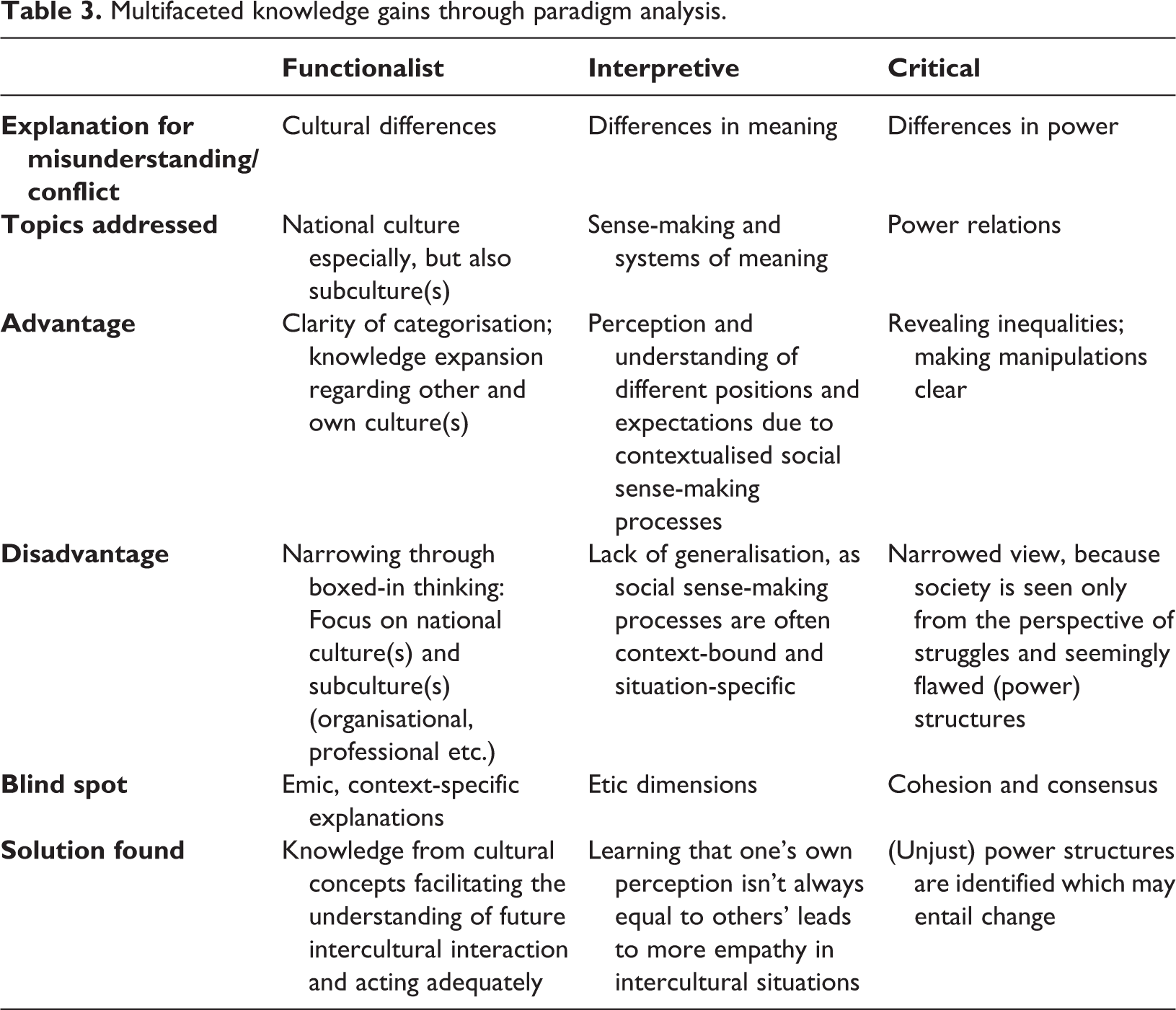
We want to highlight the following advantages and disadvantages of each paradigm presented:
The functionalist paradigm mainly concentrates on national–cultural differences which serve as explanations for misunderstandings and conflicts between the German employee and the French. An advantage is a clear and very accessible categorisation on the basis of cultural dimensions and cultural standards. Moreover, the knowledge about others’ and one’s own culture(s) is expanded. A disadvantage can be superficiality and narrowing, which is caused by boxed-in thinking. Focusing on only the French and the German national culture leads to the disregard of other subcultures, such as professional cultures or organisational cultures, which are rarely the focus of functionalist studies (Primecz et al., 2009: 270). These cultural concepts can increasingly be used as preparation and thus facilitators for future intercultural interactions. The blind spot of this paradigm is context-specific explanations, because the ‘objective’ researcher adopts an external perspective and corresponding etic methods that overlook local understanding.
The interpretive paradigm takes the specific Franco-German context into account as well as the divergent viewpoints and meaning systems of the employees. Therefore, the interpretation according to employees’ own cultural imprint that assumes what is right, normal and appropriate, results in misunderstandings and conflicts. An advantage of this paradigm is not the classification of cultural differences (functionalism), but the consideration of a diversity of perspectives due to different social sense-making processes which explain individual positions and expectations. A disadvantage can be the often absent possibility of generalisation since the social sense-making processes of the actors are often context-bound and thus very (situation-)specific. Moreover, accepting specific, context-bound interpretations may lead to a blind spot with regard to the etic dimensions. Only particular, not universal, knowledge is gained.
The critical paradigm explains misunderstanding and conflict on the basis of power inequalities. Its advantage is uncovering subcultural inequalities (gender, organisation, language etc.). The awareness of conflictual power relations may give a voice to the unheard, seemingly ‘powerless’ or ‘marginal’ individuals. Thus established structures can be challenged, and power can be differently allocated, producing change. A disadvantage may be the unilateral critical world view creating a focus on society as a place of struggle. The focus on silenced voices and oppression leads to a blind spot with regard to potential or existing cohesion and consensus.
In sum, the functionalist paradigm explains the conflict through cultural differences, the interpretive paradigm through different attributions of meaning to context and behaviour, and the critical paradigm through power (in)equalities. Table 3 displays the multifaceted knowledge gains which complement existing specialised studies that rely on only one paradigm. Multi-paradigm analyses are not necessarily superior but simply have another aim: not to delve deeply but to widen the picture, to broaden the views on social phenomena via multiple angles. Furthermore, we believe that in general conducting multi-paradigm studies enlarges possible perspectives. Therefore, we want to invite researchers to make the effort to engage in multi-paradigmatic sensitivity from time to time.
Multifaceted knowledge gains through paradigm analysis.
Becoming open to complementary handling of paradigms in cross-cultural management research
We are not claiming that we are able to change our core assumptions, nor that it is possible ‘that social scientists can adopt other positions so wholeheartedly that they determine their entire research outlook’ (Parker and McHugh, 1991: 452). In their criticism of a multi-paradigm study by Hassard (1991), Parker and McHugh, furthermore, state that acting ‘as if’ is also not possible: Paradigms cannot be like spectacles that we can change when necessary, otherwise all debate between them would be reduced to academic play. There would be no point in debate since we would all be able to move between paradigmatic positions whenever we wished. (Parker and McHugh, 1991: 452f.)
In addition, the critics Parker and McHugh (1991) point to the meta-level, namely that Hassard’s discussion on the four paradigms in use – four because he divides the critical paradigm into its two origins on the basis of Burrell and Morgan (1979) – goes back to ‘claiming priority over the other four [paradigms] and suggesting that his discourse synthesises the discourse produced by the other four [paradigms]’ (Parker and McHugh, 1991: 453). This was also criticised by Chia (1996: 40) with regard to Burrell and Morgan’s 2 × 2 paradigm matrix: ‘The question then arises of their ability to be both within the framework and at the same time in a privileged position to frame it’. Parker and McHugh (1991) introduced another argument, which is even more profound: Hassard’s study is not multi-paradigmatic at all, because no ‘mental gymnastics’ is necessary to follow it. In our opinion, these types of critiques may have their justification, but aren’t they going too far if we don’t want to stagnate in terms of knowledge production? We, as a research community, could continue to argue on this level and isolate paradigms, but then there will be no progress: at most a deepening of scientific-theoretical determination and the discussion’s specialisation. Especially within cross-cultural management as an applied science, it is important to activate interdisciplinarity and to argue practically: For Hassard, paradigms also remain distinct, if negotiable, language games whose dynamic lies primarily in the production, rather than the consumption, of knowledge spaces. (Hassard and Kelemen, 2002: 345)
Occasionally researchers could try to change perspectives in order to discover new insights, even if the discussion of scientific theory reaches deeper, and for some researchers our positioning would be seen superficially as an ‘anything goes’ approach (Feyerabend, 1975). Nevertheless, we think there is ‘the need to move beyond paradigms by adopting a “pragmatic” perspective’ while preserving ‘the internal logic and identity of paradigms’ (Hassard and Kelemen, 2002: 345f.). Critics of multi-paradigm studies are invited to try this, but are also welcome to remain fundamentally critical, so that the paradigms do not become too blurred. The scientific community might take care that multi-paradigm studies do not become a standard of mixing paradigms without reflection. Multi-paradigm studies should therefore only take place with a certain amount of reflexivity on the debate and, accordingly, on one’s own paradigm. This makes a study less susceptible to being exposed as ‘non-consumer’, referring to ‘those researchers who may not be aware of the debate on paradigms, and/or do not make it explicit in their writings’ (Hassard and Kelemen, 2002: 341).
Empirical and meta-theoretical contribution
The contribution of our article is threefold. First, it should be noted that although there is literature on the methods and meaningfulness of multi-paradigm studies, few actually carry them out and apply them. Respective research therefore often only takes place on a meta-theoretical level (Gioia and Pitre, 1990; Schultz and Hatch, 1996). Beyond these meta-theoretical considerations, we point out different paradigm views on a critical incident, leading to a paradigmatically aware and broadened, multifaceted view on the situation. We are able to show that paradigms not only determine what is researched, but also where problems are seen and in which way these problems can be directed. Searching for similarities and differences enables a constructive approach to paradigms, which enriches research and practice accordingly through complementarity. There might already be enlightening moments as, reading through the different paradigms, aspects come to light that broaden one’s own way of thinking. There is an expansion of corresponding considerations and thus the ‘tunnel vision’ of one’s own paradigm is diminished.
Furthermore, second, we analogically demonstrate how meaningful multi-paradigmatic sensitivity can be, especially with regard to the intercultural component of the critical incident. In line with cross-cultural management, we show that the different perspectives gained by this sensitivity extend the possible options for successful intercultural cooperation. This is equivalent to the concept of ethnorelativism (Bennett, 1993) to better understand other cultural social systems and thus promote complementary cooperation. An increasing awareness and dealing with the diversity of existing paradigms in cross-cultural management leads to a constructive ethnorelativist attitude. In line with constructive cross-cultural management, this awareness of different paradigms – paradigmatic ethnorelativism – thus also enriches the field and transforms stagnation and bias into innovation (Barmeyer et al., 2019b). Without the openness to other paradigms, the picture remains mostly one-sided, exclusive and ethnocentric.
Third, the multi-paradigm approach makes it possible to repeatedly assume a meta-level – here not to be confused with the meta-theoretical level. A meta-level is a superordinate, intellectual-abstract view that people adopt in order to view structures, objects and interactions from a distance and thus better understand and question them. The concept originates in psychology (Metzger, 1999) and is addressed in systems theory (Luhmann, 1995) in connection with self-referentiality. The German sociologist Simmel (1908) addressed the significance of objectivity as ‘freedom’, helpful in understanding ‘the Other’. The use of meta-perspectives makes it possible to reflect interculturality – in theory and practice – and thus to adopt a ethnorelativist attitude mentioned above (Bennett, 1993; Hoopes, 1981).
Implications, outlook and future research
Theoretical implications
Members of the research community could increasingly look at paradigms in order to learn to empathise with their own and other paradigms and thereby advance research through original findings that can enhance innovative discussions. Sensitivity to multiple paradigms means being able to present and understand research findings more comprehensively in relation to situations or phenomena. The – so far – predominantly missed opportunity of expediently and advantageously using different paradigmatic views can be taken up in cross-cultural management research by analysing complex intercultural contexts from the point of view of different paradigms. Different insights can only be gained if the existing paradigmatic diversity of perspectives is used thematically, methodically and empirically and the potential is not simply recorded on a meta-theoretical level. In addition to the discussion about multi-paradigm studies and novel possibilities on a theoretical level, further contributions with regard to empirical data and actual sensitive application to intercultural topics are needed.
Practical implications
The practical implications underline the advantages of knowing our own and other existing paradigms. First, multi-paradigm analysis, or even just the sensitivity to it, enables managers to reflect on cross-cultural situations from different angles and so is an eye-opener, expanding their views by making them see what they did not realise or imagine before. These actors can thus be inspired to think ‘out of box’ and find (innovative) solutions. Second, via a sensitive multi-paradigm mindset, managers take the ethnorelativist meta-level which helps to achieve a tendentially more neutral position. The adoption of the meta-level perspective, i.e. ultimate awareness of multiple paradigms, is addressed in publications on intercultural competence (Spencer-Oatey and Franklin, 2009) and cultural intelligence (Earley et al., 2006). This puts managers, consultants and trainers in a position to act integratively, connecting and mediating in organisational networks. In conclusion, managers familiar with paradigms tend to be more interculturally competent in concrete cross-cultural situations because they can communicate and cooperate in a targeted and appropriate manner.
Outlook and future research
The handling of multiple paradigms is still in its infancy. We wanted to demonstrate an enlightening moment: the recognition of a possibility of building up a more diverse knowledge and thus a more comprehensive understanding. From our constructive cross-cultural management point of view, researchers might focus on complementarities resulting from differences. A researcher with another dominant paradigm would probably have approached this paper differently. There will always be different points of view to be heard and discussed in the interests of knowledge generation. This is why the goal, demand and obligation of the research community might be to shift from the meta-theoretical level to empirical action using multiple paradigms or simply multi-paradigmatic sensitivity to research phenomena to generate knowledge via content. Nevertheless, the dialogue and critical debates about raising theoretical issues help to keep the balance through reflexivity.
Since every person and thus every researcher is shaped by different life stories and, therefore, different influences, the conscious handling of paradigms in articles must always be critically questioned. What are the basic assumptions used by the researcher? In this context, it would be extremely interesting for future studies to assemble a research team with team members from different paradigms, who would then consider a research phenomenon separately, ideally empirically, and subsequently enter into an exchange. Contrary to what we have been able to show in this paper, this team composition would first lead to a deepening of each paradigm through expert knowledge and then to a broadening due to the exchange about the different analyses.
This article not only strengthens multi-paradigmatic consciousness, generates attention and stimulates research discussion, but also triggers a momentum of its own. Respecting and actively dealing with other paradigms contributes to changing one’s own awareness of diverse (previously hidden) topics and creates complementary insights on several levels. Like Lewis and Grimes (1999: 687), we would like to conclude fruitfully with the following quotation from Popper (1970: 86): I do admit that at any moment we are prisoners caught in the framework of our theories; our expectations; our past experiences; our language. But we are prisoners in the Pickwickian sense: if we try, we can break out of our framework at any time. Admittedly, we shall find ourselves again in a framework, but it will be a better and a roomier one; and we can at any moment break out of it again.
Footnotes
Acknowledgement
The authors would like to thank the reviewers for their dedicated and constructive reviews of the manuscript.
Declaration of Conflicting Interests
The author(s) declared no potential conflicts of interest with respect to the research, authorship, and/or publication of this article.
Funding
The author(s) received no financial support for the research, authorship, and/or publication of this article.
