




Abstract
This article examines the middle management representations of organization and managerial roles within a specific bicultural organizational context. The argument explores the extant cross-cultural management literature and identifies two predominant positions: a functionalist-stable stance and a dynamically interpretive perspective of culture. Historically, both positions have contributed to understanding management roles and behaviours in different cross-cultural contexts; however, each also possesses limitations. In response, the argument elaborates a multi-paradigmatic model and framework that synergise elements of the respective approaches. An interpretive methodology using a distinctive qualitative case study of the Franco-German collaborative media venture ARTE is developed. The researchers conducted 31 interviews with French and German ARTE middle managers in order to determine their perceptions of middle-manager roles in this context. The article identified differences in managerial role perceptions and behaviours as well as hybrid working practices as a result of intercultural adaptation and learning in addition to implications, limitations and future directions in the study.
Keywords
Introduction
Cultural discussions in organization and management have been commonly addressed through the areas of international business and cross-cultural management (CCM). CCM research has had a frequent predilection towards functionalist perspectives of culture considering it as an artefact – self-contained, stable and temporally bound (Fang, 2006; Jackson, 2011; Primecz et al., 2016). In more recent decades, social constructivist and interpretive approaches to culture have arisen embracing: emergence, complexity, hybridity and pluralism (Brannen and Salk, 2000; Jackson, 2011; Primecz et al., 2011; Søderberg and Romani, 2017). Much of the empirical work on CCM tends to espouse one of these two cultural paradigmatic conceptualizations. However, as a means of developing cross-cultural understandings, a categorical adherence to a single approach may inhibit rich representations of cross-cultural phenomena and, therefore, it is important to move beyond a mono-perspectival approach. There is, therefore, scope to develop and present a more balanced view embracing hybrid appreciation of stable-functionalist and dynamic-interpretive perspectives (Dao, 2016; Lee et al., 2015). An integrative hybrid approach of culture, kindred with multi-paradigmatic approaches, is valuable for a better understanding of managerial practices in intercultural contexts.
We explore this integrative approach by examining the processes and impacts of Franco-German middle manager role perceptions in the TV channel company, ARTE – a high profile binational organization where French and German employees interact on a daily basis in multicultural teams in an expressly Franco-German collaborative institution. This intercultural context and focal group are particularly apposite because middle managers’ operational roles and perceptions have a particular propensity to being acutely exposed to cultural and institutional influences (Ganter and Walgenbach, 2002). A distinctive feature of middle managers is not their place in the organizational chart, but ‘their access to top management coupled with their knowledge of operations’ (Wooldridge et al., 2008). Understanding how managerial role perceptions vary in different cultural and institutional contexts emerges as a key issue at a time where multinational company workforces are increasingly multicultural and operate from diverse locations. Evidently, prior studies have acknowledged that national cultures and institutions influence organizational structures as well as managerial representations and role perceptions in culture-comparative or intercultural perspective (e.g. Child and Kieser, 1979; Delmestri and Walgenbach, 2005; Segal, 1997; Stewart et al., 1994; Winch et al., 2000). Consequently, we cross-examine the role perceptions of middle managers from two European countries, France and Germany, traditionally associated with two different cultural metaphorical representations of organization (Hofstede, 2001): the (French and Latin) ‘Pyramid of People’ and the (Germanic) ‘Well-oiled machine’. We then show how practices and representations are negotiated.
The article develops as follows: first, the theoretical framework of the article is presented; then, the argument considers the framing and influence of national cultural contexts on managerial role perceptions and, specifically, French–German interactions. This leads to the presentation of the ARTE case study and methodology. Finally, we discuss the article’s findings, contributions, limitations and possible future directions.
Theoretical background and conceptual framework
The article employs organizational metaphors, which are often culturally embedded, used in the sense of Max Weber’s (1904) ‘ideal-types’ to circumscribe and depict particularities of organizations. These are then related to two organizational–cultural representations which are prevalent in CCM research: a stable-functionalist and a dynamically interpretive one – and their complementary aspects.
Organizational metaphors in France and Germany
It has been argued that distinctive individual perceptions of organizations are related to implicit images or metaphors of organizations (Gmür, 2006; Morgan, 1986). Metaphors are associations between abstract concepts and tangible things and thus clarify one concept by means of another concept (Lakoff and Johnson, 1980). Hofstede (2001) stresses the impact of culture on these perceptions and famously derives (by isolating the two cultural dimensions of ‘uncertainty avoidance’ and ‘power distance’) four implicit models of organizations (‘village market’, ‘family’, ‘well-oiled machine’ and ‘pyramid’ of people) aligned with particular clusters of countries (Hofstede, 2001: 376–8). Hofstede’s influential work has been critiqued as having methodological design issues and limitations (Kirkman et al., 2006; McSweeney, 2002); however, it remains extensively cited in organization and management within a stable-functionalist tradition (Beugelsdijk et al., 2017; Hofstede, 1980; House et al., 2004; Jackson, 2011; Stahl and Tung, 2015).
Metaphors can have significant implications for middle managers. In Hofstede’s typology, the normative French mode of organization is represented as a ‘Pyramid of people’ typically characterized by high hierarchical distance, highly centralized decision-making processes and more informal and personalized leadership style (Barsoux and Lawrence, 2013; Maclean et al., 2006). Therein, middle managers are conduits to higher power-centric individuals. Alternatively, German managers may more typically understand the organization as a ‘Well-oiled machine’ – a functional structure characterized by: low hierarchical distance, high degree of specialization of activities, decentralized and participative decision-making process and a formal leadership style relying on norms, goals and procedures (Hofstede, 2001; Marinas and Condruz-Bacescu, 2009). Herein, middle managers operate in a collegial and facilitative community-based mode.
It has been posited that many multinational firm employees enact quasi-Anglo-Saxon identities (Delmestri, 2006), reflecting hegemonic Anglo-Saxon management approaches (Chanlat, 2014; Ferner and Quintanilla, 1998; Smith and Meiksins, 1995). Moreover, Anglo-Saxon culturally informed contexts tend to reify the empirical, pragmatic, vocational and experiential and employ situational sense-making focusing on ‘practical’ and ‘local’ (Bryman and Bell, 2015; McEwan, 2001; Stokes, 2008; Weick, 1995). Furthermore, theories developed by major classical authors in France and Germany underpin critical influences on manager perceptions of their roles. In the German context, Weber’s (1947) theory of bureaucracy evokes a ‘well-oiled machine’, where ‘official functions are governed by rules’ and where authority centres on ‘a specified sphere of competence’ delineated by a systematic division of labour (Weber, 1947: 330). As a result of this high specialization of activities, decision-making processes are consensual and decentralized with all ‘experts’ being consulted which, in turn, reflects a low power distance. In contrast, the French organizational sociologist Crozier (1963) reflects an understanding of organizations that is more human and political, resonant with a pyramid of people and emphasizing actors’ freedom and agency rather than structures (Chanlat, 2014). In such models of organizations, power distance is greater linked to directive decision-making processes. Hence, for example, while German students may learn classical organization theory from the predominant perspective of ‘functions’, ‘structures’ and ‘processes’, their French counterparts, especially those in ‘Grandes Ecoles’, are initiated early in issues of power and micropolitics within organizations (Barmeyer, 2007; Davoine, 2002; Stokes, 2008). French and German educational systems therefore convey quite distinctive and differentiated embedded images of organizations (Gmür, 2006), which students learn, internalize and reproduce as they operate and evolve in organizations.
Developing multi-paradigmatic approaches of culture
CCM and International Management (IM) scholars have commonly identified distinct stances concerning organizational and national cultures (Boyacigiler et al., 2004; Fang, 2006; Mahadevan, 2013; Sackmann and Phillips, 2004). Broadly stated, one can be described as a stable-functionalist approach and the other the dynamically interpretive approach (Romani et al., 2018). Stable-functionalistic viewpoints cast culture in terms of, for example, fixed characteristics and differences which may destabilize international collaborations and joint ventures. Alternatively, a dynamic-interpretive view sees culture as emergent within various international contexts (Dao, 2016; Lee et al., 2015). The present article proposes that, rather than being mutually exclusive (as is frequently argued), these approaches can be complementary and integrated in CCM research with each approach providing a lens on the complexity of international managerial and organizational practices. In order to situate them in organizational research, the present argument links these positions to social research paradigms and advocates the development of a constructivist multi-paradigmatic approach. In the next stages of the article, these two broad positions are mapped out in greater detail and a multi-paradigmatic posture is developed.
A stable-functionalist culture approach
CCM has been long-dominated by a functionalist concept of ‘culture’ as something which is stable, self-contained and homogenous (Brannen and Doz, 2010; Fang, 2006; Nathan, 2015). Therein, culture comprises distinct characteristics, such as values and norms that can be observed, measured and managerially manipulated. Therefore, categories of cultures, for example, ‘classical’ cultural dimensions such as ‘Power Distance’, serve to describe and elaborate particularities of (national) management and organizations as well as bipolar spectra of behaviour (Hofstede, 1980, 2001; House et al., 2004). Within this canon, one long-standing research focus is the search for regularities or patterns (Romani et al., 2018) which illustrate how cultures contribute to specific solutions concerning universal problems (Kluckhohn and Strodtbeck, 1961). This implies implicitly relatively homogenous, stable cultural units which change only gradually over time within given national cultural frameworks (Bjerregaard et al., 2009; Chevrier, 2009; Phillips and Sackmann, 2015). The ‘national culture model’ assumes that cultures are juxtaposed, akin to demarcated entities, like ‘billiard balls’, (Wolf, 1982: 6) and remain separate (Brannen, 1998). This approach is prevalent in explaining cultural organizational differences primarily through the concept of ‘cultural distance’ (Kogut and Singh, 1988), although it has also been critiqued in equal measure (Harzing and Pudelko, 2016; Shenkar, 2001). In other quarters, ‘essentialist’ approaches to culture have been discredited (Nathan, 2015) as they overlook contextual and individual factors which are important for the development of hybrid, culturally diverse work cultures and organization (Brannen and Salk, 2000: 458; Jackson, 2011: 538).
A dynamically interpretive culture approach
Alternatively, national and organizational cultures can be seen as dynamic and strongly contextualized – affiliated with the increasing internationalization and intensification of interactions between organizational actors coming from different cultural backgrounds (Fang, 2006). Yagi and Kleinberg (2011) suggest that due to this interculturalization, cultural practices (and identities) of persons in intercultural encounters are redefined, overlapped and developed. Thus, static and decontextualized cultural concepts are increasingly less suitable for depicting and analysing interculturality (Søderberg and Holden, 2002). In many regards, national categories are becoming increasingly blended and blurred due to intercultural complexities in work environments and multicultural group affiliations of individuals (Bjerregaard et al., 2009; Fang, 2006). Thus, these dynamics erode the explanatory case in research and practice for a stable-functionalist approach.
Over recent decades, a response, linked to social constructivist interpretive approaches to culture, has emerged (Berger and Luckmann, 1966). Following Geertz (1973), D’Iribarne (2009) considers culture as a system of meanings – an interpretive framework – shared, within a group and which resides within a particular – national context. This interpretive approach, based on a historical and philosophical analysis, assumes a relative (rather than fixed) temporal stability of cultural elements. Brannen (1998) and Brannen and Salk (2000) propose a concept of ‘negotiated culture’ – a more dynamic interpretive approach of culture – based on mutual adaptations and learning processes of actors which generate new working cultures. Therein, key foci emerge through co-construction of values and meanings (Romani et al., 2018). Thus, not only static (national) cultures shape the logics, roles and work practices of actors (Søderberg and Holden, 2002), but rather new dynamic forms of cooperation and working cultures increasingly emerge in a range of contexts – including multicultural organizations – grounded in hybrid meanings and practices that are ‘negotiated’ between (cultural) groups (Clausen, 2007). The negotiated culture approach acknowledges the significance of national cultural origins, but recognizes that these are modified through ongoing interactions (Barmeyer and Davoine, 2019; Brannen, 1998). ‘Culture’ has a life of its own, historically replete with dynamic evolutions and therefore full of contradictions. In addition, the interaction between cultures initiates change processes in values and behaviours which reinforce why cultures cannot be regarded as fossilized or straightforwardly inherited, but rather learned (Fang, 2006; Stokes et al., 2016).
CCM research through multi-paradigmatic analysis
Scientific paradigms have long preoccupied social and organization science (Burrell and Morgan, 1979; Kuhn, 1962). As discussed above, within CCM research, a majority of empirical work has generally been assigned to one of two principal cultural approaches: the culture stable or the culture dynamic (Mahadevan, 2013, 2017). The combination of different social paradigms is challenging due to the notion of incommensurability (Burrell and Morgan, 1979; Kuhn, 1962). This suggests that each paradigm is separated with little possibility of conjunction since they are based on different systems and their ‘norms and definitions of science’ differ (Kuhn, 1962: 159). In contrast, proponents of integrative paradigmatic approaches claim: ‘containment of the theories of pluralism’ (Scherer, 1997: 69) and wish a return to common foundational grounds of epistemology and ontology for emergent knowledge (Romani, 2010). According to Schultz and Hatch (1996), the multi-paradigm perspective not only embraces ‘separate academic worldviews’ (Romani et al., 2011) but also emphasizes the possibility of exchanges and interconnections between paradigms which augur potential learning from alternative paradigmatic metaphorical speaking of ‘languages’ (Romani, 2010: 60). Thus, the advantage of multi-paradigmatic analysis is that it permits description of phenomena more precisely (Mahadevan, 2013; Primecz et al., 2015) and examines problems from varying perspectives. The disadvantage is that when concepts are used differently within the paradigms, they risk losing their sharpness. The subsequent analysis illustrates that an integrative ‘both as well as’ approach is consistent with multi-paradigmatic studies (Mahadevan, 2013; Primecz et al., 2015; Romani, 2010; Romani et al., 2018) and align the article’s position with the interplay paradigm-crossing strategy of Schultz and Hatch (1996: 530), defined as the simultaneous recognition of both contrasts and connections between paradigms. The present article highlights how this approach brings complementary perspectives for the analysis of empirical data and responds to calls for such analyses (Brannen and Doz, 2010: 244–5).
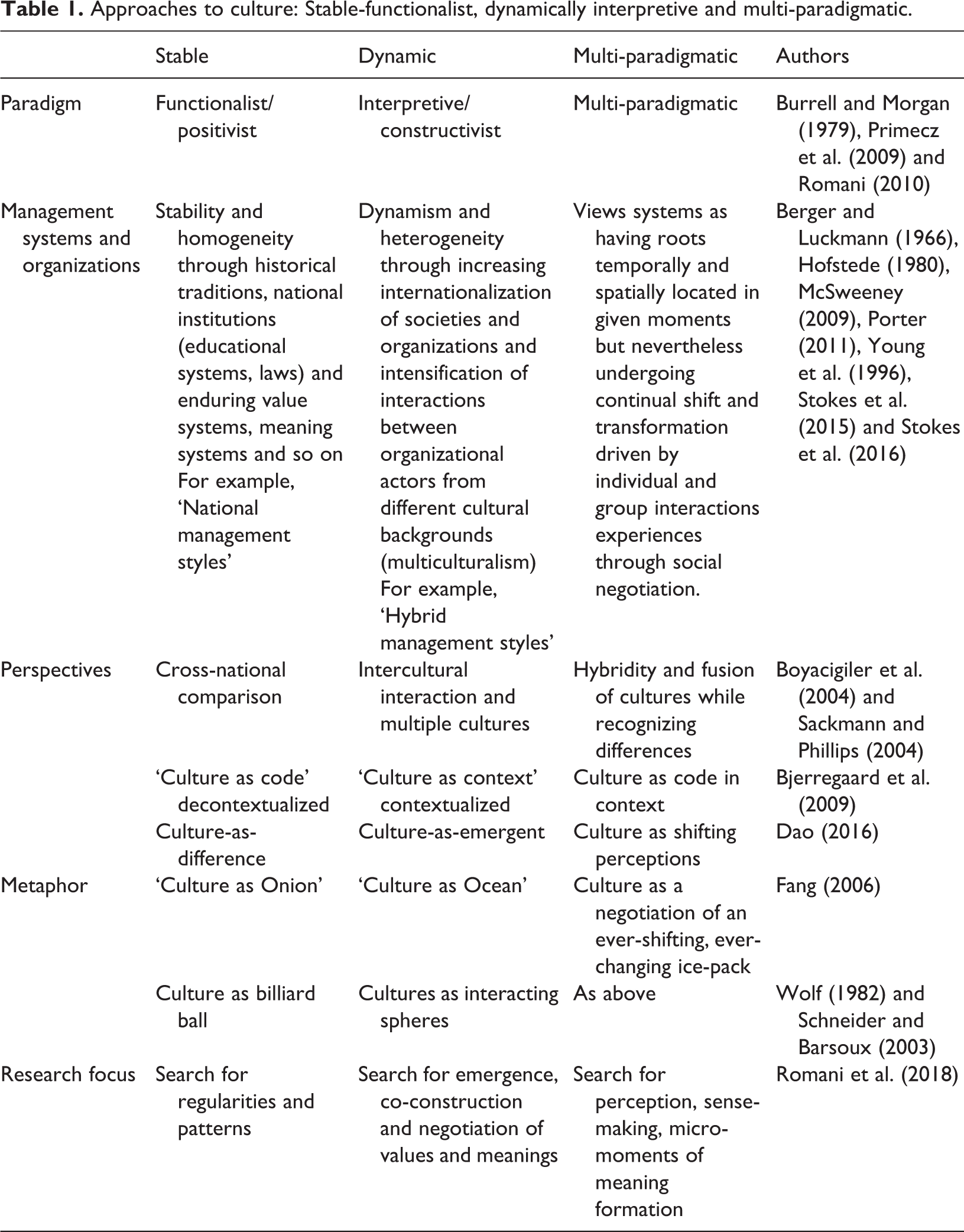
Table 1 summarizes the paradigmatic positions of approaches to culture.
Approaches to culture: Stable-functionalist, dynamically interpretive and multi-paradigmatic.
The next stage of the article builds an application of this multi-paradigmatic approach to a case study looking at the Franco-German collaborative media company ARTE.
Methodology: ARTE – A binational case study
The study employs an overall qualitative and inductive methodological approach (Caprar, 2011; Denzin and Lincoln, 2011; Silverman, 2011). This encompasses a focal in-depth binational case study involving multilingual semi-structured interviews (Gubrium and Holstein, 2012) and, to a lesser but nevertheless important extent, forms of participant observation (DeWalt and DeWalt, 2011; Spradley, 1980).
The case-study approach followed methodological elements prevalent in other case studies in intercultural and comparative settings (Stewart et al., 1994; Winch et al., 2000). In the present research, a single-case design has been chosen and, following Yin (2009: 185), it is an ‘exemplary’ case study – the organizational context of ARTE can be considered as unique (or at least extremely rare). The purpose of the case is to offer in-depth data of a detailed nature situated in specific contexts (Eisenhardt and Graebner, 2007; Siggelkow, 2007). Concerning generalizations from the case context, it is reasonable to suggest that ARTE represents a particular instance in time and space but nevertheless equally potentially offers data and insights resonant with general Franco-German/binational and potentially wider international contexts. These aspects are explored in the following section.
ARTE – The company
The binational European TV channel ARTE is based in Strasbourg, France. It is an organization set up not with conventional profit objectives but, rather, founded on the strong vision of bringing European citizens closer together and promoting cultural integration (‘Völkerverständigung’), which is stated in the mission: ‘The object is to conceive, arrange […] television programmes of a cultural and international character in a broad sense and likely to promote understanding and rapprochement between the peoples of Europe’ [the authors translation]. ARTE is also an interesting case because hundreds of employees from Germany and France work closely together in one place in order to achieve a daily European TV programme schedule broadcast across many European countries. These interactions are steered and controlled by, inter alia, middle managers, who fulfil certain roles and functions. ARTE is composed of three entities: the headquarters, located in Strasbourg, and the two national units – ARTE France in Paris and ARTE Deutschland TV GmbH in Baden-Baden. The two national units jointly oversee organizational governance, finance and control of the headquarters operations. They are also responsible, in equal proportion, for producing and delivering programmes for the headquarters which, in turn, broadcasts them. Both national units not only have to govern the organization but also have to represent the national interests through the subsidiary ARTE binational advisory and decision-making bodies (ARTE, 2019). There are four binational decision-making bodies coordinating the activities of the headquarters through Franco-German parity.
The case study research focused on the headquarters in Strasbourg, where programme strategy and commissioning and scheduling policy are defined. The headquarters is in charge of broadcasting news, magazine programmes and evening schedules. It is also responsible for coordination and planning public relations activities, website development, language services and manages European partner relations. The headquarters employs approximately 500 French and German nationals and relies on freelance and independent journalists, guest performers and contractors for miscellaneous services (ARTE, 2019). The average age of employees is 42 years and the average period of service is 9 years. In relation to the gender composition of the workforce, 63 per cent are women and 37 per cent are men. In terms of nationality, 72 per cent are French, 24 per cent are German and the remaining 4 per cent are citizens of other nationality.
Data collection
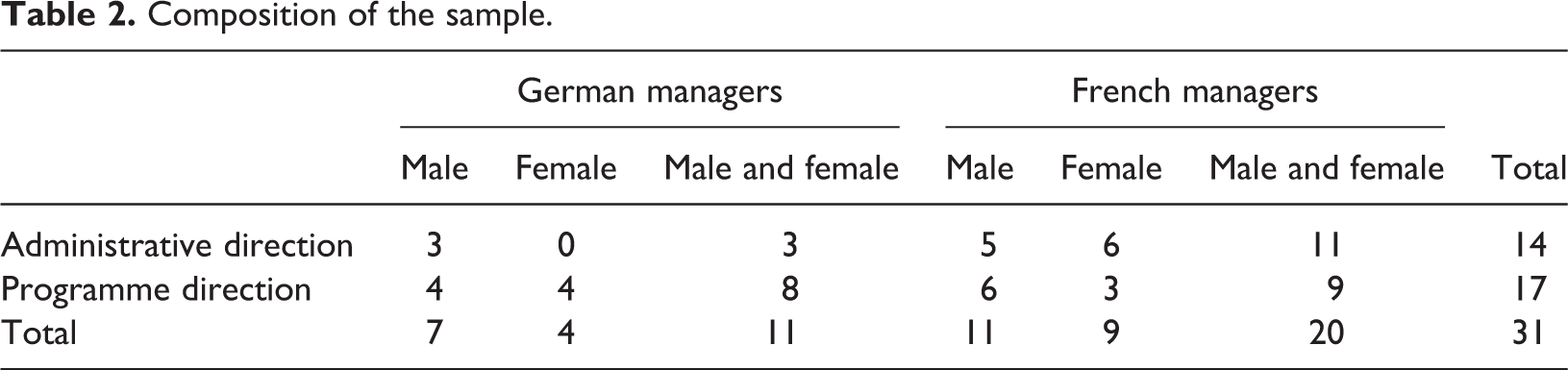
The design and preparatory phase of the research involved a documentation study in order to develop an understanding of ARTE’s history, its structural specificities and political issues. The case-study approach adhered to structural and methodological elements of other case studies of middle managers in comparative or intercultural settings. In-depth semi-structured interviews were conducted with 31 managers from different departments (see Table 2). ARTE has four management hierarchical layers (from the executive committee to team leaders). Five of the interviewed managers were members of the executive committee or upper-middle managers, the others were middle managers of the third and fourth layers. Top and upper middle managers were also asked about their expectations towards supervised middle managers (see interview guides by Stewart et al., 1994). The interviews were conducted primarily in 2008. The study used the interview guideline of the British–German comparative study conducted by Stewart et al. (1994) which added new questions relevant for French–German management (Barmeyer, 2007; Davoine, 2002) and questions relevant for intercultural interactions (Winch et al., 2000). With this integrative guideline, we could identify culture-comparative as well as interactive elements concerning middle management representations and interactions. We then analysed our data material in two steps: the first focusing on perceived differences, as well as in expressed differences, of role representations; the second step focusing on hybrid practices and mutual learning and adaptive processes.
Composition of the sample.
The interviews were conducted in the language of the interviewee by two interviewers simultaneously. They lasted between 60 min and 120 min covering a wide range of topics pertaining to middle management perceptions, including communication, constraints, time management, meeting management, leadership roles, interactions and team management methods in relation to the organizational context of ARTE. As the researchers spent substantial periods of time at ARTE, the interviews were complemented by participant observation wherein the researchers acted as ‘participant as observer’ (DeWalt and DeWalt, 2011; Spradley, 1980). In order to triangulate observations (Yin, 2009), complementary interviews were conducted with HR partners and external observers during the years 2008 and 2009; a documentation analysis covering 2 years long has been completed. A presentation of results with interviewees and additional managers was organized at the end of our research project in order to cross-validate our analysis from field actors.
Data analysis
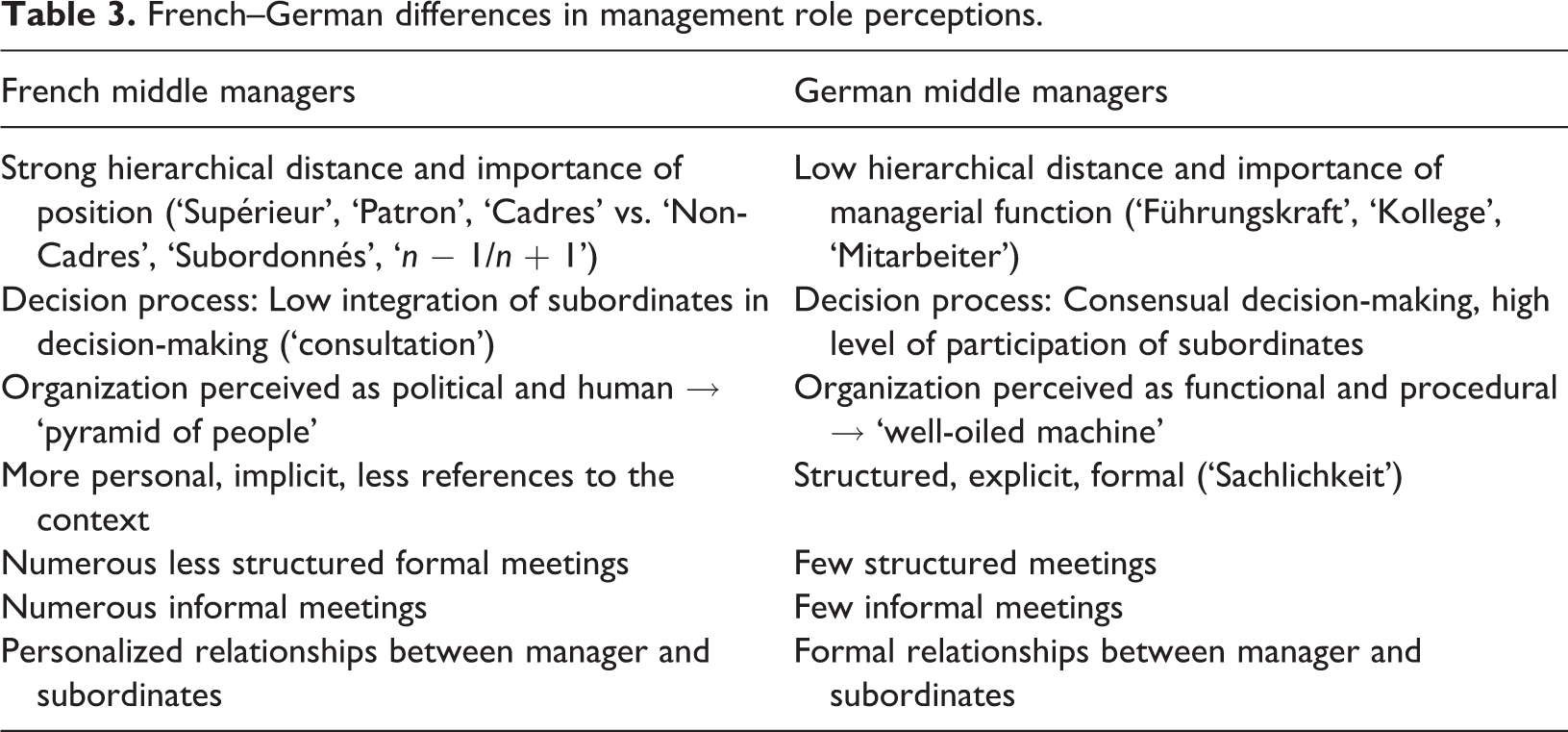
The study engaged Template Analysis developed by King (2004) for the analysis of the data. This method recommends starting the analysis with ‘a priori’ codes’, which are themes of the utmost importance. However, it is not uniquely a ‘Top-Down’ perspective: after a review of the data, some themes can be modified or deleted, while new themes may emerge. This is underlined by Miles and Huberman (1994), who emphasize the importance of revising codes, regardless of the coding approach chosen, and thereby, progressively bringing the researcher to a ‘final template’ (when all the data are coded), which serves as a basis for data interpretation and writing-up of the findings. The software MAXQDA 10 was employed to facilitate a structuring code system with categories. Concerning the process of data analysis, the content analysis of the transcribed texts was performed first separately by both interviewers with a first grid on national differences (Barmeyer and Davoine, 2008) and a second grid about intercultural learning processes and intercultural competencies (Barmeyer and Davoine, 2012), then discussed until validation of a common grid of themes. A third bilingual researcher, who was not present during interviews, has completed an additional coding process in order to validate and to complete the list of themes and the categorization of verbatim accounts through an external perspective (Flick, 2009; King, 2004; Mayring, 2008). A synthesis of the final emerging grid for differences is presented in Table 3.
French–German differences in management role perceptions.
Language is an important element in data interpretation and the interview transcripts were in French and German. Several studies in CCM deal with multilingual data. While some authors decide to translate transcripts into one specific language (Peltokorpi, 2006), others prefer to conduct the analysis in the original language of the interviewee (Witt and Redding, 2009). For reasons of nuance and authenticity, the latter was chosen for the present study. As mentioned by Michailova (2004: 379) referring to Terpstra and David (1991) and Whorf (1956): ‘in a context where different cultures interact, language is a guide for classifying reality into perceptual units that make a difference for people in the culture’. As the goal of this study is to identify and understand perceptions of managerial roles, it is important to work in the original language in order to avoid loss of meaning.
In the following presentation of the results, interviewee anonymity was ensured by use of a letter–number code based on the two demographic characteristics of the interviewed person. The first letter represented ‘D’ for ‘German’ and ‘F’ for French, and the second letter ‘F’ – female and ‘M’ – male. The numeral employed indicated the interviewee number (n = 30). Therefore, for example, FF13 = French female manager13 and DM25 = German male manager25.
Results: Discovering stable and dynamic approaches of culture
In this section, we present perceptions of organizational and managerial roles of French and German middle managers working at ARTE. This is linked to the stable-functionalist approach of culture, where particularities are presented in oppositions (Barmeyer and Davoine, 2008; Fang, 2006; Maurice et al., 1986). Second, we show how new working cultures, linked to the dynamically interpretive approach of culture, in the sense of Brannen’s (1998) negotiated culture emerge from ARTE’s specific organizational context. The aim is to show that both approaches are suitable in their combination in order to gain a more comprehensive and deeper understanding of working practices in intercultural organizations like ARTE.
Stable approach of culture to understanding managerial role perceptions
French managerial role perceptions
The data analysis demonstrated differences in the way French and German interviewees see their middle managerial role in the organization. The relationship to organizational hierarchy, in the sense of a higher power distance, seems to be one of the most obvious elements of the organizational role perception of French managers. The French word for manager is ‘cadre’, a notion associated with a stronger hierarchical meaning, because the notion has been used originally to describe the superior hierarchical layers of the army, and is also associated with legal and symbolic status as a socio-professional category used in French national social/census statistics (Barsoux and Lawrence, 2013; Davoine, 2002). Another example of this hierarchical approach is the French expression ‘n − 1’ (i.e. signalling a lower relative position in the hierarchy) to speak about supervisees or ‘n + 1’ (signalling a higher relative position) to speak about supervisors. Moreover, several interviewees mentioned the importance of transmitting information from the ‘top to the bottom’ and ‘from the bottom to the top’. French managers mostly described their organizational position as a vertical interface between the upper management above and the ‘subordinates’ below: ‘Sometimes, I have the feeling that it is also my role to inform the top about the difficulties of my staff, to serve as a link’ (FF19).
These terms reveal a relative pyramidal, as well as a political, vision of the organization. Many French supervisors expressed, as a priority of their role, the necessity to represent and defend the interests of their subordinates from higher organizational levels or other organizational units: ‘As their protector, I defend them. I am there to defend them and they know that’ (FM23). Indeed, many French managers, even women, described their role in their unit as being (masculine termed) ‘patron’ – etymologically proximate to pater familias – expressing the idea of protection as well as an affective dimension in the supervision relationship. The perception of a hierarchical and centralized mode operating in the unit was reflected in an expressed preference for informal decision-making processes wherein the middle-manager role is central. Most of the French managers critiqued formal meetings and especially those dealing with specific decisions. They have a clear preference for decision-making based on informal consultation with individuals, informal short talks and contacts. For French managers, the length of German decision-making processes often appeared long-winded: ‘Very often, I make decisions on my own and pretty quickly. However, after that, I delegate a lot’ (FM3).
Kindred with the ‘Pyramid of people’, the style of the French middle managers emerged as more relation-orientated. Many French managers expressed a strong need for frequent personal contacts in daily business, not only for information exchange, but also to develop relationships with subordinates. French managers had more bilateral informal meetings and contacts, where many problems, including private ones, were discussed. Significantly, they predominantly used the French informal form of address for ‘you’ (i.e. ‘tu’) to communicate with supervisees. They perceived the creation, maintenance and motivation of their team through close relationships as a vital and key part of their role: ‘I am there for them and their problems. I also take into account their personal problems’ (FM10).
A majority of French respondents expressed a need to be liked by supervisees, or to be considered as charismatic leaders, who are able to promote ‘enthusiasm’. Several French managers reported how they meet their team members spontaneously and informally every morning, through extended greeting rituals or at the coffee machine, checking if everything is going well and using the expression ‘measuring the temperature’. This stronger orientation on informal relationships implies a greater flexibility in time use and scheduling: ‘I always leave plenty of room in my calendar to be available so that meetings can be held. It’s true that I improvise often’ (FF1).
German managerial role perceptions
German respondents used terms reflecting collegiality and collaborative behaviour to describe their position in the organization in relation to their supervisees, speaking about their ‘Kollegen’ (colleagues), ‘Mitarbeiter’ (collaborators, meaning literally those who work ‘with me’ and not ‘for me’) or even ‘Partner’ (partners). To describe their own role, they frequently used the German term of ‘Vorgesetzter’ (a horizontal notion for supervisor) or ‘Führungskraft’ (a notional form of leadership) seen as a primus inter pares. Overall, terms employed generally expressed a lower hierarchical distance between supervisors and supervisees.
In addition, German middle managers used words such as ‘structure’, ‘system’ and ‘process’ to a much greater extent to describe their organizational role. Within their particular unit, they characterized their role as follows: ‘We (managers) are like cogs in a machine. Running on their own. As a matter of course, we have to be powered and driven from time to time’ (DM25). The explicit use of the German word ‘Zahnräder’ (cogs) alludes to an organizational metaphor of the: ‘well-oiled machine’, where employees have well-defined responsibilities and objectives and clear areas of expertise. Regarding decision-making processes, German middle managers exhibited a more participative, structure-bound, objective-setting and decision-making process-based approach. In contrast to French counterparts, German managers were more confident that their team could work without supervision for extended periods of time because their role was ‘governed’ by the structures and company objectives: ‘I want us to meet the targets as smoothly as possible and to constantly improve our quality of work. Otherwise I don’t want to play a big role’ (DM7).
Aligned with the ‘well-oiled machine’, the leadership style of the German managers appeared in the interviews as more task-orientated. In the interviews, the focus was more on autonomy, teamwork, objective agreement and structure definition. Thus, motivating supervisees was associated with communication and negotiation of clear objectives, as well as with technical coaching rather than with interpersonal, emotional relationship. In contrast, to the French interviews, the word ‘objective’ arose more often in German interviews, associated primarily with supervisor–supervisee discussions or objective setting (‘Zielbesprechung’, ‘Zielvereinbarung’). At no point did German managers describe their role as central in the decision-making process and, rather, tended to employ words such as ‘decision’, ‘participation’ or ‘agreement’. The annual objective-setting process was referred to as an important steering and motivating instrument for supervisees: ‘There are action plans. The job descriptions and goal descriptions for each of my employees are derived from this. They’re clearly defined’ (DM13).
Many German managers described their leadership style as anti-authoritarian, and – in very strong contrast with French managers who aimed to be seen as charismatic – they instead wanted to be perceived as having a ‘neutral’ position, without attracting attention (being ‘unauffällig’ (sic – unobtrusive)). Regarding relationships, many German managers mentioned wanting to appear as objective as possible, valuing uniformity, consistency and transparency: ‘I’ve got rather an anti-authoritarian leadership style, instead of standing behind persons each day and giving them orders and control them’ (DM14). The notion of ‘delegation’ appears in German interviews mainly associated with structural redefinitions: ‘I can become much more effective if I manage to use the structure of this department in such a way that I can delegate even more effectively – we are again on the question of delegation’ (DM13).
Espousing a task-orientated approach of their leadership role, German managers declared a stronger need to structure daily communication and work plans. For example, many managers mentioned that they were working fixed hours and were organizing their workload in order to fit this schedule: ‘We’re already trying to structure the day so that we can eat in peace and get out at 18h00’ (DM7). Furthermore, a greater regularity appeared in the formal communication of their unit with, for example, meetings taking place every week. While important for French managers to have daily informal interactions with subordinates, many German managers emphasized the importance of regular formal agenda-driven, minuted-meetings. German managers also expressed preferences for written email communication: ‘I favour the more formal way including an agenda and minutes’ (DM14).
Table 3 comparatively summarizes major differences from the analysis and interpretation of the empirical data of the study combined with the literature on French–German management.
Dynamic approaches of culture: Emerging hybrid working practices
Following multi-paradigmatic perspectives, we also employ the dynamic approach of negotiated culture (Brannen and Salk, 2000; Primecz et al., 2011) to understand the observed phenomena. In the next section, we present how ARTE’s middle managers have made reciprocal adjustments in order to adjust to working practices and role expectations of their interaction with organizational partners. Then, we present the emergence of a novel emergent third – that is, neither German nor French – organizational culture that produces innovative and synergetic solutions.
Adapting managerial role behaviours in intercultural interactions
The data analysis demonstrates clear conscious strategies of adaptation and adjustment by French and German managers towards colleagues, subordinates and supervisors. Especially, German managers explained how they had to adjust their behaviours by developing more informal communication, investing more time in interpersonal contacts and investing more energy defending team interests.
Given their frequent interaction with a rather French work environment, some German managers confessed to having made a great effort to adapt their work and communication practices. For instance, most of the German respondents reported the informal form of ‘you’ (‘tu’ – French/’du’ – German) in communication situations with supervisees, even if some expressed initial difficulties in getting used to this informal and more personal communication style. This also implies communication about more private topics and learning to adjust their leadership style by introducing more emotion: ‘When you work with the French, you have to be aware of the sub-text and the non-rational dimension’ (DM7). Also communicative greeting conventions (handshakes every morning between men, ‘bises’ (kisses) between women and between men and women) were also adopted by most German executives. A few German managers explicitly stated that they now regularly use longer coffee breaks and lunch times for professional problem-solving and team building purposes ‘If I need to talk to a person about something longer or more complex, I’ll call and we’ll meet at the office…or at the cafeteria for lunch’ (DF16). Some German managers also declared that they had to learn how to deal with French micropolitical approaches to organization, because if team member interests in micropolitical issues are not addressed, you could damage your legitimate authority as manager.
Similar phenomena could be observed among French managers. Some adopted different communication styles with French and German interaction partners: ‘More direct in German, even if lasts longer. It has to be more direct otherwise the German would think that it is blabla’ (FF1). They reported changes of practices in the meeting management, preparation and structuring of meetings with formal agendas, punctuality and systematic minute-taking. French managers experienced how German colleagues adhere to decisions made during formal meetings and they increasingly understand how to use structured meetings to defend their positions. Therefore, Franco-German meetings no longer take place in a ‘typical’ German way (with intensive preparations and stringent structuring) or in a ‘typical’ French way (with intensive informal discussions including emergent topics), but rather represent a masterful combination of both ways.
Adaptations also concern leadership styles, where many German managers express behaviours, and not only towards French counterparts, that have been conditioned by German colleague role expectations of managerial behaviours and decision-making processes. One of the French directors told us: (My) leadership style […] comes from the confrontations with my German colleagues. The approach that I learnt at my (French) business school was the model of the enlightened despot who can solve every problem, and they (my German colleagues) told me ‘Wait, you should also listen to our view’ (FM30) We are aware of the need to adopt a French approach when our ability to react is called for. If, however, a complex project with many documents, plans and all the trimmings is on the horizon, then we have to use a German working method. And often, a good combination of the two working methods results, covering the entire spectrum. (FM27)
Emergence of a new working culture
The behavioural flexibility of managers is due not only to their individual skills and reflexivity but also to a specific cultural work environment which facilitates the emergence of new work and management standards within the organization.
Even more important than adaptations or compromises seems to be the development of new innovative and synergistic working practices, which are institutionalized as hybrid ‘best practices’. The close dual-group cooperation over time in one combined company leads to the development of a new negotiated culture that is neither an in-between-culture nor a culture dominated by another group through confrontation. The work of journalists described by the chief editor offers a good illustration of the emergence of new hybrid practices: We had to develop an own way of making our job, of writing our texts, an in-between solution, which takes into consideration the two [German and French] groups. A sort of Newspeak…and I really believe that we do it well. (FM10) There is a specific language at ARTE because there are German words that we use when we speak French among we French. It is also amusing to see that there are German words that have been ‘Frenchized’ and vice versa. (FF2)
The new synergistic culture does not necessarily emerge in a harmonious, cooperative environment. One manager recounted the protracted conflictual story of developing the corporate identity channel programmes of ARTE. French and German teams submitted propositions, which were aggressively attacked by the other group. They had to sit, French and German together, during long weeks to develop something new which met expectations of both groups and which, ultimately, received a European TV award for its creativity. Many managers related similar examples: ‘We drill deeper, we question much more than a national company does, and that’s why new things always come into being’ (DM25). In almost all interviews, we found positive comments on the complementary intercultural dynamics of the organizational context. The ARTE organizational culture also created new synergetic solutions using cultural diversity as an advantage for the organization: ‘Finally it’s quite stimulating. It forces us to find a third way and somewhere to find creativity’ (FM17). Consequently, the ARTE television programme, which is regularly awarded by numerous international awards for its high quality, creativity and diversity of perspectives, is an example of the positive effects of a new co-created working culture.
Discussion and conclusion. Bringing together stable and dynamic approaches of culture
Our article analyses middle management role perceptions and behaviours of French and German managers in the specific context of a unique bicultural organization. We use a multi-paradigmatic approach, in line with other researchers (Dao, 2016; Lee et al., 2015), to identify on the one hand, from the perspective of a functionalist-stable approach, differences that have been already identified in former studies, and to identify, on the other hand, from a culture-dynamic perspective, mutual adjustments and adaptations which can be described as intercultural learning or negotiation processes, which finally lead to hybrid organizational practices. In a first stage of analysis, the functionalist-stable approach was used to profile French–German differences in practices and representations, rooted in history and embedded in cultural and institutional traditions (Barmeyer and Davoine, 2008). In a second analytical phase, the culture-dynamic approach was used to show how new hybrid management practices emerged, or were co-constructed, by culturally negotiating processes over time through interpersonal interactions and by combining elements of German and French working cultures (Brannen and Salk, 2000; Primecz et al., 2011). Overall, the use of these two approaches to culture generated a third approach providing insights into the complex intercultural sense-making processes of a binational organization in which both phenomena of understanding differences and adjusting to them coexist simultaneously. In this organizational context, we can observe the coexistence of perceived stable national traits in managerial role perceptions and behaviours as well as new hybrid representations and practices ‘invented’ or negotiated by the actors. Accepting this coexistence and the enrichment of different perspectives, our study is a plaidoyer for a multi-paradigmatic approach which helps to go beyond former confrontating and excluding debates between paradigms (e.g. the debates between French sociologists D’Iribarne, 1991, 2005; Friedberg, 2005; Maurice et al., 1992; Segal, 2011). Similar integrative approaches of multiple paradigms have been alluded to by other studies, for example, Dao (2016), Primecz et al. (2015) or Lee et al. (2015). The overcoming of paradigm incommensurability and a respect for other perspectives contribute to changing one’s own views and create new synergetic insights on several levels (Romani, 2010). A multi-paradigmatic approach provides a framework, orientation points and structuring features that are consciously or unconsciously used to generate solutions in the complex and contradictory world of knowledge. Therefore, the multi-paradigmatic perspective of this study represents an original contribution in the field of CCM research because it assists in explaining why stable, as well as dynamic, elements of working cultures and role perceptions occur. Briefly summarized, the multi-paradigm perspective embraces two different goals: The stable-functionalist approach may explain cultural clashes that are due to (national) differences in managerial role perceptions; the dynamically interpretive approach helps in understanding the mechanisms and social processes that lead to new managerial perceptions and practices.
A second contribution of our study refers to the stable-functionalist cultural paradigm. It concerns the context-relatedness of national peculiarities of management and organizational practices in intercultural management research: We show that the metaphors used by Hofstede (1980, 2001) still possess relevance in describing the differences of organizational representations by French and German managers (the well-oiled machine in Germany and the pyramid of people in France) and we explored the links between this representation of organization with the representation of middle manager roles. Our results are consistent with the results of former comparative studies (Davoine, 2002; Delmestri and Walgenbach, 2005; Stewart et al., 1994; Winch et al., 2000) on role perceptions of managers. We also observe that despite several decades of intercultural interactions, societal cultural differences have not disappeared in the binational organization ARTE. Our study still identifies clear differences in middle management role perceptions and behaviours of both national groups. These differences of representations and behaviours, meanings and practices, are associated with different notions used in both languages, for example, ‘cadres’ and ‘Führungskräfte’. They are also associated with different socialization processes in different national cultural and institutional environments. Looking at the qualification and career profiles of top managers and upper middle management of ARTE, we found German directors with PhD qualifications and specialist careers whereas French top managers were graduates of Grandes Ecoles such as HEC or ENA with stronger inter-functional career mobility (see Barmeyer and Davoine, 2008; Davoine and Ravasi, 2013). Most of the middle managers interviewed had former experience in the field of expertise of their department, not only the German middle managers but also most of the French middle managers (see Segal, 2014). Among the managers interviewed, we could also identify some middle managers with classical French or German top management profiles, being in intermediate steps of a promising career.
Our third contribution refers to the dynamically interpretive cultural paradigm. Our study shows that there are adaptations in the way middle managers assumed their role in a context of intercultural environment. It transpired that work and management practices in organizations are not only the result of past (national) socialization, but that they are constantly reconstituting themselves in the respective work contexts and interaction situations (Yagi and Kleinberg, 2011). ARTE, a company where German and French journalists and managers have worked together for two decades, and in different structural hierarchical positions and constellations, is the ground of particular intercultural socialization for our managers. Within the organizational context of ARTE, our interviewed middle managers have experienced social interactions with two national groups of employees, supervisees, colleagues and supervisors, who addressed various role expectations to all middle managers whether they were German and French. These various role expectations have induced changes in the perceptions and practices of our interviewees. Such changes of role expectations, perceptions and enactments have also been described by Delmestri (2006) in Italian subsidiaries of Anglo-Saxon multinational companies. With our case study, we aimed to bring empirical evidence of intercultural adaptation and learning in organizations, based on the unlimited ability of actors to negotiate and create an organizational culture, rarely demonstrated empirically in the research literature (Barmeyer and Davoine, 2019; Bartel-Radic, 2013).
Our study analyses an original case where cultural adaptations have been socially negotiated (Barmeyer and Davoine, 2019; Brannen and Salk, 2000) through socialization and interaction processes in a relative symmetric binational power context. An important facilitating factor, which can be found in other organizations like UNESCO or any other non-profit organizations dedicated to foster cultural exchanges between different countries, is the vision and mission statement: ARTE has an overriding mission for international understanding, which is laid down in the channel’s founding treaty (Barmeyer and Davoine, 2014). It is precisely these factors that lead to the emergence of a very specific, third hybrid organizational culture, which is neither typically German nor French, at the basis of innovation and intercultural synergy (Adler, 1980; Brannen and Salk, 2000). If cultural differences are not perceived and understood, it is not possible to combine them constructively and synergistically. This is in line with some recent research propositions concerning negotiated meanings (Primecz et al., 2011) and complementary and positive effects of culture in CCM research (Barmeyer and Davoine, 2019; Barmeyer and Franklin, 2016; Stahl et al., 2017) and the relationship between CCM research and positive organizational scholarship (Cameron, 2017).
We are aware of some limitations of our study. First, in contrast to other multinational organizations, ARTE is an extremely specific case, a binational organization, with a mission of cultural understanding and symmetry of power distribution; it puts a strong focus on French–German parity at all levels, which is a very particular case considering the usual power asymmetries in the micropolitics of multinational companies (Becker-Ritterspach et al., 2016). There is a balance of leadership positions and a prima facie equal allocation of power resources, even if parity is not strictly present in certain departments or functions (e.g. logistics or technical departments). Furthermore, a French location means that French legislation applies and that around 70 per cent of the workforce are French, which makes a stronger adaptation pressure on German counterparts. Second, many middle managers that we interviewed began their career within ARTE at the beginning of the 1990s. Consequently, they have been socialized for 10–20 years with their colleagues within a medium-sized company of 500 employees who are well acquainted. Middle managers have experienced several secondary socialization processes in different units where they have been supervisee, colleague and ultimately supervisor of people from the other national group. We believe that this original collective experience had a strong impact on role expectations and on role enactment, being favourable to the development of a common third culture and perceptions. These managers with long experience within ARTE represent approximately half of the interviewed middle managers and can be considered as boundary spanners (Barmeyer and Davoine, 2019; Barner-Rasmussen et al., 2014). It is interesting to observe that in spite of this collective history of some 20 years, contrasts and differences still remain. The specificity of the sector with strong professional cultures (journalists, translators, film and programme producers etc.) is a third and last factor that may impact on common perceptions of professional skills and experience to ground managerial authority. On the other hand, former studies report that strong professional cultures can support the sociocultural integration process of two national groups by facilitating the co-construction of new cultural practices within an organization merging companies, international project teams or in joint ventures (Barmeyer and Davoine, 2019; Chevrier, 2012; Viegas-Pires, 2013).
Another limitation of our research is that we used interviews, which help to make explicit attitudes and behaviours described by the actors, but we did not extensively examine (apart from some participant behaviour observations) the actual behaviour. We attempted to use the cross-perspective of top managers and middle management colleagues to triangulate declarations, but it was not possible to carry out more systematic validation, for example, through shadowing of interviewee samples like in the work of Stewart et al. (1994) to control the relationship between role perception and role enactment. Future research in French–German working practices should attempt to secure access and include direct observation, especially to compare communication and time management practices. Another limitation concerns our data: We are also aware that is it not immediately contemporaneous (2008) while the TV channel ARTE continues to exist. This is linked to frequent misgivings among researchers in the field regarding the common inability of developing a diachronic approach to analyse the continuation – or even stagnation – of intercultural learning processes and hybridization practices between long-standing partners. There may be some spheres which are culturally more resistant and do not compromise or offer sustainable hybridization. Nevertheless, the article in its essence does recognize and underline that cultures, on the one hand, do have relative stability in their behaviours and patterns, while, on the other hand, constantly evolving. Thus, the data set and the project of research show this dynamic in process. Were it the case that preceding or follow-up data sets were to be available, it would be likely to demonstrate equally this functional/evolving dynamic albeit through different micro-moment instances (Stokes and Harris, 2012). A longitudinal analysis would perhaps bring evidence about the scope and the limits of the actor’s intercultural learning abilities in organizations. Having a second series of interviews 10 years after the first series would allow to strengthen or to mitigate the identification of stable cultural traits.
Future research should address negotiation of middle management role perceptions and behaviours in multinational companies with various power asymmetry contexts. It could also address differences of middle management role perception in different professional groups. Some observations of our study show that the professional culture might differ in two national groups, which could lead to different configurations for middle managers. Finally, future research could also address the question of role perception and enactment comparing middle and top management levels in two or more countries.
Footnotes
Acknowledgement
We would like to thank Xavier Salamin for his support and for his commitment in the coding process of the interviews.
Declaration of conflicting interests
The author(s) declared no potential conflicts of interest with respect to the research, authorship, and/or publication of this article.
Funding
The author(s) received no financial support for the research, authorship, and/or publication of this article.
