



Abstract
As a step towards a systematic comparative evaluation of the fairness of different language policies, a rationale is presented for the design of an index of linguistic justice based on public policy analysis. The approach taken is to define a ‘minimum threshold of linguistic justice’ with respect to government language policy in three domains: law and order, public administration, and essential services. A hypothetical situation of pure equality and freedom in the choice of language used by all members of society in communicating with the state is used as a theoretical benchmark to study the distributive effects of policy alternatives. Departures from this standard incur lower scores. Indicators are chosen to assess effective access to three kinds of language rights: toleration (the lack of state interference in private language choices), accommodation (accessibility of public services in different languages), and compensation (symbolic and practical recognition of languages outside the dominant one). In order to take account of the cost-benefit trade-offs involved in providing language-related goods to language groups of varying sizes, a method is adopted for weighting scores with respect to compensation rights so that lack of recognition for larger groups incurs greater penalties, while factoring in the particular characteristics of each language-related good. A trial set of ten indicators illustrates the compromises entailed in balancing theoretical rigour with empirical feasibility.
Keywords
Introduction
Indices are regularly used in national and international comparative analyses. Governments or governmental organizations use them to collect and organize quantifiable information on important social and economic variables, and to monitor their evolution over time. Some well-known examples are the Human Development Index designed by Mahbub ul Haq and Amartya Sen and published by the United Nations (UN), and the Gini Index of income inequality developed by Corrado Gini and employed by international bodies such as the Organisation for Economic Co-operation and Development (OECD) or the World Bank. Various international indices are produced also by private bodies such as magazines, foundations, universities, or nongovernmental organizations, for example, the Global Competitiveness Index, the Democracy Index, and the World Press Freedom Index.
To the best of our knowledge, no indices of this kind exist to evaluate linguistic justice (although some indices have been designed to monitor various aspects of language use and policy; see the appendix to this article). This neglect is surprising, although it may stem, in part, from the mistaken idea that language is simply a tool of communication between individuals, beyond the decision-making powers of government. This view overlooks the deeply socio-political nature of language, including the impact that government's decisions regarding language use have on the linguistic environment in which individuals live. Language policy can entail substantial distributive effects between different groups of people (defined in terms of their linguistic repertoire), meaning that it can disadvantage some groups of speakers or, conversely, advantage others. Language policy, therefore, can affect the well-being of individuals living in a country or region by creating (or increasing) unjustified inequalities or even discrimination. Measuring and comparing these effects can thus make an important contribution to our understanding of how language policy is entwined with social justice.
As Helder De Schutter notes, ‘in making policies on, among other things, education or simply courtroom practices, states unavoidably have to make linguistic decisions: fully a-linguistic state policies simply do not exist’ (De Schutter, 2007: 17). Language decisions are inevitable because key government functions, such as law promulgation and enforcement, police services, criminal justice, public administration, health care and education, cannot be realized in whatever language individuals may request. Since all existing societies to different extents are multilingual, a situation of absolute linguistic equality in government language policy is practically an illusion. Yet not all decisions have the same distributive effects. A carefully designed index should enable us to characterize such distributive effects across time and space and to monitor their development.
Theoretical work on language-related inequalities/disadvantages, including implications for public policy, is not new (see, for instance, the pioneering work in political science by Pool, 1987, 1991). In the past two decades, however, such work has gained momentum and is often referred to as the ‘linguistic justice’ debate. Three books of especial note in this regard are Language Rights and Political Theory (Kymlicka and Patten, 2003), Linguistic Justice for Europe and for the World (Van Parijs, 2011), and Equal Recognition: The Moral Foundations of Minority Rights (Patten, 2014). 1 While most of this recent work is framed as normative political theory, important contributions have come from applied linguistics and educational studies, 2 as well as law 3 (see detailed overviews by Alcalde, 2018 and Morales-Gálvez and Riera-Gil, 2019).
Although this body of literature provides an important and rich resource, the question of linguistic justice has yet to be addressed from a public policy perspective as well as from an empirical and measurable point of view. 4 One obvious factor explaining this is that there are very different views about what linguistic justice means. Our approach in this article is based on policy analysis, and it focuses on the distributive and redistributive effects on individuals of government's language policy decisions. This original approach guides the design of a practically feasible series of indicators that are then aggregated into an index of linguistic justice.
Starting from some fundamental considerations of the function of the government as a provider of language-related goods and services in society, we identify a series of policy areas in which government language policy have a direct or significant impact on what individuals are able to do and to be, given their linguistic repertoire. In effect, we adopt a definition of linguistic justice that focuses on the distributive effects of the language choices of the government – that is, the differential effects they have on individuals – rather than on features of the linguistic environment in general. This enables us to outline criteria for the identification of a ‘minimum threshold’ of linguistic justice to which governments might be held accountable. 5 We present a list of possible indicators, explore their properties, and explain how they could be aggregated into an index of linguistic justice. The limits of the index are discussed in our conclusions.
It is worth emphasizing that this article, as its title reveals, aims at stimulating a debate on the evaluation of linguistic justice, rather than providing a conclusive and definitive set of indicators.
The public provision of language-related goods and services
Standard fundamental economic theory distinguishes between the extremes of a pure individual (or private) good on the one hand, and a pure collective good (or pure public good) on the other (Atkinson and Stiglitz, 1980; Cornes and Sandler, 1996). Pure private goods can be characterized by three properties, that is, they are rival (R), shielding (S), and excludable (E); the technical term ‘public good’ is used if a good is non-rival, non-shielding and non-excludable. Most goods are neither purely private nor purely public, but display some of the relevant properties to varying degrees.
Because language-related goods can be of many different kinds, they too display the same range of characteristics. For example, property R describes to what extent a good can be consumed by several individuals at the same time. Open TV broadcasting in a language is a perfectly non-rival language-related good, since one person's watching the TV programme in that language does not infringe on other individuals’ access to the same programme. Dimension E describes the extent to which it is technically feasible to exclude someone from the consumption of a given good, once it has been provided. If the TV programme is coded and one needs to acquire a decoder to watch it, we have perfect exclusion; if it is freely transmitted in the ether, we have perfect non-exclusion. Dimension S describes to what extent one can shield oneself from the consumption of a certain good, once it is available. Shielding is a property of TV broadcasting in a language, since one can choose not to watch those channels (or watch TV at all), but it is not, for example, a property of street signs (e.g. in areas of contested bilingualism), since it is almost impossible not to see the other language when reading the sign in one's preferred language.
In the case of pure individual goods, neoclassical economic theory predicts that under certain assumptions the spontaneous interaction of independent individuals and firms will lead the economy towards an efficient allocation of resources (Mas-Colell et al., 1995). 6 Difficulties arise when goods are not purely rival, excluding and shielding. For example, if the good is non-rival in consumption, once the good is available it can be consumed by everyone. The social value of a certain individual's contribution to the provision of the good exceeds its value to the contributing individual. Hence, too little of the good would be provided by spontaneous interaction via the free market, since each individual actor is assumed not to consider the social value he or she creates, only the smaller private value. We have therefore a market failure due to a positive external effect, resulting in incentives to ‘free ride’, that is, enjoy the good without contributing to its provision. Similar arguments can be made in the case of non-exclusion and non-shielding. In the first case, individuals can enjoy a rival good without contributing to its provision, creating a negative external effect – also known as the ‘tragedy of the commons’. In the second case, individuals can provide a non-rival ‘bad’ for others without paying the costs imposed on the sufferers, also a negative external effect – for instance, environmental damage. In these and other cases, the spontaneous interaction between individuals leads to sub-optimal results at the level of society, since total social benefits differ from total social costs. Public policy can improve the allocation of resources by trying to equate social benefits to social costs.
Importantly for our argument in this article, there are also distributive implications, since the financing of publicly provided goods comes from general taxes, more or less equitably distributed in the population, whereas the individual evaluations of the benefits can vary considerably from one individual to another. This applies not only to goods that are unambiguously public in nature, such as roads, parks and sewers, but also to other goods such as basic education and fundamental health care that are essentially private in nature, but that in many countries are provided by the government. Note that the provision does not imply direct production; the government can directly produce goods through its administrative apparatus or alternatively subsidize or legally force a private hospital or school to provide the good.
There are two major rationales for such public provision of private goods. In the first place, the arguments above reappear: services such as basic education and health care have important spill-over and external effects. Both acquisition of literacy by the population and vaccination campaigns are beneficial for society as a whole, not just for the single individual. Secondly, there is a general question of social equity involved. Children, for example, cannot make informed choices about their education and health care. Within limits fixed by states, such decisions are made by parents who do not necessarily have the means to pay for these core services. Also, if education or health services are financed through individual user fees, the quality of the service may depend on the size of the payments, so that poor people receive a lower quality of service than rich people for a given need. In this article, therefore, we use the term ‘publicly provided goods’ to define goods provided by the government either for efficiency reasons (e.g. pure public goods) and/or for distributional reasons.
How does language fit into this picture? In the established typology of language planning, language policy consists of measures to influence, explicitly or implicitly, the corpus, status, and acquisition of a language (see, among others, Johnson, 2013). A significant dimension of status planning consists of allocating functions to a language in society. In practice, this means ensuring the public provision in one or more languages of different goods such as toponyms (street and place names), official documents, and public services. While public goods such as street lighting and clean air have no linguistic component, many other goods provided exclusively or predominantly by the government do have a linguistic component. Therefore, a government's decisions as to which languages to use in providing such goods can directly affect the well-being of citizens, and in general residents and taxpayers alike. Typically, individuals have preferences pertaining to the language in which such goods and services are provided. At the very least, to benefit from them, they must understand the language used. The ubiquity of societal multilingualism implies that residents, generally, do not all have the same language skills. Even if one perfectly masters a language, one might for reasons of personal identity or cultural traditions strongly prefer receiving services and information in another (heritage) one. Considering also that government provision of goods and services is usually funded through general taxation (i.e. by the taxpayers), the question becomes, what are the distributive effects of publicly providing goods in only one or a few languages?
The government fundamental language policy
We term the government's choice of which language(s) to employ in providing language-related goods the ‘fundamental language policy’ or ‘original language choice’. The fundamental language policy, which – as already said – cannot be avoided, raises two issues. The first one concerns the criteria for choosing the language(s) of government, often (though not necessarily) referred to as the ‘official language(s)’ of a jurisdiction. Frequently there is only one such language for most government functions; however, as Stephen May notes, ‘the imposition of a single language for use in state activities and services is by no means a neutral act’ (May, 2005: 322). While it can be the case that the public language corresponds to the language of the majority (i.e. the fundamental language policy is based on the de facto prevalence of a certain language in society), counterexamples abound. In 15 postcolonial African countries where English is official, for example, the percentage of speakers of this language, no matter at which level of proficiency, nowhere exceeds 20 percent (May, 2014). In India, where English is an official language at the national level along with Hindi, the proportion of the population who declare themselves to be fluent in English is 5 percent for men and 3 percent for women (Desai and Dubey, 2010). Similar situations were not unusual in the past, even in countries that today are viewed as officially monolingual at the national level. At the outbreak of the French Revolution in 1789, French was spoken by no more than 11 percent of the total population of the country (Grégoire, 1794). At the unification of the Kingdom of Italy in 1861, only 2.5 to 10 percent of the population could speak Italian (Castellani, 1982; De Mauro, 1963).
Clearly, the fundamental language policy is not shaped in a historical vacuum. State traditions, power relationships, historical injustices, path-dependencies, or, sometimes, radical political changes play a determinant role in explaining the historical evolution of a language policy (on this point see Sonntag and Cardinal, 2015). Until 1991 and the beginning of a process that eventually brought about the dissolution of Yugoslavia, for example, Slovenian was just one of the official languages of a state in which Serbo-Croatian was demographically dominant. When independence was declared, Serbs, Croats, and other Yugoslav citizens that moved to Slovenia for economic reasons before 1991 suddenly found themselves to be residents in a country where Serbo-Croatian has no official status (Novak-Lukanovič and Limon, 2012).
The choice of one (or a few) de jure or de facto official language(s) creates per se a distribution of material and symbolic resources in society in favour of those with an educated command of the language(s) chosen, thereby burdening the speakers of other languages with the costs of adoption (or adaptation). This leads to our second point. As Jonathan Pool notes, ‘it is wrong to claim (as is often done) that having many official languages is necessarily inefficient. As more native languages are made official, translation costs rise but adoption costs fall. If all adoption costs are sufficiently large, it will be efficient to officialise all the groups’ native languages. […] The tendency to regard multiple official languages as inefficient may, then, reflect a state-centred neglect of costs incurred by individuals in adapting to language policies’ (1991: 503). Adoption costs (sometimes also referred to ‘adjustment costs’ or ‘implicit costs’) 7 include expenditures for language acquisition and training, as well as the costs of translations and interpreters borne by private agents such as individuals or businesses who must interact with the government in a language that they do not understand or that they do not master at a sufficient level of proficiency. Adoption costs also include psychological costs that may be difficult to quantify, such as the contribution to feelings of exclusion or marginalization that stems from a lack of official recognition of one's native language.
A key question, then, is how language-related costs and benefits are distributed. Analysis of costs requires the setting of a benchmark. Of course, there is no objective manner to fix a just benchmark (see Wickström, 2007); this depends on social/political/philosophical values and choices. Given a benchmark, however, one can identify the distributive effects of a language policy and assess the redistributive effects of various alternatives. A hypothetical situation of pure equality and freedom in the choice of language used by all members of society in communicating with the state can be used as a theoretical benchmark to study the distributive effects of policy alternatives.
As Jacqueline Mowbray notes, justice does not ‘require the State to communicate with individuals in the language of their choice’ (Mowbray 2012: 135), or that the government use all languages spoken on its territory for official purposes. Rather, ‘linguistic justice requires greater attention to the differential cost of state language choice and consideration of how disparities could be reduced’ (Mowbray 2012: 136, italics in the original). This observation is central when such inequalities derive from the fundamental language policy. A possible angle to study linguistic justice from an empirical point of view, therefore, is to identify linguistic inequalities entailed by the fundamental language policy, and to examine whether and how the government addresses such inequalities. Compensation between linguistic communities is a possible means to redress the unequal distribution of adjustment costs in society (for a discussion, see Pool, 1991, and Van Parijs, 2002). This compensation, as shown in the next section, can take different forms and need not entail direct financial transactions; minority language broadcasting funded by the state’s central budget is an example.
A minimum (but operational) threshold of linguistic justice
In the current debate about the nature of linguistic justice, most authors focus on what has been described as the ‘fair background conditions position’, that is, linguistic justice should equate to establishing fair background conditions for individuals. The prevalent approach, influenced by John Rawls’ theory of justice, tends to focus on access to certain language-related social primary goods in the form of rights, goods and services (for a discussion, see Bonotti, 2017; Lewis, 2017). In this perspective, the linguistic disadvantage is examined in terms of resources to which one person has access in comparison to another person. In principle, a wide range of resources might be used to compare people's situations, for example, political rights or public services (Shorten, 2017).
In recent years, a new approach to linguistic justice has been proposed (though not yet fully developed) in which linguistic disadvantage is defined in terms of what people are able to be and do in a given language, rather in terms of what they can receive (see Brando and Morales-Gálvez, 2021; Carey, 2019; Lewis, 2017; Shorten, 2017). In this application of the capabilities approach developed by Amartya Sen and Martha Nussbaum, resources or means should be viewed as only part of the story, since ‘if the goal is to establish conditions that provide people with truly fair opportunities to use and sustain their respective languages, then additional ‘conversion’ factors, for example the constraining influence of implicit social norms and conventions, also need to be considered and addressed’ (Lewis, 2017: 604). The twofold nature of this approach (philosophical/economic, normative/prospective) makes it well suited to analyzing complex human phenomena: it describes factors that can be easily operationalized and often readily measured, while keeping in view the socio-political dimensions of human needs (Comim et al., 2008).
Nonetheless, the differences between the two approaches should not be exaggerated, at least where applied policy research is concerned. The organization of a bilingual public administration, for example, can be viewed both as a resource accessible to individuals, and as a condition that affords the members of a linguistic minority substantive freedom to open a business and access legal services in their first language. The lack of interference by the state in people's choices as to which languages to use in their private life can be seen both as a resource (a right) and as a condition enabling individuals to exercise their freedom of expression.
Andrew Shorten (2017) argues that both approaches have limited practical applicability, because people may disagree about what goods or services people are entitled to have and about what persons should be able to be and do. This is certainly true. It does not mean, however, that these approaches cannot be used in empirical work if we are careful to define the scope of the analysis. There are many reasons why individuals might disagree on the types of private goods and services that people should have access in order to avoid various linguistic disadvantages. However, as shown above, there are several language-related goods, necessarily provided by the government for efficiency and/or equity reasons, that in principle are relevant for all citizens, long-term residents and asylum-seekers of a given country or jurisdiction. The approach to the empirical evaluation of linguistic justice proposed in this article starts from this observation.
It is important at this stage to introduce a distinction between domains in which the state exerts a direct and often exclusive influence (in some cases legally determined, e.g., the administration of public security and the judicial system, but in many cases due to market failure or redistribution objectives, as noted above), and domains in which the government shares its influence with the private sector (e.g. the media, the labour market and cultural activities). In this article, we focus on domains in which the government exerts its exclusive or predominant competence because in these domains it must be held directly responsible for the distributive consequences of its language policy decisions. Although we recognize that a person can be linguistically disadvantaged in other areas of social and economic life such as the labour market, and that for some persons those areas may be more important than those under direct public control, our analysis is limited to the latter as a starting point.
There are two relevant levels of analysis in this regard. The first one is general or systemic, and it refers to the existence (or not) of a degree of recognition of particular languages (or language varieties) by the government in the public sphere. The second level of state action is functional or operational. It consists of the concrete decisions of the government as to what languages to use (or not) in three broad domains in which the state and subordinate public authorities exert exclusive or predominant competence, that is:
Law and order, the minimal infrastructure necessary for a functional society, that is, judicial authorities such as courts and tribunals, and public security systems (police and prisons). Also, legal texts and decrees or other official communications belong to this category. Administration, the agencies necessary for the smooth working of a government, that is, the general registry office, the tax office, and the migration office, including relevant public communication in these areas. Essential public services are found in the public sector in most countries of the world, such as the public health care system (e.g. hospitals) and emergency centres, especially for asylum-seekers and refugees.
8
Education, of course, is another important public service. It raises, however, many other issues related to language policy that lie beyond the scope of this article, most notably the influence exerted by the state on the linguistic repertoire of children and adults through acquisition planning, including linguistic assimilation. This has a direct bearing on the public provision of goods in the three domains of language policy we focus on here, since it affects the state's capacity to provide, at a given moment, services and information in languages not included in the fundamental language policy. Furthermore, access to formal schooling in one's first language(s), along with effective educational access to dominant or national languages, are clearly important dimensions of linguistic justice. However, measuring the linguistic outcomes of public education (as distinct from inputs, e.g., the number of classes offered in various languages) poses theoretical and methodological challenges in indicator design that we cannot address adequately here, particularly because the effects of education are long-term, while our index is meant to provide a picture at a given moment in time. There are also significant inequities in the quality of language education, for instance, in socially deprived or rural areas, that should not be ignored. We hope to take up the question of how to measure effective linguistic justice in public education in future work.
Having limited the scope of the evaluation of linguistic justice in this article to the three domains listed above, the next question is, what type of rights can be granted by the government to minorities in these core domains. Building on Heinz Kloss’s (1977) distinction between toleration-oriented and promotion-oriented rights, Alan Patten (2009) identifies three general classes of language rights: (1) toleration rights, (2) norm-and-accommodation rights, and (3) promotion rights. Toleration rights guarantee members of society freedom of expression in the language of their choice; they are ‘protections individuals have against government interference with their private language choices’ (Patten, 2009: 107). Norm-and-accommodation rights aim at facilitating communication in the local dominant language in certain public contexts for those who are not fluent in it (the dominant language is what Patten calls the ‘normal language of public communication, typically the majority language of the jurisdiction concerned’ or ‘normal public language’); they ensure access to certain forms of assistance such as interpreters in trials, immersion education programmes or provision of services by bilingual staff. Finally, promotion rights proper are ‘not contingent on a lack of proficiency in a ‘normal’ public language. A person is free to exercise her promotion rights in a minority language even if she is quite fluent in the majority language’ (Patten, 2009: 109).
In Patten's view, one (and only one) language typically qualifies as the ‘normal language of public communication’ by virtue of its use in different domains, for example, the courts and legislatures, and in the delivery of public services and in education. In our view, however, this assumption of a single normal language of public communication is problematic. Although in many states or regions official monolingualism is de jure or de facto the norm, we see no need to naturalize a monolingual view of the state as a benchmark. Rather, we propose to treat the choice of a normal language of public communication as just one language policy among various alternatives. Whatever alternative is chosen, the fundamental language policy will create an initial distribution of resources that may require various forms of compensation. These ‘compensation rights’ for speakers of minority languages should not be treated as promotion rights proper, as Patten's approach might suggest, but as a redistributive measure to compensate the distributive effects of the fundamental language policy. This view is a consequence of the methodological choice made in this article to adopt as a theoretical benchmark a situation of equality and freedom in the choice of language used by all citizens or residents in communicating with the state.
By focusing on compensation rights rather than promotion rights, then, it is possible to develop a modified set of linguistic rights defining what we name a ‘minimum threshold of linguistic justice’ that many could accept as reasonable. Some authors use the term ‘sufficiency principle’ for such a minimal set of rights (e.g. Nielsen and Axelsen, 2016); discussions in global policy forums use the concept of ‘social protection floors’ (Deacon, 2013). Our proposed minimalist (but operative) view of linguistic justice considers three types of rights derived from our modification of Patten's framework:
Toleration. As above, the presence or not of measures aimed at interfering with individuals’ private language choices. Accommodation. In this article, this refers to the degree to which different publicly provided language-related goods in key areas of government competence (as already described) are available and accessible to people with different linguistic repertoires. Compensation. This refers to the presence of some form of compensation for the adjustment costs associated with government fundamental language policy even if speakers of minority languages are reasonably proficient in the official language(s).
Note that the three types of rights can be viewed as a continuum spanning three degrees of inclusion of individuals’ preferences by the policy maker. Toleration simply requires the respect of freedom from interferences of the government in private life language decisions, accommodation refers to the objective practical need of the speaker to be understood, while compensation is a dimension that assumes a partial entitlement to the satisfaction of linguistic preference irrespectively of the concrete practical needs of the speaker.
Accounting for language demographics and cost-benefit trade-offs
There is a fourth important aspect of the state's language policy that should be taken into account when assessing the impact on linguistic justice of various measures in favour of minorities. This arises from the unequal numbers and distribution of minority language communities. While the issue is easily described, it is more challenging to incorporate it into the definition of a minimum threshold.
We begin by noting that it is common practice in different countries to allow for the provision of goods in minority languages only when ‘numbers warrant’. A report of the United Nations Special Rapporteur on minority issues (2017: 26) provides some useful examples in that respect. U.S. federal equality legislation mandates that the threshold for the use of minority languages in federal services is 10,000 people; in Finland, a variety of public services is guaranteed in municipalities where at least 3,000 people are members of a minority; in Canada, the threshold for access to federal public services in both English and French in big cities is 5,000 people, while other public services are provided in additional languages where there are sufficient concentrations of indigenous people or immigrants. 9
Intuitively, such an approach seems reasonable; it clearly responds to the fact that there are extra costs entailed in providing services in languages beyond those included in the fundamental language policy. Such costs are more readily justified when there are many recipients of the extra services. The question is how to formalize this principle so as to evaluate the relative fairness of different situations, taking into account the fact that there may be many language minorities of different sizes within a given jurisdiction.
In this article, we use an indicator based on constitutional economics developed by Bengt-Arne Wickström and Michele Gazzola (2020), which takes into account the relationship between the costs of production of a language-related good and the number of beneficiaries of the policy (i.e. the cost elasticity, σ), as well as the size of the minority in absolute terms (n) and the total size of the population in the jurisdiction (P). The formal derivation of this ‘indicator of official recognition’ will not be repeated here, but an intuitive explanation may help clarify its importance within our overall approach to building an index of linguistic justice. Notably, this indicator involves the definition of a critical (or threshold) value n* of the size of the minority for which the provision of some administrative or public services is estimated to be efficient (i.e. benefits are equal to or exceed the costs of the publicly provided language-related good). This threshold is set by the analyst, as explained below.
In keeping with the overall approach outlined earlier, the indicator's design is based on a theoretical starting point or benchmark according to which all languages within a given jurisdiction are recognized (all individuals have the same rights), and the jurisdiction is ‘punished’ (i.e. receives a lower score) for failing to give recognition to some languages (i.e. for removing the rights from some people). In other words, the model starts from a theoretical situation of complete equity and assesses whether deviations from that equity are justified (in terms of public policy) on efficiency grounds. If providing rights to speakers of a certain language would be efficient (estimated benefits exceed estimated costs), there would be no allowable justification for removing these rights.
The interesting situation occurs when the costs are higher than the benefits in a cost-benefit calculation. In this case, providing the good in the minority language would imply a deliberate redistribution in favour of the minority, at the cost of an efficiency loss for the entire population in the community. If the language-related good is not provided, the jurisdiction would lose points for the inequality entailed by denying rights to the speakers of that language, but the magnitude of this ‘punishment’ would be mitigated by taking into account the loss in efficiency that the provision of the good would entail. In other words, the indicator is designed to capture, in a quantifiable way, the classic trade-off between efficiency and equality in public policy analysis, applied here to the provision of language-related goods. 10
In practice, the analyst first must determine in which languages provision of the language-related good is guaranteed. For those languages, the indicator value I is set equal to one. In the second step, the analyst establishes the value n* equal to the minimal size of a minority community for which the provision of rights would be efficient in the cost-benefit sense. This value is then compared to the number of speakers n of each minority language without recognition. If n exceeds or is equal to n* and the language receives no recognition, the value of the indicator for that language is zero (the ‘punishment’ is maximum, i.e. one). However, if the size of the minority is smaller than n*, the size of the ‘punishment’ will be less than one (mitigation due to taking the efficiency gain into account), and so the indicator will have a value somewhere between zero and one.
For those readers interested in how the calculation is done, the indicator I is defined by the following expression:



Finally, the aggregate value of indicator I is calculated for the jurisdiction being studied. This is accomplished by summing the scores for each language, whose contribution is weighted by the relative size of that language minority relative to the sum of all minorities residing in the jurisdiction. This ability of I to summarize a complex demographic picture in a single figure makes it useful to all of the compensation-related indicators described in the following section.
In conclusion, our approach to the empirical study of linguistic justice builds on the definition of ‘minimum threshold’ presented in the previous section, and it combines linguistic equality in the access to language-related publicly provided goods, respect for individuals’ private language choices, some form of compensation for minority languages not included in the state's fundamental language policy, and finally a measure of economic viability of language policy measures.
An index of linguistic justice
Having mapped out the scope of the index to be designed, our next step is to consider what a suitable range of indicators might be. Taken together, those indicators should reflect explicitly or implicitly the three types of rights identified, that is, toleration, accommodation, and compensation, and take into account practicability/costs. The indicators should also cover both the systemic level (i.e. the overall language policy regime) and the operational level of state action (i.e. law and order, public administration, and essential public services). Further, the indicators should be applicable to different groups of speakers affected by language policy, although not necessarily to the same extent. These include dominant/majority groups, traditional (autochthonous) minorities, minorities formed through relatively recent immigration (e.g. resident migrants, asylum-seekers and refugees, sometimes named ‘new minorities’), and Deaf communities. 11
The process of indicator design is based on a series of standard principles well summarized in Atkinson et al. (2002: 20–26) and in Maggino and Zumbo (2012). First, an indicator should identify the essence of the problem (e.g. language-related disparities in access to legal documents) and have a clear and accepted interpretation; this means that there should be a general agreement that movement in a particular direction represents an improvement. Second, an indicator should be robust and statistically validated (i.e. it should be measurable in a way that commands general support, and the data employed should be regarded as reliable). Third, an indicator should be responsive to effective policy intervention and difficult to manipulate. 12
Ideally, we wish to measure the consequences of a policy, irrespective of the means by which results are achieved (e.g. financial inputs); hence, the indicators should focus on output and possibly outcomes of government actions. However, there are practical constraints involved. In order for an index to be useful, its indicators should be easy to populate with available data, and they should not be too many. For this reason, in this article, we present indicators that can be populated with secondary data that are generally available or that are relatively easy to collect. Some of these indicators refer to the formal aspects of linguistic justice such as the presence of norms, whereas others focus on the substantive aspects of linguistic justice, that is, to what degree such norms are respected in practice. Conceptually, this is not entirely satisfying; however, one must balance theoretical finesse with empirical feasibility. Finally, we select just ten indicators as a point of departure, and we present some additional variants of them that could be adopted in applied research. As stated in the introduction, the purpose of this article is to stimulate debate (and perhaps experimentation) on the empirical evaluation of linguistic justice rather than present a definitive set of indicators. For this reason, sometimes we propose more than one variant of the same indicator.
A trial set of indicators is presented in Table 1. To facilitate comparisons, all indicators assume a simple value between 0 and 1 inclusive. Changes in the value of an indicator towards 1 are associated with an increasing level of linguistic justice. The first column reports the dimension considered, and the second the domain. The third column presents the indicator. The fourth column describes the characteristics of the corresponding good considered, while the last column presents the type of data necessary to populate the indicator.
Indicators of linguistic justice.
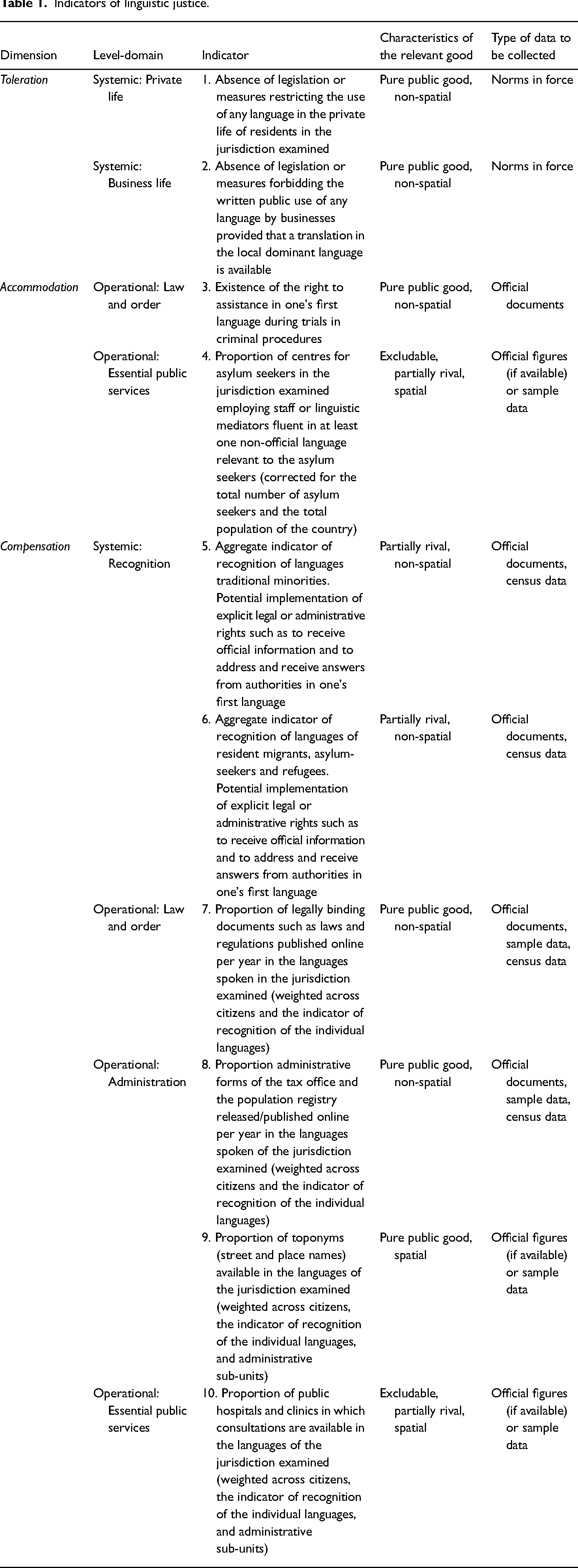
As noted earlier, the index is to be used to compare jurisdictions that vary in size and in the composition of their minority and majority populations. We should note here that the term ‘jurisdiction examined’ in the indicator description may refer to a country or to a region within a country, while the term ‘sub-jurisdiction’ refers to an institutional level immediately below the one being examined. Because of the challenges involved in making such comparisons, half the indicators (1–3, 7, 8) deliberately involve nonspatial and non-rival goods (pure collective goods) whose costs are independent of the number of beneficiaries and the size of the jurisdiction. This makes comparisons easier. The additional cost of translating web pages into additional languages, for example, depends simply on the number of pages to be translated. At the opposite extreme, we find that essential services (as in indicators 4 and 10) typically involve spatial and partially (or fully) rival goods (because they suffer from congestion). For example, the additional costs to provide services in different languages in a centre for asylum-seekers are dependent on the number of the centres, which in turn depends both on geographical factors and the number of individuals assisted. At the intermediate level, we find partially-rival and non-spatial goods (indicators 5 and 6), and spatial but non-rival language-related goods such as bilingual street and place names (indicator 9). It is important to keep the spatial dimension in mind when comparing countries of different sizes and different geopolitical locations.
The first two indicators refer to the dimension ‘toleration’ and to individuals’ capability of expressing themselves in their preferred language. They are couched in negative terms: ‘Absence of legislation or measures restricting the use of any language in the private life of residents in the jurisdiction examined’, and ‘Absence of legislation or measures forbidding the written public use of any language by businesses’, possibly under the condition ‘that a translation in the local dominant language is available’. Both indicators are self-explanatory. They can take the value zero or one. Indicators 1 and 2, therefore, describe the presence of toleration on the whole territory being examined; in this sense, toleration is a non-spatial non-rival good. The first indicator can be made more demanding, for example, by requiring the presence of regulations that explicitly protect the right to speak one's language. A proxy for the second indicator could be the existence of regulations covering the languages to be used on labels for foodstuffs.
Indicators 3 and 4 reflect the accommodation dimension in the domains of law and order and of essential public service. Indicator 3, ‘Existence of the right to language assistance in one's first language during trials in criminal proceedings’, can be applied to citizens, resident migrants or tourists alike. It can also be applied to Deaf people for oral proceedings. A better indicator would refer to the actual implementation of this right rather than its existence, for example, ‘Proportion of trials (criminal proceedings) in which a defendant receives language assistance in his/her first language’, but data to populate this indicator would be very difficult to collect from official sources. The specification ‘criminal proceedings’ deliberately emphasizes the importance of linguistic mediation in criminal justice (United Nations Special Rapporteur on minority issues, 2017: 29), but the indicator of course could be made more general by removing this specification. A proxy for this indicator could be the existence of a registry of professional interpreters who can be appointed in case of need, although it may be difficult to acquire data on the effective provision of this service.
Indicator 4, ‘Proportion of centres for asylum-seekers in the jurisdiction examined employing staff or linguistic mediators fluent in at least one non-official language relevant for the asylum seekers (corrected for the total number of asylum-seekers and the total population of the country)’, is an indicator to assess the capacity of a government to deal with foreigners in the situation of crisis (potentially also Deaf ones). The correction for the number of asylum-seekers and the size of the country should reflect both the fixed costs and variable costs involved. A more precise indicator perhaps would be ‘Proportion of refugees and asylum-seekers who received assistance in their first language for initial administrative procedures’ per unit of time, but again it could be very difficult to obtain data to populate this indicator. If it is difficult to collect data on centres for asylum-seekers, the focus could be shifted from the hotspot and reception centre to the asylum hearings in courts.
The remaining indicators refer to the compensation dimension. Unlike the accommodation dimension, they do not require the satisfaction of a practical need, since the possibility of using one's language in communication with local authorities often carries symbolic importance even if the members of the minority group are reasonably proficient in the local dominant language. Symbolic, cultural and identity issues matter in language policy. Providing public goods in the local minority language is not only a tool for status planning, but also a form to recognize the cultural dignity of speakers, and to provide symbolic compensation for inequalities caused by the state’s fundamental language policy, especially for traditional minorities. The concept of ‘first language’ could be replaced by ‘mother tongue’ or ‘heritage language’ (depending on local definitions and the focus of the research), and it is by no means restricted to one language only, nor to varieties defined by a written norm. What matters is the language varieties experienced and claimed as part of one's primary identity, regardless of the degree of oral fluency or literacy acquired in them. This can vary depending on the particular goods involved; for example, a person could be fully and equally functional in both the minority and majority language in the workplace, but benefit much more from mental health care in the minority language. These compensation indicators, therefore, do not impose any specific hierarchy on languages of territory, but are responsive to how those languages are perceived by their speakers. The two systemic indicators, 5 and 6, address the explicit formal legal/administrative status of the languages spoken, whereas the operational ones, 7–10, are concerned with the actual implementation of language rights.
The aggregate ‘indicator of official recognition’, explained above in the section ‘Accounting for language demographics and cost-benefit trade-offs’, is employed in both indicators 5 and 6, which differ according to the type of minority considered. The former focuses on traditional/autochthonous minorities, while the latter is concerned with resident migrants, asylum-seekers and refugees. As outlined earlier, the researcher should choose a threshold value n* for both indicators as well as the value of σ (variables describing the dependence of costs of implementation on the size of the minority) and consistently apply them to languages spoken in the jurisdiction to compute the aggregate I. The indicator reflects the potential implementation of formal legal and administrative rights as the minimum form of systemic recognition. Such rights per se are non-rival and non-spatial, but their implementation can be partially rival. For example, one of the most basic forms of recognition of a language is the right to use it in written communication with state offices. The right as such is a public good, but providing answers to individual correspondence in a minority language requires officials to possess a capacity in that language. The actual costs incurred by this requirement vary widely, however. In Slovakia, for example, residents can legitimately use Czech when they write to authorities, although this language is not official; if the correspondence is answered in Slovak, no additional capacity is needed and the good is almost non-rival. In Amsterdam in the Netherlands one can write in English to public authorities, although this is not an official language of the country; here too, depending on the mastery of English by a typical public servant, the additional capacity required might be negligible. For indicator 5, an alternative source of data to feed the indicator could be the availability of official information in the minority language pertaining to elections or other processes involving decision-making in public life (see United Nations Special Rapporteur on minority issues, 2017: 35).
Indicators 7–10 direct the focus towards the actual implementation of language policy. A challenge common to all de facto evaluation is the availability of reliable data, and we have commented on this issue as it applies to each proposed indicator. The definition of indicators 7 to 10, therefore, is flexible, allowing their use in different types of empirical research. In Table 1, these indicators deliberately refer to citizens (hence, traditional minorities and indigenous people are normally included, while migrants are excluded), but they can be used for all residents (including migrants), depending on the scope of the applied research.
Indicator 7, ‘Proportion of legally binding documents such as laws and regulations published online per year in the languages spoken in the jurisdiction examined (weighted across citizens and indicator I of recognition of individual languages)’ relies, in the first instance, on the state maintaining a registry of legal documents in its languages (see below for an example). Since lawyers, citizens and advocacy groups are likely to depend on such official registries for authoritative versions of the laws and regulations in any given language, this seems to be an appropriate way to gauge their effective availability. We specify ‘online’ since this type of good is non-spatial and non-rival (contrary to the paper version).
For the sake of illustration, take the example of a jurisdiction with 100,000 inhabitants and three minority languages whose speakers together total 30,000 persons. Language A is the preferred language of 15,000 persons (equivalent to 50 percent of individuals belonging to minority groups), language B is spoken by 10,000 persons (equivalent to 33 percent of individuals belonging to minority groups), and language C is spoken by 5,000 people (equivalent to 17 percent of individuals belonging to minority groups). The value of indicator 7 is 1.00 if all documents are available in all three minority languages. 13 In other cases, the indicator must be calculated with the help of the formula for the indicator of recognition taking the size of the minorities into account. We assume that n* = 12,900 and σ = 0. Case (i), non-recognition: the indicator I for language A is then 0 (it is efficient in the cost-benefit sense to provide the language-related good in language A, non-providing it would be inefficient) and for languages B and C, 0.25 and 0.64, respectively. The value of indicator 7 is therefore 0.1913 if no documents are available in any of the minority languages. 14 Case (ii): documents are only published in the biggest minority language; the value is 0.6913. 15 Case (iii): all documents are published in language A, 50 percent of the documents in language B, and only 5 percent in language C; the value of the indicator is 0.8181. 16
Although in case (ii) 50 percent of minority speakers receive no information in their preferred language, the two smallest languages give rise to higher indicators of recognition than zero in the absence of rights as explained above in the section ‘Accounting for language demographics and cost-benefit trade-offs’. The injustice of not providing rights is mitigated, from the point of view of society, by avoiding the efficiency loss that rights provisions would cause. Per person, these costs are mirrored in the indicator value that is more than 2.5 times as high for minority C as for B. Aggregated over the respective community (weighted by the size of the community) the difference is smaller, though.
Indicator 8, ‘Proportion of administrative forms of the tax office and the population registry released/published online per year in the languages spoken in the jurisdiction examined (weighted across citizens and the indicator of recognition of the individual languages)’, is similar to indicator 7, but refers to the domain of public administration. The calculation of the indicator follows the same pattern as indicator 7. The indicator deliberately includes different types of administrative documents and reports the average proportions. For practical reasons, however, it may be necessary to limit the analysis to one type of document only. As for indicator 7, this indicator rewards substantive use of language in administrative procedures, rather than simple formal status.
Indicator 9, ‘Proportion of toponyms (street and place names) available in languages spoken in the jurisdiction examined (weighted across citizens, the indicator of recognition of the individual languages, and administrative sub-units)’, is self-explanatory. Data can be collected for a sample if no official register exists. Google Street View offers a cheap alternative to direct observation. The specification ‘average across administrative sub-units’ means that the final value of the indicator depends on the arithmetical average of the proportions computed at the sub-unit level of the jurisdiction examined (in the case of Switzerland, for example, this would imply determining the weighted average across citizens per Canton and taking an average over all 26 Cantons, weighted by their populations). This is needed because some languages are spoken only at the sub-jurisdiction level and toponyms (street and place names) are a spatial good. An alternative formulation is ‘One minus the proportion of citizens who cannot benefit from toponyms in their first language on the territory of the administrative sub-units of the jurisdiction’. Because of the spatial nature of toponyms, however, this indicator is less precise than the other one. If bilingual signs, for example, are available only in the largest urban centres, or in areas where the linguistic minority is concentrated, it is difficult accurately to assess the benefit to individuals.
Indicator 10, ‘Proportion of public hospitals, health centres, and clinics in which consultations are available in the languages of the sub-jurisdiction examined (weighted across citizens, the indicator of recognition of the individual languages, and administrative sub-units),’ is a proxy for bi- or multilingual health care services across the territory of the jurisdiction examined. A more precise indicator would be ‘Proportion of citizens in ward X who were treated in their first language in public hospitals or clinics in the sub-jurisdiction examined (weighted across the indicators of recognition of the individual languages and administrative sub-units), per year’, where the specification ‘in ward X’ could be adapted according to the circumstances. Possible examples in which the role of bilingual staff may be particularly crucial are ‘emergency rooms’ or ‘psychological support’. It could be very difficult, however, to find data to populate this indicator. One possible solution would be to rely on primary data, that is, interviews or surveys with medical personnel and hospital staff. As for indicator 3, indicator 10 can include communication with Deaf people.
The indicators address indirectly both the question of diglossia and official language pluralism. Indicators 1 and 2 refer to any language used in the private sphere (as opposed to use in spheres under state control), including those in a situation of diglossia. The remaining indicators involve the use of one or more languages by public institutions/organizations in a jurisdiction, and they are relevant for the study of the extent to which official language pluralism is implemented in practice.
The simplest way of producing a synthetic index of linguistic justice that lends itself to interregional and international comparison would be simply to add up the values of the 10 indicators presented in Table 1. If we adopted this method, the level of linguistic justice in a jurisdiction would be defined in terms of an absolute score. Countries/regions would be compared on the basis of the total score, which could range between 0 and 10. Scores could potentially be organized in three ranges, for example, low (score 0–3), medium (4–7) and high (8–10). Alternatively, researchers could attribute weights to the indicators, thereby valuing some dimensions of linguistic justice more than others. Further discussion and trial application of the indicators could inform the development of such choices.
Final remarks
An index of linguistic justice is open to the same kinds of criticism as other indices used at the international level for a broad range of purposes. The usual criticism is that such indices oversimplify a complex reality, and that their methodology is flawed. However, we welcome the prospect of such debates. As noted by Klugman et al. (2011), the Human Development Index ‘should be understood as the starting point of a conversation about what we mean by development, rather than as its endpoint’, and this accurately captures our own objective. We see current debates about linguistic justice, while stimulating, as too firmly ensconced in theory, rather than being engaged in a productive dialogue with data analysis, measurement and policymaking. 17 An index of the kind we have proposed could play a useful role in encouraging theorists to make greater use of empirical data to test their ideas, while prodding policy makers to look beyond the immediate social and political context to broader visions of the (linguistically) just society. As for any index, the definition of the concept to be measured, the relevant dimensions to be monitored, and the weights attributed to the chosen indicators rely, of course, on value judgements which can be criticized. However, as long as their methodology is clear, explicit and consistent, and their data reliable, indices and the resulting rankings may produce useful information and stimulate public debate. In certain cases, the systematic use of indices by countries, or, sometimes, their popularization in the media, can promote changes in public policy and allow the effects of such changes to be monitored over time.
All states make language policy decisions that have far-reaching implications for the lives of their citizens and residents. It is worth reiterating that some government language choices, all other things being equal, create more disparities than others, and certain policies are more effective than others in reducing or mitigating linguistic disadvantages. Rather than aiming at definitive, one-size-fits-all solutions to the problem of linguistic justice, we see prospects for greater progress through the development of a system of theory-based indicators that policy makers can use to nudge language policy towards incremental improvements over time. Multilingual education and training as well as translation are clearly central instruments in that respect. One practical means for governments to positively influence the evolution of the indicators presented in this article is by training civil servants to work in more than one language and investing in translation and interpreting in public services, especially in the health sector and in emergency and support services for migrants, refugees, and asylum seekers. Such concrete measures can have measurable effects on decreasing linguistic disadvantages for different groups of people in a jurisdiction.
Footnotes
Acknowledgements
We wish to thank two anonymous referees, and the Editors for their useful comments and remarks, as well as Brian Carey, Cecilia Gialdini, François Grin, Gabriele Iannàccaro, Filomena Maggino, Gordon Marnoch, Yael Peled, and Andrew Shorten for their remarks on an earlier version of this paper.
Declaration of conflicting interests
The authors declared no potential conflicts of interest with respect to the research, authorship, and/or publication of this article.
Funding
The author(s) disclosed receipt of the following financial support for the research, authorship, and/or publication of this article: This research was supported in part by a Vice-President Research (VPR) Bridging Grant from Simon Fraser University (Canada) and by grants from the Esperantic Studies Foundation (USA). This support is gratefully acknowledged.
Notes
Author biographies
Appendix
In this section, we briefly summarize the most important indices, and we discuss the differences between them and our proposed index (for a more extensive review, see Alaimo and Seri, 2021).
The European Index of Multilingual Policies and Practices (Extra and Yağmur, 2012b), also known as the Language Rich Europe Index (Poszytek, 2013) is intended to be ‘a descriptive tool for awareness raising at both the public and the political macro-level, which presents descriptive indices per strand and per country or region in order to reflect the degree of adherence to European benchmarks in terms of European guidelines or recommendations’ (Poszytek, 2013: 74). The index focuses on a series of resolutions, conventions, and recommendations adopted by the European Union (EU) and Council of Europe (CoE). The recommendations involve the following areas of language learning, teaching and use (Poszytek, 2013: 74): provisions for teaching and learning of regional, ethnic and migrant languages; mastering two foreign languages and a mother tongue during the period of formal education – the so-called 2 + 1 formula; promoting language diversity and the idea of multilingualism; establishing clear aims of language education at all stages; providing smooth transition in learning languages between the end of one learning stage and the beginning of another one; promoting the idea of Content and Language Integrated Learning through defining the standards of teacher training and creation of didactic materials; establishing a transparent system of language certification on the basis of the Common European Framework of Reference for languages for languages developed by the CoE; introduction of a mentoring system to support young teachers; acknowledgement of teacher qualifications across Europe; promoting languages in media; promoting languages in business – taking care of language development of employees, making use of apprenticeship opportunities abroad and communication channels via different languages; promoting languages in the context of lifelong learning and the labour market; promoting the contribution of multilingualism to creativity through enhancing the access to other ways of thinking and interpreting; and promoting European languages outside Europe. These issues are collected in eight large strands, namely, official documents and databases on language diversity; languages in pre-primary education; languages in primary education; languages in secondary education; languages in vocational and university education; languages in the media; languages in public services and spaces; and languages in business.
It was originally planned to collect data through a questionnaire; data from the survey would have been analyzed to populate the indicators in each strand, where a score of 100% would mean 100% adherence to European standards. The project for this index, however, was never fully implemented and the scope of the project was reduced, resulting in the report Language Rich Europe (Extra and Yağmur, 2012a). The report collected data from 25 European countries and regions using a questionnaire containing a total of 260 questions that refer to the eight strands mentioned above. For example, regarding the strand ‘Languages in public services and spaces’, the survey collected data in 64 cities on the following nine dimensions (Extra and Yağmur, 2012a: 63–66): to what extent the city has an institutionalized strategy for promoting multilingualism; whether services and documents are provided in languages other than the national language; whether the annual municipal reports are available in other languages than the national language; web presence in other languages; the use of interpreters and translators in public services; the languages included in staff job descriptions; provision of language training recruitment of speakers of other languages; recruitment of speakers of other languages; records kept of language competencies of staff. For each of these dimensions, the report presents the number of cities in which recommendations are followed ‘widely’, ‘occasionally’ or ‘never’.
The report Language Rich Europe, therefore, does not provide an index to compare and rank countries. Moreover, its scope is different from the index proposed in this article. The report puts a greater emphasis on education. Further, its indicators are specifically aligned with documents and recommendations on multilingualism produced by the European Union and the Council of Europe (e.g. teaching two foreign languages in the school system, and using the media to support foreign language learning though subtitling instead of dubbing). As such, they do not have general validity outside the European context.
The Worldwide Language Index developed by Preply, an e-learning platform, is used to monitor the extent to which a country provides a good infrastructure to support language learning. 18 The index is computed for EU countries, the United States and Canada and analyses 18 factors split across seven dimensions, for example, the percentage of children that learn a foreign language in primary school, and whether subtitles, dubbing, or voiceover is the primary form of translation used on television. This index, therefore, focuses on language learning, and it does not address the question of fairness of language policy.
There are other indices that are worth mentioning in our discussion although they do not focus on language policy. One example is the Montreal Index of Linguistic Integration (Segalowitz and Ryder, 2006), which measures the degree to which participants feel integrated into specific linguistic communities when using language involving everyday idiomatic expressions. 19 Another example is the Migrant Integration Policy Index, 20 whose indicators pay some attention to language policy, notably as regards migrants’ education and their access to residence requirements. The Intercultural Cities Index of the CoE is aimed at monitoring the efforts cities make to encourage equality of opportunities, participation and interaction between different communities, and a positive view of diversity. 21 Language competences is one of the dimensions included in the index, for example, to monitor whether cities provide courses and other facilities for people speaking minority/migrant languages, and whether they promote a positive attitude towards minorities. Another example is the Multiculturalism Policy Index developed by Keith Banting and Will Kymlicka (2013). This index ‘identifies a range of policies that are characteristic or emblematic of the ‘multicultural turn’ over the past forty years. The index lists eight such policies for immigrant groups (such as multicultural education); six such policies for national minorities (such as official language status)’. 22 Nevertheless, none of these indices explicitly focus on language and they do not explicitly address the question of the effects of language policy on a community of speakers.