



Abstract
Robert Nozick’s Anarchy, State and Utopia contains one of the earliest and best-known criticisms of John Rawls’s theory of justice in general and the difference principle in particular. The discussion of Nozick’s critique of Rawls in the literature has focused on his argument against “patterned” conceptions of justice, of which the difference principle as Nozick understands it constitutes merely one version among others. In this article I consider the objection Nozick raises against the difference principle specifically, namely that it unfairly favors the “worse endowed” over the “better endowed” members of society. I argue that Nozick’s charge of unfairness against the difference principle is ambiguous between two distinct interpretations of the difference principle and as such divides into two distinct objections, the pre-cooperative and the cooperative fairness objection. I then argue that neither of these two interpretations of the difference principle represents the actual, Rawlsian difference principle accurately and that, more fundamentally, Nozick lacks the concept of politics as the distinctive moral category implicitly at work in Rawls’s theory of justice. Not as much of Nozick’s charge of unfairness against the difference principle therefore remains on reflection as may have appeared at first sight.
Keywords
Introduction
If Western philosophy is a series of footnotes to Plato, as Alfred North Whitehead’s well-known line has it (Whitehead, 1978: 39), then much of the last half-century’s worth of political philosophy around here has been a series of footnotes to John Rawls, at least if the term “footnote” is read in the intended honorific spirit. 1 Robert Nozick in Anarchy, State and Utopia anticipated as much when he observed there that “political philosophers now must either work within Rawls’s theory or explain why not” (Nozick, 1974: 183, unless indicated otherwise all references below are to this particular work).
Nozick’s own answer there to the question “Why not Rawls?” makes for an especially early and prominent such footnote. As with much of the subsequent debate on Rawls in the literature, Nozick’s principal target is the difference principle, according to which “social and economic inequalities are to be arranged so that they are …to the greatest benefit of the least advantaged” (Rawls, 1999: 266). Nozick raises two objections to the difference principle. The first of these concerns the difference principle’s supposed “patterned” character. The difference principle as Nozick understands it specifies a particular distributive pattern as the one required by distributive justice, namely precisely the maximal benefit of the least advantaged or “maximin criterion” (see Rawls, 1999: 72–73). Yet as Nozick’s well-known Wilt Chamberlain example (pp. 160–164) is meant to illustrate, any contentful distributive pattern is “liable to be thwarted by the voluntary actions of the individual parties transferring some of their [sic, M.G.] shares they receive under the principle” (p. 164). This in turn means that the enforcement of any such pattern invariably involves forcibly taking from some persons what is rightfully theirs. Insofar as the difference principle too calls for the enforcement of a particular pattern—that is, the maximin criterion—it too mandates “continuous interference with people’s lives” (p. 163) and so the violation of their rightful freedom, or so Nozick thinks. Call this Nozick’s freedom objection to the difference principle. 2
Nozick’s second objection to the difference principle is that “the difference principle is, on the face of it, unfair” (p. 204, emphasis in original). More specifically, the objection is that the difference principle in appealing to the maximin criterion as its conception of fairness in distributing the benefits of social cooperation sets terms of cooperation that unfairly favor the “worse endowed” over the “better endowed” members of society, where “‘better endowed’ means: accomplishes more of economic value, able to do this, has a high marginal product, and so forth” (p. 194 n.). This, the objection continues, means that the worse endowed could not reasonably propose the difference principle as the principle specifying the terms of their cooperation with the better endowed, nor would it be unreasonable for the better endowed to reject the proposal were the worse endowed to put it to them anyway its unreasonableness notwithstanding. Call this Nozick’s fairness objection to the difference principle.
These two objections are distinct. Not only does each of them find a different kind of fault with the difference principle, the two objections also must be understood as conceiving of the difference principle itself in categorically different terms. The objection against patterned principles of justice of which the freedom objection to the difference principle constitutes an instance objects to the enforcement of any particular distributive pattern. Such enforcement, the objection goes, is morally illegitimate in that it violates people’s rightful freedom. This is because the scope of a person’s rightful freedom is defined by the scope of her rights against others, and nothing outside of other persons’ rights against her limits her rights against them and so places a legitimately enforceable limit on her freedom. However, a particular distributive pattern is not the sort of thing to which anyone has a right against others. To enforce such a pattern is therefore tantamount to treating persons merely as means to the realization of that pattern. As such, the enforcement of any distributive pattern, including the one specified by the difference principle, is ipso facto morally illegitimate by Nozick’s lights. 3
The objection against patterned conceptions of justice instantiated by the freedom objection thus falls under that moral category defining the legitimate scope of coercion understood as the use of force against persons. 4 The scope of a person’s rightful freedom is a matter of the scope of her rights and so of the scope of that which is legitimately enforceable as against others. By the same token, the violation of a person’s rights against others also necessarily takes coercive form. That is, nothing other than the use of force against a person could possibly count as a violation of that person’s rights and so as her treatment as a mere means in the relevant sense. The freedom objection accordingly conceives of the difference principle as a principle claiming enforceability for itself, where it is precisely the latter’s supposed self-claimed enforceability to which it then takes exception, given that the enforcement of a distributive pattern of necessity exceeds the scope of what may legitimately be enforced according to Nozick.
Enforcement of this kind is morally illegitimate irrespective of the moral merit of the pattern in question according to Nozick. That is, to force a person to help bring about some distributive pattern is to treat her merely as a means and so to wrong her no matter how morally “choiceworthy” the pattern might be. The concept of the choiceworthy so understood instead bears on a question distinct from the question what may legitimately be enforced against persons, namely on the question which ends a person morally ought to adopt of her own voluntary accord. Given that rights qua rights constrain ends qua ends on Nozick's view (see pp. 28–30), the former of these questions must be understood as accordingly constraining the latter, in the sense that it is only within the space delimited by other people’s legitimately enforceable rights from without/her own legitimately enforceable rights from within that the question which ends a person morally ought to adopt validly enters in the first place by the strictures of Nozick’s larger moral framework.
In finding the difference principle to unfairly favor the worse over the better endowed the fairness objection denies the reasonableness and so precisely the choiceworthiness of the maximin criterion as the principle governing their cooperation. As we saw just now, however, the concept of choiceworthiness validly applies only to the objects of persons’ voluntary choices as exercised within the space of their own rightful freedom according to Nozick. In applying the criterion of choiceworthiness to the difference principle (and finding it wanting by that criterion) the fairness objection must therefore be understood as conceiving of the difference principle, not as a candidate enforceable principle, but instead as a principle held out for persons’ voluntary adoption within the limits set by their own rights from within/everyone else's from without. 5 Otherwise that criterion would count as not even validly applicable to begin with by Nozick's lights.
The difference principle as the fairness objection conceives of it thus falls within a different moral category from the one governing the freedom objection. It is in this sense that the freedom objection understands the difference principle in terms categorically different from those at work in the fairness objection. To put the point in terms of a distinction from Immanuel Kant’s Metaphysics of Morals, the freedom objection conceives of the difference principle as a candidate juridical principle, whereas the fairness objection takes up the difference principle in the guise of an ethical principle, where the difference between right and ethics is precisely the difference between that form of moral obligation which is and that form of moral obligation which isn’t externally enforceable, respectively (see Kant, 1999: 383–385, AA 6:218–221). 6
Yet despite its distinctness from the freedom objection, and even though it occupies an entire section of Nozick’s chapter on Rawls (“Terms of Cooperation and the Difference Principle” (pp. 189–197)), the fairness objection has so far received no more than passing mention in the literature, mostly from a broadly sympathetic standpoint. 7 The purpose of the present article is to take up the task thus left open so far and investigate Nozick’s fairness objection to the difference principle in its own right (although I will briefly return to the freedom objection in section 5). It will turn out that there are compelling grounds for a dedicated treatise of the fairness objection even beyond its sheer distinctness from the freedom objection. This is because the fairness objection will emerge as both more complex and more problematic than initially apparent.
As for the fairness objection’s complexity, different parts of Nozick’s case for the difference principle’s unfairness to the better endowed will turn out to rest on distinct readings of the difference principle, namely what I will refer to as the pre-cooperative and the cooperative reading. Given the higher-level distinction between the juridical and the ethical interpretation of the difference principle from just now, it follows that Nozick’s discussion of the difference principle in Anarchy, State and Utopia as a whole must be viewed as informed by the interpretive structure from Figure 1. 8
The distinction between Nozick’s pre-cooperative and his cooperative interpretation of the difference principle in turn means that his fairness objection to the difference principle also comes in two versions, the pre-cooperative fairness objection and the cooperative fairness objection. Given the higher-level distinction between the freedom and the fairness objection from above, it follows that Nozick’s criticism of the difference principle in the book at large must be viewed as exhibiting a structure matching the interpretive structure from Figure 1, as shown in Figure 2.
Yet while the pre-cooperative fairness objection arguably has considerable substantive merit as a critique of the difference principle as it understands the latter, the pre-cooperative reading of the difference principle on which it rests differs drastically from Rawls’s own, cooperative meaning, or so it will turn out below. The pre-cooperative fairness objection will therefore turn out to amount to mere philosophical shadow boxing. The cooperative fairness objection in turn calls on a conception of the difference principle more adequate to Rawls’s own meaning. However, the cooperative fairness objection is both thinner and more doubtful in its substantive merit as an objection to the difference principle as it conceives of the latter. Moreover, there remains decisive interpretive slack even here. This is because the difference principle as Rawls himself understands it amounts to a distinctly political principle, with politics marking out a sui generis moral category as distinct from both right and ethics alike, a category for which Nozick’s libertarian framework lacks the space. This is the problem with the fairness objection. It is in this sense that Nozick’s fairness objection to the difference principle will turn out both more complex and more problematic than might seem at first.
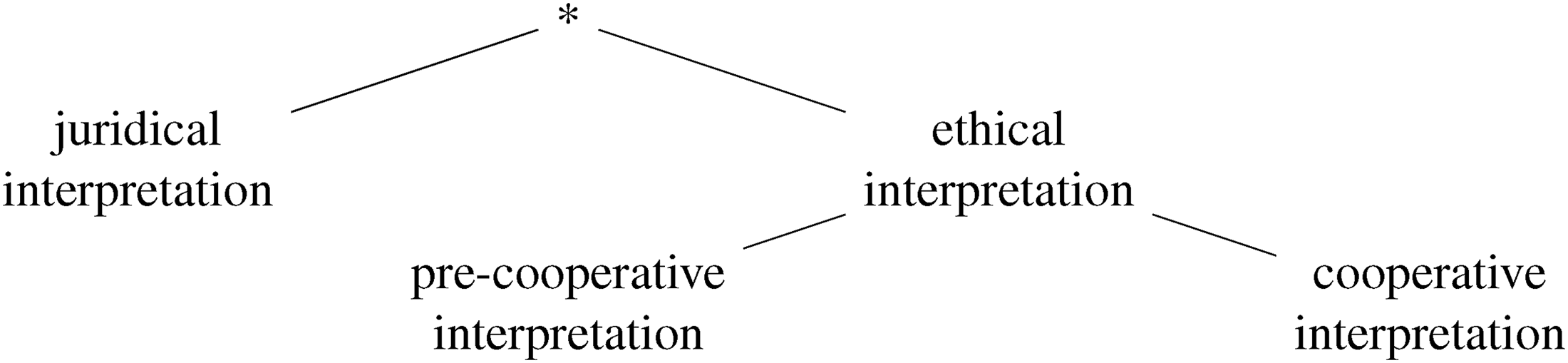
Nozick’s interpretations of the difference principle.
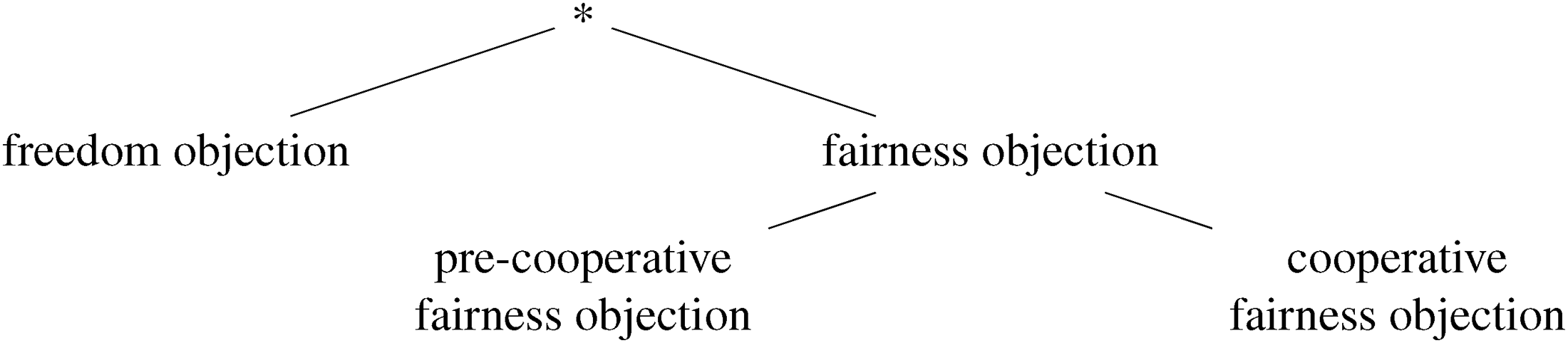
Nozick’s objections to the difference principle.
The argument to that conclusion proceeds as follows. Section 2 reproduces Nozick’s own statement of the fairness objection and disambiguates between its pre-cooperative and cooperative versions. Section 3 discusses the pre-cooperative version. Section 4 takes up its cooperative counterpart, with section 4.1 reconstructing the cooperative fairness objection in detail and section 4.2 spelling out its substantive (section 4.2.1) and interpretive (section 4.2.2) burdens. Section 5 outlines the idea of politics as a distinctive moral category implicit in Rawls’s theory of justice yet absent from Nozick’s libertarian outlook. Section 6 concludes the article.
Rawls holds that the difference principle “expresses a conception of reciprocity. It is a principle of mutual benefit” (Rawls, 1999: 88). 9 As such, Rawls thinks, a system of basic social institutions embodying the difference principle is justifiable to all members of society, whether better or worse endowed. Nozick disagrees. He thinks that, while the worse endowed members of society obviously wouldn’t have anything to complain about under a difference principle-governed scheme of cooperation, the better endowed just as obviously would. Here he is:
No doubt, the difference principle presents terms on the basis of which those less well endowed would be willing to cooperate. (What better terms could they propose for themselves?) But is this a fair agreement on the basis of which those worse endowed could expect the willing cooperation of others? With regard to the existence of gains from social cooperation, the situation is symmetrical. The better endowed gain by cooperating with the worse endowed, and the worse endowed gain by cooperating with the better endowed. Yet the difference principle is not neutral between the better and the worse endowed. Whence the asymmetry? (pp. 192–193, emphases in original)
Nozick reiterates the argument a few paragraphs later in the form of an imagined negotiation between the two groups over their terms of cooperation: Rawls would have us imagine the worse-endowed persons say something like the following: “Look, better endowed: you gain by cooperating with us. If you want our cooperation you’ll have to accept reasonable terms. We suggest these terms: We’ll cooperate with you only if we get as much as possible.” That is, the terms of our cooperation should give us that maximal share such that, if it was tried to give us more, we’d end up with less. How generous these proposed terms are might be seen by imagining that the better endowed make the almost symmetrical opposite proposal: “Look, worse endowed: you gain by cooperating with us. If you want our cooperation you’ll have to accept reasonable terms. We propose these terms: We’ll cooperate with you so long as we get as much as possible. That is, the terms of our cooperation should give us the maximal share such that, if it was tried to give us more, we’d end up with less.” If these terms seem outrageous, as they are, why don’t the terms proposed by those worse endowed seem the same? Why shouldn’t the better endowed treat this latter proposal as beneath consideration, supposing someone to have the nerve explicitly to state it? (p. 195, emphases in original)
Recall from the Introduction that a person’s endowment in the sense in which Nozick understands the term isn’t a matter of the benefits she derives from her participation in social cooperation but rather consists in those skills and capacities a person commands independently of and prior to her participation in social cooperation, which then figure as “factors of production” in the process of social cooperation insofar as the person whose skills and capacities they are chooses to apply them there. 10 Nozick’s reference to the “better” and “worse endowed” in the above passages therefore has to be understood in what might be called “pre-cooperative” terms. 11 His complaint against the difference principle there is that a difference principle-governed system of social cooperation is ipso facto unfair to the better endowed thus understood. This is Nozick’s fairness objection to the difference principle.
Fairness objection to the difference principle
The difference principle is unfair to the better endowed members of society (where “better endowed” means: accomplishes more of economic value, able to do this, has a high marginal product, and so forth).
To Nozick’s mind, his own usage of the terms “better” and “worse endowed” in the above passages simply mirrors Rawls’s. The larger passage from which the definition of these terms quoted in the Introduction was lifted runs as follows: “In the context in which Rawls uses it, all ‘better endowed’ means: accomplishes more of economic value, able to do this, has a high marginal product, and so forth …The text follows Rawls in categorizing persons as ‘better’ and ‘worse’ endowed only in order to criticize the considerations he adduces for his theory” (p. 194 n., emphasis in original).
Yet there is a subtle but as will turn out critical question to be asked about Nozick’s self-ascribed deference to Rawls in respect of the terms “better” and “worse endowed” here, namely this: does Nozick interpret Rawls as speaking of the better and worse endowed in formulating the difference principle itself? More precisely: should we take Nozick to interpret the term “advantage” as it figures in Rawls’s formulation of the difference principle—as in “the greatest benefit of the least advantaged”—as referring to a person’s endowment in the sense of the passage just quoted? Insofar as we answer this question in the affirmative, we are thereby ascribing to Nozick what I will call a pre-cooperative interpretation of the difference principle, where the terminology is meant to reflect the pre-cooperative nature of a person’s endowment discussed above.
Pre-cooperative interpretation of the difference principle
A given social group’s level of advantage as referred to by the difference principle consists in the group’s members’ level of (pre-cooperative) endowment.
By contrast, insofar as we answer the question in the negative, we are ipso facto ascribing to Nozick what I will call a cooperative interpretation of the difference principle, given that here the level of advantage of a given social group will have to be understood as the “output” of rather than the “input” into the process of social cooperation.
Cooperative interpretation of the difference principle
A given social group’s level of advantage as referred to by the difference principle does not consist in the group’s members’ level of (pre-cooperative) endowment but instead consists in the level of benefit they derive from their participation in social cooperation.
To see what the difference between the pre-cooperative and the cooperative interpretation of the difference principle might potentially come to materially speaking, consider the numerical illustration in Table 1. B and W refer to the two social groups of which society is imagined to consist, with B standing for the better and W for the worse endowed;
Nozick’s fairness objection to the difference principle.

Nozick’s fairness objection to the difference principle.
Whether we read Nozick as interpreting the difference principle in pre-cooperative or cooperative terms in turn informs how we have to conceive of his fairness objection to the difference principle. In particular, insofar as we ascribe to Nozick a pre-cooperative reading of the difference principle, we are ipso facto ascribing to him the pre-cooperative fairness objection.
Pre-cooperative fairness objection to the difference principle
The pre-cooperative difference principle is unfair to the better endowed members of society.
If by contrast we read him as interpreting the difference principle in cooperative terms, we are thereby reading him as endorsing the cooperative fairness objection.
Cooperative fairness objection to the difference principle
The cooperative difference principle is unfair to the better endowed members of society. 14
The task of the following two sections is to scrutinize these two candidate versions of Nozick’s fairness objection to the difference principle. To anticipate: the textual record as to which of these Nozick actually had in mind is ambiguous. To anticipate further: the competing interpretations of the difference principle on which the two versions of the fairness objection rest both come out as wanting.
The two passages quoted at the beginning of the preceding section arguably make for compelling textual evidence in favor of interpreting Nozick’s fairness objection to the difference principle along pre-cooperative lines. When Nozick says that the difference principle “is not neutral between the better and the worse endowed,” it is difficult to read this as anything other than a reference to the maximin criterion, that is, the requirement of maximal benefit for the least advantaged. The matter is even clearer in Nozick’s imagined negotiation between the better and worse endowed. After all, in proposing “We’ll cooperate with you only if we get as much as possible, etc.” the latter are without a doubt supposed to simply be channeling the maximin criterion itself.
The textual case for a pre-cooperative reading of Nozick’s fairness objection to the difference principle moreover finds indirect confirmation in the very sharpness of his condemnation of the difference principle there. In the second passage Nozick argues that the difference principle considered as a principle specifying society’s terms of cooperation is “outrageous,” would require “nerve to explicitly state,” and ought to strike the better endowed as “beneath consideration.” As directed against the pre-cooperative difference principle the severity of Nozick’s tone seems entirely in order. After all, the pre-cooperative difference principle in effect mandates awarding the better endowed as little as can be gotten away with so long as decreasing their lot serves to benefit the worse endowed—with potential distributive implications as slanted as those on view in Table 1—simply because the better endowed are better endowed than their would-be beneficiaries. In other words, the pre-cooperative difference principle has it that the just society is one in which one social group is being squeezed for all it is worth at the hands and for the benefit of the other, on the strength of a rationale that ought to make Nietzsche perk up. Treating the worse endowed’s imagined proposition here as too brazen to even merit entertaining ought to be a matter of self-respect for the better endowed. After all, if this isn’t being treated merely as a means, what is? 15
As criticism of the pre-cooperative difference principle Nozick’s charge of unfairness thus seems beyond reproach. However, there is a glaring interpretive problem with the fairness objection so conceived, namely that Rawls himself understands the difference principle in cooperative rather than pre-cooperative terms. That is, for the purposes of the difference principle as Rawls himself conceives of it a given social group’s relative advantage is not defined in terms of its members’ pre-cooperative endowment but instead a matter of the level of advantage they receive from social cooperation. Put another way, on Rawls’s own, cooperative conception of the difference principle it is the internal structure of the distribution of the social product itself that is supposed to satisfy the maximin criterion. With the cooperative difference principle the maximin criterion’s maximum and minimorum components both apply to the distribution of the benefits of social cooperation. The pre-cooperative difference principle by contrast governs the relation between people’s pre-cooperative endowments on the one hand and their shares in the social product on the other. The maximin criterion's maximum and minimorum components are thereby being pulled apart, with the former applying to the relevant parties’ respective shares in the benefits of social cooperation and the latter making reference to their levels of (pre-cooperative) endowment.
Note that the problem here is not that Nozick is mistaken in claiming that he is following Rawls in how the latter understands the notion of a person’s endowment. There are indeed several places across A Theory of Justice where Rawls speaks of the “better” and “worse endowed,” and in those places he does in fact mean the sort of thing Nozick ascribes to him. What Nozick thereby overlooks is just that, when it comes to stating the difference principle itself, Rawls is careful not to speak of the worse endowed but instead makes reference to the least advantaged.
This much already emerges in the passage from A Theory of Justice in response to which Nozick develops his fairness objection, where Rawls describes his conception of justice as “a fair agreement on the basis of which those better endowed or more fortunate in their social position…could expect the willing cooperation of others when some workable scheme is a necessary condition of the welfare of all” (Rawls, 1999: 13–14, quoted at Nozick, 1974: 192). “Better endowed” as Rawls uses the term here is clearly not a synonym for “more advantaged” as the latter term figures in the difference principle. Rather, a person’s endowment in the sense at play here must be understood as one of the two systematic causes of the level of advantage she derives from her participation in social cooperation Rawls identifies there, the other cause consisting in the social position she was born into.
In the revised edition of A Theory of Justice Rawls in fact adds a paragraph in which he describes a comparatively poor natural endowment along with a disadvantaged social origin and bad luck or misfortune over the course of a person’s life as the “three main kinds of contingencies” explaining how that person might come to end up among the least advantaged members of society (Rawls, 1999: 83–84). Yet if a person’s relative level of endowment is supposed to constitute one cause among others of her relative level of advantage in the distribution of the benefits of social cooperation, then it follows that these two ideas have to be conceptually distinct for Rawls. Rawls makes the point fully explicit in a footnote to Justice as Fairness: A Restatement where he says that the three contingencies in question “do not define the least advantaged. Rather, it happens that there may be a tendency for such features to characterize many who belong to that group” (Rawls, 2001: 59 n. 26, emphases added).
Moreover, in the revised edition of A Theory of Justice Rawls revises the paragraph containing his claim that the difference principle “expresses a conception of reciprocity” quoted at the beginning of section 2 specifically so as to bring out this point. As Rawls says in the revised version of the paragraph, the naturally and socially more fortunate “when they view the matter from a general perspective…regard themselves as already compensated, as it were, by the advantages to which no one (including themselves) had a prior claim” (Rawls, 1999: 88), where they are meant to so regard themselves with the difference principle already in place. The idea here is clearly not that the socially and naturally more fortunate have no prior claim to their talents or the social position they are born into. Rawls would presumably regard such a thought as either false or else unintelligible. 16 Rather, Rawls’s argument here is that even with the difference principle in full social effect the socially and naturally more fortunate would in point of empirical fact likely continue to also enjoy a greater share of the benefits of social cooperation than their socially and naturally less blessed peers—this being so not least because the difference principle precisely doesn’t require the socially and naturally more fortunate to somehow disgorge their better social and natural fortune—and that it is their superior advantage along the additional dimension at issue here to which the socially and naturally more fortunate could not reasonably regard themselves as having a prior claim. Yet this line of argument patently assumes a causal relation running from people’s good or bad social and natural fortune to the level of advantage they end up deriving from their participation in social cooperation and so presupposes the cooperative rather than the pre-cooperative version of the difference principle.
As the various passages from Rawls assembled here make plain, the actual difference principle’s reference to advantage must therefore be understood in cooperative rather than pre-cooperative terms. The pre-cooperative fairness objection thus suffers from a basic misreading of, and as such fails straightforwardly as an objection to, the difference principle as Rawls himself understands it.
The cooperative fairness objection reconstructed and questioned
The cooperative fairness objection reconstructed
Setting aside the pre-cooperative fairness objection in light of the basic misinterpretation of the difference principle on which I just argued it rests, let me turn to the second, cooperative version of the fairness objection. Unlike its pre-cooperative counterpart, the cooperative fairness objection does not understand a social group’s level of advantage in the sense referred to by the difference principle as consisting in the group members’ level of (pre-cooperative) endowment but instead follows Rawls in conceiving of the notion of advantage in the relevant sense in terms of the proceeds of social cooperation itself. 17 Accordingly, insofar as we ascribe to him the second, cooperative version of the fairness objection, we take Nozick to charge the difference principle cooperatively understood with unfairness to the better endowed. In other words, the cooperative version of the fairness objection under discussion now has it that the cooperative difference principle enjoins the worse endowed members of society to take unfair advantage of their better endowed peers, this being so even though the difference principle cooperatively understood does not make reference to persons’ (pre-cooperative) endowment and in particular does not require maximal benefit for the worse endowed qua worse endowed, as had been the case with the pre-cooperative difference principle.
One indirect bit of textual evidence in favor of ascribing to Nozick the cooperative rather than the pre-cooperative version of the fairness objection is his own explicit paraphrase of the difference principle, according to which the difference principle “holds that the institutional structure is to be so designed that the worst-off group under it is at least as well off as the worst-off group (not necessarily the same group) would be under any alternative institutional structure” (p. 190, emphasis added). Since only a person’s level of advantage shifts between alternative cooperative schemes, whereas her level of endowment must be taken as fixed prior to the realization of any particular such scheme, 18 the parenthesized clause entails that “worst off” in the present context must be understood as a synonym for “least advantaged” rather than “worse endowed.” Nozick’s explicit restatement of the difference principle here therefore does appear to be sensitive to the cooperative character of the actual, Rawlsian difference principle.
Moreover, while I argued in section 3 that the two paragraphs reproduced at the beginning of the section cannot credibly be read in anything other than pre-cooperative terms, Nozick’s discussion in the passage in between these two paragraphs (i.e. pp. 193–195) is at least consistent with a cooperative reading of the difference principle, as will emerge below. Given that the pre-cooperative difference principle patently fails as a reading of Rawls, interpretive charity thus recommends treating the passage as an objection to the cooperative rather than the pre-cooperative difference principle. 19
Nozick opens the passage in question by taking up the question as to the appropriate baseline by comparison to which we are to determine the extent to which the better and worse endowed respectively benefit from their shared cooperative scheme. According to Nozick, there is a distinction to be made between two senses in which we might ask by how much the members of each of these groups benefit from such cooperation, namely either by comparison to the absence of social cooperation altogether or by comparison to a condition of more limited, mere intra-group cooperation. He continues:
The latter is the more appropriate question with regard to general social cooperation. For failing general agreement on the principles to govern how the benefits of general social cooperation are to be held, not everyone will remain in a noncooperative situation if there is some other beneficial cooperative arrangement involving some, but not all, people, whose participants can agree. These people will participate in this more narrow cooperative arrangement. To focus upon the benefits of the better and the worse endowed cooperating together, we must try to imagine less extensive schemes of partitioned social cooperation in which the better endowed cooperate only among themselves and the worse endowed cooperate only among themselves, with no cross-cooperation. The members of both groups gain from the internal cooperation within their respective groups and have larger shares than they would if there were no social cooperation at all. An individual benefits from the wider system of extensive cooperation between the better and the worse endowed to the extent of his incremental gain from this wider cooperation; namely, the amount by which his share under a scheme of general cooperation is greater than it would be under one of limited intragroup (but not crossgroup) cooperation. General cooperation will be of more benefit to the better or to the worse endowed if (to pick a simple criterion) the mean incremental gain from general cooperation (when compared with limited intragroup cooperation) is greater in one group than it is in the other. (p. 193, emphases in original)
What Nozick is arguing here is that the appropriate baseline by which to compare the benefits from their mutual cooperation accruing to the better and worse endowed should be viewed, not as a matter of their respective levels of benefit in the absence of social cooperation altogether, but rather as a matter of their levels of benefit were the members of each group to cooperate exclusively amongst themselves. 20
Nozick’s larger objective in defending the next best less general scheme of cooperation—as opposed to the absence of cooperation altogether—as the appropriate baseline of comparison is presumably to show that terms of cooperation favoring the better over the worse endowed in absolute terms may still be perfectly fair to the latter. He seems to suggest as much in the paragraph following the one quoted at length just now. I quote: “If the better-endowed group includes those who manage to accomplish something of great economic advantage to others, such as new inventions, new ideas about production or ways of doing things, skill at economic tasks, and so on, it is difficult to avoid concluding that the less well endowed gain more than the better endowed do from the scheme of general cooperation” (pp. 193–194, emphases in original, footnote omitted). The implicit thought we have to ascribe to Nozick here by the Gricean maxim of relevance is that this is so even where the worse endowed fare worse in absolute terms than do their better endowed co-cooperators. After all, for a situation where the worse endowed fare just as well in absolute term as do the better endowed—let alone even better than them—the observation is hardly worth making.
That a conception of fairness in cooperation built on intra-group cooperation rather than non-cooperation as its baseline will in fact favor the better endowed over the worse endowed in absolute terms depends on the assumption that, at least other things being equal, 21 the better endowed would fare better than would the worse endowed under conditions of mere intra-group cooperation. At least off hand the assumption seems credible enough if we recall what it means to be “better endowed” in the sense at issue here, that is, “accomplishes more of economic value, able to do this, has a high marginal product, and so forth.” Call this the endowment-to-advantage assumption.
Endowment-to-advantage assumption
Other things being equal, the better endowed would fare better than would the worse endowed under conditions of mere intra-group cooperation.
Given the endowment-to-advantage assumption, a conception of fairness in cooperation which takes intra-group cooperation as its baseline of comparison will therefore as a matter of fact assign a greater absolute level of benefit to the better endowed than it does to the worse endowed, again at least other things being equal. 22 Yet given that intra-group cooperation—as opposed to the absence of cooperation altogether—provides for the morally appropriate baseline of comparison by Nozick’s lights, the correct conception of fairness in cooperation will be one in fact more favorable in absolute terms to the better endowed than to the worse endowed.
Nozick’s “simple criterion” from the end of the passage quoted at length above may arguably be taken as illustrative of a principle of cooperative fairness of the sort to Nozick’s liking and so as a prima facie stand-in for his considered conception of fairness in cooperation, whatever it would be. According to the simple criterion, a cooperative scheme qualifies as fair just in case the level of added benefit participants receive by way of participating in the scheme over and above how they would respectively fare under their next best outside alternative—that is, under intra-group cooperation—is equal in absolute terms. 23 The simple criterion ought to count as at least prima facie attractive from Nozick’s point of view in that it conjoins his preferred baseline of comparison with the by all appearances unimpeachably impartial distributive criterion of absolute equality of added benefit. Given the endowment-to-advantage assumption, this means that the simple criterion qua Nozick’s provisionally preferred principle of fairness in cooperation will as a matter of fact assign a greater total level of benefit from social cooperation to the better endowed than it does to the worse endowed, once again other things being equal.
By contrast, in the absence of cooperation altogether—to quote Rawls, “if each were to live solely by his own efforts” (Rawls, 1999: 4)—the difference between the members of the two groups would be negligible in absolute terms, or so Nozick seems to be implying here, the idea here presumably being that a life lived solely by their own individual efforts would for all intents and purposes be equally solitary, nasty, brutish, and short for the better and worse endowed alike, or some such. A conception of fairness in cooperation taking non-cooperation as its comparative baseline will therefore ceteris paribus disfavor the better endowed and favor the worse endowed compared to one where intra-group cooperation serves as the baseline of comparison, as was the case with the simple criterion. 24 Yet since Nozick thinks that intra-group cooperation in fact marks the morally appropriate comparative baseline, it follows that a conception of fairness in cooperation which takes the absence of cooperation rather than intra-group cooperation as its baseline of comparison ipso facto gives unfair preference to the worse endowed over the better endowed. This is so even where the conception in question ends up assigning more in absolute terms to the better endowed than it does to their worse endowed peers: whatever distribution the conception calls for in absolute terms, it will have inherited its own baseline’s unfairness to the better endowed. Insofar as the conception assigns the better endowed a greater total per capita share of the proceeds of social cooperation than it does the worse endowed, then this simply indicates that the former should have done even better and the latter even worse from the point of view of cooperative fairness than they in fact do under the conception in question here.
This, Nozick seems to think, is precisely how it is with the difference principle. The difference principle is meant to govern the distribution of the social product as a whole, with no portion “set aside” in order to satisfy any prior claims deriving from the cooperators’ next best alternative cooperative schemes. It follows that the difference principle must be understood as implicitly treating the absence of cooperation as its baseline of comparison, or so Nozick seems to think. 25 As such, it too is liable to the charge of unfairness to the better endowed, on the grounds just specified. Note here that neither version of the difference principle makes reference to the cooperators’ next best alternative as its own baseline of comparison. This is why the criticism in the passage under discussion here is consistent with a cooperative reading of the difference principle and as such arguably must be read as a critique of the latter on grounds of interpretive charity. Again, the critique applies even where—as according to Rawls is to be expected—the better endowed fare better in absolute terms than do the worse endowed under the difference principle cooperatively conceived, given that the better endowed thereby presumably still fall short of that which they are owed according to the simple criterion qua Nozick’s own provisional conception of fairness in cooperation.
To see how Nozick’s simple criterion and consequent criticism of the difference principle apply to the numerical illustration from Table 1, consider Table 2. Assume that intra-group cooperation yields the better endowed a per capita benefit level of 70 and the worse endowed one of 40. In that case
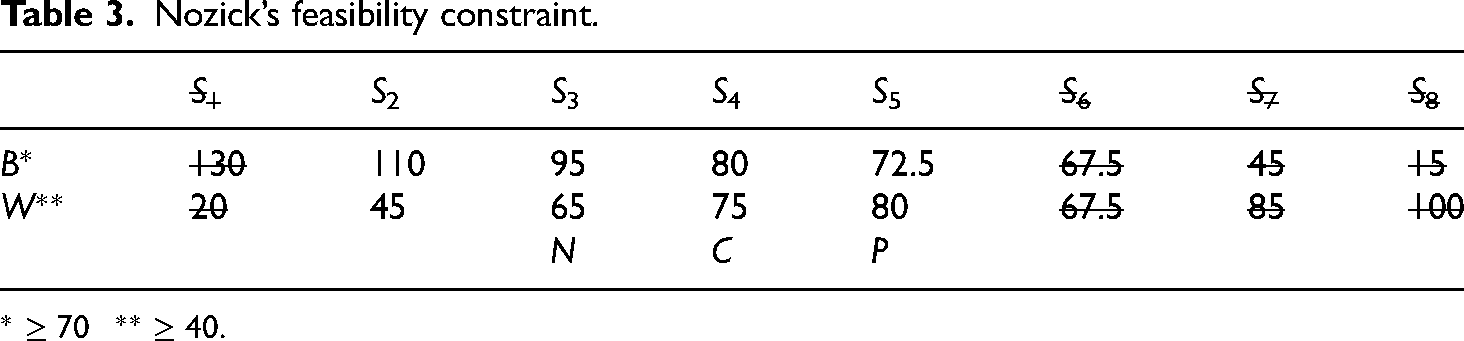
Supposing that this is indeed how we have to understand Nozick’s cooperative fairness objection to the difference principle, then the crucial question has been left unaddressed so far, namely why Nozick thinks that intra-group cooperation—rather than non-cooperation, or perhaps some third alternative still—is supposed to mark the morally appropriate baseline of comparison in the first place. The answer Nozick himself suggests in the lengthy passage from p. 193 of the book quoted towards the beginning of the present subsection seems to be that in the absence of general cooperation the members of the two groups as a matter of fact would cooperate internally, rather than each person's living solely by her own efforts. This in turn suggests that the baseline of intra-group cooperation amounts to a constraint of feasibility on Nozick’s view. Each group will in point of fact refuse to participate in any joint scheme of cooperation yielding its members less per capita benefit than would their merely internal scheme of cooperation. A cooperative scheme of that sort therefore simply won’t materialize. 27
Nozick’s conception of fairness in cooperation.
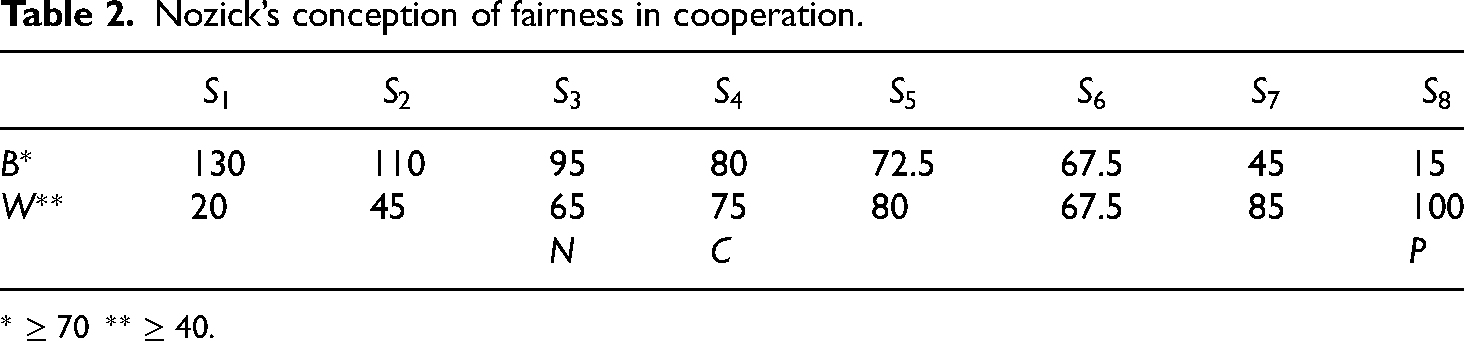
Nozick’s conception of fairness in cooperation.
*
The rationale behind Nozick’s choice of baseline so understood requires a final modification to our numerical illustration, as provided in Table 3. Of the schemes of cooperation adduced there, only
Nozick’s feasibility constraint.
*
The problem with Nozick’s thinking as interpreted so far is that, even if the assumption about the conditions under which the two groups would or would not be willing to cooperate with one another on which it is based were in fact descriptively accurate, its moral import isn’t obvious. In particular, it isn’t clear why we shouldn’t view the baseline of intra-group cooperation as merely delimiting the conditions under which the groups’ mutual threats of defection are in fact credible. However, credible defection and fairness in cooperation seem to be two very different things. To quote Rawls, “to each according to his threat advantage is not a conception of justice” (Rawls, 1999: 116).
Fortunately Nozick’s imagined negotiation between the better and worse endowed from the beginning of section 2 points to a more adequate answer here. As both parties make a point in emphasizing there, the purpose of their shared cooperative scheme is their mutual benefit (“Look, better/worse endowed, you gain by cooperating with us.”). This in turn suggests that the better endowed’s refusal to cooperate with the worse endowed on terms under which they themselves fare worse than they would if they were to cooperate merely internally need not be taken as a mere brute fact for the worse endowed to reckon with. 29 Rather, such a refusal might instead be taken as expressive of the—perfectly reasonable-seeming—expectation on the better endowed’s part that their participation in an arrangement whose express purpose consists in its participants’ mutual benefit be, in fact, to their benefit, where their benefit is measured—again reasonably enough—by comparison to how they would fare under their next best outside alternative. 30 Call this the reasonable expectation principle.
Reasonable expectation principle
The participants in a scheme of cooperation the purpose of which is their mutual benefit may reasonably expect to fare better as participants in the scheme than they would under their next best outside alternative.
All the materials for my best effort at reconstructing Nozick’s cooperative fairness objection to the difference principle are finally on hand. According to the cooperative fairness objection as conceived here, the cooperative difference principle’s unfairness to the better endowed ultimately derives from its appeal to non-cooperation rather than intra-group cooperation as its baseline of comparison. Intra-group cooperation is the morally appropriate baseline because it embodies the correct conception of what it is for a given party to benefit from some scheme of cooperation, namely the one expressed by the reasonable expectation principle. By the endowment-to-advantage assumption, non-cooperation is less favorable to the better endowed and more favorable to the worse endowed as a baseline of comparison than is intra-group cooperation, at least other things being equal. Given that the latter rather than the former embodies the correct conception of what it is for a given party to benefit from some scheme of cooperation and so the morally appropriate baseline of comparison to be deployed by a conception of fairness in cooperation, a conception of cooperative fairness deploying non-cooperation as its baseline of comparison ipso facto fails to give the better endowed’s reasonable expectation of benefit from their cooperation with the worse endowed its proper due and as such unfairly favors the latter over the former. Since this is how it is with the difference principle on both its pre-cooperative and its cooperative reading, it is so with the cooperative difference principle. It follows that the cooperative difference principle unfairly favors the worse endowed over the better endowed. Or so Nozick’s cooperative fairness objection as reconstructed to the best of my abilities has it.
Substance
Note that the moral force of the cooperative fairness objection so reconstructed comes out significantly weaker even on its own terms than the one at issue in its pre-cooperative counterpart. According to the cooperative fairness objection, the better endowed will tend to fare worse and the worse endowed better than they should as a matter of fairness in a cooperative scheme governed by the cooperative difference principle. Even if the complaint so understood is assumed sound, the grievance thereby identified doesn’t seem to cry to the heavens quite like the one invoked by the pre-cooperative fairness objection. This is so not only because the condition under which the least advantaged benefit maximally tends to be one under which the better endowed in fact still fare better in absolute terms than do the worse endowed if Rawls is to be believed. It is so also and more fundamentally because the cooperative difference principle doesn’t make reference to the better and worse endowed as such in the first place, as did the pre-cooperative difference principle in mandating maximal benefit for the worse endowed qua worse endowed. Rather—and as we already saw in section 3—the relation between the cooperative difference principle’s requirement of maximal benefit to the least advantaged on the one hand and the cooperators’ differing levels of (pre-cooperative) endowment on the other is merely contingent.
In any event, whether the cooperative fairness objection thus reconstructed is indeed sound as a critique of the difference principle as it understands it is in fact not obvious, even by Nozick’s own lights. The difficulty here arises from the further rationale to which Nozick appears to be appealing in rejecting the cooperative difference principle as unfair to the better endowed. As noted in section 4.1, Nozick’s larger objective in defending intra-group cooperation as the appropriate baseline of comparison seems to be to demonstrate how a scheme of cooperation favoring the better over the worse endowed in absolute terms need not be unfair to the latter. This is because he thinks that the worse endowed may well be benefiting more from cooperating with the better endowed than vice versa even where they fare worse absolutely speaking than do the latter given that “the better-endowed group includes those who manage to accomplish something of great economic advantage to others, such as new inventions, new ideas about production or ways of doing things, skill at economic tasks, and so on.”
Nozick’s suggestion here seems to be that it is just and proper for the better endowed to fare better in absolute terms than do the worse endowed under their joint cooperative scheme on account of the former’s relatively greater productive contribution to the scheme. This in turn suggests that, according to Nozick, fairness in cooperation must be thought of as a matter of scaling the various cooperators’ relative gains to their relative productive contributions. Call this the productive contribution principle.
Productive contribution principle
Fairness in cooperation consists in a distribution of the proceeds of cooperation according to productive contribution.
The difficulty for Nozick here arises because the productive contribution principle on the one hand and the reasonable expectation principle on which the cooperative fairness objection as reconstructed above is built on the other need not coincide. This is so on two counts: first, because a given group’s would-be internal level of productivity need not reflect its members’ relative productive contributions to the cooperative scheme they share with the other group, 31 and second, because the would-be level of benefit enjoyed by the members of a given group under mere intra-group cooperation need not reflect the group’s relative internal level of productivity. 32
In reply, it might be suggested to resolve the conflict between the reasonable expectation principle on the one hand and the productive contribution principle on the other in favor of the latter on Nozick’s behalf. That is, the suggestion here is that the differing levels of benefit the cooperators would obtain under their respective outside options were never supposed to count for anything in their own right for Nozick but instead were meant to serve as mere proxies for the cooperators’ differing productive contributions to their shared cooperative scheme all along. Insofar as the presumed proxy relation fails on grounds of either one, or both, of the counts just noted, then so much the worse for the reasonable expectation principle. 33
Yet that suggestion saddles Nozick with complications of its own. In particular, the reasonable expectation principle may well seem to have genuine force in its own right, that is, independently of its supposed status as a proxy for the cooperators’ differing contributions to their shared scheme of cooperation. 34 If so, however, then resolving the conflict between it and the productive contribution principle exclusively in favor of the latter would appear tantamount to suppressing something of sui generis moral import. Moreover, it isn’t obvious just how compelling the appeal to productive contribution as the standard for fairness in cooperation really is to begin with. Why should a cooperator’s fair share in the proceeds of social cooperation not instead be regarded as a function of her level of effort, or her level of need, or some yet further consideration, or perhaps some weighted function of some or all of these factors? 35
Interpretation
Perhaps these various substantive concerns about Nozick’s—anyway cursory and inconclusive—thinking about fairness in cooperation are in the end allayable. Moreover, even if they weren’t, this would at most provide for a negative defense of the difference principle as conceived by the cooperative fairness objection, namely via the refutation of one particular competitor conception of fairness in cooperation, that is, Nozick’s own as reconstructed in section 4.1. Nothing whatsoever has thereby been said by way of positive support of the maximin criterion as the morally appropriate standard for fairness in cooperation to be deployed in the sort of context the cooperative fairness objection envisages. Such support would moreover clearly be in order given that, as Rawls himself notes, his principles of justice are “plainly not suitable for a general theory” and “in many if not most cases … give unreasonable directives” (Rawls, 2005: 261).
In fact, it stands to reason that Rawls would consider the kind of case Nozick is envisioning in mounting his cooperative fairness objection to the difference principle to be one where the latter does indeed give unreasonable directives. This is because the context on which Rawls himself brings the difference principle to bear precisely differs from the one presupposed by the cooperative fairness objection. As we saw in section 4.1, the cooperative fairness objection as reconstructed there finds the difference principle wanting on account of the latter’s supposed appeal to non-cooperation—as opposed to intra-group cooperation—as its baseline of comparison, which appeal unfairly favors the worse over the better endowed according to Nozick. Yet subjecting the difference principle to the sort of comparative reasoning at work there is tantamount to treating it as formally akin to a principle governing what Rawls calls “particular agreements.” Rawls himself by contrast conceives of the difference principle as a principle of justice for society as a whole and so as belonging to the social contract qua sui generis form of cooperative agreement. Put differently, we might distinguish two forms of social cooperation, political cooperation on the one hand and associative cooperation on the other, where Nozick’s cooperative fairness objection might be said to implicitly treat the difference principle as a principle of associative cooperation, whereas the difference principle as Rawls himself understands it constitutes a principle of political cooperation. 36
Like the passage quoted just now about the difference principle’s unsuitability for a general theory, Rawls’s most explicit statement of the present point occurs in Lecture VII of Political Liberalism, “The Basic Structure as Subject.” Rawls there describes the nature of particular agreements in his sense as follows:
Typically these are based on the parties’ known (or probable) assets and abilities, opportunities, and interests, as these have been realized within background institutions. We may assume that each party, whether an individual or an association, has various alternatives open to them, that they can compare the likely advantages and disadvantages of these alternatives, and act accordingly. Under certain conditions someone’s contribution to a joint venture, or to an ongoing association, can be estimated: one simply notes how the venture or association would fare without that person’s joining, and the difference measures their worth to the venture or association. The attractiveness of joining to the individuals is ascertained by a comparison with their opportunities. Thus particular agreements are reached in the context of existing and foreseeable configurations of relationships within the basic structure; and it is these configurations that provide a basis for contractual calculations. (Rawls, 2005: 275–276)
As Rawls describes it here, the form of reasoning proper to the question whether to enter a given particular agreement within the basic structure exhibits two formal features. First, the form of reasoning in question here is particular, in the sense that it governs the choice between particular alternatives, where this potentially includes probabilities ranging over such alternatives. Second, the relevant form of reasoning is external, in the sense that it involves comparing the candidate agreement with what must be conceived of as numerically distinct and as such outside alternatives.
The form of reasoning to be deployed in selecting the principles governing the basic structure itself—that is, the form of reasoning embodied by the original position—differs from the one applying to particular agreements precisely along these two dimensions according to Rawls. First, the form of reasoning in the original position is general. In selecting principles of justice for society the parties abstract from any comparison of particulars; hence Rawls’s stipulation that the veil of ignorance “excludes all knowledge of likelihoods,” such that the parties in the original position “have no basis for probability calculations” (Rawls, 1999: 134). Second, the form of reasoning in the original position is internal. That is, the parties’ reasoning must be understood as ranging exclusively over different possible arrangements of the basic structure of society as a whole and as such of different possible arrangements of the same system of cooperation. There is no question there of comparing how the members of society would fare in society as a whole on the one hand and how they would fare in this or that numerically distinct, more limited cooperative scheme on the other hand. 37
Note that this is not to say that there is no comparing taking place in the original position. On the contrary, the parties cannot but engage in comparing alternatives if there is to be a rational selection among competing conceptions of justice there at all. And indeed this is what they do on Rawls’s picture, for instance in rejecting the principle of average utility in favor of his own two principles of justice. The point is rather that any such comparison will be entering exclusively at the level of the “general facts about human society” (Rawls, 1999: 119) available in the original position, in abstraction from any information about particulars. Moreover, the comparison in question is of necessity limited to one between different conceivable arrangements of the basic structure of society itself. There is no question in the original position of a comparison of society as a whole with something other than itself. As Rawls puts it, “the alternatives [among which the parties in the original position are to choose, M.G.] are not opportunities to join other societies, but instead a list of conceptions of justice to regulate the basic structure of one’s own society” (Rawls, 2005: 277).
It is along the two dimensions just specified—particular versus general and external versus internal—that “the context of a social contract is strikingly different” (Rawls, 2005: 276) by Rawls’s lights from the one in which particular agreements between particular individuals must be understood as taking place. 38 Given that the difference principle as Rawls himself conceives of it forms part of the social contract and as such applies to the basic structure itself, it is not meant to apply to the internal arrangement of the sorts of particular agreements in which private persons engage with each other as these occur within the basic structure. From Rawls’s point of view, the difference principle therefore cannot be understood as answerable to the particular and external form of comparison associated with particular agreements in his sense.
Yet answerability of this sort is precisely what Nozick’s cooperative fairness objection as reconstructed in section 4.1 presupposes. The unfairness to the better endowed with which the cooperative fairness objection thus reconstructed charges the difference principle reflects the supposed moral mismatch between the—particular—level of benefit the better and worse endowed would respectively derive under a difference-principle-governed shared scheme of cooperation between them on the one hand and the—equally particular—level of benefit they each would enjoy under their next best outside scheme on the other. Moreover, the cooperative fairness objection rests on the assumption that Rawls’s neglect of any appeal to the cooperators’ next best scheme of cooperation as the relevant baseline of comparison in defending the difference principle is tantamount to an appeal to the absence of cooperation as Rawls’s alternative positive baseline of comparison, which appeal Nozick then goes on to criticize as unfairly favoring the worse endowed over the better endowed.
The assumption is mistaken. The absence of cooperation does not serve as a positive baseline of comparison for Rawls. On the contrary, there is no comparative baseline whatsoever at work in Rawls’s defense of the difference principle, or rather: none of the particular and external variety to which the cooperative fairness objection as reconstructed in section 4.1 appeals. Instead, the kind of comparison on which the difference principle’s selection in the original position rests has to be understood as general and internal in the above sense. By the same token, comparative considerations of the sort by which Nozick wishes to establish the difference principle’s unfairness to the better endowed have no place within the kind of context in which the difference principle enters as a candidate principle, that is, the context of the social contract qua formal object of the original position.
As was the case with the pre-cooperative fairness objection, the cooperative fairness objection’s reading of the difference principle thus amounts to a misinterpretation. 39 Again as with its pre-cooperative counterpart, the question whether the cooperative fairness objection succeeds at demonstrating the unfairness of the difference principle as it interprets the latter is therefore ultimately beside the point for the purpose of investigating the merits of the actual, Rawlsian difference principle. 40
Note that Rawls’s formal distinction between particular agreements on the one hand and the social contract on the other in fact already problematizes the very concept of a metric of advantage of the sort on which Nozick’s fairness objection implicitly relies throughout, that is, one allowing for particular comparisons between society as a whole on the one hand and this or that less general cooperative scheme on the other as invoked by the better and worse endowed in negotiating their terms of cooperation on Nozick's telling. Specifically, the index of social primary goods by appeal to which the parties in the original position are supposed to select the difference principle is precisely not available as the requisite metric for Nozick’s purposes. This is because the social primary goods in providing the parties in the original position with a rational basis for choosing among the various candidate conceptions of justice with which they are presented there exhibit precisely the general and internal character proper to their reasoning there. Given that it presupposes the sort of external and particular comparability between society as a whole on the one hand and this or that less general and as such extra-societal cooperative scheme on the other fundamentally inimical to Rawls’s way of thinking about justice, the numerical illustration presented in Tables 1 through 3 thus isn’t theoretically innocent from the latter’s point of view. The argument up to and including section 4.2.1, while overtly critical of Nozick, thus effectively granted him a basic presupposition over which he and Rawls are in fact at odds. 41
Rawls on politics
This leaves us with the question of the rationale behind Rawls’s formal distinction between particular agreements within the social contract on the one hand and the agreement that is the social contract itself on the other. In other words, the question here is whether Nozick in misinterpreting the difference principle in the way just described ipso facto misses out on a matter of genuine philosophical moment.
The answer as I understand it is that Rawls in good Kantian fashion conceives of the relation between these two kinds of agreements as that between a moral condition and that which the condition conditions, that is, that to which it applies as its condition. Specifically, Rawls as I read him holds that a just basic structure in virtue of its justice confers fairness on the particular agreements taking place within it and as such provides for the mutual freedom and equality of its citizens as these engage in such agreements with one another. As Rawls expresses the point, “the role of the institutions that belong to the basic structure is to secure just background conditions against which the actions of individuals and associations take place” (Rawls, 2005: 266). 42
Put the other way around, particular agreements between private individuals depend for their fairness, and so for their (specifically political) moral worth as agreements between free and equal persons, on their taking place within a just basic structure. Rawls’s description of society as a “cooperative venture for mutual benefit” in A Theory of Justice (Rawls, 1999: 4) as transposed to his considered conception of justice must therefore be taken as really shorthand for “cooperative venture for the possibility of mutually beneficial particular agreements between free and equal persons.” Or, retrieving the distinction between political and associative cooperation from section 4.2.2, we might say that political cooperation is the condition under which alone morally worthy associative cooperation is possible for Rawls.
Rawls’s basic objection to Nozick’s “entitlement theory” of justice turns precisely on the latter’s unconcern with the basic structure’s worth-conferring significance in relation to the particular agreements among private persons taking place within it. As Rawls puts it, Nozick-style libertarianism “has no special role for the basic structure” (Rawls, 2005: 262), nor by the same token does it have use for the form of reasoning embodied by the original position. To return to the Kantian distinction introduced in the Introduction, libertarianism in Nozick’s sense might be said to recognize both right and ethics but to lack the concept of politics qua sui generis moral category. 43
In particular, Nozick holds that the moral legitimacy of the state is a question of the conditions under which it may legitimately coerce its citizens and so a question proper to right in the Kantian sense of that term. Nozick’s answer to that question is that “the minimal state is the most extensive state that can be justified” and that “any state more extensive violates people’s rights” (p. 149), where the minimal state is “the night-watchman state of classical liberal theory, limited to the functions of protecting all its citizens against violence, theft, and fraud, and to the enforcement of contracts, and so on” (p. 26). Nozick’s answer here is a straightforward consequence of the idea, also already mentioned in the Introduction, that nothing outside of other persons’ rights against a person legitimately limits that person’s rights as against those others.
Fairness in cooperation as Nozick understands it by contrast is a matter of the choiceworthiness of a given cooperative scheme. As such, the concept of fairness in cooperation falls outside the scope of right, which in turn means that the enforcement of cooperative fairness necessarily exceeds the scope delimiting Nozick’s minimal state. It follows that any valid principle of cooperative fairness has to take ethical form in the Kantian sense from above, that is, it has to amount to a principle to which persons ought to subscribe voluntarily in jointly arranging their private schemes of cooperation, rather than one legitimately enforceable against them. A principle of cooperative fairness arrogating enforceability to itself and so presenting itself as a juridical principle ipso facto exceeds its own moral competence, so to speak. The freedom objection charges the difference principle with doing precisely that and as such has to be understood as effectively declaring the difference principle invalid qua moral principle.
In developing his fairness objection to the difference principle Nozick implicitly represents society—that is, that to which he refers as “general cooperation”—as a cooperative scheme of a sort to which the concept of fairness in cooperation is in fact validly applicable. It follows that society so understood could not amount to a coercive institution but instead has to be conceived of as a voluntary cooperative scheme taking place against the background of persons’ mutual rights as enforced by the minimal state. This is so because otherwise society qua general cooperation would have to count as morally illegitimate from the outset on the specifically juridical ground that the enforcement of anything beyond people's mutual rights is tantamount to a violation of those very rights. In other words, in order to qualify as morally legitimate in the specifically juridical sense of moral legitimacy as consistency with people's rights society qua general cooperation has to be viewed as merely one of the indefinitely many forms of association people might voluntarily enter into with one another within the libertarian utopia made possible by the minimal state. It follows that the difference between society qua general cooperation on the one hand and the various intra-group cooperative schemes on the other invoked by Nozick’s fairness objection to the difference principle as reconstructed in section 4.1 above cannot be anything other than one of mere degree by the fairness objection’s lights: does the scheme of cooperation in question happen to cover all or merely a proper subset of the citizenry of the minimal state? It is in turn precisely because their difference is bound to amount to one of mere degree on Nozick’s picture that the comparison between society on the one hand and mere intra-group cooperation on the other on which the fairness objection as reconstructed in section 4.1 depends is formally available to him in the first place.
The merely gradual difference between society and mere intra-group cooperation in question here might indeed be described as one of degree of generality, as Nozick himself in fact does when he speaks of society as the scheme of “general cooperation.” Yet the sense in which the difference in degree here is one of degree of generality is formally distinct from generality in the sense in which the original position constitutes a distinctly general form of thought for Rawls (as per section 4.2.2). 44 By the same token, for Rawls the basic structure amounts to a specifically political system of institutions, just as the original position represents a specifically political form of reasoning and the social contract as the original position’s formal object marks out a specifically political form of cooperation, where politics must be understood as a moral category distinct from both right and ethics. Unlike Nozick’s minimal state, the basic structure qua specifically political scheme of social cooperation concerns itself, not merely with enforcing people’s rights against one another, but instead also with securing the fairness of their private schemes of cooperation. Political cooperation therefore isn’t merely a juridical matter. At the same time, political cooperation unlike associative cooperation is mandatory rather than voluntary and in that sense participates in the coercive nature of right. As such, politics isn’t simply a matter of ethics either. 45
Put differently, Nozick’s libertarianism holds out two social forms whose instantiations count as morally legitimate in the specifically juridical sense of the term in question here: first, the minimal state, which despite its coercive nature qualifies as legitimate on account of its purely “defensive” character; and second, the various voluntary schemes of cooperation taking place within the minimal state, which in their voluntary and so non-coercive character count as legitimate in that sense as it were by default. Yet these two social forms amount to a pair of false alternatives by Rawls’s lights given the specifically political character of the scheme of social cooperation that is the basic structure.
46
Moreover—and as we already saw above—it is political cooperation which is supposed to make fairness in associative cooperation possible in the first place for Rawls. In other words, the topic of politics isn’t
The same problem carries over to Nozick’s case against the difference principle. According to the freedom objection, the enforcement of the difference principle qua distributive pattern “violates people’s rights” and as such exceeds the state’s legitimate scope on Nozick’s minimal conception thereof. Yet in treating the difference principle as a requirement to be enforced against the members of society as individuals the freedom objection in effect treats it as a principle of right in the Kantian sense. By contrast, the fairness objection as reconstructed in section 4.1 finds the difference principle wanting as a principle of fairness in cooperation and so as a principle governing society understood as a scheme of voluntary cooperation between the better and worse endowed (namely on account of its unfair bias against the former and in favor of the latter). However, in treating agreement to the difference principle as a purely voluntary matter the fairness objection ipso facto treats it as a principle of ethics.
The difference principle as Rawls himself conceives of it falls in neither of these two moral categories. It isn’t meant to merely specify persons’ enforceable mutual rights, as is the task of a principle of right in Kant’s sense. Nor is it supposed to govern the internal workings of our merely voluntary schemes of cooperation—again, in that context its directives may well be unreasonable by Rawls’s own lights—and so in Kantian terms represent a principle of ethics. Rather, the difference principle qua distinctly political principle is meant to regulate the basic structure qua mandatory form of social cooperation such that citizens’ respective levels of material advantage make possible their private association on terms that are fair and as such understandable as expressive of their mutual freedom and equality. 47
There is thus no space within Nozick’s framework for the difference principle as the specifically political principle as which Rawls himself understands it. Moreover, according to Rawls the difference principle qua distinctly political principle partially specifies the institutional conditions under which material differences between citizens of the sort expected to arise in a democratic society might be viewed as fair and so as realizing their mutual freedom and equality. The invisibility to Nozick of the specifically political sense in which Rawls intends the difference principle must therefore be viewed as part and parcel of the former’s more general insensitivity to the question how mutual freedom and equality between persons are possible—or, more precisely, to that sense of the question how mutual freedom and equality between persons are possible in which politics is supposed to serve as its answer—from Rawls’s perspective as interpreted here. 48
Conclusion
The purpose of this article was to show how there is both more and less to Nozick’s fairness objection to the difference principle than initially meets the eye. There is more to the fairness objection than might seem at first in that it turns out to divide into two distinct versions, each attended by its own complexities. There is in turn less to the fairness objection than might appear on the face of it in that both of these versions rest on misinterpretations of the difference principle as Rawls understands the latter, the result being that Nozick’s charge of unfairness against the difference principle is nowhere near as stringent and compelling as might first be thought.
In one sense, the result reached here is narrow and limited. I do not pretend to have covered the entirety of Nozick’s case against the difference principle in full detail. Nor have I done more than preparatory work with a view to adjudicating whatever larger disagreement over the nature of justice stands between Nozick and Rawls. That is, all I have tried to do on that count is to bring out how Rawls’s conception of justice rests on the thought that particular and external reasoning presupposes general and internal reasoning and how that thought in turn implicitly depends on Rawls’s understanding of politics as a moral category in its own right, without offering anything by way of an account of what is supposed to underwrite these various relations, let alone by way of a full-fledged “deduction” on Rawls’s behalf of the genuine moral significance of politics thus understood.
At the same time, the scrutiny applied to Nozick’s fairness objection to the difference principle here may potentially be of interest beyond the confines of any such adjudication. For one, the positive Nozickian conception of fairness in cooperation emerging from the reconstruction of his cooperative fairness objection to the difference principle in section 4.1 may well be worth a proper investigation of its own, over and above the merely promissory remarks offered on this count in section 4.2.1. After all, even Rawls would grant that particular agreements in his sense do make for a bona fide subject of justice in its own right, even if not its primary subject. Moreover, the interpretation of Rawls’s account in terms of the formal distinctness of the social contract from particular agreements in this sense proposed in section 4.2.2 and, more fundamentally, in terms of the concept of politics as a moral category distinct from right and ethics to which Rawls thereby implicitly appeals discussed in section 5 might serve, not just to illuminate Rawls’s own larger conception of justice, but also to inform our systematic understanding of social contract theory as a distinctive framework of political morality, or perhaps rather: as a distinctly political framework within morality.
Footnotes
Acknowledgements
I am grateful to Ralf Bader for a discussion of and to Alexander Prescott-Couch for written feedback on a distant ancestor of this article, as well as to the two anonymous referees for this journal for their extraordinarily helpful reports on the initially submitted manuscript. I would also like to thank Christine Korsgaard, Thomas Scanlon, and Arthur Ripstein for many instructive conversations about Rawls while I was in graduate school and beyond.
Declaration of conflicting interests
The author declared no potential conflicts of interest with respect to the research, authorship, and/or publication of this article.
Funding
The author disclosed receipt of the following financial support for the research, authorship, and/or publication of this article: This work was supported by the Swiss National Science Foundation [grant number 100012_192412].