



Abstract
When studying the feasibility and justice of basic income, researchers usually assume that policymakers would be introducing the unconditional benefit to a closed economic entity. When contemplating the introduction of a universal policy, few researchers take into consideration the fact that citizens and foreigners migrate, and that this movement alters the size and skill structure of the population. This article addresses this oversight by analyzing how basic income schemes based on residence or citizenship may affect tax base, wages, and employment while incorporating migration incentives. The discussion is based upon neoclassical labor supply and migration theory and informed by the conjectured economic effects from a normative perspective. This research suggests that a basic income would create migration incentives that reduce the tax base, leading us to question this policy’s feasibility. Moreover, the flow-on effects of migration call into question the justice of both residence-based and citizenship-based basic income schemes. Therefore, this article sheds light on how basic income’s feasibility and justice relate to each other and identifies the benefits and further opportunities for interdisciplinary social policy research.
Introduction
In economic policy, a basic income involves giving regular, universal, and unconditional cash payments to every individual of a defined society 1 (Van Parijs and Vanderborght, 2017: 4–23). Importantly, introducing such a policy would affect not only the economy, but also society as a whole, hence, posing questions for the policy’s feasibility and justice. When national basic income schemes are considered within a global context and migration is taken into consideration, questions about the universality of the basic income are particularly interesting. Eligibility questions usually deal with whether a basic income should require recipients to be willing to participate in the workforce, whether it should be paid to children or the elderly and, finally, whether it applies only to citizens (Fleischer and Hemel, 2020: 671); the citizen aspect is the focus of our analysis. Van Parijs and Vanderborght (2017: 9) assume that ‘(r)ecipients of it (basic income) must be members of a particular, territorially defined community’. But what if community membership changes due to migration? This article shows why defining eligibility criteria is important for the economic effects of a basic income policy and for justifying the introduction of such a policy.
To date, supporters of national basic income schemes minimize feasibility issues, such as a possible decrease in hours worked. Natural and laboratory experiments support the theoretical reasoning that an ambiguous income effect causes indeterminate labor supply reactions (Gilbert et al., 2018; Gilroy et al., 2013; Haigner et al., 2012; Marx and Peeters, 2008; Palermo Kuss and Neumärker, 2018; Van Parijs and Vanderborght, 2017). Considering those who support basic income policies as a matter of justice, advocates argue that if introduced, such a policy would improve the position of society’s worst-off members in terms of opportunity, self-respect, and power (Breen, 2017; Casassas and De Wispelaere, 2016; Festl, 2013; Fukuma, 2017; McKinnon, 2003; Pettit, 2007; Raventós, 2007; Van Parijs, 1997; Van Parijs and Vanderborght, 2017).
However, the debate about basic income has seldom incorporated the migration of citizens and foreigners into the discussion (see, for example, Boso and Vancea, 2012; Fischer, 2020; Howard, 2006; Van Parijs and Vanderborght, 2010, 2017). It is important to rectify this oversight, as policymakers must consider how their social policy works within the global context. When analyses do consider migration, the economic effects change, offering different insights into the feasibility of the basic income policy. As demonstrated in the following study, considering the effect of migration also reveals ethical aspects, enriching our understanding and perception of the policy’s desirability. Showing how economic and normative social policy debates relate, this study illustrates why interdisciplinary research aids policymakers. It contributes to the basic income literature by suggesting that incentives to migrate challenge the policy’s feasibility. Moreover, it questions claims that basic income is just, because when migration is taken into consideration, the policy’s wage and employment effects leave low-skilled citizens and foreigners worse off.
In order to address these issues, I first discuss how basic income, based on residence or citizenship and financed by a flat tax on income, affects the tax base, wages, and employment while taking into consideration cross-country migration of citizens and foreigners. To the best of my knowledge, this is the first basic income article to combine neoclassical labor supply and migration theory. I further assume that citizens and foreigners inhabit the state territory, that residents can migrate, and that basic income induces individuals to move. For net contributors, it is the higher tax burden that provides the incentive to emigrate. For net beneficiaries, it is the promise of income security that provides the incentive to immigrate (Van Parijs and Vanderborght, 2010: 2–5). These migration movements reduce the basic income tax base and oppose or reinforce wage and employment effects, depending on the respective scheme. Therefore, overall, I question basic income feasibility within a global context for the specific schemes presented.
Second, I explore whether basic income schemes conform to justice requirements, in regard to migration and foreigners. Real libertarians, liberal egalitarians, and republicans justify basic income by arguing that it maximins a social good index. I hypothesize that the justness of basic income depends on how immigration affects low-skilled residents’ wages and employment and that a citizenship-based basic income worsens low-skilled foreigners’ opportunities, self-respect, and power. On this basis, I question the justice of basic income within a global context for the specific schemes presented.
I use a theoretical model to highlight the economic effects for two reasons. First, as Crespo (2013: 69) describes, ‘good models shed light on otherwise unknown elements of reality’. Modeling is useful as it increases policymakers’ understanding of how basic income and migration effects interact, thus generating a starting point for further economic research. Second, basic income experiments and lottery winner surveys fail to yield reliable results because the scenarios critically differ from introducing a real-world basic income (Hoynes and Rothstein, 2019: 949–952; Špeciánová, 2018a; Spermann, 2017). Modeling intends to deconstruct real-world circumstances, being aware of how abstracting affects results. Therefore, this study proceeds to model economic effects as an alternative to analyzing insufficient empirical data.
The analysis focuses on two specific basic income schemes that are financed by a flat tax on income and implemented nationwide within a global context. The schemes’ characteristics are critical for the presented results. For example, other possibilities exist for financing a basic income, such as taxes on capital, natural resources, money transactions, or consumption (Van Parijs and Vanderborght, 2017: 147–158), and each of these might change the presented results. 2 I opt for financing basic income with the help of a flat income tax, in line with previous research (Atkinson, 1995; Ghatak and Maniquet, 2019). This type of tax has been proposed by basic income advocates because it is the ‘most straightforward form’ (Van Parijs and Vanderborght, 2017: 133). While progressive tax schemes may be more common in Western societies, a simple flat tax coupled with a basic income allows for analyzing potential effects in an easier fashion.
Stating that national basic income schemes are necessary for a transition period, Van Parijs and Vanderborght (2017: 216–230) argue in favor of a global basic income scheme while admitting feasibility issues. Fischer (2020: 9–12) summarizes that the implementation of global and regional basic income schemes, e.g. on the European level, are probably not attainable due to political reasons. Accordingly, the nation-state is the institution that is most likely to possess the power and legitimacy to introduce a basic income policy. Hence, if the introduction of a national basic income is within reach and at least a precondition for a global scheme, it seems to be reasonable to discuss how feasible and desirable it is.
Moreover, I focus on the economic effects of cross-country migration while not denying the relevance of regional migration. However, it is common to analyze internal migration as a separate issue; the recent attempt to integrate the two by Bernard and Perales (2021) prompts avenues for further research.
The article proceeds as follows: The second section reviews basic income literature on labor supply and migration, the third section presents and discusses the results of the economic analysis, and finally the fourth section further explores how proponents justify basic income and then evaluates the economic effects of basic income in relation to these justifications.
Basic income and migration
In this section, I outline the theoretical arguments and empirical evidence for the effect basic income would have on labor supply. I also introduce the basics of migration theory, which are relevant for our analysis. Finally, to contextualize this study I evaluate the literature on basic income that also considers migration. This allows me to demonstrate the importance of performing a systematic interdisciplinary analysis of basic income’s feasibility and justice that takes into consideration migration and the presence of foreigners and how such an analysis addresses a literature gap.
In theory, basic income would function similarly to an increase in welfare benefits because it introduces a non-working income. In our model, the basic income benefit is accompanied by the introduction of an income tax to finance it. If one assumes a static labor supply model, this combination yields a decrease in labor supply (Chan and Moffitt, 2018: 350–352; Moffitt, 2002: 2402–2408). However, the impact of basic income on hours worked is ambiguous and depends on the income effect. The individual decision to supply labor is based on maximizing utility over consumption and leisure. Introducing a non-working income and reducing net wages by taxation would have two effects. First, work would be worth less due to lower net wages. Therefore, individuals would substitute consumption for relatively cheaper leisure. This substitution has a positive effect on leisure and, hence, a negative effect on hours worked for all wage groups. 3 By contrast, the income effect can go in either direction. For net beneficiaries, the additional income via basic income will outweigh the loss caused by the levied income tax. Therefore, beneficiaries will consume more goods and more leisure. The income effect is positive on leisure and, hence, negative on hours worked. Substitution and income effect reinforce each other, causing a decrease in hours worked. For net contributors, the benefit increases income less than taxes reduce it, and contributors consume fewer goods and less leisure. The income effect is negative on leisure and, hence, positive on hours worked. In this regard, substitution and income effect oppose each other, and the overall effect of a basic income on hours worked is also ambiguous (Gilroy et al., 2013: 51–58; Green, 1968; Petersen, 2017: 9–10; Van Parijs and Vanderborght, 2017: 133–138).
In our model, the substitution effect is stronger than the income effect, yielding a decrease in hours worked for all wage groups because it does not account for non-working income in the status quo. The negative effect on intensive labor supply is reasonable when comparing a labor market without any social security to one with basic income (Hoynes and Rothstein, 2019: 934–938, 947–948). Considering developed countries, a decrease in hours worked by a basic income introduction can also be expected when other forms of social security exist, but this is questionable when considering developing countries (Banerjee et al., 2019; Ghatak and Maniquet, 2019: 919–921; Hoynes and Rothstein, 2019: 947–948).
Empirically, the effect of a basic income on hours worked differs according to the examination methods used, which range from experiments to analyzing the labor supply reactions of lottery winners (Haigner et al., 2012; Imbens et al., 2001; Marx and Peeters, 2008). Overviews on empirical basic income research are presented by Widerquist (2018) and, for Europe specifically, by Delsen (2019). Gilbert et al. (2018) and de Paz-Báñez et al. (2020) focus on trial programs to test how labor supply is affected by the introduction of basic income; they show that the overall effects on hours worked were negligible. However, empirical analyses do not adequately assess how the introduction of a basic income would play out in the real world (Hoynes and Rothstein, 2019: 949–952; Špeciánová, 2018a). 4
For one, laboratory experiments are unable to simulate the long-term effects of introducing a basic income (Hoynes and Rothstein, 2019: 952; Jokipalo, 2019: 3). Moreover, they pose unrealistic settings. For example, Haigner et al. (2012: 4–7) exposed participants to different social security systems financed endogenously by income taxation. In one scenario, they provided them with a basic income and then allowed participants to either work at a repetitive and supposedly boring task or to do nothing at all. Haigner et al. (2012: 9–11) conclude that the decision to work does not depend on the tax scheme but on individual characteristics. However, a real-world basic income does not offer the choice between doing boring work and doing nothing but between doing boring work and doing something one wants to do instead.
In regard to studies on lottery winners, it is argued that winning the lottery serves as a natural experiment to illustrate a permanent increase in non-earned income such as a basic income. Yet, samples are usually small, and authors obtain inconsistent results with respect to labor supply effects, ranging from negative (Imbens et al., 2001) to negligible (Marx and Peeters, 2008). Moreover, since winning the lottery is more of a lump-sum transfer, results may not indicate what happens when a basic income is introduced, which is paid regularly.
In a scenario similar to a basic income scheme, in 2011 the Iranian government introduced cash transfers amounting to almost 30 percent of the household income. In their study, Salehi-Isfahani and Mostafavi-Dehzooei (2018: 3–9) found negative effects of this policy only on labor supply among adults between 20 and 29 years old. However, in the Iranian case study, a possible negative effect on labor supply can be countervailed by the necessity to work more, since the payment was specifically designed to compensate living communities for rising energy prices. Furthermore, inflation renders the real effect of the Iranian basic income negligible.
In summary, these case studies demonstrate that it is difficult to obtain applicable results from empirical evidence that can be reliably generalized to predict the effects of basic income. As a result, modeling effects to check feasibility, the second-best alternative to natural and lab experiments, is common in academic literature (Gilroy et al., 2013; Palermo Kuss and Neumärker, 2018). 5 However, to the best of my knowledge, this is the first attempt to integrate migration theory into such a model.
In theory, the decision to migrate correlates positively with the average income of the destination country and negatively with cost of migration. It has been argued that migration movements differ based on income inequality, as shown in Figure 1. This graph depicts two societies with equal mean income but differing standard deviations. A higher standard deviation yields a flatter curve, illustrating higher income inequality. Individuals have a greater incentive to move from one society to another if the probability of securing a higher income increases. Hence, individuals situated at the lower end of the income distribution up to the mean income increase their income prospects by migrating to the society with lower inequality. The opposite is true for individuals situated at the higher end of the income distribution. Consequently, different governmental policies induce different migration movements. In general, low-income individuals migrate to economies that provide social security, yielding lower income inequality and relatively few low incomes. High-income individuals migrate to skill-based economies, allowing for high inequality and consequently relatively more high incomes (Borjas, 1994: 1687–1692; 1999: 1700–1716; Roy, 1951).
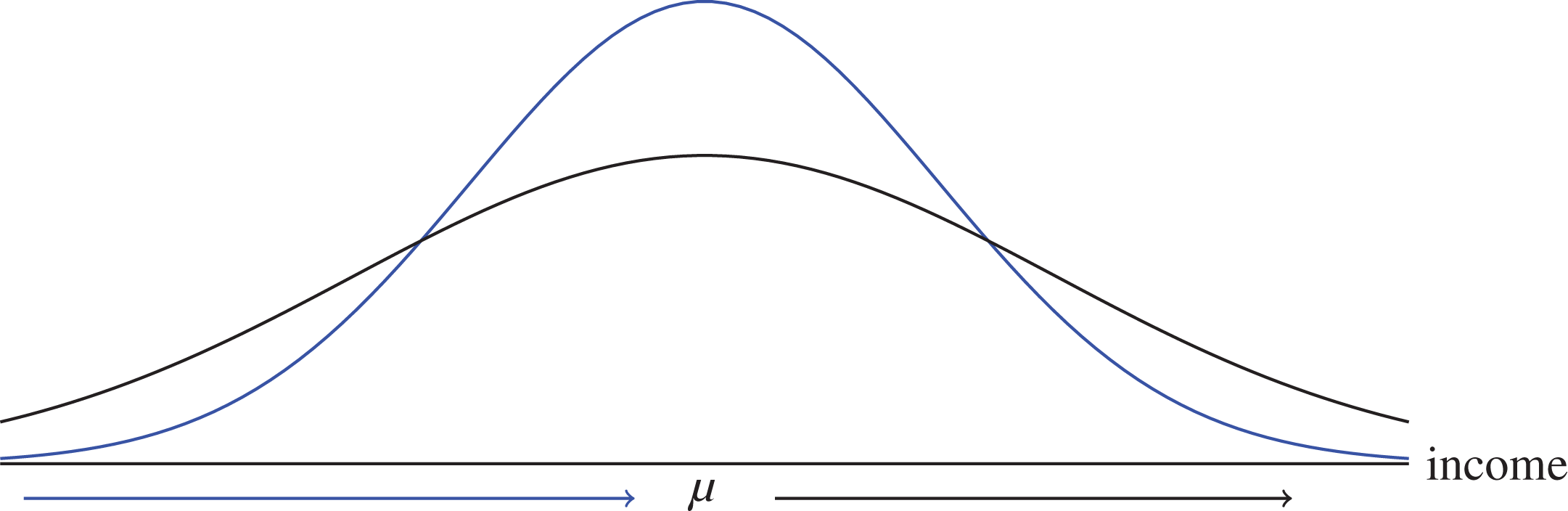
Migration according to income inequality based on Tani (2014: 6).
If basic income is interpreted as an increase in welfare benefits, it hence encourages immigration of net beneficiaries and emigration of net contributors. Empirical evidence from Europe strengthens this so-called welfare-magnet hypothesis in regard to low-skilled immigrants (De Jong et al., 2020; Jakubiak, 2019; Razin and Wahba, 2015). Moreover, Cebolla-Boado and Miyar-Busto (2020: 186–189) find that while high-skilled individuals are attracted by high wages, they are deterred by social expenditure, albeit only in the short-term.
Nevertheless, Boso and Vancea (2012: 13–15) question the relevance of the welfare-magnet hypothesis considering basic income, arguing that the decision to migrate is influenced by community networks rather than by monetary factors. Other philosophers acknowledge the economic challenge to the feasibility of a basic income posed by the immigration of net beneficiaries and the emigration of net contributors (Howard, 2006; Van Parijs and Vanderborght, 2010: 16–21; 2017: 218–226). They argue that restricting immigration by enforcing border control and deterring emigration by enhancing loyalty and patriotism is the second-best alternative to introducing a global basic income, given that such a policy is not currently politically feasible. However, this option is opposed by Abizadeh et al. (2015) who claim that restricting immigration cannot be justified by special obligations to natives even if local low-skilled individuals are adversely affected, although they question whether this is the case.
This article is the first to synthesize neoclassical labor supply and migration theory with the concept of a basic income, and for reasons of simplicity, the following discussion focuses on short-term effects and monetary incentives to migrate. It aims to provide a systematic economic analysis based on the introduced conjectures about labor supply effects and migration incentives. In the context of the presented literature, this analysis is relevant for two reasons. First, we show that migration incentives and corresponding wage and employment effects differ depending on the implemented basic income scheme (residence or citizenship); we also question the feasibility of a basic income based on either residence or citizenship. Second, we use the results of the economic analysis to provide a structured discussion on the justness of the basic income schemes, stressing the interdependence of feasibility and justice and, hence, the relevance of interdisciplinary research.
Feasibility of residence- and citizenship-based basic income
This section examines how a basic income scheme, b, based on either residence or citizenship, and financed by a proportional flat tax on income,
The analysis is based on a static neoclassical labor supply model considering individual decision making of a representative agent under perfect certainty. Individual decision making is illustrated utilizing a Cobb-Douglas utility function, and savings are not discussed for reasons of simplicity (Gilroy et al., 2013: 51; Yunker, 2013: 206–207). The basic income amount is exogenous, as is the tax rate. The analysis closely follows Gilroy et al. (2013: 51), who use a simple version of a utility function with only consumption, c, and leisure, l, as input factors and constant corresponding affinities,
I analyze the labor supply effects of introducing a basic income in comparison to a labor market without any social security system for two reasons. First, the analysis serves as a starting point. Although limiting general applicability, the simplicity of the comparison enables us to isolate the effects of the basic income introduction and migration, the focus of the stated research question. However, given that the results of the analysis depend heavily on the stated assumptions, future research should investigate this further. For example, one could extend the discussion by comparing basic income schemes and migration within the framework of social security, as suggested by Hoynes and Rothstein (2019: 934–935). The second reason for comparing the basic income to a labor market without social security concerns the basic income justice debate. Intuitively, any form of social security is better than none for those who are worst off in a given society. However, this assumption may no longer stand if the discussion takes into consideration the economic effects posed by migration.
I further assume that labor is heterogeneous. This means that the analysis considers the different skill levels of workers. We distinguish two groups, low-skilled and high-skilled workers. The groups do not compete within the same labor market, with the result that there is no possibility to substitute low-skilled for high-skilled work or vice versa. However, low-skilled immigrants are perfect substitutes for low-skilled natives and the same is true for high-skilled workers. Moreover, the presence of low-skilled immigrants has a (small) complementary effect on the high-skilled labor market (Bodvarsson and Van den Berg, 2013: 27–36; Borjas, 2013: 1365–1369).
In addition, it is also assumed that the individual skill level is equivalent to the paid wage. If income follows a normal distribution within a society with two occupations, this prompts a process in which occupation is self-selected according to skill level. The high skilled choose to work in more profitable jobs because wages are equivalent to the marginal product of labor in equilibrium. The minimum income of the high skilled is equal to the maximum income of the low skilled, who work in the second, less productive occupation (Borjas, 1994: 1687–1692; 1999: 1700–1716; Roy, 1951). Hence, in our model low-skilled individuals are paid a low wage, wl , and high-skilled individuals are paid a high wage, wh .
In the following thought experiment, we analyze the effects of a residence- and citizenship-based basic income on a representative society. Residence-based basic income is paid to all residing citizens and foreigners. In contrast, citizenship-based basic income is only paid to residing citizens, but all individuals are subject to the proportional flat tax. We assume that average incomes are the same across societies in the benchmark scenario. This means that we compare migration movements between equally rich (or poor) societies.
6
Hence, migration can only be incentivized by a policy-induced change in income inequality. Moreover, the volume of immigration,
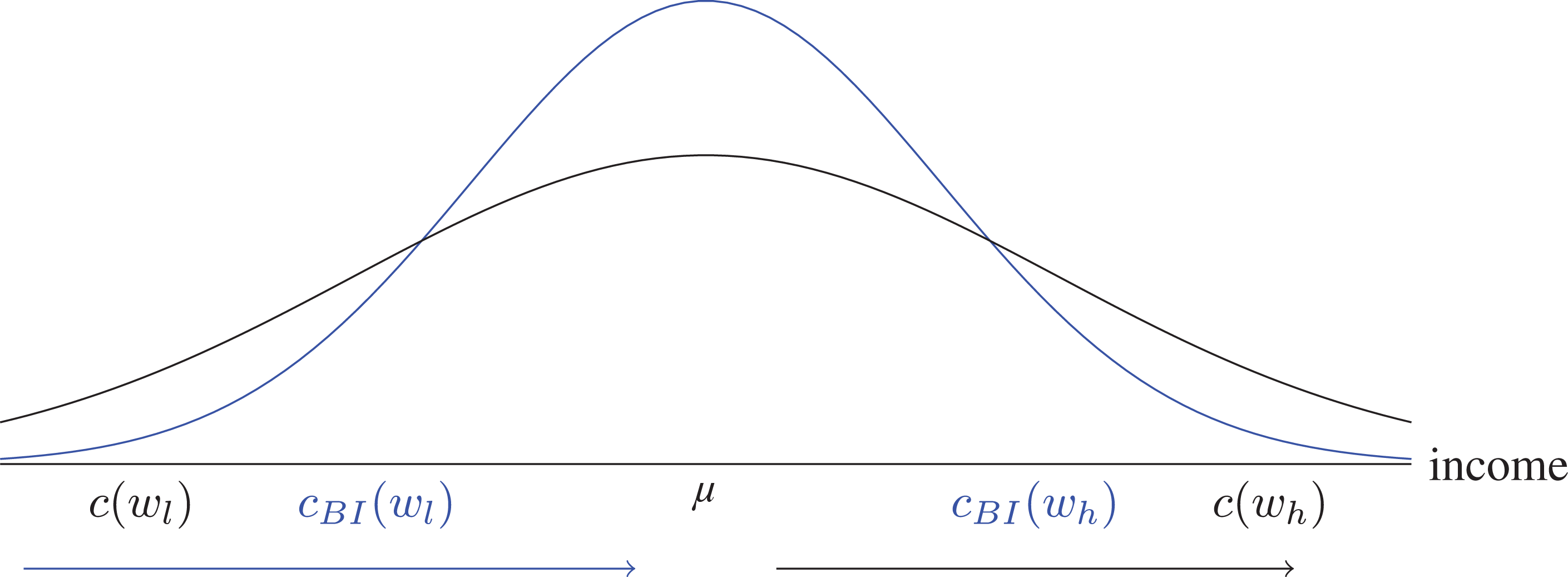
The population and skill structures of the representative society are illustrated in Table 1. Several citizens, Ci
, foreigners, Fi
, and residents, Ri
, either low skilled or high skilled,
Status quo population and skill structure.
Wage and employment effects of residence-based basic income
Consider the introduction of a residence-based basic income, a scheme in which a basic income is paid to all those living in the state territory irrespective of their citizenship status. By definition, low-skilled individuals are net beneficiaries and high-skilled individuals are net contributors.
Proof. See Appendix A1.
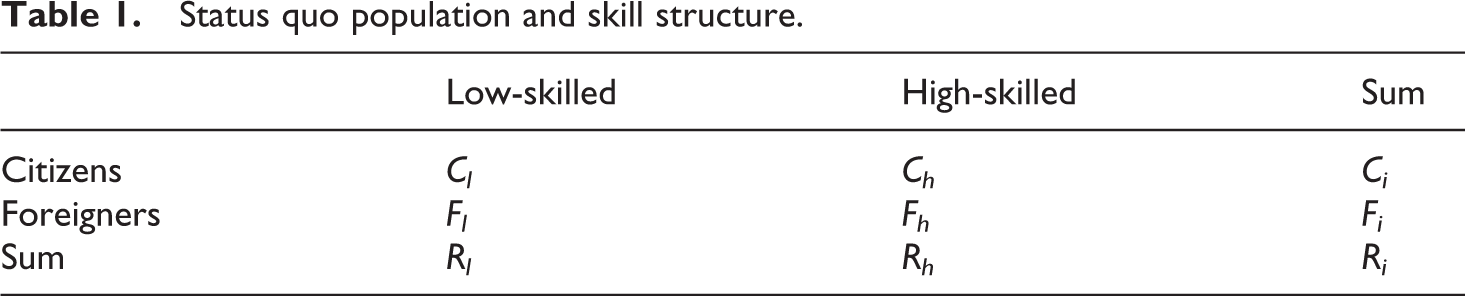
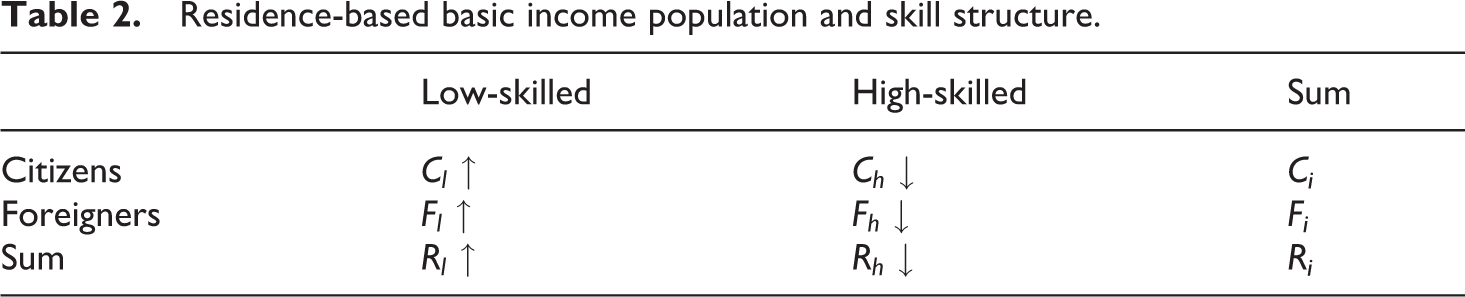
Arguing that a change in income inequality induces a decision to migrate, the basic income introduction poses such an incentive as shown in Figure 2 because it increases the income of low-skilled individuals while decreasing the income of high-skilled individuals. Table 2 illustrates the change in population and skill structure of the example society caused by the introduction of a residence-based basic income. Here, the population structure, namely the ratio of citizens to foreigners living in the state territory, does not change because low-skilled citizens and foreigners immigrate, while high-skilled citizens and foreigners emigrate. It is assumed that these migration movements cancel each other out. Accordingly, only the skill structure changes. The society is now inhabited by more low-skilled than high-skilled individuals. With more net beneficiaries and fewer net contributors, aggregate income is lower than before, and the tax base from which the basic income needs to be financed is reduced. Hence, the feasibility of a residence-based basic income is questionable.
Migration with a residence-based basic income.
Residence-based basic income population and skill structure.
Proof. See Appendix A3.
In the following, the implications of the residence-based basic income and the induced migration effects for the low-skilled and high-skilled labor markets are explored. Figure 3 depicts the relation between wages (y-axis) and hours worked (x-axis) for the low-skilled labor market. Given a Cobb-Douglas utility function and no non-labor income, the labor supply curve,
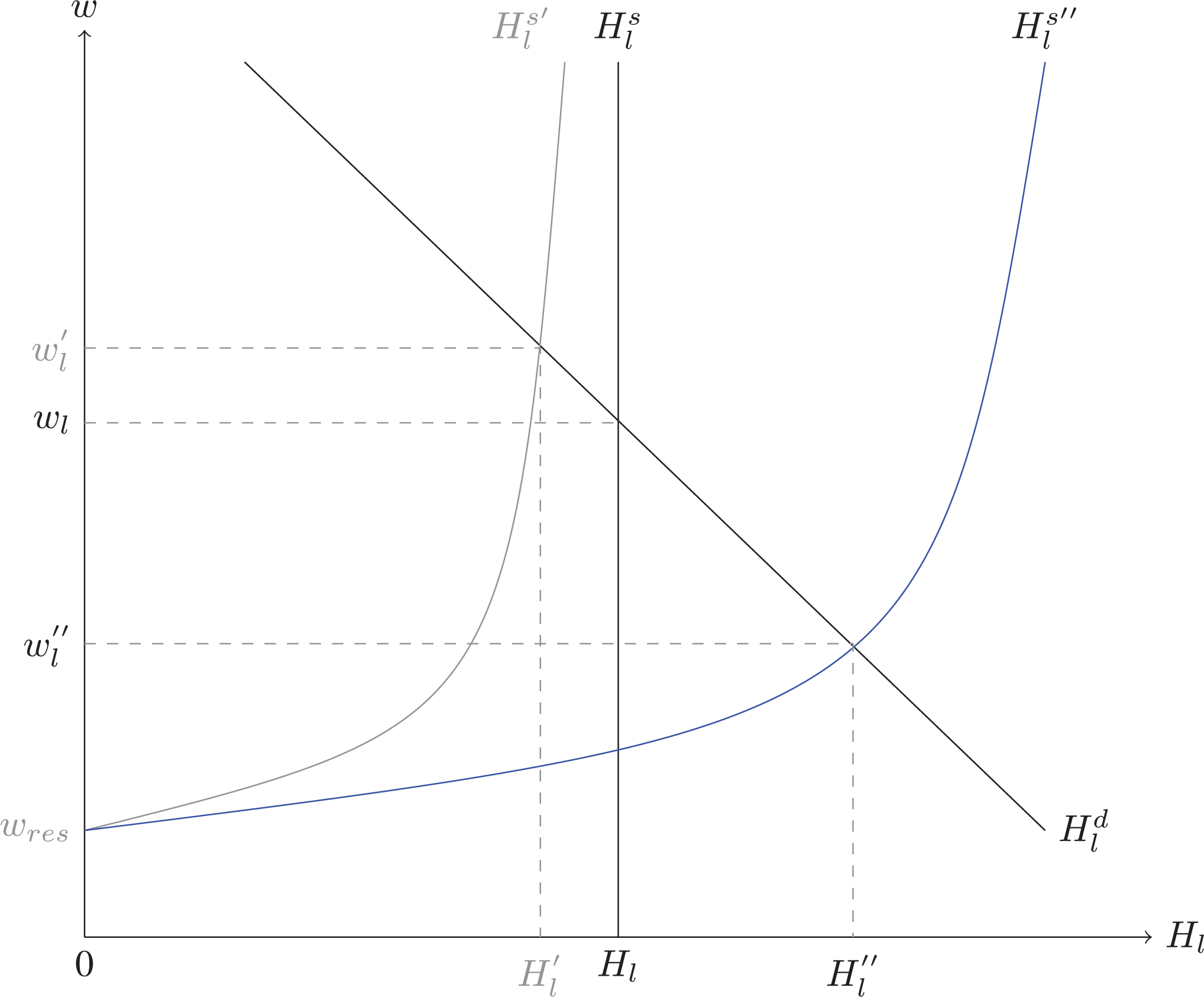
Effects of a residence-based basic income on the low-skilled labor market.
First, consider the effect of a basic income introduction compared to the status quo without any social security. The labor supply curve shifts to the left, from
Proof. See Appendix A2.
Second, consider the estimated immigration of low-skilled workers. Since every resident is entitled to a basic income, the labor supply curves of the representative resident and the representative immigrant become identical as soon as the immigrant settles. Labor supply is added and shifts the labor supply curve to the right, from
Proof. See Appendix A2.
To summarize, in the low-skilled labor market, the effects of a residence-based basic income and migration oppose each other. Whereas a basic income influences wages positively, immigration affects them negatively. Furthermore, whereas the basic income has a negative effect on hours worked, the effect of immigration is positive. The overall effect is ambiguous and depends on the volume of migration.
Figure 4 depicts the high-skilled labor market. First, consider the effect of a basic income introduction: As before, the labor supply curve shifts to the left,
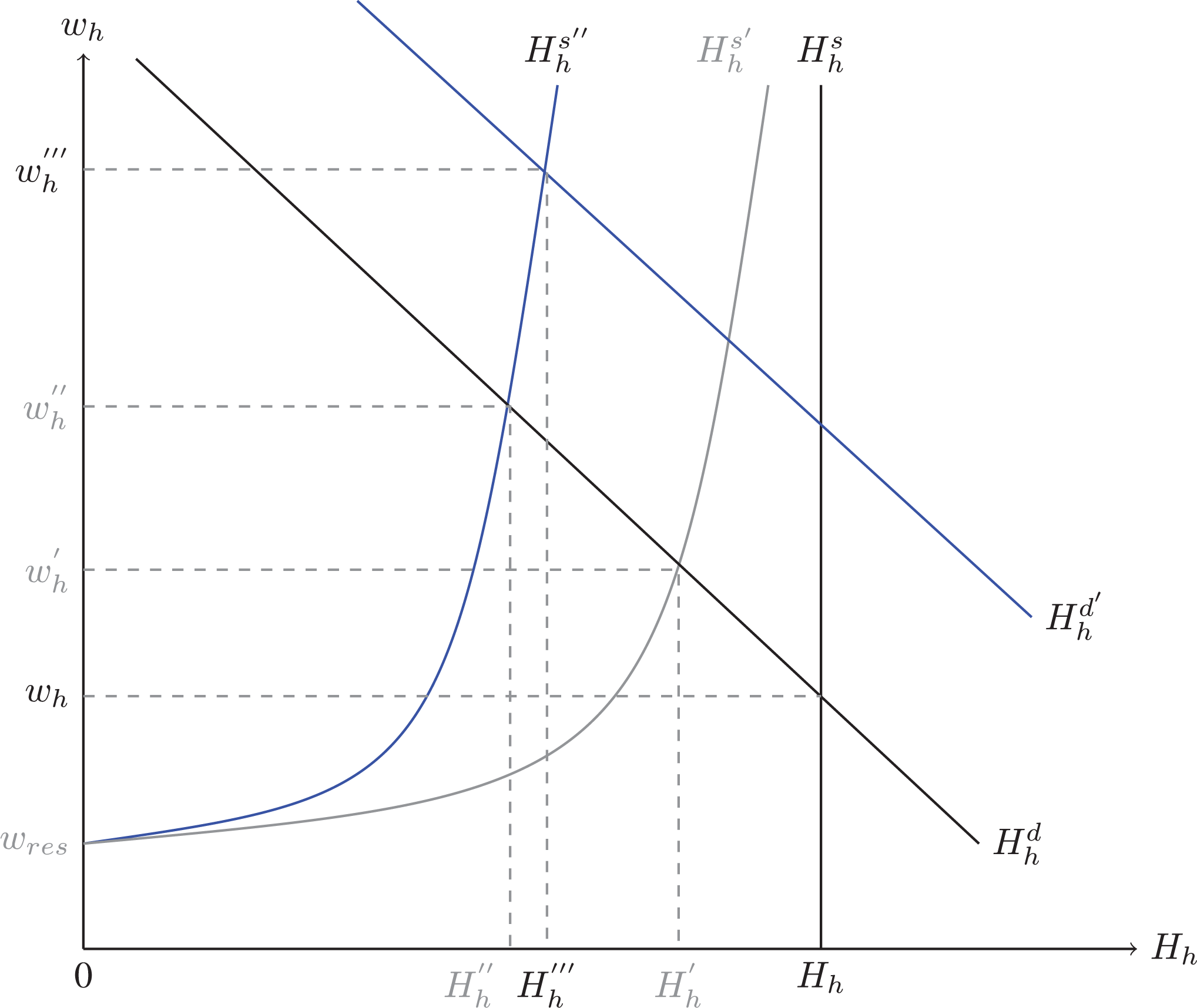
Effects of a residence-based basic income on the high-skilled labor market.
Proof. See Appendix A2.
In conclusion, in the high-skilled labor market, the effect of a residence-based basic income when taking migration into consideration is positive in regard to wages and indeterminate in terms of hours worked. The introduction of a basic income, emigration, and complementary immigration of low-skilled workers all have a positive effect on wages. Whereas basic income and emigration have a negative effect on hours worked, the increase in labor demand has a countering positive effect. As a result, how far the demand curve shifts to the right is determined by the role that technology plays in the production function of firms (Borjas, 2013: 164–166).
Wage and employment effects of citizenship-based basic income
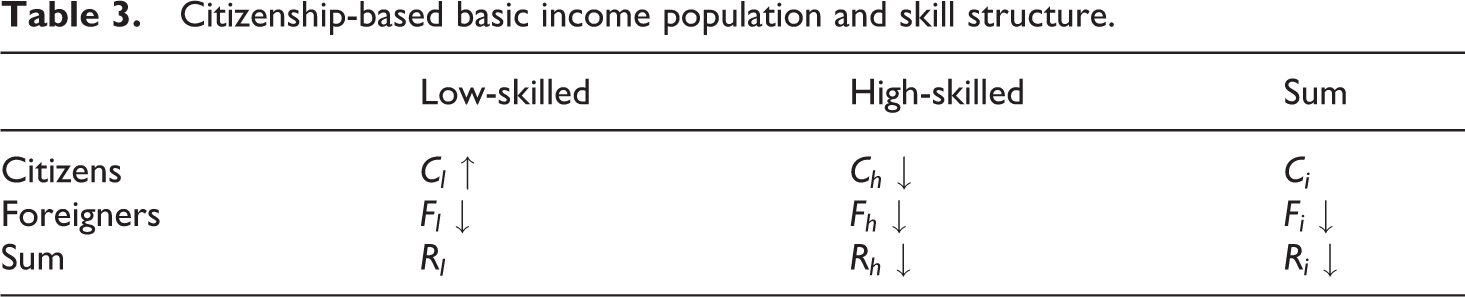
In contrast to the residence-based basic income, which is paid universally to all who reside in the state territory, the citizenship-based basic income is only paid to residing citizens. All foreigners are net contributors irrespective of their wage level because all of them must pay the flat tax levied despite not being entitled to the basic income payment. Therefore, foreigners as well as high-skilled citizens, all being net contributors, have an incentive to emigrate. Conversely, low-skilled citizens have an incentive to immigrate.
Table 3 illustrates the change in population and skill structure of the example society caused by the introduction of a citizenship-based basic income if the same number of individuals of each skill-citizenship combination decides to migrate. It shows that the population structure changes because there are more individuals with an incentive to emigrate than to immigrate, resulting in an overall reduction of the population. Moreover, the skill structure changes. The society is now inhabited by more low-skilled than high-skilled individuals. With the aggregate income lower than before, a result of the reduction in the population combined with the shift toward a low-skilled society, the tax base from which the basic income needs to be financed is reduced. Hence, the feasibility of a citizenship-based basic income is questionable.
Citizenship-based basic income population and skill structure.
Proof. See Appendix A5.
In the following, the implications of the citizenship-based basic income and the induced migration effects for low-skilled and high-skilled labor markets are explored and depicted by Figure 5. First, consider the effect of a basic income introduction: As before, the labor supply curve shifts to the left,
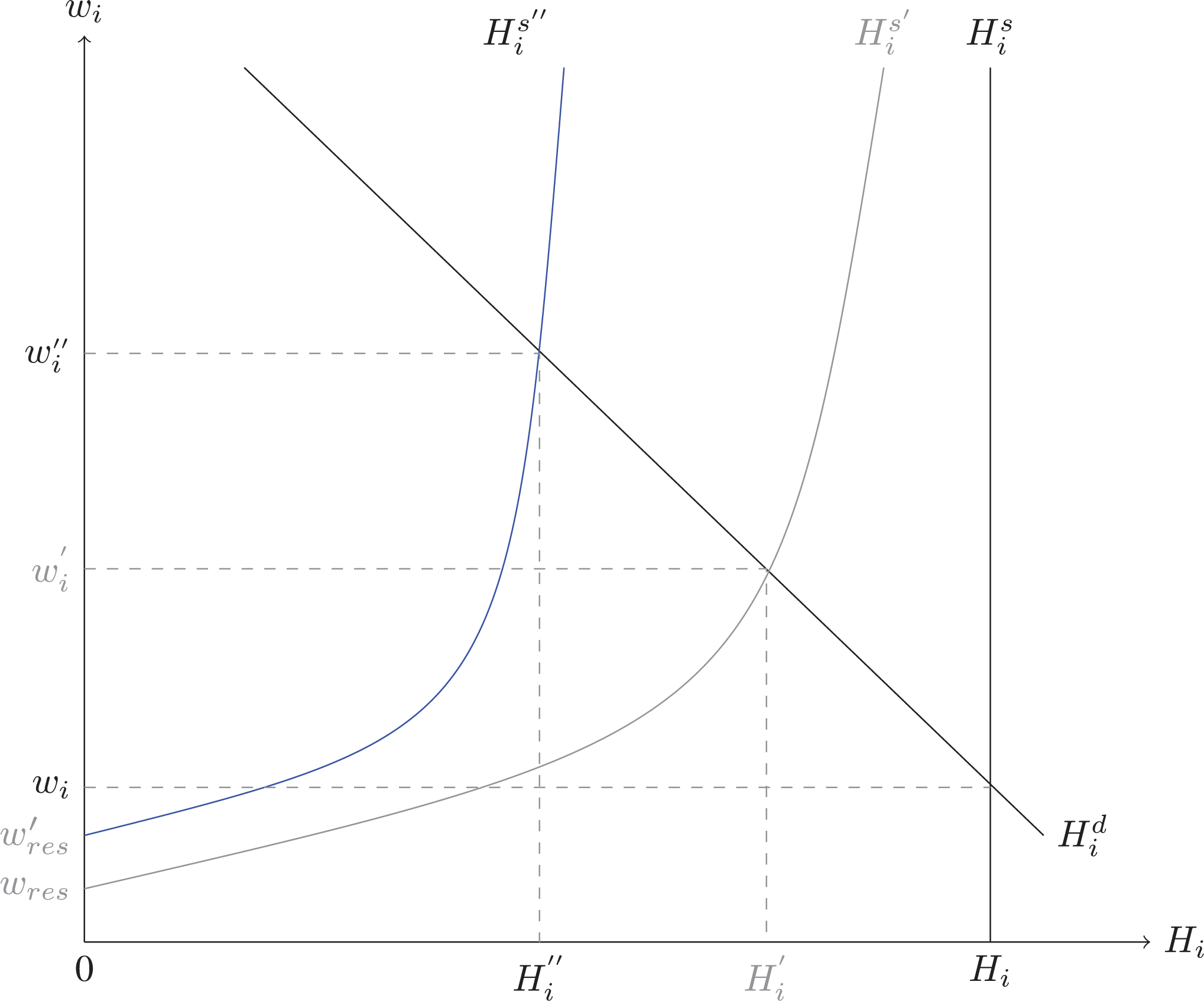
Wage and employment effects of a citizenship-based basic income.
Up to this point, effects on the low-skilled and high-skilled labor markets are equivalent. Now, considering migration on the low-skilled labor market, it is predicted that foreigners emigrate whereas low-skilled citizens immigrate. Since low-skilled work by foreigners can be substituted for low-skilled work by citizens, a first intuition is that the opposing effects of emigration and immigration cancel each other out. However, as previously explained, with a citizenship-based basic income, immigrating low-skilled citizens supply less labor than emigrating foreigners. Consequently, the effects of a basic income on the labor market depend on the composition of the resident structure. If the number of people employed does not change, hours worked increase with foreigners and decrease with citizens. If as many citizens immigrate as foreigners emigrate due to a citizenship-based basic income, the low-skilled labor market is composed of more citizens than foreigners compared to the status quo. With citizens supplying less labor than foreigners, aggregate labor supply is reduced. The equilibrium wage further increases,
Proof. See Appendix A4.
In summary, in the low-skilled labor market, the effect of a citizenship-based basic income when considering migration is distinct in terms of wages and hours worked. The introduction of a basic income and the emigration of foreigners both have a positive effect on wages and a negative effect on hours worked. The immigration of citizens opposes these effects, but does not counter them completely if we assume that as many individuals immigrate as emigrate. On the high-skilled labor market, citizenship-based basic income and emigration have a positive effect on wages and a negative effect on hours worked.
Comparison of effects posed by basic income schemes
Above, we show that migration incentives and the corresponding effects of introducing a basic income on the tax base, wages, and employment differ with respect to the choice of scheme. This section briefly compares the results presented and puts them into an empirical perspective.
First, consider the migration incentives as summarized in Table 4. Whereas for the residence-based basic income only high-skilled foreigners and citizens emigrate, the citizenship-based basic income establishes emigration incentives for all foreigners living in the state territory as well as for high-skilled citizens. Regardless of this difference, it is true for both schemes that the tax base from which the basic income is financed is reduced. Hence, it is questionable whether residence- and citizenship-based basic income are feasible. For the residence-based basic income, the immigration of low-skilled workers countervails the emigration of high-skilled workers in terms of migration volume by assumption. However, only net beneficiaries immigrate whereas contributors emigrate, hence, reducing the tax base. For the citizenship-based basic income, the effect is even stronger because the population might shrink overall.
Summary of migration incentives posed by basic income schemes.

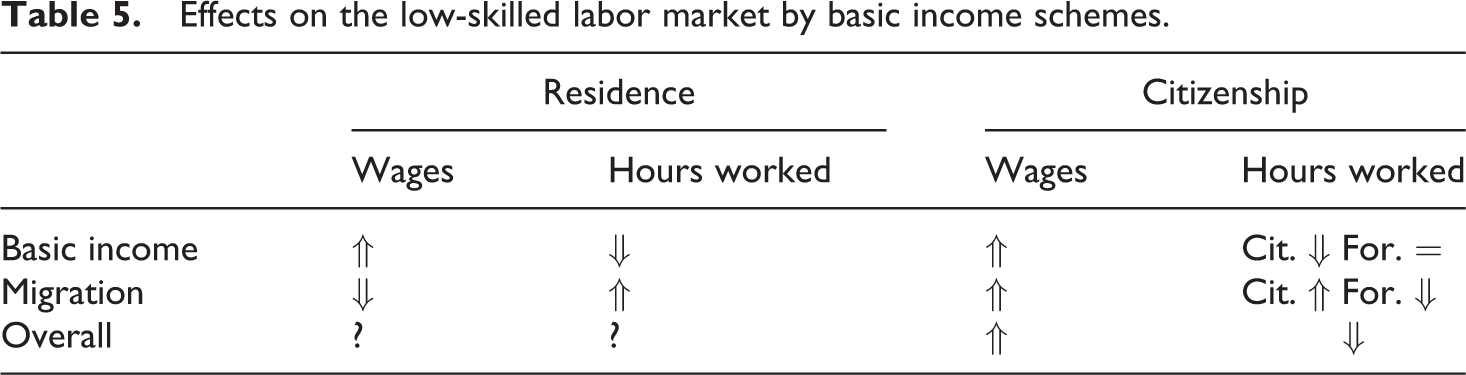
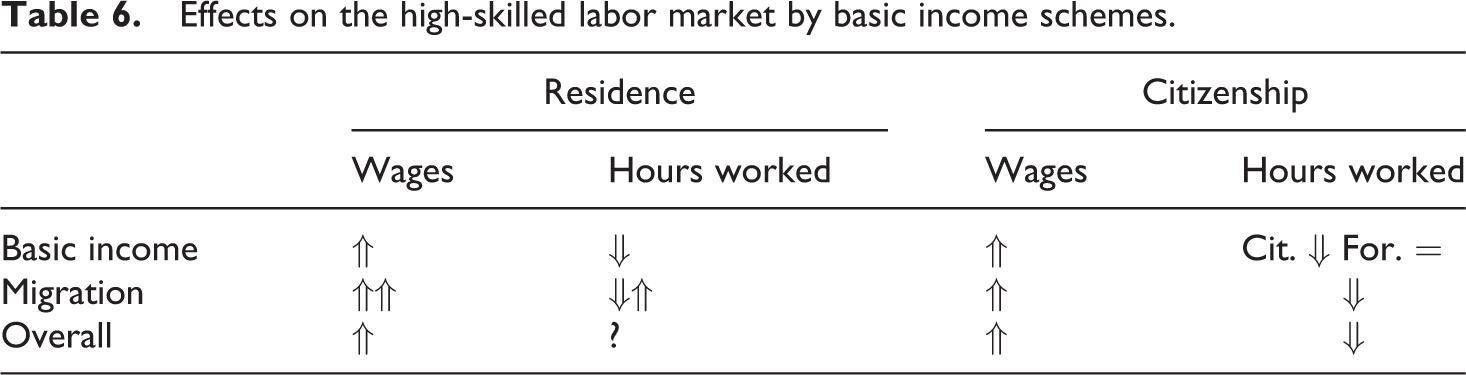
Second, the basic income in combination with the presented migration movements cause wage and employment effects as summarized in Tables 5 and 6. Recall that the basic income affects wages and hours worked by changing individual budget constraints, while migration affects each labor market by changing the number of workers and, thus, aggregate labor supply. If we disregard migration, the effects of a basic income differ only slightly between residence- and citizenship-based basic incomes. With a citizenship-based basic income, individual labor supply changes only for citizens, but not for foreigners. Hence, aggregate labor supply is not reduced as much with a citizenship-based basic income as with a residence-based basic income. This is true for both low-skilled and high-skilled labor markets. The induced migration effects depend on the respective labor market and basic income scheme.
In the low-skilled labor market (Table 5), migration opposes the effects of a residence-based basic income with indeterminate overall results. In contrast, migration reinforces the effects of a citizenship-based basic income. The emigration incentives for foreigners do not offset positive wage effects and negative employment effects, even if countervailed by the same number of immigrating low-skilled citizens. This is due to lower optimal labor supply of citizens who are basic income beneficiaries, in comparison to contributing foreigners.
Effects on the low-skilled labor market by basic income schemes.
In the high-skilled labor market (Table 6), the positive wage and negative labor supply effects caused by basic income are reinforced by emigration. With a residence-based basic income, the positive wage effect is promoted due to the complementary effect on labor demand by low-skilled immigration. Moreover, hours worked increase, opposing the negative effect caused by emigration, and yielding an overall result that is indeterminate. With a citizenship-based basic income, there is no complementary effect because low-skilled foreigners have an incentive to emigrate, which countervails the possibly positive effect of the immigration of low-skilled citizens. Thus, the reduction of the tax base in the citizenship-based scheme might be more severe than in the case of the residence-based basic income.
Effects on the high-skilled labor market by basic income schemes.
Overall, the effects of the presented analysis depend on the volume of migration. Therefore, the results cannot be easily generalized and need to be put into an empirical perspective. Examining the empirical discussion on wage and employment effects caused by immigration shows that there is considerable debate on their direction and strength. Some studies find that migration has significant wage effects, stressing that immigrants act either as substitutes or complements depending on the skill composition of the migrating cohort and the workforce of the destination country (Borjas, 2013; Chletsos and Roupakias, 2019; Docquier et al., 2011; Filipski et al., 2020; Zorlu and Hartog, 2005). Others show only slightly negative or negligible effects on native wages and employment (Fallah et al., 2019; Glitz, 2012; Gutiérrez-Portilla et al., 2020; Sparreboom et al., 2019).
The case of the Mariel boatlift exemplifies the discussion. Card (1990) was the first to analyze the influx of 125 000 Cuban immigrants to Miami in 1980. He concludes that the development of wages and employment in Miami is similar to that in comparable cities and, therefore, that the migration effects are negligible. Attempting to generalize the results, two analyses were conducted using study data for the whole of the US collected between 1960 and 1990. Borjas et al. (1997: 16–21) calculate spatial correlations, obtaining no significant wage and employment effects of immigration. However, they argue that spatial correlations are biased due to unobserved structural forces. Accordingly, Borjas (2003) pioneered the so-called skill cell approach, dividing workers into education-experience groups, and shows that immigration affects wages negatively within skill cells. Borjas and Monras (2017) provide further evidence by reevaluating four labor supply shocks throughout history that strengthen the hypothesis that immigration has negative wage effects. The validity of this analysis is questioned by Clemens and Hunt (2019) who argue that the results are subject to an endogeneity problem. Contrary to previous studies, they find that the effects of immigration on the native labor force are small to negligible. The debate is ongoing (Borjas, 2019).
A review by Edo (2019: 927–945) structures the research on the effects of immigration on wages and employment according to the examination method used. Whereas spatial analyses on average wages find immigration has mostly positive or negligible effects, skill-cell approaches assert that immigration has a downward pressure on wages for the competing skill-cohort. If wages cannot decrease further due to labor market policies such as minimum wages, immigration instead has a negative effect on employment instead.
Up to this point, it has not been possible to gain further clarity on the impact of basic income through empirical analyses, as the discussion on its effects remains hypothetical. However, the theoretical analysis presented here is in line with the empirical results obtained using the skill-cell approach. Although we acknowledge differences in the empirical discussion, we conclude that given the conjectured economic effects of residence- and citizenship-based basic income, the combination of basic income introduction and migration poses a problem for the policy’s feasibility. The results need to be considered in future basic income research not only due to their economic relevance, but also because the predicted wage and employment effects pose a challenge to the justice of basic income, as argued in the following section.
The justification of residence- and citizenship-based basic income
Putting aside for a moment the question of feasibility, let us consider why a basic income should be introduced in the first place. As plainly put by one of its first defenders, ‘It is not charity but a right – not bounty but justice, that I am pleading for’ (Paine, 1797: 11). 8 But who is entitled to it? In the following, I provide a short and general attempt to justify the introduction of residence- and citizenship-based social policy, respectively, but I do not claim that the authors advocating a basic income follow any of the two approaches. Moreover, I place the discussion in the context of global justice and explain the structure of the justice debate presented in this section.
Consider first one possible reason for a residence-based social policy. Walzer (1980: 218–220; 1985: 167–169) argues that nation-states do not merely serve the instrumental purpose of an administrative unit but rather possess a normative justification because of the proximity of the members they protect. Individuals form communities based on shared experiences and history, entering into a hypothetical horizontal contract. Thus, the state’s commitments toward its citizens are strong. In contrast, the state has only weak obligations toward foreigners (Walzer, 1998: 341–344). If membership in a community is not arbitrary but is justified on the grounds of internal proximity, then introducing a universal policy can be restricted to those who are members. Hence, a basic income might be denied to foreigners without undermining the universality assumption. However, everyone who immigrates and stays is subject to a process of naturalization, meaning they will eventually become part of the original community (Walzer, 1998: 362–363). 9 Therefore, at some point after admission every resident of a state territory ‘must be offered the opportunities of citizenship’ (Walzer, 1998: 362) which include basic income if it is introduced. This reasoning might justify introducing a universal policy such as the residence-based basic income on a nation-state level.
Is there any justification for a social policy that only covers citizens? Pettit (2007: 5–7) states that for a policy to be legitimate, its introduction must be subject to public decision making. Only those who have the opportunity to be part of the decision-making process possess some sort of control. Therefore, taxation and corresponding social policy can be interpreted as controlled, and, thus, justified state interference. As Robeyns (2001: 84) states for the case of a basic income, ‘(it) is then one of the material aspects of economic citizenship, just as the right to vote is one of the material aspects of political citizenship’. Pettit (2016: 51) works around the issue of differing between citizens and residents by defining citizens as individuals who are ‘more or less permanently resident’ in the state territory. However, if foreigners do not have the opportunity to be part of the decision making on basic income, citizens would exercise control by imposing the policy’s costs as well as its benefits on high- and low-skilled individuals, which is unjustified following the stated argument. Even if one is not convinced by this line of reasoning, a citizenship-based basic income has been discussed in the literature (McKay, 2007; Pateman, 2004), and it is therefore relevant to address the scheme within the scope of this article.
Last but not least, the evaluation of national basic income schemes within a global context needs to be placed within the discussion on global justice. The debate is traditionally pursued by relying on either statist or cosmopolitan assumptions. While statists argue that conceptions of justice mainly apply within each nation-state, cosmopolitans find that principles of domestic justice should be extended globally (Valentini, 2011: 2–10). In our case, a mostly statist discussion focuses on the effect that a national basic income has on the people residing in the state territory. In contrast, a cosmopolitan view would encompass the effect it has on individuals in general, independent of the state they live in. The discussion concentrates on domestic justice, hence, the statist view, albeit the final paragraph of each following section is dedicated to a short cosmopolitan analysis.
In current literature, three different schools of thought attempt to justify the concept of basic income: real libertarianism, liberal egalitarianism, and republicanism. 10 Accordingly, basic income maximins opportunity, self-respect, or power. The maximin criterion is a distribution rule that gives strong priority to those who are worst off in a given society (Rawls, 1999: 65–73). Basic income has also been opposed for various reasons (Breen, 2017; Gourevitch, 2016; Maskivker, 2018; Sagar, 2019; Van Donselaar, 2009; White, 1997, 2007). 11 Leaving these criticisms aside, I here check the basic income against its own standards as set by the main attempts to justify it. We focus on the justice of the policy proposal on a national level, considering the society to which it is introduced. We proceed by presenting each school of thought and identifying the worst-off individual in the example society as the relevant unit of analysis when applying the maximin distribution rule. Finally, we discuss whether basic income really maximins opportunity, self-respect, and power when considering migration and foreigners, as we incorporate the results of the previously presented economic analysis.
Real libertarianism and basic income
Real libertarians argue that a just society is a free society that maximins opportunities. 12 The most prominent author justifying a basic income from a real libertarian perspective, specifically coining the term, is Philippe Van Parijs. In this context, opportunities are defined as: ‘access to the means for doing what one might want to do’ (Van Parijs, 1997: 5) with two implications. The definition refrains from judging what people might want to do and favors no particular want over any other (Van Parijs, 1997: 18–19). Moreover, it puts an emphasis on individuals with the least opportunities (Van Parijs, 1997: 27–29). Based on these requirements, namely neutrality and maximin distribution, an equal distribution of external resources is rationalized. External resources are defined by the fact that others assign value to the use of them (e.g., by making an offer in a market transaction). However, equal resources do not necessarily translate to equal outcomes because people differ in tastes and talents and, therefore, use their resources differently (Dworkin, 1981b: 306–314; Van Parijs, 1997: 48–54; Van Parijs and Vanderborght, 2017: 103–116).
Tastes and talents are internal resources that are only partially subject to redistribution. On the one hand, the distribution should be insensitive to tastes, because otherwise it would assign more resources to those with expensive tastes. On the other hand, it should be sensitive to talents, because these are assigned arbitrarily (Dworkin, 1981a: 228–240; 1981b: 306–314; Van Parijs, 1997: 48–51). 13 But, talents and tastes are not clearly separable. Therefore, differences in talents should only be compensated for if they are dominated, whereby domination occurs if every person knowing their tastes would prefer one set of talents over the other (Van Parijs, 1997: 60–77). However, ‘it is very unlikely that there will be any single person which all would regard as better endowed than X’ (Van Parijs, 1997: 73). Hence, according to real libertarians, a basic income is justified if it maximins the distribution of opportunity by distributing external resources equally.
Yet, who is worst off in terms of opportunities in the example society? The definition of opportunities highlights the importance of having the means to live as one might prefer. In a monetary society, income has a wide range of uses that add to individual freedom because it enables, or at least facilitates, the acquisition of goods (Neuhäuser, 2018: 55). Distributing anything but money (e.g., means of production) is not equally efficient because people have different talents, and resources might be wasted. Ultimately, such a waste reduces the amount of the basic income, leaving those with the least amount of opportunities worse off than they otherwise could be. Thereby, an equal distribution of means of production is unjust because an equal distribution of income is more effective in terms of maximinning opportunities (Van Parijs, 1997: 41–42). 14 In light of this, the assumption of a monetary society is critical. It is plausible that in a society organized differently, other goods might offer a bigger range of opportunities to those who are worst off (Sirsch, 2020: 10–13). Thus, only in a monetary society is maximinning opportunity equivalent to maximinning income. The individual who is worst off in terms of income in the status quo is the low-skilled resident, whether citizen or foreigner.
What are the distributional consequences of a basic income for the low-skilled individual when we incorporate the possibility of migration? By definition, the low-skilled labor market is composed of net beneficiaries. Therefore, the income effect of introducing a basic income is positive. Hence, basic income maximins the opportunities for those who were worst off before its introduction. With a residence-based basic income, this is true for all low-skilled residents, whether citizen or foreigner.
Yet, the positive income effect for low-skilled residents can be offset by the pressure immigration puts on wages and hours worked. Moreover, the emigration of high-skilled individuals and, therefore, of net contributors, reduces the tax base from which a basic income is financed and, consequently, the amount of the basic income. While the individual effect of a basic income on the opportunities for a low-skilled resident is positive, the collective effect, including the immigration of other low-skilled workers, might be negative depending on the size of migration. Thus, the overall effect of a residence-based basic income on the worst-off individual in terms of income is indeterminate, because the effects of basic income and migration counter each other.
With a citizenship-based basic income, low-skilled citizens are better off in terms of income, as previously explained, but foreigners are not. Under the scheme presented here, foreigners are subject to the tax scheme, and basic income provides them with less income than they had before the policy’s introduction. Hence, basic income only improves the position of low-skilled citizens in terms of income and leaves foreigners worse off. Migration does not worsen the situation of low-skilled foreigners further. The increase in equilibrium wages through the combination of introducing a basic income and the emigration of some low-skilled foreigners could even counter the negative effect of the flat tax levied on income. Nevertheless, if wages remain below the critical level that defines the low-skilled labor market with a citizenship-based basic income, low-skilled foreigners are not better off in terms of income but are actually worse off.
Three counterarguments might be levied in light of these results. Howard (2006) as well as Van Parijs and Vanderborght (2010: 16–21; 2017: 218–226) suggest that a social planner can diminish these effects by reducing immigration (and emigration), albeit admitting that this is a second-best option. However, it is at least questionable whether strict border control can be reconciled with the ethical principles underlying a universal policy such as the basic income. 15
Second, in the case of the residence-based basic income, proponents could say that the presented critique does not exclusively apply to the introduction of a basic income but is true for any social security scheme. This point gains significance by the presented literature on the welfare magnet hypothesis. Welfare-induced migratory pressure on the low-skilled labor market might worsen individual opportunities to the point that they are worse than without social security, independent of the specific scheme that is introduced. Conditional social security has been implemented in most European countries, and, even if it induces migration and low-skilled migration has a negative effect on low-skilled wages, it is still in place and, hence, seems to leave individuals better off. However, a basic income that applies universally is, for one, more accessible, thereby increasing the immigration incentive. Moreover, it is more expensive, needing more extensive financing by taxes, thereby increasing the emigration incentive. Hence, the stated effects are stronger for a basic income scheme than for conditional social security. Nonetheless, this counterargument is not fully convincing if it solely relies on the fact that other forms of social security might expose the labor market to a similar pressure, which I have already questioned.
Third, in the case of the citizenship-based basic income, one could argue that it does not matter how foreigners are treated because the state has greater responsibilities toward its citizens. Granted that this is the case, I feel like the argument made in favor of a basic income by Van Parijs (1997) does not conform with this idea because it relies on the fact that each individual is entitled to her fair share of resources. With other forms of social security that target specific groups, like the poor or the elderly, it might be easier to justify excluding citizens than when considering a universal scheme. Moreover, the foreigners in our example society are subject to the taxation scheme but are not entitled to the basic income grant. This means that they are solely negatively affected by a basic income without being able to vote on the scheme’s specifics, because they are not part of the public decision-making process that is directly connected to citizenship.
How can these results be evaluated from a cosmopolitan perspective? As in the economic analysis, we assume that two societies exist that are equal in all the described parameters, especially, in that they possess the same income distribution in the pre-basic income period. We have already discussed the effect of introducing a basic income on low-skilled individuals in the society with basic income. Now, we extend the debate to include individuals in the society that does not have a basic income. In this society, average income and inequality are now higher than in the society with a residence-based basic income. Low-skilled individuals have emigrated, while high-skilled individuals from the society that has introduced a basic income might have immigrated. This means that average income is higher not only in comparison to the basic income society but also in comparison to pre-basic income introduction. What does this mean for individuals who were the worst off in society before basic income introduction? Low-skilled individuals have either migrated to the basic income society in hopes of a higher income or they have stayed. The effect of a basic income introduction on those who migrated has already been discussed, and whether their hopes are fulfilled depends on the size of migration. Those who stayed, however, might improve their income, because with fewer workers employed on the low-skilled labor market, the equilibrium wage increases. Hence, from a cosmopolitan perspective, low-skilled individuals are better off in the society without basic income compared to the status quo. Therefore, the question of whether a basic income is just depends on the case made for domestic justice.
In contrast, with the introduction of a citizenship-based basic income, in our model the emigration and immigration on the low-skilled labor market in the society without basic income cancel each other out. Hence, there is no change in equilibrium wage and no change in income, thereby no change in opportunities for the low skilled in the society without the basic income. With a citizenship-based basic income, the society without basic income might only be affected in terms of a higher average income than before if it benefits from the immigration of the high-skilled workers who leave the basic income society. However, this is not relevant considering the maximin distribution of opportunities, because the position of society’s worst off does not change in terms of income.
To sum up, for domestic justice, a residence-based basic income only increases opportunities for the low-skilled individuals if its positive income effect is not countervailed by the negative effect on wages by immigration. A citizenship-based basic income does not increase opportunities for low-skilled foreigners. The real libertarian justification of basic income, however, rests on the assumption that every individual is entitled to her fair share of resources; thus, it can hardly be reconciled with a discrimination against foreigners. Moreover, from a cosmopolitan perspective, a residence-based basic income might improve the opportunities of low-skilled individuals living in another state’s territory because emigration increases their equilibrium wage. However, a citizenship-based basic income has no effect on opportunities of low-skilled individuals residing in a different territory because immigration and emigration countervail each other.
Liberal egalitarianism and basic income
Liberal egalitarians argue that a just society maximins the social basis of self-respect. Representative authors justifying a basic income from a liberal egalitarian perspective include Simon Birnbaum, Michael G. Festl, Satoshi Fukuma, and Catriona McKinnon. They draw on the idea of justice as fairness (Rawls, 1999). 16 From this point of view, self-respect is thought to be generated by living a successful life within a meaningful community according to one’s own standards (Festl, 2013: 144–150; Fukuma, 2017: 2–4; McKinnon, 2003: 146–147). Put another way, self-respect is about perceiving oneself as an equal human being (Neuhäuser, 2018: 50–51). The social bases of self-respect include means for achieving both individual success and communal recognition (Birnbaum, 2012: 501–502). Hence, according to liberal egalitarians, a basic income is justified if it maximins the distribution of self-respect and its social bases.
To begin with, basic income has been argued to reduce the stigma of receiving welfare, enhancing the perception that those in need are still equal, thereby maximinning self-respect (Birnbaum, 2010: 498; Festl, 2013: 158; McKinnon, 2003: 151–152). 17 Regarding the social bases of self-respect, it is argued that work is important because it acts as a proof of one’s abilities and a source of social recognition (Festl, 2013: 144–150). Basic income improves the position of those who are worst off in employment relations by providing freedom of job choices, more leisure time and better leisure quality. For one, the freedom to change or quit a job allows workers to join a more self-respect enhancing community (McKinnon, 2003: 147–151). Basic income enables otherwise risky self-employment and the ability to engage in badly paid but intrinsically rewarding jobs (Birnbaum, 2010: 503). In other words, it enables meaningful work (for more on this, see Fukuma (2017)). In addition, more income provides the opportunity to spend less time on work and more time on other parts of communal life that increase self-respect (McKinnon, 2003: 148). With a basic income, more individuals who do not gain self-respect from work can choose to work less, enhancing the social acceptability of such a choice and thereby the recognitional basis of self-respect (Festl, 2013: 158). At the same time, those who gain self-respect from work are not forced to quit (Fukuma, 2017: 6). Finally, the quality of communal life can be improved because leisure takes up time and money. Both costs can be borne by the basic income (McKinnon, 2003: 148).
Identifying the worst-off individual in terms of self-respect is not as easy as in the case of income because the example society we have analyzed is simplistic. One clue could be the equivalence of wages and skills, as suggested by Roy (1951). How does skill or talent distinguish between individuals considering their self-respect? It is likely that individuals, if they are aware of their talent, perceive themselves as unequal. High-skilled individuals may perceive themselves as at least equal to low-skilled individuals, but the reverse is questionable. This does not imply that a hierarchy of individuals according to skills is morally justified, nor that it even exists. However, this might be the perception, and, therefore, it is psychologically relevant to the question of self-respect and should be considered in discussion of whether basic income maximins the self-respect of the low-skilled citizen and foreigner.
With a residence-based basic income, low-skilled workers can perceive themselves as equal in terms of being part of the basic income scheme because low- and high-skilled individuals receive the same benefit and are subject to the same flat tax. The stigma reduction of residence-based basic income schemes remains regardless of immigration, because immigrants are treated equally to natives. However, the argument presented here is based on a comparison between unconditional and conditional welfare, while our economic analysis compares the situation with basic income to the one without any social security. Therefore, in this example case study, stigma cannot be attached to receiving welfare as there are no welfare payments in the status quo. The stigma-relieving effect of a basic income does not depend on the payment being made to everyone equally because before basic income introduction, no one received anything: thus, individuals were already treated equally. Basic income does not improve the self-respect of low-skilled individuals through equal treatment. Yet, proponents can rightly argue that stigma may also be attached to being poor. If this is the case, the effect of basic income on the self-respect of low-skilled individuals may depend on its income effect, which, as in the case of opportunity, is indeterminate.
Another counterargument might be that the presented reasoning underestimates the relevance of the relative position of individuals considering self-respect. For example, Birnbaum (2012: 51) states that social recognition as a basis of self-respect is affected by the ‘relative economic positions […] (and by) the power asymmetries, dependencies, and social roles with which they are associated’. Granted that this is the case, it can be argued that a residence-based basic income improves the relative position of low-skilled residents because, first, it decreases inequality. However, emigration also decreases average income. With more low-skilled and fewer high-skilled individuals than before the basic income introduction, the income distribution is now right skewed, and average income is lower than the mode and median income. This means that there are more individuals who earn a similarly low income and fewer people who earn more. With more individuals being in the comparable peer group and a lower mean income, social recognition of earning low wages might be increased. However, the fact that higher inequality as in this scenario affects self-respect positively in the explained way seems counterintuitive and is reasonably rejected, for example by Schemmel (2019: 641–644). The argument would only be convincing if the relative improvement went along with an absolute increase in income of the larger low-skilled group, but, as explained in the previous section, this is questionable for low-skilled individuals in a residence-based basic income scheme and impossible for foreigners in a citizenship-based basic income scheme.
A citizenship-based basic income affects self-respect similarly to the residence-based basic income – at least in the case of citizens. However, for foreigners, it enhances the perception of being unequal, irrespective of the negative income effect, because they are excluded from the basic income payment, unlike in the benchmark society where low-skilled citizens and foreigners are treated equally. Hence, with a citizenship-based basic income, the self-respect of low-skilled foreigners is worse compared to the status quo.
The reasons why a basic income might increase the social bases of self-respect are closely connected to an assumed increase in labor market bargaining power of those who are worst off considering their employment. With a residence-based basic income, this is questionable because of the adverse effects of immigration on low-skilled workers. If more people are part of the low-skilled labor market, employers can substitute labor more easily. Moreover, due to the possible reduction of the amount of the basic income, the reliance on working income might even be increased. Hence, the positive effects of a basic income on the social bases of self-respect depend on the volume of migration. With a citizenship-based basic income, the income effect for low-skilled foreigners is negative. Therefore, the effect on labor market bargaining power as basis for self-respect is also negative.
From a cosmopolitan perspective, we compare two initially equal societies again. Introducing a basic income to one society poses a problem depending on the individual reference point. If a low-skilled individual in the society without basic income compares herself to a low-skilled individual in the society with a residence-based basic income, she might perceive herself as being treated unfairly because she has no non-working income. Consequently, spending time on leisure and, hence, gaining social recognition, is more costly for her. Proponents might respond that the increase in income due to a higher equilibrium wage caused by the emigration of low-skilled individuals to the basic income society enables individuals to spend more time on leisure. However, this effect depends on the size of migration. Hence, because individuals who are not being granted a basic income are being treated unequally, residence-based basic income might worsen the self-respect of low-skilled individuals abroad who are not part of a basic income scheme. With a citizenship-based basic income, low-skilled foreigners perceive themselves as unequal in comparison to citizens who receive a basic income, irrespective of whether they live abroad or in the basic income society.
If a low-skilled individual perceives her situation only within borders, a basic income introduction in another society does not change her situation directly. Yet, since the average income of her society increases due to immigration of high-skilled individuals, her relative economic position is worsened, which might have a negative effect on her self-respect if it is not countered by an increase in income due to a higher equilibrium wage, as explained. This is only possible for the residence-based basic income and if emigration is sufficiently high.
To sum up, a residence-based basic income might only affect the self-respect of low-skilled residents positively if stigma is attached to being poor and if the policy has a positive income effect. However, if inequality increases, self-respect is likely to decrease. With a citizenship-based basic income, low-skilled foreigners are excluded from the basic income scheme and, hence, perceive themselves as unequal. Thereby, their self-respect is worsened. Moreover, from a cosmopolitan perspective, an increase in inequality in both societies (one with a now higher and the other with a now lower average income) leaves the low skilled worse off in terms of self-respect due to a perceived increasing economic inferiority, independent of where they live.
Proponents might argue that most of the arguments for why basic income enhances self-respect are still valid because the starting point for this school of thought is usually the insufficiency of the labor market to provide subsistence income for everyone. This is a valid point because our model does not incorporate labor market imperfections. Hence, the results need to be tested for robustness by extending the presented model.
Republicanism and basic income
Finally, republicans argue that a just society maximins power. Representative authors justifying a basic income from a republican perspective include David Casassas, Carole Pateman, Philip Pettit, and David Raventós. Republican ethics are similar to liberal ethics in regard to two concepts: freedom and neutrality (Casassas, 2007: 4–5). For one, they are in favor of an equal provision of freedom. However, instead of focusing on opportunities, republicans argue that enabling freedom means securing non-domination. A person is dominated if the possibility of arbitrary interference exists either vertically, by the state, or horizontally, by fellow citizens (Casassas and De Wispelaere, 2016: 285; Raventós, 2007: 68–69). In contrast to liberal ethics, the possibility of arbitrary interference is sufficient for being considered dominated, even if it is not executed. Here, the arbitrariness of interference is critical, because interference in the public interest becomes justified (Breen, 2017: 4–7; Pettit, 2007: 3–7). Interestingly, Birnbaum (2010: 505–506) connects the concept of non-domination, or in his terms non-subservience, to self-respect. He argues that one is unable to perceive oneself as living a successful life if one can be held responsible for it by others. Not possessing the means to escape an unequal relationship such as this results in ‘exploitable dependency’ (Birnbaum, 2010: 506). To illustrate this type of relationship, republicans emphasize employees who are dependent on their jobs and, therefore, also on their employers for a living (Pateman, 2007: 3–5; Pettit, 2007: 5; Raventós, 2007: 72–74). A basic income is only justified if it provides individuals with an exit option from such exploitable dependence, in other words, if it equips them with enough resources to quit their job without loss of subsistence consumption (Casassas and De Wispelaere, 2016: 287–290).
Republicans also stress neutrality regarding one’s lifestyle choices. A key difference between the liberal stance on neutrality and the republican idea is that whereas the liberal stance allows even for illiberal conceptions of the good life (Van Parijs, 1997: 18–19), the latter accepts only those that conform with the republic. Hence, as related to the feasibility of a basic income, republicans escape the tension between neutrality for reasons of justice and the requirement for a work-ethos because the republican way of life calls for civil engagement in the working community. 18 It follows that the state is not only allowed but required to interfere if someone’s lifestyle threatens the republican ideal. Thus, universalizing property is necessary if it guarantees material existence and, hence, enables non-domination (Pettit, 2007: 3–7; Raventós, 2007: 68–69).
We argue that securing non-domination is essentially equivalent to improving the situation of those who are worst off in terms of power. Non-domination is concerned with a minimum amount of power because it is defined by occupying a protected position and ‘being empowered against (…) control on the part of others’ (Pettit, 2007: 4). Hence, according to republicans, basic income is justified if it maximins the distribution of power.
Who is worst-off in terms of power considering the example society? Irrespective of individual preferences, talent enables one to choose from a broader range of possible occupations within the labor market. Should highly skilled individuals choose to switch employment, the chances that they will secure alternative employment are enhanced by the range of occupations they are able to perform due to their talent. Moreover, highly skilled individuals can also perform low-skilled labor, whereas the reverse is not true. 19 Therefore, the low-skilled individual is less powerful in the context of the labor market than the high-skilled individual. Hence, the low-skilled individual is the relevant unit of analysis considering the distributional effects of basic income in terms of power. This reasoning can be opposed by arguing that taxation is an arbitrary interference of the state because it diminishes the power of high-skilled individuals and violates republican justice. However, as already stated, the universalization of property is necessary if it guarantees material existence, thus enabling non-domination. Therefore, it is only required that taxation of high-skilled individuals does not endanger their subsistence consumption and that basic income enables this consumption for low-skilled individuals.
How do basic income schemes affect the power of low-skilled individuals if we consider migration? With a residence-based basic income, the same reasoning that has been outlined in terms of income and self-respect applies to the concept of power. The power wielded by low-skilled residents only increases in relation to material independence and labor market power, and the increase depends on the volume of immigration.
One possible counterargument to this reasoning could be that even if the consumption level generated by basic income plus working income is lower than the working income generated before a basic income introduction due to migratory pressure on the equilibrium wage, the possibility of quitting one’s employment without losing all income empowers individuals. This is a fair point, but for non-domination to be secured it is still required that basic income is feasible on a level that enables subsistence consumption, which is, in turn, questionable if it causes the explained reduction of the tax base.
With a citizenship-based basic income, a two-tier society would be created increasing the ‘possibilities of domination between BI (basic income) recipients and’ (Fischer, 2020: 26), in our case, foreigners. The status of being a foreigner is the one criterion that distinguishes a basic income recipient from a non-recipient and, therefore, it epitomizes a difference in power (Fine, 2014: 15–17). Again, proponents could argue that at least low-skilled citizens can gain power and that some if not all low-skilled individuals might be able to leave oppressive working conditions. However, a citizenship-based basic income not only increases the power of low-skilled citizens and leaves foreigners as powerless as before, but it worsens foreigners’ relative situation. Hence, basic income is unjust because foreigners do not receive a benefit and can continuously be exploited on the labor market, probably even more so with basic income than without one.
Considering global justice, republicans usually discuss whether domination occurs between states (Pettit, 2016) rather than between individuals living in different state territories, and whether the idea of border control generally clashes with the principle of non-domination (Costa, 2020; Fine, 2014). Considering our model, one could argue that if the average income of residents affects the power of states, then a basic income introduction, whether residence or citizenship based, decreases state power compared to a society without basic income. However, this is a bit of a stretch based on the presented evidence and not the focus of the analysis.
From a cosmopolitan perspective, basic income can only be just concerning the republican view if it does not lead to domination of individuals living abroad (Fischer, 2020: 20–26). Low-skilled residents living in a society without basic income gain labor market power if a residence-based basic income is introduced in another society. The reasoning behind this argument is that emigration lifts some of the pressure off low-skilled labor markets, yielding higher bargaining power for those who stay in the non-basic income society. With a citizenship-based basic income, there is no migratory relief on the low-skilled labor market. The situation for low-skilled residents of the society without basic income is, therefore, not affected by the introduction of citizenship-based basic income in another society in terms of power.
In summary, from a domestic perspective the residence-based basic income maximins power only if its positive income effect is not offset by immigration and emigration due to the indirect effects on subsistence and labor market power. From a cosmopolitan perspective, it can be argued that it actually increases the power of low-skilled individuals living abroad. In contrast, the citizenship-based basic income does not comply with the standards of justice, as it discriminates between citizens and foreigners and worsens the situation of low-skilled foreigners in terms of domestic power while not affecting those residing outside the state territory.
Possible adjustments to residence- and citizenship-based basic income and limitations
Two possible adaptions of the citizenship-based basic income have not been taken into consideration by this analysis. In our model, only residing citizens are subject to the basic income scheme. But, citizenship could also be the only requirement for a basic income. For example, one could argue that citizens who reside elsewhere have contributed to society in the past and are, therefore, entitled to basic income benefits. In terms of justice on a national level, this would not change the results. However, it would yield emigration incentives for all citizens including low-skilled citizens, because they would be entitled to a basic income without the necessity of being subject to the tax scheme that is connected to residence, therefore, worsening the feasibility problems. Second, foreigners could be excluded not only from the basic income benefit but also from the tax scheme. There would be no migration incentives for foreigners because their situation would be equivalent to the benchmark society. However, this would not render the citizenship-based basic income just because although they would avoid not being worse off in terms of income, the society’s foreigners would perceive themselves as unequal by not being subject to a redistribution scheme in comparison to citizens. Such discrimination of a minority is likely to cause problems with self-respect for the excluded group.
Another option would be to implement a waiting period to be eligible for the residence-based basic income. This way, immigration that is motivated by the short-term gain of a basic income could be deterred. Hence, feasibility issues with a long-term residence-based basic income could be less severe. However, such a waiting period might be problematic because it discriminates between individuals based on the duration of residence. Up until the waiting period is over, the situation would be similar to a citizenship-based basic income with a slightly different eligibility criteria. Moreover, it might be politically unfeasible because the waiting period differs between lawfully residing and tax-paying individuals within borders (Van Parijs and Vanderborght, 2017: 222–224).
As an alternative to residence- and citizenship-based basic income, Van Parijs and Vanderborght (2017: 8–9) propose to base basic income on fiscal residence. This scheme encompasses more residents than only citizens but excludes undocumented migrants. A similar suggestion is made by Fleischer and Hemel (2020: 679), who suggest introducing a basic income to ‘lawful permanent residents’. Both proposals justify the exclusion of all other residing non-citizens with pragmatic reasons and advocate for implementing strict immigration laws. However, strict immigration policies are not equivalent to enforcing effective immigration control, and governments might even have an incentive not to enforce these laws (Facchini and Testa, 2021). Hence, even assuming that immigration can be completely controlled, this might not happen. Moreover, one cannot reasonably argue that a scheme encompassing everyone but undocumented immigrants is just compared to a citizenship-based basic income, because both cause dual-tier societies. The argument that the former at least includes more people is irrelevant if we consider the maximin distribution rule as a benchmark for a just distribution, because minimizing the number of people who are the worst off is not equivalent to improving their situation.
Introducing a global basic income would naturally challenge the robustness of the presented results. With a global basic income, the policy would not induce cross-country migration as this article suggests, because if a global basic income is paid administratively by every state or by an overarching institution, there is no incentive to move from one state to another. While the presented thought experiment rests on the assumption that average income is equivalent in the two states being compared, this is not reasonable considering a global basic income. Hence, inequality across countries might still cause cross-country migration, thereby affecting basic income feasibility. However, the domestically decreasing effect of a basic income on inequality might mitigate migration incentives.
The presented results would also be challenged if we alter the assumption that the two societies being compared have equal mean income and inequality before one introduces a basic income. There might be emigration incentives for low- and high-skilled individuals if the mean income in one society is lower than in another, independent of a possible basic income introduction. Moreover, labor supply effects of a basic income might differ depending on whether the basic income is introduced to a developed or a developing state (Banerjee et al., 2019; Hoynes and Rothstein, 2019). Eventually, the economic results have to be checked for desirability again, not only on the national level, but also within a global context. For example, introducing a basic income and corresponding strict immigration laws in a developed country might foster domination of individuals living in developing countries, as argued by Fischer (2020: 24–26).
Another limitation of the analysis presented in this article is that it does not consider the position of the unemployed, because there is no involuntary unemployment in neoclassical labor supply theory. Unemployment yields an obvious challenge to the feasibility of any basic income scheme that is income tax based. In regard to the justice of the basic income, it can be argued that the low-skilled unemployed individual is worse off than the employed in terms of opportunity, self-respect, and power. Any basic income greater than zero increases the income of the unemployed in comparison to the status quo without any social security. However, if a residence-based basic income induces the immigration of low-skilled unemployed, the tax base from which a basic income is financed is reduced: hence, the feasible basic income amount decreases. A citizenship-based basic income does not improve the situation of low-skilled unemployed foreigners and, hence, is unjust as argued.
Naturally, much more could have been said on the issues presented in this section, and I hope that some of the presumptions prompt further research.
Conclusion
In conclusion, this study has called into question the feasibility and justice of two specific basic income schemes financed by a flat tax on income, taking into consideration migration incentives and foreigners living in the state territory. This argument was based on a normative discussion of economic effects obtained by a neoclassical labor supply model that incorporated migration theory.
It has been shown that a residence-based basic income causing immigration of net beneficiaries and emigration of net contributors ultimately yields a reduction of the tax base from which the basic income is financed. Therefore, its feasibility is questionable. Moreover, the analysis demonstrated that a residence-based basic income would only be just if it improved the situation of low-skilled residents in terms of opportunity, self-respect, and power, that is, if the effects of immigration do not offset its positive income effect.
A citizenship-based basic income could cause a population decrease because of its emigration incentives for everyone except low-skilled citizens, which would also cause a reduction of the tax base. Moreover, such a scheme is unjust as it discriminates between citizens and foreigners and worsens the situation of low-skilled foreigners in relation to opportunity, self-respect, and power.
In regard to future research, this analysis can be extended by including long-term effects and capital, by conducting a dynamic instead of a static analysis, by considering different options to finance a basic income scheme, or by comparing its effects to those posed by conditional income security schemes, to name only a few options. Within this context, I want to stress again that the outcome of the analysis depends on the assumptions of the model, which is why robustness needs to be tested in further research.
The complexity of the results uncovered in this study, which were obtained despite the simplicity of the model, shows that future basic income research must incorporate migration incentives and consider effects on foreigners as much as on citizens. Moreover, the dual analysis stresses the interdependence of economic effects in relation to the feasibility of social policy and its implications on policy evaluation in terms of justice, hence emphasizing the relevance of interdisciplinary social policy research.
Footnotes
Acknowledgments
I am grateful to editor Andrew Williams, two anonymous referees, Christian Müller, Celeste Brennecka, Julie Davies, Kim Kellermann, Matthias Hoesch, Christian Neuhäuser, Thomas Apolte, and participants at the Politics, Philosophy & Economics Society Annual Meeting in New Orleans, March 2020, for encouraging support as well as for very helpful comments.
Declaration of conflicting interests
The author(s) declared no potential conflicts of interest with respect to the research, authorship, and/or publication of this article.
Funding
The author(s) received no financial support for the research, authorship, and/or publication of this article.