



Abstract
In this article we defend the view that, on the All Affected Principle of voting rights, the weight of a person’s vote on a decision should be determined by and only by the degree to which that decision affects her interests, independently of her voting weights on other decisions. Further, we consider two recent alternative proposals for how the All Affected Principle should weight votes, and give reasons for rejecting both.
According to (a generic version of)
The All Affected Principle: a person should have a say on a decision if and only if that decision affects her interests.
Thus far, a question that has received relatively little attention in the literature is this: what implications, if any, does the All Affected Principle have for the weighting of votes? Does it allow, forbid, or perhaps require, differential weighting of people’s votes on (at least some) decisions which affect their interests? 4 In this article, we discuss three alternative weighting criteria: (i) what we call the Independent Proportionality Criterion, according to which a person’s voting weight on a decision, D, is positively proportionate to the extent to which D affects her interests (relative to how D affects the interests of others), 5 independently of her voting power on other decisions; (ii) Goodin and Tanasoca’s Equal Quantum Criterion, according to which everyone is entitled to an equal amount of voting power, and where a person may freely apportion this leverage across the total number of decisions which affect her interests (such that her voting weight on a decision is not determined independently of her voting weights on other decisions); and (iii) Brighouse and Fleurbaey’s Prioritarian Criterion, according to which the voting weights of people whose interests are affected by a decision are adjusted in accordance with how well off those people are from the viewpoint of social justice. 6
We shall argue that the All Affected Principle should accept (i), and reject (ii) and (iii). The most plausible basis for the weighting of people’s votes on a decision is the relative extent to which their interests are affected by that decision, regardless of the voting weights they have on other decisions, and regardless of the pursuit of social justice (important as though social justice is).
For reasons of space, we limit our analysis in two ways. First, we simply assume the intuitive plausibility of the All Affected Principle, and do not provide arguments in its favor. 7 However, in order to argue for (i) and against (ii) and (iii), we will appeal to what we take to be the most plausible normative basis of the principle, namely respect for personal autonomy. Second, we take no stand on how The All Affected Principle ought to be specified along the various above-mentioned dimensions. The only exception is when we appeal to what we believe is a minimal requirement for any plausible account of relevant interests. 8 Apart from that, we expect our analysis to be compatible with most versions of the principle.
The plan of the paper is as follows. In the next section, we present and defend the Independent Proportionality Criterion. We believe this is the most plausible criterion for weighting votes, as seen from the perspective of the All Affected Principle (that is, in light of its widely recognized moral foundation in personal autonomy). We then turn, in the next two sections, to consider the two rival views, starting with Goodin and Tanasoca’s proposal, before examining Brighouse and Fleurbaey’s view. We argue that those weighting-criteria are vulnerable to serious objections, and that they present no compelling alternative to the Independent Proportionality Criterion. This leads us to conclude, in the last section, that the latter is the most plausible weighting-criterion for proponents of The All Affected Principle.
The All Affected Principle and the Independent Proportionality Criterion
According to The All Affected Principle, a person should be enfranchised on all and only those decisions that affect her interests. This claim might be grounded in different ways. On a widespread view, which we shall follow here, the moral force of the All Affected Principle flows from the value of personal autonomy, or ‘self-rule’. 9 As it is often put, people should be allowed to author their own lives. For decisions that are collective in nature, such as democratic law-making, personal autonomy may still function as a regulative ideal, recommending that people should be allowed to (at least) co-author those collective decisions that affect their lives (Waldron, 2012: 195).
Now, the idea that people ought to have a say in decisions that affect their lives is, strictly speaking, compatible with a wide range of criteria for how we should weight their say on those decisions. There is a straightforward way to do this, we believe, which is both intuitively compelling and which arguably shows as much deference as possible to the regulative ideal behind the All Affected Principle. The straightforward criterion is this: when a person’s degree of affectedness goes up, the weight of her vote on the relevant decision also increases proportionally (always relative to how much others are affected by the same decisions). For now, call this the Proportionality Criterion. 10
On this view, a person’s voting weight on a decision D is determined by the degree to which she is affected by D. In order to determine this weight, we need information about a person’s number of D-affected interests, the intensity with which she holds them (i.e. their importance to her), and the extent to which these interests are affected by D. (In addition, we need information about the similarly calculated voting weights of all other D-affected people.) We mention this complexity only to set it aside. In what follows, for the sake of simplicity, we will use the expression ‘more (or less) affected’ by a decision, as shorthand for whatever relevant variation may occur between persons, on one or more of the variables, within this more complex set.
Intuitively, the Proportionality Criterion has a lot going for it. Consider a simple hypothetical scenario in which A, B, and C are supposed to vote over three decisions, X, Y, and Z. The outcome of X affects A immensely, the outcome of Y affects B immensely, and the outcome of Z affects C immensely. The outcome of Y and Z, however, affects A only to a very small extent. The same is true of the outcome of X and Z with regard to B, and the outcome of X and Y with regard to C. Imagine that the situation is like this (where the outcome preferred by the most affected party is marked in bold):
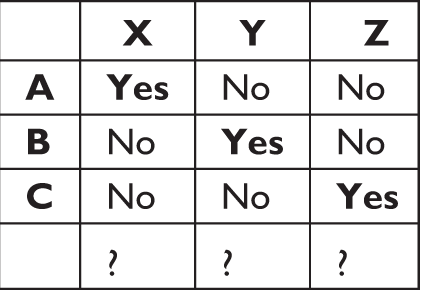
We assume that the degree to which A is affected by X, is greater than the combined degree to which B and C are affected (and so on). If so, A has more than 50% say over X, B has more than 50% say over Y, and C has more than 50% say over Z. In that case, in this particular scenario, propositions X, Y, and Z will all be affirmed. On the other hand, if A, B, and C all had an equal say in all decisions, all the propositions would have been rejected. 11 It thus seems clear that weighting votes in accordance with Proportionality will leave individuals with more power over their lives – more autonomy – than alternative weighting schemes. 12 In light of this, it arguably makes sense to weight the votes of A, B and C, in positive proportion to the extent to which they are affected by the respective decisions that they collectively face.
Clearly, weighting votes in positive proportion to people’s degree of affectedness, will in many cases not yield the smooth results suggested by the above table. However, it will always increase the chances that people get the favored results of the decisions that affect them the most, and consequently increase the chances for people to lead autonomous lives, relative to other weighting schemes. Note, however, that our proposal does not rely upon any notion of autonomy-maximization (or other forms of maximization). What our proposal says is merely that whenever a person’s interests are affected by a decision, she should be enfranchised on it in positive proportion to her relative degree of affectedness, and that this is mandated by a concern for her autonomy. If we could somehow maximize the total amount of autonomy by departing from that formula, nothing in what we say is meant to give reason for doing so. In our view, autonomy is an important value that has implications for voting weights. It is not a supreme value that should be maximized at all costs. One could easily imagine scenarios in which autonomy could be increased by disenfranchising some in order to boost the autonomy of many others. This would be wrong, on our view, because autonomy should be combined with, and might plausibly be founded on, a more fundamental idea of equal moral worth that bans the sacrifice of the vital interests of some, for the benefit of others (barring extreme cases).
To bolster the case for applying the Proportionality Criterion when weighting votes, consider, for illuminating contrast, the opposite alternative (Negative Proportionality): the more you are affected by a decision, the less of a say you should have over that decision. That seems both intuitively very implausible and arguably in direct tension with the regulative ideal of personal autonomy. Also the neutral alternative, though common, sounds defective (No Proportionality): No matter how much a decision affects you, no matter whether it threatens to ruin your life, or improve it imperceptibly, you should have the exact same say in that decision. 13
In addition to the Proportionality-dictum, we believe, as suggested throughout, that the weight of a person’s vote on a decision should be determined independently of whatever voting weights she might have on other decisions that affect her interests. We therefore refer to our view as the Independent Proportionality Criterion: the weight of a person’s vote on a decision is determined by and only by the degree to which that decision affects her interests, and independently of her voting weights on other decisions.
We add this Independence-feature in order to avoid various problems that follow, or so we believe, from rejecting it. We shall spell out these problems in the next section, where we assess Goodin and Tanasoca’s weighting criterion – a proposal which explicitly rejects the independence-feature we endorse. But first, to sum up: as we see it, on a straightforward understanding of the moral foundation for the All Affected Principle, Independent Proportionality is a plausible criterion for determining a person’s voting weights on decisions that affect her interests. From the perspective of a proponent of the All Affected Principle, can either of the two rivals offer a more plausible way of weighting votes?
The All Affected Principle and the Equal Quantum Criterion
According to Goodin and Tanasoca (2014), although the All Affected Principle enfranchises all and only affected interests, the weight it gives to a person’s say on any particular decision is dependent upon her voting weight on the other decisions that affect her. Voting power should be distributed to everyone, everywhere equally in a fixed quantum, such that a person’s voting weights on any particular decision will depend upon her total pattern of affected interests and how she decides to apportion her fixed quantum of voting power across the decisions that affect her.
Goodin and Tanasoca develop their view as follows. They start by observing that the ‘all affected interests’ principle…holds that the right to vote in a place should be extended to all and only those who have an interest in that place. By that principle, someone owning property in both Australia and the US should have a right to vote in both places, whereas someone with property in Australia alone should have a right to vote there alone. (2014: 748) Anyone whose interests are affected by decisions taken in a place should indeed get to vote in that place. But he should not get more votes to reflect the more interests he has at stake…Someone with stakes in multiple issues should ideally get a fixed quantum of voting power which he can apportion according to the size of his stake in any particular issue or place, casting fractional votes in the various places and contests where his interests are affected. The crucial thing is that, for any given voter, those fractions sum to one (or, more generally, to the same number for every voter). (2014: 749)
Why do Goodin and Tanasoca favor Equal Quantum (over something like Independent Proportionality)? The reason is a particular understanding of what they call ‘the democratic egalitarian ideal’, according to which ‘everyone’s votes [ought] to be equally consequential’ (2014: 745). This view, they claim, is embodied in the famous ‘one person, one [equally consequential] vote’-slogan. In light of this, the following reasoning (against something like Independent Proportionality) seems straightforward: [A]llocating the right to vote proportionately to people according to their material interests – giving more votes to people with more by way of material interests – would fly in the face of the equalizing impulse at the heart of democratic egalitarianism…The right way of understanding the ‘all affected interests’ principle, consistently with democratic egalitarianism, is [therefore the Equal Quantum Criterion]. (2014: 748–749)
We agree. It does indeed seem that the appropriateness of the ‘one person, one vote’-slogan, as a representation of the democratic ideal, is confined to the special (and typically highly idealized) case where people’s affectedness is roughly equal. 14 So, as we (and Brighouse and Fleurbaey) see it, the concern which motivates the ‘one person, one vote’ slogan requires unequal (or proportional) distribution of voting weights whenever affected interests (however defined) are distributed unequally. Equal weights are only incidentally required by the relevant concern underlying the slogan (i.e. when all members of the demos are equally affected by all decisions). A successful case for the Equal Quantum view will thus arguably have to depend on something else (than merely claiming its embodiment in the so-called ‘democratic egalitarian’ ideal). 15
The Equal Quantum Criterion, however, highlights an aspect of our own view that might seem problematic. Even if we accept the general idea that people’s total voting power can vary with the extent of their interests, as we argued above, it would be implausible if the rich, through their investments and property, gain more voting power than the poor. It is clear that wealth is one factor that might translate into voting power on our account.
We agree that it is undesirable if the rich get to dominate politics and run roughshod over the poor. In that case, the interests of the poor would count for naught, and their autonomy would clearly be infringed. However, the Independent Proportionality Criterion is exactly intended to safeguard and realize the autonomy of everyone, not only the rich. In our view, Independent Proportionality would not in general give the rich objectionable political power. First, even in cases where one rich individual has interests, others may have interests as well, even if these interests are not based on property or ownership. Thus, even if the rich stand to lose or gain materially, depending on, say, whether a planned factory is approved or banned, others can have competing interests in maintaining biodiversity, protecting the environment more generally, saving recreational areas, or providing accessible housing for the poor. All these interests are perfectly valid. 16 In addition, there will sometimes be many people with opposing interests. Thus, these opposing interests will not necessarily be outweighed by interests based on large sums of money.
Second, since the base idea is autonomy, the interests of the less autonomous will (often) be in a relevant sense stronger than the interests of the more autonomous. At least this will be the case if we claim that autonomy is more morally important for those who have little of it. We think this claim is reasonable. If we can boost the autonomy of either A or B to the exact same extent, but A has barely any autonomy, whereas B has plenty, it seems plausible to choose to boost A’s autonomy. 17
So, even if a billionaire stands to lose or gain large sums of money on one of her many investments, the interests of a small group of poor people – who, say, stand to lose a site that is important to their traditional lifestyle – might well be stronger (at least in total) than the billionaire’s. More generally, there is no necessary connection between the amount of money at stake and the strength of the associated interests. Thus, we have no reason to think that the rich will unduly dominate politics on our proposed scheme of voting rights. Notice, however, that we do not deny that some rich individuals, in virtue of having many interests, sometimes will have more influence in some decisions than some poor individuals, and sometimes more influence in total than some poor individuals. The same, however, might well be true of others who have, for whatever reason, many or strong interests, or both.
Resource fetishism: Losing the connection to autonomy
For those, like us, who believe that personal autonomy is the moral foundation of the All Affected Principle, the Equal Quantum Criterion could be criticized for having too fragile a connection to the concern for autonomy. To reiterate, in light of the All Affected Principle’s autonomy-foundation, the point of democracy is to ensure that people get to be co-authors of their own lives, by letting them have a say in those irreducibly collective decisions which affect their interests. This means that the value of having a say over a polity’s decisions depends upon the extent to which those decisions affect your autonomy. We agree with Goodin and Tanasoca that the vote is a power resource. But the point of having it (in this or that distributional pattern), is arguably to influence the decisions which affect your (self-authored) life, not to satisfy a criterion of (just patterns of) resource equality per se. In other words, the Equal Quantum Criterion seems to run into the problem of resource fetishism, where a distributional pattern is sought realized for its own sake, independently of its effect on people’s lives.
To see this, consider again the above-mentioned case of Albert (who has voting rights in France) and Brita (who is enfranchised in Sweden). They both live roughly equal lives, autonomy-wise, in their respective states. (We assume for simplicity that they are both affected only by the decisions made by their states). Now imagine that they both coincidentally fall in love with someone abroad, say, in Australia, and start to travel there to visit their respective partners. Albert and Brita thus develop an interest in relevant parts of Australian decision-making (e.g., border control rules, dual citizenship laws, etc.). If we follow the logic of Equal Quantum, Albert’s vote in Australian decisions should be weighted below Brita’s, in order to equalize their power over the world. After all, even though this weighting will create an inequality with regard to the autonomy they enjoy, it is imperative to neutralize the larger amount of power over the world which Albert has thus far possessed due to his having voting rights in the more powerful French polity. But if we weight Albert and Brita’s votes differently in this scenario, we seem implausibly concerned with equalizing resources for its own sake. Albert ends up having less of a say over the decisions that affect his life than Brita has over the decisions that affect her life, and this seems unfair. 18
In light of the Equal Quantum Criterion’s problems, then, let us set it aside, and instead consider the second alternative to Independent Proportionality.
The All Affected Principle and the Prioritarian Criterion
According to Brighouse and Fleurbaey, we should determine the weight of a person’s vote on a decision that affects her interests, by taking into account the degree to which her actual level of distributional advantage reflects the ideal of social justice. The more unjust her actual position is, the more weight should be given to her vote (2010). Put differently, a person’s ‘stake’ in a decision – that is, her degree of (relevant) affectedness – is determined by the differential between her current level of advantage and the level of advantage to which she is entitled from the viewpoint of social justice. As Brighouse and Fleurbaey puts it, ‘stakes are [to be] measured by the impact of decisions on individual advantage as properly defined by the theory of social justice’, where advantage refers to ‘the general allocation of resources and wellbeing’ (2010: 151). Brighouse and Fleurbaey’s rationale for favoring this weighting criterion is to achieve what they claim is ‘a simple reconciliation of democracy and justice’ (2010: 151). The very purpose of their weighting criterion is to ‘radically [reduce] the tension between democracy and justice by incorporating the evaluation of individual interests and social priorities into its fabric’ (Brighouse and Fleurbaey, 2010: 155). Put differently, the point is to bring the world closer toward the ideal of social justice, by devising democratic decision-making in a way that prioritizes the worse-off: ‘it is perfectly possible to define stakes in a way that gives priority to the worst-off to any desired degree [in the pursuit of social justice]’ (2010: 151). We shall refer to Brighouse and Fleurbaey’s weighting-criterion as the Prioritarian Criterion (just because they assume that justice requires a prioritarian distribution of advantage).
There might be good reasons for devising a polity’s voting scheme such that it promotes social justice, all things considered. We could reach that conclusion both when seeking to balance various theoretical ideals, and when deciding how to act here and now, under less than ideal circumstances. The controversial point that presently concerns us, however, is whether there is good reason to endorse the Prioritarian Criterion as the most plausible weighting-criterion when our aim is to define the democratic ideal. That is to say, Brighouse and Fleurbaey, as we understand them, do not submit the Prioritarian Criterion as a pragmatic guide for action here and now, nor as the criterion that we end up with when we aim to balance democracy and social justice. Instead, they present their weighting criterion as a theoretical advance in the definition of the democratic ideal itself. As they put it, their aim is to ‘provide better guidelines for the definition of a democratic ideal in theory’, and to provide ‘a guide for devising ideal democratic institutions’ (2010: 138).
We raise two objections to the Prioritarian Criterion. The first is outcome-oriented: it casts doubts on whether the Prioritarian Criterion is able to secure the intended justice-promotion. The second is process-oriented: even if we assume that people do vote ‘correctly’ – such that the Prioritarian Criterion effectively promotes socially just policies – Brighouse and Fleurbaey’s weighting criterion undercuts the autonomy of citizens in two distinct ways.
Uncertain outcomes
Brighouse and Fleurbaey underline that, when distributing voting weights (according to their account of ‘stakes’), we shall not include information about the direction of a person’s interests, but only their intensity (2010: 146). That is, when weighting a person’s vote we shall register the degree to which a decision affects her, but not which way she will vote on it. This removal of information about how people will use their weighted votes threatens to undermine the Prioritarian Criterion’s ability to serve its own purpose: to promote social justice. After all, unless we do include information about the direction of the interests we shall weight, the whole weighting process risks becoming pointless and even counterproductive. Without information about people’s preferences, we cannot know in advance of the vote whether this or that distribution of weights will help usher in, rather than prevent, policies that promote social justice. 19
Imagine a relevantly disadvantaged person, X, who is a rational voter but affirms an incorrect ideal of social justice. X uses his increased voting weight to vote for a presidential candidate, Y, who affirms the same incorrect ideal. Y goes on to win the election, and enacts her unjust policies. Increasing the weight of X’s vote has not promoted social justice. Over time, moreover, Y’s policies might make X even worse off according to the correct ideal of social justice. If so, Brighouse and Fleurbaey’s Prioritarian Criterion will imply weighting X’s vote even more in the next election, thus increasing the probability of Y’s reelection, which will make X even worse-off, and so on. In other words, by boosting the weight of X’s vote, the Prioritarian Criterion might, contrary to its purpose, turn out to counteract the pursuit of social justice. 20 To avoid such counterproductive upshots, a proponent of the Prioritarian Criterion must know (and act upon) the direction of people’s interests (when weighting their votes), not merely their intensity.
In short, Brighouse and Fleurbaey’s weighting criterion leaves us in the dark about whether making use of it will have a positive or negative effect on the relevant distribution of advantage. A proponent of the Prioritarian Criterion cannot be certain that the worse-off will use their increased voting weights to promote rather than undermine social justice. By failing to serve its own purpose, the Prioritarian Criterion is no plausible alternative to the Independent Proportionality Criterion.
Now, let us set aside this outcome-uncertainty, and instead assume that, by using the Prioritarian Criterion to weight people’s votes we would be able to promote social justice. One might still object on grounds of autonomy, or so we shall now argue.
Overriding autonomy
People typically disagree about what distributive justice requires. The democratic response to such disagreement is arguably to settle the matter through inclusive democratic procedures. The Prioritarian Criterion’s second problem is this. It effectively sidesteps people’s disagreement about distributive justice and weights their votes in accordance with, and for the purpose of promoting, a single conception of justice the affirmation of which has itself not been subject to democratic decision-making.
In doing so, the Prioritarian Criterion undercuts the rightful exercise of autonomy on the part of all those affected. Even those who affirm a prioritarian conception of justice are denied the opportunity to partake in the decision concerning which conception of distributive justice society should be organized in accordance with. 21 As we have argued, democracy is based on autonomy. It is morally imperative that agents should be the authors of their own lives, and the co-authors of their collective lives. The former requires an adequate set of individual rights and liberties that are (rightly) not subject to democratic decision making, whereas the latter requires that irreducibly collective decisions are in fact decided collectively. If such decisions are not decided collectively, those agents who are excluded from the decision will have their autonomy severely undermined. Which principles of distributive justice society should adopt is (if anything is) such an irreducibly collective decision. 22 In light of this commitment, the Prioritarian Criterion seems clearly inadequate. 23
A possible reply to this line of argument might be to present the Prioritarian Criterion (and the democratic ideal of which it is part) as applying only in scenarios where all those affected agree about the correct account of social justice. But if that is the proper backdrop for our theory of the democratic ideal, the need for democratic procedures is drastically reduced. There would be little need for people to settle collective decisions through voting – little need for politics at all. As Waldron puts it, if people ‘did not disagree about justice, what would [they] have to reason or argue (or vote) about in a democratic society?’ (1999: 153). If so, one might wonder whether the democratic ideal, as Brighouse and Fleurbaey understand it, would then be detached from those circumstances where it makes sense to regard (and appeal to) it as an ideal in the first place. Just like the ideal of distributive justice is superfluous in circumstances of abundance, the ideal of democratic decision-making, one might say, is superfluous under circumstances of full agreement (Waldron, 1999).
There is also another way in which the Prioritarian Criterion undermines autonomy. From the point of view of autonomy-based versions of the All Affected Principle, defining affectedness in the way Brighouse and Fleurbaey does, is implausible. To illustrate, suppose A and B are both affected by a democratic decision, in the straightforward sense that their interests are impacted by that decision. For A, we suppose, very much is at stake. Her life plans depend crucially on the outcome of the decision. B, on the other hand, is just barely affected. His life plans depend on the outcome of the decision only to a very limited extent. B, however, is slightly worse off from the point of view of justice, than he ought to be, whereas A is as well off from the point of view of justice as she ought to be. In this case, B’s stake in the decision, is, on Brighouse and Fleurbaey’s view larger than A’s stake in the decision. That does not seem right. Much more is at stake for A. She is obviously more affected, and the outcome of the decision affects the extent to which she is able to control and choose her own life, more than it affects the extent to which B is able to control and choose his life. Thus, when the All Affected Principle is based on autonomy, Brighouse and Fleurbaey’s way of defining stakes seems wanting.
Consider also a case in which A and B are equally well off from the point of view of justice. Again, both are affected by some democratic decision, but A is hugely affected, whereas B is only barely affected. Yet, on the Prioritarian Criterion, A and B have equal stakes, and should count as equally affected. This seems mistaken, and conceptually dubious. Affectedness and what your position is, in light of justice, are just two different things. 24
To be sure, whenever there is injustice (as in the relation between A and B in the first scenario) it should be corrected. But it seems wrong to correct injustices through the distribution of voting weights, and wrong to assume that this is the way of understanding affectedness. In our view, Brighouse and Fleurbaey’s account relies too heavily on consequentialist premises (with the aim of realizing justice) that risk being in conflict with the value of autonomy and the All Affected Principle.
Summing up, there are two problems with the Prioritarian Criterion. First, it is uncertain that those whom we grant more voting power will vote for policies that reflect the correct account of social justice (and thus promote rather than frustrate justice). Second, even if we assume that those people do vote ‘correctly’ – such that the Prioritarian Criterion does effectively promote socially just policies – Brighouse and Fleurbaey’s weighting criterion undercuts the autonomy of people who ought to have a say over the collective decisions that (thereby) affect them, as well as the autonomy of people who have small justice-based stakes in decisions that affect them hugely.
Concluding remarks
In this paper, we have argued that what we called Independent Proportionality is the most plausible weighting-criterion for proponents of the All Affected Principle. When combined, the All Affected Principle and the Independent Proportionality criterion say this: the democratic ideal requires that we enfranchise all and only those people whose interests are affected by a decision and that we assign voting weights in positive proportion to people’s degree of affectedness, measured for each decision separately. In reaching this conclusion, we have assessed two alternative weighting-criteria: Goodin and Tanasoca’s Equal Quantum view and Brighouse and Fleurbaey’s Prioritarian Criterion. Although those proposals present themselves as suitable pairings with the All Affected Principle, we have given reasons for rejecting both.
Footnotes
Acknowledgments
This paper was presented at conferences and workshops at the University of Gothenburg, the University of Hamburg, the University of Oslo, the University of Bergen, Aalborg University, and the Institute for Future Studies in Stockholm. We are grateful to the participants at all these events. In particular, we owe thanks to Svenja Ahlhaus, Gustaf Arrhenius, Rainer Bauböck, Ludvig Beckman, Andreas Bengtsson, William Bülow, Steinar Bøyum, Matthew Coffay, Lina Eriksson, Eva Erman, Espen Gamlund, Robert Goodin, Axel Gosseries, Clare Hayward, Fredrik Dybfest Hjorthen, Jonas Hultin-Rosenberg, Göran Duus Otterström, Jørgen Pedersen, Beate Rössler, Johannes Servan, William Sjöstedt, Jørn Sønderholm, Jens Damgaard Thaysen, Jesse Tomalty, Annette Zimmerman, as well as one Editor and two anonymous reviewers for this journal.
Declaration of conflicting interests
The author(s) declared no potential conflicts of interest with respect to the research, authorship, and/or publication of this article.
Funding
The author(s) disclosed receipt of the following financial support for the research, authorship, and/or publication of this article: This work was supported by funding from the European Union’s Horizon 2020 research and innovation programme under the Marie Skłodowska-Curie grant agreement no. 792263 awarded to Kim Angell. This article reflects only the authors’ view. The European Commission is not responsible for any use that may be made of the information it contains.