



Abstract
Fairness in sport is not just about assigning the top prizes to the worthiest competitors. It is also about the way the prize structure itself is organised. For many sporting competitions, although it may be acceptable for winners to receive more than losers, it can seem unfair for winners to take everything and for losers to get nothing. Yet this insight leaves unanswered some difficult questions about what stakes fairness requires and which principles of stakes fairness are appropriate for particular competitions. In this article I specify a range of different principles of stakes fairness (ten in total) that could regulate sporting competitions. I also put forward a theoretical method for pairing up appropriate principles of stakes fairness with given sporting competitions. Specifically, I argue that the underlying rationales for holding sporting competitions can provide useful guides for identifying appropriate principles of stakes fairness. I then seek to clarify and work through some of the implications of this method for a sample of real world controversies over sporting prize structures. I also attempt to refine the method in response to two possible objections from indeterminacy and relativism. Finally, I compare and contrast my conclusions with more general philosophical debates about justice.
Introduction
The issue of fairness in sport has not gone unexamined by philosophers. Hitherto they have tended to concentrate on questions of fairness associated with the ideal of equality of opportunity broadly construed: on the qualities and competitive advantages that should or should not produce winning performances as well as on the background conditions that rightly or wrongly enable individuals to develop the requisite qualities and competitive advantages. The work of Sigmund Loland is typical in this regard (Loland, 1999, 2001). These insights into equality of opportunity in sport resonate with the work of contemporary political philosophers on the competition for scarce jobs and positions in society (see, for example, Fishkin 1983; Mason, 2006; Rawls, 1971; Roemer, 1998; and Williams, 1962). However, in order to understand what makes sporting competitions fair the aforementioned theory of equality of opportunity does not suffice. It is no less important to consider what is at stake in competitions in terms of their prize structures. The crude choice is between a winner-takes-all prize structure, in which the competitor who finishes first in the competition gets everything while the losers get nothing, and a losers-get-something prize structure, in which there are prizes for first place, second place, third place, and so on, competitors. 1
There may well be important instrumental reasons to favour losers-get-something prize structures over winner-takes-all prize structures. One such reason begins from the realisation that ideals of fair competition are seldom fully satisfied in practice given the problems of background inequality, hidden procedural unfairness and human errors in adjudication. 2 So ensuring that even losers receive something can be a way of mitigating various forms of unfairness relating to inequalities of opportunity that are a common and perhaps inevitable feature of actual competitions, sporting or otherwise. 3 The problem with this reason, however, is that it makes the case for broadening the spread of prizes between winners and losers of derivative importance. A fairer prize structure is depicted as a remedy for unequal opportunity and not as a fundamental issue of concern in its own right.
The main aims of this article, therefore, are threefold: first, to make the case that sporting prize structures matter in their own right from the perspective of fairness; second, to add precision to the general idea that for many sporting competitions losers-get-something prize structures provide greater stakes fairness than winner-takes-all prize structures by identifying a range of governing principles of stakes fairness; third, to establish a mechanism for pairing up appropriate principles of stakes fairness with given sporting competitions. My argument shall proceed as follows. I start by fleshing out the idea of stakes fairness, being careful to distinguish three different aspects of the idea. Following on from that I identify a range of principles of stakes fairness (ten in total) that could be used to regulate sporting prize structures. I then address the questions of the justification and appropriateness of such principles for sporting competitions. Specifically, drawing on existing theories of the point and purpose of competition in general, I identify various different types of rationale for holding sporting competitions in particular and I try to demonstrate how these rationales can provide a useful guide for matching appropriate principles of stakes fairness to given sporting competitions. I then clarify and work through some of the implications of the method for a sample of real world controversies over sporting prize structures. I also seek to refine the method in response to two possible objections from indeterminacy and relativism. Finally, I compare and contrast my conclusions with more general philosophical debates about justice.
The idea of stakes fairness
The term ‘stakes fairness’ was coined by Lesley Jacobs in his book Pursuing Equal Opportunities: The Theory and Practice of Egalitarian Justice (Jacobs, 2004). Equality of opportunity is, I suggest, an ideal for the normative regulation of competitions that distribute valuable opportunities in society. It is possible to distinguish three dimensions of fairness that might guide this regulation. Procedural fairness reflects a concern with the basic rules of procedure that guide a competition, including the determination of the winners. Background fairness reflects a concern that there be a level playing field for all competitors. Stakes fairness focuses on the prizes or what is at stake in the competition. […] My three-dimensional model of equal opportunities as a regulative ideal is innovative because it adds the dimension of stakes fairness. (Jacobs, 2004: 4) Stakes fairness reflects a concern with the distribution of benefits and burdens within a competition. The issue here is with whether it is fair to have, for instance, a winner-take-all scheme. (Jacobs, 2004: 16).
In fact, Jacobs goes on to explain that stakes fairness has three distinct aspects. First, there is a concern with ‘the fairness of the effect or outcome within the sphere of competition’ (Jacobs, 2004: 44). This is a matter of how the prize structure marks the difference between winning and losing or, in a more fine-grained way, between first place, second place, and so on, such as whether the winner takes all or whether the losers also get something and how much. Second, there is a concern with ‘limiting the effects of one competition on another’ (Jacobs, 2004: 43). This echoes Michael Walzer’s principle of ‘complex equality’, which is designed to secure the autonomy of different spheres of distribution. 4 Third, there is a concern with ‘how much is at stake in a given competition’ (Jacobs 2004: 43) or, more specifically, ‘the concern that there should be constraints on the risks that participants in competitions are exposed to’ (Jacobs, 2010: 257). Expecting professional boxers to fight bare knuckle and for an unlimited number of rounds, for instance, would seem to make the stakes too high in terms of risk to life and limb.
Jacobs insists that it is the first aspect ‘that is at the very core of stakes fairness’ (Jacobs, 2004: 44), and so it will be my central focus here. According to Jacobs, achieving core stakes fairness depends on ‘promoting a wide distribution of benefits’ (Jacobs, 2010: 259). For example, it is the norm for professional boxers to share the prize, the difference between the winner and loser being their proportion of the prize. This example expresses the insight that winner-take-all stakes for competitive opportunities are rarely fair. (Jacobs, 2004: 38)
Norms of stakes fairness are not limited to sporting competitions. Jacobs argues that equal pay legislation ‘remedies a form of stakes unfairness women experience in the labour market’ (Jacobs, 2004: 208). Workfare schemes ‘are capable of addressing the stakes unfairness of labour market competition with regard to job assets’ (Jacobs, 2004: 164). Widening opportunities to provide and perform medical and legal services without a university degree neutralises what would otherwise be the stakes unfairness of winner-takes-all competitions for scarce places at law and medical schools (Jacobs, 2004: 94; see also Jacobs, 2013). Stakes fairness also means ensuring that the winners of divorce settlements do not get everything while the losers get nothing (Jacobs, 2004: 16). Although this article is mainly about sporting competitions, I shall return to some of these wider issues of distributive or social justice in the final section.
Despite Jacobs’ illustrations, however, what constitutes a ‘wide distribution’ of benefits remains vague. As John Baker puts it, ‘[i]f stakes fairness really matters, we surely need a clearer account of what it is’ (Baker, 2004; see also Voorhoeve, 2005; Brown, 2008). In a more recent article applying his ideas to the field of educational policy Jacobs offers the following response to the imprecision objection. In my view, the imprecision objection stems from mistaken expectations about an equal opportunities approach that functions as a regulative ideal. The distinction I have in mind is between educational policy and an ideal that regulates that policy. The ideal sets the parameters on that policy, but within those parameters it does not specify the content of the policy. From this perspective, a three-dimensional equal opportunities approach through the lens of procedural, background and stakes fairness sets the parameters on the objectives of educational policy and how they can be pursued. The imprecision objection is grounded on mistaken expectations in the sense that it seeks, from a regulative ideal, precise answers to educational policy issues. (Jacobs, 2010: 262)
Nevertheless, Jacobs underestimates what is required for something to operate as an effective and, therefore, adequate regulative ideal. It is true that a regulative ideal is not the same as a set of rules that when applied to the facts deliver complete, determinate answers to detailed policy questions. But in order to set the parameters on the objectives of policies a regulative ideal must be more than a mere idea; it must also be a principle. According to Jacobs, the core idea of stakes fairness reflects a concern with widening the distribution of good outcomes within competition prize structures and the putative insight that winner-takes-all prize structures are rarely fair. However, this idea is not yet an adequate regulative ideal, since it does not provide parameters that guide the formation of policy with regards to how wide the distribution of good outcomes should be and sheds no light on the rare cases when winner-takes-all prize structures are fair. What is required here is a principle or set of principles of stakes fairness that can act as a governing standard to be met for particular competitions. I aim to add this specificity to the philosophy of stakes fairness.
The principles of stakes fairness to be discussed in this article are regulatory principles of justice in the sense that they specify normative governing standards or instruments of assessment for sporting prize structures which in theory could be codified, implemented or complied with by governing bodies, agents, promoters, tournament directors, and so on. In other words, regulatory principles of stakes fairness are conceived so that they might guide and where necessary constrain institutions, rules and practices surrounding the design and implementation of actual sporting prize structures. 5 Unless otherwise stated I shall use the term ‘prize’ to refer to the monetary rewards that competitors receive. The term ‘prize structure’ will refer to how much of the available prize money goes to winners and losers respectively. I should stress, however, that the notion of stakes fairness is not only applicable to prizes and prize structures in the narrow senses with which this article is primarily concerned. Elite athletes are not motivated only and simply by money but also by titles, prestige and plaudits. Whilst these things can be difficult to quantify, they are also issues of stakes fairness. Furthermore, in the case of multi-round competitions what is at stake in each round is not merely a monetary prize but also entry into the next round of competition. 6
Principles of stakes fairness in sport
Given the diverse range of sporting competitions which principles of stakes fairness might be expected to regulate and the fact that the principles are intended to be bespoke for sporting competitions, it is highly unlikely that a single principle of stakes fairness could appropriately regulate all competitions. In what follows I shall identify ten principles in total. It should be borne in mind from the outset that different principles may be appropriate for different competitions, and that the list is intended to be instructive rather than exhaustive.
When reflecting on the stakes fairness of sporting prize structures it may seem natural to start with principles that focus on the positions in which competitors are ranked at the end of the competition. I begin with the principle of stakes fairness that Jacobs rejects.
The Principle of Ranking-Based Winner-Takes-All. Whichever competitor is ranked in first place at the end of the competition should take the whole prize, while the losers receive nothing.
Whether or not one thinks that this principle is plausible in general terms, 7 it only takes a moment of reflection to see that relatively few actual sporting competitions conform strictly to it. Across the diverse world of professional sports, from snooker to body-building, competitors have more than just a single top prize for which they compete. I shall try to explain and justify why this should be the case in the section on ‘rationales for sporting competition.
But by the same token, relatively few competitions operate under the terms of this alternative principle.
The Principle of Strict Equality. All competitors receive the same prize, irrespective of their ranking as winners and losers and whether or not such a ranking is employed.
That is not to say that there are literally no competitions or games which adhere to this principle. The game of piñata played at children’s parties or the Caucus Race in Lewis Carroll’s Alice in Wonderland are possible examples. Rather, the point is that in the world of professional sport the vast majority of prize structures operate somewhere between the extremes of winner-takes-all and winners-and-losers-get-the-same.
One typical principle is this.
The Principle of Ranking-Based Lexicality. Every competitor should receive a share of the prize pot, but whichever competitor is ranked in first place at the end of the competition should take the largest share of the prize pot, the competitor who is ranked in second place should take the second largest share of the prize pot, and so on.
This principle departs from the winner-takes-all model of prize structures in a particular way. It ensures that shares are staggered from the winner all the way down to the competitor who finishes in last place. This principle seems apt for many of the world’s most famous and beloved professional sporting competitions: from the world of team sports consider the Football Association (FA) Premier League in England and Wales or the Fédération Internationale de l’Automobile (FIA) Formula One World Championship.
However, not all governing bodies or individual tournaments that adopt or adhere to the Principle of Ranking-Based Lexicality do so all the way down. From the world of individual sports, consider the four Major Championships in golf. After two rounds the field of competitors is split in two: those who ‘make the cut’ continue on in the tournament and compete in the final two rounds; those who ‘miss the cut’ are eliminated and their competition is over. For the players who do make the cut the prize structure is lexical, whereas the players who miss the cut receive no prize money. For the purposes of this article I shall treat this sort of bifurcated prize structure as exemplifying a sub-category of the Principle of Ranking-Based Lexicality. In such cases there may be a coming together of different rationales that support this special, split strategy. I shall say more about this later.
In addition to this, however, the Principle of Ranking-Based Lexicality has a feature that could prevent it from being universally suitable for all sporting competitions. Put simply, it may be insensitive to nuances surrounding the differing degrees of performance of the winners and losers. Imagine a governing body that brings together the world’s top eight exponents of its sport at the end of the season to compete in a knock-out tournament for a total prize fund of $5,000,000. The current principle permits a prize structure according to which the winner receives $2,000,000, the runner-up $1,000,000, the losing semi-finalists $500,000 and the losing quarter-finalists $250,000. Under this prize structure the winner receives twice as much as the runner-up, the runner-up receives twice as much as the losing semi-finalists, and so on. Yet this can seem unfair if it is not the case that the performance of the winner is twice as good as that of the runner up, and so on.
In the light of this it might sometimes be more appropriate, all things considered, for principles of stakes fairness to reflect more closely the differing degrees of performance of the winners and losers during the competition, where the differing degrees of performance are based on doing better or worse along a set of dimensions that reflect the particular set of intricate skills associated with the sport. I leave it open whether doing better or worse is measured in absolute or relative terms. To this end, consider this further standard.
The Principle of Performance-Based Proportionality. All competitors should receive shares of the prize pot that are proportional to their differing degrees of performance.
This principle implies that the best performer may receive a prize that is larger than the second best performer’s prize but not a prize that is disproportionate to the difference in performance between the two. Only if the best performer actually performed twice as well as the second best performer should they receive a prize that is twice as large. Because this principle depends on information about actual performances, a tournament organisation that wished to adopt it would not be able to determine in advance how much each of the eventual winners and losers should receive. The distribution of prizes must be settled after the competition based on actual performance. Here the prize structure might start to resemble a complex system of performance-based bonuses. Nonetheless, the tournament organisation must set out its parameters beforehand − for example, that if a winner achieves performance indicators within a certain range or outperformed the loser by a certain amount, then a given prize will be awarded. The parameters might draw upon customary sporting measures such as time, distance, height, weight, number of goals scored, points tallied, and so on.
However, one drawback with the Principle of Performance-Based Proportionality is that it overlooks something special about being the winner of a competition, regardless of the degree of performance. So there may be reason to favour this alternative.
The Principle of Winner-Weighted Performance-Based Proportionality. The winner of a competition may take a share of the prize pot that is disproportionate to his or her degree of performance.
In addition to this, the Principle of Performance-Based Proportionality is insensitive to the special significance that might be attached to finishing in last place in a sporting competition. A society that has some special reason to reward glorious failure might adopt this standard.
The Principle of Loser-Weighted Performance-Based Proportionality. The competitor who finishes in last place at the end of a competition may take a share of the prize pot that is disproportionate to his or her degree of performance.
This principle would permit a tournament organisation to give a significant prize even to a competitor whose level of performance was very poor. At first glance, this principle would appear to be antithetical to the spirit of competition; but, as I shall discuss later, sometimes there are particular rationales for rewarding the underdog.
So far I have assumed that the prize pot is not dependent on who is taking part in the competition. However, this is often not the case and this fact may have significant implications for stakes fairness. To illustrate, Jacobs uses the example of professional boxing to explain the nature of stakes fairness, but he misconstrues the prize structure involved. He writes this. In, for instance, professional boxing, the stake is prize money. The practice is to have the winner receive say 75 percent of the money (say, $750,000) and the loser 25 percent ($250,000). The justification typically is that this is fairer than a winner-take-all prize of $1,000,000. The dimension of fairness drawn upon here is what I mean by stakes fairness. (Jacobs, 2004: 15)
Whilst it is the norm for professional boxers to share the prize money, typically in the case of world championship and elimination fights this is not done on the basis of a split between winner and loser. For instance, Rule 2.12 of the World Boxing Council (WBC) Rules and Regulations (‘Division of Proceeds in a Purse Offer’) states: The net purse offer (after deduction of the WBC certification fees) shall be divided as follows: a) 70% for the champion and 30% for the challenger. b) 50% to each contender in the case of vacant titles or elimination bouts. c) 55% to the champion and 45% to the interim champion, in the event of such a bout. d) Notwithstanding the terms of subparagraphs a), b) and c) above, the Board of Governors may, in its discretion and by a majority vote, modify the division of purse offer proceeds between boxers in a purse offer in unusual or special cases, like the consideration of the outstanding marketing value of one of the boxers. The modification of the split will be limited to three categories: 70–30%; 60–40%; and 55–45% for the Champion and challenger, respectively, except in the most exceptional circumstances, in which the split may be modified to 50–50%.
The term ‘net purse’ refers to the monies that are collected in box office and merchandise sales, television rights, endorsements and advertising deals, and so forth, minus the promoter’s cut and a myriad of other fees, taxes and expenditures relating to putting on the fight. The WBC rules regulate the terms of bout agreements and make it clear that the net purse should be split between champion and contender rather than winner and loser. This is to reflect the fact that in most instances the champion has greater marketing value than the contender and so the champion is likely to contribute more to the net purse than the contender. For example, at the WBC’s annual convention in Cancun in November 2010 it was agreed by the boxers involved, the promoter Don King and various other interested parties that the then WBC Heavyweight Champion, Vitali Klitschko, would face the winner of a final eliminator contest between Ray Austin and Odlanier Solis on the basis that Klitschko would receive 70% of the net purse and either Austin or Solis would receive 30%. This 70–30 split in favour of Klitschko reflected his greater marketing value as measured by the ratio between the average net purse of Klitschko’s previous three fights and the average net purses of the two contenders’ previous three fights.
In order to better understand what a more appropriate principle might look like it is useful to draw a distinction between input stake and output stake. The input stake is the participant’s contribution to the prize pot. In the case of boxing, a fighter’s input stake is the proportion of the net purse that is due to his appearance in the fight. The output stake, by contrast, is the amount which each participant stands to receive from the prize pot. In the case of boxing this tends to be some fixed percentage of the net purse. The principles of stakes fairness identified above focus on the relationship between a competitor’s rank or performance and his or her output stake. So, consider instead a principle that highlights the relationship between a competitor’s input stake and his or her output stake.
The Principle of Contribution-Based Proportionality. Each competitor should receive a prize that is proportionate to his or her contribution to the prize pot.
At this point the distinction between prizes and honours becomes relevant. In boxing the prize is the net purse, whilst the honour is the championship title or, in other instances, the prestige of maintaining an undefeated record or simply the kudos of being the best fighter on the night. 8 In the case of championship elimination bouts winning the right to fight for a title might be thought of as not quite a prize nor an honour but instead a valuable opportunity. Whilst the Principle of Contribution-Based Proportionality may be appropriate for regulating prizes, the Principle of Ranking-Based Winner-Takes-All is perhaps more fitting for honours and valuable opportunities.
Although the current principle has the merit of enabling competitors to receive in prize money an amount that is proportionate to what they directly or indirectly put into the prize pot, it is also rather restrictive. Specifically, it removes an element of gambling-based accumulation from sporting prize structures. In other words, it prevents someone from putting down a relatively small input stake in the hopes of gaining a much larger output stake if he or she wins the competition. In the case of some professional sports or games, therefore, it may be more suitable to give competitors a chance of winning an output stake that far exceeds their input stake. Here the right principle might be this.
The Principle of Contribution-Based Winner-Weighted Proportionality. The winner of a competition may receive a prize that is disproportionate to his or her contribution to the prize pot.
Then again, this principle opens the door to a scenario in which someone makes a paltry contribution to the prize pot but comes away with the lion’s share. Although it may seem fair for winners to receive more than they contributed, it might be unfair if they only contributed a negligible amount in the first place. So we may need a principle that prevents this sort of carpet-bagging. One such principles is this.
The Principle of Equity-Stake Contribution-Based Winner-Weighted Proportionality. The winner of a competition may receive a prize that is disproportionate to his or her contribution to the prize pot, but only if he or she has contributed an equal amount to the prize pot.
But perhaps this principle goes too far. Making it a requirement that persons contribute equal stakes in order to be entitled to win disproportionately large winning prizes places a barrier to entry for persons who are unable to match the stakes of other, wealthier entrants. This might be stakes fairness for certain competitions, but it raises concerns over background unfairness. The Principle of Equity-Stake Contribution-Based Winner-Weighted Proportionality seems to be one that rich people could embrace as a way of keeping competitions to themselves.
9
In the case of stakes horseracing, for example, adopting this principle would lock out the least wealthy owners and trainers, preventing them from competing for the sorts of top prizes that would enable upwards mobility into the higher echelons of the sport. Background fairness, in the sense of a level playing field, would seem to imply that the winning prize should be open to richer and poorer participants alike. Therefore, for the sake of overall fairness we may need a principle that is sensitive to concerns about both the problem of carpet-bagging and the problem of background unfairness. Thus bear in mind one final principle.
The Principle of Minimum-Stake Contribution-Based Winner-Weighted Proportionality. The winner of a competition may take a prize that is disproportionate to his or her contribution to the prize pot, but only if he or she has contributed a minimally adequate amount to the prize pot.
Up to this point I have explained the idea of stakes fairness in the context of sporting prize structures and differentiated ten principles of stakes fairness. In the next section I consider the justification and appropriateness of such principles. But before doing so, I should reiterate that the foregoing list of ten principles is intended to be illustrative rather than exhaustive. Some possible principles are left out. On a libertarian conception of fairness, for example, the ‘fair’ prize structure is identical to whatever prize structure is mutually agreed upon by consenting adults and organisations absent coercion, fraud, cartels, and so on. 10 However, this conception renders mysterious a good deal of the language that is used by sports writers and sports fans around the world and that can be found in sports magazines and Internet discussion forums. For instance, in boxing it is commonplace for people to question the fairness of actual as well as proposed purse splits despite knowing that the splits have been contractually agreed. As such I do not intend to discuss it further in this article.
Justification and appropriateness
I begin with the question of justification. As with any principles of justice, the principles of stakes fairness cannot be taken for granted but must be supported by compelling reasons or justificatory arguments. Jacobs implies that his three-dimensional model of equal opportunities could be arrived at and justified in the same way that John Rawls arrives at and justifies the Two Principles of Justice in A Theory of Justice, that is, through a process of ‘reflective equilibrium’ (Jacobs, 2004: 39n.73). For Rawls, the aim of reflective equilibrium is to find a coherence or ‘fit’ between basic ideas found in the public political culture of a ‘well-ordered society’, principles of justice that could regulate ‘the basic structure’ of such a society, and considered judgements about justice in particular cases, where nothing is immune from revision (Rawls, 1971: 20–21; 1996: 14; 2001: 5). Along similar sorts of lines, Jacobs (2004: 31–32) begins with what he calls ‘the principle of status equality’ (‘Status equality identifies a starting position − the same status for each and no higher moral standing possible − in a competition that all individuals should enjoy’) and then tries to develop a conception of justice for the regulation of various competitions for scarce goods within civil society that reflects this principle and, moreover, that will conform to ‘widely held views’ and ‘common sense’ judgements about fairness (Jacobs, 2004: 39). Among the views and judgements to which Jacobs appeals are the following. Imagine, say, divorce settlements that were structured [as winner-take-all]. Most of us would object that this is unfair because it is wrong to have the stakes so high; while it may be acceptable to have the winner receive more benefits, it is unfair that the loser receive nothing. (Jacobs, 2004: 16) Imagine a competitive Olympic sport such as figure skating. The stakes are familiar: the gold, silver and bronze medals. Three levels of medals entail a wider distribution than simply winner-take-all. The results of this competition conform to widely held views of stakes fairness …(Jacobs, 2004: 39)
There is much that could be said about Jacobs’ appeal to considered judgements, but I shall limit myself to making three brief points. The first is that although it may be possible to describe examples in which the judgement that winner-takes-all stakes are unfair seems plausible, there may be other examples where this is not the case. There are examples and there are examples. Consider the game of musical chairs, routinely played at children’s parties. Few people complain that its prize structure is unfair, even though only one child ends up with a prize. The same can be said of winner-takes-all poker tournaments. Just because winner-takes-all is rarely fair does not mean that it is never fair. So, if no judgements are immune from revision, one would have to be sure that one is revising the right judgements. This brings me to my second point. Whereas Rawls appeals to the theoretical device of ‘the original position’ to show how it is possible to achieve reflective equilibrium between basic political ideas, principles of justice and considered judgements in particular cases, 11 Jacobs provides no similar mechanism for connecting together the abstract principle of status equality, the idea of stakes fairness and considered judgements in particular cases. Thus there is an open question about the nature of the connections which underpin any coherence that might be achieved. My third point is that there are some important differences between Jacobs’ examples. Whilst people tend to enter into sporting competitions consensually, whether for amusement (amateurs) or to make a living (professionals), people can be effectively entered into divorce competitions without their consent; and they typically do so neither for amusement nor as careers (gold-diggers aside). So, different moral considerations may be driving people’s considered judgements in different cases, even if the generalised conviction that winner-takes-all prize structures are rarely fair stays the same. I shall return later to explain how I think reflective equilibrium might be better put to use.
Having briefly considered the problem of how the idea of stakes fairness might be justified, the next step is to figure out which particular principles of stakes fairness are appropriate for any given sporting competition. One could take two different approaches at this stage. The first abstracts from the competition in question and proceeds on the assumption that one of the above principles is the best principle of stakes fairness tout court. One just has to decide which principle that is and then having made this determination find some way of applying the principle to whichever sporting competitions one happens to be confronted with at any given time. In contrast to this, a second method begins with reflection on the particular details and features of different sporting competitions in order to try to pair up given competitions with appropriate principles of stakes fairness. In the context of his discussion of various competitions for scarce goods in civil society Jacobs adopts the second of these two approaches. In doing so he takes on board Rawls’ dictum that ‘the correct regulative principle for anything depends on the nature of that thing’ (Rawls, 1971: 29). Jacobs writes as follows. Civil society is characterized by extensive diversity and plurality in the opportunities it offers. There appears to be no essentializing or defining feature of the institutions and practices that make up civil society. Therefore, when egalitarians envision a regulative ideal for civil society, it must be an ideal that is sensitive to this pluralism and diversity in opportunities. The shift from equal opportunity to equal opportunities meets this demand. In civil society, pursuing equality means focussing on particular institutions and practices and the opportunities they engender. Each extension of the three-dimensional model requires attending to the particular details and features of the individual competitions and involves at some level pioneering developments. (Jacobs, 2004: 23–24)
However, it is one thing to say that in pairing up competitions with appropriate principles of stakes fairness, or even pioneering new principles of stakes fairness for unusual competitions, we should be attending to the particular details and features of given competitions, it is quite another to explain which details and features we should be attending to and why. Jacobs’ account of stakes fairness is missing a method of connecting particular competitions to appropriate principles of stakes fairness. It is to this project that I now turn.
Rationales for sporting competition
I believe that a useful method for connecting particular competitions to appropriate principles of stakes fairness is to explore the underlying point and purpose of the competitions in question. The basic thought is that if we can discern the rationales for holding different competitions then this should tell us something, or provide a basis for reasonable inferences, about which particular principles of stakes fairness would be appropriate for which particular competitions. This method is not to be confused with Walzer’s approach in Spheres of Justice, which looks further back to the social meanings of the goods in question in order to identify whether or not a competition or some other distributive mechanism is appropriate for it (Walzer, 1983). That being said, sometimes in order to understand the rationale for a particular competition it will be necessary to look into the social meaning of the benefit which it is designed to distribute.
Not surprisingly, there is a range of possible rationales for holding a competition; or, to be more exact, a range of ideal types of what competition is for. Jonathan Wolff enumerates one such list in his article, ‘The ethics of competition’ (Wolff, 1998). 12 Although it is not specifically designed with sporting competitions in mind, it does provide a plausible framework for thinking about sport. 13 One type of rationale identified by Wolff has to do with what he calls ‘the side-effect of activity’: ‘a competition is held for the external effects of people engaging in the activity that the competition draws out or encourages’ (Wolff, 1998: 90). What principles of stakes fairness might be appropriate to such rationales? This question is made more difficult by the fact that the side-effect of activity rationale is itself extremely varied. In examples of sports or games which involve soft competition, such as piñata or the Caucus Race, the competition is held for the purposes of sharing out sweets or small toys amongst equally deserving people or for the even more basic effect of giving everyone a good time. Here it would appear that the Principle of Strict Equality aptly serves the rationale.
The side-effect of activity rationale can also be seen in the world of professional sport, but here the desired side-effect is much less altruistic. So, for example, when the governing bodies in tennis and snooker choose to hold increasing numbers of tournaments in different parts of the world the driving motivation is to advance the profile of these sports or games internationally and to get more amateurs interested in playing and more spectators watching. The governing bodies also understand that the higher the quality of competition, the greater the public interest, and the greater the public interest the higher the fees which can be commanded for the rights to broadcast the tournaments on television or through the Internet and the higher the revenues that can be obtained from sponsorship deals. Over time the revenues generated by successful tournaments underpin the prize funds to be shared among the competitors. 14 The upshot is that the prize structures must be designed to ensure various things: for example, that the best players are attracted to the tournaments; that once at the tournaments all the competitors are motivated to perform at their best so as to create the most thrilling spectacles possible; that the less gifted players are still able to earn enough to maintain themselves on the tour, so that there is sufficient strength in depth in the professional sport or game to make a large number of tournaments worldwide economically viable. All of these things are instrumental to achieving the overall side-effects of promoting the game and making money. Given these looked-for direct and indirect side-effects in tennis and snooker, what would be some appropriate principles of stakes fairness? Consider the Principle of Ranking-Based Lexicality. It requires that all competitors receive an amount for playing in the first round and earn more the further they progress in the tournament. The increments of prize money ensure that competitors are motivated to try as hard as possible to make it to the next round, meaning that spectators can enjoy fierce competition at every stage of the competition. But this prize structure also makes it possible for a wide pool of players to make ends meet as professionals without ever progressing to the end of tournaments.
There is a related reason why many governing bodies and tournament directors sanction or actively endorse lexical prize structures rather than winner-takes-all prize structures. For example, in order to remain solvent and in control of its professional sport a football governing body must serve the interests of the football clubs that it regulates, and these clubs in turn must satisfy the interests of their owners or shareholders. It is unlikely that a winner-takes-all prize structure would be in the long-term interests of football clubs. The economists Robert Frank and Philip Cook provide a general reason – but one that is also applicable to the present example – why this should be the case in their book, The Winner-Take-All Society (Frank and Cook, 1995). If there is only one prize at stake, winner-takes-all competitions generate an irresistible incentive on the part of every competitor to invest more money than the rival competitors in trying to finish in first place. This creates a ‘positional arms race’ in which competitors invest ever larger amounts in order to come out on top. Ultimately they can reach a point where their marginal investments are greater than the prize at stake and so whatever happens they lose money. By adopting a prize structure that distributes money to winners and losers on a lexical basis a football governing body encourages clubs to make more efficient investments. 15
In other professional sports, however, the side-effect of activity rationale for holding a competition may work slightly differently. In the case of professional golf, for example, the prize structure in the Major Championships and in most large international tournaments is bifurcated, meaning that only the players who make the cut gain access to the lexical prize structure, while those who miss the cut receive no prize money. Here the rationale of creating sporting drama points in the direction of ensuring that players in the middle and at the bottom end of the field have the maximum possible incentive to compete hard. With a very large field at the start of the tournament all players have to come out in the first two rounds playing at their best. The very large field also enables the tournament directors to invite a diverse range of players, from older, seasoned professionals to younger, up-and-coming players, from the colourful characters to the relatively unknown players from the fastest growing golf economies − all in an attempt to please audiences and sponsors alike. Finally, there is an element of branding. Golf is a sport which seeks to portray an air of prestige and sporting excellence, both of which may be incompatible with seemingly rewarding failure.
To give another example, for many competitors in international poker tournaments the driving motivation is not to try to win back slightly more than the ‘buy in’ or input stake (that is, a good chance of a small return) but to win big prize money (that is, a small chance of a large return). So what is special about some poker tournaments − their unique selling point one might say − is the extreme difference between the buy in and the prize money. In such cases the rationale behind holding the competition is perfectly compatible with and may even be predicated upon it being the case that virtually all of the competitors will end up losing money and the whole competition encourages imprudent investments. Therefore, the organisers of such tournaments may find the Principle of Ranking-Based Winner-Takes-All more appropriate than the Principle of Ranking-Based Lexicality.
Professional boxing operates differently again. Because the sport tends to be structured around one-off events rather than routinised tournaments, the broadcasting and sponsorship deals that can be commanded by a promoter for any particular bout depend crucially on the ability to predict with confidence how many spectators and viewers will be attracted. Thus principles of stakes fairness are adopted in order to ensure not only that competitors will take part but also that prizes structures themselves reflect the marketable value of the boxers. Here the desired side-effect of the activity favours the Principle of Contribution-Based Proportionality. In the case of the ‘Rumble in the Jungle’, for instance, Muhammad Ali and George Foreman agreed to a 50–50 split in the purse, meaning that they would each receive $5,000,000, win or lose. This was the split that Don King needed to put on the table in order to tempt each of the fighters to risk their records, reputations and future marketable value.
The side effect of activity rationale may work in yet another way in the case of stakes horseracing, where some or all of the prize pot on offer is made up of the ‘entry fees’ or input stakes put up by the owners of the horses. As in poker, part of the motivation for entering a horserace is to take a gamble; but it is also about the prestige and sheer enjoyment that comes from owning a racehorse. Without something like this motivation few people would be willing to bear the very high costs associated with keeping, training and racing horses. The rationale for organising stakes races is to make money both by enabling racehorse owners to fulfil their motivations and by attracting audiences, corporate sponsorship, bookmakers, and so on. Much of this points in the direction of the Principle of Contribution-Based Winner-Weighted Proportionality. That being said, it is also in the interests of entrants to prevent carpet-baggers from making virtually no contribution to the prize pot whilst retaining the same opportunity to walk away with the top prizes. At the same time, the organisers may have a reason to ensure that the barriers to entry into the competition, including the entry fees required to compete, are not such as to exclude all but the very wealthiest competitors, thus making for fewer runners and riders. This elitism may be appropriate in some instances, but not if the organisers are trying to capture the imagination of the grass roots of the racing fraternity. So, reflecting the aim of achieving the widest field of participants possible whilst at the same time guarding against carpet-bagging, the Principle of Minimum-Stake Contribution-Based Winner-Weighted Proportionality may be apposite.
A second type of rationale for holding a competition focuses on ‘activity enhancement’: ‘a competition for a prize is presented as a way of enhancing an activity already thought valuable in itself’ (Wolff, 1998). Consider the skill of archery, which during the Elizabethan period (1558–1603) was one of the most popular pastimes, practised at all levels of English society. Practicing the skill of archery was deemed to be of great importance to the country because it meant that ordinary citizens could be called upon with greater confidence in times of war. Making a tournament out of the skill, including bestowing prizes upon the most skilled archers, was thus a way of enhancing an activity already thought valuable in itself. Indeed, during this time a law was passed which required Englishmen to practice the sport of archery (Singman, 1995: 155).
A third type of rationale for holding a competition is to achieve what Wolff terms a ‘weighted lottery’: ‘the competition is arranged so that someone who achieves best on a scale designed to reflect some underlying trait will be awarded the scarce resource’ (Wolff, 1998: 90). This is not a ‘pure lottery’ in the sense of an allocation of a scarce resource which reflects only chance, where success or failure does not, and is not meant to, reflect any underlying trait or ability. Instead the competition is weighted such that a certain trait or ability tends to be rewarded. However, there is still an element of chance, in the sense that results are not solely determined by the trait or ability and the results on the day cannot be predicted with absolute certainty. 16 In his article, ‘Sport and justice’ Loland provides an interpretation of sport that exemplifies this rationale (Loland, 2007). According to Loland, sport’s ostensible goal is to measure, compare and rank competitors according to their performances. If this is true, then it may lend support to both the Principle of Ranking-Based Lexicality and the Principle of Performance-Based Proportionality.
A fourth type of rationale for holding a competition is to achieve or promote ‘pure competition’: ‘competitive behaviour is considered desirable in itself, and so turns an activity of no value in itself into something of value’ (Wolff, 1998: 90). If the rationale for holding a sporting competition is simply for the sake of competition, the question arises as to which principle of stakes fairness would be appropriate. Presumably it is whichever principle best reflects or promotes the spirit of competition and this, of course, is something that is likely to attract a different social meaning at different times and in different places. Sporting competition has always been adopted and co-opted by people who imbue it, intentionally or unintentionally, with particular meanings − meanings that resonate with core aspects of their culture (values, beliefs, traditions, and so on) including in some cases grandiose hopes and dreams about the standing of their society in the world. It might be central to the meaning of pure competition in the USA, say, that winning is crucial to competing. This culturally-specific attitude is summed up in the words of the highly successful American football coach, Vince Lombardi (after whom the Super Bowl trophy is named), ‘Winning isn’t everything – it is the only thing’. Or consider the catch-phrase of Dale Earnhardt, the NASCAR driver who won seven championships, ‘Second place is just the first place loser’. The emphasis placed on winning may be so great that it becomes appropriate to adopt the Principle of Ranking-Based Winner-Takes-All.
However, the ideal of pure competition can also have very different implications. In some professional sports certain benefits are distributed to teams in reverse order based on the previous season’s win–loss records, with the team achieving the worst record receiving the top benefit. Consider the system used by the National Football League (NFL) in American football to allocate valuable college draft picks. The team with the worst record is given the first pick in each round, the team with the second-worst record the second pick, and so on, down to the winning team of the previous year’s Super Bowl, which receives the last pick in each round. Here the rationale is a kind of forward-looking pure competition: a deliberate attempt to level the playing field and improve the quality of competition during the next season. In this way the stakes fairness of one competition merges into the background fairness of another. Of course, the NFL also pays prize money to successful teams on the basis of Ranking-Based Lexicality. This has enabled certain franchises to build dynasties of prolonged success despite the draft handicap. Compare the Pittsburgh Steelers, who have won more Super Bowls – six – than any other team, despite having only received first pick in the draft on three occasions since its inception in 1936, and the Cleveland Browns, who have never even appeared in a Super Bowl and have received the first round pick on more occasions – eight times – than any other franchise.
Being the worst competitor can also have a particular cultural meaning and value in some societies. Sometimes the ideal of pure competition does not mean that winning is the be-all and end-all; it also matters if a competitor has a never say die attitude and a desire to compete even when there is no hope of victory. Consider the accolade ‘Lanterne Rouge’ given to the rider who finishes in last place in Le Tour de France (‘The Tour’) at the end of each day. During each stage of the tour those riders who do not finish within the day’s time limit (through illness, injury, exhaustion or lack of performance) are eliminated and forced to abandon The Tour. The art of the Lantern Rouge is to always finish just inside the elimination time. Whilst it is not included among the official ‘classifications’ of The Tour (general, points, mountains, young rider, team, combativity), there is a distinction or honour associated with occupying this position and those riders who do so can earn more in appearance and interview fees than those who finish in higher positions overall. The public has embraced this award as being intimately connected with the true meaning of competition and the values associated with a stubborn refusal to quit and a drive to compete against all the odds. Perhaps the Principle of Loser-Weighted Performance-Based Proportionality would be an appropriate operative principle here. That being said, this conception of pure competition also places internal limits on the extent of value that may be placed on finishing in last place. For, if the prize for the weakest result were too great, rivalling the prize for the strongest result, competition would gradually degenerate. Racers without clear winning chances would all go for the loser’s prize. These internal limits may explain why the organisers of The Tour, Société du Tour de France, have never attached an official honour or prize money to the Lanterne Rouge and why, over the years, some race directors have even tried to stamp out any mention of the accolade, claiming that it makes a mockery of The Tour (Strickland, 2008).
A similar dilemma faces the International Olympic Committee (IOC) as a result of its policy of allowing persons to compete in the Olympics who have not achieved the established minimum qualifying standards. Presumably the rationales for this policy have to do with activity enhancement and promoting athletics throughout the world (that is, to give small nations a chance to participate in the Olympics whilst they develop their local Olympic programmes and seek out talented youngsters). Given these rationales, should the IOC augment the standard gold, silver and bronze medals with a fourth medal which would recognise outstanding effort or endeavour? Such a medal might have been used to formally recognise the performances of people like Eddie ‘The Eagle’ Edwards, the British ski jumper who became the most memorable participant in the 1988 Winter Olympics in Calgary despite finishing a distant last place in both the 70 m and 90 m ski jump events, or Eric Moussambani, the swimmer from Equatorial Guinea who achieved folk hero status at the 2000 Summer Olympics in Sydney precisely because he barely managed to complete the full distance in the men’s 100 m freestyle event. However, it is one thing to admire the plucky spirit of these individuals; it is quite another to think that it is fair to recognise their efforts in the prize structure itself. Perhaps it would be fairer to reserve Olympic medals for excellence in performance and find alternative ways of marking the achievements of distant losers, such as through television and radio appearances, advertising campaigns, sports ambassadorial roles, Twitter followers, and so forth.
Clarifications and implications
Thus far I have set out a range of principles of stakes fairness in response to a lack of precision in the literature. I have also outlined a certain sort of method for working out what is the right principle of stakes fairness in a given situation. The method involves identifying the rationales, including the social meanings, behind particular competitions and making inferences as to appropriate principles of stakes fairness for those competitions. I have also offered a number of tentative suggestions in concrete cases. In this section, however, I shall offer some important clarifications of the method and the conclusions I seek to draw from it.
My first clarification has to do with the nature of the sporting rationales. Sporting rationales are interpretive properties of the practices of those involved in given sports in the sense that they seek to help us understand why the rules, regulations and practices take the forms they do. It is not assumed that these rationales are explicitly adopted. They are also critical properties in the sense that they are taken to be norms that could inform the reflections of governing bodies, tournament directors, and so on, as they seek to improve their rules, regulations and practices over time, and that can provide a basis for external evaluation, positive or negative, along the lines of whether agencies are or are not doing enough to honour and serve the implicit rationales of the sports they regulate. 17
What implications does this have for some of the real world controversies that have emerged in relation to fairness in sporting prize structures? In some instances the method provides a basis for commending a governing body for its stance over a particular controversy, or rebutting criticisms levelled at parties involved in negotiations over the prize structure of certain sporting events. Consider once again professional boxing. Since 2010 the world’s two highest paid athletes, boxers Manny Pacquiao and Floyd Mayweather, have been in protracted, on–off negotiations to stage a ‘mega-bout’. In early 2012 the negotiations supposedly stalled because Mayweather refused to agree to the normal 50–50 split in the case of a bout between two defending champions, with some reports that Mayweather was holding out either for a 70–30 split in his favour or a deal in which Pacquiao received a flat-fee of $40,000,000 rather than a percentage of the pay-per-view money and other variable earnings. Many boxing fans who were eager to see the fight took the opportunity on various websites to attack Mayweather’s reported demands as ‘unfair’, claiming that it would be wrong for any of the four organising bodies to sanction the bout under Mayweather’s terms. Some even accused Mayweather of looking for excuses to avoid the fight. Hopes for the fight were raised once again later in the year when, having unexpectedly lost his WBO Welterweight title to Timothy Bradley, Pacquiao indicated that he would accept a 45–55 split, with Mayweather taking the larger percentage. But, soon afterwards, Pacquiao lost another fight, this time to Juan Manuel Márquez. I believe that focusing on the relevant sporting rationale offers a path through the morass. The customary expectation that two champions split a purse flows from the assumption that, other things remaining equal, two champions will contribute roughly the same in terms of generating revenues. However, the reality in the case of the proposed Mayweather–Pacquiao fight was that in 2012 Mayweather had a significantly better track record in attracting paying customers. Forbes.com calculated that Mayweather’s previous six fights had averaged 1.4 million pay-per-view buys, while only one of Pacquiao’s fights had ever reached that figure (Badenhausen, 2012). So, if the rationale of the governing bodies in boxing was and is to enable agents and promoters to put on fights which attract as many paying customers as possible over time, it does not seem unfair for them to sanction Mayweather’s demands for the higher percentage. Recall part (d) of Rule 2.12 of the WBC Rules and Regulations quoted above: ‘the Board of Governors may, in its discretion and by a majority vote, modify the division of purse offer proceeds between boxers in a purse offer in unusual or special cases, like the consideration of the outstanding marketing value of one of the boxers’.
In other instances my method supports a critical stance, for instance when a rationale permeates part but not all of a governing body’s rules and practices, making it possible to rebuke the body concerned for not fully realising its rationale. Consider the rationales behind the International Association of Athletic Federations (IAAF) Diamond League which are to reward those athletes who are able to be consistently excellent throughout a season (activity enhancement) and to enhance the worldwide appeal of athletics (side-effect of activity) by pitting the world’s top athletes against one another as individuals over a series of events held in different parts of the world, with points accumulated on a league table or Diamond Race. Here the onus is on individual athletes to perform well at each and every event, thus giving the spectators throughout the world the best possible sporting action. In 2012 the prize money for the event winners at each of the 14 meetings was $10,000, with just $40,000 going to the eventual winners of the Diamond Races. This meant that in principle an athlete who focused on winning a number of events without competing at every Diamond League meeting and without winning the Diamond Race could have accumulated similar levels of prize money to an athlete who appeared in every event and won the Diamond Race on aggregate points. Arguably the rationale would have been even better served by putting more of the total prize money into the Diamond Race itself, thereby fairly rewarding what was supposed to be a true test of consistency in performance throughout the season.
My second clarification has to do with the nature of the supporting connections that I have indicated between given rationales for sporting competitions and appropriate principles of stakes fairness. It is that the supporting connections involve moralised practical reasoning of the following form. If the rationale for a given sport is R, there is a rationale-orientated reason to believe that an appropriate principle of stakes fairness for that sport is P, where a rationale-orientated reason is one that either shows that P is consistent with R (a weak reason) or that P advances R (a strong reason). A principle P is consistent with a rationale R if ultimately the enforcement of P is expected to be not counter-productive to R, in the sense that P is likely not to undermine or detract from R relative to a baseline of no principle. A principle P advances a rationale R if P is likely to push forward or advance the cause of R relative to a baseline of no principle. 18
The discovery or construction of rationale-orientated reasons involves, amongst other things: careful reflection on the constituent features of possible rationales (which may be amenable to a combination of methods from across the humanities and social sciences including but not limited to sociology, psychology, economics and philosophy); identification of a relevant metric by which it is possible to judge whether or not, or the extent to which, a principle is consistent with or advances a given rationale; detailed assessment of evidence about causal links between the enforcement of a principle and resulting states of affair including intricate examination of probability and risk. Naturally, then, the project of discovering or constructing rationale-orientated reasons is neither simple nor error-free. In the case of side-effect of activity rationales, for example, the metric must reflect the intended side-effect which stimulates the sport, but it is still possible to make mistakes as to what the likely consequences of enforcing a given principle will be. This is why I have described the suggestions made in the previous section as ‘tentative’: at best they reflect preliminary or provisional rationale-orientated reasons. The project of working through a set of sound reasons based on comprehensive analyses is beyond the scope of this article, the aim of which is to motivate and sketch a general framework.
Up to this point I have only provided rationale-orientated reasons for given principles based on particular instances or tokens of four main types of sporting rationale. This raises an obvious question: would it be possible to draw any meaningful generalisations linking each of the four types of sporting rationales with particular principles of stakes fairness? And, further, what would such generalisations look like? Table 1 provides a rough approximation of one possible set of generalisations that could in theory emerge from the sort of detailed examination described in the previous paragraph, based on a sufficiently large sample of sports. With the four types of sporting rationale listed across the top and the ten principles of stakes fairness listed down the left-hand side, ‘S’ denotes a strong connection between a type of rationale and a principle (that is, that the principle is likely to advance the type of rationale if enforced), ‘W’ stands for a weak connection (that is, that the principle is merely consistent with the type of rationale) and ‘N’ indicates a negative connection (that is, that the principle is likely to undermine or detract from the type of rationale if enforced).
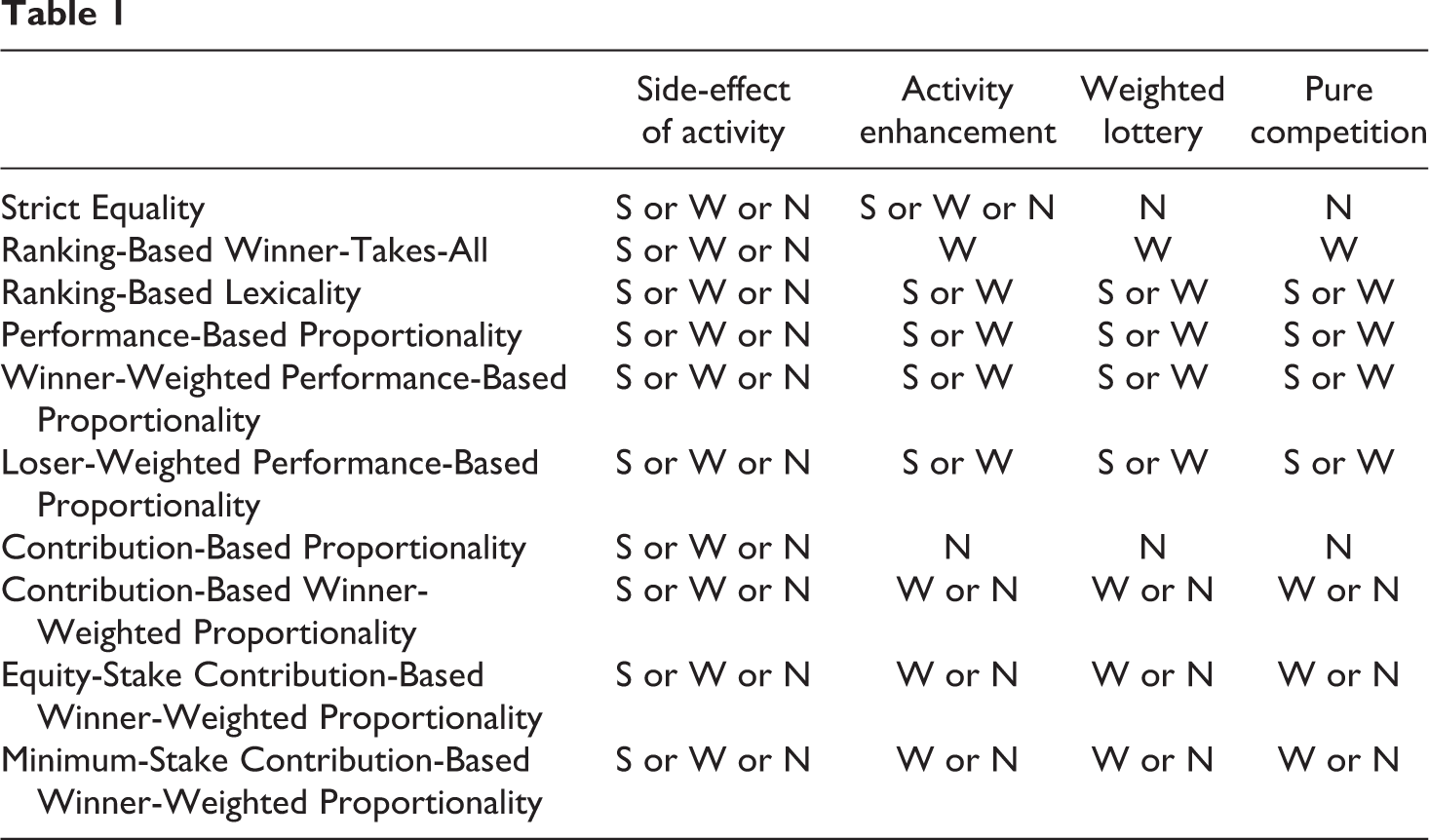
Several things may be immediately striking about Table 1. One is that it proposes the existence of strong, weak and negative connections between the side-effect of activity rationale and each of the ten principles. This hedged generalisation (or non-generalisation) reflects the wide range of rationales that can be captured within the side-effect of activity family of rationales, such that whether the connection is strong, weak or negative for any particular case will depend crucially on the particular external effect being aimed at. In addition, Table 1 suggests a negative connection between the activity enhancement, the weighted lottery and the pure competition rationales and the Principle of Contribution-Based Proportionality. Recall that ‘contribution’ has a technical meaning in my framework, namely, what each participant contributes to the prize fund. So, basing the prize structure solely upon contributions is likely to detract from these rationales, because they are each geared towards rank and performance rather than contribution. However, the three winner-weighted contribution-based principles might be weakly connected (that is, consistent) with these same three rationales simply by virtue of the significance these principles place on the winning rank or performance over and above contribution. Table 1 also states that the Principle of Strict Equality is negatively connected with the weighted lottery and pure competition rationales but can be weakly connected, strongly connected or negatively connected with activity enhancement depending on the motivations of the competitors. This has to do with the fact that within at least some sporting contexts competitors may be motivated to engage in the desired activity by the idea of winning prizes regardless of whether or not it is the sort of prize that everyone wins. Finally, Table 1 posits a weak connection, but not a strong connection, between the activity enhancement, weighted lottery and pure competition rationales and the Principle of Ranking-Based Winner-Takes-All. The basis for doing so is that giving the entire prize to the winner tends to be a missed opportunity to honour or push forward those rationales for all concerned. A winner-takes-all prize structure might recognise enhancements in the activity of the winner but not of the losers or lower ranked competitors, tracks the differential traits and qualities between the winner and the losers but not between or among the losers, and valorises the competitive spirit demonstrated by the winner but ignores a similar spirit demonstrated even by the lower ranked competitors.
Objections
In this section I identify two possible objections to my method and its conclusions and indicate how the method might be further developed in response. The first objection highlights the problem of indeterminacy. Having suggested that the underlying rationales for holding sporting competitions can provide useful guides for identifying appropriate principles of stakes fairness it also demands attention that sometimes the answer to the question, ‘What is the most appropriate principle of stakes fairness for a given sport?’, remains partially indeterminate. By this I mean two things. First, it may be possible to read more than one rationale and social meaning into a sporting competition at the same time. Call this rationale pluralism. Such pluralism need not always pose a problem, of course, as when two rationales point to the same principle. However, in some instances having two or more rationales can suggest the appropriateness of two or more principles of stakes fairness which if applied concurrently would entail entirely different prize structures. This problem reflects the fact that the rationales and meanings of most social practices are complex and dynamic and subject to disagreement. What strikes some interpreters as a plausible rationale for a sporting competition may appear to other interpreters as without genuine value to the participants or spectators. This is not all that surprising given a pluralism of views in society about the value of competition.
Second, even when it is possible to fix upon a single rationale and social meaning as best capturing the underlying purpose or value of a sporting competition, it remains possible, likely even, that one and the same rationale and social meaning will support more than one principle of stakes fairness. So, for example, even if the rationale and social meaning behind a sporting competition is activity enhancement and this points in the direction of a performance-based principle rather than a contribution-based principle, this rationale and social meaning may not in itself determine that any one of the alternative performance-based principles is the most appropriate. The objection, therefore, is that if there is no emergence of a single principle of stakes fairness, then the method I have outlined would be hard to use as an action-guiding method. This objection presupposes a wider phenomenon in the interpretation of value concepts: contestation as to the correct meaning of a concept and what that meaning implies for precisely how agents ought to act in given circumstances. 19
The question I need to consider, therefore, is whether or not these two forms of partial indeterminacy fatally weaken the practicality of the method. In other words, could one say that the method is not sufficiently helpful to those governing bodies, administrators, competitors and fans associated with sporting competitions who are committed to the idea of stakes fairness and need to know which particular principle of stakes fairness to adopt? One possible answer to this question that I shall not seek to rely upon here denies the premise of the question: that it is one of the tasks of philosophy to be practical. This response is not equivalent to the denigration of philosophy as irrational or to the claim that it cannot provide genuine knowledge of value concepts. Rather, it is the view that action-guidance is not the job of philosophy, not least because invariably a social practice will reek of more than one value or else there is more than one way to satisfy the requirements of that value because it is essentially contested. However, I shall assume that it is reasonable to ask a philosopher of stakes fairness for tools that can be used both to identify the operative rationale and to narrow down the field of appropriate principles once a rationale has been identified.
What needs to be emphasised, I think, is not that the method must be fully determinate but rather that it is determinate enough to be sufficiently helpful in a significant number of cases. It is possible, I believe, to reach the desired level of sufficiency by bolstering the method with certain provisos − provisos which enable the philosopher of stakes fairness to light upon the operative rationale in a systematic, non-arbitrary way and which provide guidance on the selection of the most appropriate principle(s) for a given rationale. While it may be possible to make a case for several provisos I shall limit myself to just two. The first tries to capture the idea of reflective equilibrium discussed earlier.
The Reflective Equilibrium Proviso. Identifying an operative rationale for a sporting competition is partly a matter of seeking a coherence or fit between a given rationale, a principle or principles of stakes fairness and considered judgements about stakes fairness in particular cases, where nothing is immune from revision.
In most of the examples developed in the previous sections I started with a rationale or rationales for a sporting competition and then worked forwards to identity a principle or principles of stakes fairness that would be consistent with or serve the rationale or rationales. However, the Reflective Equilibrium Proviso reminds us that the process of trying to find a fit among various possible rationales and principles works in both directions: that it is not simply a matter of which principle is most appropriate for a rationale but also which rationale is most appropriate for a principle, all the while factoring in considered judgements of stakes fairness in relevant cases.
Sometimes, although not always, achieving coherence or fit requires the ruling out of some rationales. When considered judgements are particularly strong about relevant cases and a certain principle seems self-evident, it may be possible to work backwards to settle upon an operative rationale that best fits the principle. Consider the ancient Olympic games. The games were shrouded in myth and legend, with historians such as Pausanias and Pindar telling different stories of their origins, typically making use of the legends of the Greek Gods. Non-mythical histories of the games of ancient Greece also vary in their accounts of the central function they served (compare Kyle, 2007; and Spivey, 2005). There is the theory that the games helped to build and maintain truces between the peoples of warring city states and their aggressive warrior classes. Better warriors face each other in a sporting arena than on a battlefield. This side-effect of activity rationale seems to favour the Principle of Ranking-Based Winner-Takes-All − ‘to the victor belong the spoils’. Then there is the thesis that at a very basic level the ancient Greeks were instinctively competitive, believing as they did in the intrinsic value of agon (contest). This rationale of pure competition also seems to support the Principle of Ranking-Based Winner-Takes-All. But, then again, there is the hypothesis that the games were initiated and maintained in order to enhance a range of physical activities that were already deemed valuable. This account emphasises the institution of public gymnasiums, where persons would meet together to practise and perfect their running, jumping, throwing, wrestling, and so on. The games were an extension of these institutions and enhanced further those physical activities that partly constituted what it meant to lead a flourishing life or eudaimonia (that is, self-fulfilment through personal excellence) within that culture. This rationale might seem to favour the Principle of Performance-Based Proportionality. So, which is the operative rationale for the purposes of judging the stakes fairness of the ancient Olympics? Starting with considered judgements about the actual prize structures of the games may provide a way of narrowing down the rationales. It seemed right to the ancient Greeks that during the games competitors from city-states across the region would compete in events for which there was but a single winner who would receive a prize of a crown or wreath made from an olive branch. So they favoured the Principle of Ranking-Based Winner-Takes-All. What does this tell us about the operative rationale? It tells us, I suggest, that the operative rationale was not to promote or enhance the sort of physical activity and perfection that was already valued in Greek society. For, if that were the purpose it is difficult to explain why prizes were not given to all competitors who demonstrated improved performance or, for that matter, why the prizes did not take a form, such as money or training, that could help persons to improve. 20 The practice is also difficult to fathom on the relevant side-effect of activity rationale. To honour a single athlete is to symbolise the victory of one city over another. In fact, in many instances the victor would return to his city to receive further valuable opportunities including the command of an army and the honour of leading his city into real battle. So the games continued to Balkanize, especially when stories were told by athletes from other city-states during or in the build up to warfare, of cheating during the games. None of this is easy to square with the rationale of diffusing tension. Arguably the best explanation as to why the Principle of Ranking-Based Winner-Takes-All was an appropriate principle of stakes fairness for the ancient Olympics is the deep and profound commitment to pure competition in Greek culture. In this way reflective equilibrium can be used to narrow down appropriate rationales for sporting competitions as well as appropriate principles of stakes fairness.
However, what about instances in which it is the rationale that seems self-evident and there is more than one principle on the table? A second proviso addresses this other form of indeterminacy.
The Comparative Support Proviso. In the event that there is a supporting connection between a given rationale and two or more principles of stakes fairness, priority should be given to a principle grounded by a strong rationale-orientated reason over a principle grounded by a weak rationale-orientated reason, and the order of priority among two principles both grounded by strong rationale-orientated reasons depends upon the extent to which each of the proposed principles serves the rationale comparatively speaking.
In order to see how this proviso might work consider the Prizefighter Series in boxing. In April 2008 the UK boxing promoter Barry Hearn put on a new boxing tournament which aired on the successful subscription channel, Sky Sports. Eight professional boxers competed in knockout stages (quarter-finals, semi-finals and a final) during a single night of boxing. The rationale behind the tournament had to do with the side-effect of activity: to make boxing more exciting, to increase television audiences and, ultimately, to generate wealth for everyone associated with the tournament – including the boxers, the trainers, the venue proprietor, the broadcaster, the advertisers and, of course, the promoter himself. So far, so straightforward. However, Hearn opted to base the prize structure not on the standard rules and regulations of the main governing bodies in relation to championship bouts and eliminators, which speak to the marketing value of the boxers and which uphold the Principle of Contribution-Based Proportionality. Instead, Hearn opted for a structure that reflected the Principle of Ranking-Based Lexicality. The winner of the tournament received £25,000, the runner-up £10,000, the losing semi-finalists £7,000 and the losing quarter-finalists £3,000. Now it may have been possible to make a case for either of these rival principles of stakes fairness based on strong rationale-orientated reasons: the likelihood is that both of the principles and associated prize structures would have advanced Hearn’s aim of putting on an exciting tournament and generating wealth, relative to a baseline of no tournament. In that sense it is not possible to say that Hearn’s chosen prize structure was fairer than an alternative, contribution-based structure. However, the Comparative Support Proviso calls for fine-grained comparisons of two or more strong rationale-orientated reasons wherever possible. How is this done? In the first instance it is a matter of identifying a relevant metric by which to judge the extent to which a principle advances a given rationale. Since the rationale in this case was wealth-focused, the relevant metric is money. So the question is: adhering to which principle of stakes fairness would have generated the greatest amount of money for those involved? Based on this shared rationale arguably the stronger of the two rationale-orientated reasons is the one favouring the Principle of Ranking-Based Lexicality. Hearn’s aim was to generate both incremental incentives on the part of the boxers and mounting audience excitement in the tournament as the rounds progressed, which, in all probability, would have been harder to achieve had the winners of each of the stages not been guaranteed to receive larger prizes than the losers (that is, had Hearn adopted more conventional contribution-based principles).
Of course, using the Comparative Support Proviso may not always yield a unique, most appropriate principle, especially when two or more principles serve a rationale for which there is no obvious metric or the advancement of which is a matter of fundamentally uncertain probabilities. But the approach does not need to yield uniqueness in every case to be sufficiently helpful. That the method substantially narrows down the field of possibilities in a significant number of cases is consistent with its sometimes being fully indeterminate. In the latter cases one can simply accept that there is no unique, most appropriate principle.
It is now time to consider a second objection. The method I have outlined selects appropriate principles of stakes fairness using a particular sort of moralised practical reasoning seasoned with the aforementioned provisos. However, the objection might be raised that appealing to the existing rationales and social meanings of given sports cannot provide acceptable premises for moralised practical reasoning, because accepting whatever exists just because it does exist is dogmatic or arbitrary, in the sense that it is not sufficiently critical of the rationales that animate sports. After all, in some cases one might think that the rationale of a sport is morally pernicious. The further worry is that without critical reflection on the rationales any conclusions reached as to the appropriateness of principles of stakes fairness will be relative to the assumed rationales and as such these conclusions could only give credence to a form of value relativism in stakes fairness.
My response to this objection is to stress that mine is not an uncritical account of rationale-orientated reasons. Indeed, by using the word ‘appropriate’ I was deliberately intending to connote more than simply whatever principle serves a rationale. Instead, I meant a principle and rationale that are both morally fitting in a broader sense. So I propose two additional provisos to address the objection head-on.
21
The first is this.
The Autonomy Proviso. When it comes to selecting an appropriate principle of stakes fairness it is necessary that a principle is consistent with or serves a rationale which participants in the sport have chosen to adopt or if they cannot choose would choose to adopt if they could. One of the clearest signs of autonomy is that those engaged in the sporting competition can be interpreted as though they were co-authors of the rationales.
The power of the proviso is most evident whenever rationales have been externally imposed on sport. In China during the early 1950s, for example, Chairman Mao prescribed sport or ‘physical culture’ as something that helped individuals to be physically strong and consequently better able to ‘Serve the People’ through agricultural and material production or in the military (the side-effect of activity). By edict he also elevated table tennis to the status of the national sport of China as a symbol that post-revolution it could compete with and defeat the world’s leading nations (the side-effect of activity). Other sports or games were banned on the grounds that they embodied undesirable rationales. For instance, Mah-jong was banned in 1949 as a gambling activity which signified the excesses of capitalism. In 1959 Mao also criminalised boxing by virtue of its violent and wicked nature, again citing its links to capitalism and capitalistic traits. Later, during the Cultural Revolution of the 1960s and 1970s, the government discouraged people from engaging in certain martial arts, which, because they were based on traditional philosophies and clan lineages, were denounced as counter-revolutionary. During this period a new emphasis was placed on sport’s function in creating unity and cooperation (the side-effect of activity). Anticipating a loss to a visiting American table tennis team, the Party promoted the slogan, ‘Friendship First, Competition Second’. Nevertheless, historians have observed that people continued to play competitive games and sports such as Mah-jong and various styles of martial arts due to rationales that predated the founding of the People’s Republic of China. Mah-jong continued to be a fun way to pass the time, whether for participants or for spectators gambling on the outcomes (the side-effect of activity), and the idea persisted that martial arts embodied the values of individual accomplishment (activity enhancement) and sublime human contest (pure competition). (These various historical interpretations rely on Clumpner and Pendleton, 1978; Jones and Riordan, 1999; and Fu, 2006). Applying the Autonomy Proviso to this example enables the philosopher of stakes fairness to rule out rationales that the Maoist regime attempted to impose on the Chinese people: to say that the relevant governing authorities did not make of sport something that the people chose or would have chosen if they could. In turn, the proviso blocks the claim to appropriateness of any principles of stakes fairness which reflect only non-autonomous rationales.
This proviso is necessary but not sufficient for the identification of an operative rationale, however. For, a rationale can be autonomous in the above sense yet nevertheless fail to capture a value that anyone could have reason to care about. Thus I also propose a further proviso.
The Objective Value Proviso. For the purposes of selecting an appropriate principle of stakes fairness it is necessary that a principle serves an interpretive rationale that is itself objectively valuable. A rationale is objectively valuable only if it can stand as a basis for a sporting competition without depending on a particular view of what has value that would be unconscionable to any reasonable, morally cognisant human being.
This proviso is designed to address the possibility that a group of persons could believe that a certain principle of stakes fairness is appropriate for a given sporting competition even though the rationale it serves is one that any right-thinking person would find abhorrent. Suppose a group of twisted individuals invent a sport the purpose of which is designed to enhance their torture techniques (torture being something they already like to do). The aim of the torture game is to score more points in the infliction of pain and suffering on unwilling victims than the other competitors. The scoring system reflects performance parameters such as the intensity and duration of the pain and suffering caused, the elegance and innovation of the torture devices and techniques employed, the ability to keep the victims conscious and alive for long periods of time whilst inflicting maximum pain, and so forth. Now, there is a sense in which one or more of the ten principles of stakes fairness could be appropriate for this sport given its rationale. Consider the Principle of Performance-Based Proportionality, for example. However, there is another sense in which no principle of stakes fairness is ‘rightful’ and this is the sense I intend to capture with the Objective Value Proviso. Because the competitors in the sport actively embrace the rationale of activity enhancement, the Autonomy Proviso does not rule it out. Nevertheless, so long as the rationale assumes a set of motives, inclinations and consequences that are objectively wicked, the prize structure fails to satisfy the proviso and cannot be viewed as genuinely appropriate. 22
But to what extent is the Objective Value Proviso sensitive to cultural differences? In answer to this question, I read the proviso as speaking to motives, inclinations and consequences that are seen as wicked in virtually every human society – and if they are not viewed as such by some outlier societies it is because those societies are not signatories to basic standards of human rights as normally conceived. However, even within the range of what is an acceptable rationale for organising or participating in sporting competitions there will be cultural differences such that some societies may have rationales for engaging in sports that other societies find it hard to fathom. Even so, I believe that it does remain possible to accommodate the fact of cultural diversity within more general descriptions of valuable rationales that are ubiquitous throughout the world. So, for example, consider the traditional Inuit game of ear-pulling, which is designed to test not how much pain a competitor can inflict but rather how much pain a competitor can endure. 23 At first glance, it might not be possible for non-Inuit spectators to see the value in a game which involves pulling on ears with such force as to cause bleeding. Yet it might still be possible to reach a shared understanding on the value of any sport which tests the competitors’ bravery and fortitude in the face of physical discomfort. So, if members of Western cultural communities can recognise the general value in competitors attempting to run 26 miles non-stop in the shortest possible time and sometimes in warm conditions and on hard road surfaces, in spite of the loss of toe nails, torn muscles and even severe dehydration and exhaustion, then upon further reflection they might be able to see the same general value in ear-pulling.
Furthermore, the Objective Value Proviso is not violated simply because some people take a dim view of a rationale. Consider people who regard it as immoral to put on sporting competitions, such as boxing, which carry serious health risks for the competitors, primarily for the purpose of making money. They might say that this is treating the competitors purely as means and not as ends in themselves. Or, borrowing from Jacobs’ insights about all aspects of the concept of stakes fairness, someone could argue that the input stakes in boxing are too high because of the physical risks involved. If this sort of judgement is correct, then it raises questions about a range of other, inherently dangerous and life-threatening professional sports, everything from transatlantic sailing to motor sport and alpine skiing, despite the fact that competitors freely consent to participate. However, I shall assume that such cases do not violate the Objective Value Proviso provided that they can be fitted into more general rationales that are universally valued (for example, allowing autonomous persons to choose to take risks in order to realise their rational life plans, or enhancing the ability of human beings to achieve great feats of endurance, skill and physical bravery) and, more importantly, provided that they do not involve or amount to universally recognised abuses of human rights. No doubt the line between the two sorts of cases may sometimes be difficult to draw and could depend upon whether or not reasonable safety precautions can be agreed upon.
The place of equality and desert
In this final section I want to look at some of the associations and disassociations between the above discussion of stakes fairness in sport and more general philosophical debates about justice. In order to give the section a sharper focus I shall concentrate on two concepts that continue to be central to those debates: equality and desert.
For Jacobs, the core idea of stakes fairness reflects a concern with widening the distribution of good outcomes within competition prize structures and the putative insight that winner-takes-all prize structures are rarely fair. This aspect of stakes fairness shares some features, but is not identical, with the now familiar ‘luck egalitarian’ distinction between equality of opportunity and equality of outcome.
24
To demand stakes fairness is to demand more than equality of opportunity, more than background and procedural fairness. It demands that the prize structure or framework of outcomes is fair. However, principles of stakes fairness are also supposed to regulate certain competitive opportunities that by their nature yield winners and losers or unequal outcomes. For this reason stakes fairness rarely demands simple equality of outcome. This can be seen in Jacobs’ discussion of what we owe to the unemployed. Jacobs defends, on the grounds of stakes fairness, the importance of widening the distribution of ‘the assets of having job’, which, according to Jacobs, cannot be reduced to mere income but may also include ‘social networking, mental and physical health, self-esteem, and so on.’ His policy conclusion is dramatic: ‘The analysis suggests to me [.] that the most effective means to deliver the assets of having a job to the unemployed is precisely by supplying them with jobs’ (Jacobs, 2004: 164). In fact, it is a conclusion not too far removed from what Rawls says in his later work about the institutions required for stability in a pluralistic society. [.] d. Society as an employer of last resort through general or local government, or other social and economic policies. Lacking a sense of long-term security and the opportunity for meaningful work and occupation is not only destructive of citizens’ self-respect but of their sense that they are members of society and not simply caught in it. This leads to self-hatred, bitterness and resentment. (Rawls, 1996: lvi–lvii)
Two features of this debate about equality call for attention. The first is that neither Jacobs nor Rawls is advocating that all competitors receive the same prize. Society as an employer of last resort through workfare schemes providing public jobs or training to the long-term unemployed very rarely provides job assets of the same quality or value as are secured by those individuals who win the competition for work and occupation in the labour market. Instead, it makes sense to think of job assets as existing on a scale from higher to lower quality or value; as first, second, third, and so on, prizes. So, the relevant principle here is not the Principle of Ranking-Based Winner-Takes-All but neither is it the Principle of Strict Equality. Rather, it is perhaps the Principle of Ranking-Based Lexicality. The second feature is that Jacobs and Rawls both reach a broadly similar conclusion about a fair prize structure in the competition for work and occupation, but do so by drawing on different rationales. For Jacobs, a major part of the concern is pure fairness: that it is intrinsically unfair for persons to compete for scarce job assets under a winner-takes-all prize structure. He also plays on the problem of the results of the competition for jobs unduly influencing the competition for other scarce goods. For Rawls, by contrast, the rationale is the following. First, widening the distribution of work and occupation serves the Second Principle of Justice, 25 which is part of a general conception of basic structure justice as distinct from Jacobs’ much narrower conception of justice which focuses on various individualised competitive opportunities in civil society. 26 Second, widening the distribution of jobs and occupations is necessary for ensuring stability, meaning that the scheme of cooperation is self-supporting by virtue of the fact that the principles of justice which regulate the scheme tend to incite rather than deter regular compliance with the basic structure over time (Rawls, 1971: 6). The fact that both Jacobs and Rawls can arrive at similar sorts of policy conclusions based on very different rationales speaks to the phenomenon of rationale pluralism − a phenomenon which arose in my account of stakes fairness in sporting prize structures.
Turning to desert, reflecting on the ten principles of stakes fairness discussed above it is apparent that seven of the principles (denoted by the word ‘proportionality’) have something in common with the Aristotelian idea that unequal treatment of agents ought to stand in a reasonable relationship or ‘geometrical proportion’ to the extent of inequalities between them (Aristotle, 2004: 118-120). The relevant principles of stakes fairness are all instances of a more general principle of justice which Mark Reiff calls ‘the principle of proportionality’: ‘that when two competing claims have unequal moral weight, we should divide the good so that the parties each receive a share of the good that is proportionate to the relative strength of their competing claims’ (Reiff, 2009: 11).
As one might expect, considerations of proportionality routinely figure in philosophical debates about justice, especially debates couched in terms of ‘desert’. I have in mind everything from debates about just punishment and compensation in law to the just distribution of income and bonuses in the labour market and, further, to the just allocation of praise and blame in personal ethics. As a result, proportionality-sensitive principles of just deserts tend to focus on talent, effort, virtue, intent, personal circumstances, egregiousness of action, and so forth, as bases of desert. Furthermore, there are philosophers who maintain that something can qualify as a desert-base for a given individual only if that person is responsible for it (see, for example, Cupit, 1996: 83–100; Arneson, 2003). By contrast, the above principles of stakes fairness concentrate on rank, performance and contribution to the prize pot as bases for the just allocation of prizes. If these principles are plausible then they suggest that stakes fairness in sport has little to do with deeper philosophical concerns about virtue and moral responsibility. Examining the various rationales for actual sporting competitions can help us to see why this should be the case. Competitors do not need to be virtuous or morally responsible for their rank, performance or contribution to the prize pot in order to justly receive prizes governed by principles of stakes fairness when the latter serve rationales constituted by the side-effects of activity, activity enhancement, weighted lottery and perhaps even pure competition.
Of course, that is not to say that issues of virtue and moral responsibility are absent from judgements of background and procedural fairness. I do not rule out the possibility that such issues are more pressing for these other aspects of fairness. For example, I do not mean to ignore the disquiet that most people interested in sport perpetually show for the problems of cheating, both in cases of bending the rules (for example, ‘diving’ in football) and in cases of directly flouting the rules (for example, taking banned performance-enhancing drugs in athletics or cycling). 27 However, it seems to me that even here the discussion is primarily about the sorts of traits and abilities that societies deem valuable and which the rules and prize structures of sporting competitions ought to track, as distinct from a concern for the finer philosophical questions of whether moral responsibility is a necessary condition of desert and whether moral responsibility is compatible with hard determinism, for example. 28 In most ordinary debates about sporting fairness, if there are any desert-bases steering our judgements about what people do or do not deserve they tend to be desert-bases that reflect widespread social norms regarding valuable behaviour. This may also be true of various other competitions for social and economic advantages. Think of the granting of scarce jobs and positions to people most likely to perform productively. Here, the thought is that a person can be intelligibly said to deserve a job or position by demonstrating dispositions and behaviour that society deems valuable in relation to the successful performance of that job or position, even if the individual concerned cannot claim to be responsible for the dispositions and behaviour in the sort of pristine or robust sense that preoccupies metaphysicians and some ethicists. 29 If this thought is accurate, then it chimes with all of the rationales for sporting competitions identified in this article.