



Abstract
Marketing theory offers extensive insight into the impact of digital technology on consumption, consumers and consumer culture. Yet, these theorisations are largely centred on digital goods, services and platforms, whereas phenomena such as the analogue revival, typically understood through the lens of material objects and their affordances, remain peripheral to this discussion. Drawing on a qualitative study of adult board game consumption in the UK, this paper adopts a postdigital theory perspective to bring these ‘digital’ and ‘analogue’ strands together. The paper theorises the analogue revival as a manifestation of postdigital consumer culture in which digitalisation not only produces new commodities and practices but also transforms the meaning of existing ones through the dialectical tension and entanglement between digital and non-digital. In doing so, this paper advances marketing theory’s understanding of the current cultural condition shaped by digitalisation while also informing postdigital theory by showing how this condition is lived and made meaningful through everyday consumption.
Introduction
A growing body of marketing and consumption scholarship has sought to make sense of the ongoing analogue revival (Bartmanski and Woodward, 2015; Beverland et al., 2024; Goulding and Derbaix, 2019; Hracs and Jansson, 2020; Humayun and Belk, 2020; Magaudda, 2011; Whitehouse, 2023). While existing studies have advanced our understanding of this phenomenon by foregrounding its material and temporal aspects and their implications for authenticity, consumer identity, status and agency, they stop short of unpacking the complex relationship between analogue commodities and practices and digital technologies that underpin and shape their consumption. Beyond recognising that analogue and digital can ‘coexist’ (Bardhi and Eckhardt, 2017: 8) within the same object or consumption practice, little is known about how such entanglements are navigated and made meaningful by market actors. Examining these dynamics can help contextualise an ostensibly niche phenomenon of the analogue revival within the ever-growing discussion around the impact of digital technology on consumption, consumers and consumer culture, which has so far primarily focused on digital commodities, practices and intermediaries (Airoldi and Rokka, 2022; Belk, 2013; Caliandro et al., 2024; Cochoy et al., 2017; Denegri-Knott and Molesworth, 2010; Hoang et al., 2022; Lambert et al., 2024; Mardon and Belk, 2018; Ritzer and Jurgenson, 2010).
A more convergent approach can be found in postdigital theory – a transdisciplinary theoretical tradition that emerged in the field of arts and humanities in the early 2000s and has subsequently been applied and developed in many other contexts from pedagogy to urbanism. Built on the premise that ‘the digital is no longer new’ (Macgilchrist, 2021: 660), postdigital theory seeks to understand the ‘messy and paradoxical condition (…) after digital technology revolutions’ (Andersen et al., 2014: 5) in which analogue and digital (as well as offline and online, real and virtual, natural and technical, old and new) are neither separate nor the same but ‘in complex, mutually constitutive relationships’ (Jandrić, 2023: 6). By adopting a postdigital lens, the focus of marketing theory can be expanded beyond consumption of and through digital technology to the broader ‘context of context’ (Askegaard and Linnet, 2011) shaped by digitalisation, including phenomena such as the analogue revival.
Using the empirical context of adult board game consumption in the UK, this paper theorises the analogue revival as a manifestation of postdigital consumer culture in which digitalisation not only produces new commodities and practices but also transforms the meaning of existing ones through the dialectical tension and entanglement between digital and non-digital. Reflecting the postdigital ‘messiness (…) inherent to the contemporary human condition’ (Jandrić et al., 2018: 895), board gaming has recently surged in popularity as a respite from the digital (Booth, 2021; Sax, 2016) while being enabled and sustained by digital technology (Trammell, 2019). Instead of trying to resolve this paradox, the paper approaches the analogue/digital dialectic at the core of contemporary board gaming as ‘coproductive’ (Haraway, 2016) and negotiated rather than settled.
The paper proceeds with a review of relevant literatures on the analogue revival, the resurgence of board gaming, digitalisation, consumer culture and postdigital theory, followed by an overview of the research context and methodology. Next, the empirical sections examine how the analogue/digital dialectic is interpreted, constructed and negotiated by market actors involved in board game consumption. The concluding sections articulate the study’s contributions to the analogue revival and digitalisation literatures, showing how a dialogue between marketing theory and postdigital theory can advance our understanding of the current cultural condition and suggesting an orientation for further research.
Theoretical background
Board games and the analogue revival
So far, theorisations of the analogue revival have mainly been drawn from the context of vinyl record consumption (Bartmanski and Woodward, 2015; Beverland et al., 2024; Goulding and Derbaix, 2019; Hracs and Jansson, 2020; Whitehouse, 2023), with occasional extensions to film photography, analogue synthesisers, paper notebooks and light phones (Beverland et al., 2024; Humayun and Belk, 2020; Thorén et al., 2019). Hence, the main thrust of this scholarship has been to understand the revived consumer appeal of obsolete analogue media over more technologically advanced digital formats that had largely replaced them. With a tendency to focus on objects and their affordances, much of this literature has resisted nostalgia as an interpretative lens, turning instead to the themes of materiality (Magaudda, 2011), iconicity, ritual, aura and coolness (Bartmanski and Woodward, 2015), authenticity (Goulding and Derbaix, 2019), or consumer agency and experimentation (Beverland et al., 2024). Among the few exceptions, Hracs and Jansson (2020) looked beyond the consumer end of the market, drawing attention to value-creating strategies used by vinyl record shops, whereas Whitehouse (2023) explored the interplay between individual and collective nostalgia in the UK indie pop music scene, also pointing out that in this non-mainstream context ‘vinyl did not die, so it never needed resurrecting’ (p. 64).
Over the past decade, board games have been persistently labelled in the media and pop science books as yet another example of the ‘revenge of analog’ (Sax, 2016). Celebrated as the next ‘real thing’ after ‘books and vinyl’ to unexpectedly ‘make a comeback’ in a digital age (Boycott-Owen, 2018: n. pag.), board games have experienced an unprecedented surge in popularity since the mid-2010s. Following a steady year-on-year increase (Bloomberg, 2019), global board game sales soared during the COVID-19 pandemic (Matalucci, 2021) and are predicted to rise further in the years to come (Statista, 2023). Yet, contrary to the common depiction of board games as ‘small primitive ancestors of an evolved form’, that is, video games (Woods, 2012: 8), the latter neither replaced nor sought to replace the former. Rather, it was a series of broader technosocial shifts brought first by the advent of television, then video games, and later the internet and social media, that made the once-popular pastime shrink into a cultural niche associated with families arguing over Monopoly at Christmas or groups of male hobbyists poring over an arcane rulebook in a basement (Booth, 2021; Sax, 2016; Woods, 2012). Furthermore, while the media often portray ‘millennials (…) putting down their Xbox controllers and smartphones [to] embrace games their parents and grandparents used to love’ (Boycott-Owen, 2018: n. pag.), contemporary board game consumption is dominated by newly developed genres, mechanics and designs rather than by familiar classics such as Monopoly or Scrabble (Booth, 2021).
In popular discourse, the stronger-than-ever appeal of board gaming to the adult demographic is attributed to its aura of materiality and face-to-face interaction (Boycott-Owen, 2018), which earned it a new reputation as a ‘digital detox’ practice promoted in self-help bestsellers (Newport, 2019). Indeed, in-person socialising and disconnection from technology ranked among the top motivations for playing board games in an international survey of hobby gamers (Booth, 2021). However, despite the popular representation of board games as a ‘unique social space apart from the digital world’ (Sax, 2016: 80), the industry and culture around them is inseparable from digital technology. Not only are digital platforms and devices increasingly integrated into the gameplay of contemporary board games (Booth, 2021), but they also facilitate their production, distribution and promotion (Trammell, 2019) and support participation in the hobby (Rogerson et al., 2017), making it ‘more accessible, more socially acceptable, and more available than ever before’ (Booth, 2021: 161). As board game scholar Trammell (2019: n. pag.) noted, ‘[a]nalog games are emerging as a cultural phenomenon in our present moment because of their explicit relationality to the digital. They can only be understood and defined by and through an oppositional-yet-contingent relationship to digital media’.
Although this paradox is not lost on board gamers (Booth, 2021: p. 160–162), there is a gap in understanding how they interpret and negotiate it in their lives. According to another survey, while opinions on the use of online resources in board gaming are generally mixed, ‘for a younger generation there has never been a division between analogue and digital’ (Kankainen, 2020: 2). Other studies have examined consumer resistance to a company-led digitalisation of a pen-and-paper roleplaying game (Thorén, 2021) and captured the early (and uneasy) reactions of hobbyists to using online tools for board gaming during COVID-19 lockdowns (Coward-Gibbs, 2021). What remains lacking is a more interpretive and critical approach delving deeper into consumer accounts and lived experiences of the analogue/digital relationality while also analysing how this dialectic is constructed by vendors and the media and represented in the socio-material organisation of board game consumption. Together, these insights can shed light on the complex and contradictory role of digital technology in the popularisation of board games. As an empirical context, board gaming offers a valuable extension of the extant theorisations of the analogue revival by shifting the focus from obsolete formats and their affordances to the entangled relationship between analogue and digital and its implications for contemporary consumer culture.
Digital technology, consumer culture and postdigital theory
Exploring the ‘oppositional-yet-contingent’ (Trammell, 2019) relationship between board games and digital technology provides a useful avenue for contextualising the analogue revival within a wider and more prominent strand of marketing theory concerned with the impact of digitalisation on consumption, consumers and consumer culture. This body of scholarship offers great insight on how digital technology reconfigures market relations, processes and infrastructures (Hagberg and Kjellberg, 2020; Ritzer and Jurgenson, 2010; Ritzer and Miles, 2019) and shapes and mediates consumer identities and consumption practices (Bardhi and Eckhardt, 2017; Belk, 2013; Cochoy et al., 2017; Denegri-Knott and Molesworth, 2010; Kozinets et al., 2017; Mardon and Belk, 2018). However, discussions of the broader, more holistic effects of digitalisation on consumer culture – a constantly evolving system of meanings through which consumers make collective sense of their lives, represented in discourse, objects, practices and identities (Arnould and Thompson, 2005) – are relatively scarce. While ‘digital consumer culture’ is occasionally mentioned as a self-evident signifier (Bassiouni and Hackley, 2014; Gurrieri and Drenten, 2022) or defined narrowly in behavioural terms (Dey et al., 2020), some scholars propose more specific and systematic concepts such as ‘algorithmic’ (Airoldi and Rokka, 2022) and ‘platformised’ consumer culture (Caliandro et al., 2024). Another emerging strand offers critical reflections on the emotional texture of the consumer condition under surveillance capitalism (Denegri-Knott et al., 2023; Hoang et al., 2022; Lambert et al., 2024). Yet, these theorisations focus on digital consumption (i.e. the use of digital goods, services and platforms) rather than capture the broader dynamics of consumption in a digital age, where the impact of digitalisation on consumer ideologies, practices and experiences extends beyond the digital realm to contexts such as analogue consumption.
Expanding the analytical gaze from digital consumption contexts to the broader ‘context of context’ (Askegaard and Linnet, 2011) brought about by digitalisation invites a dialogue with postdigital theory, which ‘seeks to look beyond the promises of instrumental efficiencies, not to call for their end, but rather to establish a critical understanding of the very real influence of these technologies as they increasingly pervade social life’ (Jandrić et al., 2018: 895). The prefix ‘post’ in ‘postdigital’ does not imply a linear ideological progression, like in postmodernism or post-histoire, but describes ‘more subtle cultural shifts and ongoing mutations’ between old and new, like in postpunk or postcolonialism, and reflects ‘the state of affairs after the initial upheaval caused by the computerisation and global digital networking of communication, technical infrastructures, markets and geopolitics’ (Cramer, 2014: 13). In postdigital theory, the digital is considered ‘part (and, crucially, not apart) of the fabric of everyday life’ (Cormier et al., 2019: 503). Therefore, the binary oppositions of analogue/digital, virtual/real, human/nonhuman and nature/technology are rejected and reimagined as mutually constitutive entanglements (Blanco-Fernández, 2022; Jandrić, 2023; Taffel, 2015) or even hybrids (Kankainen, 2020; Thorén et al., 2019). The hybrid metaphor, however, has been contested in feminist technoscience, an adjacent field that has intersected with and influenced postdigital theory – most notably by Haraway (2016). In contrast to a hybrid ontology, where distinct categories are merged to stabilise singularised differences or achieve an ultimate resolution between them, Haraway’s ideas of ‘sympoiesis’, ‘coproduction’ and ‘making-with’ figuratively describe a process of mutual shaping in which boundaries, tensions and porosities between categories generate multiple possible outcomes that should be ‘questioned and explored, not resolved’ (Devendorf and Rosner, 2017: n. pag.).
To date, applications of postdigital theory in marketing and consumption research have been very limited. Among the few exceptions, Humayun and Belk (2020: 632) conceptualised postdigital consumption as the ‘use of analogue objects to escape the omnipresence of the digital realm’ and explored the aesthetic roots of this phenomenon. Kviat (2022: 819), in an analysis of a new cafe concept inspired by Web 2.0 culture, called for a ‘post-digital approach to consumer culture research, looking into the cultural impact of digital technology on traditional servicescapes’. Although not explicitly framed in postdigital terms, the emerging critical marketing inquiry into the affective dimension of digital consumption (Denegri-Knott et al., 2023; Hoang et al., 2022; Lambert et al., 2024) also resonates with recent advances in postdigital theory. Since Cramer’s (2014: 12) early framing of the postdigital condition as a ‘contemporary disenchantment with digital information systems and media gadgets’, affect received little attention in postdigital scholarship until resurfacing in Blanco-Fernández’s (2022: 1432) recent outline of a ‘post-digital zeitgeist, our current affective map’ comprising a ‘complex chaos of ideas, creations, emotions, reflections and debates’ emerging from digital expansion. Similarly, Evans and Riley (2023: 21), inspired by Williams’ (1977) notion of ‘structure of feeling’, approach the postdigital as a ‘sensibility or structure of feeling that deserves attention, working its way into how we think, feel, act and behave’, and that is ‘distinctive but not monolithic’, with ideology and emotion entangled together (p. 163). Such a pluralistic perspective can add nuance to existing marketing theory interpretations foregrounding consumers’ collective desire to ‘escape the clutches of the digital’ (Humayun and Belk, 2020: 635) and ‘heal’ from digital dependency (Lambert et al., 2024), only to find that there is no actual exit (Hoang et al., 2022). This paper therefore examines contemporary board gaming through a postdigital lens to provide a ‘practically and affectively complex portrait of life with the digital’ (Feldman, 2021: 104) in the context of the analogue revival, thereby helping to begin outlining the contours of postdigital consumer culture.
Research context and methodology
The paper draws on findings from a broader qualitative study of the UK’s social board gaming scene (2021–2022), which examined how social gaming both reflects and fosters the popularisation of board games and contributes to the social life of UK cities and communities. Since the 2010s, board gaming, traditionally associated with private, mainly domestic environments (Woods, 2012), has been expanding to public places – from dedicated board game cafes and shops to more traditional establishments such as pubs or libraries. Thanks to the exceptionally wide scope of themes, genres and complexity levels of modern board games, social board gaming attracts not only seasoned hobbyists but also casual players and those who have little interest in games per se but look for a social activity (Kviat, 2024).
The study employed a multi-method approach combining ethnographic techniques and media analysis (Appendices 1). The research began with an exploratory thematic analysis of mainstream media publications and specialised online content produced by board game businesses and gaming communities, gathered through online searches related to the research topic (e.g. ‘board game revival’). This helped identify the scope of the UK’s social board gaming scene and uncover recurring discursive patterns including, most notably, the analogue-versus-digital trope. To gain first-hand insights into the socio-material organisation of social board gaming, informal participant observations were then conducted in a customer/attendee role at 24 social board gaming venues across six regions of England. This essential immersion in the participatory culture of board gaming (Woods, 2012) was followed by in-depth interviews with 50 board gamers, meetup organisers, business owners and employees (25 women and 25 men; aged 25–55, M = 36; see Appendices 1). Through a series of grand-tour and open-ended questions and planned and floating prompts (McCracken, 1988), participants were invited to share their perceptions and actual experiences of board gaming in public, private and online environments, their motivations and pathways into board game culture, and their personal reflections on the growing popularity of board games. This inductive, interpretive approach, consistent with existing studies of related consumption contexts (Goulding and Derbaix, 2019; Hoang et al., 2023), provided a holistic understanding of the current cultural meaning of board gaming ‘from both a social and personal perspective’ (Goulding and Derbaix, 2019: 550) and without reducing it to the central phenomenon of social play. Pseudonymised interview transcripts were iteratively analysed to identify recurring themes through a combination of open (e.g. ‘away from screens’; ‘disenchantment with social media’) and axial (e.g. ‘escaping the digital’) coding. Fieldnotes were annotated with thematic notes to integrate observational insights into the analysis. All data was collected and analysed solely by the author.
While the broader study generated multiple themes, this paper focuses on the analogue/digital dialectic, which emerged most prominently in interviews and media representations. Although observational data is referenced more sparingly here, it also informed the findings by revealing the enabling role and strong presence of digital technology in the social board gaming scene. Drawing together multiple data sources allowed for better understanding of the complex and sometimes contradictory ways in which market actors interpret, construct and negotiate the analogue/digital dialectic of board gaming. Three key insights emerged from the data: (1) an escapist structure of feeling that underpins the growing appeal of board games as a respite from the digital; (2) the discursive, infrastructural and cultural entanglement of this analogue respite with digital technology that enables its popularisation; and (3) the negotiated character of players’ engagement with the analogue/digital dialectic. The next section expands on these findings, illustrating them with interview and media excerpts and observational insights.
Findings
This section analyses the interplay between analogue and digital in contemporary board game consumption, approaching it as both productive and symptomatic of postdigital consumer culture. First, it traces the escapist structure of feeling that acts as an affective driver of the ongoing popularisation of board games, endowing them with a new meaning of a respite from the digital. Second, it demonstrates how the supposedly analogue practice of board gaming is in fact discursively, infrastructurally and culturally entangled with and supported by digital technology. Third, it delves into lived negotiations of this dialectic, showing how their diversity and complexity are rooted in structural and situational factors while also being indicative of further cultural and ideological coproductions between analogue and digital.
Escaping the digital
The deep and unassailable embeddedness of technology in postdigital life is often described by the popular phrase that the digital is both ‘everywhere and nowhere’ (Bassett, 2015: 136). Indeed, the vast majority of interviewees turned to board games seeking an escape from the hegemony of the digital, which they imagined as a ubiquitous force encroaching on every corner of their existence: Everything we do in life is in front of a screen – TV, computers, working, whatever. People are aware of their mental and physical health more so than ever before, [so they are] getting away from the screen (Evan, gamer, M, 40).
For screen-bound and especially home-based workers, board gaming also serves to soothe their digital fatigue and protect their leisure from being completely colonised by work: My work is really screen-intense. Sometimes I’ll have ten- or twelve-hour days and the very last thing I want to do after that is watch TV or go on my phone, so I’ll make a conscious effort [to] do something completely unrelated to work, completely non-digital (Megan, gamer, F, 33).
As much as the digital is everywhere, it is also nowhere – in the sense that it is widely perceived as a dematerialised simulation of experiences and relationships (Sutton, 2017; Syvertsen and Enli, 2020). Against this backdrop, board gaming is framed as a compensatory practice of reconnection and rematerialisation. This motif was particularly prominent among those interviewees who came of age in the 1990s and early 2000s, amid the rise of video games and social media. Exposed to family classics such as Monopoly in their childhood, many of them reengaged with more contemporary board games after a long break caused by the cultural dominance of online entertainment. In their adult lives, board gaming became a way, or, as many of them phrased it, an ‘excuse’ to interact with others ‘in real life’. This common wording points to a technosocial condition where moments of unmediated interaction must be deliberately sought after and carved out of the otherwise digitalised routine. While the rare and precious experience of ‘real life’ achieved through board gaming was typically contrasted with video games and social media, the latter can hardly be considered a direct competition to board games. Rather, it is social media’s broken promise of the ‘social’ (Lambert et al., 2024) that is meant to be remediated with board gaming: I believe everyone’s having the human problem of wanting to connect. And in a more and more digital age we’re in, everything and everyone is accessible all the time, and yet people are falling out of love with social media. (…) I just wanted to have a bit more actual physical social interaction as opposed to playing online and stuff like that (Ben, gamer, M, 39).
The idea that unmediated experiences are inherently more authentic and valuable than digitalised ones is one of the core assumptions underpinning the broader culture of voluntary digital disconnection (Sutton, 2017; Syvertsen and Enli, 2020). For board gamers, this sense of authenticity and grounded presence also comes from an embodied, multisensory engagement with material objects through analogue play, providing a break from ‘oculo-centric’ (Blanco-Fernández, 2022) digitalised environments: What I really like about it is the tactile experience, which video games do not offer. To take a colourful wooden token and move it around just feels satisfying. I have this romanticised view of a fireplace, it’s cold outside, and we are sitting at the table and playing Catan, moving these wooden, chunky, colourful pieces around the board (Michel, gamer, M, 31).
The sentiment expressed by Evan, Megan, Ben and Michel, echoed by many other interviewees and perpetuated in numerous media publications and pop science books discussing the growing popularity of board gaming (see, e.g. Boycott-Owen, 2018; Newport, 2019; Sax, 2016), has been previously captured in a larger quantitative sample by Booth (2021: 158), who characterised it as a ‘decidedly anti-technology vibe’ that board games evoke and that ‘propels people’ toward this pastime. The affective term ‘vibe’ here is not accidental but points to a phenomenon wider and more powerful than individual consumer motivation – namely, to a collectively shared cultural sense of the present, or, in Williams’ (1977) terms, a ‘structure of feeling’ that both shapes and reflects current social processes. Although the escapist urge that structures this particular configuration of the ‘post-digital zeitgeist’ (Blanco-Fernandez, 2022) is not unique to board gamers, it may play out differently in other consumption contexts. For example, in Humayun and Belk’s (2020) study, consumption of paper notebooks and film cameras is interpreted as a means of reinstating the blurred boundary between the digital and ‘real’ by reaching back into an idealised analogue past. Board gamers, however, rarely expressed this retro-oriented sentiment in their interviews. Rather than reverting to an obsolete commodity, they rediscovered one that never disappeared but has acquired a new meaning in a postdigital climate – that of a respite from the omnipresent digital. The following section examines how discursive representations of this emergent meaning, alongside infrastructural and cultural scaffolding provided by digital technology, have contributed to the growing appeal of board games beyond hobbyist circles.
Making-with the digital
Despite fuelling a collective urge away from screens and pixels, digitalisation has played a critical role in the development of the UK’s social board gaming scene, contributing to the broader popularisation of board games. Before the mass uptake of social media, board gaming gatherings outside the home mostly remained a hobbyist pursuit (Woods, 2012). In interviews with meetup organisers, Facebook and Meetup were mentioned as key drivers of such events becoming more visible and accessible to the general public: Clubs that had been running for years hadn’t cottoned on to the idea that you needed to be on Facebook, so it was less obvious that they existed. We put photos on Facebook so people could see the atmosphere before they came (Ryan, organiser, M, 42).
Crafting a group description, welcoming new members, responding to queries, posting announcements, moderating discussions and sharing content (especially photos from events) has proved to be as vital to promoting social board gaming as the events themselves. However, such mediation cuts both ways, as participation in this scene is largely contingent on digital connectivity, which can be a barrier for those less keen on or confident with technology: Somebody slightly older asked if they could have a leaflet so they can then look it up on Facebook. I wonder if they weren’t as tech-savvy, because I usually say, ‘We’re on Facebook, just type in […]’, and they do it whilst I’m there (Isabel, organiser, F, 40).
Findings from the media analysis show that for board game cafes, digital technology functions not only as a community-building tool, as it does for non-profit meetup groups, but also as a discursive foil, an ‘omnipresent “other”’ (Thorén, 2021: 737) that has helped reposition a niche, mostly home-bound activity associated with children and hobbyists as a more mainstream and public form of leisure. The UK’s first board game cafes, Oxford’s Thirsty Meeples and London’s Draughts, opened in 2013 and 2014, respectively, were presented by their founders and the media as novel, somewhat experimental businesses addressing the emerging but still localised signs of digital overload. For example, in the following media commentaries, Thirsty Meeples positioned itself against the hyperconnected cafe culture of the early 2010s, whereas Draughts tapped into the sensibility of British digital natives entering adulthood and looking for cooler and more mature alternatives to video gaming, raving and drinking: ‘Over the last 10-15 years board gaming has grown as a hobby,’ says [Thirsty Meeples’ founder]. (…) But it’s also about switching off from the internet and wireless culture we have in cafes now and having that interaction with people’. (…) ‘There’s a whole generation who grew up playing video games but are now at an age where they don’t want to sit around doing that in the evening anymore’, [Draughts’ founder] says. ‘We’re aiming it at people in their 20s and 30s who feel like they’re past going out and listening to rave music, but want to do an activity that’s a bit different to drinking at the pub’ (Coldwell, 2014: n.pag.).
Unsurprisingly, the media often bracketed the first board game cafes with cat cafes, cereal cafes, avocado bars and other quirky concepts of the early 2010s (Coldwell, 2014). In personal interviews, some business owners contested this persistent trope in a remarkably emotional way, asserting their genuine ambition to provide a respite from the digital: It really pissed me off when we’d do interviews and [journalists] were like, ‘Oh, so it’s like those cereal cafes and cat cafes’, and I was like, ‘No, this isn’t a gimmick, it’s just a vehicle to socialise’. It’s more substance than that, and it always annoyed me when they were saying, ‘Oh, this is another fad’, and I was like, ‘No, this is actually part of, really, a movement away from digital interaction, it’s about reconnecting with people again, face-to-face socialising, it’s the opposite of looking at your phone all the time. This is just the antidote to that (Steve, business owner, M, 36).
Echoing Steve’s sentiment, the further expansion of board game cafes in the UK was accompanied by a discursive shift from promoting the ‘cool factor’ of conspicuous analogue consumption for the young and trendy to addressing the growing societal concern about digital overload by offering family-friendly oases of disconnection. As a Newcastle cafe put it in their crowdfunding appeal, We hope to be a gateway, (…) showing people a great way to turn off from the digital world we live in. (…) A board game cafe enables people of all ages to play games at a table, with one another, instead of using a television, computer, arcade or smartphone (Meeple Perk, 2018).
In addition to being discursively framed as a respite from the digital (sometimes even in venue names, e.g. ‘Unplug + Play’), some board game cafes also express this meaning through servicescape design: It’s like an escape from technology and a little hideaway, all rustic and wooden, and our website and gift vouchers are all brown and cardboard, to go with the nostalgic and away-from-technology vibe. And I have nostalgic and retro songs in our soundtrack (Ethan, business owner, M, 32).
At the same time, board game cafes, much like board games themselves (Trammell, 2019), rely on digital platforms for startup fundraising and promotion, often inviting consumer participation (Figure 1). Furthermore, most cafes also provide customer Wi-Fi to diversify their offer and enhance customer experience. Other digital elements frequently observed across the visited venues ranged from flat-panel displays, customer-facing apps and QR code menus to video game consoles and arcade machines. The latter, according to Steve, fit well with board games because of their not-so-digital sensibility and co-located play affordances setting them apart from more isolating forms of online gaming: That’s tied to very cool interactive experiences I had as a child. I remember going to arcades with my sister or having a Mega Drive at home, and the game was just a vehicle to have a laugh with the person you were playing with. It’s a digital thing, but it’s not really. You’re still connected to the person next to you, you aren’t playing online (Steve, business owner, M, 36). A loyalty card asking customers to tag the cafe on Instagram (photo by the author).
Unlike Ethan, Steve emphasised that his selection of dining-style wooden tables and indeed the above-mentioned arcade machines ‘wasn’t necessarily about a general sense of nostalgia’ but ‘about getting people around [a thing] and enjoying each other’s company’, reflecting a postdigital continuity of embodied sociability across both analogue and digital forms rather than a longing for an idealised past.
The supportive role of digital technology was also evident through ethnographic observations and informal conversations at social gaming events, which revealed a variety of digital micro-practices woven into the flow of analogue play. These ranged from uses prescribed by game rules and mechanics (e.g. using a smartphone stopwatch in time-sensitive games or publisher companion apps in digitally augmented tabletop games) to more incidental, creative applications of digital affordances (e.g. looking up rules and clarifications, taking and sharing photos of the gameboard when playing in large groups, using a smartphone torch in dim venues). Beyond their instrumental role in facilitating gameplay, these micro-practices created moments of collaboration and shared fun between strangers, contributing to the social atmosphere. Smartphones were also used in personally adaptive ways to manage sensory overload through fidgeting or to help with translation, thus fostering inclusion. Practices such as watching YouTube playthrough videos before a game session, photographing games for personal records or social media content, and updating personal gaming catalogues during or after events supported identity work for aspiring and seasoned hobbyists, enhancing their competence and externalising it through digital self-extensions (Belk, 2013).
Alongside supporting the popularisation of board gaming discursively and infrastructurally, the digital has also acted as an important cultural catalyst in this process. While personal attitudes toward video gaming varied across interviewees, many acknowledged how its mainstreaming ‘has normalised continuing to play into adulthood’ (Susanne, business owner, F, 38), thus paving the way for wider social acceptance of board gaming.
The ‘oppositional-yet-contingent’ (Trammell, 2019) relationship between board gaming and digital technology has parallels in other consumption contexts. In critical media studies, the reliance on digital tools such as detox apps to step away from the digital is commonly interpreted as a techno-solutionist palliative, a working of the neoliberal ethics of self-regulation, and, ultimately, a symptom of the ‘big tech’ hegemony that is yet to be overthrown (Feldman, 2021; Kuntsman and Miyake, 2019). Similarly, commercial products and services offering disconnection from the digital, ranging from holidays and retreats to coaching and corporate events, are often seen as a capitalist attempt to commodify authenticity and nostalgia (Syvertsen and Enli, 2020). Notwithstanding this critique, the digital embeddedness of contemporary board gaming reveals a more complex dynamic. Rather than being simply fabricated and exploited for profit, the collective desire to escape the digital is shared and amplified across producers, consumers and the media. The infrastructural, discursive and cultural entanglement between board games and digital technology does not erase or challenge their affective opposition – instead, both configurations enable and sustain the popularisation of board gaming through a relationship of coproduction, or ‘making-with’ (Haraway, 2016). The following section turns to the varied and often uneasy negotiations through which this dialectic is further configured in players’ lived experiences.
Negotiating the dialectic
The analogue/digital dialectic at the core of contemporary board gaming is not settled by the wider affective, discursive, infrastructural and cultural dynamics discussed above but actively negotiated on a personal level. These negotiations were especially visible in interviewees’ reflections on their experiences, or lack thereof, of online board gaming during the COVID-19 pandemic. When in-person gatherings were disrupted by national lockdowns and bans on socialising, many turned to Discord, Tabletop Simulator, Roll20, Zoom and similar platforms to play board games online – both socially, with existing or new gaming communities, and privately, with closer friends or family. Personal responses to this change ranged from non-participation, refusal and quick withdrawal to reluctant acceptance and even enthusiasm. While some firmly rejected the very idea of playing online to avoid replacing ‘the experience of being and physically moving things’ with ‘being on a screen again’ (Esha, gamer, F, 35), others simply did not know that ‘online gaming of board games existed’ (Natalie, gamer, F, 37) or could not participate due to a lack of technological access: It was a very disheartening experience ‘cause all I saw on Facebook was ‘Had a great Saturday night game. I’m in five [game] nights a week now thanks to Zoom and Roll20’. I don’t have a PC, so I couldn’t do Tabletop Simulator or anything like that for board games, so I just sat like, ‘I guess I’ll just be here on my own’ (Ray, gamer, M, 32).
Natalie and Ray’s quotes reflect the critical distinction between voluntary and involuntary non-use of digital technology (Kuntsman and Miyake, 2019). As mentioned in the previous section, participation in social board gaming largely relies on, and thus normalises, social media presence. The scene’s digital migration during COVID-19 required both advanced cultural capital (Natalie) and access to a greater variety of digital tools (Ray), isolating and excluding those who could not adapt to the new normal. Yet even for the luckier ones, this adaptation was far from smooth. Many of those who experimented with online board gaming found it ‘awkward’, ‘dry’ and ‘flat’ and therefore chose ‘not to persevere with it’ (Ryan, organiser, M, 42), feeling that it ‘wasn’t going to scratch the itch’ (Liz, gamer, F, 55). The sensory mismatch between analogue and digital formats caused some emotional responses, adding new shades to the affective landscape of postdigital board game consumption: I hate this so much, this is why I don’t play video games! To me, putting a board game on the computer ruined everything about why board games are fun. I find it annoying and faffy, and it’s not the same vibe – it doesn’t feel like I’ve sat and socialised (Keith, organiser, M, 30).
Those who carried on despite disliking the practicalities of online play typically described it as a compromise, or, as Frank (gamer, M, 29) put it, a ‘methadone that alleviated the pain (…) but wasn’t a complete substitute in the slightest’. However, Frank also admitted that he had developed a post-pandemic habit of trying digital versions of new games before purchasing their analogue originals, which saved him money and storage space. Toby (gamer, M, 32), similarly frustrated by the limitations of the new format, nevertheless continued to play online after the end of restrictions because in-person social events often clashed with his care responsibilities. Toby’s broader reflections on the use of digital devices in board gaming revealed a situated, context-specific character of the analogue/digital negotiation beyond the pandemic context. When hosting occasional roleplaying game nights at home, he reportedly asked guests to follow ‘the social contract of no phones’: ‘You’re here socially, so put your phone away!’ At the same time, he imagined an ideal gaming environment as a ‘table with a TV on its back’, which would allow him to ‘integrate the digital resources and still maintain the social element from in-person roleplaying to get the best of both worlds’.
Albeit very common, the framing of the digital as the analogue’s lesser counterpart, instrumentally useful in some respects but socially deficient, was not universal. For Fiona (gamer, F, 27), who moved cities during the pandemic, and Dawn (gamer, F, 26), who had to self-isolate for longer than most due to being immunocompromised, online board gaming became a ‘lifeline’. Likewise, Ted (organiser, M, 55) described voice-only gaming sessions on Discord as a ‘lifesaving opportunity to get out of the house online’, which felt to him like ‘meeting up in a pub’. Excited by the unexpected and inexplicable influx of new overseas members to the Discord server originally meant for his locally based gaming community, he also enjoyed the new warm-up ritual that evolved from a jokingly subverted rule of a popular card game, creating a distinct ‘online culture, very different to playing in person’. Although most of his group moved back offline with the easing of restrictions, Ted continued to play online with a few other members alongside in-person meetings. And yet, his positive experience conflicted with the normative idea of online leisure as unhealthy and insubstantial: I really enjoyed, but I was very aware that my hobby is now computer gaming and that I spend all day working at a screen, and it was now my evenings too – I don’t get out, I don’t do something.
A similar unease was expressed by Trey (gamer, M, 45), whose navigation of the post-pandemic gaming scene was imbued with a feeling of guilt for not stepping out of his comfort zone to pursue the ideal of the socialised self, interlaced with the pressure to invest leisure time wisely: I find myself playing online board games a lot, and I shouldn’t. I try to get into social gaming to get away from that, but I end up falling back to it because you’re guaranteed to play the systems that you’ve learnt, so you’re getting some recompense for investing time learning. So, that’s some cost to your time recouped, but it’s not social.
Taken together, these accounts do not line up into a universal narrative but reveal a variety of analogue/digital configurations ranging from opposition to integration with multiple muddled areas in-between. What emerges from this postdigital ‘messiness’ (Andersen et al., 2014; Jandrić et al., 2018) is not merely the heterogeneity and multidimensionality of personal experiences that is irreducible to generational dispositions (cf. Kankainen, 2020). In addition to being shaped by social, cultural, economic and technological inequalities and situational contexts, these variations complicate the affective texture of postdigital board gaming and illuminate new analogue/digital coproductions including globalised gaming communities, online micro-cultures and more sustainable consumption practices. Furthermore, participants’ stories gesture toward a postdigital consumer ideology marked by new imaginaries, pressures and moral tensions that arise from the analogue/digital entanglement.
Discussion
While marketing theory has, somewhat parenthetically, acknowledged the dialectical connection between analogue and digital (Bardhi and Eckhardt, 2017), for the most part it has treated these categories as analytically separate. As a result, the analogue revival scholarship has largely remained isolated from the ever-growing discussion around digitalisation and its effects on consumption, consumers and consumer culture. The analysis of contemporary board gaming in the UK offers new theoretical insights for both areas of research, bringing them together by approaching the analogue revival as a manifestation of postdigital consumer culture.
First, this study expands the dominant interpretation of the analogue revival as a renewed consumer appeal of obsolete formats replaced by digital equivalents (Bartmanski and Woodward, 2015; Beverland et al., 2024; Goulding and Derbaix, 2019; Hracs and Jansson, 2020; Humayun and Belk, 2020; Magaudda, 2011) and advances the understanding of this phenomenon beyond individual consumption. Following Hracs and Jansson (2020) and Whitehouse (2023), this paper has shown that the analogue revival phenomenon cannot always be reduced to the obsolescence-resurrection dynamic, nor should it be theorised solely from the consumer (especially individual) point of view. In contrast to other analogue revivals, board games did not resurge after having been replaced by a digital successor but have acquired a new meaning and value in a postdigital cultural climate. The growing appeal of adult board gaming beyond traditional festive and specialist hobbyist contexts is largely driven by the societal desire to escape the ‘everywhereness and nowhereness’ of the digital (Bassett, 2015). This structure of feeling (Williams, 1977), shared across market actors including not only consumers but also business owners, meetup organisers, journalists and pop science writers, has recast board gaming as an oasis of embodied, multisensory, face-to-face experience within an increasingly digitalised everyday life.
At the same time, the study has demonstrated that both the practice of board gaming and its ongoing popularisation are largely enabled and sustained by digital technology. This paradox, occasionally noted in the context of other analogue revivals (Thorén et al., 2019), has received little explicit attention in marketing theory. Rather than viewing it as a contradiction, this paper approaches the ‘oppositional-yet-contingent’ (Trammell, 2019) relationship between analogue and digital as a live dialectic driving the development of contemporary board gaming. By tracing the affective, discursive, infrastructural and cultural entanglements through which an ostensibly analogue practice is ‘coproduced’, or ‘made-with’ (Haraway, 2016) the digital, this study extends marketing theory’s engagement with digitalisation beyond digital objects, practices, communities, relationships, platforms and algorithms toward the broader cultural condition shaped by technological development. This ‘context of context’ (Askegaard and Linnet, 2011) not only frames our consumption of and through digital technology (Denegri-Knott et al., 2023; Hoang et al., 2022; Lambert et al., 2024) but also reconfigures phenomena that appear to fall outside the conventional remit of digital consumption. In making this conceptual move, the paper draws on postdigital theory, which looks beyond ‘events “on the screen”’, asserting that computational technology ‘has broken out of [its] confines’ and become a ‘condition of possibility for, rather than instantiating new forms of, everyday contemporary life’ (Bassett, 2015: 137). However, this study seeks not merely to expand the emerging marketing literature on postdigital consumption and consumer culture (Humayun and Belk, 2020; Kviat, 2022) and kindred reflections on the affective climate shaping consumer lives with the digital (Denegri-Knott et al., 2023; Hoang et al., 2022; Lambert et al., 2024), but to bring marketing theory and postdigital theory into a mutually enriching dialogue.
Thus, in a departure from Humayun and Belk (2020), this paper does not equate postdigital consumption with the analogue revival but treats the latter as a manifestation of postdigital consumer culture. In doing so, it builds on theorisations of the postdigital as inclusive of but not limited to the ‘pro-analogue turn’ (Blanco-Fernández, 2022: 1425; Taffel, 2015). Indeed, the affective, discursive, organisational, structural and ideological dynamics underpinning contemporary board gaming can be found in consumption contexts beyond the analogue revival, such as digital disconnection and detox (Hoang et al., 2023; Kuntsman and Miyake, 2019; Sutton, 2017; Syvertsen and Enli, 2020), crafting (Luckman, 2013; Wilkinson et al., 2026), or hiking (McLaughlin, 2026). Yet, postdigital does not only mean anti-digital or reinvented pre-digital – it also includes arrangements and environments hyper-saturated and hyper-entwined with digital technology (Blanco-Fernández, 2022; Taffel, 2015). While delineating the full spectrum of postdigital consumer culture lies outside of this paper’s scope, it can be broadly defined as a form of consumer culture emerging from the profound yet productive tension and entanglement between old and new, physical and digital, offline and online, natural and artificial, which give rise to new commodities and practices and transform the meaning of existing ones. Like ‘post’ in ‘postdigital’ does not imply a progression (Cramer, 2014), postdigital consumer culture does not replace or subsume other forms – for example, algorithmic (Airoldi and Rokka, 2022) or platformised (Caliandro et al., 2024) consumer cultures – but coexists with them.
Likewise, a consumer culture perspective adds depth and nuance to postdigital theory by elucidating how the postdigital condition is lived and made meaningful through everyday consumption. The ‘radical criticism of binarisation’ (Blanco-Fernández, 2022: 1429) and the premise that technology is no longer ‘separate, virtual, “other” to a “natural” human and social life’ (Jandrić et al., 2018: 893) have led to the rejection of the boundary between digital and non-digital in postdigital theory. Undoubtedly valuable as an analytical principle, this idea does not fully align with empirical evidence. According to Humayun and Belk (2020), even though this boundary has indeed become almost non-existent in our daily lives, it is nonetheless ‘reinstated’ (p. 653) through analogue consumption. As the board gaming study has further demonstrated, this boundary is not simply recovered – rather, it is simultaneously sought affectively, blurred infrastructurally, rebuilt discursively and negotiated in lived experience. The ‘messy and paradoxical’ (Andersen et al., 2014: 5) nature of postdigital consumption does not always fit neatly in the popular hybrid metaphor (Kankainen, 2020; Thorén et al., 2019) but represents a ‘sympoiesis’ (Haraway, 2016) between analogue and digital, where their differences are never resolved or stabilised but produce multiple possible outcomes for ‘selves, relationships, collectives and cultures’ (Devendorf and Rosner, 2017: n. pag.), which risk being overlooked in hybrid theorisations. These include, for example, the diverse and situated personal experiences of postdigital board gaming; the macro- and micro-contexts underlying these differences; the new consumption practices and gaming communities enabled by digital technology; the new normative pressure to be a postdigital amphibian who practises analogue sociability but must be able to migrate online in a moment of disruption and return offline just as smoothly; the new moral tensions around the guilty pleasure of consuming the digital in a cultural scene that values the analogue; and, indeed, a hybrid imaginary of ‘getting the best of both worlds’.
Shared across recent developments in both marketing theory (Denegri-Knott et al., 2023; Hoang et al., 2022; Lambert et al., 2024) and postdigital theory (Blanco-Fernández, 2022; Evans and Riley, 2023) is their growing interest in affect, which has an important implication for the analogue revival scholarship. With its almost unanimous rejection of nostalgia as apparently too simple an explanation, existing studies appear to have dismissed the overall role of affect in analogue consumption too soon. As Sutton (2017: n. pag.) notes, the idea of taking a break from the digital ‘strikes a chord (…) and articulates a feeling of concern that individuals genuinely feel’. Although the sense of nostalgia rarely emerged in board gamers’ accounts, it may be more prominent in other consumption contexts marked by the same escapist sensibility (Humayun and Belk, 2020; Syvertsen and Enli, 2020; Whitehouse, 2023). Nevertheless, neither escapism nor nostalgia exhaust the postdigital structure of feeling, which is not monolithic (Evans and Riley, 2023) and thus may also include anxiety, tiredness and boredom (Blanco-Fernández, 2022) as well as excitement and hope.
Conclusion
Our apparent inability to escape the digital is often interpreted as a symptom of the pervasive power of digital capitalism trapping us in a no-exit cultural condition in which such respite is perpetually pursued yet structurally foreclosed (Feldman, 2021; Hoang et al., 2022, 2023; Kuntsman and Miyake, 2019; Lambert et al., 2024). Without dismissing this critique, postdigital theory offers a different analytic orientation that shifts emphasis from narratives of deceit, escape and healing to what Haraway (2016) called ‘staying with the trouble’, foregrounding the ways in which consumers and marketers make-with and live-with the digital. While contemporary board gaming in the UK offers valuable insights into postdigital consumer culture, it does not represent the breadth and plurality of this phenomenon. Further research should therefore be guided by the premise that ‘there are many postdigitals’ (Bassett, 2015: 137), and many ways to experience and make sense of them.
Footnotes
Acknowledgements
I would like to thank Janice Denegri-Knott and three anonymous reviewers for their constructive comments and close engagement with this paper. I am also grateful to Avi Shankar, Rebecca Mardon and David Evans for their feedback on earlier versions of this paper, and to Mark Banks for supporting my research proposal in 2020. The ideas outlined here were presented at the 12th EIASM Interpretive Consumer Research Workshop in Malaga in April 2024 and the ESA RN05 Midterm Sociology of Consumption Conference in Prague in August 2025.

Ethical considerations
This study was approved by the Media, Communication and Sociology Research Ethics Committee, University of Leicester (ref. number 29320-ak797-ss/mc: media & communication) on 26 March 2021.
Consent to participate
All participants provided written informed consent prior to participating.
Funding
The author disclosed receipt of the following financial support for the research, authorship, and/or publication of this article: This work was supported by the Leverhulme Trust (grant number ECF-2020-465).
Declaration of conflicting interests
The author declared no potential conflicts of interest with respect to the research, authorship, and/or publication of this article.
Data Availability Statement
The dataset generated during this study is not publicly available due to privacy restrictions (study participants did not give written consent for their data to be shared publicly).
Author biography
Appendix
Dataset summary. Research participants.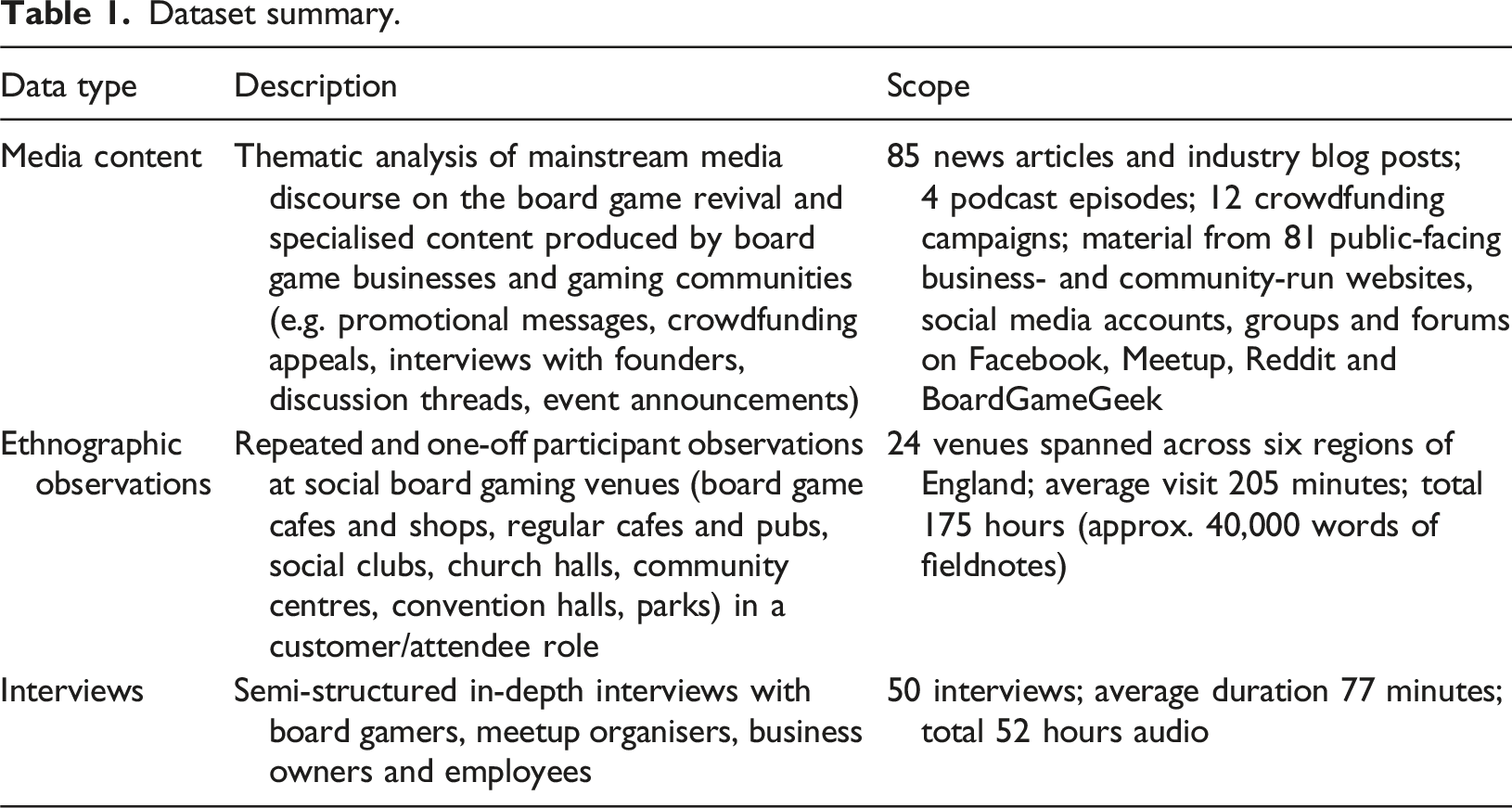
Data type
Description
Scope
Media content
Thematic analysis of mainstream media discourse on the board game revival and specialised content produced by board game businesses and gaming communities (e.g. promotional messages, crowdfunding appeals, interviews with founders, discussion threads, event announcements)
85 news articles and industry blog posts; 4 podcast episodes; 12 crowdfunding campaigns; material from 81 public-facing business- and community-run websites, social media accounts, groups and forums on Facebook, Meetup, Reddit and BoardGameGeek
Ethnographic observations
Repeated and one-off participant observations at social board gaming venues (board game cafes and shops, regular cafes and pubs, social clubs, church halls, community centres, convention halls, parks) in a customer/attendee role
24 venues spanned across six regions of England; average visit 205 minutes; total 175 hours (approx. 40,000 words of fieldnotes)
Interviews
Semi-structured in-depth interviews with board gamers, meetup organisers, business owners and employees
50 interviews; average duration 77 minutes; total 52 hours audio
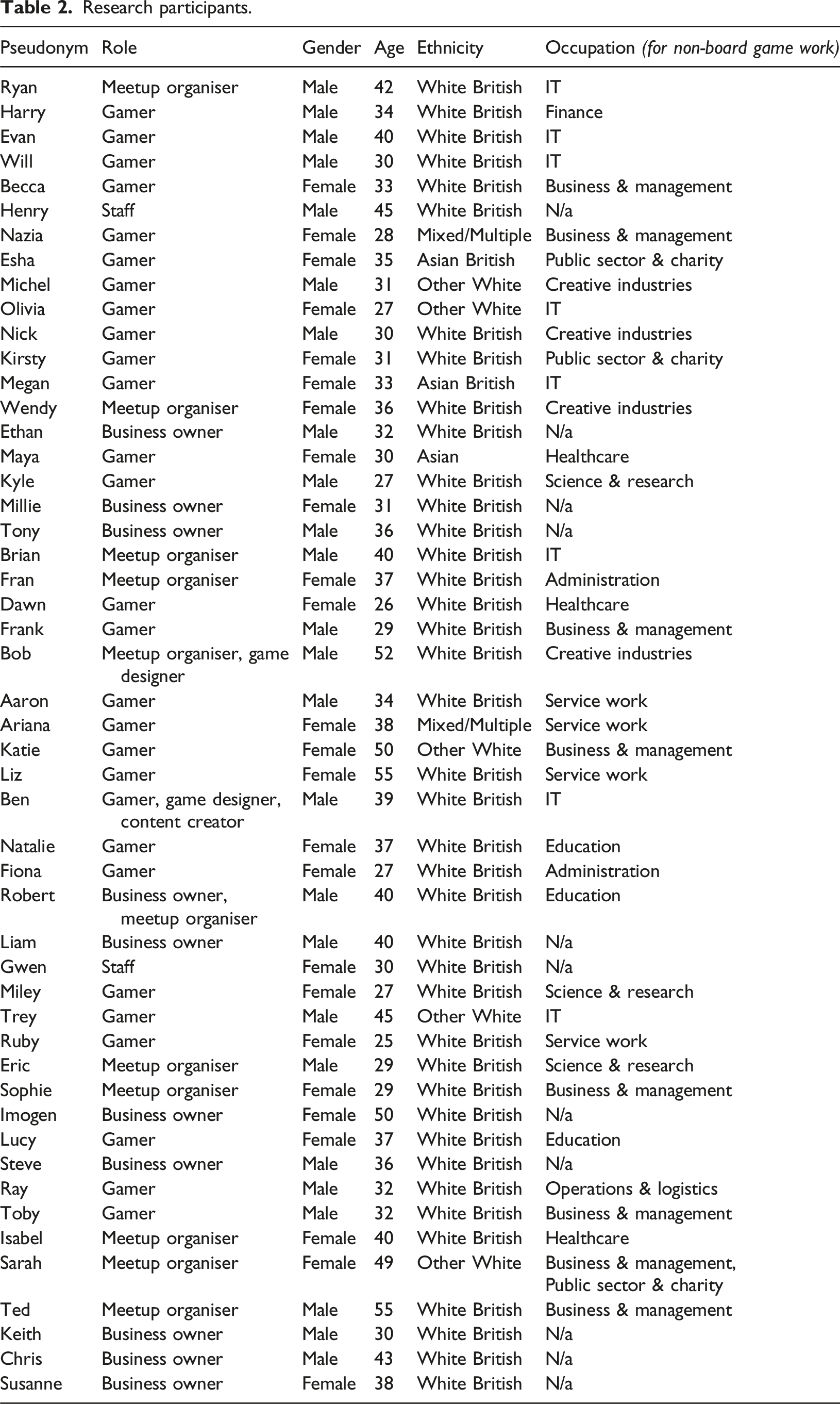
Pseudonym
Role
Gender
Age
Ethnicity
Occupation (for non-board game work)
Ryan
Meetup organiser
Male
42
White British
IT
Harry
Gamer
Male
34
White British
Finance
Evan
Gamer
Male
40
White British
IT
Will
Gamer
Male
30
White British
IT
Becca
Gamer
Female
33
White British
Business & management
Henry
Staff
Male
45
White British
N/a
Nazia
Gamer
Female
28
Mixed/Multiple
Business & management
Esha
Gamer
Female
35
Asian British
Public sector & charity
Michel
Gamer
Male
31
Other White
Creative industries
Olivia
Gamer
Female
27
Other White
IT
Nick
Gamer
Male
30
White British
Creative industries
Kirsty
Gamer
Female
31
White British
Public sector & charity
Megan
Gamer
Female
33
Asian British
IT
Wendy
Meetup organiser
Female
36
White British
Creative industries
Ethan
Business owner
Male
32
White British
N/a
Maya
Gamer
Female
30
Asian
Healthcare
Kyle
Gamer
Male
27
White British
Science & research
Millie
Business owner
Female
31
White British
N/a
Tony
Business owner
Male
36
White British
N/a
Brian
Meetup organiser
Male
40
White British
IT
Fran
Meetup organiser
Female
37
White British
Administration
Dawn
Gamer
Female
26
White British
Healthcare
Frank
Gamer
Male
29
White British
Business & management
Bob
Meetup organiser, game designer
Male
52
White British
Creative industries
Aaron
Gamer
Male
34
White British
Service work
Ariana
Gamer
Female
38
Mixed/Multiple
Service work
Katie
Gamer
Female
50
Other White
Business & management
Liz
Gamer
Female
55
White British
Service work
Ben
Gamer, game designer, content creator
Male
39
White British
IT
Natalie
Gamer
Female
37
White British
Education
Fiona
Gamer
Female
27
White British
Administration
Robert
Business owner, meetup organiser
Male
40
White British
Education
Liam
Business owner
Male
40
White British
N/a
Gwen
Staff
Female
30
White British
N/a
Miley
Gamer
Female
27
White British
Science & research
Trey
Gamer
Male
45
Other White
IT
Ruby
Gamer
Female
25
White British
Service work
Eric
Meetup organiser
Male
29
White British
Science & research
Sophie
Meetup organiser
Female
29
White British
Business & management
Imogen
Business owner
Female
50
White British
N/a
Lucy
Gamer
Female
37
White British
Education
Steve
Business owner
Male
36
White British
N/a
Ray
Gamer
Male
32
White British
Operations & logistics
Toby
Gamer
Male
32
White British
Business & management
Isabel
Meetup organiser
Female
40
White British
Healthcare
Sarah
Meetup organiser
Female
49
Other White
Business & management,
Public sector & charity
Ted
Meetup organiser
Male
55
White British
Business & management
Keith
Business owner
Male
30
White British
N/a
Chris
Business owner
Male
43
White British
N/a
Susanne
Business owner
Female
38
White British
N/a