




Abstract
Marketing theory has drawn attention to the co-creation of atmosphere in social consumption experiences that illustrate a broader culture of togetherness. Less is known about how atmospheres are co-created when the consumer is in solitude. Drawing on an ethnographic study of urban exploration, we examine consumers who actively seek solitude as a positive way of being alone. The contribution of this paper is to theorise how consumers co-create atmospheres when consuming in solitude by exploring the affective experiences of place that emerge when consumers are disengaged from other people. Our findings suggest consumers draw on worldly encounters and otherworldly encounters to co-create atmospheres when consuming in solitude. This theorisation broadens our appreciation of the agentic actors that co-create atmospheres to include more-than-human entities, unpacks the role consumer imagination plays in co-creating atmosphere in the absence of other people, and advances understanding of solitary consumption by revealing how consumers actively seek and maintain solitude.
Marketing theory has contributed to the atmospheric turn by exploring the significance of atmospheres for consumers and markets. Atmospheres are ‘a quality of environmental immersion that registers in and through sensing bodies’ (McCormack, 2008: 413). From an affective perspective, atmospheres are created through constellations of objects that articulate atmospheres, and human bodies that sense atmospheres in space (Böhme, 1993). Affective atmospheres are defined as ‘a kind of indeterminate affective “excess” through which intensive space–times can be created’ (Anderson, 2009: 80). Characterised by ambiguities, affective atmospheres are simultaneously ‘determinate and indeterminate, present and absent, singular and vague’ (Anderson, 2009: 80).
Previous marketing research has considered how consumers co-create atmospheres in spaces of consumption, such as football stadiums (Hill et al., 2022; Steadman et al., 2021), religious spaces (Higgins and Hamilton, 2019; Preece et al., 2022), retail environments (Joy et al., 2023), and tourism sites (Goulding and Pressey, 2023). These studies have focused on atmosphere as ‘collective affects’ (Anderson, 2009: 77) that result in shared emotions and behaviours. Marketing and consumer researchers have prioritised contexts of high sociality where social atmospheres intensify through consumer expressions of collective effervescence (Hill et al., 2022) and spread through affective contagion that cement and strengthen social bonds (Goulding et al., 2009; Higgins and Hamilton, 2019). Marketing theory has thus drawn attention to the co-creation of atmosphere during social consumption experiences that points to a broader culture of togetherness. Less is known about how atmospheres are co-created when the consumer is in solitude.
Consumers often spend time alone as part of the mundane rhythm of everyday life, for example, when cooking, reading, or running. These activities can be considered as ‘atmospheric practices of affecting and being affected performed in solitude within a world of material objects, without any direct affective relation to other people’ (Bille and Simonsen, 2021: 3015). People may draw on objects and sensory elements to co-create their own personalised atmospheres that enhance experiences of consuming in solitude. Bille’s (2015) analysis of the use of lighting to co-create a cosy atmosphere suggests atmosphere creation is just as important for people when they are alone as it is when in the companionship of others. Similarly, lone runners co-create their own ‘personalised soundworlds’ by listening to curated music playlists and wearing noise-cancelling headphones to shelter from noise-filled urban atmospheres (Kerrigan et al., 2014). In these examples, atmospheres are positively experienced. Other research reveals that conditions of solitude can also be linked to less positive emotions, such as if being alone in public space is perceived as unsafe (Heu and Brennecke, 2023) or threatening when ‘[e]mptiness works here not as something reassuring, but rather as all the more horrific’ (Fuchs, 2019: 106).
In this paper, our focus is on consumers who actively seek moments of solitude. We ask: how do consumers co-create atmospheres when they are in solitude? Our contribution is to theorise how consumers co-create atmospheres when consuming in solitude by exploring the affective experiences of place that emerge when consumers are disengaged from other people. We theorise that consumers draw on worldly encounters and otherworldly encounters to co-create atmospheres when consuming in solitude. We offer three contributions that broaden our appreciation of the agentic actors that co-create atmospheres to include more-than-human entities, unpack the role consumer imagination plays in co-creating atmosphere in the absence of other people, and advance understanding of solitary consumption by revealing how consumers actively seek and maintain solitude.
The remainder of the paper is structured as follows. We begin by discussing current marketing research on the co-creation of atmospheres and conceptualisations of solitary consumption, before reviewing the concept of absence as our theoretical lens. Our findings comprise two sections of worldly encounters and otherworldly encounters. The paper closes with our contribution to theorising atmosphere and areas for future research.
Theoretical foundations
Co-creation of atmospheres
Researchers have debated how atmospheres come into being. Böhme (1993: 114) suggests ‘[w]e are not sure whether we should attribute them [atmospheres] to the objects or environments from which they proceed or to the subjects who experience them’. Recent marketing research has challenged the conventional idea that atmospheres can be pre-determined by companies by drawing attention to the role of consumers in atmosphere co-creation (Danatzis et al., 2025; Hill et al., 2022; Joy et al., 2023; Steadman et al., 2021). This research reinforces Anderson’s (2009: 79) assertion that atmospheres are always unfinished and remain open ‘to being taken up in experience’. While marketers can attempt to orchestrate particular atmospheres through servicescape staging, they ultimately cannot control how atmospheres affect consumers (Preece et al., 2022).
Joy et al. (2023) suggest that affective atmospheres are co-created by material features, sensory modalities, and social interactions. Co-creation of atmospheres can occur when material features of the environment offer evocative spaces (Higgins and Hamilton 2019) or bubbles (Rokka et al., 2023) that shape consumers’ embodied affective experiences. Research has drawn attention to consumer experiences of social interaction in atmosphere co-creation. Hill et al. (2022: 123) discuss how consumers engage in ritual interactions to ‘cocreate the visual, sonic, and emotional qualities’ of atmospheric experiences of places. While their focus is largely on consumer-to-consumer interactions, Joy et al. (2023: 304) prioritise social interactions between consumers and staff as the ‘most important’ element of atmosphere co-creation. They argue that interactions with staff frame consumer experiences of material features and sensory modalities that would otherwise remain under-expressed. More recently, Danatzis et al. (2025) argue frontline staff are ‘curators’ of social atmospheres by actively managing customer heterogeneity to achieve the optimal mix of clientele. Such curation requires intentional aesthetic work to evaluate potential customers’ social fit with the desired atmosphere (Danatzis et al., 2025). Understanding the curation of social atmospheres deepens our appreciation of the central role staff play in shaping atmospheres that moves beyond staff and consumer interactions (Joy et al., 2023) to recognise consumer-to-consumer interactions are also carefully constructed elements of social atmospheres.
Other marketing research highlights that, even without significant consumer effort, social processes play an important role in atmosphere co-creation. This occurs when affective responses become institutionalised, evident, for example, when immersion in religious servicescapes generates emotional responses that relationally spread through affective contagion (Higgins and Hamilton, 2019; Preece et al., 2022; Thrift, 2008). Often enhanced by the materiality of the environment (Rokka et al., 2023), the bodily synchronisation that occurs when bodies are physically co-present is particularly powerful in amplifying vibrant atmospheres (Cayla and Auriacombe, 2025). Although consumers land in atmosphere in heterogeneous ways due to personal biographical lived experience, consumers who experience a shared atmosphere differently are positioned in relation to the dominant group as outsiders (Preece et al., 2022).
The emphasis in previous research on atmosphere co-creation through social interactions of bodies that are physically co-present overlooks how consumers can also co-create atmospheres when they are alone. In response to the call to move beyond human-centric perspectives (Grant et al., 2025), we consider how the co-creation of atmospheres when consuming in solitude brings to the fore consumer interactions with more-than-human entities. To support our theorising, we turn to previous research on consuming in solitude.
Consuming in solitude
Marketing theory has focused on consuming during moments of togetherness, evident, for example, in extensive research on consumer tribes (Cova et al., 2007), subcultures of consumption (Schouten and McAlexander, 1995), and marketplace rituals (Otnes et al., 2012). This prioritisation acknowledges the pleasures of sociality (Goulding et al., 2009), but it has resulted in less research on consuming in solitude. Although solitude is increasingly recognised as consequential in everyday life, there is lack of agreement on how it should be defined (Weinstein et al., 2023). Some definitions seek to emphasise solitude as a positive experience, for example, Ost-Mor et al. (2020: 957) define solitude as ‘[t]he choice to dedicate time to a meaningful, enjoyable activity or experience conducted by oneself’. As Weinstein et al. (2023) explain, definitions of ‘positive solitude’ function to distinguish solitude from loneliness or isolation, both of which are associated with more negative conditions and outcomes. Similarly, Scott (2019) distinguishes between solitude and loneliness as two distinct ways of experiencing aloneness. Solitude involves acts of commission and is ‘a deliberate, positive choice to withdraw and avoid social company’ (p. 130). In contrast, loneliness involves acts of omission as it is not chosen, meaning that the absence of others is felt as ‘a nauseating chasm of oppressive limitation’ (p. 131). We follow this distinction and are concerned with consumption in solitude that is characterised as beneficial and meaningful.
Although the solo consumer has long been viewed as an opportunity for service marketers (Goodwin and Lockshin, 1992), consuming in solitude remains rarely acknowledged in marketing theory (Lai and Higgins, 2015; McCamley and Morland, 2021). While scholars have explored contexts when consumers are alone, such as binge watching in the home (Jones, 2020), solitude has not been the theoretical focus of study. The pleasures of solitude are often overlooked and instead, solitude has been associated with negative unsettling emotions such as boredom and loneliness (Murphy et al., 2023). Resistance to a positive narrative of solitude can be attributed to historical and cultural understandings that link solitude to deviant activities (Goodwin and Lockshin, 1992), such as drinking alcohol alone.
A key factor underlying the lack of consensus in defining solitude is whether it requires physical separation from other people. Weinstein et al. (2023) find physical separation from others is important for solitude but even more salient is mental separation from others. This leads Weinstein et al. (2023: 1663) to conclude that ‘solitude is a state in which the dominant relationship is with the self’. This is reflective of Long and Averill (2003: 23) who define solitude as ‘a state characterised by disengagement from the immediate demands of other people—a state of reduced social inhibition and increased freedom to select one’s mental or physical activities’. Following this prior research (Long and Averill, 2003; Weinstein et al., 2023), we find solitude exists on a continuum. At one end of the continuum is solitude that occurs in the absence of others, referred to as pure (Long and Averill, 2003: 23) or total solitude (Weinstein et al., 2023). At the other end, is solitude that occurs in the presence of others, referred to as peripheral solitude (Long and Averill, 2003).
Most marketing research has prioritised peripheral solitude. McCamley and Morland (2021) conceptualise the lone consumer servicescape in which consumers may consume alone whilst in presence of others, for example, visiting a busy coffee shop alone. Such peripheral solitude can be pleasurable by fulfilling emotional needs and offering opportunities for self-reflection. In acknowledging the presence of others, consumers are ‘lone not lonely’ and can function as a consumer collective. Koponen and Mustonen (2022: 370) highlight the paradoxical sociality involved in peripheral solitude when solo diners are ‘simultaneously alone and with others’ that can offer deep aesthetic immersion free from social distractions. However, peripheral solitude can also be uncomfortable due to concerns about negative evaluations from others (Ratner and Hamilton, 2015). For example, Brown et al. (2020: 1355) highlight solo diners may feel stigmatised, perceiving judgement from staff and other customers, and may use various props, such as smartphones, as an ‘emotional shield’ to distract from their solo status. Similarly, Murphy et al. (2023) find consumers use social media to seek connectivity and overcome boredom associated with solitude.
In summarising existing research, solitude can be either peripheral or total and can be actively sought or oppressively experienced. We examine consumers who actively seek total solitude that is characterised by an absence of other human interaction. In the following section, we discuss absence as a useful theoretical lens to explore how consumers co-create atmospheres when in solitude.
Atmosphere and absence
Whilst previous marketing research suggests that atmospheres are co-created during sensory encounters that are materially laden with the presence of people, places, and things (Danatzis et al., 2025; Hill et al., 2022; Joy et al., 2023; Steadman et al., 2021), atmospheres are equally shaped by what is missing. Theorising absence often draws on Derrida’s (1994) notion of hauntology that enables the co-existence of absence and presence. As noted by Goulding (2023), absence is significant in shaping and charging atmospheric experiences. Absence is a complex concept due to its elusive character and contested materiality. Absence is not absolute, rather, it exists in relation to ‘a potential presence that has not materialised and remains out of sight’ (Scott, 2019: 77). As such, it is not an entity in itself but ‘exists through relations that give absence matter’ (Meyer, 2012: 103). We review existing theorisations of absence that coalesce around three key domains: space, embodiment, and materiality.
Marketing theory has often prioritised what is spatially present and failed to consider what is absent. This is what Goulding et al. (2018: 25) refer to as a politics of absence that can ‘conceal or render invisible, alternative, subaltern or excluded narratives to those of the master discourse’. Commercial spaces of absence have been critiqued for artificially staging atmospheres, what Edensor (2005: 830) refers to as ‘performative styles of imprinting memory on space’. In contrast, non-commercial spaces of absence are free from artificial atmospheric staging and can therefore allow consumers to surface untold stories, undocumented histories, and overlooked memories (Anderson and Hamilton, 2024). Spectro-geography highlights how absence subtly or overtly shapes the atmospheres of spaces and places (Maddern and Adey, 2008). Places characterised by absence can evoke the imagined presence of absent others. For example, Derbaix and Gombault (2016) consider how Cézanne’s studio enables visitors to ‘feel the presence’ of the painter, while Chronis et al. (2012) consider how the Gettysburg heritage site evokes the imagined presence of the dead. This aligns with Sutton-Smith’s (2001: 127) assertion of imagination as ‘the act of making what is present absent or what is absent present’.
In surfacing the absent in atmospheres, consumers draw on both the place and their embodied experience. As Alison (2020: 114) argues, ‘atmosphere captures us in perceiving the immediacy of the place: the atmosphere speaks to our emotional perception’. The embodied experience of absence can be evoked through fluctuating atmospheres that exist in the air as ‘a nebulous, invisible sensation that induces certain moods or feelings’ (Goulding and Pressey, 2023: 2). Stewart (2011) terms this atmospheric attunement as a ‘practised sensibility’ that allows the body to become sentient to the subtlety of atmospheres. Absence is sensed through affect at the pre-cognitive level in which many ‘phantom forces’ shape embodied experience (Miller et al., 2021: 143). Absence charges atmospheres by evoking strong emotions, such as intense feelings of grief and longing (Goulding, 2023). This reinforces how the embodied experience of absence is sensual, deeply embedded in corporeality, and laden with emotions (Frers, 2013). Embodied experiences of absence may require powers of imagination. Consumer imagination is both a mental phenomenon and an embodied experience (Chronis et al., 2012; Heath and Nixon, 2021). Martin (2004) goes beyond viewing imagination as an individual human faculty and acknowledges the catalysing role of sociohistorical contexts in shaping the imaginary. Further, Chronis et al. (2012) reveal how cultural imaginaries involve a back-and-forth negotiation of collective narratives. Unlike the social process of imagination in the presence of others (Chronis et al., 2012; Martin 2004), in atmospheres characterised by an absence of others, negotiations require affective work of ‘an intrapsychic, introverted kind’ (Scott, 2019: 131).
Atmospheres characterised by absence have particularly ambiguous materiality as they are ‘more than immaterial and less than material’ (Bille et al., 2010: 179). From this perspective, absence belongs to the material world, yet it is also foreign to that world (Fowles, 2010). Absence and presence are useful conceptual devices to support understanding of how objects can co-create atmospheres. Anderson and Hamilton (2024) find that abandoned objects can evoke the imagined presence of previous owners through the traces they leave behind. Such objects act as spectral containers that exude haunted auras (Goulding and Pressey, 2023) that may hint at dark histories. This gives absence a spectral quality as ‘[g]hosts reside in the shadows, in the margins, in the barely visible and they are never simply absent’ (Van, 2004: 288). Literature often treats hauntings as metaphors of loss and as rhetorical devices that represent departed people, places, or events (Maddern and Adey, 2008; Meier et al., 2013). However, treating the spectral as purely metaphorical or rhetorical overshadows the lived experiences of haunting (Maddern and Adey, 2008; Meier et al., 2013). Hauntings are sensed through ‘unfathomable feeling’ (Goulding, 2023: 12) that is located somewhere between the atmosphere and the body. They can be experienced ambiguously through embodied perceptions of invisible absent-presences (Fuchs, 2019).
Research methods
The context for the research is urban exploration, a subcultural activity in which individuals explore abandoned buildings such as homes, hospitals, schools, and factories. Urban exploration is often conducted in solitude. Exploring alone is common, ranging from those who explicitly explore solo to those who actively seek moments of solitude during exploration trips with others. Urban explorers seek to immerse themselves in abandoned buildings and experience their atmospheres in recognition that although ‘the capitalist use-life of all places will inevitably end, places do not “die”’ (Garrett, 2011: 1050). Urban exploration is considered a form of recreational trespass (Garrett, 2014) as alongside its playful intention it can involve illegal entry dependant on country-specific laws. The mantra of ‘take only photographs, leave only footprints’ guides the behaviour of urban explorers who concentrate on photographing the abandoned interior of buildings without causing any negative impact. Although photographs may be shared on forums and social media, urban exploration itself is often practiced alone as explorers seek a solitary experience.
To enable immersion within the context of urban exploration, we adopted an ethnographic approach to data collection. Over a 3-year period, this included ethnographic fieldwork, netnography, and in-depth interviews with urban explorers. Ethnographic fieldwork, based on 27 abandoned buildings, involved participation in urban exploration practices of locating, exploring, and photographing these sites. Although we do not include ethnographic fieldnotes in the findings of this paper, it has supported and informed our interpretation. Initially, netnography of forums, social media, and personal websites helped us develop an understanding of urban exploration. These online observations were conducted on a weekly basis for 1 year. We also used the netnography to recruit urban explorers for interview.
Interview participants.
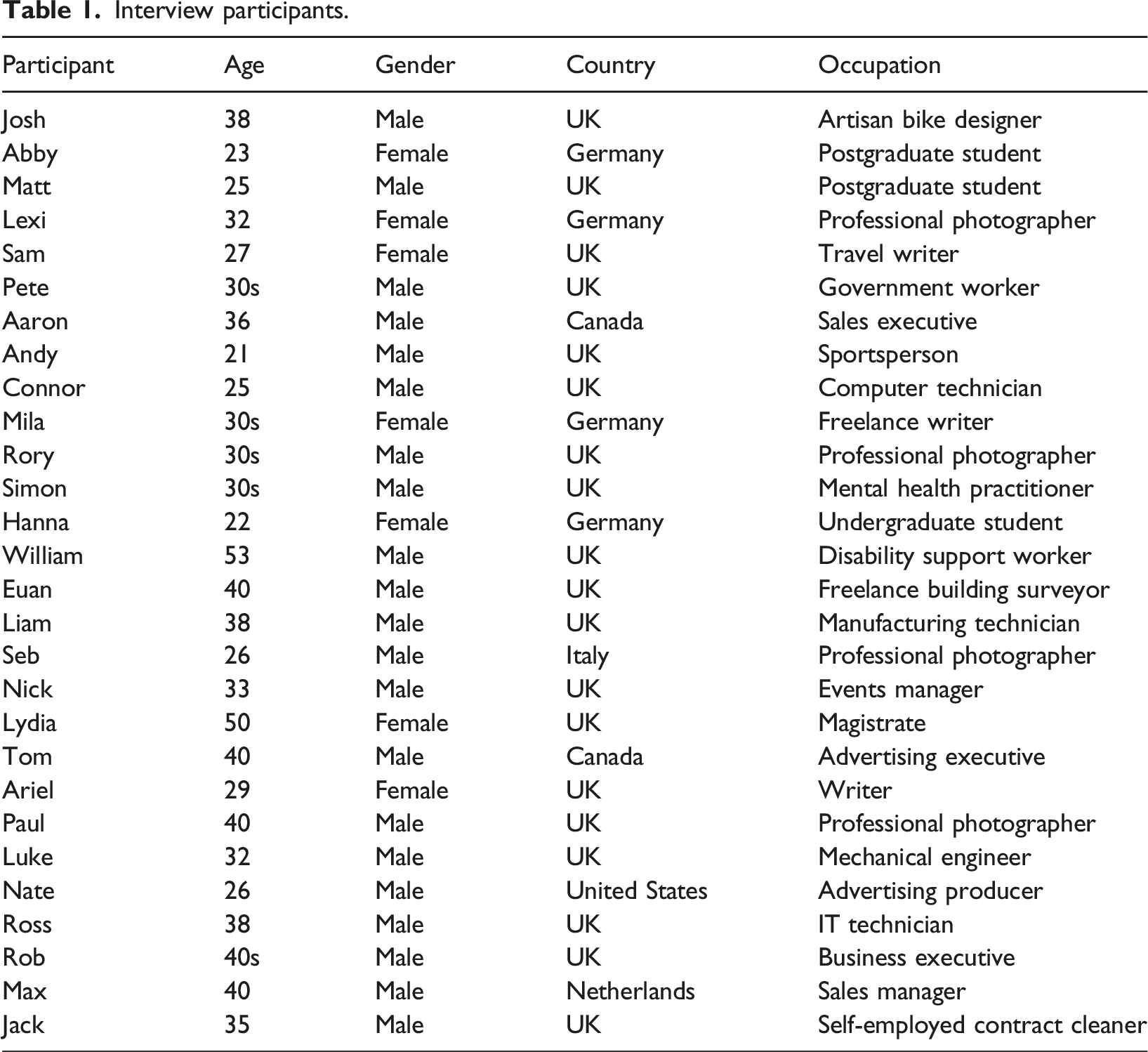
We followed an iterative approach to data analysis (Thompson, 1997), oscillating back-and-forth between the data (emic) and relevant theory (etic). Our starting point was current literature that revealed the significance of absence in charging atmospheres (Goulding, 2023) that resonates with our research context. Both authors independently open-coded for emerging themes, using descriptive codes to represent the data in a way that preserved participant meanings. One theme that emerged in data analysis, that we focus on below, related to how urban explorers consume in solitude. This led us to the literature on solitude and solitary consumption within and outside of marketing theory. Drawing on existing theory, we conducted systematic and iterative rounds of discussion of our coded themes. We used Glaser’s (1965) constant-comparative method to identify intertextual similarities and differences across the data set. This led to the refinement of our coding framework that included codes such as spaces, embodiment, and materiality that formed the basis of our emerging theorisation of how consumers co-create atmosphere when in solitude.
Findings
We theorise how consumers co-create atmospheres when consuming in solitude by exploring the affective experiences of place that emerge when consumers are disengaged from other people. Our findings reveal that consumers draw on both worldly encounters and otherworldly encounters to co-create atmospheres when consuming in solitude. Worldly encounters occur with non-human entities and elemental features. Otherworldly encounters occur with inexplicable absent-presences. Whilst in solitude, these worldly and other-worldly encounters have more space to come to the forefront of consumer perception. Consumer responses to these encounters help to inform the ‘indeterminate affective “excess”’ (Anderson, 2009: 80) that characterises the atmosphere and makes it meaningful.
We begin with a data example that broadly illustrates this theorisation, before moving on to discuss worldly and otherworldly encounters in more detail. The absence of others and associated human activity is central to urban exploration because it accentuates the fascination with abandonment. Exploring in total solitude heightens the atmospheric experience of worlds left behind. Paul prefers exploring alone as it increases his appreciation of the particularities of a building’s atmosphere. His description introduces how explorers engage in worldly and otherworldly encounters: Getting to see something that used to be bustling with people but now it has got like ghostliness about it. [...] Some buildings have a feel to them. I don’t know what it is, it is the architecture, or the space, or the lighting, or the fact that you know what used to go on there. They have either got no feel at all, they are totally dead, or they have got a really eerie feel, like a threatening feel or they have got a really sort of calm and you get a right good feeling from them. I think there is a melancholy. There is a sadness about abandoned places, and I think that feeling is more addictive. People like that melancholy feeling, don’t they? They like a sad song better than a cheesy pop song (Paul).
Paul’s account refers to worldly encounters with the building’s architecture, spatial layout, and lighting, and otherworldly encounters when Paul contrasts his knowledge of how the building was previously used with its current ‘ghostliness’ that arises in the absence of people. Paul’s responses to the interaction of these worldly and otherworldly encounters co-create the atmosphere in the buildings. Being alone heightens ‘the immediacy of the place’ (Alison, 2020: 114) that allows Paul to feel these encounters and the unique atmosphere of each building. Paul compares the ‘dead’ atmospheres experienced in some buildings with the atmospheres in other buildings that are more alive and readily felt. For Paul, atmospheres range from high arousal atmospheres that provoke fear, to low arousal atmospheres that envelop him in a sense of peacefulness. This range illustrates the variety of ways consumers can draw on worldly and otherworldly encounters to co-create atmospheres and make them meaningful when consuming in solitude.
Worldly encounters
Consumers co-create atmospheres when in solitude by immersing themselves into spatial environments and building their own perception of the atmosphere informed by their worldly encounters with non-human entities and elemental features. For many explorers, being alone heightens their ability to attune (Stewart, 2011) to the worldly particularities of atmosphere. Hanna explains why she finds pleasure in exploring in solitude whereby the sights and sounds of humans have been replaced by nature. The whole atmosphere because it was pretty dark. Nature was already taking over the place. There were like trees inside the houses and the whole atmosphere was pretty dark. Everything was like damp and mossy. [...] I think when you are alone in these places it is such a pleasure, and you can really think about life a little bit. Because if someone is with you then you are talking and you think oh look at that, look at this, but if you are alone then you are really alone with yourself (Hanna).
Being alone is central to Hanna’s ability to co-create atmosphere through worldly encounters. She finds pleasure in the dark, damp atmosphere where overgrown plants and moss cushion her from the outside anthropogenic world. For Hanna, the absence of people coupled with the presence of nature creates an ideal atmosphere in which ‘being alone with yourself’ enables retrospective contemplation. The presence of other people would compromise Hanna’s contemplative self-focus (Weinstein et al., 2023) and ultimately spoil her experience of consuming in solitude. While social atmospheres intensify as the collective increases (Hill et al., 2022), the presence of people is perceived as an unwelcome interruption that negatively impacts solitary atmospheres.
Urban explorers actively seek total solitude from the outside world by visiting remote locations that are devoid of human presence. Pete shares his recollections of exploring a ruined seminary located within the Scottish wilderness. One of my favourite moments when I was in the seminary…there are no exterior walls anymore. The whole thing is just kind of three floors more or less. It was absolutely pissing with rain and as I stood in the middle of this building completely dry. You have got rain pouring down all four sides of you. I just loved that. It was just lovely. Lovely and peaceful. It was I suppose my version of when people go to the country to relax. I was just quite chilled out and it was just a nice place for me to be (Pete).
Standing in the shelter of the seminary, Pete feels peacefulness as he watches the heavy rain cascade around him. The atmospheric conditions of rainfall that envelop Pete become an affective experience in which his solitude allows him pause and fully appreciate the materiality of the rainfall. Unlike rain that inhibits atmosphere creation (Rokka et al., 2023), for Pete, rain mobilises a peaceful atmosphere in the ruined seminary that he compares to a country retreat. In some ways, Pete’s evaluation is surprising given the seminary environment is covered in graffiti and littered with broken glass and rubbish (see Figure 1). This highlights that the peacefulness associated with atmospheres when consuming in solitude can emerge in unexpected places, reinforcing how atmospheres can ‘exceed that from which they emanate’ (Anderson, 2009: 80). It is Pete’s efforts that co-create this affective excess because he uses the desolate building as a resource to enable him the peaceful atmosphere he seeks during urban exploration. St. Peters seminary, CC-BY-SA by Lirazelf.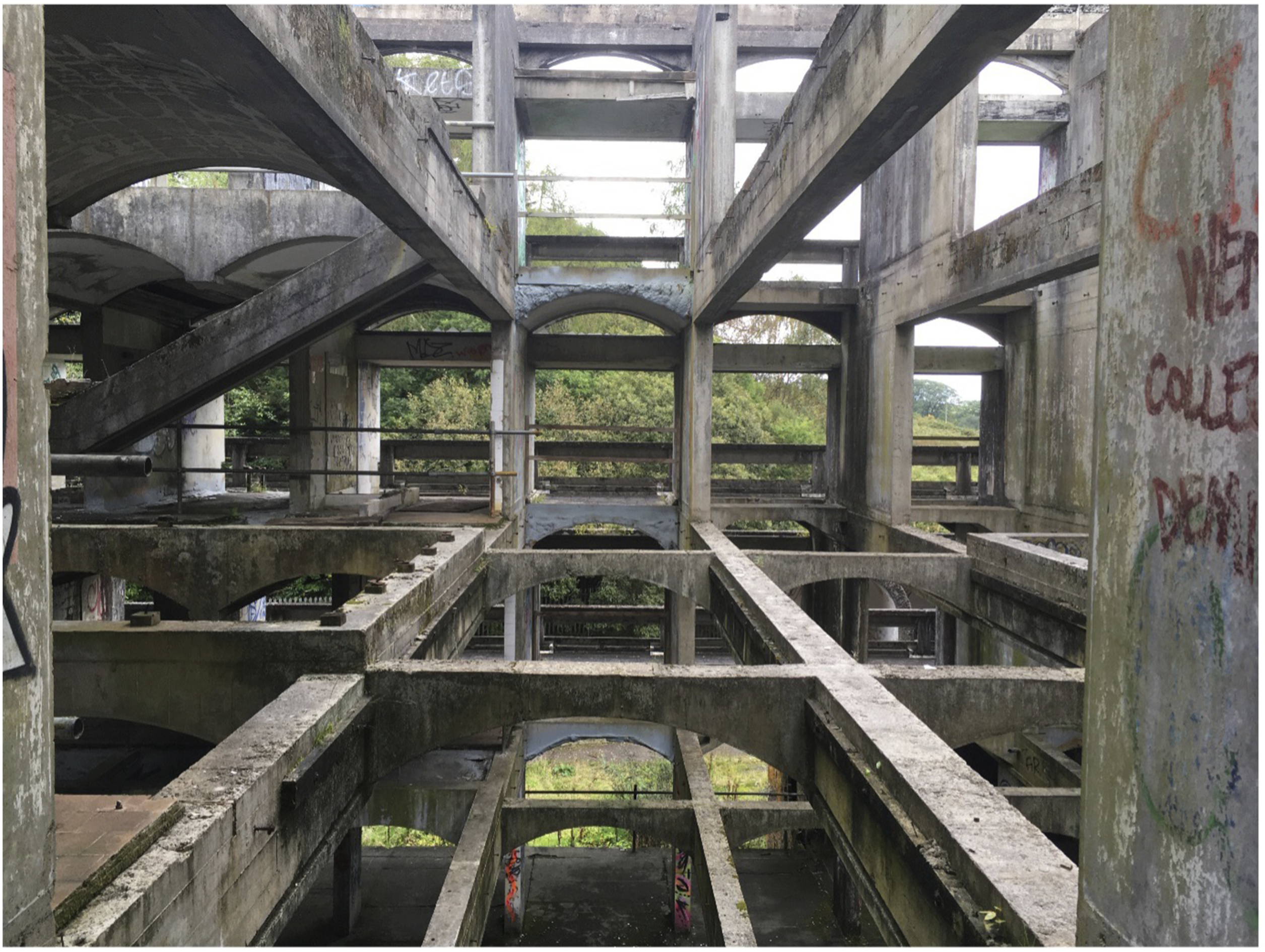
Solitude is often actively sought by explorers who enjoy the sensory experience of being alone. Nick explains his preference for exploring in solitude: ‘I love the emptiness. […] There is no noise, no people, no shops, no commuting, no driving or talking, it is all peaceful’. For Nick, the absence of human activity creates ‘emptiness’ that is counterintuitively full of peace and quietness. Sonic qualities are salient to atmospheres when consuming in solitude. For Seb, silence is particularly integral: When I was going inside, I was expecting silence. That is what you expect. It is what you want. You are fine on your own. You don’t want to have many people around. That is not the point. You want to have fun, not to listen to people walking and talking. Silence is about the place. It is good to be there in the silence with your camera, listening to every noise, being aware of everything. That is the best thing about urbexing is the silence, the noises of the place. Every place has got those noises, something that is coming from the place (Seb).
Solitude creates an opening for silence to permeate the atmosphere and allows Seb to fully immerse himself in a place. As Goulding and Pressey (2023: 7) argue, ‘silences are not nothingness, but rather spaces for affect – we feel them’. Anthropogenic silence is an important atmospheric condition that Seb uses to enhance his awareness of the sonic particularities that emanate from buildings. Explorers seek to replace identifiable sounds of traffic and people with ambiguous sounds that emanate from the affective excess of abandoned buildings. By paying greater affective attention to the unique noises of a building, Seb can better attune himself to the atmosphere. We build on prior research that demonstrates how the anthropogenic silence of solitude is a resource that enables an inner focus on the self (Dehling, 2024), to also demonstrate how the silence of solitude enables an outer focus on the place. This preference for solitude explains why explorers make efforts to avoid the distracting noises of other people that disorientate (Preece et al., 2022) and may lead to atmospheric failure (Hill et al., 2022).
Not all explorers find human disruptions to cause atmospheric failure as they are able to attune to the particularity of worldly encounters. Simon explains how he experiences the atmospheres of the buildings he explores: Well they are different. They all have a unique feel. There is usually a real calmness to them when you are in the house. You may feel a bit tense because you may hear cars going past or you can hear machinery in the distance. You know people are quite close you always feel a bit tense that you are in this house, but after a few minutes you kind of become acclimatized to it. You have to get used to the sounds in these places and get familiar with them, get to know the floorboards or things at the windows. You desensitize towards the sounds first and then when you hear them you know it is part of the house and not something foreign. The atmosphere can be very strange (Simon).
Like Paul who identified diverse atmospheres, Simon identifies a variety of atmospheres that impress a range of feelings from calmness to tension. His emic description of acclimatising to the worldly sounds of cars, machinery, and people reflects Stewart’s (2011) notion of atmospheric attunement as a ‘practised sensibility’ that enables a broader sensory awareness of taken-for-granted everyday phenomena. Rather than finding these anthropogenic noises to be distracting (Preece et al., 2022), Simon goes through a process of sensitising and desensitising to the noises emanating from the environment until the unfamiliar becomes familiar. This process of attuning by becoming familiar is afforded by being in total solitude as the absence of others allows subtleties of atmosphere to be noticed more readily. Whilst Simon admits only occasionally to ‘feel on edge, a bit spooked out’, his account also highlights how otherworldly encounters, or in his words ‘something foreign’, can make atmospheres become somewhat strange. We explore the role that otherworldly encounters play in co-creating atmospheres when consuming in solitude in the following section.
Otherworldly encounters
Whilst being in solitude can heighten consumer attunement to worldly encounters, they can also heighten attention to otherworldly encounters. The otherworldly is often barely sensed, rarely understood, and invites imagination. Like Paul who suggests atmospheres can feel threatening, some explorers find being in solitude can cause atmospheres to appear unsettling. William exclusively explores in solitude yet acknowledges this solitary modus operandi can easily turn from being therapeutic to threatening when the worldly becomes otherworldly. In some ways when I go away, I find it quite therapeutic and I feel quite relaxed after I’m in a place everything melts away. When you hear the butterflies and the wee bees. [...] [When exploring the castle] I could hear something. Normally you can hear something but this time it was like a voice. It was really like a voice at my head at the side. I thought that was weird, you know and I just discarded it completely, take a photograph. The very same thing happened at the other side [of my head]. And then that really unnerved me because I am there myself. It was getting dark. […] Everybody [in the online community] was going on about it cause they love to pick up on some psychic presence by saying that somebody has tried to warn you and all this (William).
Exploring in solitude is therapeutic to William who uses the quietness of solitude to notice the quiet flutter of butterfly wings and buzz of bees. However, whilst he finds therapeutic value in the worldly presence of insects, the otherworldly absent-presence of a disembodied voice is deeply unnerving. As Joy et al. (2023: 293) argues, atmospheres ‘arise as embodied emotional responses […] enveloping consumers as they form and dissipate’. In William’s case, the positive emotions associated with relaxation dissipate and become replaced with fearful emotions as the atmosphere shifts from therapeutic to threatening. William becomes enveloped in fear as being alone in the darkening daylight hours makes hearing a voice whisper from ear-to-ear more disturbing. This shift underscores how the co-creation of atmospheres when consuming in solitude is produced by consumers alongside more-than human entities. While social atmospheres catalyse shared emotions in the moment (Higgins and Hamilton, 2019; Hill et al., 2022), co-creating atmospheres in solitude relies on the individual’s emotions in the moment as there is no emotional contagion from one consumer to the next. Yet, sharing accounts of otherworldly encounters in community spaces can co-create retrospective emotional contagion and reaffirm unnerving experiences.
Co-creating atmospheres when consuming in solitude opens greater possibilities for atmospheric attunement (Stewart, 2011) due to the absence of others. Ariel describes her experience of exploring Cloud House, a small cottage in Wales that has been abandoned since the 1960s. Ariel describes the sense of other worldliness she experienced when photographing Cloud House alone: That was just a small place and that took me an hour and a half to go take some detailed photos and had a fight with my camera because it wasn’t working properly. […] It was a bit freaky. I did feel like I was being watched in there, that there was something in there that was other-worldly. There were quite a few times that I felt like there was something behind me watching me taking my photos (Ariel).
Ariel attributes this ‘freaky’ feeling to an absent-presence that lingers behind her and observes as she takes photographs. She stops short of identifying the absent-presence and rather describes it as ‘something other-worldly’ that reflects Van Wagenen’s (2004: 288) observation that ‘[g]hosts reside in the shadows’. Whilst Van (2004: 288) associates absence with ‘barely visible’ spectral beings, for Ariel invisibility of the absent-presence triggers scopaesthesia, or the sense of being watched. In contrast to William who auditorily senses a disembodied voice, Ariel relies on the affective attention of scopaesthesia to explain sensing a spectral gaze. Unlike social atmospheres of market-mediated ghost experiences where encounters are socially constructed through staged theatrics (Holloway, 2010), atmospheres when consuming in solitude are co-created with more-than-human otherworldly encounters. Consumer responses to these otherworldly encounters inform the indeterminate affective ‘excess’ (Anderson, 2009: 80) of the atmosphere in the buildings.
Whilst abandoned buildings can be materially empty, they can be as equally evocative as materially dense spaces (Tonkiss, 2003). This evocativeness prompts explorers to post stories of their solitary experiences on urban exploration forums. The explorer below shares his otherworldly encounter when exploring the basement of an abandoned building alone: Imagine a vast building, with two floors, and a basement. No lights, and the winter light dying fast outside. I was alone in the nether regions of the basement, using my penlight to navigate through the debris and broken glass. Halfway across the cold and windy bowels of the old building I heard a sound which I can still hear when I close my eyes... The sound of someone, or something sighing. The sound seemed to have no direction or focus, or even an echo. This was followed by the sound of flapping wings, and water sloshing about very close to me. I turned, and on my right, I saw a pale blue light, shimmering and pulsating, and 'breathing'. I froze, my feet glued to the wet ground. All was still (Facebook post, December 2015).
This account is drenched in worldly atmospheric elements such as thermal shifts and fading light, as well as otherworldly encounters from disembodied voices. The explorer gives agency to the indeterminable presence as ‘sighing’ and blue light as ‘breathing’. In solitude, these inexplicable encounters become vibrant matter (Bennett, 2010) that exist without rational explanation that reflects the in-betweenness of absent-presences (Derrida, 1994) that fail to neatly fit into cultural categories. Such experiences of absent-presences become heightened when consuming in solitude as consumers attune to otherworldly possibilities. Consumers draw on absent-presences through storytelling by sharing their otherworldly encounters in attempts to re-create affective contagion. Co-creation of atmospheres goes beyond sensing in the moment as through storytelling explorers invite others to imagine the atmosphere themselves.
Consumers develop imaginative responses to atmospheres when in solitude. Lydia, a 50-year-old urban explorer from the UK, exclusively explores abandoned locations by herself. She explains how solitude enhances her imaginative response. I like to be on my own. There are people who go out as groups. You know, core groups of people who all go out and explore together. That is fine, but for me it is for the relaxation. I think just standing in some of these buildings...I was at an RAF air force base at the weekend, just standing there and it was completely ruined but I could almost close my eyes and imagine all of the pilots wondering through with their uniforms on. It was quite special and quite amazing (Lydia).
Being alone allows Lydia space for relaxation that she could not experience in the presence of others. Lydia’s imaginings are thick with detail that reflect an embodiment technique (Martin, 2004) in which the imaginary is given form. Scott (2022) argues that an appreciation of empty space can offer an opportunity for absent people and objects to emerge. Despite the ‘completely ruined’ interior, Lydia creatively responds to the building’s atmosphere by visualising the absent pilots down to the detail of their uniforms. Here the ruined RAF building acts as a spectral container (Balzano and Weisberg, 2012) that reveals how inanimate objects can become imaginatively animated. A similar visualisation of absent-presences can occur in both social atmospheres and solitary atmospheres. However, the imaginary in social atmospheres may be a collective negotiation (Chronis et al., 2012), while in solitude, atmospheres are co-created when consumers individually generate their own imaginative responses.
Discussion
Our overarching contribution is to theorise how consumers co-create atmospheres when consuming in solitude by exploring the affective experiences of place that emerge when consumers are disengaged from other people. We demonstrate the significant effort consumers deploy while co-creating atmospheres when consuming in solitude. In the absence of others, such as fellow consumers and service-providers, consumers play the primary (human) role in co-creating the atmosphere. Our findings reveal that consumers draw on both worldly encounters and otherworldly encounters to co-create atmospheres when consuming in solitude. Consumer responses to these encounters help to inform the ‘indeterminate affective “excess”’ (Anderson, 2009: 80) that characterises the atmosphere and makes it meaningful. In theorising how consumers co-create atmospheres when consuming in solitude, we offer three contributions that broaden our appreciation of the agentic actors that co-create atmospheres to include more-than-human entities, unpack the role consumer imagination plays in co-creating atmosphere, and advance understanding of solitary consumption by revealing how consumers actively seek and maintain solitude.
Our theorisation is useful in highlighting the more-than-human interactions involved in co-creating atmospheres. Building on previous research that primarily considers consumers affective entanglements with material and sensory features that have been co-orchestrated by staff and other consumers (Hill et al., 2022; Joy et al., 2023), we consider how affective entanglements also extend to more-than-human interactions. First, worldly encounters occur with non-human entities, such as animals and plants, and elemental features, such as weather. Second, otherworldly encounters occur with inexplicable absent-presences. In following Goulding (2023) who reminds us that atmospheres are powerfully charged by the absent, we reveal the interplay of absence and presence in the co-creation of atmospheres. Our theorisation advances previous marketing theory on social atmospheres that has prioritised what is present in atmospheres (Higgins and Hamilton, 2019; Hill et al., 2022; Joy et al., 2023; Preece et al., 2022; Steadman et al., 2021), by shedding light on the role absence plays in atmospheres.
We draw on Stewart’s (2011) concept of atmospheric attunement to demonstrate that when in solitude consumer attunement enables greater sensitisation to more-than-human entities that consumers draw on in co-creating atmospheres. Such consumer attunement allows the ‘enigmas and oblique events and background noises that might be barely sensed yet are compelling’ to become apparent (Stewart, 2011: 445). Consumers expand their sensory engagement when co-creating atmospheres in solitude to readily grasp the barely sensed absent-presences that could otherwise be overlooked in the presence of people. In building on Goulding and Pressey’s (2023: 8) observation that ‘silence enables the spectral moment’, we demonstrate that anthropogenic silence enhances consumer attunement to worldly and otherworldly entities. By attuning to anthropogenic silence, consumers experience greater contemplative space for more-than-human entities to surface more readily and co-create the atmosphere.
Consumer attunement to atmospheres in solitude is also deeply emotional. We demonstrate the spectrum of consumer emotional responses to atmospheres when consuming in solitude such as melancholy, fear, peacefulness, and joy. These emotions may be more subjective and idiosyncratic in the absence of affective contagion that spreads shared emotional responses. We demonstrate how ‘lingering affect’ of more-than-human entities is given ‘more potency’ (Preece et al., 2022: 371) when co-creating atmospheres in solitude. We add depth to Preece et al.’s (2022) acknowledgement of the heterogeneity of landing in social atmospheres by demonstrating how solitary atmospheres may allow for greater freedom of emotional expression in the absence of others. Specifically, we reveal that co-creating atmospheres in solitude supports greater contemplative space to prioritise one’s own perception outside of social contagion. In spotlighting the emotional character of consumer attunement, we demonstrate how solitary affects are as emotively potent as collective affects.
We reveal consumers’ imaginative efforts in the co-creation of atmosphere when consuming in solitude. Recognising that atmospheres emerge through ‘bodily capacities to affect and to be affected’ (Anderson, 2014: 9), consumers can be both active and passive in the creation of atmospheres. Previous marketing research reveals the embodied efforts of consumers in atmosphere co-creation, for example, the physical movement of dancing supports the intensification of social and convivial atmospheres (Goulding et al., 2009; Rokka et al., 2023). Physical efforts are often intertwined with emotional efforts, such as when embodied religious rituals catalyse emotional expressions that co-create the atmosphere of pilgrimage sites (Higgins and Hamilton, 2019). We build on this previous research on consumers’ physical and emotional efforts to consider consumers’ imaginative efforts. While previous research has considered imagination as an embodied consumer experience (Chronis et al., 2012; Heath and Nixon, 2021), its role in the co-creation of atmosphere has yet to be acknowledged. Drawing attention to consumer imagination enables appreciation of the ambiguities of atmosphere. In particular, the ‘indeterminate affective “excess”’ (Anderson, 2009: 80) of affective atmospheres comes to the fore through consumer imagination that defies rational explanation. Through environmental immersion, consumers feel the space in a way that prompts them to fill in the blanks (Martin, 2004) and, in turn, co-create the atmosphere. Although consumers can also make imaginative efforts in the co-creation of social atmospheres, previous research has focused on contexts dominated by shared and synchronised emotions and behaviours (Hill et al., 2022; Rokka et al., 2023) where there is less scope for individual imagination to come to the fore.
Our theorisation extends the relatively scant research on solitary consumption by providing empirical insights into consumers’ active efforts to seek solitude. Given broader consumer trends towards working from home and solo living as well as increases in social isolation and loneliness (Kislev, 2019), the importance of understanding positive and negative experiences of aloneness is paramount. Our focus is on solitude as a positive way of experiencing aloneness (Scott, 2019) that consumers not only actively seek but also actively attempt to maintain. Maintaining conditions of solitude when co-creating atmospheres is challenging as it relies on consumers blocking out sociality. This is most relevant to cases of peripheral solitude that occur within a broader culture of togetherness. Building on prior research that suggests solo consumers use props to avoid the stigma of being alone (Brown et al., 2020), we suggest props can equally be used to protect positive experiences of solitude. Strategic uses of props allow solitary consumers to curate atmospheres. Whilst social atmosphere curation focuses on cultivating and selecting the optimal mix of consumers to co-create an atmosphere (Danatzis et al., 2025), curating atmospheres when in solitude involves cultivating and selecting the optimal mix of worldly props. Consumers can maintain solitude through using and displaying resources that symbolise their intention for being alone (e.g. headphones and books) or through restricting the use of resources that may cause social distraction (e.g. phones and computers). Consumer efforts to maintain solitude work to protect atmospheric stasis. In contrast to social atmospheres which intensify towards an atmospheric climax (Hill et al., 2022), solitary atmospheres rely on preserving atmospheric equilibrium through continuously blocking out sociality.
Our findings demonstrate that solitary atmospheres can dissipate when consumers are unsuccessful in blocking out sociality. While social atmospheres need the presence of others to keep them alive (Cayla and Auriacombe, 2025), solitary atmospheres need the absence of others to keep them alive. Social atmospheres intensify as the collective increases (Hill et al., 2022) but in solitary atmospheres, interruptions from others are perceived as unwelcome distractions that negatively impact the atmosphere. Dehling (2024) uses the metaphor of a bubble for moments of temporary solitude. This captures the fragility of atmospheres which are easily disrupted and dispelled. This is particularly salient to atmospheres in total solitude that require the complete absence of others. For example, the peace associated with a solitary walk in nature may be disrupted by the emergent presence of another walker. This highlights the peculiarity of intentionally co-creating atmospheres in solitude whereby the presence of people is problematic, yet the presence of more-than-human entities can be readily welcomed. For example, in the case of solitary experiences of nature, the presence of animals can offer interspecies encounters (Grant et al., 2025) that consumers find valuable. Solitude enables the prioritisation of a relationship with the self (Weinstein et al., 2023) so disruptions to this inner focus can lead to atmospheric failure. This may occur, for example, if other people alter the sensory dynamics of the atmosphere by making noise that dispels anthropogenic silence and brings solitude to an abrupt ending.
We believe that our theorisation of how consumers co-create atmospheres when consuming in solitude is broadly applicable to a range of other solitary consumption settings. For example, a consumer who is watching a horror movie alone at home may actively draw on worldly and otherworldly encounters to co-create an atmosphere that satisfies their desire for fearful stimulation. This could include only starting the movie when it is dark outside and keeping the light switched off (worldly encounters) and imagining that what they are seeing on the screen is also present in the room (otherworldly encounters). Or a consumer stargazing alone in nature may draw on worldly and otherworldly encounters to co-create an atmosphere that satisfies their desire for peace. This could include timing their stargazing to coincide with dark skies (worldly encounters) and seeking the appearance of stars, planets, and other celestial bodies (otherworldly encounters). In both examples, the focal consumption activity (horror movie, stargazing) is intensified because the consumer is in solitude and can actively use worldly and otherworldly encounters to co-create an atmosphere that is meaningful to them.
Future research could explore diverse contexts where consumers co-create atmospheres when consuming in solitude, such as hiking alone, to consider how contextual particularities impact consumer experience. It may also examine the effort required to co-create solitude in dense urban settings and the barriers faced by consumers with limited access to solitary environments or resources to block social interaction. Researchers could investigate how social atmospheres and solitary atmospheres interplay by exploring how moments of solitude emerge within social atmospheres and how moments of sociality emerge within solitary atmospheres. Future research could consider the role of technology in this interplay not only as an emotional shield (Brown et al., 2020) to distract from solitude but also as a potential enabler of solitude, such as digital detox apps.
Marketing researchers could also usefully explore other consumption contexts where otherworldly absent-presences manifest. Sometimes atmospheres that evoke absent-presences can be comforting, such as angels who are regarded as benevolent spiritual beings. Other times, atmospheres that evoke absent-presences can be discomforting, such as poltergeists who are regarded as malevolent spiritual beings. Future research should acknowledge this diversity of otherworldly encounters, including those specific to different cultural contexts. Of particular interest to marketing scholarship would be how the market intersects with supernatural traditions.
Footnotes

Funding
The authors received no financial support for the research, authorship, and/or publication of this article.
Declaration of conflicting interests
The authors declared no potential conflicts of interest with respect to the research, authorship, and/or publication of this article.